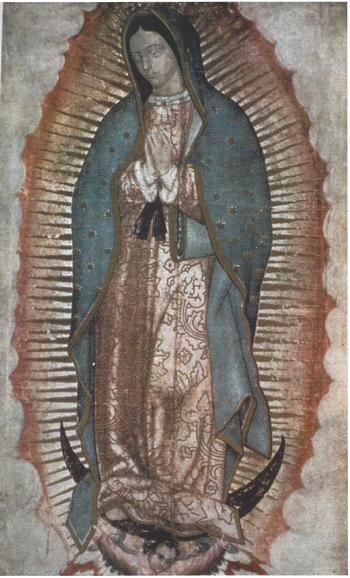
In 1941 a one-centimeter square cutting from the miraculous representation of the Virgin of Guadalupe arrived in the city of Los Angeles. The original image, contained in Mexico City and known also as Our Lady of Guadalupe (fig. 1), was associated with divine origins as established in a legend that described its manufacture. According to that legend, a representation of the Virgin had been divinely imprinted on a cloak, known as a tilma, following a series of appearances of the Virgin to an indigenous Indian named Juan Diego in 1531. Due to its believed miraculous creation, the Virgin of Guadalupe has the status of a relic-textile, similar to other images not made by human hands, such as the Veronica.Footnote 1 By association, the small piece of cloth in Los Angeles, currently displayed in a chapel in the Cathedral of Our Lady of the Angels, is also considered a relic and is, notably, the only known fragment of the Virgin of Guadalupe found outside of Mexico City.
Our Lady of Guadalupe (tilma image), Basilica of Our Lady of Guadalupe, Mexico City. Photo from Wikimedia Commons.

As discussed by Alexandra Walsham, relics are differentiated from other types of material objects in “their capacity to operate as a locus and conduit of power.”Footnote 2 Relics are objects that have been “left behind,” can be fragments that evoke a whole, and can physically embody a divine presence; as such, relics are material signs that frequently convey great spiritual significance.Footnote 3 The meaning of a relic is encoded by the society in which it is found and reflects the priorities of that particular community.Footnote 4 Through “ritual, story, and social actors,” relics are given meaning; the legends that authenticate the holy objects, their transfer to different locations, and their preservation and display illustrate not only the position of particular relics in religious practice but also within their wider cultural matrix.Footnote 5 In this sense, the cultural biography of a relic is especially helpful for understanding more general attitudes related to faith, politics, and social institutions.
Considering the significant role that relics play, it is not surprising that the Virgin of Guadalupe has received a great deal of devotional and scholarly attention. The meaning of the Virgin of Guadalupe is multivalent—the image has been appropriated and reinterpreted as expressed in popular devotion, indigenistic and nationalistic discourses, inculturation, political struggle, and feminist theory.Footnote 6 As discussed by Jeanette Favrot Peterson, the Virgin of Guadalupe was not solely an unchanging emblem of liberty for oppressed populations, as it has sometimes been described, but could instead be “reinterpreted for different ruling parties primarily in those times when existing sociopolitical institutions were being reconstituted.”Footnote 7
This article explores the complex role of devotion to the Virgin of Guadalupe in Los Angeles. After discussing the seventeenth-century origin legend for the miraculous production of the image, the article examines how the Virgin of Guadalupe became a special symbol of the Catholic community in southern California, as illustrated by the initial processional celebrations of Our Lady of Guadalupe and the decision by Archbishop John J. Cantwell of Los Angeles to lead a pilgrimage to the shrine in Mexico City in 1941. The role of the tilma relic is integrated into this discussion of the Virgin of Guadalupe, for its transfer to Los Angeles in 1941, its shift into obscurity in the second half of the twentieth century, and its revival in 2003 help to illustrate the changing influence of the Virgin of Guadalupe and the significance of Juan Diego's canonization for devotion to the tilma relic. This examination of the Virgin of Guadalupe and the reception of the tilma relic demonstrate how the divine image and its synecdochal referent in southern California reflect the interrelationship between the changing political landscape and popular devotion.Footnote 8
I. The Virgin of Guadalupe: Miraculous Origins
The Virgin of Guadalupe is an image associated with an apparition legend that describes its believed miraculous creation on December 9, 1531.Footnote 9 A series of visions, taking place on the hill of Guadalupe not far from Mexico City, instructed Juan Diego to request that the bishop, Juan de Zumárraga, build a chapel in honor of the Virgin at Tepeyac. Not believing the Indian's account, the bishop required that Juan Diego return with a sign to prove the veracity of the Virgin's apparitions. In a third appearance to Juan Diego, the Virgin requested that he fill his cloak, or tilma, with flowers; upon his return to the bishop, Juan Diego opened his cloak to reveal a miraculously imprinted representation of the Virgin on the fabric. The bishop, immediately recognizing the importance of the holy image, placed it on public display and proceeded with the construction of a chapel dedicated to the Virgin at Tepeyac.
The earliest visual and textual sources related to the apparition legend and thaumaturgic power of the Virgin of Guadalupe date to the first half of the seventeenth century and were probably based on an oral tradition grounded in popular belief.Footnote 10 An engraved “book of miracles” by Samuel Stradanus, created likely between 1613 and 1615, visualizes eight supernatural events associated with the Virgin of Guadalupe that flank a reproduction of the tilma image, accompanied by an indulgence.Footnote 11 Some of the miracles represented on the Stradanus engraving may have been influential for accounts given in a text by the preacher Miguel Sánchez in 1648 and in a compilation of miracles known as the Nican motecpana found in Luis Laso de la Vega's Huei tlamahuiçoltica written in 1649.Footnote 12 Sánchez's account, while dependent on oral sources, emphasizes the typological significance of the image and its legend through an interpretation that evoked scripture and the texts of the church fathers.Footnote 13 Writing from a Eurocentric perspective, Sánchez associates the Virgin of Guadalupe with the woman of Revelation 12 and links the apparition of the Virgin to the conquest and Christianization of Mexico. Luis Laso de la Vega's Huei tlamahuiçoltica, written in Nahuatl, avoids the scriptural allusions found in Sánchez's text in favor of a more straightforward narrative of the appearances of the Virgin and the discussions between Mary and Juan Diego that are recounted using his native language.Footnote 14 Laso de la Vega further describes fourteen miracles associated with the image and expands upon the figure of Juan Diego, presenting him as a model of Christian virtue.
Similar to the legends of other acheiropoietic images—representations “not made by human hands”—the apparition story of the Virgin of Guadalupe underscores the divine sanction for the image; the appearance of the Virgin on a cloth establishes parallels with representations found in western Europe, such as contact relics like the Veronica, the Mandylion, and the Shroud of Turin.Footnote 15 As discussed by Peterson, the representation of the Virgin on a cloth had a symbolic resonance: the physicality of the textile served as a point of mediation between the human and sacred spheres.Footnote 16 Although associated with a tradition of European legends that explained the appearance of Marian or Christological representations that were imbued with the praesentia of the holy figure through contact or miraculous production, the origin story of the Virgin of Guadalupe, as recorded by Sánchez, linked the image on the tilma to the context of colonial New Spain. According to Sánchez, the Virgin of Guadalupe derived from an “image of Heaven” whose appearance on the tilma was specifically linked to the conquest of Mexico: the territory was “won so that an image of God of such worth might appear.”Footnote 17 Sánchez and Laso de la Vega used the ethnicity of Juan Diego, as well as the native Nahuatl language, to situate the Guadalupe legend in the environment of Mexico City.Footnote 18 Sánchez's description of the coarse material of the tilma further emphasized the social status of Juan Diego as a poor and humble Indian; at the same time, the tilma had a broader symbolic significance, for Sánchez referred to the cloak as “the cape of the Indian nation.”Footnote 19 In Sánchez's text, in the direct analysis of the Virgin of Guadalupe by artists in the seventeenth and eighteenth centuries, and in subsequent recordings of the legend, such as that by Cayetano de Cabrera y Quintero in 1746, the unique physical quality of the image and the cloth on which it is found substantiated the miraculous nature of the representation. For example, in 1666, an officially sanctioned visit of painters used a technical analysis of the representation to reaffirm the extraordinary nature of the Virgin of Guadalupe and its divine authorship.Footnote 20 The commission specifically noted that the rough quality of the tilma did not allow for a normal application of paint, thus indicating the presence of supernatural intervention. Cayetano de Cabrera y Quintero further described the unique quality of the tilma image:
There can one see, and there appears that which is not, or at least should not be, naturally, and if it were, it should then disappear since it is an excessively carefully unified composition, without overlaps, a painting without colors . . . an image that seems printed without colors . . . a wash without a brush, painted without a brush, painted without a canvas, the canvas having no threads.Footnote 21
While the perceived miraculous origin of the Virgin of Guadalupe is often used to explain the current condition of the image, the cloth has undergone some alterations during the course of its history. An examination of the tilma in 1982 determined that it had been trimmed on all sides, due in part to the colonial practice of adhering canvas to a wooden stretcher; in 1766, for instance, the cloth was trimmed by fifty-one centimeters when it was placed in a new frame.Footnote 22 The process of cutting “relic” fragments from the cloth has also contributed to the current condition of the tilma, as is confirmed by Luis Becerra Tanco in a seventeenth-century source that describes how portions of the cloth's border were cut off to form relics.Footnote 23 An inventory from 1683 additionally establishes the presence of a fragment of the tilma located in a sculpted reliquary that was placed in front of the Virgin of Guadalupe to serve as a point of physical contact for visiting pilgrims, who would touch or kiss the sculpture to obtain some of the power of the image.Footnote 24 While this seventeenth-century account and the current condition of the Virgin of Guadalupe in Mexico City suggest that there may have been substantial trimmings taken from the tilma, to my knowledge there is only one known fragment of the tilma currently on display outside of Mexico City. This one-centimeter square fragment of the tunic was sent to Los Angeles in 1941 and is now found in the Cathedral of Our Lady of the Angels in a chapel that was dedicated to the tilma relic in September 2012.Footnote 25
II. Devotion to the Virgin of Guadalupe in Los Angeles
The arrival of the tilma relic in Los Angeles in 1941 parallels an increasing devotion to the Virgin of Guadalupe that characterized the city's Catholic communities in the early twentieth century. The devotion to the image in Mexico contrasts, however, with attempts to impose a more Roman focus on the developing pueblo that characterized Los Angeles immediately following the Mexican-American War. After Mexico had ceded California and other northern territories to the United States in 1848, shifting economies, a loss of political positions held by Hispanics, and the “Americanization” of the church of the Spanish-speaking residents redefined the City of Angels.Footnote 26 Since 1841, the patroness of Los Angeles had been Nuestra Señora del Refugio (Our Lady of Refuge), as established by the first bishop in California, Francisco García Diego y Moreno.Footnote 27 With the arrival of Bishop Thaddeus Amat in 1854, a Roman saint began to eclipse the popularity of the Mexican Madonna. Amat, having received the relics of a third-century saint, Vibiana, from Pope Pius IX, initiated the construction of a cathedral in her honor and requested that the Roman martyr be named as patroness of his diocese. As noted by Michael E. Engh, the shift to Vibiana “underscored the determination of ecclesial leaders to foster more standardized, ‘Roman’ forms of faith expression, at the expense of local customs on the frontier.”Footnote 28 This was further visualized in the construction of the Cathedral of Saint Vibiana in an English-speaking residential district in downtown Los Angeles; Saint Vibiana, which opened in 1876, remained the city's cathedral for over one hundred years.Footnote 29 Stylistically aligned with Baroque churches in Spain, the large cathedral was distinctly different from the Hispanic colonial church, Our Lady of the Angels, located in the old plaza at the original geographic center of the city.
It was in that smaller church of Our Lady of the Angels that a Society of Our Lady of Guadalupe was created by 1899.Footnote 30 The weekly Spanish-language devotions that took place in that church paralleled the increasing popularity of Guadalupe in the early twentieth century that was related to the general growth of the city, coupled with the Mexican Revolution of 1910. At that time, Catholic Mexican immigrants were attracted to southern California by job prospects and by the desire to escape the conflict associated with the Mexican Revolution.Footnote 31 Religious faith and a special devotion to the Virgin of Guadalupe played an important role in the lives of many of these immigrants, as expressed both in the domestic sphere and publically through processions and parochial protests. Particularly vocal Mexican clerics were often forced to flee the country and frequently ended up in American parishes in the border states. Priests and bishops were especially welcomed in southern California because of the need for clergy to support the ever increasing Mexican and Mexican American Catholic population in Los Angeles.Footnote 32 Nonetheless, Spanish-speaking clergy were often insufficient. This led, as discussed by Jeffrey M. Burns, to a Mexican American spirituality that was practiced both privately and publically; such spirituality was expressed in the home at the individual or family level as well as in the wider community through processions, public events, and communal worship.Footnote 33 Within the home, faith traditions were often transmitted under the guidance of mothers and grandmothers, which has been referred to by Santos Vega as “abuelita theology.”Footnote 34 Family altars became focal points for devotional practice, and saints’ medals or statues were frequently viewed as offering potential protection. The central importance of images, like the Virgin of Guadalupe, for Mexican American piety can be summarized in the comment of one immigrant in the 1920s who declared, “I never go to Church, nor do I pray. I have an amulet which my mother gave to me before dying. This amulet has the Virgin of Guadalupe on it, and it is she who protects me.”Footnote 35
Visible displays of devotion to the Virgin of Guadalupe in Los Angeles, in the form of annual processions, offered a means of promoting a “Mexican consciousness” while at the same time acted as a clear protest against the contemporary anti-clerical movement in Mexico.Footnote 36 Initiated in 1928 through the sponsorship of a women's group, the Hijas de Maria (Daughters of Mary), the annual procession associated with the Virgin of Guadalupe's feast day on December 12 quickly grew in popularity. The involvement of José David Orozco and the newly established chapters of Santo Nombre (Holy Name), an organization aimed at inspiring religious devotion among Mexicans in the Los Angeles area and supporting Catholics in Mexico, contributed to the procession's success.Footnote 37 As a Los Angeles radio announcer and nephew to the archbishop of Guadalajara, Orozco was particularly well-positioned to help promote the December procession.Footnote 38 In 1933 the Mexican Division of the Holy Name Union sponsored “one of the most brilliantly colorful religious processions seen in Los Angeles” that consisted of 20,000 participants from ninety-eight parish groups.Footnote 39
By 1934, the year of the election of Lázaro Cárdenas as president of Mexico, the procession had a clear political dimension, for it was described in the Catholic and Spanish language press as a way to protest the persecution of the church in Mexico through a “campaign of prayer for [the] restoration of religious freedom in [the] unhappy republic.”Footnote 40 Cárdenas had run on a platform that promised to reduce the influence of the Catholic Church and create modern secular schools; after his election, press reports in the United States described attacks on clergy and religious institutions, which were viewed as examples of the “vicious socialism” that characterized the Mexican government.Footnote 41 In the days prior to the Virgin of Guadalupe's feast day, Mexican consular officials Alejandro V. Martínez of Los Angeles and Hermolao Torres of San Bernardino attempted to discourage participation in processions in their cities; concerns were raised that the events were not simply religious celebrations but rather political demonstrations that risked igniting American support for a U.S. intervention against the Cárdenas government.Footnote 42 The consular representatives were unsuccessful, for the Los Angeles procession proceeded as planned in Boyle Heights on December 9, and the San Bernardino celebration followed one week later. In Los Angeles the procession attracted 40,000 multi-ethnic participants, with the core of Spanish-speaking Catholics joined by Italian, Japanese, African American, and Polish faithful; various floats as well as dancers, the Boy Scout Drum and Bugle Corps, the Loyola High School Band, the Paulist Cadets, and the Knights of Columbus Band took part in the ceremony.Footnote 43 The diverse cultural heritage of the participants, a point underscored in descriptions of the celebration, illustrated the unifying nature of the Virgin of Guadalupe. The address of Los Angeles Bishop John J. Cantwell further underscored the political quality of the procession through his mention of and prayer for the unprotected in Mexico: “Let us pray that the eyes of the present administration in Mexico may be opened and that that unhappy nation may redeem its past and become again a great Catholic country under Christian rulers.”Footnote 44
Los Angeles was additionally the site of the international Marian celebration in 1937 that culminated with the coronation of a representation of Our Lady of Guadalupe on June 6.Footnote 45 Following a four-day ceremony, a procession of 40,000 faithful—which included the Right Reverend Monsignor Augustin de la Cueva (the head of the Shrine of Our Lady of Guadalupe in Mexico City), other Mexican dignitaries, representatives of the Catholic organizations of the Archdiocese of Los Angeles, and staff officers of the 160th Infantry—accompanied Archbishop Cantwell and an image of the Virgin of Guadalupe.Footnote 46 Arriving at a platform on the steps of the Mausoleum in the Calvary Cemetery in East Los Angeles, the image received a jewel-studded crown and was proclaimed the “queen of the Americas.” The crown, serving as “a gift of friendship and religious good will,” was made from jewelry belonging to important families in Mexico City and was modeled after the crown used in the coronation of the original image in Mexico City in 1895.Footnote 47
The image of the Virgin of Guadalupe was clearly a political as well as religious symbol for Cantwell that could be used to reinforce a personal connection between the archbishop of Los Angeles and Mexico. On April 23, 1941, an oil painting copy of Our Lady of Guadalupe was sent to Cantwell from Archbishop Filipe Torres, Vicar Apostolic of Baja California; Cantwell accepted this “artistic reproduction” as “a testimony of the bond of history and culture and religion that binds us to Baja California.”Footnote 48 The picture was placed in his residence where it gave “an added stimulus to our love and devotion to the Blessed Mother of Mexico.”Footnote 49
The large Mexican population in Los Angeles as well as the undisputed significance of the Virgin of Guadalupe for Catholics in the city may have also influenced Cantwell's decision to lead a pilgrimage to the shrine of the Virgin in Mexico City from October 6 to 19, 1941. Notably, Cantwell had wished to travel to Mexico for many years, but only in 1941 did he feel that a “Catholic Bishop would be very welcome.” Cantwell further explains in a letter to Sumner Welles, the Under Secretary of State in Washington, D.C., that “the reason I did not go in the past was that I did not wish by my presence in Mexico to cause any friction between our governments.”Footnote 50 In a circular letter publicizing the archdiocesan pilgrimage of 1941, Cantwell underscored the bond between Los Angeles and Mexico:
We have been joined by the closest ties of religion, because it was from that venerable land the first missionaries came to California, and built the Missions which are our greatest historic landmarks. We have been joined to this venerable land by bonds of affection because of the large number of Mexicans who have come to California, and indeed to the Southwest, carrying the finest traditions of their own land in music, in art, in sculpture, and in painting.Footnote 51
Although there was a connection through geographic proximity and the historic tradition of the California missions, the invitation by the archbishop of Mexico City, Luis Maria Martinez, had a clear contemporary relevance.Footnote 52 As noted by Cantwell, the trip would reinforce a connection between the two territories: “A visit by our people to the City of Mexico would be a gracious compliment to the Hierarchy and Catholics of a country that has sent so many of its children to California.”Footnote 53 Los Angeles had, after all, more Mexicans than any other city in the world, with the exception of Mexico City.Footnote 54
Following Archbishop Martinez's invitation, Cantwell alerted the State Department of his intentions and received a letter of introduction to the American ambassador in Mexico City from Sumner Welles.Footnote 55 Departing from Los Angeles on October 6, Cantwell traveled to Mexico along with forty priests and fifty prominent lay people.Footnote 56 He was greeted upon his arrival in Mexico City by a crowd of dignitaries and was further welcomed by a military delegation and diplomatic corps at a pontifical Mass celebrated at the National Basilica on October 12.Footnote 57 In addition to filling the Shrine of Our Lady of Guadalupe, a crowd of 50,000 gathered outside the church.Footnote 58 Cantwell, however, addressed a far wider community on October 17 via the National Broadcast System, through which he delivered a speech heard throughout the Mexican Republic and in parts of the United States.Footnote 59
During the Mass at the National Basilica, Cantwell reconfirmed the significance of the Virgin of Guadalupe for the Los Angeles religious community:
This visit which we are now paying your beautiful country is for us the realization of a long-felt desire to come among you, and to kneel before the miraculous image of Our common Mother, Holy Mary of Guadalupe, under whose kindly smile Our Beloved Archdiocese of Los Angeles was born, when a century ago, our predecessor, Francisco Garcia Diego y Moreno, received episcopal consecration before her altar.Footnote 60
The ceremony at the Guadalupe Shrine “surely furnished the key to continental solidarity,” with the Virgin of Guadalupe serving as a locus for the visualization of that unity through the juxtaposition of the flags of Mexico, the United States, and the Latin American nations below the miraculous image. Following the Mass, the flags of the American nations were blessed by Archbishop Martinez.Footnote 61
The success of Cantwell's visit to Mexico and to the Guadalupe Shrine was unmistakable. The official paper of the Archdiocese of Los Angeles, The Tidings, proclaimed the “triumph of Archbishop Cantwell.”Footnote 62 The significance of Cantwell's visit was also recognized by sources in Mexico, which stressed the incalculable impact of the encounter not only for Mexico and the United States but also for other countries of the Americas.Footnote 63 As noted in The Tidings, newspapers in Mexico covered the event more extensively—in both print and photographs—than a similar encounter would have ever generated in the media in the United States.Footnote 64 In both countries, the media underscored the role of the Virgin of Guadalupe. For example, shortly after the visit, the weekly paper of Mexico City, Hoy, stated in an editorial that the publication
is bound to promote whatever strengthens our Mexicanism. And nothing can be more Mexican, nothing can be more ours than the Virgin who left her Image on the lowly cloak of Juan Diego, than the Holy Mass which Hidalgo celebrated atop the mount of the Crosses, or than the decree promulgated by Morelos constituting the Queen of Tepeyac patroness of the men who fought for our independence.Footnote 65
It is not without significance that this noteworthy encounter of church officials from the United States and Mexico took place before the Virgin of Guadalupe, a representation linked to the history of the site and to the faith of the Mexican people.
Following Cantwell's return to southern California, Archbishop Luis Maria Martinez of Mexico City decided, along with the canons of the National Basilica, to commemorate the historic visit by offering a relic of the tilma to Los Angeles.Footnote 66 This fragment, enclosed in a silver reliquary, was brought to Los Angeles by a “Father Gomez.” Once in the city, the relic was entrusted to Father Fidencio Esparza, a priest originally from Guadalajara, Mexico. While a lack of sources makes certainty impossible, it is likely that Father Esparza would have kept the relic in the parish of San Antonio de Padua in Los Angeles, where he was pastor since 1938. In the year following the arrival of the relic, Father Esparza announced plans for the fifth annual pilgrimage to the Shrine of Our Lady of Guadalupe in Mexico City.Footnote 67
III. Juan Diego and the Changing Reception of the Tilma Relic in Los Angeles
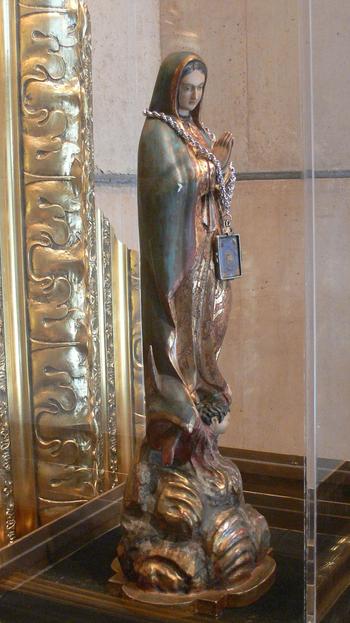
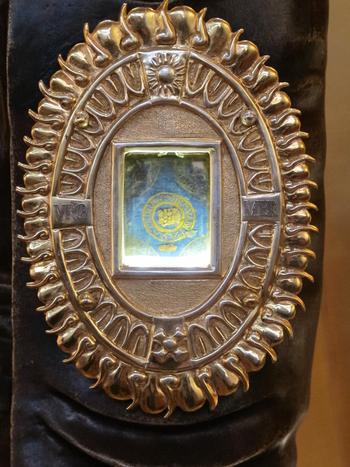
Considering the extraordinary political and social significance of the image of the Virgin of Guadalupe in Los Angeles, it is surprising that the tilma relic fell into relative obscurity in the decades following Cantwell's visit to Mexico City. Notably, at the time of its transfer—and still today—this relic was the only known existing fragment of the tilma outside of Mexico City. While a technical analysis of the original image suggests that it was trimmed as part of its framing process and was perhaps cut over the centuries to provide relics, these fragments do not survive or are not a part of current public record.Footnote 68 There are various reasons that might help to explain the absence of documentation related to the relic's transfer to Los Angeles and the tilma fragment's lack of prominence until 2003. Because the relic was transferred directly to southern California, it may not have been accompanied by the same type of paper trail that it would have received had it been routed through the Vatican.Footnote 69 Additionally, the entry of the United States into World War II on December 7, 1941, dramatically shifted the focus of news cycles and may have eclipsed any press related to the arrival of the tilma in Los Angeles.Footnote 70 Once in the city, the relic was overseen for the next forty years by Father—later Monsignor—Esparza and possibly the parish of San Antonio de Padua. In 1981, Timothy Cardinal Manning led a pilgrimage to the National Shrine in Mexico City; upon his return to Los Angeles, the relic was transferred to Manning, who subsequently sent it to the Historical Museum located next to the Archival Center of the Archdiocese of Los Angeles at the San Fernando Mission.Footnote 71 In the Historical Museum, the relic was contained within a locket reliquary and was placed around the neck of a seventeenth-century wooden sculpture of the Virgin of Guadalupe (fig. 2). The tilma relic remained relatively forgotten in the Historical Museum until after the canonization of Juan Diego, when the relic was removed from the museum and eventually transferred to the Cathedral of Our Lady of the Angels.
Statuette of Our Lady of Guadalupe (seventeenth century) and the Relic of the Tilma. Photo by Andreas Praefcke, Wikimedia Commons.

The canonization of Juan Diego was an acknowledgment of the Indian to whom the apparition of the Virgin of Guadalupe first appeared. The path to his canonization was initiated on April 12, 1939, through a letter written by José de Jesús Manríquez y Zárate, the bishop of Huejutla, Mexico, that called for work to begin on the beatification process.Footnote 72 It was, however, only in 1979 that the process gained momentum through the support of two archbishops in Mexico, Ernesto Cardinal Corripio Ahumada and Norberto Cardinal Rivera Carrera. After a series of setbacks, the beatification was eventually approved and was presided over by Pope John Paul II on May 6, 1990, in the Basilica of Guadalupe.Footnote 73 In the winter of 1995, an interview of Guillermo Schulenburg Prado, the abbot of the collegiate church of Guadalupe, publicized doubts over the historical existence of Juan Diego that had been raised already during the beatification process.Footnote 74 This interview resulted in a flurry of articles in the mainstream press and general public outrage. The scandal that ensued led to Schulenburg's resignation in 1996 after having been abbot of the collegiate church of Guadalupe since 1963. The Congregation for the Causes of the Saints called for an investigation of Juan Diego by a historical commission; the resulting report presented indigenous, mixed Spanish-indigenous, and Spanish sources for Juan Diego's existence and was accepted by the commission in 1998. Although debate continued over the validity of the textual sources and the authenticity of a miracle in 1990 that was associated with Juan Diego's intercession, his canonization took place in Mexico City on July 31, 2002.Footnote 75 Millions of devoted followers, who were united in a public ritual broadcast over television and printed news, celebrated the three-day papal visit and the recognition of Juan Diego's sanctity in a ceremony conducted by Pope John Paul II.Footnote 76 Many local parishes in Los Angeles marked the canonization with multi-day celebrations.Footnote 77
Not surprisingly, the tilma relic received renewed attention in Los Angeles in the wake of the “Juan Diego-mania” that was associated with the canonization.Footnote 78 In February 2003, with the permission of Roger Michael Cardinal Mahony, the tilma relic was removed from the Historical Museum of the Archive in order to participate in a nationwide tour.Footnote 79 Through the facilitation of the Los Angeles-based Apostolate for Holy Relics and the co-sponsorship of the Knights of Columbus, the tilma relic toured for six months, beginning with a stop at Denver's Immaculate Conception Cathedral on May 30 and ending with a visit to New York's Saint Patrick's Cathedral on December 7. The tilma visited twenty-one cities, attracting the veneration of well over 100,000 faithful prior to returning to Los Angeles.Footnote 80 Once back in southern California, the tilma was permanently installed in a chapel in the Cathedral of Our Lady of the Angels on December 9 as part of the observance of the feasts of Saint Juan Diego (on December 9) and Our Lady of Guadalupe (on December 12).Footnote 81 In the chapel, the tilma was displayed as it had been in the Historical Museum: hanging in a sealed glass pendant draped over the neck of the seventeenth-century sculpture of the Virgin (fig. 2).
After its installation in the chapel, the tilma relic was removed from the cathedral only on very special occasions to partake in large-scale international celebrations of the Virgin of Guadalupe. From August 6 to 8, 2009, after remaining in the cathedral for over five years, the tilma relic was loaned for display at the first International Marian Congress on Our Lady of Guadalupe in Phoenix, Arizona, which was organized by the Knights of Columbus.Footnote 82 The Knights of Columbus also sponsored, along with the Archdiocese of Los Angeles, a second international event known as the Guadalupe Celebration on August 5, 2012, when speakers and performers joined at the Los Angeles Memorial Coliseum to honor the Virgin of Guadalupe and the tilma relic.Footnote 83 With 130,000 ticket requests and an actual attendance of over 70,000, the Guadalupe Celebration was “one of the largest Catholic events in Los Angeles in a generation.”Footnote 84
The Knights of Columbus, a Catholic fraternal service organization, has been particularly engaged in promoting events related to the Virgin of Guadalupe and the tilma relic. Founded by immigrants and the sons of immigrants in 1882 in New Haven, Connecticut, this group demonstrated an early devotion to the Virgin of Guadalupe through the creation of a “Guadalupe Council” in Mexico City in 1905.Footnote 85 More recently, the chief executive officer and chairman of the board of the Knights of Columbus, Supreme Knight Carl A. Anderson, dedicated his administration to Our Lady of Guadalupe; since he took over leadership in 2000, Anderson has helped to facilitate the celebrations of Guadalupe and the tilma relic. In 2009, Anderson co-authored, along with Monsignor Eduardo Chávez, Postulator of the Cause of the Canonization of Saint Juan Diego, the book Our Lady of Guadalupe: Mother of the Civilization of Love.Footnote 86 In 2015, the Knights of Columbus produced a film, Guadalupe: The Miracle and the Message, which, according to Anderson, underscored the multicultural significance of the Virgin of Guadalupe, who “is loved and embraced across cultural lines throughout this continent and beyond.”Footnote 87
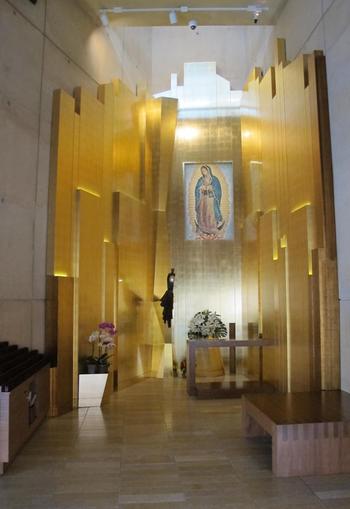
Following the Guadalupe Celebration at the Los Angeles Memorial Coliseum on August 5, 2012, the tilma relic was transferred on September 2 to a new, permanent chapel in the Cathedral of Our Lady of the Angels (fig. 3). The irregularly shaped, trapezoidal chapel in the north aisle of the church is decorated with golden panels made of maple wood from Monterrey, Mexico. This arrangement visually evokes the framing and installation of the original image in Mexico City yet also creates an architectural dialogue with José Rafael Moneo's design for the cathedral.Footnote 88 The shimmering surface of the highly reflective golden panels is enhanced by the presence of windows opposite the chapel. The dedication of this chapel by Archbishop José Gomez, an event corresponding with the tenth anniversary of the cathedral's construction, recognized the thousands of followers who had “venerated her Image and the Relic of the Tilma of St. Juan Diego” since the opening of the cathedral.Footnote 89
Our Lady of Guadalupe Chapel, Cathedral of Our Lady of the Angels, Los Angeles. Photo by the author.

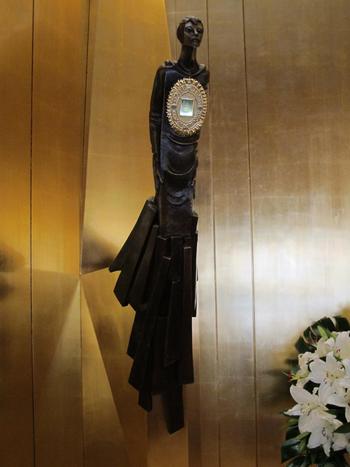
In conjunction with the chapel's dedication, a new reliquary was designed to contain the patterned square of the tilma fragment, along with relics of Saint Francis Borgia, Saint Teresa of Avila, Saint Francis Xavier, and Saint Ignatius Loyola (fig. 4). In contrast with the previous display of the relic in the cathedral, when it was contained within a medallion draped over a seventeenth-century sculpture of the Virgin (fig. 2), the new reliquary underscores the role and significance of Juan Diego and visually links the relic with the miraculous original in Mexico. According to a press release from the archdiocese the new reliquary,
inspired by the image of St. Juan Diego found in the Cathedral tapestries, depicts a young Juan Diego rising from the earth with roots representing the diverse cultures of our world coming together in celebration of the Virgin of Guadalupe. The sculpture of St. Juan Diego is positioned to represent the moment when he opened his Tilma, or cloak, on which the Image of Our Lady of Guadalupe miraculously appeared in 1531.Footnote 90
The figure of Juan Diego, created by the Mexican sculptor Cuauhtémoc Zamudio, enshrines the relics. The holy objects, revealed through a piece of protective glass, are surrounded by a golden mandorla in the chest of Juan Diego (fig. 5); the reliquary, therefore, establishes a visual contrast with the bronze body of the saint while being situated at the very heart of the sculpture. The outer ring of the mandorla includes rose petals combined with an indigenous symbol for “Word.” As a reference to the miraculous creation of the Virgin of Guadalupe, it is through the mediation of the roses that the image, and thus the Word, is made known.Footnote 91 A ring of feathers characterizes the decoration of the inner ellipse to underscore a connection with Juan Diego's name in Nahuatl: Cuautlatoatzin, meaning “speaking eagle.” An image of a sun, referencing Jesus as the light of the world, compliments an indigenous representation of the cosmos and divinity found at the bottom of the mandorla. The intention is to underscore Mary's role as the Mother of God and her seemingly contradictory identity as a Virgin-Mother.
Reliquary of the Tilma, Our Lady of Guadalupe Chapel, Cathedral of Our Lady of the Angels, Los Angeles. Photo by the author.

Reliquary of the Tilma (detail), Our Lady of Guadalupe Chapel, Cathedral of Our Lady of the Angels, Los Angeles. Photo by the author.

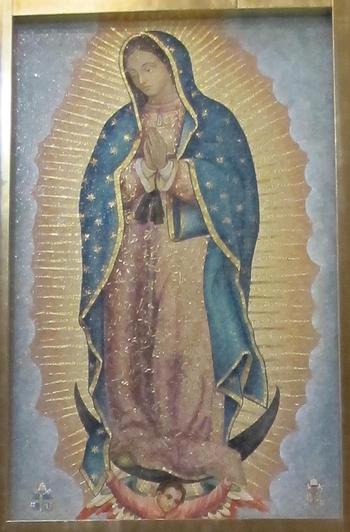
The sculptural representation of Juan Diego further establishes a visual dialogue with a mosaic reproduction of the Virgin of Guadalupe created in Rome and located on the back wall of the chapel (Figs. 3, 6). Symbols in the lower corners of the mosaic of the Virgin of Guadalupe link that image with the papacy and the Vatican through the presence of the papal coat of arms (lower right) and the coat of arms of Pope John Paul II (lower left).Footnote 92 The juxtaposition of the statue of Juan Diego and the representation of the Virgin of Guadalupe perpetually reenacts the miraculous production of the original image, a miracle that is reconfirmed through the presence of the tilma relic. The mosaic image, while a copy itself, nonetheless maintains a special status through the presence of the papal insignia, which serve not only to establish the value of the reproduction but also to mediate the legend through the contemporary hierarchy of the church.Footnote 93 It is not surprising that Pope John Paul II would be referenced in the chapel, for his “ardent Marian and Guadalupan piety led him to make more theological pronouncements on Guadalupe than any other pope.”Footnote 94 John Paul II made five visits to Mexico (including his first foreign trip as pope), he beatified and canonized Juan Diego, and he was responsible for numerous homilies and public addresses that dealt with Guadalupe.Footnote 95
Mosaic reproduction of the Virgin of Guadalupe, Our Lady of Guadalupe Chapel, Cathedral of Our Lady of the Angels, Los Angeles. Photo by the author.

The nationwide tour of the tilma relic in 2003, its presence during special Marian celebrations in 2009 and 2012, and its subsequent placement in a newly designed reliquary in a chapel dedicated to the Virgin of Guadalupe in the Los Angeles cathedral clearly indicate the changing fortune of a relic that had remained in relative obscurity for over sixty years. The role of the relic has shifted from being a symbolic gesture of good will between two countries, as it was in 1941 when the offering of the tilma fragment celebrated the historic encounter between the archbishop of Los Angeles and the archbishop of Mexico City. The revived interest in the tilma relic in the twenty-first century is instead directly related to the figure of Juan Diego and his canonization. Juan Diego was, as Pope John Paul II declared during the canonization ceremony in Mexico City on July 31, 2002, a “simple, humble Indian who contemplated the sweet and serene face of Our Lady of Tepeyac, so dear to the people of Mexico.”Footnote 96 Juan Diego accepted the Christian message, as visualized in the miraculous appearance of the Virgin, and “thus he facilitated the fruitful meeting of two worlds and became the catalyst for the new Mexican identity, closely united to Our Lady of Guadalupe, whose mestizo face expresses her spiritual motherhood which embraces all Mexicans.”Footnote 97
As a part representing the whole, pars pro toto, the tilma relic is believed to carry the sanctity of the divinely created image.Footnote 98 The tilma is a clipping from the cloth on which the original image of the Virgin of Guadalupe is found in Mexico City, yet it does not itself portray the Virgin. Nonetheless, as a fragment of the whole, the tilma relic is the Virgin of Guadalupe. As described on the website of the Los Angeles cathedral, the relic provides an opportunity for the faithful who are unable to travel to Mexico City to partake in the grace associated with the representation of the Virgin of Guadalupe located there.Footnote 99 It is through the relic that the vision of the Virgin is made manifest.
The tilma fragment in Los Angeles not only serves as a testimony to the image of Our Lady of Guadalupe but also reinforces the mediatory role of Juan Diego in the process of its miraculous creation. The current reliquary in the Los Angeles cathedral underscores the significance of the fragment as a point of spiritual contact between the figure of Juan Diego and the Virgin Mary. In contrast with its previous locket reliquary, which ignored the role of Juan Diego and the legend of the image's divine origin, the tilma fragment is now placed at the heart of Juan Diego—it is the cloak that covers the humble Indian. At the same time, the mandorla surrounding the tilma fragment echoes the mandorla around the Virgin of Guadalupe to reinforce the sacred nature of the tilma and the image inscribed on its surface.
The current installation of the tilma fragment and its participation in contemporary religious celebrations demonstrate the evolving significance of this relic in the context of Los Angeles's ethnic and religious population. While the representation of the Virgin of Guadalupe played an important role in the devotions of Catholic faithful in southern California throughout the twentieth century, the tilma relic was only given a prominent position in those devotions starting in 2003. The current installation of the tilma fragment reflects the changing importance of this relic in Los Angeles and in light of the increasing significance of Saint Juan Diego.