

 bagside ‘back page’, but it has lately been heard with stød:

1. Introduction
In a chapter ‘Danish stød – towards simpler structural principles?’, Grønnum & Basbøll (Reference Grønnum, Basbøll and Oliver2012) present a collection of words pronounced with unexpected occurrences of stød, which Nina Grønnum (NG) culled from radio broadcasts, beginning in 2002, by speakers who did not otherwise deviate from the Standard Danish pronunciation norm. We suggested that the putative changes implied by NG’s corpus would lead to modifications (simplifications) in the principles of stød assignment as these principles have hitherto applied, and we concluded a section about the theoretical implications of such changes thus: ‘The productivity of this purported change in the nature of the stød governing principles can be tested in fairly straightforward production experiments’ (p. 44). The three of us now pick up where two of us left off.
Section 2 contains an overview of the phonetics of stød, its function, and its present distribution in monomorphemic lexemes, in inflected and derived words, and in two-member compounds. We also take a brief look at (dis)similarities with the word accents in Swedish and Norwegian.
Section 3 summarizes the contents of NG’s corpus. One group of words in particular stands out, namely disyllabic nouns in final position in two-word compounds – nouns which in isolation do not have stød. The question poses itself whether we are dealing with spurious deviant pronunciations, or whether they are indicative of a sound change in progress.
Section 4 describes the production experiment. It falls squarely within the well-established experimental phonology tradition (see, for instance, Ohala & Jaeger Reference Ohala, Jaeger, Ohala and Jaeger1986). In so far as the method – producing nonce nouns in final position in two-word compounds inserted in meaningful sentences – proves useful in our context, and the results can be accounted for in terms of clear tendencies, production studies like this may have something to offer more generally in questions about ongoing, synchronic sound change.
Section 5 presents the results. We find a propensity for stød in the definite singular in the test words, particularly when the stressed vowel is short, and more specifically when the initial word is monosyllabic. Lexical searches show that this may reflect a corresponding relative overweight of stød in the definite singular in existing nouns in the Danish vocabulary.
Finally, Section 6 discusses the theoretical implications of the results and outlines the consequence, if the expansion of stød into new morphological contexts continues through coming generations. More syllables will have stød, and the need to formulate principles for its absence within the structure of the word will diminish.
2. Stød: Its function and distribution
Stød is laryngealization, a specific kind of creaky voice: non-modal voice with aperiodic vocal fold vibrations and irregular amplitude, often but not invariably accompanied by a local fundamental frequency (F0) perturbation at the end, an abrupt and brief F0 dip. Such is its prototypical appearance, but the manifestation may be considerably weaker and resemble modal voice more: a somewhat compressed voice quality, lacking creak proper and/or lacking F0 perturbation at the end, often also associated with some modest and gradual decrease in intensity towards the end of the rhyme, as opposed to the comprehensive and very irregular decrease in intensity in the creaky manifestation. The only constant and ever-present acoustic property of stød, across the different – stronger or weaker – manifestations, is a higher F0 at the onset of the syllable (Fischer-Jørgensen Reference Fischer-Jørgensen1987, Reference Fischer-Jørgensen1989a, b; Grønnum & Basbøll Reference Grønnum and Basbøll2001, Reference Grønnum, Basbøll, Maria-Josep, Patricia Speeter and Manjari2007, Reference Basbøll, Thomas, Nicole and Cornelia2012; Grønnum Reference Grønnum2015; Hansen Reference Hansen2015).
Stød is associated phonologically with syllable rhymes – not with specific segments, nor words as such. It requires a long sonority rhyme: either a long vowel or a short vowel followed by a sonorant consonant – in either case succeeded or not by one or more consonants. This is so-called stødbasis (Martinet Reference Martinet1937, Hansen Reference Hansen1943). For example, the words in (1) below have long sonority rhymes, hence stødbasis, as do the words in (2), but not the words in (3). Note that although the laryngealization extends over the entire syllable rhyme, convention transcribes stød with a raised glottal stop symbol, [ˀ], after the vowel if it is long, and after the first postvocalic consonant if the vowel is short.
-
(1)

-
(2)
-
(3)
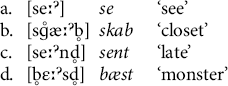
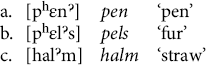
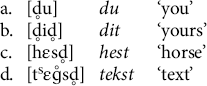
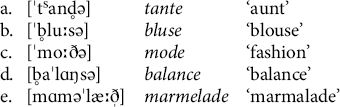
For stød to actually occur in long sonority rhymes, the syllable cannot be unstressed. In other words, with stress (be it primary or secondary) and stødbasis syllables are stød-receptive. Note that stød-receptive is not synonymous with stød. Stød-receptive syllables also occur without stød:
-
(4)
2.1 Stød versus non-stød
Stød versus non-stød is indisputably distinctive on the phonetic surface:
-
(5)

Note that vowel length is not distinctive before the glides [w ð j ɐ̯]. Vowel duration may therefore vacillate, as in the two words in (5b) above and in [lɔːˀwð̩] or [lɔwˀð̩] låget ‘the lid’, [sæːˀj] or [sæjˀ] sag ‘case’, [seːˀɐ̯] or [seɐ̯ˀ] ser ‘sees’, with a distinct preference for short vowel sounds among younger speakers. In its phonologically distinctive capacity, presence versus absence of stød in stød-receptive syllables also distinguishes morphological structure. For instance, the absence of stød in [ˈvanḍə] tells us that this is a disyllabic stem, vante ‘mitten’, whereas the stød in [ˈvanˀḍə] is indicative of a monosyllabic stem, the adjective [vanˀḍ] vant ‘usual’ with a suffix, /ə/ (def.sg/indef.pl). Or the absence of stød in [ˈmuːs:] reveals a disyllabic stem [ˈmuːsə] muse ‘muse’ in the def.sg, whereas the presence of stød in [ˈmuːˀs:] signifies a monosyllabic stem, [ˈmuːˀs] mus ‘mouse’, in the def.sg. Both words are inflected, but the morpheme boundary is located differently in the two words.
In Sections 2.2–2.6 below, we present some central features of Basbøll’s (Reference Basbøll2008, Reference Basbøll2014) Non-Stød Model. Every other previous account of Danish stød has attempted to formulate principles for the presence of stød, which has always proved to be a frustratingly complicated endeavour. Reversing the question and asking instead ‘when do stød-receptive syllables not have stød?’ turned out to have considerable descriptive and theoretical advantages – hence the ‘Non-Stød Model’. Its basic tenet is that stød-receptive syllables have stød (the unmarked state), and the model’s purpose is to formulate the principles for its absence (the marked state).
Note that the model contains features – pertaining to suffix positions in the word and suffix productivity – which are not relevant in the context of this experiment and which we leave out of the account.
2.1.1 Terminology
For the purpose of this paper, stress – unless otherwise specified – encompasses primary and secondary stress. Note also that secondary stress is not an independent, autonomous prosodic parameter, a state of affairs which could conceivably be accounted for in three different ways:
-
(i) Secondary stress is exclusively the result of syntactically conditioned reduction of primary stress, as it happens in compounds like for instance [ˈsølḍeːðə] sølvbede ‘chard’, from [søl] sølv ‘silver’ + [ˈḍeːðə] bede ‘beet’. In that case there would be no secondary stress in [ˈεmḍeːðə] embede ‘post (office)’.
-
(ii) Without primary stress, secondary stress is assigned to any syllable with a long sonority rhyme, no matter its origin. In other words, the posttonic syllables in [ˈsølḍeːðə] and [ˈεmḍeːðə] would both have secondary stress.
-
(iii) Without primary stress, any syllable with stød is assigned secondary stress.
Whichever the approach, secondary stress can normally be deduced from other phonological properties in the word and can be assigned automatically. It has no real independent prosodic content, effectively making secondary stress marks in the transcription redundant.
Primary stress and syllable structure are orthogonal parameters in phonology, although they often interact: complex syllables attract primary stress more often than simple syllables. But long sonority rhymes do not necessarily have primary stress, as in [ˈεmḍeːðə] embede ‘post (office)’. Conversely, stressed syllables do not invariably have long sonority rhymes, as in [ḍus] bus ‘bus’, [ʌḍ] op ‘up’. In Basbøll’s model, stressed syllables with long sonority rhymes are termed heavy, and all other syllables are light. That makes a complex syllable like [vεɡ̊sḍ] vækst ‘growth’ light and a simple syllable like [ulˀ] uld ‘wool’ heavy. This heavy–light distinction fits well into Basbøll’s theoretical framework, but it does run counter to conventional usage, and we substitute ‘heavy’ with stød-receptive in this paper. Thus, in conventional usage, [vεɡ̊sḍ] may be a heavy syllable, but it is not stød-receptive.
Basbøll’s word structure provides the structural description for certain phonological rules, in particular non-stød principles that ascribe non-stød to syllables in positions defined exclusively by phonological domain boundaries relative to a following syllable (Basbøll Reference Basbøll2005:381–383; Reference Basbøll2018:237–240).
2.2 Native/nativelike and non-native words; word structure non-stød versus lexically specified non-stød
Basbøll (e.g. Reference Basbøll2008, Reference Basbøll2014) distinguishes two sections within the Danish vocabulary. One contains the native or nativelike (i.e. phonologically indistinguishable from native) words, the other contains non-native words (phonologically deviating from native words). In the native and nativelike (henceforth subsumed under ‘native’) vocabulary, the absence of stød is to a very large extent determined by principles applying within the word (word structure non-stød), and exceptions must be lexically specified as such. In the non-native vocabulary absence of stød in monomorphemic lexemes applies across the board.
2.2.1 The native vocabulary and extraprosodicity
In the native vocabulary there are three types of words with stød-receptive syllables, but without stød. They require some kind of lexical specification.
-
(6)
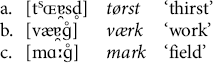
(i) Until around the middle of the 20th century, older Danish speakers could be heard pronouncing words like those in (6) with a short vowel plus unvoiced consonantal [ʁ̥], which therefore lacked stødbasis altogether. The postvocalic /r/ subsequently developed into a glide, [ɐ̯], stødbasis ensued, and many of these words have acquired stød over time, as in [ḍøɐ̯ˀs] børs ‘stock exchange’, [uɐ̯ˀḍ] urt ‘herb’, [fiɐ̯ˀs] firs ‘eighty’; but the stødless pronunciation survived in some instances and must be lexically marked. Non-stød is slowly losing ground, however, to a pronunciation with stød:
-
(7)

(ii) There are circa 300 words, mostly nouns, ending in a short vowel succeeded by one sonorant consonant without stød:
-
(8)
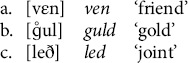
However, these words acquire stød in inflection, invariably so in the def.sg, as in [ˈvεnˀ:] vennen ‘the friend’, [ˈɡ̊ulˀð̩] guldet ‘the gold’, [ˈleðˀð̩] leddet ‘the joint’. In Basbøll’s analysis this is because the final consonant in the uninflected words is lexically specified as extraprosodic. It does not count in the rhyme, and the syllable is not stød-receptive. When a suffix is added, however, the final consonant is no longer extraprosodic, the syllable retrieves its stødbasis, and stød appears. Note that genitive clitic /s/ does not suspend the extraprosodicity of the final consonant, and the words remain without stød, as in [vεns] vens ‘friend’s’, [ɡ̊uls] gulds ‘gold’s’, [leðs] leds ‘joint’s’.
Words of structure similar to those in (8) above – and they are in the majority – have stød in accordance with their phonology and need no lexical specification:
-
(9)
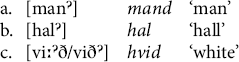
(iii) Words ending in a final short full vowel (whether stressed or unstressed) do not have stødbasis, and do not per se require lexical specification:
-
(10)
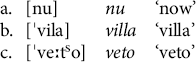
But they, too, invariably acquire stød in the def.sg, as in [ˈnuːˀð̩] nuet ‘the now’, [ˈvilæːˀ:] villaen ‘the villa’, [ˈveːtˢoːˀð̩] vetoet ‘the veto’. That is because the word-final vowel has underlying length which is marked as being extraprosodic; it does not count in the rhyme, and the syllable is not stød-receptive. But add a suffix, the length surfaces, and so does stød. Note that if we are not to admit stød in unstressed syllables, we are forced to automatically assign secondary stress to the post-tonic syllables in villaen and vetoet.
2.2.2 The non-native vocabulary
In the non-native vocabulary, non-stød is general. Thus, recent English and French loans are without stød:
-
(11)
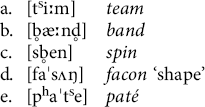
Words with long vowels remain without stød throughout, as in [ˈtˢiːmð̩] teamet ‘the team’, [ˈḍæːnḍð̩] bandet ‘the band’ – just like the native words in (6) above. If the vowel is short, such words acquire stød in inflection, as in [ˈsḍenˀð̩] spinnet ‘the spin’, [faˈsʌŋˀ] faconen ‘the shape’, [pʰaˈtˢeːˀ:] patéen ‘the paté’ – just like the native words in (8) and (10) above.
2.3 The stød principles are productive in modern Danish
Although stød versus non-stød is distinctive, as in the words in (5), presence or absence of stød is to a very large extent predictable from phonological and morphological structure, according to principles which are productive in Danish. Thus, German names as well as Greek and Latin loans have stød in syllables with stødbasis:
-
(12)

These are all well-established names and loans in Danish and not per se proof of productivity today. But two German composers, whom we have only just discovered, Johann Joseph Abert (1832–1915) and Melchior Vulpius (1570–1615), have last names which we unhesitatingly also pronounce with stød, [ˈæːˀḍɐḍ] and [ˈvulˀpʰius]. In the same way, we would say [ˈεmˀpʰyεm] empyem ‘pus in the pleural space’, [imˈpʰeːˀtˢiɡ̊o] impetigo ‘an acute contagious staphylococcal or streptococcal skin disease characterized by vesicles, pustules, and yellowish crusts’, [ḍɒḍoʁyɡ̊ˈmiːˀ] borborygmi (plural of borborygmus) ‘a rumbling or gurgling noise made by the movement of fluid and gas in the intestines’, words which certainly are not part of our everyday vocabulary. That is to say, the stød principles are productive, also in modern Danish, and they stipulate that stød-receptive syllables have stød unless (i) they are lexically marked for non-stød, or (ii) word structure non-stød principles apply. We shall have a brief look at the word structure non-stød principles here and return to them in Section 6.
2.4 Stød in monomorphemic lexemes
The penultimate syllable of a lexeme has no stød:
-
(13)
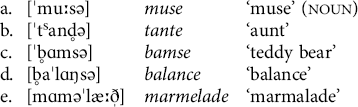
If they are not penultimate in the lexeme, stød-receptive syllables have stød, as in:
-
(14)

There are two groups of exceptions to this principle: (i) approximately 300 lexemes with an extraprosodic final sonorant consonant are without stød, like [ˈven] ven ‘friend’, mentioned in Section 2.2.1 and exemplified in (8) above; and (ii) circa 400 lexemes (of approximately 650) ending in /əl ən ər/ which are lexically specified for having stød, as seen in (15), with similarly structured words without stød for comparison to the right:
-
(15)

2.5 Stød in inflection and derivation
Matters are more complex in inflected and derived words, because different suffixes behave differently. Some suffixes have no effect on the presence or absence of stød in the stem. Other suffixes are integrated into and fuse with the stem, effectively adding a syllable, and they affect stød accordingly. Yet other suffixes vacillate between being integrated and not integrated, depending on the phonological composition of the stem. A further complication arises from the fact that certain suffixes which rank as generally non-integrating, nevertheless do get integrated into certain stems. There is no principled difference between inflection and derivation in this respect (but see Basbøll Reference Basbøll2005:471–489), so examples from inflection suffice.
The noun plural morpheme /ə/, which is no longer productive, is invariably integrated into a monosyllabic stem, increasing the number of syllables by one. The ensemble behaves like a disyllabic lexeme, and the penultimate syllable appears without stød:
-
(16)

The noun plural morpheme /ər/, which is the productive plural suffix in Danish, generally has no effect on the stem (except when added to an extraprosodic consonant, see Section 2.2.1 above):
-
(17)

(Note that the sequence /ər/ is always pronounced [ɐ]. The plural form in (17b) furthermore involves a contraction of /ə/ + /ə/ to /ə/: /tantə/ + /ər/ > /tantər/ > [ˈtˢanḍɐ].)
But there are exceptions, and integration does occur with certain stems, for instance with [ˈfɒːˀm] form ‘shape’ which is [ˈfɒːmɐ] former, without stød, in the plural.
Infinitive /ə/ is integrated into a monosyllabic stem, the ensemble resembles a disyllabic lexeme, and accordingly the penultimate syllable appears without stød:
-
(18)

But infinitive /ə/ is not integrated into a polysyllabic stem, whether the stem is polysyllabic due to a prefix, as in (19), or not, as in (20):
-
(19)
-
(20)


The different ways that different suffixes interact (or not) with the stem are coupled to their productivity in the inflectional and derivational morphology (Basbøll Reference Basbøll2003, Reference Basbøll2005, Reference Basbøll2014).
In this manner, absent any lexical specification, phonology and morphology predict the presence or absence of stød. Conversely, stød or its absence may disambiguate word structure, as mentioned in Section 2.1.
2.6 Stød in two-word compounds
In our context, two-word compounds suffice to illustrate the principles at work. Compounding does not generally entail neither deletion nor addition of stød. But loss of stød may occur in the initial word if it is a monosyllable, and it is common and well-established initially in the compound words of Danish speakers’ vocabulary. Thus, stød is absent in [ˈsoːlḍʁælɐ] solbriller ‘sun glasses’ (as well as every other sol compound) from [soːˀl] sol ‘sun’ + [ˈḍʁælɐ] briller ‘glasses’, whereas it is retained in [ˈɡ̊ʌlˀfkʰḷuḍ] golfklub ‘golf club’ (as well as every other golf compound) from [ɡ̊ʌlˀf] golf ‘golf’ + [kʰḷuḍ] klub ‘club’. Addition of stød occurs in verbs, verbal derivatives, and adjectives finally in compounds. Hansen (Reference Hansen1943) lists numerous examples of final infinitives and adjectives, for example [ˈfɒːɐɡ̊ɶjˀlə] foregøgle ‘pretend’ and [ˈmoðsḍʁæːˀḍ:ə] modstræbende ‘reluctant’, whereas [ˈɡ̊ɶjlə] gøgle ‘make believe’ and [ˈsḍʁæːḍ:ə] stræbende ‘striving’ in isolation are without stød. However, stød in such compounds is not compulsory.
Brink & Lund (Reference Brink and Lund1975) tracked the development of pronunciation in Copenhagen in speakers born between 1840 and 1950. They note (pp. 499–507), like Hansen (Reference Hansen1943), that a verb in final position in compounds normally acquires stød, but after an initial adjective or noun, they say, stød is not compulsory, as in [ˈmuːliɡ̊joːɐ] muliggjorde ‘facilitated’ (from [ˈmuːli] mulig ‘possible’ + [ˈɡ̊joːɐ] gjorde ‘did’) and [ˈnøðlanð̩ə] nødlandede ‘emergency landed’ (from [nøːˀð/nøðˀ] nød ‘distress’ + [ˈlanð̩ə] landede ‘landed’). Adjectives in final position acquire stød much like verbs, according to them, as in [ˈliːiɡ̊ylˀḍi] ligegyldig ‘indifferent’ (from [ˈliːi] lige ‘equal’ + [ˈɡ̊ylḍi] gyldig ‘valid’) and [ˈfʁ̥ivilˀi] frivillig ‘voluntary’ (from [fʁ̥iːˀ] fri ‘free’ + [ˈvili] villig ‘willing’).
We believe that stød addition to verbs and verbal derivatives finally in compounds is expanding in modern Danish. For instance, there are a couple of words in NG’s corpus which we have never before come across: [ˈvalḍəliːˀ:nə] hvalpelignende ‘puppy-resembling’ (from [ˈvalḍə] hvalpe ‘puppies’ + [ˈliː:nə] lignende ‘resembling’) and [ˈjeːsustˢʁ̥oːˀ:ə] Jesustroende ‘Jesus-believing’ (from [ˈjeːsus] Jesus + [ˈtˢʁ̥oː:ə] troende ‘believing’). They sound like ad hoc constructs and were likely created by the speaker on the fly.
Brink & Lund also state that simple nouns hardly ever acquire stød finally in a compound, provided the noun also exists as a normal simplex word with a related meaning. Thus, stød may occur in [ˈalmuːˀə] almue ‘simple people’ (from [alˀ] al ‘whole’ + a synchronically unknown [ˈmuːə] *mue), but not in [ˈfḷøːð̩kʰanə] flødekande ‘cream jar’ (from [ˈfḷøːðə] fløde ‘cream’ + [ˈkʰanə] kande ‘jar’) or [ˈʌmvæɐ̯ḍ:] omverden ‘surrounding world’ (from [ʌmˀ] om ‘round’ + [ˈvæɐ̯ḍ:] verden ‘world’). However, NG did observe stød in similar nouns. In fact, they represent the single largest group of words, 150 in all, in her corpus. We might not learn anything new from experimenting with verbs and adjectives, but nouns present a promising line of inquiry.
2.7 Accent, compounds, and monosyllables in the Nordic languages
Our enterprise has a certain similarity to some investigations in Swedish and Norwegian. Thus, Bruce (Reference Bruce and Christer1974) finds that varieties of Southern Swedish treat accents in compounds differently from the Central Swedish norm. In Central Swedish a compound word as a whole invariably has Accent II, but in Malmö (in southwest Sweden), for example, the compound accent depends on the initial word. If the initial word is disyllabic the whole word takes over its accent, be it Accent I or Accent II. But if the initial word is a monosyllable – which by definition has Accent I – there are two possibilities: (i) if the final word is stressed on its initial syllable so that a stress clash arises, the ensemble has Accent II; and (ii) if the final word has a pretonic syllable, the ensemble has Accent I.
Kristoffersen (Reference Kristoffersen1992) reports a similar vacillation in compound accentuation in East Norwegian: A polysyllabic initial word’s accent applies to the ensemble, but a monosyllable (with Accent I) initially can lead to Accent I as well as Accent II on the whole word, with a tendency that the longer sonority rhyme is in the initial word, the greater is the likelihood of Accent II over the whole compound.
The similarity with Danish is superficial, however: There is nothing in the existing Danish vocabulary to suggest that the structure of either word in a compound (in terms of number of syllables or stress location) determines the presence or absence of stød in either word. Most notable is that Danish differs decisively from Swedish and Norwegian in that compounds may have more than one ‘accent’. Stød in the initial member may be succeeded by either stød or no stød in the final member; and stød in the final member may be preceded by either stød or no stød in the initial member. Oxytone or monosyllabic initial members have no special status. If they are common and well-established as initial members of compounds – and hence without stød – they are without stød irrespective of what follows across the word boundary. In (i)–(iv) below, we illustrate the various compound types, including monosyllables with stødbasis which are without stød in isolation (see Section 2.2.1 and (8) above) as well as disyllables of the /əl ən ər/ type, some of which do have stød in isolation (see Section 2.4 and (15) above).
(i) Monosyllabic initial member (not well-established as such) with stød, which remains, [ɡ̊ʌlˀf] golf ‘golf’, [tˢeːˀ] te ‘tea’, succeeded by mono- and disyllables with and without stød, respectively, and a trisyllable ([kʰʌmˈsɑmˀ] komsammen, literally ‘come-together’, i.e. ‘gathering’) stressed on the second syllable:
-
(21)

(ii) Monosyllabic well-established initial member with stød, [vanˀ] vand ‘water’, [soːˀl] sol ‘sun’, which is lost, succeeded by mono- and disyllables with and without stød, respectively, and a disyllable stressed on the second syllable:
-
(22)

(iii) Disyllabic initial member without stød, [ˈsʌmɐ] sommer ‘summer’, succeeded by mono- and disyllables with and without stød, respectively:
-
(23)
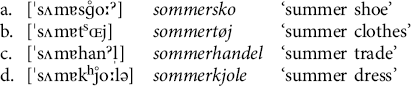
(iv) Disyllabic initial member with stød, [ˈmøːˀḍ] møbel ‘piece of furniture’, [ˈɑŋˀɡ̊] ankel ‘ankle’, which remains, succeeded by mono- and disyllables with and without stød, respectively:
-
(24)

3. Stød in unexpected contexts
Beginning in 2002, NG has collected a small corpus of words with stød in what to her appeared surprising locations, culled from radio broadcasts and speakers who did not otherwise appear to deviate from the Standard Danish pronunciation norm. The corpus contains a total of 555 different words, exemplified in (25)–(31) below. The standard stødless pronunciation is given in parentheses after each example.
There are 38 verbs, like
-
(25)

There are 148 adjectives – all compounds, like
-
(26)

Among the 148 adjectives there are 87 verbal adjectives, like
-
(27)

Among a total of 369 nouns there are 35 simplex nouns, like
-
(28)
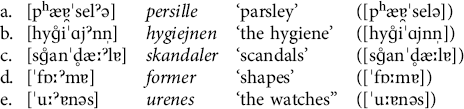
There are 150 compounds with nouns in final position, like
-
(29)

There are 83 compounds with verbal nouns in final position, like
-
(30)

There are 91 compounds with agent nouns in final position, like
-
(31)

There are only four compounds with stød added to the initial word, like [ˈkʰvεːˀlɐɡ̊ʁæːˀḍ] kvælergreb ‘strangle hold’ (normally [ˈkʰvεːlɐɡ̊ʁæːˀḍ]). And there are only six compounds whose final member is monosyllabic, like [ˈsḍʁɑfəsḍɑːˀɡ̊] straffespark ‘penalty’ (normally [ˈsḍʁɑfəsḍɑːɡ̊]).
4. The experiment
If the presence of stød in the words in NG’s collection does not simply represent 555 spurious mistakes, it may be indicative of a nascent sound change now in progress. Whether or not that is the case is an empirical question: Will young speakers of Standard Danish produce stød in words resembling those in NG’s corpus under controlled circumstances in the laboratory?
Five hundred and ten words in the corpus are compounds, against 45 non-compounds. If that is indeed significant, compounds should also be more likely to yield positive results experimentally. Furthermore, since (non-compulsory) stød in verbs and adjectives in non-initial position in compounds is not an entirely new phenomenon (see Section 2.6 above), nouns would be most revealing of a truly new trend. The vast majority in the corpus, 490 compounds in all, are composed of only two words. The remaining 20 contain three or four words. Accordingly, we limit ourselves to two-member compound nouns in the design of the experiment and the discussion of the results.
4.1 Test material
Test words had to be indubitably new in the speakers’ experience – otherwise how could we know if a stød was produced from memory or online, so to speak? In order not to unduly tax our speakers’ patience, we limited the test material to 40 nonce nouns – 37 disyllables and three trisyllables: 12 in the indef.sg, 10 in the def.sg, 10 in the indef.pl, and eight in the def.pl, mirroring the inflectional proportions among the 150 corresponding nouns in NG’s corpus. They conform to the phonotactics of Danish, they are stressed on the initial syllable, and they are stød-receptive, but as speakers of Standard Danish we (the authors) would unfailingly pronounce them without stød in isolation. Semantically, the nouns were intended to belong in three distinct realms: zoology/insects, trade/tools, and environment/pollution. The 40 nonce nouns were added as final member to 40 existing words as initial member: 29 nouns, 7 verbs, 4 adverbs; 13 were monosyllables, three words were oxytonic disyllables, and 24 were disyllables with stress on the initial syllable.
Note that there are no monosyllables among the nonce nouns. Recall from Section 2.2.1 that most stød-receptive monosyllables have stød, so they would teach us nothing new about addition of stød to a noun in final position in compounds. But there are circa 300 monosyllables with a short vowel and only one succeeding sonorant consonant without stød in the indef.sg, as in the words in (8) above. However, there is no way we could give monosyllabic nonce nouns an orthographical representation that would ensure that they be conceived as stødless in isolation by our speakers. Besides, existing words of this structure invariably have stød in the def.sg, and some of them in the two plural forms as well.
The resulting compounds, with primary stress on the initial word, were inflected (or not) and inserted in meaningful sentences. Having no empirically founded notions about what would constitute a lesser or greater phonological propensity for stød attribution to disyllabic nouns like these, in this specific context, we introduced a number of phonological variables in the nonce nouns in the 40 compounds which make up the test material:
-
Long or short stressed vowel (20:20)
-
Higher or lower stressed vowel (13:27)
-
Long stressed vowel succeeded by an obstruent or a sonorant consonant (9:11)
-
Short stressed vowel plus sonorant consonant succeeded or not by another consonant (7:13)
Thirty-seven nonce nouns were disyllables, 31 of which ended in -e [ə], three ended in -um [ɔm], and three ended in ing [eŋ]. The latter six were to appear only in the indef.sg, because inflexion normally induces stød in such nouns, as in [ˈalḍɔm] album ‘album’, [ˈalḍɔmˀð̩] albummet ‘the album’, [ˈalbɔmˀɐ] albummer ‘albums’, [ˈalbɔmˀɐnə] albummerne ‘the albums’; [ˈtˢɑjneŋ] tegning ‘drawing’, [ˈtˢɑjneŋˀ] tegningen ‘the drawing’, [ˈtˢɑjneŋˀɐ] tegninger ‘drawings’, [ˈtˢɑjneŋˀɐnə] tegningerne ‘the drawings’. We would learn nothing new from these nouns when inflected.
Three nonce nouns were trisyllables ending in -else [əlsə]. They would probably be perceived by the speakers in the experiment – as by us – as derived, in analogy to existing derived verbal nouns, like [ˈsɡ̊æːḍsə] skabelse ‘creation’ and [ˈḍyɐ̯ɡ̊sə] dyrkelse ‘worship’, which are without stød in the existing vocabulary.
Twelve nonce nouns were neuter (indef article et, def.sg suffix /əd/), the remaining 28 were common (indef article en, def.sg suffix /ən/), reflecting the proportions in NG’s corpus. The appendix contains the complete list of 40 compounds and the sentences in which they were inserted – after three introductory practice sentences with existing compound nouns.
4.2 Speakers and design
The participants in a phonetics course at the Department of Nordic Studies and Linguistics at Copenhagen University were invited to participate. Thirteen self-proclaimed speakers of Standard Copenhagen Danish accepted. They took the test in the sound-proof recording studio at the department, reading off a computer screen, recording directly on to compact discs, with professional quality recording equipment.
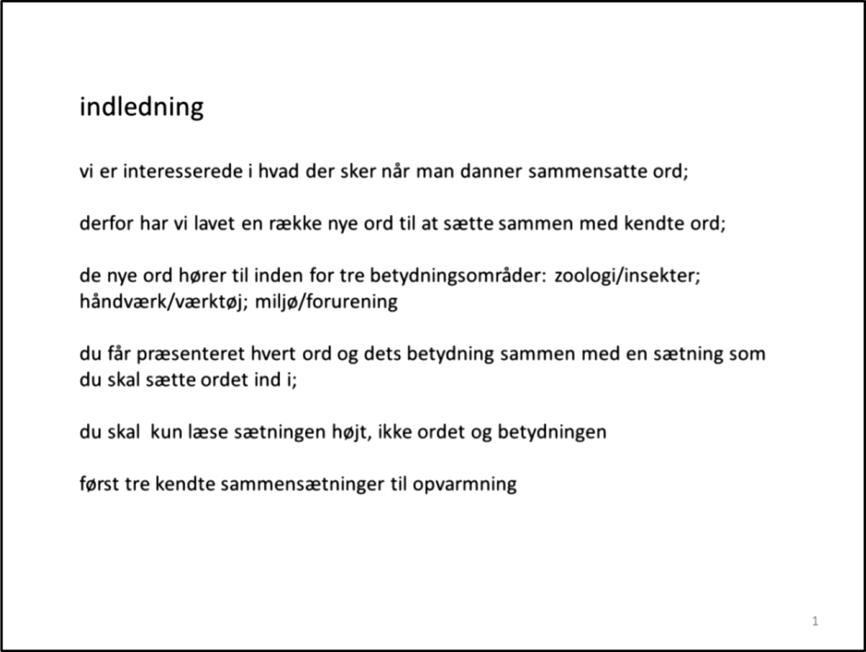
The first screen, seen in Figure 1, presented the broadly formulated purpose of the experiment and the procedure to follow:
we are interested in what happens when words are joined in compounds; therefore we have created a number of new words to be added to existing words; the new words belong within three semantic fields: zoology/insects; trade/tools; environment/pollution; each new word is presented with its meaning together with a sentence in which to insert the word; read only the sentence aloud, not the word and its meaning; first three known compound words for practice
Power Point screen shot of the instructions to participants.

Next came three screens for practice, succeeded by 40 test screens in randomized order; see the example in Figure 2.
Sample test screen: ‘A “stabe” (tool)’ – ‘The chisels and the guiding-stabes belong in the drawer’.

On completion of this part, the next screen invited speakers to read aloud in succession the 40 sentences, interspersed with ten sentences with existing compounds to create some diversion, i.e. 50 sentences in all, 10 per screen. In this way, we doubled the number of responses and also introduced a measure of consistency from the first to the second trial run. The continuous list was devoid of specific information about the nonce nouns, i.e. their gender and their syllabic structure.
The speakers controlled the flow of screens (the page down button) themselves. The experimenter was present in the studio during the whole session, available for questions, etc. The test took on average 15 minutes to complete.
5. Results
5.1 Facts and statistics
Three speakers turned out during the recordings to have non-standard traits in their pronunciation and were excluded from further processing.
Forty words, two conditions, and 10 speakers ideally yield 800 responses. But mistakes were inevitably made: A screen was skipped over; a short vowel produced where we had intended a long one, or vice versa; the final member of the compound received the primary stress; vowel–consonant metatheses occurred, etc., leaving us with a total of 761 valid responses.
Speakers differed considerably among themselves. One did not produce a single stød in the nonce part of the compounds in his valid responses, with 13 instances of stød by the highest scoring speaker. But the distribution across variables is not qualitatively different across speakers, i.e. speakers with fewer stød overall still have more stød in the def.sg than elsewhere. Tables 1–5 exhibit the results pooled across speakers.
Number of valid responses by 10 speakers to 12 compounds with nonce nouns in final position, in the indefinite singular, and the number of stød produced in these words, in the first and second trial run, respectively. Three words are neuter gender, marked (neu), the remaining nine are common gender.

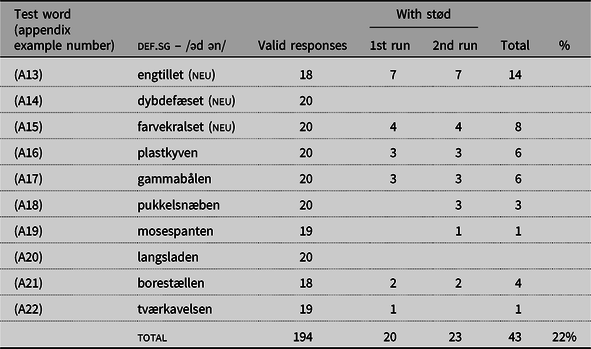
Number of valid responses by 10 speakers to 10 compounds with nonce nouns in final position, in the definite singular, and the number of stød produced in these words, in the first and second trial run, respectively. Three words are neuter gender, marked (neu), the remaining seven are common gender.

Number of valid responses by 10 speakers to 10 compounds with nonce nouns in final position, in the indefinite plural, and the number of stød produced in these words, in the first and second trial run, respectively. Three words are neuter gender, marked (neu), the remaining seven are common gender.

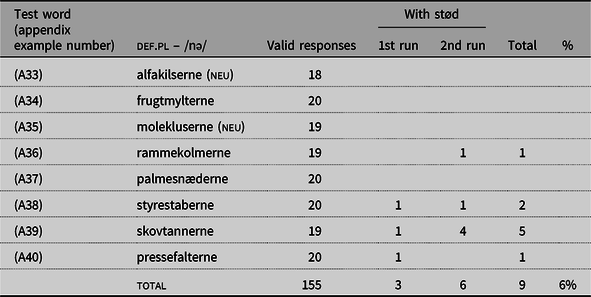
Number of valid responses by 10 speakers to eight compounds with nonce nouns in final position, in the definite plural, and the number of stød produced in these words, in the first and second trial run, respectively. Two words are neuter gender, marked (neu), the remaining six are common gender.


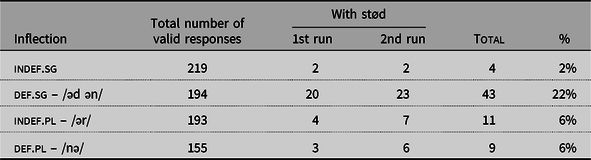
Table 5 shows that (4 + 43 + 11 + 9 =) 67 nonce nouns were produced with stød, amounting to 9% of the (219 + 194 + 193 + 155 =) 761 valid responses. To a first approximation, there seems to be a tendency, albeit a rather weak one, for the word structure non-stød principle to be suspended in final disyllabic nouns in compounds (see Section 2.4 and (13) above).
The majority of stød occurred in the second run of the test – reading sentences aloud in succession, without specific information about the nonce nouns, namely (2 + 23 + 7 + 6 =) 38 nouns with stød, compared to (2 + 20 + 4 + 3 =) 29 nouns with stød in the first run. But according to Tables 1–4, the distribution across the 40 nouns in the four inflections is similar in the two conditions. In other words, the nonce nouns that received the highest number of stød in the first trial run are the same nouns that received the highest number of stød in the second trial run. Note specifically that in the highest scoring group of nouns, the def.sg in Table 2, there are only three more stød in the list reading (23 nouns with stød) than in the first trial (20 nouns with stød). Accordingly, we may pool responses from the two conditions and treat the 761 valid responses as one data set in the statistical calculations.
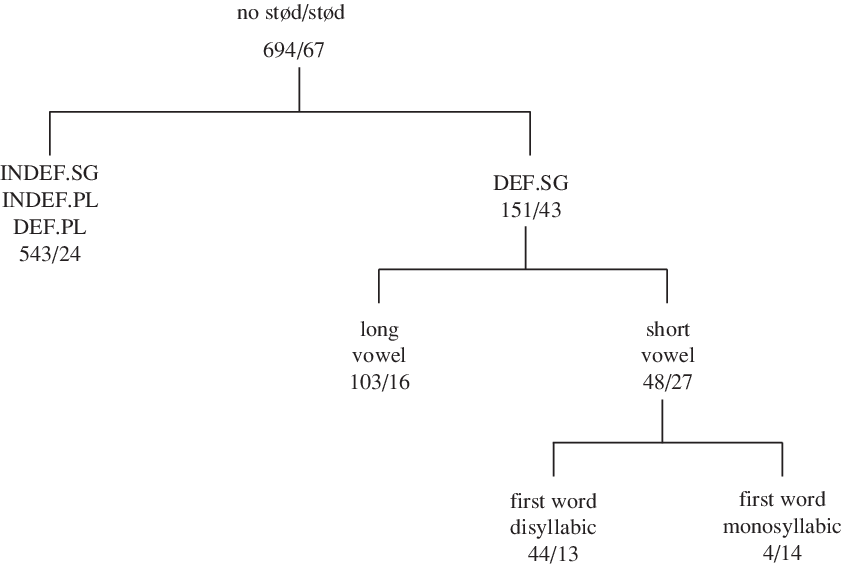
It is immediately evident from Table 5 that only nouns in the def.sg received a significant number of stød, 22% against next to nothing, namely 2% in the indef.sg and very modest 6% in either plural form. According to Table 2, one word, engtillet (14 stød occurrences), stands out from the rest, with farvekralset (8 stød occurrences), plastkyven (6 stød occurences), gammabålen (6 stød occurrences), and borestællen (4 stød occurrences) as runners-up. But there are more significant factors in the data. A CART (Classification And Regression Tree) analysis (Baayen Reference Baayen2008) was performed. We used the latest version of the package rpart (Therneau, Atkinson & Ripley Reference Therneau, Atkinson and Ripley2018), implemented in R 3.0.3. The results are reproduced in Figure 3.
Regression tree depicting the three significant factors determining stød distribution in the data. See further the text.

The figure tells us, not surprisingly, that the first split in the data is in inflection: def.sg scores 43 stød in (151 + 43 =) 194 responses (= 22%), versus 24 stød in (543 + 24 =) 567 responses (= 4%) in the other three forms together.
Within the def.sg, vowel length creates the next split. Nouns with short stressed vowels exhibit stød three times more often than long stressed vowels: 27 stød in (48 + 27 =) 75 responses (= 36%) versus 16 stød in (103 + 16 =) 119 responses (= 13%).
Furthermore, when the stressed vowel in the nonce noun is short, a monosyllabic initial member induces stød in the noun more often than does a disyllable: 14 stød in (4 + 14 =) 18 responses (= 78%) versus 13 stød in (44 + 13 =) 57 responses (= 23%). No other variable in the data, among those listed in Section 4.1, had a significant effect on responses.
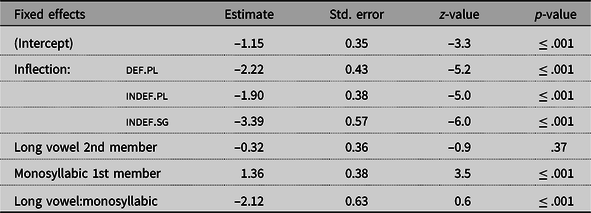
We also fit a multiple logistic regression model, with all of the factors and interactions found in the CART analysis and with a random intercept for speaker, to the data. The model was stepped down from a full model, and the summary of the final model is shown in Table 6. Note that the interaction of inflectional type and vowel length did not emerge as significant.
Model summary of multiple regression with mixed effects. See further the text.
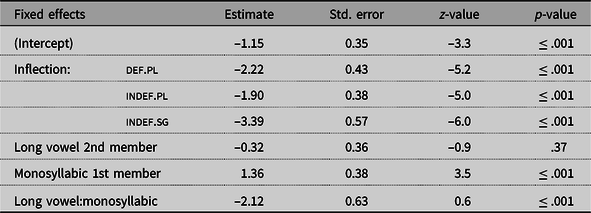
Table 6 displays the significant factors apparent in the data. The tripartite factor inflection is calculated with reference to the def.sg. It shows how the other three forms differ: the negative estimates (–2.22; –1.90; –3.39) indicate that stød is less likely to occur than in the def.sg. Vowel length in the nonce noun is apparently not a significant factor (p = .37); but the number of syllables in the initial word plays a significant role (p ≤ .001), and the positive estimate (1.36) tells us that stød is more likely in the nonce noun when the initial word is monosyllabic. However, nonce noun vowel length and initial word number of syllables interact significantly – and with a negative estimate (–2.12), as seen in the bottom row in Table 6. This means that the effect of initial word length is suspended when the vowel in the nonce noun is long. In other words, only when the vowel in the nonce noun is short, does a monosyllabic initial part increase stød likelihood in the final part. That is also how the lowest/rightmost split in the regression tree in Figure 3 would have it.
According to these analyses engtillet (def.sg, short stressed vowel in tillet, monosyllabic eng), ought to be the top scorer in the results, as indeed it is with 14 instances of stød in 18 valid responses (= 78%).
Add to the statistically significant effects an apparent trend in the results in the def.sg (see Table 2): Within the four nonce nouns with short stressed vowel (tillet, kralset, spanten, stællen) there are two orthogonal properties. Two nouns are neuter gender (tillet, kralset) with (18 + 20 =) 38 valid responses, (14 + 8 =) 22 of which have stød (= 58%). Two nouns are common gender (spanten, stællen) with (19 + 18 =) 37 valid responses, only (1 + 4 =) 5 of which have stød (= 14%). It would seem that neuter gender favours stød over common gender. But one of the two neuter nouns is also the one with a monosyllabic initial part, (eng)tillet, and gender alone cannot be shown to significantly increase the likelihood of stød in the final part. A larger database is required to settle the issue.
Finally, it appears in Table 1 that the only two nonce nouns pronounced with stød in the indef.sg are the two trisyllables, stæbelse (3 stød occurrences) and tærkelse (1 stød occurrence).
5.2 Explaining the results
5.2.1 Definite singular
The definite singular suffixes are normally considered to be fully productive, they are not integrated in the stem and do not bring about either absence or presence of stød (except when added to an extraprosodic consonant, see Section 2.2.1), as in [huːˀs] hus ‘house’, [ˈhuːˀsð̩] huset ‘the house’ and [ˈtˢanḍə] tante ‘aunt’, [ˈtˢanḍ:] tanten ‘the aunt’. But our speakers did produce stød in the def.sg – and much more often (43 instances) than in the other three inflections together (4 + 11 + 9 = 24 instances); see Table 5 and Figure 3. Is there anything about the suffixes per se, /əd ən/, which would favour stød in the stems as opposed to the indef.pl /ər/ and def.pl /nə/? Perhaps not in the phonology, but the pronunciation of the def.sg suffixes differs from that of the plural suffixes: [ð̩ :] versus [ɐ] and [nə]. Syllabic consonants are presumably perceptually less salient than vowels, and the words in the def.sg might have more perceptual affinity with monosyllables than with disyllables. Accordingly, they would not be subject to the non-stød principle which relieves disyllabic lexemes of stød (see Section 2.4 above). Thus, the segmental sequence [ˈtˢilð̩] would be more akin to the sequence [tˢilḍ] – which must have stød – than to the sequence [ˈtˢilə] – which cannot have stød (see Section 2.4). And perhaps the reduction in salience pertaining to posttonic syllabic consonants is relatively more pronounced when the whole word has undergone stress reduction in the compound. Perhaps the consonantal manifestation of suffixes is a contributing factor in the preference for stød in the def.sg, but it cannot be the decisive one. If it were, -fæset ought to have received stød in at least some instances, which it did not. Furthermore, stød should occur in more equal numbers across the three neuter and six common gender disyllabic nouns in Table 2. Since that is not the case, can we blame an inherent difference between a more consonant-like syllabic [ð̩] and a more vowel-like syllabic [:]? Quite the contrary: [n] is a proper consonantal sound, but Danish [ð] is actually phonetically a non-consonantal glide.
The question of monosyllables versus disyllables turns up in another guise. In principle, all the nonce nouns in the def.sg are open to two different parsings. For instance, tillet, kyven, spanten could be perceived as either till-et, kyv-en, spant-en, or tille-t, kyve-n, spante-n. Parsed as monosyllables they would have stød in the indefinite, and the def.sg suffix does not alter that. Parsed as disyllables they would be without stød in isolation, also remaining unaffected by the suffix. Of course, we cannot know what went on in the minds of our speakers, but we have to assume that they made use of the information about word structure provided on the screen in the first trial run (see Figure 2 above) and treated the nonce nouns there as disyllabic. We were, however, alert to the fact that that information might have been forgotten in the second (list reading) trial run, which might have invited reinterpretation as monosyllables, and hence presumably also rendered stød in the def.sg. If so, there should be more stød in the second than in the first trial run. That is not – or barely – the case: there are 43 instantiations with stød in the definite singular, 20 are from the first run, 23 from the second run, i.e. only slightly more in the list reading (see Table 2 above). Therefore, we are confident that reinterpretation as monosyllables across the board did not take place. It may have applied to some words with some speakers, but it is hardly a major factor in the interpretation of the results. We shall return briefly to this question again in Section 5.2.4.
Could the existence of rhyming nouns in the existing vocabulary have influenced our speakers? If a nonce noun in the def.sg in the test rhymes with existing words with stød, it might score higher in the stød account than otherwise. Or vice versa, if it rhymes with existing words without stød, we could expect the stød score to be low. Table 7 contains examples of rhyming words in the def.sg with and without stød.
Ten nonce words in the definite singular (leftmost column), rhyming words with stød (second column) and without stød (third column) in the existing lexicon. The rightmost column contains the number of stød occurrences, in the first and second run, respectively, with the total number of valid productions of the nonce word in parentheses. Stød is indicated in the orthography with an apostrophe.

Except for kralset, which does not rhyme with anything, all the nonce nouns rhyme with words with stød as well as words without stød. We must conclude that there is no discernible influence from rhyming words in the existing vocabulary upon the appearance of stød or not in the nonce nouns in the test.
Our final recourse is statistical in nature. The way stød is distributed across the four inflections of the nonce nouns in our experiment may reflect the way it is distributed across inflections of corresponding existing Danish simplex nouns. The stød principles in Sections 2.4–2.6 above apply to types, but do not inform us about tokens. Speakers may well be influenced by the number of polysyllabic nouns with stød they hear in daily spoken Danish, and when new disyllabic nouns are encountered, the preponderance, if any, of stød in any given inflectional form may override what the principles stipulate.
Ideally, we would search a phonetically annotated, representative Danish spoken language corpus for pointers. But none is available, adequate to our purpose. The DanPASS corpus, created for phonetic analysis of non-scripted speech (https://danpass.ku.dk; Grønnum Reference Grønnum2009), is phonetically annotated, but it is not comprehensive enough in our context. Although it contains a total of approximately 73,500 running words, there are only 2,110 orthographically different word forms, not all of them nouns, of course. The LANCHART corpus of sociolinguistic interviews (Gregersen, Maegaard & Pharao Reference Gregersen, Maegaard, Pharao, Jacques, Ulrike and Gjert2014) would certainly be comprehensive enough – with its more than 6.5 million running words and more than 77,000 wordtypes. But it is not searchable in terms of phonological features like stress location, number of syllables in the word, vowel length, stød, or stødbasis. We would have to first extract a large lexicon from LANCHART and then mark that up for the features we need, in order to attempt to explain our test results, a prohibitively time-consuming project.
Accordingly, we settled for a dictionary search and turned to the OLAM database at The Department of Language and Communication, University of Southern Denmark at Odense. It is developed in close collaboration between Claus Lambertsen, Berlin, and Hans Basbøll and Thomas Madsen, University of Southern Denmark. It is supplied with sophisticated coding and analytic systems. The name is a fusion of OLA, short for ‘Odense Language Acquisition (Project)’ and ‘Lambertsen’; see Madsen, Basbøll & Lambertsen (Reference Madsen, Basbøll and Lambertsen2002). OLAM contains 41,375 lexical entries, supplied with orthographic, morphological, phonological, and segmentation information, as well as a conventionalized broad phonetic transcription.
The basic phonetic forms in OLAM are those of Molbæk Hansen’s (Reference Molbæk Hansen1990) pronouncing dictionary, Dansk Udtale. Other phonetic forms in OLAM are generated by the OLAM system itself. In other words, the transcriptions in OLAM are prescriptive and normative, not descriptive of any actual speakers of modern Danish, nor do they tell us anything about frequency of occurrence in running speech. Nevertheless, we did learn something useful, as will transpire below.
There are 21,876 different nouns in OLAM, 6,617 of which are prosodically basic nouns, abbreviated PBNs. PBNs are nouns which in the indefinite singular have one primary stress, on the initial syllable, and succeeding syllables, if any, are exclusively unstressed (Basbøll, Kjærbæk & Lambertsen Reference Basbøll, Kjærbæk and Lambertsen2011:86–87 et passim). The nonce nouns in our experiment are perfect instances of OLAM’s polysyllabic prosodically basic nouns.
We restrict our search in the database to stød-receptive PBNs. In the indef.sg there are 4,806 such nouns, 1,599 monosyllables and 3,207 polysyllables.
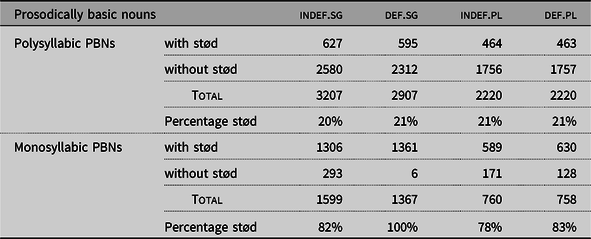
Table 8 displays the number of polysyllabic and monosyllabic stød-receptive prosodically basic nouns, with and without stød. Numbers across the four inflections for a given syllable structure are similar but only sporadically identical, because not every noun in the language occurs in every form. For instance, fusen – as in at tage fusen på nogen ‘to fool someone’ – occurs only thus, in the def.sg; penge ‘money’ exists only in the plural; and non-countables, like smør ‘butter,’ mælk ‘milk’, exist only in the singular.
Prosodically basic nouns (PBNs) with stødbasis in the OLAM database.

Polysyllabic PBNs are the non-stød environment par excellence (see Sections 2.4 and 2.5), which is clearly reflected in the relatively low stød percentages (around 20%) in Table 8, top half, and the def.sg does not stand out from the rest. Monosyllabic PBNs with stødbasis are the prime environment for stød. When they are inflected in the def.sg – whether with common gender /ən/ or neuter gender /əd/ – they invariably become disyllabic, and they retain their stød because the def.sg suffixes do not interfere with the stem:
-
(32)

Those relatively few (293) without stød invariably attract stød in the def.sg, like
-
(33)

Because monosyllabic nouns become disyllabic in the def.sg and acquire stød in the process, if they do not have one already, the percentage stød among them is practically 100%. In absolute numbers there are (2312 + 6 =) 2,318 def.sg nouns, all polysyllabic, without stød in OLAM; but there are also (595 + 1361 =) 1,956 def.sg nouns with stød, enough – we think – to have induced our speakers to produce 43 nonce nouns with stød (see Tables 2 and 5 above) in the definite singular.
The situation is somewhat different in the plural of monosyllabic nouns – with fewer instances of stød than in the def.sg – because one of the two plural suffixes, /ə/, which is no longer productive, is invariably integrated into the stem, turning it into a disyllabic non-stød environment:
-
(34)

The productive plural /ər/, which is added to new words in the language, may likewise be integrated into certain stems, as in [ˈfɒːˀm] form ‘shape’, [ˈfɒːmɐ] former ‘shapes’ (see Section 2.5). Furthermore, some nouns are identical in the indefinite singular and plural, hence without stød in the plural if the singular is stødless, as in [eḍ ˈḍuð] et bud ‘a commandment’, [ḍi ˈtˢiːˀ ˈḍuð] de ti bud ‘the Ten Commandments’.
5.2.2 Short versus long vowel
Within the 194 valid responses to nonce nouns in the def.sg 119 had a long stressed vowel (fæset, kyven, bålen, snæben, sladen, kavelsen) and 75 had a short stressed vowel (tillet, kralset, spanten, stællen). Sixteen of the 119 long vowels (= 13%) had stød, whereas 27 of 75 nouns with short vowels (= 36%) had stød (see Table 2 and Figure 3 above). OLAM’s transcription of vowels as long or short follows Molbæk Hansen’s Dansk Udtale which was published in 1990. That is well over a generation ago, and in certain respects the pronunciation now appears somewhat conservative. Specifically where the duration of vowels succeeded by any of the four glides [w ð j ɐ̯] is concerned: Molbæk Hansen prescribes long stød vowels before [w ð], as in [ˈæːˀð] adel ‘nobility’ and [ˈleːˀwɐ] lever ‘liver’, but to-day’s younger generation produces short vowels, [ˈæðˀ] and [ˈlewˀɐ]. And where Molbæk Hansen prescribes short vowels in disyllables before [ð ɐ̯], as in [ˈɡ̊eðð̩] gedde ‘pike’ and [ˈḍuɐ̯ɐ] burre ‘burdock’, young speakers of Standard Danish now produce long vowel sounds, [ˈɡ̊eːð̩] and [ˈḍuːɐ]. We have recategorized the vowels in Tables 9 and 10, to better reflect the pronunciation of our young speakers.
Percentage of short vowels in prosodically basic nouns with stød in the def.sg in the OLAM database.

Proportion of stød in syllables with stødbasis in prosodically basic nouns in the def.sg with short and long vowel sounds in the OLAM database.

There are two slightly different ways to search the OLAM database for a pointer why short vowel syllables would attract more stød than long vowel syllables.
How large is the percentage with short stressed vowels among nouns with stød in the def.sg in the existing vocabulary? Table 9 displays the counts. It turns out that among prosodically basic nouns with stød in the def.sg in the OLAM database there are practically equal numbers of words with short and with long stressed vowels. The explanation for the preponderance of stød in syllables with short vowels in our experiment must lie elsewhere.
Another way to search for putative parallels between our experimental results and the wider language context would be to ask which category contains the larger proportion of stød, stød-receptive syllables with short vowels or stød-receptive syllables with long vowels? Table 10 contains the OLAM counts as they apply to nouns in the def.sg. Among prosodically basic nouns with short vowels in the def.sg, the proportion of existing words with stød is appreciably larger than among nouns with long vowels (58% versus 35%).
Altogether, the short vowel advantage in prosodically basic nouns with stød in the def.sg in the Danish vocabulary may suffice to explain why our speakers applied stød more often in the def.sg in nonce nouns with short stressed vowels than in nonce nouns with long stressed vowels. As an aside one may wonder why the vocabulary developed in this manner: why would a short vowel succeeded by a sonorant consonant be more prone to have or develop stød than a long vowel? Is there something about the articulatory and laryngeal dynamics of a VC sequence that favours creaky voice? Could it be the rapid transition from greater to lesser intensity? We know that normally even the weaker stød manifestation – the compressed voice quality without any F0 perturbation (see Section 2) – exhibits some intensity reduction towards the end of the rhyme (Fischer-Jørgensen Reference Fischer-Jørgensen1987, Reference Fischer-Jørgensen1989a, b). Conversely, intensity reduction alone can induce stød perception in resynthesized long stødless vowel stimuli (Mortensen Reference Mortensen2013–2014). It may be a long shot to infer from the synchronic state of affairs to the development of stød over time, however, and we shall have to leave it, speculatively, at that.
5.2.3 Monosyllabic versus disyllabic initial part
Among the 75 instances of nonce nouns in the def.sg with short stressed vowel, 18 were preceded by a monosyllable (engtillet) and 57 by a disyllabic word (farvekralset, mosespanten, borestællen). Fourteen of the 18 (= 78%) had stød, while that is true of only 13 of the 57 (= 23%); see Table 2 and Figure 3 above. Why would that be? Actually, the situation is equivalent to what we know to be true of compound verbs: ‘stød is rarer the heavier the first element of such a verb is’ (Basbøll Reference Basbøll2005:500). And we observe in the next section that a principle which used to apply only to verbs before certain vowel suffixes may be spreading to any word which ends in a suffix-like vowel, hence also to nouns. Then why would something which is true of verbs in compounds not also generalize to nouns in compounds?
5.2.4 Neuter versus common gender
Among 75 renderings of four nonce words in the def.sg with short stressed vowel, neuter gender tillet had stød in 14 instances, kralset in eight instances, whereas common gender spanten had one and stællen four stød, respectively (see Table 2). But tillet also has a monosyllabic initial part, eng ‘meadow’, and that is a statistically significant factor in stød attribution to nouns with short vowels in the def.sg. That is why gender, in and of itself, cannot be shown to significantly increase the likelihood of stød in this context. But iff we had had reason to suspect that our speakers had reinterpreted at least some of the nonce nouns as monosyllables in the definite, and thus with stød, would neuter gender nouns have had a lead over common gender nouns? Do proportions within the existing vocabulary support such a contention?
Table 11 shows that among the neuter gender nouns in the lexicon, there are twice as many monosyllables than polysyllables (553 versus 299), and among the common gender nouns, there are thrice as many polysyllables than monosyllables (2,759 versus 925). That is, monosyllables are indeed in the majority in the neuter gender and in the minority in the common gender. But there are also altogether twice as many polysyllables than monosyllables (3,207 versus 1,599). Given the overall majority of stød-receptive polysyllabic nouns in the existing vocabulary, and given also our reasoning in Section 5.2.1 above about reinterpretation, we are inclined to trust that our speakers interpreted the nonce words as disyllables, as intended, but – as we said – more data are needed to establish the role of gender, if any, in stød assignment in disyllabic nouns in final position in compounds. Furthermore, if neuter gender had invited reinterpretation of tillet, fæset and kralset as monosyllables in the def.sg, we may wonder why fæset was not pronounced with stød, not even once. Except, of course, that the stressed vowel is long, [ˈfεːsð̩], not short. If that is why fæset never received stød, then any influence from gender on the interpretation of word length – in terms of number of syllables – in nouns is subordinate to the phonology of the word. Therefore, it cannot be a very decisive factor. We may be justified in dismissing it.
Number of prosodically basic monosyllables and polysyllables with stødbasis in the indef.sg, in the neuter and common genders.

5.2.5 Substantivizing suffix else
If it is not merely a coincidence that indef.sg kontaktstæbelse (neuter) and rørtærkelse (common) received four and one stød responses, respectively (see Table 1), then what is the explanation? The form -else is most likely to have been perceived as a suffix. As such, a monosyllabic stem preceding it should be without stød, as in [ˈkʰεnsə] kendelse ‘verdict’, and a polysyllabic stem should have stød, as in [ḍeˈkʰenˀsə] bekendelse ‘confession’ (see Section 2.5). However, if stæbelse and tærkelse were not infallibly perceived as derived, but in some instances as trisyllabic lexemes, we would be dealing with non-penultimate syllables in lexemes, and normally they do have stød if they are stød-receptive (see Section 2.4 above).
6. Discussion
The point of departure for our experiment was the many occurrences in unexpected locations of stød in Nina Grønnum’s corpus – particularly in disyllabic nouns in the final position in two-word compounds, nouns which in isolation do not have stød. Would speakers of modern Danish replicate these observations under controlled circumstances? They did, but the number of stød in our experiment is not overwhelming. That was hardly to be expected either, given that the phenomenon is relatively new, absent in speakers born before 1950 (Brink & Lund Reference Brink and Lund1975). But the fact that stød – in this new environment – exhibits the same distributional pattern across inflections as in the existing vocabulary – namely more stød in nouns (i) in the definite singular, (ii) with short stressed vowels, and (iii) after a monosyllabic word if the stressed vowel of the nonce noun is short – strengthens our belief that we are not dealing with spurious, deviating pronunciations without any staying power, but a systematic change in the distribution of stød.
If the trends we have observed are consolidated in the future, more stød-receptive syllables will have stød than previously. So far, we can assert with some confidence that penultimate syllables in inflected nouns tend to acquire stød finally in two-word compounds. With three exceptions – drejesilber (4 stød occurrences), skruedaller (3 stød occurrences), and skovtannerne (5 stød occurrences) – stød attribution in the plural was negligible. In other words, the definite singular is the major trigger, most pronouncedly so in nouns with short vowels, and within that category particularly when the initial word in the compound is monosyllabic.
What are, more specifically, the non-stød principle(s) under siege here? Not the phonological requirement for a long sonority rhyme (see Section 2), nor the lexical non-stød principles (see Section 2.2), but rather those word structure principles which stipulate that (i) penultimate syllables in lexemes do not have stød (see Section 2.4); (ii) def.sg suffixes /ən əd/ do not interfere with the stem, nor do indef.pl /ər/ or def.pl /nə/ (see Section 2.5); and (iii) nouns do not acquire stød through compounding (see Section 2.6). They all appear to have been suspended when our disyllabic nonce nouns were pronounced with stød. Is there any way to make good sense of that, beyond the specific arguments we brought to bear in Section 5.2? Can they all be made to instantiate one common trend? Recall from Section 2.5 that infinitive /ə/ is integrated into a monosyllabic stem, making the ensemble look like a disyllabic lexeme, and accordingly the penultimate syllable appears without stød, as in [ˈɡ̊ʁiːḍə] gribe ‘catch’ from [ɡ̊ʁiːˀḍ] grib! ‘catch!’; but not if the stem is polysyllabic as in [ḍeˈɡ̊ʁiːˀḍə] begribe ‘comprehend’.
In a progression of arguments, Grønnum & Basbøll (Reference Grønnum, Basbøll and Oliver2012) suggested that this principle is on its way to a much more general application: in any word which phonetically resembles a stem + a syllabic suffix, only monosyllabic stems have no stød. ‘Any word’ includes nouns, of course, and the noun inflection suffixes are indeed syllabic. The critical concept is stem. If, for instance, plastkyven was parsed by the speakers as plast-kyven, then kyven – in this new state of affairs – resembles a monosyllabic stem with a syllabic suffix (no matter its grammatical category) which would be without stød – just like gribe ‘catch’ above. But parsed as plastkyve-n any resemblance with an inflected monosyllable is repealed, and the stem appears with stød – just like begribe ‘comprehend’ above. We concluded that the net result of the changes observed in NG’s corpus – to which we can now add the results of our experiment – is that more and more stød-receptive syllables will have stød, and the need to formulate principles for its absence will diminish. We suggested that the driving force behind such a change is the simplification it entails for the speaker, against the concomitant loss in morphological specificity. Thus, for instance, [ˈpʰḷasḍiɡ̊muːˀs:] will become ambiguous between plastikmuse-n ‘a muse made of plastic’ and plastikmus-en ‘a mouse made of plastic’.
The change concerns a phonological property, a prosodic feature, but it is conditional on morphology (inflection) and grammar (word boundaries), generalizing the occurrence of stød in stød-receptive syllables. It is also a generalization across word classes: A phenomenon which was previously associated with verbs and adjectives is now on its way to also apply to nouns – but so far only in specific contexts.
Acknowledgements
We are grateful to Laila Kjærbæk, University of Southern Denmark, and Claus Lambertsen, Berlin, for generous assistance with the OLAM analyses. We are also very appreciative of the extremely helpful and extensive comments and questions from three anonymous reviewers and the editor.
Appendix. Test material
Three introductory well-established compounds inserted in sentences:
-
(i) hud + farve: hans mørke hudfarve gjorde ham til et nemt offer for mobning
ʻskin’ + ‘colour’: ‘the dark colour of his skin made him an easy target for mobbing’
-
(ii) over + størrelse: hun måtte købe tøj i overstørrelse, da hun kom i syvende måned
ʻover’ + ʻsize’: ʻshe had to buy oversized clothing when she came in the seventh month’
-
(iii) rød + strømper: det er længe siden, at fire rødstrømper gik med bare bryster på Strøget
ʻred’ + ʻstocking’: ʻit has been a long time since four redstockings [feminists] went with bare breasts on Strøget’
List of 40 compound words and the sentences in which they were inserted follows below. ‘(neu)’ indicates neuter gender nouns; all other nouns are common gender. The intended meanings of the nonce parts of the compounds, as they appeared on the computer screens in the experiment (see Figure 2 in the main text), have been added in parentheses.
Indefinite Singular (12 words)
-
(A1) sølv + ilum (insekt): på køkkenbordet lå der en død sølvilum
ʻsilver’ + ‘ilum’ (insect): ʻon the kitchen table was a dead silver-ilum’
-
(A2) metal + svile (værktøj): man kan bruge en metalsvile til at stramme hovedlåsen
ʻmetal’ + ʻsvile’ (tool): ʻyou can use a metal-svile to tighten the main lock’
-
(A3) under + stylling (sikring ved stilladser): uden en understylling falder stilladset sammen
ʻlower’ + ʻstylling’ (safety component in scaffolding): ʻwithout a lower-stylling the scaffolding will collapse’
-
(A4) top + skæling (bygningselement): der skal sidde en topskæling oven over tagvinduet
ʻtop’ + ʻskæling’ (building component): ʻthere should be a top-skæling above the skylight’
-
(A5) inder + spæle (møbelsnedkerkonstruktion) (neu): hvis ikke sammenføjningen skal være synlig, må du sætte et inderspæle på
ʻinner’ + ʻspæle’ (furniture carpentry construction): ʻif the joints are not to be visible, you must mount an inner-clamp’
-
(A6) mudder + slænning (forurening): efter stormen lå der en stor mudderslænning på fortovet
ʻmud’ + ʻslænning’ (pollution): ʻafter the storm there was a big mud-slænning on the sidewalk’
-
(A7) plast + velkum (overfladebehandling): man kan behandle med plastvelkum for at gøre overfladen skridsikker
ʻplastic’ + ʻvelkum’ (surface treatment): ʻone can treat with plastic-velkum to make the surface non-slip’
-
(A8) slibe + stase (konstruktionsfejl) (neu): kaklerne over håndvasken havde et grimt slibestase
ʻgrind’ + ʻstase’ (construction error): ʻthe tiles above the sink had an ugly grinding-stase’
-
(A9) sommer + tasum (insekt): vi sad på terrassen, og så kom der en gul sommertasum flyvende forbi
ʻsummer’ + ʻtasum’ (insect): ʻwe sat on the terrace, and then a yellow summer-tasum came flying by’
-
(A10) kors + tamse (insekt): næste morgen sad der en tyk korstamse i de nyplantede roser
ʻcross’ + ʻtamse’ (insect): ʻthe next morning there was a fat cross-tamse in the newly planted roses’
-
(A11) kontakt + stæbelse (møbelsnedkerkonstruktion) (neu): der skal ligge et kontaktstæbelse i sammenføjningen
ʻcontact’ + ʻstæbelse’ (furniture carpentry component): ʻthere should be a contact-stæbelse in the joint’
-
(A12) rør + tærkelse (krum rørsammenføjning): vi behøver kun en enkelt rørtærkelse under cisternen
ʻpipe’ + ʻtærkelse’ (curvilinear pipe joint): ʻwe only need a single pipe-tærkelse under the cistern’
Definite Singular (10 words)
-
(A13) eng + tille (et stykke jord på en halv hektar) (neu): det har regnet meget, så engtillet skal drænes før køerne kommer på græs
ʻmeadow’ + ʻtille’ (a piece of land the size of half an acre): ʻit has been raining a lot, so the meadow-tille must be drained before the cows are let out to grass’
-
(A14) dybde + fæse (digitalt trykmåleinstrument) (neu): ifølge loddet og dybdefæset er der vand nok i tanken
ʻdepth’ + ʻfæse’ (digital pressure gauge): ʻaccording to the weight and the depth-fæse, there is enough water in the tank’
-
(A15) farve + kralse (fladt blad med skæfte til at blande farver på en palet) (neu): penslerne og farvekralset er ikke blevet renset ordentligt
ʻcolour’ + ʻkralse’ (flat leaf with handle to mix colours on a palette): ʻthe brushes and the colour-kralse have not been cleaned properly’
-
(A16) plast + kyve (overfladebehandling): med lakken og plastkyven blev overfladen helt glat
ʻplastic’ + ʻkyve’ (surface treatment): ʻwith the varnish and the plastic-kyve, the surface became completely smooth’
-
(A17) gamma + båle (instrument): antennen og gammabålen skal sikre en god radiomodtagelse
ʻgamma’ + ʻbåle’ (instrument): ʻthe antenna and the gamma-båle should ensure good radio reception’
-
(A18) pukkel + snæbe (jungledyr): koalabjørnen og pukkelsnæben får ikke unger i fangenskab
ʻhump’ + ʻsnæbe’ (jungle animal): ʻthe koala bear and the hump-snæbe do not have cubs in captivity’
-
(A19) mose + spante (bundbevoksning): efter afvandingen kunne man tydeligt se bunden og mosespanten
ʻbog’ + ʻspante’ (bottom greenery): ʻafter the drainage, one could clearly see the bottom and the bog-spante’
-
(A20) lang + slade (element i bunden af vikingeskibe): man kan kende et vikingeskib på rælingen og langsladen
ʻlong’ + ʻslade’ (element in the bottom of Viking ships): ʻyou can know a Viking ship by the rail and the long-slade’
-
(A21) bore + stælle (værktøj): hammeren og borestællen har deres faste pladser på væggen
ʻbore’ + ʻstælle’ (tool): ʻthe hammer and the drill-stælle have their fixed places on the wall’
-
(A22) tvær + kavelse (del af tagkonstruktion): skorstenen og tværkavelsen er med til at holde stråtaget på plads
ʻcross’ + ʻkavelse’ (part of a roof construction): ʻthe chimney and the cross-kavelse help keep the thatched roof in place’
Indefinite Plural (10 words)
-
(A23) dreje + silbe (værktøj): de to drejesilber skal renses for rust
ʻturn’+ ʻsilbe’ (tool): ʻthe two turning-silbes must be cleaned of rust’
-
(A24) kyst + fyse (miljøbeskyttelsesforanstaltning) (neu): der blev bygget tre nye kystfyser efter stormen
ʻcoast’ + ʻfyse’ (environmental protection measure): ʻthree new coastal-fyses were built after the storm’
-
(A25) olie + dole (tønde i overstørrelse): de fire oliedoler faldt overbord under stormen
ʻoil’ + ‘dole’ (oversized barrel): ʻthe four oil-doles fell overboard during the storm’
-
(A26) høvle + stulle (værktøj): vi har kun to høvlestuller, men der er fire lærlinge
ʻplane’ + ʻstulle’ (tool): ʻwe only have two planing-stulles, but there are four apprentices’
-
(A27) lampe + punse (væge til udendørs olielamper) (neu): vi mangler to lampepunser til lygterne i gården
ʻlamp’ + ʻpunse’ (wick for outdoor oil lamps): ʻwe are short of two lamp-punses for the lamps in the yard’
-
(A28) gemse + blise (insekt): en hestebremse og et par gemsebliser gjorde dyrene i stalden urolige ʻgadfly’ + ʻblise’ (insect): ʻa gadfly and a couple of chamois-blises made the animals in the stable uneasy’
-
(A29) kloak + slænte (rist til underjordiske rørføringer) (neu): fire kloakslænter måtte skiftes ud efter oversvømmelserne
ʻsewer’ + ʻslænte’ (grill in underground piping): ʻfour sewer-slæntes had to be replaced after the floods’
-
(A30) blad + gæmpe (insekt): vi fandt et par bladgæmper i salatbedet
ʻleaf’ + ʻgæmpe’ (insect): ʻwe found a couple of leaf-gæmpes in the salad bed’
-
(A31) støtte + spale (bygningselement): der skulle bruges 16 støttespaler i konstruktionen
ʻsuppport’ + ʻspale’ (building element): ʻ16 support-spales were required in the construction’
-
(A32) skrue + dalle (værktøj): de to skruedaller havde han selv lavet
ʻscrew’ + ʻdalle’ (tool): ʻhe had made the two screw-dalles himself’
Definite Plural (eight words)
-
(A33) alfa + kilse (instrument til måling af kosmisk stråling) (neu): teleskoperne og alfakilserne på de canariske øer skal finde sorte huller i universet
ʻalpha’ + ʻkilse’ (instrument to measure cosmic radiation): ʻthe telescopes and alpha-kilses in the Canary Islands are intended to find black holes in the universe’
-
(A34) frugt + mylte (insekt): ormene og frugtmylterne har spist godt af jordbærrene
ʻfruit’ + ʻmylte’ (insect): ʻthe worms and fruit-myltes have eaten quite a bit of the strawberries’
-
(A35) mole + kluse (havnekonstruktion) (neu): kampestenene og molekluserne var dækket af slam efter højvandet
ʻpier’ + ʻkluse’ (harbour construction): ʻthe boulders and pier-kluses were covered in sludge after the high tide’
-
(A36) ramme + kolme (værktøj): skruetvingerne og rammekolmerne hører til i værktøjskassen
ʻframe’ + ʻkolme’ (tool): ʻthe clamps and framing-kolmes belong in the toolbox’
-
(A37) palme + snæde (insekt): bananfluerne og palmesnæderne angreb alle palmerne på sydkysten
ʻpalm’ + ʻsnæde’ (insect): ʻthe banana flies and palm-snædes attacked all the palm trees on the south coast’
-
(A38) styre + stabe (værktøj): stemmejernene og styrestaberne hører til i skuffen
ʻguide’+ ʻstabe’ (tool): ʻthe chisels and guiding-stabes belong in the drawer’
-
(A39) skov + tanne (insekt): myrerne og skovtannerne havde det dårligt i den fugtige sommer
ʻforest’ + ʻtanne’ (insect): ʻthe ants and forest-tannes were doing poorly in the humid summer’
-
(A40) presse + falte (udstyr i vaskeri eller rulleforretning): rullerne og pressefalterne skal renses med sprit
ʻpress’ + ʻfalte’ (equipment in laundry or rolling shop): ʻthe rollers and press-faltes should be cleaned with alcohol’