


Social scientists often attribute moderation of the political salience of ethnicity in ethnically diverse societies to the presence of cross-cutting cleavages—that is, to dimensions of identity or interest along which members of the same ethnic group may have diverse allegiances (Dahl Reference Dahl1956; Lipset and Rokkan Reference Lipset, Rokkan, Lipset and Rokkan1967). When individuals who are members of the same group or social category on one dimension of interest or identity, such as ethnicity, are members of different groups on another dimension, such as social class, their competing interests on the second dimension may undercut their primary allegiance to interests arising on the first dimension. Cross-cutting cleavages can thereby inhibit the extent to which political alignments intensify along any single dimension. As the sociologist Lewis Coser (Reference Coser1956, 72) once put it, “The interdependence of antagonistic groups and the crisscrossing within such societies of conflicts, which serve to ‘sew the social system together’ by canceling each other out, thus prevent disintegration along one primary line of cleavage.”Footnote 1
A recent literature in comparative politics and political economy has extended this classic insight in a number of ways. Where ethnicity has multiple dimensions—for example, when language, race, religion, caste, or clan can each provide the basis for different ethnic identities—the way in which different identities interact can explain whether political conflict becomes entrenched along any single ethnic dimension, as well as which dimension of ethnic identity is politically salient (Chandra Reference Chandra2005; Laitin Reference Laitin1986; Posner Reference Posner2004a, Reference Posner2005). A rich theoretical literature suggests that the degree to which cleavages are cross cutting may affect individual vote choice and coalition formation (Rogowski Reference Rogowski1989), patterns of party competition (Bartolini and Mair Reference Bartolini and Mair1990; Roemer, Lee, and van der Staeten Reference Roemer, Lee and Van der Straeten2007), and other outcomes of interest to students of comparative politics. By limiting the potential for electoral alignments to intensify along any one dimension of identity or interest, cross-cutting cleavages may even promote the stability and persistence of democracy (Chandra Reference Chandra2005; Lipset Reference Lipset1959, 31, 88–9).
Yet, estimating the causal effects of cross-cutting cleavages is difficult. Cross-country comparisons can be problematic because a country's cleavage structure may be related to many confounding factors that might also explain patterns of ethnic politics. Analysts must also take care to isolate the separate influences of different dimensions of identity. In addition, it may be difficult to define the relevant manipulation or intervention, the impact of which we want to estimate.Footnote 2 Empirical studies are thus challenged to isolate the causal effects of those aspects of the cleavage structure that are, in principle, subject to manipulation.
In this article, we present experimental results that help explain why ethnicity appears to have little political salience in Mali, an ethnically heterogeneous sub-Saharan African country in which ethnic identity is a poor predictor of vote choice and parties do not form along ethnic lines. The apparent absence of ethnic voting in Mali constitutes an important puzzle. Previous survey evidence suggests that ethnic identification is highly socially salient in Mali, as does our own research. Yet, unlike many other sub-Saharan African countries, in Mali, the social importance of ethnicity does not translate into a strong observed association between ethnicity and voters’ electoral choices.
We show that the cross-cutting ties afforded by an informal institution called “joking kinship” or “cousinage” can help explain the limited political salience of ethnic identity in Mali. During the Mali Empire (1230 to c. 1600), families formed alliances on the basis of patronyms (i.e., surnames); today, in countries such as current-day Mali, as well as Sénégal, The Gambia, Guinea, and Burkina Faso, these historical alliances are invoked in everyday social interactions. The cross-cutting nature of cousinage and coethnic ties may well explain the weak relationship between ethnicity and voter choice in Mali and several other countries. Imagine two voters from the same ethnic group and a politician who comes from a different ethnic group. If a cousinage alliance exists between the politician and one of the voters but not the other, and if voters prefer their joking cousins as well as their coethnics, the relative attractiveness of the candidate to the two voters may diverge. In the aggregate, the cross-cutting nature of ethnic and cousinage ties may weaken the correlation between ethnicity and political preferences.
To test this hypothesis, we developed an experimental research design that isolates the effects of different dimensions of candidate identity on voter preferences. In brief, we showed videotaped political speeches to experimental subjects in Bamako, Mali's capital, and then asked subjects to evaluate the quality of the speech, as well as various attributes of the candidate giving the speech. The content of speeches viewed by each subject was identical; the experimental manipulation consisted of what subjects were told about the politician's last name. Because surname conveys information about both ethnic identity and cousinage ties in Mali, varying the politician's last name allowed us to vary the treatment along two dimensions: the ethnic relationship of the politician and the subject (same ethnicity/different ethnicity) and their cousinage relationship (joking cousins/not joking cousins). The experimental design thus allows us to compare, for example, subjects’ evaluations of cousins from a different ethnic group and noncousins from their own ethnic group, while holding constant the content of the speech and any fixed effects associated with the candidate.
We find that cousinage alliances do affect candidate evaluations in the anticipated direction. Politicians who are cousins are evaluated more favorably than politicians who are noncousins. In contrast to previous observational survey evidence, we also find that subjects favor coethnics over politicians from a different ethnic group. However, we show that cousinage alliances counteract the negative impact of ethnic differences on candidate evaluations. For example, subjects’ evaluations of candidates who are cousins from a different ethnic group are statistically indistinguishable from their evaluations of candidates who are noncousins from their own ethnic group.
Our data and field research allow us to test further our core hypothesis and to evaluate the external validity of our findings. We show, first, that cousinage links between voters and politicians are widespread and comparable in frequency to coethnic ties, so they provide a plausible counterweight to ethnic linkages. Second, cousinage alliances are politically salient. In our experiment, the effects of cousinage are strongest for politically active subjects, and our analysis of electoral data suggests that parties exploit cousinage relations when choosing candidates to place on party lists. Third, we demonstrate that although ethnic and cousinage ties both positively affect voters’ evaluations of candidates, there is a negative correlation between cousinage and coethnicity (in the sense that coethnics are more likely to be noncousins than cousins, and non-coethnics are at least as likely to be cousins as noncousins); thus, the omission of cousinage ties from analyses of observational survey data should indeed suppress the true positive effect of coethnicity on political preferences. Fourth, although we cannot adjudicate between all mechanisms that might explain why voters prefer their cousins and their coethnics, we show that subjects deem their cousins to be more trustworthy than noncousins; cousinage relations appear to influence voters’ expectations about politicians’ responsiveness to their demands. Finally, we contrast the limited political salience of ethnicity in the several countries formerly under the authority of the Mali Empire, where cousinage is practiced, with ethnicity's more pronounced political role in other countries, also formerly part of French West Africa, that lack cousinage. Of course, we do not suggest that cousinage necessarily constitutes the only reason ethnicity is not associated with vote choice in Mali. Our experimental research simply shows that cousinage has a causal effect on candidate preferences and that it helps offset the effects of coethnicity—something not easily inferred from the existing evidence.
Although some features of our research design are best suited to the study of cousinage and ethnic politics in Mali and elsewhere in West Africa, the experiment we introduce can be used to study the effects of cross-cutting cleavages in other settings. Our article therefore constitutes a methodological as well as substantive contribution, complementing recent pioneering research in which experiments have been used to study such topics as the relationship between ethnic diversity and public goods provision (Habyarimana, Humphreys, Posner, and Weinstein Reference Habyarimana, Humphreys, Posner and Weinstein2007) or how clientelism shapes voter behavior (Wantchekon Reference Wantchekon2003). Our expectation is that replication of the experimental design we introduce here will prove useful in other settings as well.
ETHNICITY AND COUSINAGE AS CROSS-CUTTING CLEAVAGES IN MALI
Ethnicity is a highly relevant dimension of social identity in Mali. The West African country is ethnically diverse. It has more than 12 linguistically defined ethnic groups, and its ethnolinguistic fractionalization score of .84, which measures the probability that two individuals selected at random will come from different linguistically defined ethnic groups, approaches the score of ethnically diverse countries such as Kenya (.89) and Nigeria (.85) (Alesina et al. Reference Alesina, Devleeschauwer, Easterly, Kurlat and Wacziarg2003, 184–9). In Afrobarometer surveys taken in 2001 and 2002, respectively, 40% and 37% of respondents said they belonged “first and foremost” to their ethnic group. These percentages are higher than for any other category, including religion, occupation, or gender, and they exceed the average of 31% for nine other African countries surveyed (Eifert, Miguel, and Posner Reference Eifert, Miguel and Posner2007, 8). In an Afrobarometer survey taken in 2005, 76% of respondents said they felt “some” or “a lot” of confidence in people from their own ethnic group, whereas just 54% said the same of other ethnic groups (Afrobarometer 2007, 51). Different regions of Mali are identified with and populated by particular ethnic groups, and although the capital of Bamako tends to be well integrated, many neighborhoods are nonetheless associated with particular ethnic groups.Footnote 3
Yet, despite the social importance of ethnic identification in Mali, ethnicity is not highly salient politically. In contrast to many other sub-Saharan African countries, ethnicity has not provided a strong basis for individual vote choice or party competition in Mali since the country's return to democracy in 1992. Dowd and Driessen (Reference Dowd and Driessen2008, 6–8) calculate a measure of association between individual ethnicity and party identification, and find that Mali has one of the lowest scores among the seventeen African countries surveyed (see also Norris and Mattes Reference Norris and Mattes2003, 25). Posner (Reference Posner2004b), using country reports and other sources to code how often ethnicity is mentioned as a basis for party formation or political identity, creates a Politically Relevant Ethnic Group (PREG) fractionalization index. Mali's PREG score ranks far below countries with similar levels of ethnolinguistic fractionalization. Cabinets in Mali often include ministers from various ethnic groups, and Mali lacks ethnic parties in the sense of Chandra (Reference Chandra2004, 3): parties do not portray themselves as “the champion of a particular ethnic group or category to the exclusion of others” or “make such a strategy central to [their] strategy to mobilize voters.” Thus, even as Africanists have begun to reevaluate the presumed influence of ethnicity on voting behavior elsewhere in sub-Saharan Africa (Basedau and Stroh Reference Basedau and Stroh2009; Bratton and Kimenyi Reference Bratton and Kimenyi2008; Cheeseman and Ford Reference Cheeseman and Ford2007; Erdmann Reference Erdmann2007; Lindberg and Morrison Reference Lindberg and Morrison2008; Norris and Mattes Reference Norris and Mattes2003; Posner and Simon Reference Posner and Simon2002), Mali still stands out as a clear regional outlier.
What explains the apparently negligible political role of ethnicity in Mali? The cross-cutting ties afforded by cousinage alliances may play an important role, as anthropologists, political scientists, Malian politicians, and the U.S. State Department have all pointed out.Footnote 4 Cousinage, sometimes called “joking kinship,” has existed in what is now the country of Mali since at least the time of the Mali Empire.Footnote 5 Under the rule of the emperor Sundiata Keita (c. 1235–1255), joking relations between subjects of the empire who bore certain patronymsFootnote 6 (which were often identified with occupational specializations) were officially sanctioned.Footnote 7 Article 6 of Keita's “Kurukan Fuga”—which was a set of prescriptions for how the Mali Empire should be organized and governed—stated that cousinage “is (hereafter) instated among the Mandenkas [subjects of the Mali Empire]. By consequence, no difference born between these groups can degenerate, the respect of the other being the rule” (Kouyaté Reference Kouyaté2003). According to several scholars, the stated purpose of institutionalizing cousinage was to “defend, with language, the peace and harmony within the empire” (Kouyaté Reference Kouyaté2003, 58).
Just as constructivist scholars have argued with respect to ethnic identities (e.g., Nobles Reference Nobles2000), then, cousinage was originally codified and reinforced by the state. Although joking alliances were described by colonial administrators (Arcin Reference Arcin1906; Humblot Reference Humblot1918; Molinié Reference Molinié1959) and anthropologists (Mauss Reference Mauss1928; Radcliffe-Brown Reference Radcliffe-Brown1940) in the preindependence period, there appears to be little information about the impact of colonialism on this social practice. Unlike other institutions that provided a greater basis for mobilizing challenges to colonial rule, colonists apparently did not seek to restructure cousinage relations.Footnote 8 Since independence, however, and especially after the return to democracy in many countries in the 1990s, official tributes organized by governments in Mali, Sénégal, and elsewhere have celebrated cousinage as a source of interethnic understanding, which may again underscore the role of the state in reinforcing this institution (Canut Reference Canut2006). Although our main goal in this article is to estimate the political effects of cousinage and not to explain the origins or persistence of this institution, it is nonetheless important to understand the political incentives that may underlie this cultural equilibrium.Footnote 9
Today cousinage alliances exist not only in Mali, but also in other places that were either under the authority of the Mali Empire, such as Sénégal (Galvan Reference Galvan2006; O'Bannon Reference O'Bannon2008), Guinea (Kouyaté Reference Kouyaté2003), The Gambia (Davidheiser Reference Davidheiser2006), and Burkina Faso (Sissao Reference Sissao2002), or that have since experienced substantial immigration from these areas, such as the northern Ivory Coast, southern Mauritania, and Niger. Cousinage is not practiced everywhere in West Africa. Although it occurs in many parts of the Western Sahel zone, countries located along the Gulf of Benin, such as Togo and Benin, lack cousinage. There is also some variance in practice within countries where cousinage does exist. For example, the Tuareg (Tamasheq) in northern Mali and the Diola in Sénégal do not appear to have extensive surname-based joking alliances with members of their own or other ethnic groups.Footnote 10 However, cousinage is practiced almost everywhere else in Mali, and joking kinships occur between and among members of most of the country's 12 largest ethnic groups.Footnote 11 Today, if someone in Mali with the last name of Keita (a surname from the Malinké ethnic group) meets someone named Coulibaly (a surname from the Bambara ethnic group), these two joking cousins may insult each other with a standard set of jokes, even if they have never met.
It may be tempting to think of cousinage alliances as themselves being ethnic ties, yet this does not seem appropriate. Although common descent is often taken to be a defining feature of ethnic identity (Chandra Reference Chandra2006; Weber Reference Weber, Roth and Wittich1978), sharing a surname in Mali only loosely implies common descent. As Launay (Reference Launay2006, 767–8) explains, “in a large community, it is not uncommon for two entirely unrelated descent groups to share the same patronym . . . the relationship of senankunya [cousinage] transcends all locality, linking all people who share one name with all people who share another.”Footnote 12 Cousinage relationships therefore provide a distinct form of identity; they are not simply an extension of ethnicity.
Cousinage relations imply a social bond between parties to the alliance, that is, between joking cousins. At least historically, there was often hierarchy involved in these relationships, with one patronym in a pair of cousins associated with a higher caste (say, the caste of nobles) than the other.Footnote 13 Part of the point of cousinage appears to be precisely that the leveling influence of joking subverts hierarchies of power, at least temporarily.Footnote 14 For instance, cousins sometimes compete to call each other their “slave” (esclave); dietary customs may be denigrated through comments such as “you eat beans” (Canut and Smith Reference Canut and Smith2006; Jones Reference Jones2007). Although such jokes are formulaic, they are also reformulated to diffuse social tensions or to advance particular aims in ways that are situation dependent. Jones (Reference Jones2007, 72) recounts an instance in which a certain M. Traoré asked for the surname of an administrative office worker, who was taking a long time with the preparation of paperwork; on learning that the worker was a joking cousin, Traoré said, “You must work faster. You are doing the work of your master.” Some typical jokes imply possession or dominance, through phrases such as “you are my daughter/son” (often uttered by a younger joking cousin to an older one) or “I made you, and God made the others” (Jones Reference Jones2007, 75). Other standard jokes are simpler, mocking insults such as “Your name is worthless,” “Your name is something found in the street,” or simply “Keita (insert other name) is bad” (said by the Coulibaly/other joking cousin).Footnote 15 Joking kinship alliances thus allow the establishment of rapport and permit a degree of frankness between cousins that may not otherwise exist in social relationships.
Cousinage relations are also said to imply a set of reciprocal obligations. As one ethnic Senoufo interviewee told us, he could “never hurt his cousin” and would “have to do what his cousin asks,” a sentiment shared by other interviewees as well.Footnote 16 Anthropologists and other scholars have alleged that joking kinship may “result in greater willingness to make voluntary material sacrifices (of resources, time, willingness to voluntarily cede in disputes, etc.) for people thought to belong to different groups” (Galvan Reference Galvan2006, 816–17). These bonds of obligation can have real practical consequences. Cousinage relations may be invoked to avoid payment of traffic tickets, extract concessions from bureaucrats, speed up (or avoid) the payment of taxes, and for other purposes (see Canut and Smith Reference Canut and Smith2006; Jones Reference Jones2007). As we discuss further below, the ability to procure special favors from one's joking cousins may play an important role in explaining the political impact of cousinage.
This does not imply, of course, that the establishment of greater rapport or trust through cousinage relations is automatic. As many cultural anthropologists and sociologists emphasize, although social practices such as cousinage typically involve a set of persistent habits that structure behavior, parties to an exchange must also choose to invoke these relationships (Bourdieu Reference Bourdieu and Nice1992). As Launay (Reference Launay2006, 95, 99) puts it, “joking [between cousins] has constantly to be instantiated . . . .Such relationships . . . are either deliberately staged . . . or voluntarily instantiated by one or both parties. For there to be a joking relationship, someone actually has to do the joking.” We do not presuppose a positive impact of cousinage on interpersonal trust. Indeed, our experiment is designed to allow us to evaluate empirically the political effects of this social institution, whatever they may be. We also recognize that the nature of cousinage relationships may change over time, with even the set of surname pairs that constitute joking cousins subject to transformation.Footnote 17 However, cousinage alliances constitute “social facts,” which are difficult for any individual to alter. At any given point in time, there exists an understanding about who can joke with whom, and the ability to invoke cousinage alliances is constrained by the surnames of the parties doing the joking.Footnote 18 In Mali, surnames imply a set of cross-cutting ethnic and cousinage ties. It is therefore important to emphasize the specificity of the social institution we study. Although many anthropologists have examined similar “joking kinship alliances” in other settings (see Radcliffe-Brown Reference Radcliffe-Brown1940), they may not involve the cross-cutting ties that characterize cousinage in Mali.Footnote 19
What, then, is the political role of this social institution? Our field research and the secondary literature suggest that Malian politicians employ cousinage relations to serve their electoral objectives. A deputy in the National Assembly told one of us (Dunning) that he uses cousinage alliances to establish rapport and “win the loyalty” of non-coethnic voters in his constituency.Footnote 20 Mali's current president, Amadou Toumani Touré, often refers in speeches to his joking cousins (Douyon Reference Douyon2006, 899). The president is fortunate that his surname grants him alliances with voters bearing common patronyms from at least four ethnic groups—namely, the Coulibaly (ethnic Bamanans), the Maiga (ethnic Songhais), the Keita and the Sissoko (ethnic Malinkés), and the Guindo (ethnic Dogons). Thus, Touré can invoke cousinage relations nearly wherever he travels in the country. Douyon (Reference Douyon2006, 899) also notes that “numerous candidates in the legislative or municipal elections have solicited the vote of their senankun allies [their cousins], who are manipulated more easily than (even) direct relatives” (see also Canut Reference Canut2006).Footnote 21 Interestingly, politicians sometimes find ways to extend the range of cousinage relations to which they can legitimately appeal politically, for example, by drawing on both maternal and paternal patronyms (Douyon Reference Douyon2006, 896–7). Finally, where deputies or other politicians come from a minority or nondominant ethnic group in a given constituency, they appear to enjoy particularly widespread cousinage relations with voters in the consituency. In Gao, which is ethnically nearly 75% Sonrhai, the president of the regional assembly is ethnically Dogon, an extreme minority comprising well under 5% of the population in that region. However, this politician's surname (Guindo) affords him cousinage relations with the most common Sonrhai patronyms (e.g., Maiga, Cissé, Touré).Footnote 22
If politicians strategically exploit cousinage in their electoral campaigns, then these relationships should presumably also shape the preferences of individual voters. Several studies allege that voters prefer their cousins and even suggest why they would do so. Douyon (Reference Douyon2006, 899), for example, claims that “voters tend to vote for their allies (cousins), saying that in case of problems—administrative, political, or social—the elected ally would be more prompt to intervene than he would be even with a direct member of his own family.” Other scholars have referred to the role of joking kinships in limiting the political salience of ethnicity in several West African countries (see Lieberman Reference Lieberman2009, 277–8). Nevertheless, to our knowledge, our research supplies the first rigorous empirical test of the proposition that cousinage shapes political preferences. Most important, it allows us to assess how the cross-cutting ethnic and cousinage ties interact, and thereby may inhibit the crystallization of political preferences along ethnic lines.
EXPERIMENTAL DESIGN
To measure the effect of cousinage on voter preferences, we showed videotaped political speeches to experimental subjects, who were recruited through door-to-door canvassing in almost all neighborhoods in the capital city of Bamako. Subjects were told that the candidate in the video was a political independent who was considering launching a campaign for deputy in the National Assembly.Footnote 23 In all 824 experimental trials, we asked subjects to evaluate the overall quality of the speech and the attractiveness of the candidate along various dimensions. The content of speeches viewed by all subjects was identical. The experimental manipulation consisted of what subjects were told about the politician's last name, which conveys information about both ethnic identity and cousinage ties in Mali.
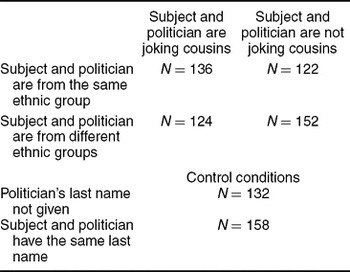
Our experimental design had six treatment and control conditions. In the four treatment conditions shown in the top two rows of Table 1, the subject and the politician are, respectively, joking cousins from the same ethnic group (N = 136); noncousins from the same ethnic group (N = 122); joking cousins from different ethnic groups (N = 124); or noncousins from different ethnic groups (N = 152). We also added two additional control conditions to the experimental design (bottom rows of Table 1). In the fifth condition, subjects were not provided with information about the politician's last name, and thus received no information about their ethnic and cousinage ties to the politician (N = 132). Adding this fifth condition therefore allows us to estimate treatment effects relative to this baseline candidate evaluation. Finally, in the sixth condition, the politician had the same last name as the subject (N = 158). Of course, such politicians are also noncousins from the subject's own ethnic group (because cousinage alliances occur between patronyms, and because last name indicates ethnicity); thus, this final control condition in one sense coincides with the coethnic, noncousin treatment condition.Footnote 24 However, adding this additional condition allows us to compare treatment effects stemming from cousinage or coethnicity to a simple sameness or clan effect. Experimental subjects were assigned at random to these six treatment and control conditions with equal probability, using a computer-generated list of pseudorandom integers between 1 and 6 (inclusive).
Experimental Design: Subjects Assigned to Treatment and Control Conditions

To assign subjects at random to the treatment and control conditions, we needed a way to expose each subject to the appropriate stimulus—that is, to a politician's patronym that corresponds to the relevant cell of Table 1, for a given subject surname. To do this, we reviewed the secondary literature and conducted interviews with experts on cousinage, as well as ordinary Malian informants in Bamako. We then catalogued the surnames associated with each treatment condition for more than 200 subject surname-ethnicity combinations.Footnote 25 This allowed us to create a large matrix in which each row corresponds to a Malian last name that we could expect to encounter in the field and each column gives politicians’ surnames associated with the appropriate treatment or control condition.Footnote 26 We used two small experiments (N = 42 and N = 169, respectively) to test a preliminary version of our matrix. In conjunction with further qualitative interviews in the field, these smaller experiments allowed us to create and refine the random assignment matrix used in the larger experiment reported in this article. Although several secondary sources describe cousinage alliances between various patronyms, we do not know of any previous mapping that is as comprehensive as our random assignment matrix.
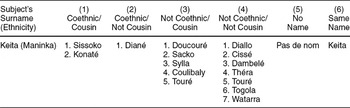
Table 2 shows a typical row of our matrix, this one for a subject named Keita who is from the Malinké (also known as Maninka) ethnic group. The columns of Table 2 give the politicians’ surnames associated with each of the six treatment and control conditions, for such a subject. For example, politicians with the surnames in the first two columns are coethnics of the subject; however, those in the first column (Sissoko and Konaté) are considered cousins of the Keita, whereas those in the second (Diané) are not. The surnames in the third and fourth columns, meanwhile, are associated with other (non-Malinké) ethnic groups, some of which are cousins of the Keita (third column) and some of which are not (fourth column). In cells with multiple entries, such as in the first, third, and fourth columns in Table 2, the politician's last name was selected at random from the names listed in the cell. The surnames included in each column are not intended to be exhaustive; for instance, the first and third columns of the matrix do not include all possible cousins for this subject surname. Rather, we sought to use politician surnames for which cousinage links are well understood and widely recognized, so that we could accurately manipulate the stimuli to which subjects were exposed.
Typical Row of Our Random Assignment Matrix

One important question is whether we were in fact able to manipulate subjects’ perceptions of their ethnic and cousinage ties to politicians. This is important because we ultimately care about how subjects’ perceptions of these ties to politicians shape candidate evaluations. In some cases, we were concerned that we risked misclassifying the stimuli to which subjects perceived themselves to be exposed. As a manipulation check, we therefore asked subjects to identify the ethnicity of the politician in the videotape and also whether the politician was a joking cousin of the subject. (We did this only after subjects had answered all questions related to the treatment.)
Subjects perceived both the politician's ethnic identity and their cousinage ties to the politician with substantial accuracy. First, given only the politician's last name and choosing from more than 14 ethnic categories, subjects correctly classified the politician's ethnicity more than 80% of the time. In the control condition in which no politician surname was provided, subjects’ guesses roughly tracked the distribution of ethnic groups in Bamako. Next, when assigned to view a speech by a politician from a different ethnic group, subjects correctly classified the politician as a cousin or a noncousin nearly 85% of the time. Subjects more often misclassified their cousinage ties to politicians from their own ethnic group (in particular, they more often classified coethnic cousins as noncousins than they did coethnic, noncousins as cousins). As a substantive matter, the direction of the misclassification may serve to emphasize that cousinage alliances are typically understood to cut across ethnic groups.Footnote 27
We recruited experimental subjects by approaching men and women sitting outside homes (or knocking on doors) and asking if they would participate in a study on political speeches. Distributions on several measured variables in the experimental population, such as ethnicity and age, are similar to those given for Bamako and Mali as a whole by representative surveys (Afrobarometer 2007). However, the experiment severely underrepresents women, who comprise just 27% of the experimental population.Footnote 28 After approaching a potential subject, we administered a screening questionnaire in which we sought background information, including first and last name and ethnic identity.Footnote 29 The information gathered during screening allowed us to determine subject eligibility and to assign subjects randomly to the treatment and control conditions.Footnote 30
To create the political speech to be viewed by the experimental subjects, we drew on fieldwork conducted by one of us (Harrison) in Bamako during Mali's parliamentary elections in 2007, as well as secondary sources. The speech focused on standard themes in Malian political campaigns, such as the need to improve infrastructure, invest in schools, and relieve electricity blackouts. Approximately 56% of experimental subjects said the speech “reminded them of a speech they had heard on a previous occasion.” The speech was delivered in Bambara/Bamanakan, which is the lingua franca of Bamako (and of Mali).Footnote 31 The fieldwork for our experiment took place from June to October 2008.
Subjects viewed the videotaped political speech on a portable DVD player or laptop computer using headphones. When subjects were found in groups, only one subject was recruited per group; only the subject could hear the speech through the headphones, and each subject answered follow-up questions on his or her own. These features of the research design limited the potential for subjects’ responses to treatment to depend on the treatment assignment of other subjects, which would violate the standard assumption in experimental analysis of “no interference between units” (Cox Reference Cox1958) or what Rubin (Reference Rubin1978) called the “stable unit treatment value assumption” (SUTVA).
Follow-up questions then asked subjects to evaluate the content of the speech and the politician who delivered it. For instance, subjects answered questions about the speech's quality, whether the speech made them want to vote for the candidate, and candidate attributes such as competence, likeability, and intelligence. The experimental manipulation was reinforced through repetition of the politician's surname. Our research assistants mentioned the politician's surname before playing the videotape (after subjects were randomly assigned to one of the treatment conditions) and repeated it each time they asked about the candidate or the speech in the posttreatment questionnaire. Our Malian research assistants asked the follow-up questions in French, Bambara, or a mixture of the two.Footnote 32
A final aspect of the experimental design to note is that we sought to achieve a within-subjects component to the experimental design in order to reduce the variance of estimated treatment effects. To do this, we hired two Malian actors, who each separately recorded the political speech; some subjects saw the speech twice, with a different actor each time. However, we took care to ensure that the identity of the actor did not interact with other experimental stimuli.Footnote 33 The results reported here are qualitatively very similar when we drop all data from second showings of the speech. The experimental protocol was published prior to data analysis (Dunning Reference Dunning2009), as recommended by many methodologists.
It bears emphasis that we might expect treatment effects to be weak in this experiment, for several reasons. First, viewing a videotaped political speech may not closely approximate the experience of attending a real political rally. Despite our attempt to create a speech that is similar to typical campaign speeches, the delivery of the speech via a laptop or DVD makes the stimulus somewhat artificial. Second, subjects were not asked to evaluate politicians whom they already knew, and the effects of cousinage or coethnicity could be different (perhaps stronger) with different candidate histories. Finally, merely changing the last name of the politician across different treatment conditions may not provide a strong priming of ethnic identification or cousinage ties. By simply changing the last name of the politician giving a speech, we may fail to capture the subtle and perhaps more powerful ways in which political actors call on the institution of cousinage to serve their strategic purposes.
Nonetheless, our substantive wager was that ethnic ties and cousinage-based alliances are sufficiently important that merely changing the last name of the politician would allow us to capture some of the interacting effects of these cross-cutting cleavages. However, the true effects of cousinage and ethnic ties may be substantially stronger than those we estimate here.
EXPERIMENTAL RESULTS: INTENTION-TO-TREAT ANALYSIS
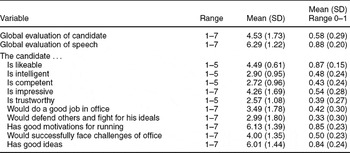
After viewing the videotaped political speech, subjects were asked, “On a scale of 1 to 7, how much does this speech make you want to vote for (name of politician)?”Footnote 34 For subjects assigned to the control condition in which the politician's last name was not given, this candidate replaced name of politician. Higher numbers indicate more favorable evaluations. The average candidate evaluation was 4.53 across all treatment conditions, with a standard deviation of 1.73. Table 3 reports descriptive statistics for all response variables analyzed in this article. Because posttreatment questions were measured on different scales (some on a scale of 1–5 and others on a scale of 1–7), Table 3 also presents means and standard deviations for the response variables, rescaled to run from 0 to 1.
Descriptive Statistics on Response Variables (Across All Treatment Conditions)

The table reports the theoretical (and empirical) range, mean, and standard deviation for each variable analyzed in the article. The final column reports means and standard deviations for each variable, recoded on a 0–1 scale.
How did coethnicity and cousinage alliances shape subjects’ evaluations of candidates? To answer this question, we compare average responses among subjects randomly assigned to the various treatment and control conditions. Such intention-to-treat analysis estimates the causal effect of treatment assignment (Freedman Reference Freedman2006). The intention-to-treat principle implies that we ignore (for the moment) whether subjects actually believed the politician to be their coethnic or their cousin; we return to this important issue later in the article.
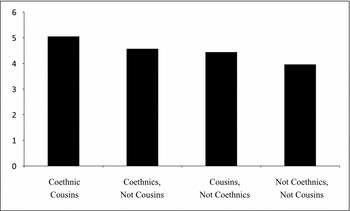
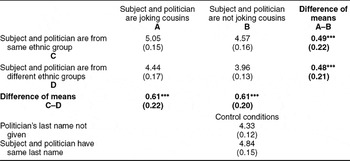
Figure 1 graphically depicts average candidate evaluations by treatment assignment category for four treatments, and Table 4 reports the full results. As Figure 1 and Table 4 show, both coethnicity and cousinage alliances significantly affect candidate evaluations. On average, assignment to view a speech by a coethnic, rather than a politician from a different ethnic group, raised candidate evaluations by more than one half a point, whereas assignment to view a cousin rather than a noncousin increased evaluations by just under one half of one point. Taken together, the effects imply that assignment to view a speech by a coethnic cousin, rather than a noncousin from a different ethnic group, raised the average evaluation by 1.09 points (with a t statistic of 5.54), or nearly two thirds of one standard deviation.Footnote 35
Average Candidate Evaluations, by Treatment Assignment

Average Candidate Evaluations, by Treatment Assignment

The cells report average answers to the question, “On a scale of 1 to 7, how much does this speech make you want to vote for (name of politician/this candidate)?” Estimated standard errors are reported in parentheses.
***p < .001.
Most important for our purposes, the evidence suggests that cousinage relations can counteract the negative effects of ethnic differences on candidate evaluations. In fact, the average evaluation of cousins from a different ethnic group (4.44) is statistically indistinguishable from the average evaluation of noncousins from the same ethnic group (4.57). On average, subjects appear roughly indifferent between noncousins from their own ethnic group and cousins from a different ethnic group.
We subjected these results to a variety of robustness tests. Nonparametric, two-sample Wilcoxon rank-sum tests, which are based on the median rather than the mean, tell the same story as the parametric analysis: coethnics are significantly preferred to non-coethnics, and cousins are significantly preferred to noncousins, whereas preferences for joking cousins from a different ethnic group and noncousins from the same ethnic group are statistically indistinguishable. We also found very similar treatment effects for similar questions, such as “On a scale of 1 to 7, how would you rate the global quality of this speech?” Because our main analysis effectively pools across multiple experiments, one for each subject surname, we also analyzed treatment effects by individual surnames; although sample sizes are small, even for the most common last names, the results track the aggregate findings. Finally, we conducted several tests using permutation distributions of the test statistics, under the sharp null hypothesis of no unit-level effects, and found substantively identical results.Footnote 36
In addition, although our intention-to-treat analysis suggests significant effects, it likely underestimates the effect of treatment receipt. As we show in the Appendix, treatment effects are nearly 50% larger once we adjust for some mismatches between treatment assignment and subjects’ perceptions of the treatment—that is, when we estimate the effects of treatment on those who perceive the treatment as we intended. Note that here and in the Appendix, we do not present analysis by “treatment received”; that is, we do not compare all subjects who perceive the politician to be a cousin to all those who perceive the politician to be a noncousin. Suppose that some subjects generally feel more positively about other people and are also more likely to identify other people as their joking cousins. By comparing subjects who identify the politician as a cousin with those who do not, we might misleadingly infer that cousinage boosts evaluations of politicians when instead there is simply an omitted confounder—that is, how positive a subject is about people in general. Use of our “objective” matrix, rather than the de facto perceptions of subjects, solves this problem by randomizing people to treatment conditions. However, we can then use the random assignment to address the important issue of perception by estimating the “effect of treatment on compliers” (see the Appendix).
Qualitative data gathered during the experiment also underscore the political salience of both ethnic and cousinage ties. In response to open-ended questions, subjects frequently made disparaging remarks about candidates from different ethnic groups. For example, an ethnic Bamanan subject who saw a speech by a politician named Guindo (a patronym from the Dogon ethnic group) said someone named Guindo “could never do a good job” as a politician. Another Bamanan said that Dogons “don't know how to lead.” An ethnic Songhai suggested that Bobo ethnics “don't know anything about politics,” whereas an ethnic Malinké subject said the same of Dogons. An ethnic Soninké subject, in turn, offered the opinion that “the Malinkés are not intelligent.”
Subjects tended to offer more positive comments about coethnics. For instance, a Bamanan subject named Koné saw a speech by a coethnic named Diarra and said “the Koné and the Diarra are the same thing.” One subject who said he paid attention to the candidate's family name in reflecting on the candidate's merits said he did so because “it is important to know the identity of the candidate.” Subjects also held a special regard for politicians who shared their own surnames. A subject with the last name Anne offered the opinion that “the Anne family is composed of intellectuals.” One subject named Sacko said that “a Sacko is a hard worker,” and another commented that the “Sackos are very cultured.” A griot (oral historian) named Kouyaté commented that “if a griot [Kouyaté] is a candidate, it is because he is capable of many things,” whereas a Malinké subject named Koné said that she paid attention to the politician's name of Koné because the “Konés are nobles.” (The Konés were members of the caste of nobles during the Mali Empire.) A subject named Keita, when asked whether she would be more susceptible to vote for a candidate sharing her family name, said “yes, like uncle IBK”—a reference to an opposition candidate during the 2007 presidential elections, Ibrahim Boubacar Keita.
Finally and most important, subjects offered several rationales for their tendency to support cousins. The ability of cousins to reprimand and sanction one another appeared to play a particularly important role. As one subject put it, if a joking cousin “is not serious, we will correct him.” Another said she would vote for her cousin because “if he does not respect his promises, I will bring him to heel, because he is a cousin.”
These comments suggest some hypotheses about why subjects prefer candidates who are their cousins. Unfortunately, our data do not allow us to distinguish rigorously between independent families of mechanisms that may explain why subjects vote for coethnics and cousins, as Habyarimana et al. (Reference Habyarimana, Humphreys, Posner and Weinstein2007), for example, have sought to do in explaining why ethnic diversity inhibits public goods provision.
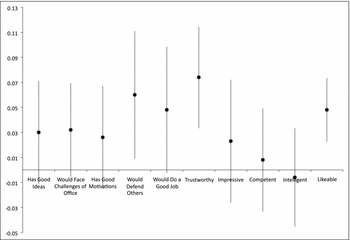
Nonetheless, our analysis does provide some important clues. Figure 2 presents mean differences, across the cousin and noncousin conditions, in subjects’ evaluations of candidate attributes such as likeability, competence, intelligence, and trustworthiness. To focus attention on the effects of cousinage, in Figure 2 we pool across the ethnic relationship between subjects and politicians; that is, we compare subjects assigned to the “coethnic cousin” or “non-coethnic cousin” conditions with subjects assigned to the “coethnic, noncousin” or “non-coethnic, noncousin” conditions. Such pooling is appropriate for two reasons. First, coethnicity is assigned at random with equal probability, so there are about as many coethnics as noncoethnics in each of the cousin and noncousin conditions (Table 1). Second, our analysis suggests additive rather than interactive effects (Table 4). Thus, pooling readily allows us to estimate the effects of cousinage, net of the effects of ethnicity.Footnote 37 Note that for purposes of comparability across differing scales, in Figure 2 the raw variables measuring subjects’ evaluations of candidate attributes are all rescaled to run from 0 to 1.
Effects of a Cousinage Alliance on Evaluations of Candidate Attributes (Differences of Means, Cousins Minus Noncousins)

Our quantitative analysis echoes the qualitative comments discussed previously. The single largest difference of means is for a survey question asking subjects whether the candidate is trustworthy.Footnote 38 On the 0–1 scale, cousins are viewed as over 0.07 points more trustworthy than noncousins, for a statistically significant effect size of more than one fourth of a standard deviation. Cousins are also rated more favorably than noncousins on other variables that tap expectations about postelectoral behavior, such as whether the candidate would do a good job if elected, whether he or she would fight for others and defend his or her ideals, or whether he or she could successfully face the challenges of office (although for the latter two variables, the differences of means are significant only at the 0.1 level). In contrast, cousins are seen as no more competent, intelligent, or impressive than noncousins. They are, however, viewed as more likeable than noncousins.Footnote 39
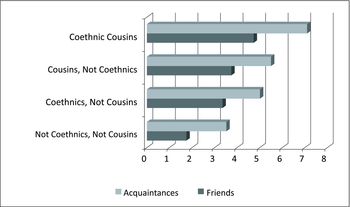
One interpretation of these data is indeed that voters anticipate being able to sanction cousins who renege on campaign promises, or anticipate being able to procure benefits from their cousins, thus making such candidates more “trustworthy.”Footnote 40 Perhaps social networks also allow voters to monitor and sanction both cousins and coethnics.Footnote 41 In our postreatment questionnaire, we asked subjects how many of their close friends and acquaintances (i.e., people they see regularly but who are not as close as friends) bear the same last name as the politician in the video; possible answers ranged from 0 to 10 or more.Footnote 42Figure 3 displays the average number of close friends and acquaintances bearing the last name of the politician in the video by treatment assignment. Notice that subjects assigned to the coethnic cousin condition have on average 4.73 friends and 7.1 acquaintances with the politician's last name, whereas subjects assigned to the noncoethnic, non-cousin condition have on average just 1.75 friends and 3.52 acquaintances with the politician's surname.Footnote 43 It is possible that voters prefer their cousins and coethnics because they are more tightly linked with them in social networks, which may also make it easier for them to sanction politicians who perform poorly.Footnote 44
Mean Number of Subjects' Friend and Acquaintances Sharing the Politician's Last Name (by Treatment Assignment)

However, these are not the only interpretations consistent with our evidence. It could well be that the greater trustworthiness of cousins is related to their greater likeability, although the fact that cousins are not seen as any more intelligent, competent, or impressive than noncousins may weaken the interpretation that affective factors play an important role. Our data cannot readily tell us whether likeability and trustworthiness are independent dimensions that shape candidate evaluations,Footnote 45 nor can they tell us the precise role played by social networks. Although it is possible that networks increase cousins’ trustworthiness by allowing voters to monitor and sanction their cousins more effectively (Stokes Reference Stokes2005), just as they may monitor coethnics in other contexts (Fearon and Laitin Reference Fearon and Laitin1996), further evidence is needed on this point. In the final analysis, we cannot adjudicate between all such alternative mechanisms. Future research should seek to explain further why voters prefer coethnics and their cousins.
CAN COUSINAGE ALLIANCES EXPLAIN THE ABSENCE OF ETHNIC VOTING IN MALI?
To what extent can the causal effects revealed by our experiment help explain the real world puzzle we have highlighted—namely, the weak relationship between ethnicity and individual vote choice in Mali? Comparing cousinage to other explanatory factors is challenging. For example, existing data on individual vote choice do not include measures of joking kinship alliances between voters and politicians, so it is difficult to assess the “variance explained” by cousinage. However, our own data allow us to make some progress in this regard. In this section, we discuss external validity and several related topics before turning to alternative explanations.
First, note that random assignment to the treatment conditions supports the internal validity of our conclusions and implies that we can validly estimate causal effects for our experimental study group. Yet, is the study group representative of the population of Mali, or even of Bamako? As noted previously, our field investigators canvased every neighborhood of Bamako in a more-or-less random way. However, subjects who chose to participate in the experiment (or whom our field investigators chose to persuade to participate) may be unlike those who refused in ways that matter for subjects’ responses to treatment. Thus, even if strict probability sampling had been used to recruit subjects, nonparticipation might have posed obstacles to validly extrapolating estimated treatment effects to broader populations. In addition, the capital city is clearly unlike the rest of Mali in many ways, which may also limit the external validity of our findings.
Although we cannot fully correct for nonparticipation, we can partially assess the resulting degree of bias when we extrapolate estimated treatment effects to broader populations. As noted previously, the distribution of key covariates in the experimental study group is quite similar to those reported by representative surveys. For example, if we pick any two experimental subjects from our data set, the probability that they are coethnics is about .17. This number is strikingly consistent with the ethnolinguistic fractionalization score of .84 reported for Mali by Alesina et al. (Reference Alesina, Devleeschauwer, Easterly, Kurlat and Wacziarg2003, 185), which gives the probability that two individuals selected at random are from different ethnic groups. This may also imply, inter alia, that our study group includes a fairly representative sample of last names because there is no a priori reason to think that our sampling process would over- or underrepresent particular last names, within each ethnic group.Footnote 46
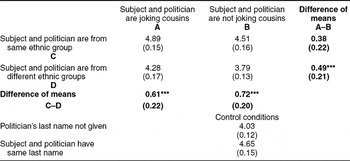
However, we were quite concerned about the underrepresentation of women in our sample. After all, if treatment effects differ systematically for men and women, we might risk bias in extrapolating effects from our study group.Footnote 47 To evaluate this possibility, we estimated the treatment effects reported in Table 4 separately for men and women (the results are reported in an online Appendix).Footnote 48 Note that for both men and women in our study group, our estimators are unbiased and internally valid because both men and women were randomized to treatment conditions. In Table 5, we present the weighted average of these unbiased estimates, where the weights are proportional to the inverse of the probability of selection for men and women.Footnote 49 In principle, this procedure allows us to correct for the overrepresentation of men and the underrepresentation of women. Note, however, that in using the weights to extrapolate to the population of Bamako, we are in effect assuming that we have a simple random sample of men and a simple random sample of women, which may be a strong assumption. Thus, we preferred to begin with the estimates of causal effects reported in Table 4, which are internally valid for our experimental study group.
Average Candidate Evaluations, by Treatment Assignment (Weighted Averages of Male and Female Subjects)

The cells report average answers to the question, “On a scale of 1 to 7, how much does this speech make you want to vote for (name of politician/this candidate)?” The table reports weighted averages of treatment effects estimated separately for men and for women, where the weights are proportional to the inverse of the probability of selection. Estimated standard errors are reported in parentheses and are as in Table 4.
***p < .001.
Our evidence suggests that cousinage and coethnicity shape the voting preferences of men and women in similar ways. Although female subjects evaluated our male candidates less positively than did male subjects, on average (across all cells of Table 5, candidate evaluations are 0.17 points lower than in Table 4), there is little difference in the estimated effects of cousinage or coethnicity. Women in our study group may be marginally more influenced by coethnicity than by cousinage (e.g., among subjects exposed to coethnic politicians, the weighted average effect of cousinage is no longer significant; however, it is significant for those exposed to non-coethnics). However, the differences are slight. Thus, even when we adjust for the underrepresentation of women, as in Table 5, the substantive interpretation of the results is the same: coethnicity and cousinage both boost evaluations of our candidates, but the two effects are similar in size and nearly cancel each other out.
Evaluating other biases that might be introduced in extrapolating our treatment effects is a subtler issue. For example, would we find different treatment effects in an experimental study group drawn from the whole country? The only way to answer this question is through replication of the experiment on a nationally representative sample. However, we do have some capacity to evaluate whether the effects of cousinage might be particularly strong (or weak) among urban dwellers. First, it is useful to note that urban residents are quite mobile: nearly 87% of our experimental study group has lived somewhere besides Bamako. Perhaps unsurprisingly, given that this set of subjects predominates in the experimental study group, we find that treatment effects for this subgroup are very similar to those reported in Table 4. Second and more interesting, we find very similar estimated treatment effects when we restrict the sample to subjects who have lived in Bamako for less than five years in total (15% of the study group) or less than ten years in total (34% of the study group).Footnote 50 Thus, we can have at least some confidence that cousinage may have similar effects outside the capital city.Footnote 51
Several pieces of additional evidence may be required to support our claim that cousinage helps explain the limited role of ethnic voting in Mali. First, cousinage links between voters and politicians must be widespread and comparable in frequency to ethnic ties. After all, if cousinage alliances only affect a small proportion of the population, they cannot very plausibly counter the effects of ethnicity on voter preferences in the electorate as a whole. To evaluate this issue, note that the probability that any subject drawn at random from our data set has a given surname is the number of subjects with this surname, divided by the total number of subjects. The probability that a second subject drawn at random is the cousin of the first subject is the number of the first subject's cousins in our data set, again divided by the number of subjects. The probability of drawing a subject with the first surname and then drawing a subject who is his or her cousin is then the product of these two probabilities. (This assumes drawing with replacement, a minor technical issue.) Then, the probability that any two names drawn from our data set are cousins is the sum of the individual probabilities, calculated in this way for each surname. Assuming arguendo a representative sample of last names in our experimental study group, the latter sum estimates the probability that any two individuals drawn at random from the population of Bamako are cousins.
Our analysis suggests that cousinage alliances are at least as widespread as coethnic ties. The estimated probability that any two individuals drawn at random are cousins is at least .14.Footnote 52 By comparison, recall that the estimated probability that two randomly drawn individuals are coethnics is about .17. It also bears emphasis that leading exemplars of cross-cutting cousinage alliances are very common in our data set. For example, approximately 10% of our subjects are named either Keita or Coulibaly; on average, at least one half of 1% of randomly drawn subject pairs will include one Keita and one Coulibaly, whose cousinage alliance cross-cuts the Malinké and Bambara ethnic groups.Footnote 53
Second, our evidence suggests that cousinage is not only a widespread social institution, but also politically relevant. In our experiment, the estimated effects of cousinage alliances are strongest for politically active subjects—defined as subjects who say that they are registered to vote and who have voted in the most recent presidential and parliamentary elections. Although the group of politically active subjects is smaller than the group of nonactive subjects, estimated treatment effects tend to be substantively large and statistically significant for this smaller, politically active group. For the larger, nonactive group, estimated treatment effects are smaller and sometimes insignificant.Footnote 54 In addition, the political salience of cousinage appears independent of any “modernization” effect, whereby the importance of cousinage recedes as people become more educated. If anything, causal effects are stronger for more educated subjects (those who have a baccalaureat) than for less educated subjects. The heightened relevance of cousinage alliances among politically active and educated citizens may suggest the political utility of these alliances in fully “modern” forms of electoral competition.
If cousinage alliances are both politically salient and strategically useful for candidates (as our brief examples suggested earlier in this article), then party leaders may also exploit the preference of voters for their cousins in placing candidates on party lists. We devised a way to investigate this possibility more systematically. First, we used three rounds of Afrobarometer survey data to estimate the distribution of ethnic groups within each of the electoral constituencies from which candidates on single or multimember party lists are elected to the National Assembly.Footnote 55 The Afrobarometer surveys taken in 2001, 2002, and 2005 were all nationally representative probability samples, and each survey has respondents from most of Mali's 55 constituencies.Footnote 56 Combining data across the three surveys gives us probability samples of, on average, 87 respondents per constituency, with a median of 60. Because most constituencies have one or two major ethnic groups, this sample size allows us to estimate the distribution of ethnic groups in each constituency with reasonable precision. Next, we obtained the names and ethnicities of 221 candidates placed on party lists by Mali's three largest parties, ADEMA-PASJ, RPM, and URD, during the 2007 legislative elections. Together, these parties won 96 of 147 seats in the National Assembly. We then coded the ethnic match between each candidate and his or her electoral constituency. Because the largest ethnic group in each constituency comprises, on average, nearly 71% of the population, it makes sense to code whether each politician comes from the largest ethnic group in his or her constituency. However, our results are similar if we instead code whether each candidate came from one of the two largest, three largest, or four largest ethnic groups.Footnote 57
To evaluate the extent of cousinage alliances between ethnic minority candidates and the ethnic majority group(s) in each candidate's constituency, we then calculated two probabilities: the probability that a voter drawn at random from the largest ethnic group (or groups) in a given constituency would be a cousin of each candidate, and the weighted average probability that a voter drawn at random from any other ethnic group would be a cousin of the candidate (where the weights are the relative sizes of the other ethnic groups). Under the null hypothesis that parties are not paying attention to cousinage relations between ethnic minority candidates and ethnic majority groups, these probabilities should be about the same. In contrast, if parties pay attention to cousinage relations in placing candidates on party lists, we may find that ethnic minority candidates are disproportionately likely to have cousinage relations with voters from the ethnic majority group.Footnote 58
Our results suggest, first, that in choosing candidates, parties in Mali underrepresent major ethnic groups in each electoral constituency. Although the largest ethnic group comprises 71% of each constituency on average, the candidates in our data set come from this ethnic group just 39% of the time.Footnote 59 In other words, the probability that any voter and any citizen-candidate picked at random from the pool of citizens will both come from the largest ethnic group is (.71)(.71) = .50, on average. Yet, the probability that a voter drawn at random and a candidate picked at random from an actual party list will both come from the largest ethnic group is just (.71)(.39) = .28. The gap to be explained is thus on the order of 50 − 28 = 22 percentage points. This finding, striking as it is, is obviously consistent with the puzzle that motivates this article.
However, we also find that the strategic use of cousinage relations by parties may at least partially account for the lack of ethnic match between candidates and their constituencies. Recall that the estimated probability that a voter and a citizen-candidate drawn at random are cousins is .14; thus, cousinage may go some distance toward explaining the gap between .50 and .28. Most relevant here, the estimated probability that an ethnic-minority candidate is a cousin of a randomly drawn voter from the majority group is .16, whereas the estimated probability that this candidate is a cousin of a randomly drawn voter from any other ethnic group is .09.Footnote 60 In other words, our evidence suggests that ethnic minority candidates are at least two thirds more likely to be cousins of voters in the ethnic majority group than they are to be cousins of ethnic minority voters.
A final piece of evidence also supports our argument. As we show, coethnicity and cousinage both positively affect candidate evaluations. Given the weak association between ethnicity and vote choice in observational data, coethnic and cousinage ties must arguably be negatively associated, in the sense that one's cousins tend disproportionately to be non-coethnics; if so, omitting the effects of cousinage from observational analyses would suppress the true effect of ethnicity. We use the following procedure to verify this claim. For each experimental subject, we can use the information in our random assignment matrix to classify the subject's ethnic and cousinage ties to an ethnically Malinké politician named Keita, the patronym of Mali's first president after independence.Footnote 61 Our analysis suggests a strong negative relationship between ethnic and cousinage ties, at least for this patronym. Among subjects from the Malinké ethnic group, just 34% of subjects are also cousins with the Keita. In contrast, among subjects from non-Malinké ethnic groups, around 57% are cousins of the Keita. In other words, for a politician named Keita, the off-diagonal cells in the top two rows of Table 1 are more heavily populated, empirically, than are the diagonal cells.Footnote 62 Although our data do not allow us to investigate the relevant covariance for all potential politician names, our analysis therefore suggests the strong plausibility that cousinage and coethnic ties are negatively related.
What about other explanations? Our claim is by no means that cousinage constitutes the only reason there is relatively little ethnic voting in Mali. Our experiment does not readily allow us to compare the strength of cousinage with all other potential explanatory factors, although our experiment does usefully suggest that the cross-cutting effect of cousinage almost exactly cancels the effect of coethnicity on candidate preferences.
Yet, it is also useful to note that some plausible alternative explanations appear incomplete on close examination. For instance, it has been suggested that French colonists encouraged forms of occupational specialization that cross-cut ethnic groups, or instituted other policies that limited the political salience of ethnicity. Our ability fully to probe alternative “French colonialism” arguments is somewhat limited, because the countries where cousinage is practiced are indeed former French colonies. However, ethnicity does have a political role in many former French colonies in sub-Saharan Africa in which cousinage is not practiced, such as Congo-Brazzaville or Chad. Perhaps the most interesting comparison is to Benin, located just south of Burkina Faso and not far from Mali; Benin is among the countries in French West Africa without cousinage and with ethnic politics (Basedau and Stroh Reference Basedau and Stroh2009; Koter Reference Koter2009). We have not found evidence that the French encouraged greater cross-cutting occupational specialization in Mali than in Benin or their other West African colonies.Footnote 63
Other explanations for the limited salience of ethnicity in Mali and elsewhere where cousinage is practiced may well be complementary, rather than alternative. Koter (Reference Koter2009), for example, has examined how distinct modes of mobilizing traditional authority may account for the contrasting role of ethnic politics in Benin and Sénégal. Yet, the existence of cross-cutting cousinage ties in Mali and Sénégal (but not Benin) may have made patterns of mobilization along nonethnic lines more feasible as well. List voting and proportional representation could also contribute to our finding that parties tend to include candidates from nonmajority groups on lists. For instance, parties may put one or two candidates from the majority ethnic group on their lists and also include minority candidates. However, this cannot be a sufficient condition for nonethnic voting, because several former French colonies (including Benin) have both list voting and ethnicized politics. The presence of list voting also does not explain why, in Mali, candidates from minority groups are disproportionately likely to be cousins of voters from majority ethnic groups, as we found previously. It is indeed striking that in West Africa, ethnicity has a more limited political role in those countries located largely in the Western Sahel zone in which cousinage is practiced, such as Mali, Sénégal, The Gambia, and Guinea, than in countries where it does not exist, such as Benin or Nigeria. Thus, although the observational evidence presented in this section cannot definitively tell us how much variance cousinage explains or completely allow us to compare the effect of cousinage to alternative or complementary explanations, it does support our claim that cousinage helps explain the absence of ethnic voting in Mali.
CONCLUSION
Social scientists have often suggested that cross-cutting cleavages may moderate the development of political conflict along any one dimension of identity or interest. We have assessed whether cross-cutting ties can explain the limited presence of ethnic voting in Mali, an ethnically heterogenous sub-Saharan African country. In contrast to previous observational research, our experimental results suggest that cousinage alliances and coethnicity both positively shape voters’ evaluations of candidates. Yet, due to their cross-cutting structure, cousinage ties counteract the effects of coethnic relationships. Cousinage thus plausibly contributes to the weak relationship between ethnicity and vote choice in Mali. Our results may also help explain why ethnic politics have a relatively minor role in several other countries of the Western Sahel zone in West Africa.
Of course, we do not mean to suggest that cousinage alliances provide the only reason that ethnicity appears unrelated to vote choice in Mali or other countries where cousinage exists. Other explanations for the limited political salience of ethnicity may be complementary, rather than alternative, and future research should probe the relative strength of other explanatory factors. Our experiment and our supplementary evidence simply demonstrate that there is indeed a causal effect of cousinage alliances and ethnic ties on candidate evaluations—something not easily inferred from previous research—and that the cross-cutting nature of these ties can account for the lack of salience of ethnicity in electoral politics.
The experimental design we introduce in this article could be useful for exploring other questions. For instance, why do cross-cutting cleavages seem to inhibit ethnic voting in some settings but not others? Does the nature of the cross-cutting cleavage structure (e.g., the empirical distribution of voters along different cleavage dimensions) matter? How do political or electoral institutions interact with cleavage structures? An innovative theoretical and empirical literature recently addressed such questions (e.g., Chandra Reference Chandra2005; Posner Reference Posner2004a, Reference Posner2005), and an impressive body of observational research has been built up. Research designs similar to the one we have employed could readily complement and extend such research to illuminate the political effects of cross-cutting cleavages.
APPENDIX: EFFECT OF TREATMENT ON COMPLIERS
As discussed in the text, one inferential issue in our experiment is that subjects may not perceive themselves to be in the intended cell of Table 1—that is, the treatment condition to which they were randomly assigned. For example, a subject might perceive a politician who we intend to be a coethnic cousin as, say, a cousin from a different ethnic group. This may be problematic because we ultimately care about how perceiving oneself as being a cousin or coethnic of a politician shapes evaluations of candidates. From an inferential standpoint, this issue is analogous to the standard problem of experimental crossover. In a typical experiment to evaluate a new medical drug, not all subjects will follow the experimental protocol. Some subjects assigned to the treatment regime may refuse the drug, whereas subjects assigned to control may seek out the treatment. Crossover from the treatment to the control arm of the experiment tends to dilute the effects of treatment assignment (Freedman Reference Freedman2006).
Under some conditions, experimental data may be adjusted to recover the effect of treatment on compliers, that is, the effect of treatment on subjects who follow the treatment regime to which they are assigned.Footnote 64 In our application, compliers are those who “correctly” perceive the treatment condition we intend. In posttreatment questionnaires, we asked subjects to identify the ethnic group to which the politician in the video belonged, and also whether the politician in the video was the subject's joking cousin. Using these questions and the self-identified ethnicity of subjects, we are able to code whether subjects assigned to a particular treatment condition in fact perceived the politician as we intended.
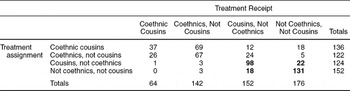
Table 6 cross-tabulates treatment assignment and perceived treatment receipt. As the bolded cells in Table 6 show, subjects who viewed a speech by a politician from a different ethnic group could determine with substantial accuracy whether the politician was their cousin. (Put differently, their perceptions matched the perceptions of the informants who helped us construct our random assignment matrix.) Nonetheless, as the bolded cells suggest, there was some crossover from the non-coethnic, cousin to the non-coethnic, noncousin condition and vice versa. In addition, subjects who were assigned to view a speech by a coethnic perceived themselves in the “wrong” treatment condition with greater frequency.Footnote 65 In general, estimation of the effect of treatment on compliers is a complicated proposition. For one, subjects assigned to view speeches by coethnics crossed over to each of several other conditions.
Treatment Assignment and Treatment Receipt

The rows of the table report the number of subjects assigned to each treatment condition; columns report subjects’ perceptions (i.e., the columns report the number of subjects who perceived themselves to be exposed to each treatment condition, as measured through questions about the subject's ethnic and cousinage relationship to the candidate).
However, it is reasonable to estimate the effect of cousinage on compliers for those subjects assigned to view speeches by politicians from a different ethnic group. In that case, nearly all crossover occurred between the cousin and the noncousin conditions. Moreover, treatment assignment is strongly correlated with treatment receipt. Nearly 80% (98/124) of subjects assigned to the non-coethnic cousin condition correctly perceived the intended treatment, whereas the same held for more than 85% (131/152) of subjects assigned to the noncoethnic, noncousin condition.
Ignoring the very few such subjects who perceived the politician to be a coethnic (see the third and fourth rows of Table 6), we can thus estimate the effect of treatment on compliers (ETC) for subjects assigned to view a speech by a politician from a different ethnic group as follows:

The numerator of the estimator in Equation (1) is the estimated intention-to-treat parameter, which is calculated by subtracting the right-hand cell of the second row of Table 4 from the left-hand cell. The denominator is the proportion of subjects assigned to the non-coethnic, cousin condition who correctly perceive treatment assignment (i.e., 98/124 or 0.79) minus the proportion of subjects assigned to the different ethnicity, noncousin condition who (incorrectly) perceive themselves to be viewing a speech by a joking cousin from a different ethnic group (i.e., 18/152 or 0.12). The estimated effect of treatment on compilers of 0.72 in Equation (1) is 50% greater than the estimated intention-to-treat parameter in the numerator, that is, 4.44 −3.96 = 0.48.



Comments
No Comments have been published for this article.