Ministerial office represents the pinnacle of political power. Quite rightly, politics and gender and comparative scholarship is paying increasing attention to women's access to political executives (Claveria Reference Claveria2014; Davis Reference Davis1997; Escobar-Lemmon and Taylor-Robinson Reference Escobar-Lemmon and Taylor-Robinson2005; Krook and O'Brien Reference Krook and O'Brien2012; Reynolds Reference Reynolds1999; Siaroff Reference Siaroff2000; Whitford, Wilkins, and Ball Reference Whitford, Wilkins and Ball2007). These studies develop and test a range of hypotheses relating to the demographic, socioeconomic, political cultural, or political institutional factors at state or system level deemed to shape women's access to political executive office. The conclusions primarily emphasize relatively general correlations between women's ministerial representation and a nation's familiarity with women in positions of power (Reynolds Reference Reynolds1999), the prevalence of “egalitarian societies” and “leftist values” (Siaroff Reference Siaroff2000), or international pressure and regional contagion (Escobar-Lemmon and Taylor-Robinson Reference Escobar-Lemmon and Taylor-Robinson2005). Studies that address the importance of political institutional factors affecting the supply and demand of female government ministers highlight the different procedures for appointing ministers in presidential versus parliamentary democracies (Reynolds Reference Reynolds1999; Whitford, Wilkins, and Ball Reference Whitford, Wilkins and Ball2007) or the generalist versus specialist recruitment traditions of ministerial recruitment in parliamentary democracies (Claveria Reference Claveria2014; Davis Reference Davis1997; Siaroff Reference Siaroff2000). All studies flag the significance of the numerical presence of women in parliament, and some, the way the electoral system or gender quotas influence women's access to parliament (Claveria Reference Claveria2014; Krook and O'Brien Reference Krook and O'Brien2012).
The premise of this article is that recruitment to executive office cannot be fully explained by the aggregate sociodemographic characteristics of ministers or by the general characteristics associated with the political systems in which they operate. These studies' general correlations do not explain the complex factors that structure pathways to ministerial office. To understand ministerial recruitment, it is important to know precisely who is eligible to be chosen (the eligibility pool), how to qualify (generalist or specialist principles), and who select ministers (the prime minister or party).
Regarding the eligibility pool, the existing literature finds that a high share of women in parliament correlates with a high share of women in ministerial office, but this correlation only takes into account women in the single or lower house. This is misguided, as there is a strong variation in rules across parliamentary systems regarding whether ministers can be recruited from just the lower house (e.g., Germany), or from the upper house as well (e.g., UK, Australia). Moreover, it makes little sense to correlate women's ministerial presence with the aggregate number of women in parliament, as it is only women from the governing party or parties, and not the lower house as a whole, who are in the ministerial eligibility pool. Even when there is a high share of women in parliament, few may be eligible for ministerial office by dint of the fact that they sit on the opposition benches.
Women's presence in the eligibility pool does not automatically translate into a ministerial position. Yet the existing literature says little about the criteria that qualify someone to move from the recruitment pool to ministerial office. The one exception is Davis (Reference Davis1997), who specifies that specialist systems recruit on grounds of policy expertise while generalist systems reward political skill, service, and loyalty. She finds that specialist systems are more open to women's recruitment than generalist systems (1997, 46), but this is measured quantitatively rather than qualitatively.
The existing literature also provides incomplete explanations for the demand side of ministerial recruitment: who is it that selects ministers? Some studies test for correlations between the presence of a female prime minister (PM) and the number of female ministers (Krook and O'Brien Reference Krook and O'Brien2012), and others between governments of the left and women's ministerial presence (Siaroff Reference Siaroff2000). But this literature does not capture or explain the central role the PM, as primary selector, plays in structuring demand for female ministers, particularly where she is not required to form a coalition. Nor does the literature capture the significance of other actors, such as political parties, who play a role in ministerial selection.
The claim of this article is that ministerial recruitment is best explained by using new institutionalist approaches to reveal complexes of formal and informal rules that govern who is eligible, how to qualify, and who selects ministers. Drawing on the theoretical contributions of feminist institutionalists (Chappell and Waylen Reference Chappell and Waylen2013; Kenny Reference Kenny2007; Krook and Mackay, Kenny, and Chappell Reference Krook and Mackay2011; Mackay and Waylen Reference Mackay and Waylen2009), the article makes the case that women's access to ministerial office is best explained by the way these complexes of rules distribute power unequally between men and women. It also shows how rule change in these three complexes have and could improve women's chances of securing ministerial office. The research adopts a most similar system research design, selecting two countries with seemingly similar rules at the system level—the UK and Australia (Rhodes, Wanna, and Weller Reference Rhodes, Wanna and Weller2009). In these two Westminster democracies ministers may only be recruited from within parliament; in both systems generalist criteria determine who qualifies as a minister; and in both countries the PM has, in theory, autonomy over ministerial appointments, as the need to share portfolios with a coalition partner is rare. This research design allows us to establish the extent to which rules determining ministerial recruitment are identical at the system level and identify the differences that exist between and within similar systems, as well as over time. The article first sets out the benefits of a feminist institutionalist approach to the study of executive recruitment and the methodological implications of researching formal and informal rules. Second, it presents empirical data on the complexes of rules that govern who is eligible to be chosen, how to qualify, and who selects ministers in the UK and Australia, as well as how these rules are gendered and have changed. Third, it concludes with an evaluation of the types of rules that govern ministerial recruitment, stressing the predominance of informal rules, and presents some proposals for institutional reforms that would improve women's access to ministerial office in the future.
RULES, POWER, AND GENDER
New institutionalist (NI) analysis recognizes that political life is structured by formal rules, informal practices, and ideational norms (Hall and Taylor Reference Hall and Taylor1996; March and Olsen Reference March and Olsen1984; North Reference North1990; Thelen Reference Thelen1999; Reference Thelen, Mahoney and Rueschemeyer2003), and institutionalist scholars specify that each political arena has its own distinct set of formal and informal rules of the political game (Annesley and Gains Reference Annesley and Gains2010; Chappell and Waylen Reference Chappell and Waylen2013, 608; Mackay and Rhodes Reference Mackay and Rhodes2013). Feminist institutionalism (FI) significantly adds to NI analysis by theorizing and researching the ways in which formal and informal rules are gendered (Chappell and Waylen Reference Chappell and Waylen2013; Kenny Reference Kenny2007; Krook and Mackay Reference Krook and Mackay2011). Institutions can, for example, experience “gender capture” due to men's domination of politics or a “gender bias” that “seep[s] into supposedly impartial or gender neutral arrangements” (Goetz Reference Goetz, Mukhopadhyay and Singh2007, 46–47).
Formal rules are “formally constructed and written down” (Lowndes and Roberts Reference Lowndes and Roberts2013, 53) in a constitution, terms of reference, code of conduct, regulations, or policies. These can easily be identified and studied through the “tools of the lawyers and the historian” (ibid., 54) and by the formal sanctions on actors who do not adhere to formal rules. Formal rules can be explicitly gendered in negative or positive ways (Lowndes Reference Lowndes2014, 687). Equally, in politics “seemingly neutral rules … may have gendered effects because of the way they interact with informal rules derived from wider gender norms” in private or public life (ibid., 687) or with rules in other parts of the political system.
Political life is structured not only by formal rules, but also by informal rules, the “socially shared rules, usually unwritten, that are created, communicated, and enforced outside of officially sanctioned channels” (Helmke and Levitsky Reference Helmke and Levitsky2004, 727; see also Azari and Smith Reference Azari and Smith2012). Informal rules are “specific to a particular political or governmental setting, they are recognized by actors (if not always adhered to), [and] they have a collective (rather than personal) effect” (Lowndes and Roberts Reference Lowndes and Roberts2013, 47). For feminist institutionalist scholars, informal rules relating to gender are key to understanding how power is allocated in the political world (Chappell and Waylen Reference Chappell and Waylen2013). This includes social norms concerning men and women's respective roles and accepted ideas about feminine and masculine modes of behavior ascribed to men and women in public and private life, what Chappell (Reference Chappell2006) refers to as the gendered “logic of appropriateness.”
Formal and informal institutions work together in a variety of ways. Helmke and Levitsky (Reference Helmke and Levitsky2004, 728–29) propose that informal institutions can be complementary, filling the gaps by “addressing the contingencies not dealt with in the formal rules”; accommodating, creating incentives to “behave in ways that alter the substantive effects of the formal rules”; competing, structuring incentives “in ways that are incompatible with formal rules”; and substitutive, achieving what formal institutions were meant to, but failed to, achieve. An alternative strategy for establishing and assessing the interaction of formal and informal rules is the concept of “rules in use” (Kenny Reference Kenny2013; Lowndes Reference Lowndes2014; Ostrom Reference Ostrom and Sabatier1999), which avoids “making any strict separation of informal and formal rules or prejudging their relative significance” (Lowndes Reference Lowndes2014). This strategy identifies rules as “the way we do things around here” (Lowndes and Roberts Reference Lowndes and Roberts2013, 41) or the “dos and don'ts that one learns on the ground” (Ostrom Reference Ostrom and Sabatier1999, 38). For FI scholars, gender norms and practices shape the interaction between formal and informal institutions (Chappell and Waylen Reference Chappell and Waylen2013).
Institutions are not neutral in their disposition but distribute power in ways that create opportunities for and constraints on different actors (Burch and Holliday Reference Burch and Holliday1996). FI scholars make the case that power flows to one sex rather than the other as a consequence of the gendered balance of power when the institution was established (Kenny Reference Kenny2007, Krook and Mackay Reference Krook and Mackay2011). According to Chappell and Waylen (Reference Chappell and Waylen2013, 607), “earlier rules about gender can survive in an informal guise and continue to operate to enforce the same (old) expectations, relationships and power structures.”
Formal and informal rules change, and the way they interact is dynamic (Azari and Smith Reference Azari and Smith2012). Rules, practices, and norms may combine to produce institutional stability over time, but change can occur when gaps or contradictions open up between formal institutions, creating instability (Azari and Smith Reference Azari and Smith2012; Lowndes and Roberts Reference Lowndes and Roberts2013). When the “fit” between different parts of an institutional configuration weakens, “creative spaces” open up, which can lead to institutional change (Lowndes and Roberts Reference Lowndes and Roberts2013, 134). Political actors enact and sustain institutions, but actors can also exploit “creative spaces” to make, bend, and break rules (ibid., 105). Creative spaces can also be purposefully created by activists who “can work to instate practices and rules that recast the gendered nature of the political” (Beckwith Reference Beckwith2005, 132–33). However, a change in formal rules may not be accompanied by a change in informal rules, including gender norms, which are notoriously “sticky” (Chappell and Waylen Reference Chappell and Waylen2013, 603).
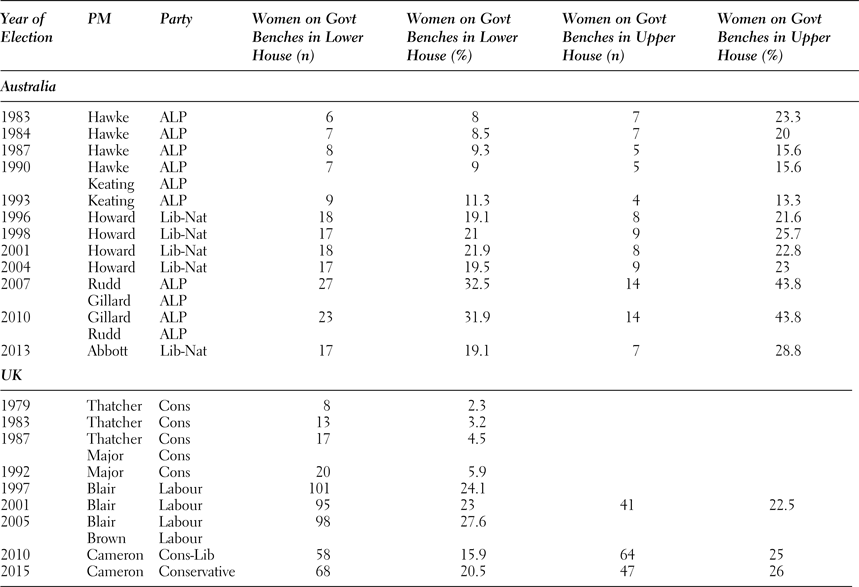
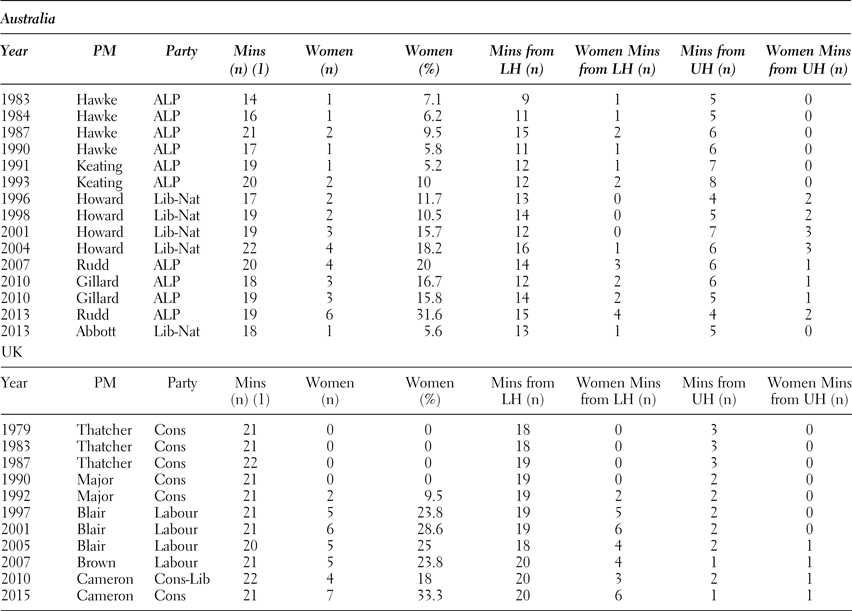
To identify the gendered and dynamic rules in use in the recruitment of ministers in the UK and Australia, the research employs a qualitative methodology. To identify any formal rules that shape ministerial recruitment, it refers to the constitution, laws, regulations, or policies at the national and party levels. Informal institutions, though hard to spot, identify, and measure, can “be recognized by actors and can be described and explained” either directly to researchers or in the form of insider accounts and expert observations (Lowndes and Roberts Reference Lowndes and Roberts2013, 47). To identify the informal rules of ministerial recruitment, this research uses data derived from seven semistructured elite interviews conducted by the author with UK and Australian ministers, former ministers, and special advisers from 2007 to 2013, supplemented by published sources, such as autobiographies, insider accounts, and media reports. In addition to this qualitative data, a numerical overview of women's presence in Australian and UK cabinets and parliaments since the early 1980s is provided in Table 1 and Table 2.
Women on upper house and lower house government benches: UK and Australia

Sources: Parliament of Australia 2014; House of Commons Library 2014; Eason Reference Eason2010; Centre for Women and Democracy 2013.
Women ministers and parliamentary house of origin: UK and Australia
(1) Excludes PM
Sources: Government of Australia, UK Government.
WHO IS ELIGIBLE TO BE CHOSEN?
In Westminster parliamentary democracies such as Australia and the UK the rule is that eligibility for ministerial positions is restricted to members of the national parliament. The Australian constitution states that “no Minister of State shall hold office for a longer period than three months unless he is or becomes a senator or a member of the House of Representatives” (Commonwealth of Australia 2010), while in the UK it is a “convention … that ministers must be members of either the House of Commons or House of Lords” (Parry and Maer Reference Parry and Maer2012, 1). Both parliamentary systems are bicameral, and in each case ministers can be recruited from the upper house as well as the lower house. This rule determines that the eligibility pool of ministers is broader than just the lower chamber.
However, there are consistently fewer women than men in the ministerial eligibility pool. Table 1 shows the number and share of women on the government benches in the lower and upper houses at the point at which the government was formed. Women's share of government seats in the lower house ranges from 2.3% (1979) to 27.6% (2005) in the UK and from 8% (1983) to 32.5% (2007) in Australia. Systematic data on the members of the House of Lords by gender and party in the House of Lords over time is not available, but snapshots from recent years show women's share on government benches at between 20% and 25% (Centre for Women and Democracy 2013; Eason Reference Eason2009; Reference Eason2010). In Australia, women's share of seats in Senate ranges from 13.3% (1993) to 43.8% (2007).
Women's access to the ministerial eligibility pool is determined by formal rules of the electoral systems or the procedure for nomination to the House of Lords. The electoral systems for the UK and Australian lower houses, though different, each involve a contest between individual candidates at the end of which just one is elected to a constituency. Such electoral systems do not deliver high percentages of female parliamentarians, as there is steep, gendered competition at the party selection stage (Kenny Reference Kenny2013; Lovenduski and Norris Reference Lovenduski and Norris1989; Studlar and McAllister Reference Studlar and McAllister1991).
Women's presence in the upper house is stronger, particularly in the Australian senate, as a consequence of different rules of appointment. The proportional representation electoral system to the Australian Senate, in place since 1948 (Curtin Reference Curtin, Woodward, Parkin and Summers2010, 401), means women have been permanently represented there since 1943. In contrast, women's access to the House of Lords has been constricted by two rules. Hereditary peerages were passed down the male line only until 1963, and nominated life peerages were not granted to women until 1958 (Eason Reference Eason2010, 72). Rule changes by Labour governments (1997–2010) to the Lords appointment procedure restricted the number of hereditary peers to 92 and opened up recruitment to the House of Lords as life peers through a process of nomination by party and selection by committee. This change significantly increased the presence of women in the Lords (Eason Reference Eason2010).
In the UK, peers and baronesses can and do become ministers—indeed the cabinet position Leader of the House of Lords is reserved for one—but they are significantly outnumbered by ministers who are elected MPs (Parry and Maer Reference Parry and Maer2012). Table 2 shows that between 85% and 95% of UK ministers are recruited from the House of Commons. Similarly, between two-thirds and three-quarters of Australian ministers are recruited from the House of Representatives (see also Curtin Reference Curtin1997; Reference Curtin, Woodward, Parkin and Summers2010). Moreover, certain ministerial appointments—prime minister, treasurer, and minister for foreign affairs—are informally reserved for members of the House of Representatives (Curtin Reference Curtin, Woodward, Parkin and Summers2010; Reference Curtin, Woodward, Parkin and Summers2010 interview with former minister). This informal rule has meant that Senators with certain ministerial aspirations “have had to relinquish their Senate position and seek election to the lower house” (Curtin Reference Curtin, Woodward, Parkin and Summers2010, 401). It is clear that although Australian and UK ministers can be recruited from both houses of parliament, competing informal rules favor ministerial appointments from the lower house.
Since membership of the House of Lords is now based primarily on selection, PMs can also proactively place favored ministerial candidates in the eligibility pool by appointing them to the upper house. In 2008 PM Gordon Brown made former MP Peter Mandelson a life peer so that he could return to cabinet as business secretary (Eason Reference Eason2010), and in 2015 PM David Cameron appointed Dr. Ros Altman, former director of the pensioners' lobby group Saga, as pensions minister (Read Reference Read2015). By extension, nomination to the Lords can be used as a strategy to boost women's representation in government if the supply of eligible women in the Commons is low. In 2010 UK PM Cameron selected five women to his cabinet—one of whom was Baroness Warsi—as an unpaid minister without portfolio (Annesley and Gains Reference Annesley and Gains2012).
While an analysis of system-level rules is important, it is ultimately incomplete if it fails to acknowledge the important differences among parties within that system. Table 1 shows that the supply of potential female ministers is higher when the UK Labour Party or Australian Labor Party (ALP) is in government than at times when the Liberal-National Coalition or Conservative Party are forming the government. Formal and informal rules at the party level shape the supply of potential ministers in parliament. In the UK, the number of women in the lower house was boosted significantly by a formal party-level rule change by Labour regarding candidate selection in the run-up to the 1997 general election. The rule permitted All Women Shortlists (AWS) in candidate selection to ensure that women would be selected to run for constituencies in half of winnable seats (Childs Reference Childs2002). Labour later introduced the Sex Discrimination (Election Candidates) Act 2002, which permits positive discrimination in the selection of all parliamentary candidates (ibid.). Of the main parties, only Labour has used AWSs, and this accounts for the higher rates of female presence in the House of Commons: up from 60 female MPs in the 1992 parliament (37 Labour women) to 120 following the 1997 election (101 Labour women). The Conservatives opted for softer mechanisms ahead of the 2010 election, namely the adoption of a priority list for candidate selection comprising at least 50% women (Campbell, Childs, and Lovenduski Reference Campbell, Childs and Lovenduski2006).
In Australia, a formal rule change in the ALP constitution introduced affirmative action to promote women's presence across the party structure, including in parliament. The initial 1981 ALP conference decision to support affirmative action set a target of 30% women in the parliamentary party by 1990 (ALP 2004, 20; Curtin and Sexton Reference Curtin and Sexton2004, 12; Kent Reference Kent2009). Despite being “on the books,” the 1981 decision was weakly enforced because there were “no mandatory targets or sanctions” (Kent Reference Kent2009, 108), and there was no explicit requirement to select women to winnable seats (Curtin and Sexton Reference Curtin and Sexton2004, 12). The formal rule was ineffective because “when push came to shove, many of the boys were unwilling to extend the power base for preselection” (Joan Kirner, former premier for Victoria, Australia, cited in Kent Reference Kent2009, 108).
A second ALP affirmative action strategy was the adoption at the 1994 party conference of an explicit 35% gender quota for all ALP party positions by 2002, upped in 2002 to 40% by the year 2012 (ALP 2004, 7; Curtin and Sexton Reference Curtin and Sexton2004, 12). This rule, developed by “a national campaign in Labor branches, involving three generations of Labor women” (Kent Reference Kent2009, 108), was more strictly enforced by the National Conference through the threat of a sanction of all seats being opened up for reselection, running the risk of unseating incumbent men (Curtin and Sexton Reference Curtin and Sexton2004, 12). The impact of the quota was to double the number of ALP female candidates from 26 to 59 and to quadruple the number of women selected for winnable seats from 4 to 15 (ibid.), and indirectly the Liberal Party has increased the number of women contesting seats for parliament (ibid., 12).
HOW TO QUALIFY AS A MINISTER
Being a member of parliament on the government benches is no automatic route to ministerial office. Members of the eligibility pool must secure “certification for eligibility for office” (Davis Reference Davis1997, 43). In generalist parliamentary systems, such as the UK and Australia, qualification for ministerial office derives from the ability to demonstrate “broad political backgrounds” such as parliamentary expertise or service and loyalty to the party or leader (ibid., 38). Such criteria are largely informal and hard to demonstrate that they have been met.
Generalist political skills for ministerial office are accumulated and demonstrated in parliament and political parties. Some accounts of the informal rules of generalist ministerial appointment assert that ministers need to have served a certain period of time in politics. Davis (Reference Davis1997, 43) suggests at least seven years in parliament, while a former minister said she was appointed because she had “been around for almost 10 years” (2010 interview with Australian minister). Political skills can also be demonstrated through parliamentary positions, committee assignments (Davis Reference Davis1997, 44; Kaufman Reference Kaufman1997, 6), and good parliamentary performance (Berlinski et al. Reference Berlinski, Dewan, Dowding, Subrahmanyam, Dowding and Dumont2009, 60). According to a former UK minister, “it pays to be able to speak well in the House,” though “over-exposure at Question Time is not recommended” (Kaufman Reference Kaufman1997, 5).
Generalist political skills can also be accumulated via a political apprenticeship with a party, which involves “hard work” (2013 interview with UK former minister) and extensive party campaigning and/or serving as a party official (2010 interview with Australian former minister). Such party activities can fast-track newly elected MPs into ministerial office (2013 interview with UK former minister), and internal party careers can count as prerequisites for certain ministerial posts. As well as the party leader being able to claim the post of PM, in Australia the portfolio of treasurer is traditionally reserved for the deputy leader of a party (2010 interview with Australian former minister; 2010 interview with Australian minister).
Most significantly, loyalty to the PM and the party of government are important qualifying criteria in generalist systems of ministerial recruitment (Berlinski et al. Reference Berlinski, Dewan, Dowding, Subrahmanyam, Dowding and Dumont2009, 60). As Kaufman puts it, “[G]enuine loyalty … is … a rightly valued quality which is properly rewarded,” (1997, 3), and “being Parliamentary Private Secretary to the leader, whether in government or Opposition, is itself almost a guarantee of office” (ibid., 6). Reflecting on why she was appointed to cabinet, one former minister cites her ethos of being “loyal and discrete” (2013 interview with UK former minister). Another credits her loyalty to the PM in his leadership contest (2010 interview with former Australian minister).
Informal rules of qualification in generalist systems are strongly gendered. Davis (Reference Davis1997, 46) finds that “women … have a more difficult time accessing the highest ranks of the elite in generalist systems than in systems closer to the specialist pole,” not because of women's lower numbers in the eligibility pool but because the informal “rules of the political game” (ibid., 54), which state that “access to the highest ranks of political power requires access to the lower rungs and participation in a way that certifies eligibility for the highest ranks” (ibid., 55). The ability of female eligibles to qualify for ministerial office in generalist systems is constrained by the gendered “logic of appropriateness” (Chappell Reference Chappell2006), the enduring set of informal rules and norms attributed to male and female bodies, and behaviors in political arenas. The informal rule determining “what makes a good minister” is distinctively gendered with an expectation that ministers are male (Jenkins Reference Jenkins2003; Reference Jenkins2006).
Women MPs' capacity to accumulate generalist skills is curtailed by parties and parliament as gendered institutions (Lovenduski Reference Lovenduski2005; Puwar Reference Puwar2004). According to one female Conservative MP, parliament “was developed by men, for men … that this is a real problem for us. It is not really designed to bring out the best in us” (cited in APPG 2014, 36). Women's historic absence from parliament means that men's service will invariably exceed theirs, and women are more likely to be selected to represent marginal seats, meaning that they are less likely than their male counterparts to survive past one term. Opportunities for women to accumulate generalist skills to qualify as ministers are also curtailed by the mode of debate in parliament (Lovenduski Reference Lovenduski2005). The Women in Parliament inquiry (APPG 2014, 42) reported “several MPs avoid the Chamber during Prime Minister's Questions due to the testosterone fuelled atmosphere.” In contrast, research on the reformed House of Lords found it “less-testosterone fueled,” “less confrontational,” and “a much gentler place to work” than the Commons, creating an atmosphere “in which women thrive” (Eason Reference Eason2010, 142).
Both the UK and Australia have had female PMs, but few women have secured the other leadership positions in political parties that set up ministerial opportunities. In Australia it took until 2001 for a woman, Jenny Macklin, to be elected deputy leader of the ALP, followed by Julia Gillard in 2006–2010. It was not until 2007 that the Liberal Party elected a female deputy, Julie Bishop. In the UK there have been two deputy leaders of the Labour Party: Margaret Beckett, 1992–1994 and Harriet Harman, 2007–2015.
Finally, there is evidence that women are excluded—either overtly or covertly—from the crucial networks around the PM that set up opportunities for ministerial office in generalist systems. The first female ALP minister, appointed in 1983, found that, as a woman, she was “not meant to be there” (Ryan Reference Ryan1999a, 227); that her presence “defied the natural order of things” (281); and that “men are meant to exercise power” (284). In the UK women with ministerial experience stated the biggest barrier to ministerial appointment was “men” (2007 interview UK minister) and “men's sense of entitlement” (2013 interview with UK former minister), implying overt informal obstruction to women's presence in executive office. Accounts of UK Labour governments from 1997 to 2010 described the culture of the inner circle around the leaders as “blokey” and “laddish,” making it hard for women to access high-trust networks (Annesley and Gains Reference Annesley and Gains2010). However, interviews also reveal strategies used by networks of feminist actors to help women meet the informal qualification for ministerial office (2007 interview with UK minister; 2010 interview with Australian minister). For example, PM Blair's political secretary, Sally Morgan, would put women on his radar for ministerial appointment (2007 interview with UK minister; 2008 interview with UK former special advisor; 2013 interview with UK former minister), and female ministers now report being part of the high-trust networks that preface ministerial appointments (2010 interview with Australian minister).
WHO SELECTS MINISTERS?
The Australian constitution states the formal rule that the governor-general, as the Queen's representative in Australia, “may appoint and dismiss the members of the Executive Council, ministers of state, and all officers of the executive government” (Australian Constitutions 2.2.). However, the dominant practice in parliamentary democracies is that ministerial appointments are in the gift of the prime minister. In Westminster democracies this power of patronage is mostly unconstrained, as elections result in single-party governments or, in the case of the Australian Liberal Party, a permanent and predictable alliance with a second party.
Another important feature of Westminster systems is that the main party in opposition forms a shadow cabinet: ministerial careers are initially set up by being appointed to the cabinet in opposition (2010 interview with Australian minister; 2013 interview with former UK minister). One minister's recruitment to cabinet was her reward for her having “put in a good campaign for us in opposition as a shadow minister” (2010 interview with Australian minister). Ahead of the 2013 Australian election Liberal leader Abbott stated that “all my frontbenchers can expect to be doing the same job in government as they are now” (cited in Annesley, Beckwith, and Franceschet Reference Annesley, Beckwith and Franceschet2014). Abbott's choice to enforce this informal rule meant that just one woman was appointed to cabinet, as the other woman on the shadow team lost her parliamentary seat (Annesley, Beckwith, and Franceschet Reference Annesley, Beckwith and Franceschet2014).
The informal rule of PM patronage in ministerial and shadow cabinet appointment most strongly applies to Conservative PMs in the UK and Liberal PMs in Australia. These significant informal powers of patronage reinforce loyalty as the core qualifying criterion. Strong PM autonomy in ministerial appointments equally means that a PM can, if the will is there, be proactive in appointing male and female ministers in equal numbers. PM David Cameron failed to deliver on his 2008 pledge of one-third women in his (coalition) cabinet 2010–2015, partly due to his coalition partner not nominating any female ministers, (Annesley and Gains Reference Annesley and Gains2012), but he met this target in his single-party government.
In contrast, Labour PMs in the UK and Australia have been more constrained in their powers of patronage due to formal rules that permit the party in parliament to select ministers through a ballot, a practice intended to secure a strong voice for the collective parliamentary party vis à vis executive leadership (McHenry Reference McHenry1955, Punnett Reference Punnett1964, Rhodes, Wanna, and Weller Reference Rhodes, Wanna and Weller2009). In the ALP the caucus elects ministers, with portfolios then allocated by the PM, a tradition that dates back to 1905 (Dowding and Lewis Reference Dowding, Lewis, Dowding and Dumont2015, 47; Rhodes, Wanna, and Weller Reference Rhodes, Wanna and Weller2009, 105). In the UK, the Parliamentary Labour Party (PLP) in opposition traditionally had the power to elect shadow ministers who subsequently become members of the cabinet after a successful general election. In the UK, the shadow cabinet was elected by the PLP annually until 2010. An incoming PM was not obliged to adopt the PLP list wholesale (Punnett Reference Punnett1964), but Kaufman (Reference Kaufman1997) advises that the political costs of ignoring it would be high, a sentiment echoed in an interview with a former minister (2013 interview with former UK minister). When in government, Labour PMs have had the freedom to select their own ministers, albeit taking into account “the standing of politicians in the wider party and trade union movement” (2013 interview with former UK minister).
This formal rule in labor parties changes the dynamics of ministerial recruitment. Rather than needing to demonstrate loyalty to the PM, this practice dictates that it is essential for aspiring ministers to “lobby hard” to secure strong support of the parliamentary party (Ryan Reference Ryan1999, 211; 2013 interview with former UK minister). As has been documented elsewhere with respect to candidate selection for general elections, party selectorates can act as an additional barrier to women seeking to access political office (Kenny Reference Kenny2013). Indeed, the UK Labour Party, built on strong male working-class and trade unionist traditions, traditionally prioritized class over gender (Lovecy Reference Lovecy, Annesley, Gains and Rummery2007), and the ALP caucus features an additional cleavage between the right “influenced by Catholic social teaching” and the left “influenced by traditional labour-market protectionist beliefs” (Kent Reference Kent2009, 145).
In his assessment of Labour shadow cabinet elections from 1955 to 1963, Punnett (Reference Punnett1964) found that there was little turnover on the lists, making it hard for newcomers—for example, women—to secure a place on the shadow ministerial list. Moreover, there were “a lot of blocs in the PLP, Scots voting for Scots and so on” (2013 interview with former UK minister). In Australia, ALP caucus elections have been flagged as one of the biggest hurdles to women in executive office (Ryan 1999) on account of the strong, gendered factions within the ALP (Summers Reference Summers2003). The first female ALP minister, Susan Ryan, stated that “factional party power stymied more women than parliament” (Reference Ryan1999, 138), and more recently the former Speaker of the House of Representatives, Anna Burke, criticized faction leaders as “faceless men” who were “firmly in control” of the ministerial selection process, to the detriment of women who hoped for a “meritorious selection” (Crowe Reference Crowe2013; see also Dowding and Lewis Reference Dowding, Lewis, Dowding and Dumont2015, 47).
Even though the caucus vote and elected list was strictly enforced in Australia, informal rules have allowed ALP PMs to exercise discretion to improve diversity. In 1990 Hawke sent the list back to the party caucus and requested a “more balanced and representative selection” (Weller Reference Weller2007, 198). PMs Rudd and Gillard were permitted to bypass the formal rule and make their own ministerial appointments as a “reward” for returning the party to government (2010 interview with Australian minister). In 2007 Rudd chose his ministers first and then got the seal of approval from the caucus, in the process dumping “six time servers” (Rhodes, Wanna, and Weller Reference Rhodes, Wanna and Weller2009, 105). Rudd was “very good at appointing women to key portfolios” (2010 interview with Australian minister).
In the UK a series of formal rule changes have secured the appointment of more women to shadow cabinets, a change that came about as a result of feminist campaigning within the party (2013 interview with former UK minister). First, the size of the shadow cabinet was increased from 12 in 1979 to 15 in 1982, 18 in 1992, and 19 in 1995 to create more openings for women (2013 interview with former UK minister). New voting rules for the 1992 shadow cabinet election specified that the top three women would be included in the shadow cabinet, even if they were not among the top 18 based on votes alone. From 1993 to 1996 MPs were required to vote for four women with the sanction that ballot papers would be otherwise void.
Following Labour's return to opposition in 2010, shadow cabinet election required PLP members to vote for six women for the ballot to be valid to ensure the share of women in the shadow cabinet would be equal to their representation in the House of Commons (31.5%). Following the report of a group commissioned to consider changing the rules, the practice of shadow cabinet elections was abolished: Labour MPs were “sick of all those bloody emails from lobbying MPs,” and the 2010 intake had “no strong memory of shadow elections” (2013 interview with former UK minister). In 2011 shadow cabinet appointments reverted to an informal process of patronage by the party leader. This informal rule allowed Labour leaders Ed Miliband (2010–2015), Harriet Harman (2015), and Jeremy Corbyn (2015) to achieve 50% female representation in the shadow cabinet, demonstrating that a party leader or PM's informal powers of patronage can deliver an improvement on what was achieved through formal quotas rules. According to one female former minister, “Ed has done more than anyone else to break down male entitlement” (2013 interview with former UK minister).
CONCLUSION: INFORMAL RULES ARE DOING THE WORK IN MINISTERIAL RECRUITMENT
Australia and the UK are textbook Westminster parliamentary democracies with seemingly similar rules at the system level: ministers must be recruited from parliament, qualification for office is based on generalist criteria, and the PM should have discretion over ministerial appointments. This article presents a qualitative analysis of the rules in use of ministerial recruitment using original and existing data from both states and reveals some commonalities but significant variation within the similar system—between the countries, between parties, and over time. A core, original finding is that these gendered rules and the ways actors within each complex of rules relate to them is the determinant of women's access to ministerial office.
In Australia and the UK there is an almost complete absence of formal written rules directly relating to ministerial recruitment other than the clauses in the Australian constitution stating that ministers must be members of parliament and that the governor-general formally appoints ministers. Analysis of the three institutional complexes does reveal some important associated formal rules that structure ministerial opportunities for women. However, there are significant differences between formal rules in each country, such as the rules of election versus selection to the upper houses of parliament. There are also important contrasts in the formal rules of the main parties in each state, most notably the gender quota rules adopted by the ALP and the formal rules that gave the parliamentary party or caucus a role in selecting their ministers.
In the absence of (m)any explicit formal rules on ministerial recruitment, it is most evident that in both cases it is informal rules that are doing the work in structuring ministerial recruitment. Complementary informal rules are “filling the gaps” and “addressing the contingencies not dealt with in the formal rules” (Helmke and Levitsky Reference Helmke and Levitsky2004) in different ways, in different sites, and by different actors. These informal rules about ministerial recruitment operate alongside informal rules regarding gender that govern men and women's assumed roles in the public and private spheres as well as expectation of appropriate modes of behavior for women in public life.
Regarding the eligibility pool, the informal rule in use in both states is that ministers should predominantly be recruited from the lower house, and this is particularly so in the UK because the Lords is nonelected. We also see competing informal rules at play in the ALP: formally, affirmative action in selection procedures was “on the books” but not fully implemented because “when push came to shove, many of the boys were unwilling to extend the power base for preselection” to women (Joan Kirner, former premier for Victoria, Australia, cited in Kent Reference Kent2009, 108).
In the absence of any formal rules concerning how to qualify as a minister, complementary informal rules specify that generalist skills must be accumulated and demonstrated in parliament, parties, and/or the PM's networks. These unwritten rules of qualification can be described by insiders: ministers recall they became ministers as a reward for hard work and service to the party and/or loyalty to the party leader. Equally, female insiders describe how women have traditionally been denied access to positions and networks that provide opportunities to accumulate generalist skills, initially because their “presence denied the natural order of things” (Ryan Reference Ryan1999, 277). Over time such informal rules of qualification have been challenged by female actors: women have created parallel informal networks for themselves (2007 interview with UK minister; 2010 interview with Australian minister), or they have made use of strategically placed feminist allies to place women with the requisite generalist skills on the PM's radar, as in the case of Sally Morgan, PM Blair's political secretary.
In regard to ministerial selection, the dominant informal rule in use is that the PM has strong powers of patronage to choose his ministerial team. In Australia, substitutive informal rules allow the Australian PM rather than the governor-general to select ministers and, in certain circumstances, a Labor PM rather than the caucus to make the ministerial selection. In the UK an informal rule has replaced the formal PLP rule, thus allowing the party leader to make the shadow cabinet appointments that set up ministerial opportunities. Informal rules underpinning PM patronage work both ways for aspirant female ministers. On the one hand, they empower male and female PMs/leaders who are “sympathetic or feminist” (2008 interview with former UK special advisor) to appoint women to ministerial positions: Rudd and Miliband are described in interviews as feminist, Blair and Cameron as sympathetic. On the other hand, the informal rules allow PMs with no inclination to appoint women to stick with the dominant norm of ministers as male (prime ministers Thatcher and Abbott, for example).
This institutionalist analysis of the rules of ministerial recruitment in Australia and the UK also identified some examples of institutional change that has improved women's chances of being eligible for, qualifying for, or being selected to ministerial office. There is some evidence of change to informal rules, despite their reputation for being sticky, which has led to improvements in the recruitment of women to ministerial office. Labour leaders and PMs in both countries have invoked informal powers of patronage to challenge traditional party power structures in the caucus/PLP, which are strongly gendered to men's advantage and promote equality and diversity in ministerial appointments instead. Conservative PM Cameron also challenged his party's traditional stance on gender, appointing one-third female ministers, in excess of their 20% share of government seats in the Commons. That said, many informal rules remain, especially relating to the generalist qualification criteria in parties and parliament, and these continue to disadvantage women.
The evidence from this article is that some formal rules have replaced informal rules and that these, if properly enforced, have made a difference to women's ministerial opportunities. For example, formal rule changes over the years have opened access for women to the House of Lords, thus allowing them to secure ministerial office by that route. Overt feminist activism within the ALP and UK Labour Party resulted in formal rules relating to candidate selection for the lower houses of parliament, thereby increasing the number of Labour women in those eligibility pools. Rules regarding the election of the UK Labour Party shadow cabinet were, over time, formally changed in response to feminist campaigning within the PLP.
From this premise it is possible to flag which further formal rules might improve women's access to ministerial office. This article concludes with proposals for formal rules designed to boost women's presence in the eligibility pool, improve their chances of qualifying in a generalist system, and steer the selectorate to appoint more women. To improve women's presence in the eligibility pool, gender quotas in candidate selection should be adopted and enforced by all parties. Also, constitutional reform to create an elected, representative House of Lords would strengthen the legitimacy of that ministerial eligibility pool where women are “thriving” (Eason Reference Eason2010). To address the informal, generalist rules of ministerial qualification, governments should introduce formal job descriptions for ministers, coupled with a formal process of application (see Annesley Reference Annesley2014 and Murray Reference Murray2014). To encourage selectorates to appoint male and female ministers in equal numbers, states should introduce gender quotas for executive office (Annesley Reference Annesley2014), as this would require PMs and/or the party selectorate in generalist systems to build more inclusive networks and spread rewards for loyalty and service more evenly between male and female party activists (Annesley Reference Annesley2014).