INTRODUCTION
Several central questions in evolutionary ecology concern the evolution of resource specialization in living organisms. At one end of the spectrum, generalist species exploit a wider range of resources and thus have a wide niche breadth, while at the other end specialists can only utilize a narrow range of resources (Futuyma and Moreno, Reference Futuyma and Moreno1988; Ferry-Graham et al. Reference Ferry-Graham, Bolnick and Wainright2002). Generalist species are usually considered to be ‘jacks of all trades and master of none’, implying that their ability to exploit a wider range of resources comes with a trade-off in decreased overall performance when compared with specialists (Whitlock, Reference Whitlock1996; Kassen, Reference Kassen2002; Egas et al. Reference Egas, Dieckmann and Sabelis2004; but see Krasnov et al. Reference Krasnov, Poulin, Shenbrot, Mouillot and Khokhlova2004).
For a parasite, the host represents the main resource, providing it with habitat, nutrients, and other means with which to complete its life-cycle. Thus, resource specialization for parasites is manifested as their host specificity, or the extent to which a parasite is restricted in the number of host taxa it can exploit (Poulin, Reference Poulin2007). A highly host-specific parasite would only be able to exploit a single species of host, and the degree of specificity declines as the parasite's host range increases. However, even a generalist parasite with a wide host range does not exploit all its host species equally, due to ecological and/or evolutionary factors (Poulin, Reference Poulin2007; Poulin and Keeney, Reference Poulin and Keeney2008). Different host species also present different environments that can affect host exploitation strategy; as such a parasite may alter its host exploitation strategy to suit the host (Thomas et al. Reference Thomas, Brown, Sukhdeo and Renaud2002). While most studies have investigated variation in host specificity and exploitation strategy between different parasite species (e.g. Edwards and Vidrine, Reference Edwards and Vidrine2006; Yokoyama et al. Reference Yokoyama, Kim and Urawa2006; Glennon et al. Reference Glennon, Chisholm and Whittington2007; Randhawa et al. Reference Randhawa, Saunders and Burt2007), or between different populations of the same species (e.g. Kalbe et al. Reference Kalbe, Haberl, Hertel and Haas2004; Olstad et al. Reference Olstad, Robertson, Bachmann and Bakke2007; Štefka et al. Reference Štefka, Hypša and Scholz2009), little is known about the potential variation in host specificity and exploitation strategies within a single population (see Rauch et al. Reference Rauch, Kalbe and Reusch2006 for exception). Poulin and Keeney (Reference Poulin and Keeney2008) have advocated an experimental approach to the study of specificity; accordingly, here we use experiments to test whether different parasite genotypes show different patterns of host use within a bivalve-trematode system.
The New Zealand cockle, Austrovenus stutchburyi, is commonly parasitized by metacercarial cysts of the trematode Curtuteria australis (Echinostomatidae) that encyst within its foot. At high infection intensity, C. australis can impair the cockle's ability to burrow. This forces heavily-parasitized cockles to remain on the sediment surface, a change that facilitates the parasites' transmission by making cockles more susceptible to avian predators which are the parasites' definitive hosts (Thomas and Poulin, Reference Thomas and Poulin1998; Mouritsen, Reference Mouritsen2002). This appears to be an example of host phenotype manipulation by parasites. The trematode C. australis displays an overall preference for encysting at the tip of the cockle's foot, where it directly disrupts the normal functioning of the foot and prevents burrowing (Mouritsen, Reference Mouritsen2002). However, this preference comes at a cost as metacercariae encysted at the tip of a cockle's foot are vulnerable to non-host predators, i.e. fish that crop the tip of the foot of surface-stranded cockles (Mouritsen and Poulin, Reference Mouritsen and Poulin2003). Thus, the encystment site of the parasite has important implications for its transmission success.
Recently, it has been found that C. australis also uses another sympatric species of bivalve as second intermediate host, the wedge shell Macomona liliana, where it also encysts as metacercariae in the bivalve's foot (Leung and Poulin, Reference Leung and Poulin2008). Macomona liliana differs greatly from A. stutchburyi in a number of ways. Not only do they belong to different families (Veneridae for A. stutchburyi, Tellinidae for M. liliana), but also M. liliana occurs at lower abundance and burrows deeper in the sediment. The two bivalves also differ in their feeding habits; while both are capable of suspension feeding by filtrating food particles from the water column, only M. liliana is capable of deposit feeding at low tide by using its long inhalant siphon to skim surface sediment. It is also uncertain what role M. liliana plays in the transmission ecology of the trematodes; infection intensities by C. australis metacercariae in M. liliana are generally far lower than those of A. stutchburyi from the same locality. Also, because they are more deeply buried than A. stutchburyi, they are less accessible to shorebird definitive hosts, and may in fact act more as a sink or dead-end host for the cercariae (Leung and Poulin, Reference Leung and Poulin2008).
Given the differences between the two bivalves and the ability of C. australis to infect and successfully encyst in both host species, the trematode may well be a host generalist. However, is this lack of specificity evenly spread across the population, or is there also intraspecific variation among C. australis genotypes? Is there a trade-off between infection success in one host and success in the other? In other words, are some clones specializing for A. stutchburyi while others specialize for M. liliana? As the key to manipulating host burrowing is encystment in the tip of the host's foot by the metacercariae, the encystment pattern of different cercarial genotypes across the two hosts can also provide us with clues regarding intraspecific variation. Thus, do clones display consistent patterns of encystment within the foot of different host species, or do they vary between the two host species? Here, we use single-clone infections of C. australis in both bivalve hosts to answer the above questions and test for intraspecific variation in host infection success and exploitation strategies.
MATERIALS AND METHODS
The first intermediate host of C. australis is the mud whelk Cominella glandiformis, and thus naturally-infected whelks served as sources of different trematode genotypes. Approximately 800 whelks were collected from Lower Portobello Bay, Otago Harbour, South Island, New Zealand, in October 2007. The whelks were screened for C. australis infection by placing them individually into a clear plastic cylinder (60 mm high×40 mm wide) filled with seawater, and incubating them at 25°C under constant illumination for 18 h to encourage cercarial emergence. Whelks shedding C. australis cercariae were transferred to and maintained in a separate plastic container (300 mm long×130 mm wide×150 mm high) filled with seawater and approximately 30 mm of fine sand, and aerated with an airstone.
Whelks infected with a single clonal lineage of C. australis (i.e. all cercariae having identical genotypes) were initially identified by pooling 25 cercariae, from each snail separately, into a 1·5 ml tube; DNA was then extracted from the cercariae in 500 μl of 5% chelex containing 0·1 mg/ml proteinase K, incubated at 60°C for 4 h and boiled at 100°C for 8 min. Cercariae DNA samples were genotyped at 6 microsatellite loci (Cau1, Cau5, Cau11, Cau13, Cau15, Cau19) as described by Leung et al. (Reference Leung, King, Poulin and Keeney2008). The loci were selected on the basis of their level of polymorphism and their statistical power to identify true genetic clones. Then, pooled cercariae DNA samples that did not possess more than 2 alleles at any locus were used for further genotyping to confirm that the whelks from which they originated were indeed infected with a single clonal lineage. This was done to protect against missing rare genotypes that may have amplified poorly and the presence of multiple homozygous genotypes that could have been misidentified as single-clone heterozygotes. Cercariae shed from infected whelks were collected and, this time, placed individually into 1·5 ml tubes for DNA extraction. The DNA extraction procedure was identical as above except that individual cercariae were each in 200 μl of 5% chelex. A total of 24 cercariae were genotyped from each whelk, consisting of 2 separate batches of 12 cercariae shed from the whelks 4 weeks apart, to ensure that multi-clone infections would be identified even if there are temporal differences in shedding patterns among clones. The probabilities of observing at least as many identical genotypes by chance based on the loci used were estimated using GENCLONE version 2.0 (Arnaud-Haond and Belkhir, Reference Arnaud-Haond and Belkhir2007). GENCLONE can take into account any departure from Hardy-Weinberg equilibrium (HWE) when calculating the probability that identical multilocus genotypes were produced via sexual reproduction instead of being true genetic clones. Analysis by GENCLONE indicated that cercariae with identical multilocus genotypes found in the same host can be reliably considered as true genetic clones (all psex <0·0003). Nine whelks identified as having a single clonal infection of C. australis were individually marked and kept in a container identical to the one previously described for holding C. australis-infected whelks. The whelks were fed with cockle flesh ad libitum every 4 days, and used as the source of the 9 clones used for experimental infections.
Two batches of approximately 100 cockles, A. stutchburyi, were collected from a sand flat at Otakou, Otago Harbour, South Island, on 26 January 2009 and 11 March 2009. The infection intensity of C. australis is known to be relatively low at that site (Mouritsen, Reference Mouritsen2002; Poulin, unpublished data), which is only about 1 km from where the whelks were collected. Two groups of about 100 wedge shells, M. liliana were collected from Company Bay, also in Otago Harbour, on the same dates as the cockles. Even though bivalves from that location are known to have high infection intensity of metacercariae, infection intensity in M. liliana is comparatively low (Leung and Poulin, Reference Leung and Poulin2008), and Company Bay is the only location in the harbour where adult M. liliana are commonly found. Prior to experimental infection, both cockles and wedge shells were held in plastic containers (300 mm long×130 mm wide×150 mm high) filled with seawater and approximately 60 mm of fine sand, and aerated with an airstone.
To obtain cercariae, the 9 whelks were placed individually into a clear plastic cylinder (60 mm high×40 mm wide) filled with seawater and incubated at 25°C under constant illumination, to encourage cercarial emergence. The cercariae were collected at least 3 h after emerging from the whelk. This period between initial cercarial emergence and collection was necessary due to the behaviour of C. australis cercariae. Within their first few hours, these cercariae display energetic swimming, positive phototaxis and negative geotaxis that make them difficult to collect, possibly corresponding to a ‘dispersal phase’ in the natural habitat. After the first few hours, they begin displaying positive geotaxis that, in their natural environment, would probably bring them closer to the open siphons of their second intermediate hosts (T. Leung, personal observations). At this point the cercariae were collected with a 200 μl pipette and transferred into a 60 mm Petri dish filled with 5 ml of artificial seawater.
For labelling individual cercariae and tracking their encystment site within the host, and to distinguish them from any pre-existing infections acquired by the bivalve prior to its collection, we used a green fluorescent dye, i.e. the fatty acid analogue probe BODIPY FL C12 from Molecular Probes, Inc. Following purchase of the dye, a 10 mm stock and 100 μm working stock were created by dissolving the dye in dimethyl sulphoxide (DMSO). The BODIPY dye has no effect on cercarial survival or infectivity (Keeney et al. Reference Keeney, Bryan-Walker, King and Poulin2008). The cercariae were transferred with a 200 μl pipette into a 1·5 ml tube, filled with 1 ml of artificial seawater with 200 nm concentration of the dye. The tube with cercariae was then incubated in the dark at 25°C for 60 min. The cercariae were removed from the tube with a pipette, and rinsed to decrease dye carryover by sequentially transferring them into 3 wells in a 96-well plate, each well containing 75 μl of artificial seawater. The cercariae were then used for experimental infection of their assigned bivalves.
Whenever possible, for every A. stutchburyi exposed, a M. liliana was also simultaneously exposed to cercariae from the same clone and same batch, though this was subject to cercarial availability. For experimental exposure, each C. australis clone was used to infect between 4 and 8 individuals of each bivalve species, depending on the availability of cercariae. Each bivalve used was individually exposed to a single dose of 60 cercariae, with all 60 cercariae being clones. For infection, hosts were placed individually in plastic cylinders (80 mm high×70 mm wide) and completely covered with fine sand so that only the siphons protruded above the substrate. The container was then filled with 10 mm of seawater. The bivalves were given at least 60 min to acclimatize to the container and extrude their siphons to start filtering the water layer, before a single-clone batch of 60 dye-treated cercariae was added to the water with a 200 μl pipette. The container holding the bivalve and the cercariae was kept in the dark for 24 h to minimize the influence of light on the fluorescence of the dye. The small volume of water and the long exposure period ensured that the cercariae had ample opportunity to infect the bivalve. Exposed hosts were dissected 48 h post-exposure as cercariae have been found encysted within hours of penetrating the host (T. Leung, personal observations).
After total shell length was recorded, the foot of each bivalve was removed by cutting along the narrow bridge between the gonad and foot basis, and placed between 2 glass plates that were pressed firmly together to gently flatten the foot. All encysted metacercariae were visible through the transparent foot tissue. The foot was then cut into 2 sections, hereafter the tip and the base. The sectioning of the foot was performed in a standard way, by cutting at 45° from the bottom margin of the foot, starting from one-third of the way toward the proximal end. The tip area matched roughly the part of the foot protruding from the shell when a bivalve attempts to burrow, i.e. the part most likely to be cropped by fish, whereas the base area is never exposed to cropping. While flattened between the glass plates, each section of the foot was examined with a Leica MZ FLIII fluorescence stereomicroscope equipped with a Leica DFC320 Digital Camera system and GFP2 fluorescent filter sets suitable for BODIPY FL C12. All metacercariae (dyed or non-dyed previously encysted metacercariae) from each foot section were counted.
All statistical analyses were parametric tests conducted with JMP version 7.0. Variables that did not conform to the assumptions of normality were log-transformed. Potential confounding factors were entered as covariates, while the dependent variables include the number of successful infections (i.e. the number of metacercariae acquired by the host) and the proportion of metacercariae that settled at the foot tip.
RESULTS
Overall, 51 M. liliana (4–8 per clone) and 55 A. stutchburyi (5–8 per clone) were exposed to cercariae. The sizes of M. liliana (overall mean±s.d. shell length, 38·5±2·3 mm) did not differ between the two batches used in the experiment (two-way ANOVA: F 1,41=0·026, P=0·873), but it did vary slightly among the 9 trematode clones (F 8,41=2·679, P=0·018). In contrast, the sizes of A. stutchburyi (32·5±1·3 mm) did not vary among clones (two-way ANOVA: F 8,45=0·911, P=0·516) but differed slightly between batches (F 1,45=5·955, P=0·019). Therefore, host shell length was entered as a covariate in subsequent analyses.
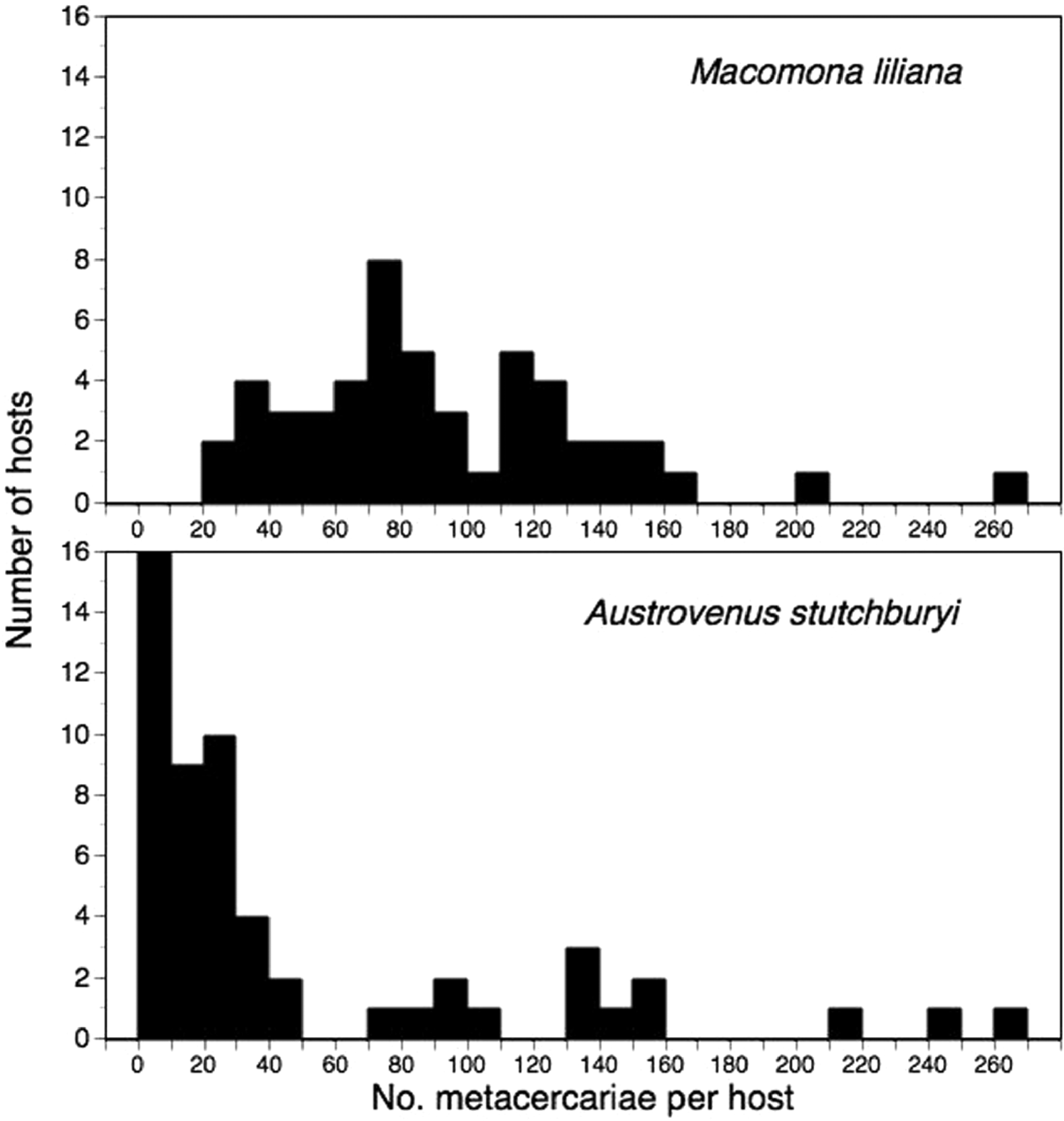
Another potential confounding factor was the number of metacercariae already encysted in the foot of the bivalves prior to the experiment, i.e. the number of prior infections. All bivalves used harboured prior infections (Fig. 1); our efforts to collect A. stutchburyi from a site with relatively low infection levels resulted in a similar range of prior infections in the two bivalve species (20–260 per host in M. liliana, 3–261 per host in A. stutchburyi), though M. liliana generally harboured more metacercariae than A. stutchburyi. There was a weak correlation between shell length and number of prior infections in both M. liliana (r=0·351, N=51, P=0·012) and A. stutchburyi (r=0·260, N=55, P=0·055). The number of prior infections per host did not vary among the individuals allocated to each trematode clone or batches of hosts in M. liliana (two-way ANOVA: clones, F 8,41=1·456, P=0·203; batches, F 1,41=2·612, P=0·114), but it differed among batches in A. stutchburyi (two-way ANOVA: clones, F 8,45=1·057, P=0·410; batches, F 1,45=8·612, P=0·006). The number of prior infections per host was thus included as a covariate in subsequent analyses, in addition to shell length.
Frequency distribution of the number of Curtuteria australis metacercariae per host, including only metacercariae already present in the hosts prior to the start of the experiment. Data are shown separately for the wedge shell Macomona liliana (N=51) and the cockle Austrovenus stutchburyi (N=55).

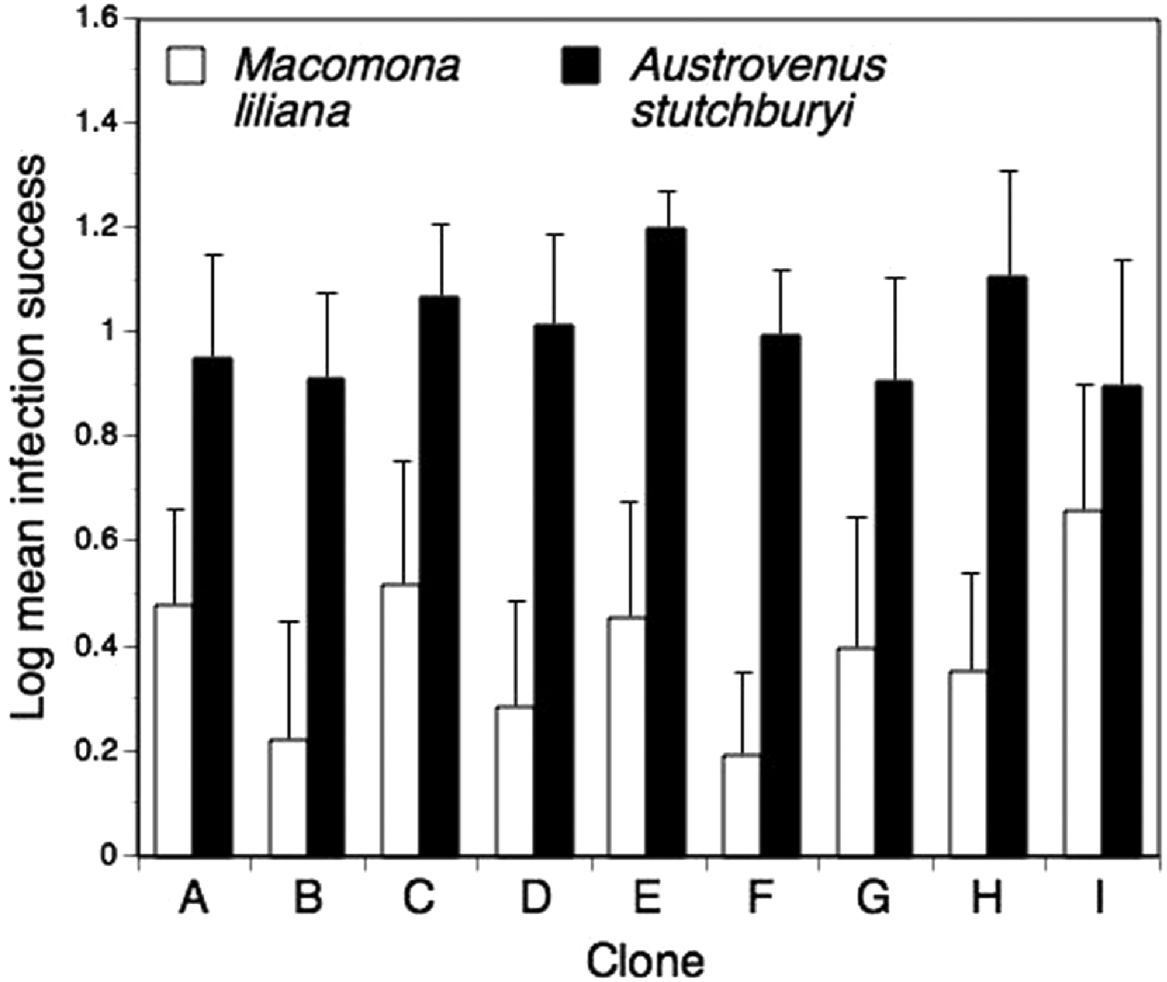
A total of 191 dyed metacercariae acquired during the experiment were recovered from M. liliana, while 733 were recovered from A. stutchburyi. Only 25 (49%) of the 51 M. liliana acquired at least 1 experimental metacercaria, compared with 53 (96·4%) out of 55 for A. stutchburyi. Considering only those bivalves that acquired dyed metacercariae, the mean (±s.e.) number per host was 7·6±1·3 for M. liliana and 13·8±1·5 for A. stutchburyi. In all 9 clones, average infection success was higher in A. stutchburyi than in M. liliana (Fig. 2). To investigate the determinants of infection success, we used an ANCOVA using trematode clonal identity and host species as main effects and the number of experimental metacercariae acquired (log [x+1]-transformed, and including zero values) as the dependent variable, with shell length and the log-transformed number of prior infections as covariates. The analysis revealed that the 9 clones did not differ in infection success (F 8,94=0·494, P=0·858), and that infection success was not affected by either host shell length (F 1,94=0·429, P=0·514) or number of prior infections in the host (F 1,94=0·002, P=0·964). However, infection success of the parasites differed between the two host species (F 1,94=6·762, P=0·011), being consistently higher in A. stutchburyi than in M. liliana (Fig. 2).
Mean (±s.e.) infection success of 9 clones of the trematode Curtuteria australis in 2 bivalve hosts, the wedge shell Macomona liliana and the cockle Austrovenus stutchburyi, under experimental conditions. Infection success is measured as the numbers (log [x+1]-transformed, and including zero values) of metacercariae recovered in each host, out of an initial dose of 60, averaged across all bivalves used (4–8 per clone) for each clone.

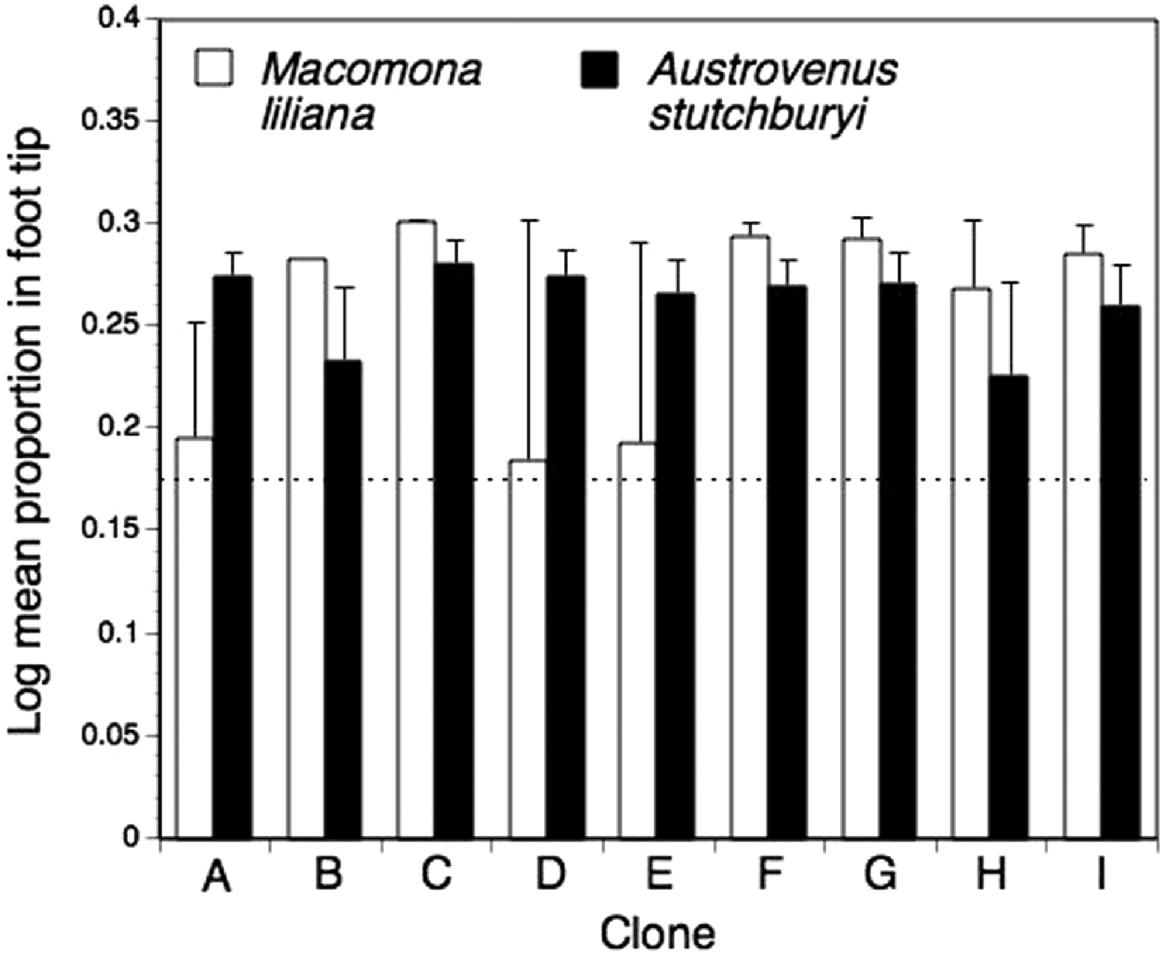
In both host species, a substantial number of pre-existing infections were located in the tip of the bivalve's foot (mean±s.e.: M. liliana, 36·5±2·9, range 9–113; A. stutchburyi, 41·3±7·3, range 3–233). And in both species, the majority of metacercariae acquired experimentally also settled in the tip of the foot (Fig. 3). Considering only hosts that had acquired at least 1 experimental metacercaria, the mean (±s.e.) percentage of experimental metacercariae settling in the foot tip was 81·0±6·4% for M. liliana and 84·3±2·6% for A. stutchburyi. To investigate which factors influence the probability that a parasite settles in the foot tip, we used an ANCOVA with the proportion of experimental metacercariae found in the tip of the host foot (log [x+1]-transformed, and including zero values but only including hosts that had acquired at least one experimental metacercaria somewhere in the foot) as the dependent variable. Trematode clonal identity and host species were the main effects, and shell length and the log-transformed number of prior infections in the foot tip were included as covariates. None of the main effects or covariates had a significant effect on the proportion of metacercariae settling in the tip of the host foot (all P>0·31).
Mean (±s.e.) proportion of metacercariae encysting in the tip of the host foot, for each of 9 clones of the trematode Curtuteria australis in 2 bivalve hosts, the wedge shell Macomona liliana and the cockle Austrovenus stutchburyi, under experimental conditions. Proportions of metacercariae (out of those recovered) in the foot tip of each bivalve were log [x+1]-transformed, and averaged for each clone across all bivalves (4–8 per clone) for which at least 1 experimental metacercaria settled in the host. The broken line indicates the value corresponding to 50%.

Finally, we looked for a correlation among clones between infection success in M. liliana and infection success in A. stutchburyi; for these, we used log-transformed clonal mean values computed across all bivalves of one species that were exposed to a particular clone. We found no relationship between success in one host species and success in the other (r=−0·008, N=9, P=0·984). We also looked for a correlation among clones between the proportion of metacercariae settled in the foot tip of each host species, using log-transformed clonal mean values computed across all bivalves of the same species that acquired at least 1 experimental metacercaria from a particular clone somewhere in the foot. Here again, we found no correlation among clones between the tendency to settle in the foot tip of one bivalve species and the tendency to settle in the foot tip of the other host species (r=−0·226, N=9, P=0·559).
DISCUSSION
While generalist parasites can infect a wider host range than specialist parasites, for various reasons, this does not necessarily mean that a generalist is capable of exploiting all host species within its host range equally. Parasites that are considered as generalists often display a preference for, or otherwise perform better on, certain host species in comparison to others due to a range of ecological and physiological reasons (González et al. Reference González, Carvajal and George-Nascimento2000; Lajeunesse et al. Reference Lajeunesse, Forbes and Smith2004; Blaustein et al. Reference Blaustein, Romansic, Scheessele, Han, Pessier and Longcore2005; Jones et al. Reference Jones, Nagel, Hughes, Cribb and Grutter2007; Smith et al. Reference Smith, Ruiz and Reed2007; Dang et al. Reference Dang, de Montaudouin, Bald, Jude, Raymond, Lanceleur, Paul-Pont and Caill-Milly2009).
Detwiler and Minchella (Reference Detwiler and Minchella2009) investigated the infection profile of 2 species of echinostome trematodes in 3 species of snails that can serve as potential second intermediate host. They found that due to fluctuating availability of the different snails, patterns of infection seen in field samples do not reflect the actual performance of the parasites within different hosts. However, this was not the case in our system. Our experimental results confirmed the role of host-compatibility in forming the pattern seen in the field, where wedge shells, M. liliana, have relatively low infection intensity when compared with cockles, A. stutchburyi, from the same area (Leung and Poulin, Reference Leung and Poulin2008). Therefore, their relatively low parasite load compared with sympatric cockles is not simply a result of their lower abundance providing them with fewer opportunities to encounter the pool of infective cercariae in the environment. Instead, wedge shells are simply more difficult to infect than cockles. This may be due to the deeper burial depth of the wedge shell in comparison with the cockle. However, as our study showed, even when exposed to cercariae under the same conditions as cockles, wedge shells do not become as heavily or easily infected by C. australis as cockles. Therefore, some other host attributes may be involved in generating this pattern, such as the wedge shell's feeding style (alternating filter and deposit-feeding), its longer and narrower siphons (which are the main route of entry for the cercariae), or otherwise less compatible physiology. However, to pinpoint the exact factor(s) involved would require further investigation.
While C. australis displays different infection success in its two bivalve hosts, interestingly enough, the metacercariae that do manage to establish show the same pattern of encystment in both hosts. The tip of the bivalve's foot is the preferred encystment site regardless of the bivalve species. Thus C. australis impairs burrowing in both of its bivalve hosts. Such consistent patterns of infection across different hosts are not always found in other host-parasite systems. Parasites often elicit different pathology or host responses when infecting different host species (e.g. Olstad et al. Reference Olstad, Robertson, Bachmann and Bakke2007; Batista et al. Reference Batista, Boudry, Dos Santos, Renault and Ruano2009). For example, the metacercariae of Ribeiroia ondatrae induce limb malformations in many of the amphibian species they infect (Johnson et al. Reference Johnson, Sutherland, Kinsella and Lunde2004). However, this pathology is not necessarily manifested in all amphibians infected by R. ondatrae. This trematode induces significant malformation and mortality in the metamorphs of the American toad, Bufo americanus; however, not only are Eastern gray tree frogs, Hyla versicolor, less likely to become infected by R. ondatrae cercariae, but also, in contrast to infected B. americanus, infected H. versicolor exhibit limited mortality and no malformation (Johnson and Hartson, Reference Johnson and Hartson2009).
The fact that C. australis displays the same preference for encysting at the foot tip whether in A. stutchburyi or M. liliana is remarkable, considering the different internal structure of both bivalves. This suggests that the same cues responsible for directing the cercariae to encyst at the tip of the foot are present in both hosts. In contrast, the larvae of the nematode Angiostrongylus costaricensis can infect several different species of gastropods that serve as intermediate hosts, but A. costaricensis larvae take different migratory routes and become established in different parts of the body when infecting different species of host (Montresor et al. Reference Montresor, Vidigal, Mendonça, Fernandes, de Souza, Carvalho, Caputo, Mota and Lenzi2008). However, little is known regarding within-host navigation of trematodes in their invertebrate hosts. For C. australis, encysting at the tip of a cockle's foot can serve to manipulate host behaviour and facilitate trophic transmission (Thomas and Poulin, Reference Thomas and Poulin1998; Mouritsen, Reference Mouritsen2002). In an earlier study focussing exclusively on cockles, we observed that the number of prior infections in the foot tip influenced the proportion of newly-arriving cercariae settling in the tip (Leung et al. Reference Leung, Keeney and Poulin2009). Here, we did not detect this effect. However, in the present study, the cockles used were larger and harboured more prior infections in their foot tip; in addition, the sectioning of the foot was performed differently in this study (tip=anterior 50% of the foot) than in the earlier one (tip=anterior 25% of the foot). In any event, the general preference of C. australis for encysting in the foot tip may yield benefits in cockle hosts, but this preference is less useful in wedge shells. The effect of C. australis in cockles is density dependent and requires the host to be infected with a threshold number of metacercariae before behavioural alteration is induced (Thomas and Poulin, Reference Thomas and Poulin1998; Mouritsen, Reference Mouritsen2002). However, wedge shells accumulate metacercariae at a much lower rate (Leung and Poulin, Reference Leung and Poulin2008) and are buried deeper in the sediment, thus are less likely to become stranded at the sediment surface even if infection intensity reaches the critical threshold. In fact, live M. liliana stranded on the sediment surface are never observed in the field (T. Leung and R. Poulin, personal observations).
In terms of variations in performance among parasite genotypes across the host range, this study found little intraspecific variation. Different clones showed no significant variation in their relative infection success in A. stutchburyi or M. liliana, nor differences in encystment site within the different hosts. The lack of intraspecific variation can be due to the limited opportunity for local adaptations, and hence differential host exploitation strategy, to develop in either hosts or parasite in our system. Despite the limited mobility of their intermediate hosts, adults of C. australis live in shorebirds that are efficient dispersers of trematode eggs (Keeney et al. Reference Keeney, Bryan-Walker, King and Poulin2008), leading to a population with a well-mixed gene pool in Otago Harbour. Dybdahl and Lively (Reference Dybdahl and Lively1996) found that if gene flow among different host populations is limited, local adaptation can still occur even if the parasite has high gene flow. However, soft sediment bivalves such as M. liliana and A. stutchburyi have planktonic larval stages (Booth, Reference Booth1983), thus the dispersal ability of both hosts and parasites in the C. australis-bivalve system limits the potential for local adaptation and co-evolution. It would be interesting to compare the results of this study with those from different populations of the parasite. Curtuteria australis was originally described from the Avon-Heathcote estuary of Christchurch (Allison, Reference Allison1979), which is located further north along the east coast of New Zealand's South Island. Would the population there display similar exploitation strategies and performance across its host range as the Otago population?
Our study shows that while generalist parasites may have higher performance in certain host species within their niche, this does not necessarily mean that they use different exploitation strategies, including encystment site, in these different hosts. These findings provide an insight into the factors that determine the evolution of specialization and the evolution of generalists from specialized ancestors. Differential performance among genotypes of a parasite species with broad host specificity across its host range may be an indicator that lineages within a population are on the path towards specialization, possibly even speciation (Huyse et al. Reference Huyse, Poulin and Théron2005). In the broader ecological context, variation in performance and exploitation strategy can have important consequences for the effect of a parasite on its host population(s). Such small differences should be considered when assessing the functional role that generalist parasites play in their ecosystem.
ACKNOWLEDGEMENTS
The authors would like to thank Sarah Herbert and Haseeb Randhawa for field assistance collecting cockles and wedge shells. We also thank Dr Caroline Beck for the use of her fluorescence stereomicroscope. Funding for this research was provided by a grant from the Marsden Fund to R. P.