

Anatomically modern humans can be viewed as both occupants of a wide variety of Late Pleistocene ecological niches and also as modifiers of those niches (Laland & O’Brien Reference Laland and O’Brien2010). This paper examines the interaction between Magdalenian (17,000–12,000 bp) co-occupants of the riverine niches in parts of north-west Europe using both ecological and archaeological data. We go beyond a passive interaction between Late Upper Palaeolithic hominins and ecology to consider the creation and recognition of active and reciprocal ecological modifications as an application of niche construction theory (NCT; Odling-Smee et al. Reference Odling-Smee, Erwin, Palkovacs, Feldman and Laland2013). The functional context for this analysis is human survival and health, but the implications are behavioural and even cognitive. In this paper we first present key aspects of the ecology (cf. autecology) of the key non-human species in this niche before relating them to human behaviour as reflected by mobiliary art.
A recent analysis of the distribution of Lower Palaeolithic super-sites in southern England and northern France by Brown et al. (Reference Brown, Basell, Robinson and Burge2013) has highlighted the location-specific importance of fat and carbohydrate in balancing protein intake, and the importance of critical nutrients such as vitamins C, D, E, and folate. The typical location of super-sites in the most nutritionally diverse locations in the interglacial landscapes of this region (namely the lowest freshwater reaches on braided floodplains) strongly suggested that sources of fats, carbohydrate, and critical nutrients may have been utilised from sources other than, or in addition to, large herbivores. It was also noted that humans co-inhabited this niche with a distinctive combination of flora and fauna including aquatic plants, beaver, and eel, as well as other fish and waterfowl. This zone also attracted the herbivores that butchery evidence suggests were the main target prey, particularly horse and deer.
However, for the Lower Palaeolithic, apart from tool type, palaeoecological data, and site distribution – all of which can have multiple drivers – there is little or no other behavioural information and, as yet, limited isotopic data (Bocherens Reference Bocherens2015). Data from analysis of dental calculus for microfossils (pollen, chemical compounds, starch, phytoliths, micro-charcoal, and diatoms) is generating a wealth of fascinating information (Salazar-García et al. Reference Salazar-García, Power, Sanchis Serra, Walker and Henry2013; Hardy & Buckley Reference Hardy and Buckley2013; Buckley et al. Reference Buckley, Usa, Jakob, Radini and Hardy2014; Power et al. Reference Power, Salazar-García, Straus, González Morales and Henry2015; Hardy et al. Reference Hardy, Radini and Buckley2015; Reference Hardy, Radini, Buckley, Sarig, Copeland, Gopher and Barkai2016; Radini et al. Reference Radini, Buckley, Rosas, Estalrrich, de la Rasilla and Hardyin press). However, how such data, particularly phytoliths, relates to overall diet over the lifetime is still being established and is complicated by factors such as differential preservation (Hardy et al. Reference Hardy, Radini and Buckley2015; Power et al. Reference Power, Salazar-García, Straus, González Morales and Henry2015), difficulties of identification related to mastication damage (Shillito 2013), and the fact that these environmental signatures can become incorporated through breathing, eating, oral hygiene activities, and raw material processing. The analysis of faecal biomarkers is an emergent field, but the results cannot be resolved to species level (Sistiaga et al. Reference Sistiaga, Mallol, Galván and Summons2014). More behavioural data exist for the Late Upper Palaeolithic (Late Upper Palaeolithic (LUP), c. 17–10kabp) where additional data sources include portable and fixed art, a wider range of perishable artefacts, and human isotopic data. LUP sites have fewer confounding factors as a result of higher chronological resolution and less post-depositional disturbance.
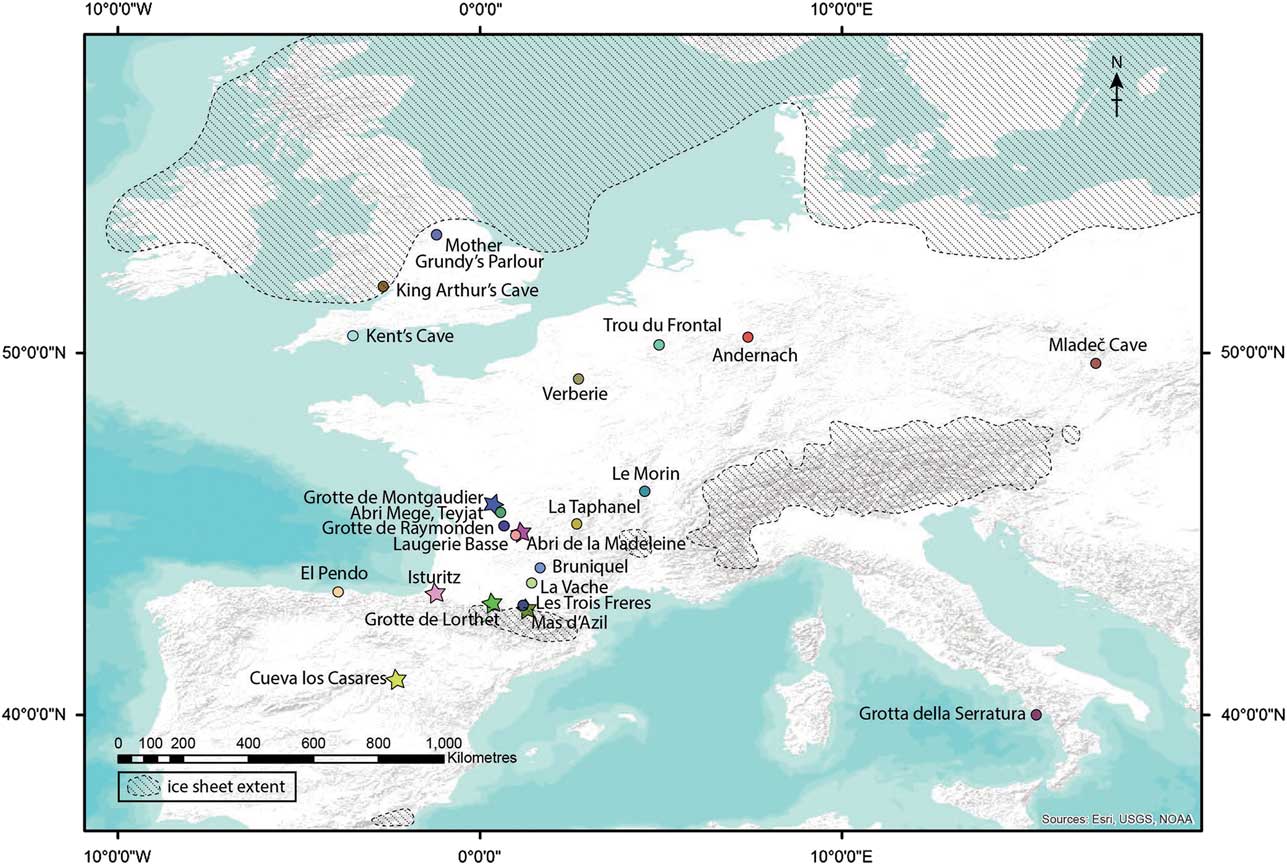
Human settlement of north-west Europe in the LUP over the area covered by the Magdalenian culture (Fig. 1) must be seen in climatic context with high spatial as well as temporal variation, with biomes varying from tundra to cool temperate forest. After the Lateglacial maximum (LGM) this variation includes the rapid melting of permafrost which had covered all the non-glaciated parts of the British Isles, central and northern-central France, and the Low Countries as well as the northern part of the European Plain eastwards. This had melted by the Termination 1a c. 16.6 kabp (end of the Heinrich 1 event meltwater pulse) which was marked by rapid warming with July temperatures rising 2–5°C into the Lateglacial Interstadial (Windermere or Bølling Interstadial, Lotter et al. Reference Lotterr, Heiri, Brooks, van Leeuwen, Eicher and Ammann2012). July temperatures show a declining trend of c. 2°C during this interstadial with increasing instability (ie, cold oscillations) culminating in the Lateglacial Stadial (Younger Dryas) before the rapid warming at the beginning of the Holocene at 11.7 ka bp (Walker et al. Reference Walker2009).
Magdalenian Europe with ecological, palaeontological, and Magdalenian art sites mentioned in the text. Stars: sites with art reproduced in this paper; solid circles: other Magdalenian sites mentioned in the text

Recent work by the INTIMATE project utilising tephrachronology (Blockley et al. Reference Blockley, Bourne, Brauer, Davies, Hardiman, Harding, Lane, MacLeod, Matthews, Pyne-O’Donnell, Rasmussen, Wulf and Zanchetta2012) has allowed regional event stratigraphies to be identified which although broadly phase-locked to the Greenland NGRIP ice core record do show significant variations which were manifest by regional to local variations in vegetation cover (Walker et al. Reference Walker2012). The lack of well-developed soils and high rates of climate change promoted moderate to high ecological disturbance regimes with a high prevalence of, what we would recognise today as, early successional stages. For example open shrublands and light or scrubby woodland was dominated by pioneers, ruderals, and light-demanding herbaceous species (Peyron et al. Reference Peyrona, Be´geota, Brewerb, Heiric, Magnya, Milleta, Ruffaldia, Van Campod and Yue2005). Many of these species, now found as Arctic or Alpine plants, are calcicoles suggesting soils were far less acidified than they became in the early Holocene (Rhind & Jones Reference Rhind and Jones2003). One of the best Lateglacial records for Central France, La Taphanel, shows rapid variations in major taxa such as pine, juniper, birch, grasses, mugworts (Artemisia), and other herbs (eg, Chenopodiaceae, Helianthemum) reflecting rapid climate change from just after the LGM, through the Older Dryas, the Allerød-Bølling, the Younger Dryas, and finally rapid warming into the Preboreal (Ponel et al. Reference Ponel and Coope1990). These biomes had high herbaceous productivity which attracted, and may have been partly maintained by large herbivores, small mammals, and birds but are without an analogy today (Gill et al. Reference Gill, Williams, Jackson, Donnelly and Schellinger2012). Fire may also have played an important role in maintaining moderate to high disturbance regimes (Thonicke et al. Reference Thonicke, Prentice and Hewitt2005) and variations in lithology, geomorphology, and geo-hydrological conditions created locally variable vegetation patterns as has been shown for the Netherlands (Hoek Reference Hoek1997). Of particular importance here is the probable persistence of more climatically temperate refugia, so called cryptic refugia (Birks & Willis Reference Birks and Willis2008), in valley floors dominated by willows, birch, hornbeam, and alder (Ponel & Cooper Reference Ponel and Coope1990).
Although this paper concentrates on the Magdalenian, the broader focus is on the wider interpretation of Palaeolithic artefacts and the relationship between different ‘actors’ within an ecological niche rather than an exhaustive survey of Magdalenian art. It is also important to note that ecological conditions through abrupt environmental transitions (AETs) were similar in other interstadials in MIS 3 such as IS 7–IS 5 (van Andel & Davies Reference Andel and Davies2003; Davies et al. Reference Davies, White, Lewis and Stringer2014). Two of the first migrants into this region during de-periglaciation were the European eel (Anguilla anguilla) from the west (Atlantic) and the European beaver (Castor fiber) from the east and south, with wild horse (Equus) probably surviving the LGM throughout most of central to northern continental Europe (Bignon et al. Reference Bignon, Baylac, Vigne and Eisenmann2005). By the Magdalenian (c. 17–12 ka bp) these three species were common throughout north-west Europe and formed part of the ecosystems that Magdelanian people occupied and interacted with.
EEL, BEAVER, & HORSE ECOLOGY
There are aspects of the species specific ecology (autecology) of eels, beavers, and horses that are of particular archaeological significance. Eels are ecologically and evolutionarily unusual fish which humans have always struggled to understand – Aristotle, for example, suggested that they generated spontaneously from mud as he could find no larvae (Tskamoto & Kuroki Reference Tsukamoto and Kuroki2014). Although there are some 800 species of eel alive today, only the European freshwater eel (Anguilla anguilla L. 1758) is commonly found in north-west European freshwaters. Anguilla anguilla is the only catadromous fish common in Europe descending rivers to the Sargasso Sea to spawn (Schmidt Reference Schmidt1922) with the pelagic eggs and then larvae taking 3 years to drift with the North Atlantic Current back to the European shelf where they metamorphose into ‘glass-eels’ and then into elvers (‘civelles’ in France) before migrating upstream (Wheeler Reference Wheeler1969). After living in rivers and lakes for 8–18 years they migrate downstream to begin their 6000 km journey to the Sargasso Sea where they spawn and die. The triggers for their spawning-migration as silver eels are not fully understood but appear to be influenced by declining day length (photoperiod), high rainfall, and a complex effect of the lunar cycle (Bruijs & Durif Reference Bruijs and Durif2009).
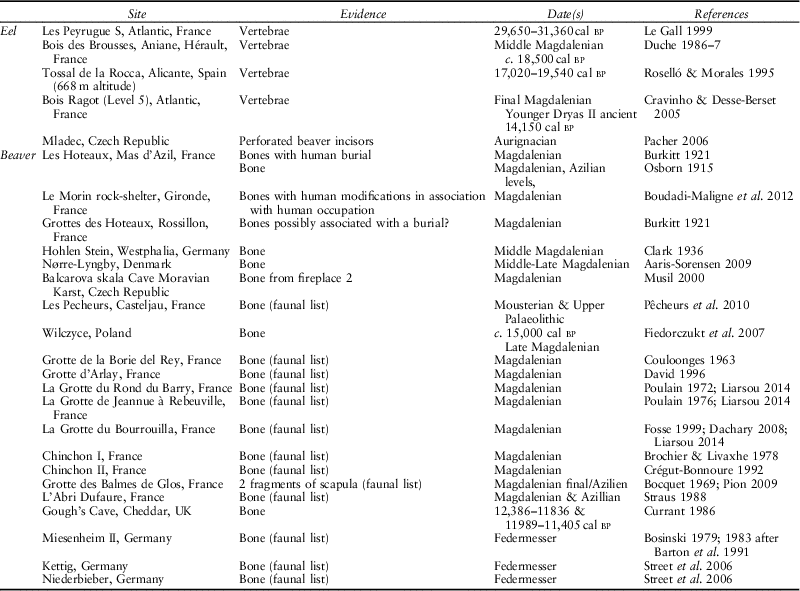
This life-cycle means that eel re-occupation of the region after the LGM would have been directly linked to the re-establishment of the Gulf Stream as the Polar Front retreated from 35°N to above 55°N in under 1000 years. This re-occupation would have occurred during the Lateglacial from glacial refugia in Iberia and, using palaeoecological data, Kettle et al. (Reference Kettle, Heinrich, Barrett, Benecke and Locker2008) show that eel was present in central France by 19,000 bp, although not into the British Isles until c. 11,000 bp (Table 1). Although some may die during their period in rivers and lakes, most will die in the Sargasso Sea, which makes their presence on LUP sites more likely to be due to human activity than natural processes. Eels can also spread rapidly from river to river and to lakes due to their semi-amphibian capabilities. As shown in this interglacial the European eel can occupy a wide range of habitats spanning the marine–freshwater ecotone and this ecological plasticity (Vøllestad Reference Vøllestad1992) produces large variations in their stable isotopes values (Harrod et al. Reference Harrod, Grey, McCarthy and Morrisey2005). This also reflects the eel’s generalist diet, being both carnivorous and a scavenger, with the ability to detect blood through its keen sense of taste. One of its main prey is bloodworms, although it eats fish and larvae and, indeed, almost all aquatic fauna (Sinha & Jones Reference Sinha and Jones1975). The eel’s semi-amphibian abilities to cross land and come out of water also allows it to feed on earthworms (Deelder Reference Deelder1985) and may be due to an overwhelming urge to migrate (Tesch Reference Tesch2003).
Fossil evidence of eel & beaver presence in magdalenian & federmesser western europe

There are two other aspects of eel ecology which are particularly relevant to humans. First, eel is of high nutritional value being high in both protein (66 g per 100 g) and fat (42 g per 100 g) with high levels of polyunsaturated fat (0.95 g per 100 g). It is also high in several essential minor nutrients including potassium, phosphorous, iron, zinc and sodium, taurine, and vitamins A, B6, and B12. Eels are high in docosahexaenoic acid (DHA) which has recently been strongly linked to human brain development both directly and indirectly through mother’s milk (Xiang et al. Reference Xiang, Alfvén, Blennow, Trygg and Zetterström2000; Brenna & Carlson Reference Brenna and Carlson2014). The high nutritional value of eel was utilised in the medieval and post-medieval period in Europe when it became a major food source promoted by the Church and, later, a major source of nutrition for urban settlements (Bunting & Little Reference Bunting and Little2005). Eels were the fall-back food of settlers in North America who faced starvation in AD 1620 but traded for them with Native American peoples (Prosek Reference Prosek2011). Secondly it is the only common fish species in Europe that is ichthyohemotoxic; its blood is toxic to mammals, including humans. However the poison, which is a protein (Yoshida et al. Reference Yoshida, Sone and Shiomi2008) that cramps muscles including the heart, is broken-down by any cooking, exposure to gastric juices, or naturally a few hours after the eel has died (Halstead Reference Halstead1988; Auerbach & Halstead Reference Auerbach and Halstead2007). Experiments in the 19th century showed that just a few drops of fresh eel blood could kill a medium-sized mammal such as a dog (Anon 1899; Sato Reference Sato1917; Keffer & Welsh Reference Keffer and Welsh1936). In the early 20th century Charles Robert Richet tried to use it as a vaccine but found that it caused anaphylaxis, and more recently it has been trialled in both traditional Chinese and northern English folk medicine (Amin et al. Reference Amnin, Yingfu, Yuan and Zhemin2003; Hatfield Reference Hatfield2004). Although it may be difficult to prove its use on points of spears for hunting game it is a possibility and warrants further investigation.
Beavers (Castor fiber L. 1758) migrated back into north-west Europe as part of the development of riverine woodlands and would have established themselves quickly in most river systems during this period (Table 1) from glacial refugia in Spain and south-east France (Liarsou Reference Liarsou2014). The basic biology and major role of beavers in modifying riverine habitats is described by Coles (Reference Coles2006) who also reviews their post-LGM history from at least 15.5 ka bp and recent redating of museum bones has confirmed that beaver survived through the Younger Dryas cold stage in south-west England (Marr Reference Marr2016). Recent work on beavers has shown that they are driven to dam running water through audible cues and in the absence of high levels of predation would come to a self-limiting density related to the density and gradient of streams (Meentemeyer & Butler Reference Meentemeyer and Butler1999; Westbrook et al. Reference Westbrook, Cooper and Baker2011). There are many ways in which beavers would have been of high value to hunter-gatherers from the high thermal value of their dense pelts, to their meat which is equivalent in energy to a roe deer (Coles Reference Coles2006). As Coles discusses there are many ways in which beavers would have been of high value to hunter-gatherers from the high thermal value of their dense pelts to their meat, which is equivalent in energy to that of a roe deer (Coles Reference Coles2006). There is also ethnographic evidence of their castor sacs being used as they contain a substance with similar medicinal properties to aspirin (Kitchener Reference Kitchener2001). Other ethnographic examples exist of hunter-gatherers using their hafted teeth and mandible as tools (Osgood Reference Osgood1940). One of their most valuable features may have been their tails which store fat and can be as much as 60% fat by weight during the winter (Kitchener Reference Kitchener2001).
The wild ‘caballine’ horses of Lateglacial Europe which belonged to the species Equus caballus showed regional morphological variations which suggest they survived the LGM in mainland Europe rather than migrating in from the south or east (Bignon et al. Reference Bignon, Baylac, Vigne and Eisenmann2005). Horse remains are found at most bone-rich Magdalenian sites indicating they were one of, if not the, prime prey species for humans (Nitecki & Nitecki Reference Nitecki and Nitecki1987). These small sized horses were common in a variety of open habitats and their dentition suggests they were adapted to grazing rather than browsing (Mihlbachler et al. Reference Mihlbachler, Rivals, Solounias and Semprebon2011). The high land cover of sedges and graminoids would have promoted large herds (Bignon et al. Reference Bignon, Baylac, Vigne and Eisenmann2005). The challenges presented by hunting free running herds are best addressed by ambush hunting, as demonstrated by ethnographic analogy (Stiner Reference Stiner2002). While the earliest evidence for ambush hunting at 1.8 million years ago remains a matter of debate (Bunn & Pickering Reference Bunn and Pickering2010; Bunn & Gurtov Reference Bunn and Gurtov2014; Pante et al. Reference Pante, Blumenschine, Capaldo and Scott2012), skeletal adaptations are consistent with modern humans’ ability to throw at high speed (Roach et al. Reference Roach, Venkadesan, Rainbow and Lieberman2013). Good evidence also exists that Lower Palaeolithic hominins hunted horses cooperatively (Stiner et al. Reference Stiner, Barkai and Gopher2009), as exemplified by the scapula of a horse punctured by a wooden spear found at Boxgrove GTP17 (Roberts & Parfitt Reference Roberts and Parfitt1999) and the horses found in association with the famous Schöningen spears (Conard et al. Reference Conard, Jordi Serangeli, Böhner, Starkovich, Miller, Urban and Van Kolfschoten2015). Floodplains were an easy place to kill horses while they were drinking. Horses are not habituated to swimming and try to avoid it; if forced to swim, they are at their most vulnerable. Although the palaeoecological contexts of the examples given above support a floodplain ambush hunting scenario as early as the 500 kabp, recent research has demonstrated that Schöningen was not a mass kill site and instead represents several separate episodes of hunting and butchery (Urban & Bigga Reference Urban and Bigga2015; Balter Reference Balter2014). Interestingly, new research on the site sediments has demonstrated that the spears and horse remains were not deposited on dry land, but in the lake under 1–2 m of water (Urban & Bigga Reference Urban and Bigga2015). After 250 ka bp it is more widely accepted that ambush hunting would have been possible (Stiner Reference Stiner2002) and, certainly by the Magdalenian, horse and reindeer were dominant components of the diet (Kuntz & Costamagno Reference Kuntz and Costamagno2011) and seem to have been symbolically embedded in Magdalenian lifeways in a way that is not apparent for earlier periods (Langley Reference Langley2013). An alternative to ambush hunting may be corralling and even proto-domestication has been discussed for the Solutrean and Magdalenian (Lewis Reference Lewis2009).
By the early Magdalenian beaver, eel, and horse were ubiquitous and probably numerous in central France and common throughout the area by the middle–late Magdalenian (Table 1). Beavers are highly adaptable and this makes them in effect pioneer species (Liarsou Reference Liarsou2014) and one which was almost certainly hunted (Petillon Reference Petillon2008). Recent evidence from the Caune de l’Arago shows that, by the Lower Palaeolithic (MIS 13), in southern France beaver was being systematically exploited for its skin and meat (Lebreton et al. Reference Lebreton, Moigne, Filoux and Perrenoud2017). The attraction of horses to water and their vulnerability near it, and the effect of beavers on Lateglacial river systems, are just two of the ways these species interacted with each other and impacted the floodplain environment. Geomorphological research has shown that floodplains in this period were covered by secondary channels (Brown Reference Brown1995; Pastre et al. Reference Pastre, Limondin-Lozouet, Leroyer, Ponel and Fontugne2003; Lespez et al. Reference Lespez, Viel, Rollet and Delahaye2015) and beaver damming of these channels would have increased the year-round water availability – effectively creating many lakes or ponds (Coles Reference Coles2006; Puttock et al. 2016). This would have increased habitats available for fish (Häglund & Sjöberg Reference Häglund and Sjöberg1999), waterfowl, and amphibians. The increase in fish and other aquatic species would have increased eels in particular and ponding would also have attracted grazing herbivores, especially in drought periods. Such beaver-modified ecosystems would have been particularly attractive for humans who, if present in low numbers, could be regarded as a part of this ecological association. It is argued here that humans introduced another interaction between the species co-occupying this ecosystem through sophisticated food procurement strategies which would have, in turn, altered competitive conditions for plant growth as part of the constructed niche evolution (Allaby et al. Reference Allaby, Kistler, Gutaker, Ware, Kitchen, Smith and Clarke2015).
ETHNOGRAPHIC EVIDENCE OF EEL FISHING AND ECOLOGICAL SYMBOLISM
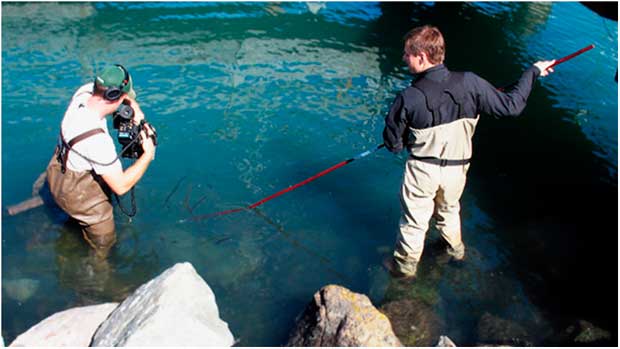
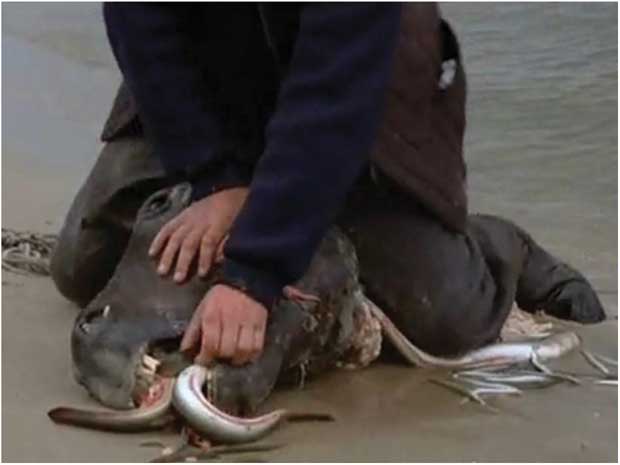
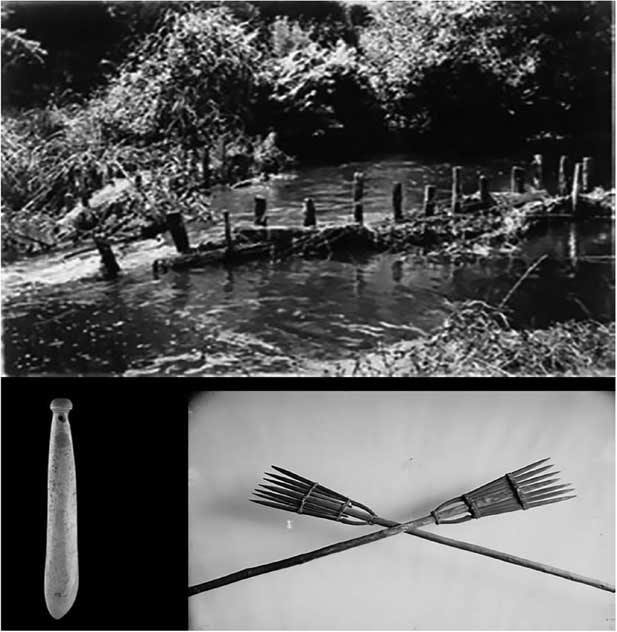
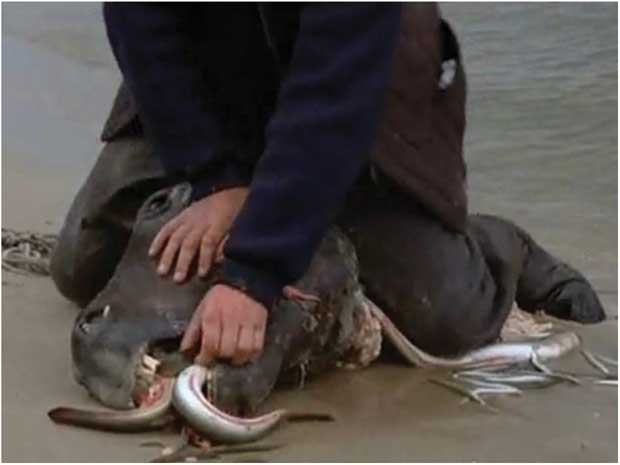
There are two principal methods of fishing for eels, both of which require only very basic equipment. The first method uses a long pole, called in English a ‘poke pole’ (Fig. 2). Generally, the long pole is over 2 m long and is used to flush out eels from behind rocks and in aquatic vegetation. Once flushed-out they can be caught by hand, a practice known by Maori peoples as ‘bobbing, feeling and striking’ or by the use of a basket or eel spear. The pole can have a variety of ends, such as a hook or loop, or it can be a simple point. The other technique involves placing a severed horse head in shallow water to attract eels, which enter the cranial cavity through the orifices, attracted by the smell of rotting flesh. As reported in Smart (Reference Smart2003), the horse head is placed in water during the evening and eels are squeezed out the following morning (Fig. 3). A single horse head can be used repeatedly until there is little flesh left (ibid., 152–3). There is also evidence of ancient eel fishing techniques from non-European societies, particularly among the Maori peoples in New Zealand. A Maori myth proposes that eels could be attracted out of the water by small game, as depicted in a painting of a giant eel being caught at Tangahoe Lake, New Zealand painted by T. W. Downes in 1918. Maori eel hunters used both their hands and multi-tanged eel spears (matarau) and killing batons (patu tuna; Fig. 4) to kill eels, and they also constructed eel-weirs which are structurally very similar to natural beaver dams (Fig. 4). Although it is beyond the scope of this paper, baskets and weaving would have been helpful in trapping and transporting eels, and there is evidence of rope/cord from Lascaux (Leroi-Gourhan & Allain Reference Leroi-Gourhan and Allain1998) and from earlier Gravettian sites from Europe (Adovasio et al. Reference Adavasio, Soffer and Klima1996; Soffer et al. Reference Soffer, Adovasio and Hyland2000a; Reference Soffer, Adovasio, Illingworth, Amirkhanov, Prasvlov and Street2000b). This ecological zone would be the most resource-rich for basketry as withies (willow saplings), tall grasses, and reeds (Hurcombe Reference Hurcombe2014) would have been readily available. There is archaeological support for ethnographic evidence of eel-catching with poles and killing batons. ‘Batons’ or Bâton de commandement commonly found at Magdalenian and Cresswellian sites north-west Europe would have been suited for killing fish, eel, and other small game, and harpoon-like antler projectile points might have been similarly useful as well as final Upper Palaeolithic ‘Lyngby Axes’ (Langley Reference Langley2014).
A poke pole being used to flush eels out for filming (photo courtesy of the Monkeyface News)

A scene of horse head eeling from the 1979 adaptation of The Tin Drum by Gunter Grass directed by Volker Schlöndorff and produced by Jadran Films (Reproduction by permission of Jadran Films, Croatia)
A Maori eel-weir on the outlet stream of Horowhenua lake New Zealand (above) and eel killing baton (patu tuna) and eel spears (matarau) (below) (by permission from Museum of New Zealand Collections. Wweir photographer Leslie Adkin 1925, gift of the G.L. Adkin family estate 1964)

Until recently many aspects of eel, beaver, and horse ecology proved mysterious and/or remarkable to diverse cultures. The discovery of eels on land, but not on nights with a full moon (Bruijs & Durif Reference Bruijs and Durif2009); the movement of adult eels and fry through river mouths on full moons; their green glow (bioflourescence; Baker Reference Baker2013); and the relatively long-lasting post-mortem convulsions which are similar to those of snakes (caused by muscle contractions) all engendered stories and myths. Even today, the unusual long-distance life cycle of the European eel is not fully understood (Baker Reference Baker1978; Pfeiler Reference Pfeiler1986). Similarly, beavers are mythically significant to many cultures, as it is the only medium-sized mammal to produce complex structures, fell trees, and be semi-aquatic. Similarly ethnographic evidence from North America reveals a complex relationship between humans and beavers encoded in myth and metaphor (Dods Reference Dods2003).
The symbolic importance of horse during the LUP is evidenced by the fact that they are by far the most dominant artistic subject, especially in the Magdalenian (Rice & Paterson Reference Rice and Paterson1996). Aspects of their ecology would have been noticeable to prehistoric hunter-gatherers, including their tight social grouping and mutual grooming behaviour. During the Magdalenian there is evidence for the careful placement of horse teeth and bones in hearths within the caves of Labastide and Erberua, at the open site of Pincevent (Bahn and Vertut Reference Bahn and Vertut1988; Lewis Reference Lewis2009) and the horse ‘totem’ cave at Ekain in the Basque Region (Leroi-Gourhan Reference Leroi-Gourhan1968). Associations between horse and eel persist today; in English the black line down the back of a horse is known as an ‘eel stripe’ (Stachurska Reference Stachurska1999) possibly because it was a common belief until the late 19th century that a long black horse-hair thrown into running stream instantly became a live eel (Righton & Roberts Reference Righton and Roberts2014).
ARCHAEOLOGICAL EVIDENCE OF LATE UPPER PALAEOLITHIC EEL, BEAVER, & HORSE
Eel bones are relatively uncommon archaeological remains and otoliths, which offer the best information about age, have yet to be reported at Palaeolithic sites (Kettle et al. Reference Kettle, Heinrich, Barrett, Benecke and Locker2008, 1320). Even in later prehistoric and into historic contexts, eel remains are very rare finds. For instance, there is written evidence of eel exploitation during the medieval period but the relative lack of their bones in the archaeological record suggests that their recovery is poor (Kettle et al. Reference Kettle, Heinrich, Barrett, Benecke and Locker2008) and also that preserving (eg, smoking) and consumption softens bones so they are ingested or unlikely to be preserved. Indeed in several cultures, including Japanese, eel bones are themselves eaten as a delicacy. However, a few Magdalenian sites have yielded isolated eel remains. Trou du Frontal (Belgium) yielded two dentaries and a caudal vertebra (van Neer et al. Reference Neer, van, Wouters and Germonpre2007), and an eel ‘fishery’ at Grotta della Serratura (Italy) suggested exploitation of immature yellow eel during the spring (Kettle et al. Reference Kettle, Heinrich, Barrett, Benecke and Locker2008).
Human exploitation of beavers is known from as early as the Lower Palaeolithic in Southern France (Lebreton et al. Reference Lebreton, Moigne, Filoux and Perrenoud2017) and beaver remains are evident throughout the Upper Palaeolithic in this region. The Aurignacian archaeozoological assemblage from Mladec Cave (Czech Republic) provides some of the earliest evidence of beaver exploitation (Svoboda Reference Svoboda2001) along with bones from Kent’s Cavern, UK (Campbell Reference Campbell1977; Currant & Jacobi Reference Currant and Jacobi2011). The important ornamental assemblage from from the Mladec cave also includes nine perforated beaver teeth, at least one of which was excavated less than a metre from the famous human skull (Schwartz & Tattersall Reference Schwartz and Tattersall2006: Antl-Weiser Reference Antl-Weiser2006), suggesting symbolic interest in this species. Noteworthy LUP zooarchaeological assemblages from north-west Europe with significant quantities of beaver remains include the Magdalenian assemblage from Le Morin, France (Boudadi-Maligne et al. Reference Boudadi-Maligne, Mallye, Langlais and Barshay-Szmidt2012), the Federmesser assemblage from Andernach, Germany (Stapert & Street Reference Stapert and Street1997, 179–80), and Dog Hole cave at Cresswell (Campbell Reference Campbell1977) and King Arthur’s Cave in the Wye Valley, UK (Currant & Jacobi Reference Currant and Jacobi2011).
Horse bones are ubiquitous throughout Palaeolithic archaeological horizons and the species is commonly represented in art, from the Aurignacian through to the Magdalenian (eg, Graziosi Reference Graziosi1960; Simões de Abreu & Bednarik Reference Simões de and Bednarik2000; Pigaud Reference Pigaud2002; Stevens et al. Reference Stevens, O’Connell, Hedges and Street2009). During the Lateglacial, horse would have made up a significant component of human diet (Bignon & Turner Reference Bignon and Turner2003; Turner Reference Turner2006). Rice and Paterson (Reference Rice and Paterson1996) calculated that 43.7% of Palaeolithic engravings are of horses. There is also evidence that the horses frequently portrayed in Magdalenian art were illustrative of real herds of animals (Hodgson Reference Hodgson2003).
MOBILIARY ART
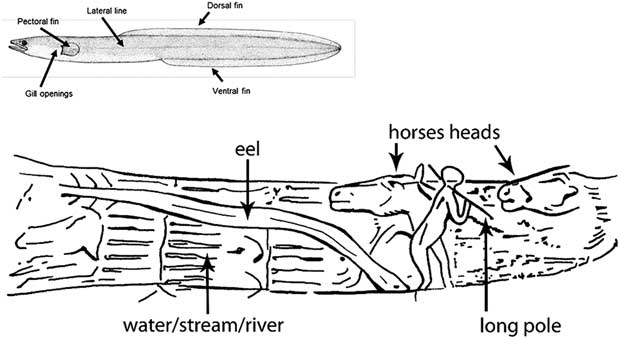
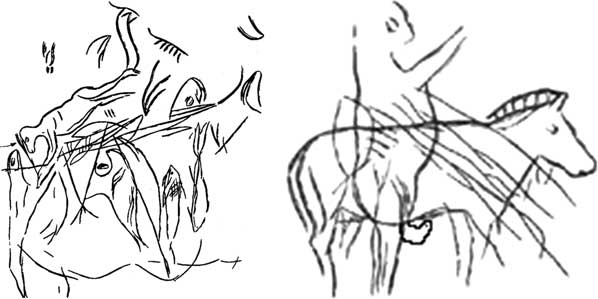
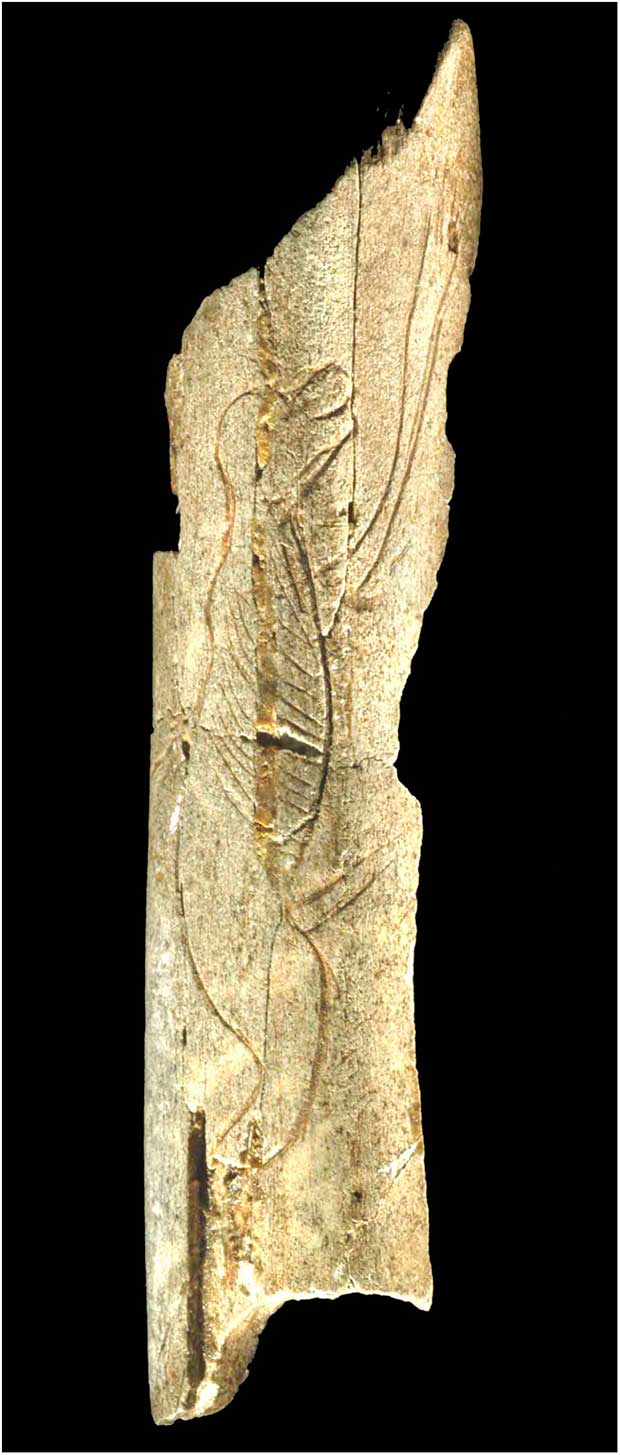
At least four sites yielded mobiliary art that may offer evidence of human engagement with the beaver-eel-horse ecosystem and exploitation of these species. The first is the Magdalenian type-site of Abri de la Madeleine rock-shelter in the Vézère Valley in the Dordogne, first excavated in 1863–4 by Edward Lartet and Henry Christy and later by Denis Peyrony (in 1926) and dating largely to the late Magdalenian (c. 13,440–12,640 bp: Boyle Reference Boyle1994; Gambier et al. Reference Gambier, Valladas, Tisnerat-Laborde, Arnold and Bresson2000; Maier Reference Maier2015). The Abbé Breuil interpreted one of the many zoomorphic engravings executed on a so-called bâton de commandement, as a human representation, a snake or an eel, and two horse heads (Fig. 5). Marshack later described the same group of engravings more generally as a ‘complex composition of “obscure significance”’ (Marshack Reference Marshack1972, 208), and there are some discrepancies between Marshack’s (Reference Marshack1972) and Breuil’s transcriptions of the eyes on the anthropomorphic engraving. However, their transcriptions of the horse heads and snake- or eel-like animal are in accordance with one another. Other thematic elements on this engraving include a suggestion of water or a stream (which Marshack interpreted as vegetation), and a human figurine holding a long stick, spear, or pole.
‘Snake or eel, man and two horse heads’ from Abri La Madelaine redrawn from Marshack (Reference Marshack1972) (redrawn and adapted from original © MNP Les Eyzies – Dist.RMN - cliché Ph. Jugie)

We propose a revised interpretation of this depiction in which the snake-like animal may instead be interpreted as a European eel. This engraving includes a series of marks that seem to depict the confluent dorsal-anal and caudal fins (dorsal and ventral) near the tail end of an eel. Furthermore, the width to length ratio of the engraved animal is closer to that of an eel than to that of a grass-snake (Natrix natrix), which would be the most likely common snake to be associated with rivers and wetlands. However, we have a very incomplete record of snakes and other herpetofauna for the Lateglacial in this region and snakes, like most of the herpetofauna, are thermophiles, require a long enough period of summer warmth (over 16°C) in order to incubate eggs (Gleed-Owen Reference Gleed-Owen1999). Three true snakes (Natrix natrix, N. maura, and Vipera latasteri) are known from Magdalenian levels at Gorham’s cave in Gibraltar (Blain et al. Reference Blain, Gleed-Owen, Carriónd, Jennings, Finlayson and Giles-Pacheco2013) and it is assumed that Iberia was the nearest refugium for these species during the LGM. There is also evidence of snakes at two Magdalenian sites in the Pyrenees. At Bois du Cantet Cave, in the Hautes Pyrénées Natrix sp., Zamenis longissimus (Aesculapian snake), and Vipera aspis (European adder) were recorded, and at Malarode Cave, Pyrénées-Atlantiques remains of Natrix sp. (Bailon Reference Bailon1991; Bailon pers. comm. 2016). It therefore has to remain an open question as to whether snakes were present in sites further north such as Abri de la Madeleine although it is likely by the end of the Magdalenian they would have migrated into this area, assuming they had not survived in a local refugia (Stewart pers. comm.).
Although there is little definitive detail on the stick held by the anthropomorphic figure, it could depict either a poke pole for eel fishing or a harpoon. The downward orientation of the stick is strongly reminiscent of the way the eel poke pole is held and used. Marshack (Reference Marshack1972) refers to two branches or leaves on the lower end of the pole, but in his drawing they are on opposing sides of the pole and quite uniform and symmetrical, so they might represent prongs on an eel spear or harpoon. This alternative interpretation leads, in turn, to a revised narrative for the whole engraving; it may depict humans exploiting eels using both a tool similar to a poke pole and horses’ heads as an eel trap. This implies that the engraving may not be just a random assemblage of representational elements but, rather, an intentional narrative of activities that held both practical and symbolic importance to Magdalenian culture.
From the same site there is also a ‘fish carved on reindeer antler’ on display at the Musée de Saint-Germain-en-Laye (see http://donsmaps.com/laugeriebasse.html). We argue here that it is possible that this is also a representation of an eel. for two reasons. First, although the artefact is incomplete, the length and shape of the carved fish is more typical of an eel than other freshwater fish (although it could be argued that this shape was mandated by the morphology of the antler). Even if the shape of the depicted species was dictated in part by the material support, the rib depicted at the top of the body is more reminiscent of the dorsal fin of an eel than a pike, which would be the most likely alternative fish species.
Another baton from La Madeleine, curated at the British Museum, preserves four schematic engravings previously interpreted as ‘fish’ (Sieveking Reference Sieveking1987, 21, pls 28–9) alongside and, in one case superimposed on, an engraving of a horse. Several of these engravings are sufficiently abstract that they might be equally interpreted as schematic depictions of eels, and the hatched marks are particularly reminiscent of the scales and markings on eels. A similar ‘ladder’ motif found on another baton from La Madeleine (Sieveking Reference Sieveking1987, 20–1, pls 26–7) was interpreted in the Reliquiae Aquitanicae (1875) as a schematised fish. However, the elongated shape of this motif and the suggestion of a dorsal fin again introduces the possibility that it represents an eel. The horse muzzle overlaps the eel/fish motif, spatially reinforcing the association between these two species; to modern viewers, the eel might appear to be moving into or out of the horse’s head, similar to its expected behaviour while being trapped in a horse-head. There are also bevelled spear points from La Madeleine along with several harpoons and leisters from the site attesting to the importance of fishing to the site’s occupants.
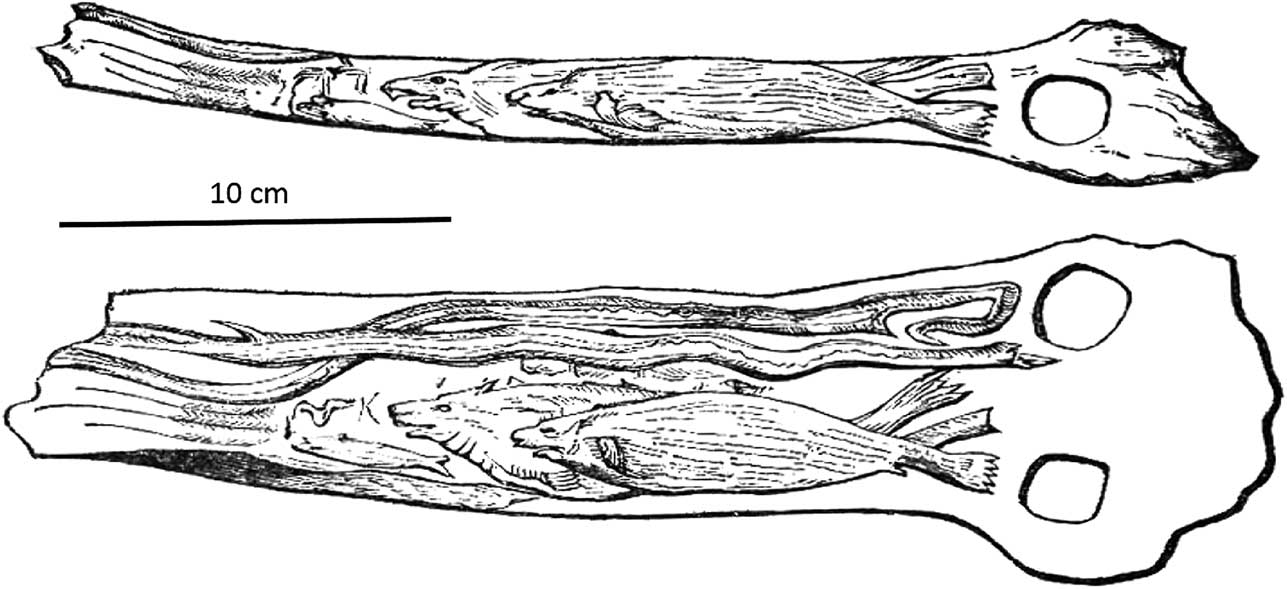
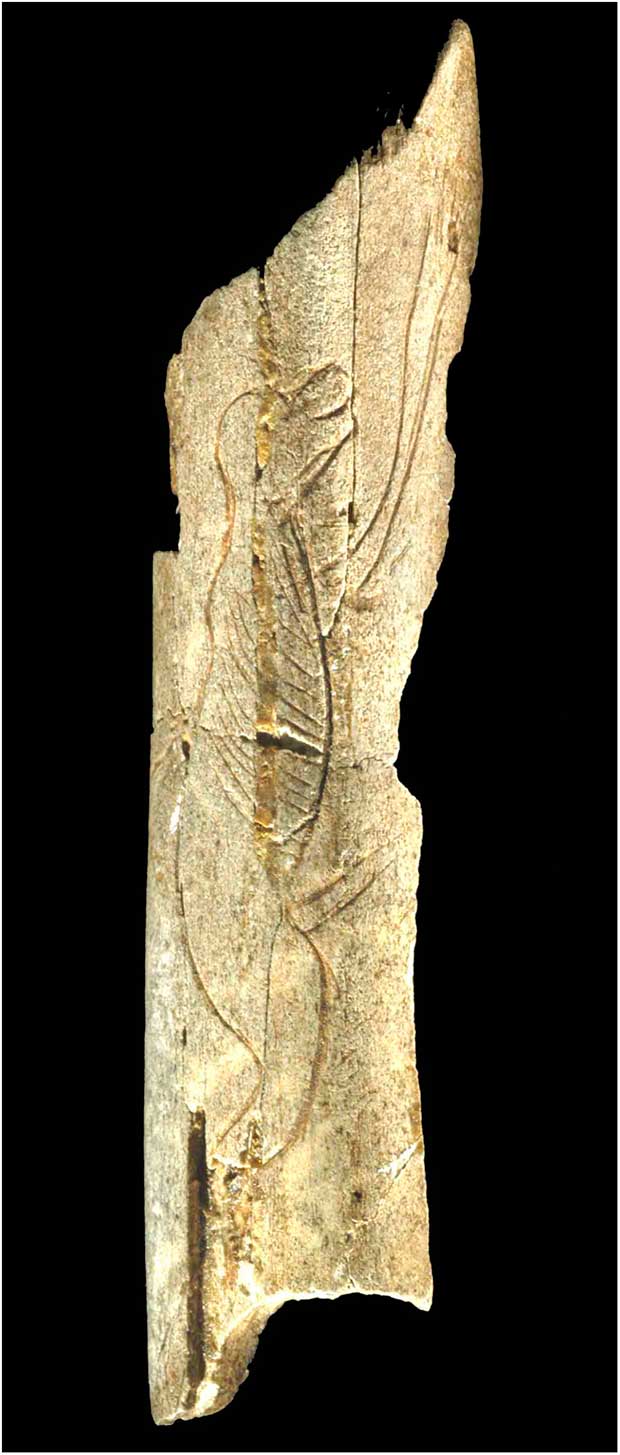
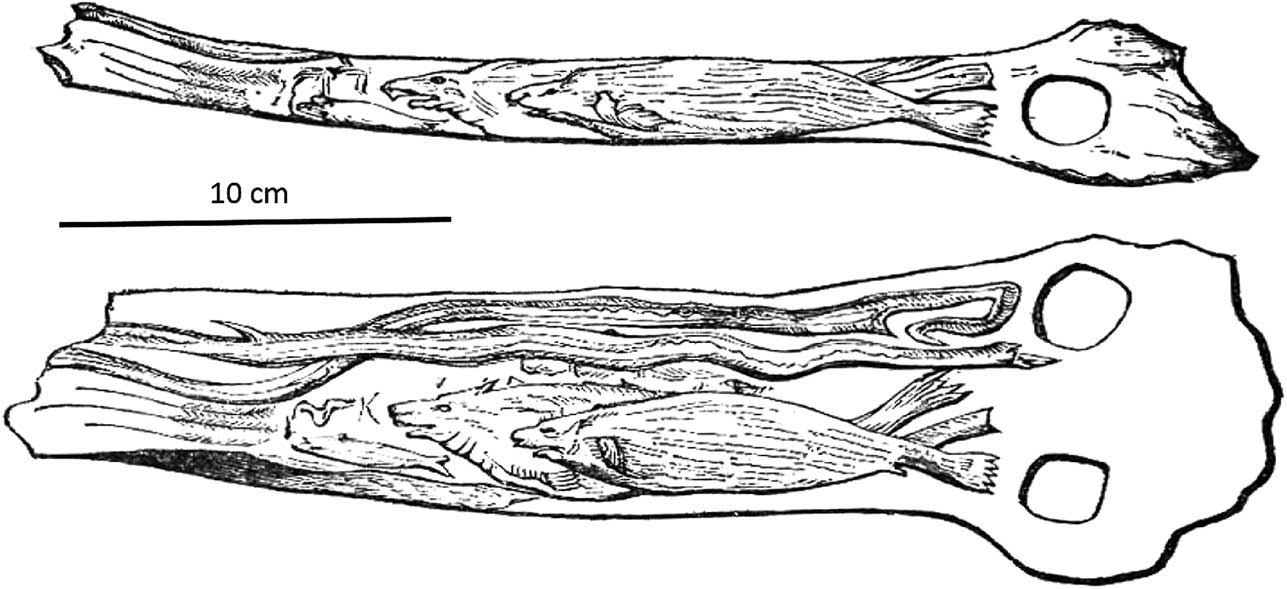
At Grotte de Montgaudier, Charante, central France, a reindeer antler bâton de commandement, found in 1886, was incised with depictions of two eels (whose fins are discernable), two feels, a fish, and vegetation and/or water (Fig. 6). It was first described 1887 by Albert de Nadaillac who clearly recognised the eels and regarded the site as late Magdalenian. The engraved baton was accompanied by pieces of ivory decorated with engravings and a pierced bone which was decorated with a frieze of three horses as well as perforated reindeer antlers decorated with two heads of goats (Airvaux Reference Airvaux2002). It is relevant here that this site is only just above river level with the lower areas liable to flooding today.
Engraving on a bâton de commandement from Grotte de Montgaudier from de Nadaillac (Reference de Nadaillac1887) (Creative Commons licence)
An engraved bone from El Pendo, north-west Spain depicts a ‘horse and a serpent associated with a set of linear marks’ (Marshack Reference Marshack1972, 211). Pozzi (Reference Pozzi2004) has noted that the representations on harpoons rarely represent terrestrial animals, so this example is unusual. By contrast the representation of fish on Magdalenian harpoons is frequent, although many are stylised and schematic (ibid.). Again the shape of the serpent is far more like an eel and it does not display the markings and forked tongue seen on representations that are almost definitely snakes, such as the engraved bone from Grotte de Lorthet in the foothills of the Pyrenees (Breuil & Saint-Périer Reference Breuil and Saint-Périer1927; Marshack Reference Marshack1972, 223). The linear marks are curved and could represent water by analogue with depictions such as the line angles on the horse, bison and fish engraving on the eagle bone from La Vache (Ariègè) as interpreted by Marshack (ibid., 275).
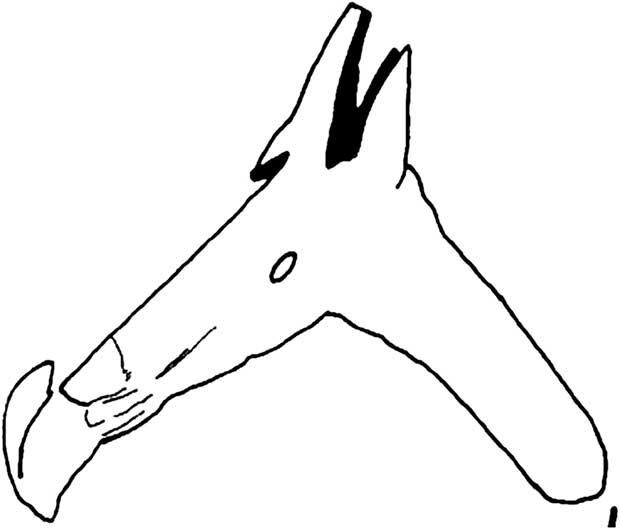
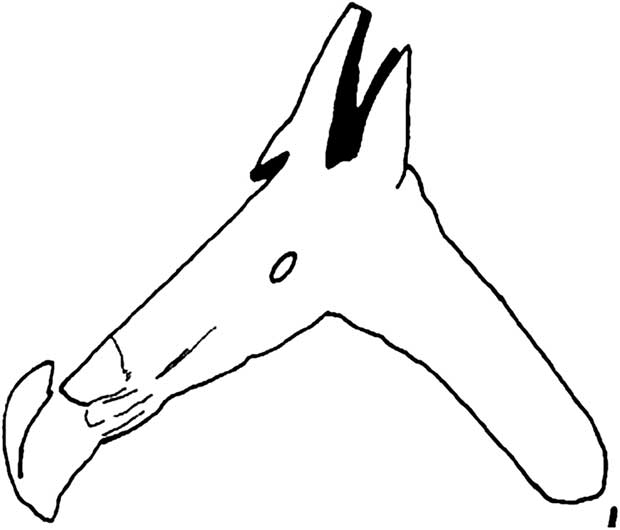
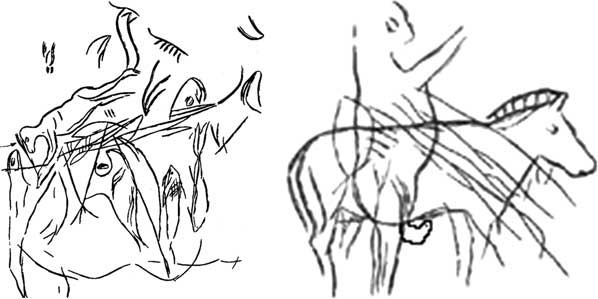
An enigmatic representation from the Grotte du Mas d’Azil, Ariègè, depicts a horse’s head with a thin irregular line emanating from its mouth (Fig. 7). This has generally been interpreted as grass or some form of foliage (Tyldesley & Bahn Reference Tyldesley and Bahn1983). Although possible, this seems rather prosaic and it is argued here that an equally plausible interpretation is that this also represents horse-head eel fishing. This is further supported by the presence of a possible ‘spear-thrower’ from the site with an unusual form (Garrod Reference Garrod1955). The spear-thrower, illustrated in Piette (Reference Piette1907 pl. li, no. 2), is 21 cm long and is thought to represent an eel with a small fish’s tail against its head (Piette Reference Piette1907; Garrod Reference Garrod1955). It is made on reindeer antler and its use as a spear-thrower is considered dubious by Garrod for a variety of reasons; however, the representation of the eel remains significant, even if the purpose of the artefact remains enigmatic. An alternative interpretation of the artefact might be that this is instead a fishing device of some unknown function. Two other artefacts from Mas d’Azil reinforce the possible significance of horse heads in the trapping and fishing of eels. A famous spear-thrower from the site depicts three horses heads in various stages of life and death (Mas D’Azil Website 2012). It has been interpreted as a young horse, an older horse, and a horse skull. The horse skull depiction is particularly relevant to this discussion. Another sculpture fragment from la Grotte du Mas d’Azil has similarly been interpreted in the past as a horse head with the flesh removed. Overall, the graphic juxtaposition of images of life and death may be related to meaning associated with the use of the spear-thrower in killing horses, but it should be noted that the same life-death relationship is present in the use of a carcass to attract eels. An association between fish and horses and vegetation is also seen at Lortet and Cueva los Casares where there are also images of possible anthropomorphic mustelids, such as otters, but which could also be reinterpreted as beavers (Fig. 8, see below for further discussion of beaver/otter representation).
‘Horses head with herbage’ from Grotte du Mas d’Azil, adapted from Tyldesley & Bahn (Reference Tyldesley and Bahn1983) (copyright: Elsevier)
Two panels from la Cueva de los Casaresal. Magdalenian. (http://quintadimension.blogcindario.com/2008/09/00019-antropomorfos-en-la-cueva-de-los-casares.html; Creative Commons licence)
A strong association between fish and fertility is suggested at Bruniquel, Tarn-et-Garonne (Sieveking Reference Sieveking1987), where a broken baton, which was carved to the shape of a phallus, was decorated with fish and ‘angles probably representing water’ (Marshack Reference Marshack1972, 330). A broken engraved bone from the same site is interpreted as a depiction of fish on one side and uncertain images, fish tails, or trees on the other. An alternative interpretation is that these are fish or eel heads and the uncertain images are eel spears, similar to those used by Maori, or a fish-catcher (ibid., 200).
Several other sites have depictions that might be related. A rib bone from La Vache, in the French Pyrenees, was engraved with a horse head, which Marshack (Reference Marshack1972, 225) interpreted as a stallion, followed by a mare; the two figures are separated by a symbolic branch. However, Marshack does not discuss the curved line emanating from the stallion’s mouth which might be a schematic interpretation of an eel. Mobiliary art from other sites associates horses or horse’s heads with rivers and fish. For instance, an engraving on stone from Trois Frères (Ariègè) features a small horse’s head engraved over a fish (Marshack Reference Marshack1972, 244). Similarly, an engraving on a baton from Abri Mège, Teyjat, depicts a horse and deer head surrounded by three serpentine shapes (ibid., 260). At least one of the shapes has a pectoral fin while another has a clear lateral-line, suggesting that they are probably depictions of eels rather than snakes. At Grotte de Raymonden, Chancelade (Dordogne), a stone baton was engraved with a horse’s head, fish, harpoon, and a possible bud or flower (Breuil Reference Breuil1937; Marshack Reference Marshack1972; Tyldesley & Bahn Reference Tyldesley and Bahn1983).
While evidence for the use of beaver pelts exists from at least the Middle Palaeolithic (Fiore et al. Reference Fiore, Gala and Tagliacozzo2004), there are only a few possible depictions of beavers in Magdalenian art. One of them from Abri de la Madeleine is regarded by the Musée Les-Eyzies-de-Tayac as an anthropomorph entitled ‘The sorcerer of La Madeleine’ (Fig. 9). The other is a very well known engraved image of two women-otter figures from the Middle Magdalenian levels at Isturitz (on display at the Musée Nationale de Préhistoire Les Eyzies de Tayac; Isturitz Websites). Both images have traditionally been is regarded as human-otters and, in the La Madeleine case, an otter-like human/shamanistic being (Cooper Reference Cooper2001). However, this figure (Fig. 9) appears to have a wide/fat tail and the other has a similar body shape and either no tail or possibly a fat tail rendered as feet. In these regards, both images are more likely to be beavers than otters, in which case a symbolic link is suggested between the human form (and/or human behaviour) and beavers. The presence of beaver in the region during the Magdalenian is not in doubt (see Table 1), however, there is only one find of fossil otter (Lutra lutra) from the Lateglacial in France and that comes from the Alps (Chaix & Olive Reference Chaix and Olive1984) although finds are known from Germany and Poland (Knul pers. comm.). Although it might be argued that otter would likely be under-represented in caves and not being a human food resource (like most carnivores) there is no fossil data at present to question the view of Sommer and Beneck (Reference Sommer and Beneck2004) that the European population of otter was restricted to a single glacial refuge and did not expand westwards into France until the Holocene. Other purported otter representations might be similarly reconsidered as beavers. For instance, an engraving from Laugerie Basse, Dordogne, repeatedly interpreted as an otter, is located adjacent to one fish engraving and overlapping another (MacCurdy Reference MacCurdy1924, 37; Guthrie Reference Guthrie2006, 224). Like the other enigmatic zoomorphs discussed above, the purported ‘otter’ is easily re-interpretable as a beaver.
Engraved bone of an anthropomorph entitled ‘The sorcerer of La Madeleine’ from Abri La Madelaine (reproduced by permission of the Musée National de Préhistoire, Les-Eyzies-de-Tayac. © MNP Les Eyzies – Dist.RMN - cliché Ph. Jugie)
NICHE CONSTRUCTION THEORY & LATEGLACIAL HUMAN–ENVIRONMENT INTERACTIONS
Niche construction theory (NCT) provides a potentially valuable framework for analysing the bi-directional interactions of humans with environments in the past which explicitly considers human behaviour, abiotic factors, and ecological feedbacks within an evolutionary context (Smith Reference Smith2007; Lewontin Reference Lewontin2000; Odling-Smee et al. Reference Odling-Smee, Erwin, Palkovacs, Feldman and Laland2013; Allaby et al. Reference Allaby, Kistler, Gutaker, Ware, Kitchen, Smith and Clarke2015). Niche construction refers to the ‘modification of both biotic and abiotic components in environments via trophic interactions and the informed (i.e., based on genetic or acquired information) physical work of organisms’ (Odling-Smee et al. Reference Odling-Smee, Erwin, Palkovacs, Feldman and Laland2013, 5). Of importance here is that this includes both actions by humans and also by other biotic components of the ecosystem. It is evolutionary in that it can increase carrying capacities, facilitate co-operative behaviour, and lead to ecological inheritance which can include acquired social learning. This includes an element of selective pressure provided by a diet that would enhance brain development in infants and facilitate cognition, rapid learning, and visual acuity (Cheetham et al. Reference Cheatham, Colombo and Carlson2006; Agostini 2008). NCT goes beyond the extended phenotype approach (sensu Dawkins Reference Dawkins1982) in considering such behaviour as more than adaptations, including by-products such as artefacts that include signs, signals, or new behaviours which may or may not be ‘profitable’ (Madden et al. Reference Madden, Dingle, Isden, Sparfield, Goldizan and Endler2012). In both evolutionary and archaeological terms NCT is important because it can; (a) influence the strength and selection acting on all participants (Odling-Smee et al. Reference Odling-Smee, Laland and Feldman2003), (b) increase the abundance of individuals by increasing fecundity and/or extending longevity, and (c) encompass ecological spill-overs which are modifications to other species niches creating multiple co-evolutionary events. NCT also implicitly recognises ecological change through the occurrence of new assemblages creating potentially novel trophic interactions as must have been common under the rapidly changing climates and biogeographical biotic distributions during periods of rapid climate change such as the Late Upper Palaeolithic (Dawson et al. Reference Dawson, Jackson, House, Prentice and Mace2011; Birks & Birks Reference Birks and Birks2008). Thus particular associations brought into being by climatic change can interact to produce locationally-specific nutritional advantages for human populations, in this case along river-corridors. Of particular significance for this paper is the commonly cited example in the NCT literature of the beaver’s dam which alters the environment of many populations and even the abiotic environment (Naiman et al. Reference Naiman, Johnston and Kelly1988; Odling-Smee et al. Reference Odling-Smee, Laland and Feldman2003). We can also differentiate niche construction (as with the beaver dams), opportunistic niche recognition via inherited environmental knowledge and niche maintenance through repeated use involving social memory.
INTERACTION, NICHE CONSTRUCTION, & DISCUSSION
The re-interpretation of some panels of mobiliary art as possible depictions of interactions between eels (and in some cases fish), horses, and in a few cases beavers highlights the interactions between these species and Magdalenian hunter-gatherer-fishers. The similarity between fish or eel killing batons, bâton de commandement and bâton perforé should be explored more although they have been interpreted in a bewildering number of ways (Bahn & Vertut Reference Bahn and Vertut1988). It is also during the Magdalenian that harpoon technology becomes widespread (Julian 1982). It is not clear what the prey species were, but a link with fishing is most commonly made (Julien Reference Julien1982; Reference Julien1995; Román and Villaverde Reference Román and Villaverde2012) although this is difficult to prove due to the lack of detailed studies of ichthyofauna.
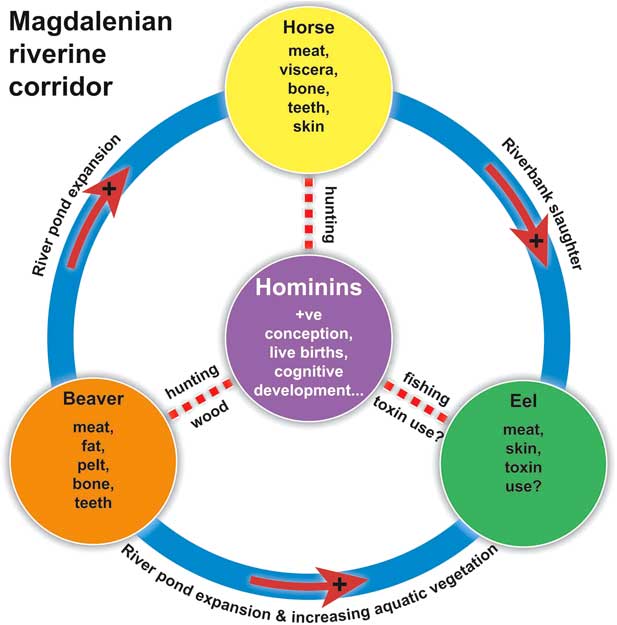
In the riverine environments of mainland north-west Europe along with the niche constructing activities of beavers we can add the involvement of Magdalenian peoples through butchery by rivers (attracting eels), and the hunting/trapping of eels and beavers (Fig. 10). This niche co-constructed by humans and beavers would have produced ecological spill-over effects of increases in waterfowl and fleshy tubors such as reed-maces (Typha sp.). In this context it is interesting to note that the highest proportion of all birds represented in Palaeolithic art are water-birds such as swans, geese, ducks, and heron (Bahn & Vertut Reference Bahn and Vertut1988). This niche can also be seen in relation to evolving views on Magdalenian diet and nutrition as counterbalancing potentially excess protein in the Magdalenian diet (Speth Reference Speth1991). Whilst the Magdalenian in north-west Europe has commonly been viewed as the ‘reindeer-horse hunters’ with regional variations (Ávarez-Fernández Reference Ávarez-Fernández2011) this is biased by the data which are largely artefacts, animal bones, and a limited amount of isotopic data. Recent studies using different datasets such as dental calculus have argued for a much broader dietary base with significant plant consumption including underground storage organs (Power et al. Reference Power, Salazar-García, Straus, González Morales and Henry2015). This study also recovered a sponge spicule from dental calculus suggesting some plant or animal input from a freshwater habitat.
Schematic representation of ecological relationships between humans, beaver, eels and horses in the European Late Upper Palaeolithic

This can be seen as part of the co-evolution of plant–human relationships (Allaby et al. Reference Allaby, Kistler, Gutaker, Ware, Kitchen, Smith and Clarke2015) and which we argue here includes co-constructed riverine niches. These niches would also have been relatively stable in the face of climatic instability during this period (Bignon et al. Reference Bignon, Baylac, Vigne and Eisenmann2005) and may have provided an expanded season of both protein and carbohydrate/fat. Any linkage between the exploitation of individual resources inevitably raises the question of seasonality. It has been argued that, in the Magdalenian in France, reindeer was hunted in the autumn/winter and horse in the spring/summer (Fontana Reference Fontana2000). There is direct evidence of reindeer hunting in autumn from Verberie in northern France (Enloe Reference Enloe2006). If so, a link between the exploitation of horse and eel would suggest a spring to summer window, however, both eel and beaver are potentially available year-round. Beavers do not hibernate but store enough food underwater to last the winter, which they can access even if the pond or river is frozen over and snow cover has made terrestrial plants inaccessible. Ethnographic records from North America indicate that beaver tail fat provided an important late winter fat component for human diet (Coles Reference Coles2006). Winter availability also applies to several plant resources such as the rhizomes of reed-maces and the leaves of plants such as watercress (Nasturtum officinale) which are high in valuable nutrients, particularly vitamin C. Although it is difficult to be precise about the targeted species, the noted rise of harpoons as an artefact type during this period reinforces the centrality of riverine environments (Julien Reference Julien1982; Reference Julien1995; Román & Villaverde Reference Román and Villaverde2012). This accords well with Boyle’s (Reference Boyle2010) argument in favour of true specialisation during the Magdalenian and Solutrean, and it is possible to see how this adaptation could fit into arguments regarding the expansion of the Magdalenian to north-west Europe (Miller Reference Miller2012).
It is proposed here these relationships, between eel, beaver, horse, and Magdalenian peoples constitute a humanly-constructed niche in both ecological and symbolic terms, which was also advantageous for human well-being and social development in at least two ways. First it allows year-round occupation which has reproductive, social, and cultural consequences (Shennan Reference Shennan2001; Zubrow Reference Zubrow2010). Secondly the diet, and in particular the high consumption of eels, eggs, and fish would be unusually high in long-chain polyunsaturate acids (LCPs, including omega-3 and omega-6) and docosahexaenoic acid (DHA). These nutrients are all known to promote eye and brain development in babies and social learning (Xiang et al. Reference Xiang, Alfvén, Blennow, Trygg and Zetterström2000; Brenna & Carlson Reference Brenna and Carlson2014; Birch et al. Reference Birch, Garfield, Castaneda, Hughbanks-Wheaton, Uauy and Hoffman2007; Kuratko et al. Reference Kuratko, Cernkovitch Barertt, Nelson and Salem2013). In terms of culture and to paraphrase Lévi-Strauss (Reference Lévi-Strauss1964), food and cooking is a language – and an essential part of group identity and culture. Both the sedentism and the nutritional advantages are part of the ecological feedbacks and selective pressure within an evolutionary context that underlie niche construction theory (Smith Reference Smith2007; Lewontin Reference Lewontin2000; Odling-Smee et al. Reference Odling-Smee, Erwin, Palkovacs, Feldman and Laland2013; Allaby et al. Reference Allaby, Kistler, Gutaker, Ware, Kitchen, Smith and Clarke2015) and simultaneously can be seen as part of the way human agency was created and transformed through inhabitation of complex material conditions (Barrett Reference Barrett2001). We suggest here that the representation of the affluence and development of such a society is embodied in the symbolism of the artistic representations discussed here.
CONCLUSIONS
It is argued here from a combination of ecology, palaeoecological evidence, and the reinterpretation of several pieces of mobiliary art that Magdalenian hunter-gatherers had honed the skill set and technologies necessary to undertake eel-fishing using poke poles, nets, or baskets, and horse heads used as traps. These innovations which are part of the ‘broad spectrum evolution’ could have arisen when eels were attracted to horse butchery sites in shallow channels and on river banks, and the roots of these practices might extend even earlier in the Palaeolithic. This can also be seen as part of a larger socio-ecological interaction between humans and beavers, with horses and eels (as beaver dams are ready-made eel traps and ideal for horse-head eels traps) which, we argue, formed part of a particularly valuable and probably symbolically loaded humanly constructed niche. The similarity between hedge-type fish traps now known to date from at least the early Mesolithic in north-west Europe (Zvelebil Reference Zvelebil2008; Smart Reference Smart2003; Zhilin Reference Zhilin2014) suggests this niche construction could have been an integral part of associative innovation which extended north during the Magdalenian. Both the act of depicting eels, horses, and beavers as elements on mobiliary art at sites with other elements of ritual significance, and the biology of these three animals (which have engendered myths until the present day), suggests that they were part of an animistic association which represented important elements of the Magdalenian peoples’ view of both themselves and other occupants of this ecological niche. This also implies that key panels of Magdalenian mobiliary art could be seen as representing ecological assemblages and a constructed niche rather than isolated biological, resource, or symbolic elements. Seen as such, this is part of the deeper time-depth of co-evolutionary process with selective pressure that led eventually to domestication of key species such as the horse (Allaby et al. Reference Allaby, Kistler, Gutaker, Ware, Kitchen, Smith and Clarke2015). This behaviour is also part of an evolving socio-ecological cognition that some have argued forms part of modern human behaviour.
However, the existence of this ecological association earlier in the Pleistocene, but relative lack of artistic representation, cautions against such an interpretation. Indeed, whilst the primary focus for this paper has been on the Magdalenian, there is intriguing evidence that the association of hominins in this particular niche may have much deeper roots. For example, the site of Cueva Millán dating to 37,600 bp yielded six species of fish including trout (Salmo truta farios, N=198), Iberian nase (Chondrostoma polylepsis, N = 52), and eel (Anguilla Anguilla, N = 29) in association with human activity (Izquierdo Reference Izquierdo1992; Boyle Reference Boyle2010). Even older is the remarkable 2012 discovery of the Eemian site of Waziers, France (minimum U/Th age of 103+3.5/–3.4 ka, Hérisson et al. Reference Hérisson, Locht, Vallin, Deschodt, Antione, Auguste, Limondin-Lozouet, Lefèbvre, Hulin, Masson and Ghalen2015) where wood shows clear marks of beaver activity and a cut mark on one of the beaver bones (Castor fiber) (Hérisson pers. comm. 2015). Although analysis is still underway, a range of other interglacial fauna were also present including horse, roe and red deer (Hérisson pers. comm. 2015). Whilst we can never put ourselves in the place of these Palaeolithic peoples and the use of ethnographic analogy such as Maori or even historical eel fishing should be used with care (Lane Reference Lane2014), a holistic approach to understanding their artefactual remains and landscapes surely places some constraints on the plethora of possibilities and can only improve our interpretations of artefactual evidence. Re-interpreting some key Palaeolithic art objects also highlights the importance of studying Palaeolithic art in its broader ecological and archaeological context, rather than continuing to focus on the iconographic features and interpret them in isolation.
Acknowledgments: Thanks to John Stewart, Chris Gleed-Owen, Mark Roberts, Katheryn Boyle, William Davies, John Stewart, Monika Knul, Mike Lobb, Kevin Walsh, Mark Gardiner, Finbar McCormick, Ezra Zubrow, and Des Tatana Kahotea for helpful discussions on this topic which improved the paper. Thanks also to Don Hitchcock for assistance with photographic materials.