Grazed pasture is a major source of nutrients for dairy cattle in many parts of the world due to its inherent low cost (Doyle & Stockdale, Reference Doyle, Stockdale, Fuquay, Fox and McSweeney2011). In south eastern Australia, however, below average rainfall has reduced the availability of pasture (Dairy Australia, 2011) and increased the reliance on supplements, often produced off-farm, to meet the nutritional requirements of dairy cows. Traditional systems of providing supplementary grain in the parlour at milking times can lead to inefficiencies in rumen fermentation, and thus reduces milk responses, when high amounts of grain are offered (Wales & Doyle, Reference Wales and Doyle2003; Doyle et al. Reference Doyle, Francis and Stockdale2005). Feeding strategies that maintain grazed pasture as a high proportion of the diet, but provide supplements as a partial mixed ration (PMR) after milking have potential to increase the milk production response of grazing cows compared with traditional systems (Bargo et al. Reference Bargo, Muller, Varga, Delahoy and Cassidy2002; Auldist et al. Reference Auldist, Marett, Greenwood, Hannah, Jacobs and Wales2013).
It has been well established that feeding strategies can affect milk fatty acid (FA) composition of dairy cows, which in turn can impact on human health and physico-chemical properties of milk fat (Chilliard, Reference Chilliard2000; Bargo et al. Reference Bargo, Delahoy, Schroeder and Muller2006a). However, reports on the effects of PMR on milk composition are limited to studies conducted in countries other than Australia (Bargo et al. Reference Bargo, Delahoy, Schroeder, Baumgard and Muller2006b; Vibart et al. Reference Vibart, Fellner, Burns, Huntington and Green2008; La Terra et al. Reference La Terra, Marino, Manenti, Licitra and Carpino2010; Morales-Almaráz et al. Reference Morales-Almaráz, Soldado, González, Martınez-Fernández, Domınguez-Vara, de la Roza-Delgado and Vicente2010). Investigation of the effects of these feeding systems in Australia is important since a high proportion of milk products are exported. Further, the influence of offering different amounts of PMR containing different carbohydrate sources to cows grazing a restricted allowance of pasture has not been extensively tested. In a companion paper, Auldist et al. (Reference Auldist, Marett, Greenwood, Hannah, Jacobs and Wales2013) indicated that milk fat depression (MFD) occured in cows receiving high amounts of supplement in a traditional supplementation regime and those receiving PMR, both contained a readily digestible carbohydrate source. In contrast, milk fat concentration and milk yield did not decrease in cows receiving high amounts of supplement as a PMR contained a more slowly digestible carbohydrate. Fatty acids with 18 carbons and a 10-trans bond have been considered to be responsible for MFD (Bauman et al. Reference Bauman, Perfield, Harvatine and Baumgard2008; Shingfield et al. Reference Shingfield, Sæbø, Sæbø, Toivonen and Griinari2009; Maxin et al. Reference Maxin, Glasser, Hurtaud, Peyraud and Rulquin2011) and it is important to know if the proportions of these FA in milk are altered under different feeding systems.
The current research aimed to compare the impacts of 2 differently formulated PMR with the traditional strategy of feeding grain in the parlour and forage in the paddock on milk FA, including those FA that affect MFD. It was hypothesised that differences in ruminal digestion of supplements (different carbohydrate sources) could affect ruminal metabolism of dietary lipids and consequently milk FA composition. It was also hypothesised that supplementing grazing dairy cows with a high amount of supplement as a traditional pasture-based diet, compared with a PMR, could increase the proportions of FA responsible for MFD.
Materials and methods
Design and milk sampling
The experiment was conducted at the Department of Primary Industries (DPI) Victoria, Ellinbank, Australia (38°14′S, 145°56′E) in autumn 2010 (April and May), for a 25-d period. The experiment had a 14-d adaptation period and an 11-d measurement period. The study was undertaken in accordance with the Australian Code of Practice for the Care and Use of Animals for Scientific Purposes and under institutional animal ethics committee approval.
This study was performed in conjunction with an existing animal feeding experiment conducted by Auldist et al. (Reference Auldist, Marett, Greenwood, Hannah, Jacobs and Wales2013). The details of the main experimental procedure were reported by those authors. Briefly, 24 groups of 9 cows each were fed supplementary grain and forage according to one of 3 different strategies. The 3 strategies were: (1) Control: Cows grazed perennial ryegrass pasture supplemented with milled barley grain fed twice daily in the milking parlour and pasture silage provided in the paddock; (2) PMR1: Cows grazed the same pasture allotment as Control cows and were offered the same amounts of milled barley grain and pasture silage, but these supplements were mixed and presented as a ration on a concrete feedpad immediately after each milking; (3) PMR2: Cows grazed the same pasture at the same allowance offered to the Control cows, but were also offered a mixed ration comprising barley grain (25 % of total supplement dry matter, DM), crushed corn grain (30 % of DM), corn silage (20 % of DM) and alfalfa hay (25 % of DM), fed after each milking on a feedpad. Two groups of 9 cows within each strategy (Control, PMR1 and PMR2) were randomly assigned to receive either 6, 8, 10 or 12 kg DM supplement/cow per d. Thus there were 2 replicated groups per supplement amount per strategy. The supplements in these treatments were isocaloric and offered in addition to a pasture allowance of approximately 14 kg DM/cow per d.
Milk samples were collected at consecutive milkings (p.m. + a.m.) on two occasions during the last 2 weeks of the experiment with a week interval (48 samples in total). Milk samples were collected using in-line milk metres (DeLaval International, Tumba, Sweden) that collected a representative sample from each cow. Cows with clinical mastitis were excluded. Milk samples from the evening milking were stored at −4 °C overnight and mixed with the corresponding milk samples from the morning milking. Each milk sample was a mixture of the milk from one group of cows (9 cows) fed the same dietary treatment with the same amount of supplement. The milk from replicate groups was not mixed. Milk samples were stored at −20 °C until analysis.
Milk fat concentration and fatty acid composition of feedstuffs
Milk fat concentration was measured at a commercial laboratory using near infrared spectrophotometry (Foss 605B Milko-Scan, Foss Electric, Hillerød, Denmark). Feed FA composition was analysed at a commercial laboratory according to the method described by Sukhija (Reference Sukhija1988).
Milk fatty acid analysis
Milk fat was extracted according to ISO14156-IDF172. Subsequently, FA were methylated according to ISO15884-IDF182 (ISO-IDF, 2001, 2002). Fatty acid methyl esters were analysed with a Varian 3800 gas chromatograph (GC) (Varian, Mulgrave, Australia) fitted with a 100 m×0·25 mm, 0·2 μm Varian CP-Sil 88 column and equipped with a Varian CP-8400 autosampler and flame ionisation detector. The GC operation conditions were programmed following the method of Kramer et al. (Reference Kramer, Cruz-Hernandez, Deng, Zhou, Jahreis and Dugan2004).
Fatty acid methyl esters were identified and quantified using a standard mixture of 37 fatty acids C4-C24 (Supelco, Bellefonte, PA, USA). Linoleic acid, conjugated methyl ester (Sigma, Sydney, Australia) and trans-11-vaccenic acid (Supelco, Bellefonte, PA, USA) were used for the identification of 9c,11t-18:2 and 11t-18:1, respectively. Linoleic acid, conjugated methyl ester standard contained three different isomers 9c,11t-18:2, 10t,12c-18:2 and 10c,12c-18:2 (Sigma-Aldrich, 1996). For all samples, only one peak, corresponding to the retention time of 9c,11t-18:2, was found in the region of the chromatogram where conjugated linoleic acid isomers elute. Similar to milk, the main isomer in the standard is 9c,11t-18:2 (Contarini et al. Reference Contarini, Pelizzola and Povolo2009). The peak between 9t-18:1 and 11t-18:1 was considered as 10t-18:1 in the chromatogram of milk samples comparing the order of elution according to Juanéda (Reference Juanéda2002) and Kramer et al. (Reference Kramer, Cruz-Hernandez, Deng, Zhou, Jahreis and Dugan2004).
Amounts of FA were calculated as mg FA/100 mg fat using the peak areas of external and internal standards and the actual amounts of the FAs in the standard.
Statistical analysis
General linear model was fitted to the data using the PROC GLM of SAS (2009) with feeding strategy, supplement level and the interaction between these two as the model terms and each of the FA as a dependent variable. For each level of the feeding strategy, the differences between supplement levels were investigated using the ‘Slice’ option of the ‘LSMEANS’ statement of the PROC GLM. The effect of one week time interval between two samplings was not significant (P>0·1) on the proportions of FA; consequently, data were pooled across samplings for presentation. Correlations between milk fat per cent and 10t-18:1, 9c,11t-18:2 and 15:0 + 17:0 were assessed using Pearson's linear correlation coefficient of the PROC CORR procedure of SAS. To make the relationship linear, the correlation between 10t-18:1 and milk fat percentage was evaluated following the log transformation of the proportion of 10t-18:1.
Results
Dry matter intakes of supplement and pasture and rumen parameter data are reported in Auldist et al. (Reference Auldist, Marett, Greenwood, Hannah, Jacobs and Wales2013).
Fatty acid composition of feedstuffs
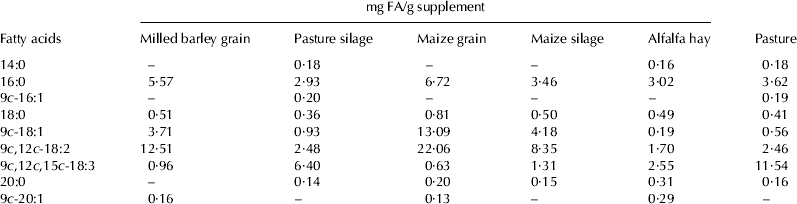
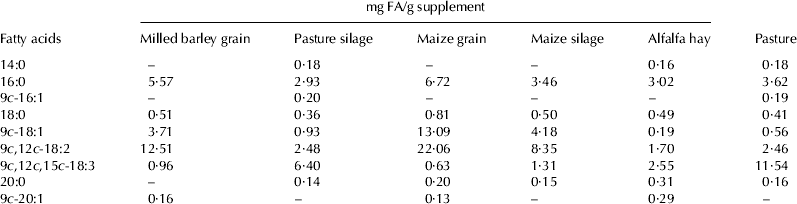
The data in Table 1 shows that pasture silage used in Control and PMR1 strategies contained higher proportions of 9c,12c,15c-18:3, whereas maize grain offered to the cows in PMR2 strategies contained higher proportions of 9c,12c-18:2.
Fatty acid composition of supplements and pasture offered to the cows
Fatty acid composition of milk
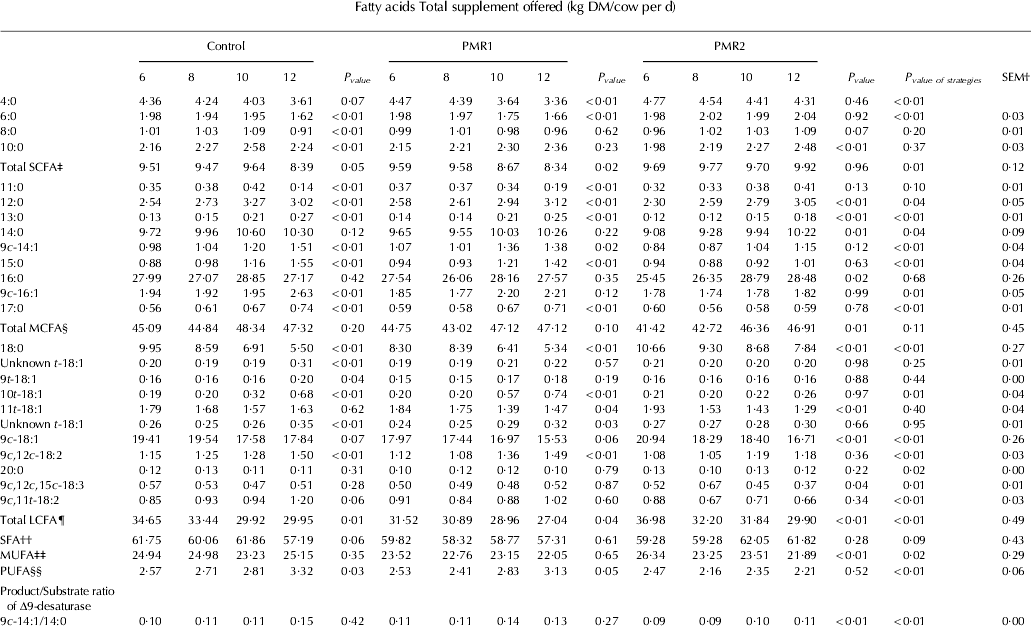
Feeding strategies and amount of supplement affected (P<0·05) most of the measured FA (Table 2). Fatty acid profiles of Control and PMR1 milks were largely similar, but different (P<0·05) from PMR2 milk.
Fatty acid proportions in milk fat from cows offered different amounts of supplement (6, 8, 10 or 12 kg DM/cow per d) according to 3 different feeding strategies (Control, PMR1 and PMR2). Data represent mg fatty acid/100 mg fat (mean; n=4)

P value indicates the differences between supplement levels within each feeding strategy
P value of strategies indicates the differences between feeding strategies (Control, PMR1 and PMR2) regardless of the amount of supplement
† SEM
‡ Short chain fatty acids
§ Medium chain fatty acids
¶ Long chain fatty acids
†† Saturated fatty acids
‡‡ Monounsaturated fatty acids
§§ Polyunsaturated fatty acids
The proportion of the total short chain fatty acids (SCFA) with 4–10 carbons was highest (P<0·05) in PMR2 milk compared with Control and PMR1 milk at all supplement amounts (Table 2). The total SCFA decreased in Control (P=0·04) and PMR1 (P=0·02) milk, however, remained constant in PMR2 milk (P=0·96) as the amount of supplement increased.
There was 13 % increase (P<0·01) in total proportion of medium chain fatty acids (MCFA) and 19 % decrease (P<0·01) in total proportion of long chain fatty acids (LCFA) as the amount of supplement increased from 6 to 12 kg DM/cow per d in PMR2 strategy. The proportion of 18:0 was highest (P<0·05) in PMR2 milk compared with Control and PMR1 milk at all supplement amounts and decreased as the amount of supplement increased (Table 2).
The proportion of polyunsaturated fatty acids (PUFA) was higher (P<0·05) in Control and PMR1 milk compared with PMR2 milk, particularly at higher amount of supplement (Table 2). The proportion of CLA isomer, 9c,11t-18:2, was higher (P<0·05) in Control and PMR1 milk at higher amounts of supplement and reached the highest in milk from cows fed 12 kg DM/cow per d of Control and PMR1 strategies (1·20 and 1·02 mg FA/100 mg fat, respectively for Control and PMR1 milk vs. 0·66 mg FA/100 mg fat for PMR2 milk).
Control and PMR1 milk contained higher (P<0·01) proportions of 15:0 and 17:0 at higher amounts of supplement. Milk 15:0 and 17:0 contents increased as the amount of supplement increased in Control and PMR1 strategies (P<0·01), but were unaffected (P>0·1) in PMR2 strategy (Table 2).
Fat concentration and proportion of 10t-18:1
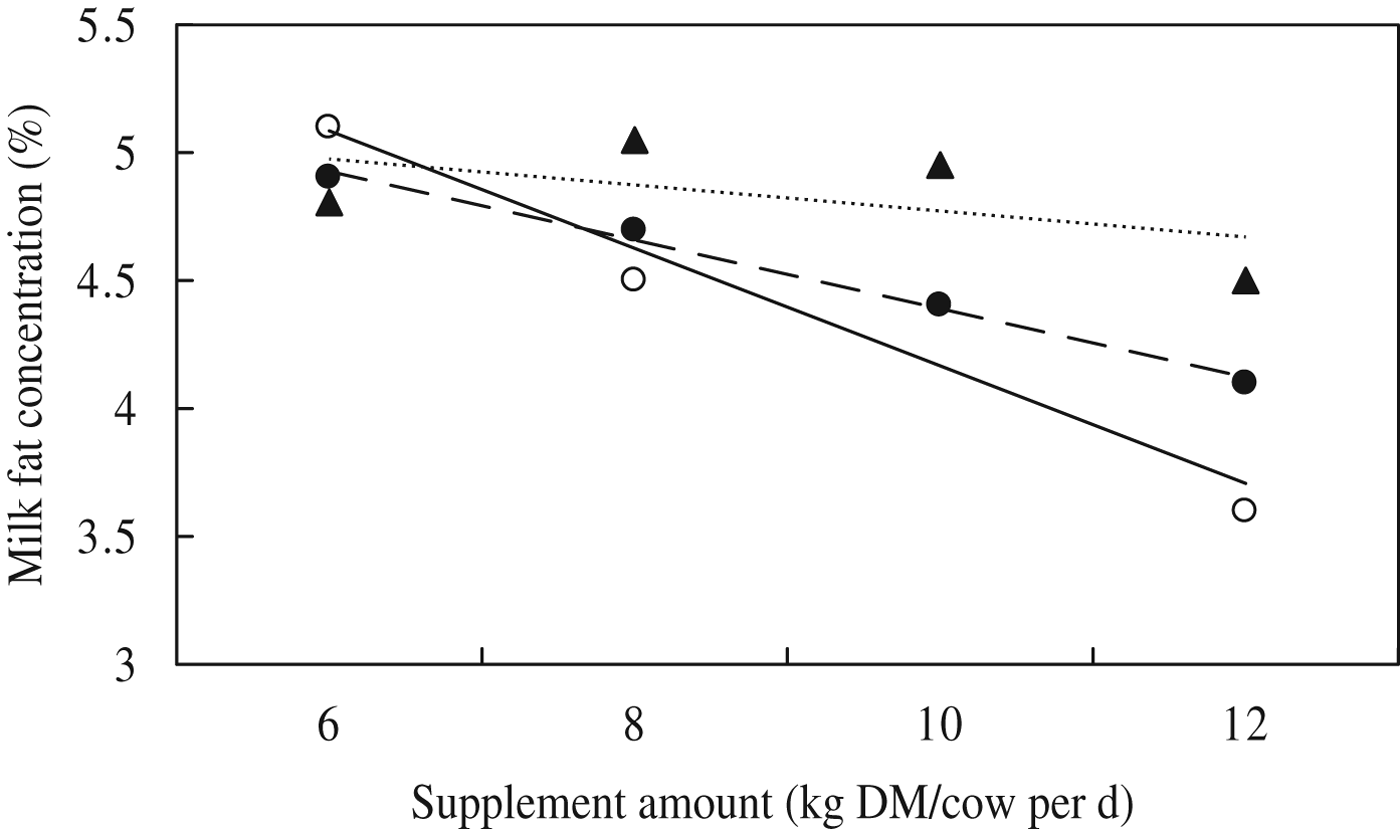
There was 29 and 16 % decrease in milk fat percentage as the amount of supplement increased from 6 to 12 kg DM/cow per d in Control and PMR1 strategies. In contrast, milk fat percentage in cows fed PMR2 strategy showed less fluctuations and only 6 % decrease was observed (Fig. 1). Milk from cows fed PMR2 strategy had higher (P<0·01) concentrations of fat at higher amounts of supplement than those cows fed Control or PMR1 feedings strategies (4·5 % vs. 4·1 % and 3·6 % fat for PMR2, PMR1 and Control milk respectively, from cows received 12 kg DM/cow per d; Fig. 1). Auldist et al. (Reference Auldist, Marett, Greenwood, Hannah, Jacobs and Wales2013) reported from the same experiment that yield of milk fat was also higher (P<0·05) in PMR2 milk at a supplement intake of 11 kg DM/cow per d.
Milk fat percentage in cows offered the Control ○, PMR1 ● and PMR2Δ strategies at nominal amounts of 6, 8, 10 or 12 kg DM/cow per d. Lines were fitted for the Control (solid line), PMR1 (long dashed line) and PMR2 (short dashed line). n=4, effects of feeding strategies (P<0·01) and amount of supplement (P<0·01).
Control and PMR1 milk contained similar proportions of 10t-18:1. The proportion of 10t-18:1 in milk increased 4 × with the increase in the amount of supplement in Control and PMR1 (P<0·01) strategies (Table 2). However, increasing the amount of supplement did not influence the proportion of 10t-18:1 in PMR2 milk (P=0·97, Table 2).
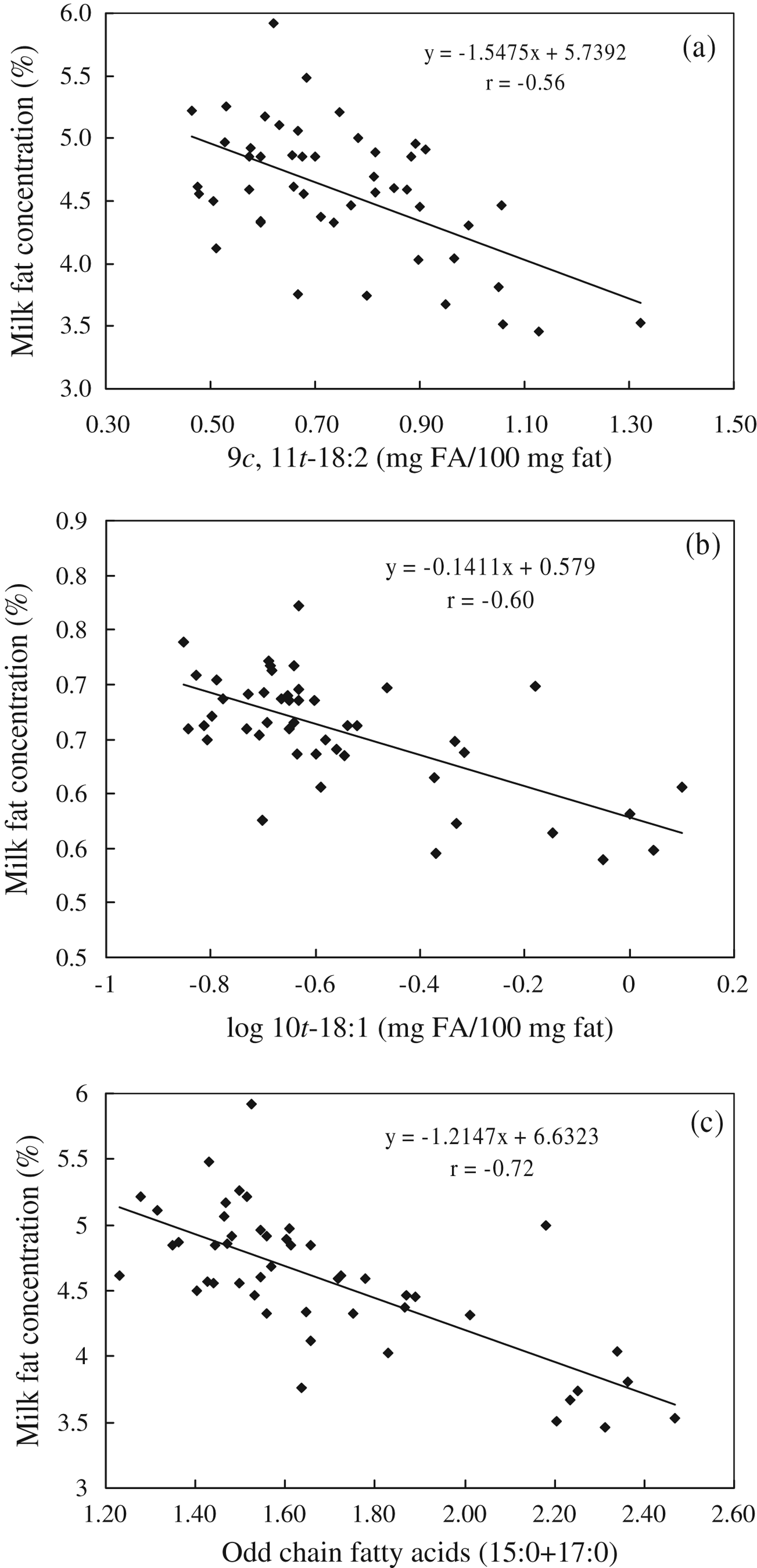
There were negative correlations between milk fat percentage and 9c,11t-18:2 content (P<0·01, r=−0·56) (Fig. 2a) and 10t-18:1 content (P<0·01, r=−0·60) (Fig. 2b) and 15:0+17:0 content (P<0·01, r=−0·72) (Fig. 2c).
Correlation between milk fat percentage and (a) 9c,11t-18:2 (P<0·01, r=−0·56) and (b) 10t-18:1 (P<0·01, r=−0·60) and (c) 15:0+17:0 (P<0·01, r=−0·72) content.
Discussion
Previous studies have reported the influence of feeding PMR to grazing dairy cows on milk FA composition (Bargo et al. Reference Bargo, Delahoy, Schroeder, Baumgard and Muller2006b; Vibart et al. Reference Vibart, Fellner, Burns, Huntington and Green2008; La Terra et al. Reference La Terra, Marino, Manenti, Licitra and Carpino2010; Morales-Almaráz et al. Reference Morales-Almaráz, Soldado, González, Martınez-Fernández, Domınguez-Vara, de la Roza-Delgado and Vicente2010). However, the influence of feeding different amount of supplement as a PMR with different carbohydrate sources on FA proportions of milk from grazing diary cows was not extensively studied.
Influence of feeding strategies on milk fatty acid composition
The similarity between FA profile of milk from cows fed Control and PMR1 indicated that the form in which supplements were offered to the cows (PMR vs. traditional pasture-based diet) did not influence milk FA proportion. These results were in agreement with those reported by Auldist et al. (Reference Auldist, Marett, Greenwood, Hannah, Jacobs and Wales2013), from the same experiment, who indicated that the form of supplementation did not influence milk production responses. These results also supported the hypothesis regarding the similar ruminal metabolism of dietary lipids and FA in cows fed a similar carbohydrate source. The differences between FA proportions of milk from cows fed Control and PMR1 (readily digestible carbohydrate source) as compared with milk from cows fed PMR2 (slowly digestible carbohydrate source) was speculated to be a result of different carbohydrate source. In contrast, Bargo et al. (Reference Bargo, Delahoy, Schroeder and Muller2006a) suggested that different dietary carbohydrate sources did not affect milk FA composition of grazing cows. The differences might be attributed to the different ways of delivering supplements and carbohydrate sources used in the two studies, barley vs. corn in the current study and cracked vs. steam-flaked corn in the study of Bargo et al. (Reference Bargo, Delahoy, Schroeder and Muller2006a). It has been also reported that steam rolling or flaking of corn did not significantly enhance the ruminal digestion of carbohydrate by dairy cows (Owens & Soderlund, Reference Owens and Soderlund2012). Moreover, the current study included a greater range and maximum inclusion level of supplements.
The decrease in the proportions of SCFA with the increase in the amount of supplement at Control and PMR1 strategies could be attributed to MFD as explained by Bauman & Griinari (Reference Bauman and Griinari2003) who reported a decline in SCFA in milk from cows experiencing MFD. Similarly, in a large study conducted by Walker et al. (Reference Walker, Williams, Doyle and Dunshea2007, Reference Walker, Wijesundera, Dunshea and Doyle2013) on 24 commercial farms showed a decrease in both total milk fat and SCFA with increasing level of supplementation to grazing cows.
The increase in the proportion of milk MCFA with the increase in the amount of supplement in PMR2 strategy was coincident with the decrease in the proportions of LCFA in these milk samples. The rate of de novo synthesis of FA with 4 to 14 carbons and proportions of 16:0 increases as positive energy balance and DM intake increases (Palmquist et al. Reference Palmquist, Beaulieu and Barbano1993). In contrast, LCFA mobilisation of adipose tissue decreases as positive energy increases (Bauman & Griinari, Reference Bauman and Griinari2003). In this study, total DM intake and apparent metabolisable energy intakes increased as the amount of supplement increased, and total DM intake and apparent metabolisable energy intake were higher for PMR2 cows (Auldist et al. Reference Auldist, Marett, Greenwood, Hannah, Jacobs and Wales2013). These changes may increase the de novo synthesis of MCFA and decreased the mobilisation of LCFA in PMR2 cows when the amount of supplement increased.
Lower content of PUFA in milk fat from cows fed PMR2 could be either due to the initial lower content of 9c,12c,15c-18:3 in the PMR2 strategy or differences in the ruminal biohydrogenation pattern, as Auldist et al. (Reference Auldist, Marett, Greenwood, Hannah, Jacobs and Wales2013) reported that pasture DM intake or pasture utilisation (as the main source of dietary PUFA) were not influenced by feeding strategies. Extensive ruminal biohydrogenation of dietary PUFA leads to an increase in the amount of 18:0 in milk. The last step of biohydrogenation (conversion of 11t-18:1 to 18:0) is rate-limiting (Lock & Garnsworthy, Reference Lock and Garnsworthy2003), and can be inhibited by diets that decrease rumen pH (Bauman et al. Reference Bauman, Perfield, de Veth and Lock2003). The proportion of 18:0 (the final product of biohydrogenation) was higher in milk fat from cows fed PMR2, whereas the substrates (9c,12c-18:2 and 9c,12c,15c-18:3) and intermediate products of biohydrogenation (11t-18:1, 9c,11t-18:2) were lower in these milk samples, particularly at higher amount of supplement. These findings suggest a more complete ruminal biohydrogenation of dietary lipid in cows fed PMR2 diet. The dietary treatments did not significantly influence ruminal pH; although ruminal pH was numerically higher in PMR2 cows (Auldist et al. Reference Auldist, Marett, Greenwood, Hannah, Jacobs and Wales2013). The slow fermentable carbohydrate source of PMR2 strategy might provide optimum condition for the activity of bacteria involving in biohydrogenation. Although pasture DM intake decreased as the amount of offered supplement increased, total PUFA increased in Control and PMR1 milk fat. Perhaps, lower ruminal pH at higher amount of supplement increased the proportion of PUFA in those milk samples.
Conjugated linoleic acid isomers with purported health benefits (Parodi, Reference Parodi1999) are formed during ruminal biohydrogenation of 9c,12c-18:2 or 9c,12c,15c-18:3 or through the desaturation of 11t-18:1 by Δ9-desaturase in the mammary glands (Bauman & Griinari, Reference Bauman and Griinari2001). Lock & Garnsworthy (Reference Lock and Garnsworthy2003) suggested that the activity of Δ9-desaturase can be determined by calculating the product/substrate ratio of the enzyme, and they considered 9c-14:1/14:0 as the best indicator of enzyme activity index. In the current study, the proportions of 9c,11t-18:2, 11t-18:1 and 9c-14:1/14:0 were higher in Control and PMR1 milk at 12 kg DM/cow per d compared with PMR2 milk. These findings could explain the higher proportions of 9c,11t-18:2 in Control and PMR1 milk.
Influence of feeding strategies on milk fat concentration and fatty acids related to MFD
An important finding from the present study was that whereas there was an inverse relationship between the amount of supplement and milk fat yield and percentage, this was least pronounced in those cows fed the more slowly fermentable carbohydrate source as PMR2. Bauman & Griinari (Reference Bauman and Griinari2003) explained that diets containing large amounts of readily fermentable carbohydrate are associated with MFD and usually reduce rumen pH and shift the biohydrogenation pattern in favour of the formation of FA (with a 10-trans bond), which decrease the gene expression of enzymes involved in milk fat biosynthesis. Bauman et al. (Reference Bauman, Perfield, Harvatine and Baumgard2008) suggested 10t,12c-18:2 as the main FA responsible for MFD. However, Perfield et al. (Reference Perfield, Sæbø and Bauman2004) indicated that the substantial divergences from the proportion of 10t,12c-18:2 and reduction in milk fat yield could suggest the role of other CLA isomers or FA formed in the rumen on lipid metabolism in the mammary gland and MFD. In the present study, 9c,11t-18:2 was the only detected isomer of CLA; consequently, it suggests that the proportions of other CLA isomers were lower than the detection limit. Previously, MFD in grazing dairy cows was connected to the increase in total CLA content (Schroeder et al. Reference Schroeder, Delahoy, Vidaurreta, Bargo, Gagliostro and Muller2003; Dunshea et al. Reference Dunshea, Walker, Ostrowska and Doyle2008). Dunshea et al. (Reference Dunshea, Walker, Ostrowska and Doyle2008) found that 10t,12c-18:2 only accounted for 4 % of total CLA and was not related to milk fat percentage in grazing cows. They found that 9c,11t-18:2 was negatively correlated (P<0·01) with milk fat percentage as were a number of t-18:1 FA including 10t-18:1. In the current study, negative correlation between 9c,11t-18:2 and milk fat percentage might also indicate an impact of other CLA isomers on MFD.
While the proportion of 10t-18:1 was significantly influenced by increasing the amount of supplement in Control and PMR1 strategies, it was unaffected by the amount of supplement in PMR2 strategy. It has been reported that 10t-18:1 content increased markedly during diet-induced MFD (Bauman & Griinari, Reference Bauman and Griinari2003; Bauman et al. Reference Bauman, Perfield, Harvatine and Baumgard2008). Whereas Lock et al. (Reference Lock, Tyburczy, Dwyer, Harvatine, Destaillats, Mouloungui, Candy and Bauman2007) reported that abomasal infusion of 10t-18:1 (42·6 g/d) did not influence milk fat content; Shingfield et al. (Reference Shingfield, Sæbø, Sæbø, Toivonen and Griinari2009) suggested that the supply of 10t-18:1 at the mammary gland during diet induced MFD is often several-fold higher than the amounts evaluated by Lock et al. (Reference Lock, Tyburczy, Dwyer, Harvatine, Destaillats, Mouloungui, Candy and Bauman2007). In light of this, the negative correlation between 10t-18:1 and milk fat percentage in the current study, suggests a causative effect of 10t-18:1 as an alternative or additional 10-trans (rather than 10t,12c-18:2) causing MFD. Thus, the hypothesis regarding the effects of high amounts of supplement on the putative FA responsible for MFD was supported by the coincident increase in the proportions of 10t-18:1 in Control and PMR1 milk with increasing supplement amount (but not for PMR2). However, the hypothesis regarding the influence of feeding strategies on the proportions of 10t-18:1 was rejected, as milk from cows fed Control and PMR1 strategies contained the highest proportion of 10t-18:1. These findings also supported the influence of carbohydrate source on factors responsible for MFD.
In Control and PMR1 cows, MFD was coincident with an increase in the proportions of 10t-18:1 and odd chain FA. These results were in agreement with Kay et al. (Reference Kay, Roche, Kolver, Thomson and Baumgard2005) and Colman et al. (Reference Colman, Fokkink, Craninx, Newbold, De Baets and Fievez2010) who reported the increase in 10t-18:1 and odd chain FA in cows experiencing MFD. In the current study, a negative significant correlation was observed between the sum of the milk 15 : 0 and 17 : 0 content and milk fat percentage. Colman et al. (Reference Colman, Fokkink, Craninx, Newbold, De Baets and Fievez2010) suggested that the profile of milk odd chain FA mainly depends on the activity of bacteria producing these FA rather than the precursor availability. It could be suggested that readily fermentable carbohydrate source of Control and PMR1 strategies stimulated the growth of bacteria forming trans-isomers (responsible for MFD) and rich in odd chain FA.
Conclusions
Milk fat content and FA composition were influenced by the composition of feeding strategies (as dietary carbohydrate source was speculated to be the main factor); however, the method of supplementation did not alter milk FA proportions.