INTRODUCTION
Attention-deficit/hyperactivity disorder (ADHD), a common neurodevelopmental condition, has heterogeneous etiologies (Castellanos, Sonuga-Barke, Milham, & Tannock, Reference Castellanos, Sonuga-Barke, Milham and Tannock2006). Executive dysfunction is one of the most prominent neuropsychological features (Willcutt, Doyle, Nigg, Faraone, & Pennington, Reference Willcutt, Doyle, Nigg, Faraone and Pennington2005) and a potential cognitive endophenotype (Gau & Shang, Reference Gau and Shang2010) for ADHD. Although most imaging studies of ADHD find alterations of discrete regional abnormalities within the frontostriatal circuitry underpinning executive functions (Rubia, Reference Rubia2011), the emerging etiological models have begun to emphasize aberrant interactions among brain regions (Castellanos & Proal, Reference Castellanos and Proal2012).
Intrinsic resting-state functional connectivity (RSFC), represented by the correlation of low frequency (e.g., <0.1 Hz) spontaneous fluctuations in neural activity measured by resting-state fMRI (rs-fMRI) BOLD signal, characterizes the functional organization of the brain at a system level, and is robust and reliable (Castellanos, Di Martino, Craddock, Mehta, & Milham, Reference Castellanos, Di Martino, Craddock, Mehta and Milham2013). Aberrant neural connectivity across brain regions has emerged as a characteristic of brain differences in ADHD (Castellanos & Proal, Reference Castellanos and Proal2012; Posner, Park, & Wang, Reference Posner, Park and Wang2014). For example, atypical RSFC lies within the cortical-striatal-thalamic circuitry (Cao et al., Reference Cao, Cao, Long, Sun, Sui, Zhu and Wang2009; Tian et al., Reference Tian, Jiang, Wang, Zang, He, Liang and Zhuo2006), and its connectivity is associated with neuropsychological performance (Mennes et al., Reference Mennes, Vega Potler, Kelly, Di Martino, Castellanos and Milham2011; Mills et al., Reference Mills, Bathula, Dias, Iyer, Fenesy, Musser and Fair2012) in ADHD. RSFC within the default mode network (DMN) is atypical in the development (Fair et al., Reference Fair, Posner, Nagel, Bathula, Dias, Mills and Nigg2010) and correlates with behavioral problems (Chabernaud et al., Reference Chabernaud, Mennes, Kelly, Nooner, Di Martino, Castellanos and Milham2012) in ADHD. Individuals with ADHD also show reduced antiphase relationship between the DMN and task-positive network (Castellanos et al., Reference Castellanos, Margulies, Kelly, Uddin, Ghaffari, Kirsch and Milham2008; Hoekzema et al., Reference Hoekzema, Carmona, Ramos-Quiroga, Richarte Fernandez, Bosch, Soliva and Vilarroya2013). Deficits in emotion regulation were associated with altered amygdala-cortical RSFC (Hulvershorn et al., Reference Hulvershorn, Mennes, Castellanos, Di Martino, Milham, Hummer and Roy2014), and the affective circuitry is demonstrated to have a clear dissociation with executive attention circuitry in children with ADHD (Posner et al., Reference Posner, Rauh, Gruber, Gat, Wang and Peterson2013). Despite that burgeoning findings from RSFC research conceptualized ADHD as a disorder underpinned by atypical large-scale neural systems, the roles of component networks are still largely elusive (Castellanos & Proal, Reference Castellanos and Proal2012; Posner et al., Reference Posner, Park and Wang2014).
The frontoparietal control network (FPCN) (Vincent, Kahn, Snyder, Raichle, & Buckner, Reference Vincent, Kahn, Snyder, Raichle and Buckner2008) is composed of the anterior prefrontal cortex (aPFC, Brodmann area, BA, 10), dorsolateral prefrontal cortex (DLPFC), anterior cingulate cortex (ACC), anterior insula, anterior inferior parietal lobule (aIPL), and caudate (Vincent et al., Reference Vincent, Kahn, Snyder, Raichle and Buckner2008; Yeo et al., Reference Yeo, Krienen, Sepulcre, Sabuncu, Lashkari, Hollinshead and Buckner2011). This network is anatomically and functionally interposed between the DMN and the dorsal attention network (Spreng, Sepulcre, Turner, Stevens, & Schacter, Reference Spreng, Sepulcre, Turner, Stevens and Schacter2013; Vincent et al., Reference Vincent, Kahn, Snyder, Raichle and Buckner2008), and is suggested to underpin executive control functions (Dosenbach et al., Reference Dosenbach, Visscher, Palmer, Miezin, Wenger, Kang and Petersen2006) and facilitates optimal decision making (Spreng, Stevens, Chamberlain, Gilmore, Schacter, Reference Spreng, Stevens, Chamberlain, Gilmore and Schacter2010).
Emerging literature suggests an important role of FPCN in the pathophysiology of ADHD. Previous structural imaging studies consistently report abnormal morphometry (Nakao, Radua, Rubia, & Mataix-Cols, Reference Nakao, Radua, Rubia and Mataix-Cols2011) and developmental trajectories (Shaw et al., Reference Shaw, Malek, Watson, Sharp, Evans and Greenstein2012) in the prefrontal, cingulate and parietal structures in ADHD. Both qualitative review (Rubia, Reference Rubia2011) and meta-analyses (Cortese et al., Reference Cortese, Kelly, Chabernaud, Proal, Di Martino, Milham and Castellanos2012; Hart, Radua, Nakao, Mataix-Cols, Rubia, Reference Hart, Radua, Nakao, Mataix-Cols and Rubia2013) on task-fMRI document hypoactivation of the components within the FPCN in ADHD across tasks. Rs-fMRI studies using various analytic methods also suggest involvement of the FPCN in ADHD (Cao et al., Reference Cao, Zang, Sun, Sui, Long, Zou and Wang2006; Posner et al., Reference Posner, Rauh, Gruber, Gat, Wang and Peterson2013; Qiu et al., Reference Qiu, Ye, Li, Liu, Xie and Wang2011; Wang et al., Reference Wang, Zhu, He, Zang, Cao, Zhang and Wang2009; Zang et al., Reference Zang, He, Zhu, Cao, Sui, Liang and Wang2007). However, to our knowledge, no studies have directly investigated the resting functional organization of the FPCN based on the aPFC, and how it underpins the cognitive/behavioral features of ADHD.
To test the hypothesis that children with ADHD show alterations in the FPCN, we measured whole-brain rs-fMRI in ADHD and typically developing (TD) children using seed-based analysis, and investigated the association with symptom severity and executive functions (including attention regulation, response inhibition, and spatial working memory). We hypothesized that the network connectivity would be atypical, and more aberrant disconnection would be associated with more severe symptoms and executive dysfunction in children with ADHD.
METHOD
Participants and Procedures
The Research Ethics Committee at National Taiwan University Hospital (NTUH) approved this study before implementation (approval number, 200903062R; ClinicalTrials.gov number, NCT00916851). The procedures and purpose of the study were explained face-to-face to the participants and their parents, who then provided written informed consents. All participants underwent the same clinical, neuropsychological, and MRI assessments.
We recruited 39 Taiwanese children with ADHD (aged 7–14 years; 34 males) consecutively from the child psychiatry outpatient clinic of NTUH, and 31 TD children (aged 7–14 years; 25 males) from schools in similar geographical districts. All participants were right-handed (Oldfield, Reference Oldfield1971). Children with ADHD were clinically diagnosed according to the DSM-IV-TR criteria and confirmed by the Chinese Kiddie epidemiologic version of the Schedule for Affective Disorders and Schizophrenia (K-SADS-E) interview (Gau & Shang, Reference Gau and Shang2010) by the corresponding author. The parents completed the Chinese version of the Swanson, Nolan, and Pelham, version IV scale (SNAP-IV)-parent form (Gau et al., Reference Gau, Shang, Liu, Lin, Swanson, Liu and Tu2008). Intellectual function was assessed by the Wechsler Intelligence Scale for Children, 3rd edition (Wechsler, Reference Wechsler1991). Executive functions were evaluated by the Conners’ continuous performance test (CCPT), alongside the Spatial Span of the Cambridge Neuropsychological Test Automated Battery. Our earlier studies showed that Taiwanese children with ADHD were impaired on these tests (Chiang, Huang, Gau, & Shang, Reference Chiang, Huang, Gau and Shang2013; Chiang & Gau, Reference Chiang and Gau2008; Gau, Chiu, Shang, Cheng, & Soong, Reference Gau, Chiu, Shang, Cheng and Soong2009; Gau & Shang, Reference Gau and Shang2010) (see supplementary material for details).
TD children were included if they did not have any current or lifetime DSM-IV psychiatric disorder based on the K-SADS-E interviews. Exclusion criteria for all participants included past or current neurological or severe medical illness, lifetime diagnoses of learning disorder, substance use disorder, autism spectrum disorder, schizophrenia, mood disorders, current anxiety disorders, or an intelligence quotient (IQ) less than 80. Individuals with current use of psychotropic medication, except methylphenidate for children with ADHD, were excluded. None of the ADHD participants took methylphenidate for at least one week before and during all assessments. In the final sample of ADHD (n=25), there were eight participants comorbid with oppositional defiant disorder, while no participants met clinical diagnosis of conduct disorder.
MRI Acquisition
Data were obtained on a 3T scanner (Siemens Magnetom Tim Trio) with a 32-channel phased-arrayed head coil. All participants were verbally instructed to remain still with their eyes closed to complete a 6-min rs-fMRI scan (see supplementary material for MRI parameters).
Rs-fMRI Preprocessing
The first five echo planar imaging volumes were discarded to allow for signal equilibration. Data preprocessing was performed using Data Processing Assistant for rs-fMRI (DPARSF) (Yan & Zang, Reference Yan and Zang2010), which is based on Statistical Parametric Mapping (SPM8). Image preprocessing comprised of slice timing and head motion correction. The fMRI data were then spatially normalized to the Montreal Neurological Institute (MNI) space with isotropic 3 mm voxel, via the gray matter (GM) segment obtained from structural images as follows. The mean fMRI volume was co-registered to individual T1-weighted image, then segmented into GM, white matter (WM) and cerebrospinal fluid (CSF) using the New Segment toolbox in SPM8, with custom tissue priors generated from the Template-O-Matic toolbox using the “matched-pair” approach (Wilke, Holland, Altaye, & Gaser, Reference Wilke, Holland, Altaye and Gaser2008). Next, we used a diffeomorphic nonlinear registration algorithm (Ashburner, Reference Ashburner2007) to create a study-specific template and to normalize segmented images to the MNI space. Individual fMRI volumes were then spatially normalized to the MNI space using this customary template, to improve the accuracy of spatial normalization (Tahmasebi, Abolmaesumi, Zheng, Munhall, & Johnsrude, Reference Tahmasebi, Abolmaesumi, Zheng, Munhall and Johnsrude2009). Normalized fMRI volumes were smoothed with 8 mm Gaussian kernel. Then linear drifts were removed and band-pass was filtered (0.009–0.08 Hz).
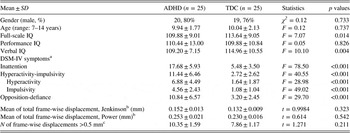
Since in-scanner head movements can substantially introduce spurious results in rs-fMRI findings (Power, Barnes, Snyder, Schlaggar, & Petersen, Reference Power, Barnes, Snyder, Schlaggar and Petersen2012; Van Dijk, Sabuncu, & Buckner, Reference Van Dijk, Sabuncu and Buckner2012), participants who exhibited >1 mm maximum framewise displacement (FD), calculated by the “motion fingerprint” software (Wilke, Reference Wilke2012), during rs-fMRI scans were excluded from analyses. As shown in Supplementary Table 1 and 2, the imaging data of 25 (58.8%) of 39 children with ADHD and 25 (76%) of 31 TD children were analyzed in this study. In the final sample, the two groups were matched on the amount of composite movement based on the measures derived from Jenkinson, Bannister, Brady, and Smith (Reference Jenkinson, Bannister, Brady and Smith2002) and Power et al. (Reference Power, Barnes, Snyder, Schlaggar and Petersen2012) (Table 1 and Supplementary Figure 1). There was no significant group differences in the number of spiking movements (>0.5 mm).
Participants’ characteristics and rs-fMRI motion parameters

a based on parental report on the SNAP-IV.
b measures are derived from Jenkinson et al. Reference Jenkinson, Bannister, Brady and Smith2002 and Power et al. Reference Power, Barnes, Snyder, Schlaggar and Petersen2012.
c framewise displacement measure is derived from Power et al. Reference Power, Barnes, Snyder, Schlaggar and Petersen2012. There were 175 available timepoints for every participant, and 10 displacements corresponds to 5.7% of total timepoints.
IQ=intelligence quotient; SD=standard deviation; ADHD=attention-deficit/hyperactivity disorder; TDC=typically developing children.
Nuisance Signal Regression and Motion Correction
To attenuate residual motion artifacts (Yan et al., Reference Yan, Cheung, Kelly, Colcombe, Craddock, Di Martino and Milham2013) and physiological nuisance signals, and to maximize the specificity of positive correlation between time series (Weissenbacher et al., Reference Weissenbacher, Kasess, Gerstl, Lanzenberger, Moser and Windischberger2009), preprocessed fMRI data were further linearly regressed with nuisance covariates, including mean signals derived from WM, CSF, averaged global signal, and “Friston-24” motion parameters (6 realignment parameters, 6 motion parameters one time point before, and the 12 corresponding squared items) (Friston, Williams, Howard, Frackowiak, & Turner, Reference Friston, Williams, Howard, Frackowiak and Turner1996). The residual time series were used for subsequent connectivity analyses. To justify the inclusion of global signal regression (GSReg) in the confound correction model in our main analysis, we calculated the criterial global negative index (which, if below 3, indicates that performing GSReg induces less error) (Chen et al., Reference Chen, Xie, Ward, Li, Antuono and Li2012). Only two TD children and one child with ADHD had a criterial global negative index above 3 (mean±SD of all participants=1.07±0.74; Supplement Figure 2), endorsing the decision to include GSReg in the denoising steps.
To demonstrate the robustness of findings against potential biased group differences introduced by different regression strategies (Gotts et al., Reference Gotts, Saad, Jo, Wallace, Cox and Martin2013), we performed complementary denoising methods, including the model without GSReg (i.e., only with nuisance regressors of WM and CSF signals, alongside Friston-24 parameters), and component-based noise correction method (CompCor) (Behzadi, Restom, Liau, & Liu, Reference Behzadi, Restom, Liau and Liu2007) using the Conn toolbox (Whitfield-Gabrieli & Nieto-Castanon, Reference Whitfield-Gabrieli and Nieto-Castanon2012), respectively.
We took several additional steps to minimize the likelihood that the connectivity findings were confounded by in-scanner head motion (see supplementary material for details).
Seed Selection and Functional Connectivity Analysis
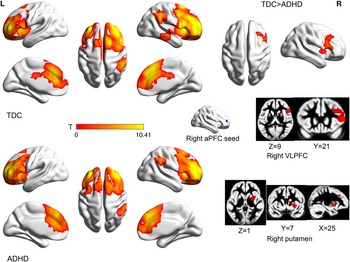
We used a seed region of interest in the aPFC, defined as a sphere (4 mm in radius) centering at MNI coordinates −36, 57, 9, and its homologous (x-flipped) version for the right-hemisphere aPFC (coordinates 34, 52, 10) (Figure 1), following previously established methods (Spreng et al., Reference Spreng, Stevens, Chamberlain, Gilmore and Schacter2010; Vincent et al., Reference Vincent, Kahn, Snyder, Raichle and Buckner2008). These seed regions anatomically characterize the canonical FPCN, and are considered the principal hubs in this network. They form the apex of the executive system underlying cognitive control and decision-making (Koechlin & Hyafil, Reference Koechlin and Hyafil2007), and are considered developmentally atypical in children with ADHD (Dumontheil, Burgess, & Blakemore, Reference Dumontheil, Burgess and Blakemore2008). Despite the findings that dysconnectivity between the ventral striatum and the regions near these chosen seeds is associated with impulsive decision-making (Costa Dias et al., Reference Costa Dias, Wilson, Bathula, Iyer, Mills, Thurlow and Fair2013) and emotional lability (Posner et al., Reference Posner, Rauh, Gruber, Gat, Wang and Peterson2013), these aPFC seed regions and the associated identified FPCN have never been directly investigated in children with ADHD.
The frontoparietal control network (right aPFC seed) and between-group difference, with GSReg. Relative to TD children (TDC), children with attention-deficit/hyperactivity disorder (ADHD) demonstrated hypoconnectivity between the right aPFC and the right ventrolateral prefrontal cortex (VLPFC) and right putamen (p<.05, cluster-level Gaussian Random Field corrected, voxel-level cluster-forming threshold p<.01). aPFC: anterior prefrontal cortex; L: left-side; R: right-side.

Whole-brain functional connectivity was calculated by correlating the seed time-series with the time series of all other voxels using the REST toolbox (Song et al., Reference Song, Dong, Long, Li, Zuo, Zhu and Zang2011). The resulting Pearson’s correlation coefficients were Fisher-z transformed to conform to normality assumptions for second-level analyses.
Statistical Analysis
We used SAS version 9.1 (SAS Institute Inc., USA) to conduct diagnostic group comparisons in demographic, clinical, and neuropsychological data. To conduct a matched case-control analysis for continuous variables, we used a linear multilevel model to compare the mean scores of IQ, the SNAP-IV, the CCPT, and the CANTAB tests. The alpha value was pre-selected at the level of 0.05. The effect sizes were computed using Cohen’s d.
Using SPM8, one-sample t tests were performed on the z-maps of children with ADHD and TD children, separately, to display connectivity maps for bilateral aPFCs. Between-group comparison in the connectivity of the FPCN was implemented by a two-sample t test. As suggested by Yan and colleagues (2013), we included mean FD derived from Jenkinson et al. (Reference Jenkinson, Bannister, Brady and Smith2002) as a covariate in all group-level analyses to further reduce influences from motion artifact.
It is worth noting that children with ADHD had lower full-scale IQ in our final sample despite being matched on performance IQ (Table 1). Poor performance in intelligence measurement has been considered inherent in individuals with ADHD, and it is arguably suggested not to partial out IQ effect in cognitive studies (Dennis et al., Reference Dennis, Francis, Cirino, Schachar, Barnes and Fletcher2009). However, imaging studies regardless of modality have consistently implicated a network comprised of prefrontal and parietal structures that is associated with intelligence, which overlaps sizably with the FPCN (Jung & Haier, Reference Jung and Haier2007; van den Heuvel, Stam, Kahn, & Hulshoff Pol, Reference van den Heuvel, Stam, Kahn and Hulshoff Pol2009). We thus included full-scale IQ as an additional covariate in both behavioral and imaging statistical analyses to reduce confounding effects from intellectual functioning, and to keep model consistency to aid cross-referencing between behavioral and neuroimaging findings.
Voxel-level analyses were restricted in the GM region by applying the sample-specific GM mask (thresholded at partial-volume-estimate >0.15). Owing to the finite spatial coverage of the EPI scan, we excluded cerebellum in the analysis by subtracting the cerebellum ROIs derived from the Automated Anatomical Labeling template (Tzourio-Mazoyer et al., Reference Tzourio-Mazoyer, Landeau, Papathanassiou, Crivello, Etard, Delcroix and Joliot2002) from the mask. To control for the risks of false-positives, neuroimaging statistical analyses used a cluster-forming threshold of p<0.01, with cluster size larger than 583 contiguous voxels for within-group and 107-voxel cluster extent for between-group functional connectivity map, which respectively corresponded to a corrected p<.05 at the cluster level. This correction was confined within the same GM mask used in group analysis (60,152 voxels) and determined by Gaussian Random Fields theory (Worsley et al., Reference Worsley, Marrett, Neelin, Vandal, Friston and Evans1996).
To localize the areas of connectivity and to identify the related BA, we used the xjView8 toolbox (http://www.alivelearn.net/xjview8/). Stereotaxic coordinates were reported in MNI space. The results were visualized using BrainNet Viewer (Xia, Wang, & He, Reference Xia, Wang and He2013) and MRIcron (Rorden & Brett, Reference Rorden and Brett2000).
Functional Connectivity in Relation to Behavioral Variation
Owing to the moderate sample size (n=25 for each group, respectively, for correlational analyses) and that some behavioral data were not normally distributed (Supplementary Table 3), we used Spearman’s rank correlation (r s ) to examine brain-behavior correlations, stratified by group. Aberrant functional connectivity values were calculated for seed-ROIs pairs. ROIs were defined as a sphere (4 mm in radius) around the peak coordinates within clusters showing significant between-group differences in our main analysis (i.e., with GSReg). ADHD symptom severity was represented by scores of inattention, hyperactivity, impulsivity, and opposition-defiance on the parent-reported SNAP-IV. Executive functions were indexed by the performance on CCPT and Spatial Span. We predicted that the more atypical RSFC in ADHD, the more severe symptoms and executive dysfunctions are.
The probability of our hypothesis being true given the observations (data) on these connectivity-behavior correlations was tested by a Bayesian approach (Dienes, Reference Dienes2008, Reference Dienes2011). We used Bayes factor (BF) to pit our prior hypothesis against a null hypothesis (Dienes, Reference Dienes2011). For interpretation, a BF above 3 is considered substantial evidence for the prior theory over the null hypothesis, and a BF below 1/3 to be substantial evidence for the null hypothesis (Jeffreys, Reference Jeffreys1961) (see supplementary method for details regarding a Bayesian approach).
RESULTS
Demographic, Clinical, and Neuropsychological Characteristics
Compared with TD children, children with ADHD had significantly higher scores in inattentive, hyperactive-impulsive, and oppositional symptoms, without significant group differences in age, sex and performance IQ (Table 1).
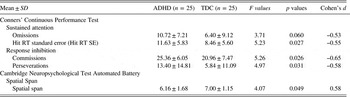
Compared with TD children, children with ADHD had marginally greater omission errors (F=3.71; p=0.060; Cohen’s d=−0.53) and higher hit RT standard error (SE) (F=5.23; p=0.027; d=−0.55) in CCPT, suggesting impaired attention regulation in ADHD (Table 2). Higher commission errors (F=5.26; p=0.026; d=−0.65), together with higher perseverations (F=4.97; p=0.031; d=−0.58) indicated poorer response inhibition in children with ADHD relative to TD children. Children with ADHD had shorter spatial span lengths (F=4.07; p=0.049; d=0.58) than TD children, indicating poorer spatial working memory (Table 2; refer to Supplement Table 4 for the similar results without covarying full-scale IQ).
Comparisons of executive functions between children with ADHD and typically developing children (Covarying Full-Scale IQ)

ADHD=attention-deficit/hyperactivity disorder; TDC=typically developing children.
Functional Connectivity Mapping of the FPCN and Between-Group Differences
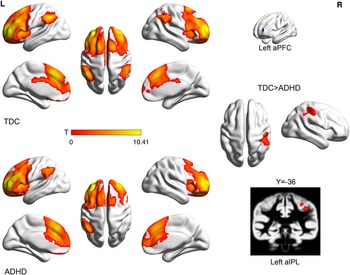
Both groups demonstrated extensive but specific regions significantly associated with BOLD fluctuations in the aPFC seed, including the lateral PFC extending to frontal pole, anterior insula, dorsal ACC, and caudate nucleus, similar to that reported in adults (Vincent et al., Reference Vincent, Kahn, Snyder, Raichle and Buckner2008) (Figures 1 and 2).
The frontoparietal control network (left aPFC seed) and between-group difference, with GSReg. Relative to TDC, children with ADHD demonstrated hypoconnectivity between the left aPFC and the right anterior inferior parietal lobule (p<.05, cluster-level Gaussian Random Field corrected, voxel-level cluster forming threshold p<.01). aPFC: anterior prefrontal cortex; L: left-side; R: right-side.

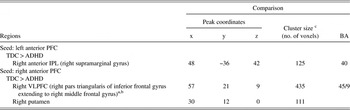
Children with ADHD, relative to TD children, showed hypoconnectivity between the right aPFC and right VLPFC (BA 45/9; coordinates 57, 21, 9; cluster size 11745 mm3), regardless of the denoising methods (Figure 1, and Supplementary Figures 3 and 4). Children with ADHD showed weaker connectivity between the left aPFC and the right inferior parietal lobule (BA 40; coordinates 48,−36, 42; size 3375 mm3) compared to TD children (Figure 2). There was also weaker connectivity of the right aPFC with the right putamen in children with ADHD than in TD children (coordinates 30, 12, 0; size 2997 mm3; Figure 1). However, these two findings were not identified in the analyses using the other two denoising methods (i.e., without GSReg and CompCor).
In the denoising model without GSReg, there was hypoconnectivity in the left aPFC-right middle frontal gyrus (MFG, BA 8; coordinates 30, 15, 48; size 4833 mm3) in children with ADHD relative to TD children (Supplementary Figure 3, Supplementary Table 3). With CompCor, we found weaker left aPFC-left MFG (BA 6; coordinates −24, 18, 63; size 3726 mm3) connectivity in children with ADHD relative to TD children (Supplementary Figure 4, Supplementary Table 4). There were no brain regions that showed increased aPFC connectivity in the ADHD group compared to the TD group across all denoising methods.
Correlations between Functional Connectivity, Clinical Symptoms, and Executive Functions
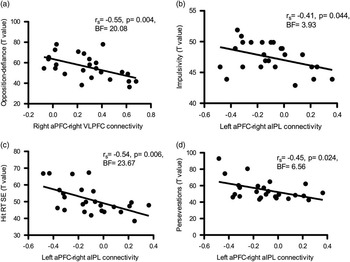
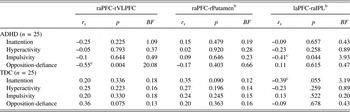
Brain-behavior correlations were measured separately for the ADHD and TD groups. Bayesian statistics revealed substantial evidence supporting our prior hypothesis that weaker right aPFC-right VLPFC connectivity was linked with more severe opposition-defiance symptoms (r s =−0.55; BF=20.08), and weaker functional connectivity in the left aPFC-right aIPL predicted greater impulsive symptoms (r s =−0.41; BF=3.93) in children with ADHD (Table 4; Figure 3). For TD children, weaker left aPFC-right aIPL connectivity was associated with inattention (r s=−0.39; BF=3.19). The effect sizes for correlation between altered connectivity and hyperactivity, impulsivity, and opposition-defiance symptoms did not support the prior hypothesis over the null in the TD group.
Correlation analysis in children with ADHD, between (A) right anterior prefrontal frontal cortex (aPFC)-right ventrolateral prefrontal cortex (VLPFC) functional connectivity and opposition-defiance symptoms; between (B) left aPFC-right anterior inferior parietal lobule (aIPL) functional connectivity and impulsivity symptoms, (C) perseverations and (D) Hit RT standard errors in Conners’ CPT. The scatter plots of correlational connectivity-behavior relationships all support the prior hypothesis over the null. r s : Spearman’s rank correlation coefficient; p: uncorrected p value: BF, Bayes factor.

Peak MNI coordinates for RSFC group differences, with global signal regression

a Only this cluster is consistently found across disparate denoising methods.
b One cluster with 3 peak coordinates: (57, 21, 9), (54, 15, 30), (33, 24, 30)
c The normalized voxel was resampled to isotropic 3 mm (27 mm3 per voxel).
ADHD=attention-deficit/hyperactivity disorder; TDC=typically developing children; No=number; PFC=prefrontal cortex; BA=Brodmann area; VLPFC=ventrolateral prefrontal cortex.
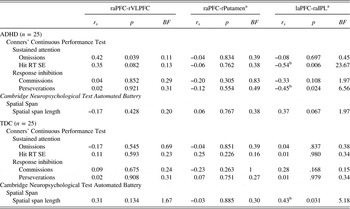
Table 5 shows the correlations between executive functions and RSFC in children with ADHD. For CCPT, lower functional connectivity between left aPFC-right aIPL was negatively correlated with hit RT SE (r s =−0.54; BF=23.67) and perseverations (r s =−0.45; BF=6.56), showing substantial evidence in favor of the prior hypothesis over the null. There was no evidence supporting the prior hypothesis on the RSFC-Spatial Span associations over the null in children with ADHD. For TD children, left aPFC-right aIPL connectivity was associated with Spatial Span (r s =0.43; BF=5.18). The effect sizes for correlation between altered connectivity and attentional control and response inhibition did not support the prior hypothesis over the null in the TD group.
DISCUSSION
This study provided the first data using rs-fMRI to examine RSFC in FPCN based on the aPFC, alongside the relationship between FPCN RSFC and behavioral performance in children with ADHD. We found right aPFC-right VLPFC hypoconnectivity across different denoising methods in ADHD, and that this aberrant RSFC was associated with opposition-defiance symptoms. For the left aPFC seed, we found reduced RSFC with the right aIPL and associations of aberrant connections with impaired response inhibition and attention in ADHD.
The canonical hubs in the FPCN based on the aPFC (Vincent et al., Reference Vincent, Kahn, Snyder, Raichle and Buckner2008) are comparable to structures implicated in the frontoparietal and fronto-striatal-cerebellar circuits, principally implicated in the pathophysiology of ADHD (Hart et al., Reference Hart, Radua, Nakao, Mataix-Cols and Rubia2013; Nakao et al., Reference Nakao, Radua, Rubia and Mataix-Cols2011; Rubia, Reference Rubia2011). Directly investigating the FPCN potentially provides an integrative neural model for ADHD (Castellanos & Proal, Reference Castellanos and Proal2012; Cortese et al., Reference Cortese, Kelly, Chabernaud, Proal, Di Martino, Milham and Castellanos2012). Involvement of related cognitive control networks in ADHD has been confirmed by prior rs-fMRI studies based on putamen (Cao et al., Reference Cao, Cao, Long, Sun, Sui, Zhu and Wang2009), DLPFC (Posner et al., Reference Posner, Rauh, Gruber, Gat, Wang and Peterson2013), alongside dorsal ACC seeds (Tian et al., Reference Tian, Jiang, Wang, Zang, He, Liang and Zhuo2006), and regional homogeneity analysis (Cao et al., Reference Cao, Zang, Sun, Sui, Long, Zou and Wang2006). Our work adds to the literature by providing evidence directly investigating the canonical FPCN based on the aPFC, underpinning executive control functions (Spreng et al., Reference Spreng, Sepulcre, Turner, Stevens and Schacter2013, Reference Spreng, Stevens, Chamberlain, Gilmore and Schacter2010), and by relating its aberrancy with executive dysfunction in ADHD. However, seed-based analysis is limited by the scope of inquiry, despite its obvious advantage in hypothesis-testing (Fox & Greicius, Reference Fox and Greicius2010). Future work using both seed-based and data-driven independent component analysis in larger samples would complement the existing literature on the role of the FPCN in ADHD.
Existing diffusion imaging literature echoes our findings, given that RSFC may be partially predicted by structural connectivity (Goni et al., Reference Goni, van den Heuvel, Avena-Koenigsberger, Velez de Mendizabal, Betzel, Griffa and Sporns2014; Honey et al., Reference Honey, Sporns, Cammoun, Gigandet, Thiran, Meuli and Hagmann2009). Our finding of right aPFC-right VLPFC hypoconnectivity indirectly supports white matter abnormality in the right forceps minor (connecting the lateral and medial surface of the PFC) in ADHD revealed by a recent meta-analysis by van Ewijk, Heslenfeld, Zwiers, Bitelaar, and Oosterlaan (Reference van Ewijk, Heslenfeld, Zwiers, Buitelaar and Oosterlaan2012). Furthermore, forceps minor is close to the genu of the corpus callosum, which is disrupted in the development of ADHD (Gilliam et al., Reference Gilliam, Stockman, Malek, Sharp, Greenstein, Lalonde and Shaw2011). These, together with impaired white matter integrity of the superior longitudinal fasciculus (interconnecting frontal-parietal regions) in ADHD (van Ewijk et al., Reference van Ewijk, Heslenfeld, Zwiers, Buitelaar and Oosterlaan2012), may underlie left aPFC-right IPL hypoconnectivity found here. Lastly, reduced fronto-striatal integrity in ADHD (van Ewijk et al., Reference van Ewijk, Heslenfeld, Zwiers, Buitelaar and Oosterlaan2012) corresponds to our findings of right aPFC-right putamen hypoconnectivity. The complex relationship between structural and functional connectivity within the FPCN in ADHD awaits direct clarification using multi-modal imaging technique.
Brain-Behavior Relationships in ADHD
In children with ADHD, we observed significant associations between right aPFC-right VLPFC hypoconnectivity and opposition-defiance symptoms. Opposition-defiance symptoms range from the mild end as a broad component of ADHD to the severe end as related more to behaviors meeting conduct disorder criteria (Connor, Steeber, & McBurnett, Reference Connor, Steeber and McBurnett2010). They may further relate to “cool” (Oosterlaan, Logan, & Sergeant, Reference Oosterlaan, Logan and Sergeant1998) and “hot” executive dysfunction (Rubia, Reference Rubia2011), alongside social cognition and judgment (Dinolfo & Malti, Reference Dinolfo and Malti2013). Beyond a central role in executive control, the aPFC is also critically involved in deceptive behaviors (Karim et al., Reference Karim, Schneider, Lotze, Veit, Sauseng, Braun and Birbaumer2010), social judgment (Moll, Zahn, de Oliveira-Souza, Krueger, & Grafman, Reference Moll, Zahn, de Oliveira-Souza, Krueger and Grafman2005), and emotional regulation (Volman, Roelofs, Koch, Verhagen, & Toni, Reference Volman, Roelofs, Koch, Verhagen and Toni2011). Its direct neural connectivity with VLPFC is implicated in explicit process of social cognition and representation of situational contexts to guide social behaviors (Forbes & Grafman, Reference Forbes and Grafman2010), both being crucial in the development of oppositional behavior (Dinolfo & Malti, Reference Dinolfo and Malti2013). Furthermore, lateral PFC (especially in the right hemisphere) is involved in top-down emotional control (Ochsner & Gross, Reference Ochsner and Gross2005), and individuals with dysfunctional lateral PFC may be vulnerable to impulsive violent acts (Davidson, Putnam, & Larson, Reference Davidson, Putnam and Larson2000). Our findings of the association between reduced right aPFC-right VLPFC connectivity and increased opposition-defiance symptoms therefore shed light on the potential role of the FPCN endorsing emotional regulation and social judgment in ADHD.
Left aPFC-right aIPL hypoconnectivity significantly associated with inhibitory and attentional control in ADHD was not further observed in the subsidiary analyses (without GSReg and CompCor). These findings should thus be interpreted with caution. The anterior and dorsolateral parts of PFC, alongside parietal regions, are involved in executive control and problem solving (Kim & Lee, Reference Kim and Lee2011; Miller & Cohen, Reference Miller and Cohen2001). Weakened activation in parietal regions (Vaidya et al., Reference Vaidya, Bunge, Dudukovic, Zalecki, Elliott and Gabrieli2005) is associated with insufficient cognitive control. Temporal disruptions in lateral PFC functioning could increase impulsive decision-making (Figner et al., Reference Figner, Knoch, Johnson, Krosch, Lisanby, Fehr and Weber2010). Our findings suggest that their aberrant intrinsic connectivity may contribute to deficient regulation of impulsivity in ADHD. Regarding attention performance, parietal cortices mediate orienting attention toward spatial information, whereas PFC is involved in cognitive control based on relevance to task (Arnsten & Rubia, Reference Arnsten and Rubia2012). These areas are intricately coordinated to provide optimal attentional experiences in healthy population (Corbetta, Patel, Shulman, Reference Corbetta, Patel and Shulman2008; Konrad et al., Reference Konrad, Neufang, Thiel, Specht, Hanisch, Fan and Fink2005) and ADHD (Hart et al., Reference Hart, Radua, Nakao, Mataix-Cols and Rubia2013). Thus our data suggests that aPFC-IPL hypoconnectivity may lead to inapt organization between bottom-up perception and top-down attention processes, resulting in impaired attention performance.
Despite convergent evidence that developmental changes in structure and function of prefrontal and parietal regions underlie improvement in attention, working memory and inhibitory control (Bunge & Wright, Reference Bunge and Wright2007; Corbetta et al., Reference Corbetta, Patel and Shulman2008; Klingberg, Reference Klingberg2006; Konrad et al., Reference Konrad, Neufang, Thiel, Specht, Hanisch, Fan and Fink2005; Scherf, Sweeney, & Luna, Reference Scherf, Sweeney and Luna2006), surprisingly, we did not find significant correlations between spatial working memory performance and atypical FPCN in ADHD. Such inconsistency may be explained by different cognitive strategies used across studies and the engagement of supplementary brain regions other than those conventionally identified as related to task performance in ADHD (Fassbender & Schweitzer, Reference Fassbender and Schweitzer2006). Besides, we measured relatively simple cognitive processes in relation to visuospatial processing, rather than the more complex higher-order cognition subserved by the FPCN (Spreng et al., Reference Spreng, Sepulcre, Turner, Stevens and Schacter2013, Reference Spreng, Stevens, Chamberlain, Gilmore and Schacter2010).
Controversies exist for defining the construct of executive functions (Miyake et al., Reference Miyake, Friedman, Emerson, Witzki, Howerter and Wager2000; Sergeant, Geurts, Huijbregts, Scheres, & Oosterlaan, Reference Sergeant, Geurts, Huijbregts, Scheres and Oosterlaan2003; Willcutt et al., Reference Willcutt, Doyle, Nigg, Faraone and Pennington2005). We herein investigated response inhibition, spatial working memory, and attentional control as reflecting aspects of executive functions. However, the limitation of not tapping other basic units, for example, set-shifting, interference control, etc., in the present study should be acknowledged. Nonetheless, the main results of brain-behaviors correlations indicate separate components within executive functions may share some common mechanisms which are underpinned by the atypical FPCN, supporting the model of “the unity and diversity of executive functions” (Miyake et al., Reference Miyake, Friedman, Emerson, Witzki, Howerter and Wager2000).
Moreover, the functional significance of atypical FPCN connectivity in children with ADHD could be interpreted in the integrative framework of self-regulation (Heatherton & Wagner, Reference Heatherton and Wagner2011). Basic facets of executive functions, including response inhibition and attention regulation may jointly support self-regulation (Heatherton & Wagner, Reference Heatherton and Wagner2011; Hofmann, Schmeichel, & Baddeley, Reference Hofmann, Schmeichel and Baddeley2012). In Barkley’s seminal (albeit contentious) theory (1997, 2001), self-regulation failure and inhibitory dysfunction are posited as core to ADHD. Executive functions are involved in regulating emotional process of situated conceptualization (Lindquist & Barrett, Reference Lindquist and Barrett2012; Ochsner & Gross, Reference Ochsner and Gross2005), and emotional dysregulation is a signature for ADHD (Shaw, Stringaris, Nigg, & Leibenluft, Reference Shaw, Stringaris, Nigg and Leibenluft2014). Our findings of the relationship between FPCN connectivity and impulsivity/opposition-defiance symptoms, as well as executive dysfunctions, provide one potential neural basis underlying the interplay among executive functions, emotional regulation, and clinical presentations of ADHD (Martel, Reference Martel2009). One should note that here we only focused on the FPCN, which is implicated in top-down control. The role of bottom-up reward and emotion processing, mediated mainly by striatum and amygdala and their dynamic interactions with other brain networks, remains to be explored (Sonuga-Barke & Fairchild, Reference Sonuga-Barke and Fairchild2012).
Methodological Considerations
Balancing the merits and perils, we decided to perform the main analysis including GSReg after assessing the criteria global negative index of our data (Chen et al., Reference Chen, Xie, Ward, Li, Antuono and Li2012), to better account for motion artifacts and increase specificity of the findings. To be cautious, we further performed subsidiary analyses with other denoising methods and interpreted prudently the inconsistent results. Reassuringly, the finding of right aPFC-right VLPFC hypoconnectivity in ADHD was robust across denoising methods, suggesting the robustness and reliability of the findings.
In dealing with potential confounds from head motion, we ensured the final sample of participants with limited “jerky” movements and the two groups were matched on a composite of motion parameters. We also did not find significant mean FD-RSFC correlation. Across different motion-correction models, aberrancy of FPCN was similar in spatial extents and regions. Despite the comprehensive motion correction strategies in this study, in-scanner head motion may still affect RSFC in a non-linear manner (Power et al., Reference Power, Barnes, Snyder, Schlaggar and Petersen2012; Van Dijk et al., Reference Van Dijk, Sabuncu and Buckner2012) (see supplementary material for a detailed relevant discussion).
On the other hand, our conservative inclusion of rs-fMRI data based on limited head motion might introduce selection bias. Despite comparable severity of the core ADHD symptoms among the included and excluded groups, children with ADHD who survived the stringent motion criterion had higher verbal IQ and opposition-defiance symptoms, compared with those being excluded from the analyses. Investigating individuals with relatively higher co-occurring opposition-defiance and verbal IQ might affect the generalizability of the findings to ordinary clinical sample. Future works using promising alternative image acquisition and denoising strategies, for example, multi-echo fMRI (Kundu et al., Reference Kundu, Brenowitz, Voon, Worbe, Vertes, Inati and Bullmore2013), might help balance considerations of sample representativeness and artifact-removal. Before that, the present finding should still be considered valuable in providing a candidate neurobiological substrate for ADHD, among other possibilities.
Limitations
Our study has several limitations. First, due to limited sample size, we did not conduct subgroup analyses with regards to sex and ADHD DSM-IV subtypes. Second, findings of atypical RSFC from a cross-sectional observational design cannot provide conclusions regarding causality. Third, some of the participants had received methylphenidate treatment. Despite the at-least 1-week wash-out before assessment, prior exposure to medication might still have some lingering effect on current neural characteristics. Fourth, considering the sample size and lack of pubertal stage assessment, we did not stratify our sample based on any arbitrary age cutoff. Future studies with larger samples and a wider age range may be more sensitive in picking up developmental effects, in which case findings should be characterized in association with chronological age and/or pubertal stage of the participants. Lastly, the present findings await validation in independent datasets. However, there is a lack of consistency in the measurement of sample characteristics in terms of IQ and ADHD symptoms across different study designs. Also, there are still many challenging methodological issues for analyzing multisite rs-fMRI dataset (Nielsen et al., Reference Nielsen, Zielinski, Fletcher, Alexander, Lange, Bigler and Anderson2013).
In summary, atypical FPCN connectivity in children with ADHD is associated with impulsivity, opposition-defiance, and executive dysfunctions in terms of inhibitory and attentional control. Our report attests to the emerging conceptualization of ADHD as a brain network disorder. The findings advance our knowledge to the relationships among executive functions, impulsivity, opposition-defiance, and their underlying neural mechanisms in ADHD
Correlations between ADHD symptoms and functional connectivity in children with ADHD and typically developing childrenFootnote a

a ADHD symptoms assessed by the SNAP-IV scale.
b The aberrant seed-ROIs were only found in denoising steps with GSReg.
c Bayes factor value >3.
ADHD=attention-deficit/hyperactivity disorder; TDC=typically developing children; l=left; r=right; aPFC=anterior prefrontal cortex; aIPL=anterior inferior parietal lobule; VLPFC=ventrolateral prefrontal cortex; p=uncorrected alpha value; BF=Bayes factor.
Correlations between neuropsychological functions and functional connectivity in children with ADHD and typically developing control.

a The aberrant seed-ROIs were only found in denoising steps with GSReg.
b Bayes factor value >3.
ADHD=attention-deficit/hyperactivity disorder; TDC=typically developing children; r=right; aPFC=anterior prefrontal cortex; VLPFC=ventrolateral prefrontal cortex; Hit RT SE=hit reaction time standard error; p=uncorrected p value; BF=Bayes factor.
Acknowledgments
This study was supported by grants from the National Health Research Institute (NHRI-EX98-9407PC, NHRI-EX100-0008PI, NHRI-EX101-0008PI), grants from the National Science Council (NSC96-2628-B-002-069-MY3, NSC99-2321-B-002-037, NSC99-2627-B-002-015, NSC100-2627-B-002-014, NSC101-2627-B-002-002), and grants from National Taiwan University Hospital (NTUH101-S1910), Taiwan. The authors thank Dr. Pei-Chi Tu for helpful discussion on RSFC analysis, Ms. Yu-Lun Lin for clinical data management, and all the research assistants, participants and their parents for their contribution to the study. During the period of this work, Meng-Chuan Lai was supported by the William Binks Autism Neuroscience Fellowship, University of Cambridge. The authors declare no biomedical conflict of interest related to this work.
Supplementary material
To view supplementary material for this article, please visit http://dx.doi.org/10.1017/S135561771500020X