Introduction
In several regions of the world, most sheep and cattle are raised on natural grasslands. The nutrient intake by these animals cannot be measured directly, so estimating their nutritional status throughout the year remains a challenge. A commonly used technique for estimating the nutrition of free-ranging ruminants is based on measuring both faecal excretion and herbage digestibility. Faecal excretion can be measured individually with bags attached to the animals or by using external markers, and herbage digestibility is usually measured by in vitro incubation of herbage samples collected by hand clipping, which simulates grazing behaviour. However, the main flaws of this technique are a failure to account for individual variability in digestibility values expected for grazing ruminants and limited accuracy of the in vitro assay for estimating the actual in vivo digestibility (Peyraud, Reference Peyraud, Spörndly, Burstedt and Murphy1997). These flaws are probably more problematic when estimating the diet quality of free-ranging animals, which encounter a heterogeneous canopy and ingest forage selectively. To overcome some of the limitations of the in vitro technique, Mayes and Lamb (Reference Mayes and Lamb1984) proposed the use of n-alkanes as both external (dotriacontane, C32) and internal markers (odd-chain n-alkanes) to simultaneously estimate both faecal output and herbage digestibility with greater accuracy than conventional markers (Dove and Mayes, Reference Dove and Mayes1996). However, the n-alkanes technique does not solve the problem of obtaining representative samples of the herbage ingested by free-ranging ruminants.
Alternatively, a strong correlation has been reported between organic matter (OM) intake and faecal nitrogen (N) excretion (Lancaster, Reference Lancaster1949; Peripolli et al., Reference Peripolli, Prates, Barcellos and Neto2011), and linear equations have been proposed to estimate OM intake by sheep based on the amount of N excreted in the faeces (Azevedo et al., Reference Azevedo, Poli, David, Amaral, Fonseca, Carvalho, Fischer and Morris2014; David et al., Reference David, Poli, Savian, Amaral, Azevedo, Carvalho and McManus2014; Kozloski et al., Reference Kozloski, Oliveira, Poli, Azevedo, David, Ribeiro Filho and Collet2014). However, these equations were developed with data obtained in trials conducted with animals fed only one type of forage or forage supplemented with concentrate feedstuffs, and no information on the reliability of this technique on estimating nutrients intake by free-ranging ruminants was provided. Furthermore, all previous studies have focused only on estimating total OM intake, whereas the animal performance is more a consequence of the digestible OM intake.
The objectives of the present study were (i) to analyse whether there is a strong relationship between OM intake and faecal N excretion in sheep and cattle fed hay from a rangeland pasture and (ii) to evaluate the validity of using the amount of N excreted in the faeces as an index to estimate both the total and the digestible OM intake in free-ranging sheep and cattle.
Materials and methods
Locality and rangeland description
The study was undertaken in Southern Brazil at the Universidade Federal de Santa Maria, Santa Maria, RS (29°4′S, 53°5′W, 151 m alt.) and at the Centro de Pesquisa Pecuária Sul (EMBRAPA/CPPSUL), Bagé, RS (31°2′S, 54°1′W, 212 m alt.). The rangelands of Southern Brazil belong to the Pampas Biome, an ecosystem that encompasses an area of 750 000 km2 known as the ‘Rio de la Plata Grasslands’ (Bilenca and Miñarro, Reference Bilenca and Miñarro2004). The dominant forage species present in the grazing trials were Andropogon lateralis, Axonopus affinis, Paspalum notatum and Eragrostis plana (Cezimbra, Reference Cezimbra2015; Faria, Reference Faria2015; Saccol, Reference Saccol2015; Kuinchtner, Reference Kuinchtner2016).
Indoor digestibility trials (equation development)
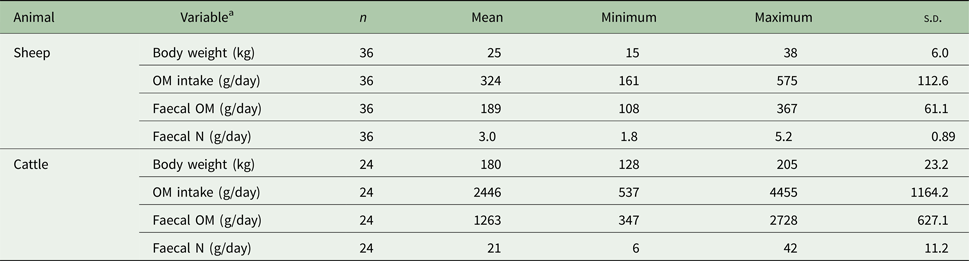
The digestibility trials were conducted with male sheep (two trials, each one with six animals throughout three periods) and cattle (two trials, one with six animals throughout one period and other with six animals throughout three periods) housed in metabolism cages and fed only forage. The forage offered in either trial was hay containing, on average, the following (all as g/kg dry matter (DM)): 935 g OM, 780 g neutral detergent fibre, 420 g acid detergent fibre, 68 g sulphuric-acid lignin, 13 g total N, 5.7 g neutral detergent insoluble N and 2.9 acid detergent insoluble N. The hay was obtained during the summer season (i.e. December–March) from a local rangeland by cutting the pasture approximately 3 cm above ground level. In all trials, the experimental treatments were three levels of forage allowance (i.e. 15 g/kg body weight (BW), 25 g/kg BW or ad libitum), and the experimental periods varied from 15 to 21 days, with 10–14 days for adaptation and 5–7 days for data and sample collection. In all trials, the hay was offered twice a day (08.00 h and 17.00 h) and the animals had free access to water and a mineral salt containing the following (g/kg): calcium, 100; phosphorus, 45; sulphur, 4.1; sodium, 205; cobalt, 0.025; copper, 0.450; iron, 1.5; iodine, 0.05; manganese, 1.0; selenium, 0.009; zinc, 2.52 and fluorine, 0.45. The feed offered and refused and the faeces were weighed, recorded and sampled daily during the collection periods. All samples were dried at 55 °C in a forced-air oven, ground through a 1-mm screen and pooled by the animal within each experimental period for analysis. General descriptions of the relevant variables are shown in Table 1.
Descriptive variables of indoor digestibility trials with sheep and cattle fed hay from a rangeland pasture

a OM, organic matter.
Grazing trials (equation evaluation)
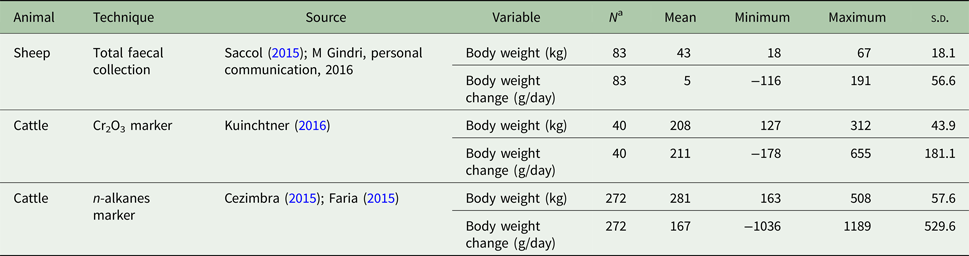
The free-range trials were conducted from 2011 to 2014 with sheep (two trials, one with 12 animals throughout three periods, and other with six animals throughout eight periods) and cattle (two trials with heifers, one with ten animals throughout four periods and other with 21 animals throughout seven periods, and one trial with 16 steers throughout eight periods). The experimental periods varied from 28 to 90 days, and sampling and data collection were performed in each period throughout the trials. The BW change (BWc, g/day) was calculated as BW at the end minus BW at the beginning of each experimental period divided by the number of days between BW measurements. The description of the animal variables is shown in Table 2. In both trials with sheep, the total amount of excreted faeces was collected for five consecutive days in each experimental period using bags fixed to the animals with harnesses, and the faeces of each animal was weighed and sampled daily. All faecal samples were dried in a forced-air oven at 55 °C, ground to pass through a 1-mm screen and pooled by animal and experimental period for analysis. In one of the trials with heifers (i.e. that conducted with ten animals throughout four periods), chromium oxide (Cr2O3) was used as an external marker for estimating faecal excretion. The Cr2O3 was offered once daily (5 g/day) in 1-g capsules (i.e. five capsules/day) for 10 days in each experimental period. The capsules were mixed with 0.2 kg of rice bran, which was offered in individual feeders to each animal. Ingestion of the supplement, which occurred within a few minutes, was monitored by an observer to ensure that all capsules were actually ingested. Ground and coloured polyethylene particles (20 g) were also mixed with the rice bran from days 5 to 9 and used as a marker to identify the excreta of individual animals in the field (i.e. each heifer received different-coloured particles). From days 8 to 10, faecal samples were collected daily from faeces excreted in the field and containing the coloured particles and then dried in a forced-air oven at 55 °C, ground (1-mm screen) and pooled by animal in each period for analysis. In the other trial with heifers and in the trial with steers, C32 n-alkane was used as an external marker for estimating faecal excretion. For 10 days in each experimental period, animals were dosed orally twice daily with approximately 150 mg of C32 n-alkane (i.e. 300 mg/day), which was impregnated in 2-g cellulose pellets. Faecal samples were then collected directly from the rectum twice daily from days 5 to 10, just before marker dosing, dried in a forced-air oven at 55 °C, ground (1-mm screen) and pooled by animal in each period for analysis. In all trials, parallel to the faecal sampling, the herbage was sampled daily using the hand-clipping procedure, which simulated the grazing behaviour of the animals. All samples were dried in a forced-air oven at 55 °C and ground (1-mm screen) for analysis. In the sheep trial conducted with 12 animals and in the heifer trial conducted with ten animals, the herbage samples were pooled by pasture plot and period for analysis.
Description of the animal variables of trials with free-ranging sheep and cattle where conventional techniques were used for estimating organic matter intake
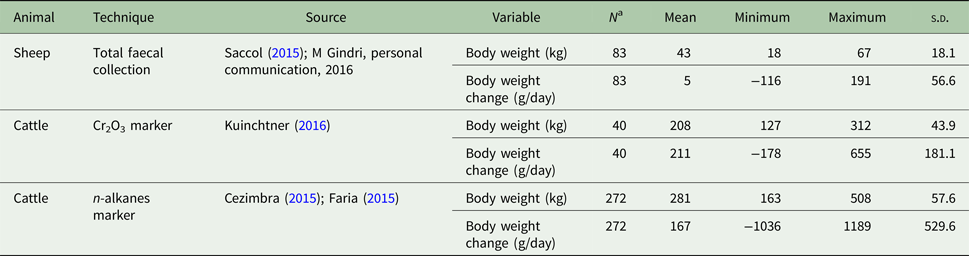
a Animal/period number.
Chemical and in situ digestibility analysis
Dry matter content was determined by drying the samples at 105 °C overnight. Ash was determined after combustion at 600 °C for 3 h, and OM was calculated by the difference in mass. Nitrogen concentration was assayed by the Kjeldahl method (Method 984.13; AOAC 1997), and the chromium concentration in the faeces samples was analysed by atomic absorption spectrophotometry after acid digestion as described by Czarnocki et al. (Reference Czarnocki, Sibbald and Evans1961). The concentration of n-alkanes was analysed in the herbage and faeces samples by gas chromatography (GC-2010, Shimadzu Corp., Japan) using the extraction and analysis protocols of Dove and Mayes (Reference Dove and Mayes2006). A mixed standard (Sigma-Aldrich Corp., St. Louis, MO, USA) containing known concentrations of C7 to C40 n-alkanes was used for equipment calibration. To measure the in situ herbage digestibility, approximately 1 g of dried and ground samples were weighed in 5 × 5 cm2 polyamide bags (40 µ porosity) and incubated in the rumen of a grazing steer for 48 h (Dermarquilly et al., Reference Dermarquilly, Chenost, Aubry, Chevalier and Chenost1969). Afterward, the bags were removed from the rumen, washed with tap water, oven dried at 110 °C overnight and weighed. Ash was then determined after combustion at 600 °C for 3 h, and OM was calculated by the difference in mass. The herbage in situ OM digestibility was calculated as: (incubated OM (g) – residual OM (g))/incubated OM (g).
Calculations (free-range trials)
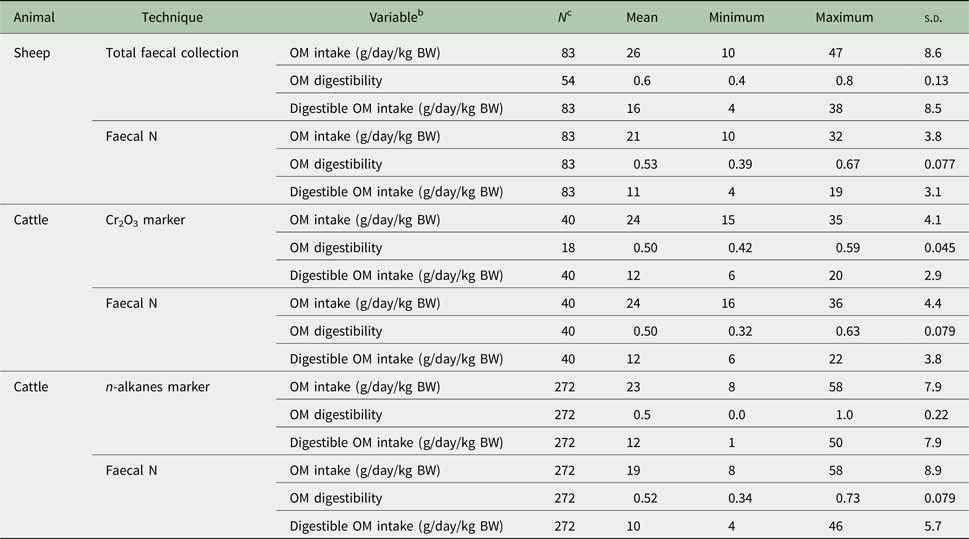
Faecal excretion (DM or OM, g/day) was estimated from external markers (i.e., chromium or C32 n-alkane) as: dosed marker (mg/day)/faecal marker (mg/g of DM or OM). The faecal N excretion (g/day) was estimated as faecal DM (g/day) × faecal N (mg/g DM). In the sheep trials and in the trial with heifers in which chromium was used as an external marker, the herbage intake (OM, g/day) was calculated as: faecal OM (g/day)/(1- in situ OM digestibility). In two of these trials, the herbage samples were pooled by pasture plot and periods for in situ incubation and, thus, the same in situ digestibility value was used for all animals kept in the same plot. In trials where n-alkanes were used as markers, OM intake (g/day) was calculated as: ((faecal C33 (mg/kg OM)/(faecal C32 (mg/kg OM) – herbage C32 (mg/kg OM)) × dosed C32 (mg/day))/ herbage C33 (mg/kg OM)) × 1000 (De-Stefani et al., Reference De-Stefani Aguiar, Forbes, Rouquette, Tedeschi and Randel2013). Furthermore, the herbage OM digestibility in these trials was calculated as: 1 – (herbage C33 (mg/g OM)/faecal C33 (mg/g OM)). The concentration of C32 and C33 in herbage and in faeces samples were (mean ± standard deviation), respectively, 13 ± 6.0 and 206 ± 69.7, and 124 ± 48.9 and 408 ± 182.3 mg/kg DM. For calculations, values were expressed on an OM basis. The digestible OM intake (g/day) was then calculated as OM intake (g/day) × OM digestibility. All intake values were then expressed per kg of BW. Alternatively, OM intake was also calculated in all trials from the amount of N excreted in the faeces using the linear equation generated with data from indoor trials. The digestible OM intake (g/day/kg BW) in the faecal N technique was then calculated as: OM intake (g/day/kg BW) – faecal OM (g/day/kg BW). The general description of the estimates generated with either technique is shown in Table 3.
Description of nutritional variables estimated through either conventional technique or through the alternative faecal N (Nf) technique in trialsa carried out with free-ranging sheep or cattle

a The sources of trials were described in Table 1.
b OM, organic matter; BW, body weight.
c Some of the herbage samples were pooled by pasture plot and period.
The metabolizable energy (ME) intake (kJ/day/kg BW) of the animals was calculated as: digestible OM intake (g/day/kg BW) × 18.41 × 0.82 (Fox et al., Reference Fox, Tedeschi, Tylutki, Russell, Van Amburgh, Chase, Pell and Overton2004) and the ME required for maintenance (MEm, kJ/day/kg BW) was calculated considering the basal metabolism (i.e. 403 kJ/kg BW0.75 for sheep and 500 kJ/kg BW0.75 for cattle) plus an additional 15% which was required for activity (Fox et al., Reference Fox, Tedeschi, Tylutki, Russell, Van Amburgh, Chase, Pell and Overton2004; Tedeschi et al., Reference Tedeschi, Cannas and Fox2010). Additionally, the ME associated with BWc (MEc, kJ/day/kg BW) was also calculated using the appropriate equations described by Cannas et al. (Reference Cannas, Tedeschi, Fox, Pell and Van Soest2004) for sheep and by Fox et al. (Reference Fox, Tedeschi, Tylutki, Russell, Van Amburgh, Chase, Pell and Overton2004) for cattle. The total ME requirement (kJ/day/kg BW) was calculated as MEm + MEc, where the MEc value was negative or positive depending on whether the change in BW was negative or positive, respectively.
Statistical analysis
Indoor digestibility trials (equation development)
Data from indoor trials were analysed using a variance-covariance model, in which OM intake was the dependent variable and faecal N excretion was the independent variable. The animal species was included as a class fixed effect in the model. The PROC MIXED statement in SAS (2002) was used for this analysis, which generated a linear equation.
Grazing trials (equation evaluation)
For convenience, the analyses described below were performed separately for the two groups of trials: trials that used the in situ technique (Group 1) and trials that used the n-alkanes technique (Group 2). Data on OM intake and digestible OM intake generated from the alternative faecal N technique were compared with those obtained with either conventional technique (i.e. in situ or n-alkanes) using a similar variance-covariance model for indoor trials, except that trial was included as a random class effect in the model. Additionally, the relationship between the ME requirement and the ME supply estimated by either technique was also analysed with this model. When relevant, the average values obtained through either technique were also compared. Significance was declared at P < 0.05, and the root mean square error (RMSE) was used to determine the precision of the relationship between techniques. When appropriate, the confidence interval (95%) of the equation parameters was calculated from the standard error (s.e.) values (i.e. ± 2 s.e.) and used to evaluate the deviation of either the slope from 1 or the intercept from 0.
Results
Indoor digestibility trials (equation development)
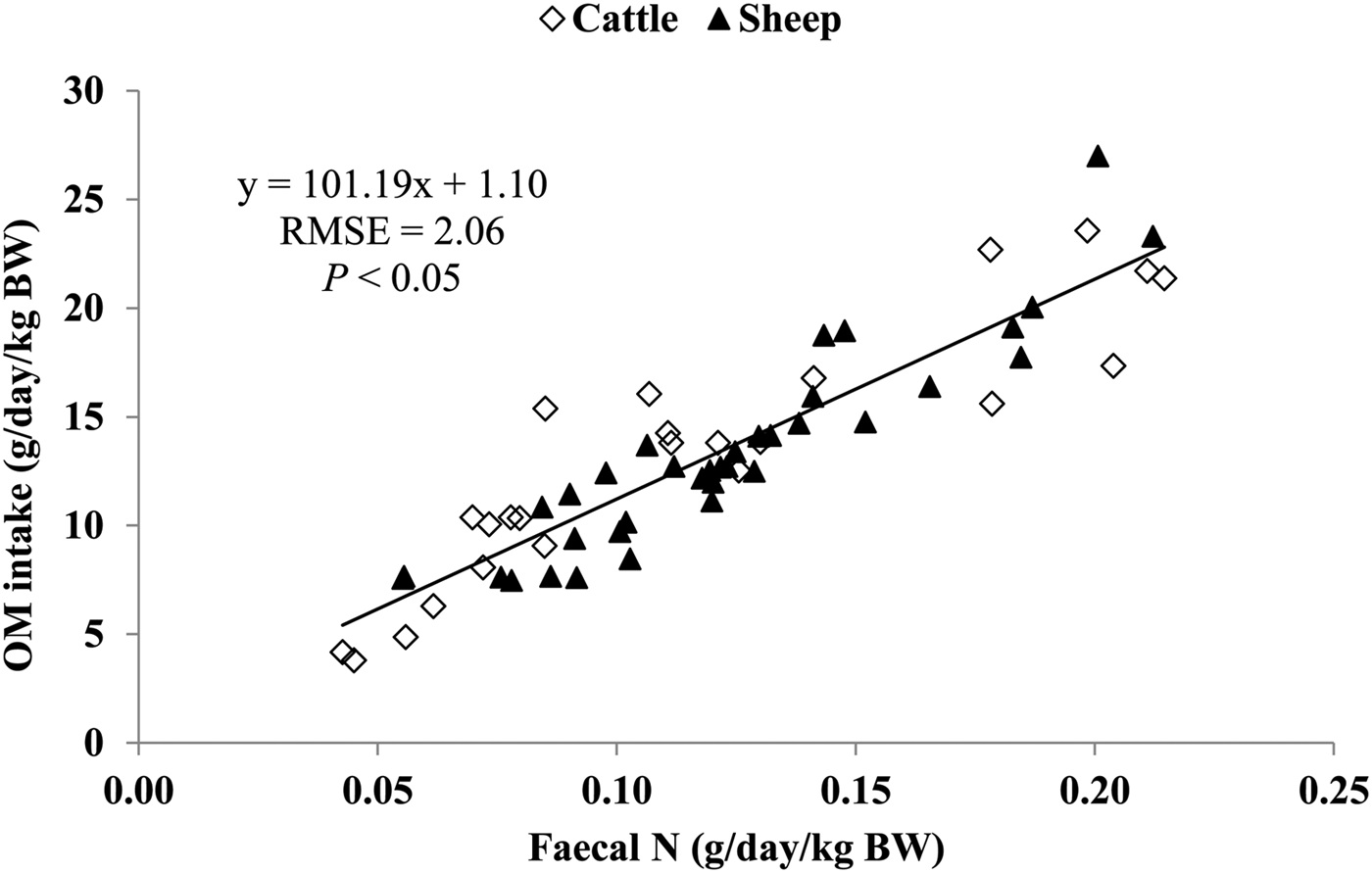
Faecal N excretion was linearly (P < 0.05) related to OM intake without a significant effect of animal species (Fig. 1), and the generated equation was: OM intake (g/day/kg BW) = 1.1 ± 0.75 + (101 ± 5.9 × faecal N (g/day/kg BW)), which was then used to estimate OM intake in the free-range trials.
Relationship between organic matter (OM) intake and faecal N excretion in cattle and sheep fed hay from a natural pasture. BW, body weight; RMSE, root mean square error; n = 60. The effect of animal species was not significant (P > 0.05).

Free-range trials (equation evaluation)
Faecal N v. in situ
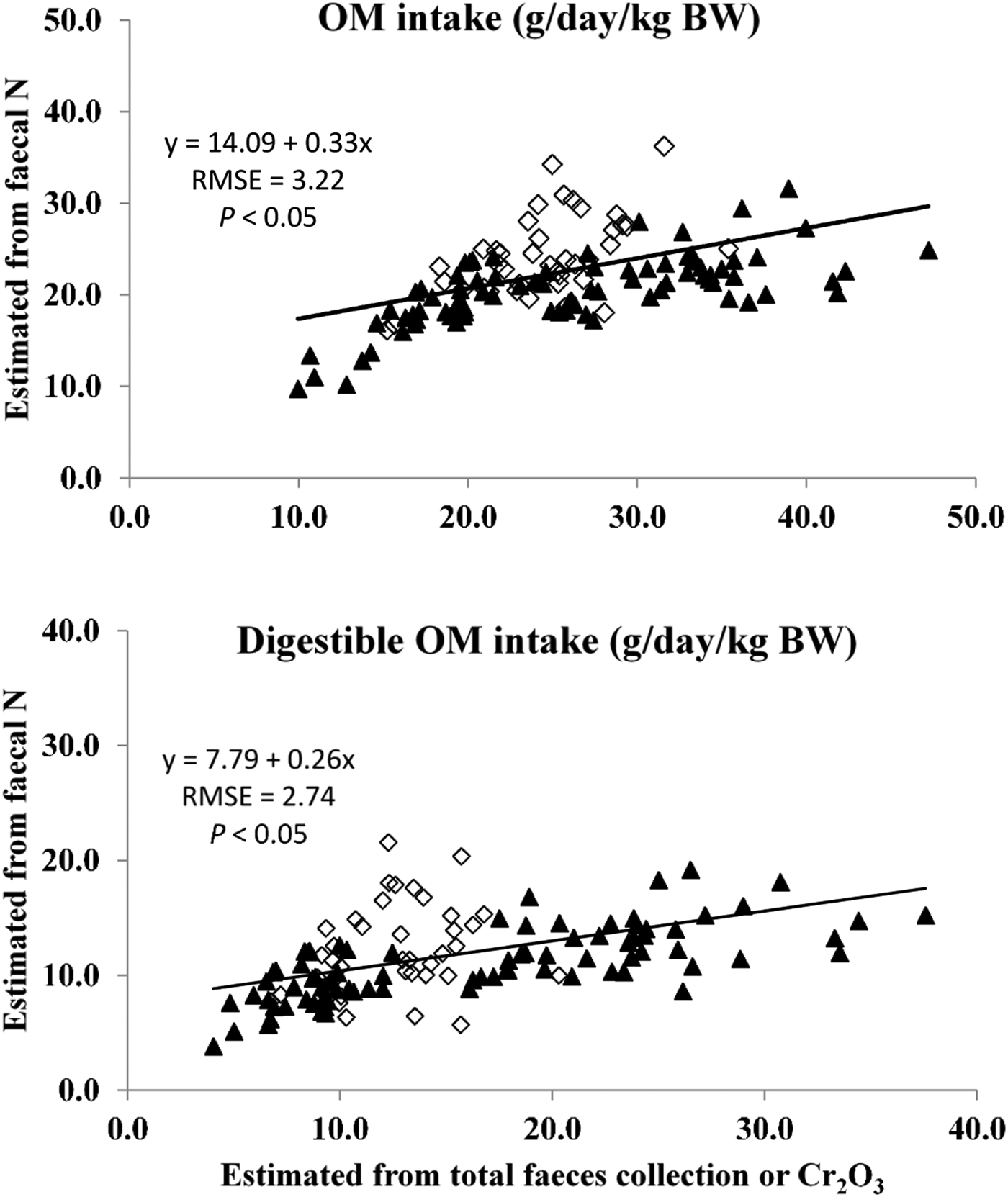
The OM intake and the digestible OM intake values estimated by the in situ technique were related linearly (P < 0.05) to those estimates based on faecal N excretion (Fig. 2). However, for both variables, the intercept and slope of the linear equation were different (P < 0.05) from 0 and 1, respectively. No significant relationship was obtained between the ME requirement and ME supply estimated through either technique (results not shown). On average, the ME supply was similar to the ME requirement (188 ± 65.1 kJ/day/kg BW) when estimated through faecal N (171 ± 51.3 kJ/day/kg BW) and higher (P < 0.05) than the ME requirement when estimated through in situ technique (226 ± 111.0 kJ/day/kg BW).
Relationship between intake values estimated through either technique the conventional (i.e. total faeces collection or Cr2O3 marker) or faecal N in trials with free-ranging sheep (▲) and cattle (◊). The OM intake was estimated from the conventional techniques as: faecal OM (g/day/kg BW)/(1 – in situ OM digestibility) and, from faecal N as: 1.10 + (101.2 × faecal N (g/day/kg BW)), which is the equation showed in Fig. 1. The digestible OM intake was calculated as: OM intake – faecal OM. RMSE, root mean square error; n = 123. OM, organic matter; BW, body weight.

Faecal N v. n-alkanes
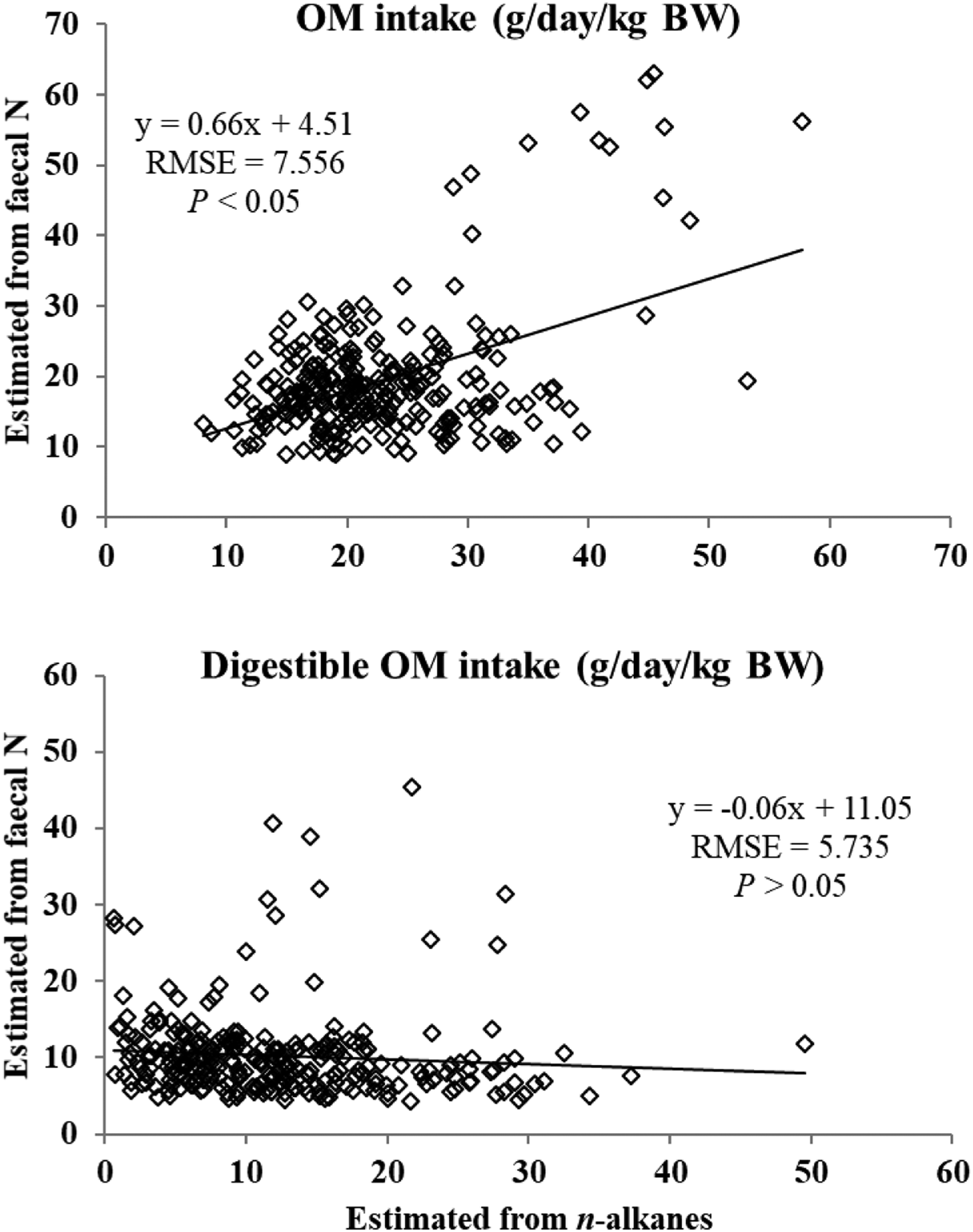
There was no significant relationship between techniques for estimating digestible OM intake whereas the OM intake values estimated using n-alkanes were linearly (P < 0.05) related to those estimated by faecal N (Fig. 3). However, the intercept of the equation was different from zero, and the slope was different from 1. No significant relationship was obtained between the ME requirement and ME supply estimated through either technique (results not shown). On average, ME supply was similar to ME requirement (158 ± 54.2 kJ/day/kg BW) when estimated through faecal N (184 ± 87.3 kJ/day/kg BW) and higher (P < 0.05) than the ME requirement when estimated from n-alkanes (184 ± 119.2 kJ/day/kg BW).
Relationship between intake values estimated through either technique n-alkanes or faecal N in trials with free-ranging cattle. The OM intake was estimated from n-alkanes as: ((faecal C33 (mg/g OM)/(faecal C32 (mg/g OM) – herbage C32 (mg/g OM)) × dosed C32 (mg/day))/ herbage C33 (mg/g OM))/BW and, from faecal N as: 1.10 + (101.2 × faecal N (g/day/kg BW)), which is the equation showed in Fig. 1. The digestible OM intake was calculated as: OM intake – faecal OM. RMSE, root mean square error; n = 272. OM, organic matter; BW, body weight.

Discussion
Wang et al. (Reference Wang, Tas, Glindemann, Rave, Schmidt, Weißbach and Susenbeth2009) developed an equation for estimating OM digestibility of forage from the crude protein content in faeces of sheep. However, the general objective of the present study was more to test whether nutrient intake by free-ranging sheep and cattle could be estimated through faecal N excretion than to estimate herbage attributes. There is no standard approach for measuring herbage or nutrient intake by grazing ruminants, so faecal N excretion was compared with other conventional techniques commonly used to estimate these variables. Previous studies have reported a high correlation between OM intake and faecal N excretion (Peripolli et al., Reference Peripolli, Prates, Barcellos and Neto2011), and linear equations have been proposed to estimate OM intake based on the amount of N excreted in the faeces of sheep fed with a specific type of forage, or forage supplemented with concentrate feedstuffs (Azevedo et al., Reference Azevedo, Poli, David, Amaral, Fonseca, Carvalho, Fischer and Morris2014; David et al., Reference David, Poli, Savian, Amaral, Azevedo, Carvalho and McManus2014; Kozloski et al., Reference Kozloski, Oliveira, Poli, Azevedo, David, Ribeiro Filho and Collet2014). The results from indoor trials in the present study corroborated this relationship even when diet was a mixture of forage species taken from a natural grassland and generated a linear equation with a relatively low RMSE (i.e., 2.06 g/day/kg BW to a general mean of 13.26 g/day/kg BW). Moreover, despite the differences between sheep and cattle in chewing activity and digestive responses (De Boever et al., Reference De Boever, Andries, De Brabander, Cottyn and Buysse1990; Aguerre et al., Reference Aguerre, Cajarville, Kozloski and Repetto2013) the effect of animal species was not significant in the present study, so it was assumed that the same equation could be used for both sheep and cattle. The parameters of this linear equation were expressed as a proportion of BW and thus it was not compared with other similar equations in the literature, which were developed using absolute values of OM intake and faecal N, or crude protein, excretion.
The validity of the equation was then tested with data taken from two groups of free-range trials where the in situ technique (Group 1) or n-alkanes (Group 2) techniques were used to estimate the nutrient intake, and regardless of group, the estimates obtained based on faecal N did not closely fit those obtained with either conventional technique. In some cases, a linear relationship was observed between techniques, but in all linear relationships, the intercept differed from zero and the slope was lower than 1. In general, for all variables in this group, increased values obtained by the in situ technique were paired with lower values estimated through faecal N.
The n-alkanes technique has been proposed to be more accurate than other conventional techniques based on the use of external markers (Dove and Mayes, Reference Dove and Mayes1996), mainly because it overcomes the limitations of the in vitro (in situ in the present study) technique when estimating in vivo digestibility (Peyraud, Reference Peyraud, Spörndly, Burstedt and Murphy1997). However, in the present study, the n-alkanes yielded broadly variable digestible OM intake values, some of which were probably unrealistic estimates. This discrepancy was probably the consequence of an incomplete and variable faecal recovery rate of n-alkanes (Ohajuruka and Palmquist, Reference Ohajuruka and Palmquist1991; Morais et al., Reference Morais, Berchielli, Veja, Queiroz, Keli, Reis, Bertipaglia and Souza2011; Keli et al., Reference Keli, Olmos, Veja and Guada2013; Kozloski et al., Reference Kozloski, Oliveira, Poli, Azevedo, David, Ribeiro Filho and Collet2014), which might have introduced bias in the estimation of herbage digestibility. Moreover, the chemical composition of the herbage was measured in samples collected by the hand-clipping procedure, where the ingestion behaviour of each animal was monitored by an observer during some hours of a day in each experimental period. Independently of whether the herbage samples were pooled by pasture plot or not, it is unlikely the herbage attributes used for the calculations in both groups have accounted for the variability in grazing selectivity along a day and throughout the days, which is expected to be significant by free-ranging animals (Orr et al., Reference Orr, Tozer, Griffith, Champion, Cook and Rutter2012; Bonnet et al., Reference Bonnet, Meuret, Tischler, Cezimbra, Azambuja and Carvalho2015; Provenza et al., Reference Provenza, Gregorini and Carvalho2015).
Alternatively, when the nutritional variables were estimated through faecal N, any herbage attribute was required and, independently of using total collection or external marker, faeces excretion was individually measured or estimated over three to five collection days under normal grazing conditions. Thus, this technique has some advantages over the conventional approaches as it does not include errors associated with herbage sampling and it accounts for the individual variability in diet selectivity. Moreover, the digestible OM intake estimated through faecal N is probably more representative of the total in vivo digestion processes than that obtained through the in situ technique. However, the largest source of faecal N in ruminants is of metabolic origin, most of them represented by rumen microbial cell wall residues, whereas a lower proportion is undigestible N from the feed (Van Soest, Reference Van Soest1994). Thus, although the faecal excretion of both is expected to increase at increased forage intake, it is probable that the absolute faecal N excretion, even as the proportion of BW, will be affected by forage type and/or chemical composition. Azevedo et al. (Reference Azevedo, Poli, David, Amaral, Fonseca, Carvalho, Fischer and Morris2014), for example, in a study with sheep fed Italian grass, obtained linear equations between OM intake and faecal crude protein excretion which were not similar at the increased phenological stage of the forage. This might limit the reliability of using a general equation, as that obtained in the present study, for all ranging systems.
Despite the above differences, standard values are not available and, thus, it is not possible to draw conclusions about the validity of one technique or another in estimating the nutrient intake by free-ranging animals based on simple comparisons. Thus, all techniques were evaluated in the present study based on their accuracy in estimating the ME supply relative to the ME requirement. When individual paired values were compared, any technique was suitable for estimating ME supply, which would be expected when the individual variability on the energy required for activity was not accounted for in calculations. Moreover, whereas BW change was calculated over measurement intervals varying from 28 up to 90 days, energy supply was calculated from samples and data taken over a short period of time in each experimental period (i.e. 3–5 days). Despite these discrepancies, when averaging all individual values within groups, the ME supply estimated through faecal N in both groups was similar to the requirement, whereas both the n-alkanes and in situ techniques over-estimated the ME supply to sheep and/or cattle.
Conclusion
The OM intake by free-ranging sheep and cattle can be estimated from the amount of N excreted in faeces with advantages over the conventional in situ or n-alkanes techniques: knowledge about herbage attributes is not required and it accounts for individual variability on selectivity and digestion processes. However, the reliability of the linear equation obtained in the present study on estimating herbage intake in other ranging systems needs to be evaluated.
Financial support
The authors thank the Conselho Nacional de Desenvolvimento Científico e Tecnológico (CNPq, Brazil) and the Coordenação de Aperfeiçoamento de Pessoal de Nível Superior (CAPES, Brazil) for scholarship support.
Conflicts of interest
None.
Ethical standards
All procedures were conducted in accordance with the guidelines in the Code of Practice for the Care and Use of Animal for Experimental Purposes of the Brazilian College of Animal Experimentation.