





1. Introduction
One of the apparent problems in studying massive stars is their formation efficiency – describing the relative number of stars with different initial masses at any coeval star formation, the stellar initial mass function (IMF), often characterized as  $dN/dm \propto (\frac{m}{M_{\odot}})^{-\alpha}$Footnote 1. While local (from the Milky Way, to neighbouring galaxies such as SMC, LMC and M31) measurements carried out on resolved photometry deduce a perhaps surprisingly similar high-mass (
 $M \gtrsim 1.4\,M_{\odot}$) slope of the IMF of
 $\alpha \approx 2.3$ (e.g., Salpeter Reference Salpeter1955; Kroupa Reference Kroupa2001, see also Massey et al. Reference Massey, Morrell, Neugent, Herzog, Drout and O’Brien2025 for a recent review), the lack of resolving power to carry out photometry for individual star clusters away from our local universe makes it impossible to have a direct measurement of the stellar IMF. The IMF is thus often assumed to be universal across cosmic time in extragalactic astronomy. This assumption, however, might contribute to some of the mismatch between observations and predictions. One of the most famous examples is the number count of high-redshift massive galaxies observed by the James-Webb Space Telescope (JWST) (e.g., Harikane et al. Reference Harikane, Ouchi, Oguri, Ono, Nakajima, Isobe, Umeda, Mawatari and Zhang2023). Recent works proposed that a top-heavy IMF, i.e., a shallower IMF that forms more massive stars than the local IMF, can resolve such a tension without appealing to the standard lambda CDM cosmology (e.g., Ziegler et al. Reference Ziegler, Freese, Lozano and Montefalcone2025).
An emerging method in measuring the IMF beyond the local universe is by looking at the detection rate of transient lensed stars – individual, luminous stars in gravitationally lensed background galaxies that are made temporarily detectable via stellar microlensing. First discovered less than a decade ago (Kelly et al. Reference Kelly, Diego, Rodney, Kaiser, Broadhurst, Zitrin, Treu, Pérez-González, Morishita, Jauzac, Selsing, Oguri, Pueyo, Ross, Filippenko, Smith, Hjorth, Cenko, Wang, Howell, Richard, Frye, Jha, Foley, Norman, Bradac, Zheng, Brammer, Benito, Cava, Christensen, de Mink, Graur, Grillo, Kawamata, Kneib, Matheson, McCully, Nonino, Pérez-Fournon, Riess, Rosati, Schmidt, Sharon and Weiner2018), these transient lensed stars are now regularly detected in deep Hubble Space Telescope (HST) and JWST repeated observations of galaxy clusters (e.g., Rodney et al. Reference Rodney, Balestra, Bradac, Brammer, Broadhurst, Caminha, Chiriv, Diego, Filippenko, Foley, Graur, Grillo, Hemmati, Hjorth, Hoag, Jauzac, Jha, Kawamata, Kelly, McCully, Mobasher, Molino, Oguri, Richard, Riess, Rosati, Schmidt, Selsing, Sharon, Strolger, Suyu, Treu, Weiner, Williams and Zitrin2018; Chen et al. Reference Chen, Kelly, Diego, Oguri, Williams, Zitrin, Treu, Smith, Broadhurst, Kaiser, Foley, Filippenko, Salo, Hjorth and Selsing2019; Yan et al. Reference Yan, Ma, Sun, Wang, Kelly, Diego, Cohen, Windhorst, Jansen, Grogin, Beacom, Conselice, Driver, Frye, Coe, Marshall, Koekemoer, Willmer, Robotham, D’Silva, Summers, Nonino, Pirzkal, Ryan, Ortiz, Tompkins, Bhatawdekar, Cheng, Zitrin and Willner2023; Meena et al. Reference Meena, Chen, Zitrin, Kelly, Golubchik, Zhou, Alfred, Broadhurst, Diego, Filippenko, Li, Oguri, Smith and Williams2023; Kelly et al. Reference Kelly, Chen, Alfred, Broadhurst, Diego, Emami, Filippenko, Keen, Li, Lim, Meena, Oguri, Scarlata, Treu, Williams, Williams, Zhou, Zitrin, Foley, Jha, Kaiser, Mehta, Rieck, Salo, Smith and Weisz2022; Fudamoto et al. Reference Fudamoto, Sun, Diego, Dai, Oguri, Zitrin, Zackrisson, Jauzac, Lagattuta, Egami, Iani, Windhorst, Abe, Bauer, Bian, Bhatawdekar, Broadhurst, Cai, Chen, Chen, Cohen, Conselice, Espada, Foo, Frye, Fujimoto, Furtak, Golubchik, Hsiao, Jolly, Kawai, Kelly, Koekemoer, Kohno, Kokorev, Li, Li, Lin, Magdis, Meena, Niemiec, Nabizadeh, Richard, Steinhardt, Wu, Zhu and Zou2025). Given their cosmological distances ( $z \gtrsim 1$), these stars must be intrinsically luminous (absolute magnitude,
 $M \lesssim -5$) to be detected even with the extreme magnification of up to
 $\sim 10^{4}$ (Oguri et al. Reference Oguri, Diego, Kaiser, Kelly and Broadhurst2018; Diego Reference Diego2019; Li et al. Reference Li, Weisenbach, Collett, Diego, Lim, Broadhurst, Chow, Enzi, Kelly, Melo-Carneiro, Palencia, Williams and Zhang2025c). These stars must therefore be (and only be) the most massive stars among the lensed stellar population, whose abundance depends on both (i) the star formation history (SFH), and (ii) the slope of the stellar IMF. While the IMF is well-known to be degenerate with the SFH (e.g., Hoversten and Glazebrook Reference Hoversten and Glazebrook2008), the abundance of massive stars, thus the transient detection rate, is not. They hence become a unique probe to break the IMF-SFH degeneracy, and allow to distinguish the IMF where the SFH is constrained by spectral energy distribution (SED), and/or spectral features.
2. Lensed stars’ insight on the IMF
Here, I discuss a few cases where insights on the high-mass end of the stellar IMF are placed by transient lensed star observations.
2.1. “Spock”
“Spock” ( $z = 1.0$) is a galaxy strongly lensed by the foreground cluster MACSJ0416 (
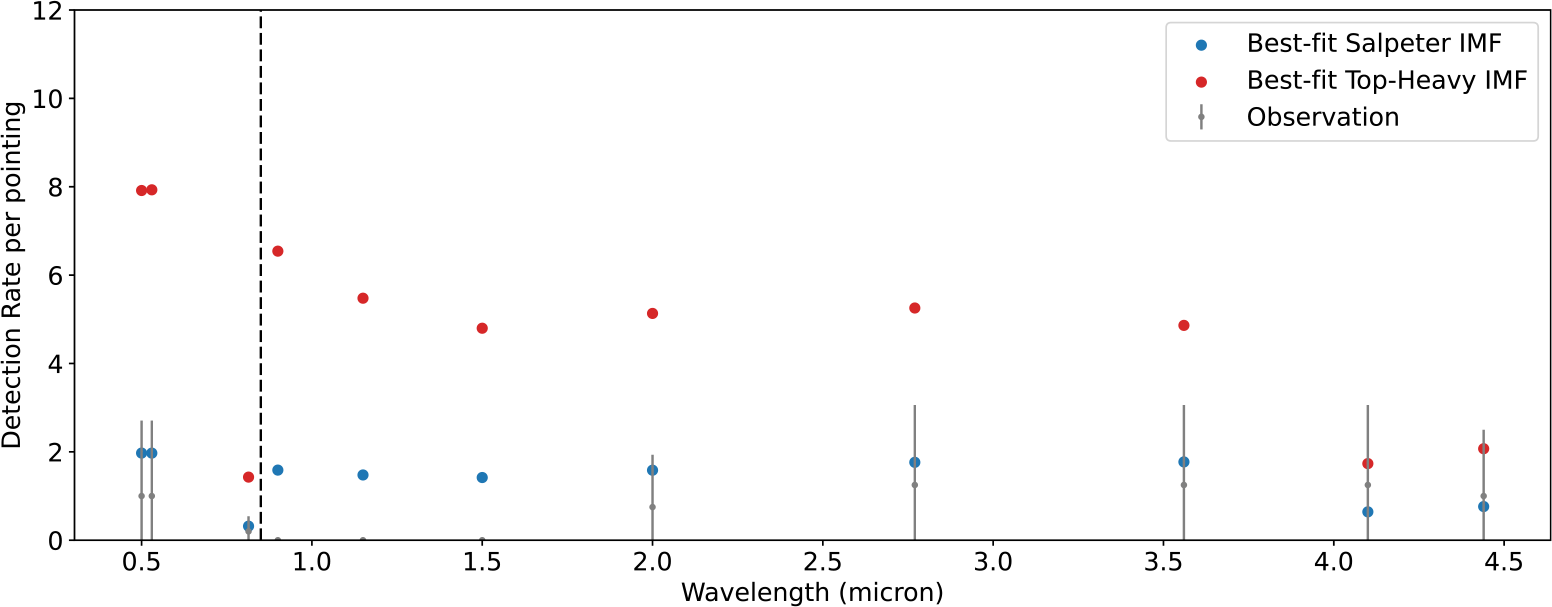
 $z = 0.4$). Nine transient lensed star events have been discovered in this galaxy so far – of which four of them are detected by HST (thus are likely to be blue supergiants given their restframe UV brightness, Rodney et al. Reference Rodney, Balestra, Bradac, Brammer, Broadhurst, Caminha, Chiriv, Diego, Filippenko, Foley, Graur, Grillo, Hemmati, Hjorth, Hoag, Jauzac, Jha, Kawamata, Kelly, McCully, Mobasher, Molino, Oguri, Richard, Riess, Rosati, Schmidt, Selsing, Sharon, Strolger, Suyu, Treu, Weiner, Williams and Zitrin2018; Kelly et al. Reference Kelly, Chen, Alfred, Broadhurst, Diego, Emami, Filippenko, Keen, Li, Lim, Meena, Oguri, Scarlata, Treu, Williams, Williams, Zhou, Zitrin, Foley, Jha, Kaiser, Mehta, Rieck, Salo, Smith and Weisz2022), and five of them are detected by JWST (thus are likely to be red supergiants given their restframe optical/IR brightness, Yan et al. Reference Yan, Ma, Sun, Wang, Kelly, Diego, Cohen, Windhorst, Jansen, Grogin, Beacom, Conselice, Driver, Frye, Coe, Marshall, Koekemoer, Willmer, Robotham, D’Silva, Summers, Nonino, Pirzkal, Ryan, Ortiz, Tompkins, Bhatawdekar, Cheng, Zitrin and Willner2023; Williams et al. Reference Williams, Kelly, Windhorst, Filippenko, Alfred, Broadhurst, Chen, Conselice, Cohen, Diego, Holwerda, Koekemoer, Li, Meena, Palencia, Ricotti, Robertson, Sun, Willner, Yan and Zitrin2025). Li et al. (Reference Li, Diego, Meena, Lim, Fung, Levitskiy, Nianias, Palencia, Williams, Zhang, Amruth, Broadhurst, Chen, Filippenko, Kelly, Koekemoer, Perera, Sun, Williams, Windhorst, Yan and Zitrin2025a) carried out an in-depth analysis of this arc, and compared the transient detection rate predicted using a Salpeter IMF (blue in Figure 1), versus that using a Top-heavy IMF (
 $\alpha = 1.0$, red in Figure 1) with SFH constrained by HST and JWST photometry. From Figure 1, one can clearly see that the calculation adopting a shallower IMF significantly overpredicts the observed transient detection rate (gray) in almost all filters (except at
 $\gtrsim 4\,$ microns). Marginalizing over the choice of lens model and SFH models, the likelihood ratio analysis of Li et al. (Reference Li, Diego, Meena, Lim, Fung, Levitskiy, Nianias, Palencia, Williams, Zhang, Amruth, Broadhurst, Chen, Filippenko, Kelly, Koekemoer, Perera, Sun, Williams, Windhorst, Yan and Zitrin2025a) indicates that given the model assumptions, the observation definitively favour the Spock galaxy to have a Salpeter-like IMF rather than a shallower top-heavy IMF.
Observed transient detection rate in the Spock arc (gray data points), compared with predicted detection rate when adopting a Salpeter IMF (blue,  $\alpha = 2.3$), and a top-heavy IMF (
 $\alpha = 1$, red) as predicted by Li et al. (Reference Li, Diego, Meena, Lim, Fung, Levitskiy, Nianias, Palencia, Williams, Zhang, Amruth, Broadhurst, Chen, Filippenko, Kelly, Koekemoer, Perera, Sun, Williams, Windhorst, Yan and Zitrin2025a). Filters leftward of the vertical dashed line are HST filters, whereas those on the right are JWST filters.

2.2. “Warhol”
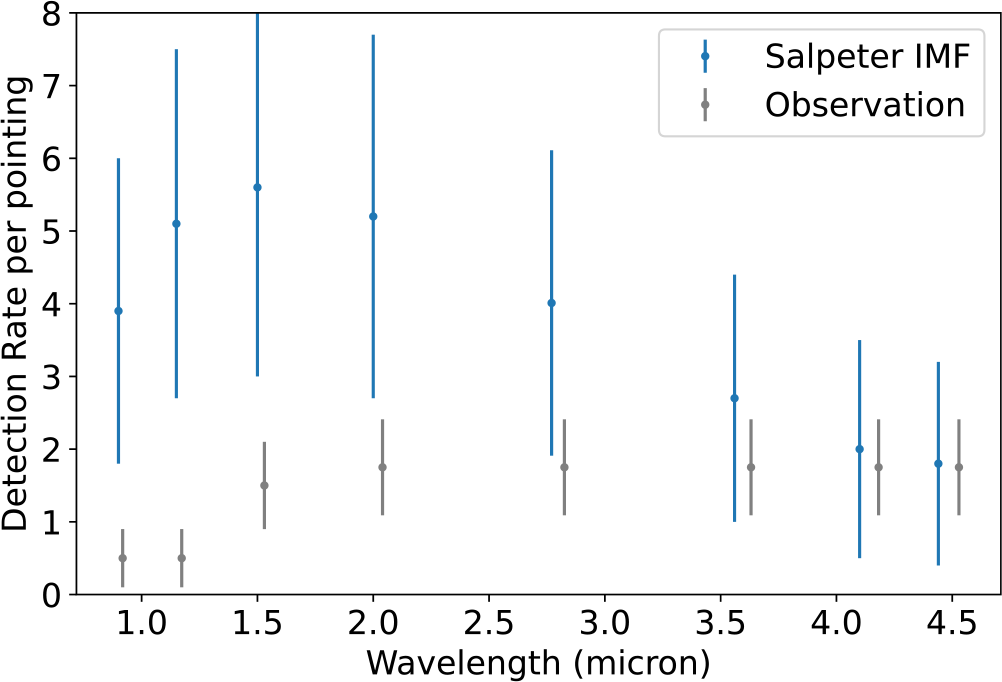
“Warhol” is another lensed galaxy in the same cluster, MACSJ0416, at a slightly lower redshift of  $z = 0.94$ (Chen et al. Reference Chen, Kelly, Diego, Oguri, Williams, Zitrin, Treu, Smith, Broadhurst, Kaiser, Foley, Filippenko, Salo, Hjorth and Selsing2019). Palencia et al. (Reference Palencia, Diego, Dai, Pascale, Windhorst, Koekemoer, Li, Kavanagh, Sun, Alfred, Meena, Broadhurst, Kelly, Perera, Williams and Zitrin2025) predicted the transient detection rate, similarly, for this galaxy. Although the initial purpose of this paper was not about the IMF, the fact that adopting a locally inferred IMF can reproduce the JWST detection rate (nine transients over 4 visits, Yan et al. Reference Yan, Ma, Sun, Wang, Kelly, Diego, Cohen, Windhorst, Jansen, Grogin, Beacom, Conselice, Driver, Frye, Coe, Marshall, Koekemoer, Willmer, Robotham, D’Silva, Summers, Nonino, Pirzkal, Ryan, Ortiz, Tompkins, Bhatawdekar, Cheng, Zitrin and Willner2023; Williams et al. Reference Williams, Kelly, Windhorst, Filippenko, Alfred, Broadhurst, Chen, Conselice, Cohen, Diego, Holwerda, Koekemoer, Li, Meena, Palencia, Ricotti, Robertson, Sun, Willner, Yan and Zitrin2025) down to an accuracy of
 $\sim 2\sigma$, as shown in Figure 2, indicates that there are no reasons to believe that this galaxy in particular, has an IMF deviates significantly from the locally measured value. Moreover, the detection rate when adopting a Salpeter-like IMF is already an overprediction – meaning that a Top-heavy IMF is qualitatively not favoured by the data, as it would otherwise create an even stronger tension with observations. The consistency with a Salpeter IMF here further strengthens the case for such an IMF to be valid at
 $z \approx 1$.
Observed transient detection rate (gray) versus transient detection rate predicted with a Salpeter IMF (blue) in the Warhol arc, numbers adopted from Palencia et al. (Reference Palencia, Diego, Dai, Pascale, Windhorst, Koekemoer, Li, Kavanagh, Sun, Alfred, Meena, Broadhurst, Kelly, Perera, Williams and Zitrin2025).

2.3. HST “Flashlights” Sample
The two previous studies made use of data combining both HST and JWST observations, limited to two  $z\approx1$ galaxies with many transient detections. There is a wider span of lensed arcs, at different redshifts, where their transient detection rate (albeit much lower) can also provide insights into the IMF. Meena et al. (Reference Meena, Li, Zitrin, Kelly, Broadhurst, Chen, Diego, Filippenko, Furtak and Williams2025) carried a similar study (with a slightly different method in estimating the lensing effect), in which the detection rate of transients is marginalized over
 $\sim 10$ arcs (with a redshift range between
 $0.7 \lt z \lt 2.8$) across the six Hubble Frontier Field clusters, as observed by the HST Flashlights program (Kelly et al. Reference Kelly, Chen, Alfred, Broadhurst, Diego, Emami, Filippenko, Keen, Li, Lim, Meena, Oguri, Scarlata, Treu, Williams, Williams, Zhou, Zitrin, Foley, Jha, Kaiser, Mehta, Rieck, Salo, Smith and Weisz2022). By marginalizing the detection rate over all these arcs, the observed detection rate of
 $20\pm5$, which falls between the predicted rate of simulations adopting
 $\alpha = 2.3$ (
 $\sim 13 \pm 4$) and
 $\alpha = 1$ (
 $\sim 35 \pm 6$) – hinting that perhaps the IMF has evolved at a certain redshift. Combining this result with the conclusion in Li et al. (Reference Li, Diego, Meena, Lim, Fung, Levitskiy, Nianias, Palencia, Williams, Zhang, Amruth, Broadhurst, Chen, Filippenko, Kelly, Koekemoer, Perera, Sun, Williams, Windhorst, Yan and Zitrin2025a) and Palencia et al. (Reference Palencia, Diego, Dai, Pascale, Windhorst, Koekemoer, Li, Kavanagh, Sun, Alfred, Meena, Broadhurst, Kelly, Perera, Williams and Zitrin2025), the deviation of the IMF might have occurred at
 $z \gt 1$ during the cosmic noon.
3. Conclusion
Using lensing star transients to study the IMF is a very young field, yet it has demonstrated great potential in probing various astrophysical questions (e.g., Kelly et al. Reference Kelly, Diego, Rodney, Kaiser, Broadhurst, Zitrin, Treu, Pérez-González, Morishita, Jauzac, Selsing, Oguri, Pueyo, Ross, Filippenko, Smith, Hjorth, Cenko, Wang, Howell, Richard, Frye, Jha, Foley, Norman, Bradac, Zheng, Brammer, Benito, Cava, Christensen, de Mink, Graur, Grillo, Kawamata, Kneib, Matheson, McCully, Nonino, Pérez-Fournon, Riess, Rosati, Schmidt, Sharon and Weiner2018; Diego et al. 2024a; Diego et al. 2024b; Broadhurst et al. Reference Broadhurst, Li, Alfred, Diego, Morilla, Kelly, Sun, Oguri, Williams, Windhorst, Zitrin, Abe, Chen, Dai, Fudamoto, Kawai, Lim, Liu, Meena, Palencia, Smoot and Williams2025; Li et al. Reference Li, Palencia, Diego, Lim, Kelly, Meena, Nianias, Williams, Williams and Zitrin2025b). Featuring individual, massive stars at cosmological distances, here in this proceeding, I highlight lensed stars’ capability in probing the stellar IMF beyond the local universe, demonstrated in recent works (Li et al. Reference Li, Diego, Meena, Lim, Fung, Levitskiy, Nianias, Palencia, Williams, Zhang, Amruth, Broadhurst, Chen, Filippenko, Kelly, Koekemoer, Perera, Sun, Williams, Windhorst, Yan and Zitrin2025a; Meena et al. Reference Meena, Li, Zitrin, Kelly, Broadhurst, Chen, Diego, Filippenko, Furtak and Williams2025; Palencia et al. Reference Palencia, Diego, Dai, Pascale, Windhorst, Koekemoer, Li, Kavanagh, Sun, Alfred, Meena, Broadhurst, Kelly, Perera, Williams and Zitrin2025). Future JWST observations have already been scheduled, and it is only a matter of time before we have a large number of detections of lensed stars. Finding no evidence of redshift  $\sim 1$ galaxies having an IMF that deviates from the local measurement so far, extending the study to higher redshifts can allow one to trace further the validity of the IMF universality and allow for a better understanding of how the IMF might have evolved over cosmic time.
Acknowledgment
S.K.L. acknowledges the support from the Research Grants Council (RGC) of Hong Kong through the General Research Fund (GRF) 17302023.


 α=2.3
 α=1

 Open access

