1 Introduction
Microscopic dust particles in plasma acquire a charge
 $q<0$
when the electron mobility is much greater than that of positive ions and when secondary electron emission is not significant. Each negatively charged dust particle is surrounded by a positive space charge cloud that partially shields it’s charge from the plasma. For ion flow speeds much less than the ion acoustic speed (Lampe et al.
Reference Lampe, Joyce, Ganguli and Gavrishchaka2000), or in directions perpendicular to the ion flow (Konopka, Morfill & Ratke Reference Konopka, Morfill and Ratke2000; Ludwig et al.
Reference Ludwig, Miloch, Kählert and Bonitz2012) such as in a sheath, the potential
 $V$
a distance
 $r$
from a dust particle is well approximated by a shielded Coulomb (i.e. Debye or Yukawa) potential
 $$\begin{eqnarray}V(r)=\frac{1}{4{\rm\pi}{\it\epsilon}_{0}}\,\frac{q}{r}\text{e}^{-r/{\it\lambda}_{D}},\end{eqnarray}$$
where
 ${\it\epsilon}_{0}$
is the permittivity of free space. The electron Debye length
 $$\begin{eqnarray}{\it\lambda}_{D}=\sqrt{\frac{{\it\epsilon}_{0}k_{B}T_{e}}{e^{2}n_{0}}},\end{eqnarray}$$
where
 $k_{B}$
is Boltzmann’s constant,
 $T_{e}$
is the electron temperature,
 $e$
is the elementary charge and
 $n_{0}$
is the plasma number density. For dust particles in flowing plasma with ion Mach numbers
 ${\gtrsim}1.3$
(such as in a sheath), (1.2) is found (Ludwig et al.
Reference Ludwig, Miloch, Kählert and Bonitz2012) to accurately give the screening length in (1.1). In the plasma sheath, where the ion density exceeds the electron density, experimental results suggest (Sheridan Reference Sheridan2009a
) that
 $n_{0}$
is the local ion density.
Since the dust particle charge
 $q$
and plasma Debye length
 ${\it\lambda}_{D}$
are determined by local plasma conditions, these parameters can only be measured when the particles are in the plasma. Once
 $q$
and
 ${\it\lambda}_{D}$
are known, they can be used to estimate local plasma properties. Because the dust particles are small, they perturb the plasma much less than any Langmuir probe and therefore enable a superior measurement of local plasma parameters.
Dust particles can be confined in plasma at the minimum of a potential energy well formed solely by electrostatic forces, or by electrostatic forces in combination with the gravitational force
 $mg$
, where
 $m$
is the dust particle mass and
 $g$
is the acceleration due to gravity. For a single confined dust particle with known
 $m$
, this typically means there are two unknowns:
 $q$
and the electric fields in the neighbourhood of the dust particle, which may be uncertain by
 ${\sim}50\,\%$
(Homann, Melzer & Piel Reference Homann, Melzer and Piel1999). However, for two dust particles confined in the same potential well, the dust charge and local electric field can be determined from the interaction between the particles. That is, using an isolated, confined cluster of two interacting dust particles, we can determine
 $q$
and
 ${\it\lambda}_{D}$
together with properties of the confining potential well and the local plasma.
In this paper we use a cluster of two monodisperse spherical dust particles to characterize the sheath above a short rectangular trench with dimensions comparable to the sheath width. In Child–Langmuir theory (Chen Reference Chen1974; Sheridan & Goree Reference Sheridan and Goree1989; Sheridan Reference Sheridan2009b
), which is one of the simplest descriptions of a planar direct current (dc) sheath, the sheath width
 $s$
varies as
 $$\begin{eqnarray}s\sim \frac{|{\it\phi}_{w}|^{3/4}}{n_{0}^{1/2}},\end{eqnarray}$$
where
 ${\it\phi}_{w}$
is the negative wall (electrode) potential measured with respect to the plasma potential. The sheath edge cannot reproduce geometrical features (such as trenches) on the electrode much smaller than
 $s$
, while the sheath edge conforms to features with sizes much greater than
 $s$
. Dust particles float near the sheath edge, and so their position can be used to estimate the sheath width, while normal mode frequencies of dust clusters give the local shape of the sheath edge. The radio-frequency (rf) discharge power is varied to investigate the effects of plasma density on dust and sheath properties. In particular, varying the rf power changes
 $s$
, thereby changing the relative size of the trench and effecting sheath conformation.
In § 2 we discuss the theory needed to determine
 $q$
and
 ${\it\lambda}_{D}$
from normal mode frequencies of two interacting dust particles. The experiment is described in § 3. Results are presented in § 4. Conclusions are in § 5.
2 Theory
Confined dust particles in plasma sit near the minimum of a potential energy well
 $U(x,y,z)$
, which in three dimensions can be approximated by the leading terms in a Taylor series (Melzer Reference Melzer2006),
 $$\begin{eqnarray}U_{\mathit{well}}(x,y,z)={\textstyle \frac{1}{2}}m{\it\omega}_{x}^{2}x^{2}+{\textstyle \frac{1}{2}}m{\it\omega}_{y}^{2}y^{2}+{\textstyle \frac{1}{2}}m{\it\omega}_{z}^{2}z^{2},\end{eqnarray}$$
where
 $m$
is the (known) particle mass and
 ${\it\omega}_{x}$
,
 ${\it\omega}_{y}$
and
 ${\it\omega}_{z}$
are the single-particle oscillation frequencies in the
 $x$
,
 $y$
and
 $z$
directions, respectively. We assume
 ${\it\omega}_{x}<{\it\omega}_{y},{\it\omega}_{z}$
so that the long axis of a cluster of dust particles is aligned with the
 $x$
axis. For particles levitated inside the sheath we take
 $z$
as the vertical direction while
 $x$
and
 $y$
define a horizontal plane. For sheath edge confinement
 ${\it\omega}_{z}\gg {\it\omega}_{x},{\it\omega}_{y}$
so particles float in the
 $x{-}y$
plane.
Consider two dust particles confined in a biharmonic potential energy well and interacting through the Debye potential in (1.1). The particle positions are
 $(x_{1},y_{1})$
and
 $(x_{2},y_{2})$
, respectively, so that the cluster’s total potential energy is
 $$\begin{eqnarray}U=\frac{1}{2}m{\it\omega}_{x}^{2}(x_{1}^{2}+x_{2}^{2})+\frac{1}{2}m{\it\omega}_{y}^{2}(y_{1}^{2}+y_{2}^{2})+\frac{1}{4{\rm\pi}{\it\epsilon}_{0}}\frac{q^{2}}{r_{12}}\text{e}^{-r_{12}/{\it\lambda}_{D}},\end{eqnarray}$$
where
 $r_{12}$
is the distance between the two particles. In equilibrium, the particle positions are
 $(-a/2,0)$
and
 $(+a/2,0)$
so
 $$\begin{eqnarray}U=\frac{1}{2}m{\it\omega}_{x}^{2}\frac{a^{2}}{2}+\frac{1}{4{\rm\pi}{\it\epsilon}_{0}}\frac{q^{2}}{a}\text{e}^{-a/{\it\lambda}_{D}}.\end{eqnarray}$$
The equilibrium particle separation
 $a$
is found by minimizing (2.3) with respect to
 $a$
giving
 $$\begin{eqnarray}{\it\alpha}^{3}=\text{e}^{-{\it\kappa}{\it\alpha}}(1+{\it\kappa}{\it\alpha}),\end{eqnarray}$$
with dimensionless variables
 $$\begin{eqnarray}{\it\alpha}=\frac{a}{r_{0}},\quad {\it\kappa}=\frac{r_{0}}{{\it\lambda}_{D}},\quad {\it\kappa}{\it\alpha}=\frac{a}{{\it\lambda}_{D}},\end{eqnarray}$$
where
 ${\it\alpha}$
is the dimensionless separation and
 ${\it\kappa}$
is the Debye screening parameter. The length scale
 $r_{0}$
is defined by
 $$\begin{eqnarray}\frac{1}{2}m{\it\omega}_{x}^{2}r_{0}^{2}=\frac{1}{4{\rm\pi}{\it\epsilon}_{0}}\frac{q^{2}}{r_{0}},\end{eqnarray}$$
which balances the characteristic energy of the confining well against the electrostatic energy.
In the
 $x{-}y$
(or
 $x{-}z$
) plane, a system of two dust particles has four normal modes. Two of these modes are the centre-of-mass (c.m.) modes in the
 $x$
and
 $y$
directions with frequencies
 ${\it\omega}_{x}$
and
 ${\it\omega}_{y}$
, respectively. The other two normal modes are a breathing mode with frequency
 ${\it\omega}_{br}$
and a rotational mode with frequency
 ${\it\omega}_{rot}$
. The rotational mode frequency, which is a combination of the c.m. frequencies,
 $$\begin{eqnarray}{\it\omega}_{rot}^{2}={\it\omega}_{y}^{2}-{\it\omega}_{x}^{2},\end{eqnarray}$$
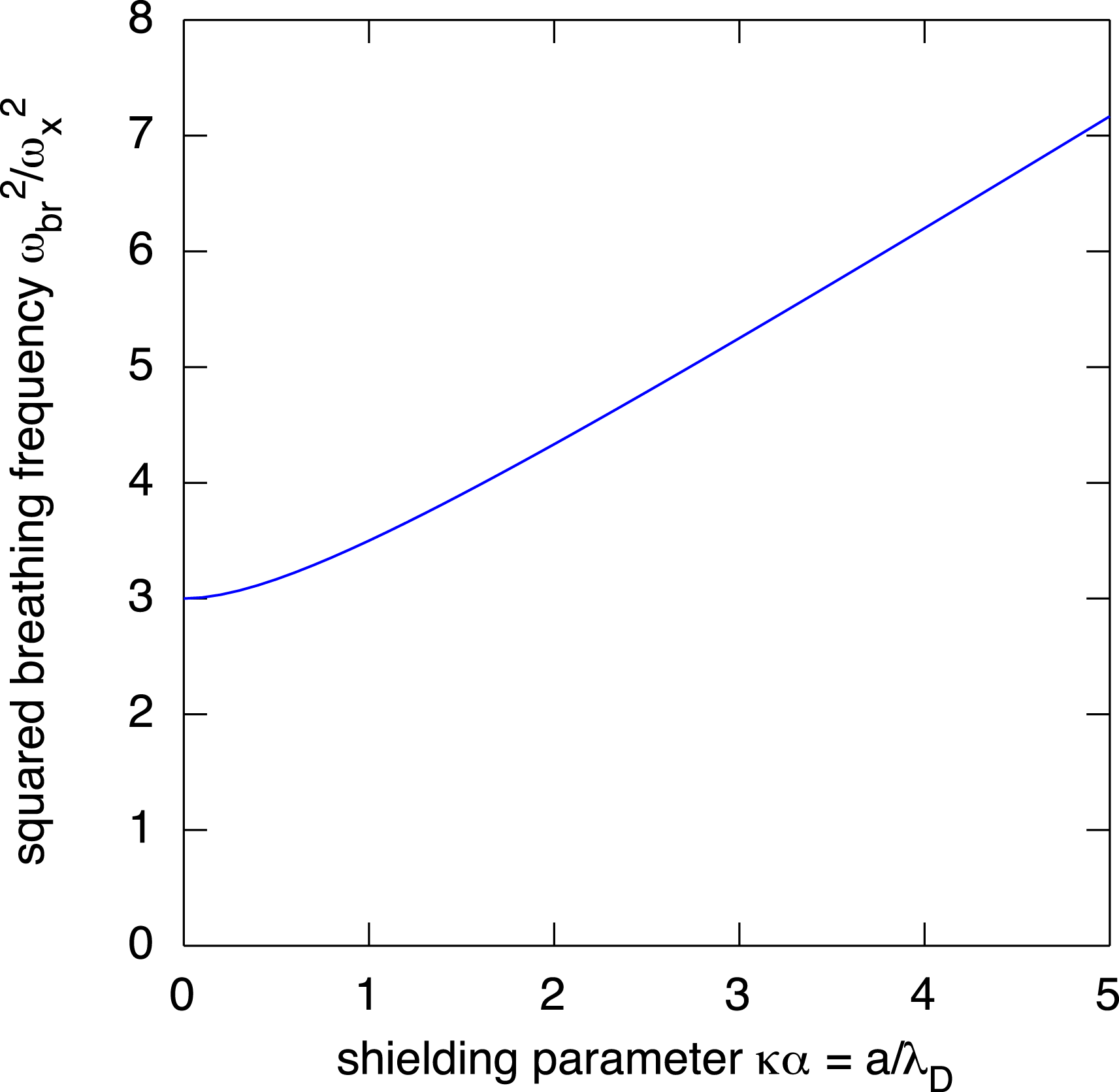
does not provide independent information. The normalized, squared breathing frequency only depends on
 ${\it\kappa}{\it\alpha}=a/{\it\lambda}_{D}$
,
 $$\begin{eqnarray}\frac{{\it\omega}_{br}^{2}}{{\it\omega}_{x}^{2}}=3+\frac{({\it\kappa}{\it\alpha})^{2}}{1+{\it\kappa}{\it\alpha}},\end{eqnarray}$$
and effectively probes the Debye shielding length since the particle separation
 $a$
oscillates. As shown in figure 1,
 ${\it\omega}_{br}^{2}/{\it\omega}_{x}^{2}=3$
for the unshielded Coulomb interaction
 ${\it\kappa}{\it\alpha}=0$
, and increases approximately linearly with
 ${\it\kappa}{\it\alpha}$
when
 ${\it\kappa}{\it\alpha}\gtrsim 1/2$
. The dependence of
 ${\it\kappa}{\it\alpha}$
on
 ${\it\omega}_{br}^{2}/{\it\omega}_{x}^{2}$
is strongest for two particles (Sheridan, Katschke & Wells Reference Sheridan, Katschke and Wells2007). Consequently, a measurement of
 ${\it\omega}_{x}$
and
 ${\it\omega}_{br}$
determines
 ${\it\kappa}{\it\alpha}$
, which allows us to find
 ${\it\kappa}$
and
 ${\it\alpha}$
separately using (2.4). The measured value of the equilibrium particle separation
 $a$
together with the (2.5) then give
 $r_{0}$
and
 ${\it\lambda}_{D}$
. The particle charge
 $q$
is calculated from (2.6).
The normalized, squared breathing frequency for two confined interacting dust particles as the Debye shielding parameter (the particle separation measured in Debye lengths) increases.

Information about local plasma conditions can be estimated from the measured dust parameters. In general, confinement in the
 $x$
-
 $y$
plane is in a biharmonic well. The local shape of the well, i.e. the conformation of the sheath edge to the underlying electrode geometry can be characterized by an ellipticity parameter, which we define as
 $$\begin{eqnarray}e=\frac{{\it\omega}_{y}^{2}}{{\it\omega}_{x}^{2}}-1.\end{eqnarray}$$
For an isotropic well
 $e=0$
. Unlike eccentricity, the ellipticity for highly anisotropic wells is
 ${>}1$
. For particles confined in the vertical direction by the sheath electric field
 $E_{z}$
, balancing the vertical forces (neglecting other forces such as ion drag and thermophoretic forces (Ticoş, Dyson & Smith Reference Ticoş, Dyson and Smith2004)) gives the local electric field as
 $$\begin{eqnarray}E_{z}=\frac{mg}{q}.\end{eqnarray}$$
Planar sheath theory (Chen Reference Chen1974) predicts that inside the sheath edge, where quasi-neutrality breaks down, the magnitude of the electric field
 $$\begin{eqnarray}E_{z}\sim \frac{T_{e}}{{\it\lambda}_{D}},\end{eqnarray}$$
where
 $T_{e}$
is an effective electron temperature in eV. As we measure both
 $E_{z}$
and
 ${\it\lambda}_{D}$
using dust particles,
 $T_{e}$
can be estimated from (2.11).
3 Experiment
Experiments were performed in the DONUT (Dusty ONU experimenT) apparatus. Argon gas was fed into the vacuum chamber and the pressure was stabilized at 11.4 m Torr. At this pressure dust cluster normal modes are underdamped. An rf signal at 13.56 MHz was amplified and applied to a capacitively coupled, horizontal, 89-mm diameter circular electrode to create a plasma. Two monodisperse melamine formaldehyde (MF) dust particles with a diameter of
 $8.94\pm 0.09~{\rm\mu}\text{m}$
(
 $m=5.65\times 10^{-13}$
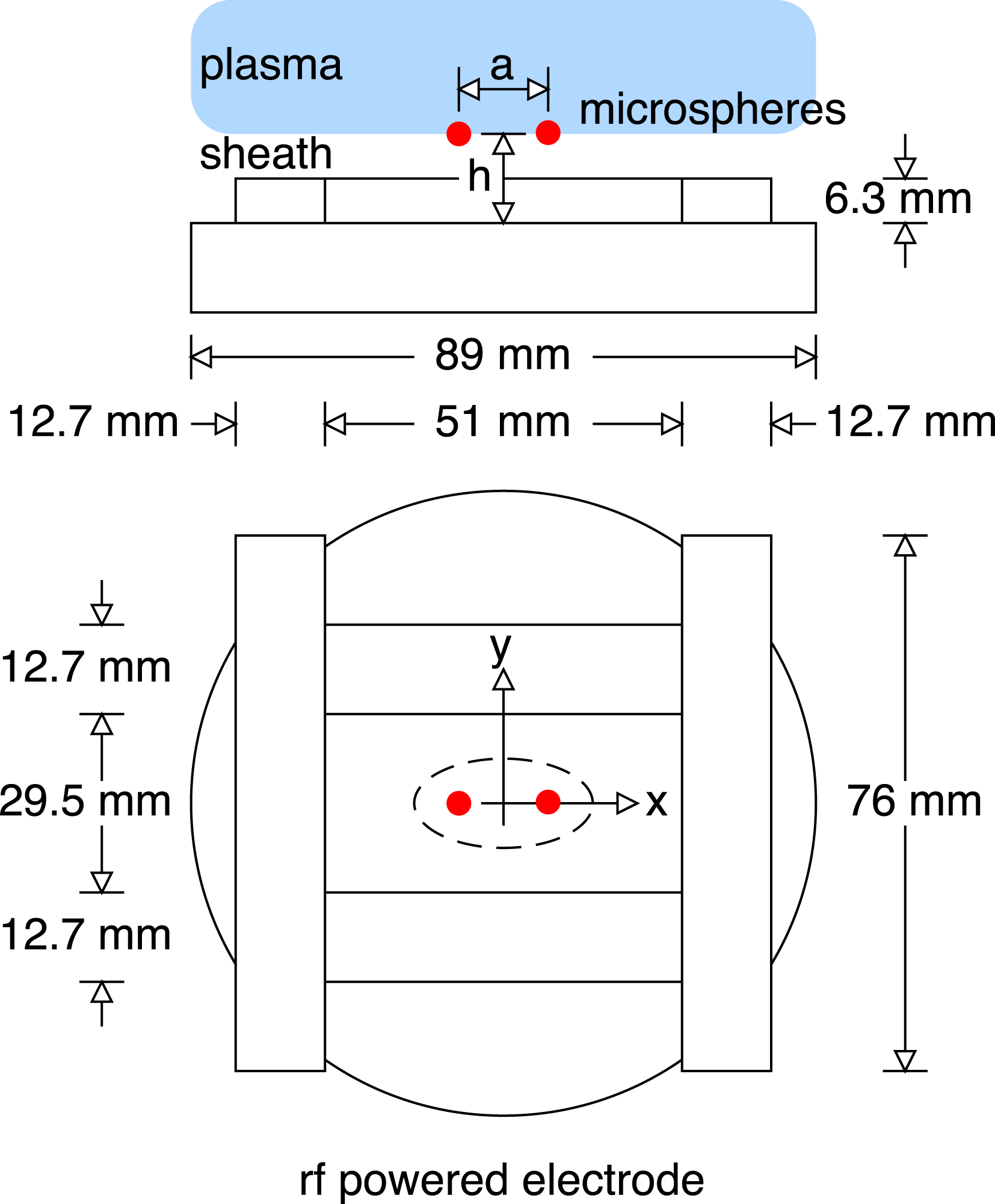
kg) were dropped into the plasma above the electrode. The dust particles were confined by the plasma sheath formed above a short rectangular trench (Sheridan & Wells Reference Sheridan and Wells2010) on top of the electrode, as shown in figure 2. This arrangement creates a biharmonic well in the
 $x{-}y$
plane as the plasma sheath edge approximately conforms to the trench geometry. The shape of this well should change as the sheath width varies.
Schematic of experimental geometry showing side and top views. Here
 $n=2$
spherical dust particles float inside the sheath edge above an electrode. The four bars on the circular electrode create a short rectangular trench which confines the dust particles in a biharmonic potential well is the
 $x{-}y$
plane shown by the dashed ellipse. Typical particle separation is
 $a\sim 1~\text{mm}$
.

To look for changes in sheath geometry, the rf power to the electrode, as measured at the rf amplifier, was varied from
 ${\approx}2.5$
to 10 W. Increasing the rf power increases the plasma density (Sheridan et al.
Reference Sheridan, Katschke and Wells2007) and causes the dc electrode self-bias to become more negative, which varies the sheath width (1.3). Here 13 measurements were taken both for increasing and decreasing rf power to insure there were no mode jumps. The negative dc electrode voltage,
 ${\approx}{\it\phi}_{w}$
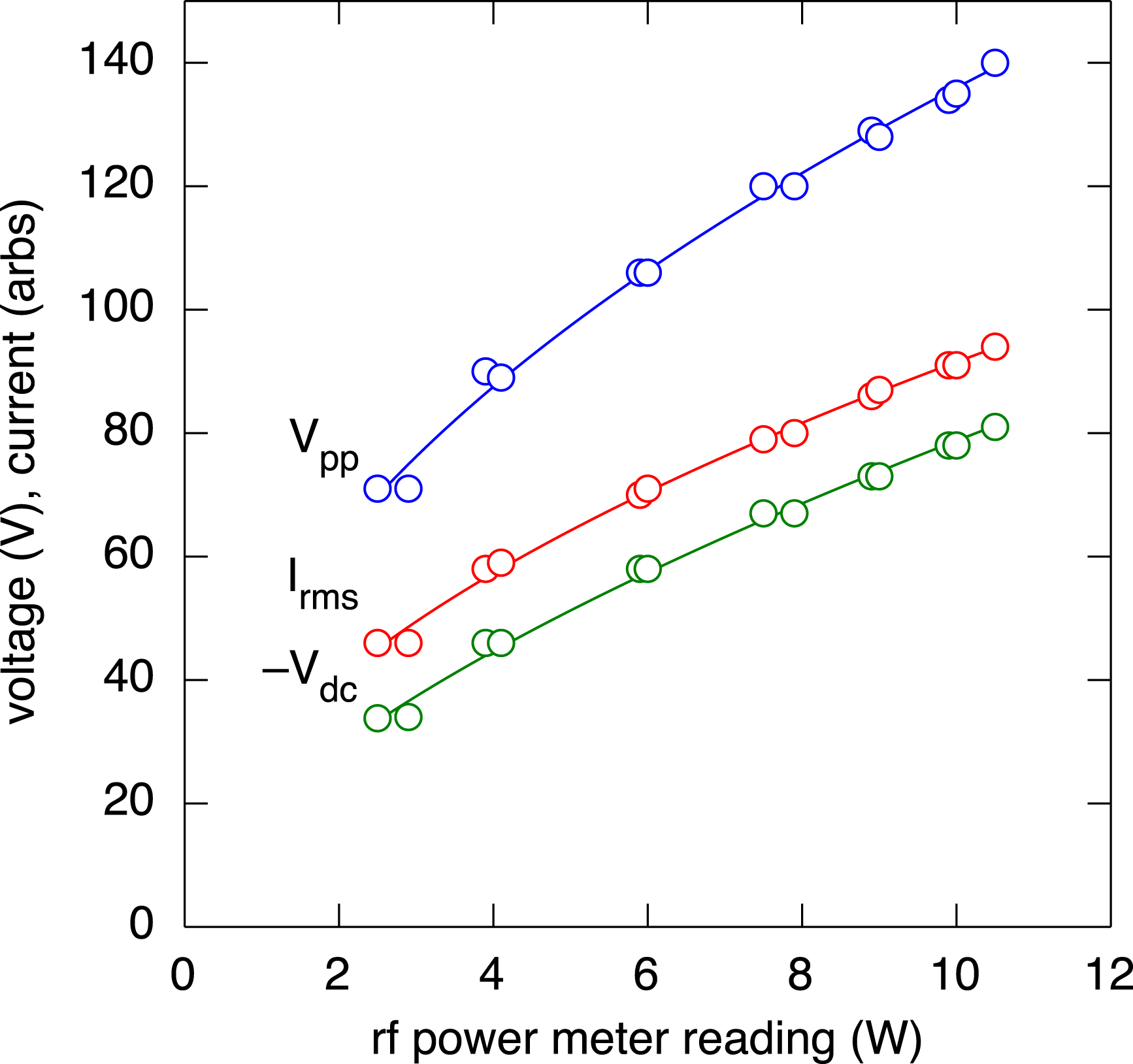
in (1.3), peak-to-peak rf voltage on the electrode and the root-mean-squared (rms) rf current were measured outside the vacuum vessel
 ${\approx}15$
cm from the electrode. The measured discharge parameters are shown in figure 3. All three quantities increase with rf power with a sublinear dependence. To attain a more reliable estimate of the rf power for small powers we multiplied the measured r.m.s. rf current and peak-to-peak voltage and plotted this versus the output rf power measured at the amplifier and fitted this data with a straight line. The linear fit was then used to give a corrected rf power using the more precisely measured current and voltage.
Measured peak-to-peak rf voltage (
 $V_{pp}$
), r.m.s. rf current (
 $I_{rms}$
) and average negative self-bias (
 $-V_{dc}$
) versus output rf power measured at the rf amplifier.

The two dust particles were illuminated by a sheet of red laser light and their motions were recorded using a top-view camera with a resolution of
 $22.7~{\rm\mu}\text{m pixel}^{-1}$
. We recorded 2048 frames at 30 frames per second to determine the normal mode frequencies from the thermal (Brownian) motion (Sheridan & Theisen Reference Sheridan and Theisen2006). The positions of the particles were taken from the videos and the power spectral density was calculated and used to find the normal mode frequencies by fitting with the theoretical expression for a driven damped harmonic oscillator. From the normal mode frequencies we calculated
 ${\it\lambda}_{D}$
and
 $q$
. For each rf power, we adjusted the height of the laser sheet to maximize the particle brightness. This was used to measure the cluster height
 $h$
(figure 2), which provides an estimate of the sheath width
 $s$
.
4 Results
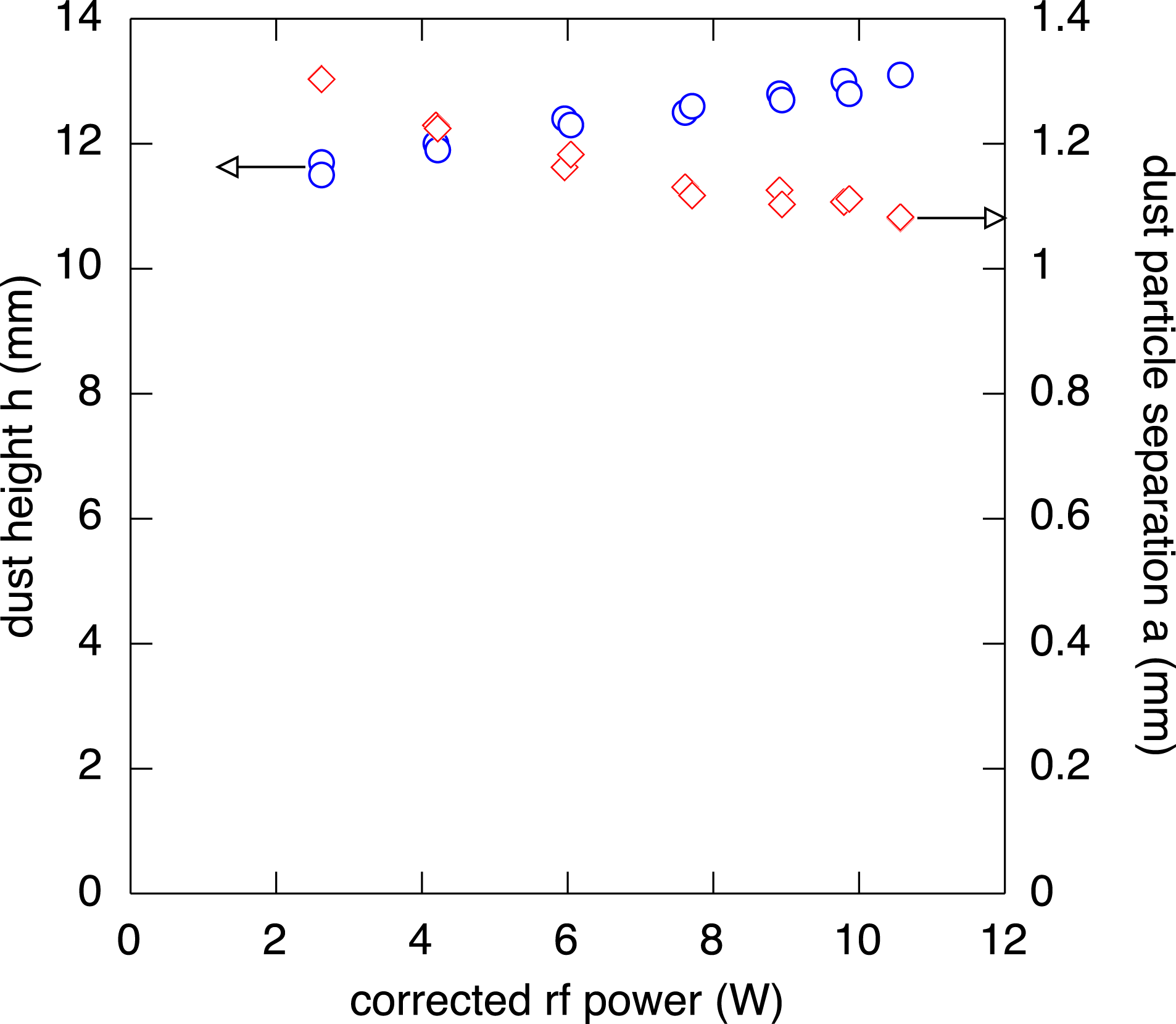
In figure 4 we show the dust height
 $h$
and average dust particle separation
 $a$
versus rf power. The particle separation is
 ${\approx}1.2$
mm and decreases slightly with increasing rf power, suggesting a decrease in the transverse Debye length with increasing plasma density. The cluster height
 $h$
increases from
 ${\approx}11.5$
mm at the lowest power to
 ${\approx}13.5$
mm at the highest power. This is consistent with the increase in the sheath width
 $s$
from the Child–Langmuir law (1.3). For this case, the depth of the trench is
 ${\approx}0.5~\text{s}$
and the width is
 ${\approx}2.5~\text{s}$
. The size of the trench, measured using
 $s$
, decreases by
 ${\approx}10\,\%$
as the rf power increases.
Height of dust particles
 $h$
above the electrode surface and dust particle separation
 $a$
versus the rf discharge power. Here
 $h$
is an estimate of the sheath width
 $s$
.

Mode frequencies are determined by projecting the Brownian motion of the two dust particles onto each of the four normal mode coordinates in the horizontal (
 $x{-}y$
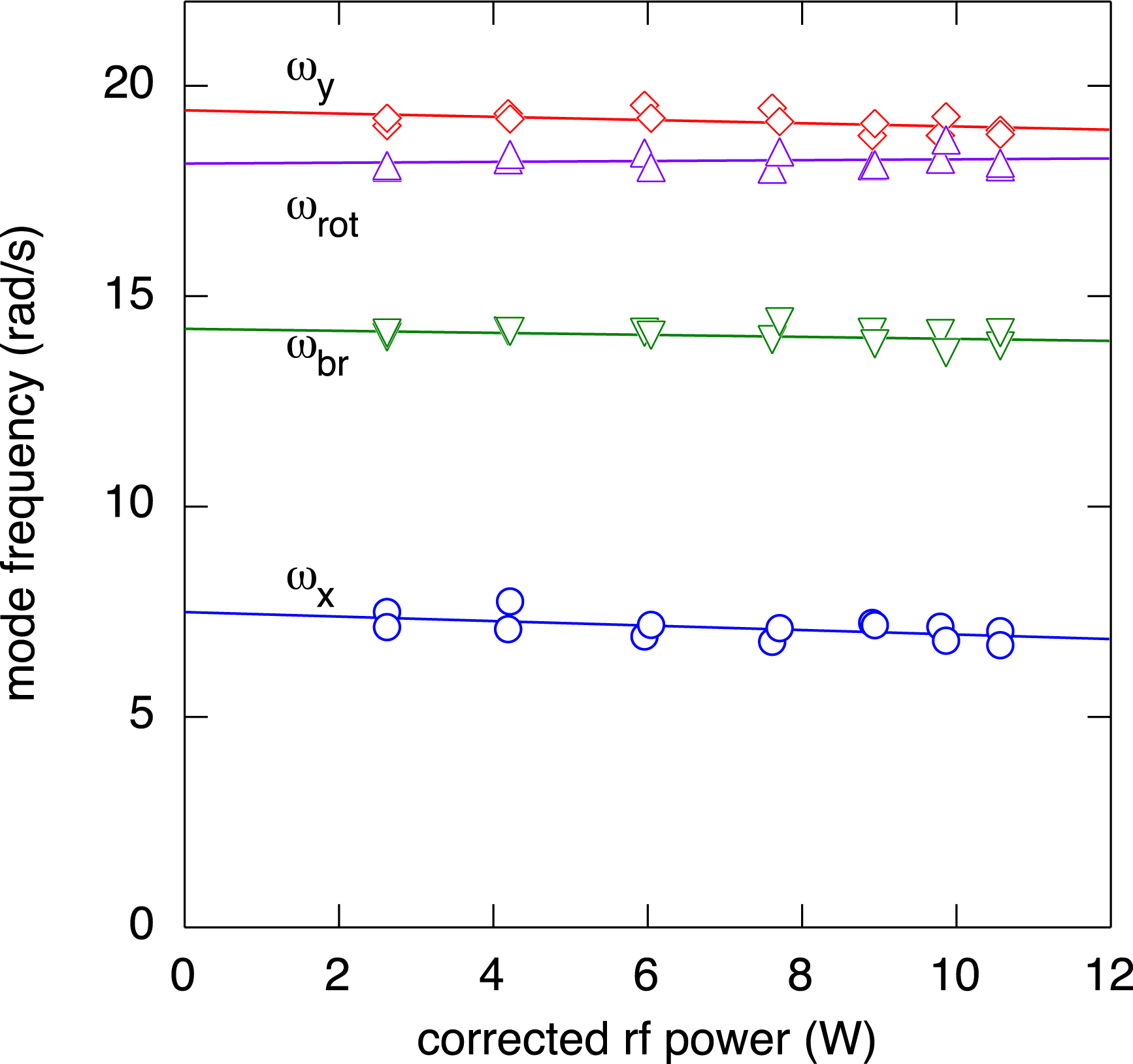
) plane (Sheridan & Theisen Reference Sheridan and Theisen2006). The resulting resonance curve for a driven, damped harmonic oscillator is used to find the mode frequencies, damping rate and mode temperatures. Measured mode frequencies are shown in figure 5. In contrast to the cluster geometry (figure 4), the mode frequencies are nearly independent of the rf power. This indicates that the shape of the confining well in the horizontal plane is not significantly effected by the changes in plasma density and electrode bias for these discharge parameters even though the sheath width increases.
Measured mode frequencies versus rf power for the four normal modes of two particles confined in a biharmonic well.

The ellipticity of the confining well (2.9) increases slightly with rf power from
 $e=5.9$
to 6.5, with an average value
 $e=6.25\pm 0.06$
. This is much larger than would be expected solely from the trench geometry indicating significant sheath overlap in the
 $y$
direction. To check the consistency of the data, we computed
 $({\it\omega}_{y}^{2}-{\it\omega}_{rot}^{2})/{\it\omega}_{x}^{2}$
. From (2.7) this ratio is predicted to be one. For this data the ratio is consistently
 ${>}1$
, but
 ${\lesssim}1.1$
with an average value of
 $1.05\pm 0.01$
.
To further analyse the data, we assumed that
 ${\it\kappa}{\it\alpha}$
found from (2.8) using the measured
 $({\it\omega}_{br}/{\it\omega}_{x})^{2}$
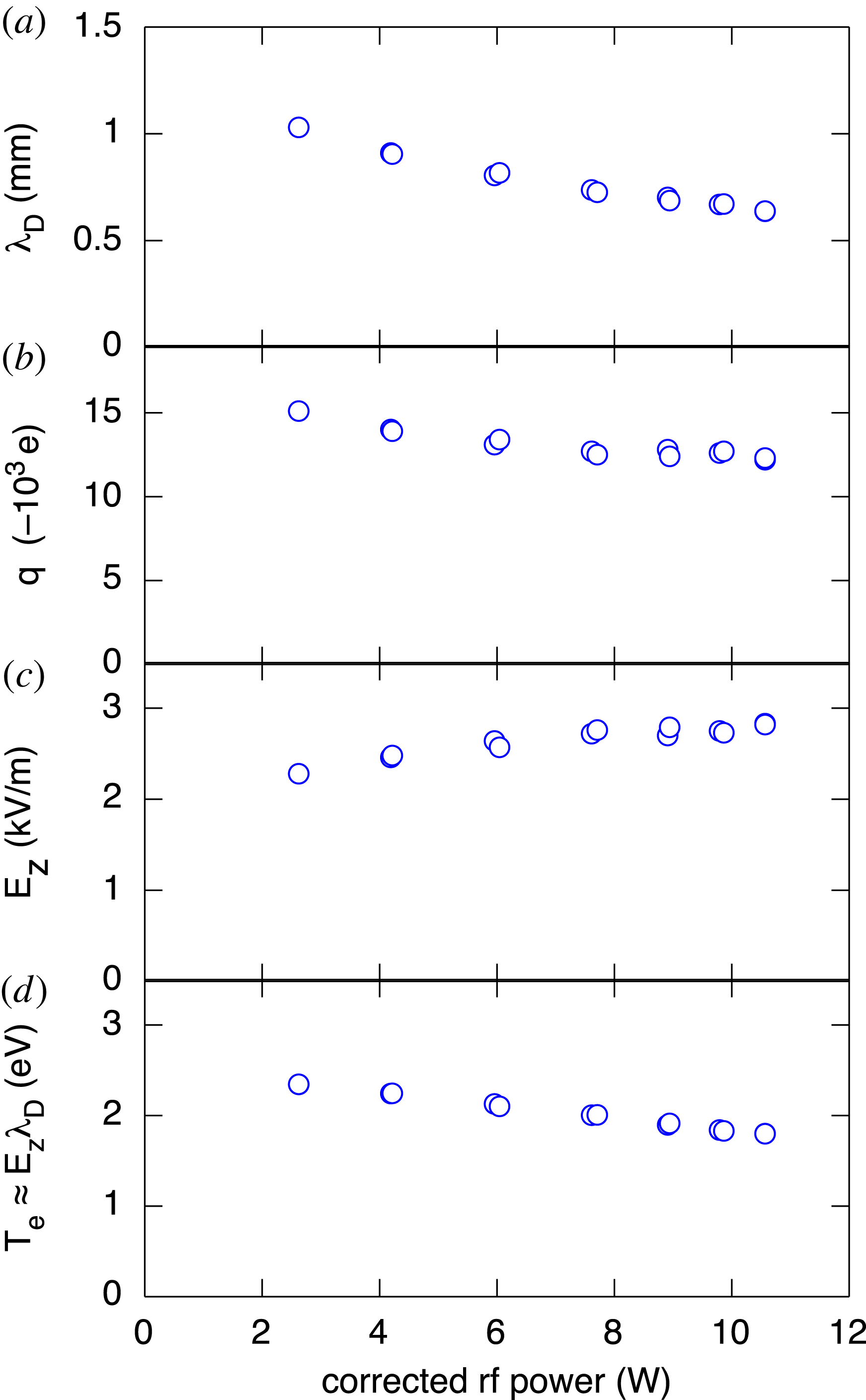
has a linear dependence on rf power over the range of powers in this experiment. The transverse Debye length in shown in figure 6(a). Here
 ${\it\lambda}_{D}$
decreases with increasing rf power as the plasma density at the sheath edge increases, mostly due to the decrease in
 $a$
(figure 4). The Debye length (1.2),
 ${\it\lambda}_{D}\sim \sqrt{T_{e}/n}$
, where
 $n=n_{i}-n_{e}\approx n_{i}$
is approximately the ion density since the particles lie inside the sheath (Sheridan Reference Sheridan2009a
). The decrease in
 ${\it\lambda}_{D}$
together with the increase of the sheath width
 $s$
with increasing power rf power means that the dimensionless sheath width
 $s/{\it\lambda}_{D}$
(Sheridan Reference Sheridan2009b
) increases more rapidly than
 $s$
.
(a) Dependence of the transverse Debye length
 ${\it\lambda}_{D}$
, (b) particle charge
 $q$
, (c) vertical electric field
 $E_{z}$
and (d) approximate electron temperature
 $T_{e}$
on rf power at the
 $z$
-position of the two-particle dust cluster.

In figure 6(b), we show the dependence of the dust charge
 $q$
on rf power. The estimated particle charge decreases slightly as the rf power increases and is effectively constant for rf powers
 ${\gtrsim}6$
W. The measured values of
 $q$
are consistent with similar measurements in this system (Sheridan & Theisen Reference Sheridan and Theisen2006; Sheridan et al.
Reference Sheridan, Katschke and Wells2007; Sheridan Reference Sheridan2009a
; Sheridan & Wells Reference Sheridan and Wells2010). From the particle charge
 $q$
and particle weight
 $mg$
we can compute the average vertical electric field
 $E_{z}$
needed to levitate the dust particle, as shown in figure 6(c). The estimated electron temperature
 $T_{e}\sim E_{z}{\it\lambda}_{D}$
versus the corrected rf power is shown in figure 6(d). We find that
 $T_{e}\approx 2$
eV, which is in qualitative agreement (Konopka et al.
Reference Konopka, Morfill and Ratke2000) with what we expect the bulk electron temperature to be for rf discharges in argon at these pressures.
5 Conclusions
We have considered an isolated cluster of two identical, interacting dust particles confined in a plasma. If we define the
 $x$
axis by a line connecting the average positions of the two particles, then the measured average particle separation
 $a$
, the
 $x$
centre-of-mass frequency and the breathing frequency can be used to determine the dust particle charge and Debye length in situ for the assumption that the dust particles interact through a shielded Coulomb (i.e. Debye or Yukawa) potential. The two dust particles probe a volume of only
 $3\sim 4$
Debye spheres and do not require any supporting structures which would disturb the plasma.
We have applied this method to a two dust particles confined at the sheath edge formed above a short rectangular trench on the powered electrode of an rf discharge. Measurements were taken for rf powers from
 ${\approx}2$
to 10 W, giving a variation in plasma density of
 ${\approx}5$
. The confining potential well in the horizontal plane is biharmonic, giving four normal modes which were characterized using video data from a top-view camera. The normal mode frequencies for the two centre-of-mass modes, the breathing mode and the rotational mode were determined from the power spectra of the particles’ Brownian motions.
We found that for these conditions mode frequencies depend only weakly on the plasma density. This indicates that the Debye shielding parameter
 ${\it\kappa}$
also depends weakly on plasma density. The ellipticity of the sheath edge increases slightly, with most of the change due to a slight decrease in
 ${\it\omega}_{x}$
. As the plasma density increases, the particle separation
 $a$
decreases, which when combined with
 ${\it\kappa}$
leads to a larger decrease in the transverse Debye length which is consistent with an increasing plasma density for a nearly constant electron temperature. The height of the dust particles above the electrode, which we take as a proxy for the sheath width, decreases slightly with increasing plasma density (the average bias on the electrode also becomes more negative) in a manner consistent with the Child–Langmuir law. The particle charge
 $q$
decreases weakly as rf power increases and is found to be
 ${\sim}-10^{4}e$
, in agreement with previous experiments using the same dust particles. Using the dust charge and mass, we estimate the electric field at the sheath edge as
 $2{-}3~\text{kV}~\text{m}^{-1}$
. From sheath theory, quasi-neutrality is violated when the electric field reaches
 $E\sim T_{e}/{\it\lambda}_{D}$
, which defines the sheath edge. Using the measured
 $E$
and
 ${\it\lambda}_{D}$
, we find
 $T_{e}\sim 2$
eV.