Introduction
Heritage speakers are defined as those who regularly use a non-English indigenous or immigrant language (Valdés, Reference Valdés, Peyton, Ranard and McGinnis2001). In the US, approximately 20% of children speak a language other than English at home, and the majority of them are born to parents from Mexico, the Caribbean and Latin America, and South America (www.urbaninstitute.org). Irrespective of their parents’ country of origin, the Spanish of heritage speakers will inevitably differ from the variety used by their parents due to an altered acquisition process that reflects contact with English (Silva-Corvalán, Reference Silva-Corvalán1994, p. 5). In contact situations, cross-linguistic transfer occurs when the knowledge of one language influences that of the other, creating patterns of usage that appear non-native (Montrul, Reference Montrul2008, p. 119). Importantly, this transfer is bidirectional. Not only does knowledge of one's first language (L1) influence the learning of a second language (L2), but prolonged use of the L2 can result in structural modifications to the L1 (Cook, Reference Cook2003, p. 5).
Attrition and incomplete acquisition
First language attrition occurs when L1 features are lost as a consequence of becoming dominant in L2; while incomplete acquisition is defined by a failure to acquire native-like structures as a result of insufficient exposure during crucial developmental stages (Anderson, Reference Anderson1999). Attrition may occur at any age, as is evident in the cases of internationally adopted infants or individuals who take up residence elsewhere and substantially reduce the use of their native language. On the other hand, incomplete acquisition occurs during the critical period of language acquisition (i.e., prior to 8–10 years), and is accompanied by a shifting dominance to L2, making for a unique profile, distinct from the complete L1 system that is acquired in monolingual situations (Montrul, Reference Montrul2008, p. 21).
That is, where attrition is generally concerned with a language that is lost following emergence of another language, incomplete acquisition is a distinct type of loss that occurs before the L1 has been fully acquired (Montrul, Reference Montrul2008, p. 20). Accordingly, those who receive greater L2 exposure and reduced L1 input at early ages will be most vulnerable to incomplete acquisition (p. 159), and the changes may persist into adulthood, creating unique patterns of L1 variation (p. 152). Moreover, heritage speakers who shift dominance before fully acquiring L1 (8–10 years) will rarely develop native-like proficiency in L1 (Bylund, Reference Bylund2009), and younger children may show particular vulnerability to these effects (Anderson, Reference Anderson and Goldstein2004, p. 194). In a case study of L1 Spanish in contact with L2 English, Anderson (Reference Anderson1999) reported a progressive reduction of Spanish morphological complexity in a child between the ages of 4;7 and 6;5, particularly with verb inflections and gender assignment. Similarly, a longitudinal study of ten preschool children revealed higher rates of grammatical errors among those who were exposed to English at school while experiencing reduced input in L1 (Guiberson, Barret, Jancosek & Itano, Reference Guiberson, Barrett, Jancosek and Yoshinaga Itano2006).
The child's language learning environment also plays a role in determining the eventual outcome. Children who acquire two languages from infancy, or prior to ages 2–3 are considered to be simultaneous bilinguals, whereas those who acquire a second language after that period are sequential bilinguals. Early sequential bilingualism, the most common form of bilingualism in the USA, is seen in children who speak a heritage language at home, learn English at school (4–5 years), then eventually shift dominance at approximately age 10 (Kohnert, Reference Kohnert2002). Irrespective of the type of bilingualism, the progressive effects of incomplete acquisition are an inevitable consequence of the shifting of dominance that occurs during the critical period of language development. Children who experience L1 loss during early bilingualism are predicted to maintain this delay throughout the later school years, whereas those who maintain L1 through ages 8–10 years will be impermeable to its effects (Montrul, Reference Montrul2008, p. 159). At the same time, the impact of incomplete acquisition may be even greater for children who experience clinically motivated language delays during the early course of acquisition (Restrepo & Kruth, Reference Restrepo and Kruth2000).
Bilingual language impairment
Language impairment (LI), also known as specific language impairment (SLI), is a diagnosis based on exclusionary criteria, occurring in children who perform below age expectations on standard measures of language ability in the absence of hearing loss, mental retardation, structural deficits or neurological/neurobehavioral disorders (Schwartz, Reference Schwartz and Schwartz2009). Bilingual language impairment (BLI) becomes evident when bilingual children fail to develop language skills relative to other children who have had similar amounts of exposure to the language that is being examined, and with this definition comes the understanding that both languages will be impaired, albeit in unique ways that depend upon the respective structures of each, and the relative amount of input throughout development (Bedore & Peña, Reference Bedore and Peña2008).
Sources of impairment are generally discussed in terms of either linguistic or processing deficit accounts. Linguistic accounts attribute errors to underspecified linguistic representations, and rely primarily on the analysis of children's grammatical errors. In particular, the absence of finiteness marking is a key component of the Extended Optional Infinitive account (Rice & Wexler, Reference Rice and Wexler1996), an approach that is well suited to describing grammatical errors in English. An extension of this account for speakers of other languages is the Unique Grammatical Checking Constraint hypothesis (Wexler, Reference Wexler, Levy and Schaeffer2003), which claims that problems arise when two grammatical features must be simultaneously marked. Importantly, the characterization of grammatical errors in comprehension or production does not differ for each of these accounts.
One distinction between these approaches is that linguistic accounts rely on language output, whereas processing accounts target the underlying mechanisms that support language use (Mullen, Reference Mullen2005), namely, memory, attention, perception, speed of processing or processing load (Leonard, Reference Leonard1998, p. 237; Windsor & Kohnert, Reference Windsor, Kohnert and Schwartz2009). Recent studies that have looked at processing deficits have expanded our understanding of LI. Accordingly, many of the children who were previously assumed to have problems exclusive to language, are presently considered to have concomitant non-linguistic deficits as well (Schwartz, Reference Schwartz and Schwartz2009; Windsor & Kohnert, Reference Windsor, Kohnert and Schwartz2009). Despite an increased awareness of processing deficits, the knowledge base for BLI still lags behind what is known for monolingual impairment, resulting in a continued reliance on language-based analyses in BLI research (Kohnert, Reference Kohnert and Goldstein2004). Another shortcoming is the failure to adequately provide a profile of typical and atypical bilingual development, particularly at later stages.
Distinguishing BLI from typical bilingual development is an ongoing challenge, owing to a lack of available tests that are capable of making this discrimination (Peña & Bedore, Reference Peña, Bedore and Schwartz2009), particularly beyond 6 years of age (Gutiérrez-Clellen, Restrepo & Simon-Cereijido, Reference Gutiérrez-Clellen, Restrepo and Simon-Cereijido2006). Ongoing discussions regarding the effects of bilingualism on LI suggest that bilingualism does not exacerbate LI, and may even pose certain advantages (Paradis, Reference Paradis2010).
Because linguistic knowledge is distributed across both languages (Pearson, Fernández & Oller, Reference Pearson, Fernandez and Oller1995; Peña & Bedore, Reference Peña, Bedore and Schwartz2009), typically developing bilingual children may show delays in each of their languages, yielding a misclassification of impairment (Schiff-Meyers, Reference Schiff-Meyers1992). One suggested strategy for defining the impairment has been to focus on perceived grammatical markers in the target language while considering changes that occur as a result of contact with another language (Peña & Bedore, Reference Peña, Bedore and Schwartz2009). To that end, this study examines grammatical markers of Spanish LI, comparing bilingual children with typical development (TD) and BLI in the lower and higher elementary grades.
Characterizing the linguistic deficit
Over the past decade, an attempt to characterize the grammatical profile of BLI among heritage Spanish speakers in the USA has been the focus of several book chapters (Anderson, Reference Anderson, Centeno, Anderson and Obler2007; Anderson & Marquez, Reference Anderson, Marquez and Grinstead2009; Bedore, Reference Bedore and Goldstein2004; Goldstein, Reference Goldstein2004; Peña & Bedore, Reference Peña, Bedore and Schwartz2009; Restrepo & Gutiérrez-Clellen, Reference Restrepo, Gutiérrez-Clellen and Goldstein2004) and research articles (Bedore & Leonard, Reference Bedore and Leonard2001; Reference Bedore and Leonard2005; Gutiérrez-Clellen, Reference Gutiérrez-Clellen1998; Gutiérrez-Clellen, Restrepo & Simon-Cereijido, Reference Gutiérrez-Clellen, Restrepo and Simon-Cereijido2006; Jacobson & Schwartz, Reference Jacobson and Schwartz2002; Restrepo & Gutiérrez-Clellen, Reference Restrepo and Gutiérrez-Clellen2001; Simon-Cereijido & Gutiérrez-Clellen, Reference Simon-Cereijido and Gutiérrez-Clellen2007). Much of this research focuses on the developing grammatical profile of children during 4–6 years of age, as this is when grammatical errors are most prevalent. Less is known regarding older children who continue to speak Spanish while using more English outside of the home in social situations and at school.
The characteristics of Spanish BLI include errors on articles (Anderson & Márquez, Reference Anderson, Marquez and Grinstead2009; Anderson & Souto, Reference Anderson and Souto2005; Bedore & Leonard, Reference Bedore and Leonard2001; Restrepo, Reference Restrepo1998), which are not addressed in the present study, clitics (Bedore & Leonard, Reference Bedore and Leonard2001; Gutiérrez-Clellen et al., Reference Gutiérrez-Clellen, Restrepo and Simon-Cereijido2006; Jacobson & Schwartz, Reference Jacobson and Schwartz2002; Simon-Cereijido & Gutiérrez-Clellen, Reference Simon-Cereijido and Gutiérrez-Clellen2007), gender and number assignment (Bedore & Leonard, Reference Bedore and Leonard2005; Eng & O'Connor, Reference Eng and O'Connor2000; Restrepo & Gutiérrez-Clellen, Reference Restrepo and Gutiérrez-Clellen2001), and to a lesser extent on verb inflections (Bedore & Leonard, Reference Bedore and Leonard2001; Restrepo & Kruth, Reference Restrepo and Kruth2000). These errors are largely consistent with those of monolingual Spanish impairment (Morgan, Restrepo & Auza, Reference Morgan, Restrepo, Auza and Grinstead2009) and those of other null-subject languages (Leonard, Reference Leonard and Schwartz2009), barring some variation.
Object clitic pronouns
A defining characteristic of Spanish clitics is their attachment to a host verb (Montrul, Reference Montrul2010). Object clitics appear preverbally with finite forms (e.g., lo comió “he/she ate it”) and post verbally with non-finite infinitives and gerunds (e.g., terminó de comerlo “he/she finished eating it”; estaba comiéndolo “he/she was eating it”). For a more detailed overview of Spanish clitic acquisition, see Montrul (Reference Montrul2004) and Anderson (Reference Anderson1998). Even after Spanish-speaking children begin to accurately produce object clitic pronouns (OCPs), occasional omission has been documented in early Spanish acquisition (Hernández Pina, Reference Hernández Pina1984). In both monolingual and bilingual discourse contexts, preverbal placement is overwhelmingly preferred (Montrul, Reference Montrul2004; Silva-Corvalán, Reference Silva-Corvalán1994). Clitic placement is not reported to shift in contact situations, as even third generation English dominant adult Spanish heritage speakers continue to demonstrate a preference for the use of preverbal OCPs, even though such constructions (e.g., lo hizo “it he/she did”) are impossible in English (Silva-Corvalán, Reference Silva-Corvalán1994, p. 139). Furthermore, when compared to advanced L2 speakers of Spanish, who learned Spanish after puberty, heritage speakers demonstrate more native-like linguistic knowledge with respect to comprehension and use of OCPs (Montrul, Reference Montrul2010), thus suggesting that OCPs are more readily acquired during the critical period and may be resistant to attrition.
OCPs are realized as unstressed syllables, making them vulnerable to omission in typical early acquisition (Hernández-Pina, Reference Hernández Pina1984) as well as in situations of impairment (Leonard, Reference Leonard1998, p. 95). Accordingly, their omission has been proposed as one of several potential clinical markers of impairment in speakers of Spanish, along with other Romance Languages such as French (Paradis, Crago & Genesee, Reference Paradis, Crago, Genesee, Beachly, Brown and Conlin2003) and Italian (Bortolini, Caselli & Leonard, Reference Bortolini, Caselli and Leonard1997). For speakers of Romance languages, such as French, Italian and Spanish, the use of clitic pronouns constitutes a major challenge for children with LI. Omission errors are reportedly more common in studies of Italian and French; however, reports from Spanish vary. Omissions were documented in the spontaneous samples of children in Spain with a mean age of 7;6 (Bosch & Serra, Reference Bosch, Serra, Baker, Beers, Bol, deJong and Leemans1997), and preschool-aged children in the USA (Simon-Cereijido & Gutiérrez-Clellen, Reference Simon-Cereijido and Gutiérrez-Clellen2007). Yet the sampling procedure and language environment may have also contributed to the error patterns. Omissions constituted the most prominent error among 4–5-year-old children using an elicited production task (Jacobson & Schwartz, Reference Jacobson and Schwartz2002), yet spontaneous samples from the same children resulted in a very few OCP productions across groups. By contrast, a higher proportion of number and gender substitution errors were reported for children aged 3;11–5;6 not only on elicitation measures (Bedore & Leonard, Reference Bedore and Leonard2001), but also in spontaneous language samples (Bedore & Leonard, Reference Bedore and Leonard2005). Conceivably, the inconsistency in error prominence (omission vs. substitution) may be linked to the differing stages of contact with English. Linguistic proficiency may also determine the type of error produced. To illustrate, higher rates of substitution errors have been documented for bilingual children with TD, relative to those with impairment (Simon-Cereijido & Gutiérrez-Clellen, Reference Simon-Cereijido and Gutiérrez-Clellen2007).
In addition to supplying anaphoric reference, the expression of Spanish OCPs is complicated by the requirement for gender and number assignment. The use of OCPs emerge early in children's speech while the mastery of number and gender extends through the preschool years (Anderson, Reference Anderson1998). For monolingual Spanish speakers, accuracy is generally high by 3–4 years of age, with occasional errors related to ambiguous forms that tend to resolve themselves with maturation (Montrul, Reference Montrul2004, p. 69). Unlike their monolingual peers, Spanish–English bilingual children continue to produce these errors well into the early school years, and the rate of such errors is linked to the language of dominance (p.71), as well as, the extent of contact with other languages (Montrul, Reference Montrul2008, p. 71).
Notably, gender and number substitution errors are even more common than omission errors for some samples of children with BLI. In particular, near-miss errors constitute the most frequent error type for both typically and atypically developing children (Bedore & Leonard, Reference Bedore and Leonard2001). That is to say, when children produce errors, they are more likely to produce an error on number or gender, but less likely to incur errors on both. However, the significance of these errors is unclear, particularly as gender substitution errors seem to also occur more frequently in contact situations (Anderson & Márquez, Reference Anderson, Marquez and Grinstead2009), and extend to bilingual children with TD (Simon-Cereijido & Gutiérrez-Clellen, Reference Simon-Cereijido and Gutiérrez-Clellen2007). This warrants a closer inspection of the acquisition of OCPs and verb inflection in monolingual and bilingual environments.
Verb inflections
Another area of vulnerability in contact situations is subject–verb inflection agreement. By age two, the Spanish preterit past tense is being used accurately by Latin American Spanish speakers (Montrul, Reference Montrul2004, p. 122). In contrast to English where there is a high reliance on non-finite forms, the use of root infinitives is comparatively low, accounting for less than 5% in studies of two-year-old Spanish-speaking children (Montrul, Reference Montrul2004, p. 119). A greater reliance on non-finite forms (e.g., infinitives and gerunds) has been reported for some children with Spanish BLI, though this is not seen to the same extent as for LI in other romance languages (Crago, Paradis & Menn, Reference Crago, Paradis, Menn, Ball, Perkins, Muller and Howard2008). In Spanish, the substitution of a third person singular inflection for a third person plural inflection is considered to be a non-finite error, comparable to the English bare stem phenomenon (Bosch & Serra, Reference Bosch, Serra, Baker, Beers, Bol, deJong and Leemans1997). It is argued that data from spontaneous samples may be less reliable for uncovering potential areas of deficit, seeing as the subject–verb agreement in null subject languages does not always prove obligatory, thereby resulting in the possibility that errors regarding the substitution of third person singular verbs for third person plural forms may go undetected in situations where the subject has not been realized (Grinstead, De la Mora, Pratt & Flores, Reference Grinstead, Mora, Pratt, Flores and Grinstead2009). In light of this complication, Grinstead et al. (Reference Grinstead, Mora, Pratt, Flores and Grinstead2009) administered a grammaticality judgment task to Spanish speakers with TD and LI which revealed a higher acceptance of non-finite constructions by children with LI.
Although children acquiring Spanish in monolingual contexts use accurate person and number agreement on verb inflections at two years of age (Montrul, Reference Montrul2004), Spanish heritage speakers in the USA continue to produce occasional errors with verb inflection agreement throughout the preschool years (Bedore & Leonard, Reference Bedore and Leonard2001). Errors on verb inflections are reportedly lower in Spanish language impairment relative to what has been reported for other Romance languages (Crago et al., Reference Crago, Paradis, Menn, Ball, Perkins, Muller and Howard2008). However, such substitutions have been reported for some (Bedore & Leonard, Reference Bedore and Leonard2001; Restrepo & Kruth, Reference Restrepo and Kruth2000), but not all samples of BLI (Jacobson & Schwartz, Reference Jacobson and Schwartz2002; Simon-Cereijido & Gutiérrez-Clellen, Reference Simon-Cereijido and Gutiérrez-Clellen2007).
According to Montrul (Reference Montrul2004, p. 178), the strength of subject–verb inflection agreement in Spanish is contingent upon its pro-drop status. Most dialects of Spanish remain solidly pro-drop. The overt expression of subjects is discourse driven. In successive utterances with no change in subject, the use of overt subjects is deemed to be pragmatically odd (p. 176), because subject information is carried on the inflection. Nonetheless, in certain circumstances overt subjects appear more often and have been attributed to contact with English especially for Caribbean Spanish speakers (p. 179). Moreover, a weakening of the pro-drop status as manifested by the greater expression of overt subjects has also been documented in adult Spanish speakers in New York regardless of their native Spanish background (Otheguy, Zentella & Livert, Reference Otheguy, Zentella and Livert2007), although this was noted only for third person singular, not third person plural inflections. Thus it is possible that heritage Spanish speakers in the US may weaken their subject–verb inflection agreement as a consequence of cross-linguistic influence.
Cross-linguistic influence
Muller and Hulk (Reference Muller and Hulk2001) suggest that cross-linguistic influence occurs at the level of the syntax–pragmatics interface when there is an overlap of structural possibilities in two languages. This “interface” is generally assumed to cover the linguistic knowledge that integrates information from the syntactic and pragmatic domains, while differing from “core” aspects of syntax which rely exclusively on knowledge of syntactic rules (Hulk & Muller, Reference Hulk and Muller2000). In order for cross-linguistic influence to occur, there must be an overlap in the surface structures of the two languages.
Both English and Spanish allow the use of direct object pronouns or full noun phrases, where the choice between them is determined by the discourse context. If the referent has been clearly established, use of a direct object to express anaphoric reference is more pragmatically appropriate. Thus, children hear full noun phrases in both languages (e.g., el niño comió la galleta “the boy ate the cookie”. However, when use of the direct object pronoun is obligated in finite verb constructions, a similar overlap does not occur (e.g., el niño la comió “the boy ate it”). Still, overlap does occur in the non-finite construction where the object appears postverbally with an infinitive or gerund (e.g., el nino terminó de comerla “the boy finished eating it”. In Spanish, OCPs occur preverbally in finite contexts and postverbally with non-finite forms (e.g., infinitives and gerunds). Thus, there is no overlap between Spanish and English in the use of OCPs in finite verb constructions when the use of an object is required, so we would not expect to see cross-linguistic influence at this “core” level (Silva-Corvalán, Reference Silva-Corvalán1994, p. 124). On the other hand, a speaker may choose to produce a non-finite construction (e.g., terminó de comerla “he/she finished eating it”) in an obligated context (e.g., elicited production), particularly if the OCP in Spanish has not been adequately developed prior to the switch to English dominance. Alternatively, a discourse context may be more amenable to the substitution of a full noun phrase because the use of these forms overlaps in English and Spanish. Indeed, this shift toward favored use of full noun phrases has been reported for older heritage Spanish speakers in a narration task (Montrul, Reference Montrul2010). In a related environment, higher rates of object omission for heritage speakers of French have been reported (Muller, Hulk & Jakubowicz, Reference Muller, Hulk, Jakubowicz, Greenhill, Littlefield and Tano1999; Perez-Leroux, Pirvulescu & Roberge, Reference Perez-Leroux, Pirvulescu and Roberge2009), and are especially noteworthy, given that French is also a Romance language being acquired in contact with English. Importantly though, the acquisition of French in contact with English differs with respect to an overlap in clitic placement since both pre- and postverbal placements are permissible in finite contexts.
The search for clinical markers of Spanish BLI
Generally speaking, clinical markers refer to persistent errors that reliably distinguish children with impairment from their typically developing peers (Rice & Wexler, Reference Rice and Wexler1996). In BLI, clinical markers should necessarily consist of persistent errors that are not commonly observed in the speech of typically developing bilinguals who have had similar amounts of exposure to the language in question (Bedore & Peña, Reference Bedore and Peña2008). A serious drawback with respect to verifying grammatical markers has been the inconsistency of their diagnostic value over time. Even for English, a language for which impairment has been extensively documented, the sensitivity of grammatical markers is known to weaken with increasing age (Oetting & Haddley, Reference Oetting, Hadley and Schwartz2009). Although the omission of tense-bearing morphology reliably serves as a clinical marker of impairment among monolingual English speakers, French–English bilinguals (Paradis, Crago, Genesee & Rice, Reference Paradis, Crago, Genesee and Rice2003), Spanish–English bilinguals (Jacobson & Schwartz, Reference Jacobson and Schwartz2005), and speakers of certain non-mainstream English dialects (Oetting & McDonald, Reference Oetting and McDonald2001), the sensitivity of this marker for identifying impairment weakens as children move beyond the early elementary grades, becoming less reliable after the age of 8 (Conti-Ramsden, Botting & Farragher, Reference Conti-Ramsden, Botting and Farragher2001; Oetting & Hadley, Reference Oetting, Hadley and Schwartz2009). Likewise, such markers lose their relevance and utility when studying the English of older children with BLI (Jacobson & Livert, Reference Jacobson and Livert2010). Unfortunately, much of what is known regarding the changing grammatical profile of LI has been documented for English (Conti-Ramsden, Botting, Simkin & Knox, Reference Conti-Ramsden, Botting, Simkin and Knox2001; Tomblin, Zhang & Buckwalter, Reference Tomblin, Zhang and Buckwalter2003). A recent analysis involving several potential grammatical errors in monolingual Spanish speakers failed to yield a consensus regarding a particular error that might qualify as a single clinical marker (Morgan et al., Reference Morgan, Restrepo, Auza and Grinstead2009). However, this may be linked to possible changes in the profile of LI across a small sample that encompasses a relatively wide age span. More studies comparing children at early and later developmental stages are needed.
Changing profile
Despite evidence supporting the omission of OCPs as a clinical marker of Spanish language impairment, the stability of this marker in children beyond 6 years of age is uncertain. Most studies addressing the grammatical deficits of Spanish speakers with BLI focus on young children with limited English (Bedore & Leonard, Reference Bedore and Leonard2001; Gutiérrez-Clellen et al., Reference Gutiérrez-Clellen, Restrepo and Simon-Cereijido2006). Less knowledge has been established, however, regarding the effect of English acquisition in cases where Spanish is maintained. For this reason, the profile for older children with BLI is less exact (Bedore & Peña, Reference Bedore and Peña2008). It is possible that OCP omission continues or worsens in situations of impairment because children have not appeared to master these structures between 4 and 6 years of age. Incomplete acquisition is predicted to be greater for children with BLI given their lower levels of L1 attainment when being exposed to L2. Alternatively, when adequate support for L1 is provided at home and at school, robust knowledge and use of OCPs may be maintained, as was reported for children attending dual language programs (Montrul & Potowski, Reference Montrul and Potowski2007). Circumstances that impact the maintenance of heritage Spanish include the extent to which Spanish is used at home (Guiberson et al., Reference Guiberson, Barrett, Jancosek and Yoshinaga Itano2006), in the community, and at school (Montrul & Potowski, Reference Montrul and Potowski2007; Winsler, Diaz, Espinosa & Rodriguez, Reference Winsler, Diaz, Espinosa and Rodriguez1999). Even in cases where the heritage language is maintained, changes to the language are inevitable due to a restructuring that occurs following contact with English (Anderson, Reference Anderson1999). With this in mind, we pose the following questions.
(i) Do children with BLI differ from those with TD on the rate of OCP errors, and are the profiles the same for lower and higher elementary grades?
(ii) Do the rates of pronoun errors differ according to preverbal (finite) versus postverbal (non-finite) elicitation contexts for children with BLI and TD?
(iii) Do children with BLI and TD differ on subject-verb inflection agreement for third person singular and plural verb inflections in the lower and higher elementary grades?
(iv) Do the outcomes observed for children with BLI at higher grade levels suggest attrition or incomplete acquisition of Spanish?
Predictions
As a consequence of using more English, typically developing children may avoid direct object pronouns entirely, instead favoring the overt use of a noun phrase (Simon-Cereijido & Gutiérrez-Clellen, Reference Simon-Cereijido and Gutiérrez-Clellen2007). Moreover, the preferred placement of OCPs may shift as the TD child becomes more proficient in English, particularly given the structural differences in the realization of clitics across languages. Because English does not mark gender on objects, it is possible that accuracy on gender assignment may decrease as English becomes stronger. On the other hand, it would follow that number marking would be less susceptible to attrition as English also marks number on objects. Montrul and Potowski (Reference Montrul and Potowski2007) report maintenance of these grammatical structures in school-age heritage speakers attending dual language programs in the USA, while outcomes for children with BLI are not known. Because of the vulnerability of object expression and third person plural verb inflections in younger children with BLI, mastery of these forms may never be realized, thereby lending credence to the notion that the existence of language impairment somehow blocks dual language acquisition. On the other hand, a gradual improvement in the use of OCPs and verb inflections among children with BLI would discredit this assumption.
Method
Participants
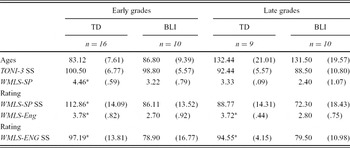
Participants included 45 heritage Spanish speakers who were currently, or had previously been, enrolled in the same late exit transitional bilingual program. Children were grouped into those enrolled in lower grades (26) and those in higher grades (19). In the early grades, there were 16 children with TD (1st = 15; 2nd = 1) and 10 children with BLI (1st = 9; 2nd = 1). In the higher grades, there were 9 children with TD (3rd = 2; 4th = 1; 5th = 3; 6th = 1; 7th = 2), and 10 children with BLI (3rd = 3; 4th = 5; 5th = 1; 6th = 1). Group characteristics are provided in Table 1.
Group characteristics for age, standard scores for Test of Non-verbal Intelligence (TONI-3), Woodcock-Munoz Language Survey proficiency ratings and standard scores in Spanish (WMLS-SP) and English (WMLS-Eng).

notes: Standard deviations appear in the parentheses.
* p < .05 (two-tailed).
Two TONI-3 scores are missing form the Early TD group; one WMLS-3 SP score is missing from the Early BLI group.
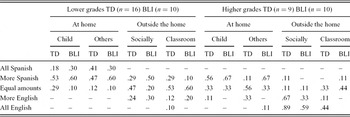
All resided in the same ethno-geographic community and continued to use Spanish at home. There were no differences in the reported amounts of relative language use between children with TD and BLI (see Table 2). Most (30) had histories consistent with the pattern of early sequential bilingualism. Although some (15) had older siblings, reliable estimates of English exposure over the first three years were not available.
Proportion of children reporting amounts of Spanish and English language input and use according to grade and language status.

note: Chi square analyses yielded no difference (p < .05, two-tailed) in relative amounts of Spanish and English use for children with TD and BLI.
Classification of LI
Children with BLI met at least two of the following criteria: current or previous history of speech–language therapy, grade retention, enrollment in remedial reading instruction, and/or standard scores below 1 standard deviation of the mean on the English Sentence Repetition Subtest, or below 1 stanine on the Spanish Sentence Repetition Subtest of the English or Spanish versions of the Clinical Evaluation of Language Fundamentals (CELF-4; Semel, Wiig & Secord, Reference Semel, Wiig and Secord2006). The sentence repetition subtest was administered in either Spanish or English depending upon the child's relative language proficiency scores on the Woodcock-Munoz Language Survey (WMLS; Woodcock & Munoz-Sandoval, Reference Woodcock and Muñoz-Sandoval2001). Sentence repetition tasks are often included in studies attempting to come up with alternate ways of classifying impairment (Morgan et al., Reference Morgan, Restrepo, Auza and Grinstead2009) as they tap both linguistic and processing (working memory) abilities known to be challenging in language impairment. The first two criteria represent a functional grouping as these children exhibited language-related learning difficulties requiring remedial action. They included children who failed to meet age-expected levels relative to their peers from comparable bilingual backgrounds and educational experiences in a district with a sizeable Latino population.
All children passed a pure tone hearing screening bilaterally at 25 dB. All scored within 2 standard deviations of the mean on the Test of Non-Verbal Intelligence – 3 (TONI-3; Brown, Sherbenou & Johnsen, Reference Brown, Sherbenou and Johnsen1997). Mean scores between TD and BLI did not differ (See Table 1).
Language use
Language proficiency was measured using the WMLS, administered on separate dates in English and Spanish. This measure yields an academic proficiency rating that ranges from 1–5 for each language. The ratings are as follows: Level 1 = negligible cognitive–academic proficiency; Level 2 = very limited cognitive–academic proficiency; Level 3 = limited cognitive–academic proficiency; Level 4 = fluent cognitive–academic proficiency; Level 5 = advanced cognitive–fluent academic proficiency. Because of the overlap in “language ability” and “language proficiency”, the lower cognitive–academic proficiency scores are not uncommon for children with BLI, given their general lower performance on language tasks. Use of the WMLS-3 is not without its drawbacks, particularly with respect to its reliance on normative data from monolingual comparisons and the lower proficiency scores among children with BLI that reflect lower language ability. Still, the measure provides a systematic way of looking at performance across languages in order to make a determination regarding relative language strength. Moreover, the inclusion of tasks associated with formal schooling was appropriate for the children who had received instruction in both languages. On the WMLS-3, children with BLI show lower proficiency ratings and standard scores in English and Spanish across grade levels (Table 1), despite similar amounts of Spanish and English input (Table 2).
Information regarding relative input and use of each language at home and school was obtained via parent and child responses to the WMLS-3 Language Use Questionnaire, through which estimates were obtained regarding the approximate percentage of time that each language was used in different contexts. Because these percentages did not constitute exact numerical values, they were converted to descriptive labels so that <25% English = no English; <25% Spanish = no Spanish; 25% English = more Spanish; 25% Spanish = more English; 50% English/Spanish = equal amounts of English and Spanish; 75% English = more English; 75% Spanish = more Spanish; 100% English or Spanish = all English or Spanish. As indicated in Table 2, Spanish was the dominant language spoken at home for both groups. By contrast, English was being used more often in social situations and in the classroom. For both groups, the use of English outside of the home was greater in the higher grades.
In the lower grades, the vast majority of children with TD and BLI reported using all or more Spanish at home. Similarly, predominant use of Spanish by others in the home was reported for both groups, indicating comparable amounts of home language input. Children with TD and BLI reported using English outside of the home, and they did not differ significantly in this respect. Largely similar patterns were noted for both groups in the later grades. Spanish continued to be used by self and others at home, whereas most reported using all or more English in social situations and in the classroom (Table 2).
Stimuli
The stimuli were created by the author and consisted of videotaped actions corresponding to the verbs and objects sampled in the elicitation task. A total of 56 direct object pronouns were sampled. The vast majority of objects were inanimate, requiring the targeted use of lo, la, los or las “it/them”. See listing in the “Appendix”. Although substitution of le “him/her” would have been plausible in certain dialects and with certain items (e.g., el perro “the dog”), this substitution was extremely rare. In task I, 28 OCPs were elicited in a way that prompted the customary preverbal position. The actions were presented on a laptop screen accompanied by a pre-recorded voice produced by a native Spanish speaker so that the child heard el niño está tirando la pelota “the boy is throwing the ball” while viewing the accompanying video. At the conclusion of the presentation, the examiner asked Qué hizo con la pelota? “What did he do with the ball?” for the intended response la tiró “he threw it”. In another task, the same 28 OCPs were elicited in postverbal position. After viewing the action, the examiner administered the prompt Ya terminó de ____ “He just finished ___” for the intended response tirarla “throwing it”. Three practice trials were provided before beginning each of the tasks. The trials were repeated at the discretion of the examiner if the child appeared to not understand the task. The examiner was a bilingual native Spanish speaker holding the Certificate of Clinical Competence from the American Speech Language and Hearing Association, and was blind to the child's language impairment status. The breakdown for object clitics was as follows: lo = 4; la = 28; los = 12; and las = 12. There were 32 singular (lo/la) and 24 plural (los/las) OCPs. For gender, 16 were masculine (lo/los) and 40 were feminine (la/las). The OCPs were not balanced for gender and number because the videos were created to coincide with comparable stimuli that examined similar actions and objects in English.
Verb inflections
Verb inflections were elicited in the same sentences that were used in the OCP preverbal context. The verbs were equally split between those requiring third person singular (14) and third person plural (14) responses. A response was correct if the child produced a past form using the correct person inflection. Responses were typically generated in the past preterit (though use of the imperfect was not scored as incorrect) in the first analysis to determine whether the inflection matched the targeted response irrespective of a change in tense. In a subsequent analysis, we looked at alternate responses as sources of error. We were particularly interested in errors that included person changes such as la tiró “he threw it” for la tiraron “they threw it”, the use of other tenses (la tiran, la están tirando) or a switch of both person and tense (la tira, la está tirando).
Results
Object clitic pronouns
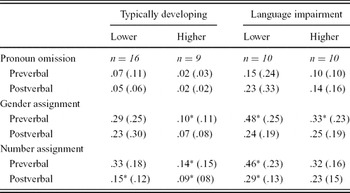
The first question addressed potential differences between children with TD and BLI on the rate of OCP errors in lower and higher elementary grades. Also of interest was clitic placement, that is to say, whether it occurred in the preverbal or postverbal phrase position (question 2). The results were analyzed using MANOVA and ANOVA to explore differences in the use of OCPs according to Grade level and Language status (TD vs. BLI). The dependent variables were OCP omission, and accuracy on Gender and Number assignment for the OCPs produced. Error rates expressed as proportions and standard deviations appear in Table 3.
Error rate proportions for pronoun omission, gender and number assignment in pre- and postverbal elicitation contexts according to grade level and language impairment status.

notes: Standard deviations appear in parentheses.
* = p < .05 level of significance (two-tailed) as indicated by a one-way ANOVA and post-hoc tests employing a Bonferroni adjustment.
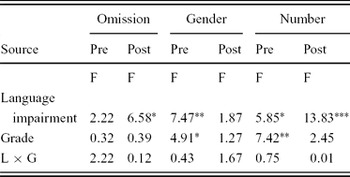
A factorial MANOVA tested the multivariate main effects for language impairment, grade and their interaction for the six clitic expression variables (OCP omission pre- and post-, gender accuracy pre- and post-, and number accuracy pre- and post-). The MANOVA revealed a significant multivariate main effect for language impairment (Wilks’ λ = .32, F(6,36) = 2.76, p < .05, partial eta squared = .32). Power to detect that effect was .81. The main effect for grade and the interaction term (impairment × grade) were not significant (λ = .83, F(6,36) = 1.23; and λ = .90 F(6,36) = 0.66, respectively). Given the significance of the overall test, the univariate main effect for language impairment was examined.
Table 4 reveals significant univariate main effects for language impairment for the post measure of OCP omission (F(1,41) = 6.58, p < .05), indicating that the rate of omissions was higher for children with BLI (M = .18, SD = .25) compared to children with TD (M = .04, SD = .05). Significant univariate effects for language impairment were also found for the assignment of gender in the preverbal context (F(1,41) = 7.47, p < .01) with the TD group performing more accurately (M = .76, SD = .24) than the BLI group (M = .60, SD = .25). Main effects were also found for number accuracy in both the preverbal and postverbal elicitation contexts, respectively (F(1,41) = 5.85, p < .05; and (F(1,41) = 13.83, p < .001). The pattern of accuracy was consistent for these outcomes: children with BLI were less accurate than their TD counterparts on the preverbal (.61 vs. .72) as well as the postverbal elicitation context (.74 vs. .87).
Univariate analysis of variance for clitic pronoun errors.

notes: Univariate df = 1, 41.
*p < .05, **p < .01, ***p < .001.
Table 4 also shows two significant univariate effects of grade level on gender accuracy in the preverbal context (F(1,41) = 4.91, p = .033) and number accuracy in the preverbal context (F(1,41) = 7.42, p < .01). In both cases, accuracy was greater for children in higher grades than lower grades. The interaction between language impairment and grade level did not achieve statistical significance in either the multivariate or univariate tests.
Verb inflections
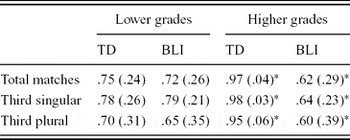
A third question addressed potential differences between children with TD and BLI on verb inflection agreement. The responses for verb inflections were analyzed in two ways. In the first analysis, we asked whether children produced a third person singular or plural verb inflection irrespective of the tense used. Thus, a response of estaban comiendo was acceptable even though the target was comieron. For this preliminary analysis, we also asked if accuracy was different according to whether the targeted inflection was the third person singular or third person plural. Although younger children were more accurate using third person singular inflections, the difference was not maintained for children in the higher grades, as indicated in Table 5. For the lower grades, the proportion of verb inflections matching the elicited target did not vary between BLI and TD subjects. For higher grades, the proportion matching the target was significantly higher for children with TD (.97) than those with BLI (.62) (F(1,17) = 12.6, p = .002).
The proportion of third person singular and third person plural verb inflections that matched the targeted inflection according to grade level and language status.

notes: Standard deviations appear in parentheses.
* = p < .05 between BLI and TD groups as indicated by independent groups t-test within the grade (lower or higher).
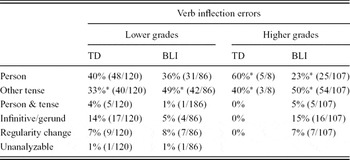
In the second analysis, we examined the types of errors. The raw frequency and percents for differing error types are presented in Table 6. Examples of error types included: “person errors”, such as comió “he/she ate” for comieron “they ate”; “other tense errors”, such as estan comiendo “they are eating”; “person and tense errors”, such as esta comiendo (he/she is eating); “infinitive/gerund substitutions”, such as comer “eat” or comiendo “eating”; and, regularity changes, such as comeran “eated”. For person errors, most substitutions were in the direction of third person singular inflections. Both children with TD and children with BLI produced person errors in the early grades, but only children in the TD showed significantly better performance in the later grades. In the later grades, the rates of person errors were substantially lower for children with TD, but remained the same for children with BLI. However, the percentages for older children with TD are somewhat misleading given the relatively low number of errors produced.
Percent and raw frequency of verb inflection errors by grade level and language status.

notes: Raw frequencies appear in parentheses.
* = p < .05 between the BLI and TD groups as indicated by either a Pearson Chi-Square or Fisher's Exact Test within the grade (lower or higher).
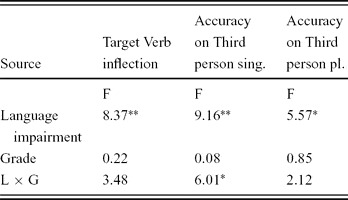
A factorial MANOVA and ANOVA were again employed to test the effects of language status and grade level on target verb inflections overall as well as the production of third person singular and plural verb inflections. The MANOVA revealed a significant multivariate main effect for language impairment (Wilks’ λ = .80, F(3,39) = 3.20, p < .05, partial eta squared = .20). Power to detect the effect was .69. The main effect for grade and the interaction term (impairment × grade) were not significant (λ = .97, F(6,36) = 0.59; and λ = .87, F(6,36) = 1.91, respectively). Given the significance of the overall test, the univariate main effect for language impairment was examined.
Table 7 shows significant univariate main effects of language impairment for all three measures of inflection. Children with TD were more accurate in matching inflection overall (F(1,41) = 8.37, p < .01) and in producing third person singular (F(1,41) = 9.16, p < .01) and third person plural (F(1,41) = 5.57, p < .05) inflections. There was one significant univariate interaction effect for language × grade level for third person singular inflection (F(1,41) = 6.01, p < .05). Post-hoc analysis revealed no difference in third person singular accuracy between children with TD and BLI lower grade level (.79 and .78, respectively). However, children with TD were significantly more accurate in the higher grade level (.98) than were children with BLI (.64).
Univariate analysis of variance for target verb inflection outcomes.

notes: Univariate df = 1, 41.
*p < .05, **p < .01.
Language attrition/incomplete acquisition
A final question asked whether children with BLI showed greater effects of language attrition or incomplete acquisition. To answer this question, we considered error rates for both groups, particularly for gender and number accuracy given the predominance of substitution errors among children in language contact situations. Although children with BLI produced more errors, similar patterns were displayed. For both groups, gender assignment for the masculine lo and los was more accurate than that for the feminine la and las. For children with TD, the proportions of accurate gender assignment were as follows: lo = .84 (SD = .37); los = .84 (SD = .48); la = .83 (SD = .58); and las = .71 (SD = .59). For children with BLI, the proportions were: lo = .74 (SD = .75); los = .77 (SD = .54); la = .70 (SD = .72); and las = .60 (SD = .69). The groups showed similar trends in errors involving number assignment, with accuracy favoring the singular forms lo and la. For children with TD, the proportions were: lo = .89 (SD = .32); los = .58 (SD = .58); la = .95 (SD = .49); and las = .53 (SD = .62). For children with BLI, the proportions were: lo = .79 (SD = .73); los = .48 (SD = .68); la = .87 (SD = .64); and las = .60 (SD = .51). Moreover, the proportion of near-miss errors was similar across groups. The percent of near-miss errors was 81% for children with TD, and 82% for children with BLI, corresponding to proportions of 19% and 18% for TD and BLI, respectively, for combined substitution errors involving both number and gender assignment.
Discussion
This study systematically explored the use of OCPs and verbal inflections in heritage Spanish speakers at different grade levels to determine the influence of incomplete acquisition, attrition and maintenance in BLI. According to Montrul (Reference Montrul2008), these factors are motivated by the age of L2 introduction and the amount of sustained L1 input during the critical period of development. Reduced expression of OCPs, noun phrase substitutions, omissions and increased errors relating to number and gender assignment would be taken as evidence of incomplete acquisition, or language attrition had they occurred to a greater extent in later grades. Verb inflections were also examined with respect to incomplete acquisition. Reflecting on the work of others, we considered that children with BLI might be more susceptible to a reduction or restructuring of Spanish because they had attained lower levels of L1 when they began learning English (Montrul, Reference Montrul2008). At the same time, it was possible that these children would show maintenance of Spanish grammar as a consequence of receiving continued L1 input at home and school.
Object clitic pronouns
The first question aimed to ascertain whether the rate of OCP errors was different for children with BLI and those with TD, and whether similar profiles were obtained at lower and higher grades. Further questioning addressed potential differences between pre- or postverbal elicitation contexts.
The omission of OCPs is well documented for Spanish speakers with LI (Bedore & Leonard, Reference Bedore and Leonard2001; Bosch & Serra, Reference Bosch, Serra, Baker, Beers, Bol, deJong and Leemans1997; De la Mora et al., Reference De la Mora, Paradis, Grinstead, Flores and Cantu2003; Jacobson & Schwartz, Reference Jacobson and Schwartz2002; Morgan et al., Reference Morgan, Restrepo, Auza and Grinstead2009). Although we found higher rates of OCP omissions overall for children with BLI, these rates were lower than those reported previously (Bedore & Leonard, Reference Bedore and Leonard2001; Bosch & Serra, Reference Bosch, Serra, Baker, Beers, Bol, deJong and Leemans1997; Jacobson & Schwartz, Reference Jacobson and Schwartz2002), and extremely rare for both TD and BLI in the higher grades. These patterns were consistent with other comparisons that have failed to obtain differences on the use of OCP omissions between typical and atypically developing children at older ages (Gutiérrez-Clellen et al., Reference Gutiérrez-Clellen, Restrepo and Simon-Cereijido2006; Morgan et al., Reference Morgan, Restrepo, Auza and Grinstead2009). Moreover, the findings were consistent with the reported limitations of using grammatical elicitation probes for identifying older children with LI (Oetting & Hadley, Reference Oetting, Hadley and Schwartz2009).
To date, there have been no studies that have systematically examined preverbal versus postverbal elicitation contexts for Spanish OCPs. Given that OCPs occur preverbally in finite contexts, most studies have examined OCPs in terms of that usage. Here, we found that children with BLI produced more OCP omissions in the postverbal (non-finite) than the preverbal (finite) elicitation context. Despite other studies linking non-finiteness errors with BLI (Bedore & Leonard, Reference Bedore and Leonard2001; Grinstead et al., Reference Grinstead, Mora, Pratt, Flores and Grinstead2009), these results do not implicate finiteness as a potential source of difficulty in school-aged children. Additionally, cross-linguistic influence which would favor the English postverbal placement was not evident. Despite generally low rates of OCP omissions, errors for gender and number assignment were more prominent.
Relative to omission errors, higher rates of near-miss gender and number substitution errors have been reported for BLI in English contact situations (Bedore & Leonard, Reference Bedore and Leonard2001; Reference Bedore and Leonard2005). In “near-miss” errors, the number or gender substitution differs from the target on only one feature (Leonard, Reference Leonard and Schwartz2009, p. 317). In the early grades, children with BLI performed differently on the use of gender assignment in the preverbal, but not the postverbal elicitation context, implying that the postverbal context provided a more facilitative condition for younger children with BLI. On the other hand, children with TD showed no effect of context, and neither group was affected by context in the later grades. The implication here is that children with BLI do not have difficulty with gender assignment per se, as evidenced by the facilitative postverbal context in early grades and higher rates of accuracy in later grades. Moreover, a similar pattern was seen for number assignment on OCPs. In the preverbal elicitation context, children with BLI were less accurate on number assignment compared to children with TD. For both groups, the accuracy on number assignment was higher for children in the later grades. On average, the postverbal facilitation context facilitated accurate number assignment irrespective of language status, and this was particularly evident for younger children.
Fewer OCP omission errors by children with BLI in later grades suggest that, with continued L1 support, it may be possible to establish the morphological paradigms for OCP use (Anderson & Marquez, Reference Anderson, Marquez and Grinstead2009). Importantly, cross-linguistic influence did not appear to impact OCP omission as these were generally few among TD children in both the lower and higher grades. The overall low rate of omissions by children in both groups at higher grade levels reinforced the proposed core status of OCPs in Spanish grammar (Montrul, Reference Montrul2004), thereby protecting it from cross-linguistic influence (Hulk & Muller, Reference Hulk and Muller2000).
Continued errors relating to OCP omissions and number and gender assignment were evident in children with TD as well as BLI, though in differing degrees. Recall that the postverbal context facilitated accurate number and gender assignment for children with BLI in the lower grades, a condition that lost its effect in the higher grades. Early errors of OCP omission that diminish over time are consistent with a possible perceptual deficit (Leonard, Reference Leonard and Schwartz2009, p. 318), or a less mature linguistic system that has failed to yet acquire the morphological paradigm (Anderson, Reference Anderson1998). Alternatively, substitution errors might be motivated by other circumstances (Leonard, Reference Leonard and Schwartz2009, p. 319). Specifically, cross-linguistic influence may play a role. Increased errors on number and gender assignment are reported for adult heritage Spanish speakers (Silva-Corvalán, Reference Silva-Corvalán1994, p. 124) and in other contact situations. Moreover, Anderson and Marquez (Reference Anderson, Marquez and Grinstead2009) maintain that gender substitution errors may be related to problems of lexical access, given that gender information is learned with nouns and lexical access difficulties are common in situations of reduced input. Accordingly, it is somewhat surprising that both groups (TD and BLI) produced gender assignment more accurately than number assignment, as English requires number, but not gender, assignment for direct objects (e.g., it/them). In fact, we might expect the influence of English on Spanish to bolster accurate number assignment as both features are shared. A corresponding decrease in gender accuracy at higher grades would also be expected as a consequence of increased English exposure. Taken as a whole, the maintenance of number and gender assignment, particularly at higher grade levels, may reflect the benefits of continued L1 use at home and early Spanish literacy instruction at school. At the same time, the extent of near-miss errors in both groups may represent certain trade-offs that bilinguals sometimes experience when using another language.
Verb inflection errors
Taken as a whole, children with BLI were less accurate in producing the targeted inflections, but the groups did not differ significantly in the lower grades. A significant interaction across grade level showed higher accuracy among children with TD, yet lower rates for children with BLI. Children with BLI may be more susceptible to incomplete acquisition because they were at an earlier stage of Spanish acquisition when English was introduced (Montrul, Reference Montrul2008, p. 159). In addition to producing more errors overall, children with BLI were also more likely to use another tense (e.g., present or past progressive), though use of the latter was generally not assumed to be an error, but rather due to restructuring (Peña & Bedore, Reference Peña, Bedore and Schwartz2009). Still, it is not clear whether this profile represents a final stage of incomplete acquisition for children with BLI, or whether the errors are to be diminished over time. Spontaneous language samples would be useful for examining potential changes in the use of overt subject expression and verb inflections. Further research incorporating longitudinal data is needed to answer this question.
Conclusion
This study extends what has previously been reported for maintenance of grammatical morphology among typically developing heritage Spanish speakers (Montrul & Powtowski, Reference Montrul and Potowski2007; Winsler et al., Reference Winsler, Diaz, Espinosa and Rodriguez1999). That is to say, heritage Spanish speakers with BLI show continued development of OCP use, including gender and number agreement morphology, when support for the heritage language was provided at home and with formal schooling. The present data also allude to the possibility that there is a period of suppression in the use of Spanish grammatical morphology during the early elementary grades, coinciding with increased exposure and use of English, thereby reflecting a complex interaction between languages that are being developing in contact situations (Kan & Kohnert, Reference Kan and Kohnert2005; Kohnert, Reference Kohnert and Goldstein2004; Oller, Jarmulowicz, Gibson & Hoff, Reference Oller, Jarmolowicz, Gibson, Hoff, Caunt-Nulton, Kulatilake and Woo2007). The current study also documents continued development of grammatical morphology in later school years when there is L1 support at home and school, as indicated by the diminished error rates for OCP omission and gender and number assignment for children in higher elementary grades, irrespective of language impairment status.
Higher error rates for children with BLI in the later grades may be indicative of a greater impact of incomplete acquisition related to impairment (Peña & Bedore, Reference Peña, Bedore and Schwartz2009; Restrepo & Kruth Reference Restrepo and Kruth2000). Yet another explanation is possible. Notably, children with TD and BLI did not differ on the number of verb inflection errors in the early grades, which is surprising in itself, because children with BLI are generally less accurate on grammatical measures. However, it might be that the younger children with BLI are less affected by the disruption and suppression of their Spanish skills because they have actually acquired less English at that time, a pattern consistent with the higher rates of gender substitution errors among bilingual children with TD (Simon-Cereijido & Gutiérrez-Clellen, Reference Simon-Cereijido and Gutiérrez-Clellen2007). Children with BLI may simply require more time to recover from the early errors associated with English contact.
The present data weaken claims that bilingualism exacerbates language impairment. Despite moving toward English dominance, children with BLI are more accurate on tasks measuring core aspects of Spanish grammar at higher grade levels. Potentially greater effects of incomplete acquisition cannot be ruled out, given the extent of verb inflection errors in later grades. More research is needed to determine how these errors resolve over time, and the extent to which the profile of older children with BLI resembles that of bilingual peers with TD at earlier developmental stages. A limitation of the current report has been its reliance on elicited production data at a single point in time. More challenging tasks that could include producing written language, adding processing measures such as non-word repetition tasks, imposing time constraints or obliging the allocation of resources (executive functions) might prove to be more informative. Longitudinal data are also essential for exploring the effects of incomplete acquisition on typical and atypical development.
Appendix