Seed dispersal is a crucial stage in the life cycle of plants (Harper Reference HARPER1977). After primary dispersal, seeds can be deposited in sites that may favour, or not, seed survival and germination and/or seedling survival and growth. After primary dispersal, most seeds are moved again by secondary dispersal vectors, an event that will ultimately determine seed fate, and that is often associated with positive effects on plant fitness (Vander Wall & Longland Reference VANDER WALL and LONGLAND2004).
Among rain-forest invertebrates, dung beetles (Coleoptera: Scarabaeinae) are important secondary dispersers of seeds defecated by vertebrates (Andresen & Feer Reference ANDRESEN, FEER, Forget, Lambert, Hulme and Vander Wall2005). Vertebrate dung is used by dung beetles to feed and breed, with seeds generally representing contaminants of the faecal material (Andresen Reference ANDRESEN2002). So, when it occurs, secondary seed dispersal by dung beetles is carried out unintentionally, from the beetle's perspective (Andresen & Feer Reference ANDRESEN, FEER, Forget, Lambert, Hulme and Vander Wall2005).
Several dung beetle and seed traits interact to determine how dung beetle activity affects the fate of defecated seeds (Andresen & Feer Reference ANDRESEN, FEER, Forget, Lambert, Hulme and Vander Wall2005). For example, when the size of a seed is large relative to the size of the beetle handling the seed-containing dung portion, the beetle will most likely remove the seed before relocating the dung (Andresen Reference ANDRESEN2002, Braga et al. Reference BRAGA, KORASAKI, ANDRESEN and LOUZADA2013, Santos-Heredia & Andresen Reference SANTOS-HEREDIA and ANDRESEN2014). The beetle's dung-processing behaviour also affects the probability of secondary seed dispersal. In general, dweller dung beetles do not act as secondary seed dispersers; only beetles that relocate dung under the soil surface (rollers and tunnellers) move seeds (Andresen & Feer Reference ANDRESEN, FEER, Forget, Lambert, Hulme and Vander Wall2005, Estrada & Coates-Estrada Reference ESTRADA and COATES-ESTRADA1991). During dung relocation, roller and tunneller dung beetles dig tunnels, burying dung while at the same time moving large amounts of soil to the surface (Braga et al. Reference BRAGA, KORASAKI, ANDRESEN and LOUZADA2013). During this process, some of the defecated seeds end up buried in the tunnels while others remain on the surface but covered by the excavated soil.
While seed burial by dung beetles has been quantified in several studies (reviewed by Andresen & Feer Reference ANDRESEN, FEER, Forget, Lambert, Hulme and Vander Wall2005), the number of seeds that remain on the surface but covered by the soil excavated by dung beetles, has not been previously assessed separately from seed burial. Yet both types of seed deposition may have different consequences for seed fate. The effect of seed burial by dung beetles is known to be mostly beneficial for short-term seed survival due to lower predation rates (Andresen & Feer Reference ANDRESEN, FEER, Forget, Lambert, Hulme and Vander Wall2005, Estrada & Coates-Estrada Reference ESTRADA and COATES-ESTRADA1991, Shepherd & Chapman Reference SHEPHERD and CHAPMAN1998), and possibly also due to decreased desiccation (Chambers & MacMahon Reference CHAMBERS and MACMAHON1994). However, when seeds are buried too deeply, seedling emergence is known to be affected negatively (Andresen Reference ANDRESEN2001, Feer Reference FEER1999, Griffiths et al. Reference GRIFFITHS, BARDGETT, LOUZADA and BARLOW2016, Shepherd & Chapman Reference SHEPHERD and CHAPMAN1998). It is possible that when seeds remain on the surface but covered by excavated soil, seeds may benefit from similar advantages as buried seeds, but without the disadvantages.
Not all seeds are buried or covered by soil after dung beetle activity and at least two additional deposition patterns may be common: First, seeds remaining on the surface clean and visible, and, when beetles do not bury all dung, seeds on the surface embedded in the remaining faecal material. Seeds that remain on the surface after dung beetle activity, either with or without dung, strongly attract seed predators, suffering higher predation rates compared with non-defecated seeds visible on the soil surface (Andresen Reference ANDRESEN2001, Andresen & Levey Reference ANDRESEN and LEVEY2004). Also, seeds that remain in dung may suffer higher rates of pathogen attack (Jones Reference JONES and Thesis1994), and, if in high density, emerging seedlings are more likely to suffer density-dependent mortality (Lawson et al. Reference LAWSON, MANN and LEWIS2012).
The objective of this study was to determine the frequencies of four distinct seed deposition patterns that can occur after dung beetle activity, and how they are affected by seed size. The four types of seed deposition we assessed were: (1) ‘covered’: seeds on the soil surface covered by soil excavated by beetles; (2) ‘buried’: seeds under the surface in beetles’ tunnels; (3) ‘exposed’: clean seeds on the forest floor; (4) ‘in dung’: seeds embedded in dung on the forest floor. Our hypothesis was that the relative frequency of the different seed deposition types would vary depending on seed size. In particular, we predicted that larger seeds would more often have deposition types (1) and (3), while smaller seeds would more often have deposition type (2). In the case of deposition type (4), we had no specific prediction.
The study was carried out from April to August 2010 in an Amazonian rain-forest region in the municipality of Santarém (54°29′33.2″W, 2°44′19.11″S), in the Brazilian state of Pará. The climate is hot and humid with annual mean temperature of 25–28°C and annual mean rainfall of 1920 mm. We worked in 48 transects (separated by at least 1 km) of primary forest located in nine watersheds spread across the region. Details about the study area and the broader research design can be found elsewhere (Gardner et al. Reference GARDNER, FERREIRA, BARLOW, LEES, PARRY, VIEIRA, BERENGUER, ABRAMOVAY, ALEIXO, ANDRETTI, ARAGÃO, ARAÚJO, ÁVILA, BARDGETT, BATISTELLA, BEGOTTI, BELDINI, DE BLAS, BRAGA, BRAGA, BRITO, CAMARGO, SANTOS, OLIVEIRA, CORDEIRO, CARDOSO, CARVALHO, CASTELANI, CHAUL, CERRI, COSTA, COSTA, COUDEL, COUTINHO, CUNHA, D'ANTONA, DEZINCOURT, DIAS-SILVA, DURIGAN, ESQUERDO, FERES, FERRAZ, FERREIRA, FIORINI, SILVA, FRAZÃO, GARRETT, GOMES, GONÇALVES, GUERRERO, HAMADA, HUGHES, IGLIORI, JESUS, JUEN, JUNIOR, OLIVEIRA-JUNIOR, OLIVEIRA-JUNIOR, SOUZA-JUNIOR, KAUFMANN, KORASAKI, LEAL, LEITÃO, LIMA, ALMEIDA, LOURIVAL, LOUZADA, MAC NALLY, MARCHAND, MAUÉS, MOREIRA, MORSELLO, MOURA, NESSIMIAN, NUNES, OLIVEIRA, PARDINI, PEREIRA, POMPEU, RIBAS, ROSSETTI, SCHMIDT, SILVA, SILVA, SILVA, SILVEIRA, SIQUEIRA, CARVALHO, SOLAR, TANCREDI, THOMSON, TORRES, VAZ-DE-MELLO, VEIGA, VENTURIERI, VIANA, WEINHOLD, ZANETTI and ZUANON2013).
Transects were 300 m long and contained three sampling points (0 m, 150 m and 300 m). Data from the three sampling points were averaged to obtain transect mean values. In each sampling point we set up an experimental arena consisting of a circular fenced area 1 m in diameter where we removed all existing vegetation and leaf litter (Braga et al. Reference BRAGA, KORASAKI, ANDRESEN and LOUZADA2013). The fence was built using a nylon screen 20 cm high. In the centre of the arena we placed 200 g of dung (50:50 mixture of human and pig dung) containing plastic beads as seed mimics. The use of seed mimics is common in studies of seed dispersal by Scarabaeinae (Andresen Reference ANDRESEN1999, Braga et al. Reference BRAGA, KORASAKI, ANDRESEN and LOUZADA2013, Santos-Heredia & Andresen Reference SANTOS-HEREDIA and ANDRESEN2014) and facilitates methodological standardization while avoiding removal by seed predators. Spherical seed mimics (hereafter referred to as seeds) of three sizes were used: small (3.5 mm), medium (8.6 mm) and large (15.5 mm). A total of 50 small, 20 medium and 10 large seeds were placed in each dung pile, totalling 11520 seeds used in this experiment (80 seeds × 3 sampling points × 48 transects). After 24 h we recorded the number of seeds in each of the four possible deposition pattern categories (covered, buried, exposed, in dung). To analyse the data we used a mixed generalized linear model (GLMM), with deposition pattern (covered, buried, exposed, in dung) and seed size as fixed factors. As random factor we used the sampling points of each transect. Due to overdispersion we used the quasi-binomial function. The constructed model was (m1 <- glmm (proportion ~ seed.size * pattern, random = ~ 1|sampling points, family = quasibinomial)). We performed post hoc mean comparisons using Tukey tests. We used the function PQL of the MASS package in R.
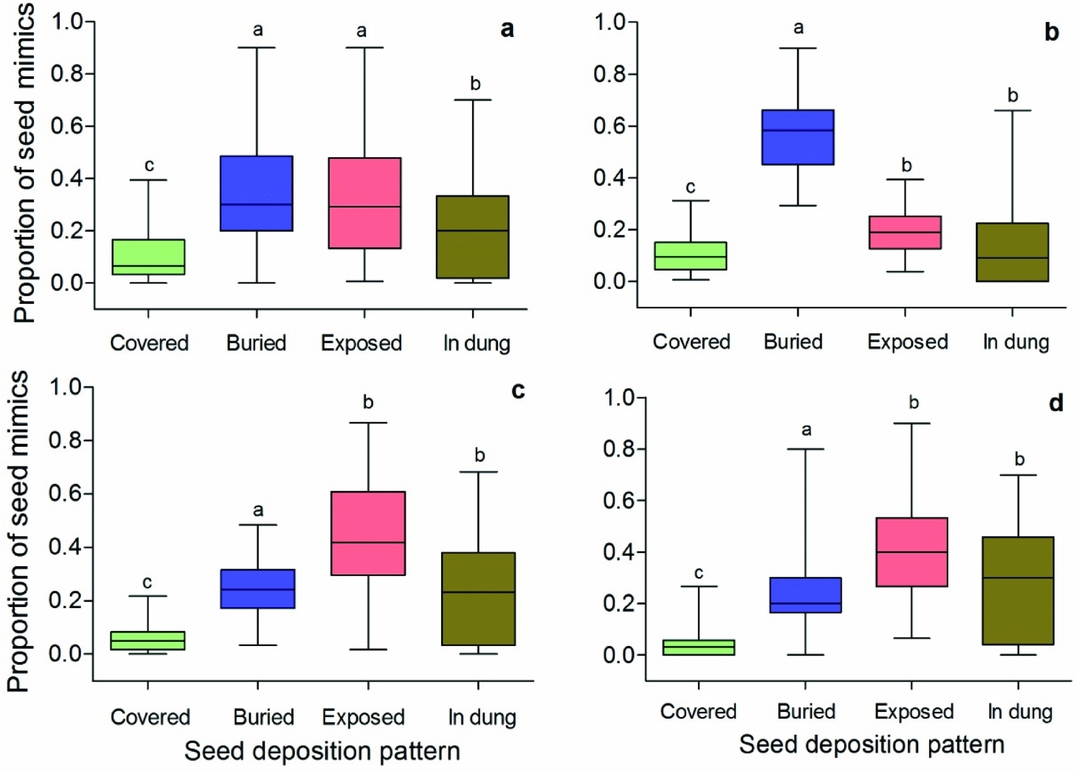
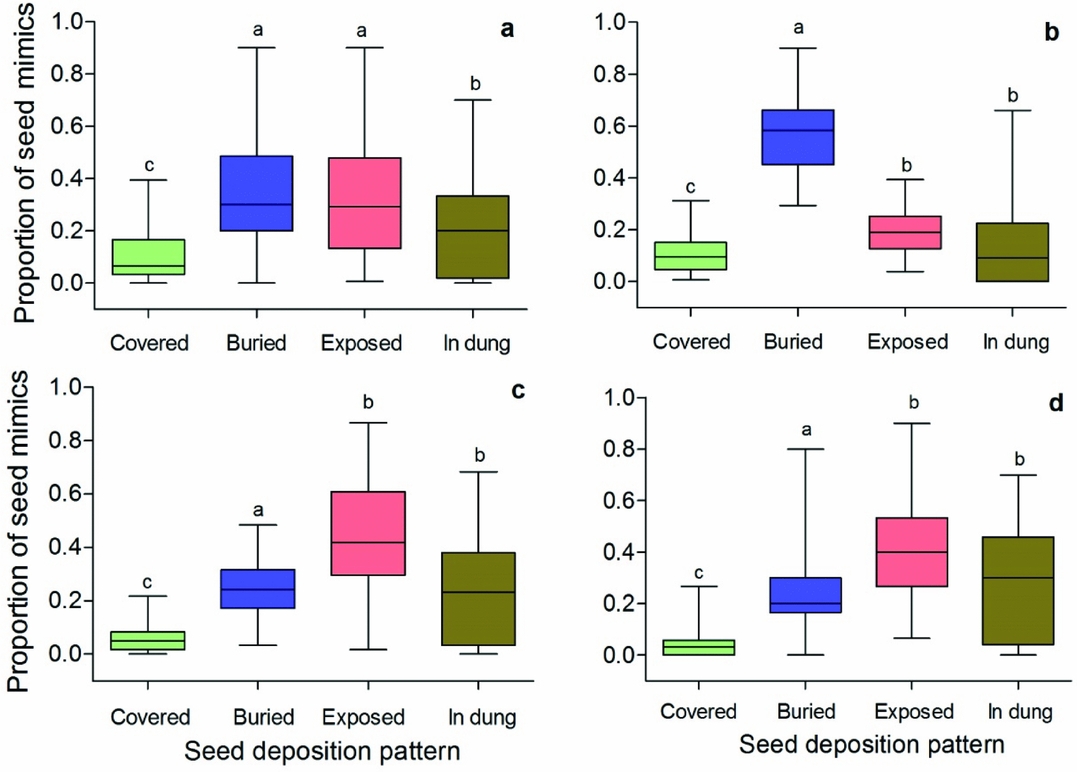
The proportions of seed mimics (all sizes pooled) differed significantly among seed deposition-pattern categories (F = 68.9; df = 3; P < 0.01). After dung beetle activity, most seeds were found buried in beetle tunnels, or exposed on the soil surface, followed by seeds remaining in dung and seeds covered by the soil excavated by beetles (Figure 1a). The interaction between seed size and deposition pattern was also significant (F = 545; df = 6; P < 0.01). Small seeds were more often buried (Figure 1b), while medium and large seeds were most often found on the surface, either exposed or in dung (Figures 1c, d).
Proportion of spherical plastic beads used as seed mimics embedded in dung and found in four different deposition patterns following dung beetle activity in Amazonian rain forest, for three seed sizes pooled (a), and separately for small seed mimics (3.5 mm, b), medium seed mimics (8.6 mm, c) and large seed mimics (15.6 mm, d). Boxes show the median, 25th and 75th percentiles; whiskers indicate minimum and maximum values. Different letters above the bars indicate statistically significant differences according to post hoc Tukey tests.
This is the first study that quantifies four distinct patterns of post-dispersal deposition of defecated seeds, following dung beetle activity. In particular, this is the first study quantifying the proportion of seeds that remain on the surface yet covered by soil that is excavated by beetles. Previous studies have most often focused on comparing only two patterns of seed deposition by beetles: buried seeds vs. seeds on the surface (see Andresen & Feer Reference ANDRESEN, FEER, Forget, Lambert, Hulme and Vander Wall2005 and references therein).
As in previous studies, we also found a negative relationship between seed size and the proportion of seeds buried by dung beetles; small seeds had a probability of approximately 0.6 of being buried in beetle tunnels, while this value was only about 0.2 in the case of medium and large seeds. As mentioned above, burial of small seeds promotes their survival, but it can also affect seedling emergence negatively. The extent of the latter effect depends on burial depth and plant traits (seed size, dormancy, seedling functional morphology; Andresen & Feer Reference ANDRESEN, FEER, Forget, Lambert, Hulme and Vander Wall2005, Andresen & Levey Reference ANDRESEN and LEVEY2004, Griffiths et al. Reference GRIFFITHS, BARDGETT, LOUZADA and BARLOW2016). Although smaller seeds may suffer stronger negative effects when buried by dung beetles compared with larger seeds that might be able to emerge from greater depths (Shepherd & Chapman Reference SHEPHERD and CHAPMAN1998), it is important to remember that small seeds often remain viable in the soil seed bank for longer periods of time, and that the seed bank is not static. In this context, it is relevant to mention that dung beetles affect seed bank dynamics not only by burying seeds (Pouvelle et al. Reference POUVELLE, JOUARD, FEER, TULLY and PONGE2009), but also by moving previously buried seeds to more superficial soil layers, promoting the germination of these seeds and ultimately seedling establishment (Santos-Heredia & Andresen Reference SANTOS-HEREDIA and ANDRESEN2014). This is a line of research that needs further investigation.
Seeds that remain on the surface, but covered by the soil excavated by beetles, may be exposed to low predation risk while maintaining a high probability of seedling emergence. Although few seeds were found in this deposition pattern (14.3%) the probability of seedling establishment might be disproportionately high for these seeds. However, this remains purely speculative at the moment and needs to be tested in the future, as other factors (e.g. rain) may expose seeds covered by loose soil. The long-term fate of seeds that remain embedded in dung also needs to be assessed in future studies. Though generally this deposition pattern is thought to have negative consequences for seed fate due to predator and pathogen attack, it is also possible that the dung itself may protect some seeds from desiccation or predator detection (Ríos & Pacheco Reference RÍOS and PACHECO2006).
Dung beetles perform an important ecological function as secondary dispersal agents of seeds defecated by mammals. Here, we demonstrate that through their activity, dung beetles can change seed deposition patterns in more ways than previously assessed, and that these patterns may greatly vary according to seed size. The three seed sizes we used in our experiment represent the higher end of the seed-size spectrum commonly found in mammal defecations, but do not cover well the lower end of it. Assessing the post-dispersal fate of smaller seeds (<3 mm) under field conditions still remains a challenge. We encourage future studies to continue investigating the interactions that dung beetles have with both defecated seeds and those present in the soil seed bank, and the many possible consequences of these interactions for the long-term fate of seeds and seedlings.
ACKNOWLEDGEMENTS
We thank Gudryan Barônio for assistance with statistical analyses. RFG thanks CAPES for the scholarship granted. RC thanks FAPEMIG for the scholarship granted. DVA thanks CNPq for the scholarship granted. EAS thanks Fapemat and PELD. JL acknowledges the financial support from FAPEMIG and CAPES.