


INTRODUCING KALLOL
In 1921, four young writers established the Four Arts Club (Catuṣkalā for literature, music, the crafts and painting) in Calcutta, to foster artistic modernism. The club was formed in the context of political and intergenerational crises. Gandhi's non-cooperation movement was in full force and thousands of protesting Indians were sent to jail. The following year, Kazi Nazrul Islam, the famed twenty-two-year-old Muslim bidrohi kabi (rebel poet) was arrested for publishing Marxist literature, and he subsequently went on hunger strike. In response, the Four Arts Club proclaimed a “vitalist revolt” (jībanbader bidroha) in Bengali literature and culture.Footnote 1 Buddhadeva Basu, an important literary scholar who joined the club at the age of fifteen, recalled that its journal, Kallol, was identified with “the spirit of youth, with revolt, and even [with] the revolting”. He remarked how startling it was that the “Kallol-clan, then so young and tentative, should have been taken so seriously”.Footnote 2
The Bengali-language literary journal Kallol, whose name meant “musical waves”Footnote 3 , began appearing in 1923 and continued publication until 1929. The journal was edited by two relatively poor and relatively young men: Gokulchandra Nag (born in 1895) and Dineshranjan Das (born in 1888). Gokul, aged twenty-eight, was a recent graduate from the Government Arts College of Calcutta, had published short stories and was completing a novel.Footnote 4 He had a day job at a flower stall in New Market, and worked part-time as a sketcher in the Archaeological Society, and as a set designer and actor in the fledgling Calcutta film industry.Footnote 5 Dineshranjan was a gregarious organizer employed in a sporting goods store.
The group they started was put under surveillance by the Calcutta Criminal Investigation Department in 1924.Footnote 6 Political oppression meant that Kallol had to shift editorial offices three times and print from at least four different presses.Footnote 7 Nevertheless, the journal had an epochal effect on Bengali intellectual life. The establishment of the Comparative Literature Department at Jadavpur University in 1956, as well as the influential 1962 Bengali anthology of world poetry, Sapta Sindhu Daś Diganta (Seven Seas and Ten Horizons) by the eminent young writers Sankha Ghosh and Alokeranjan Dasgupta, derived part of their inspiration from the 1920s modernist experiments of Kallol.
The study of the so-called “Kallol era” is typically framed in terms of literary history alone, and the efforts of young writers to break away from the style of the great master, Rabindarnath Tagore (1861–1941).Footnote 8 Sudipta Kaviraj proposed a new approach to studying the journal by placing it within a broader history of artistic representations of modernity in Bengal.Footnote 9 As Kaviraj has pointed out, Kallol solidified the status of youth (yubak) as chief votaries of cultural production, unleashing an artistic movement keyed to modernism within the frame of world literature (viśva sāhitya).Footnote 10 By “world literature”, this paper refers to literary internationalism, institutionalized by the early twentieth century in such forms as the Nobel Prize and the International PEN.Footnote 11 I follow the path opened up by Kaviraj, and maintain that geopolitical tensions in the international domain and generational divides in the local social order of Calcutta helped account for the literary internationalism of Kallol.Footnote 12 The persistence of geopolitical and generational divides interrupts totalizing narratives of the “globalization of the West”, or the “global life” of capitalism that often inform studies of colonial Indian intellectual history.
Modernism is a slippery term, and tends to be reflexively associated with what Pascale Casanova has called the bourse of originally European literary values.Footnote 13 Marshall Berman characterized modernism as a record, begun by European artists and then passed along to non-Europeans, of the “tragedy of development” wreaked by capitalistic modernity.Footnote 14 In this paper, however, I follow Edward Said's notion of modernism as a form of opposition from within structures of social power that came out of nineteenth- and early twentieth-century resistance movements in both Europe and the colonial world.Footnote 15 I use modernism to refer to artistic experimentation in colonial Bengal that sought to represent the abject aspects, injustices and irrationality of life, but also sought to stimulate political resistance and spiritual renewal.Footnote 16
In Calcutta, beginning in Dineshranjan's small apartment at 10/2 Patuatola Lane, young intellectuals conversed in their adda, or salon, about what they saw as the cultural stagnation of their fathers’ society and the need to rediscover rasa (the feeling of wonder) in Bengali letters through affiliations with literary movements worldwide.Footnote 17 A generation of intellectuals, born between around 1885 and 1905, positioned itself not on a regional or a national stage, but on a global stage in the postwar years in order to pursue the search for value, meaning and social relevance.Footnote 18 The global horizons of Kallol were intrinsic to its modes of artistic creativity, and this essay explores the historical context in which this global imagination developed, as well as the textures of Bengali intellectual life that it produced.
Hans-Georg Gadamer, a major twentieth-century student of Heidegger, developed a powerful philosophy of conversation that provides the compass for this study. The philosophical hermeneutics grounded by Gadamer in Truth and Method (1960) elicited a flurry of critique in its time, both from those who insisted that his approach left questions of power and domination unaddressed and from others who believed that it celebrated tradition over reason.Footnote 19 While a discussion of those debates is beyond the scope of this paper, it is worth mentioning that Gadamer's 1960 insights about the diffuse, environmental quality of power actually resonated strongly with Foucault's later thought.Footnote 20 Yet what makes Gadamer's philosophy of particular interest here is his theory of conversation, and its implications for the study of intellectual history in the context of globalization.Footnote 21 A Gadamerian perspective invites us to explore Kallol along three lines: (1) the horizons and configurations of conversations in which Bengali intellectuals strove to create meaning for life; (2) the modes by which Bengali intellectuals participated in these conversations, what Gadamer calls “phronesis”; and (3) the constraints on intentionality imposed on Bengali modernists by the traditions and milieus of authority in which they lived. Using this approach, I hope to show why, for the study of colonial intellectual history, the global domain is best not conceived as abstract and homogenized, but rather as “lumpy”, in which the lumps are best depicted as congested intersections of power relations and conversation.Footnote 22
COLONIAL EXPERIENCE WITHIN A GLOBAL HORIZON
Postcolonial theorists have tended to study the intellectual life of the colonized in ways that associate “the global” with imperial rule, with Western domination, or with the trope of abstract capitalist logic. The colony, from these perspectives, becomes a site of contestation with and resistance to dominating global forces, or a location in which global logics are interpolated and unwittingly championed by local social groups. These views of the global domain certainly capture features of globalization in the age of imperialism.Footnote 23 But what such approaches, discussed in greater detail below, do not bring onto center stage is how the global horizon opened up fields for new experience, and new experiments in making meaning. Hermeneutic activity, by which I mean interpretive activities that create meaning for human existence, occurred on the margins of the Britain–India imperial axis, and outside the imperial axis, and this activity deserves further consideration.
Edward Said, in his 1978 masterpiece Orientalism, helped establish the field of postcolonial studies by showing “the Orient” to be a formation of European imperialist knowledge/power. His subsequent work, as well as that of a host of eminent contributors over the course of the next thirty years, has sought to study the intellectual history of empire from the bottom up; that is, from the perspective of the colonized and minoritized as they were located within globe-straddling structures of power.Footnote 24
A major contribution to the study of colonial intellectual history from the bottom up came in the collection of Homi Bhabha's essays in Location of Culture (1994), and his theorization of hybridity. Bhabha proposed that colonial subjects, in confronting the colonizer's hegemonic discourse, responded with a “borderline work” that produced “in-between” spaces of “neither the One nor the Other but something else besides”.Footnote 25 The colonizer was also hybridized, unable to maintain the “purity” that his power, and the knowledge it produced, sought to ensure.Footnote 26 The imposition of the imperial order in the Indian colony was met with “sly mimicry”, Bhabha suggested.Footnote 27 Colonial peoples creatively translated the literature and customs of the metropole in such a way that made their difference known, mocking the power structure of colonialism just as it put it to use.
But the assertion that the colonized found themselves on the ambivalent borderland between two domainsFootnote 28—one belonging to the colonial master language, the other to the indigenous vernacular—tends to leave out of view the differentiated intellectual and social interactions that Indians experienced outside the imperial axis. Were interactions between Indians and Asians, Africans, Americans and anti-imperial communities in Britain, as well as groups in continental and eastern Europe, characterized by mimicry and contestation, or perhaps by other dynamics, such as partial recognition, mutual mirroring or even collaboration?
Another means of setting colonial intellectual history within a global horizon was laid out by Dipesh Chakrabarty in Provincializing Europe (2000), inspired by a Marxian concern for the historical causes of the West's universalization, and a Heideggerian interest in the experiential world of the colonized.Footnote 29Provincializing Europe provided one capstone to the Subaltern Studies project, which aimed to wrest the fragments of local and indigenous culture from the West's ever-present “imaginary figure”.Footnote 30 Chakrabarty envisioned two historical streams: History 1, which is the “transition narrative” of development, posited as the path whereby all groups worldwide gradually take their place in the modern capitalist order; and History 2, consisting of the experiences of “belonging” among cultural communities, that “inhere in capital and yet interrupt and punctuate the run of capital's own logic”.Footnote 31 Under History 2, Chakrabarty catalogues the “bodily habits, unselfconscious collective practices, and reflexes about what it means to relate to objects in the world”.Footnote 32 Capitalist circulation and abstract scientific discourses are associated with the global horizon in his interpretation. Local culture becomes the space in which moments of rich meaning can still be salvaged from within the homogenizing global maelstrom.
One drawback to this approach is that the History 2s, or the “histories of belonging”, are conceived, at least in practice, as necessarily rooted in vernacular language, and in local customs and traditions. The Bengali family, the Bengali tradition of poetry, or the fraternity among Calcuttan males that develops in their adda discussions are all presented as sites for hermeneutic activity in Provincializing Europe. But from this perspective we have difficulty accounting for the ways that long-distance, global communities of imagination, discussion and even affection became intrinsic to the lifeworlds of colonial subjects who made long-distance travels, either physically or imaginatively. Within a global horizon, especially given the accelerated expansion of transport and communication technologies from the 1880s onwards, hermeneutic activity increasingly interrupted and crossed the bounds of linguistic community, family, fraternity and fixed traditions.
If Bhabha and Chakravarty respectively see local hermeneutic activity as contestations with, or respites from, the onslaught of global forces, Andrew Sartori presents hermeneutic activity as the local imprint of global concepts of political economy. Sartori, in his impressive Bengal in Global Concept History (2009), argues along Marxist lines that the condition of possibility for hermeneutic activity in nineteenth- and twentieth-century Bengal was determined by capitalist economic relations that operated globally.Footnote 33 Sartori argues that nationalists around the world were proclaiming cultural difference in such resonant ways because of a deeper, unitary economic experience that engulfed their individual societies.Footnote 34
But if hermeneutic activity only consists in modifying unitary globally circulating concepts, then we have difficulty in representing the particularity and complication of conversations that developed between groups of differential political power and dissimilar traditions in the modern period. If the globe is ruled by the nomos of abstract capitalism, then the thought of all groups worldwide can be understood as the handiwork of capitalism's wizardry. But if we study processes of conversation from a high-zoom historical perspective, we emphasize the shifting boundaries and horizons in the global domain that sometimes stopped, and other times facilitated, intellectual interactions. Especially in relation to the study of Indian colonial thought, an appreciation of geopolitics is required in order to account for how Indian hermeneutic activity operated not only within the British imperial axis, but also across and beyond that axis, in lumpy global space.
A host of scholars are adding to postcolonial hermeneutic theory by providing ways to refocus attention onto the subtle agencies of receptivity and interpretation within a global horizon. Leela Gandhi provides an important discussion of “anti-colonial friendships” that formed between Indian and British anticolonial activists.Footnote 35 Harish Trivedi considers the feedback loops of “inter-literary transactions”.Footnote 36 Tim Harper, Dilip Menon, Benjamin Zachariah and Mark Ravinder Frost shed light on translation and borrowing within colonial interregional zones.Footnote 37 Dhruv Raina and Kapil Raj study the spaces of scientific circulation that connected South Asians and Europeans.Footnote 38 Sudipta Kaviraj stresses the “detailed graded structure” of intellectual fields, and Frederick Cooper discusses “intertwining histories” that create disharmonies and “lumpiness”.Footnote 39 An engagement with Gadamer's philosophy of hermeneutics contributes to these approaches. We can disaggregate “the global” by considering Gadamerian insights into events of mediation (mediale Vorgänge), and the between-worlds (Zwischenwelten) created by conversation.
ALIENATION OF THE BHADRALOK YOUTH
Three contexts of Indian political life—the international, the national and the local—all underwent drastic changes beginning in the 1880s. The Kallol journal became the mouthpiece for the generation of Bengalis who were born at the end of the nineteenth century, and saw the world drastically change before their eyes. The Bengali bhadralok, or “genteel society”, at the turn of the twentieth century was largely composed of Hindus from the higher castes. This status community, which distinguished itself through devotion to education and by serving as the literate proletariat of the British colonial bureaucracy, set cultural norms for the colonial metropolis of Calcutta and for the Bengal region more generally, but never became a structurally dominant bourgeoisie.Footnote 40 All the writers and editors of the Kallol journal came from bhadralok families.
The generation of Bengali bhadralok born at the end of the nineteenth century came of age in an era of multipolar globalization. This resulted from the quick rise of new world powers, and their expanding and overlapping communication and travel technologies, especially shipping, printing, telegraphs and finance.Footnote 41 These technologies, used for imperial expansion, could also be utilized against their own grain by itinerant anticolonial activists.Footnote 42 In this era, Germany, Japan and the United States began to interfere in the Asian economic paramountcy of Britain and Russia.Footnote 43 In terms of imperial competition, a “scramble for Africa” in the 1880s was followed by a “scramble for Asia” in the 1890s.Footnote 44 One German contemporary observer spoke of the “great partitioning of the world” that was taking place.Footnote 45
On the national level, the end of the nineteenth century saw the institutionalizing of Indian nationalism in the form of the Indian National Congress, founded in 1885 and led by many Bengali bhadralok politicians in its early years.Footnote 46 Indian anticolonialism, although still operating through “prayers and petitions” to the colonial state, had become a unified force in colonial politics for the first time, establishing a platform to connect politicians from diverse regions of British India. The generation of Bengali bhadralok youth born between around 1885 and 1905 thus grew up in the wake of the founding of a new all-India infrastructure for political activism. Their fathers’ generation was peopled by “great men”, individuals renowned for establishing the rudiments for anticolonial nationalism, and for announcing India's national prowess in the fields of art, science and literature.Footnote 47
At the turn of the twentieth century, the bhadralok youth in Calcutta, growing up in the shadow of their fathers’ generation, were also experiencing unprecedented social and political obstacles to their own advancement. Jobs for the educated classes were being squeezed out of the district towns throughout Bengal and funneled into Calcutta as the expanding imperial global economy riveted the countryside ever more directly to the industries and trading activity of the colonial metropolis.Footnote 48 The period from 1880 through 1930 was a great era of urbanization.Footnote 49 Calcutta and Bombay were the two main beneficiaries of this urbanization boom, serving as hubs for the subcontinent's global industries, such as cotton and jute manufacture, and as the centers for finance, shipping and legal institutions.Footnote 50 Yet while the trading and industrial developments that expanded in Calcutta during this period benefited some merchant groups, especially British and American businessmen, but also Marwari and Parsi trading communities, they did not greatly enhance the prospects of the Bengali bhadralok youth. As the number of young educated migrants to Calcutta bulged at the turn of the century, the availability of administrative employment was becoming increasingly scarce.Footnote 51
Added to this, the colonial administration was beginning a concerted effort to diminish the social standing of the mostly Hindu bhadralok.Footnote 52 Beginning in 1904 with the Universities Act, the colonial administration under Viceroy Curzon tried to reduce the position of the bhadralok in the educational institutions of Calcutta, as it also centralized control of the universities in Bombay, Madras, Allahabad and Lahore.Footnote 53 Curzon also announced plans to create a vying educational center and administrative hub for the Muslims of eastern Bengal in Dacca.Footnote 54 Bengal was partitioned in 1905, frustrating the bhadralok's efforts to remain the cultural and political spokespeople for the whole Bengal region.Footnote 55
The Swadeshi Movement, the largest revolutionary movement in India since the 1857 revolt, began in multiple regions of India in 1905, but Bengal was the most active center of insurgency. The impoverished bhadralok youth led the warfare against colonial meddling. While the broader Bengali society boycotted British manufactures especially in the first years of the movement, from 1905 to 1908, the number of Calcuttan youth who joined radical antigovernment societies continued to increase, year by year, until 1915.Footnote 56 From 1905 onwards, colonial administrators repeatedly remarked in their reports that “corrupted youths” were the cause of “revolutionary outrages”, including the bombing of buildings, armory raids and even assassinations of colonial officers.Footnote 57 Between 1915 and 1917 alone, over 1,200 young Bengalis from across the whole province served time in prison as detainees.Footnote 58 Indeed, the editor of Kallol, Gokulchandra Nag, wrote his novel Pathik (The Wayfarer, 1923) about the lives of young men facing prison terms during the Swadeshi years. Because of this youth insurgency, the British rescinded partition in 1911. In 1911, the colonial administration moved its power center from Calcutta to Delhi. The British administration made it clear to the young radicalized bhadralok that even if they regained a unified Bengal, the security and stature their parents had enjoyed would not be their own.
INTERNATIONALIZING COLONIAL THOUGHT
Perhaps it is no surprise, then, that members of this alienated cohort, poorly integrated into the Calcutta social order, saw the conflicting spheres of influence among imperial powers in the lead-up to the Great War as a sign of promise. Kallol became the literary register of this generation's global imagination.Footnote 59 The journal broke with an earlier mode of representing Bengal in the world, epitomized in Bankimchandra Chattapadhyay's Bangadarśan journal, which began in 1872. With Bangadarśan, Bankim (1838–94) looked out at the world through the lens of the British Empire. Bankim himself was a product of Anglicist education.Footnote 60 He deeply admired James Mill, as well as Victorian translations and interpretations of Auguste Comte.Footnote 61 As shown by Tapan Raychaudhuri, Bankim's project was suffused with a sense of cultural inadequacy vis-à-vis Britain.Footnote 62 “Today some claim that education will ‘filter down’”, Bankim wrote, “but we don't have enough time to wait for this watery bridge to be built”.Footnote 63 The aim of his journal was jāti-pratiṣṭhā (cultivating national feeling) for the new Hindu nation. He hailed the contemporaneous Italians and Germans as two peoples who had recently united themselves as modern polities. The Hindus across Bengal would soon do the same, Bankim believed. “When the nation-sense is intact, a people grows in importance. This knowledge has led the Italians to create a unified state [rājya]. And with this same awareness, a new mighty German nation has arisen”.Footnote 64 Bankim's vision aimed at internal national unification, as with the kleindeutsch solution, but not at the external transgression of the imperial axis.
There was a major break, often overlooked, between the global horizons of Bankim's Bangadarśan of the 1870s that framed Hindu nationalism within the India–Britain imperial axis, and a different kind of global imagination that characterized the alienated youth generation of the 1920s, articulated in the terms of an explosive, extra-imperial, global youth movement.
Kallol confidently proclaimed itself a journal started by “a few youth” (koyjan yubak). And as opposed to a focus on the Hindu nation, Kallol asserted a stridently cosmopolitan ethos. One of the editors, Dineshranjan Das, wrote in 1925 that he wanted the magazine to be a “caravanserai . . . where people [mānuṣ] will be able to rest their weary souls without regard to community, age, sex and social position”.Footnote 65 Indeed, Kallol gave attention to the international feminist movement, the Muslim Khilafat movement and Marxist internationalism in its pages. Although mainly a product of the male Hindu bhadralok, a few renowned young Bengali Muslims contributed essays, and the journal showed a surprising commitment to publishing the critical writings, short stories and poems of women.Footnote 66 The poem that christened the inaugural issue of the journal, written collectively by the editorial staff, began, “I am the wave, rudderless, tumultuous, chasing sleep away”.Footnote 67 For Bankim, the “Hindu people” was the main category used to make connection within the global realm. But for the Kallol editors, on the other hand, the main categories for bridging global connections were not bounded concepts such as “culture” and “nation”, but unbounded ones, such as youth and experimentation.
The rather constrained global horizon in Bankim's writings, focused mostly on the Britain–India relationship, by the 1920s had given way to a more robust international perspective, that confidently transgressed the imperial axis. Pramatha Chaudhuri, an eminent writer and barrister, began publishing his modernist journal, Sabuj Patra (Green Leaves), in 1914, which provided a model for Kallol later on.Footnote 68 Chaudhuri wrote that the years leading up to the First World War generated “restless and scattered sensibilities” in Bengal, and that only the youth could “concentrate and organize reflection on present conditions”.Footnote 69 And in that same year, the famed Swadeshi revolutionary poet Satyendranath Datta (b. 1882) penned his poem Yaubane dao Rajṭikā (Anoint the Youth).Footnote 70 “Satyendranath was the poet of this new age. Bengal's new poets will redirect the sensibilities of our people”,Footnote 71 wrote a critic in Kallol. Kallol identified itself with an unorthodox band of writers, especially Satyendranath Datta and Saratchandra Chattopadhyay (b. 1876), instead of with the cultural fountainheads of their elders’ generation, epitomized by Bankimchandra.Footnote 72 By the 1920s, figures such as Bankim came to be seen as representatives of intellectual mandarinism among the rising young literati.
THE YOUTH REVOLT IN LITERATURE
In orchestrating this shift in Bengali thought from an imperial imagination to an international imagination, the alienated generation born between around 1885 and 1905 found a pathway out from under their parents’ shadow, as well as an avenue for radical intellectual revolt against the British Raj. At the turn of the twentieth century, a middle-aged ascendancy had come to rule Bengali thought and letters. In the years leading up to the Swadeshi Movement, the most important Bengali thinkers performed their stature not by identifying with the young, but by writing as avuncular counselors to the youth. Vivekananda (b. 1863) wrote his letters to the santān (to the young men).Footnote 73 Rabindranath Tagore (b. 1861), J. C. Bose (b. 1858), Ashutosh Mukherjee (b. 1864), Brajendranath Seal (b. 1864), Bipinchandra Pal (b. 1858) and Aurobindo Ghosh (b. 1872), among many others, published tracts to rouse the youth, and to promote their “national education”.Footnote 74 This generational configuration contrasted with the period in the 1830s, during the Young Bengal movement, when the most-discussed writers and artists were recent college graduates.Footnote 75 It was different, too, from the 1860s, when the likes of Bankimchandra and Bhudev Mukhopadhyay reached the pinnacle of cultural life while in their thirties.Footnote 76
Already by the 1910s, and especially from the 1920s onwards, however, the magnetic center for new ideas and cultural production in Calcutta came to be situated among the young. The Swadeshi insurgency that began in 1905 brought a phalanx of young people to the forefront of Bengali politics, thought and letters, proclaiming a new internationalist creed. For example, the precocious Benoykumar Sarkar (b. 1887) became professor of literature and history at the newly established Bengal National College at age twenty, and published a series of essays starting in 1910, which summoned his fellow youth to tap into what he called “world forces” (viśva śakti).Footnote 77
Of course, this transition from an imperial to an internationalist scope for Bengali intellectual life was already taking place by the end of the nineteenth century. Aurobindo Ghosh's New Lamps for Old (1893), which praised French modes of politics over British styles, provided an early expression of this new political internationalism. Ramananda Chatterjee (b. 1865), editor of two of the most widely circulated monthly journals, Prabasi (founded in 1901) and the Modern Review (founded in 1907), robustly turned attention away from imperial relations and towards international relations.Footnote 78 While Bankim's journal oriented itself towards bilāt (which can mean both “England” and “the West” more generally), Ramananda Chatterjee framed his publication in terms of bideś (the overseas or foreign realm).Footnote 79 Rabindranath Tagore officially established the Viśva Bhārati Āntarjātik Viśva-Vidyāloy (Visva Bharati International University) at Santiniketan in 1921. Tagore made eight international voyages outside the imperial geopolitical framework between the beginning of World War I and the high tide of the Great Depression in 1931. Chatterjee joined Tagore for a six-month international journey to continental Europe in 1926.Footnote 80 The internationalization of Indian colonial thought was hardly an exclusive Bengali bhadralok phenomenon. In 1916, the influential Punjabi intellectual Lala Lajpat Rai, writing from New York, remarked that “Indian nationalists [are] ardent students of France, Germany, Italy, Russia, Austria . . . Turkey and the Balkan States” and excoriated the “taboo” of European history in Indian universities.Footnote 81
The Kallol literary journal, begun in 1923, radicalized this enthusiasm for bideś as a realm for artistic experimentation and interpersonal recognition outside the imperial frame. While the poor, young editors of Kallol could not travel by ship or automobile to distant climes, their letter correspondences and imaginations still roamed the planetary republic of letters, and they also eagerly awaited reports sent from their friends and relatives abroad.
Easily overshadowed by the international travels of middle-aged Bengali eminences such as Rabindranath Tagor, Brajendranath Seal and J. C. Bose in the early twentieth century, is the peripatetic activity of the alienated bhadralok generation. Benoykumar Sarkar (b. 1887) spent twelve years traveling through Japan, America, France, Germany and Egypt between 1914 and 1926. Through the letters and books he sent back home, Calcutta youth gained access to modernist literature and thought beyond the syllabi of British colonial universities. Other such international envoys included Nandalal Bose (b. 1882), who traveled to China and Japan to perfect his ink-wash painting techniques in 1924; the philosopher Manabendranath Roy (b. 1887), who engaged deeply with German and Russian Marxist thought during his decade living in Berlin and Moscow in the 1920s; Shahid Suhrawardy (b. 1892), a theater director in post-Revolutionary Moscow; Dilip Kumar Roy (b. 1897), a musician and composer widely traveled through continental Europe; Himanshu Rai (b. 1892), an actor and movie director with links to the Munich and Berlin film industries, and the founder of the Bombay Talkies production studios; Meghnad Saha (b. 1893) and Satyendranath Bose (b. 1894), young physicists who worked with Albert Einstein and Walther Nernst in Berlin; and Taraknath Das (b. 1884), a political scientist who obtained his 1925 doctorate from Georgetown University and traveled regularly between the USA and Germany.
Perhaps most significant for the present discussion, a young Bengali indologist named Kalidas Nag (b. 1891) was the elder brother of one of the editors of Kallol. Kalidas was completing his dissertation in Paris under the supervision of Sylvain Lévi. During this time, he put Gokul and Dineshranjan, the editors of Kallol, into direct contact with the celebrated author and 1915 Nobel laureate in Literature, Romain Rolland. Kalidas translated portions of Rolland's famous experimental novel Jean Christophe directly from French into Bengali and sent them to Calcutta, where they were serialized in the pages of Kallol.Footnote 82 One of the editors of Kallol reflected in 1926 on the role of “Bengalis living outside Bengal” in assisting the development of Bengali literature (sāhityer unnati).Footnote 83
In addition to the network of Bengalis abroad who helped facilitate contacts beyond the imperial axis, the growing book trade in Calcutta created a new scope for the international imagination.Footnote 84 Bookshops across the street from Presidency College began enthusiastically importing English translations of world literature in the 1910s and 1920s.Footnote 85 In addition to this, as Suzanne Marchand has shown, a new kind of “furious” orientalism was channeling the travel of countercultural and avant-garde Europeans to Calcutta in these same years.Footnote 86 Among the writers, indologists, literary scholars and art historians from beyond the imperial axis who traveled to Calcutta and to Tagore's “international university” (āntarjātik viśva-vidyāloy) in Shantiniketan were Sylvain Lévi (1921), Stella Kramrisch (1921–50) and Moritz Winternitz (1922) from Austria, Vincenc Lesný from Czechoslovakia (1925), Leonid Bogdanov from Russia (1922), Schlomit Friede Flaum originally from Lithuania (1922), Sten Konow from Norway (1924), and Carlo Formichi (1925) and Giuseppe Tucci from Italy (1926).Footnote 87 All these figures from beyond the imperial axis taught at Tagore's university in Shantiniketan and spent time in Calcutta in the years of the founding of Kallol.
The world abroad, or bideś, was not a domain situated “out there”, beyond the horizon of local culture. Rather, bideś was an inherent dimension for conversation set within Bengali modernist modes of artistic creation. For example, among Kallol writers, Romain Rolland was not only an early European devotee of Vivekananda, a winner of the Nobel Prize in Literature and a European admirer of Gandhi and Tagore. For Acintyakumar Sengupta (b. 1903), Romain Rolland became a muse who inspired Bengali poetic experimentation:
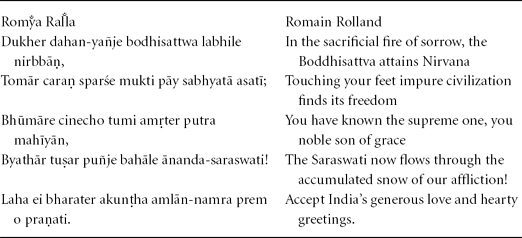
Such a poem was not written merely in the mode of a panegyric to a European artist, nor as a didactic instrument for expounding on the significance of Rolland's art to a Bengali audience. “Romain Rolland” became an instance for experimentation in Bengali verse, and a means to meditate on the thawing effects of literary internationalism on political oppression in India. The world was not a distant geographic realm, but an inherent experiential horizon for Bengali literary modernism.
GLOBAL CONVERSATIONS
A Gadamerian perspective does not picture the third space, or between-world, of encounter in colonial intellectual life as one of contestation or “sly mimicry”, which assumes the divide between colonial vernacular agency and Western knowledge. Instead, third space is a realm of conversation within the context of authority in which antifoundational, perspectival truths arise—ideas that are true for the historical actors in question.Footnote 88 How, then, were the conversations in Kallol configured, and what kinds of conversational play do we observe? What kinds of authoritative language and what genres of literary production were employed, and who were the conversational partners involved?
The study of conversation pushes us to pay attention to modes and genres of expression. Kallol editors, having once published a literary discussion (samālocanā) of a foreign artist, or a Bengali translation of his or her work, endeavoured to make direct contact with the author through letter correspondence. English almost always served as the language of correspondence between the Kallol group and their French, Japanese, Norwegian or Spanish contacts. In this way, Indian relations to the world pivoted on the British imperial axis, but were not locked within it. Kallol writers and editors spoke a fused conceptual language, using some technical terms translated from English words, such as bāstababād (realism), viśwa sāhitya (world literature) and adhunikatā (modernism), but other keywords had much longer local histories and were almost untranslatable into English, such as rasa (the feeling of wonderment) and śakti (creative force).Footnote 89 But even apart from the technical language of literary modernism, it was common everyday Bengali words that the alienated generation employed to brand their project. These were words such as taruṇ (young), yubak (youth) and naba naba yug (the new era).Footnote 90 But it is less the derivation of technical vocabularies and more the uses to which language was put that informs the study of hermeneutics.
In addition to intense contact with Romain Rolland, evidenced by the exchange of at least twenty letters,Footnote 91Kallol editors also wrote directly to Johan Bojer and Knut Hamsun of Norway, Jacinto Benevente of Spain, Yone Noguchi of Japan, Leonid Andreyev of Russia and Marcel Prévost of France.Footnote 92 Often the response they received in return was brief—a signal of greeting and recognition sent across the international field of world literature. Jacinto Benavente sent a “thank you with all my heart”, and Johan Bojer sent his “fraternal compliments” in return. Knut Hamsun sent a “thanks for the friendly letter” and Yone Noguchi sent not only thanks but also a dedicated poem and a picture.Footnote 93 When there was more extensive interaction, it focused on questions of modernist aesthetics. With Romain Rolland, they discussed “word music” as a way of combining prose and poetry, as well as the philosophical teachings of Tagore and Gandhi. They also discussed the idea of “semi-realism”, as the pursuit of a critical perspective in art that still affirmed “god in man”.Footnote 94
But more often Kallol writers had conversations with modernist writers abroad through engagement with their written work. Over six years, there were essays and translations devoted to at least thirty-one foreign modernist artists, most from the small or defeated nations of postwar Europe, or from Russia and Japan. Only three were British and only five were Nobel laureates.Footnote 95 This selection contrasted starkly with the literary canon of British colonial education, which focused on Shakespeare, Milton, Tennyson, Shelley and Shaw at the college level.Footnote 96 Of the 636 novels in the Presidency College library in 1909, only seventeen were by non-British authors, and none of those works were modern, but from the Italian, French and German classics.Footnote 97Kallol's exploration of the literary world outside empire, even if it pivoted on English translations, must be understood as a politically charged endeavor.
The “world” was not synonymous with Europe, nor was Europe envisioned as a single homogeneous entity among Kallol modernists in the postwar years. “World literature” in Kallol was intended to delimit zones for artistic and political life that opposed literary forms of classic English literature and impugned the moral claims of the British imperial order. For example, an article about Jacinto Benavente from a 1926 issue of Kallol presented him as a renovator of the Spanish dramatic tradition because of his “turn to the East” and his criticism of Western imperialism.Footnote 98 Norway's Knut Hamsun and Johan Bojer were hailed for “returning a sense of direction to life and awakening their people” through their unflinching depiction of social injustice.Footnote 99 Leonid Andreyev and Maxim Gorky of Russia were singled out for channeling “creative force [śakti] and inspiration”.Footnote 100 They were hailed for transforming stories of human suffering into heroic tales of liberation.Footnote 101 In an article entitled “Russia and Young Bengal”, the critic asserted that “Russians have invented a national literary tradition in less than a hundred years . . . from which Bengalis take inspiration”.Footnote 102 In 1925, Dineshranjan Das declared solidarity with Romain Rolland's pacifism, and praised his ability to visualize a “dream India” (swapna-Bhārat), free from colonial oppression, that reflected the “eternal India” alive in Rabindranath Tagore's writing.Footnote 103 An essay about Yone Noguchi, the Japanese poet, praised the minimalism of his haikus in communicating “beauty, rasa, sounds, smell and touch”, and hailed the poet as a voice of ethical reflection for his people.Footnote 104 Other youthful renewers of national culture and ethical thought around the world highlighted in Kallol included Walt Whitman (USA), Vadislav Reymont (Poland), Koloman Mikszath (Hungary) and Selma Lagerlöf (Sweden).Footnote 105 Many of these figures were praised for their interest in Eastern spirituality, which was said to deepen their “inward journey” into social protest and artistic experimentation. Kallol writers seemed to envision themselves as involved in an important conversation about artistic form, political action and ethical reflection with authors living abroad whom they had only met through literature.
PHRONESIS
Conversations took place in Kallol through various modes of critical literary reception. In particular, Kallol authors organized their intellectual labor into the following modes: samālocana (literary criticism), anubād (translation), ālocana (discussion), sṛṣṭir ullās (the publication of new fiction), and ḍākghar (correspondence).
In Gadamer's discussion, phronesis—or the skill of application—is not a variety of instrumental or scientific knowledge that can be learned and mastered technically, such as the skills needed for building or for scientific study. Phronesis develops out of common sense (sensus communis or Vernünftigkeit), the awareness of “the good” that is available to us without the need for moral reflection.Footnote 106 Individuals adopt dispositions while in conversation. The quality of this disposition, whether it is relatively more or relatively less open to a particular conversation, determines the adeptness of the phronemos—the practitioner of phronesis.
We might say that the youthful, rebellious literary production of Kallol was the work of a masterful crew of phronemoi. A disposition of openness towards the conversation game in which one is involved, a willingness to receive and engage with the multiple claims at hand, and to create new truth for oneself from those conversations, leads to the fuller expression of phronesis.Footnote 107 The different modes of reception in Kallol characterize dispositions of reception to the world beyond empire.
Samālocana, or literary criticism, was a particular mode of phronesis displayed in Kallol, and there was significant critical reflection in the magazine on just how the art of literary criticism could be developed by the youth of Bengal. “Kallol has often argued that Bengali notions of criticism are confused”, wrote one editor. While older journals had traditionally “simply approved or rubbished literature”, Kallol was seeking a discipline of criticism.Footnote 108 Such a discipline would require objectivity and broad knowledge, since “this Bengal of ours is now bathing in the waters of the world”.Footnote 109
Literary criticism in Kallol tended to challenge the values or codes of British imperial culture. For example, in discussing the rhyme of the Bengali poet Sukumar Ray, famous for his wordplay, a critic noted that
in English, “nonsense rhymes” are sayings used to lull children to sleep or sayings that children enjoy reciting . But apart from this, they have no other value . . . “Jack and Jill, went up the hill”, etc. But the effect of Ābol Tābol [by Sukumar Ray] has nothing to do with this. If this is nonsense, then it is the most exquisite kind.
Sukumar Ray is said to exploit the flexibility of the Bengali language in unprecedented ways. His unusual poetic style is even likened to the “new talent” of Countee Cullen, an experimental black American poet.Footnote 110 The critic continued that just as Maxim Gorky was interested in the absurdity of everyday life, and just as Charlie Chaplin exaggerated human experience through humor in order to reveal something true at its core, Sukumar Ray also raised Bengali everyday experience to the level of the extraordinary.
Along similar lines, another literary critic in Kallol argued that the Spanish author Jacinto Benavente was “misunderstood” by British reviewers. While a British critic reportedly wrote that “it is difficult to understand Benavente's idea in writing his play [The Fire Dragon]”, the Bengali critic launched into a sustained appreciation of Benavente's drama, especially because of its critique of pompous notions of Western civilization. Benavente mocked Europe's diplomacy of “Protectorates, War-Indemnity, Civilization and Progress” in the context of the first Agadir crisis of 1911. Benavente's critique of the West, said the Kallol critic, was reminiscent of Rabindranath Tagore.Footnote 111
Apart from the work of evaluation and critique, Kallol also established itself as a vessel for the translation (anubād) of modernist world literature into Bengali. “Bengali translation is active. It brings out something new in the original”.Footnote 112 The development of a library of world literature in Bengali translation would eventually allow for a more direct bridge to the outside world, displacing the need for English as the pivot. The cultivation of Bengali in the 1920s was certainly not aimed at carving out a space of inwardness from the onslaught of globalizing forces. For the young alienated generation, Bengali was not just to remain a vernacular, but was to become a new universal language for trade with the world. That Bengali should be a universal language did not entail the foolhardy wish that it should be spoken everywhere, but rather the much more practical desire that it should be a medium to understand and represent the world. The Calcutta translation industry was at its peak in the 1920s, and it was in this period that the insistence on faithful translations, as opposed to adaptations, first came into vogue.Footnote 113 Calcutta publishing houses turned out translations of Goethe's collected works, Friedrich List's economics, Omar Khayyam's poetry, Romain Rolland's prose, Booker T. Washington's social thought and Albert Einstein's scientific papers.Footnote 114
The criteria for selecting literature to be translated had as much to do with political considerations as it did with the admiration of any specific set of literary aesthetics or philosophical claims. Indeed, the chosen works spanned centuries, from Omar Khayyam and Kabir to Walt Whitman, and spotlighted the heroic Romanticism of Romain Rolland alongside the heroic realism of Gorky.Footnote 115 “Literary modernism” for the Kallol writers provided the means to peer outward onto the world and find their own image obscurely reflected back.
The phronesis of translation, the way it was applied in Kallol, had a different end than contesting a hegemonic “Western” discourse. Nor can it be understood only as the local articulation of a universal set of concepts about literary value. The transnational association envisioned by Kallol intellectuals was not unbounded or abstract, but framed by the idea of an alternative world order of “young nations” to which Bengal belonged. Almost without exception, the examples of national youthfulness were drawn from outside the British context. And it is also clear that many of the nations highlighted were themselves rising, or else recently defunct, imperial powers, such as America, Japan, France, Soviet Russia and Germany. In other words, the cosmopolitanism of the Kallol group, and of Bengali modernism more generally, did not float above the geopolitical power regime. Rather, it worked through the multipolar global order that existed in the postwar years. This new kind of internationalism in the 1920s is also reflected in the two most widely circulating Bengali review journals, Prabasi and the Modern Review, each of which standardly carried about 20 percent international non-British journalistic content in the postwar years.Footnote 116 Bengali young intellectuals of the 1920s envisioned their own community of nations less as a series of closed cultural or political entities (as with Bankim's discussion of the Hindu nation) fitting within an established world order, and more as a realm of association among young, self-strengthening, experimental national groups that would re-create the world order.
In addition to publishing translations from the repertoire of modernist world literature, Kallol cultivated yet another mode of phronesis, namely the publication of experimental prose and poems by young Bengali authors. The writers featured in Kallol were phronemoi who exemplified openness towards new conversations about aesthetics and value. In addition, these artists demonstrated a willingness to rebel in literature, and to transgress the presumed divides between genres and between cultures.
One remarkable practitioner of phronesis in poetry was Mohitlal Mazumdar (b. 1888), a young Bengali Hindu artist, and professor of Urdu and Persian literatures. He began teaching at the newly established Dhaka University in 1921 and translated sections of the Rubaiyat and other Persian poems for the Muslim modernist journal Bulbul. Mazumdar's famous poem “Pāntha” (The Traveller), first published in a 1925 issue of Kallol, demonstrated his great acumen for phronesis. The poem was dedicated to the “philosopher-sage” Arthur Schopenhauer, one of the most celebrated philosophers in Bengal since the nineteenth century. As a prime example of the connection between phronesis, conversation and circulation, this same poem, first published in 1925, was reproduced in English translation, alongside philosophical essays by Michael Landmann, Otto Pöggeler and others, in a 1960 special issue of the Zeitschrift für philosophische Forschung to commemorate the hundredth anniversary of Schopenhauer's death. I have reproduced a portion of the translation made by Charu Chowdhuri, which German philosophers would have encountered in September 1960:
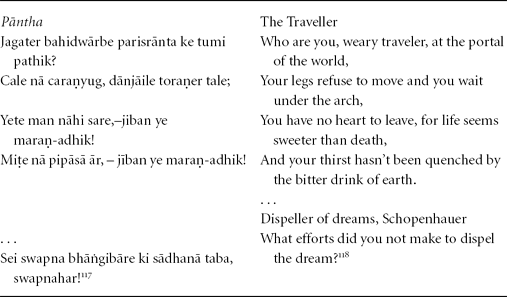
This poem comprises a poetic commentary on Schopenhauer's thought, but also contains a Bengali wordplay that transforms the lyrical treatise into something experimental and new. Questioning the imagined Schopenhauer about his pessimistic philosophy and his attempts at renouncing the illusion of the world, Mazumdar called Schopenhauer the “stealer of dreams” (swapna har), which, in Bengali, functions as a calque, or a sound translation, of the German name “Schopenhauer”. Mazumdar's ability to transfigure, not just translate, a German proper name, as well as the philosophy associated with it, into a Bengali calque, “swapna har” (stealer or dispeller of dreams), which comments on Schopenhauer's pessimistic thought, showed the inventiveness of phronesis at work. There was no conflict or contortion involved in being both deeply ensconced in Bengali literary traditions and simultaneously thoroughly experimental and open to foreign influences—in fact a global horizon was necessary for Mazumdar's poetic inventiveness. The binaristic divide between a global realm marked by capitalist logic and a domestic space rooted in culture and local traditions, as informs the approaches of Chakrabarty and Sartori in different ways, effectively misreads acts of phronesis as acts of interrupting (Chakrabarty), or being overcome by (Sartori), global homogenizing forces. In fact, the hermeneutic labor at issue here utilized the lumpy global domain to announce a generation's distinction from the values of its fathers, and also from British imperial habits of mind, especially as anticolonial Indians experienced unprecedented oppression in the postwar years.Footnote 119
Mohitlal Mazumdar, a Bengali Hindu, played across the hardening Hindu–Muslim line in the 1920s as he applied the ghazal form—a style of poetry traditionally written in Urdu or Persian—to Bengali with dazzling effect. Mazumdar used a Bengali vocabulary enriched with Urdu and Persian words, and captured the cadences of the Urdu ghazal in such poems as Dildar (Lover):

Highlighting the flexibility of the Bengali language, and pointing out that the Sanskritized Bengali of the elders’ generation—that used by Bankimchandra—could be countered with a Persianized literary Bengali, was both an aesthetic and a political statement. Rhythms and wordplay such as in “Kende jhare jhar jhar” and “Suggule masgul” represented a willingness to abandon British models of scansion altogether, and to celebrate aesthetic difference from English, as opposed to aesthetic proximity. The poem used quintessentially Persianate images, such as the cup of wine as a symbol of romantic escape.Footnote 120 Mazumdar was close friends with the Muslim “rebel poet” Kazi Nazul Islam, master of the ghazal form in modern Bengali.Footnote 121 Mazumdar published a large set of Bengali experimental poems in ghazal form in the early 1920s, such as Hafizer Anusaraṇe (After Hafiz), Irani and Beduin, whose very titles exploded the notion that Bengali Hindus should only cultivate Sanskritic themes in their art.Footnote 122
The experimental ethos was so strong in this postwar internationalist period due to both political and generational crises. Experimentation, as a generation's pathway to social relevance, is also observed when it comes to women's writings in Kallol. In a time in which still few women published written work, and when those female authors who reached the reading public were expected to deal with wholesome “feminine” topics, Kallol stridently gave voice to the “new women” of Bengal and their view on men and romantic love. Nrisinghadasi Debi's “Byathār Tṛpti” (The Pleasure of Pain) was a tale of domestic pathos unusually focused on the emotional life of men in the joint family. She narrates the suffering of a man as he experiences the death of his wife and only son.Footnote 123 Suniti Debi's protagonist in “Pon-Bhanga” (Broken Oath) is a woman who discovers that the man she has fallen in love with is not a “war hero” (yuddha phirat) as she had imagined. She decides to marry him anyway.Footnote 124 Other women whose work Kallol published included Indulekha Debi (“Chabi”, 1923), Santa Debi (“Rabindranath Choṭagalpa”, 1924), Indusobha Debi (“Śilper Swarup”, 1925), and Sarojini Naidu.
Another mode of reception in Kallol was the discussion article (ālocana). These articles were used to survey a field of artistic production and identify the main features of new aethestics. An article from 1926 focused on the features of contemporary Bengali theater, for example, and praised the move away from British drama and the proscenium stage, and the return to folk traditions. In Bengal, one sees “the tired culture of theater, too affected by the British influences and by the proscenium”, the author noted.Footnote 125 Another discussion dealt with the prose of Saratchandra and his presentation of the “limits, conflicts and baseness [nicatā] of human nature”,Footnote 126 out of which his characters strive for the “joy of a greater humanity. Saratchandra is not a “realist [bastutāntrik]”, but a semi-realist “who has the ability to make meaning out of human experience”, commented the Kallol writer.Footnote 127
And a final mode of phronesis in Kallol is encapsulated in the ḍākghar, or the editorial page, which provided a space in the journal for the editors to reflect directly on the progress of their enterprise. As opposed to a “letters-to-the-editor” page, this was more of a “letter-from-the-editor” section. The editors repeatedly reiterated the founding principle of the journal “to bring a new kind of thinking to Bengal in the pursuit of the uplift of the Bengali people”.Footnote 128 Dineshranjan wrote in one reflection, “Kallol, this small monthly, has had a quick and profound reception in our country. It has quickened the language and sentiments of Bengal”. The journal was successful to the extent that it was sending out “waves of inspiration and new kinds of sentiment” to its audience.Footnote 129 Reflecting critically on their work in 1927, the editors wrote,
we have made a number of mistakes over the years. This is not unknown to us. We published some unsatisfactory works by young writers . . . Their way of thinking might have sometimes been confused, in some places it may have been lethargic [mlān]. Their style of writing may have sometimes been inexpert, but we had to give them a chance . . . In fact, their writings are the reflection of the many troubles affecting their minds.Footnote 130
There was, then, painstaking labor put into the format in which specimens of world literature were received, interpreted, written, critiqued, translated, discussed and commented upon in Kallol. The aim of this section has been to investigate the modes and practices by which knowledge was produced, and to make clear what the study of phronesis entails. Those colonial intellectuals who participated in conversation games of global breadth and opened themselves to foreign influences were particularly gifted phronemoi. Their intellectual labor can be understood in a way that seeks to describe the modes of reception and interpretation within a differentiated global horizon.
TRADITIONS ON THE MOVE
How did tradition and authority constrain the way phronesis took place among representatives of Bengali literary modernism? Kallol authors were certainly not interpreting and applying ideas in a vacuum, but rather in response to and constrained by their historical conditions. Hermeneutic theory tells us that understanding always takes place as a conversation with traditions that are given, not chosen. But tradition, Gadamer proposes, is not a thing, but an event of handing over (Überlieferung or traditio) through which individual perspectives on the world are constituted.Footnote 131 Conversation goes “all the way down” for Gadamer. Just as the between-world of conversation is Gadamer's focus in the encounter among different points of view, the subjectivity of each individual is shown to emerge out of a conversation, a fusion of horizons, between her historically informed prejudices and the pressing concerns of her present conditions. Gadamer calls this ongoing conversation with tradition the “historically effected consciousness” (wirkungsgeschichtliche Bewusstsein).Footnote 132
The Kallol writers in the 1920s vividly show this internal conversation with inheritance, this historically effected consciousness, at work in their persistent reflection on the Bengali literary tradition. As the modernist youth broke from their fathers’ intellectual institutions in the 1910s and 1920s, and decisively moved from an imperial to an internationalist view of the world, they were not breaking from tradition, but were moving in and through tradition.
The youth of the 1920s were not introducing something Western into vernacular Bengali literary tradition, since the global dimension was inherent to their interpretive activity. It is not the activity taking place within cultural bounds, but rather the activity taking place across conversational horizons that captures the significance of the Kallol endeavor. The conversational horizons facing young Bengali thinkers in the 1920s were geopolitical, between imperial versus internationalist narratives of Bengal's place in the world, as well as generational, between parents and children about how to represent the social and political world in art, and how to find meaning in life.
Kazi Abdul Wadud (b. 1894), a young teacher at Dacca Intermediate College, wrote on the “Problems of Bengali Literature” (“Sāhitye Samasyā”) in a 1924 Kallol article. He foresaw great unrest in Bengali letters. He spoke of the “obsession” (pradhān moha) with “tradition” (saṁskār) that fails to acknowledge the existence of “beauty . . . and value outside our tradition”.Footnote 133 Referring to the canonical great men of Bengali letters, Wadud mused,
could the people of Michael Madhusudan Dutt's day have fathomed how he was contributing to Bengali poetry? How much have we understood of Bankim Chandra [Chattopadhyay's] worship of the mother country [desmatṛkar puja], or of Tagore's unparalleled ability to make art out of the lifeless, dull [boicitryahīn] and routine Bengali life.Footnote 134
With this understanding, Wadud could easily assert that to reform the Bengali literary tradition required not a return to the past, but the forward-looking use of creativity (sṛṣṭi) by artistic geniuses. “History is the witness of continual destruction [dhwaṁgsa] . . . as life moves down ever new paths replete with new discoveries [naba naba ābiṣkār]”.Footnote 135
Wadud, who was a founder of the Muslim modernist Buddhir Muktir Āndolan (the Movement to Awaken the Intellectual) in 1926, shared conversation with Hindu counterparts in the interwar years about the revolutionary calling of the youth. A common identity as members of an alienated, world-traveling generation predominated among Calcuttan young intellectuals after the Great War's conclusion. In Wadud's formulation, the Bengali literary tradition was not the preserve of cherished cultural goods through time, but rather was a historical pattern of literary experimentation.
In intensive discussions about the Bengali literary tradition, and their own place within it, Kallol writers articulated their way of gauging the advantages of Rabindranath Tagore over Bankimchandra Chattopadhyay. Tagore's openness to the world (viśwa) and his critique of nationalism in famous works such as Gora and Ghare Baire accounted for his greatness. While Bankim had emphasized the role of vijñān (science) and artha (economics) for the intrinsic uplift of Bengalis, Tagore spoke of the transformative power of kalpana (inventive imagination) and rasa (the feeling of wonder) that create extrinsic benefits for Bengalis by building associations with groups worldwide.
Tagore is presented in Kallol as establishing a place for Bengal in “world literature”. “Rabindranth invited the views of the world into Bengal”, wrote one commentator. “To understand the basis of Tagore's poetry, one must keep abreast of all of world literature [viśwa sāhityer khabar]”.Footnote 136 Another writer explained that Tagore's message created “branches and connections” with other groups worldwide.Footnote 137 “What is important about Rabindranath is that he employed the Bengali language to plumb the universal experience of being human. He showed that Bengali writing could have universal salience”.Footnote 138
But now the time had come even for Tagore to be superseded, the writers in Kallol agreed. This was taking place in the new works by Satyendranath Datta and Saratchandra Chatterjee, especially through their turn towards the abject and fallen, instead of the spiritual and transcendent. If Bankim had been a champion of Hindu nationalism and the “ten-armed mother goddess”, and Tagore had replaced Hindu traditionalism with a more world-encompassing message of “sacrifice and devout offering”, younger poets such as Satyendranath were more interested in speaking of “the flux of moods and emotions, just like the flows of our rivers—the Ganga, the Padma and the Tista”.Footnote 139
Similarly, the famous writer Pramatha Chaudhuri concluded a long appreciative essay on Tagore's work in Kallol with a devastating final paragraph of critique:
And yet, I feel that Rabindranath, with all of these gifts to literature, has nonetheless left out one aspect of life. His heroes and heroines are always presented as filled with purity and immaculateness. In their troubles, they are still bereft of muddiness or filth. But it could be that in that very mud (kādā) that Tagore avoids, there reside sparks of a person's true nature . . . Tagore searches for truth in beauty and has never been tempted to descend into the dirt in order to search for the great truths that may be hidden there.Footnote 140
Of course, this overt critique of Tagore opened up a raging debate in Bengali literary circles in the 1920s. Tagore himself was embroiled in the discussion. He criticized the embrace of Marx and Freud by the Kallol group, and chided their wish to “flaunt poverty”, celebrate the “unrestraint of lust”, and depict a “curry powder reality”.Footnote 141 In the very pages of Kallol one hears echoes of the livid reaction against the journal. In a review of Sailajananda's Atasi, Dhurjatiprasad Mukherji begins by mentioning Sailajananda's focus on the suffering of coolies, manual laborers and those who live in “messes, bastis and tribal villages”, as opposed to the “well-off” protagonists in Tagore's stories. The reviewer, himself a sociologist, continues to criticize the turn to psychology (monobijñan), sociology (samājbijñan) and social history in literature among young writers, since these imposed hard categories that literature should seek to transcend.Footnote 142 It is worth noting, though, that Dhurjati's protest did not hinge on a divide between Bengali culture versus “Western” science. The “sciences” in question were not taught in colonial universities at the time, and were associated by young Bengalis with the international, not the imperial, domain. The debate had to do with whether perspectives that revealed the fractured nature of the psyche, or showed systemic pathologies of the social order, could displace Tagore's more spiritual art, or perhaps only supplement it.
“YOUTH” AS DIFFERENCE
Conceiving of difference, not just as an insulated realm for hermeneutic activity, but as an alternative transborder space, was obviously important to the young leaders of Bengali literary modernism in the 1920s. As Partha Chatterjee pointed out, in order to understand the particular character of colonial thought in the anticolonial nationalist era, the persistent assertion of difference by the colonized must be placed front and center.Footnote 143 But, crucially, and in contrast to a problematic assumption of the Subaltern School, claims of difference were not only made by reference to the local or the indigenous, or to closed cultural or national categories. Especially from 1880 onwards, in a highly differentiated global domain, new boundaries of difference were configured on a world stage, especially in terms of geopolitical blocs and generational divides. Difference from the colonial master was not produced from a turn inward among the alienated generation born between around 1885 and 1905, but rather by a conversation between proximate and longer-distance influences. From the perspective of imperial liberalism the world may have been a boundless space, but from the perspective of the colonial intellectual it was one with proliferating limits that were encountered with a sense of expectancy.
New limits of power on the global stage promised to interfere with the map of the parents’ generation framed by the Britain–India imperial axis. Youthful Bengali modernists were not just trying to find a place for themselves and for Bengal in a world frame, but were simultaneously seeking to explode concepts of imperial geography. Kallol writers saw in the interpretive acts of opprobrious African American, central and eastern European and Asian literary modernists distant reflections of their own fascination with eruptive, and disruptive, creativity. This mirrored space of the world established an alternative realm for recognition outside the imperial educational, administrative and political system from which the 1885–1905 generation had experienced irrevocable alienation.
At the turn of the twentieth century, around the world, it seemed that younger generations were taking on new stature as the fount of political and intellectual life. Sons and daughters seemed to be either seeking to use the power structures of their fathers against the grain, or seeking to explode the institutions of their fathers altogether. We need only think of the radical phase of the Swadeshi Movement, the Young Turks, the Indonesian pergerakan, the Annam modernists, the Chinese “found generation”, the Iranian Kave circle, the Italian Futurists, the German expressionists or the Russian Bolsheviks.Footnote 144 Such convergence can be explained by following how modes of transborder conversation developed, both by the encounters between individual travelers, and by the encounter with foreign texts, material culture and art objects. At a structural level, the actuality of intellectual encounter tends to be subsumed into assertions about discursive formations, or abstract global forces, such as print capitalism or technological globalization. But at a hermeneutic level, the study of transnational conversations cannot be dissociated from an understanding of the intentionality, disposition and interpretive labor of those involved.
Gokulchandra Nag died of tuberculosis in 1925, at the age of thirty. Dineshranjan continued editing the journal, but without the visionary Gokul it would soon lose much of its force. More ominous still, Dineshranjan was running out of money. In the November–December (Agrahāyaṇ) issue of 1928, Dineshranjan announced, “in the past few years I have taken on a huge amount of debt. For this reason, I cannot afford to publish Kallol any more. The coming issue (Magh) will, for the time being, be Kallol’s last”.Footnote 145 Still, the waves created by Kallol in the mid-1920s continued to be felt through the 1930s and onwards, even in the context of the narrowing political culture of Hindu majoritarianism that quickly came to dominate elected office.Footnote 146 If we read history mainly to extract principles or laws, then we risk not only eliding historical shifts in the history of ideas, but also washing out the intellectual labor and intentionality that constitute conversations. We have considered the internal divide between generations, as well as the external divides between imperial spheres of influence. The turn towards world literature, and from an imperial to an internationalist imagination, simultaneously represents a struggle for relevance in the context of declining social status among Bengali bhadralok youth, as well as the intention to use mounting global imperial competition against the grain for anticolonial ends. The fin de siècle produced an alienated generation of Bengali youth who revolted against their imperial masters, just as they fought against their bhadralok father figures. In the study of Bengali modernism, as generally in the study of intellectual history within connective and comparative frameworks, the skills of phronesis and the emergence of conversation at congested transborder points of intersection call for an accounting.



