




No CrossRef data available.
Voters, Responsibility Attribution and Support Parties in Parliamentary Democracies
Published online by Cambridge University Press: 24 August 2017
Abstract
An abstract is not available for this content. As you have access to this content, full HTML content is provided on this page. A PDF of this content is also available in through the ‘Save PDF’ action button.
Information
- Type
- Notes and Comments
- Information
- Copyright
- © Cambridge University Press 2017
Footnotes
*
Department of Political Science, Rice University (emails: mathias.w.tromborg@rice.edu, stevenso@rice.edu); Department of Political Science, Texas A&M University (email: fortunato@tamu.edu). Data replication sets are available in Harvard Dataverse at: doi:10.7910/DVN/HG0YSS and online appendices are available at https://doi.org/doi:10.1017/S0007123417000096.
1 Powell (Reference Powell2014, 35). Powell defines minority cabinets that are supported by formal support parties as ‘governments in which the seats in the cabinets held by parties sharing portfolios are not over 50% of the legislature, but adding seats held by parties publicly committing themselves to support the government brings the total to over 50%’. This definition formalizes the idea that formal support parties are both pivotal to the government’s legislative majority and lack the formal ability to use the ministerial bureaucracy to develop and push forward policy proposals (i.e., what political scientists usually think of as the ‘proposal powers’ that come with cabinet membership).
2 Anderson, Reference Anderson1995; Duch and Stevenson Reference Duch and Stevenson2008; Powell and Whitten Reference Powell and Whitten1993.
3 Strøm (Reference Strøm1984). This argument starts from the well-established empirical observation that almost all incumbent cabinets lose votes, with longer-serving cabinets losing more (Paldam and Nannestad Reference Paldam and Nannestad2002; Stevenson Reference Stevenson2002).
4 Duch and Stevenson Reference Duch and Stevenson2013; Duch, Przepiorka, and Stevenson Reference Duch, Przepiorka and Stevenson2015.
5 If this expectation is wrong, the empirical estimates of the strength of performance voting will be biased downward.
6 Bartling, Fiscbacher, and Schudy, Reference Bartling, Fischbacher and Simeon2015; Shapley and Shubik Reference Shapley and Martin1954. As with the main results in Duch, Przepiorka, and Stevenson (Reference Duch, Przepiorka and Stevenson2015), the empirical work supporting this later conclusion comes from laboratory experiments.
7 Heinskou and Klarskov Reference Heinskou and Klarskov2014.
8 Eleven per cent of our respondents refused to make such a classification, which is similar to the percentage of respondents that refused to make such a classification for the other (non-support) parties in the system.
9 It is important to note that responsibility attribution is not the only mechanism that links assessments of policy performance to voting behavior. For example, Duch and Stevenson (Reference Duch and Stevenson2008) show that economic voting depends not only on responsibility attribution, but also on how many potential cabinets a government party is part of. Consequently, if a support party is attributed more responsibility in our survey results below, that does not necessarily mean that there is more performance-based voting for that party.
10 Powell Reference Powell2000.
11 Following standard practice, we excluded from our sample respondents who showed clear evidence of shirking – not taking the survey seriously. This included respondents who completed the survey very quickly (in far less time than it was possible to read the questions) or who ‘straight-lined’ (gave all prompts the same answer) to other questions we asked about the set of parties (e.g., left-right placements).
12 We provide a more detailed analysis of the relationship between party characteristics and responsibility attribution in Appendix B. Specifically, we regress responsibility attribution on perceived party size and perceived party role; the unit of analysis is the respondent-party. Those results suggest that parties’ perceived sizes and roles affect responsibility attribution independently in substantively and statistically significant ways.
13 The specific phrasing of the option was ‘støtteparti for regeringen’, which is common Danish terminology and translates as ‘support party for the government’.
14 The Danes are also slightly more likely to choose a ‘don’t know’ response for the true support parties when the support option was omitted: compare the DK proportions for the true support parties (0.10 and 0.09) in Table 3 with the corresponding numbers in Table 4 (0.14 and 0.12). These differences are consistent with some respondents being unwilling to make a classification when not given the ‘correct’ response category. That said, this is a small difference: the vast majority of respondents were willing to make a classification.
15 Appendix B shows supplementary results where we regress responsibility attribution on perceived party size and perceived party role in Denmark, with respondent-party as the unit of analysis. Consistent with the results presented in Table 5, those results suggest that parties’ perceived sizes and roles both have independent, substantively and statistically meaningful impacts on responsibility attribution. Most importantly for our purposes, perceived support parties are attributed more responsibility than perceived opposition parties at the same level of perceived size, but average responsibility attribution is nonetheless higher on average for parties perceived to be in the opposition and very large compared to parties perceived to be support parties and moderate in size. Danish voters thus treat support parties in a way that is more similar to opposition than to government parties.
16 Strøm Reference Strøm1984.
17 Hence our decision to present these findings in a short research note with the hope of stimulating further interest.
18 Duch, Przepiorka, and Stevenson Reference Duch, Przepiorka and Stevenson2015.
19 Goldstein and Gigerenzer Reference Goldstein and Gigerenzer2002.
20 Another aspect of parties’ records that could drive attributions is the extent to which the parties vote with the cabinet: support parties that more regularly vote with the cabinet are attributed more responsibility. While we are skeptical that most voters are aware of such voting records, it is certainly worth collecting the data to test this possibility. As a preliminary first attempt, we examined the roll-call record on ministerial proposals in the Netherlands during Rutte’s first cabinet and discovered that the record of cabinet support for the PVV is effectively identical to that of the opposition CU party (77 per cent and 76 per cent, respectively). This provides some initial evidence against the idea that this kind of general support for the government on legislative bills drives responsibility attribution. Of course, to properly examine this idea one would need to collect data on levels of legislative support for different support parties across contexts, rather than just comparing parties in different roles in the same context.
References
Anderson, Christopher J. 1995. Blaming the Government: Citizens and the Economy in Five European Democracies. Armonk, NY: M.E. Sharpe.Google Scholar
Bartling, Björn, Fischbacher, Urs, and Simeon, Schudy. 2015. Pivotality and Responsibility Attribution in Sequential Voting. Journal of Public Economics 128:133–139.Google Scholar
Duch, Raymond, and Stevenson, Randolph. 2008. The Economic Vote: How Political and Economic Institutions Condition Election Results. Cambridge: Cambridge University Press.Google Scholar
Duch, Raymond, and Stevenson, Randolph. 2013. Voter Perceptions of Agenda Power and Attribution of Responsibility for Economic Performance. Electoral Studies 32 (3):512–516.Google Scholar
Duch, Raymond, Przepiorka, Wojtek, and Stevenson, Randolph. 2015. Responsibility Attribution for Collective Decision Makers. American Journal of Political Science 59:372–389.Google Scholar
Goldstein, Daniel G., and Gigerenzer, Gerd. 2002. Models of Ecological Rationality: The Recognition Heuristic. Psychological Review 109:75–90.Google Scholar
Heinskou, Nilas, and Klarskov, Kristian. 2014. Fire punkter mellem DF og en regering. Politiken. 5 August. Available from http://politiken.dk/indland/politik/ECE2358603/fire-punkter-mellem-df-og-en-regering/.Google Scholar
Paldam, Martin, and Nannestad, Peter. 2002. The Cost of Ruling: A Foundation Stone for Two Theories. In Economic Voting, edited by Han Dorussen, Harvey Palmer and Michael Taylor, 17–45. London and New York: Routledge.Google Scholar
Powell, G. Bingham, and Whitten, Guy. 1993. A Cross-National Analysis of Economic Voting: Taking Account of the Political Context. American Journal of Political Science 37:391–414.Google Scholar
Powell, G. Bingham. 2000. Elections as Instruments of Democracy: Majoritarian and Proportional Visions. New Haven, CT: Yale University Press.Google Scholar
Powell, G. Bingham. 2014. Minority Governments, Election Rules and Ideological Congruence. Presented at the 2014 Annual Meetings of the American Political Science Association, Washington, DC, 28 August.Google Scholar
Shapley, Lloyd S., and Martin, Shubik. 1954. A Method of Evaluating the Distribution of Power in a Committee System. American Political Science Review 48:787–792.Google Scholar
Stevenson, Randolph T. 2002. The Cost of Ruling, Cabinet Duration, and the Median-Gap Model. Public Choice 113 (1/2):157–178.Google Scholar
Strøm, Kaare. 1984. Minority Governments in Parliamentary Democracies: The Rationality of Nonwinning Cabinet Solutions. Comparative Political Studies 17 (2):199–227.Google Scholar
Tromborg, Mathias. 2017. Replication data for: Voters, Responsibility Attribution, and Support Parties in Parliamentary Democracies, doi:10.7910/DVN/HG0YSS, Harvard Dataverse, V1, UNF:6:0Z6izSQwiN/pqpaI/+E51w==”.Google Scholar
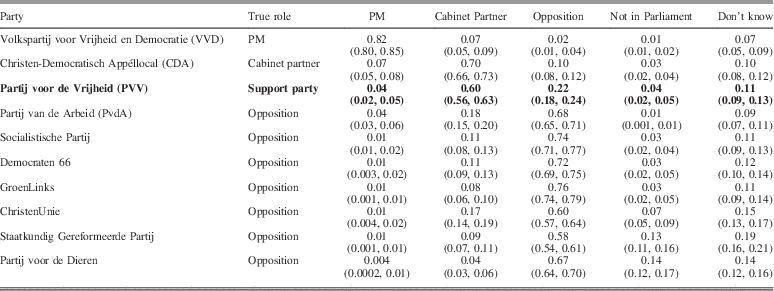
Table 1 Respondent Classifications of Party Roles, Netherlands 2012
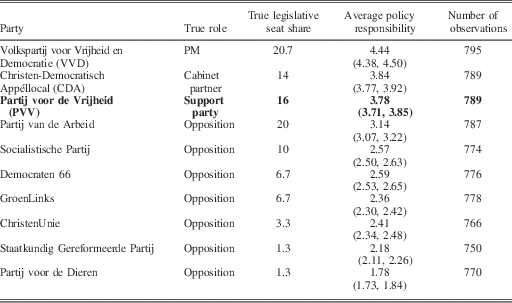
Table 2 Respondent Attributions of Responsibility, Netherlands 2012
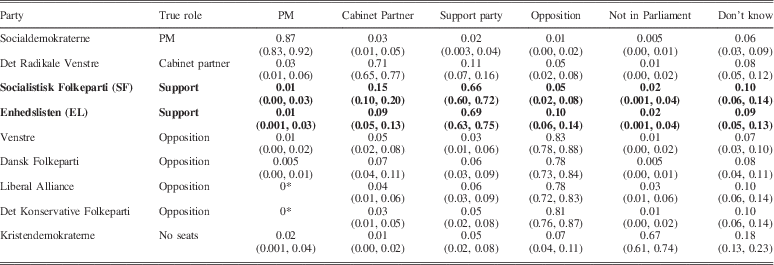
Table 3 Respondent Classifications of Party Roles, Denmark 2014 (with Support Party Option)
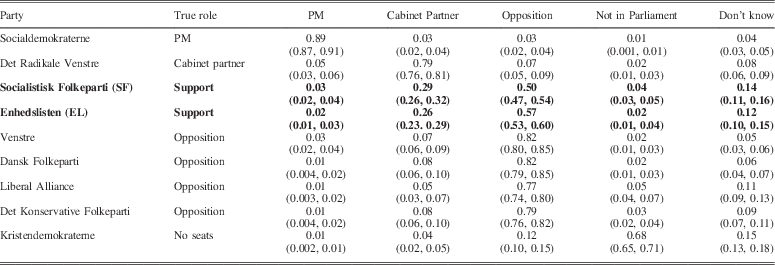
Table 4 Respondent Classifications of Party Roles, Denmark 2014 (without support party option)
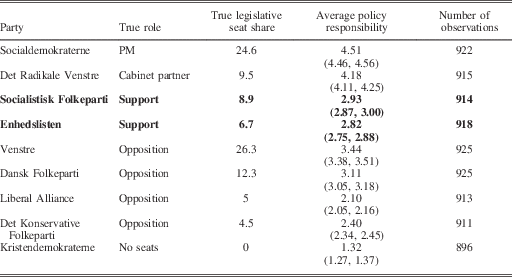
Table 5 Responsibility Attribution to Danish Parties in 2014

Tromborg et al supplementary material 1
Appendices

File
22.9 KB
Tromborg et al supplementary material 2
Appendices
File
91.7 KB
Minority governments must, by definition, rely on the support of parties that are not part of the government to form the legislative majorities needed to stay in office and pass legislation. Further, while the composition of these majority coalitions may certainly shift from vote to vote, many minority cabinets rely on support from a stable set of parties (‘support parties’ from here on) that have publicly committed to side with the government on votes of confidence and other major pieces of legislation. Such ‘minority cabinets with outside support’ are relatively common among Western democracies. For example, Powell finds that of the 373 cabinets formed from 1946 to 2013 in twenty Western democracies, 104 (28 per cent) were minority cabinets – thirty-six of which (35 per cent) relied on ‘formal support parties’.Footnote 1
Despite the importance of support parties to the formation and continued governance of many minority cabinets, political scientists know very little about how voters perceive such parties, or how they weigh their influence in the policy-making process. Do voters discount the influence of these parties because they lack a cabinet seat, or do voters recognize the pivotal position such parties play in supporting the cabinet and thus infer greater policy-making influence relative to other opposition parties?
Existing empirical studies of performance voting have all classified support parties as members of the opposition – implicitly assuming that voters do not punish or reward them for government performance.Footnote 2 This assumption also underlies Strøm’s theoretical argument that many minority governments form because some potential cabinet partners anticipate that they will be punished electorally if they formally join the government.Footnote 3 Clearly, Strøm’s argument relies on a strong assumption about how voters treat support parties – essentially arguing that these parties can ‘have their cake and eat it too’. Or, put differently, they can influence policy from outside the cabinet, but avoid electoral responsibility. To our knowledge this foundational assumption has never been tested.
Further, recent work on voters’ attributions of policy-making responsibility in complex multiparty systems provides a theoretical rationale for this model of voter behavior. Duch, Przepiorka and Stevenson show that individuals use proposal power as a simple but powerful cue for attributing policy-making responsibility for collective decisions, and Duch and Stevenson show that voters in multiparty coalitional systems similarly focus on the proposal powers granted by cabinet membership as a simple guide to the policy-making influence of legislative parties.Footnote 4 Applying this framework to support parties, which lack such proposal powers (at least compared to cabinet partners), we would expect voters to treat support parties more like members of the opposition than the cabinet – attributing them little policy-making influence.Footnote 5
Of course, there is no lack of argument (though, as yet little empirical evidence) to support the opposite view. First, there is a long tradition of formal work in political science that supports the importance of pivotality on policy-making influence, and more recent work has suggested that voters may understand and act on this.Footnote 6 Secondly, rather than priming voters to believe that support parties have less responsibility than government parties, support party leaders sometimes argue that staying out of the cabinet is a winning strategy for maximizing policy-making influence. For example, in the lead-up to the 2015 Danish election, the leader of the Danish People’s Party, which was in the opposition, justified his party’s strategy in precisely these terms: ‘In our assessment, we will not gain the biggest influence by participating in a government, even if an election day results in a majority in favor of a change of government, but as a hopefully strong support party for the new government.’Footnote 7 Thirdly, the identity of support parties is usually well known at the time the cabinet forms, and support parties are occasionally written into the formal coalition pact, as was the case with the Partij vor de Vrijheid’s (PVV) support of Rutte’s first cabinet (2010) in the Netherlands. Such declarations may well tie the support party to the government in the minds of voters – leading them to treat such parties more like cabinet partners than members of the opposition.
In the remainder of this article, we attempt to adjudicate between these competing views by answering two empirical questions: do voters classify support parties as opposition parties or cabinet partners?Footnote 8 And, how much influence over policy-making outcomes do voters attribute to support parties?Footnote 9 To answer these questions, we use data from three original surveys fielded in the Netherlands (2012) and Denmark (2014 and 2015). The answers to these questions are important for future research on performance-based voting, but they are also relevant to other questions about representation in coalitional systems. For example, when estimating governments’ policy positions (a task central to many empirical studies of representation in coalitional systems),Footnote 10 should the ideological positions of support parties play an important role? Should the answer be different when the theory focuses on voters’ perceptions versus actual policy outputs? And how should support parties be treated in studies of Gamson’s Law? While we do not answer these other questions directly here, we hope that this study will stimulate more interest in such questions – and the role that support parties play in the system of democratic representation more generally.
SUPPORT PARTIES IN THE NETHERLANDS, 2012
In 2012, our research team fielded a survey in the Netherlands probing voter knowledge, perceptions of policy positions and responsibility attributions. The survey was administered by YouGov in the days preceding the 12 September 2012 Dutch parliamentary election. The election had been called as a consequence of the PVV’s withdrawal of support for the government (in April) after refusing to sign onto the government’s proposed budget cuts (the cabinet was a coalition of the Volkspartij voor Vrijheid en Democratie (VVD) and the Christen-Democratisch Appéllocal (CDA) led by the VVD’s Mark Rutte). The survey asked respondents to classify all parties according to their role in parliament.Footnote 11 The complete question wording was:
For each of the following political parties, please choose the option which BEST describes each party’s role in the most recent government which was formed after the September 2010 election.
Possible response categories were: (1) Political party of the prime minister; (2) Political party of the cabinet, but not the party of the prime minister; (3) Political party in the opposition in the lower house; (4) Political party has no seats in the Parliament and (5) Don’t know. Importantly, the question asked our respondents to think about the cabinet that formed after the last election, and not the cabinet that was in place at the time of our survey (which was a caretaker government that did not have outside support from any party). Further, we deliberately did not include a ‘support party’ response option in order to assess whether voters perceived the PVV as more similar to a government party or an opposition party when not given the choice to classify them specifically as a support party. Table 2 shows the proportion of respondents that assigned each party to each role.
As pointed out above, the empirical literature on performance voting has almost universally treated support parties as opposition parties rather than as cabinet parties – implicitly assuming that voters think of these parties more like the former than the latter. The evidence in Table 1, however, clearly shows that this assumption does not hold for Dutch voters in 2012. Rather, 60 per cent of our respondents assigned the PVV to the cabinet party category, which is nearly three times the number of respondents who assigned it to the opposition, over three times the number of respondents who assigned other parties without portfolio to the cabinet, and nearly as many as those who assigned the CDA, the cabinet’s true junior partner, to the cabinet.
Respondent Classifications of Party Roles, Netherlands 2012
Note: table entries are the proportion of respondents classifying a given party in a given role; 95 per cent confidence intervals are in parentheses. N=882.
Of course it is possible that while Dutch respondents classified the PVV as a cabinet party rather than an opposition party, they attribute policy-making responsibility to this party differently than they do cabinet partners. Perhaps voters assign the PVV to the cabinet party category rather than the opposition category (when given only those choices), but believe it has little policy-making influence. To assess this possibility, we asked our respondents to assign levels of policy-making responsibility to each party in the system. Specifically, we asked them:
The ‘legislative process’ consists of legislators proposing, modifying, and voting on proposed legislation. Ultimately, this process produces a set of new laws and modifications to old laws. Taking account of all the various methods parties can use to influence the legislative process, how much influence, if any, do you think each of the following political parties has on the legislative process in the Netherlands during the most recent government?
The response categories ranged from 1 (‘No influence at all’) to 5 (‘A lot of influence’). The question wording was deliberately designed to help us understand how voters perceive general policy responsibility to be distributed across parties, and so encouraged respondents to think broadly about the sources of policy influence. Table 2 reports how respondents attributed policy-making responsibility to each Dutch party.
Respondent Attributions of Responsibility, Netherlands 2012
Note: table entries are the average responsibility attributed to a party (on a 1–5 scale) with 95 per cent confidence intervals in parentheses. The number of observations varies because ‘don’t know’ answers for a given party are treated as missing.
The results in Table 2 clearly show that the Dutch support party was treated much more like a cabinet partner than an opposition party in 2012. The average responsibility attributed to the true junior partner (CDA) was 3.84, which is not statistically different from the 3.78 average attributed to the PVV (p=0.25). Likewise, average responsibility for all true opposition parties was substantially lower than (and statistically differentiable from) that for the PVV. In sum, the data suggest that Dutch voters tended to classify and treat the support party much more like a cabinet partner than an opposition party.Footnote 12
SUPPORT PARTIES IN DENMARK, 2014
In July 2014 we replicated the Dutch survey described above in Denmark. This time the survey was administered by Survey Sampling International (SSI). There were two support parties in Denmark during the time of our survey: Socialistisk Folkeparti (SF) and Enhedslisten (EL). SF had been part of the cabinet since 2011, but left the cabinet (becoming a formal support party instead) in January 2014 over the government’s decision to sell a large portion of an energy company to a subsidiary of Goldman Sachs. EL was a support party for the entirety of the cabinet’s duration leading up to our survey.
In this survey we asked respondents the same set of questions as in the Netherlands, with one exception: For the question about party roles, we randomized 25 per cent of our Danish respondents to a set of response options that included an explicit ‘support party’ option.Footnote 13 Giving a subset of respondents the option to classify a party as a support party rather than a cabinet or opposition party enables us to discover whether respondents think of party roles in these terms, while also facilitating comparison (among the rest of the sample) to the Dutch data.
Table 3 shows the percentage of respondents in the subset that classified each party to each of the five roles (the other respondents are examined in Table 4). The results suggest that Danish voters understand which category support parties belong to. When given the option, almost 70 per cent correctly classified the two true support parties as such. Of course, the number of 2014 Danish respondents that were given the support party option was fairly small, but we have replicated these results using a larger Danish sample from 2015 (shown in Appendix A), and a majority of respondents in that sample also classified SF and EL as support parties. Based on the evidence in Table 3 and Appendix A, we thus conclude that most Danish voters can correctly classify support parties as a separate category when given the option to do so.
Respondent Classifications of Party Roles, Denmark 2014 (with Support Party Option)
Note: table entries are the proportions of respondents assigning a given party to a given role with 95 per cent confidence intervals in parentheses. N=209. *No respondents assigned the party to this role.
Respondent Classifications of Party Roles, Denmark 2014 (without support party option)
Note: table entries are the proportions of respondents assigning a given party to a given role, with 95 per cent confidence intervals in parentheses. N=782.
For the remaining 75 per cent of the 2014 Danish sample we presented the same response options as in the Dutch survey – purposely omitting the support party option. This allows us to examine whether Danish voters were more likely to classify support parties as cabinet partners than opposition parties when not given the support party option. These data are presented in Table 4 and show that in this situation, Danes classified support parties quite differently from the Dutch. Specifically, when Danish respondents were not given the support party option, they were almost twice as likely to assign the true support parties to the opposition as to the coalition.Footnote 14
To understand whether Danish voters tend to treat their support parties like cabinet partners, opposition parties or, potentially, as a third and separate category, Table 5 replicates the analysis in Table 2 for our 2014 Danish data. The results are clearly consistent with the Danes’ tendency to classify these support parties as members of the opposition. Specifically, respondents attribute SF and EL 2.93 and 2.82 average responsibility scores, respectively. These responsibility attribution scores are not only substantially smaller than the scores for both cabinet parties, but they are also less than the two largest parties in the opposition (Dansk Folkeparti and Venstre). Though we do not want to generalize too much from only one case, it is also interesting that there is a clear relationship in Table 5 between party size and attributed responsibility for non-cabinet parties (that seems to function independently of party role). Furthermore, we get the same result when we replicate the analysis using our 2015 Danish data (shown in Appendix A). This is quite different from the Dutch sample in which respondents thought the support party was just as responsible for policy as was the true cabinet partner – and substantially more responsible than all opposition parties even if they were smaller in terms of legislative seat share. Taken together, then, these data not only suggest that Danish voters tend to classify support parties as opposition parties when they cannot classify them as support parties (unlike Dutch voters), but also that Danish voters attribute much less policy-making responsibility to their support parties than Dutch voters attribute to theirs. This is an intriguing contextual difference that we hope will spark the interest of other students of comparative political behavior, and to which we return in the conclusion.Footnote 15
Responsibility Attribution to Danish Parties in 2014
Note: table entries are the average responsibility (bounded between 1 and 5) attributed to the different parties with 95 per cent confidence intervals in parentheses. The number of observations varies because ‘don’t know’ answers for the responsibility attribution question are treated as missing.
DISCUSSION AND CONCLUSION
This article examines, for the first time, how voters perceive roles and policy responsibility for the support parties of minority cabinets. Our main finding is that context seems to matter a great deal. In 2012, Dutch voters attributed policy responsibility to their support party in a way that was comparable to that of the junior cabinet partner and greater than any other opposition party (including the larger PvdA). In contrast, Danish voters in both 2014 and 2015 attributed levels of policy responsibility to support parties that were more similar to other opposition parties (and indeed generally less than the larger opposition parties) than to cabinet partners. Complementing these analyses, we found a parallel difference in the way that Dutch and Danish respondents classified support parties (as government or opposition) when forced to choose. Specifically, the Dutch voters overwhelmingly placed the support party in the cabinet, while the Danish voters (in both 2014 and 2015) placed both their support parties in the opposition.
Our results thus suggest that if Strøm is correct that minority governments form because support parties anticipate that voters will treat them differently from cabinet parties, then that strategy worked better in Denmark in 2014 and 2015 than in the Netherlands in 2012.Footnote 16 Given the exploratory nature of this study and the fact that we only surveyed voters in two contexts, we cannot come to strong conclusions about the causes of this contextual variation.Footnote 17 That said, it is worth speculating (and examining what little evidence is available) on a number of possibilities that we hope spark the interest of other scholars. Before turning to these possibilities, however, we can rule out some sources of relevant difference related to the relative sizes and strategic positions of the support parties. In both Denmark and the Netherlands, the votes of the support parties were necessary to the government’s legislative majority (that is, they were pivotal) and in both cases the support parties had no formal proposal power (ministerial portfolios). Likewise, in both cases the support parties were roughly equal in size to the junior cabinet partner, and in both contexts there were opposition parties that were both smaller and larger than the support parties. Thus it seems unlikely that voters in the two contexts would come to different conclusions about the policy-making influence of their respective support parties based on any of these kinds of differences.
Alternatively, there are three other ways in which the two cases differ that may well lead to the kinds of differences in responsibility attribution that we have observed. These stem from differences in the familiarity of support parties, differences in the recent actions of support parties, and differences in the formality of the support party arrangement and how these parties are portrayed in the media.
First, it could be that the real policy-making influence of support parties is limited by their lack of agenda-setting powers and that Danish voters, with their relatively frequent experience of minority cabinets, have come to understand that. This is consistent with Duch et al.’s conclusion that voters focus on agenda powers when assessing responsibility.Footnote 18 It is also consistent with Goldstein and Gigerenzer’s explanation of how populations acquire ‘ecologically rational’ (that is, accurate) heuristics over time.Footnote 19 In contrast, Dutch voters’ relative inexperience with minority cabinets does not provide sufficient information for accurate heuristics about the policy influence of support parties to develop.
It is also possible that voters attribute responsibility to support parties based on a more detailed reading of the recent record of the parties in question. Before our Dutch survey was administered, the Rutte cabinet was dissolved because the PVV withdrew its support from the government. This action was well publicized, and represents a clear demonstration of the importance of pivotality – that is, that the PVV was essential to the cabinet’s continued existence. In contrast, in the period leading up to our Danish surveys, the SF withdrew its support from the Thorning-Schmidt cabinet, but in this case the cabinet survived the withdrawal, perhaps sending an equally powerful signal about SF’s lack of importance to the cabinet’s continued existence.Footnote 20
A third alternative is that formal distinctions in the support party arrangement (with consequent differences in the media representations of the support parties) drive these differences. We mentioned above that the PVV’s support of the Rutte cabinet was formalized in the published coalition agreement, whereas the relationship between the Thorning-Schmidt cabinet and the support parties was omitted from the coalition agreement, and perhaps this contributes to the differences. Of course, an argument against this view is that majorities of our Danish respondents correctly identified the Danish support parties as such – so however they were portrayed in the media, their status as support parties seems to have been well understood.