




No CrossRef data available.
Is Gender like Ethnicity? The Political Representation of Identity Groups
Published online by Cambridge University Press: 01 September 2004
Abstract
Some 50 countries officially allocate access to political power by gender, ethnicity, or both. Yet in the world's electoral democracies, the policies used for women differ systematically from those used for ethnic groups. The former receive candidate quotas in parties; the latter, reserved seats in legislatures. Why? My explanation focuses on the varying ways that gender and ethnic identities intersect with partisan cleavages and on the distinct “work” performed by the different remedies for underrepresentation. Quotas, which make space within existing parties, are appropriate for groups whose boundaries crosscut partisan divisions. Reservations, which create incentives for the formation of group-specific parties and permit them direct representation, suit groups whose boundaries coincide with political cleavages. Since gender is crosscutting while ethnicity tends to be coinciding, women receive candidate quotas while ethnic groups get legislative reservations. Claims for inclusion via quotas pose less of a challenge to liberal institutions than claims to difference through legislative reservations. Case studies of representational politics in France, India, and Peru illustrate the argument.Mala Htun is author of Sex and the State: Abortion, Divorce, and the Family under Latin American Dictatorships and Democracies. The author gratefully acknowledges the assistance and advice of Kanchan Chandra, Jorge Domínguez, Jennifer Hochschild, Mark Jones, Courtney Jung, Jim Miller, Victoria Murillo, Jack Snyder, Donna Lee Van Cott, Myra Waterbury, participants in colloquia at the New School and Columbia University, and anonymous reviewers.
Information
- Type
- Research Article
- Information
- Copyright
- © 2004 American Political Science Association
Political leaders take our money, lead us to war, and write the laws that govern our lives. Must their ranks include men and women, rich and poor, masters and slaves? For most of world history, the answer was no. Men ruled; women worked at home. Female interests were represented by husbands and fathers. The same was true for members of subordinate ethnic groups: conquerors would care for colonial subjects, the rich for the poor, whites for browns, and so on.
As the twentieth century progressed, however, a consensus emerged in international society and within democratic polities that one social segment should not monopolize political power. Special efforts were made to include previously excluded groups—generally defined in terms of gender and ethnicity. Today, some 50 countries officially allocate access to political power along the lines of gender, ethnicity,1
Ethnicity is used here as an all-encompassing term referring to social groups differentiated by kinship, tribe, skin color, religion, caste, language, race and other markers of communal identity. This broad definition of ethnicity, though somewhat at odds with the popular use of the term, is becoming more common in social science as scholars seek explanations for the causes—and consequences—of political phenomena motivated by ethnic identities. See Chandra 2004; Varshney 2001; Horowitz 1985.
How does gender differ from ethnicity? Why do democracies apply distinct policies to different previously excluded groups? What does this imply about the normative status of various claims to representation and the appropriate response of liberal states?
This article argues that different remedies for underrepresentation are logically appropriate for different groups. Quotas, which make space within existing parties, suit groups whose boundaries crosscut partisan divisions. Reservations, which create incentives for the formation of group-specific parties and permit them direct legislative representation, suit groups whose boundaries coincide with political cleavages. Whereas gender tends to be crosscutting, ethnicity tends to be coinciding. Women and men belong to all political parties; members of ethnic groups, by contrast, frequently belong to one only. In countries where it is mobilized, ethnicity is a central, if not the central principle of political behavior; gender, though occasionally a consideration, almost never defines how individuals vote and what parties they affiliate with.
Of course, actual politics do not always conform to functional requirements. Historical legacies may get in the way of matching group characteristics with suitable policies. Thus countries with traditions of ethnic reservations have given reserved seats to women; one with a gender candidate quota applied similar quotas to ethnic minorities. Yet when it applies the “wrong” remedy, the state neglects the true causes of underrepresentation and fails to grant group members real access to power. As we see in the Indian and Peruvian cases discussed below, supposed beneficiaries of these unwelcome remedies may protest them and demand alternative policies.
Though the divergence between the modes of gender and ethnic representation cuts across many countries, it has received no scholarly attention. We know a great deal about women's movements and women in politics, and a growing number of works focus on gender quotas. Hundreds of scholars have studied ethnic identity formation and mobilization; the causes and consequences of conflict; and institutional solutions for divided societies. Few works analyze representational politics across identities.2
An exception is Anne Phillips's The Politics of Presence, which at several points compares the pursuit of gender parity and ethnic minority representation. See Phillips 1995.

Group Representation Policies
Table 1 identifies countries with statutory gender quotas or reservations, ethnic quotas or reservations, or both. (For descriptions of these policies, see tables 1a and 1b.)3
Most of the data come from IDEA 2003; Reynolds n.d.; Parline 2003; Electionworld 2003. I attempted to confirm each case in the country-specific scholarly literature and in government websites, and made adjustments accordingly. Some of these sources are mentioned in footnotes.
The availability of more data on formal and informal practices within parties could reveal more widespread use of ethnic candidate quotas. Parties in India, for instance, regularly apply ethnic quotas for leadership posts. See Chandra 2004. For more information about gender quotas in parties, see IDEA 2003.
Statutory group representation policies

Gender quotas and reservations

Ethnic reservations

Policies to guarantee group representation generally assume one of two forms: candidate nomination quotas in political parties or legislative reservations. Quotas require that a minimum number of candidates fielded by political parties for general election have certain demographic characteristics. The Argentine Ley de Cupos (or Quota Law of 1991), for example, requires that women comprise a minimum of 30 percent of political party lists. Reservations or reserved seats set aside a fixed percentage of legislative seats for members of a certain group. These may be filled through competitive election in specially created districts (Scheduled Castes and Scheduled Tribes in India), through election by voters registered on separate rolls (Maoris in New Zealand), by the group member receiving the most votes in general elections (constitutionally recognized ethnic groups in Mauritius), or through designation by political parties (minorities in Pakistan).
States adopted these policies at different historical moments. In some countries, collective representational rights constitute part of the bargain struck to ensure the viability of democracy in a plural society. In such “consociational” or “consensus” polities, each group is guaranteed a share of power to preclude secession and civil war. Other countries introduced collective rights rather recently in response to the growth of identity-based social movements and their demands for the recognition of cultural diversity. These claims have mobilized concern for the question of whether elites in power resemble, in their personal characteristics and life experiences, the people they represent, thus transforming group representation from a matter of state survival into a question of democratic legitimacy and social justice.
Considerable debate surrounds these policies. Liberal critics argue that granting rights to identity groups treats them as essential givens, failing to acknowledge their dynamism and fluidity, as well as internal injustices suffered by some members. Existing liberal institutions, moreover, can resolve the domination and oppression inflicted on social groups since these wrongs are ultimately suffered by individuals.5
Civic republicans claim that group-differentiated rights undermine common citizenship and render suspect a public good toward which society could be oriented,6 while libertarians allege that collective rights benefit the already privileged, increase in-group inequality, and aggravate social divisions.7 Finally, social scientists have found that policies promoting the descriptive representation of minorities may actually end up harming their substantive representation: for example, the creation of so-called majority-minority districts helps to put more blacks and Latinos in the U.S. House of Representatives, but it may also facilitate the election of legislators elsewhere who are ideologically hostile to their interests.8Cameron, Epstein, and O'Halloran 1996. For a critique and response, see Lublin 1999 and Epstein and O'Halloran 1999.
Defenders of quotas and reservations point out that group rights do not constitute a major departure from existing democratic practices. After all, some form of collective representation is inherent to the political process. As Justice Lewis F. Powell put it in a 1968 voting rights opinion, “The concept of representation necessarily applies to groups; groups of voters elect representatives; individuals do not.”9
Quoted in Phillips 1995, 92.
Kymlicka 1995, 134–38.
Gender Quotas and Ethnic Reservations in Electoral Democracies
When we consider only electoral democracies, the following pattern emerges: states give candidate quotas in political parties to women and reserved seats in legislatures to members of ethnic groups. As table 2 demonstrates, there are only four exceptions to this rule. The probability that a democracy with group rights for women will have candidate quotas is 0.86; in countries with measures guaranteeing ethnic representation, the probability is 0.94 that these take the form of legislative reservations.
Group representation rights in electoral democraciesa

What accounts for this divergence in modalities of gender and ethnic representation? My argument can be summarized in the following syllogism: (1) candidate quotas are more appropriate for groups that crosscut partisan cleavages, while reservations suit groups that coincide with them; (2) gender identities tend to cut across parties, whereas ethnic identities often overlap with partisan affiliations; (3) consequently, disadvantaged groups that are defined by gender demand, and are granted, candidate quotas; ethnic groups prefer, and receive, legislative reservations.
Quotas for crosscutting groups; reservations for coinciding ones
To understand the different uses of the two types of policies, we must first explore the distinct means they use to improve the representation of identity groups. Quotas intervene in party nomination procedures by requiring that a certain percentage of the candidates fielded by a party be of a certain group. For example, the quota may demand that around one-third of positions on party lists be occupied by women and that they alternate with men in the rank ordering of candidates, as is the case in Argentina, Costa Rica, Belgium, and Guyana.11
A quota policy may therefore provoke some changes in the ways parties go about nominating candidates, formulating lists, and deciding who runs in what district. However, it does not alter the overall structure of incentives governing the political system. Specifically, quotas do not affect issues such as counting rules, timing, the circumscription of electoral districts, the structure of the ballot, and so on that have been shown to exert the most powerful effects on voter behavior, the party system, and internal party structure.12The literature on how electoral rules affect the party system and political behavior begins with Duverger's law and is vast. See, for example, Cox 1997; Carey and Shugart 1992; Lijphart 1990; Shugart 1995; Jones 1995; Ames 1995.
Reservations take a different approach. They introduce group-specific avenues of representation that circumvent the existing party system and create new electoral incentives. These include the creation of: separate electoral rolls, special electoral districts that limit competition to group members, exceptions to counting rules, and provisions for direct appointment to the legislature.
Candidate quotas thus presume a different sort of problem from that addressed by reservations. The goal of quotas is to take a category of people who belong to, but suffer from discrimination in, mainstream parties and propel them to positions wherein they stand a chance of popular election. Quotas therefore provide a means of assimilation and integration into already existing political institutions. Reservations, by contrast, guarantee group members a share of power independently, if need be, of existing parties. Their objective is to facilitate autonomy of political communities and electoral success of group-specific parties.
Figure 1 depicts the location of crosscutting and coinciding groups in the party system. We see that members of a crosscutting group belong to all parties, whereas those of a coinciding group tend to belong to a single party, a set of political organizations, or no party. Figure 2 illustrates the “work” done by a well-designed candidate quota. The policy attacks the discrimination suffered by group members in the party but permits them to continue militating in it. Meanwhile, the party gains representation in legislatures through regular electoral procedures. The demographic characteristics of its delegations may change, but the rules of interparty competition remain the same.

Cross-cutting versus coinciding groups

What quotas do
Figure 1 helps us see why a candidate quota would make little sense for a coinciding group. What is gained by making space for group members within all parties when they tend to cluster at one end of the political spectrum? In fact, a candidate quota might undermine a minority group's political organizations as its partisan opponents snatch up group leaders in order to comply with the quota. Finally, figure 3 clarifies the mechanics of legislative reservations. They permit a group's party, organizations, or independent representatives to gain power on their own and may furnish additional incentives for formation of minority parties.

What reservations do
In theory, a proportional representation (PR) electoral system, particularly one with low thresholds, would facilitate the representation of group-specific parties and organizations. PR also avoids a situation in which the state is compelled to assign individuals to specific groups (as required by the maintenance of ethnic voter rolls or the reservation of certain districts for group members), a practice that contradicts the fluidity and contextual nature of many ethnic identities. In addition, PR is flexible, permitting the automatic adjustment of representational relationships to changing demographics and political interests. Divided legislatures and reserved seat ratios, by contrast, often contain no provision for periodic updating based on new census data.13
PR thus permits “self-determination” rather than the “pre-determination” of ethnic groups. See Lijphart 1995. Lani Guinier also endorses PR to allow for the representation of “voluntary interest constituencies,” ethnic and otherwise. See Guinier 1994.
Crosscutting gender versus coinciding ethnicity
The next step is to examine variation in the extent to which gender and ethnic identities actually correspond to partisan cleavages. For much of world history, politics has been the exclusive domain of men. Women gained the right to vote and stand for office only in the twentieth century. Since the early days of gender integration in politics, however, political parties have counted on both men and women as supporters. There are few instances of parties defined by gender, and none have consistently won elections. To be sure, different parties send men and women to office to varying degrees: women comprise a larger portion of legislative delegations of the Left than those of the Right. One reason is that the former have been more likely to adopt voluntary candidate quotas than the latter.15
To reduce the electoral advantage such policies may provide to their opponents, parties of the Right in several countries have responded by introducing, if not always explicit quotas, other forms of affirmative action to improve women's opportunities.16 Party positions may differ on women's rights issues such as abortion, but are converging—at least in theory—on the goal of gender parity in representational politics.What about the gender gap? In advanced democracies, women tend to vote for leftist parties in greater numbers than men. A few decades ago (and in many parts of the developing world today) the opposite transpired: support for the Right was greater among women.17
Though analyses of these phenomena tend to center on women's views, there is evidence that men are the ones changing: in the United States at least, transposition of the gender gap is due to major shifts in men's partisan preferences.18 The gap peaked in the U.S. presidential elections of 1996, when 54 percent of women voted for Democrat Bill Clinton, as opposed to 43 percent of men.19 While significant for party strategy, these percentage point differences are small compared to the overall volume of female and male support for various parties and candidates.The size of gender differences in party support contrasts vividly with the ethnically inflected political divisions characterizing many plural societies. In patronage democracies such as India, politics is driven by ethnic head counting.20
Linguistic divisions in heterogeneous European countries such as Belgium and Switzerland map onto party—and party system—divisions.21 A large number of postcolonial societies in Africa and Asia are dominated by parties whose reliance on the support of exclusive ethnic groups lends a “census-like quality” to elections.22Horowitz 1985, 332.
Ethnic boundaries are not always politically loaded, however, and not everyone has a communal experience of ethnicity. Its coincidence with partisan and ideological cleavages and geographic concentration is the effect of historical construction as well as political manipulation. Ethnic groups in some countries, such as Afro-descendents in Brazil, have features usually associated with gender identity, such as low geographic segregation and little correlation with voting behavior or party affiliation. Consequently, the affirmative action bill under consideration in the Brazilian Congress calls for racial quotas in parties, not for reserved seats in the legislature.27
The stacking of ethnicity on salient social divisions is the product, not the premise, of a political process, an outcome to which the allocation of specific representational rights surely contributes.For these reasons, there is an active debate among political scientists about which types of institutions can best mold ethnicity to promote democratic stability. Arend Lijphart has long advocated proportional representation and power sharing, policies that preserve group identity but encourage cooperation among ethnic elites. Donald Horowitz favors electoral rules that encourage politicians to make appeals across ethnic lines. And Kanchan Chandra has found that when state institutions create incentives for politicians to mobilize different dimensions of ethnic identity—by authorizing positive discrimination by caste, granting access to government jobs by language, or recognition of statehood by tribe—ethnic parties will compete to occupy the center, thus averting the centrifugal spiral that undermines democracy.28
Lijphart 1977; Horowitz 1985, 1991; Chandra n.d..
Women receive quotas; ethnic groups receive reserved seats
Finally, we must establish that gender-based demands center on quotas and that this is related to the fact that women are spread throughout the party system. We also need to show that the preference of ethnic groups for reserved seats flows from their tendency to cluster in a single party or organization.
Let us begin by analyzing candidate quotas. Their diffusion is a relatively recent phenomenon resulting from several trends. The first is the growth of the second-wave feminist movement, which identified male dominance in political life as a problem and questioned the legitimacy of polities that tolerate it. Feminist activism helped forge new international norms of gender equality. Major agreements, such as the Convention on the Elimination of All Forms of Discrimination Against Women (CEDAW) and the Platform for Action adopted by governments at the 1995 Fourth World Conference on Women in Beijing, endorse affirmative action. International and regional organizations, such as the United Nations, the European Union, the Southern African Development Community, the Summit of the Americas, and the Association of Southeast Asian Nations, have declared that growth in women's leadership contributes to democratic consolidation and economic and social progress.
Another factor was the development of normative arguments that identified the gender composition of legislatures as an indicator of justice and the quality of democracy. Quota advocates reconceptualized political equality to include not just the right to vote and stand for office, but to be present in office. A homogeneous legislature of men, they argued, violates this fundamental right. Meanwhile, partisans of deliberative democracy stressed the need for representatives to share experiences with their constituents in order to adequately communicate citizen views in open-ended political deliberation. Finally, feminists maintained that having more women in power would introduce additional perspectives to decision making and tailor policy outcomes to suit a broader variety of citizen interests. Ann Phillips sums up these various developments as a reorientation of democratic theory and practice from a “politics of ideas” to a “politics of presence.”29
Argentina pioneered a candidate quota law in 1991. Influenced by the success of candidate quotas in the Spanish Socialist Party, Argentine female politicians from different parties united behind the proposal. Though it was initially ridiculed by men, last-minute persuasion by President Carlos Menem and his interior minister helped to overcome this resistance. Subsequently, the policy snowballed across the region. By the end of the decade, ten other Latin American countries had adopted legislative quotas, and an eleventh, Colombia, introduced them for senior executive appointments. Belgium introduced a law in 1994 that states that a maximum of two-thirds of all candidates could be of the same sex; in 1999 France modified its constitution to call for gender parity in political office and enacted legislation requiring parties to field an equal number of men and women candidates. Meanwhile, under the influence of the United Nations, the Organization for Security and Co-operation in Europe (OSCE), and the Stability Pact for South-Central Europe, quota rules were inserted into the electoral laws of most countries of the former Yugoslavia, including Bosnia and Herzegovina, Macedonia, and Serbia, including Kosovo.30
Three aspects of women's mobilization for gender quotas stand out. First, multipartisan and ideologically diverse coalitions have backed the new policies. Women from the Peronist and Radical parties in Argentina; the Party of the Democratic Revolution and National Action Party in Mexico; and the socialists, Rally for the Republic, and the Union for French Democracy in France joined together to defeat the arguments of male colleagues that quotas were undemocratic and unconstitutional. “Although all women may not agree on the substance of specific policy outcomes, they do have a common interest in being present when policy is being made.”31
Friedman 2000, 291.
Second, most politicians regard quotas as a temporary measure. As more women gain power, they will break down the obstacles holding others back. Over time, the quota will become obsolete.
Finally, women's activism around quotas has been episodic. After the adoption of quota laws, women's coalitions have disbanded as their members returned to their prior commitments and became reabsorbed into their parties. In some countries—notably Argentina, Costa Rica, Belgium, and Guyana—women's presence in power increased significantly as a result of the quota. Yet the feminization of legislative delegations has not produced major changes in what parties actually do. Though some women politicians have introduced fresh items to political agendas, their collective presence has thus far failed to produce major shifts in policy and practice.32
Ethnic demands for reservations have followed a quite different political logic. Rather than improving the legitimacy of already existing democracies, the granting of reserved seats has tended to occur as part of a founding compromise in consociational or consensus polities. In these countries, split legislatures, the allocation of ministerial portfolios by ethnicity, or fixed ratios of parliamentary seats form part of the elite bargains necessary to make democracy possible. Each group has a constitutional share of power, giving it an incentive not to defect from the existing political regime and undermine the survival of the state. As opposed to quotas, which improve the leadership prospects of group members within existing parties, reservations presume the existence of group-specific parties or organizations. Groups demanding reservations do not want to be integrated into mainstream parties. They want access to political power in their own right.
In Belgium, the constitution requires that there be an equal number of French- and Dutch-speaking ministers in the federal government and in the government of the Brussels region, with the parliament divided between these two language communities and their respective party systems. In Switzerland, language group quotas are used not only in the federal council,33
The council is generally comprised of four German-speakers, two French-speakers, and one Italian-speaker.
Elsewhere, the ethnic allocation of political power was codified in peace agreements following civil wars. International mediators, with an eye toward establishing pluralist polities, helped install forms of power sharing in virtually all of the new states formed after the breakup of Yugoslavia. Bosnia and Herzegovina has a three-member presidency comprised of a Bosniak, Serb, and Croat, as well as a bicameral legislative assembly divided between these three communities. In Serbia and Montenegro, the bicameral federal legislature is divided between Serbians and Montenegrans. In Kosovo, seats are reserved in parliament for Serbs, Roma, and other ethnic groups. (In less polarized Croatia and Slovenia, a smaller number of seats are reserved for minorities.)36
Birch 2002; Birch et al. 2002; Darmanovic 2003; UNHCR and OSCE 2002; Embassy of Croatia, n.d.; Constitution of the Republic of Slovenia, n.d.
Some reservations policies reflect attempts to compensate victims of slavery, colonialism, or a caste system for past oppression. India's reservations for Scheduled Castes and Scheduled Tribes are intended to ameliorate the historic discrimination suffered by those at the lowest rungs of the caste system. New Zealand's white rulers made a similar attempt to compensate oppressed minorities: the Maori Representation Act of 1867 installed four representatives in a legislature of over 70 members. The number of seats later increased to seven (representatives are elected by voters who voluntarily register for a separate Maori roll).38
In the late twentieth century, some disadvantaged ethnic groups demanded rights during constitutional reforms. Responding to indigenous mobilization, the Colombian Constitution (1991) created a two-seat senatorial district for Indians and permitted the reservation of up to five seats in the lower house for ethnic groups and other political minorities. Venezuela had a similar experience: the 1999 constitutional reform established three reserved seats for “indigenous communities” in the national assembly and permitted social movement organizations to contest them, thus eliminating the party registration barrier. In both countries, these seats granted resources and visibility to indigenous parties and movements; as a result, they successfully contested general elections and gained power in local governance.39
Van Cott 2003; Efrén Agudelo 2002.
The Argument in Action
France, India, and Peru illustrate the theoretical propositions I have advanced. France and India show us political actors engaged in pragmatic debates, pondering the difference between gender and ethnicity, though to opposite ends. Both honed in on the crosscutting nature of gender. In France, this supported women's claims to representation; in India, it undermined it. Comparing India and Peru emphasizes a different point. Though the countries seem like exceptions to my argument (see their location in table 2), in fact they support it. India initially granted reservations to ethnic minorities, and Peru introduced quotas for women. Both governments later tried to apply the same policy to a different type of group: Indian women got reservations and Peruvian indigenous peoples received quotas. The two policies were subsequently criticized by their alleged beneficiaries. By mismatching groups and remedies, the Indian and Peruvian states not only failed to address the underlying causes of disadvantage, but arguably jeopardized women's and indigenous people's quest for political equality.
Parité in France
In June 2000 the French parliament approved a law requiring that parties field an equal number of male and female candidates in legislative elections. This turn of events is surprising in a country that has prided itself on a republican tradition of an indivisible body politic and has long forbidden official distinctions among citizens in terms of sex, race, ethnicity, and religion. In fact, these nondiscrimination principles were invoked by the Supreme Court in a 1982 decision that struck down a quota law passed by Congress (the law would have banned one sex from occupying more than 75 percent of the places on lists of candidates for municipal elections). The French court claimed that gender preferences contradicted republican principles of equality and unity, which dictate that citizens represent the nation as a whole, not discrete groups or categories.40
Advocates of women's representation thus had to make a case that their preferred policies were compatible with republican universalism. This required demonstrating that the existing model was flawed for failing to incorporate sex differences and that gender parity would not legitimize representational rights for other social groups. Gender, they argued, is a unique form of social difference.
Unlike ethnicity, race, and religion, which are socially constructed and changeable categories, sex is universal and permanent:
Women do not constitute a category analogous to minorities, but half of humanity, and their status is immutable. The young grow older, one can change one's religion, people of color can intermix with others—miscegenation is widespread—, workers may switch professions, and so on. But once one is born a man or woman, one does not change (save in the extremely rare case of transsexuals).41
Mossuz-Lavau 1998, 83.
Both traditional French “universalism,” which stresses the unity of men and women, and contemporary American “particularism,” which collapses sex into other forms of difference, are therefore misguided. Philosopher Sylvia Agacinski, wife of former Socialist Premier Lionel Jospin, argues that both political traditions have denied the real nature of sex:
The “French” effacement proceeds by engulfing both sexes in an abstract humanism, from which only the singular model of a sexually neutral human being can surface…. The “American” effacement proceeds by drowning women in a systematic particularism in which minorities of all sorts (ethnic, religious, cultural, etc.) are grouped together, and both sexes end up being considered pure “constructions.” … Today, the new French feminism simultaneously challenges both these types of sexual neutralization in affirming sexual duality as the only universal difference within humanity. This is why it was able to conceive of the parité ideal in politics.42
Agacinski 2003, 18.
The fact of sexual difference divides humanity in two. As a result, a republican polity that claims to include all citizens, but in which only men hold power, unjustly privileges one half over the other. Parity feminists did not want their arguments to be leveled against a legislature of white Catholics, however. Since sex is the only universal category, women are not like any other social group.
With this stance, parity advocates were able to anchor their movement within republican discourse and find allies from the mainstream of French politics. By denying that parity would or should lead to a cascade of demands for other representational rights, they made their case more palatable. What is more, they focused on the narrow objective of getting the parity bill passed, and not broader considerations, such as socioeconomic equality and policy change. By avoiding questions about the substantive representation of women's interests, French feminists of diverse political and ideological stripes were able to smooth over their differences and unite in a nonpartisan movement. This also helped defray fears that right-wing and conservative women would be attacked or disqualified, and by the mid-1990s, most politicians had jumped on the parity bandwagon. When it came to a vote in the national assembly, the parity proposals—both the constitutional amendment and the implementing legislation—were approved unanimously. Following promulgation of the law, however, the large and diverse movement began to disperse. What had held participants together was support for parity, not a more comprehensive policy agenda or a shared history of activism.43
Giraud and Jenson 2001; Bird 2002; Jenson and Valiente 2003; Mazur 2001.
The parity law worked well in the 2001 municipal elections, since municipal councilors are elected under a semiproportional closed-list system and parties were required to include three women for every three men on the list. In cities of more than 3,500 inhabitants where the parity law was applied, women's presence on municipal councils rose to 48 percent. Yet at the national level, where deputies are elected by the first-past-the-post system in single-member districts, the results were disappointing. Preferring to suffer financial penalties rather than comply with the quota, the center Right UMP nominated women to less than 20 percent of the districts where it ran a candidate, and even the Socialist Party nominated women to only 36 percent of districts. Most of these were losing districts and the number of women in the assembly barely increased (from 62 to 71 out of 576, or to 12 percent of the total).44
Reservations policy in India
Whereas the French state acknowledged social difference in the law only at the end of the twentieth century, in India such recognition has a long tradition. Legislative reservations for minorities were introduced during British rule. First Muslims (in 1909), then Christians and Sikhs (in 1919) were granted separate electorates; at the same time, nominated seats were granted to “untouchables” or dalits to offset inequities of the caste system. The British had originally proposed that these lower castes vote on separate rolls; a 21-day hunger strike by Mohandas Gandhi, however, led to compromise. The 1932 agreement, known as the Poona Pact, reserved seats for dalit candidates to be elected by everyone. The British also reserved a number for women within these communal seat allocations in provincial and national legislatures. Although favored by British feminist Eleanor Rathbone, such reservations were opposed by the largest national Indian women's associations as well as the Indian National Congress, which contested the introduction of any distinctions (whether by gender, religion, or caste) among Indians. Both groups viewed British policy as part of a divide-and-rule strategy against the nationalist movement.45
The constitution promulgated in 1950 rejected communal quotas as an organizing principle in favor of formal equality and individual rights, with two exceptions. Recognizing that equal treatment would be insufficient to ameliorate historic discrimination suffered by the lowest social groups, the constitution upheld the British legacy of legislative reservations for untouchables (Scheduled Castes) and introduced them for indigenous groups (Scheduled Tribes). Similar consideration, however, was not extended to Muslims or women. Delimitation commissions in each state designated single-member constituencies in which only members of Scheduled Castes and Scheduled Tribes could stand for office, even though the electorate as a whole would vote for them (the number was proportional to their share of the population). The text authorized a range of other policies to advance “backward classes” of citizens, including: reserved posts in government service and university admissions; scholarships, meals, supplies, and special schools; and preference for economic development assistance.46
The debate over women's representation died down for several decades, but it was revived in the 1970s when the government of India formed the Committee on the Status of Women to propose recommendations for improving their rights and opportunities. Its report was to be launched in time for International Women's Year in 1975. One of the thorniest issues considered by the committee was gender reservations. After weighing arguments for and against, it declined to recommend such policies at the national or state level, though it recognized women's political underrepresentation as a serious problem.
To justify its position, the committee drew a distinction between women, who are a “category,” and minority “communities,” including those based on caste and religion. “There can be no rational basis for reservations for women,” since “the minority argument cannot be applied to women. Women are not a community, they are a category. Though they have some real problems of their own, they share with men the problems of their groups, locality and community. Women are not concentrated in certain areas [or] confined to particular fields of activity.”47
Government of India 1974, 304.
Ibid.
Anticipating arguments made by French feminists in the 1990s, Indian experts stressed the difference between women and ethnic minority communities, but as an argument against women's representation, not in favor of it. The Committee on the Status of Women did, however, borrow the institutional model the state had used for Scheduled Castes and Tribes and endorsed reserved seats for women in local governments. This appears to have been a compromise between those who rejected women's representation altogether and those who wanted to recommend reservations at all levels.49
The annex to the official report contains three notes of dissent written by four committee members. Two of the notes oppose reservations altogether; the other, signed by two members and running eleven paragraphs, supports reservations at the national and state levels. See Government of India 1974.
Ibid., 301.
The seats may be allocated by rotation to different constituencies; one-third of council chairmanships must also be reserved for women. For analysis of the local reservations see Tekchandani, Jyoti, and Sharma 1997; Lakshmi, Jyoti, and Sharma 2000.
The debate was revived in 1996 when MP and former Minister for Women Margaret Alva proposed to amend the constitution to extend the women's reservations system to the national and state legislatures. A lottery system would determine the single-member districts in which only women could run, and these would rotate every two elections. The bill would also reserve one-third of the seats allocated to Scheduled Castes and Tribes for women of those communities. Though virtually every political party supported the bill in their 1996 electoral platforms, the parliamentary debates over it were ferocious, with some MPs almost coming to blows and others rushing to the podium to tear up copies of the text.52
One of the main parliamentary concerns was the relationship between women's reservations and rights for members of “other backward classes” (OBCs, a group the 1950 constitution had recognized as entitled to special protections). In a 1990 decision that provoked massive controversy, the government had granted OBCs reservations in its central bureaucracy, but not in national and state legislatures. Entrepreneurial MPs from the Hindu nationalist Bharatiya Janata Party (BJP) demanded that the women's bill include subreservations for lower castes, a move that allowed them to appear as champions of the OBCs, but which mired the gender proposal in polemics surrounding caste rights. In addition, some legislators called for special provisions in the bill for Muslims. As Laura Dudley Jenkins notes, “by endorsing the bill in party platforms and then failing to pass it out of a sudden concern for backward citizens or Muslims, politicians court the women's vote, the backwards vote, and the Muslim vote and simultaneously protect their own hopes of reelection.”53
Popular views of the elitist nature of the women's movement also did not help the cause of the bill. Middle-class women had assumed visible roles in protests against the decision to grant OBCs central government reservations and most feminist organizations had failed to build ties to lower caste groups. During the debate, a prominent OBC politician declared that the reservation bill was for “balkati auraten” or short-haired women, a reference to upper class urban feminists.54
Jenkins 2003, 170.
As in France, political actors in India highlighted the crosscutting nature of gender. Unlike ethnic groups, women transcend geographic, occupational, language, and religious categories. In France, this meant that, in theory, women's representation would not threaten the republican universalist tradition. In India, by contrast, women's crosscutting status made it less likely that they would represent the caste and socioeconomic interests the reservations system was supposed to advance.
Meanwhile, a group of dissidents argued that rather than reserved seats, the bill should introduce a candidate quota within political parties. The Forum for Democratic Reforms argued that the reservations proposal was seriously and inherently flawed. By mechanically providing for the entrance of women into one-third of the seats in the national and state legislatures, the bill failed to address the main problem impeding women's effective participation in politics: gender discrimination in political parties.55
This is the case not just in India but more generally. Data from the United States show that when they run, women have as good a chance as men to get elected. Their low numbers in power owe to the unwillingness of parties to nominate women as candidates, not discrimination in the electorate. See Darcy, Welch, and Clark 1994.
The very same male party leaders who compete with each other in announcing their support of special reservations for women have shown little willingness to include women in party decision making, or even to help create a conducive atmosphere for women's participation in their own organizations. In fact, women's marginalization is even more pronounced in the day-to-day functioning of almost all political parties than in the Lok Sabha. Therefore, it is urgently required that we make special measures to enhance women's political participation in ways that will help them influence decision making at all levels of our society and polity. Our democracy will remain seriously flawed if it fails to yield adequate space to women.56
Furthermore, the Forum argued, a system of women's reservations would enable patriarchal leaders to solidify their positions. At the local level, political bosses regularly compel their wives, sisters, and daughters to contest reserved seats. National politicians would duplicate this strategy and the women entering politics would be mere fronts for male power.57
Kishwar 1999, 126–27.
Pointing out that those countries with the highest levels of women's representation use candidate quotas, not reserved seats, these critics proposed an alternative bill. It would require that one-third of candidates nominated by political parties for general elections be women, though each party would be free to choose the constituencies where these women would run. Rather than contesting women's seats, female candidates would compete against men and other women in general elections. To ensure their success, parties would need to nurture these candidates. Women might therefore become legitimate leaders and have a greater political base from which to advance women's interests in parliament.58
The Indian government has not resolved these issues, so it is not yet clear whether quotas or reservations will emerge as the preferred remedy.Quotas in Peru
While some Indian authorities have sought to apply to women the same system they had used for Scheduled Castes and Tribes, Peruvian officials have employed a women's policy for indigenous peoples. In 1997 the Congress approved an electoral law requiring that female candidates make up no less than 25 percent of the slots on party lists contesting national legislative elections (the quota was later increased to 30 percent). Several years later, Peruvian leaders introduced the same remedy—party candidate quotas—for indigenous communities of the Amazon region. Though intended as a response to their demands for representation, the policy was criticized by indigenous leaders for undermining their political organizations. Like their ethnic counterparts elsewhere in the world, Peru's Amazonian and highland Indians wanted reserved seats in parliament, not quotas.
In a process of coalition building similar to what occurred in France, Peruvian women politicians—representing both the governing and opposition parties—initially joined forces in the mid-90s to lobby for a quota law. Five congresswomen had attended the 1995 Fourth World Conference on Women, where they debated the policy with delegates from other countries. Upon their return, a special commission on women was installed in parliament and quotas were the first item on its agenda. Although the proposal initially met with overwhelming skepticism from other legislators, it eventually received a boost from an unexpected ally: the President. Alberto Fujimori, the only head of state to have attended the 1995 conference, declared his support for quotas and the majority in Congress immediately fell in line. As in France, the proposal was approved unanimously.59
Its effects on women's presence in power, however, were more dramatic: in the first national election held after the quota, the percentage of congressional seats held by women jumped from 11 to 20 percent.Meanwhile, the 1990s witnessed the growing ethnic politicization of indigenous peoples in various Andean countries, including Peru. Previously, a “peasant” or “poor” consciousness had tended to prevail over an indigenous one, and ethnic prejudice was perceived—and disguised—as class discrimination. The decreasing viability of class affiliations like peasant in the neoliberal era, combined with opportunities offered by global discourses of multiculturalism, helped spawn mobilization along ethnic lines.60
In 1998, organizations from the Amazon and highland regions formed the Permanent Conference of Peruvian Indigenous Peoples, uniting previously disparate organizations to forge a common political platform and lobby congress to recognize Indian rights.61After the 2001 election of President Alejandro Toledo, the state became increasingly receptive to indigenous claims. Though he frequently donned a poncho and espoused a populist discourse, former President Fujimori had undermined indigenous land rights, and his efforts to centralize power—he canceled regional elections—reduced Indian opportunities to participate in politics. Toledo pledged to expand the rights of indigenous peoples and created a high-level commission presided over by his wife, Belgian anthropologist Elaine Karp, to represent their interests in the state. Fulfilling a campaign promise, he also reinstated regional elections.62
Ibid.
The law regulating these elections, approved by Congress in early 2002, declared that lists of candidates for regional and local councils comprise no less than 30 percent women and a minimum of 15 percent of representatives of “native communities” or “original peoples” in those regions where they lived. According to the national election tribunal, the indigenous quota would be applied in 11 (of a total of 25) regions.63
The groups targeted by the law include some 350,000 people speaking over 40 languages, mostly residents of the lowland Amazon region.Peru's ethnic quotas apply only to those Indians considered members of “native communities.” What is the origin of this term? In 1969 military ruler General Juan Velasco declared that, “as an act of liberation,” the words indigenous and Indian be purged from official discourse and all peoples incorporated into a “modern” class-based society.64
A 1974 law then reclassified the entire indigenous population into two groups: “native communities” and “peasant communities.” The former benefit from the 2002 quota law, but the latter, who are far more numerous, do not. “Peasant communities,” or those indigenous peoples inhabiting the country's highland regions, comprise over 40 percent of Peru's 28 million people.Although it was designed to help them, several Amazonian Indian organizations criticized the way the 2002 electoral law channeled their representation through existing political parties. These indigenous movements preferred instead to form their own autonomous organizations and political platforms. Emulating the success of similar organizations in Bolivia and Ecuador, where ethnic parties had made major electoral gains in the 1990s, representatives of various Peruvian native communities formed the Indigenous Movement of the Peruvian Amazon (MIAP) and attempted to field candidates for several elections in the late 1990s and early 2000s. The quota posed a threat to this group, however, since its leaders were being recruited by mainstream parties seeking to comply with the law.65
One activist complained that, though the intention behind the quota was good, the result was bad, for it would only cause Indians to become more divided.66Wrays Perez of the Inter-Ethnic Development Association of the Peruvian Forest (AIDESEP); interviewed by Donna Lee Van Cott, July 11, 2002.
Indians from both the Amazon and the highlands want the Peruvian state to guarantee their representation through legislative reservations, not candidate quotas. The program for constitutional reform advanced by indigenous organizations in 2003 calls for the creation of special electoral districts, from which Indians would directly elect 30 percent of seats in the national congress and regional and municipal councils.67
The reservation of seats conforms to the notions held by many indigenous organizations that political participation is not just an individual but a collective right.68As mentioned earlier, Colombia and Venezuela had granted them legislative reservations in the early 1990s.
Reservations are but one element in the broader agenda advanced by indigenous peoples in Peru. Indians want collective property rights, territorial and cultural autonomy, deference to customary law, and bilingual education. These goals contradict the model of the homogeneous, mestizo nation and comprehensive legal order installed in the American republics after their independence from Spain in the early nineteenth century. They challenge the liberal state and its traditions of individual rights, since completing the indigenous agenda would require the state to recognize multiple, collective forms of citizenship as well as tolerate a plurality of legal regimes.69
The Peruvian case helps show how legislative reservations advance group rights and reinforce differences in a way that candidate quotas do not. Quotas attack the discrimination suffered by individuals within parties to give them a better chance of getting elected. A regime of reserved seats more directly empowers the whole group. When legislators are chosen from separate electorates and specially created districts, the policy confers on group members the right to be represented not just by one of their kind, but by a candidate of their choice. This mechanism strengthens the links between representatives and their ethnic kin constituents while distancing them from others. Reservations thus bestow a distinctive status on the group as a political community. Quotas, by contrast, collapse the group into the rest of political society.
Authoritarian Exceptions
The stories of France, India, and Peru illuminate another aspect of quotas and reservations. Their purpose is not merely to insert differently configured, colored, or cultured bodies into legislatures. Rather, advocates of these measures aim to promote the substantive representation of the interests of a disadvantaged or excluded group. The agents of such representation should therefore exercise not just symbolic but effective power. Part of the motive for choosing the right remedy is to reinforce connections between leaders and the base that nourishes them politically. Quotas improve the position of women within those parties that get them elected and advance their agendas; reservations strengthen those groups whose very existence is crucial for the promotion of the rights and interests of their members.
Regimes that lack a commitment to substantive representation have little incentive to promote the right remedy. In states with military governments, one-party states, no-party states, and other countries that fail to respect civil liberties, legislative powers are subject to arbitrary dictatorial will. Such polities lack competitive party politics and the links of accountability that they provide. Consequently, representation patterns in authoritarian polities differ from those observed in democracies. Women get reserved seats in legislatures, not candidate quotas (see table 3), as do ethnic groups. Toleration of democratic parties—which the quota remedy presumes—would undermine the survival of these regimes.
Forms of gender representation in democracies and nondemocracies

We could also speculate that in extremely oppressive societies—which correlate, albeit imperfectly, to those without democratic governance—gender is not crosscutting enough for candidate quotas. With their roles limited exclusively to biological functions, women have not spread out into the economy, society, and party system in ways characteristic of wealthy democratic states. Their common experiences and interests cause them to resemble a coinciding group more than a cross-cutting category. This suggests there may be an inverse relationship between the collective identity of women and their degree of liberation: the greater the success of the feminist movement in pushing women in to the public sphere, the less they have in common.
In any event, the introduction of women's reservations in some nondemocracies shows that even these states are not immune to arguments connecting regime legitimacy with gender diversity. In Morocco, parties decided to reserve the 30-seat national list for women after a three-year process of mobilization and consultation in which international organizations—particularly the United Nations Development Fund for Women (UNIFEM)—played important roles.70
Subsequently, hundreds of delegates attending the Arab Women's Summit in late 2002 approved a declaration calling on Arab states to follow Morocco's lead. In Pakistan, feminist mobilization and international benchmarks helped provoke an expansion of the reservations system inherited from the colonial period. (Unlike in India, where women's seats were abolished after independence, Pakistan upheld reservations of between 5 and 10 percent in national and provincial assemblies in various constitutions adopted into the 1980s.) In 2000 the military government of General Pervez Musharraf expanded the reservations system to 17 percent at the national and provincial levels and one-third at the local level.71Pakistan also reserves 7 percent of seats for technocrats. Various national plans for women had endorsed a 30 percent reservations scheme, as did representatives of eleven political parties. See Reyes 2002; Weiss and Bari 2002.
Granting reserved seats to women allows nondemocracies to respond to popular pressure and conform to international norms without ceding ground to the competitive party politics presumed by candidate quotas. Yet the very nature of such regimes prevents female—and male—legislators from representing citizen interests and wielding effective power.
Conclusion
Advocates and critics of group representation frequently fail to distinguish between types of policies and the groups they apply to. Yet these distinctions are consequential for normative debates about social difference in a liberal polity. Gender- and ethnic-based demands present unique challenges to the liberal tradition. Because they are self canceling, quotas produce the opposite effect on group difference than the self-reinforcing remedy of reservations.
As a first cut at disaggregating group claims to representation, I suggest that gender quotas be seen as analogous to a class action and ethnic reservations as a group right.72
I am grateful to John Comaroff for helping me with this formulation.
The logic of a class action corresponds closely to that of women's mobilization for gender quotas. They unite to contest common experiences of political exclusion and discrimination. The quota remedy aims to transcend these gender-based disabilities, thereby erasing the conditions giving rise to the claim in the first place. Once women enter political office, the reasons motivating the quota movement disappear. The logic of the quota is “to put the group out of business as a group.”73
Fraser argues that this logic characterizes redistributive remedies for class-based social injustice. See Fraser 1997, 18.
As the French case shows, women from all parties and ideologies united in the struggle for quotas, but reverted to their prior ideological and political commitments once this goal was achieved. This trajectory parallels the cyclical patterns observed in women's movements more generally: they emerge to oppose problems (denial of voting rights, military rule, discriminatory legislation) but dissipate once the situation has been resolved. Women may act like a group in order to get something, but realign themselves as a category once they have it. Being excluded from power makes women conscious of belonging to a group; once they have power, this group identity tends to weaken and dissipate.74
According to David Miller, a category consists of all those persons fitting a proper description, while a group is “a set of people who by virtue of their shared characteristics think of themselves as forming a group.” See David Miller 2002, 178.
Ethnic reservations, by contrast, are a group right. Claimed in order to guarantee the continued existence of the group, they are exercised collectively by group members. Such rights are self-reinforcing rather than self-canceling. Organizations of Chinese in Mauritius, Croats in Bosnia, and Italian-speakers in Switzerland will not dissipate once representational rights have been granted. On the contrary, since legislative reservations create incentives for the development of group-specific organizations, their boundaries will be strengthened.
Self-canceling claims for political inclusion have the reverse effect of self-reinforcing group rights. Women seeking quotas aim to have their different position absorbed by universalistic institutions. Ethnic minorities demanding reservations want their particularism recognized and legitimized. These are opposite trajectories: women suffer from too much difference; ethnic groups, from too little. Claims for inclusion pose less of a challenge to contemporary liberal institutions than claims to difference.75
Brian Barry, for example, argues that classical liberalism is perfectly compatible with special treatment for members of disadvantaged groups as long as the objective of such treatment is to make the need for it “disappear as rapidly as possible.” He contrasts such remedies with the permanent group rights favored by those he deems multiculturalists: “if the group [no longer needed] special rights, that would not be regarded as a cause for celebration, because it would be taken to suggest that the support for the group's culture had been insufficient to prevent its members from assimilating to that of some larger or more powerful group.” See Barry 2002, 13.
The distinction between a class action and a group right is an analytical one I inferred from this study of representation policies in contemporary democracies. It does not describe all claims made on behalf of gender and ethnic identities. In fact, gender claims may on occasion be self-reinforcing: some women's movements aim at separatism; others argue that their essential differences from men require dissimilar treatment over the long term. And ethnic claims may sometimes be self-canceling: part of the rationale behind reservations in India is to help break down caste distinctions; likewise, affirmative action in the United States and Brazil seeks to make race less determining for political opportunities, occupational status, and social experience.
Nevertheless, selecting one remedy for underrepresentation over others will generally shape the future trajectory of a social group. A candidate quota promotes the integration of group members into existing political parties. Beneficiaries of the quota may later act to advance group interests, but they will do so—save at episodic moments—as individuals, not as a group. A legislative reservation produces the opposite effect: it strengthens ties among group members by connecting them through channels of representation distinct from those used for everyone else. Though more conducive to continued collective action, reservations have the potential to magnify intergroup differences and impede development of the overlapping affiliations that underlie a successful democracy. The choice between softening or hardening difference inevitably arises in the quest for political justice. Policymakers designing institutions and the scholars advising them should take notice lest they unwittingly trade a legislature of white men for a fragmented, even polarized political society.
References
REFERENCES
Agacinski, Sylviane.
2003.
The turning point of feminism: Against the effacement of women.
In
Beyond French feminisms: Debates on women, politics, and culture in
France, 1981–2001, ed.
Roger Célestin,
Eliane DalMolin, and
Isabelle de Courtivron,
17–22.
London:
Palgrave.
Ames, Barry.
1995.
Electoral strategy under open-list proportional representation.
American Journal of Political Science
39 (2):
406–33.Google Scholar
Baldez, Lisa.
2004.
Elected bodies: The gender quota law for legislative candidates in
Mexico.
Legislative Studies Quarterly
29 (2):
231–58.Google Scholar
Barry, Brian.
2002.
Culture and equality: An egalitarian critique of multiculturalism.
Cambridge:
Harvard University Press.
BBC News.
2004.
Bangladesh law boosts women MPs. May 16, 2004.
http://news.bbc.co.uk/1/hi/world/south_asia/3719227.stm.
Birch, Sarah.
2002.
The 2000 elections in Yugoslavia: The “bulldozer
revolution.”
Electoral Studies
21 (3):
499–511.Google Scholar
Birch, Sarah,
Frances Millard,
Marina Popescu, and
Kieran Williams.
2002.
Embodying democracy: Electoral system design in post-Communist
Europe.
London:
Palgrave.
Bird, Karen.
2001.
Liberté, egalité, fraternité, parité
… and diversité? The difficult question of ethnic
difference in the French parity debate.
Contemporary French Civilization
25 (2):
271–92.Google Scholar
Bird, Karen
2002.
Who are the women? Where are the women? And what difference can they
make? The effects of gender parity on French municipal elections.
Paper prepared for the Annual Meeting of the American Political
Science Association, Boston, August 28–September 2.
Cameron, Charles,
David Epstein, and
Sharyn O'Halloran.
1996.
Do majority-minority districts maximize substantive black
representation in Congress?
American Political Science Review
90 (4):
794–812.Google Scholar
Carey, John, and
Matthew Soberg Shugart.
1992.
Presidents and assemblies: Constitutional design and electoral
dynamics.
New York:
Cambridge University Press.
Carr, Adam.
2003.
Psephos. Adam Carr's election archive.
http://psephos.adam-carr.net/.
Carton, Ann.
2001.
The general elections in Belgium in June 1999: A real breakthrough
for women politicians.
European Journal of Women's Studies
8 (1):
127–35.Google Scholar
Caul, Miki.
2001.
Political parties and the adoption of candidate gender quotas: A
cross-national analysis.
Journal of Politics
63 (4):
1214–29.Google Scholar
Center for American Women and Politics.
1997.
The Gender Gap: Voting Choices, Party Identification, and Presidential
Performance Ratings.
http://www.rci.rutgers.edu/∼cawp/Facts/ggap.pdf.
Chandra, Kanchan.
2004.
Why ethnic parties succeed: Patronage and ethnic head counts in
India.
New York:
Cambridge University Press.
Chandra, Kanchan.
N.d.
Ethnic parties, and democratic stability.
Unpublished manuscript.
Central Intelligence Agency (CIA).
2003.
The world factbook.
http://www.cia.gov/cia/publications/factbook/.
Comisión Organizadora de la Consulta Indígena sobre
la Reforma Constitucional.
2003.
Programa de derechos colectivos de los Pueblos indígenas del
Perú. Acuerdos de Consulta Nacional Indígena del 14.4.2003
sobre reformas constitucionales reordenados como propuestas
programáticas.
http://peru.indymedia.org/news/2003/07/1672.php.
Corrin, Chris.
2002.
Developing democracy in Kosova: From grassroots to government.
Parliamentary Affairs
55 (1):
99–108.Google Scholar
Cox, Gary.
1997.
Making votes count: Strategic coordination in the world's
electoral systems.
New York:
Cambridge University Press.
Croatia, Embassy of.
N.d.
http://www.croatiaemb.org/politics/Politics_FrameSet.htm.
Dahlerup, Drude.
2002.
Using quotas to increase women's political representation.
Women in Parliament: Beyond Numbers.
Stockholm:
International IDEA,
2002.
http://www.idea.int/women/parl/ch4a.htm.
Darcy, R.,
Janet Welch, and
Susan Clark.
1994.
Women, elections, and representation.
2nd ed.
Lincoln:
University of Nebraska Press.
Darmanovic, Srdjan.
2003.
Montenegro: Dilemmas of a small republic.
Journal of Democracy
14 (1):
145–53.Google Scholar
Dawson, Michael.
1994.
Behind the mule: Race and class in African-American politics.
Princeton:
Princeton University Press.
Deschouwer, Kris.
2002.
Falling apart together: The changing nature of Belgian consociationalism,
1961–2001.
Acta Politica 37 (1, 2):
68–85.Google Scholar
Efrén Agudelo, Carlos.
2002.
Etnicidad negra y elecciones en Colombia.
Journal of Latin American Anthropology
7 (2):
168–97.Google Scholar
Electionworld.
2003.
http://www.electionworld.org.
Elshtain, Jean.
1995.
Democracy on Trial.
New York:
Basic Books.
Epstein, David, and
Sharyn O'Halloran.
1999.
A social science approach to race, redistricting, and
representation.
American Political Science Review
93 (1):
187–91.Google Scholar
Forum for Democratic Reforms.
2000.
Enhancing women's representation in legislatures. An Alternative
to the Government Bill for Women's Reservation.
Manushi 116 (January–February).
http://free.freespeech.org/manushi/116/alterbill.html.Google Scholar
Fraser, Nancy.
1997.
Justice Interruptus: Critical reflections on the
“postsocialist” condition.
New York:
Routledge.
Freedom House.
2003.
Electoral Democracies.
http://www.freedomhouse.org/research/freeworld/2003/democracies.pdf.
Galanter, Marc.
1984.
Competing equalities: Law and the backward classes of India.
Berkeley:
University of California Press.
Giraud, Isabelle, and
Jane Jenson.
2001.
Constitutionalizing equal access: High hopes, dashed hopes? In
Has liberalism failed women? Assuring equal representation in
Europe and the United States, ed.
Jyette Klausen and
Charles S. Maier,
69–88.
London:
Palgrave.
Grofman, Bernard,
Lisa Handley, and
Richard G. Niemi.
1992.
Minority representation and the quest for voting equality.
New York:
Cambridge University Press.
Guinier, Lani.
1994.
The tyranny of the majority: Fundamental fairness in representative
democracy.
New York:
Free Press.
Heisler, Martin O.
1990.
Hyphenating Belgium: Changing state and regime to cope with
cultural division. In
Joseph V. Montville,
177–95.
Lexington, MA:
Lexington Books.
Horowitz, Donald L.
1985.
Ethnic groups in conflict.
Berkeley:
University of California Press.
Horowitz, Donald L.
1991.
A democratic South Africa? Constitutional engineering in a divided
society.
Berkeley:
University of California Press.
Htun, Mala.
2004.
From racial democracy to affirmative action: Changing state policy
on race in Brazil.
Latin American Research Review
39 (1):
6089.Google Scholar
Htun, Mala, and
Mark Jones.
2002.
Engendering the right to participate in decision making: Electoral
quotas and women's leadership in Latin America. In
Gender and the politics of rights and democracy in Latin America,
ed.
Nikki Craske and
Maxine Molyneux,
32–56.
London:
Palgrave.
India, Government of.
1974.
Towards equality. Report of the Committee on the Status of Women in
India.
New Delhi:
Ministry of Education and Social Welfare, Department of Social
Welfare.
Inglehart, Ronald, and
Pippa Norris.
2003.
Rising tide: Gender equality and cultural change around the world.
New York:
Cambridge University Press.
International IDEA.
2003.
Global Database of Quotas for Women.
A Joint Project of International IDEA and Stockholm University.
http://www.idea.int/quota/index.cfm.
Inter-Parliamentary Union.
2003.
PARLINE Database.
http://www.ipu.org/parline-e/parlinesearch.asp.
Jenkins, Laura Dudley.
2003.
Identity and identification in India: Defining the disadvantaged.
London:
Curzon Press.
Jenkins, Laura Dudley
1999.
Competing inequalities: The struggle over reserved legislative
seats for women in India.
International Review of Social History
44 (1):
53–75.Google Scholar
Jenson, Jane, and
Celia Valiente.
2003.
Comparing two movements for gender parity: France and Spain. In
Women's movements facing the reconfigured state, ed.
Lee Ann Banaszak,
Karen Beckwith, and
Dieter Rucht,
69–93.
New York:
Cambridge University Press.
Jones, Mark P.
1995.
Electoral laws and the survival of presidential democracies.
Notre Dame:
University of Notre Dame Press.
Jones, Mark P.
Forthcoming.
Quota legislation and the election of women: Learning from the Costa
Rican experience.
Journal of Politics.
Jung, Courtney.
N.d.
Critical liberalism: What Democrats have to learn from the Mexican
Zapatistas.
Unpublished manuscript.
Jurado Nacional de Elecciones.
2002a.
Ley de elecciones regionales.
Ley no. 27683. March 15, 2002.
Lima, Peru.
Jurado Nacional de Elecciones
2002b.
Press Release no. 103-2002-OCII/JNE.
Kaufmann, Karen M., and
John R. Petrocik.
1999.
The changing politics of American men: Understanding the sources of
the gender gap.
American Journal of Political Science
43 (3):
864–87.Google Scholar
Keating, Christine.
2002.
The women's reservations bill in India: Disrupting the postcolonial
sexual contract.
Paper prepared for the Annual Meeting of the American Political
Science Association, Boston, August 28–September 2.
Kishwar, Madhu.
1999.
Off the beaten track: Rethinking gender justice for Indian women.
New Delhi:
Oxford University Press.
Kukathas, Chandran.
1992.
Are there any cultural rights?
Political Theory
20 (1):
105–39.Google Scholar
Kymlicka, Will.
1995.
Multicultural citizenship: A liberal theory of minority rights.
Oxford:
Clarendon Press.
Lakshmi, Josyula,
Kiran Jyoti, and
Priti Sharma.
2000.
Daughters of the 74th Amendment. A study of women elected to
municipal bodies in Karnal and Delhi.
New Delhi:
Multiple Action Research Group.
Lijphart, Arend.
1977.
Democracy in plural societies: A comparative exploration.
New Haven:
Yale University Press.
Lijphart, Arend
1986.
Proportionality by non-PR methods: Ethnic representation in
Belgium, Cyprus, Lebanon, New Zealand, West Germany, and Zimbabwe. In
Electoral laws and their political consequences, ed.
Bernard Grofman and
Arend Lijphart,
113–23.
New York:
Agathon Press.
Lijphart, Arend
1990.
The political consequences of electoral laws, 1945–85.
American Political Science Review
84 (2):
481–96.Google Scholar
Lijphart, Arend
1995.
Self-determination versus pre-determination of ethnic minorities
in power-sharing systems. In
Will Kymlicka,
275–87.
New York:
Oxford University Press.
Lublin, David.
1999.
Racial redistricting and African-American representation: A
critique of “do majority-minority districts maximize substantive
black representation in Congress?”
American Political Science Review
93 (1):
183–86.Google Scholar
Mansbridge, Jane.
1999.
Should blacks represent blacks and women represent women? A
contingent “yes.”
Journal of Politics
61 (3):
628–57.Google Scholar
Matland, Richard E.,
Donley T. Studlar.
1996.
The contagion of women candidates in single-member district and
proportional representation electoral systems: Canada and Norway.
Journal of Politics
58 (3):
707–33.Google Scholar
Mazur, Amy G.
2001.
Drawing lessons from the French parity movement.
Contemporary French Civilization
25 (2):
201–19.Google Scholar
Miller, David.
2002.
Group rights, human rights, and citizenship.
European Journal of Philosophy
10 (2)
178–95.Google Scholar
Mossuz-Lavau, Janine.
1998.
Femmes/hommes pour la parité.
Paris:
Presses de sciences.
Nath, Meenakshi.
1996.
Cutting across party lines: Women members of Parliament explain their
stand on reservation quotas.
Manushi 96 (September–October).
http://free.freespeech.org/manushi/96/intvus.html.Google Scholar
Nordlund, Anja Taarup.
2003.
International implementation of electoral gender quotas in the
Balkans—A fact-finding report. Research Program on Gender Quotas,
Department of Political Science, Stockholm University.
Working Paper Series 2003, 1.
http://www.statsvet.su.se/stv_hemsida/statsvetenskap_04/quotas/a_nordlund_wps_2003_1.pdf.
Okin, Susan Moller.
1999.
Is multiculturalism bad for women?
Princeton:
Princeton University Press.
Pedersen, Susan.
Forthcoming.
Eleanor Rathbone and the politics of conscience.
New Haven:
Yale University Press.
Phillips, Anne.
1995.
The politics of presence.
New York:
Oxford University Press.
Pierson, Paul.
1994.
Dismantling the welfare state? Reagan, Thatcher, and the politics of
retrenchment.
Cambridge:
Cambridge University Press.
Promujer.
1998.
Poder politico con perfume de mujer: Las cuotas en el Perú.
Lima:
Movimiento Manuela Ramos and Instituto de Estudios Peruanos.
Rachida, Tahri.
2002.
Femmes, gouvernance: Participation, pourcentages, impact et pouvoir. Cas
du Maroc.
Quatrième Forum Global sur la réinvention du rôle
de l'Etat. Marrakech, Morocco, December 10–11, 2002.
Reilly, Benjamin.
2001.
Democracy in divided societies. Electoral engineering for conflict
management.
New York:
Cambridge University Press.
Reyes, Socorro L.
2002.
Quotas for women for legislative seats at the local level in Pakistan.
Perempuan di Parlemen: Bukan Sekedar Jumlah.
Stockholm:
International IDEA.
English translation available at
http://www.idea.int/gender/wip/PDF/Indonesian/English_translations/CS_Pakistan_Reynes.pdf.
Reynolds, Andrew.
1999.
Women in the legislatures and executives of the world: Knocking at
the highest glass ceiling.
World Politics
51 (4):
547–72.Google Scholar
Reynolds, Andrew.
N.d.
Comparative approaches to race, and districting.
Unpublished paper.
Rice, Roberta.
Forthcoming.
From peasants to Politicians: The politicization of ethnic cleavages
in Latin America.
PhD diss.,
University of New Mexico.
Rodríguez, Victoria E.
2003.
Women in Contemporary Mexican Politics.
Austin:
University of Texas Press.
Rwanda, Republic of.
2003.
The Constitution of the Republic of Rwanda.
http://www.cjcr.gov.rw/index.htm.
Samuels, David.
N.d.
Sources of mass partisanship in Brazil.
Unpublished manuscript.
Shugart, Matthew Soberg.
1995.
The electoral cycle and institutional sources of divided
presidential government.
American Political Science Review
89 (2):
327–43.Google Scholar
Sineau, Mariette.
2003.
Parité in politics: From a radical idea to a
consensual reform. In
Beyond French feminisms: Debates on women, politics, and culture in
France, 1981–2001, ed.
Roger Célestin,
Eliane DalMolin, and
Isabelle de Courtivron,
113–26.
London:
Palgrave.
Singapore, Republic of.
2003.
Singapore Elections.
http://app.elections.gov.sg/index.asp.
Slovenia, Republic of.
N.d.
Constitution of the Republic of Slovenia.
http://www.dz-rs.si/en/aktualno/spremljanje_zakonodaje/ustava/ustava_ang.pdf.
Smith, Richard Chase.
1982.
Liberal ideology and indigenous communities in post-independence
Peru.
Journal of International Affairs
36 (1):
73–82.Google Scholar
Snyder, Jack.
2000.
From voting to violence: Democratization and nationalist conflict.
New York:
W. W. Norton.
Sowell, Thomas.
1990.
Preferential policies: An international perspective.
New York:
William Morrow.
Stability Pact.
2002.
Gender Task Force, Progress Report June 2002, Stability Pact Working
Table 1 Meeting ISTANBUL.
http://www.stabilitypact.org/gender/istanbul-2002.doc.
Stavenhagen, Rodolfo.
2002.
Indigenous peoples and the state in Latin America: An ongoing
debate. In
Multiculturalism in Latin America: Indigenous rights, diversity,
and democracy, ed.
Rachel Sieder,
24–44.
London:
Palgrave.
Steiner, Jürg.
1990.
Power sharing: Another Swiss “export product”? In
Conflict and peacemaking in multiethnic societies, ed.
Joseph V. Montville,
Lexington, MA:
Lexington Books,
107–14.
Steiner, Jürg
2002.
Consociational theory and Switzerland—revisited.
Acta Politica
37 (1, 2):
104–20.Google Scholar
Tekchandani, Bharti,
Kiran Jyoti, and
Priti Sharma.
1997.
They Call Me Member Saab: Women in Haryana Panchayati Raj.
New Delhi:
Multiple Action Research Group.
Telles, Edward.
1999.
Ethnic boundaries and political mobilization among African
Brazilians: Comparisons with the U.S. case. In
Racial politics in contemporary Brazil, ed.
Michael Hanchard,
82–97.
Durham:
Duke University Press.
Trebble, Adam James.
2002.
What is the politics of difference?
Political Theory
30 (2):
259–81.Google Scholar
UNHCR, and
OSCE.
2002.
Ninth Assessment of the Situation of Ethnic Minorities in Kosovo.
http://www.osce.org/kosovo/documents/reports/minorities/min_rep_09_eng.pdf.
Van Cott, Donna Lee.
2003.
Institutional change and ethnic parties in South America.
Latin American Politics and Society
45 (2):
1–39.Google Scholar
Van Cott, Donna Lee.
N.d.
From Movements to Parties: The Evolution of Ethnic Politics in Latin
America.
Unpublished manuscript.
Varshney, Ashutosh.
2001.
Ethnic conflict and civil society: India and beyond.
World Politics
53 (2):
362–98.Google Scholar
Walker, Ranginui.
1992.
The Maori People: Their political development. In
New Zealand politics in perspective, ed.
Hyam Gold.
3rd ed.
Auckland:
Longman Paul,
379–400.
Weiss, Anita, and
Farzana Bari.
2002.
Struggling for a political voice: Women contesting the system in
Pakistan.
Paper prepared for the annual meeting of the Association of Asian
Studies, Washington, DC, April 4, 2002.
Wilkinson, Steven.
2000.
India, consociational theory, and ethnic violence.
Asian Survey
40 (5):
767–91.Google Scholar
Williams, Melissa.
1998.
Voice, trust, and memory: Marginalized groups and the failings of
liberal representation.
Princeton:
Princeton University Press.
Yashar, Deborah.
1999.
Democracy, indigenous movements, and the postliberal challenge in
Latin America.
World Politics
52 (1):
76–104.Google Scholar
Yashar, Deborah.
Forthcoming.
Indigenous movements and the state in Latin America.
New York:
Cambridge University Press.
Yishai, Yael.
2001.
Bringing society back in: Post-cartel parties in Israel.
Party Politics
7 (6):
667–87.Google Scholar
Young, Iris Marion.
1990.
Justice and the politics of difference.
Princeton:
Princeton University Press.
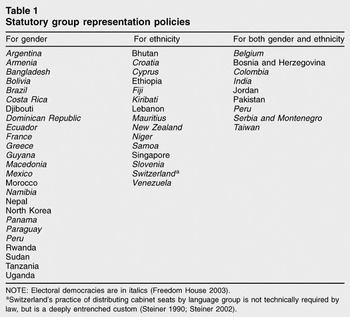
Statutory group representation policies
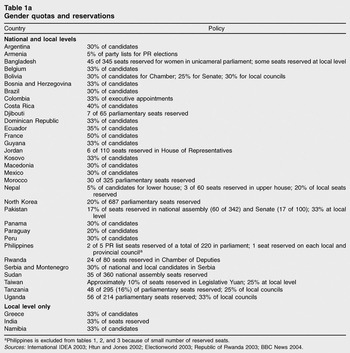
Gender quotas and reservations
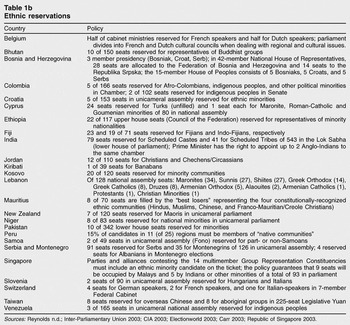
Ethnic reservations
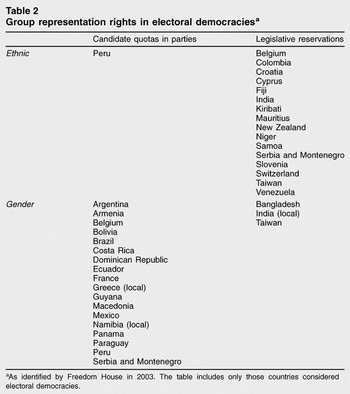
Group representation rights in electoral democraciesa
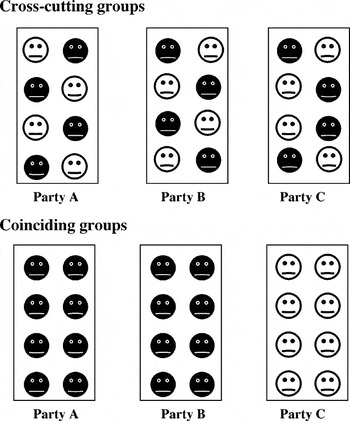
Cross-cutting versus coinciding groups
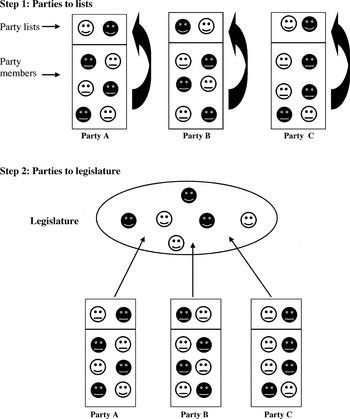
What quotas do
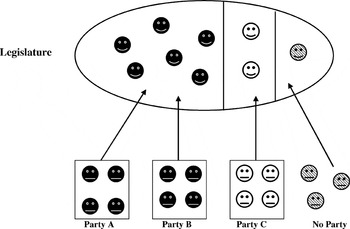
What reservations do
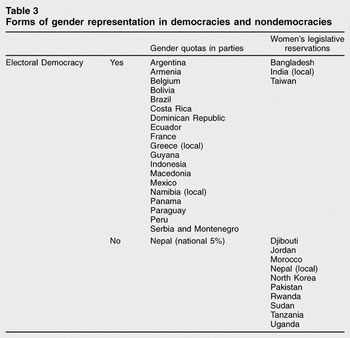
Forms of gender representation in democracies and nondemocracies
 You have
Access
- 205
- Cited by