Approximately 5%–10% of hospital-admitted patients experience a hospital-acquired infection.Reference Singh, Kaur, Gardner and Treen 1 Patients receiving treatment in intensive care units (ICUs) are at higher risk of hospital-acquired infection due to increased acuity of illness, high prevalence of invasive devices, and comorbidities, including higher likelihood of being immunocompromised.Reference Weber, Raasch and Rutala 2 Patients can be exposed to pathogens that cause hospital-acquired infections from multiple sources, including healthcare providers, equipment, and environmental surfaces.
The use of personal mobile devices (PMDs) within the hospital environment offers a fast and convenient way for healthcare providers to access and update patient information. However, these devices may serve as a nontraditional route for pathogen or disease transmission. It has been established that the hospital environment and hands of healthcare providers can serve as prominent vectors for transmitting hospital-acquired pathogens to patients.Reference Marimuthu, Pittet and Harbarth 3 , Reference Allegranzi and Pittet 4 Although less is known about healthcare providers’ personal equipment, several studies have demonstrated that PMDs in the hospital environment are often contaminated with multidrug-resistant organisms (MDROs) and may serve as a vector of MDRO transmission.Reference Brady, Verran, Damani and Gibb 5 , Reference Goldblatt, Krief and Klonsky 6 However, these studies have not investigated the change in contamination of PMDs using metagenomic techniques, which can more accurately represent microbial community structures.
In the present study, we investigated the change in the bacterial microbiome and presence of antibiotic resistance genes (ARGs) on the PMDs of ICU nurses during a single working shift.
Methods
Participant selection
Participants were eligible for this study if they were employed as nurses in an ICU at Duke University Medical Center. Recruitment of 32 total volunteers was performed at a surgical ICU (SICU) and a medical ICU (MICU). In total, 31 volunteers completed the study.
Study design
Samples were obtained from each participant’s palms and fingers of both hands as well as the front and back of their PMD. Sample collection occurred at the beginning and end of a 12-hour shift. After collection of the samples before the shift, PMD surfaces were sanitized using a 70% ethanol solution to ensure that the microbial community and ARGs detected at the end of the shift were primarily due to hospital environment exposure.
Specimen collection
Sterile cotton swabs (Puritan, Guilford, ME) were dipped in 1× phosphate buffer solution prior to sample collection. Hand and PMD surfaces were swabbed completely using a rolling motion. Samples were transported to the laboratory within 1 hour of collection and stored at −20°C until processing.
DNA extraction and Illumina MiSeq sequencing
Within 24 hours of sample collection, total genomic DNA (gDNA) was extracted from swab tips using the MoBio BiOstic Bacteremia kit (MoBio, Carlsbad, CA). Swab tips were removed from the collection stick and added directly to bead tubes (step 1 of the supplier protocol was skipped). Isolated gDNA was stored at −20°C until further processing. The gDNA was used as the template for polymerase chain reaction (PCR) amplification of the V3-V4 region of the 16S rRNA gene region, and 300 paired-end sequencing was performed using Illumina MiSeq (Duke Center for Genomic and Computational Biology, Duke University, Durham, NC).
DADA2 software was used to filter, trim, denoise, merge, check for chimeras, and assign taxonomy to FASTQ.Reference Callahan, McMurdie, Rosen, Han, Johnson and Holmes 7 Taxonomic assignments were made using the Silva version 132 database.Reference Quast, Pruesse and Yilmaz 8 R Studio version 3.4.2 software (R Foundation for Statistical Computing, Vienna, Austria) was used to run DADA2.
Multiplex quantitative PCR (qPCR) of select antibiotic resistance genes
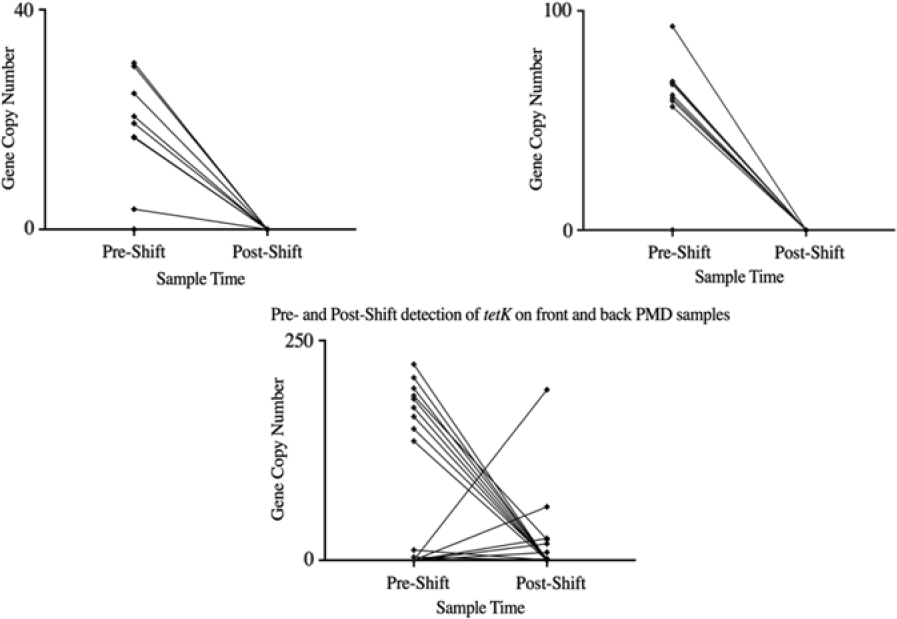
A novel multiplexed qPCR assay targeting the vanA, mecA, and tetK genes (Fig. 1) was developed for hand samples and for combined gDNA from the front and back of PMD samples. PCR amplifications were performed on a BioRad C1000 Touch thermal cycler (Applied Biosystems, Foster City, CA) using the following conditions: initial denaturation (3 minute, 95°C); 39 cycles including further denaturation of (15 seconds, 95°C), and annealing (1 minute, 64°C). Purified gBlocks (Integrated DNA Technologies, IL) were used to generate the standard curves for this assay. Results were expressed in gene copy number, and Student t tests were completed to determine significant differences (P ≤ .05) between the overall average of samples from each time point. These analyses were conducted in GraphPad PRISM version 7.0d software for Mac OS X (GraphPad Software, La Jolla, CA).
Antibiotic resistance genes (ARGs) quantified via quantitative polymerase chain reaction (qPCR) in combined front and back of personal mobile device (PMD) samples. Note the varying ranges in y-axes. A significant difference between the gene copy numbers of common ARGs was detected at the beginning of a work shift versus the end. Points indicated individual measurements and lines indicate the direction of change of pre-shift measurements per individual at the end of the shift.

Results
Detection of antibiotic resistance genes (ARGs)
Quantitative PCR was used to detect genes encoding for phenotypic resistance to commonly used antibiotics: vancomycin (vanA), methicillin (mecA), and tetracycline (tetK). The 2 ARGs included in this assay were detected in <50% of the participants’ PMDs at the beginning of the shift. The tetK gene was the only ARG detected at the end of the shift, in 10 of the 31 samples. Interestingly, we observed a significant decrease (P ≤ .05) in the gene copy numbers at the end of the shift, which suggests that fewer ARGs were present on the PMDs (Fig. 1).
Microbial community structure
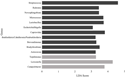
When comparing the samples obtained before and after the shift, 6 significant genera were identified with linear discriminant analysis effect size (LEfSe), and these were detected on at least half of the phones. Of these, 2 genera were found at significantly higher relative abundance (P ≤ .05) after the work shift: Cutibacterium and Lysinibacillus. However, there was no discernable change in the overall microbial community in pre- versus post-shift samples as tested via ANOVA for either ICU (P ≤ .05). LEfSe was also used to determine differences in the PMD bacteria relative abundance between the different ICU post-shift cell-phone microbiomes. Figure 2 shows the linear discriminant analysis (LDA) scores of the 9 significant genera that were detected on at least half of the phones. The 7 most abundant genera found on all PMDs sampled were determined and ranked according to average relative abundance: Cutibacterium, Delftia, Lactococcus, Lawsonella, Micromonospora, Staphylococcus, and Streptococcus. These 7 genera range in abundance from 10.6% to 90.2% of the total PMD microbiome, with a median value of 56.9%.
Linear discriminant analysis (LDA) scores indicating the genera with significant differences in relative abundance between the pre- and post-shift samples in the different intensive care units (ICUs). Dark gray bars represent significant genera from the surgical ICU (SICU) samples and light gray bars represent significant genera from the medical ICU (MICU) samples.

Discussion
This study investigated the change in bacterial microbiome and presence of ARGs on PMDs of ICU nurses during a 12-hour working shift. The results indicate that most ICU nurses who entered the hospital ICU with ARGs no longer hosted ARGs at the end of the working shift. These results may be influenced by the sterilization with an ethanol-based solution of PMD surfaces after the collection of samples before the shift. In this context, our findings suggest that a 12-hour working shift may not be sufficient for a PMD to develop a community of MDROs and ethanol, or another antimicrobial solution, is likely to reduce MDRO transmission in the hospital environmentReference Singh, Kaur, Gardner and Treen 1 .
Almost 30% of the PMDs sampled in this study hosted ARGs at the start of the shift, but only tetK was detected in a few samples at the end of the shift. Possibly, behaviors were altered during the workday because of the participants’ knowledge of the study mission and increased self-awareness of phone usage and hand hygiene compliance, as previously reported.Reference Chen, Carriker and Isaacs 9
Hospitals that have implemented guidelines for hand hygiene practices report a lower rate of hospital-acquired infections,Reference Johnson, Martin and Burrell 10 suggesting that hand-hygiene compliance can have major implications in proliferating MDROs in the hospital environment. Basic hygiene guidelines for PMDs in the hospital setting could include disinfection of mobile devices after patient contact and adherence to good hand-hygiene practices.Reference Singh, Kaur, Gardner and Treen 1
We hypothesized that the PMD microbiome would be significantly altered by the hospital environment; however, no significant shift in the overall bacterial community was observed. Several genera were different between the 2 ICUs, which may reflect the environment within the respective ICUs. Further sampling of the ICU environment would be required to verify this claim. Interestingly, of the 7 genera with highest relative abundance, Streptococcus was one of the most abundant and is also common among hospital-acquired infections. However, the sequencing method used herein did not distinguish pathogenic and nonpathogenic Streptococcus; thus, it is possible that the bacteria detected in this genus were common skin commensals.
The genomic technologies utilized in this research are capable of representing the microbial community structure within a sample and detecting genes of interest. However, these approaches are unable to determine microbial viability, which is of particular interest when assessing the potential of ARG transmission and infection. Furthermore, the multiplexed qPCR assay targeted subsets of large gene regions encoding for antibiotic-resistant phenotypes; thus, it is possible that the regions targeted in this study were not representative of the MDRO profile of these hospital units.
Future work could investigate how longer shifts, different hospital staff cohorts, or different PMD surfaces (ie, screen protectors) affect the presence of ARGs or the microbial community structure.
Supplementary Material
To view supplementary material for this article, please visit https://doi.org/10.1017/ice.2019.56
Author ORCIDs
Claudia K Gunsch 0000-0002-8555-0313
Acknowledgments
The authors thank Rachel Addison and Duke University Medical Center ICU nurse leads for their feedback on our sampling methods and their advice on interacting with nursing staff. Any opinions, findings, conclusions or recommendations expressed in this material are those of the author(s) and do not necessarily reflect the views of the National Science Foundation (NSF) and the Environmental Protection Agency (EPA). This work has not been subjected to EPA review and no official endorsement should be inferred. This work was approved by the DUMC Institutional Review Board (protocol no. Pro0078279).
Financial support
This material is based upon work supported by the NSF and the EPA under NSF Cooperative Agreement EF-0830093 and by the Center for the Environmental Implications of NanoTechnology (CEINT). S.J. Volkoff received support from the National Science Foundation (grant no. DGE 1545220). A.W. McCumber received support from the National Institutes of Health (grant no. T32GM008555).
Potential conflicts of interest
All authors report no conflicts of interest relevant to this article.