Introduction
A range of educational and therapeutic programmes are available as early interventions for children exhibiting what may be referred to as disruptive behaviours, conduct problems or externalising behaviours. These interventions attend to the development of social-emotional skills in children, enhancement of parenting skills for parents/carers and/or strengthening of parent–child communication and relationships. Programmes may be delivered by teachers in the classroom, by parent educators or, when concerns are more pronounced, by mental health clinicians. Mental health interventions focus primarily on parent education because parenting approach, including supervision, consistency of discipline and clarity of expectations, has been found to be the most significant factor impacting on a child's behaviour (Bonin, Stevens, Beecham, Byford, & Parsonage, Reference Bonin, Stevens, Beecham, Byford and Parsonage2011; Bywater, Reference Bywater2012; Hutchings et al., Reference Hutchings, Bywater, Daley, Gardner, Whitaker, Jones and Edwards2007; Scott et al., Reference Scott, Sylva, Doolan, Price, Jacobs, Crook and Landau2010).
Addressing emerging conduct problems when children are young, through building the capacities of parents, carers and teachers to respond effectively, has potential short- and long-term benefits. For children, the development of social-emotional skills can improve learning and the quality of peer relationships. Reducing disruptive behaviours in the classroom can ease classroom management demands and enhance learning opportunities for all children. Interventions can also lead to more harmonious family relationships and home environments (Bonin et al., Reference Bonin, Stevens, Beecham, Byford and Parsonage2011; Dretzke et al., Reference Dretzke, Davenport, Frew, Barlow, Stewart-Brown, Bayliss and Hyde2009; Furlong et al., Reference Furlong, McGilloway, Bywater, Hutchings, Smith and Donnelley2012; Waddell, Hua, Garland, Peters, & McEwan, Reference Waddell, Hua, Garland, Peters and McEwan2007). Of particular importance, however, is the relationship between early behavioural problems in children and the later development of persistent, defiant and aggressive behaviours and the associated diagnosis of conduct disorder. It is estimated that around 40% of children with early conduct problems develop conduct disorder (Hutchings et al., Reference Hutchings, Bywater, Daley, Gardner, Whitaker, Jones and Edwards2007). Early conduct problems and conduct disorder are also predictors of costly long-term antisocial and criminal behaviours (Scott, Knapp, Henderson, & Maughan, Reference Scott, Knapp, Henderson and Maughan2001). If early intervention for conduct problems is effective in reducing conduct disorder in the long term, there are significant gains to be made by individuals, families, the education system and society as a whole.
This article reports on a specialist multi-level programme called Getting On Track In Time! (Got It!) and the trajectories of a cohort of children and families for two years after they participated in the programme. Got It! is delivered in schools by NSW Ministry of Health through Child and Adolescent Mental Health Services (CAMHS), in partnership with NSW Department of Education. Got It! aims to reduce the frequency and severity of conduct problems at a time when intervention is likely to be effective (ages 5–8) and prevent the development of severe behaviour problems such as conduct disorder (Bywater, Reference Bywater2012; Foster, Olchowski, & Webster-Stratton, Reference Foster, Olchowski and Webster-Stratton2007). It builds capacities amongst teachers and families to support the development of social-emotional and peer-relationship skills in children. The programme includes targeted interventions for children with elevated behavioural concerns and conduct problems, and offers universal interventions for families and teachers in the school.
The research reported here builds on prior research that identified positive short-term outcomes from the Got It! programme (Plath, Croce, Crofts, & Stuart, Reference Plath, Croce, Crofts and Stuart2016), and the importance of universal interventions in the school environment as a condition for engaging families in targeted interventions (Plath, Crofts, & Stuart, Reference Plath, Crofts and Stuart2016). The current research addresses the questions of whether gains from the intervention are sustained two years post-intervention and how families understand the impact of the intervention at this point. The study aims to identify trajectory patterns for children and families over the two years and, through an examination of parental experiences, to develop a better understanding of what works, for whom and in what circumstances. The study also sought to identify implications for program implementation and follow-up supports.
Background Literature
There is a growing body of research literature that supports the effectiveness of parenting programmes in addressing child behaviour concerns, parenting practices and family relationships. A systematic review of 13 studies on group-based parenting programmes for early onset conduct problems in children aged 3–12 (1078 participants) undertaken for the Cochrane Collaboration concluded that, based on parent and independent assessments, parenting programmes produced significant reductions in child conduct problems and in negative or harsh parenting practices (Furlong et al., Reference Furlong, McGilloway, Bywater, Hutchings, Smith and Donnelley2012). Similarly, positive conclusions were drawn by Dretzke et al. (Reference Dretzke, Davenport, Frew, Barlow, Stewart-Brown, Bayliss and Hyde2009) from a meta-analysis of findings from 157 randomised controlled trials of parenting programmes. Whilst sample sizes in these studies tended to be small, consistent results of positive outcomes were found for intervention groups in comparison to the controls. No conclusions could, however, be drawn about the relative benefits of any one type of parenting programme over others (Dretzke et al., Reference Dretzke, Davenport, Frew, Barlow, Stewart-Brown, Bayliss and Hyde2009). Bonin et al. (Reference Bonin, Stevens, Beecham, Byford and Parsonage2011) undertook a meta-analysis of randomised controlled trials of prevention programmes and found an average 34% reduction in conduct problems (range: 20–68%) from pre-intervention to post-intervention if families completed programmes. This analysis included research on home, clinic and community-based programmes. Waddell et al. (Reference Waddell, Hua, Garland, Peters and McEwan2007) carried out a systematic review of preventative programmes for mental health disorders in children, including nine randomised controlled trials of programmes to prevent conduct disorder. Programmes included pre-school, primary school, home visiting and group-based programmes targeting children aged 0–8. All trials demonstrated significant reductions in at least one conduct related symptom or measure, with parent training and child social skills training identified by the authors as the most noteworthy interventions (Waddell et al., Reference Waddell, Hua, Garland, Peters and McEwan2007). In the context of growing support for the effectiveness of parenting intervention programmes, questions remain, however, about the longer term impact of interventions. Further research is required into the sustainability of positive post-intervention outcomes.
Aggressive and defiant behaviours associated with conduct disorder have expensive consequences in adolescence and adulthood. Retrospective studies demonstrate enormous costs to individuals and to society, largely attributed to criminal behaviour, unemployment, substance misuse and health and health service usage (Knapp, King, Healey, & Thomas, Reference Knapp, King, Healey and Thomas2011; Scott et al., Reference Scott, Knapp, Henderson and Maughan2001). Based on a systematic review that identified two methodologically strong economic evaluations of early intervention programmes, Furlong et al. (Reference Furlong, McGilloway, Bywater, Hutchings, Smith and Donnelley2012) concluded that there is evidence for the cost-effectiveness of programmes of modest cost that bring children with clinical conduct problems into the non-clinical range. Bonin et al. (Reference Bonin, Stevens, Beecham, Byford and Parsonage2011) modelled costs and benefits from early intervention programmes for children with conduct disorder and found that even in a worst case scenario, where the chance of conduct disorder persisting is reduced by less than 5%, there is still an economic benefit derived from the programmes. Confidence in the economic benefits of early intervention does, however, rely upon building a body of evidence on the sustainability of parenting practices and behaviour improvements following the interventions.
Got It! is informed by research indicating that multi-level programmes targeting school, family, individual and peer systems in an interactional way are effective in addressing conduct problems and strengthening protective environments for children and families (Bywater, Reference Bywater2012; Foster et al., Reference Foster, Olchowski and Webster-Stratton2007; Webster-Stratton & Reid, Reference Webster-Stratton, Reid, Murrihy, Kidman and Ollendick2010; Woolgar & Scott, Reference Woolgar and Scott2005). Such programmes utilise established practice theories in group work, social learning and family processes and draw on knowledge of risk and protective factors. Programmes rely on multi-agency collaboration to establish and trained professional staff to deliver (Bywater, Reference Bywater2012; Trentacosta & Shaw, Reference Trentacosta, Shaw and Grigorenko2012).
The GOT IT! Intervention
Got It! is delivered in schools, targeting children in Kindergarten to Year 2, aged 5–8 years. The Got It! team comprises mental health clinicians located in CAMHS in the Local Health District (LHD). The team engages for a period of six months with each participant school and the different components of the programme are planned and delivered in partnership with the school. Got It! provides universal screening for conduct problems, universal interventions for parents and teachers, and an intensive targeted group intervention for parents with their children who are identified through the screening as having emerging conduct problems. All Kindergarten to Year 2 children are screened using the teacher and parent versions of the Strengths and Difficulties Questionnaire (SDQt and SDQp) (Goodman, Reference Goodman2001). Those with scores in the abnormal or borderline bands for the conduct sub-scale in either measure are shortlisted for further assessment of suitability for the targeted intervention programme. Following consultations with teachers, observation of children and assessment interviews with parents/carers, a group of up to 8 children, together with a parent/carer, are selected for a ten-week group intervention programme. Only families in which a parent/carer commits to attend the group programme are invited into the targeted intervention.
The intervention group is held at the school, led by the Got It! clinicians and co-facilitated by school staff. Exploring Together (Hemphill & Littlefield, Reference Hemphill and Littlefield2001) was the group intervention programme used in Got It! during the research intervention. Exploring Together comprises a child-focused group, a parent/carer-focused group, an interactive child–parent/carer group, partner evenings for other parent/carers not able to attend the weekly group and teacher meetings. The child-focused group explores anger management, pro-social skills, conversation skills, problem solving and decision making. The parent/carer group focuses on awareness of feelings and relationships, understanding factors that can influence behaviours, behaviour management techniques and enhancing parenting strengths. The combined parent/carer–child group focuses on modelling and supporting the development of positive adult–child communication and relationships. There is also social time for parents/carers, children and facilitators to interact informally. In addition, the Got It! model of care includes consultation between clinicians and classroom teachers and referral of children and families to other services as appropriate. The attendance rate in the targeted intervention programme was found to be high, with child and parent/carer attending together for 88% of sessions (Plath et al., Reference Plath, Croce, Crofts and Stuart2016).
Research Methods
A mixed method design was used to examine outcomes for a cohort of children who participated in Got It! during 2013. Data were analysed from four time-points: pre-intervention; immediately post-intervention; six months post-intervention and two years post-intervention. Findings relating to the first three time-points were previously reported (Plath et al., Reference Plath, Croce, Crofts and Stuart2016). In the current research, SDQt data from the earlier time-points were analysed together with data gathered at the fourth data collection point. Qualitative data collected at the fourth (two-year) data point is also reported here. Ethical concerns relating to privacy and personal intrusion were addressed through signed, informed consent and de-identification of data prior to analysis. Ethics approval for the research was granted by the Hunter New England Human Research Ethics Committee and the Schools Education Research Approval Process.
Sampling
During a six-month intervention period in 2013 there were 63 children who completed the Got It! targeted group programme, together with a parent/carer, in 12 schools across three LHD sites in New South Wales (regional city, rural and capital city-suburban sites). These families participated in 12 separate groups ranging in size from 4 to 8 families. A sample of 60 from the population of 63 families participated in the study, being those who consented to pre, post and six-month data collection. In 2015, letters were sent by the researcher to the 57 families, for which addresses had been current at the six-month follow-up, inviting participation in the two-year follow-up study. Schools were also asked to distribute letters of invitation to those families who had not responded within three weeks of the invitation being sent. School staff at this point also provided information to the researcher on which children had left the schools.
A total of 45 children from the original sample of 60 Got It! participants were found to have remained at the same schools for the two-year period. A current address could be confirmed for only one of the 15 children who had changed schools. In addition, one child who remained at the same school had been placed in out-of-home care and was no longer in the care of their family who participated in Got It! For that reason the child was excluded from the two-year follow-up research. A total of 45 families from the original sample of 60 families therefore received invitations to participate in the two-year follow-up study (75%).
Measures
The version of the SDQt was used to measure behaviour outcomes at the four time-points. The SDQ is a 25-item child behaviour screening tool with UK norms that generates scores and sub-scores within abnormal, borderline and normal bands (Goodman, Reference Goodman2001). There are both parent and teacher versions of the SDQ. The SDQt is completed by teachers on the basis of their experience of the child in the classroom. The total difficulties score on the SDQ is comprised of five sub-scales: Emotions, Conduct, Hyperactivity, Peer Problems and Pro-social Behaviour. The Conduct sub-scale is most relevant to the Got It! programme and was used as the behaviour measure for the research. Participant schools were contacted requesting that classroom teachers complete the SDQt for children for whom parental consent had been provided for this data collection. Due to class changes, each child was rated at the two-year follow-up point by different classroom teachers to the earlier data collection points. Good reliability and validity has been found for the SDQ measure in the Australian context, which supports the use of multiple raters (Hawes & Dadds, Reference Hawes and Dadds2004).
Qualitative data on family experiences subsequent to the Got It! targeted intervention was gathered from interviews with the parents who participated with their children in the intervention groups. Parents were offered either a face to face or telephone interview. Interviews were audio recorded and fully transcribed for analysis. The semi-structured interview schedule comprised open questions relating to: child's current behaviour, behaviour changes over the past two years, factors seen to contribute to behaviour changes, parent–child relationship, changes to parenting approach resulting from Got It!, perceived impact of changes in parenting practice, other siblings in the family and the indirect impact of Got It! for them, involvement with the school community, help-seeking behaviours, referral to and involvement with other services since Got It!, and barriers to obtaining help with parenting.
Analysis
Unique identifiers for participant children were used to track SDQt conduct scores and bands across the four time-points (pre-intervention, immediately post-intervention, six months post-intervention and two years post-intervention). SDQt band (Abnormal, Borderline and Normal) movements by children over the two years were used to create behaviour trajectories. Participants were placed into four trajectory groups: (1) Pre-intervention scores in abnormal band and all post-intervention scores in normal band, (2) Pre- and post-intervention scores consistently in abnormal or borderline bands, (3) Fluctuation between bands across the time period and (4) Pre- and post-intervention scores consistently in normal band. It should be noted that children in group 4 were provided with the targeted intervention on the basis of abnormal pre-intervention conduct sub-scores on the SDQp, despite having scores in the normal band on the SDQt.
SDQt scores were analysed to determine any statistically significant changes for the group as a whole. The Linear Mixed Model (LMM) analysis with compound symmetry residual correlation structure was used to model correlation between repeated SDQt conduct sub-score measures over the two years for each child. For the SDQt conduct bands, a fitted model using Generalised Estimating Equations (GEE) with multinomial distribution was used for the three bands (normal, borderline and abnormal) and a log link function. A compound symmetry correlation structure was used to model correlation between repeated measures over time for each child.
Qualitative data from parent interviews were de-identified and unlinked from SDQt scores prior to analysis to avoid potential coding bias that could have arisen from knowledge of the SDQt conduct trajectories. Interview data were coded thematically within the pre-determined categories: child's current and past behaviour, factors impacting on behaviour, parent–child relationship, changes to parenting approach, impact of parenting approach, impact for other children, engagement with school, help-seeking behaviour, involvement with other services and barriers to obtaining help. Within each category, sub-themes and divergent experiences or views of the participants were also coded. Participant quotes were extracted and grouped within categories and sub-themes.
The final stage of analysis entailed linking qualitative data back to SDQt conduct band trajectory groups. Qualitative themes and sub-themes were re-examined within and between trajectory groups to identify patterns of similarity and difference and to inform understanding of how aspects of the intervention programme could impact on the issues faced by children and families in the different trajectory groups.
Findings
Sample Characteristics
A total of 27 from the original sample of 60 families (45%) consented to participate in the two-year follow-up study, which comprised 60% of the 45 families who could be contacted at the two-year point. All 27 consented to the collection of SDQt data and 14 consented to an interview. SDQt data were not collected for 1 child due to the child's transfer to a school that had not participated in the Got It! programme. Only interview data were obtained for this family. The final sample at the two-year follow-up point thus comprised 26 with results for the SDQt measure (43% of the original sample and 58% of the group contacted) and 14 interviews (23% of original sample and 31% of the group contacted).
The sample comprised 14 families from the regional city LHD site, 8 families from the rural LHD site and 5 families from the capital city-suburban LHD site. There were 20 boys and 7 girls in the sample, reflecting the predominance of boys in the intervention programme.
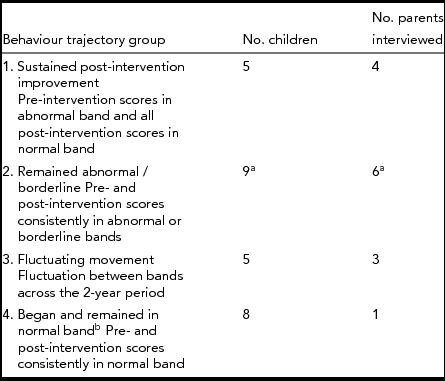
Table 1 provides the numbers of children in each of the behaviour trajectory groups and the number of parents interviewed in each group. The group of children rated by teachers in the normal conduct band on the SDQt for each of the four time-points is under-represented in interviews, with only one parent interview in this group.
Child 2-year behaviour trajectories groups on SDQt conduct (n = 27).

aIncludes one participant with no SDQt score for 2-year time-point.
bPre-intervention conduct scores on parent version of SDQ were in abnormal or borderline band to qualify for intervention.
Child Behaviour Measure
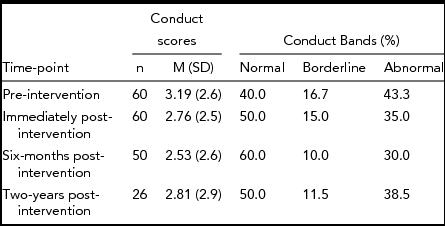
The SDQt scores and bands for the Conduct sub-scale at the four data collection time-points are provided in Table 2. The desirable outcome of lower mean scores (indicating improved behaviour) and higher proportions in the normal score band were found for all time-points post-intervention. Whilst these results show a trend in the desirable direction, the LMM analysis did not find a statistically significant reduction in behaviour scores for the whole sample for the two years (p = .42). Analysis of behaviour bands also found that the post-intervention change was not statistically significant (Wald test, p = .09).
SDQt conduct scores for four time-points.

Parents’ Experiences and Views
Whilst for the sample as a whole, the improvements in SDQ Conduct scores and bands were not statistically significant, some children did show clinical improvements, demonstrated by a sustained shift in behaviour band, and some did not (Table 1). Analysis of qualitative data from parent interviews enabled better understanding of what was at play for children in each of the four behaviour trajectory groups in Table 1 and the implications for programme implementation.
-
1. Child's current behaviour
All parents of children with sustained improvement from abnormal pre-intervention to normal post-intervention on SDQt conduct scores reported positively on their child's behaviour. This showed a correspondence between teacher and parent assessments of the child's behaviour.
Everything like we went to the Got It! programme in relation to has all improved and is back on track (P1).
Generally his behaviour is much easier to manage. . . In all aspects he's doing pretty well really (P2).
All parents of those children who remained in the abnormal/borderline bands recognised that they were still facing challenges with their child's behaviour, although some improvements were noted.
He's learnt to control his anger a bit more now. . . . But there is the odd day where he does have his really bad day. . .he lashes out at them and he hits them and yells and screams. . .maybe once a week or once a fortnight (P9).
Improving slightly. . . but he's picked up other behaviours. . . stealing . . . at home and at school (P14).
Similarly, parents of those children with fluctuating scores reported some gains and some continuing or new problems with their child's behaviour.
He does have problems at school, like he's not as bad as he used to be, he hasn't got in trouble this year at school. Normally if he doesn't get his own way he'll chuck a tantrum (P5).
Not too good. . . . His anger, temper, yeah that's pretty much it. . . from what the school was telling me it was going good there for a good while and then all of a sudden just started going downhill again. . . .fighting and just anger problems (P7).
The parent of the child who remained in the normal band on the SDQt experienced their child's behaviour differently to the teacher's assessment in the school setting. This corresponds with the pre-intervention assessment at which time the child also scored in the abnormal band on the parent SDQp and in the normal band on the teacher SDQt.
He's an angel at school. . . He has a lot of issues and clashes with me at home (P12).
-
2. Factors impacting on changes in behaviour over time
For the children with sustained improvement, parents attributed this partly to the group intervention programme, but also to the support and strategies provided by the school and to the natural maturity process for the child.
It did sort of kick in immediately (after Got It!) and it has been sustained, which is good. It hasn't actually needed a lot of ongoing thought because I think it was something with her that just had to click a little bit, and she got given the skills. She learnt the skills and put them into practice (P1).
It [Got It!] must have sunk in somewhere because it's stuck with him. . . He's been really good (P11).
There's been a lot of change. . . His attitude is much better. . . It's been a slow change over the two years. . . started after Got It!. . . He's grown up a fair bit too (P13).
For those children who remained in the abnormal/borderline bands, parents attributed ongoing problems to underlying psychological, physiological and environmental factors. All said that Got It! made an impact, but due to other more significant issues, the programme was not enough. One parent spoke about a trauma that the child had experienced that involved the police and counselling, others spoke about family upheavals and diagnoses of underlying conditions. Parents in this group also regarded the school environment as one of the factors that could impact positively or negatively on the child's behaviour.
The Got It! programme it did help. . . But we could see that she was struggling. . . Finally when we did get her on medication – we're on medication trials, and she did have those ups and downs when she had side effects from the medication (P3).
There's a number of things that have occurred since Got It! but Got It! certainly helped lay a foundation. . . We changed schools. . . he's an individual and he's also quite impulsive (P6).
We gave that Got It! programme everything that we could at home as well. It impacted at home and it did help him gain some confidence and social skills. . . But yes, there were underlying issues and I think that getting him diagnosed and getting some extra help. . . all of that together has had an impact (P8).
The parent of one child who fluctuated between bands across the time period spoke about her relationship breakdown and moving houses during this time and how this had impacted on her child's behaviour. The other two parents in this trajectory group regarded the classroom teacher as the key factor impacting on their child's behaviour and appeared to regard the behaviour concerns as a school issue.
The parent of the child with scores consistently in the normal SDQt conduct band could not identify any improvements as a result of the Got It! programme and, despite the positive assessment by the teacher, experienced escalating behaviour problems at home.
I can't really remember how he was before Got It!, but his behaviour has escalated since then. But different issues set him off now. . . he's more aggressive now. That's why he's seeing the school counsellor. . . It's all good with his peers and at school and the school counsellor wasn't going to take him on, but there were too many explosions at home (P12).
-
3. Parent–child relationship
Parents across all groups reported positive relationships with their children. A number of parents attributed lasting improvements to Got It!
I've learnt how to encourage her how to step out of her comfort zone a little bit and I've sort of learnt that that's okay and that she's capable of doing that. So, yeah, I guess in that way it has changed (P1).
She's a lot more open. She tells me what's going on. If she has troubles and things like that, she'll actually open up and she'll tell me, whereas before she'd try and deal with it in her own little way. It has helped her as well. Even though it's two years, it still sits in the back of her mind. Yeah we're a lot closer (P3).
It really helped in improving our relationship, giving us a framework for discussing things that otherwise might be difficult to discuss. . . I took a few hours out of the working day to put aside to focus solely on building a better relationship with my child (P6).
She gives me more cuddles now. She didn't do that before. . . There were things we had to do together for the Got It! group and we had to talk about things, which was helpful (P14).
-
4. Parenting strategies
All parents spoke about strategies they had learnt through Got It! and still use. No trends were apparent that distinguished the four trajectory groups. Parents of children with sustained improvement spoke about being firm, setting boundaries and expectations, establishing and following through with behaviour consequences, using time out, not yelling, attending to oneself, being self-reflective and organising family activities. Parents of children who remained in the abnormal/borderline bands said that being consistent, encouraging ‘stop, think and thumbs up choices’, talking about feelings, giving warnings/chances, using time out and giving clear and short directions were the most useful strategies. Parents of children with fluctuating SDQt bands spoke about talking things through, not yelling, giving warnings, having consequences for behaviours, using timeout, parent self-awareness and self-control, and setting rules. The parent of the child in the normal band said she had developed more patience and understanding that children need time and tolerance.
-
5. Impact for others in family
Across the four trajectory groups, parents reported applying what they had learnt from Got It! to their parenting of other children. Whilst a couple of parents said that changes were not really necessary with other children due to these children having different personalities and no behaviour issues, most said that they had adopted consistent approaches with all of their children. Some said how much easier parenting had become with their younger children, but there were also benefits noted in relation to older children.
I think my strategies are definitely more significant with her [older daughter] than with [child who attended]. . . So the relationship that I have now with [older daughter], especially because she is 14 now, it's improved dramatically, in the fact that I don't get angry anymore. It doesn't work. I realise it doesn't work. So I sort of take a step back and look at things less personally and more logically and work things through from looking at things from her perspective and then discuss things with her. We have come a long way (P1).
I don't just do it with [child in programme]. . . so he doesn't feel left out or different. . . They know the consequences or what's going to happen if they misbehave or get cranky. . . they know where they stand (P5).
I do the same thing with my other boys as well. . . just to like stop and calm down and think about what they're going to do before they do it. . . They say boys will be boys, but I don't really want to be like that, so I try and get them to calm down and talk about why they're arguing with each other. . . You've got to stop and think, I tell them, and that's part of the programme to stop and think about what you're going to do (P11).
-
6. Involvement with school
Six parents from across the groups said that involvement with Got It! led to a closer engagement with the school and with other families. The programme did not lead to closer involvement with the school for the other 8 parents for two reasons. Five parents said that they were already very involved at the school. Three parents said that work commitments limited their capacity.
It helped us as a group of parents to achieve some kind of normalisation as parents of children who don't really fit inside the box and it gave us a forum to discuss what we were doing with our children (P6).
I wasn't involved with the school, like not much, because I never had to go up there. . . but I'm always up at the school now. I'm on a first name basis with all the teachers (P7).
I got to know the others in the group, which was useful when we started at the school. There are people you know, who you've shared things with. You don't feel as isolated (P14).
-
7. Help-seeking behaviour
Whilst half of the parents across the different groups said that they would have sought out assistance with parenting if they were not offered a place in the Got It! programme, all were uncertain as to where and how they would have found assistance and how long it may have taken.
A difference was, however, found between the trajectory groups in relation to help-seeking behaviour following Got It! In three of the groups (sustained improvement, fluctuating and normal) either no follow-on services were utilised or the only follow-up was provided internally within the school by the school counsellor. Most parents said that they had been given information from the Got It! team on how to access follow-up services if required, but did not think this was needed. The experiences with follow-up services were notably different for the children with scores that remained in the abnormal/borderline bands across the four time-points. Five of these six children had been linked into specialist services in response to the concerns about underlying psychological and physiological factors impacting on the child's behaviour. Participation in the Got It! programme led to a heightened awareness and motivation to follow through with finding further help, and in some cases Got It! staff facilitated access to specialist services.
She's just been diagnosed with ADHD and OCD. . . We actually thought that it was just [child] being a child with her behavioural problems until she came into the Got It! programme. . . So that actually helped us find out things that were actually the norm for her age group. . . So we're actually thankful for the Got It! programme for pointing us in the direction of which way to go about things. . . The Got It! programme actually helped push those issues to get us faster through getting those referrals. So without that we don't know how far we would have gotten. . . We'd probably still be waiting to see the paediatrician today (P3).
-
8. Barriers to accessing parenting help
Parents across the four trajectory groups identified barriers to getting help with parenting a child with behavioural problems, including cost, waiting times for assessments, limited intervention options, lack of knowledge on available services, stigma surrounding child behavioural and family issues, self-blame, isolation and lack of social supports.
I think trying to find a private psychologist or someone like that, the cost of it might have been prohibitive. . . Trying to find out who would be good to go to in this area coming from somewhere else would be difficult. . . trying to get to know other parents in the rush of drop-off and pick-up without having had that time at Got It! would have been quite difficult, so I'm not sure that I would have tapped into the connections that I've got now if that hadn't been available. . . Knowing who to ask for help because it's the thing that's a bit awkward. You don't feel like saying - oh, I'm not sure how to manage my child's behaviour. It would be hard to know who to open up to about that really (P2).
For low income families there's a lot of barriers because they have to go on waiting lists and they have to have that label before you get any help. . . If it hadn't have been for Got It!, who knows where we would have ended up (P4).
Knowledge on where to go for help. . . A lot of people don't have information and don't know where to go for help (P12).
You feel like it's your fault. You have to say that there's a problem (P14).
All parents reported that Got It! was enjoyable, easy to access and viewed positively within the school environment. It offered a way to overcome the barriers to accessing help.
Discussion
Whilst statistically significant improvements in SDQt scores and bands were not found for the sample as a whole, the SDQt results were used to group children into those who did maintain clinical improvements in behaviour for two years post-intervention and groups that did not. Information gathered from parent interviews indicates that for children with sustained positive outcomes, benefits were derived from parents learning about parenting approaches, building stronger connections with the school community and having opportunities to focus upon and gain feedback on the parent–child relationship. Benefits are reflected in sustained improvement in child behaviour scores. The targeted group programme was sufficient for these families, who took away new knowledge and experiences and were able to maintain positive gains.
In contrast, there was a group of families whose children's behaviour remained in the abnormal or borderline ranges. Findings indicate that the early intervention programme did still play an important role with this group. Parents reported that Got It! helped to identify their children as having more significant physiological and psychological issues or social and environmental concerns, and to motivate and facilitate access to specialist services. These services included the National Disability Insurance Scheme, domestic violence services, trauma counselling, housing services, separation and custody support, paediatric assessment, family case management, psychology services and family counselling. According to the parents, information, contact details, encouragement, assessment reports and letters of recommendation obtained from the Got It! team can facilitate access to therapeutic, support and other specialist services. Potential barriers to accessing services, such as lack of information, waiting times, stigma and self-blame, may consequently be reduced. Participation in Got It! could prepare and support families to negotiate the help-seeking process, which for some families will be a long-term process. Got It! acts as a conduit to follow-up services for the group of families with children who remain in the abnormal/borderline behaviour bands by the end of the targeted intervention. Attention to building strong professional networks and referral pathways beyond the group intervention is a practice implication of these findings.
The families of children who maintained a shift from the abnormal band to the normal band post-intervention identified that Got It!, along with a number of other factors, positively impacted on child behaviour. These other factors included the natural maturation process and the structure and processes within the school setting. The importance placed on the school setting supports the location of Got It! within schools and the value in offering professional development and consultation for teachers to enhance their capacity to support the social and emotional development of children. Positive teacher experiences, perceived teacher support, effective classroom management and parent engagement in learning and schooling are all factors that have been found to work as protective factors in the wellbeing and positive development of children (Fox et al., Reference Fox, Southwell, Stafford, Goodhue, Jackson and Smith2015). For parents across the trajectory groups, Got It! facilitated closer links with the school. This included building relationships with teachers, feeling comfortable to get involved in school activities and developing friendships with families at the school. Attention to integrating the programme within the school system, rather than simply locating it there, is a principle for effective intervention.
Two years on from the Got It! intervention, parents in all trajectory groups were able to identify ways in which their parenting approach had changed as a result of the programme and spoke of effective strategies that they still used. With an average of 2.65 children per family, potential flow-on effects to other children in these families is an important consequence of the programme. Comments from parents indicated that changes in parenting approach are making a difference for both younger and older children in their families and, as such, could have early intervention and preventative impacts.
The small sample size in this study and the reliance on qualitative data limits the strength of findings and the ability to generalise findings beyond the experiences of study participants. Whilst a 55% attrition rate for a two-year follow-up study is acceptable, the final samples of 26 children for the SDQt measure and 14 parents participating in interviews are quite small. The lower response rate is partly due to children changing schools, which was the case for 15 of the 60 who originally consented to participate in the research (25%). There is also the potential for sample bias towards more motivated parents and those with higher regard for the Got It! programme, but it was not possible to verify these conjectures. A larger, long-term study with a non-intervention control group may provide stronger evidence on the impact of the Got It! intervention programme, and the potential to test the findings from this study.
Another limitation of the study is the SDQt as the measure of child conduct. The SDQt is useful as a screening tool when followed by a more thorough assessment, but it is not a diagnostic tool. The SDQt provides an indication of potential behaviour concerns and a general picture of behaviour trajectories over the period, but may not be sufficiently sensitive as a measure of child behaviour for the purpose of establishing behaviour improvements in this small sample study. SDQt scores did, however, complement the qualitative data from parent interviews by offering insights into child behaviour in the school setting and general trends of change over the two years.
Conclusions
Considerable benefits are to be gained from parenting intervention programmes that achieve sustainable improvements in child behaviours into adolescence and adulthood. Evidence-based approaches to practice have moved on from notions of ‘what works’ to more nuanced understandings of ‘what works, for whom and under what circumstances’. This small study has contributed to that understanding in relation to early intervention programmes for children with emerging conduct problems. Further research is required to address not only the question of whether post-intervention changes are made and sustained, but also questions about the types of children who make gains and how children who continue to struggle can be better supported to make improvements.
Whilst improvements in SDQt scores were not statistically significant for the sample group as a whole, this research has revealed some of the varying experiences and trajectories for a group of 5–8 year old children with emerging conduct problems and their families who participated in the school-based Got It! programme. Parenting strategies developed through Got It! were reported by most parents to have had an ongoing presence in their family lives during the two years after the intervention, and the programme was viewed as having made a positive impact on parent–child relationships and child behaviours. The struggles experienced by families of those children whose behaviour had not improved following Got It! were highlighted by the research. If the Got It! programme is to maximise preventative and early intervention goals, the research suggests that linking families with follow-on health, social and family intervention services in the community is more important for some families than the Got It! targeted group intervention itself.
The location of Got It! within schools was important for families. Access is easy and families are supported to develop stronger relationships with teachers and other families and to become involved with school activities. As parent–school relationships are a protective factor in child wellbeing and development, the presence of Got It! in the school environment and the role of the programme in building the capacities of teachers through professional development and consultation is supported.
The findings from this small study suggest that for some children and families, the targeted group intervention programme was sufficient to address behaviour concerns. Other families require ongoing services in response to specialised needs. It appears that a successful early intervention programme for emerging conduct problems requires a targeted parenting intervention programme, strategies that facilitate access to specialised services, and attention to building capacities for the ongoing support of families within schools.
Acknowledgements
Research conducted under contract for NSW Ministry of Health. Statistical analysis undertaken by Statistical Support Service, University of Newcastle.