INTRODUCTION
Palliative care nursing involves several types of stressors, such as organizational, professional, and emotional (Fillion et al., 2003b). By the very nature of their work, nurses practicing palliative care encounter emotional stressors such as repeated deaths, as well as the distress and difficult questions from their patients and families. This article offers one answer to these nurses' particular emotional stressors; that is, it describes an intervention whose purpose is to create a framework and strategies for alleviating nurses' burden of care, reduce stress, and increase their work satisfaction. The first section provides an understanding of workplace stress, stressors particular to palliative care nursing, coping theory and interventions, and ends with Frankl's logotherapy. The next section describes the development and validation of the intervention. Then we depict the intervention announced above. Finally, a brief conclusion for future directions regarding the evaluation of the intervention's efficacy and the accompanying process is provided.
RATIONALE AND OBJECTIVES
Workplace stress occurs generally when the work environment's demands exceed the employee's available coping resources (Cox et al., 2000). It contributes to negative outcomes at both organizational and individual levels. For the organization, work-related stress tends to be associated with high rates of absenteeism (Brun et al., 2003; Moreau et al., 2004; Verhaeghe et al., 2004) and can decrease employees' performance and productivity (Beehr et al., 2000). At the individual level, stress experienced at work is understood to be related to a high incidence of health problems (de Jonge et al., 2000; Niedhammer et al., 2004; Rosengren et al., 2004), burnout (Parker & Kulik, 1995; Calnan et al., 2000), and job dissatisfaction (Calnan et al., 2000; de Jonge et al., 2000).
Nursing is recognized as a highly stressful occupation (Humpel et al., 2001; Verhaeghe et al., 2004). It is characterized, among other things, by heavy workload, uncertainty regarding treatment and discrimination, important budget cuts (Yang et al., 2004), verbal abuse by other nurses (Rowe & Sherlock, 2005) and patients (Lawoko et al., 2004), poor hospital design characteristics (Ulrich et al., 2004), and demanding work schedules (Geiger-Brown et al., 2004). Despite an increase in job demands, social support and available resources necessary to cope with these demands often remain insufficient (Demerouti et al., 2000). Moreover, some researchers have concluded that work-related stress among nurses could contribute to reduced perceived quality of care provided to patients (Levek & Jones, 1996; Hannan et al., 2001). For instance, nurses under stress tend to experience fatigue, thus becoming more likely to commit errors that could threaten patients'quality of care (Ulrich et al., 2004).
More specifically, palliative care practice research repeatedly suggests those providing palliative care could be particularly at risk for experiencing workplace stress (Alexander & Rotchie, 1990; Wilkes et al., 1998; Yang et al., 2004). Palliative care consists of providing comfort and support and improving quality of life for patients living with fatal diseases, such as cancer (Canadian Hospice Palliative Care Association, 2002). Although they are confronted with the same professional and organizational challenges as all practicing nurses, those working with the dying have to cope with particular emotional demands (Plante & Bouchard, 1995; Vachon, 1995, 1999; Fillion et al., 2003b). These emotional stressors include multiple bereavements, exposure to patients' and families' distress, and personal discomfort about suffering and death (Farrell, 1998; Wilkes et al., 1998; Ersek et al., 1999; Vachon, 1999). Despite all this, they often describe palliative care as one of the most rewarding parts of their work, although emotional stressors specific to the care of terminally ill patients can be particularly challenging for nurses (Katz & Genevay, 2002; Fillion et al., 2003b).
From Stress to Coping
It goes without saying that coping with stressful events is a complex process. Over the years, several stress-coping models have emerged, involving strategies such as problem- and emotion-focused coping (Lazarus & Folkman, 1984; Folkman, 1992). Problem-focused coping has been shown to be adaptive when facing circumstances that allow for some sort of control (e.g., a nurse deciding to be systematic in attending to her patients in order to better manage her time). On the other hand, emotion-focused coping is related to psychological adjustment when an individual feels out of control and, thus, unable to act satisfactorily (e.g., a nurse feeling incompetent and ill at ease in caring for a terminally ill patient). A further distinction regarding emotion-focused coping is that it can be either active or passive. When applied passively in circumstances where the individual could be solving the issue (e.g., worrying about a patient instead of consulting with a doctor so as to alleviate the patient's pain; complaining to a colleague or family member rather than addressing one's sense of work overload with a supervisor), emotion-focused coping may lead to more distress. Active strategies, be it emotional, behavioral, or cognitive, appear to be more efficient on emotional outcomes than passive ones (Carver et al., 1989; Stanton et al., 1994, 2000).
The concept of meaning making, being an active coping strategy, was later elaborated in stress-and-coping research after researchers studied strategies people use when they are facing unwanted and unchangeable events (Park & Folkman, 1997). Meaning is defined as “perceptions of significance” (p. 116). Park and Folkman's model includes two levels of meaning: global meaning and situational meaning. Global meaning represents one's beliefs systems and important goals (proximal and distal), whereas situational meaning refers to the immediate appraisal of an event (i.e., how important and relevant it is to me) and the search for its meaning, which, in turn, interacts with, and may modify, the person's global meaning. Whenever global and situational meaning are discrepant, distress ensues. This type of discrepancy tends to take place whenever unchangeable life events bring suffering and loss, such as the death of a patient after several days (and at times years) of care, especially if the patient was young, the relationship close, and in the context of multiple deaths (Ramirez et al., 1998). According to the theory, the individual then has two choices: either change his or her global meaning to match the situation or reappraise the situational meaning (i.e., giving it a new meaning) so that it coincides with his or her global meaning. The shift in or relinquishment of beliefs would be accomplished through cognitive reappraisal. Changes in or adaptations of beliefs and meaning (i.e., regaining control over the meaning of the situation) bring a sense of control, which leads to better psychological adjustments (Bandura, 1997). Because global meaning beliefs work as motivational factors that give a person a sense of purpose, which, in turn, leads to goals, a change in beliefs leads to the articulation of new meaningful goals. In turn, new goals generate matching actions. In that sense, meaning refers to beliefs that organize, justify, and direct a person's striving (Antonovsky, 1987; Csikszentmihalyi, 1990).
An illustration of such a shift would be a nurse exerting a lot of energy in “healing” her patients, believing that “curing” was her purpose as a nurse, until she is faced with caring for her terminally ill father. As she realizes, and is being deeply touched by, the importance of keeping her father comfortable, pain-free as much as possible, and finding ways of lifting his spirits, she may adjust her professional beliefs, thus making comfort and life meaning her priorities. Meaning making has been shown to lead to less psychological distress and greater life satisfaction (Holahan et al., 1995; Moskowitz et al., 1996), better adjustment (e.g., Antonovsky, 1987), and the ability to move on (Brooks & Matson, 1982; Horowitz, 1990). Conversely, some argue that distress and depression are more likely whenever people are unable to let go of unreachable goals (Martin & Tesser, 1989). It follows that because nurses providing palliative care frequently encounter unavoidable stressors, such as repeated deaths and families' upsets, helping nurses cope with such stressors, by introducing them to the concept of meaning making and the subsequent sense of control it generates, would be beneficial. The following section investigates existing coping interventions targeting nurses practicing palliative care.
Coping Interventions in Palliative Care Nursing
Radziewicz (2001) proposes several self-care strategies to help nurses cope with emotional demands related to palliative care. Adjusting the pace of work, taking regular 20-min breaks, maintaining good nutrition, and practicing regular physical activities are believed to enhance nurses' well-being. This author also suggests that meditation, breathing exercises, journaling, and cognitive reframing (i.e., reappraising the stressful situation in a positive manner) represent effective individual coping strategies to buffer emotional stress in palliative care nursing.
Group interventions, aiming at reducing workplace stress, are another type of strategy intended to prevent burnout among palliative nurses. Many hospices and palliative care units have support groups for their staff (Parry, 1989; Van Staa et al., 2000). These groups can be specific for nurses or can include any member of the interdisciplinary team (e.g., doctors, chaplain, volunteers). Support groups allow participants to share work-related affective experiences and discuss clinical management of patients. Such groups are described as being effective in decreasing stress (Parry, 1989).
Another type of group intervention to support palliative care professionals focuses on creativity and self-care (Murrant et al., 2000). It aims at encouraging caregivers to discover their own resources through creativity and play. The intervention consists of a one-day workshop including three modalities: journal writing, art therapy, and music therapy. At the end of the day, participants have to talk about their experience. Participants reported appreciating the opportunity to take time for themselves and to share their experience in palliative care with other caregivers.
These strategies and interventions can help nurses cope with emotional demands specific to palliative care but present limitations. For instance, although existential (i.e., meaning-making) dimensions are crucial in end-of-life caregiving (Park & Folkman, 1997), it was not directly addressed in any of these interventions. Additionally, rewards and benefits associated with accompanying end-of-life patients, an experience frequently reported by nurses as satisfying, are not used in the therapeutic process. The workplace positive elements (i.e., rewards and benefits) could stimulate nurses to find meaning in their work and, consequently, enhance their well-being and job satisfaction (McConnel, 1998). Moreover, these coping interventions are not specifically designed for nurses; they are often adapted for or offered to the entire multidisciplinary team. Therefore, they do not match the specificity of the nursing profession. Furthermore, coping interventions are most often offered in the immediate work environment with colleagues as coparticipants, which may limit the efficacy of the interventions. In extra-institutional settings, nurses generally feel more at liberty to express their emotions and to vent about personal and professional difficulties (Lamau, 1994).
Existentialism, Meaning, and Logotherapy
Given the potential benefits of applying meaning making as a coping strategy, Frankl's (1955) existential approach, called logotherapy, appears as a relevant tool for nurses and palliative care stress. Concisely, logos means meaning and logotherapy is a therapeutic approach based on meaning making. Logotherapy or meaning-centered therapy's characteristics emphasize the wholeness or unity of the person in all his or her dimensions: the physical self, the psychological/emotional self, and the spiritual or existential self. The existential self is the human being's core, the essence of humanness; it searches for expression and contains the opportunity for expression within itself. It is the dimension where one makes decisions, where one takes stands. It contains resources that can be marshaled by the individual to cope with stressful and traumatic situations.
This approach holds three cardinal assumptions: (1) humans carry the freedom and the ability to find meaning as long as they are conscious, (2) humans have a basic will to find such meaning, and (3) human beings carry within themselves the knowledge that life has meaning. Freedom of will does not mean being free from determinants (biological, psychological, sociological), but refers to the human's capacity to choose an attitude toward conditions of life. Even in stressful situation, there is a minimum of choices: flight, fight, or transcend. The will to meaning refers to Frankl's principle that humans are motivated to find meaning. They are pulled by meaning, rather than being pushed by something to act, and that, consequently, it depends on them to decide whether or not they wish to fulfill the latter. Therefore, meaning fulfillment always implies decision making and congruent actions. Finally, meaning of life refers to what each one makes of a given moment; it is not a general meaning that is revealed to us, but rather the way one chooses to perceive an event or another individual. An operational definition of meaning (Wong, 1997) includes three components: cognitive (beliefs, making sense), emotional (feeling good, alive), and motivational (goal striving, incentive values). It can differ from person to person, from situation to situation, from moment to moment, and serves as motivation. Those who suffer “existential vacuum,” that is, those who don't find meaning in their lives and cannot be guided by it, can experience severe anxiety and depression.
Logotherapy proposes three ways or basic avenues to explore “meaning”: through creative, attitudinal, and experiential values. Creative values represent what we give to the world, what we contribute to, add to life and create. These values encompass, for instance, the cake we bake, the snowman we erect with the children, the genuine advice we provide to a client, or the comfort we provide to a patient. Nurses rarely take the time to evaluate and recognize their contributions on a daily basis. If they were to, however, they might benefit from such a perspective. Although caring is part of a nurse's daily tasks, becoming conscious of her contribution to her patients' well-being could add meaning and satisfaction to her practice. The second avenue is through experiential values. Meaning can emerge from simple experiences through the beauty of art, nature, and love, in other words, any gifts of life (i.e., what we did not work for). The natural beauty of flowers and sea, of the works of artists, as well as the nurturing human relationships of a compassionate nurse are there for the taking and can help us find meaning. Although life offers gifts that could bring meaning to people's lives, lack of consciousness and sensitivity may keep us from appreciating beauty and its gifts. Thus, a shift in attention (i.e., consciousness) is necessary to bring meaning through experiential values. The third avenue is through attitudinal values. Meaning can take place in accepting what cannot be changed, that is, in the attitude one takes toward unalterable situations such as death and incurable diseases. Situations that bring extreme physical, mental, or emotional suffering can serve as a springboard to meaning. For instance, individuals who use their suffering as the basis for societal involvement, as in Mothers Against Drunk Driving, transcend their pain into a meaningful achievement that serves others. Otherwise, without meaning, suffering may turn into despair and self-destruction. “Suffering guards us against apathy” (Frankl, 1967, p. 144); that is to say, humans grow and mature in suffering, enriching and strengthening all of us. Although a nurse may feel powerless toward inescapable suffering, her attitude toward it may become under her control. Consequently, from the experience of suffering can come the possibility of attitudinal change, which brings meaning and motivation.
These sources of meaning presume that finding meaning is to recognize that something is unique, and that seeing the uniqueness (i.e., the unique possibilities) of another human being is to care deeply. The same could be said about circumstances; seeing the unique possibilities or values of the most arduous situation is to embrace it. It thus can be said that, seeing the uniqueness of a person or a situation demands consciousness and self-reflection. However, consciousness alone is insufficient for finding meaning. Caring for someone and embracing a situation are active responses; they demand action. That is, one must acknowledge what is significant and act consequently, which means conduct oneself responsibly. As an illustration, a nurse practicing palliative care could be conscious of a patient's need to explore what he has done for his family and friends over the course of his life, but if she does not respond to that need accordingly, the nurse will rob herself, and the patient, of a meaningful experience. Thus, finding meaning becomes something very real and concrete; it can be found in action and conduct and result from an alignment of all three human dimensions: consciousness or thought (i.e., spiritual or existential self), feeling (i.e., psychological/emotional self), and behavior (i.e., physical self).
To summarize, logotherapy is “therapy through meaning” (or meaning-centered therapy) and has a strong potential to reinforce meaning-based coping among nurses. The very nature of palliative care forces nurses to confront life's finiteness and suffering. Logotherapy may provide concrete ways to help nurses find meaning and become conscious that meaning is a strong motivation for living, leading to lesser psychological distress. Furthermore, logotherapy assumes that life may have meaning even at the end of a close tie. Meaning can be found through creative, experiential, and attitudinal values. Inescapable suffering, which is frequently reported in palliative care settings, can be the means by which caregivers and family members find meaning by enlisting an attitudinal change. Consciousness is the vehicle that allows the identification of what is meaningful; however, consciousness needs decision making and action for meaning to be fully integrated. Finally, a person's ability to respond to people, events and circumstances goes through the existential self.
DEVELOPMENT AND VALIDATION OF THE INTERVENTION
Development of the Intervention
Based on logotherapy, an existentially based and meaning-centered group program prepared for cancer patients with advanced diseases (Greenstein & Breitbart, 2000; Breitbart, 2001) has been used as the foundation for the development of the intervention described here. The original program consists of eight weekly sessions and aims at helping cancer patients maintain meaning in their lives, despite the life-threatening nature of their illness. Each session lasts for one and a half hours and focuses on one logotherapy theme (Frankl, 1987). Sessions comprise a mix of didactic presentations, discussions, experiential exercises, and home exercises. To better serve our targeted group of nurses, the original format and content needed first to be adjusted. The eight-session format was reformulated into four sessions lasting between 2 and 2.5 h each. It was assumed that active work and home lives reduce nurses' availability. The original didactics, discussions, and exercises were all revised and adapted to cover topics relevant to nurses. For instance, a discussion on “what a ‘good death’ could be” was transformed into a discussion around “What is good nursing accompaniment at the end of life?” Finally, the first version of the intervention manual for group facilitators was produced to ensure intervention integrity. The translation from English to French took place concurrently at every step of the adaptation process.
Validation with Experts
The validation of the intervention's format and content was executed with the help of a group composed of eight multidisciplinary experts in palliative care: three nurses, a physician, three psychologists, and a social worker. They participated in three validation meetings. During the first two meetings, they were to act as recipients of the intervention, whereas at the third meeting they were consulted as experts. They were exposed to the intervention's Sessions 1 and 2 at the first meeting, and to Sessions 3 and 4 materials at the second meeting. The principal investigator, accompanied by an experienced professor in humanist-existential psychology, led the group. Prior to the third meeting, the expert team was asked to read the intervention manual prepared for group facilitators. The third meeting aimed at validating the content of the manual by inviting the participating experts to review each didactic content, discussion, instructions, experiential exercise and home exercises, as well as the process established for each session.
With this expertise, adjustments were made to the sequence of activities in each session. A single, uniform and logical structure was retained and applied for each session. For example, exercises always precede their associated didactics. Some exercises were also tailored to the experience of nurses in palliative care. In dealing with the topic of suffering, more emphasis was placed on distinguishing patients' and nurses' experiences of suffering. Nurses' experience of suffering and emotional stressors were addressed directly and discussed in terms of existential distress, powerlessness, and multiple losses. The intervention manual for group facilitators was revised and a manual for participating nurses was then developed.
Pilot Testing
A second stage of validation consisted of pilot testing the intervention with a group of nurses specialized in palliative care; they were seven nurses (six women and one man), employed full- or part-time in the same palliative care hospice for cancer patients. They received the validated intervention in four weekly sessions. In addition, they provided feedback to the research team in a fifth, supplementary, focus group session. The pilot test's facilitators were not present for the focus group to encourage nurses to discuss freely.
Minor modifications were made following the pilot test. First, the focus-group session revealed that the way the intervention was introduced to the nurses led them to believe that they would be discussing professional and organizational stressors present in their work environment. Consequently, the information given to the nurses before their enrollment was slightly modified so as to correspond to the intervention goals. In addition, a short discussion was added at the beginning of the first session, thus allowing the nurses to express their expectations and the facilitators to align them with the intervention's goals. Second, adjustments were made to better answer nurses' preoccupations and needs. For example, some didactic presentations were shortened to avoid redundancy and give more time for experiential exercises and discussions, as per the nurses' suggestions. Both manuals (for group facilitators and participants) were then revised.
Facilitators' Training
For maximum quality and consistency of delivery, all facilitators were licensed psychologists. They all had relevant experience in individual psychotherapy and were familiar with humanistic and existential approaches. Some had experience as psycho-educational group facilitators. Others had personal or work-related experience in palliative care, whereas other psychologists were knowledgeable of the nurses' reality. The facilitators were evaluated as having the required skills to lead a group and to work in dyad with another psychologist.
The facilitators' training was completed in three training sessions. The training was administered by the principal researcher and an expert in humanistic-existential approach. A facilitator's training manual was then developed (Dupuis & Fillion, 2005). The total time allocated for the training was approximately 15 h. In the first two training sessions, the facilitators were exposed to the intervention as participants. The intent was to help them experience the exercises for themselves and discover greater meaning in their own lives. At that point, they had not consulted the intervention manual for group facilitators. Prior to the third session, the facilitators were to read the group facilitators' manual in order to discuss its content. The facilitators were also required to read the book Man's Search for Meaning (Frankl, 1987).
THE INTERVENTION: ENHANCING MEANING IN PALLIATIVE CARE PRACTICE
Content and Format
The intervention is designed to cover five of logotherapy's principal themes, over four weekly meetings. The topics are (1) characteristics of meaning; (2) sources of meaning; (3) creative values explored in terms of personal historical perspective and a sense of accomplishment at work; (4) suffering, as a source of attitudinal change; and (5) affective experiences and humor as experiential avenues to finding meaning. Themes, strategies, examples, and teachings adopted in the intervention directly relate to the needs of nurses providing palliative care, rather than being theoretical and abstract in nature. More specifically, discussions and exchanges are of an experiential nature and directly related to palliative care, which, by its nature, repeatedly exposes nurses to suffering and loss. Therefore, the intervention emphasizes an implicit and positive aspect of palliative care practice.
The material used for the intervention includes the nurses' handbook mentioned earlier. Given that the material is provided to participants on a weekly basis, rather than at once at the beginning of the intervention, the format retained was a customized binder. The nurses' handbook contains the information introduced in the didactic presentations, as well as the handouts for the activities and home exercises. In addition, each participant was given the book Tuesdays with Morrie (Albom, 1997). This book relates the true story of a retired university professor dying of a rare degenerative disease. The reader witnesses his physical degeneration and emotional connection with those around him through the eyes of an older student. In the process, the student awakens to the beauty of true friendship, dignity, and consciousness. This text had been selected specifically for this intervention for three reasons: its focus on end-of-life accompaniment, Morrie's existential attitude toward his illness, and the student's personal and spiritual journey throughout his professor's death process.
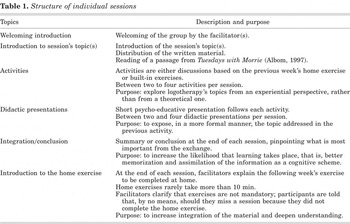
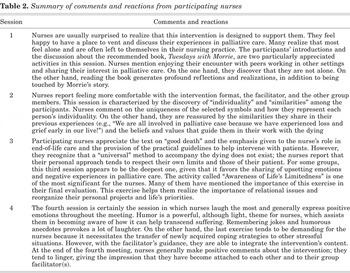
Each meeting lasts approximately 2.5 h and follows the structure and objectives provided in Table 1. Samples of participants' comments and reactions to the individual sessions are presented in Table 2. These samples were extracted from the first few intervention groups of our ongoing randomized trial.
Structure of individual sessions

Summary of comments and reactions from participating nurses

Session One: Search for and Sources of Meaning
The first session's principal aims are for participants to be acquainted with Frankl's concept and characteristics of “meaning” and to help the participants become aware of their personal “sources of meaning,” that is, what gives meaning to their lives. Given that a significant portion of the first session is spent on introductions and group functioning, the session includes no more than two activities and one didactic presentation. The first activity consists of a reflection. Participants are asked to share their thoughts on the book Tuesdays with Morrie (Albom, 1997). The purpose of this reflection is twofold: to set up the tone for the entire intervention and to allow the participants to ponder and structure their thoughts about meaning, life, death, and dying. Concretely, participants are encouraged to formulate whether the book's events correspond to their experience in palliative care and their private lives and share what aspects they found uplifting, demoralizing, or unrealistic. Following this experiential activity, a didactic presentation on the characteristics of meaning and the consequences of experiencing the absence of meaning, called existential vacuum, such as depression, burnout, and even suicide, is provided. The second activity seeks to identify moments and experiences that bring meaning to the participants' lives. The facilitator's role is to emphasize the sources of meaning by naming logotherapy's three broader sources underlying the participants' moments and experiences. This task of focusing on creative, attitudinal, and experiential values throughout examples is summarized at the end of each session.
Session Two: Historical Perspective and Sense of Accomplishment as Creative Values
The second session's goal is to help participants realize that finding meaning can be done through adopting a historical perspective on their lives, developing a sense of accomplishment at work or elsewhere, and/or having goals, hopes, and wishes. This session comprises three activities and two didactic presentations. The first activity aims at bringing to mind the manner in which the choice and practice of palliative care impacts the nurses' lives and how it has influenced their personal life trajectory and their sense of identity and continuity. The participants are invited to identify the values that guide their work. More specifically, they are asked to reflect on their career from three perspectives: past, present, and future. They have to discuss their choice of being a nurse, articulate that which they feel they have accomplished professionally, and reflect on what they have learned in palliative care. Finally, they are asked to share future projects they would like to achieve, as well as identifying what they would like to transmit to other nurses or be remembered for. The second activity aims at defining what it means, for each participant, to be responsible by identifying what each person's responsibilities are, for whom and for what they are responsible, and who imposes those responsibilities. Furthermore, participants are asked to reflect on differences and similarities between home- and work-related responsibilities. Facilitators must ensure that the participants are working on only one aspect of each question at any one time. A didactic presentation on responsibility follows. The second session's last activity focuses on future hopes and goals with the purpose of bringing consciousness to and integrating the session's themes. This goal is realized by asking the participants to list five things (hopes, wishes, and goals) they would like to realize in their lives. They then must indicate whether they feel they have control over these projects' realization and describe the concrete actions they are currently taking to reach their goals. Finally, nurses are asked to reflect and comment on whether their work in palliative care influences or facilitates the attainment of their hopes, wishes, and goals.
Session Three: The Meaning of Suffering through Attitudinal Change
The purposes of the third session are to explore the experience of patients and caregivers suffering in palliative care, create a link between suffering and meaning, and establish that which the participants do personally to avoid or respond to suffering at work and elsewhere. This session includes three activities and the same number of didactic presentations. A discussion revolving around the previous week's home exercise opens the session's activities. Participants are asked to discuss the text on “good death,” reflect on what a “good” end-of-life accompaniment would look like, and elaborate upon how a nurse could contribute to a patient's “good death” and whether they would feel at ease accompanying a dying patient in that fashion. The facilitator's role is to detect and explore the participants' potential anxiety and emotions about death, such as powerlessness, guilt, a sense of failure, and uncertainty, while emphasizing the positive aspects of palliative care nursing. The didactic presentation focuses on attitudes one can adopt when facing one's and others' suffering.
The second activity is intended to help the participants become conscious of their own attitude toward suffering and develop strategies to face it. The participants are asked to relate at least one workplace situation in which they experienced suffering and identify attitudes they could have adopted. Nurses' strengths and abilities to find solutions are to be emphasized. The accompanying didactic presentation elaborates upon the increased complexity nurses face, because they often must ignore or put on hold their own suffering in order to care for their patients. Three strategies are then suggested for giving meaning to the nurses' suffering: (1) transforming a dramatic situation into an accomplishment, that is, through the creative avenue; (2) trying to see things differently, that is, through an attitudinal change; and (3) doing a life review and transcending suffering, that is, through the experiential avenue.
The purposes of the third activity are to provide the participants with an experience of the finiteness of life and to help nurses develop skills that will enable their dying patients to identify what is important and precious to them. It also helps nurses and patients realize that hope can be marshaled until the very end of life. Participants are encouraged to refer to the previous week's list of five things they said they wanted to accomplish in their lives and prioritize the items. Once everyone has had the opportunity to share their lists' priorities, the facilitator interrupts the group to introduce a new rule to the exercise: participants are to review their list, imagining they have no more than one year to live, and discuss whether the content of the list and its priorities remain the same. The facilitator then invites the participants to pursue their discussion, knowing that they have only one month to live, then one week. Finally, the facilitator tells the participants that, as they pursue their discussion on their end-of-life most important goals, he or she will name the months of the year. As their birth month comes up, the participants must stop participating in the discussion until the entire group is silent. In generating a personal experience of how one's personal goals change when one is faced with a very short time to live, it is hoped that nurses will bring the same consciousness in both caring for their dying patients and caring for themselves. It is recommended that the facilitator focuses on the transformation of concrete goals into relational ones, which is expected to lead to specific actions and greater hope.
Session Four: Affective Experiences and Humor in Experiential Values
The fourth and last session's main purposes are to explore how emotion-filled experiences can be a source of meaning and how humor, both being aspects of experiential values, can help distance oneself from extreme suffering. It contains three activities and two didactic presentations. The first activity's purpose is to provide the participants with an experience where emotion is central and explore its value and meaning in their lives. Participants are asked to remember three things that they identified as wonderful or magnificent. With these in mind, they are asked to choose from a large selection of pictures (∼30 pictures) one that makes them feel particularly alive. One by one, participants are encouraged to share their experience. The facilitator can explore how beauty and experiential avenues connect us to a broader and more solid aspect of ourselves, that is, the existential self. Other themes can also be explored: What moments were particularly important for someone? Do people feel as if they were part of something greater than themselves? Have these emotion-filled experiences changed since the beginning of their palliative care nursing? Did some participants not find pictures that represented something beautiful? Why? This is followed by a didactic presentation on affective experiences as a source of meaning.
The second activity aims at highlighting the role of humor as a source of meaning. Participants share a joke, an anecdote, or an event that took place at work and that they found amusing. The facilitator holds the space for all participants to take part in the benefits of humor and laughter, and then explores the way nurses make or do not make space for humor at work. Finally, the didactic presentation provides a definition of humor and explores its functions. It is noted that not everyone has a sense of humor and that having a sense of humor is not limited to the ability to tell jokes or be a clown. It can be an attitude that allows one to be open to others' jokes and teasing, not taking oneself too seriously, and being able to laugh at oneself and the situations with which one is confronted. In addition, the positive effects of laughter and humor at work and in general are introduced.
The third activity's purpose is to find organizational or individual strategies to help face stressors in the workplace. First, the facilitator recalls the different active coping strategies brought up over the last four sessions (e.g., finding meaning in a sense of accomplishment, using humor in distressing situations, changing one's attitude under dire circumstances). The participants are invited to list at least three sources of work-related stress and then develop strategies, individual and organizational in nature, that would help them transform otherwise difficult situations. Nurses are invited to focus on strategies that can be implemented in their work environment. The facilitator is mindful that the discussion should not turn into a complaining or venting session.
Intervention Closing
The facilitators give thanks and express gratitude for the nurses' participation and active engagement in the group. Participants are reminded that they contributed to their own growth and the growth of others, including that of the facilitators. The latter express hopes that each will pursue their search for meaning, as well as continue to equip themselves with tools that will help them transform the stress they may experience at work. Finally, the facilitators ask all participants to talk about their growth process in the group. Suggestions of themes to address are: Has your definition of meaning changed? Did you redefine what brought meaning to your life? Do you see your profession differently? How are you intending to continue what was started in this group? Do you have comments or suggestions for future groups?
Collection of Meaningful Experiences in Palliative Care
Throughout the four sessions participants were also asked to participate in the creation of a collection of short essays related to meaningful experiences in their palliative care practice (Fillion et al., 2006). Nurses are encouraged to write a short text in which they would share their experience, in order to transmit their wisdom to other nurses. The goal is to put together a small collection of texts that could eventually be used in training and, therefore, provide a sense of legacy to participating nurses.
Future Directions
The next step is to assess the intervention's efficacy in improving satisfaction at work and other positive outcomes, as well as preventing burnout. We are currently testing the intervention among a first sample of 120 nurses with a randomized controlled trial (Fillion et al., 2003a). We are also planning, by means of qualitative studies, to explore how this meaning-centered intervention could influence existential issues (e.g., spiritual experiences, meaning of life and death) in palliative care nurses. Finally, we believe that this intervention shows promise and could be adapted to other formal and informal caregivers involved in palliative care delivery.
CONCLUSION
The development of this meaning-centered intervention for palliative care nurses is innovative. It is aiming at helping nurses find meaning in their work and better cope with emotional stress and suffering. Based on the comments of our first participants, as well as from managers and union members, this intervention seems to have the potential to contribute to the betterment of nurses' quality of life and satisfaction and, indirectly, to the quality of care they provide. Before promoting a wide implementation of the intervention, however, we first propose to document its efficacy on a first sample of palliative care nurses. We believe that the meaning-centered intervention for nurses, and eventually one offered to other caregivers involved in palliative care, shows promise; however it needs rigorous development and planned evaluations. Indeed, this meaning-centered intervention appears timely for nurses. Recent reviews reported that lack of acknowledgment and work-related stress contribute to less work satisfaction and the desire to quit nursing as a profession. Without saying that this initiative constitutes the only solution to the problem of satisfaction and retention of nurses, it can contribute to bringing meaningful insights about the value of this profession.
ACKNOWLEDGMENTS
We thank our committee of experts, Christiane Savard, Marie de Serres, Dany Tourville, Serge Dumont, Pierre Gagnon, Hubert Marcoux, for their participation in the validation of the intervention. We also thank our participating nurses for their generous involvement. This research was supported by a grant (RC2-0946-05 FRSQ-FRESIQ) from the Canadian Health Services Research Foundation (CHSRF) and by an Investigator Award to Lise Fillion.