




No CrossRef data available.
Article contents
Deep-sea hydrothermal vent parasites: why do we not find more?
Published online by Cambridge University Press: 19 January 2004
Abstract
While parasitism is recognized as the most common mode of existence on the planet, and hosts from virtually all ecosystems have been studied, very little is known about the parasites found in deep-sea hydrothermal vent ecosystems and even less is known about their ecology, evolution, and effects on their hosts. The purpose of this work is to offer a comprehensive review of our state of knowledge about parasitism in the deep-sea vents and to pose and address specific questions for future studies. Because the deep-sea environment itself may influence the number and types of parasites found in the vents, non-vent (below 1000 m) and vent deep-sea data were used in a comparative analysis to account for this factor as a potential major determinant of the parasite fauna in the vents. Based upon analysis of these data, it is highly likely that the reason why so few parasites are currently known from deep-sea vents, even given the low diversity of hosts in this ecosystem, is simply that their inconspicuous nature has caused them to be overlooked by vent biologists.
Information
- Type
- Review Article
- Information
- Copyright
- 2004 Cambridge University Press
INTRODUCTION
Whether their life-cycle is simple or complex, parasites maintain durable and intimate interactions with their hosts that lead to the selection of co-evolutionary mechanisms and biological patterns that tighten the host–parasite association. As a result, parasites are now receiving growing recognition as major driving forces in the evolution of their hosts and as major players in the structuring and delineation of host communities (Brooks & McLennan, 1993; Poulin, 1998; Combes, 2001). Significantly, it is important to note that parasites of hydrothermal vent organisms live in 2 extreme environments, the host itself (Combes & Morand, 1999) and the hydrothermal vent, which represents a particularly adverse environment for those parasites with extensive free-living stages. Thus, in deep-sea hydrothermal vents, which are in general characterized by low diversity, high endemicity, and a high concentration of organisms (Tunnicliffe & Fowler, 1996; Van Dover, 2000), one may wonder about the role that parasitism plays. Further, and although indicated otherwise by Bray et al. (1999), one may also wonder if the depth, pressure, and darkness associated with deep-sea vents are not also factors limiting the evolution and development of the sometimes complex parasitic life-cycles that involve delicate free-living stages and different intermediate hosts. However, current knowledge of the parasitic fauna of deep-sea hydrothermal vents is meager, and there have been no studies on either parasite communities (either within or between hosts) or the effects of parasites on host populations from these areas. That is, deep-sea vent communities represent virgin territory for the exploration of parasite communities and for the exploration of the effects of parasites on both host populations and community structure in general.
Research efforts would provide an ideal arena to address novel questions of general interest to mainstream ecologists as well as parasitologists, including the determination of those factors that affect the colonization of vents and the structure of vent populations and communities.
METHODS
In order to identify the parasites reported from deep-sea hydrothermal vents, an in-depth literature review was performed using Zoological Records (1978–present), Current Contents (1995–present), and the back-tracking of original sources in the primary literature (references can be provided on request). Since the literature review focused only on deep-sea vents a comparative survey of the literature using the same sources listed above and focusing on deep-sea parasites (below 1000 m) in general was also performed. Because the deep-sea environment itself may influence the number and types of parasites found in the vents, the latter data were used in a comparative analysis to account for this factor as a major determinant of the parasite fauna in the vents. While a number of papers recorded the presence of parasites from the ‘deep-sea’ only those where specific depths were reported were used in the analysis.
RESULTS
Analysis of the data compiled on deep-sea hydrothermal vent parasites revealed the presence of a leech, a nematode, as well as several copepods, acanthocephalans, and digeneans (Table 1). These include: (1) 4 parasitic copepods (1 from an annelid in the Galapagos Rift and at 20°N EPR (Humes & Dojiri, 1980), 1 from another copepod in the Galapagos Rift (Huys & Conroy-Dalton, 1997), and 2 from octopods at Juan de Fuca Ridge and 13°N EPR (Humes & Voight, 1997 and Lopez-Gonzales, Bresciani & Huys, 2000, respectively); (2) 1 leech from the Galapagos Rift (Burreson, 1981); (3) 1 acanthocephalan found in a zoarcid fish from 13°N EPR (Buron, 1988); and (4) 1 nematode (also from a zoarcid fish) from 2 vents of the Mid Atlantic Ridge (Justine, Cassone & Petter, 2002). Significantly, no verified parasite is described from Indian Ocean vents, although 1 polychaete whose parasitic nature needs to be confirmed has recently been reported from this area (Hashimoto, Ohta & Gamo, 2001). Further, acanthocephalans are now also known to be present on the Mid-Atlantic Ridge (Marques, personal communication) and digeneans from both the East Pacific Rise and Mid-Atlantic Ridge have been collected and are currently being identified (Segonzac, personal communication).

Concerning non-vent deep-sea parasites, 126 species of parasites from various types of hosts (crustaceans, fish …) have been identified at depths of 1000 m or below, with almost every group of macroparasites being represented. The highest diversity is found in the Digenea and Copepoda, which together represent 65% of all parasites (80% of all parasitic metazoans) reported from these depths (Fig. 1). Whereas these 2 groups plus the Cestoda and the Acanthocephala were observed at great depths (as deep as 5000–7000 m), the Nematoda and Cirripedia were reported only from lesser depths (less than 4000 m deep) and Monogenea have been observed only in ‘shallower’ waters of the deep ocean (near 1000 m) (Fig. 2). Further, in poorly surveyed regions such as the Indian Ocean (18 records) only copepods and other crustacean parasites have been recorded while these same groups, along with digeneans, have been recorded from the slightly more surveyed Pacific Ocean (23 records). In comparison, a much higher parasite species diversity is observed in the Atlantic Ocean for these groups (165 records). Overall, there is a significant positive correlation (R2=0·84, P<0·0001) between the number of species observed and the number of investigations reported, indicating that the reported species richness of the vent areas is dependent upon the sampling effort (Fig. 3).

Fig. 1. Parasite species diversity in non-vent deep-sea hosts (depth under 1000 m).

Fig. 2. Parasite species presence, according to their taxonomic group, in relation to depths.

Fig. 3. Relationship between the number of species and the number of records (in log, R2=0·84, P<0·0001).
DISCUSSION
As has been noted by Bray et al. (1999), the extreme pressure and lack of incident light in the deep-sea are probably not of great importance as limiting factors in parasite life-cycles relative to the patchy nature of host distributions in this realm and almost all groups of macroparasites have been reported from the deep-sea. And it is in this regard that Campbell (1990) has referred to a high parasite species diversity in the non-vent deep-sea. In contrast, our review of the published data shows a different story for parasites at deep-sea vents, with the actual known fauna of hydrothermal vent parasites being comparatively depauperate. Based upon the correlation of diversity and the number of studies performed, however, the observed low parasite species richness of the vents relative to deep-sea environments probably reflects a lack of studies on hydrothermal vent parasites rather than an actual lack of parasites in these areas. Thus, the lack of study of vent parasites may obscure not just our appreciation of the potential diversity of parasites in these areas but also biases current estimates of the overall total organismal diversity of vents in general. It should, however, also be noted that the species diversity of the free-living macrofauna at hydrothermal vents is very low relative to that of deep-sea environments (Grassle & Maciolek, 1992). Further, the free-living fauna of hydrothermal vents are highly particular in that they are mainly composed of invertebrates (Desbruyères & Segonzac, 1997) with only a few fish families, each including a small number of species (Biscoito et al. 2002), being found. Thus, there is the possibility that the reported low diversity of parasites at vents may also be the result of the low diversity of vertebrate hosts in these areas. This relatively low overall diversity of potential host species at vents may, however, be offset by the well-known high concentration of potential hosts at vent locales as well as by the high degree of difference in physical structure that exists between vents (Van Dover, 2000), both factors that would be expected to increase parasite transmission and diversity (Combes, 2001).
Interestingly, the data compiled concerning the non-vent deep-sea parasites showed a pattern wherein researchers first recorded crustacean (e.g. copepod) parasites, which are mainly ectoparasitic and easily observed by the non-specialist, before recording the less easily observed endo- and meso-parasites. In the hydrothermal vents, easily detected organisms such as polychaetes and parasitic copepods were also the first organisms recorded and only recently have internal parasites, such as nematodes, digeneans, and acanthocephalans been reported as parasitologists began to gain access to, and obtain samples from, these areas. Because meso- and endoparasites are often small and inconspicuous and because they may cause little-to-no visible impact at the gross morphological level, they may easily be ignored by non-specialists. Thus it is highly likely that the reason why so few parasites are currently known from deep-sea vents, even given the low diversity of hosts, is simply that they have so far been overlooked.
As a result of this it is important to find out what parasites are present in the deep-sea hydrothermal vent environment in order to address a number of questions of interest to parasitologists. These include the identification of the types of communities formed by vent parasites, recognition of how these communities are structured, and how vents from the different oceans compare in terms of their parasitic fauna. Significantly, however, the collection and analysis of parasitological data from deep-sea vents is of significance well beyond that of the field of parasitology. Notwithstanding the fact that parasites must be considered before any definitive statement concerning the overall organismal diversity of vents can be made in general, the accumulation and analysis of parasitological data would have the added benefit of furthering our overall understanding of vent ecology and biology. For example, the delineation of the life-cycles of vent parasites would serve to increase our understanding of vent trophic structures via the delineation of ‘who-eats-whom’ in the system and one may wonder if other important questions in vent biology may not in fact be best addressed using parasitological data. For instance, the collection and analysis of data on parasite transmission and colonization bears directly not just on questions of trophic structure but also on questions of the transmission between and colonization of vents in general. Given the character of their host specificity, their propensity to evolve strategies to insure transmission, and their general usefulness as biological markers parasites may in fact be the best and most convenient tags for the delineation of inter-vent transmission/colonization events by non-parasitic organisms.
In short, the identification of hydrothermal vent parasites and their vectors will likely allow us to address not just important and interesting questions concerning life-cycles and strategies for survival in this previously unexplored realm but will also aid in answering more general ecological questions regarding deep-sea vent colonization, community structure, ecology, and evolution.
The authors thank Michel Segonzac (IFREMER, Brest, France) and the personnel of the Library of Marine Resources at the South Carolina Department of Natural Resources for their dedicated support and help. We also thank Anne Ducreux for preparing the manuscript.
References
REFERENCES
BISCOITO, M.,
SEGONZAC, M.,
ALMEIDA, A. J.,
DESBRUYERES, D.,
GEISTDOERFER, P.,
TURNIPSEED, M. &
VAN DOVER, C.
(2002).
Fishes from the hydrothermal vents and cold seeps – an update. Cahier de Biologie Marine 43, 359–362.Google Scholar
BRAY, R. A.,
LITTLEWOOD, D. T. J.,
HERNIOU, E. A.,
WILLIAMS, B. &
HENDERSON, R. E.
(1999).
Digenean parasites of deep-sea teleosts: a review and case studies of intrageneric phylogenies.
Parasitology 119 (Suppl.), S125–S144.CrossRefGoogle Scholar
BROOKS, D. R. &
McLENNAN, D. A.
(1993).
Parascript: Parasites and the Language of Evolution.
Smithsonian University Press,
Washington.
BURON, I. de
(1988).
Hypoechinorhynchus thermaceri n.sp. (Acanthocephala: Hypoechinorhynchoidae) from the deep-sea zoarcid fish Thermarces andersoni Rosenblatt and Cohen, 1986.
Journal of Parasitology 74, 339–342.Google Scholar
BURRESON, E. M.
(
1981).
A new deep-sea leech Bathybdella sawyeri, n. gen., n. sp., from thermal vent areas on the Galapagos Rift.
Proceedings of the Biological Society of Washington 94, 483–491.Google Scholar
CAMPBELL, R. A.
(1990).
Deep water parasites.
Annales de Parasitologie Humaine et Comparée 65, S65–S68.CrossRefGoogle Scholar
COMBES, C.
(2001).
Parasitism: the Ecology and Evolution of Intimate Interactions.
The University of Chicago Press,
Chicago.
COMBES, C. &
MORAND, S.
(1999).
Do parasites live in extreme environments? Constructing hostile niches and living in them.
Parasitology 119, S107–S110.Google Scholar
DESBRUYÈRES, D. &
SEGONZAC, M.
(1997).
Handbook of Deep-Sea Hydrothermal Vent Fauna.
IFREMER, Brest.
GRASSLE, J. F. &
MACIOLEK, N. J.
(1992).
Deep-sea species richness: regional and local diversity estimates from quantitative bottom samples.
American Naturalist 139, 313–343.CrossRefGoogle Scholar
HASHIMOTO, J.,
OHTA, S. &
GAMO, T.
(2001).
First hydrothermal vent communities from the Indian Ocean discovered.
Zoological Science 18, 717–721.CrossRefGoogle Scholar
HUMES, A. G. &
DOJIRI, M.
(1980).
A siphonostome copepod associated with a vestimentiferan from the Galapagos Rift and the East Pacific Rise.
Proceedings of the Biological Society of Washington 93, 697–707.Google Scholar
HUMES, A. G. &
VOIGHT, J. R.
(1997).
Cholidya polypi (Copepoda: Harpacticoida: Tibisdae), a parasite of deep-sea octopuses in the north atlantic and northeastern pacific.
Ophelia 46, 65–81.CrossRefGoogle Scholar
HUYS, R. &
CONROY-DALTON, S.
(1997).
Discovery of hydrothermal vent Tantulocarida on a new genus of Argestidae (Copepoda: Hapacticoida).
Cahiers de Biologie Marine 38, 235–249.Google Scholar
JUSTINE, J.-L.,
CASSONE, J. &
PETTER, A.
(2002).
Moravecnema segonzaci n.sp., n. gen. (Nematoda: Cystidicolidae) from Pachycara thermophilum (Zoarcidae), a deep-sea hydrothermal vent fish from the Mid-Atlantic Ridge.
Folia Parasitologica 49, 299–303.Google Scholar
LOPEZ-GONZALES, P. J.,
BRESCIANI, J. &
HUYS, R.
(2000).
Description of Genesis vulcanoctopusi gen. et sp. nov. (Copepoda: Tibisdae) parasitic on a hydrothermal vent octopod and a reinterpretation of the life cycle of cholidyinid hapacticoids.
Cahiers de Biologie Marine 41, 241–253.Google Scholar
POULIN, R.
(1998).
Evolutionary Ecology of Parasites.
Chapman and Hall,
New York.
TUNNICLIFFE, V.
(1991).
The biology of hydrothermal vents: ecology and evolution.
Oceanography and Marine Biology: An Annual Review 29, 319–407.Google Scholar
TUNNICLIFFE, V. &
FOWLER, C. M. R.
(1996).
Influence of sea floor spreading on the global hydrothermal vent fauna.
Nature, London 379, 531–533.CrossRefGoogle Scholar
VAN DOVER, C. L.
(2000).
The Ecology of Deep-Sea Hydrothermal Vents.
Princeton University Press,
Princeton.
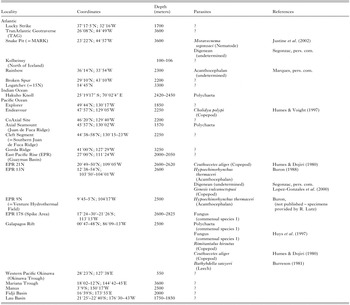
Table 1. Major deep-sea hydrothermal vents (Tunnicliffe, 1991; Van Dover, 2000; Hashimoto et al. 2001) with presence of parasites

Fig. 1. Parasite species diversity in non-vent deep-sea hosts (depth under 1000 m).

Fig. 2. Parasite species presence, according to their taxonomic group, in relation to depths.

Fig. 3. Relationship between the number of species and the number of records (in log, R2=0·84, P<0·0001).
 You have
Access
- 28
- Cited by