Introduction
Parenting children who have been frightened within their early parenting environments poses particular difficulties for parents, whether they are parenting through fostering, adoption, kinship care or some other arrangement. Having experienced fear without resolution in their early environment, the children have developed styles of relating to parents that can make it difficult to nurture, comfort and protect them in the present. Ordinary parenting, especially the provision of boundaries and discipline, triggers fear within the children. This leads to increasing insecurity and escalating challenging behaviour. The children mistrust the parents’ motivations and anticipate rejection or hurt instead of comfort and nurture. If the children can consistently experience emotional connection with their parents, they will build trust and security. The correction implicit within discipline and boundaries can then be accepted for what it is; a loving parent helping the child to behave in socially appropriate ways (see also Golding, Reference Golding2008, Reference Golding2013; Hughes, Reference Hughes2009).
Challenge One: The Development of Mistrust
Secure parent–infant interactions rely on parenting that is attuned, sensitively responsive and empathic. This experience is necessary for the development of a healthy nervous system. This provides the foundation for the development of social, emotional, cognitive and physical health.
When infants do not receive this parenting, but instead experience a frightening early environment without parental protection, their development will organise around a nervous system that is prepared for danger. Erikson (Reference Erikson1963) suggested that during the first stage of life the infant's experience of the world, which comes primarily from the caregivers, provides an experience of either safety or danger. Erikson calls this the crisis of trust versus mistrust. Consistent, predictable, reliable and stable nurturing care will lead to a sense of trust. Erikson describes this as the development of hope. If the care has been frightening, unpredictable and unreliable then the infant will develop a sense of mistrust, leading to the development of fear. It is this sense of hope/trust or fear/mistrust that is taken forward to later relationships and will determine whether a child can feel secure and trusting of others even when threatened.
This development of trust and mistrust, in relation to children traumatised by the early parenting they experience, has been expanded upon (Baylin, personal communication, 2014). The infant stage of development is a unique time in the parenting of children. Infant behaviour is relatively simple and focused on eliciting care and learning about the world, beginning with the social world. At this developmental stage the young child is not considered to be responsible for his behaviour and therefore does not need discipline. Because the parents are not concerned with teaching acceptable behaviour they can focus their parenting efforts on providing the infant with nurture and responsive care. This leads to the experience of trust, leading to the development of a secure attachment. The infant experiences being loved unconditionally; and comes to believe that “with this person I will be loved no matter what”.
Towards the end of the first year, increasing maturity leads to a range of skills and abilities that allow children to move further away from parents to explore the world around them. The children are becoming mobile and can start to get into mischief! Something additional has to be added to parenting. This is the process of socialisation; the parents ensure that their children are kept safe and they start the long task of teaching them how to behave; matched to the values of the community they are living within. Parents are starting to put boundaries around the children's behaviours. The children experience safety in this new aspect to their relationship with their parents because they already have the experience of being unconditionally loved. They know they will be loved no matter what. They can manage boundaries upon their behaviour because of this.
Children who have difficult early experiences have a very different development. The first year of life for these children is a breeding ground for mistrust rather than for trust; the children experience love as conditional. Provisions of boundaries and restrictions, especially in the absence of empathy or warmth, only serve to reinforce this conditionality; “you will only be loved if. . .”, rather than “no matter what”. The children experience unregulated shame and learn to associate boundaries with their developing sense of self as bad.
This early experience has a profound impact upon the development of the nervous system, as described in the Polyvagal Theory (Porges, Reference Porges2011). The social monitoring system is becoming sensitised by the early experience of abuse and neglect, and the lack of safety that this signals. The child becomes hyper-alert to danger; for example, perceptions of rejection, anger or neglect. This deactivates the social engagement system, and activates the social defence system within the brain. The children are left socially defensive and not open and engaged to the influence of others. The nervous system becomes sensitised to perceptions of danger, leading to mobilisation (fight, flight and freeze) and immobilisation (faint) in response to this perceived danger. These behaviours, which are not considered to be socially acceptable, only serve to increase the child's sense of badness and to reinforce the mistrust of others.
Children who mistrust therefore learn to resist authority and to oppose parental influence. They don't trust in their parents’ good intentions. They don't trust in the unconditional support and love that's on offer to them. They trust in themselves rather than others. These children develop controlling behaviours as they try to take charge of their own safety. It feels safer to be in charge than to be influenced by another.
Later, as the parenting environment changes, whether because children are placed with new parents or because of changes the biological parents have made, the parents try to provide the children with the experience of trust so necessary for emotional wellbeing. This is more challenging now. The children are older and therefore cannot be shown unconditional love and care without the parents also attending to their behaviour. Children need discipline and boundaries, but they still need to experience unconditional relationships. The development of trust and the provision of socialisation experience, through discipline and boundaries, have to develop together rather than sequentially. Parents try to get around this by telling the children that they love them, but they don't like the behaviour. The children, however, experience such strong feelings of shame, experienced as a sense of being bad, that they cannot make this distinction; if their behaviour is bad, it is because they are bad. To help a child recover from mistrust the parent has to help him to develop a different less shame-based sense of self. The parent offers the child connection and understanding through which unconditional love is communicated, while also empathically providing structure and boundaries.
Challenge Two: Avoidance of an Intersubjective Relationship
An intersubjective relationship is one within which experience is shared. This is a reciprocal relationship because each person is open to influencing the other and being influenced by them. This is based upon an experience of shared affective states, joint attention and congruent, complementary intentions.
Safety and intersubjectivity are interwoven. The attachment relationship, which is a hierarchical relationship, “I look to you to keep me safe and well, I do not need to keep you safe and well” (Bowlby, Reference Bowlby1973, Reference Bowlby1980, Reference Bowlby1982) is complemented by the intersubjective relationship which is non-hierarchical. “I influence you, I'm open to influence from you” (Trevarthen, Reference Trevarthen2001). Children need both relationship experiences to thrive.
Imagine a parent and infant both absorbed in the relationship with each other. The only thing in the parent's mind is the baby; the only thing in the baby's mind is the parent. This is an important, early experience for an infant. It is the beginning of connection; the beginning of intersubjective relationship. The infant is already discovering that he is effective in relationships. The infant is experiencing a sense of efficacy, which will later allow the development of a sense of autonomy.
Imagine instead an infant being held by a depressed parent who is not able to achieve this absorption with her infant. The intersubjective connection is absent. The infant looks in the parent's eyes and sees nothing. Alternatively the infant might look in the parent's eyes and see fear, or terror or hatred. These experiences are frightening; the infant stops looking. Later the child is with a healthy parent who is ready to show love and kindness to the child. The child does not look into this parent's eyes. The memory of the fear stays with him and he avoids her gaze. This child is no longer open to the intersubjective relationship.
Children who experience neglect, lack early intersubjective experience. They feel not special. They feel not lovable. Children who experience anger, fear or rejection experience terror and shame when they seek connection. These children learn to avoid intersubjective experience. They disconnect from relationships and become controlling instead.
Parenting children who are not open to connection within the relationship can have a negative impact upon the parents. The parents offer relationship and the children respond with rejection and hostility, or with a clinginess that suggests the parent cannot soothe and comfort the child. This can trigger worries, fears and beliefs within the parent. “Am I a bad parent?”; “Maybe I can't do this”; “Maybe this is the wrong placement?”
The lack of intersubjectivity impacts on the parents’ beliefs about themselves. They start to feel a sense of failure as parents. They feel unsafe with the child. The parents now withdraw from the intersubjective relationship. They try to manage the children without connecting with them.
At this stage the parents need support more than they need behavioural advice. Support leads to resilience to continue caregiving despite their fears and doubts.
If the parents can find ways to stay connected to the children, then they can help the children to become more open to relationship. As intersubjectivity becomes possible, the children experience a relationship within which they can heal.
Challenge Three: Overwhelmed by Shame
Shame is an emotion that develops in toddlers at the same time parents are starting to provide boundaries and discipline. The experience of shame is part of the process of teaching children acceptable behaviour. Imagine a child running out into the road. What does the parent do? She pulls him back. She tells him: “Don't you ever do that again”. The parent and child are no longer in an attuned relationship; there has been a relationship rupture. This is such an unpleasant experience that the child experiences shame. The parent then repairs the relationship. This helps the child to regulate the experience of shame and the relationship returns to a state of attunement. The parent lets the child know that no matter how bad he feels it will always be okay again. The child learns that the relationship is stronger than any particular moment in time. The attunement – break – repair experience (as described by Schore, Reference Schore1994) is an important part of the parenting the child needs in order to experience being loved unconditionally while having limits put on his behaviour.
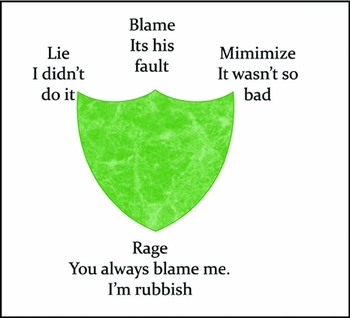
When children experience poor attunement and the parent does not repair the relationship, the children become trapped in feelings of shame without being able to regulate this emotion. The experience of shame builds up into toxic unregulated shame, which influences the children's developing sense of identity; the children develop a sense of being bad. The children have to develop a shield to defend against how bad this feels. This shield against shame is demonstrated through a range of behaviours including lying, blaming others, minimising and raging (Figure 1).
Shield against shame (Golding & Hughes, Reference Golding and Hughes2012).

Behavioural management strategies, aimed at the children reducing these behaviours, demonstrating remorse and making amends, just serves to increase the sense of shame and the shield is reinforced. The children need parents to help them to regulate the shame. This is done through connection with the children's internal experiences. As the children experience the parent understanding their anxieties, worries and fears, the behaviours will start to reduce. Now the children can experience remorse and want to make amends. Connection before correction allows children to experience an attuned relationship. They learn that relationships can always be repaired, and that they are loved unconditionally.
Challenge Four: Miscuing Parent about Attachment Needs
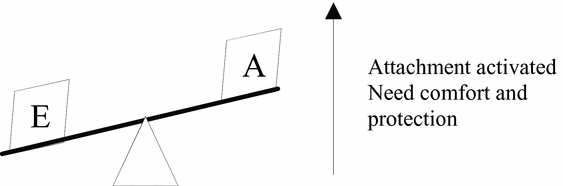
Bowlby (Reference Bowlby1973, Reference Bowlby1980, Reference Bowlby1982), in his development of attachment theory, demonstrated the compatibility of two innate drives; to attach and to explore. Much like the connection between the two ends of a see-saw, attachment and exploration inter-relate (Figure 2). When the child needs comfort and protection, attachment needs are activated, and the child seeks comfort and protection. As these needs are met the attachment needs can deactivate, and exploration needs increase with the associated drive to learn about the world. The secure child moves smoothly between seeking comfort and seeking exploration, supported by the attuned, sensitive caregiver. This, in turn, leads to the development of an internal working model of self and others. The child develops a sense of self as effective, worthwhile and lovable, and others as loving, supportive and protective. This model builds resilience, helping the child to be successful in later relationships, and to manage adversity when it arises.
See-saw metaphor: secure attachment.

These children have a secure attachment; the attachment pattern of relating that a child develops when a parent is experienced as sensitive and responsive to their emotional needs. The child learns to trust others and also age-appropriate self-reliance.
Children who do not have the experience of a secure attachment will develop patterns of relating adapted to the anticipated unavailability of the parent. They miscue the parent as to their attachment needs by displaying attention-needing behaviours (ambivalent, resistant attachment pattern) or self-reliant behaviours (avoidant attachment pattern). The children behave in ways that maximise the chance that parents will be available when needed. The disorganised controlling pattern emerges as children take these patterns to extremes in the face of frightening caregiving. These children anticipate that parents will be frightening and therefore make strenuous efforts to take control in order to reduce their sense of fear. When this fails their behaviour disorganises into highly stressed, dysregulated or dissociated behaviours.
Mary Dozier studied what happened to attachment patterns of relating when toddlers moved into their foster/adoptive homes. These children would lead the attachment dance and the parents responded in kind. Therefore, parents would behave as if the children did not need them when the children demonstrated avoidant attachment patterns, or would behave angrily when the children demonstrated an ambivalent-resistant attachment pattern and would not be comforted by them (Dozier, Knights, & Peloso, Reference Dozier, Knights, Peloso and Golding2006). It appears that the parents respond to the miscuing of the children and try to meet the needs that are being expressed but overlook the pattern of hidden needs that the children are not displaying.
To return to the see-saw analogy, children with an ambivalent-resistant pattern are like a see-saw stuck in one position; with attachment needs permanently activated (Figure 3). This is the attachment pattern or style of relating that develops when attachment needs are triggered but the child has experienced the parent as inconsistent and unpredictable. The child maximises the expression of attachment need in order to maintain the availability of the parent.
See-saw metaphor: ambivalent-resistant attachment.
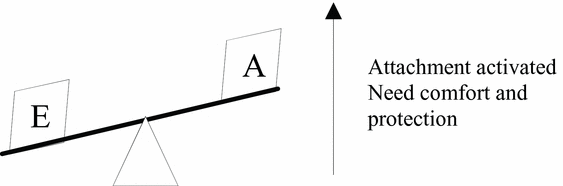
These children express their continuing need for comfort and protection. They express, “You are unpredictable, I can't trust in your availability. I need you to attend to me all the time”. In order to keep expressing this need, they have to hide their exploration needs. “I will not show my need to separate and explore. I will pull you in and push you away to keep you noticing me”. The parents are miscued about what the children are experiencing because the children are expressing their needs on the basis of their expectations of the parents rather than upon how they feel internally. They express, “Stay with me, notice me, attend to me”, they hide, “Okay, I can do this. I'm comfortable enough to be apart from you at the moment”.
The parents try to meet the expressed need, “I will reassure you that I am available. I will be here when you really need me”. This does not soothe the child and the parents express frustration that they can't meet the need. The child's expectation that parents will be inconsistent and unpredictable is confirmed.
Parents need to provide a high level of structure and consistent routines so that the child can begin to trust in the predictability of the parenting. They need to co-regulate the emotion that the child is expressing but not managing. They also need to be mindful of the hidden needs. Mary Dozier suggests that they gently challenge the hidden needs. The child needs help to be apart and to feel secure that the parent will be there when needed.
Children with an avoidant attachment pattern have the seesaw stuck in the opposite position (Figure 4). This is the attachment pattern or style of relating that develops when attachment needs are triggered but the child has experienced the parent as rejecting. The child minimises the expression of attachment need in order to maintain the availability of the parent.
See-saw metaphor: avoidant attachment.

These children display a lack of need. They miscue the parent by acting like they want to explore at times when they need comfort. The children anticipate that any displays of need will lead the parents to withdraw and become unavailable when they are most needed. They express, “I will do it by myself. I fear my need of you. I will push you away”, they hide “I will not show my need for comfort and soothing”.
The parents try to meet the expressed need by letting the children manage on their own. The children's expectation that parents will not be their when needed is confirmed.
Parents need to gently challenge the hidden needs by providing comfort and safety at times when they predict that the children will need this. The children can begin to trust that their emotional needs will not overwhelm the parents. Parents also need to co-regulate the emotion that the children are hiding but not managing. In this way parents can help the children to feel comfortable with needing and being helped by them.
Children with disorganised, controlling patterns of relating are more complex. This is the attachment pattern or style of relating that develops when attachment needs are triggered but the child has experienced the parent as frightened or frightening. The child experiences difficulty organising his or her behaviour at times of stress. As they grow older children with these patterns of relating under stress learn to control relationships to force predictability. Controlling relationships develop instead of reciprocal relationships; the child wants to influence the other without being open to influence from the other.
The secure base is frightening, the world is scary, and so the children try to take charge. They express “I will not rely on you. Relying on you is dangerous. I must be in control”. They control through highly self-reliant, rejecting behaviours that keep parents at a distance, and/or through highly coercive behaviours that keep parents attending to them. They hide away their need to explore the world and their need for comfort and nurture, except on their terms. It is a challenge for the parents to meet the hidden needs while trying to deal with the impact of the expressed needs. These children need safety and low-stress environments, but behave in ways that reduce safety and increase stress.
Therefore when attachment and connection feel dangerous, prior experience influences how a child responds. Miscuing occurs through patterns of hidden and expressed needs. Parents need to be available, responsive and gently challenging. The parents are challenging hard-won beliefs: “Parents can't keep you safe”; “Parents are dangerous”; “I am so bad, nothing you can do or say will change this”; or “I should take care of you, and not expect you to take care of me”. They need parents who can accurately interpret the child's need for nurturance despite the miscues the child is giving. They connect with the hidden experience of the child while, at the same time, providing the boundaries needed to keep the child safe; connection with correction.
Meeting these Challenges: Therapeutic Parenting
Therapeutic parenting helps children to trust in the parent and to become comfortable with reciprocal intersubjective relationships; being open to influence as well as influencing. Parents will have to regulate powerful feelings of shame in the child and meet hidden, as well as expressed, attachment needs. All of this occurs alongside parenting that provides consistent and developmentally appropriate boundaries and discipline. Connection with correction is a useful parenting approach to achieve these goals. This approach relies on the caregivers having good mentalisation abilities and being able to understand and use PACE (playfulness, acceptance, curiosity and empathy) within their parenting.
Mentalisation (the Ability to be Mind-minded)
Mentalisation – being mind-minded towards self and others – is an ability that we develop as we mature (Fonagy, Gergely, Jurist, & Target, Reference Fonagy, Gergely, Jurist and Target2002). It relies on having good Theory of Mind – the ability to understand that you and others have minds, with their internal world of thoughts, feelings, beliefs and desires. In order to connect with children, the parent first has to be able to make sense of the internal experience of the child. In turn, the parent can help the child discover his own mind, to organise his experience, and eventually to help him put into words what he is experiencing. This increases the child's capacity for regulation that has begun to develop within the relationship with an attuned, sensitive parent.
It is also important that parents notice their own minds; especially understanding and managing the emotional impact that the child is having upon them.
This is different from more traditional parenting advice based on social learning theory. Traditional advice relies on problem solving, based on understanding the environmental contingencies that make behaviours more or less likely to happen. Parenting techniques are suggested with the goal of managing these contingencies in order to increase the frequency of behaviours the parent wants the child to display. Put simply, the parent is advised to reward good behaviour and ignore or provide a negative consequence for bad behaviour.
Parenting advice that focuses on connection before correction has much less focus on immediate problem solving and advice giving, and more focus on curious exploration. The parent notices her own experience of the child, and is compassionate towards herself. The parent is then curious about the experience of the child, and finds ways to connect emotionally with that experience. This is not instead of discipline; the parent also provides structure, supervision and/or consequences to help the child feel safe and to learn appropriate behaviours. Understanding the emotional age of the child is important to guide the correct level of these.
PACE
The parenting attitude of PACE was developed by Dan Hughes in order to help parents to connect emotionally to their children (Golding & Hughes, Reference Golding and Hughes2012; Hughes, Reference Hughes2011). PACE is an acronym to express the importance of having a playful connection, accepting the child's inner world, being curious about the meaning underlying behaviour and connecting empathically with the child's emotional state.
P = Playfulness
The main aim of playfulness is to enjoy having a relationship with the child. This helps the child to experience and be open to positive experiences. In relational play, the child experiences a sense of fun and enjoyment. A different part of the brain is active compared to when the child is experiencing a state of shame. Playfulness is therefore protective. A playful relationship helps everyone to feel good, to experience joy and laughter. It facilitates social bonding. A playful attitude conveys optimism that things can change. It demonstrates that the child is experienced positively.
A = Acceptance
Acceptance creates an experience of psychological safety. The focus is on acceptance of internal experience; the thoughts, feelings, wishes, beliefs, desires and hopes that all people carry inside themselves. In accepting the internal experience of the other, we are communicating our understanding of this experience, that we are comfortable in knowing it and that we are not going to disregard or challenge it. Your experience is your experience; it is neither right nor wrong, it just is. When parenting children, we may not tolerate particular behaviours, but we will accept the experience underneath this behaviour. Acceptance therefore means becoming aware of the inner life of another without trying to change it. When inner life is accepted, behavioural conflicts are easier to resolve and also less likely to occur.
C = Curiosity
Curiosity is a powerful tool in parenting. If we're not curious, we make rapid judgments leading to non-reflective action. This can shut down our relationship with another. By staying curious we avoid becoming defensive. In other words, the parent stays open and engaged to the child; this, in turn, reduces the child's defensiveness and leads him into being open and engaged to the influence of the parent. Curiosity is an attitude of not knowing, making guesses; wondering rather than interpreting. It is a tentative wondering that comes out of the experience of the child. Curiosity is what helps the parent to be mind-minded. The parent attunes to the child's inner experience; connecting emotionally with this. Parenting that builds relationships is parenting that is also curious and reflective.
E = Empathy
Empathy is the ability to feel with someone. We experience the other's emotional state while staying in a regulated state ourselves. The parent matches the affective experience of the child. If a child is angry, the parent will match the intensity of this experience without getting angry herself. Empathy is at the heart of what makes us social. Through empathy we build relationships and make connections. When we express empathy, we're expressing our understanding of the other. Empathy helps us to stay with the feelings for longer, avoiding a precipitous desire to reassure, to make things better or to solve the problem. We instead share the experience, leading to a deeper relationship, within which we might eventually be able to help, built on a more solid foundation of understanding and acceptance.
A parent can't directly change a child's experience. A parent can change her response to it. If a parent responds differently, over time she will notice the child changing the way he behaves or communicates. PACE helps the parent to do this. Play brings pleasure and joy; a fun connection to the child. Curiosity is the search for knowing when you do not know. Curiosity leads to different understanding. You come to know the other's experience more fully. With different understanding comes a deeper acceptance of the child and his experience. The child experiences this increased understanding and acceptance through empathy. Empathy builds attachment. The child feels more secure in being deeply understood.
Connection with Correction
Mentalization and PACE within parenting allows the parent to connect emotionally with the child. This provides the child with the experience of being understood and unconditionally loved. This connection provides the security that allows the child to cope with restrictions on behaviour. Correction becomes about behaviour when the child is confident in the unconditional love from the parents. Without this confidence, correction signals that the child is bad and this parent will be lost too. Building connection while also providing correction is challenging; the parent has to help the child to experience an unconditional relationship while also providing conditions on his behaviour.
Parents of children traumatised within early parenting environments have to build trust and security while also managing behaviour. They need to combine PACE with behaviour management. PACE is the connection; behaviour management is the correction. The child experiences discipline in a more open and trusting manner because they are also experiencing that they matter to the parent. They are loved no matter what. PACE expresses this unconditional love. The child can be confident of the parent's good intentions and belief in him. PACE brings parent and child back to the relationship.
Principles of Parenting with Connection and Correction
1. The Two Hands of Parenting
Hand one provides connection with warmth and nurture. It gives the child appropriate autonomy matched to his developmental and emotional age. Hand two provides structure, supervision and boundaries. A child needs both of these; connection and correction.
2. Connection Before Correction and No Correction without Understanding
The parent needs to reflect on the behaviour they are experiencing from the child, gain some understanding of what might be underneath this behaviour and connect to this internal experience. This will reduce and regulate the shame the child is experiencing. Correction will be tempered with empathy, and will be more easily accepted by the child.
3. Avoid Lectures and Delay Problem Solving
Lectures increase shame and defensive responding, therefore they have little impact upon a child's behaviour. Making sense of behaviour is more like telling a story. Children can become much more open and engaged to understanding themselves through this story. This can lead to some useful problem solving later, so that correction becomes part of developing pro-social abilities rather than learning to avoid punishment.
4. Avoid Punishing with the Relationship, and the Adult takes Responsibility for Relationship Repair
The relationship is unconditional and therefore should not be withdrawn to encourage the child to improve his behaviour. This would give a message of conditionality instead. Sometimes the parents need to withdraw in order to take care of themselves. The child is helped to understand that this is about the parents looking after themselves and it is not about coercing the child to behave differently. In the same way, relationship repair is the adults’ responsibility, again giving the child a powerful sense of being important to the parents.
5. Provide a Parenting Cycle of Attunement–Rupture–Re-attunement
Children need to experience attunement. There will be inevitable breaks to this attunement, which lead to ruptures in the relationship. The relationship repair ensures that the relationship is back on track and that the child is again experiencing attunement.
Putting it all Together: Seven Steps for Parenting the Insecure Child
Parenting a child with connection and correction can be understood by breaking it down into seven steps. By keeping these steps in mind it is easier to stay open and engaged with the child rather than becoming defensive within parenting. This, in turn, helps to make an emotional connection with the child while also providing some behavioural management. When a parent connects before correcting, the child will experience unconditional love and acceptance alongside the safety, which empathic boundaries and discipline can provide.
Step one. Notice what is happening. Do I need to step in? What immediate steps do I need to do to ensure everyone's safety?
Step two. Pause for a moment and think: “What is the impact on me? Am I regulated? Can I stay open and engaged? Am I becoming defensive? If I'm becoming defensive, do I need a break or can I get back to being open and engaged? Can I be compassionate to myself?” Obviously in the midst of behaviour, the parent may not have much time to do this, but just taking a moment to notice this can help the parent to stay regulated. It may also be helpful to notice reactions, which can be reflected upon later with more time and with a trusted other.
Step three. Do I need to help regulate the child? Is the child open for some reflection? What part of the child's brain is activated at the moment? Do I need to provide sensory regulation? Do I need to emotionally regulate? Or can I help him to reflect.
Step four. Curiosity and understanding. Reflect with the child or, if this is not possible, on his behalf. Make sense of what's going on. What is my best guess of what the child's internal emotional experience is at this moment, remembering that internal experience is neither right nor wrong, it just is. I'm not going to judge it.
Step five. Demonstrate acceptance and empathy to connect with the child around the best guess of what his emotional experience is. How can I help him to know that I get it?
Step six. The correction. Do I need to do anything further? Do I need to provide a consequence? Do we need to do some problem solving?
Step Seven. Repair the relationship. Let the child know he is loved unconditionally. It may have felt tough but the relationship is stronger. Together we have got through it.
In more traditional parenting the parent is likely to jump from step one to step six, with steps two to five getting lost on the way. Connection before correction is the longer route to parenting as the parent works through all seven steps. It is this longer route that will allow trauma to be healed and the child to be able to experience safety within parenting.
Conclusion
When the parent–child relationship is the source of insecurity, and even more so when it is traumatic for the child, the attachment relationship becomes compromised. Additionally, the child becomes fearful of entering into an intersubjective relationship.
The child experiences mistrust and fear and enters a state of pervasive shame. The child feels helpless even when experiencing ordinary, safe parenting. He anticipates abandonment as he anticipates that love will be conditional.
The parents may also withdraw from the intersubjective relationship as they experience rejection, hostility or clinginess.
The child miscues the parents by developing a pattern of expressing and hiding needs in order to maintain some fragile feeling of security. The parents need to be compassionate to themselves, so that they can maintain the resilience needed to parent the child. They need to understand the child's fears and how these have led to the patterns of relating.
Meeting expressed needs only maintains insecurity. The parent also has to gently challenge the child to meet the hidden needs.
Therapeutic parenting increases safety, builds trust and facilitates connection. The children experience healthy dependency as they enter into an intersubjective and more secure attachment relationship. This healthy dependency provides the foundation for successful independence. Therapeutic parenting also contains and manages behaviour while maintaining this emotional connection. Connection and then correction provides the child with a sense of unconditional love, worth and safety within the relationship, from which they can learn socially appropriate behaviours and a healthy ability to relate.
In a time so filled with methods and techniques designed to change people, to influence their behavior, and to make them do new things and think new thoughts, we have lost the simple but difficult gift of being present to each other. (Nouwen, McNeill, & Morrison, Reference Nouwen, McNeill and Morrison2008, pp. 11–12)
Acknowledgement
The author would like to acknowledge the contribution of Dan Hughes. ‘Connection before correction’ is a term that he used in his training and this, and other wisdom of his, developed Kim's understanding, leading to the development of this parenting approach.