Experts in the European Palaeolithic are generally aware that one of the oldest known ceremonial human burials is that of the so-called Red Lady of Paviland on the south Wales coast; and most know that it acquired its nickname because the nineteenth-century discoverer, William Buckland, mistakenly identified it as the inhumation of a Romano-British woman. Fewer remember that the identification was made because of the presence of Romano-British material in the cave where the body was found.Footnote 1 Experts in the history of the interpretation of Stonehenge know well that one of the most celebrated early evaluations of the site was made by Inigo Jones and John Webb, who attributed the monument to the Romans. It is equally well known that this argument was decisively disproved in the eighteenth century by William Stukeley, who established the enduring realisation that it was the work of the prehistoric British. What is much less widely appreciated is that one of Stukeley's chief difficulties in making his case was that Roman coins were indeed discovered in the interior of the monument.Footnote 2
During the past three decades, archaeologists of all periods of European prehistory and ancient history have become much more aware of the consciousness that the inhabitants of the continent have apparently shown, from the Neolithic onward, for evidence of previous human occupation of their land. Richard Bradley in particular has pioneered interest in this subject in Britain, but most specialists in Neolithic and Bronze Age archaeology now routinely attach importance to the manner in which monuments were commonly sited in places of earlier activity.Footnote 3 A few authors have drawn attention to the reuse of prehistoric monuments by later prehistoric or early historic cultures, such as John Barrett and Richard Hingley in the case of the Iron Age and Howard Williams in that of the Anglo-Saxons.Footnote 4 This tendency has also had some impact on the study of Roman Britain. In 1988 N.B. Aitchison remarked in passing that the coins found in prehistoric burial mounds in England indicate that the latter were regarded, during the Roman period, as entrances to an otherworld.Footnote 5 Five years later, Ken Dark developed this idea on a larger scale, remarking as he did that the topic had thus far received scant attention. He emphasised the large number of Neolithic and Bronze Age tumuli which had yielded Romano-British pottery, coins or burials and repeated Aitchison's suggestion that this reflected a prevalent attitude to them as numinous places.Footnote 6
In 1998 Howard Williams transposed his interest in Anglo-Saxon attitudes to prehistoric monuments into the preceding period. He found thirteen Roman temples and amphitheatres placed at or near structures or burials from earlier ages, while admitting that a functional reason might account for most or all of these examples. He found 79 cases of Romano-British burials in or near prehistoric sites, though in only 18 was use of the latter direct and certainly deliberate. Taken together with the Roman-period coins and pottery found at pre-Roman tumuli, this pattern suggested to him that ‘the old structures were being associated with ancestors and may have become foci for cults of the dead’, which perhaps used the latter as mediators with the past and the supernatural. He acknowledged that such reuse was occasional and geographically restricted, and could be the result of a range of complex and conflicting intentions, only some of which had any relevance to ritual activities. He also recognised that it was less common in Britain than in other parts of the Roman world. None the less, he still felt able to conclude that activity centred on prehistoric sites had been a notable movement of the first millennium, among both the Romano-British and the early English, and that it was primarily prompted by ideological attitudes towards the past, the supernatural and the ancestors.Footnote 7
Not much more seems to have been said about the subject since then, perhaps because Dark and Williams had done their work so well, or the number of caveats which Williams entered against the nature of the evidence provoked unease, or merely because it had not, despite their efforts, attracted more interest from specialists in the period. There has been some curiosity displayed in apparent references to the past at particular Romano-British sites, of which the most notable has been that at Snow's Farm near Haddenham, Cambs., which has provided the only definite instance to date of a ‘formal’ shrine from the Roman period erected on the site of a Bronze Age burial mound. An Iron Age enclosure, perhaps itself a shrine, had been constructed next to the tumulus, and this led the authors of the report on the site to argue that it had an enduring numinous significance through the millennia, although ritual activity there during the Iron Age is unproven, as opposed to considerable evidence for settlement.Footnote 8 There has also been some interest shown in the manner in which prehistoric artefacts were curated and deposited in ritual contexts during later periods. The most significant manifestation of this in recent years has probably been Hingley's work on the occasional discovery of Bronze Age bronze weapons and tools in Iron Age contexts. He has commented that they are also recovered from Romano-British sites, and that some of the apparent Iron Age deposits of such objects may well be from the later period. This would harmonise well with Paul Robinson's earlier work on miniature socketed bronze axes of Bronze Age style from Roman-period contexts in Wiltshire, which he has suggested could have been both collected and copied as amulets.Footnote 9 These have, however, been rare forays into the subject of Romano-British attitudes to the prehistoric past. What experts in the period have continued to manifest keenly in recent years is an awareness of the diversity of expressions of ritual behaviour. Hoards of coins and other metalwork are increasingly viewed as possible votive deposits, and so is a wide range of material found in natural bodies of water such as rivers and bogs, and manmade equivalents such as wells. There is a new emphasis on the prevalence and variety of structured deposits, apparently with ceremonial connotations, on settlement sites of all kinds. These attitudes were apparently inspired by two different bodies of work: that of Ralph Merrifield on the material evidence for ritual and magic in historic British contexts, and that of specialists in the Iron Age, most notably J.D. Hill, on the significance of structured deposition of objects.Footnote 10 The past two decades have been a boom period in the use of such insights for the interpretation of Romano-British evidence.Footnote 11
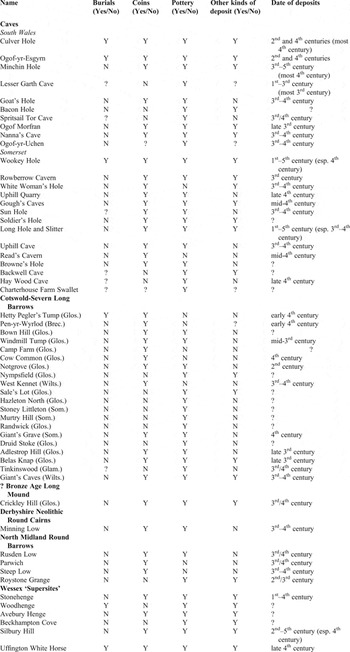
This paper proposes to combine this new interest in ritual deposition with a renewed study of Romano-British reuse of places associated with ceremony in prehistory, by making a close examination of three very different classes of site: the limestone caves on either side of the Bristol Channel; the Neolithic chambered tombs of the Cotswold-Severn region and the Peak District; and the three most spectacular and celebrated ancient monuments of the Wessex chalklands.
THE CAVES OF THE BRISTOL CHANNEL REGION
Caverns have always occupied a prominent place in the story of human spirituality, being at once awe-inspiring natural phenomena and possessed of an obvious liminal significance, placed as they are between the known world and imagined underworlds. They feature as especially important in studies of the Palaeolithic, but retain a presence in all subsequent periods. From earliest times they have fulfilled other functions in addition, as dwellings and places of craft activity and burial, but these can be compatible with a ritual usage, and it is the latter which has been emphasised most prominently of late by specialists in Palaeolithic cultures.Footnote 12 For present purposes, it is noteworthy that Bradley has made a case-study of one grotto decorated with Palaeolithic art, La Griega de Pedraza in Spain, as a prominent example of how an ancient site could be re-employed as a centre of cult activity under Roman rule with clear reference to the earlier remains.Footnote 13 This makes it the more significant in that the two leading experts on the Romano-British use of caves, Keith Branigan and M.J. Dearne, have almost discounted such activity in their analysis of the phenomenon. They have identified 20 examples of caves being utilised in the Roman period for domestic occupation, 24 in which they were employed as refuges, and a probable 18 in which they became cemeteries. Six to eight were characterised as serving other functions, but it was noted that none were adapted as shrines and only one has produced a clearly religious artefact.Footnote 14
The cave systems of the Carboniferous limestone landscapes of south Wales and Somerset are some of the most impressive and abundant in Britain. By the Roman period their natural attributes would have been enhanced, as places to provoke wonder, by the evidence of previous human or animal occupation spanning, in some cases, tens of millennia. This might include pottery, flint, bone or metal tools and weapons, and human and animal bones. Most impressive of all would have been the skeletal remains of large extinct beasts, in which many of these places abounded. Often such relics would be buried deep, and sometimes sealed by limestone flow, but in some cases they would have been exposed by human or animal activity, or the action of streams or tides. To a modern scholar, these sites contain special difficulties. An undisturbed and intact cave deposit represents an ideal opportunity for archaeology, but virtually none now survive. All of the forces that might have made evidence of past activity obvious to the Romano-British have served to confuse the stratification of finds, and most of the sites were dug out by antiquaries in the nineteenth and early twentieth centuries. Not only were these excavations often poorly conducted and recorded even by the standards of their time, but those responsible were most keenly interested in the Old Stone Age evidence, and much less in that from subsequent periods. In the past 40 years new caves have occasionally been discovered in the region by geologists and caving clubs, and reserved for investigation by archaeology, but, as one such discoverer has ruefully admitted, the process has really just consisted of making the sites known to science. In the main, they had already been entered by local people in the past few centuries: in the case of those on sea cliffs, by those taking birds and their eggs for food.Footnote 15
Bearing all these problems in mind, the present state of the evidence can now be examined. Ironically, the single case in which Branigan and Dearne were prepared to acknowledge the presence of possible ritual activity, because of the presence of a religious artefact, now seems less certain. The site is Culver Hole on the Gower coast, which was subjected to various investigations between the 1880s and 1930s, and the object was a small bronze figurine of a naked female, probably a goddess. This has been provisionally dated to the Romano-British period, and other finds also assigned to that period consist of three second-century coins, eleven of the fourth century, four brooches spanning these phases, a glass bead and a bronze ring. The problem is that the site also yielded Bronze Age and possibly Iron Age pottery, bones of animal livestock, and the remains, mostly skulls and long bones, of over 40 humans. Most or all of these objects had been washed out of their original contexts by a stream and high tides.Footnote 16 All commentators have noted that the place is completely unsuitable for domestic occupation, which is why it might well have functioned as a Romano-British shrine. It might, however, equally have served as a cemetery. The human remains were regarded as prehistoric by their discoverers, but there is no solid reason for this, since the Roman-period objects could well have been grave goods. On the other hand, if the bones are from the Roman period, and those present were selected deliberately — and the smaller skeletal parts not simply washed away — then this would be compatible with a ritual character for the place. At present, however, Culver Hole seems to be a complete enigma.
If Culver Hole were a Romano-British burial ground, then the nearest parallel to it would be Ogof-yr-Esgyrn in the Tawe Valley north-east of the Gower, excavated in 1923 and between 1938 and 1950. This also revealed many Bronze Age artefacts, followed by more from the Roman period, and the remains of up to 40 people; but on this occasion the graves have been dated to the latter period. The artefacts are more numerous than at Culver Hole — brooches, rings, a pin, six coins, a cosmetic pestle, many food bones of livestock, and at least sixteen vessels including samian ware — and likewise derive from two different phases, the first to second century and the fourth century. The brooches in particular are of high quality, and the objects in general show a mixture of native and classical influences. If those from the earlier Roman phase could firmly be associated with the burials, it would indicate that the individuals interred there were of a fairly elevated status: but water and human interference have confused the deposits too much to make this certain. A late Roman hearth was found near the entrance to the cave, suggesting that the fourth-century material may be the remains of domestic occupation.Footnote 17 Karen Pollock, who has studied burial in Roman Wales most extensively, identified this site as the most important example of use of a cave for this purpose. Like Branigan and Dearne, she played down any element of numinous significance, emphasising that such inhumations were just like any others of the period.Footnote 18 Against this may be set an earlier observation by Jeffrey Davies, in his study of native settlement in Wales during the period: stating that the bones were only of certain kinds, suggesting selection, and that, therefore, a ritual use of the cave was possible.Footnote 19 It may be noted here that six coins of Constantine the Great were found buried in a crevice. Their low value would seem to preclude the idea that they were hidden for safekeeping, and perhaps suggests that they were a form of offering.
The third south Wales site displaying considerable complexity is another on the Gower coast, Minchin Hole, investigated between 1946 and 1949. This produced clear signs of occupation in the fourth century, such as four hearths, iron fittings to support wooden structures, and abundant artefacts, including 750 potsherds and coins, brooches and many different kinds of tool.Footnote 20 Branigan, Dearne and Rutter, who have published the best study of the cave, understandably refer to this usage as ‘domestic’, but that may not be the whole story. They also note that the assemblage includes spoons and combs of a quality higher than that of the other artefacts, and suggest that these commodities were being manufactured in the cave for sale at regional markets. The cave may, therefore, have been a workplace for people living near by. Furthermore, there was a small amount of earlier Romano-British material, samian ware and brooches, which was not associated with occupational debris and seems to have been deposited separately.
The final complex example of usage is the Lesser Garth Cave near Pentyrch, where the gorge of the River Taff enters the Vale of Glamorgan. This was dug out in three episodes between 1912 and 1963, only the last being published or making any record of stratigraphy. The result is another confused and crowded catalogue of finds, stretching from the Palaeolithic to the Middle Ages, and including human bones and a hearth that cannot be assigned to any period. The securely Romano-British material consists of sherds from seven vessels, datable by style from the first to the third centuries, but mainly from the latter.Footnote 21
The rest of the evidence from the south Wales caves is small-scale and stripped of any wider context of hearths or burials. The famous Palaeolithic site of the Goat's Hole, Paviland, source of the ‘Red Lady’, yielded six coins of the late third to the mid-fourth centuries and a collection of pottery, including some samian and complete vessels. All were found in badly-recorded nineteenth-century excavations.Footnote 22 Also on the Gower coast, Bacon Hole has provided a single Roman sherd found by an antiquary in 1850 and a bronze pin and a cooking-pot of second-century or later date, discovered in 1941. At Spritsail Tor Cave, near Culver Hole, diggers in 1839 and 1849 found pieces of high-status third- or fourth-century ware, possibly associated with fragmentary human remains.Footnote 23 A similar pattern is found in the caves of the South Pembrokeshire coast. Ogof Morfran, near St Govans, was discovered in 1969, but the context of finds subsequently excavated was not clearly stated. Again, the assemblage ranged from the Palaeolithic to the early modern period, and the Romano-British material consisted of two coins, a bronze brooch pin and a cooking-pot, all of late third-century date.Footnote 24 Two caves on Caldey Island, just off the coast near Tenby, were also productive. Nanna's Cave, dug out in phases between 1911 and 1979 which has left the stratigraphical record completely confused, produced material from the Neolithic to the Middle Ages, including a coin, pieces of at least eleven Romano-British cooking-pots and bowls, plus a shale and a glass bead: the pottery and coin were datable to the third and fourth centuries. Ogof-yr-Uchen, a relatively recent discovery, has been the subject of one excavation, in the 1970s, but recording was poor and all that can be stated is that third- to fourth-century pottery formed part of the assemblage.Footnote 25 The above catalogue of material excludes Romano-British objects found outside caves and possibly washed out of them, of which there are several examples in this region, and artefacts, such as ironwork, which may belong to the Roman period, but cannot be securely dated to it.
It remains now to be seen if the evidence of the Somerset sites, most of which are inland among the Mendip Hills, makes for a contrast. Here the notable and complex example is the cave system at Wookey Hole, much visited in the medieval and early modern periods and excavated in various campaigns during the nineteenth and twentieth centuries. Once more, activity has been attested there between the Palaeolithic and medieval periods, with plentiful evidence from the Iron Age and Roman periods, the latter being represented both by a large cemetery of jumbled bones and rich occupational debris. As in the case of the sites in Wales, it is at times difficult to make the distinction between these latter two periods, and although the finds span the whole period between the first and fifth centuries they are concentrated in the third and fourth, and above all the late fourth century. Great excitement was created by the presumed discovery in 1912 of the burial of a ‘witch’ or ‘sorceress’ in a layer associated with coins from the very late fourth century. She was apparently accompanied by tethered goats, a black ware bowl, a comb, a polished stalagmite ball, and a brooch. In a pit below this deposit were human bones, an iron sickle, and a knife dubbed ‘sacrificial’ by the discoverers.Footnote 26 It is thought now, however, that these finds were not a single assemblage and had no relationship with each other.Footnote 27
Another unusual site in Mendip is the Rowberrow Cavern, excavated in the early 1920s, which was probably the site of a metalworker's forge, since the Romano-British deposits (among Palaeolithic and Iron Age remains) included a hearth and layers of charcoal and slag. Among the finds were bones of food animals, and also a range of Romano-British pottery and 15 coins of mid- to late third-century date, as well as fragments of other pottery. However, it was not clear that all of these latter finds were associated with the metalworking episode.Footnote 28 Two sites in the same hills produced what might genuinely be called hoards. The most remarkable was at White Woman's Hole, which has plausibly been interpreted as the den of a counterfeiter of the late third or early fourth century, or perhaps the place where they hid the evidence of their trade, consisting of over 400 pieces of bronze coinage. None the less, it also contained eight individual coins not connected with this deposit, the latest from c. a.d. 400.Footnote 29 A cave at Uphill Quarry, destroyed by quarrying activity, yielded a hoard of almost 200 regular coins from the late fourth century, possibly buried in a pot, sherds of which were found near them, but also an isolated coin from the middle of the century.Footnote 30
Elsewhere, the general pattern found in south Wales asserts itself. Two of the most famous caverns of Cheddar Gorge, Gough's Old and New Caves, contained between them Roman material comprising about eight ceramic vessels, five coins of the mid-fourth century, four bronze objects and a spindle-whorl, found in badly disturbed deposits. Of the less accessible and visible openings in the Gorge, Sun Hole provided fragments of at least eight vessels and four coins spanning the period a.d. 273–345, among Bronze and Iron Age material and human bones which were not dated. Soldier's Hole has produced a single sherd, a coin, a bronze pin, and a bone counter. Most remarkable, however, is the pair called the Long Hole and the Slitter, which between them have yielded at least 18 intact vessels, plus fragments of at least 18 more, over 60 metal objects, including rings, bracelets, fasteners, pins, spearheads and buckles, and 375 coins. Most of the coins are of late third- or fourth-century date, some of which might have constituted a hoard, but the entire collection spans the whole period from the first century to the opening of the fifth.Footnote 31 A final Cheddar Gorge site, Uphill Cave, had a coin and pottery from the late Roman period. Like most of the caves in the Gorge, above all Gough's, it provided significant Palaeolithic or Mesolithic remains.Footnote 32 Read's Cavern, deeper in the hills, was discovered in 1919 and immediately excavated, proving to contain plenty of Iron Age material, but also a single coin of the mid-fourth century.Footnote 33 Further east, Browne's Hole provided pieces of a Romano-British flagon, a bowl and a jar, and two coins.Footnote 34 To the north, Backwell Cave yielded Neolithic flints and Romano-British pottery and spindle-whorls plus the bones of about 18 humans: if the burials were associated with the Romano-British deposits, then the latter could well have been grave goods.Footnote 35 Hay Wood Cave in the western Mendips had Mesolithic and Iron Age material, and late fourth-century pottery, plus human bones. This time the skeletal remains seemed to be associated with the Iron Age objects, so it is very likely that the Romano-British pottery was a separate deposition.Footnote 36 Finally, Charterhouse Warren Farm Swallet produced, from an excavation undertaken in the 1970s, a small amount of Roman-period finds, along with others from most periods of prehistory. An earlier investigation had, however, found human burials, but without proper recording the question as to whether the Romano-British items were grave goods is left open.Footnote 37
To compile this catalogue involves, once again, a large element of exclusion, of material found in or outside caves which might have been washed there from the land above; of the claim that 47 Roman coins were found in Pride Evans' Hole at Cheddar, challenged by some because the cave concerned had previously been carefully examined;Footnote 38 and of references too vague to be of any use. This accounts for a great deal of lost material: one well-informed source alone announces airily that ‘numerous Romano-British remains have come from what is now a coach park, just up the road from what is now Gough's Cave’ and that Roman-period activity was detected at ‘several small sites’ in Ebbor Gorge, all seemingly without lasting record.Footnote 39 Nevertheless, it is possible on the basis of the existing evidence to claim that about half of the caves of the Somerset and south Wales limestone regions which have been submitted to extensive archaeological examination have shown traces of Romano-British activity. A few were occupied for domestic or industrial purposes, or used for burial, but most appear to have received relatively limited deposits of portable objects, above all coins, pottery and small items of personal decoration. On the whole, the more heavily a site had been used during prehistory, the more likely it was to attract interest. Such attention was paid to caves whether they were large or small, easy or difficult of access, and dry or wet. Although this activity spanned the Roman occupation of Britain, there was an apparent concentration in the last two centuries of the period. A quick look elsewhere in the province reveals a similar pattern, exactly matched in the nearby caves of the Wye Valley, and closely so in those further away in north-east Wales, the Peak District and the Pennines. The single difference in the northern examples is that the deposits in the Peak District apparently favour the second century rather than later.Footnote 40
In setting their faces firmly against a religious interpretation of these finds, Branigan and Dearne were, in part, working within an existing tradition and also using a narrow definition of evidence for ritual activity. There is no doubt that the antiquaries and archaeologists who wrote the reports from which the data are derived virtually all interpreted the finds in terms of domestic or industrial occupation, burial, or refuge from barbarian raiders. As suggested above, however, most of the finds do not seem to be associated firmly with the first three activities, but rather suggest occasional, small-scale acts of deposition. As for the notion that the caves were used as hideaways, the deposits appear to have been made in both peaceful and disturbed times during the province's history, and at sites that were clearly visible — turning them into potential traps — as well as concealed. In the case of the coin hoards, Branigan and Dearne, who themselves favoured the traditional idea that they were concealed in dangerous times, also acknowledged that ‘they should not be assumed to be associated with either criminal activities or military persecution without further evidence’.Footnote 41 What constrained them in following up this insight was the apparent lack of religious artefacts among the remains; and it is here that new awareness of the diversity of ritual behaviour may be of significance. The cave deposits certainly do not include, with the exception of the figurine from Culver Hole, any of the ritual equipment, images of deities, or inscriptions discovered on temple sites. On the other hand, coins represent one of the larger categories of find from temples, and also from sacred springs such as those at Bath and Carrawburgh. On settlement sites, the recent studies have highlighted the prominence of pottery, coins, and animal and human bone in structured deposition. In view of this, and of the data assembled above, the time may have come to suggest that a ritual context is arguable as one sustainable hypothesis for the majority of Romano-British material found in caves, at least in the Bristol Channel region. Furthermore, this would not, of course, be incompatible with use of those locations as cemeteries and smithies, if they were already viewed as vested with a numinous significance.
NEOLITHIC CHAMBERED TUMULI
All of the pioneers of interest in Romano-British activity at older sites — Aitchison, Dark and Williams — paid particular attention to prehistoric burial mounds. Of such monuments perhaps the most spectacular as a class are the megalithic chambered tombs of the Neolithic. Not only are these the most impressive visible constructions from the first half of the Neolithic, they are at once the earliest surviving monumental structures in Britain and some of the most striking from any period of prehistory. They often dominate the immediate landscape in which they are set, and their chambers, when revealed by human or animal activity or weathering, are not only impressive in themselves but commonly contain large quantities of human bone. As such, they possessed the potential to move the imagination in ancient times as in the modern. Some clusters of them have also been very extensively investigated archaeologically. All this should suggest that they are indeed a prime potential focus of study in search of Romano-British material, but there is one considerable qualification to be made to such an idea: the extensive investigation of them was mostly carried out well before the advent of sophisticated archaeological methods. Like caves, they were a particular target of Victorian antiquaries, who often worked, by the standards of the present time, hastily and carelessly and left poor or no records. Furthermore, as in the caves, those excavators were not much interested in Romano-British activity, but in remote prehistory. As a result, not only were many less inclined to take note of material from historic periods, but they also usually dug straight for the likely positions of the original burial chambers and ignored large areas of the mounds in which more thorough investigation has uncovered Roman-period remains.
With these caveats in mind, it is proposed once again to make a regional study of the evidence, choosing two different areas: the most famous single category of Neolithic chambered tumuli within the Roman province, those of the Cotswold-Severn region, and (for comparison) the much smaller cluster of them in the Derbyshire Peak District. The Cotswold-Severn sites, commonly known in Britain as long barrows, were first defined as a group by Glyn Daniel in 1937, and like the limestone caves occupy a zone along both sides of the Bristol Channel, but with a broader distribution, from Wiltshire and Oxfordshire westward to the Gower Peninsula and the upper Wye Valley. The datable material from them has recently been reconsidered, and this exercise has confirmed what was hitherto suspected, that they were a phenomenon of the fourth millennium b.c., but with a pronounced clustering in the middle of that period.Footnote 42 The most recent general survey of them was published by Tim Darvill in 2004, and in it he suggested, promisingly for present purposes, that the level of interest in them by the Romano-British ‘has been significantly underestimated’ and ‘deserves more study’.Footnote 43 Such a study is offered here, and one conclusion to emerge is how rare burial was as a mode of reuse of these monuments, which is surprising given the emphasis on this made by Dark and Williams, and the occurrence of Romano-British burials in caves. There is indeed just one instance: at Hetty Pegler's Tump, Glos., where in 1821 an antiquary found a young man had been interred at the highest point of the mound with three coins of the early fourth century, perhaps representing payment to the ferryman of the dead or perhaps one to spirits of the place.Footnote 44 The position of this monument was no ordinary one, moreover, for it was sited right outside the gate of a large temple complex dedicated to Mercury, and it may be surmised that the old tumulus represented a convenient resting-place for an unfortunate functionary or visitor.Footnote 45
The pattern of deposition is otherwise similar to that in the caves. Pen-yr-Wyrlod, Brecons., produced a coin of the early fourth century from somewhere in the mound.Footnote 46 Darvill's own list of finds from Gloucestershire long barrows includes a mid-third-century coin and pottery in the topsoil of the Windmill Tump, Rodmarton; a coin at Camp Farm; a fourth-century coin from near the west end of the Cow Common barrow; a second-century coin and pottery from Notgrove; and pottery and part of a stone roofing tile from Nympsfield.Footnote 47 Darvill himself stated that these objects ‘might be explained in terms of casual visits, outdoor adventures and picnics’ or as ‘placed deposits’; and that reservation must indeed be emphasised. On the other hand, they correspond closely to the finds at places within caves which are not suited to such casual visits or picnics, and are likely to deter all but the most adventurous (and careless with loose change and vessels). Stuart Piggott, publishing the report of his excavation of the West Kennet Long Barrow, Wilts., in 1962, noted that six coins had been found scattered through the top soil of the façade to the chambers. These spanned dates from the mid-third to the late fourth century, and he concluded that they were not ‘casual losses’.Footnote 48 The Bown Hill Long Barrow, Glos., was opened in 1863 and a bronze coin and four sherds of pottery were found high up in the mound. It was a large tumulus, commanding unusually fine views.Footnote 49 At the Sale's Lot barrow, also in Gloucestershire, twelve potsherds and two pieces of tile were found just below the grass level of the mound. The tile fragments matched one found at a villa in the valley below, suggesting that it had been some inhabitants of that high-status dwelling who had taken a small part of it up for deposition at the old mound.Footnote 50
Moreover, as Darvill went on to emphasise, other barrows showed signs of more substantial activity, involving a deep penetration of the mound or entry into the chambers themselves. In Gloucestershire and Somerset, Roman pottery had been left inside the mounds at Hazelton North, Stoney Littleton and Murtry Hill, and at the Randwick Long Barrow. The Giant's Grave yielded pottery and four fourth-century coins.Footnote 51 Pen-yr-Wyrlod, mentioned above, had dozens of blue beads, which were probably Romano-British, in the chamber. Potsherds which are definitely from the Roman period were left beside the chamber of the Druid Stoke barrow in what is now a Bristol suburb.Footnote 52 At Adlestrop Hill, Glos., pottery and a late third-century coin were found in the vicinity of the chamber. A few of the megaliths at this barrow had been removed, leaving much of the fill, including original burials, intact.Footnote 53 The excavator suggested that this had happened in Roman times because of the deposits from that period, although there is no proof for this. If he were correct, then the objects left could be interpreted as a gift made in exchange for the stones, adding a ritual element to what could otherwise be seen as a purely functional act of quarrying.
At Belas Knap, also in Gloucestershire, Roman material was found in various parts of the great mound, though it is possible that it may have been scattered further by earlier, Victorian, excavators who had not noticed it. It comprised many pieces of pottery (one of high-quality decorated samian ware), two hobnails and two coins of the late third century.Footnote 54 Tinkinswood, on the opposite side of the Bristol Channel in the Vale of Glamorgan, had an exceptionally massive chamber which not only contained a very large number of original burials, but had been visited in the Iron Age, when a bone gaming-piece and perhaps some ironwork were left. If the iron objects were correctly dated by the discoverers, and are not Roman, then the Romano-British deposits consisted only of three black-burnished cooking-pots from the third or fourth centuries.Footnote 55 The excavators thought that they had accompanied intrusive cremation burials, but there is no solid evidence for this. At the Giant's Caves, Wilts., 570 pieces of coarse pottery, six coins and a strip of bronze were found both in the mound and in the upper fill of the two chambers. The material was all from the late third or fourth centuries, but spanned such a broad chronological range that it was unlikely to have represented a single event of deposition. One of the contributors to the excavation report, Ken Annable, suggested that the pots were so well broken that they had been deliberately smashed, perhaps by people making offerings to the spirits of the dead during periodic visits.Footnote 56
The Neolithic mounds of the region, and their chambers, were not always treated with such respect: at Wayland's Smithy, on the Berkshire Downs, Romano-British cultivation was apparently extended onto the mound, denuding it. Furthermore, the chamber might have been robbed of its stones and human bones in this period, and the monument was altered by the recutting of one of its original ditches and the digging of a new one.Footnote 57 On the other hand, the monument was within sight of the imposing prehistoric complex at Uffington, which, as shall be seen, was given respectful attention in Roman times. Perhaps the outlying long barrow was accordingly regarded as expendable, or perhaps (since the case is so exceptional) the treatment of it was intended to be more positive than the excavators recognised. There is also a possible case of mistaken identity at the multi-period prehistoric site of Crickley Hill, Glos., where a long mound, currently thought to be of Bronze Age date, may have been taken for an earlier long barrow. Several late Roman coins and a brooch were found under its topsoil, which the excavator interpreted as offerings. Near this monument a fresh mound was constructed in the Roman period, and a figurine of a pregnant woman and some sherds of pottery placed in it.Footnote 58 The smaller and less numerous Bronze Age burial mounds, or ‘round barrows’, in Gloucestershire attracted proportionately less attention. None the less, deposits were left one at Rodmarton and another at Temple Guiting, and this sort of monument was used more in the county for intrusive burials, both inhumations and cremations being inserted at five different sites.Footnote 59
Overall, it seems that Romano-British material has been found at the majority of the Cotswold-Severn tombs which have received careful and well-recorded excavation. Certainly most of the high-profile twentieth-century investigations of this class of monument have yielded Roman finds. It is instructive in this context to turn to the small cluster of chambered tombs in Derbyshire. They number just three and the chambers are covered by round mounds, of which the largest is Minning Low, still standing over 3 m in height and more than 40 m across. It was opened by the local antiquary Thomas Bateman in 1848, who found many pieces of Romano-British pottery and four coins of the early fourth century: he noted that complete vessels had been found during a previous dig there in 1784. It was excavated again in the 1970s, and pottery was found in every one of the three chambers inspected. One of the chambers held large quantities of pottery, and five coins. Four more coins were found in the mound above, and all dated from the late third or early fourth centuries.Footnote 60 Neither of the two other Neolithic tombs in the Peak District showed similar material, but here a contrast with the Cotswold-Severn region may be significant. Whereas the long Neolithic mounds were the most impressive tumuli in the latter landscape, the Neolithic round cairns of Derbyshire were, with the exception of Minning Low, not much more striking than some of the Bronze Age tumuli of the district. Bateman dug into some of those as well in 1848, and at Rusden Low found Romano-British pottery and a coin of c. a.d. 300. He also heard that a prominent round barrow near Parwich had been destroyed some years before, and ‘about eighty small brass coins of the later Roman emperors were found scattered about it’. Across the Staffordshire border his friend Samuel Carrington opened the large mound of Steep Low and found 47 coins, dating from between a.d. 265 and 340. In the 1970s another prominent Bronze Age round barrow in Derbyshire, at Roystone Grange, was properly excavated, revealing 32 coarse Romano-British potsherds, a brooch, and a pin from the second or third century.Footnote 61 The deciding factor seems to have been, reasonably enough, that it was the more impressive ancient mounds that attracted attention and received deposits in both of the regions taken here as case-studies.
The existing evidence from other parts of the Roman province seems likely to bear out the pattern revealed by these two case-studies. In his survey of the non-chambered Neolithic long mounds of southern and eastern England, David Field remarked that ‘many’ of these had been revisited in the Romano-British period, with ‘reverence’. He noted that coins, in particular, were often found at them.Footnote 62 Some of these, in contrast with the chambered barrows, were used for Romano-British burials, as in the famous cases of Wor Barrow in Dorset and Julliberrie's Grave in Kent, though the latter also had separate deposits of coins and pottery from the second to the fourth centuries. The main recent authority on the site, Paul Ashbee, saw the inhumations themselves as ‘ritual deposits’ rather than ‘random funerary usage’.Footnote 63 Across the country, Bronze Age round barrows were also given attention.Footnote 64 Interestingly, for the Romano-British the attraction seems to have been prominent mounds rather than megaliths as such. There are almost no recorded cases of Roman deposits at the exposed burial chambers — commonly called dolmens — thought mostly to date from the Neolithic. The most prominent exception is at Din Dryfol on Anglesey, but here the remains are probably of a forge set up in the chamber, and not ritual deposits. The two potsherds and the coin found at another chambered tomb on Anglesey, Trefignath, were located in the long cairn that had covered it: as elsewhere, it seems that the tumulus was the attraction.Footnote 65
THE GREAT WESSEX MONUMENTS
Upon the chalklands of central southern England, three prehistoric monuments have renown far in excess of all the others. The first of these is Stonehenge, which is by far the best-known. The second is the complex of megalithic rings and avenues, and earthworks, at Avebury, which includes the largest prehistoric stone circle and the largest prehistoric mound in Europe, Silbury Hill. The third is the Uffington White Horse on the Berkshire Downs, the giant figure carved out of the chalk, which has recently been dated with 95 per cent confidence to between 1740 and 210 b.c. and with 68 per cent certainty to between 1380 and 550 b.c. This would most probably attribute it to the Late Bronze or Early Iron Age; in any event, it is securely late prehistoric.Footnote 66 The grandeur of all three should have been apparent in Roman times as now, and it is, therefore, worth examining in detail — including recently-published discoveries — how they were treated at that time.
At Stonehenge much potential evidence is almost certainly lost, because of the repeated poorly-recorded investigations at the monument in the seventeenth and eighteenth centuries. We should recall that Stukeley was aware of finds of Roman material there, by the 1740s. Recorded excavations in more recent times have turned up 20 coins ranging from the first to the fourth century, 1,857 pieces of pottery, brooches, pins and other personal ornaments. At the famous contemporary timber and stone complex given the name Woodhenge, a mile away, Roman pottery and infant burials were placed in the ditches, and the central child-burial of the complex, long interpreted as a Neolithic foundation sacrifice, may be Roman as well.Footnote 67 To put all this into perspective, Mike Pitts has noted that more pottery from the Roman period has been found at Stonehenge than from all periods of prehistory: well over 6 kg in weight.Footnote 68 On the whole, a ritual interpretation of this material has hitherto been played down. Pitts himself thought that the Roman material could have been associated with the robbing of stones from the monument, though there is absolutely no evidence of this. Paul Robinson commented that the deposits ‘could not be proved as votive’, whereas Darvill has been more even-handed, stating that ‘whether these visits were made out of curiosity and convenience, or because of some residual significance attached to the place, is not known’.Footnote 69 Darvill's statement is absolutely true, but perhaps, in the light of the other evidence discussed in this paper, his latter option should now be given a little more weight than it has been.
The evidence at Avebury now seems less equivocal. Certainly the main stone circles with their huge surrounding bank and ditch, and the avenues running to or from them, have revealed only a scatter of Roman coins and pottery, as at Stonehenge, plus bronze artefacts.Footnote 70 Much more of these sites remains unexcavated, however, and a lot of material has previously been unearthed there without any recording: we have, for example, comments like that of the labourer to an antiquary in 1870, that he had found lots of coins along the western (Beckhampton) avenue.Footnote 71 The outlying monuments of the complex have been more fruitful. In 2000 the Beckhampton Cove, the setting of megaliths which may have marked the end of the avenue, was excavated and yielded Roman pottery, a spearhead and pieces of armour, suggesting that it had perhaps been adapted as a military shrine.Footnote 72 It is notable that the prehistoric burial mounds near the complex received quite a large amount of attention. West Kennet Long Barrow is just to the south, and another Neolithic long mound, an unchambered barrow on Monkton Down, had a Roman ampulla, a dog's skull and coarse pottery 30 cm below its surface.Footnote 73 The Bronze Age round barrows on the hills facing Avebury received similar treatment. One opened in 1849 had iron nails and several coins just below the surface in different parts of it.Footnote 74 Another contained sherds, nails and 84 coins, the latest from the mid-fourth century, below the turf.Footnote 75
The most remarkable finds have been at or near Silbury Hill. Between the 1880s and the 1910s three shafts were excavated to the east; these contained large quantities of Roman potsherds, coins (33 in one shaft alone), bronzework, beads, fragments of glass vessels, bones of deer, sheep, dogs, oxen and pigs, fox teeth, ironwork, oyster and (edible) snail shells, and carved stonework. The coins spanned the early second to early fifth centuries, with a concentration towards the end of that period.Footnote 76 At the time these features were interpreted as wells, blocked with rubbish when they went out of use; they are now thought to have been ritual shafts, perhaps intended to ring the huge prehistoric mound.Footnote 77 Ninety-four coins were found in the ditch of the mound itself during Richard Atkinson's well-known excavation of 1969–70, and the immediate opinion was that they could have been votive. Roman pottery and a bronze bracelet were also discovered.Footnote 78 After that, a study was made of the Romano-British artefacts found near the top of the mound by an earlier excavator, and it was noted that in every examination of Silbury more Roman finds had been made than Neolithic.Footnote 79 A further apparent ritual shaft has now been found by the Swallowhead Spring, below the mound, and the presence of a major shrine has been suggested by discoveries at another nearby site, Mother Anthony's Well. A substantial Roman-period settlement, found east of the mound in 1993 and first thought to have been a farm or posting-house for the nearby road, is now interpreted as a possible cult centre — an idea reinforced by the realisation that it possessed nine stone structures, which included columns. It flourished late in the period, perhaps into the fifth century.Footnote 80
The Uffington White Horse similarly seems to have become a focus of significant activity in the late fourth and the early fifth centuries. A total of 63 coins, mostly dating from a.d. 388–402, 96 nails, 39 hobnails and 338 vessels, almost all of coarse local ware, was found spread across the interior of Uffington Castle, the large Iron Age enclosure, or hillfort, directly above. The enclosure had apparently been left disused for eight centuries before that time, and if the coins came from a single hoard, it was one very rapidly dispersed. The team, led by David Miles, which investigated White Horse Hill between 1989 and 1995 concluded that the finds as a whole either signified accidental loss or intentional deposition, and he came down on the side of the latter explanation, suggesting that the old ‘fort’ had been turned into a ritual space. The White Horse itself attracted no buildings or votive assemblages, but must have been regularly scoured to survive. A cemetery was dug into the unchambered Neolithic long mound below the ‘fort’; this was very large for the region, with at least 49 inhumations and 9 cremations. It certainly belonged to the late Roman period, probably the late fourth century, and may well have been connected to ceremonies carried on inside the enclosure.Footnote 81 This evidence closes a dossier which suggests that all three of the most spectacular prehistoric sites of Wessex attracted Romano-British attention. This activity was concentrated in the late Roman period and was possibly or probably ritual in nature.
DISCUSSION
Clearly, there are ways in which this study could be much extended: for example by carrying out a concentrated investigation of other regions, or by considering other categories of prehistoric monument, such as earthen enclosures or stone circles. Enough has been amassed within its limited framework, however, to demonstrate that in all probability the inhabitants of Roman Britain took a widespread interest in both the more visible and impressive ritual structures surviving from earlier periods and in numinous natural places which had been centres for activity in those previous times. Unless inscriptions or votive objects are discovered, the focus of that interest is unlikely to be recoverable, and the nature of the known evidence makes that improbable, testifying instead to the deposition of relatively small, everyday artefacts. If the activity was indeed ceremonial, we may never know whether it was formal or informal, public or private, involved individuals, families or larger groups, or was dedicated to specific deities, to spirits specific to the location concerned, or to dead humans, or to any mix of these. We can presume that in at least some cases the pottery recovered could initially have contained offerings of food or drink, but this is not so far testable. What most distinguishes the objects found in these contexts is that they were mainly the personal belongings of the people who left them, and of relatively low value: the coins are almost all small, low-denomination bronze issues, and silver or gold is more or less absent from the whole assemblage.
It is also readily and frustratingly apparent that the deposits themselves, as recovered, must have held layers of association and significance regarding which only speculation is now possible. As at any point in the prehistoric or non-historic past, a wide range of ritual activities involving biodegradable commodities — offerings of food and drink with no pottery containers, and wood or textile objects — may have taken place without leaving evidence for posterity. The surviving artefacts could themselves have been charged with meanings at which the present can only guess. The vessels which were deposited, whole or as sherds, could have been invested with importance because of their contents (previously or during the rite of deposition); their association with their former or present owners; their characteristic of being capable of shattering into fragments and yet continuing to survive; the forms of human activity in which they had been involved; and the material of which they were composed. It is possible that the human remains recovered from the caves may be susceptible to the same insights that Mike Lally has recently provided for those found on Iron Age sites in southern England: of being objectified in the same manner as animal or inanimate remains deposited at the same places, perhaps to create new agencies and altered identities.Footnote 82 This does, however, involve a complete rejection of the insistence of Pollock that the Romano-British burials in caves are indistinguishable in all respects save location from those made in cemeteries of the same period; while Richard Madgwick has recently insisted that the human bones found on the same type of Iron Age sites as those considered by Lally were indeed treated differently from those of animals.Footnote 83 The state of disturbance and the standard of recording of the Romano-British skeletal material from the caves appears in this case to render any resolution of these questions extremely difficult. Coins can have a vocabulary of meaning of their own, being at once symbols of human authority and cultural reference, as John Creighton has emphasised in his study of those of the late British Iron Age, and bearers of images and symbols of divine power, as Hilary Cool has pointed out in the specific context of Roman Britain.Footnote 84 The material evidence assembled for this study is rich in potential for such speculations, but none of them can remain anything but suggestive.
More progress, perhaps, could be made with the chronological pattern, and here at present two different perspectives may be taken. The first is to emphasise continuity with the practices of the preceding Iron Age or even earlier periods, a tendency which is at present fashionable in Romano-British studies in general.Footnote 85 This would certainly gain support from the undoubted facts that the deposits discussed here were made throughout the Roman period and that the activity of burying or leaving everyday objects in a ritualised manner was long established and common during the Iron Age, as has been mentioned above. Prehistoric activity has been emphasised in many of the caves described earlier, which was probably in itself an incentive to continued or renewed deposition during the Roman period. Furthermore, it could plausibly be argued that many additional ritual activities might have been carried out at any of the sites considered above, before and along with those that have left material traces. Prayers and other non-material rituals leave no archaeological footprint, and neither do organic offerings; such considerations have an obvious implication for any automatic assumption of a discontinuity of activity at particular places because there are no surviving traces. An important pointer here is provided by the Uffington White Horse itself, around which there appears to be a pronounced diminution or cessation of activity in the late Iron Age and early Roman period, but since the horse itself could not survive without regular scouring, its very existence makes regular and concerted human action a clear presumption. On the other hand, there are obvious limits to which an argument based on an absence of evidence can be pushed. All ages of prehistory and early history in Britain were characterised by ritual practices which left a tangible and often dramatic impact upon the archaeological record. At the least, fluctuations in the artefactual evidence, when dealing with societies in which the deposition of enduring material objects was common, can argue for changes in the intensity of activity.
This is where the second perspective comes into its own: to emphasise that whereas caves were certainly visited in previous periods of prehistory, the interest shown in the deposition of objects at them by the Romano-British appears, on the available evidence, to have been significantly more widespread and consistent. The same apparent phenomenon seems to have been even truer of the Neolithic chambered long and round mounds. Here it is telling also that the authors of the archaeological surveys of the Neolithic ritual complexes of Stonehenge and Avebury, quoted above, have emphasised a relative reduction in apparent activity at these sites during late prehistory, followed by an apparent revival of it under Roman rule. Study of the White Horse and neighbouring monuments at Uffington has, as already stated, revealed a similar marked decline in deposition of any kind at them between the late Iron Age and the middle of the Roman period. It is possible that the Roman occupation in itself created a break with the past, in the minds of some of the inhabitants of the province (as it would certainly do for incomers), which provoked a greater need to relate to past human activity. Furthermore, it was a need which apparently increased as the period went on: the datable finds at pre-Roman sites are overwhelmingly from the mid-third century a.d. onward, to the very end of Roman Britain. Some care is needed here, for coins were certainly more widely available in the province after a.d. 250, and pottery was seemingly more commonly produced after then; though the shift was only one of degree. On the other hand, activity at the places concerned seems to have developed substantially as a whole in the late Roman period. Darvill picked up on this point in his study of Cotswold-Severn long barrows, and thought that it might reflect ‘a widespread renewal of interest in local deities and native traditions and a return to a faith in the spirits of the countryside’.Footnote 86 It may be possible to take his suggestion a little further. One of the features of the late Roman period in southern Britain was a widespread construction of rural temples, often representing expensive and elaborate complexes and structures.Footnote 87 They were usually set in thinly-populated and scenically attractive parts of the countryside, often on steep hills with extensive views, or beside springs. Certainly they may be related to the booming villa economy of the time, and would have represented acts of piety, and perhaps economic investments to attract visitors, on the part of local landowners. The services that they provided, however, presuppose a viably large number of customers, and their locations suggest that the term ‘pilgrimage’ might not be wholly inappropriate for the kind of activity involved. Such temples were especially common in the West Country, and would have flourished together with the activities considered in this paper, the latter showing an intensified interest in other features of the countryside — caves, tumuli and more flamboyant prehistoric monuments — which offered a link to the remote past and hence perhaps a strengthened relationship with a spirit world or with divinities as well.
Such considerations take their place within debates among anthropologists concerning perceptions of the past in traditional societies, which have spilled over into archaeology. Hingley, in his analysis of Bronze Age artefacts recovered from Iron Age contexts, cited earlier, has emphasised one model that has been prominent in those debates: the lack of a concept, among non-Western societies, of a past separated off by difference from the present.Footnote 88 When dealing with late prehistory, such an insight has obvious value. For present purposes, however, it may be contrasted with theories provided a decade before by Chris Gosden and Gary Lock, derived from a study of the Iron Age monuments of the Berkshire Downs. Drawing heavily on recent anthropological work among Australian Aborigines, they distinguished, as modes of traditional thought, between myth, in which the structure of human society is ascribed to superhuman or pre-social forces and natural powers, and history, in which social relations are shaped by human agency, in individual or collective action. They noted that the Iron Age enclosures of the district were constructed upon Late Bronze Age predecessors, and argued for a probability that the latter had endured in consciousness, across periods of discontinuity of occupation, through genealogical histories. By contrast, they interpreted the activity of the Romano-British inhabitants in the Uffington area as linking together monuments of all prehistoric ages around the White Horse in a manner which suggested that the latter were now reordered collectively as part of a generalised sense of a mythical past.Footnote 89
Such a distinction would make sense of the deposits reviewed here. Hingley's warning against assuming a distinction between past and present is less applicable to societies dragged as abruptly into history as those submitted to Roman conquest and rule. However little the daily processes of rural life would have altered, the incorporation of the Iron Age British into the Roman system would have radically reordered the political, ideological, social and economic context, with dramatic implications for established modes of legitimisation of authority and formulation of identity. Moreover, the British underwent a treble process of adaptation under Roman rule, first to the new official framework following the conquest, next to the slower processes of cultural accommodation involved in being incorporated into the Roman system, and finally to the changes which beset the whole Empire from the third century, including increasing religious tensions and divisions which eventually culminated in the official adoption of Christianity. It is easy to suggest that, in these circumstances, an impulse to reconnect with numinous places and impressive monuments associated with pre-Roman ritual activity, and thus a mythical past which still embodied and mediated a relationship with the land, could be increasingly potent. It is even possible that such an impulse eventually became part of a broader growth of pagan self-consciousness in the face of religious instability and the specific challenge posed by Christianity. At this stage, however, we have reached the furthest point to which we can plausibly travel using the original evidence.
Table of sites analysed in the text