The rural district of Kalijān Rostāq is situated south of the city of Sāri, the capital of the Mazandaran province. The district lies in the thick Hyrcanian forest formed between the Caspian Sea and the lofty Alborz chain, which blocks the low-lying plains of Mazandaran from the Iranian plateau. The highland districts of Dodānge and Savādkuh are located to the south of Kalijān Rostāq. The district (dimâ in local dialect, corresponding to Persian boluk)Footnote 1 is home to a couple of dozen settlements, most notably Pahnekolā, Hulār, Derowpey, and Amre.Footnote 2 Each of these villages is called an ope, or “water branch,” pointing to the network of canals branching out of the nearby river Tejan to irrigate the district. The economy of Kalijān Rostāq is based on cultivation in paddy fields and animal husbandry.
The vernacular spoken in Kalijān Rostāq is a dialect of Mazandarani, a language with some three million speakers who are by and large bilingual in Mazandarani and Persian.Footnote 3 Mazandarani is called gələki by its speakers, a term used throughout Mazandaran as well as in the neighboring Gilān province to designate any Caspian language. The dialect of Kalijān Rostāq belongs to the Mazandarani type spoken in the vast plain of Mazandaran; thus I call it Mazandarani proper. Kalijān Rostāqi is close to the urban variety spoken in Sāri,Footnote 4 but it is far less influenced by Persian, and as such demonstrates Mazandarani in an authentic form.
The variety of Kalijān Rostāq is fairly uniform across the district. This study is based on the vernacular spoken in the village Pahnekolā, locally called Panikəlâ, with the suffix kəlâ, which occurs frequently in Caspian toponymy. Pahnekolā is the seat of the Kalijān Rostāq district, with a population of circa 1,200, organized into some 300 households. The major neighborhoods of the village are Diuvand, Kolu, Kalkut, Hamzekhel, and Mimkhāni. A large shrine (tekye) in Pahnekolā serves the entire district and attracts pilgrims from neighboring districts.
The data presented in this study was elicited mainly from Ali Ṭālebi, then a fifty-year-old local farmer and businessman. He was not only fluent but also had great interest in his mother tongue, which is rapidly declining due to Persian influence. The first time we met,Footnote 5 in July 2011, he brought to my attention a wordlist he had gathered. We began with his wordlist, and as it was written in the Persian alphabet, I discussed the items with Mr. Ṭālebi to arrive at accurate transcription and glossing. This was followed by documentation of more data from him and his fellow villagers that would allow compilation of a sketch grammar. The morphosyntax presented below is selective, with an emphasis on the topics not sufficiently described in the published literature on Mazandarani.
Phonology
The consonant inventory of Pahnekolāi is /p b t d k g f v s z š c j x γ h m n l r y/, in which /c/ and /j/ are postalveolar affricates, [t͡ʃ] and [d͡ʒ] respectively. The inventory agrees with the Mazandarani variety spoken in Sāri. It differs from Persian in that /γ/ always articulates as voiced uvular fricative [ʁ], and /k g/ stay velar in all positions. The voiced postalveolar fricative (ʒ) is heard in həždə “eighteen” and gaždəm “scorpion,” bearing the consonant cluster [ʒd], which might be a contraction of [dʒd].
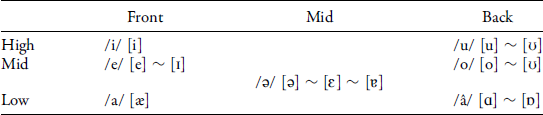
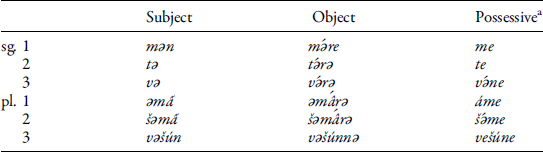
The vowel inventory of Pahnekolāi can be proposed as /a e i â o u ə/, as shown in Table 1. The central vowel /ə/, ranging between [ə], [ϵ], and [ɐ], has probably the highest frequency in the dialect; its preponderance is due to the tendency towards centralization of various vowels in Caspian languages. /ə/ forms minimal pairs with the mid-front vowel /e/ in the second person singular pronoun tə vs. possessive te (see Table 2); sə “three” vs. se “apple”; kələ “hearth” vs. kelə “ditch” (vs. kilə “scale”). Yet the distinction between the two vowel sounds is not always clear, particularly in the vicinity of sibilants and affricates, where /ə/ fronts toward [e], e.g., jət and jet are both heard as “yoke” by the uninitiated ear. In his wordlist Mr. Ṭālebi represented /ə/ often by the Persian diacritic kasra and sometimes by the fatḥa, corresponding to Persian phonemes /e/ and /æ/ respectively. /ə/ contrasts with open vowels in the minimal pairs gəl “soil” vs. gal “mouse” vs. gâl “flower.” Interestingly, in the urban dialect of Sāri the central vowel has merged with /e/.


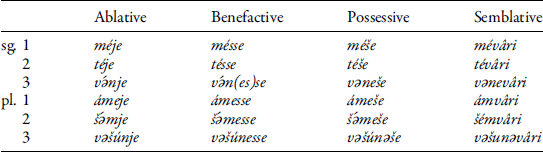
a This set is technically determiners, contrasting with the true possessive pronouns shown in Table 3. Compare me “my” with méše “mine.”
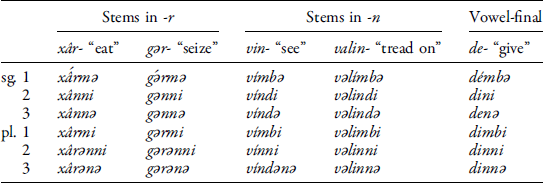
Mid-high front vowel /e/ is articulated in the range between [e] and [ɪ], at times [i], as in [sɪjɒ], the plural form of se “apple,” and the verbal stem de- “give” (see conjugation in Table 4). However, in my data /e/ and /i/ form minimal pairs in še “dew; self” vs. ši “husband”; šer “poem” vs. šir “drenched”; perzâ “child born shortly after the birth of a sibling” vs. pirzâ “mother-seedling of paddy grown in a greenhouse”; pe-run “thigh” vs. pirun “old people.” The phoneme /e/ is chiefly an outcome of the historical majhul vowel (ē) in West Iranian, but sometimes inconsistently appears in the data, e.g. the outcomes of *gēl in gələki “Caspian” and Geləkəlâ (toponym). The vowel /e/ also appears to be an outcome of historical /i/ before glottal consonants,Footnote 6 thus šer (< šiʿr) “poem” and de- (< dih-) “give.” Therefore, the outcome of the front majhul vowel in Mazandarani equals that of formal Tajik.Footnote 7
Diphthongs. Vowel length is phonemically irrelevant. The Middle West Iranian (and Arabic) long vowels and diphthongs are syncretized into individual vowels, as in midun (Pers. meydān) “plaza,” kef (Pers. keyf) “pleasure,” duri (cf. Pers. dowri) “tray,” mer-ə-mâ (Pers. mehr) “Libra.”
I could identify no diphthong in the dialect.Footnote 8 The clusters [æj] and [ɒw] are illusory. The [æj] that occurs in baymə, dayyə, etc. (Tables 10 and 11 footnotes) is an allophone of /æi/; so, the phonemic transcriptions are ba.i.mə [ˈbæ(h)imə, ˈbæjmə], da.i.ə [ˈdæijə, ˈdæijə, ˈdæjjə]. Similarly, baytə́n/baitə́n “to take” can be broken down as ba.i.tən into three syllables.
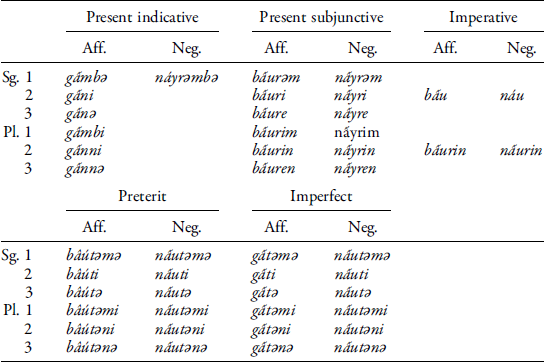
The pseudo-diphthong [ɒw] e.g. in bâutə (Table 7) occurs with free variation in stress, as bấutə and bâútə and is optionally pronounced as bâhutə and bấ:tə. These varying forms lead to the syllabic structure bâ.u.tə as the underlying form of the word.
The lack of long vowels and diphthongs in Mazandarani may have contributed to its speedy tempo, a feature hinted at a millennium ago.Footnote 9
Noun Phrase
Nouns
As a Caspian feature, Pahnekolāi has left-branching word order in noun phrases, including postpositions, adjective–head-noun, and possessor–head-noun constructions.Footnote 10 Adjective and noun modifiers precede the head noun and normally take the linker -ə/-e if they are not vowel-final. Examples are: sərx-ə se “red apple”; kal-ə kallə “bald head”; həfəndər-e təngelo “tip of the sickle”; gâl-ə tək-e še (Pers. šabnam-e ru-ye gol) “the dew on the flower.”Footnote 11 Plural markers are -un for the animate nouns and -â for others, as in pirun “old people” or suziâ “vegetables.”
Pronouns
Personal pronouns appear in three cases displayed in Table 2. The subject and the possessive determiner are the basic forms; the object set is derived from the subject set suffixed by the object marker -(r)ə. The possessive determiners, like other modifiers, precede the head noun:

Possessive determiners tend to coalesce with various postpositions, leading to the paradigms shown Table 3. There are opposing views on whether these forms can be treated as formal cases.Footnote 12 Additionally, we find in Pahnekolāi forms such as əmâjə and šəmâjə Footnote 13 that combine subject pronouns and the ablative postposition to convey a collective territory, e.g.


Verbal Morphology
Pahnekolāi shows general agreement in the verb phrase with the central and eastern Mazandarani varieties spoken in Sāri,Footnote 14 Espivard (between Sāri and Shāhi), and Māhā (south of Firuzkuh).Footnote 15 Yet there are features, such as modals, that might be unique to Pahnekolāi. The following sections elaborate on the lesser known features and offer analyses that might be different from those given in the published literature on Mazandarani.Footnote 16
Verb stems
Verbs are generally based on a binary set of stems of present (i.e. non-past) and past. The phonological correspondence between them varies in Pahnekolāi. In pairs such as vəj- : vət-Footnote 17 “pull out, drag out”; xâs- : xât- “sleep”; and kân- : kârd- the past-present stem correlation can be explained only diachronically. A sizeable class of past stems can be derived synchronically by suffixing -(V)ss to the present stem:
In Pahnekolāi, as in most Mazandarani varieties, there are verbs for which one may deduce up to four stems at a synchronic level. The stems for the verb “go” are šu-, ši-, bur-, burd- (Table 8). See also the conjugation of “say” in Table 7.
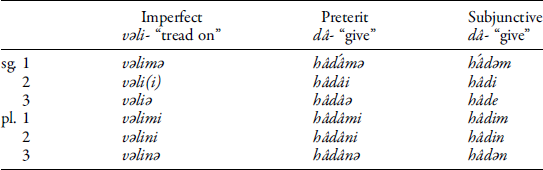
The interplay between the stem and prefixes (see below) may alter the initial consonant of the stem. Stems with initial /v/ lose it when prefixed; for instance, the stem pair vəš- : vəšâ- appear in full in the prefixless forms vəšəmbə “I open” and vəšâmə “I would open,” opposing boše “open!” and bošâi “you opened,” in which the onset submits to the modal-aspectual prefix ba- while it leaves its trace on the vowel (/ə/ → /o/) at the morpheme boundary. A similar process governs the stem pair vəlin- : vəli- “tread on, trample” (for Pers. lagad kardan), where we find the imperative form búlin “tread on!” and preterit buli(i) “you trampled.” Prefixes also result in lenition of the stem-initial /g/, as in the verb “take, seize,” with underlying stems gər- : gət-, as shown below:
The lenition of /g-/ is also observed in the verb “say” (Table 7) but not in nə́-gârden “don’t return!”; as such, this process does not affect all the relevant verbs. The lacunae in my corpus does not permit drawing general rules on lenition of stem-initial obstruents following Tense-Aspect-Mood and negation prefixes. Some other Mazandarani varieties tend to lenite other voiced obstruents, including /d-/, which remains intact in Pahnekolāi ba-di-mə “I saw” and hâ-dâ-mə “I gave.”
There is also a finite class of stems with an epenthetic -r- separating them from a prefix:Footnote 18 eš-: ešâ- “look”: ešə́mbə “I look”; ešấmə “I used to look”; ešâ bime “I had looked”; vs. hâ-r-šem “that I look”; hâršâmə “I looked.”
Prefixes
These consist of lexical preverbs, the negative marker na-, and the mood-aspect marker ba- which coexists with neither.
Preverbs include hâ-/hə- and da-, and may semantically modify the stem: bacin “pick off!” vs. dacin “arrange!”; bakəš “pull!” vs. dakəš “spread (e.g. a tablecloth)!”; dəm bədâən “to throw” vs. hâdâən “to give”; the present stem mâl- “rub” vs. həmâl- “fold.” There are stems such as hə-pâj- : hə-pât- “winnow” that only come with a preverb.
The mood-aspect marker ba- specifies the subjunctive (e.g. bávinəm “that I see”), the imperative (bávin “see!”), the preterit (bádimə “I saw”), the infinitive (badiə́n “to see”), and the past participle (badí “seen”). Absence of this prefix implies duration: vímbə “I see”; dímə “I would see, I used to see.”
The prefix ba- is replaced with preverbs when one exists, e.g. the preverb hâ- in the verb hâkârdən “to do,” with the following forms for the first person singular: present kâmbə, subjunctive hâkânəm, imperfect kârdəmə, preterit hâkârdəmə.
The negation marker na- attaches to the stem (návimbə “I don’t see”) and precludes other prefixes: də́gârdən “return!” vs. nə́gârden “don’t return!”; bádimə “I saw” vs. nádimə “I didn’t see, I would not see.” Consequently, by suppressing the aspectual marker, negation results in a merge between perfective and imperfective in past tenses (Table 6); compare also bâutəmə “I said” (with underlying form ba-gât-əma); gâtəmə “I would say”; nâutəmə “I didn’t say, I would not say.” The merge in the negative does not occur between the present indicative and subjunctive (also with prefix bá- in the affirmative) due to different personal suffixes: ná-šu-mbə “I don’t go” ≠ ná-šu-əm “that I not do” (Table 8).
Suffixes
Verbs are conjugated with six person markers, appearing in two underlying sets that are mirror image of one another: the subjunctive set, employed in the present subjunctive, and the indicative set, employed in other verb forms:

An epenthetic vowel applies for stems ending in consonants other than approximants. Other constraints are discussed under Infix, below. Examples of conjugation are given in Tables 4 and 5.


In my analysis, the binary set of personal suffixes underlies all Mazandarani varieties. This is probably the simplest way to formulate the more or less similar systems that have been expressed on purely synchronic grounds as a triad, for the varieties spoken in Sāri,Footnote 19 central-eastern Mazandaran,Footnote 20 Espivard,Footnote 21 Kojur and Nur,Footnote 22 south-central Alborz,Footnote 23 and Shahmirzad,Footnote 24 and as a tetrad for the southernmost Mazandarani variety spoken in Māhā,Footnote 25 south of Firuzkuh.
Infix. The present indicative is further specified by a nasal morpheme wedged between the stem and personal suffixes. This infix, which may be idealized as -ən-,Footnote 26 shows a remarkable morphophonemic interplay with neighboring morphemes.
Stems with an approximant in coda show these variations:
The stem evades the nasal infix for the first person singular and plural: var-∅-mə “I carry,” var-∅-mi “we carry.”
The stem coda assimilates to the nasal infix for the second and third persons singular: van-n-i “you carry,” van-n-ə “he carries.”
The nasal element of the infix drops for the third person plural: var-ə-nə “they carry.”
The morphemes agglutinate soundly only in the second person plural: var-ən-ni “you carry.”
Stems ending in /n/ overtly display the infix in the second and third person singular while others evade the infix:
For the second and third person singular, dissimilation occurs between the stem coda and the infix (nn → nd) to distinguish between plural and singular: vindi (vin- + -n- + -i) “you see.”
For the first person, double dissimilation occurs between the stem coda and the suffix: vimbə (vin- + -mə) “I see,” vimbi “we see.”Footnote 27
In the second person plural, the nasal infix finds no room between another two nasal consonants: vin-∅-ni “you see.”
The third person singular shows a similar process, e.g. in vəlin-nə “they tread on,” while víndənə “they see,” with an extraneous d, is irregular for the class of stems ending in /n/.
Table 4 compares classes of conjugation with respect to the final sound of the stem.
Inflectional verb forms
There are five simple forms: present indicative (present-future) and subjunctive, imperative, preterit, and imperfect.
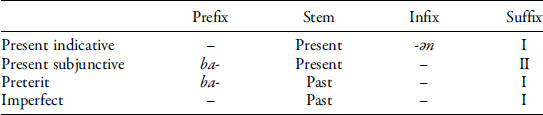
Table 6 summarizes the forms that have full patterns. Asymmetry in the distribution of tense‒aspect‒mood is found in the two present tenses that are divided by mood (indicative and subjunctive) while the two past tenses are divided by aspect (perfect and imperfect). The asymmetry also exits in the distribution of morphemes in present tenses, which are different in both the infix and suffix; only one of these two morphemes is needed to distinguish the two sets. This redundancy has led to various classes of conjugation for the present indicative, as shown in Table 4. For conjugation of the simple forms of “say,” see Table 7.


In accordance with other Mazandarani varieties, Pahnekolāi expresses the present perfect normally using the preterit tense. There are, however, forms for the stative verb “sleep”Footnote 28 in my data that resemble the present perfect in Persian: baxâtúə, baxâtúnə, baxâtúmə “he is, they are, I am asleep/sleeping,” corresponding to Pers. xwāb ast or xwābide ast, etc. These forms correspond to what Yoshie proposes as present perfect for stative verbs.Footnote 29 On the other hand, Stilo holds the opinion that Caspian varieties all lack a present perfect and resultative forms in Caspian should not be confused with a true dynamic perfect.Footnote 30
Periphrastic verb forms
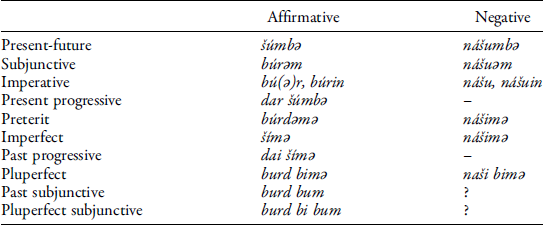
In additional to the five inflectional tenses, there are five periphrastic forms: two progressives, present and past, and three perfects built on the past participle. Table 8 demonstrates all forms for the verb “go.”

Note: All conjugated forms except the imperative are in the first person singular.
The progressives receive the imperfective conjugation preceded by the locative verb (see below) as auxiliary. The auxiliary is the invariable dar for the present and dai/day for the past, i.e. the shortened forms of the third person singular of the locative verb. Examples: dar jómbə “I am chewing”; dai jóssəmə “I was chewing.”
The periphrastic perfect tenses are constructed analytically with the past participle and the copulas as auxiliary. The pluperfect and the perfect subjunctive employ the past participle with past and subjunctive copulas respectively, as in bavərd bimə “I had carried”; bavərd bum (for Pers. borde bāšam) “that I should have carried.”
The pluperfect subjunctive has the additional element bi, which is the past participle of “be”: bavərd bi bum/buəm/bəm “I might have carried” or “maybe I had carried.” The variation in form suggests the diminishing status of this tense in the dialect due to contact with Persian, which does not have a parallel tense.
Copulative and locative verbs
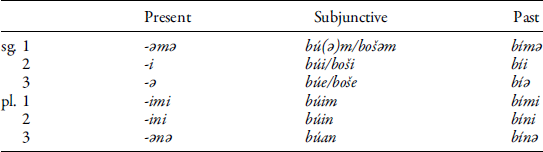
The present set of copulas are enclitics similar to the indicative set of personal suffixes. The root hass- is optionally employed (see examples (1) and (2), above). The past and subjunctive stems are respectively bi- (< *būd-) and bu- (< *baw-), as deduced from the paradigms organized in Table 9; they serve as auxiliary in perfect periphrastic tenses. The command form is boš in the singular.

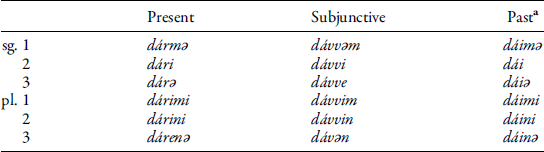
The locative verb incorporates stems based on the original preverb or adverb dar- and conjugates regularly in terms of personal suffixes (Table 10). The verb conveys location or existence when appearing as the main verb in a sentence. Shortened forms of the third person singular also serve as auxiliary in progressive tenses.

a Alternative forms: dáymə, dai, dayyə, daymi, dayni, daynə.
The form həkətə, apparently a past participle based on the past stem kət- of the verb dakətən “to fall,” signifies static, inanimate positions on a flat surface. Only the third person singular affirmative form is attested.
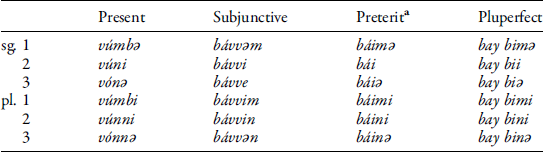
“Become” takes the prefix ba- and the personal endings regularly (Table 11). The imperative singular form is bávoš. The passive voice is constructed analytically with this verb, e.g. âmuxtə baimə “I have made a habit” (lit. “I became accustomed”).

a Alternative forms: báymə, bai, bayyə, baymi, bayni, baynə.
Modals
The Mazandarani defective modals vénə (present) and vésse (past) “must” are followed by the subjunctive and imperfect forms of the main verb respectively, e.g. venə burəm “I must go, I had better go”; vesse šimə (for Pers. bāyad/bāyest/mibāyest miraftam) “I was expected/supposed to go.” These only examples in my documentation differ from the usage of vesse in other Mazandarani dialects, which do not employ the imperfect after it.Footnote 31 It is possible that the Pahnekolāi phrase is a calque translation from Persian.
The verb “be able to” is built on the stems tun- : tuness- and takes prefixes irregularly. The present optionally takes the modal prefix, thus both túmbə and bətúmbə “I can” are grammatical. Negation can be expressed by prefixing either na- or ba-, as in nátumba or bátumba “I cannot,” in which the stressed prefix makes the negative distinctive from the affirmative. The past form tunéssemə (for Pers. (mi)tavānestam) “I could” also may be negated by either prefixes: nátunessemə or bátunessemə “I could not.”
Possibility is also expressed by bənšənə followed by the infinitive. The first component, beno , might be related to venə “must” (see above). The only parallel known to me for this impersonal modal is its negative form in the Mazandarani variety of Sāri.Footnote 32 The following example corresponds to Pers. mišavad bā u košti gereft.

The verb “want” is xâ- : xâss-, as in xấmbə “I want” xấssemə and baxấssemə “I wanted.” Moreover, the invariant emə, probably idiosyncratic to Pahnekolāi, conveys attempt or aim when followed by the verb dâr- “have”:

Verbal Nouns
The infinitive is formed from the past stem carrying a prefix and the suffix -ən, which is always stressed since the infinitive functions as a noun, e.g. hâdâə́n “to give.”
The past participle is formed from the past stem of the verb with a prefix and the suffix -ə/-e in its full form. The suffix drops when the past participle is employed in the formation of perfect periphrastic tenses. Participial adjectives of intransitive verbs may stand alone or combine with a noun, as in bajos “chewed”; bâzâr-həkət “fool, stooge” (lit. [someone whose news is] fallen in the market); davəssə́ bušâ “tied in a wrapping cloth”; bəγlâšté ənâr “cracked pomegranate.” As such, my meager corpus shows both full and truncated forms of the past participle when employed as an adjective, whereas Yoshie found only full forms for the adjectival role.Footnote 33
The past stem takes suffixes to form nouns. An -in suffix gives sar-kat-in (lit. head-fallen-suffix) “quilt” (cf. gələs-ən “drooler” (formed on a noun), maccəgin “sticky,” with obscure origin). The word girisâ “epidemic” is probably from *gir-ess-, which would be a secondary past stem for the present stem gər-, with the past stem gət- “seize, take.”
The present stem compounds with nouns and suffixes to form participial nouns and adjectives, including gerunds. Examples are: mi-ras “spinner of goat-hair”; lamə-so (Pers. namad-māl) “felt maker”; o-dagiz “one who draws water from a well” (from da-giz -: da-gišt- “pull out; rinse”); cəš-vəj (lit. eye pluck-er) “arrogant” (from vəj- : vət-); vâ-kaš-ə (with preverb vâ-?; cf. Pers. havā-kaš) “hood”; anjil-paj-e-mâ (lit. fig-ripening-month) “mid-summer.” The forms bədé (lit. giver) “debtor” and bəxấ (lit. want-er) “creditor” (cf. bə́xâ “want!”) are probably imitated from colloquial Persian. The group vacə-kar “capable of giving birth,” binjəkar (Pers. berenj-kār) “paddy cultivator,” and kasu-jam-kar (Pers. šaltuk-jamʿ-kon) “paddy collector” suggest the substratal present stem kar-, otherwise characteristic of Northwest Iranic languages, vs. Mazandarani kən- and Persian kon- “do.”Footnote 34 The common Mazandarani word bərməndik “habitual weeper” consists of bərmə, the nominal component of bərmə hâkârdən “to cry,” also expressed by the simple stem barm-Footnote 35 in Mazandarani (cf. Parthian brm- : brmʾd-) and the suffix -andik, which is otherwise rare in Mazandarani.
The suffix -eš has high frequency, e.g. in məješ “walking” (from məj- “walk”); rəmbəš “heavy walking sound” (with unattested verb stem; probably borrowed from Pers. rombeš “imploding,” which has become obsolete); and xundeš “singing.” The latter shows a past stem but most likely it originates on the present stem xun-.
An interesting gerund is səroš “talking nonsense” (< “*speech”). The associated verb is səro- : səross-, with inflected third person singular forms sərónə (present), səróssə (imperfect), basróssə (preterit), násro “don’t talk much!” The gerund is found as the nominal component in səroš bemuə “he started talking nonsense.” From this verb we have səroun (for Pers. porgu, ḥarrāf) “talkative.” These forms impeccably accord with serow, glossed as “ḥarf, soxan”Footnote 36 (“speech”) in the Mazandarani dialect of ʿAliābād spoken in the upland district of Farim. It is likely that the stem səro- is derived from proto-Iranian *srau- “to hear, listen,” which is semantically expanded in Parthian srʾw- “to sing,” with which the Pahnekolāi form agrees more closely than to the Middle Persian form srʾy “id.”
Lexis
The glossary that follows originates from the wordlist compiled by Mr. Ṭālebi, the main informant of this study; additional lexical items were elicited from him and other native speakers of Pahnekolāi as the documentation progressed. There was no attempt to compile a systematic lexicon of the language, which has been made available to various extents by other researchers.Footnote 37
The significance of Ṭalebi’s wordlist lies in its inclusion of words pertaining to the traditional way of life of his village—that is, rural economy, architecture, clothing, culinary art, kinship, measuring time, topography, landscape, and flora, as well as idioms and expressions. Most of these are already out of date or even incomprehensible to younger generations of Kalijān Rostāq, let alone urban dwellers. With the pervasive force of modernity, Mazandarani, especially its urban varieties, has wholesaled its terminology pertaining to material culture, a trend which is not altogether unexpected, for it is unlikely that a city dweller would encounter items at home, school or office, or in the street or marketplace that were essential in the lives of their forefathers. The continual depletion of characteristic Mazandarani vocabulary, which is by and large rooted in the domestic economy of the province, has made it difficult for many native speakers to perceive their mother tongue as anything more than a dialect of Persian.Footnote 38
Aside from cultural words, there are many items in the glossary that are obsolete in the urban varieties of the language. Just to name a few: məješ “walking”; səroš “speech”; əndossən “to plaster”; girisâ “epidemic”; ope “village”; dimâ “district”; pəcuk “small”; jer “below”; yər and yor “near and far sides.” Words lost to Persian in Sāravi (Sar.) includes but not limited to dinə “yesterday” (Sar. diruz); ašun “last night” (Sar. dišu); bərim “outside” (Sar. birun); dərnə “handspan” (Sar. vaje(b)); rujin “window” (Sar. darice); garmâri “pepper”; sarin “pillow” (Sar. pešti, bâleš(t)). Note also am-γâli and am-γâzi “cousin” (Sar. amme peser, amme deter), with Turkic components qul/köle “slave” and kız “girl.”
Glossary
âftâb-mâr-šu sunset
âmi-dətər paternal uncle’s daughter
âmi-pəsər paternal uncle’s son
âmuxtə accustomed
âvəssən pregnant
afto ewer
alok in flames
am-γâli paternal aunt’s son
am-γâzi paternal aunt’s daughter
am-nəmâšun this evening
am-sevi this morning
amru today
anjil fig
anjil-paje-mâ fig-ripening month, midsummer
araš pace (Pers. gām)
asiubun miller
ašun last night
attâ one
bâl-kələssi far end of the room
bâru wall
bâzâr-həkət fool, stooge (Pers. masxare)
bal flame
bandum slander, false accusation (Pers. bohtān)
barzəγ angry (cf. Pers. barzax)
bau-šâl kind of jackal
be quince
bəde debtor (Pers. bedehkār)
bənəlâ mattress (Pers. došak)
bəre sautéed
bərim outside
bərim-dərim hustle and bustle
bərmə weep, cry
bərməndik habitual weeper
bəxâ creditor (Pers. ṭalabkār)
binj unthreshed rice
bunakân kind of low-quality pomegranate
bur yellow (horse)
câc canopy
caγer sticky
câi tea
câkəpe riverbed’s dry edges
caft timber shed in the pastureland
caftə-sar resting area for shepherds
cal spinning wheel
calb greasy
cappun shepherd of sheep
car-nəmâz veil
carci vendor
cek in cek hâdâən “to sit down”
cemâz type of wild plant (Pers. saraxs)
cəlk body filth
cəlkə small balance (accounting)
cəllə branch (of trees)
cəlo water spring
cəpâ rice crumb
cuk-kisə washing mitt
dâ-γâli maternal uncle’s son
dâ-γâzi maternal uncle’s daughter
daldarəši jumbled
dar-kendâ door frame
darə small sickle
dassə handle
daštəbun farm ranger
davəndi leather shoe
der-sevi yesterday morning
dərim inside
dərnə handspan
dəryâ sea
dəryâ-vari north; toward the sea
dətər daughter
di-nəmâšun yesterday evening
diâr apparent (Pers. peydā)
diâri from afar
dimâ rural district (Pers. boluk)
dimris continually (Pers. payāpey)
dinə yesterday
dunə unthreshed rice
duri large copper plate, tray
emə intent, aim
espe white
əjâr branches used in weaving
əmâ-jə our habitat
əmâm-nəmâz dawn (lit. imam-prayer)
ənâr pomegranate
ənâr-rijə wild pomegranate used in stews
əndâ size
asb-e əndâ “as big as a horse”
əndâ size, height
əndâ-varəndâ appraisal (Pers. sabok-sangin)
əskələm-tali kind of thorn shrub
əšâk-əšâk looking secretively
əzbənâ corriander (Pers. gešniz)
əzzâl ploughshare
fal thought, imagination
fenər lantern
ferd-sevi tomorrow morning
fəni nose
fərâm bachelor
fəššo tomorrow night
fiə shovel
gâder time; jo-dero gâder “time to harvest barley”
gâl flower
gâleš cowherd
gâləš-bənə resting area for herders in pasturelands
gâli amputated, chopped off
gâlxâssək croup, laryngotracheobronchitis (Pers. xorusak)
gândəkâ yarn ball, yarn rolled into a ball
gâsbən sheep
gal mouse
gali throat
gandəm wheat
gannâ paternal grandmother
gap-o-gu conversation
garmâri pepper
gat big, large
gaždəm scorpion
gaznə type of wild bush
gel-gui mix of mud and dung used for plastering walls
gəl soil, clay
gələk Caspian (ethnicity)
gələki Mazandarani
gələs saliva
gələsən drooler (a person whose saliva flows out of their mouth unintentionally)
gərdə round, low-quality rice
gərvâz small spade
gir-gir approaching (time) (Pers. dam-dam) gir-gir-e âftâbmâršu “just before sunset”
girisâ epidemic
gisə hair (Pers. gisu)
gu cow
gu-bənə part of the pastureland for keeping cattle
guâl large sack to store cotton (Pers. javāl)
gui dung
γân treasure box
γârtik Adam’s apple
γârzəm pool (Pers. estaxr)
γaləci zinc worker: one who coats copperware with a protective layer of zinc (Pers. ruygar)
γamtər bridle of a hose (Pers. dahane)
γəblə-vari south
γərâ black (horse)
γəvâ cloak
γub-dasmâl potholder (cloth)
hambâz partner
hand depression covered by vegetation
hasnu swim
hedâr direction, sense (Pers. samt, su), e.g. tə un-hedâr-pe bur, shâyəd go-rə bavini “you go that way, maybe you see the cow”
heštə pair of oxen
hey mix
həfən-dərə scythe, sickle
həjəγerəs wrinkles
həlang long stick with curved tip used to pick fruit
həmbâr slow
huli bathe, short bath (Pers. āb-tani)
jâhəl young man
jel rag-cloth
jer under, below; skew (furrow)
jer-kələssi lower end of the room
jəl cloth
jərə clamor, outcry
jət yoke
jo barley
jortema olden days, times of yore (Pers. ān-vaqthā)
jur strait (furrow)
jurəb socks
kâ where to (Pers. kojā)
kâ where; e.g. to kâ šuni “where are you going?”
kâb heel (Pers. pāšne)
kâl shore of a river
kâlum stable
kândəs medlar (Pers. azgil)
kânji sesame
kâti ladder
kacelik squash
kadxodâ headman of the village
kahar brown (horse)
kahu blue
kai pumpkin
kai-mârim pumpkin plant
kal bald
kalək short ladder
kalələ slippers
kalizə place chosen by a hen to lay eggs
kaməl straw, chaff, hew (of paddy)
kandəl beehive
kaso harvested rice paddy
kašə bosom; embracing (Pers. baḡal)
kaši cinch (band that holds the saddle by being tightened around horse’s body just behind the front legs)
kat mud wall
kavəz turtle
kaz unripe
kef pleasure
kelə small canal, ditch
kelin ashes
ketelum measure
kələ hearth
kərə-dakət evil, wicked, malevolent (person)
kərəs cattle cote or pen in pasturelands
kəti hill
kətrâ large wooden spoon
kijâ girl
kilə scale
kingə tree stump
kogandəm nun bread made of corn flour
ku where (adverb); e.g. ku-i “where are you?”
kufâ stock of harvested chaff
kulək wild rue (Pers. espand)
kurik squint (look at something with eyes partly closed)
lâγli frying pan
lacər filth
lam thorn bushes tingled together
lam-coγâ woolen shepherds’ overcoat
lamə felt
lamə-so felt-maker
lappər inertial wave of liquids in a moving container
ləkkâ small farmland adjacent to a house
lo edge (postposition); nâl-lo “along the edge of the porch”
lolə wooden basket
loš timber gate of a farm
lucə lip
lukəti unworthy
mâ female
mâcə female
mâcək, mâckâ girl
mâšə tongs (Pers. anbor)
mâz bee
maccəgin sticky
maləmâ lukewarm
mamij raisin
mangəl resting area for sheep and cattle
marsək cupper pitcher (Pers. pārc)
mašməl spoiled, overindulged
mer bakârdən to say besmellāh
meš ewe
məješ walking
məke first milk
məkənâ headscarf
məməl frequent customer
mi hair
midun plaza
mi-ras spinner of goat-hair
mireškâr hunter
mirkâ large blue bead
moxtâbâd head shepherd
mozgâlo type of forest tree
nâləsar porch (Pers. eyvān)
nârə moan (Pers. nāle)
nâxəši illness
nəfâr elevated timber trellis built in the courtyard for storage
nəmâšun evening
nəsum shady side
nokâ wooden container for feeding animals
numzə-γərə young man at age for marriage
nun bread
o water
o-dagiz one who draws water from a well
o-dang water mill; tilt hammers for husking rice
o-pe village
oxâr stall (Pers. āxwor)
ozər wind that blows at summer night from the Tejan river
pâkâr servant
pâpəli butterfly
pal sheep pen without ceiling
pali in pali dagərdəssən “to become angry”
par-nəmâšun two evenings ago
pare day before yesterday
pe-run thigh
pe-šom desert (lit. following-super)
pelə pocket inside the veil worn by women
perzâ child born shortly after the birth of a sibling
pəcâk crafty, shrewd
pəcuk small
pəlvər timber rafter used in ceilings
pəno like (postposition); e.g. xar-pəno “donkey-like”
pərik little, a bit
pəruk withered (Pers. palāside)
pəsər son
pətak back of the neck
piləkâ clayware for yogurt
pirzâ mother seedling of the paddy grown in a greenhouse
piuri singing in unison
râhâ free
rasən-sari tip given after buying sheep or cattle
raš-o-roməš light-yellow (horse)
rəkibəki last child
rəmbəš heavy sound
rəzə change (money) (Pers. pul-e xord)
rikâ boy
roxânə river
rujin window
runəki crupper (strap that goes around an mule’s tail to keep the saddle from slipping forward)
sâynâ shade of trees
sâzə broom
sâzə-xâl bristles (of broom)
sangisə stone pestle
sar-nəmâšun dusk
sarəlâ quilt
sarəšo crack hour
sarin pillow
sarpâi slippers
se apple
sevâi morning
sevâi-sar early morning
səmâ dance
səre house
səroš talking nonsense, verbosity, speech
səroun verbose, talkative
sərpiš courtyard
sio black
sirsutaxtə cutting board (in kitchen)
suâl forehead
sumâ whirlpool
suzi cooking vegetables
šâl jackal
šâp pace (Pers. gām)
šaməd sheet used for bedding
še self (pronoun)
še, šekəšə dew
šer poem
šernə neigh
šešəm whistle
šir lion
šir wet, drenched
šo-car night graze
šokmi sarcasm (Pers. ṭaʿne)
šurəš gorge (Pers. darre)
šurmun-xâne bathing house for dead bodies
tâmun pants for women
tâš like (postposition); e.g. tə tâš âdəm “a person like you”
tali-massaək type of thorn shrub
taməšlam blackberry shrub
tandir oven, tandoor
taske short (person)
tək lip
təlâ rooster
təlâ-vang cock’s crow, dawn
tələm container for yogurt
tələmbâr fat, obese
təp, təppə drip
tərš sour
təti blossom
til mud, clay
tilənd muddy
tur axe
turə feedbag for horses (Pers. tubre)
vâ wind
vâkašə opening in the ceiling used as a chimney
vârəš rain
vâš tree-moss (used as fodder)
val skew
vang voice
varə lamb
varf snow
varvənsar porch (Pers. eyvān)
vərg wolf
vərgemeš twilight
vərzâ ox
vəšâr lukewarm
xâl-γâli maternal aunt’s son
xâl-γâzi maternal aunt’s daughter
xâm sheepskin
xâsâ retired ox
xâš pleasant
xərim sunny side
xovəš good
xundeš singing
xurd small
yər hither, near side
yor thither, far side
zâ-gu grown cow; cow after giving birth
zangâlə sheep bell
zangətâl cowbell
zardəkijâ kind of mushroom
zardijə turmeric
zək snot, nasal mucus
zəkin guess
zəmər looking suspiciously
zəzəm red wasp
zoregâder noontime
zuləng wild herb used in cooking
English‒Mazandarani
Adam’s apple γârtik
angry barzəγ
apparent diâr
apple se
ashes kelin
axe tur
bachelor fərâm
bald kal
barley jo
basket lolə
bathing huli
bead mirkâ
bee mâz
beehive kandəl
bell zangâlə
big gat
black sio
black (horse) γərâ
blackberry shrub taməšlam
blossom təti
blue kahu
bosom kašə
boy rikâ
branch cəllə, əjâr
bread nun
bridle γamtər
broom sâzə
broom bristles sâzə-xâl
brown (horse) kahar
bush lam, gaznə, tali-massaək
butterfly pâpəli
canopy câc
Caspian gələk
cattle herder gâləš
chaff kaməl
change (money) rəzə
child (consecutive) perzâ
chopped gâli
cinch kaši
clamor jərə
clayware piləkâ
cloak γəvâ
cloth jəl
cock’s crow təlâ-vang
container tələm, piləkâ, nokâ, marsək
continually dimris
conversation gap-o-gu
corn flour kogandəm
corriander əzbənâ
cote kərəs, mangəl, gu-bənə, pal
courtyard sərpiš
cousin am-γâli, am-γâzi, âmi-dətər, âmi-pəsər, dâ-γâli, dâ-γâzi, xâl-γâli, xâl-γâzi
cow gu, zâ-gu
cowbell zangətâl
cowherd gâleš
crack hour sarəšo
creditor bəxâ
croup gâlxâssək
crupper runəki
cry bərmə
cutting board sirsutaxtə
dance səmâ
daughter dətər
dawn təlâ-vang, əmâm-nəmâz
day before yesterday pare
debtor bəde
depression hand
desert pe-šom
dew še, šekəšə
direction hedâr
district dimâ
ditch kelə
door frame dar-kendâ
drip təp, təppə
drooler gələsən
dung gui
dusk sar-nəmâšun
edge lo
epidemic girisâ
evening nəmâšun
evening before last par-nəmâšun
evil kərə-dakət
ewe meš
ewer afto
farm ranger daštəbun
farmland ləkkâ
fat tələmbâr
feedbag turə
felt lamə
felt-maker lamə-so
female mâ, mâcə
fig anjil
filth cəlk, lacər
first milk məke
flame bal
flower gâl
forehead suâl
free râhâ
frying pan lâγli
gate loš
girl kijâ, mâcək, mâckâ
good xovəš
gorge šurəš
grandmother gannâ
greasy calb
guess zəkin
hair mi, gisə
handle dassə
handspan dərnə
headman kadxodâ
headscarf məkənâ
hearth kələ
heel kâb
hill kəti
hither yər
hood vâkašə
house səre
hunter mireškâr
hustle and bustle bərim-dərim
illness nâxəši
inside dərim
jackal šâl, bau-šâl
jumbled daldarəši
ladder kâti, kalək
lamb varə
lantern fenər
last night ašun
like (postposition) -vâri, pəno, tâš
lion šir
lip tək, lucə
little pərik
lower end jer-kələssi
lukewarm vəšâr, maləmâ
mattress bənəlâ
Mazandarani gələki
measure ketelum
medlar kândəs
midsummer anjil-paje-mâ
mill o-dang
miller asiubun
mitt cuk-kisə
mix hey
moan nârə
morning sevâi-sar
morning sevâi
mouse gal
mud til
muddy tilənd
mushroom zardəkijâ
neck (back) pətak
neigh šernə
night graze šo-car
noontime zoregâder
north dəryâ-vari
nose fəni
one attâ
outside bərim
oven tandir
overcoat lam-coγâ
ox vərzâ, xâsâ
pace šâp
paddy kaso
paddy seedling pirzâ
pair of oxen heštə
pants tâmun
partner hambâz
pen gu-bənə, mangəl, kərəs, pal
pepper garmâri
pestle sangisə
pillow sarin
pitcher marsək
plate duri
plaza midun
pleasant xâš
pleasure kef
ploughshare əzzâl
pocket pelə
pomegranate ənâr
pool γârzəm
porch varvənsar, nâləsar
potholder γub-dasmâl
pregnant âvəssən
pumpkin kai
pumpkin plant kai-mârim
quilt sarəlâ
quince be
rafter pəlvər
rag-cloth jel
rain vârəš
raisin mamij
resting area caftə-sar
rice denə, binj, gərdə, kaso, cəpâ
river roxânə
rooster təlâ
sack guâl
saliva gələs
sarcasm šokmi
sautéed bəre
scale kilə
scorpion gaždəm
sea dəryâ
self še
servant pâkâr
sesame kânji
shade sâynâ, nəsum
shed caft
sheep gâsbən
sheepskin xâm
sheet šaməd
shepherd gâleš, cappun, moxtâbâd
shoe davəndi
shore kâl
short taske
shovel fiə
shrewd pəcâk
shrub əskələm-tali
sickle darə
sickle həfən-dərə
singing xundeš, piuri
size əndâ
skew val
slander bandum
slippers kalələ, sarpâi
slow həmbâr
small pəcuk, xurd
snot zək
snow varf
socks jurəb
soil gəl
son pəsər
sour tərš
south γəblə-vari
spade gərvâz
speech səroš
spinning wheel cal
spoon kətrâ
spring cəlo
squash kacelik
squint kurik
stable kâlum
stall oxâr
stick həlang
sticky maccəgin, caγer
stock kufâ
stump kingə
sunny side xərim
sunset âftâb-mâr-šu
swim hasnu
tea câi
thigh pe-run
thither yor
throat gali
time gâder
today amru
tomorrow morning ferd-sevi
tomorrow night fəššo
tongs mâšə
tree-moss vâš
trellis nəfâr
turmeric zardijə
turtle kavəz
twilight vərgemeš
under jer
unripe kaz
unworthy lukəti
upper end bâl-kələssi
vegetables suzi
veil car-nəmâz
vendor carci
verbose səroun
village o-pe
voice vang
walking məješ
wall kat, bâru
wasp zəzəm
water o
weeper bərməndik
wet šir
wheat gandəm
where ku, kâ
whirlpool sumâ
whistle šešəm
white espe
wild rue kulək
wind (summer) vâ, ozər
window rujin
withered pəruk
wolf vərg
yarn ball gândəkâ
yellow (horse) bur, raš-o-roməš
yesterday dinə
yesterday evening di-nəmâšun
yesterday morning der-sevi
yoke jət
young jâhəl
zinc worker γaləc