

INTRODUCTION
Psychiatric intensive care units (PICUs) accommodate acutely disturbed psychiatric patients in an environment where they can be managed on a short term basis (Dolan & Lawson, Reference Dolan and Lawson2001). They have their counterparts in both medium and high secure facilities (Gordon, Reference Gordon, Beer, Pereira and Paton2001). The definition of a PICU within a medium secure facility may be a contradiction in terms, as there are already locked wards within the hospital and the patient’s length of stay may be considerable, but a lower stimulus environment with fewer beds and higher staffing levels are common factors shared with generic PICUs. The PICU described in this study has adopted National Minimum Standards (NMS) for PICUs recommendations, which were originally designed for generic PICUs (Department of Health, 2002).
The development of medium secure services has been described as uneven and heterogeneous (Coid et al., Reference Coid, Kahtan, Gault, Cook and Jarman2001). However it would seem that a typical patient emerges: namely a single Caucasian male in his early thirties who has a long history of enduring mental health problems with multiple inpatient admissions for treatment resistant psychosis, detained under Part III (Criminal Sections) of the Mental Health Act, 1983, substance misuse problems, contact with the criminal justice system, particularly for violence and widespread social disadvantage that persists post-discharge (Davies et al., Reference Davies, Clarke, Hollin and Duggan2007).
Current policy emphasises that secure services are expected to deliver public safety (Coid et al, Reference Coid, Hickey, Kahtan, Zhang and Yang2007), as well as treatment for mental disorder, and it is therefore of value that this patient subgroup within medium secure PICUs, who may represent some of the most mentally unwell, and violent patients within the region, are profiled.
A literature review using multiple MeSH headings revealed only one retrospective study on patients admitted to a medium secure PICU performed by Dolan & Lawson (2001). Their PICU cohort (73 patients) characteristics largely reflected the wider literature in terms of medium secure patient characteristics. When compared to their non-PICU counterparts within the same hospital, there were higher rates of deteriorating mental state, threats of violence to staff and attempted self harming in those subsequently admitted to the PICU.
Current study
The primary aim of this study was to determine the characteristics of patients admitted or transferred to the PICU, in terms of their demographics and clinical and risk factors. The data gathered indirectly reflected on the PICU practice and management of these patients.
It was hypothesised that patients detained under Section 3 (Civil section) of the Mental Health Act 1983 would be overrepresented within the PICU sample, would be more difficult to manage and therefore be deemed more dangerous. Several studies in the literature have alluded to this (Coldwell & Naismith, Reference Coldwell and Naismith1989; Gordon et al., Reference Gordon, Hammond and Veeramani1998). It was envisaged that other characteristics would largely reflect Dolan & Lawson’s (2001) PICU study.
Compulsory admission to hospital in England and Wales is governed by the Mental Health Act 1983 (Parts II and III). Patients detained under a Civil Section (2 and 3) have not been through the criminal justice system or criminal proceedings and tend to be admitted from non-custodial settings such as the community or hospitals.
Patients subject to criminal proceedings under Part III of the Mental Health Act, 1983 may be admitted, transferred or directed to hospital from courts, prisons or hospitals. These scenarios are covered by Sections 35, 36, 37, 38, 47, 48 and Restrictions under Sections 41 and 49.
Newton Lodge is a 90-bed NHS medium secure unit serving West Yorkshire. Bronte ward was originally designated a mixed sex 12-bed acute admission and assessment ward, but changed to become male only and following a major redesign was reduced to six beds. It follows current NMS guidelines.
METHOD
Design
A prospective design was employed, so that more accurate data could be collected, particularly with regard to incidents. It encompassed all admissions and inter-hospital transfers to Bronte ward between 1st November 2006 and 31st October 2007. The study proposals were approved by Leeds Central Ethics Committee and the Clinical Governance Department of the West Yorkshire Mental Health Consortium.
Procedure
Data on demographic details, psychiatric and diagnostic histories, Mental Health Act status, length of stay, referral and discharge routes, criminal histories, incidents during admission and patient risk factors were gathered by using a pre-coded pro-forma. All information was collected from the patients’ psychiatric case notes and from discussions with clinical teams where necessary.
Statistical analysis
All data was coded into SPSS. Patients detained under Part III of the Mental Health Act (Sections 37, 37/41, 47/49 and 48/49 for the purposes of this study) were grouped together due to the small numbers involved and then compared with Section 3 (Part II, Civil section) patients. Associations between group categories were determined by chi-squared and Fisher exact tests, depending on cell numbers. Quantitative variables were analysed using Pearson and Spearman’s correlation coefficients, depending on distribution. Means were compared by using independent sample t-tests.
RESULTS
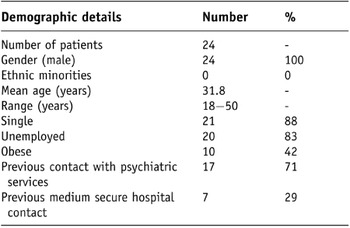
During the course of the study, 24 patients were admitted to Bronte ward, representing 31 admissions, as 7 were admitted twice. There were 25 completed admissions within the study period. Demographic details are listed in Table 1. All were male (male designated ward only) with a mean age of 31.8 years. All patients were Caucasian and only one was not British born. The majority were single and unemployed, with over 40% being obese. Over two-thirds had previous contact with psychiatric services and just under a third had previous inpatient admissions to medium secure hospitals.
Demographic characteristics of the sample

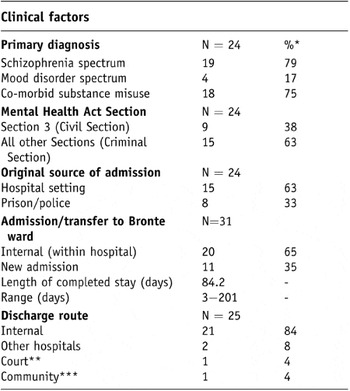
Table 2 highlights clinical factors. The majority were diagnosed with schizophrenia spectrum illness. Three quarters were diagnosed with co-morbid substance misuse. There were no informal patients with just over 60% detained under Part III of the Mental Health Act 1983. Over 60% were originally admitted to Newton Lodge from other hospital settings. The majority of admissions to Bronte ward were internal transfers within the hospital. Just over a third were new admissions. Mean length of stay was just under three months with a very wide range on both extremes. Discharge from Bronte ward tended to be an internal transfer in the vast majority of cases.
Clinical characteristics of the sample

* Percentages are rounded up to nearest whole number. Some totals may exceed 100%.
** Patient was found ‘fit to plead’ and returned to Court.
*** Patient was discharged from hospital by a Mental Health Tribunal.
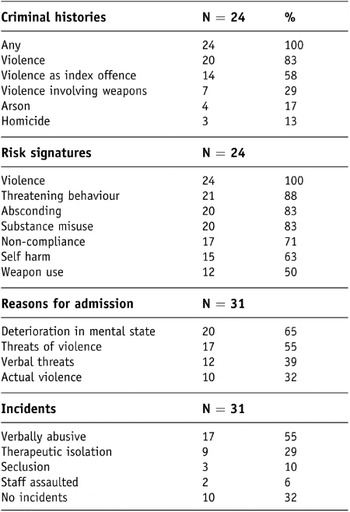
Table 3 displays reasons for admission to Bronte ward, criminal histories, incidents and risk signatures. Patients tended to be admitted for more than one reason, but in the majority of cases, it was for a deterioration in mental state and threats of violence.
Criminal histories, risk signatures, reasons for admission and incidents

All patients were deemed to have criminal histories with a high proportion having a conviction for violence. If a patient was admitted on Part III of the Mental Health Act, 1983, the index offence tended to be violence. In over half of admissions to Bronte ward the patient was described as verbally abusive. Therapeutic isolation (a secure specially adapted low stimulus room) was used in nine admissions and seclusion in three. In two admissions staff were assaulted. In around one third of admissions there were no incidents. There were 23 incident forms generated over the year. Eleven of these were generated by two patients. Fourteen patients generated no incident forms.
All patients were deemed to be at risk of violence. The majority of patients were also at risk of threatening behaviour, absconding, substance misuse, non-compliance and self harm.
Section 3 patients
Patients detained under Section 3 of the Mental Health Act 1983 were not overrepresented within Newton Lodge, with rates typically at 25% for the year, which is practically identical to Dolan & Lawson’s (2001) study. However, over the study period, 38% of patients admitted to the PICU were detained under Section 3 and this proportion was larger, though not significantly so (p = 0.294).
Four out of nine patients on a Section 3 were readmitted to Bronte ward. Out of three patients secluded, two were on Section 3 (p = 0.533) and out of eight patients placed in therapeutic isolation, four were on Section 3. Only two patients on Section 3 had no incidents documented, compared with eight out of fifteen on other sections (p = 0.138). Four out of nine patients on Section 3 had at least one incident form recorded against them, compared with six out of fifteen patients on other sections. There were therefore obvious discrepancies between ‘observed incidents’ as documented in the clinical notes and the generation of incident forms completed by nurses. Section 3 patients tended on average to have slightly more risk factors.
T-tests revealed that Section 3 status was not associated with age (p = 0.501) or completed length of stay (p = 0.145). Mann Whitney U tests revealed no associations between Section 3 status and number of incident forms (p = 0.950) or number of prescribed antipsychotics (p = 0.406). Spearman’s correlation coefficients were used to compare age, length of stay, number of prescribed antipsychotics and number of incident forms. The only significant correlation revealed was between number of incident forms and number of prescribed antipsychotics (p < 0.05), however this reflected the fact that two patients who were on higher numbers of antipsychotics generated a high proportion of incident forms.
Other findings
There were no patients from ethnic minorities in the sample. Typical values tend to average around 30% (Coid et al., Reference Coid, Kahtan, Gault, Cook and Jarman2001). Substance misuse was a recognised factor in the vast majority of patients (over 80%).
The proportion of those originally admitted from hospitals to Newton Lodge was higher (63% vs. 50%) and more patients from the Bronte sample were discharged internally (85% vs. 65%). The comparison values were obtained from Dolan & Lawson’s (2001) study.
All patients had criminal histories and this featured heavily, violent offences being highly prevalent. Incidents were compared to Dolan and Lawson’s (2001) study. Assaults on staff were lower in the Bronte ward sample (6% vs. 41%), as were acts of self harm, assaults on other patients and threats of violence. However frequencies of verbally threatening and abusive behaviour were higher. Two patients (8%) accounted for 11 out of 23 incident forms (48%). In a study by Gudjonsson et al. (2000), 18 patients (6%) accounted for 67% of incidents.
Limitations of the study
In retrospective studies, up to 25% of data has either been missing or unavailable, a factor that was not encountered in the prospective design, which was limited by feasibility constraints, but was clearly superior. A control group was not included due to limitations of ethics approval and selecting an appropriate group. The data generated was heavily reliant on patients’ case notes being accurate. The study period was for one year and so may not have included all incidents prior to the study start date for patients already resident on the ward. The main and obvious limitations were due to limited numbers of patients and a lack of comparable populations, with only one being identified (Dolan & Lawson, Reference Dolan and Lawson2001).
DISCUSSION
It is clearly of benefit for a regional specialised unit to examine the types of patients admitted and their outcomes. This study indirectly determined how the service coped with some of the region’s most mentally ill and dangerous patients.
The study represents the first of its kind to prospectively profile PICU patients within a medium secure hospital and has introduced more variables such as reasons for admission, risk signatures and incidents.
Section 3 patient representation on Bronte Ward
Section 3 patients were not overrepresented within the hospital as a whole, but tended to be admitted or transferred to the PICU, with a higher frequency than the proportion quoted in Dolan & Lawson’s (2001) study (38% vs. 25%). Why is this so? Two out of the three high secure hospitals in England have noted that these patients were overrepresented on their special units and remained persistently behaviourally disturbed due to their psychosis (Coldwell & Naismith, Reference Coldwell and Naismith1989; Gordon et al., Reference Gordon, Hammond and Veeramani1998). The literature has acknowledged that persistently disturbed psychotic behaviour is associated with a PICU admission and so it is not surprising that eight out of the nine patients admitted or transferred to PICU on Section 3 were diagnosed with a schizophrenia spectrum disorder.
Edwards et al. (2002) identified three types of patient within medium secure care. One group represented patients with a more chronic illness picture whose offences were not necessarily related to their illness but generally reflected social disorganisation, non-compliance and relapse. They had a higher risk of re-offending and less responsiveness to treatment and negative symptoms. Many of these patients had been in various tiers of service, rather than the criminal justice system. Their response to treatment may be limited and their offending tended to be less serious, though with persistent acquisitive and destructive offences. It would seem that Section 3 patients could represent this difficult subgroup.
Other variables
The lack of patients from ethnic minorities reflected a lower proportion within the hospital as a whole. Similarly, there were no patients with a primary diagnosis of personality disorder on the PICU, which also reflected a low proportion within the wider hospital.
Substance misuse was highly prevalent in this sample and has long been viewed as a predisposing, precipitating and perpetuating factor in serious mental illness. It is also seen as a major contributor to violent offending. Thus it is not surprising that it features heavily in the PICU sample. It would seem that substance misuse has not been seen as an important factor when admitting a patient or as a target for intervention, but within Newton Lodge, both individual and group substance misuse work is available.
PICU patients were more likely to be originally admitted from hospital settings and this reflected a high proportion of Section 3 patients. A growing willingness to admit non-offender patients was noted by Davies et al. (2007). The vast majority of patients were returned to their referring ward, in keeping with the ethos of a PICU.
Criminal histories were highly prevalent; all patients had a conviction against them. Studies have shown that medium secure units have admitted progressively more violent offenders, for more serious offences and that they consequently have longer stays (Coid et al., Reference Coid, Kahtan, Gault, Cook and Jarman2001). This may be due to high secure hospital bed closures and more referrals from prisons. By default, this makes the cohort more risk prone, which may or may not be related to their mental disorder. With medium secure services tasked with risk reduction, it is not surprising that lengths of stay are increasing.
The role of the PICU
The study indirectly examined the functioning of the PICU ward through patient incidents. Bronte ward has the highest number of staff to patient ratio within the hospital. PICUs were designed with patient violence in mind, so it is not surprising that threatened or actual violence were common reasons for admission. Whilst it is unfortunate that there were incidents where staff and patients were assaulted, these were relatively infrequent, especially when compared to Dolan & Lawson (2001).
Structural, relational and procedural security polices should take credit for these low numbers. Verbally threatening and abusive behaviour was common, but may reflect more accurate reporting and zero tolerance policies. These behaviours may not necessarily reflect disturbed mental state, but pre-morbid traits and underlying criminality. Ten out of 31 admissions did not involve incidents and 14 out of 24 patients did not have incident forms recorded concerning them, though there were obvious discrepancies between incidents occurring and those that generated incident forms. There was a more intensive approach to nursing within a low stimulus environment. The notion that a small number of patients cause most of incidents was echoed in that two patients accounted for just under half of the incident forms generated. However, the generation of incident forms is highly subjective.
Dolan & Lawson (2001) commented on the unintended use of PICU beds and it would seem that beds were not occupied due to waiting list pressures or to create vacancies within the rest of the hospital.
The typical patient
From the information gathered, a typical PICU medium secure patient emerges: namely one that is a young, single, unemployed, Caucasian man in his early thirties, has a diagnosis of schizophrenia with co-morbid substance misuse and previous convictions, typically for serious violent offences. If admitted through a custody diversion scheme, the index offence is likely to be for serious violence. However if the patient is on a civil section, the admission may be precipitated by persistently disturbed behaviour that may also include violence. He is likely to have had previous contact with psychiatric services. He will also be deemed to have several risk signatures, mainly violence to others, absconding, verbally threatening and abusive behaviour, substance misuse, self harm and non-compliance with treatment. With this in mind, it would seem that these patient characteristics would require management within conditions of medium security.
It is important that medium secure units profile their patients, so as to inform best practice and analyse trends within this cohort, particularly as groups profiled in the literature may now be several decades old within a low volume, but high cost service. Particular attention should focus on treatment and incidents whilst resident in hospital, as these could have bearings on behaviour and incidents post discharge.