1 Introduction
There is considerable and growing agreement among policy makers that a strong primary care system is necessary to reach objectives related to health-care delivery (Saltman et al., Reference Saltman, Rico and Boerma2006; WHO, 2008). There is less agreement, however, regarding appropriate organisational models to support such a development.
The traditional model of primary care in Sweden, with its focus on publicly owned health centres employing a multidisciplinary workforce with responsibility for population health within a geographical area, is rather unusual in an international perspective. Typically, a Swedish public primary care centre will employ 4–10 general practitioners (GPs) and several other professionals including district nurses, physiotherapists, social workers, work therapists, psychologists and specialist nurses in areas such as diabetes and asthma/COPD (Anell, Reference Anell2005a; Glenngård et al., Reference Glenngård, Hjalte, Svensson, Anell and Bankauskaite2005). In most other OECD (Organisation for Economic Co-operation and Development) countries, primary care is traditionally provided by private GPs working in small groups or alone and with responsibility to provide care to patients who seek to visit them or who are registered on their lists. Payments are often based on the volume of doctor visits and services, sometimes in combination with a fixed risk-adjusted payment for registered patients (Lamarche et al., Reference Lamarche2003).
Recent developments suggest a convergence between primary care in Sweden and other countries in at least some dimensions. Since the early 1990s, more possibilities for patients to choose their provider have been introduced in Swedish health care (Glenngård et al., Reference Glenngård, Hjalte, Svensson, Anell and Bankauskaite2005). In practice, however, money has often not followed the choice of patients and public providers have had no financial incentives to attract new patients. The share of private primary care providers has increased but was still <30% in 19 of the 21 county councils responsible for financing and providing health care in Sweden in 2006. In parallel, primary care in several other countries in northern Europe has developed towards Swedish standards in terms of less reliance on solo-practices and more integration with other health-care services (Godber et al., Reference Godber, Robinson and Steiner1997; Dixon et al., Reference Dixon, Holland and Mays1998; Vallgårda et al., Reference Vallgårda, Krasnik and Vrangbaek2001; WHO, 2001; Exter et al., Reference Exter, Hermans, Dosljak and Busse2004; Saltman, Reference Saltman2006). In the United Kingdom, about one-third of all GPs have even chosen to be employed by local authorities rather than being private entrepreneurs (Weller and Maynard, Reference Weller and Maynard2004).
In Swedish primary care, a new wave of local reforms involving choice for the population and privatisation was initiated in 2007. Important objectives behind the reform were to strengthen the role of primary care in general and to improve performance, not least in terms of access and responsiveness (Anell, Reference Anell2008). Following a typical Swedish reform pattern, the new reforms started as local initiatives among the 21 individual county councils. New primary care models were developed and implemented first in the county councils of Halland (1 January 2007) together with Västmanland and Stockholm (1 January 2008). Reforms in these three county councils triggered implementation of similar changes in seven additional county councils during 2009 (Anell, Reference Anell2009). Inspired by the new models, the national government developed a proposal to change the Health Care Act. In February 2009, the Parliament decided that the choice of primary care provider for the population, as well as freedom of establishment for accredited private providers who fulfilled requirements determined by the local county council, was mandatory from 1 January 2010.
The new focus on choice and privatisation was very much the result of a general election in 2006, which paved the way for new and pro-private coalition governments across both local governments and at the national level. Even so, local reforms in primary care have had broad political support in most county councils, including support from the Social-democrats party. The revised Act has been criticised mainly on the grounds that it interferes with local self-government and only secondary regarding its new directions for primary care. The initial broad political support may be difficult to maintain, however, as reforms get implemented and problems develop.
The purpose of this article was to compare the characteristics of the new models being introduced in Swedish primary care and to discuss changes in financial incentives for providers and challenges and options regarding governance on the part of county councils. In Section 2, a comparison is made between new primary care models in five Swedish county councils that represent both the general trend of development and existing differences. This is followed by a comparison between the new Swedish models and existing primary care models across OECD countries in Section 3, pointing out the innovative nature of current Swedish reforms. In Section 4, economic incentives for providers that follow from key financial characteristics of the new models are discussed, with references to general theory and empirical findings from other countries. Early experiences and to what extent the hypotheses outlined in Section 4 have materialised in Swedish primary care are summarised in Section 5. Finally, in Section 6, the challenges and options regarding new forms of governance on the part of county councils are highlighted.
2 Characteristics of the new primary care models
All of the five county councils compared in this section developed and implemented their new models following local initiatives. Stockholm, Region Skåne and the Västra Götalandsregionen (the VG-region) represent the three largest county councils in the country, each of them responsible for health-care services to 1.9, 1.2 and 1.5 million inhabitants, respectively. In contrast, both Halland and Västmanland are small county councils with a population of 290 and 260 thousand, respectively. In total, the five county councils cover 55% of Sweden’s 9.3 million inhabitants.
Data to support comparison between the models have been extracted from publicly available reports and requirements for primary care providers in each county council. Supplemental data and background information have been provided directly from individuals in each county council responsible for development and implementation of the models (Anell, Reference Anell2009).
2.1 Changes in the role of primary care
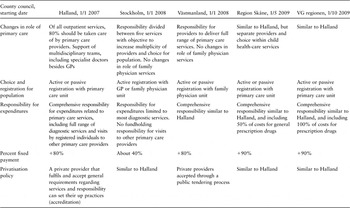
Changes in the overall role of primary care across the five county councils following reform are summarised in Table 1. Focusing on the three county councils that implemented their new models in 2007 and 2008, important differences exist between Halland on the one hand and Västmanland and Stockholm on the other. Halland, which was the first county council to introduce reform in primary care, had a more progressive vision to change the overall health-care structure in favour of primary care. The objective was that 80% of all outpatient visits should be taken care of by primary care providers. This was a rather ambitious objective by Swedish standards. The gate-keeping role of primary care has been limited and hospitals are still responsible for a significant share of outpatient visits to doctors (Glenngård et al., Reference Glenngård, Hjalte, Svensson, Anell and Bankauskaite2005). In 2006, before the introduction of reform, primary care providers in Halland were responsible for about 67% of all outpatient care visits on average, which was somewhat higher than the national average. The objective to expand the role of primary care had a direct influence on the payment system. Fixed payment to providers for each registered individual in Halland has been reduced from the start of reform if the degree of coverage (so called ‘täckningsgrad’) is below 80%. Primary care providers in Halland are also encouraged to contract or employ specialist doctors besides GPs as well as specialist nurses to fulfil this objective. Formal regulation of how primary care services should be organised or what type of staff providers should employ or contract has been kept at a minimum (Landstinget Halland, 2008).
Comparison between primary care reforms in five county council’s

The organisation of primary care in Stockholm has been more regulated. Employment of doctors other than GPs and paediatric and geriatric specialists are prohibited (Stockholms läns landsting, 2008). In both Västmanland and Stockholm, the objective of reforms implemented in 2008 was to improve access to primary care services within its existing role, rather than to introduce changes in the overall health-care structure.
An important difference compared to both Halland and Västmanland is that Stockholm distinguishes between five different primary care services: the family doctor services, child health care, maternity care, care of the feet and speech therapists. By developing separate accreditation and payment systems for these services, it was argued that more private alternatives and increased possibilities for the population to choose were created. In contrast, both Västmanland and Halland gave providers a broad responsibility to deliver primary care services, arguing that this was beneficial especially for chronic patients in need of multidisciplinary services.
Implementation of reform in Region Skåne and the VG-region in 2009 in principle followed the model in Halland. The main difference was a lower initial ambition regarding the degree of coverage. In Region Skåne, for example, the standard payment assumes that 55–61% of all outpatient care visits are taken care of by primary care providers. If this is not the case, the payment is adjusted accordingly.
2.2 Choice for the population
In all five county councils, an important part of reform was to facilitate choice and competition by allowing more private providers to enter the primary care market. Västmanland relied on a public tendering process whereby accepted private providers were allowed to start up new practices during 2008–2011. In the other four county councils, new private providers have been accredited on a continual basis if they fulfil and accept qualification requirements and responsibilities.
In all five county councils, funding is not guaranteed but depends on how well providers compete for individual registrations. In Halland, individuals have to be registered with a primary care unit, either by active choice or by acceptance of an alternative suggested by the county council. When the new model was implemented, inhabitants received a letter from the county council proposing registration with a primary care provider based on either previous visits or geographical distance (in that order). If individuals did not oppose this suggestion, they were registered accordingly. The main argument in support of registration with a unit rather than a GP was that the county council should regulate as little as possible on how providers organise contacts with their patients. Similar principles are used in Västmanland, Region Skåne och the VG-region. In Stockholm, registration is with GPs rather than units and there is no passive registration of patients who do not make an active choice.
In none of the five county councils are there any formal limits regarding the maximum or minimum number of registered individuals for each unit or GP. The possibilities for providers to deny individuals a place on their list is limited. In principle, each provider should expand their services if more people choose to register with them and all new registrations must follow a first-come, first-service basis. There are no formal limits regarding the number of times individuals can choose to delist and register with an alternative provider.
Although individual patients are encouraged to use services where they have registered, patients are in fact allowed to seek care at other (i.e. competing) primary care providers or from private specialist practices, if available. This matches traditions in Swedish health care, with possibilities for the population to seek care from a broad range of health-care services directly, and a limited formal gate-keeping role for primary care (Kroneman et al., Reference Kroneman, Maarse and van der Zee2006). In both Region Skåne and the VG-region, user charges are differentiated to give patients financial incentives to be ‘loyal’ to the provider where they have registered. In Region Skåne, for example, patients pay 120 SEK if they visit a doctor at the unit where they have registered and 200 SEK for a similar visit at other primary care units. In the other three county councils, user charges for all primary care services are the same and about 150 SEK for a doctor visit. In all five county councils, a higher user charge applies for visits to specialists without a referral, about 300 SEK. Owing to a 900 SEK high-cost ceiling for visits during a 12-month period, several patients in practice have a ‘free card’, which means that they are not affected by differentiated user charges.
2.3 Payment system and financial responsibility
Differences between the county councils in terms of payment system and financial responsibility for providers can in part be explained with reference to objectives behind the reform. In the four county councils where providers are responsible for a comprehensive primary care service, that is, Halland, Västmanland, Region Skåne and the VG-region, providers have a broad financial responsibility for all expenditures related to the delivery of primary care. At least 80% of the provider’s income is based on fixed annual payments per registered individuals (see Table 1). In principle, providers in these county councils have a fundholding responsibility for primary care expenditures related to their subscribers, irrespective of where the consumption of services takes place. This means that a provider may have to pay other providers if patients choose not to be loyal to where they are registered. If providers do not agree voluntarily on a transfer price, a payment schedule determined by the county council applies. In both Region Skåne and the VG-region, the fundholding responsibility also includes expenditures related to general prescription drugs. By comparison, primary care providers in Stockholm have a more limited financial responsibility and receive about 60% of their income based on pay per visits to GPs and other staff.
Key arguments against payment per visit is that providers then have financial incentives to increase the volume of visits rather than the quality or value of care, and to shorten visits and give priority to easy cases and repeat visits rather than to allocate resources according to the health-care needs of patients (Robinson, Reference Robinson2001). This argument was also important in the four county councils that rely more extensively on a fixed payment per registered individual. It was also argued that payment per visits preserved a traditional organisation of practices and did not stimulate new and innovative ideas on how to organise contacts with patients. In both Region Skåne and the VG-region, this argument was taken to its extreme as providers do not get any payment based on the volume of visits.
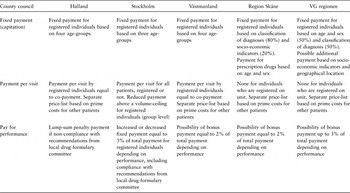
Several important differences also exist between the four county councils in respect of fixed and comprehensive payment (see Table 2). In Halland and Västmanland (as in Stockholm), more simple models for risk adjustment are used based on age groups. Indeed, this has created tensions and debate regarding ‘unfair’ payments, particularly in Stockholm where payment to providers previously was adjusted based on socio-economic indicators for the geographical area where providers were located. In both Region Skåne and the VG-region, more advanced models for risk adjustment based on classification of diagnosis using the ACG (adjusted clinical groups) system (Majeed et al., Reference Majeed, Bindman and Weiner2001) in combination with socio-economic indicators are applied.
Comparison of payment system for primary care year 2009 in five county council’s

A small proportion of payment in all five county councils is based on performance. In Halland, each provider who did not participate in a national diabetes quality register had to pay a lump-sum penalty in 2008. For 2009, a similar penalty payment exists for providers with poor compliance towards five prescribing targets (e.g. use of generic drugs and antibiotics) developed by the county council drug formulary committee. In Stockholm, pay-for-performance is organised in several sub-systems. A lump-sum penalty payment exists for practices that do not have an environmental certificate or do not provide the county council with information agreed upon. About 3% of the total annual payment is linked to targets such as access to practices over the phone, results from patient satisfaction surveys, registration in the national diabetes quality register and compliance towards recommendations from the county council drug formulary committee. Similar principles of pay-for-performance using 7–12 targets related to access over the phone, recommendations from the drug formulary committee, preventive services, registration in the national diabetes quality register, clinical process indicators (diabetes and asthma) and/or patient satisfaction exist in Västmanland, Region Skåne and the VG-region.
3 Swedish primary care reforms in an international perspective
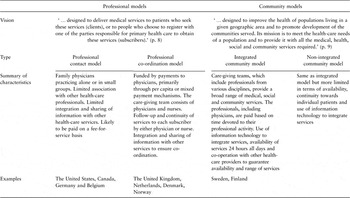
A previous Canadian study by Lamarche et al. (Reference Lamarche2003) identified four different types of primary care models based on two overall visions (see Table 3). The taxonomy was developed through an analysis of 28 cases of primary health-care organisations in industrialised countries. The objective was to cover the range of options for Canada, but the taxonomy also provides a valuable reference for analysis of ongoing reforms in Swedish primary care.
Taxonomy of primary care models based on Lamarche et al. (Reference Lamarche2003)

The traditional model of primary care in Sweden is referred to in the Canadian study as an example of a community model. Focusing on the new Swedish primary care models being introduced after 2007, based on choice and competition, we can conclude that the model in Stockholm is basically an example of a professional co-ordination model, that is, a rather traditional model from an international perspective. Similar models exist in, for example, Sweden’s neighbouring countries Denmark and Norway. Variants on this type of model have previously also been proposed by the Swedish Association of Physicians and by a Conservative-led government in 1994 (Glenngård et al., Reference Glenngård, Hjalte, Svensson, Anell and Bankauskaite2005). The new and locally developed models, especially in Halland, Region Skåne and the VG-region, are more difficult to classify. Focusing on the comprehensive responsibility of providers and the objective to support multidisciplinary teams, the models can be classified as community models. Focusing on the possibility for the population to choose and the fact that payment to providers follows registration, the models are closer to the professional co-ordination model.
The Canadian study also discusses the relative performance of each of the four identified models. Seven broad criteria were identified: effectiveness, productivity, continuity, access, equity of access, responsiveness and quality. Published evaluations (if available) together with an expert panel (if evidence were not available) were used to rank the models in terms of performance. The main conclusion from this exercise was that none of the four models performed best for all seven criteria. A professional co-ordination model dominated over a professional contact model, however, as did the integrated community model in comparison with a non-integrated community model. The choice between the professional co-ordination model and the integrated community model was more difficult. The professional model outperformed the integrated community model in terms of accessibility and responsiveness, whereas the integrated community model outperformed the professional model when looking at other criteria. The Canadian study concluded that a possible ideal model was to combine the professional co-ordination model and the integrated community model.
The assessment of the pros and cons of different primary care models by the Canadian study matches the Swedish debate about problems in primary care. Arguments against the traditional model and to support reforms based on choice and privatisation have mainly been about solving problems related to poor access and responsiveness. Reports from developments in county councils besides Västmanland, Stockholm, Region Skåne and the VG-region also indicate a clear preference for the type of model originally developed in Halland (Anell, Reference Anell2009). Thus, a majority of the new Swedish primary care models already implemented or under development across the 21 county councils can best be described as innovative combinations between the community model and the professional co-ordination model.
4 Incentives following broad financial responsibility and fixed payment
The new models implemented in Halland, Västmanland, Region Skåne and the VG-region combine a comprehensive responsibility for primary care providers with a heavy reliance on fixed capitation payments. As with all models, both the pros and cons can be identified. Although a comprehensive fixed payment is excellent in terms of cost control, important ‘issues’ that county councils have to deal with are the need for risk adjustment of payments and how to counterbalance the financial incentives to skimp on services and under-provide care. The broad financial responsibility in combination with fixed payments should also raise concern about conditions for competition and more specifically the barriers for new providers to enter the primary care market.
4.1 ‘Cream-skimming’ and under-provision of services
Problems with fixed annual payments for each registered individual include the need to risk-adjust payments to prevent a situation where providers ‘cream-skim’ to avoid the sick and unhealthy (see e.g. Robinson, Reference Robinson2001; Gosden et al., Reference Gosden2004). Even if providers are not allowed to deny individuals a place on their lists, which is the case in all five county councils, providers may try to influence who will register indirectly, for example, by selecting a preferable geographical location and/or by discriminating marketing activities. Such a ‘cream-skimming’ behaviour can be avoided if county councils risk-adjust capitation payments. It can be concluded that county councils differ with respect to ambitions in this area. So far, however, there is no knowledge about the extent to which more advanced models for risk adjustment in Region Skåne and the VG-region will have an impact on provider behaviour and the distribution of services across patient groups.
Even with a risk-adjusted fixed payment, there is still a risk that providers will skimp on services and under-provide care since all things done to patients will increase expenditures and reduce the provider’s profits. Studies in both Denmark and Norway also show that more reliance on capitation payment is associated with an increased number of referrals to specialists (Krasnik et al., Reference Krasnik, Groenewegen, Pedersen, Scholten, Mooney, Gottschau, Flierman and Damsgaard1990; Iversen and Lurås Reference Iversen and Lurås2000). With a fixed payment, providers benefit financially if patients (and the associated health-care expenditure) can be referred elsewhere. With more payment based on the volume of services, GP practices are instead given financial incentives to take care of their patients themselves.
A cost-shifting behaviour can be mitigated by enforcing a financial responsibility if patients are referred to other providers. At least in part, such a fundholding responsibility for primary care providers is also being used by Swedish county councils. With a broad financial responsibility, however, providers are incentivised not only to under-provide their own services, but also to limit access to health-care services more generally. Possibilities to limit access exist more directly for diagnostic services that require a referral from a GP. In those county councils that practise a financial responsibility for prescriptions, primary care units may also under-provide medicines.
Owing to financial incentives to limit access and skimp on services, a comprehensive and fixed payment may also have a negative effect on the trust in primary care on the part of the population. A previous comparison across OECD countries suggests that satisfaction with GP services is lower in countries with a formal gate-keeping role of primary care and with more limited direct access to specialist services for the population (Kroneman et al., Reference Kroneman, Maarse and van der Zee2006). A possible explanation can be deduced using agency theory. GPs in general have previously been defined as ‘double agents’ who should consider both expectations from individual patients as well as the need for priority setting from a societal perspective (Blomqvist, Reference Blomqvist1991). On the one hand, GPs should provide patients with services of good quality and easy access to relevant specialists. On the other, they have an organisational role to prioritise and avoid unnecessary referrals to specialist care. For GPs with a comprehensive and ‘tight’ financial responsibility, it will be more difficult to match expectations from patients and a gap in trust between primary care and the population is more likely to develop.
There are several possible ways to balance the financial incentives that follow from comprehensive fixed payment, for example, enforcement of clinical guidelines, exceptions for patients with high medical costs (outliers), transparent comparison of results across providers and pay-for-performance based on quality indicators (Miller, Reference Miller2009). In theory, competition based on choice should also counterbalance financial incentives to under-provide services. If choices are real and informed, primary care providers who hold back on services can be avoided by the population. This, in turn, gives financial incentives for units to provide more balanced services. As providers in the Swedish primary care market are unable to influence price (payment from county councils and user charges for patients are fixed), profit levels will ideally be reduced to a reasonable level as providers compete on improvements in the quality and quantity of care. For county councils that believe in this logic and the benefits of competition, it will first of all be important to encourage and facilitate choice for the population. The second and equally important condition is that the population have access to alternative primary care providers to choose from (Le Grand, Reference Le Grand2007).
4.2 Comprehensive fixed payment and conditions for competition
In traditional economic textbooks, the theoretical model of perfect competition is often associated with many buyers and sellers and unrestricted access to information about the price and quality of products or services. In practice, both theoretical and empirical studies show that a competitive situation that is similar to the model of perfect competition in terms of outcomes can be achieved with 5–6 or even a lower number of alternative providers (Hultkrantz and Nilsson, Reference Hultkrantz and Nilsson2004). If alternatives differ only by price, studies suggest that a price equal to the price that would have been established with perfect competition will be set even with only two alternative providers, the so-called Bertrand competition. With more differentiated products, more providers are needed. More than two providers are also necessary to counteract the development of silent cartels where providers collaborate without engaging in direct negotiations.
Perhaps more important than the number of alternative producers on any given market (a static perspective) is the possibility for new competitors to enter the same market (a dynamic perspective) (Shapiro and Varian, Reference Shapiro and Varian1999). New competitors often bring innovative ideas to the market and support a dynamic development. A threat from new potential competitors also puts additional pressures on existing alternatives, even if they are few in number, the so-called contestability (Baumol et al., Reference Baumol, Panzar and Willig1982).
As county councils will have a key role as single payers in the local primary care markets in Sweden, local policies to preserve and strengthen competition will indeed be important. Basic measures to facilitate competition will be the same irrespective of which primary care model county councils implement. Choice for the population needs to be encouraged, supported and informed, and barriers for new providers to enter the primary care market should be kept at a reasonable low level.
To encourage, support and inform the population is likely to be a similar challenge for all county councils. Evidence suggests that individuals in general do want the option to choose their primary care provider (Scott, Reference Scott2000; Hjelmgren and Anell, Reference Hjelmgren and Anell2007; Le Grand, Reference Le Grand2007) but are more sluggish when it comes to shifting between providers in practice (Mold et al., Reference Mold, Fryer and Roberts2004; Fotaki et al., Reference Fotaki, Roland, Boyd, McDonald, Scheaff and Smith2008). When it comes to supporting alternative providers, however, conditions for competition will at least to some extent be influenced by characteristics of the model implemented.
It can be argued that the principle of a fixed and comprehensive payment used by a majority of the Swedish county councils will increase barriers for new providers to enter the primary care market. A fixed payment means that each provider will have to bear a higher financial risk, since an increase in the quantity of care is not linked to any increase in revenue (Jegers et al., Reference Jegers, Kesteloot, De Graeve and Gilles2002). With pay-per-visit, and even more so with fee-for-service, the financial risk will instead be on the county councils. Furthermore, with a comprehensive financial responsibility for providers, variation in expected primary care expenditures across patients will increase compared to a situation with more limited financial responsibility. A risk-adjusted payment will indeed give more resources to providers who register more patients with chronic conditions. But variation in actual expenditures within each risk-adjusted group of patients will still exist. If providers have responsibility for a full range of primary care services including expenditures for prescription drugs, this variation will be more significant.
The easiest way for primary care providers to manage non-systematic variation in health-care expenditures is to grow in size by registration of more individuals or to integrate horizontally with other providers. With a larger total list of registered individuals, the ‘law of big numbers’ means that differences between actual expenditures and payments at the individual level will balance each other out. Risk-adjusted payment for patients with a higher consumption of services than expected (given their risk level) will most likely be subsidised by registered individuals with a lower consumption than expected. This also poses a dilemma in terms of governance. On the one hand, it will be more important for county councils that have chosen a fixed and comprehensive payment to facilitate competition across providers. This is to counterbalance the potential problems of skimping and under-provision. On the other hand, it may be more difficult to develop such a market where patients can delist from providers with poor performance, since the payment system and financial responsibility favour larger units and/or horizontal integration and thereby market concentration. Smaller units will have a disadvantage because of the financial risk involved. In particular, it may be difficult for new providers to enter the market, since patients who first register are more likely to be dissatisfied with their previous provider and more demanding than the average. Ironically, the model originally developed in the rural county council of Halland probably fits the general competitive conditions in the more densely populated Stockholm region best. The model developed and implemented in Stockholm, with more pay per visit and limited financial responsibility for providers, has competitive advantages in rural areas with more limited room for alternative providers.
5 Early experiences
Documentation of experiences following reform in the five county councils is so far limited. There is no evidence as yet regarding the impact of reforms on clinical practice, priority setting and delivery of primary care services across patient groups, although research programmes to address such questions have been initiated.Footnote 1 Currently available data suggest not only an improvement in performance in terms of access in at least Stockholm and Halland, but also an emerging change in the market structure that indeed highlights the need for a new form of governance on the part of county councils.
In terms of changes in the market structure, a similar pattern can be noted in all five county councils (Anell, Reference Anell2009). In the first year following reform, new private providers entered the primary care market in all five county councils, preferably in larger cities, and a substantial share of the population did make an active choice of provider. As new private providers get established, the market share of public providers decreases. In the following years, data from Halland and Stockholm suggest that the market structure in terms of alternative providers becomes more stable. Furthermore, the number of active choices on the part of the population is significantly reduced.
In Halland, the number of private providers increased from 12 to 20 while public providers maintained at 25 units during the first year following reform (Paulsson, Reference Paulsson2008). The population registered with a new provider primarily in areas where providers previously had a geographical responsibility and in areas where new private providers became available. In 2008, two additional providers entered the market and the number of active choices was substantially reduced compared to 2007. Still, the most rural municipality in the county had not seen any new providers by the end of 2009. At least three previously self-owned practices have been sold to two larger health-care corporations, which operate small networks of practices in two separate cities. The number of public primary care providers in Halland has stayed the same since 2007, in spite of a growing financial deficit and a reduction in market share from 73% to 63% between 2006 and 2008 (Paulsson, Reference Paulsson2009).
It is uncertain to what extent total visits have changed following reform in Halland due to problems in extracting data from the private sector. According to results from population surveys, satisfaction as well as experiences regarding access to primary care improved during 2007 (Paulsson, Reference Paulsson2008). In spite of the fact that individuals register with units, 56% of the population thought they had an established contact with a physician in primary care of their own at the end of year 2007, compared to 49% in 2006. In 2008, satisfaction with services continued to improve while patient experiences regarding access had a negative development (Paulsson, Reference Paulsson2009). A similar negative trend regarding access could be noted for several other county councils and it is not clear to what extent a relationship with the reform exists. Important objectives in Halland were to strengthen the role of primary care in general and to support the development of multidisciplinary teams. The average degree of coverage (‘täckningsgrad’) for providers did increase from 67% to 69% between 2006 and 2008. Several providers also reportedly employ or contract with specialist doctors besides GPs. There are no data on the actual contribution of these specialists to patients, however.
In the county council of Stockholm, about 30 new private practices opened during January 2008 to March 2009, a 15% increase.Footnote 2 As the first new providers were concentrated in the inner city, new providers, during 2009, set up establishment in suburban areas. This indicates that the inner city had become saturated with providers. An emerging trend during 2009, similar to experiences in Halland, was that larger health-care corporations were buying existing providers rather than setting up new practices. Market concentration is still limited, with two health-care corporations operating integrated chains of eight and seven practices, respectively, by the end of 2009. The same corporations also operate several primary care practices in Region Skåne, Halland and the VG-region as well as in other county councils.
Total visits to primary care physicians in Stockholm increased significantly in 2008 for all geographical areas (Stockholms läns landsting, 2009). Delivery of services across age, sex as well as main diagnosis was the same as in 2007, which indicates that there has not been any major shift in priorities across these patient groups. To increase access to GP services was an important objective behind reform in Stockholm and experiences can be directly linked to expected effects from the payment system and its focus on pay-per-visit. Even so, the increase in total primary care expenditures during 2008 was lower compared to both 2006 and 2007. Instead, the overall weighted cost per primary-care contact decreased by 10% between 2007 and 2008 (Rehnberg et al., Reference Rehnberg, Janlöv and Khan2009). Studies have not been able to find any significant difference between private and public providers in terms of productivity (Rehnberg et al., Reference Rehnberg, Janlöv and Khan2009). Significant differences in this respect exist across both public and private providers, however, which indicate the potential for additional productivity improvements. Case studies suggest that physicians working in areas with unfavourable socio-economic conditions (more often public providers) have more patients on their lists and more visits compared to the average primary care physician in Stockholm (Ernst and Young, 2008). This has fuelled an important critique against the payment system and a study was commissioned in 2009 with objectives to develop an alternative with more explicit adjustment with reference to socio-economic factors.
Anecdotal information from the county councils indicates that some new private providers struggle with low profitability, mainly because of a limited number of registered individuals, whereas others report significant profits. The same difference in profitability exists in the public sector. The public sector as a whole is challenged with the need to downscale activities and close down practices unable to balance costs with revenues due to the loss of registered individuals. Even if a market has been implemented, such decisions continue to be politically sensitive, even in areas where alternative providers exist.
Further anecdotal information illustrates that incentives for individual providers may vary significantly, and perhaps more so for private practices. From Halland, it is reported that in total 13 practices (nine of them private) have accepted significant penalty payments in 2009, instead of switching to lower-cost drug treatments for patients in accordance with recommendations from the local drug formulary committee. This illustrates that providers are influenced by multiple motives, including incentives to maintain a good relationship with patients. At the other end of the spectrum, the county council in Västmanland decided in 2009 to audit one private provider, following indications of an extraordinary profit level and suboptimal care to patients.Footnote 3
6 Discussion
Current reforms in Swedish primary care rely on population choice and increased competition through privatisation of providers to solve persistent problems since the early 1970s related to access and responsiveness. A necessary first condition for competition to work is that choices for the population are real and informed. A second condition is the existence of alternative providers. Both conditions require a new form of governance on the part of county councils.
Most, if not all, county councils think that primary care should take a broader responsibility for outpatient services in the future. This may explain why a majority of county councils have chosen a fixed and comprehensive payment to providers as a key financial characteristic of their new primary care models. To counterbalance the financial incentives to under-provide services that follow from such a payment system, it will be more important that competition actually works so that people are able to delist from providers with poor performance. It will also be more difficult to implement such a competition, however, since a fixed and comprehensive payment transfers financial risk to providers and indirectly favours large and/or horizontally integrated units (many registered individuals). In practice, emerging trends of horizontal integration are equally visible in Stockholm and Halland, in spite of the fact that providers in Stockholm have more limited financial responsibility and more pay per visits. Comparison with the more rural county of Halland is difficult, however, and it is too early to tell if developments in the more densely populated Region Skåne and the VG-region will be more favourable towards horizontal integration.
Irrespective of developments in county councils such as Region Skåne and the VG-region, one may argue that the financial risk involved and barriers to enter the primary care market for providers are acceptable. It should also be noted that larger and/or horizontally integrated providers may be associated with benefits in terms of quality and costs. Networks of providers with a common brand name have, for example, incentives to prevent single providers from skimping on quality. Large and/or horizontally integrated providers should not be looked upon as a problem per se, but it will be important for county councils to develop a policy on governance given such market conditions. Such a policy probably includes multiple steps to support new providers and thereby contestability, to provide guidance for treatment of patients with chronic conditions (possibly linked to pay-for-performance) and to develop follow-up routines and explicit exit rules for providers (private as well as public) with poor performance who are still able to exist on local markets.
Alternative providers will add little benefit if individuals are not prepared and willing to make a choice (Le Grand, Reference Le Grand2007). Early experiences from county councils match results from previous studies and indicate that individuals in general are not likely to change providers once they have made a choice. A study in the United States has indeed shown that the most common reason for older patients changing primary care physicians was that they were forced to do so, for example, since their physician had died or moved to another area (Mold et al., Reference Mold, Fryer and Roberts2004). On a positive note, this supports continuity between patients and their health-care providers. From a negative perspective, the unwillingness of individuals to change providers is problematic if patients do not delist from providers with poor performance. The inertia to change providers is also an important barrier for new providers. Thus, county councils need to take an active position and provide the population with relevant information about the quality of providers and facilitate delisting. The number of people who actually change their providers may still be small, but the threat of losing patients to others may become more real for providers. From this perspective, the possibility for individuals in Swedish county councils to visit alternative primary care providers directly if they are not happy with the services from where they have registered also makes sense.
It is possible that county councils will be capable of encouraging real and informed choices by the population. A recent review of evidence reveals that information about differences in quality across providers can inform patient choice, but the weight of such information depends on a number of features (Faber et al., Reference Faber, Bosch, Wollersheim, Leatherman and Grol2009). Previous studies also indicate that the perceived value of choice varies across the Swedish population depending on age, health status and socio-economic factors (Hjelmgren and Anell, Reference Hjelmgren and Anell2007). Some individuals have a higher interest in choice and are more informed than others. Such differences also explain why health-care reform based on individual choice is often challenged from an equity perspective (Le Grand, Reference Le Grand2007). For county councils, it will be a challenge to support choice for the population while preventing a situation where only the well off take advantage of the new conditions.
Support of choice for the population is not just a matter of providing information and empowerment. In addition, resources allocated across public and private providers need to reflect population preferences. Public providers who lose out should downscale and eventually close down their operations if alternatives exist. Such decisions will most likely continue to be politically sensitive. This suggests that the function of governance over the primary care market should be clearly separated from the ownership of public providers.
While the traditional Swedish primary care model since the early 1970s has more or less failed regarding objectives of access and responsiveness, its vision of improving public health and priority setting based on patient need has been generally accepted. New incentives for providers based on choice and competition may continue to improve both the availability and responsiveness of primary care. However, there is no guarantee that priorities and the overall vision of services will be the same as before. As more commercial providers enter the primary care market, financial incentives will probably become more important (Devereaux et al., Reference Devereaux, Heels-Ansdell and Lacchetti2004; Schlesinger and Gray, Reference Schlesinger and Gray2005) and patient expectations and societal objectives will be balanced also towards owner objectives of a reasonable return on investment. If the primary care market develops into local oligopolies, with a few horizontally integrated private providers competing with an equally integrated network of public providers, it may be more difficult to achieve real competition that gives full benefits to patients. To prevent such a development towards monopolistic behaviour of providers, county councils may have to introduce more support to population choice and alternative providers as well as governance of clinical practices than they initially intended.
For the international audience, current reform in Swedish primary care provides an interesting example of the construct of a medical home and how private providers with comprehensive responsibility can be combined with substantial degrees of freedom regarding choice for the population. From another perspective, the Swedish case also provides yet another example of the complexity of managing reform that fundamentally changes market behaviour (Saltman and Busse, Reference Saltman and Busse2002; Anell, Reference Anell2005b). Several possible scenarios for the future can be identified and ongoing studies will hopefully provide answers on the extent to which reform brings benefits to patients.