Introduction
Throughout antiquity, the close connection between Cyrene and its harbour was evident. Named after Apollo, the patron deity of Cyrene, the harbour/settlement was located on the coastal plain of Cyrenaica, modern-day eastern Libya. It was connected with its famous neighbour through a 20 km long road, which ran upward along the Jebel Akhdar, the Green Mountain, towards the plateau of Cyrene. ‘Apollonia’ began to gain a greater measure of political independence during the Ptolemaic and early Roman period (Kenrick Reference Kenrick2013, 255–85; Laronde Reference Laronde1996; White Reference White, Catani and Marengo1998). But it was not until the third and fourth centuries AD, once Christianity had successfully spread throughout the Mediterranean, that the city developed a distinct cultural and political identity (Busine Reference Busine and Busine2015, 1–13; Hahn Reference Hahn and Oberste2013, 11–30; Leone Reference Leone2013, 1–27, 189–218; Pedley Reference Pedley and Goodchild1976, 11–20). A shift towards a Christian identity can be identified in various ways: the clearest sign is the appearance of churches in the urban fabric. By the middle of the sixth century AD three had been built inside the city wall and even one outside of them (Kenrick Reference Kenrick2013, 259–65, 274–78; Reynolds Reference Reynolds2003, 35–110). Surprisingly we only know of two bishops that led the community in Apollonia. For two more there is tentative evidence that rests largely on conjecture. The first securely attested is a certain Heliodorus, who represented the polis at the Synod of Seleucia in AD 359 (Pedley Reference Pedley and Goodchild1976, 20–24). The new Christian identity also manifested itself in the renaming of the city to Apollonia-Sozousa. The feminine form Sozousa, based on the root ‘Soter’, alluded to Mary as a ‘saviour’ (Reynolds Reference Reynolds2003, 36). This ‘new’ polis steadily emerged as an important religious and political centre of the Pentapolis. Accordingly it was mentioned in the sixth century AD as the capital of the province of Libya Superior. Recent scholarship on late Roman Cyrenaica has placed this event in the middle of the fifth century AD, in some cases even firmly dating it to the year AD 450. This article proposes a new dating, based on a reassessment of all previous arguments.
1. The archaeological evidence
Following the old paradigm of ‘decline and fall’ Apollonia-Sozousa's rise to prominence was often explained with the fall of Ptolemais, the old capital (Goodchild Reference Goodchild1971, 80). At the beginning of the fifth century AD the writings of Synesius of Cyrene, the metropolitan of Ptolemais, painted a bleak picture of the political and military situation of the Pentapolis and Ptolemais in particular. This view was seemingly confirmed by Procopius of Caesarea. In his Buildings Procopius described how Emperor Justinian revitalised the depopulated city in the sixth century AD by repairing the water supply and its large aqueduct (Arthur Reference Arthur1973–74; Reference Arthur1974–75; Procopius, Buildings, 6, 2). In contrast to the literary sources, recent archaeological research carried out by teams from the University of Warsaw, the German Archaeological Institute and the University of Mainz indicated that Ptolemais remained in better condition throughout the fifth century AD than had previously been supposed (Wipszycka Reference Wipszycka2011, 51–67; Wulf-Rheidt and Weber Reference Wulf-Rheidt and Weber2009; Żelazowski Reference Żelazowski2011, 9–28). The Porta Taucheira and parts of the city wall, for example, had been repaired and refurbished before the reign of Justinian, maybe as early as the fourth century AD (Kenrick Reference Kenrick2013, 68–70; Somma Reference Somma2013, 617–19). A small fort that was discovered on the coast outside of Ptolemais, dating to the reign of Anastasius I (AD 491–518), also points to extended building activity prior to Justinian's endeavours (Bentaher and Buzaian Reference Bentaher, Buzaian and Luni2010). It may be assumed, therefore, that Procopius neglected the evidence of earlier imperial patronage in the Pentapolis to magnify Justinian's exploits, just as he had done in other parts of the Empire (Leppin Reference Leppin2011, 192–202; Reynolds Reference Reynolds2000, 169–76; Sarantis Reference Sarantis, Sarantis and Christie2013, 777–87). Therefore, the relocation of the capital from Ptolemais to Apollonia-Sozousa was not born out of sheer necessity. It was a conscientious decision, based on deciding factors that need to be investigated further.
Ewa Wipszycka has suggested that the larger aristocratic families of Cyrenaica played an important role in the relocation of the metropolis (Wipszycka Reference Wipszycka2011, 63–64). According to her, following the death of the powerful bishop Synesius of Cyrene, a different group of notables gained enough political traction in Constantinople to influence the imperial decision to move the capital. This argument cannot be discarded easily. After all, Synesius already had to cope with the animosities and opposing agendas of several aristocratic fractions at the κοινόν of the Pentapolis as well as individual figures like the praeses Andronicus of Berenice, a certain John and Julius, who also hailed from a noble family (Bleckman Reference Bleckman and Luchner2010, 207–29; Schmitt Reference Schmitt2001, 621–33, 695–710; Slootjes Reference Slootjes2006, 167–73).
Apart from the ambitions of the aristocracy the move to Apollonia-Sozousa clearly had a pragmatic side. The city was better situated than Ptolemais with its easy access to the Mediterranean and the maritime traffic routes.Footnote 2 Travellers and ships headed towards Cyrenaica, especially from the western Mediterranean, preferred to use direct routes via Sicily, Crete or even Egypt instead of sailing close to the North African coast along the Gulf of Sidra towards the Pentapolis (Arnaud Reference Arnaud2005, 14–29, 182–87, 191; Wilson Reference Wilson and Keay2012, 367–91). The winds and erratic currents unnecessarily endangered any vessel sailing on this route (Fulford Reference Fulford1989, 169–91). The two large harbour basins and stout defensive structures also made it a suitable base for the Roman navy (Beltrame Reference Beltrame2012, 315–26; Blackman et al. Reference Blackman, Rankov and Baika2013, 294–307, 494–501; Fleming Reference Fleming and Reinfeld2013, 139–47; Kenrick Reference Kenrick2013, 258–59; Laronde Reference Laronde1990, 75–83; Laronde Reference Laronde1992, 54–63; Roques Reference Roques1999, 187–95; White Reference White, Catani and Marengo1998, 579–612). Additionally the journey from the East via Egypt to the Pentapolis would be reduced by approximately two days. From Synesius we know that in good weather conditions a ship would need about a week to reach Ptolemais but just five days from Alexandria to Phycus, a harbour just west of Apollonia-Sozousa (Roques Reference Roques2008–2013, 97–141; Schmitt Reference Schmitt2001, 166; Synesius, Letters 5; 109; 121).
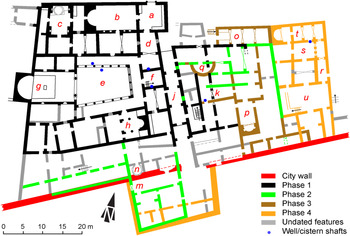
Another important factor in identifying Apollonia-Sozousa as the seat of the provincial administration is the presence of a suitable location/building (praetorium) for the chief officials (dux and/or praeses) and their respective staffs to conduct their business. Goodchild and Reynolds have proposed a structure on the southern part of Apollonia in close proximity to the city wall (Goodchild Reference Goodchild1960, 246–59; Reference Goodchild1976, 253–57; Reynolds Reference Reynolds2003, 95–105). This so-called ‘Palace of the Dux’ (see Figure 2) fulfilled all the necessary spatial requirements including a large audience chamber for court proceedings, enough rooms for the clerical staff and even a small chapel. During the excavations of the Mission Archéologique Française and the University of Michigan, several marble fragments of a monumental inscription of Anastasius I (AD 491–518) were discovered. The inscription contained fourteen provisions that regulated military matters of the province. According to Goodchild and Reynolds it was originally erected in the ‘Palace of the Dux’, thereby solidifying their claim that Apollonia-Sozousa had been the capital of Libya Superior by the time of Anastasius (Reference BarthelBarthel forthcoming; Reynolds Reference Reynolds and Goodchild1976, 309–12). Although this remains a valid option, both of these assessments pose difficulties. First off, there unfortunately is very little concrete evidence to clearly identify Roman praetoria or governors’ palaces (Wilson Reference Wilson and Bülow2011, 55–89). While surveying the potential Late Antique buildings scattered all around the Mediterranean, Lavan counted 23 praetoria (Lavan Reference Lavan1999, 135–64; Reference Lavan and Lavan2001, 39–56). Reviewing the evidence from the early Empire Haensch came up with over 60 suitable buildings (Haensch Reference Haensch1997, 37–65). Of all these potential praetoria only one building located in Caesarea Maritima has a clear architectural layout that, in combination with ample epigraphic evidence, allows for it to be identified as a governors’ palace (Ameling et al. Reference Ameling2011, nos 1282–1344; De Segni et al. Reference De Segni2003, 273–300; Haensch Reference Haensch and Faraguna2013, 333–49). In comparison the ‘Palace of the Dux’ at Apollonia-Sozousa could also have been the property of a wealthy citizen of the Pentapolis as Lavan, Ellis and Duval have pointed out (Duval Reference Duval1989, 2743–96; Ellis Reference Ellis and Barker1985, 15–27; Lavan Reference Lavan and Lavan2001, 39–56).
Secondly as the French and British excavation reports clearly indicate only one single fragment of the marble inscription of Anastasius was found in the ‘Palace of the Dux’ (Chamoux Reference Chamoux and Gadallah1968, 45: ‘Ces fragments, au nombre d'une douzaine, ont été trouvés à divers endroits du site’; Goodchild Reference Goodchild1976, 253–54: ‘Most of the fragments found to date were reused in late walls adjoining the Roman Baths, close to the sea: one fragment however, has come from the Palace itself and it is not impossible that this was its original site’).
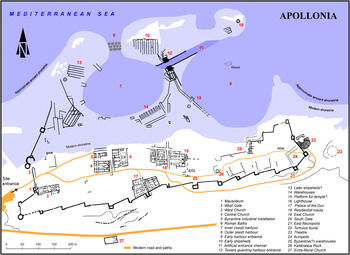
As Goodchild noted the monumental inscription of Anastasius was demolished after its initial purpose had ceased to be of significance, and then reused as building material for the reconstruction of the Roman Baths (see Figure 1, no. 6). Similar to the ‘Palace of the Dux’ this complex went through several stages of occupation. In its last phase, which dates to the sixth or seventh century AD,Footnote 3 the fragments of the Anastasian inscription were built into a new set of walls that almost divided the frigidarium in half. Bearing in mind that the baths were located closer to the sea than the ‘palace’, at a lower level of the topography of Apollonia, it is not difficult to imagine that parts of the shattered inscription might have moved there naturally. In addition the distance between these two buildings is less than 50 metres, which makes Goodchild's identification of the ‘palace’ as its original site plausible, but not as certain as has been previously implied. In my opinion, it is equally feasible that the edict of Anastasius I was simply displayed on a marble stele in the city centre, in front of the so-called ‘palace’, to inform the citizens of the Pentapolis as well as the arriving soldiers about the new measures enacted by the emperor (similarly Kenrick Reference Kenrick2013, 285).
Apollonia-Sozousa, taken with permission from Kenrick Reference Kenrick2013.

‘Palace of the Dux’, taken with permission from Kenrick Reference Kenrick2013, 81.
-
a Waiting room
-
b Audience chamber
-
c Store room with oven
-
d Lobby
-
e Courtyard
-
f Staircase
-
g Banqueting hall
-
h Chapel
-
j Corridor
-
k Arched entrance to E wing (Phase 1)
-
m Postern gate
-
n Oven
-
o Store?
-
p Office?
-
q Foundation of apse
-
r Vestibule of E building
-
s Courtyard/light well
-
t Audience chamber
-
u Courtyard

The available archaeological record of Apollonia-Sozousa has shed some light on the urban development of Cyrenaica. But in order to answer the questions of when and why this city was chosen to be the caput provinciae of Libya Superior, the archaeological record alone remains inconclusive. As such, it must be seen in combination with further historical material.
2. When was Apollonia-Sozousa elevated to the metropolis of Libya Superior?
Our main written source for the change of capital from Ptolemais to Sozousa is the Synekdemos of Hierocles. It refers to Sozousa as the caput provinciae of Libya Superior (Honigmann Reference Honigmann1939, 5–7). This administrative and geographical manual contains a list of all the Roman provinces and their major urban centres. It was probably composed around AD 527–28, but relied in part on an older geographical text from the reign of Theodosius II, who ruled from AD 408–50 (Traina Reference Traina and Kelly2013). It may therefore be assumed that the provincial administration must have (been) relocated sometime between the fifth and early sixth century AD. Based on the available timespan, Denis Roques frequently proposed the year AD 450 as the exact date for this event (Roques Reference Roques1987, 233, 276, 294; Roques Reference Roques and Ferdière2004, 303). He argued that the combination of the deteriorating military infrastructure of Ptolemais and the ongoing attacks by the Mazices and Aus(t)orians on Tripolitania and the Pentapolis led to this decision. In his view this was also accompanied by a change in the military organisation of Cyrenaica. Instead of one military commander (dux Libyae) being responsible for the provinces Libya Superior and Inferior (last attestation in AD 443; C. Th. XXIV), a new post (dux Libyae Pentapoleos) specifically in charge of the Pentapolis was created (first attestation in AD 472; CJ. XII,59,10,5). Apart from the testimonies of Ammianus Marcellinus and Synesius Roques based his argument on two additional sources:
First, an honorific inscription for the comes et dux Fl. Ortygius from Leptis Magna, that serves as evidence for the attacks of the Aus(t)orians:Footnote 4
Ortygii florentissimis saeculis d(ominorum) n(ostrorum) Honori et Theodosii p(atrum) p(atriae) semper Augustorum Fl(auio) Ortygio u(iro) c(larissimo) SPPO com(iti) et duci p(rouinciae) T(ripolitanae) ob insignia meritorum et labore(m) fidemque exhibitam Austurianorum rabie repressa ordo splendidissimus et populus Lepcimag(nensis) c̣ịụịṭạ[tis] p̣ụḅḷịc̣ẹ
(In honour) of Ortygius. In the flourishing times of our lords Honorius and Theodosius, father of the country, always Augusti, to Flavius Ortygius, splendid man (of senatorial status), SPPO (not understood), count and governor of the province of Tripolitania, on account of the outstanding character of his deserts and effort and good faith shown in the suppressing of the rage of the Austuriani; the most splendid city council and the people of the city of Lepcis Magna (set this up) publicly. (Reynolds and Ward-Perkins Reference Reynolds and Ward-Perkins1952, no. 480, available online at: http://inslib.kcl.ac.uk/irt2009/IRT480.html)
The ongoing incursions of the Aus(t)orians concur with Roques’ idea of an eastward migration of larger groups of Berbers during the late fourth and early fifth centuries AD (Roques Reference Roques1983, 660–77). Although Modéran convincingly refuted the hypothesis of a great migration by demonstrating the territorial continuity of several Berber groups of the Syrtic Region like the Laguatan, Mazices and Austuriani (Modéran Reference Modéran2003, 209–13, 279–312) the raids of the desert tribes must have played a part in the decision to move the capital. This leads to Roques’ second piece of evidence, which stems from the histories of Priscus of Panium:
… κατεγγυᾶται τῷ Κωνσταντίῳ γυνή, γαμετὴ Ἀρμάτου γενομένη, παiδὸς Πλίνθου, τοῦ παρὰ Ῥωμαίος στρατηγήσαντος καὶ ὕπατον ἀρχὴν ἄρξαντος. Συνεβεβήκει δὲ τὸν Ἀρμάτον, ἐς τὴν Λιβύων διαβάντα ἐπἰ τῇ πρὸς Αὐσαριανοὺς μάχῃ, εὐμηερῆσαι μὲν ἐν τῷ πρὸς ἐκείνους πολέμῳ, νοσήσαντα δὲ τελευτῆσαι τὸν βίον. Priscus, Excerpta de legationibus, 14.5–6 (ed. Carolla Reference Carolla2008)=Frgm.15 (ed. Blockley Reference Blockley1983).
… to Constantius a woman was betrothed who had been the wife of Armatus, the son of Plinthas who had been a Roman general and had held the consulship. Armatus had been serving in Libya during the fighting with Ausoriani [sic] and had distinguished himself in that war, but had fallen ill and died (Blockley Reference Blockley1983, 299).
In contrast to his father Flavius Plintha (PLRE III, 892–93) we know very little about Armatus (PLRE III, 147), who probably served as a dux or comes rei militaris in Libya. His father was a prominent and influential figure at the court of Theodosius II. He was of Gothic descent, chose a military career and distinguished himself as a capable commander during a rebellion in Palestine. As a result he was awarded with the consulship for the year AD 419 and the position of magister militum praesentalium which he held up to about AD 438. Later, he was part of several diplomatic missions to the courts of the Hunnic kings Rua and Attila. The passage of Priscus referred to above probably relates to this specific context. This short overview of Roques’ thesis shows that his line of argument relies heavily on prosopographical details as well as the contextualisation of the episode mentioned by Priscus.
In light of the available source material it is practically impossible to determine an exact date for the relocation of the capital. For this reason I believe it to be more beneficial to view the reasoning for this reform in a broader context instead of focusing on the events pertaining exclusively to the Libyan border district. To me, it seems more convincing to place the rise of Apollonia-Sozousa to become metropolis of Libya Superior in the second half of the fifth century AD, and after the year AD 470 to be more precise. This assumption is based on the belief that the geopolitical reverberations of the Vandal conquest of the western half of North Africa led to fundamental changes within the Roman Empire. This is not to imply that the Vandals were the main reason for the administrative reforms in the Pentapolis, but their continued presence in Africa challenged the political status quo and certainly influenced the foreign policy of Roman emperors. A short passage from the ‘Life of Daniel the Stylite’ illustrates the deep-rooted state of shock the Romans were in and the resulting consequences for the Egyptian diocese, which included the province of Libya Superior or the Pentapolis. In the 56th chapter a tremendous rumour reached the emperor Leo I:
Some time later it befell that a report was spread that Genseric, King of the Vandals, intended to attack the city of Alexandria; this caused great searchings of the heart of the Emperor and to the Senate and to the whole city. So the Emperor sent his spatharius Hylasius, who was a eunuch, to inform the holy man about Genseric and of the Emperor's intention to dispatch an army to Egypt. Hylasius went up and delivered the Emperor's message to the holy man; and the holy man said to him,‘Go and say to the Emperor, Do not be troubled about this, for God sends word to you through me, a sinner, that neither Genseric nor any of his will ever see the city of Alexandria; but if you wish to send an army that is a matter for you to decide; the God whom I ador, will both preserve your Piety unhurt and will strengthen those who are sent against the enemies of the Empire’. Hylasius departed and reported these words to the Emperor, and by the grace of God his words came true (Vita Daniel Stylites, ch. 56; trans. E. Dawes and N.H. Baynes).Footnote 5
This episode occurred prior to the great expedition of AD 468 to reconquer Vandal Africa. In the narrative context of the vita, its primary function is to demonstrate the abundant charisma of the stylite, who could potentially act as the voice of God (Pfeilschifter Reference Pfeilschifter2013, 436–39; Trampedach Reference Trampedach and Dignas2013, 185–207). This in turn gave him the ability to influence the emperor. The actual historicity of the Vandal attack on Alexandria is of secondary importance. Yet I think it is still of great value as a source for the defence and administration of the Libyan provinces, because it alludes to the various changes and anxieties of the Mediterranean world in the fifth century AD. The potential loss of the Egyptian grain supply would have had a catastrophic effect on the whole Empire and Constantinople in particular. In order to persuade the emperor to send military reinforcements to Libya, Synesius of Cyrene had conjured up similar images of fear (Catastasis, 2, 3–4). In contrast to the incursions of the Mazices and Aus(t)orians the Vandals had successfully conquered the major part of North Africa in the first half of the fifth century AD. In addition these ‘barbarians’ were not just a threat to the western Mediterranean. In his Wars Procopius mentions Vandal attacks on the Peloponnese and Illyria (Procopius, Wars, 3.5, 22–24).Footnote 6 Their king Gaiseric had furthermore proven to be a successful military leader and brilliant tactician. As such, his ambitious foreign policy had to play a role in the calculations of the Roman emperor Leo (Blockley Reference Blockley1992, 71–79; Börm Reference Börm2013, 57–81; Modéran Reference Modéran2014, 93–154; Siebigs Reference Siebigs2010, 254–70; Vössing Reference Vössing2014, 50–71). In consequence an attack on the (economically) most important province of the Empire may not have seemed far-fetched at the time. The concluding remark of the stylite, that it would be the decision of the emperor to actually dispatch an army, refers to the failed expedition of AD 468, which coincidentally is not mentioned again in the ‘Life of Daniel’.Footnote 7 We are well informed about the great military operation from several others sources (for example Procopius, Wars 3.5, 6–7; for a thorough survey of all the available material see Brodka Reference Brodka, Bleckmann and Stickler2014, 103–21; Castritius Reference Castritius2007, 103–22; Merrills and Miles Reference Merrills and Miles2010, 109–21; Steinacher Reference Steinacher2016, 207–30; Reference Steinacher, Gastgeber and Daim2015, 84–91; Wiemer Reference Wiemer, Bleckmann and Stickler2014, 121–61). The Romans tried to defeat the Vandals by employing a three-pronged strategy. They divided their great force into three separate armies. One invaded Sicily, another tried to capture Carthage directly and the third marched through Tripolitania by land. The land-based army was assembled in Egypt and Libya and put under the command of Heraclius and Marsus (Theophanes Confessor, Chronographia, a. m. 5693).Footnote 8 After some initial success and large territorial gains, the whole operation failed spectacularly. In the sources the admiral and later usurper Basiliscus, who also happened to be the brother of the empress Verina, is almost exclusively identified as the one responsible for this disaster. Depending on the author, he is either labelled as a traitor, corrupt or simply incompetent. His reluctance to launch the final assault on Carthage enabled the Vandals to put fire to the Roman fleet lying in front of the Cap Bon. This forced the suddenly decimated Romans to engage in peace negotiations with the Vandals. As part of the ensuing treaty, they had to surrender their newly conquered territories (Sicily and Tripolitania around AD 470). Even worse, they had to acknowledge Gaiseric's rule over the African provinces. This in particular must have dealt a decisive blow to the hopes of the African senators and provincials that lived in exile. These prominent ‘Africans’ would later play an important part in convincing Justinian to attempt another conquest of Vandal Africa (Conant Reference Conant2012, 76–83; Greatrex Reference Greatrex2011; Modéran Reference Modéran2003, 581–84; Pseudo-Zacharias Rhetor, 4.17.b.).
The loss to the Vandals not only limited the political influence of the Romans, it also severely impacted their financial capabilities (Börm Reference Börm2013, 89–129; Henning Reference Henning1999, 233–40, 261–67, 277–321). According to a fragment of the histories of Candidus, which was preserved in the Byzantine Suda, the cost of the campaign amounted to:
Κάνδιδος ἱστοριογράφος φησὶν ὅτι ὁ Λέων ὁ Μακέλλης, ὁ μετὰ Μαρκιανὸν βασιλεύσας, περὶ τὴν ἐκστρατείαν τὴν κατὰ Βανδήλων ἄπειρα χρήματα δεδαπάνηκεν. ἦσαν γάρ, ὡς οἱ ταῦτα ἐφανέρωσαν κεχειρικότες, διὰ μὲν τῶν ὑπάρχων χρυσίου λίτραι τετρακισμύριαι πρὸς ἑπτακισχιλίαις: διὰ δὲ τοῦ κόμητος τῶν θησαυρῶν ἑπτακισχίλιαι πρὸς μυρίαις καὶ ἀργυρίου λίτραι ἑπτακόσιαι χιλιάδες, ἄτερ τῶν ἀνηλωμένων ἐκ τῶν δημευσίμων ἀρχόντων καὶ ἐκ τοῦ βασιλέως Ἀνθεμίου. (Candidus, Fragment, 2 = Suda, X.245; see also John Lydus, De Magistratibus, 3.43).
Candidus the historian says that Leo the Butcher, who was emperor after Marcian, spent countless funds in his campaign against the Vandals. For, as those who had handled these [funds] made known, there were [spent] 47,000 [coming] from the prefects, and 17,000 pounds of gold and 700,000 pounds of silver [coming] from the count of the treasuries, not to mention the [money] spent [coming] from the confiscatory officials and from emperor Anthemius.
In my opinion the aftermath of the failed expedition, primarily after the Roman troops were forced to vacate Tripolitania in AD 470, serves as the most convenient background to date the administrative changes of Libya Superior. The elevation of Apollonia-Sozousa furthermore demonstrates a clear orientation towards the eastern half of the Roman Empire. The political and cultural influence of Egypt had always been palpable in the Pentapolis and the new capital was far closer to Alexandria and by extension Constantinople than its predecessor (Roques Reference Roques and Barker1985, 387–94; Wilson Reference Wilson2004, 143–54). The realignment of the administrative landscape was also aided by a new diplomatic stance of the Romans. In contrast to the reign of Leo I, the dire financial and military state of the Empire forced his successors Zeno and Anastasius I to launch a phase of ‘realpolitik’. In respect to all African matters, this ultimately meant accepting (at times begrudgingly) the territorial gains and religious disposition of the Vandal kings (Haarer Reference Haarer2006, 91–115; Kosinski Reference Kosinski2010, 99–101, 118–23; Meier Reference Meier2009, 118–48; Steinacher Reference Steinacher2016, 221–30, 235–86). Unsurprisingly relations with the Vandal court improved visibly in the decades following the great expedition, while at the same time control over the desert tribes of Tripolitania and Cyrenaica deteriorated. Strengthening the Libyan border defences through a new military command structure (dux Libyae Pentapoleos) and the designation of Apollonia-Sozousa as the new capital would fit this practical policy. Furthermore, the effort to limit additional territorial losses would have appeased the African faction at the emperor's court in Constantinople (Conant Reference Conant2012, 30–43, 252–305; Modéran Reference Modéran2003, 541–65).
In summary: the relocation of the capital of Libya Superior from Ptolemais to Apollonia-Sozousa resulted from several fundamental developments that engulfed the Mediterranean sphere in the fifth century AD. The two large harbour basins and ample defensive structures, as well as its access to major maritime traffic routes made Sozousa an ideal location. The available archaeological and historical source material does not allow for a precise identification of the exact moment of this administrative change. But it stands to reason that the failed attempt to reconquer Vandal Africa accelerated this process and led to this reform shortly after the year AD 470.