Introduction
The currently available pharmacological therapies for Alzheimer's disease (AD) include three cholinesterase inhibitors (ChEIs) – donepezil, rivastigmine and galantamine – and the NMDA receptor antagonist memantine. The ChEIs have been demonstrated to have modest efficacy on measures of cognition, behavior and function based on pivotal randomized control trials (RCTs) (Lanctôt et al., Reference Lanctôt2003). While evidence-based clinical practice guidelines (CPGs) recommend the use of ChEIs for mild to moderate AD (American Psychiatric Association, 2007; Hogan et al., Reference Hogan2007), the evidence on which these recommendations are based has been questioned on a methodological basis (Kaduszkiewicz et al., Reference Kaduszkiewicz, Zimmermann, Beck-Bornholdt and van den Bussche2005), and whether these medications truly affect a variety of important outcomes is unclear (Lanctôt et al., Reference Lanctôt, Rajaram and Herrmann2009). For example, the data on delay of institutionalization are conflicting and few studies have provided prospective RCT data on the effects of these medications on quality of life and cost-effectiveness. There are even fewer data on the use of ChEIs in severe AD and in institutionalized patients. The methodological issues associated with studying outcomes in severe institutionalized AD patients are perhaps even more problematic than those in mild to moderate AD (Herrmann, Reference Herrmann2007). Recent CPGs that focused specifically on severe AD, however, have also recommended the use of ChEIs along with memantine, similar to the guidelines for mild to moderate AD (Vellas et al., Reference Vellas2005; Herrmann et al., Reference Herrmann, Gauthier and Lysy2007a).
The RCTs in mild, moderate and severe AD have mostly been of six months duration. While several open-label naturalistic studies of two to five years' duration suggest on-going benefit (Raskind et al., Reference Raskind, Peskind, Truyen, Kershaw and Damaraju2004; Bullock and Dengiz, Reference Bullock and Dengiz2005; Burns et al., Reference Burns, Gauthier and Perdomo2007; Behl et al., Reference Behl, Lanctôt, Streiner and Black2008), only a few RCTs have been longer than six months (Seltzer, Reference Seltzer2007). In contrast to the relatively brief RCTs, there is evidence suggesting that ChEIs in clinical practice are being used well beyond the length of the duration of these trials. For example, in a population-based observational cohort study of almost 29,000 elderly patients in the Canadian province of Ontario (Herrmann et al., Reference Herrmann2007b), ChEIs were used for 866 days (2.4 years) on average with those residing exclusively in long-term care having been treated for an average of 1,021 days (2.8 years). Furthermore, over the observation period of up to five years, 54% of the 10,114 patients who died were still taking a ChEI at the time of death. Those authors raised a number of questions based on these data including: what is the appropriate length of time to treat patients with ChEIs? Is lengthy treatment with ChEIs after institutionalization appropriate? When should ChEIs be discontinued, and how should discontinuation be done?
With respect to duration of use and the question of when it is safe and appropriate to discontinue ChEIs, the CPGs are generally unhelpful. For example, the American Psychiatric Association practice guideline for the treatment of patients with AD and other dementias (American Psychiatric Association, 2007) suggest that the decision whether to continue treatment with ChEIs is “highly individualized”, though possible reasons for discontinuation might include poor tolerability, lack of motivation, cost and lack of perceived efficacy. The guidelines recognize that the determination of efficacy can be challenging, and while “declining rapidly” might be a reason to discontinue, they provide no operational definition of what would constitute a rapid decline. The guidelines for severe AD provide little in the way of clarification. For example, in a French Consensus Statement on the treatment of severe AD (Vellas et al., Reference Vellas2005), it was recommended that treatment should be continued “as long as clinical benefit persists”, while Canadian guidelines for severe AD (Herrmann et al., Reference Herrmann, Gauthier and Lysy2007a) recommend that treatment should persist until clinical benefit can “no longer be demonstrated, and/or the patient has reached a very severe stage of AD”.
The vagueness of these recommendations is a reflection of the scarcity of data that pertain to discontinuing ChEIs. The only randomized discontinuation study done in patients with AD was with ChEI naïve patients with mild to moderate AD and neuropsychiatric symptoms who had been pretreated with donepezil for only 12 weeks (Holmes et al., Reference Holmes2004). As such, it does not provide evidence for discontinuation after long-term ChEI use in patients with severe AD. There are no RCTs of ChEI discontinuation following routine, long-term clinical use. In a small retrospective cohort study conducted in a long-term care facility, ChEI discontinuation was recommended by a review committee based on pre-specified criteria in 33% of 52 patients reviewed (Lee et al., Reference Lee, Monette, Sourial, Monette and Bergman2007). Of 13 patients who then underwent tapering followed by discontinuation of their ChEI, four were subsequently restarted while nine remained off ChEIs during a four month follow-up. Because only two of these patients were felt to have experienced significant deterioration that required restarting that ChEI, these authors concluded that a relatively high proportion of patients in long-term care may not be benefiting from ChEIs and discontinuation can be done safely and effectively. In contrast to these seemingly positive results, in a retrospective cohort study of 178 nursing home residents, 62 ChEI patients who had their ChEI discontinued were compared to 116 who continued treatment after continuous ChEI therapy of >9 months (Daiello et al., Reference Daiello, Ott, Lapane, Reinert, Machan and Dore2009). Patients who discontinued their ChEI experienced worsening behaviors and spent less time engaging in leisure-related activities compared to patients who continued ChEI therapy. Even worse outcomes were noted in a prospective audit of consecutive patients in the U.K. following NICE guidelines which at the time had recommended ChEI discontinuation in patients with MMSE <12 (Simpson et al., Reference Simpson, Beavis, Leddy and Ball2005). In that study, 17 of 25 patients who discontinued ChEI therapy experienced poor outcomes including five deaths and significant clinical deterioration in 12. Finally, there are also a small number of studies that suggest rapid cognitive decline and “withdrawal-like” symptoms in patients whose ChEIs were abruptly discontinued (Singh and Dudley, Reference Singh and Dudley2003).
In view of the lack of RCT data, a survey of Canadian dementia experts was conducted to solicit opinions on when and under what conditions ChEIs could be discontinued based on their clinical practice. The rationale for conducting this survey was that in the absence of higher levels of evidence, expert opinions and clinical experience of respected authorities has generally been recognized as being valued for evidence-based CPGs. We were interested in the degree of consensus that existed given the lengthy experience with these drugs in the absence of an evidence base.
Methods
The Canadian Consortium for Clinical Cognitive Research (C5R) consists of neurologists, geriatricians and psychiatrists from across Canada. Established in 1991, C5R includes almost all the academic/clinical dementia researchers in Canada who participate in phase II, III and IV dementia drug trials. There are 32 centres and 49 full members. Notice of the survey was sent by email in June, 2009 to the 49 members with two subsequent reminders over the next two months. The survey was posted electronically on Survey Monkey (www.surveymonkey.com). A total of 27 C5R members (55%) submitted responses to the survey.
The survey consisted of 19 questions with most responses answered via a Likert scale with five anchors: strongly agree, agree, neither agree nor disagree, disagree, and strongly disagree. All questions provided opportunities for unstructured comments. There were four broad domains considered: (1) patient/caregiver preference; (2) administration (related to indication, formulary coverage, and health regulatory guidance); (3) effectiveness; (4) adverse events. The complete survey is included in the Appendix.
Results
Patient/caregiver preference
The majority of respondents strongly agreed/agreed with the statements that ChEIs should be discontinued if the competent patient (78%) or the substitute decision-maker of an incompetent patient (63%) requested it. The comments emphasized the need to ensure competence of the patients (and/or of the caregiver) and that withdrawal of consent was informed with the potential risks and benefits of discontinuation versus continuation.
Administration
There was almost unanimous agreement that ChEIs should not be discontinued simply because the patient is admitted to a long-term care facility (93%). While this guideline exists in at least one Canadian province, comments emphasized that this was ageist and demeaning, there are RCT data available to support use in severe institutionalized patients, and the reasons for admission to long-term care are varied and not always based on the patient's cognitive or functional status. Ninety-six percent of respondents disagreed that ChEI therapy should be discontinued if the patient no longer qualified for provincial drug benefit coverage. While financial realities were recognized, comments emphasized that most of the criteria for coverage were arbitrary and did not take into consideration individual patients who might clearly be continuing to benefit despite no longer meeting criteria for coverage.
Despite a lack of RCT studies that were longer than one year in duration, 96% responded that they would not discontinue after only one year of therapy simply because of the lack of longer term data. They pointed out that long-term studies involving placebo are highly problematic and good long-term observational data do exist. The majority of respondents (74%) would not specify a specific length of time beyond which doubt in efficacy should prompt discontinuation, noting that time in and of itself was not a criterion for discontinuation. There was similar agreement (93%) that ChEIs should not be discontinued when the Mini-mental State Examination (MMSE) score drops below 10. The MMSE score was not considered sufficient evidence of effectiveness (or lack thereof). The lack of a Health Canada indication in severe AD and an absence of RCT data in severe AD for galantamine and rivastigmine did not appear to be persuasive arguments to discontinue these drugs in patients with severe AD.
Effectiveness
There were fairly equal proportions of respondents who both agreed (46%) and disagreed (38%) with the following statement: if the patient initially demonstrated obvious clinical improvement, the ChEI should not be discontinued regardless of subsequent deterioration. Similarly, there was little consensus about what to do when there was a lack of initial improvement but the patient then appeared to be clinically stable for six to twelve months. A number of respondents to both, commented that a trial of switching to another ChEI might be considered in each scenario in the event of subsequent decline. Regardless of initial improvement or stabilization, respondents provided no consistent responses to the subsequent discontinuation of ChEIs if the patient was then declining at a rate that was greater than expected (35% agreed, 46% disagreed). Neither could respondents agree on what constituted “greater than expected decline”. Of the three options – decline in MMSE >3 points per year, emergence of serious behavioral and psychological symptoms of dementia (BPSD) such as agitation, aggression or psychosis, or loss of two or more key activities of daily living (ADLs) in one year – the last received the most positive responses (42%) and the least negative responses (27%). When asked to provide their own definition of “greater than expected decline”, most responded that this was impossible because it depended on the individual, their rate of decline prior to being treated, and the stage of illness they were in. In terms of absolute clinical characteristics that could trigger consideration of ChEI discontinuation, a Global Deterioration Scale (GDS) score of 7 (65%) and swallowing difficulties (62%) received the most positive responses, while inability to perform any basic ADLs (50%) and inability to communicate (50%) received the most negative responses. There was no agreement on the value of MMSE = 0 and loss of ambulatory status as reasons to discontinue.
Adverse events
Most respondents agreed that on-going distressing loose stools (92%), nausea or vomiting (85%) and otherwise unexplained syncope (54%) could be considered reasons to discontinue ChEIs. There was much less agreement about bradycardia, with only 12% agreeing to discontinue ChEIs with a heart rate <60 beats per minute and 42% agreeing to discontinue with a heart rate of <50 beats per minute. There was no consensus about whether otherwise unexplained falls should be considered a reason to discontinue ChEIs. Respondents emphasized that in an elderly frail severely demented patient population, there could be many causes for falls, syncope and bradycardia that might have nothing to do with ChEI therapy. Fifty-eight percent agreed that anorexia and weight loss >5% of ideal body weight could be considered a reason to discontinue ChEIs. A number of respondents suggested that a time frame for the weight loss was needed, though recommendations varied greatly from one month to six months.
Finally, in response to open-ended questions about the reasons to discontinue ChEIs and their personal practice, respondents noted several other conditions and characteristics. These included new onset seizures, exacerbation of COPD, muscle cramps, new sleep disturbance, emergence or worsening BPSD and when patients are receiving palliative care. ChEI therapy can also be discontinued when patients and/or caregivers are clearly non-adherent.
Discussion
In this survey of Canadian dementia experts, there was a wide variety of opinions expressed regarding when it was appropriate to discontinue ChEI therapy in patients with AD. These experts appeared to agree most consistently when the reasons focused on patient and caregiver preference and in the presence of bothersome severe adverse events. In contrast, there was much less consensus on issues related to effectiveness – specifically what constituted greater than expected deterioration or specific characteristics that could trigger discontinuation. While the strengths of this survey relate to the collective experience and expertise of the dementia experts surveyed, the limitations include the low number of responses received and the fact that the opinions may not necessarily represent those of the wider community of physicians who treat patients with dementia, and in particular, primary care MDs. With respect to the latter, it is likely that most severe end-stage dementia patients in long-term care facilities are being treated by primary care physicians with little input from dementia specialists. In fact, 35% of respondents in this survey stated that they would not participate in a study of ChEI discontinuation mostly because they did not follow enough patients with severe AD and/or they do not see many institutionalized patients. Another limitation of the study stems from the lack of demographic information about respondents.
Several themes arise from these survey results. There appears to be a marked reluctance to discontinue ChEI therapy among this group of physicians even in end-stage illness and/or the presence of prominent potential adverse events. Many of these clinicians would continue therapy even in the context of obvious decline fearing that decline might be even greater in the absence of treatment, and that decline in one area does not necessarily mean the patient is not benefiting in other domains. Such a bias might be predictable given that these physicians are involved in AD clinical trial research, but it also suggests that these doctors feel comfortable going well beyond the duration of treatment supported by RCT data. This reflects the reality of treating patients with severe dementia where the evidence-base is lacking. It also appears that there is a reluctance to rely on any single measure of cognition, function or behavior; composite measures (e.g. GDS) might be preferable. In particular, MMSE scores, either by cut-off or by number of points lost, were not seen as helpful for decisions about discontinuation. Knowledge of the individual patients' trajectory of decline prior to and during ChEI therapy was deemed necessary in order to determine whether discontinuation was appropriate. Many of the respondents saw switching to another ChEI as a reasonable alternative to discontinuation. Finally, ensuring the patient and caregiver were informed of all the potential risks and benefits of continuing and discontinuing ChEI therapy was seen to be essential.
In spite of the apparent support to continue ChEI therapy for as long as possible, there are many persuasive reasons to attempt discontinuation of treatment. Given that benefits are modest at best, and determining which individual patients are benefiting can be challenging, careful discontinuation trials may be appropriate. On-going useless and costly treatments cannot be justified in this frail population. It is increasingly recognized that when used widely, these drugs might be associated with increased risks of relatively rare but important adverse events such as syncope, bradycardia, pacemaker insertion and hip fractures (Gill et al., Reference Gill2009). Similarly, it is also possible that anorexia and nausea associated with ChEI treatment contribute to difficulties in maintaining the nutritional status of many patients with severe AD who cannot communicate the presence of these adverse events.
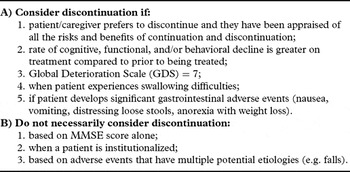
It is still unclear, however, under which conditions and for which patients discontinuing ChEI therapy is appropriate and safe. The lack of data has led to widely differing practices among experts. Based on the responses to the C5R survey, we offer the suggestions listed in the Table 1. Should a trial of discontinuation be attempted, consideration should be given to tapering the dose first and providing follow-up after one and three months. We recognize that these recommendations are made in the absence of clinical data and that these data are essential if we are to optimize therapy for patients with AD. Designing RCTs to examine ChEI discontinuation is feasible (Jones et al., Reference Jones2009), and just like similar studies examining antipsychotic discontinuation (Ballard et al., Reference Ballard2004; Ruths et al., Reference Ruths, Straand, Nygaard, Bjorvatn and Pallesen2004), it is hoped that these studies will not only provide information on the relative risks and benefits of ChEI discontinuation, but also help to identify the clinical characteristics, of the patients who are most likely to tolerate and perhaps benefit from ChEI discontinuation. In addition, large, lengthy, observational database studies charting the clinical course of patients treated with ChEIs might provide the data needed to inform individualized therapy for AD patients.
Recommendations for discontinuing cholinesterase inhibitors after long-term use

Conflict of interest
Dr. Herrmann has received research support, consultation fees, and speaker's honoraria from Pfizer, Janssen-Ortho, Novartis, Lundbeck and Wyeth. In the past two years, Dr. Black has received research support from Novartis Pharmaceuticals, Myriad Pharmaceuticals, Pfizer and Roche, as well as consultation fees or speaker's honoraria from Pfizer, Janssen-Ortho, Novartis Pharmaceuticals, Lundbeck, GlaxoSmith Kline, Schering-Plough, Elan and Wyeth Pharmaceuticals, and Bristol-Myers Squibb. Miss Li has received a speaker's honorarium from Abbott. Dr. Lanctôt has received research support, consultation fees or speaker's honoraria from Abbott, Pfizer, Janssen-Ortho, Lundbeck and Wyeth.
Description of authors' roles
Dr. Herrmann helped design the survey, analyze the results and wrote the first draft of the paper. Dr. Black, Ms. Li and Dr. Lanctôt helped design the survey, analyze the results and revise the paper.
Acknowledgments
The authors wish to thank the executive and members of the Canadian Consortium for Clinical Cognitive Research (C5R) for participating in the survey.
This research project was generously funded by the Estate of Vimy Lena Elizabeth Coleman.
Appendix: C5R ChEI Discontinuation Survey
Instructions: Please respond – strongly agree/agree/neither agree nor disagree/disagree/strongly disagree – to the following statements:
A. Patient/Caregiver Preference
1. ChEI therapy should be discontinued if the competent patient requests it.
2. ChEI should be discontinued if the caregiver requests it.
B. Administration
1. ChEI should be discontinued if the patient is admitted to a long-term care facility.
2. ChEI should be discontinued if the patient no longer qualifies for provincial drug benefit coverage.
3. Any patient who has been on a ChEI for more than one year should have treatment discontinued (rationale: lack of RCT data for more than one year).
4. Any patient whose MMSE drops below 10 should have treatment discontinued (rationale: lack of RCT data for drugs other than donepezil).
C. Lack of Effectiveness
1. If the patient initially demonstrated obvious clinical improvement, ChEI should not be discontinued regardless of subsequent deterioration.
2. If the patient did not clearly improve after initiating ChEI, but appeared to be clinically stable for six to twelve months, ChEI should not be discontinued regardless of subsequent deterioration.
3. Regardless of initial improvement or stabilization, if a patient begins to deteriorate at a rate that would be ‘greater than expected’, ChEI should be discontinued.
4. “Greater than expected” deterioration could be defined as a decline in MMSE of greater than three points in one year.
5. “Greater than expected” deterioration could be defined as a loss of two or more key activities of daily living over the course of one year.
6. “Greater than expected” deterioration could be defined as the emergence of a serious BPSD such as agitation, aggression, or psychosis.
7. Can you suggest another definition for ‘greater than expected’ deterioration?
8. Besides rate of deterioration, absolute clinical characteristics can determine ChEI discontinuation (see below).
9. ChEIs should be discontinued at GDS = 7.
10. ChEIs should be discontinued at MMSE = 0.
11. ChEIs should be discontinued when patients can no longer perform any basic activities of daily living without assistance.
12. ChEIs should be discontinued when patients are no longer ambulatory.
13. ChEIs should be discontinued when patients no longer have any communicative speech.
14. ChEI should be discontinued when patients develop swallowing difficulties.
D. Adverse Events
1. ChEIs should be discontinued if patient experiences otherwise unexplained syncope.
2. ChEIs should be discontinued if patients experiences otherwise unexplained falls.
3. ChEIs should be discontinued if patient experiences on-going distressing loose stools.
4. ChEIs should be discontinued if patient experiences on-going nausea or vomiting.
5. ChEIs should be discontinued if patient experiences bradycardia <60 beats per minute.
6. ChEIs should be discontinued if patient experiences on-going bradycardia at <50 beats per minute.
7. ChEI should be discontinued if patient experiences anorexia and weight loss that is greater than 5% of ideal body weight.
8. Can you suggest another definition for significant weight loss?
E. Other
1. Do you discontinue ChEIs for any other reason? Please comment.