


Introduction
Cognitive models for obsessive-compulsive disorder (OCD) suggest that normal intrusions escalate into clinical obsessions due to two important mechanisms (misappraisal of the intrusion and neutralization). Firstly, the intrusions are misinterpreted by vulnerable individuals, in accordance with their dysfunctional beliefs. Then, according to OCD cognitive models, these misinterpretations of intrusive thoughts provoke heightened distress, leading individuals to engage in efforts to neutralize it. Neutralizing strategies (such as thought control and thought suppression) provide temporary relief but perpetuate the belief that the intrusive thought is dangerous or intolerable.
Six core dysfunctional belief domains underlying OCD have been proposed and each of them seems to be more strongly associated with specific symptoms of OCD than the others. One of the core dysfunctional belief domains is Overimportance of Thoughts (OT; Obsessive Compulsive Cognitions Working Group, 2001), which seems to be associated with aggressive impulses. Three dimensions compose the OT belief domain: (1) Overimportance of Thought: the belief that the mere presence of a thought indicates that it is important and may reveal the true character or the moral nature of a person; (2) Moral Thought Action Fusion (TAF-Moral): the belief that thinking is morally equivalent to acting; and (3) Likelihood Thought Action Fusion (TAF-Likelihood): the belief that thinking about an unacceptable event makes their occurrence more probable (Obsessive Compulsive Cognitions Working Group, 2001; Shafran et al., Reference Shafran, Thordarson and Rachman1996).
Shafran et al. (Reference Shafran, Thordarson and Rachman1996) pointed out that some social factors, such as culture, can determine the development of these beliefs. According to Novara and colleagues (Reference Novara, Pastore, Ghisi, Sica, Sanavio and McKay2011), beliefs are predominantly stable over time but can also be modifiable throughout life. It seems reasonable to think that what makes beliefs change throughout life, in natural contexts, are both experiences and information to which individuals are intentionally or inadvertently exposed to (e.g. news of scientific research results). Furthermore, previous research found, for example, that one single-session of Cognitive Bias Modification for Interpretation (CBM-I) produced changes in beliefs about the importance of thoughts (Clerkin et al., Reference Clerkin, Magee and Parsons2014).
The current study aimed to experimentally modify beliefs content and test the effect of such modification on intrusions. Thus, we intended to increase OT beliefs providing a brief information, similar to what people can obtain in everyday life contexts, and verify the effect of these OT beliefs on the response to an aggressive impulse.
Method
Participants
Eighty-five community participants aged from 18 to 51 years (mean = 25.91, SD = 9.09) took part in the experiment. Most of them were female (52.9%) and had between 5 and 16 years of education (mean = 12.79, SD = 2.20). Participants were randomly assigned (through the web-based Research Randomizer tool) to the experimental condition (EC) (n = 41) or control condition (CC) (n = 44). The groups were equivalent concerning gender (χ2 = 0.02, p = .898), age (t (83) = –0.00, p = .997, d = 0.00) and education level (t (83) = 0.26, p = .793, d = 0.05) as well as psychological and psychopathological variables (description of scales is given in the Supplementary Material): obsessive-compulsive symptoms (VOCI) [t (83) = 0.40, p = .693, d = 0.09], thought control strategies (TCQ) [t (83) = –1.50, p = .137, d = 0.32], anxiety (DASS) [t (83) = 0.03, p = .974, d = 0.01], depression (DASS) [t (83) = –0.70, p = .499, d = 0.15] and stress (DASS) [t (83) = 0.71, p = .478, d = 0.16]. Previous history of psychiatric illness, including OCD, was considered an exclusion criterion.
Measures
The Obsessive Beliefs Inventory (OBI; Belloch et al., Reference Belloch, Cabedo, Morillo, Lucero and Carrió2003) is a 50-item self-report measure designed to assess obsessive beliefs in OCD (responses ranging from 1 ‘totally disagree’ to 7 ‘totally agree’). Only three subscales of OBI were used (TAF-Likelihood, TAF-Moral, and Overimportance of thoughts). Levels of internal consistency were satisfactory for two subscales (αTAF-Likelihood = .84, αTAF-Moral = .86) and reduced for the third (αOverimportance of thoughts = .62).
Experimental tasks
False scientific abstracts
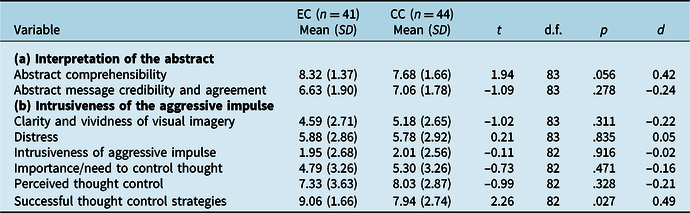
Two specially designed fake scientific abstracts were used to manipulate participants’ beliefs: one about the importance of controlling thoughts (Thought Control – EC), and another abstract non-related to obsessive beliefs (Addictive Potential of Facebook – CC). A 10 cm visual analogue scale (VAS; 0 = ‘totally disagree’ to 10 = ‘totally agree’) was used to measure abstract comprehensibility (four items; α = .86) as well as abstract credibility and acceptance of the message of the abstract (three items; α = .74). Preliminary analyses showed no differences between groups in abstracts interpretation [Table 1(a)].
Differences between conditions in the variables describing (a) the interpretation of the abstract and (b) the intrusiveness of the aggressive impulse (mean, standard deviation, t-test and Cohen’s d)

EC, experimental condition; CC, control condition.
Imagery task
To assess the responses to impulses, all participants listened to an audio file describing the aggressive impulse to stab a loved person, and were required to imagine themselves feeling that impulse. Again, VAS (0 = ‘totally disagree’ to 10 = ‘totally agree’) were used to evaluate clarity and vividness of visual imagery (three items; α = .78); distress (four items; α = .76); intrusiveness of the aggressive impulse (two items; α = .73) and perceived need to control the intrusion Importance/need to control thought (three items; α = .71). Two additional items concerning successful thought control strategies and perceived thought control were included.
Procedure
All participants completed the three OBI subscales (baseline), read the appropriate abstract, answered a brief questionnaire assessing the comprehension of the abstract, provided the name of a loved one, performed the Imagery Task and answered the questions evaluating the response to the induced impulse. This procedure allowed us to observe the effect of abstract content (OT manipulation) on the response to an aggressive impulse, maintaining the imagination of the impulse constant in both experimental conditions. At the end, participants completed the OBI subscales again, to evaluate the efficacy of the experimental manipulation.
Results
Effect of the experimental manipulation on Overimportance of Thoughts beliefs
Before data analysis, the three OBI subscales were log-transformed to correct for positive skewness. A two-way multivariate mixed analysis of variance (MANOVA) was then performed to evaluate the effect of the experimental manipulation, wherein the condition (EC vs CC) was the between-subjects factor, the time-point (baseline vs post-manipulation) was the within-subjects factor, and the OBI subscales were the dependent variables.
The MANOVA did not reveal a significant effect of the interaction between condition and time-point on obsessive beliefs [Pillai’s Trace V = .052, F (1,83) = 1.49, p = .222, ηp2 = .052], suggesting a null effect of the experimental manipulation on the overall OT belief domain. Only time-point main effect was significant, revealing a reduction of obsessive beliefs between baseline and post-manipulation [V = 0.381, F (1,83) = 16.60, p ≤ .001, ηp2 = .381]. The condition effect was non-significant [V = 0.077, F (1,83) = 2.26, p = .088, ηp2 = .077].
Separate mixed ANOVAs for each outcome variable showed a significant interaction between condition and time-point only for TAF-Moral [F (1,83) = 4.13, p = .045, η p2 = .047]. We found TAF-Moral decreased significantly between baseline and post-manipulation, both for the experimental (baseline vs post-manipulation: meanbaseline ± SD = 2.74 ± 1.61 vs meanpost. ± SD = 2.21 ± 1.69; t (40) = 5.17, p ≤ .001) and for the control condition (baseline vs post-manipulation: meanbaseline ± SD = 3.31 ± 1.49 vs meanpost. ± SD = 3.02 ± 1.62; t (43) = 2.07, p = .044). However, based on effect size values, the decrease was more pronounced in the experimental group (r = .34) than in the control group (r = .21). These results seem to suggest that after the experimental manipulation, TAF-Moral beliefs on the two groups diverged, showing a greater reduction in the experimental group. The interaction effect on the other two OBI subscales was non-significant (for OT, p = .259; for TAF-Likelihood, p = .859).
Effect of the experimental manipulation on response to the aggressive impulse
There were no significant differences between conditions in the variables that described the intensity of the aggressive impulse intrusiveness [Table 1(b)], except for the evaluation of the success of thought control strategies: participants of the EC rated their strategies as more successful than those in the CC (t (82) = 2.26, p = .027, d = 0.49).
Discussion
The present study aimed to experimentally manipulate beliefs about the importance of thought to evaluate their impact on the intrusiveness of an induced aggressive thought. Our first main result concerns the experimental manipulation and showed that reading an abstract about the possibility and desirability of achieving control over thoughts led to a decrease in TAF-Moral beliefs. This change was in the opposite direction of the expected effect. It seems possible that the content of the abstract may have generated the illusion of thought control in the participants. If, as the EC abstract suggested, almost everyone experiences unwanted thoughts and manages to control them, one can conclude that their own thoughts could not be more immoral compared with other people. As TAF-Moral implies the moral equivalence between thinking and acting (i.e. wishing for someone’s death is morally as bad as killing that person), the illusion of thought control induced by the EC abstract may have led to reduction of that belief. Moreover, participants who read the EC abstract, although not reporting having gained greater control over the aggressive impulse than CC participants, rated their strategies for handling intrusions as more effective than people who read irrelevant information (the CC abstract), reinforcing the idea of illusion of thought control.
The beliefs about OT and TAF-Likelihood decreased independently of the content of the abstract. One might therefore ask to what this reduction was due. We cannot provide a clear answer to this question. First, given that the participants answered the same self-report questionnaires before and after the experiment, it is possible that the reduction in beliefs may just reflect the commonly observed decrease in scores on self-administered questionnaires in re-test situations. Second, because beliefs were assessed after the full experimental procedure (and not immediately after reading of the abstracts), reduction may also have been due to exposure to the aggressive impulses induced in both groups during the imagery task. Imagining what it would feel like to experience an unwanted impulse to harm a significant other may have led participants to re-appraise their beliefs about the importance of thoughts.
In summary, both reading credible information suggesting that thoughts can and should be controlled and the experience of imagining an aggressive impulse seem to be potential factors that can modify beliefs that have been assumed temporally stable. Thus, like Novara and colleagues (Reference Novara, Pastore, Ghisi, Sica, Sanavio and McKay2011), we agree that beliefs can be modified. It seems reasonable to think that changes in beliefs are possible due both to one’s experiences and the credible information to which one is unintentionally exposed in the course of one’s life. Furthermore, our results are similar to those obtained in recent interventions that reduced OCD-related beliefs in a short space of time using a mobile app (Roncero et al., Reference Roncero, Belloch and Doron2018).
Concerning the effect of the changes in OT beliefs on the intrusiveness of an induced aggressive thought, the results were limited. Changes on TAF-Moral beliefs were not enough to affect the participants’ response to the aggressive impulse, except for the assessment of the effectiveness of their thought control strategies (TAF-Moral reduction led to the perception of greater control over aggressive impulse in EC participants). As the response to the aggressive impulse was not assessed at baseline, these results should be examined with caution; however, similar null results have been nevertheless obtained in previous studies (e.g. Clerkin et al., Reference Clerkin, Magee and Parsons2014).
Although the findings are promising, this study has some limitations. First, a non-clinical sample was used; second, participants answered the self-report questionnaires twice in a short space of time and this may have influenced their responses. Finally, to better determine the effects of the experimental manipulation, it would have been preferable to evaluate the beliefs about the importance of thoughts immediately after reading the abstracts and to evaluate the response to the aggressive impulse also at the baseline.
Acknowledgements
We are grateful to all participants that kindly made this research possible.
Conflicts of interest
The authors declare that they have no competing interests.
Ethical statement
Authors have abided by the Ethical Principles of Psychologists and Code of Conduct as set out by the APA http://www.apa.org/ethics/code/. Ethical approval was provided by the Scientific Committee of the Human and Social Faculty of the University of the Algarve.
Financial support
This work was partially founded by national funds through FCT – Fundação para a Ciência e a Tecnologia – as part as the projects: UID/PSI/04345/2019 CIP/UAL and UID/BIM/04773/2013 CBMR.
Supplementary material
To view supplementary material for this article, please visit https://doi.org/10.1017/S1352465820000120




Comments
No Comments have been published for this article.