INTRODUCTION
Five species of tropical shads, i.e. Tenualosa ilisha (Hamilton, 1822), Tenualosa toil (Valenciennes, 1847), Tenualosa macrura (Bleeker, 1852), Tenualosa reevesii (Richardson, 1846) and Tenualosa thibaudeaui (Durand, 1940) live in the estuaries and coastal waters in the Indo-Pacific region (Preston, Reference Preston2004). The most widespread and well-studied species is T. ilisha, which is found from north Sumatra of Indonesia in the east to Kuwait in the west, and is the basis of important fisheries in Bangladesh, India, Myanmar, Pakistan and Kuwait (Whitehead, Reference Whitehead1985; Al-Baz & Grove, Reference Al-Baz and Grove1995; Blaber, Reference Blaber1997). The closely related T. reevesii occurs intermittently along the South China coast and far up the Rivers Yangtze, Pearl and Qiantang in China (Wang, Reference Wang1996). Once widespread T. toli is now found only in the estuaries and adjacent coastal areas of Sarawak (Borneo Island) (Blaber et al., Reference Blaber, Milton, Pang, Wong, Ong, Nyigo and Lubim1996), and T. thibaudeaui, which only lives in the lower and middle Mekong system, is believed to be close to extinction (Roberts, Reference Roberts1993). Tenualosa macrura lives in the coastal waters of Sumatra and Borneo Islands.
In Malaysia, two species of Tenualosa, T. toil and T. macrura, have been recorded from Borneo Island (Blaber et al., Reference Blaber, Farmer, Milton, Pang, Wong and Ong1997). These two species are locally known as ‘Terubuk’ or ‘Terubok’ and are the most commercially important species in Malaysia. Furthermore, Malaysia imports Tenualosa species from Bangladesh and India. The unique taste, mouth-watering flavour and delicate culinary properties of Tenualosa species make it one of the most important tropical fish in the Indo-Pacific region and it has occupied a top position among other edible fish (Nowsad et al., Reference Nowsad, Mohanty, Enamul and Thilshed2012).
We found Tenualosa in estuaries and rivers in Peninsular Malaysia. Although the fish is recognized as an important fish resource, no study has been conducted in Malaysia. In the present study, we examined the fish collected in Peninsular Malaysia and describe here the first record of Tenualosa ilisha in Malaysian waters.
MATERIALS AND METHODS
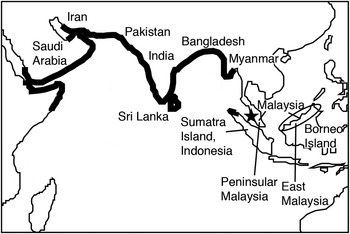
Fourteen tropical shads were collected by gill nets in the River Perak in western Peninsular Malaysia of Perak State (3°57′–3°58′N 100°52′–100°58′E) between 19 February 2014 and 15 March 2014 (Figure 1). Water temperature and salinity of sampling sites ranged from 31.4 to 31.7°C and from 0.0 to 1.0 ppt, respectively. The weight of each specimen was measured to the nearest 0.01 g using an electronic balance, the length of each specimen for morphometric measurements was measured with a digital Vernier calliper to the nearest 0.01 millimetre and the meristic character was counted.
The distribution of Tenualosa ilisha (thick lines) according to FAO (2012) and the new finding from Peninsular Malaysia in the present study (star).

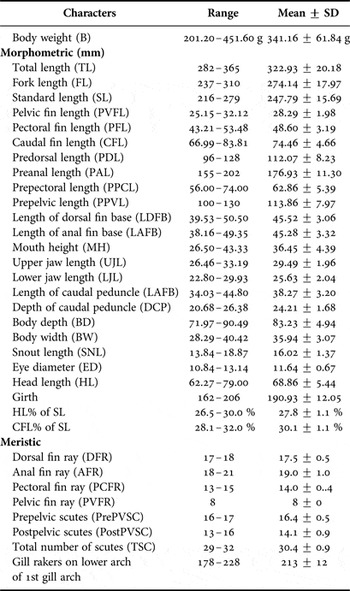
Twenty-three morphometric characters were measured, eight meristic counts were also conducted and the data are shown in Table 1.
Morphometric and meristic characters in a tropical shad Tenualosa ilisha (14 specimens) collected in the Perak River of Malaysia. SD, standard deviation.

Tropical shads have been clearly divided into five species based on the several morphometric and meristic characters such as number of scutes, ratios of head length (HL% of SL) and caudal fin length (CFL% of SL) for standard length and number of gill rakers (NGR) of each species (FAO, 2012). The NGR could be used as the most important key characters for the species identification of Tenualosa due to the fact that the present specimens did not overlap with other species (Tables 1 & 2).
Distinctive meristic characters in three tropical shads found in Malaysian waters.

RESULTS
The total length and body weight of the specimens ranged from 282 to 365 (mm) and from 201.20 to 451.60 (g), respectively (Table 1). Number of scutes, HL% of SL, CFL% of SL and NGR were ranged from 29 to 32, from 26.5% to 30.0%, from 28.1% to 32.0% and from 178 to 228, respectively (Table 1).
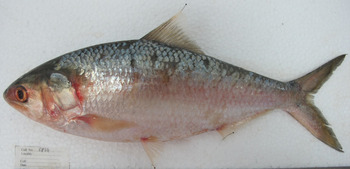
Tenualosa toil and T. macrura have been found to occur in Malaysian waters (East Malaysia). These species can be identified using morphological characters due to their difference being clear. Tenualosa macrura has a longer caudal fin, 40 to 42% of standard length (Table 2), than other tropical shads including the present specimens. Although the present specimens showed similar external morphologies to those of T. toil, NGR was much more than that of T. toil (60–100) (Table 2). These results suggested that the present specimens could not be assigned to either T. toil or T. macrura. Based on the morphological key characters and geographical distribution, all specimens were identified as T. ilisha (Figure 2).
Photograph showing a tropical shad Tenualosa ilisha (312 mm in total length) collected in the Perak River in western Peninsular Malaysia of Perak State of Malaysia.

DISCUSSION
Based on the external morphological characters, this is the first description of the occurrence and distribution of Tenualosa ilisha in Malaysian waters (Figure 2). Tenualosa ilisha is the most widespread and well-studied species in tropical shads, and the species has been found from north Sumatra in the east to Kuwait in the west. The present study suggests that the distribution range has expanded to Malaysia as the eastern limit.
This fish is the basis of important fisheries in Bangladesh, India, Myanmar, Pakistan and Kuwait (Whitehead, Reference Whitehead1985; Al-Baz & Grove, Reference Al-Baz and Grove1995; Blaber, Reference Blaber1997). No commercial fisheries and aquaculture are known for T. ilisha in Malaysia. Thus, this new record suggests that there is a potential for the usage of the fish as a commercial fishery in Malaysia like other tropical shads, T. toil and T. macrura in Sabah and Sarawak in East Malaysia, although no stock assessment and management have been conducted in the species.
Tropical shads are known as anadromous and the best known of the family is T. ilisha (McDowall, Reference McDowall1988). Tenualosa ilisha lives in the sea for most its life, but migrates at least 1200 km up river systems in India and 700 km in Myanmar (Pillay & Rosa, Reference Pillay and Rosa1963). The recruitment in T. toil is found to occur throughout the year in Bangladesh (Amin et al., Reference Amin, Rahman, Haldar, Mazid and Milton2002). Such long distance migration and year-round recruitment might enable the tropical shad to expand its distribution to Malaysia. Tenualosa ilisha spawns throughout the year (Haroon, Reference Haroon1998). The major peak of spawning is from September to October and the minor peak of spawning is from February to March (Haroon, Reference Haroon1998). Tenualosa ilisha used in the present study were collected in February and March, and the specimens were collected in freshwater environment. These fish might migrate for spawning in the River Perak of Peninsular Malaysia. Therefore, these results suggest that T. ilisha in Malaysia might be a different population from that of Bangladesh, India and other countries.
Tenualosa ilisha contributes over 13% of national fish production in Bangladesh (Ahmed et al., Reference Ahmed, Sharif and Latifa2008). The fish is one of the most common and important anadromous fish in the country. The fish is also an important commercial fish in Bangladesh and India. Due to the lack of information available on the fishing record of T. ilisha until now in Malaysia, either T. toil or T. macrura are thought to be the most important commercial species and target fishery species, although Malaysia imports T. ilisha from Bangladesh and India. The population dynamics of T. ilisha have not been studied in Malaysia in contrast to other tropical shads such as T. toil and T. macrura. Furthermore, there are no biological and ecological studies of T. ilisha in Malaysia. Therefore, further studies are needed to understand the life history and to assess the importance of population structure and dynamics to sustainable use of T. ilisha in Malaysia.
ACKNOWLEDGEMENTS
The authors are grateful to Ms Siti-Raudah SAK and Mr Samsul Hisam HMT for assistance with the field survey. This work was supported in part by the Ministry of Higher Education Malaysia under the Fundamental Research Grant Scheme (Vot No. 59281) and the Higher Institution Centre of Excellence (HICoE) Research Grant, under the Institute of Oceanography and Environment (INOS).