Introduction
The Arab World is burdened with a tobacco use with some countries like Jordan and Tunisia suffering from prevalence that is close to 50% amongst males (World Health Organization, 2015). Tobacco smoking ranks third as a risk factor for attributable burden of disease, and non-communicable diseases (NCDs) are amongst the most frequently reported causes of death (Rahim et al., Reference Rahim, Sibai, Khader, Hwalla, Fadhil and Alsiyabi2014). Given the short- and long-term benefits of quitting smoking, the World Health Organization recommends offering help to quit tobacco use as an integral measure within the MPOWER tobacco control framework.Footnote 1 Likewise, the World Bank urges governments to help smokers quit (World Bank, 1999). This recommendation builds on forecasts that 180 million deaths may be prevented by 2050 if adult tobacco consumption were to be halved by 2020, in comparison to the negligible effect on short-term mortality that may be achieved through addressing initiation (World Bank, 1999). Yet, despite the value of this preventive tobacco control measure, there continues to be a shortage of tobacco dependence treatment (TDT) services in the Arab World (Hawari & Bader, Reference Hawari and Bader2014; World Health Organization, 2013). For example, data from Egypt indicate that only 22% of smokers visited a healthcare provider (HCP) in 2009 and of those less than half were advised to quit smoking (Centers for Disease Control and Prevention, 2013).
Evidence from the region indicates that whilst medical professionals acknowledge the value of TDT services (AlKawari, Al-Koohaji, Bucheeri, Al-Joder, & Abu-Hassan, Reference AlKawari, Al-Koohaji, Bucheeri and Al-Joder2009; Alzoubi et al., Reference Alzoubi, Azab, Khabour, Al-Shamaila, Ayoub and Al-Omiri2010; Awad, El Kouatly, & Fakhry, Reference Awad, El Kouatly and Fakhry2010; Eldein, Mansour, & Mohamed, Reference Eldein, Mansour and Mohamed2013; Sreedharan, Muttappallymyalil, & Venkatramana, Reference Sreedharan, Muttappallymyalil and Venkatramana2010), implementation is hindered by barriers such as lack of skills, lack of community resources to support smokers, lack of time, lack of medications, and lack of perceived value from patients. These barriers are in-line with barriers documented internationally with regards to HCP provision of TDT services, such as negative beliefs towards the effectiveness of TDT, competing priorities during the patient's visit, the lack of awareness and familiarity with TDT, the lack of adequate education and training, and a general lack of provider self-efficacy (Caplan, Stout, & Blumenthal, Reference Caplan, Stout and Blumenthal2011; Kralikova, Bonevski, Stepankova, Pohlova, & Mladkova, Reference Kralikova, Bonevski, Stepankova, Pohlova and Mladkova2009; Muramoto & Lando, Reference Muramoto and Lando2009; Physician Behavior and Practice Patterns Related to Smoking Cessation, 2007 ; Stead, Angus, Holme, Cohen, & Tait, Reference Stead, Angus, Holme, Cohen and Tait2009; Vogt, Hall, & Marteau, Reference Vogt, Hall and Marteau2005). Some providers tend to discuss smoking only in the context of smoking-related health problems (Wynn, Coleman, Barrett, & Wilson, Reference Wynn, Coleman, Barrett and Wilson2002), whilst others are reluctant to diagnose and advise in the absence of a specialist to refer to Hughes (Reference Hughes2007).
Whilst various multi-level factors influence the provision of primary prevention and health promotion activities such as TDT by HCPs, intrapersonal barriers (e.g. provider experience, attitudes, and skills and knowledge) represent the first level to address in order to promote the provision of these services (Rubio-Valera et al., Reference Rubio-Valera, Pons-Vigues, Martinez-Andres, Moreno-Peral, Berenguera and Fernandez2014). Training and capacity building programmes offer an opportunity to address several of these barriers through instilling positive beliefs and attitudes towards TDT (Abdullah et al., Reference Abdullah, Stillman, Yang, Luo, Zhang and Samet2014; Vogt et al., Reference Vogt, Hall and Marteau2005), and enhancing readiness to offer TDT services (Muramoto & Lando, Reference Muramoto and Lando2009; Vogt et al., Reference Vogt, Hall and Marteau2005). In fact, trained HCPs are more likely to ask patients to set a quit date, provide counselling, and make follow-up appointments (Carson et al., Reference Carson, Verbiest, Crone, Brinn, Esterman and Assendelft2012), and training HCPs in TDT techniques has also been proven to have a measurable long-term effect on the continuous smoking abstinence amongst patients and the overall point prevalence of smoking (Carson et al., Reference Carson, Verbiest, Crone, Brinn, Esterman and Assendelft2012). Accordingly, the guidelines for the implementation of Article 14 of the Framework Convention on Tobacco Control (FCTC) highlight training and capacity building of TDT service providers as a key low-cost strategy to develop an infrastructure that supports treatment (World Health Organization, 2010). It is therefore understandable that whilst different countries adopt different models for offering TDT services, training and skill building is a component common to all (Raw, McNeill, & Murray, Reference Raw, McNeill and Murray2010).
To address the shortage of TDT services, Global Bridges – an international TDT healthcare alliance – was co-founded by the Mayo Clinic, the American Cancer Society, and the University of Arizona. The ultimate aim of the alliance is to help countries fulfil Article 14 of the FCTC. Starting in 2011, King Hussein Cancer Center (KHCC) has been the regional host for Global Bridges in the Eastern Mediterranean Region (EMR). Located in Amman-Jordan, KHCC is a comprehensive disease-specific care facility that serves cancer patients from Jordan and the EMR. With a TDT clinic in operation since 2008 that offers services to cancer patients and the general public, KHCC presented an ideal ambassador for TDT advocacy and training in the region, and has accordingly been conducting TDT training workshops targeting participants from all 23 countries of the EMR.
Aiming to create and mobilise a network of tobacco control practitioners and advocates, KHCC developed, implemented, and evaluated a TDT training programme in the EMR. The programme was structured to improve HCP knowledge, competence, and confidence as precursors of performance (Moore, Green, & Gallis, Reference Moore, Green and Gallis2009). Benefiting from the framework proposed by Moore et al. for planning a continuing medical education intervention, the programme employs a predisposing–enabling–reinforcing instructional framework and utilises a combination of learning techniques (Moore et al., Reference Moore, Green and Gallis2009).
In this paper, we present the process of developing a structured TDT training programme for the EMR, and the evidence of value of our training programme as a result of evaluating the immediate outcomes achieved post-training. We also describe our approach to generate general interest and demand for such training in the region.
Methods
Design and Setting
Between 2011 and 2014, KHCC engaged more than 1,500 individuals from 19 EMR countries, conducted 21 TDT training workshops of various lengths, held two TDT enrichment conferences in the EMR, and presented at five health forums in the region. Of the 21 training workshops, 10 workshops were similarly designed and offered intensive training of 10 to 16 hours. Through these 10 workshops, KHCC trained a total of 433 participants on TDT and collected pertinent registration and evaluation data. A more detailed description of the geographic reach and cumulative growth of trainees is presented in our previous work (Hawari & Bader, Reference Hawari and Bader2014).
In implementing this programme, KHCC adopted the predisposing–enabling–reinforcing framework proposed by Moore et al., and aligned this approach with an evaluation mechanism.
TDT Training Component
-
1. Predisposing (helping HCPs recognise a need and realise a learning opportunity): KHCC participated in regional health forums (such as conferences and seminars) to reach out to HCPs and make the case for TDT as a much-needed cost-effective intervention. For actual trainee recruitment, KHCC collaborated with in-country ‘consultants’ with a reach into the healthcare community in their countries given their association with national tobacco control programmes and/or academia. This active dissemination strategy was employed to overcome the potential initial lack of interest from HCPs and their prioritisation of other topics over TDT education (Carson et al., Reference Carson, Verbiest, Crone, Brinn, Esterman and Assendelft2012; Zwar, Richmond, Davidson, & Hasan, Reference Zwar, Richmond, Davidson and Hasan2009). Different countries addressed recruitment for training differently: some focussed on primary HCPs; others focussed on specialists in training; whilst others recruited a diversified mix of students, generalists, specialists, administrators, and health educators. When possible, consultants sought accreditation for the training programme from local authorities in their pertinent countries.
-
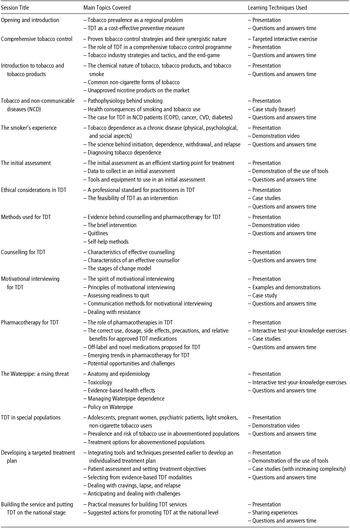
2. Enabling (supplying knowledge and allowing participants to practice): KHCC developed and delivered a TDT curriculum focussing on disseminating knowledge, and building confidence and competence. The teaching plan for the 10- to 16-hour workshop benefited from internationally recognised standards (e.g. the Association for the Treatment of Tobacco Use and Dependence (ATTUD) core competencies for evidence-based TDT), and utilised a combination of learning techniques including presentations (focussing on declarative knowledge), demonstration and example methods (focussing on procedural knowledge), and opportunities for practice and feedback (focussing on building competence) (Moore et al., Reference Moore, Green and Gallis2009). The curriculum is multi-dimensional, comprehensive, and evidence-informed, and is regularly updated with developments in the field. This curriculum is further described in Table 1.
-
3. Reinforcing (strengthening learning): KHCC left participants with hard and soft copies of the training materials. In addition, KHCC held regional TDT-centred enrichment conferences to which key regional TDT advocates were invited. Through presenting regional success stories and advanced topics in TDT, these conferences served to enhance participant motivation and engagement. Finally, engagement of the network is continuously maintained through sharing global TDT and tobacco control developments as well as success stories from the region via email distribution lists and posts on Global Bridges website (www.globalbridges.org).
The curriculum developed by King Hussein Cancer Center: topics covered and learning techniques employed

Evaluation Component
To confirm the efficacy of the enabling component, it was aligned with an assessment mechanism addressing:
-
1. Declarative knowledge: (Moore et al., Reference Moore, Green and Gallis2009) Through administering pre- and post-workshop multiple-choice tests to gauge knowledge gain. To align assessment with curriculum planning, questions were developed around objectives and main takeaways of individual sessions.
-
2. Procedural knowledge: (Moore et al., Reference Moore, Green and Gallis2009) Through administering a post-workshop case study (not used in the pre-workshop test) that is designed to track individual participants’ ability to utilise knowledge acquired through demonstration and practice sessions.
-
3. Confidence: (Moore et al., Reference Moore, Green and Gallis2009) Through self-reports of enhanced confidence. At the beginning of the post-training test, participants were requested to answer a yes/no question enquiring about whether the workshop enhanced their confidence in their ability to offer TDT counselling, and a similar question about whether the workshop enhanced their confidence in their ability to prescribe TDT medications. Ratios for those responding positively were reported.
-
4. Competence: (Moore et al., Reference Moore, Green and Gallis2009) In 2013, Global Bridges management led a collaborative multi-regional effort to develop a tool that provides a unified method to track outcomes against key learning objectives of the training programmes in all regions. The tool, employing a Likert scale to self-report on TDT-specific competencies, was used by KHCC starting July 2013. As part of taking the pre-training and post-training tests, participants reported on their competence in completing a tobacco use history, diagnosing nicotine dependence, recognising symptoms of nicotine withdrawal, incorporating relapse prevention, applying motivational interviewing techniques, and incorporating pharmacotherapy. The ratio of participants agreeing with having each of the competencies was calculated for each of the time-points (pre-training and post-training), and those ratios were then used to calculate improvement.
-
5. Intentions: (Moore et al., Reference Moore, Green and Gallis2009) Through soliciting qualitative input from participants, using an open-ended question that requested participants to list immediate and long-term steps they plan to take given the topics discussed in the workshop. Individual responses were then qualitatively analysed and grouped – where possible – under overarching themes. Responses that did not seem to fit under a general theme were left to stand alone.
In addition, an evaluation form was administered at workshop conclusion. This tool collected feedback on the alignment of the workshop with participant expectations, the overall perceived value of the workshop, the practicality of the content and its relevance to the participants’ daily practice, and the anticipated value of joining the Global Bridges’ network. To maintain anonymity of the results, no participant identifiers were collected as part of the assessment mechanism (tests, case study, self-reports, and evaluation). Instead, participant demographics were collected through registration forms that trainees filled upon arrival at the training site. These tools have been reviewed and approved by the Institutional Review Board at KHCC.
Results
General Characteristics of the Sample
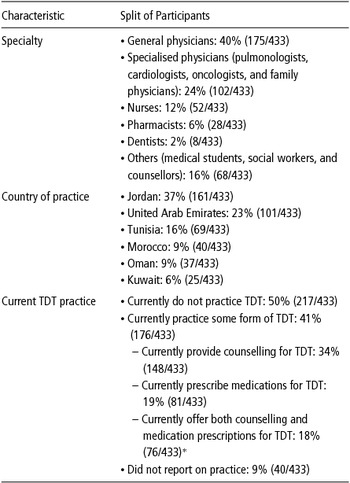
The network engaged through the ten intensive training workshops consists of participants from various sectors including the public health sector, private practice, military health services, academia, and others. Characteristics of participants in terms of specialty, country of practice, and TDT practice as they come into the workshops are presented in Table 2.
Participants’ characteristics: specialty, country of practice, and tobacco dependence treatment practice

*Those providing both counselling and medication prescriptions represent a subset of those providing counselling and a subset of those prescribing medications.
Training Impact
The workshops achieved a retention rate of 86% where 373 of the 433 participants completed the workshops and took the post-workshop test. With regards to training impact, we observed the following results:
-
• Starting with an average score of 55/100 (median: 58, standard deviation: 14) on the pre-workshop declarative knowledge test, there was an approximate 37% score increase, with the score on the post-workshop test averaging 76/100 (median: 78, standard deviation: 12). In addition, participants on average scored 61/100 on the post-workshop case study gauging procedural knowledge (median: 63, standard deviation: 18).
-
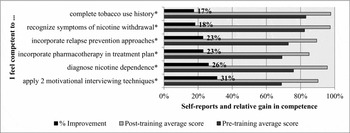
• Participants completing the training reported enhanced confidence and competence. Specifically, 94% (350/373) reported the workshops to have enhanced their confidence to perform counselling, and 85% (318/373) reported the workshops to have enhanced their confidence to prescribe medications. Participants’ self-reportsFootnote 2 indicated an average gain of 23% in TDT competence as a result of attending the training. Figure 1 depicts the self-reported gain against several TDT competencies.
-
• Of participants completing the workshops, 72% (270/373) reported intentions to change as a result of attending the training. Intended actions ranged from initiating TDT services and incorporating them into daily practice, to modifying treatment methods, to advocating for TDT, to specialising in TDT, and transferring knowledge to fellow HCPs.
Self-reported pre-workshop and post-workshop competence levels, and the absolute gain in competence amongst participants completing the tobacco dependence treatment training conducted by King Hussein Cancer Center.

Workshop Evaluation
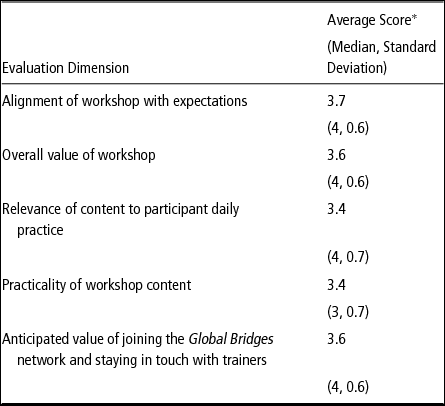
In general, participants rated the workshops as good to excellent. Specific ratings against various dimensions are summarised in Table 3. However, 12% (45/373) of participants requested more time for practice during the workshops, and 6% (22/373) requested opportunities for applied training.
Participants’ rating of the TDT workshops offered by KHCC: alignment, relevance, practicality, and value

*On a scale of 1 (poor) to 4 (excellent).
Discussion
This paper presents the methodology for and results of the first organised and evidence-based TDT training specifically designed for the EMR. Aiming to increase the availability of TDT services, and accordingly strengthen tobacco control, the initiative helped create a network of tobacco control advocates who can confront this major public health problem which will have devastating effects on their countries. To the best of our knowledge, no other systematic efforts or experiences of this magnitude specific to this region have been undertaken and shared in the literature.
The immediate outcomes of our TDT training programme indicate a positive change towards enabling trainees, by advancing their readiness and self-efficacy to offer TDT services. Participants report enhanced confidence to counsel and prescribe medications, as well as an average improvement of 23% against key competencies ranging from diagnosis of dependence to applying treatment techniques. These results are in line with objective measures indicating a 37% gain in declarative knowledge (multiple-choice tests). However, the average score of 61/100 on the post-training procedural test (case-study) may indicate that participants are still in need for hands-on experience, an assumption that is further supported by their requests for more time to practice and the opportunity for applied training.
Participants also report the workshops to be of high value and well aligned with their expectations, and the content to be practical and relevant to their daily practice. The programme which requires a 2- to 3-day commitment (a challenge in itself for individuals) has also been successful in retaining the majority of participants throughout the post-workshop assessment phase. In addition, a substantial proportion of the participants complete the training with positive intentions with regards to TDT: for example, intentions to prioritise TDT in patient overall management; intentions to employ newly acquired techniques that can enhance the effectiveness of treatment; and intentions to play an advocacy role through engaging in public education, promoting TDT, and transferring knowledge to other HCPs. Evidence suggests that intentions – or commitment to change – may be the first step in modifying practice (Adams et al., Reference Adams, Pitts, Wynne, Yawn, Diamond and Lee2012; Evans, Mazmanian, Dow, Lockeman, & Yanchick, Reference Evans, Mazmanian, Dow, Lockeman and Yanchick2014; Wakefield et al., Reference Wakefield, Herbert, Maclure, Dormuth, Wright and Legare2003). Hence, it is possible that such intentions may have started to reap fruits as five clinics have been established in EMR countries following conducting the training workshops. Ultimately, the interest and positive intentions generated through these workshops have the potential to grow the base of Tobacco Dependence Treatment Specialists (TTSs), whose presence in the healthcare system can ensure the availability of specialists to handle referrals (Hughes, Reference Hughes2007), and to act as motivated advocates of system-specific and policy-related changes (Hughes, Reference Hughes2007; Muramoto & Lando, Reference Muramoto and Lando2009).
The results of our participant evaluation highlight areas where the TDT training programme can be improved, especially in the context of the reinforcement component. Specifically, in order to address requests for more practical training, a possible future step could involve creative methods to avail practice opportunities post-training. Such opportunities may be in the form of a virtual clinic (an Internet-based space for discussion) or by allowing trainees to join running clinics as observers.
Despite various barriers facing tobacco control in general and TDT in specific in the EMR (Hawari & Bader, Reference Hawari and Bader2014), we have been successful in achieving substantial reach in the region and in building a large and diversified network of advocates. This network extends beyond physicians to include other HCPs, administrators, school teachers, and physicians in training (students). Such diversity is necessary for building TDT momentum in the region through creating interest in and demand for the service. With TDT considered the ‘foot-in-the-door’ component of tobacco control (Muramoto & Lando, Reference Muramoto and Lando2009), the hope is that this network will be the nucleus for strengthened tobacco control efforts in general in the EMR (Abdullah et al., Reference Abdullah, Stillman, Yang, Luo, Zhang and Samet2014; Muramoto & Lando, Reference Muramoto and Lando2009).
Other regions in the world may benefit from our model in several ways. First, countries or regions may wish to follow the structure and design to inform building their programmes. Second, given the success of our programme in various locations, groups of countries of similar circumstances and training needs may wish to seek synergy through developing regional training content that can be utilised in more than one country. This will help overcome barriers to TDT training that are relevant to the lack of evidence-based resources (Richmond, Zwar, Taylor, Hunnisett, Hyslop, Reference Richmond, Zwar, Taylor, Hunnisett and Hyslop2009). Third, countries may also benefit from the design of the evaluation component to track progress and identify specific intentions that participants develop as a result of attending the workshop. The latter constituent – soliciting intentions – will prove highly valuable if programme administrators are interested in following-up participants over time to track action against intentions and barriers facing such action.
Our work has its limitations. Given the design of the programme, no tracking of actual behaviour or retention of confidence and competence was performed. It is thus worthwhile to undertake an assessment of retention of confidence and competence, and the effects of training on HCP behaviour and patient health. Such tracking will allow for the comparison of this programme to others reporting long-term effects. Nevertheless, the outcomes we report present an important finding that long-term outcomes necessarily build upon (Moore et al., Reference Moore, Green and Gallis2009). Furthermore, we were unable to address or measure interpersonal and system-level barriers to TDT which likely exist (such as the lack of strategies and systems that help physicians incorporate TDT into their practice) (Carson et al., Reference Carson, Verbiest, Crone, Brinn, Esterman and Assendelft2012). Addressing such barriers was beyond the scope of our efforts, but they nevertheless can prevent trainees from translating intentions into practice. This limitation underscores the need for a comprehensive multi-level approach for the availing of TDT which includes – but naturally cannot stop at – providing training.
Conclusion
Various parts of the world, including the EMR, suffer from the shortage of TDT services. Capacity building in TDT could be the first step in meeting the need for more trained HCPs equipped to help reduce the toll caused by tobacco dependence. TDT training achieves positive change in precursors of provider practice and patient health outcomes; namely knowledge, confidence, competence, and intentions. This successful collaborative programme – developed and implemented in the region by KHCC but benefiting from international collaboration with Global Bridges – may serve as a reference for other countries and regions seeking to strengthen TDT.
Acknowledgements
We would like to thank Ms. Aisha Shtaiwi and Ms. Rawan Shihab from the Cancer Control Office at King Hussein Cancer Center for their support in recruiting trainees, engaging the network, and conducting data collection and entry.
Financial Support
King Hussein Cancer Center is a grantee of the Mayo Clinic in the USA for their work as the regional host for the Global Bridges initiative in the EMR.
Conflict of Interest
None.