Being shy is generally regarded as a less advantageous trait. For instance, shy children are at risk for depression and anxiety-related problems during the preschool and early school-age years (e.g. Hirshfeld et al., Reference Hirshfeld, Rosenbaum, Biederman, Bolduc, Faraone, Snidman, Reznick and Kagan1992; Rubin, Stewart & Coplan, Reference Rubin, Stewart, Coplan, Ollendick and Prinz1995) and emotional adjustment problems during their young adult years (e.g. Caspi, Elder & Bem, Reference Caspi, Elder and Bem1988). In addition, the social behaviour of shy children has been found to be less cognitively mature compared to that of non-shy and sociable children (Rubin, Reference Rubin, Rubin and Ross1982). Of particular concern to this study is the finding by some researchers of lower scores on language tests, including measures of both receptive and expressive language, and deficits in the social use of language, when compared to non-shy children (Evans, Reference Evans1996; Spere, Schmidt, Theall-Honey & Martin-Chang, Reference Spere, Schmidt, Theall-Honey and Martin-Chang2004; Van Kleeck & Street, Reference Van Kleeck and Street1982).
Some have argued that the language differences observed between shy and non-shy children are due to the inherently withdrawn and anxious nature of shy children, which puts them at a disadvantage in testing situations. Thus, according to this Performance hypothesis, the differences in language ability reported in the literature are not genuine skill or competence differences resulting from differing linguistic abilities (e.g. Crozier, Reference Crozier1997), and should disappear under conditions which minimize anxiety or fear of evaluation. Others have argued that, due to the limited extent to which shy children engage in conversations and social interactions, their language skills lag behind those of outgoing and talkative children who have more opportunities to practise language and benefit from social interactions (e.g. Evans, Reference Evans, Rubin and Asendorpf1993). This might be termed the Opportunity to Learn hypothesis. While not mutually exclusive, these two hypotheses do offer contrasting perspectives on the language differences previously observed between shy and non-shy children.
The purpose of the present study was to examine whether language differences between shy and non-shy children would emerge in both familiar home settings with a parent, where anxiety might be minimized, and more formal school contexts with an unfamiliar examiner. Both formal tests and spontaneous speech samples of language were used. By contrasting the performance of shy and non-shy children in a familiar context that presumably minimizes discomfort and anxiety with the standard assessment context, this study also served to provide evidence for or against the validity of formal language assessments at school.
What is shyness?
Shyness is most commonly thought of as a term to describe individuals who are hesitant to participate in social interactions, or individuals who are socially withdrawn (Beidel & Turner, Reference Beidel, Turner, Schmidt and Schulkin1999). While most children are thought to experience some degree of shyness during their early years, roughly 15 percent display this as a consistent stable characteristic and can be considered shy (Kagan, Reznick & Snidman, Reference Kagan, Reznick and Snidman1988; Schmidt & Tasker, Reference Schmidt, Tasker and Crozier2000). Shy children are often thought of as ‘anxious, quiet and behaviourally inhibited, particularly in unfamiliar social situations’ (Schmidt & Tasker, Reference Schmidt, Tasker and Crozier2000: 30). Rubin & Asendorpf (Reference Asendorpf and Meier1993) view shyness as a form of social withdrawal characterized by social evaluative concerns. In contrast, Kagan (Reference Kagan, Schmidt and Schulkin1999) views it as a form of ‘inhibition to the unfamiliar’, specifically inhibition to unfamiliar people.
The origins of shyness are complex, likely with multiple determinants and causes. It is known that introversion and extroversion, concepts linked to shyness and sociability, are among the most stable heritable traits (Kagan et al., Reference Kagan, Reznick and Snidman1988). Similarly, shyness in infancy and adulthood is heritable (Daniels & Plomin, Reference Daniels and Plomin1985), although socialization undoubtedly plays a role as well. For example, it has been proposed that some children are born with a propensity towards shyness that is exacerbated when combined with social stress (Schmidt & Fox, Reference Schmidt, Fox, Schmidt and Schulkin1999). It has also been suggested that such initial propensities are maintained by overprotective parenting (Rubin, Cheah & Fox, Reference Rubin, Cheah and Fox2001).
Regardless of the causes of shyness, certain features emerge which are common among children and adults labelled as ‘shy’. Tension, feelings of awkwardness and discomfort, distress, and inhibition of behaviour in the presence of unfamiliar others or unfamiliar situations are all emotions and behaviours seen in shy adults and children (Buss & Plomin, Reference Buss and Plomin1984), leading them to be less likely to engage in a range of social interactions.
One might question, then, what the ramifications are of being shy. Researchers have shown that shy boys are more likely to delay marriage, parenthood and careers, while shy girls are more likely to follow a conventional route of marriage and having children (Caspi et al., Reference Caspi, Elder and Bem1988). Shyness may also affect children in important facets of their childhood years. Peer interaction is important for learning social knowledge and social skills, and is necessary for achieving certain developmental tasks, and thus children who do not interact with their peers are thought to be at risk in later cognitive and social development (Asendorpf, Reference Asendorpf1990). One cognitive area that could be affected is language development.
Language development in shy children
Shyness has an impact on the amount a child talks. For example, Asendorpf & Meier (Reference Asendorpf and Meier1993) found that sociable children spent more time in conversations than shy children did, and that once engaged in conversation, shy children talked less when in unfamiliar situations. As well, other studies have found that shy children are involved in fewer conversations with their peers than other children, and that shy children take longer to make comments, and make fewer comments than non-shy children (Evans, Reference Evans1987; Rezendes, Snidman, Kagan & Gibbons, Reference Rezendes, Snidman, Kagan, Gibbons, Rubin and Asendorpf1993; Rubin, Reference Rubin, Rubin and Ross1982). These quantitative differences can be seen as early as infancy, in that inhibited infants (a precursor to childhood shyness) show less spontaneous vocalization as young as 0 ; 4 to 0 ; 9, and have less spontaneous speech at 1 ; 2 and 1 ; 9 compared to uninhibited children (Rezendes et al., Reference Rezendes, Snidman, Kagan, Gibbons, Rubin and Asendorpf1993).
Qualitative differences between shy and non-shy children's speech and language have also been observed. Studying two talkative and two reticent children, Van Kleeck & Street (Reference Van Kleeck and Street1982) found that the reticent children had less appropriate knowledge of language structure and used a less sophisticated vocabulary and fewer complex sentences in naturalistic samples of speech in a preschool setting. Furthermore, the authors found that the reticent children acted and were treated conversationally as if they were younger than their actual age. Van Kleeck & Street (Reference Van Kleeck and Street1982) suggested from this that talkativeness may be a strategy to further knowledge of language and that ‘reticence may actually be deleterious to the language acquisition process’ (p. 622) and may result in a skill delay in the social use of language. Similarly, Evans (Reference Evans1987), who repeatedly observed seven reticent primary grade children and matched peers during ‘Show and Tell’ in the classroom, found that reticent children engaged in less complex speech, speaking in shorter utterances and more often about objects in the ‘here and now’, rather than engaging in narrative speech about the past or anticipated future. More recently, Crozier & Perkins (Reference Crozier and Perkins2002) reported that on a structured narrative task, on which children were required to tell a story about a series of pictures, shy children spoke fewer words, used shorter utterances and used a less varied vocabulary.
These qualitative differences in speech between shy and non-shy children have been reflected in standardized language measures. Negative relations have been found between shyness and expressive vocabulary (Evans, Reference Evans1996), receptive vocabulary (Crozier & Perkins, Reference Crozier and Perkins2002; Rubin, Reference Rubin, Rubin and Ross1982; Spere et al., Reference Spere, Schmidt, Theall-Honey and Martin-Chang2004) and phonemic awareness (Spere et al., Reference Spere, Schmidt, Theall-Honey and Martin-Chang2004). However, other studies have failed to find such differences. For example, Broberg, Wessels, Lamb & Hwang (Reference Broberg, Wessels, Lamb and Hwang1997) found that inhibited children did just as well on tests of verbal ability as uninhibited children, and Coplan & Armer (Reference Coplan and Armer2005) failed to find a significant association between shyness and expressive vocabulary.
What might contribute to the differences that have been observed between shy and non-shy children? Evans (Reference Evans, Rubin and Asendorpf1993, Reference Evans1996) suggested that language competence, affect and experience exist in a dynamic interplay. Consistent with the literature reviewed above, the inhibition and anxiety demonstrated by shy children may restrict verbal participation in tasks. Furthermore, shy children have been shown to be less willing to take risks (Levin & Hart, Reference Levin and Hart2003), which could further preclude their participation in and practice with language in verbal interactions, and hinder opportunities to develop language skills. At the same time, language differences could act to maintain and contribute further to shyness in that the less competent child may receive more negative feedback and come to fear negative evaluations or failure in social tasks. For example, children with slow expressive language development have been found to manifest a tendency towards shyness, which could further contribute to language delay as the children become even less likely to communicate (Paul & Kellogg, Reference Paul and Kellogg1997).
However, critics of the notion that shy children are less linguistically advanced argue that ‘in interpreting these results it is essential to distinguish between competence and performance’ (Crozier, Reference Crozier1997: 205). They argue that shy children fail to perform to their full abilities, due to overwhelming anxiety during the testing situation. Shyness can, in fact, be defined as ‘social withdrawal motivated by evaluative concerns, primarily in novel situations’ (Rubin & Asendorpf, Reference Rubin, Asendorpf, Rubin and Asendorpf1993: 14), which suggests that this argument may have some merit. Crozier & Hostettler (Reference Crozier and Hostettler2003) examined this hypothesis by testing shy ten-year-olds and a control group in different conditions. In a testing condition requiring face-to-face contact, shy children performed significantly lower than non-shy children. In contrast, in a group administration situation in which children wrote their responses, the shy children still obtained lower scores but the difference was not statistically significant. The authors concluded that while temperament may have an impact on language development, the conditions of testing further influence the performance of shy children. However, these children were substantially older than those in the studies of Evans (Reference Evans1987, Reference Evans1996), Rubin (Reference Rubin, Rubin and Ross1982), Spere et al. (Reference Spere, Schmidt, Theall-Honey and Martin-Chang2004) and Van Kleeck & Street (Reference Van Kleeck and Street1982), and, as noted by Crozier & Hostettler, anxiety-related performance deficits may be more prevalent among older children.
The present study
The present study investigated whether shy and non-shy young children differ in language skills, and whether observed differences in language scores might represent genuine skill differences, or whether they are a product of performance anxiety. This is an important issue, as lower linguistic capabilities are associated with lower peer status (Gertner, Rice & Hadley, Reference Gertner, Rice and Hadley1994) and less adept social behaviour (Bzydra, Evans & Spooner, Reference Bzydra, Evans and Spooner2002).
A multi-method procedure in two contexts was employed. Three groups of children (shy, middle and non-shy) were administered a battery of tests measuring linguistic and non-linguistic skills by a trained experimenter in the child's school. To determine whether shy and non-shy children differed and whether context would affect children's scores, a home visit also took place during which the child's parent administered a parallel form of the expressive and receptive vocabulary tests given at school. It was thought that having the parent and child work together on these tests would be a less anxiety-provoking situation than what might occur when tested by an unfamiliar person at school. As a further means of exploring whether there are differences between shy and non-shy children's language, an informal sample of the child's language while interacting with their parent in the home was also collected. While there are a few studies of conversational behaviour of shy children in the laboratory or at school (e.g. Asendorpf & Meier, Reference Asendorpf and Meier1993; Evans, Reference Evans1987; Van Kleeck & Street, Reference Van Kleeck and Street1982), there are as of yet no known studies that examine conversational patterns of shy children at home with their parents. Given the absence of any documented parallel form or stimulus materials for collecting an informal language sample, this procedure was only followed in the home visit. The hope was that by comparing scores between the two groups of children on formal language measures at home and at school, and from a naturalistic speech sample at home, a clearer picture would emerge as to whether shy children have lower linguistic skills, or whether they are simply showing a performance deficit from the anxiety associated with formal testing. Specifically, a difference between shy and non-shy children on any of the language variables collected at home and/or at school would support a competence difference. This would be especially convincing coupled with a lack of differences on a non-verbal measure. In contrast, higher scores from the home testing than the school testing for the vocabulary test with parallel forms would support a performance difference at least partially attributable to context.
METHOD
Participants
Participants were recruited from junior kindergarten classes in four boards of education in south-western Ontario. Consent forms and information letters were sent home to all children in these classes to invite their participation in a three-year longitudinal study of language and literacy development in children in which home visits would be conducted each year. Of the 105 children whose parents provided consent to participate, parents of 91 children completed questionnaires on their child's shyness for the present study. These children came from predominantly middle- to upper-class Caucasian families. From these 91 children, 67 were selected to form a group of 25 non-shy (15 males, 10 females, mean age=4 ; 9), 23 middle (8 males, 15 females, mean age=4 ; 8) and 19 shy (10 males, 9 females, mean age=4 ; 8) children. All children spoke English as their primary language at home. The method for allocating children into these three groups is described in the procedures below. With these children, 65 mothers and 2 fathers participated. One father had a child in the shy group and one father had a child in the middle group.
Instruments
The following instruments were used in this study.
Home Literacy Experiences Questionnaire (Levy, Gong, Hessels, Evans & Jared, 2006)
This questionnaire, completed by the parent who is most familiar with the child's reading activities, was used to collect background and demographic information. The variables of interest included the child's age, the language spoken at home, information regarding any developmental/language development concerns and socioeconomic status of the family including parents' education and family income.
Parent rating of shyness
Parents were asked to complete the Colorado Childhood Temperament Inventory (CCTI; Buss & Plomin, Reference Buss and Plomin1984) with five questions tapping shyness: (1) My child takes a long time to warm up to strangers; (2) My child tends to be shy; (3) My child makes friends easily (reversed scoring); (4) My child is very sociable (reversed scoring); and (5) My child is very friendly with strangers (reversed scoring). The CCTI is designed for children age one to six years. The published internal consistency of the scales average 0·83 (Buss & Plomin, Reference Buss and Plomin1984) and the internal consistency for the shyness items in the current study, as measured by Cronbach's alpha, was also 0·83. Each item is scored on a 1 (not at all) to 5 (a lot) metric resulting in a maximum score of 25.
Comprehensive Receptive and Expressive Vocabulary Test (CREVT-2) (Wallace & Hammill, 2002)
The test contained two subtests, one to measure receptive vocabulary and one to measure expressive vocabulary. The receptive subtest required children to point to pictures of words from among six choices. The expressive subtest required the child to provide definitions of a word given. Standard scores have a mean of 100 and a standard deviation of 15. This test was chosen because it has parallel forms for both expressive and receptive vocabulary, allowing it to be given twice, once at home and once at school. However, standard scores are not provided for children until age five and thus could not be derived for our sample. Reliability reported in the test manual is high, with an overall coefficient alpha of 0·91 for four-year-olds, and test–retest reliability scores of 0·91 for Form A and 0·95 for Form B (Wallace & Hammill, Reference Wallace and Hammill2002). Alternate form reliability for kindergarten children as reported in the manual is 0·88 for the receptive test and 0·93 for the expressive test.
Sentence Imitation – Test of Language Development – Primary – Third Edition (TOLDP – III) (Newcomer & Hammill, 1997)
The subtest required children to imitate verbatim sentences spoken to them by the examiner. Performance on it reflects a child's familiarity with appropriate word order and grammatical markers. Standard scores for the subtest have a mean of 10 and a standard deviation of 3. The test has high internal consistency reliability (alpha of 0·93 for four-year-olds), test–retest reliability is high at 0·90 and the test has good content, criterion-related and construct validity (Newcomer & Hammill, Reference Newcomer and Hammill1997).
Block Design – Wechsler Preschool and Primary Scale of Intelligence – III (WPPSI-III) (Wechsler, 2002)
This subtest was given as a measure of non-verbal reasoning. It required the child to reproduce designs, either from a model or from a diagram, using coloured blocks. The standard scores for this subtest have a mean of 10 and a standard deviation of 3. The test manual reports that the Block Design subtest has an internal consistency reliability coefficient alpha of 0·84 and a test–retest reliability of 0·69 for ages four to five-and-a-half. The subtest has been shown to have adequate test content and internal structure validity (Wechsler, Reference Weschler2002).
Procedure
After the consent forms were collected from each teacher, the parents who had consented to participate were contacted and a time for a home visit was arranged. Each parent was then mailed a package that included the CCTI and Home Literacy Experiences Questionnaire. School visits were arranged with the teacher, so that half of the children were seen at school first, and the other half of the children were seen at home first.
During the single school session, which lasted approximately thirty minutes, the Comprehensive Receptive and Expressive Vocabulary Test-II (CREVT-II), Sentence Imitation subtest and Block Design subtest were individually administered by graduate students trained in the administration of standardized tests. After the session was complete, the children were thanked with a certificate of participation.
During the thirty-minute home visit the parent sat with the child wherever they were most comfortable, most often on a couch or at the kitchen table. The experimenter was present to ensure that standardization procedures were followed, but sat away from participants, so as not to be part of the interaction. The parent was asked to engage in two tasks with their child and was given all instructions before commencing the tasks to minimize the participation of the experimenter in the interaction.
The first task was to administer the CREVT-II using the parallel form not given during the school testing session. Half of the children received Form A at school, and the other half received Form A at home. The materials were arranged in a binder in order to facilitate the administration by the parent and to make the interaction a natural one, with the parent and child simply looking through a book and the parent asking questions about what was displayed in it. Materials were not altered in any way except that words that the parents were to say (e.g. the list of words) were typed and inserted into the appropriate places in the stimulus binder. Otherwise, standardized instructions and procedures were used. Parents were briefly oriented to what they were to do, including how they might praise their child and answer questions as to whether the answer was right or wrong. The experimenter scored the test while listening to the interaction and told the parent when to stop (i.e. when ceiling had been reached).
The second task was to look through a wordless picture book together while being audiotaped. The book contained a collection of photographs compiled by the authors depicting everyday events involving children (e.g. a birthday party, a girl looking sad, a trip to the dinosaur gallery). The parent was told to look at the book with their child as they normally would, with no further instructions given in order to gather an informal language sample of the child's interaction with their parents at home. Following this, parents were asked to rate how typical the interaction had been from 1 (not at all typical) to 5 (very typical), and to elaborate on how the conversation was both similar and different to how the dyad normally interacts.
The interactions were later transcribed using the CLAN format used in the Child Language Data Exchange System (CHILDES, MacWhinney, Reference MacWhinney2000). Mean length of child utterances, the number of utterances spoken by the child, the number of utterances spoken by the parent and the ratio of parent to child utterances were calculated for each dyad by the CLAN program. At the end of the session, the parents and children were given a gift certificate for use at a bookstore as a token of thanks.
Selection of participants for shy and non-shy groups
Children were selected on the basis of parental reports of shyness. Children were selected for the shy group if they scored one or more standard deviations above the group mean on the shyness items completed by parents (Group M=11·88, SD=4·52). They were selected for the non-shy group if they scored one or more standard deviations below the group mean. Children whose scores fell at the mean or within one point on either side of the mean (i.e. CCTI=11–13) were selected for the middle group. This resulted in 19 shy children, 23 middle children and 25 non-shy children.
RESULTS
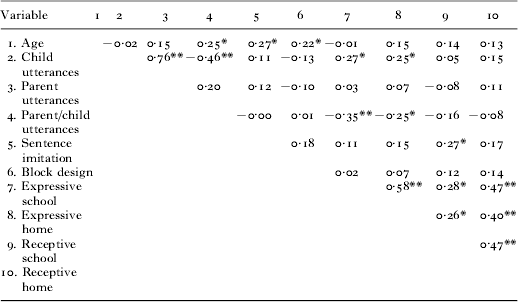
Before any analyses were conducted, all relevant variables were examined for potential outliers and normality for all 67 participants and for the two subgroups. Three of the variables had one outlier each. Two of these outliers were changed to fall within three standard deviations of the mean, and one was removed completely, as it was sufficiently far from the mean as to warrant exclusion. Three variables were significantly positively skewed (child utterances, parent utterances, ratio of parent to child utterances) and an appropriate transformation was applied to each to correct for this. Next, all variables were inter-correlated to assess their appropriateness for the analyses. The correlations in Table 1 show that age correlated significantly with three of the relevant variables (sentence imitation, block design, ratio of parent to child utterances). Multicollinearity of the variables was checked by seeing if any variable correlated above 0·80 with any of the other variables (Kahane, Reference Kahane2001). Child utterances and parent utterances were highly correlated (r=0·76) and so the decision was made to only use child utterances in the analyses.
Intercorrelation of all variables

Note: * p<0·05; ** p<0·01.
In addition, parent ratings of the typicality of the interaction when looking at the picture book were examined. The mean rating of typicality was 3·57. A one-way ANOVA comparing the typicality ratings of the three groups revealed no statistically significant difference (F(2, 64)=0·07, p>0·05). Means were 3·60, 3·61 and 3·47 for the non-shy, middle and shy groups respectively. Finally, the data was also examined for potential gender effects. Neither gender nor group by gender effects were found for any of the variables, and thus data for boys and girls were collapsed for all subsequent analyses.
Group effects
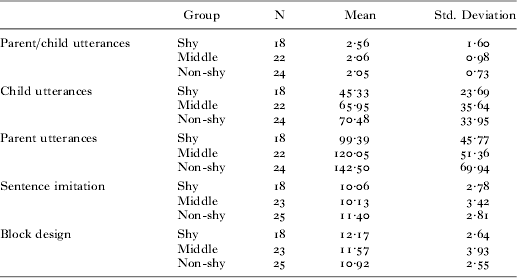
As a first analysis, shy, middle and non-shy children were compared on the discourse measures collected at home, namely number of child utterances and ratio of parent to child utterances. Mean length of utterance was not included in the analyses as originally planned because 27 of the 77 children (including 9 of the shy children) spoke fewer than 50 utterances, thought to be too low for calculating a reliable MLU. These remaining variables were entered into a one-way MANOVA, with group (shy, middle, non-shy) as the factor. Age was entered as a covariate, as it correlated significantly with ratio of parent to child utterances. One subject from each group was excluded from the MANOVA due to missing data. Table 2 presents the descriptive statistics for the variables.
Descriptive statistics for measures assessed in one context by group

The analyses revealed a significant main effect of group (F(2, 61)=4·84, p<0·05, η2=0·13), but not for age (F(2, 61)=2·31, p>0·05, η2=0·07). Further analyses showed that there was a group effect for child utterances (F(2, 61)=4·48, p<0·05, η2=0·13), but not for ratio of parent to child utterances (F(2, 61)=1·16, p>0·05, η2=0·04). Post hoc tests revealed that non-shy children spoke more utterances than shy children (p<0·01). Also the middle children spoke more utterances than the shy children (p<0·05). There was no difference between the non-shy children and the middle children. A second ANOVA was conducted separately for number of parent utterances. There was a trend towards a significant group effect (F(2, 61)=2·88, p=0·06). Post hoc analyses revealed that the parents of the non-shy children spoke more than the parents of the shy children.
Next, the children were compared on the measures given only at school, that is sentence imitation and block design. As the raw scores for both of the variables were correlated with age, standard scores were used. Table 2 also presents the means and standard deviations for these measures. One shy participant was missing data for this measure, and as such was not included in the analysis. There was no significant effect of group (F(2, 63)=2·42, p>0·05, η2=0·07).
Context effects
In the present sample alternate form reliability for our four-year-olds on the receptive test was 0·49 for the raw scores and 0·51 for the standard scores. Similarly the correlation between the raw scores of the expressive test of Forms A and B administered in the two contexts was 0·61. This is somewhat lower than that reported in the test manual for kindergarteners, as would be expected given that the assessment was conducted in two different contexts (home with parent and school with stranger) and involved children a year younger.
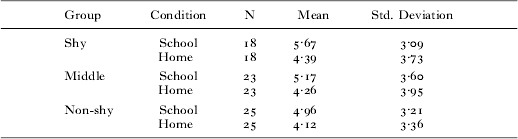
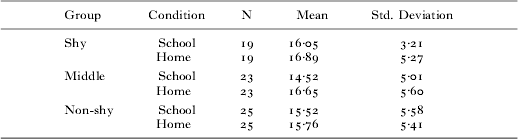
Children's expressive and receptive vocabulary raw scores from home and school were analyzed in separate parallel within-subjects ANOVA's with group (shy, middle, non-shy) as the between subjects factor, and context (home, school) as the within-subjects factor. Tables 3 and 4 present the descriptive statistics for these measures. One shy participant was missing data for the expressive vocabulary test and was excluded from the analysis. The analysis revealed a significant context effect (F(1, 63)=6·44, p=0·01, η2=0·09), with all groups obtaining higher expressive vocabulary scores at school than at home. There was no significant group effect (F(2, 63)=0·13, p>0·05) and there was no context by group interaction (F(2, 63)=0·12, p>0·05).
Descriptive statistics for raw expressive language scores at home and school by group

Descriptive statistics for raw receptive language scores at home and school by group

The parallel analysis for the receptive vocabulary tests did not reveal a context effect (F(1, 64)=2·74, p>0·05), a group effect (F(2, 64)=0·26, p>0·05) or a context by group interaction (F(1, 64)=0·80, p>0·05).
DISCUSSION
The main purpose of the current study was to add to the research literature on whether shy and non-shy children differed on various language measures, and the extent to which the context in which a child is assessed may affect the scores obtained, particularly with respect to shy children. If previously observed linguistic differences between shy and non-shy children are mainly due to performance anxiety experienced by shy children in a formal testing situation, we might expect that shy and non-shy children would not differ when tested in less anxiety-producing contexts or in naturalistic speech in the home but would differ at school. Further, it would also be likely that shy children would fare better at home than at school. This hypothesis was examined through the child's parent and an unfamiliar examiner assessing children at home and at school respectively. The overall picture that emerged from the results is that few language differences existed between shy and other children in this sample, and that an unfamiliar test context did not artificially lower the scores of the children, be they shy or non-shy.
First, it was found that the shy children spoke fewer utterances than did the middle and non-shy children overall when looking at and informally talking about pictures in a picture book with their parent. This inclusion of a group of children falling in the middle of the shyness distribution served to demonstrate that shy children spoke less than typical children, as well as extremely non-shy children. The parents of shy children did not speak proportionately more than the parents of non-shy children, and in fact, follow-up analyses demonstrated that the parents of non-shy children spoke more utterances than the parents of the shy children. Hence, in the conversations between shy children and their parents, there was less conversation overall compared to the non-shy dyads. It should be noted that parents indicated that the interaction had been fairly typical of how they normally interact (3·57 on a 5-point scale) and there were no group differences in typicality.
These results are not surprising given that reticence, or quietness, is a hallmark of shyness. Previous studies have demonstrated that shy children spend less time in conversations and that they speak less often in conversations (e.g. Asendorpf & Meier, Reference Asendorpf and Meier1993). However, most previous studies have collected speech samples in laboratory or school settings, such as taking a turn in ‘Show and Tell’ or talking about their birthday party in front of a camera. In these contexts shy children would presumably experience heightened anxiety. Here the results show that even when talking with their mothers at home, where familiarity and comfort are maximized, shy children spoke less when compared to non-shy children.
Contrary to the difference observed between shy children and the other two groups in the amount of talk, on the expressive and receptive vocabulary tasks no group differences were obtained. This finding underscores the mixed findings of previous research. This study used similar age groups to other studies that have significant findings (e.g. Spere et al., Reference Spere, Schmidt, Theall-Honey and Martin-Chang2004; Evans, Reference Evans1996) but used a different measure to index receptive and expressive language, which may account for the discrepant results. This study also had relatively low power (i.e. 0·07 for the expressive language interaction and 0·18 for the receptive language interaction), especially in comparison to Evans (Reference Evans1996), who had a much larger sample size. In addition, although Spere et al. (Reference Spere, Schmidt, Theall-Honey and Martin-Chang2004) used the same selection as this study (i.e. CCTI scores), both Evans (Reference Evans1996) and Crozier & Perkins (Reference Crozier and Perkins2002) relied on teacher ratings of shyness, and Rubin (Reference Rubin, Rubin and Ross1982) used observational data during preschool play to identify isolate children. In these cases, ratings of shyness may have been confounded with verbal communication skills. In contrast, ratings by parents in the home setting used here may be based more on the child's discomfort in unfamiliar situations and people. In support of this interpretation it might be noted that Coplan & Armer (Reference Coplan and Armer2005) used maternal ratings and did not find differences. Regardless, one conclusion that might be drawn is that vocabulary differences between shy and non-shy children are relatively subtle and not robust, depending on the measure, type of score and/or selection criteria.
A second piece of evidence suggesting that anxiety was not exerting a negative effect on shy children's test performance was the finding that on the parallel test forms given at home and at school, context effects were not found in the direction of higher expressive or receptive vocabulary scores at home. In fact, for the expressive language scores, scores at home with the parent were lower than the scores at school with an unfamiliar examiner for all three groups of children. What would cause the scores to be higher at school? One possibility is that it was, in a sense, a more natural testing situation. Even though the children were only in junior kindergarten, they had already been exposed to the question/answer format common to formal schooling. In contrast, although parents may question their children about the pictures in books, children may not be required to explain their understanding of words. In fact, a recent report by Pursoo, Evans & Shaw (Reference Pursoo, Evans and Shaw2005), who observed 148 dyads from kindergarten to grade 2, found that parents very rarely engaged in an exchange around novel vocabulary items during shared book reading. It may also be that children put more effort into their responses at school and were more willing to hazard a guess. Regardless, the scores obtained at school represented more optimal scores, as both groups of children scored higher when assessed there.
Implications
By using parallel forms in two testing contexts, the study showed that the formal testing situation, in a quiet room with a trained examiner, yields higher scores than those obtained at home with the mother. These findings should allay any fear that parents might have that young children will not do their best when assessed in a formal testing situation, and add credibility to the assessment work of professionals who are trained in putting the child at ease while administering tests in a standardized fashion.
With respect to the relationship between shyness and amount of talk, the findings suggest various possibilities, each of which would be valuable to address in further research. Shy children engaged in less speech in a conversation at home with their mother. While this might be due to less well-developed language skills that were not assessed here, such as syntactic skill or word fluency, parenting variables may play a role. First, shy children are more likely to have shy parents (Daniels & Plomin, Reference Daniels and Plomin1985), and in the present study mothers of shy children spoke fewer utterances than those of non-shy children. It may be that in households with shy children there is less conversation overall, with shy parents speaking less, engaging their shy children less in conversation and socializing their children to be less talkative. Second, some previous research (Evans, Reference Evans1987; Evans & Bienert, Reference Evans and Bienert1992; Wood & Wood, Reference Wood and Wood1984) has suggested that children come to play a more passive role in conversations, due to more adult direction and that a less leading role by the adults would encourage more initiative and spontaneous speech from shy children.
Finally, the lack of differences between shy and non-shy children on the vocabulary tests suggests that shy children will not be at greater risk in areas of development where vocabulary can play a role. For instance, shy children with lower vocabulary skills who are already unlikely to engage in reciprocal peer interactions, may be at even more risk in terms of peer acceptance (Gertner et al., Reference Gertner, Rice and Hadley1994). However, a recent study of Bzydra and colleagues (Reference Bzydra, Evans and Spooner2002) showed that expressive vocabulary mediated the relationship between shyness and assertiveness, such that higher vocabulary scores led to higher assertiveness. Likewise, Coplan & Armer (Reference Coplan and Armer2005) found that lower expressive vocabulary was associated with greater social withdrawal, lower self-perceptions and increased teacher attention in shy preschoolers. Thus, better expressive vocabulary skills may act as a ‘buffer’, leading to more promising outcomes for shy children.
Limitations
A main limitation with this study is its lack of statistical power, with just 67 subjects across three groups. Based on experience doing research in this area, it is difficult to get large sample sizes. Parents of shy young children seem more reluctant to give consent for their children to participate.
Another limitation was the test used for the expressive language measure. The CREVT-Expressive was chosen for use because it has parallel forms, allowing for an assessment of both expressive and receptive vocabulary at home and at school, but its norms for expressive vocabulary start for children aged five. The failure here to find group differences in expressive vocabulary in either the home or school testing (unlike Evans, Reference Evans1996; Spere et al., Reference Spere, Schmidt, Theall-Honey and Martin-Chang2004) could be due to a lack of power, as mentioned above. However, it is also possible that the test was not sensitive enough to tap individual differences in our sample of mostly four-year-olds. In fact, 16 children obtained raw scores of 2 or less at school, and at home 26 children obtained raw scores of 2 or less, suggesting a floor effect.
The set-up of the home visit can also be criticized for not being entirely natural, which is certainly a challenge in any research of this nature. Ideally, the interaction between the parent and child would take place without the presence of the examiner, but it was necessary that the examiner be present to ensure that standardized procedures were followed. The researchers attempted to make the home visit as informal, comfortable and natural as possible by sitting well away from the mother and child who sat together, and by having the child interact solely with the mother. In addition, the visit was scheduled when the mother felt that the home would be the quietest and when she felt she would be able to give her full attention to her child. Observational data noted that the majority of the visits were quiet and uninterrupted. Nonetheless, the mere presence of the visitor and audiotaping of the session could have altered the behaviour of the child and/or the mother. Some parents of non-shy children commented that their children were ‘not interested’, ‘fidgety’ and ‘are usually more focused’, and some parents of shy children reported that their children were ‘less involved’, ‘quieter’ and ‘playing shy’. However, as noted earlier, on average parents rated the session as fairly typical and there was no difference in typicality between shy and non-shy dyads.
A related limitation concerns the assumption that children would experience more anxiety in the formal testing situation at school. However, anxiety was not measured. The participants were too young to accurately complete self-report questionnaires, and physiological measurements such as heart rate or cortisol levels were beyond the scope of this study. The interaction could have been videotaped and coded for signs of anxiety in the children, but knowing they were being videotaped would have likely raised their anxiety further and the researchers did not want to introduce additional anxiety of testing beyond previous studies. As well, it is harder to obtain parental consent for children's participation when participants are to be videotaped.
All of the aforementioned limitations reflect the difficulties and considerations that must be made when choosing methodology for a study of this sort.
Considerations and conclusions
The study demonstrated that the conditions used in standardized testing, by an unfamiliar person such as a psychologist at school, are suitable for measuring the ability of both shy and non-shy children. Shy children's formal test scores were not enhanced when children were assessed at home by their mothers. If anything, their performance was higher at school, as was the case with expressive vocabulary. This should be helpful news for all professionals assessing the language and cognitive abilities of children.
This study also showed that shy children engage in less conversation than non-shy children in a natural home environment but no group differences were observed in receptive or expressive vocabulary, sentence imitation or non-verbal reasoning. The null findings in this study serve to emphasize the point that published research in this area is sparse, and what is published is mixed and may be partly dependent on sample size, the tests used and the selection criteria for shy participants. Age of the child may also be a factor. It is possible that performance anxiety becomes more of an issue as children get older and become more aware of the evaluative nature of tests (e.g. Crozier & Hostettler, Reference Crozier and Hostettler2003). A longitudinal study examining the effects of age on these relationships would be of value. Given the importance of language development, this research should encourage others to pursue these questions.