David Barker was responsible for formulating the initially controversial but now widely accepted idea that common chronic illnesses such as cancer, cardiovascular disease and diabetes result not from an unhealthy adult lifestyle, but from poor intrauterine and early postnatal health. These ideas, which we now know as the Developmental Origins hypothesis (DOHaD hypothesis), had their origins very early in David’s career. Following medical training at Guy’s hospital in London, he became a research fellow in the Department of Social Medicine at Birmingham University, studying under Tom McKeown, where his MD thesis ‘Prenatal influences and subnormal intelligence’ foreshadowed some of his later work. Soon after this, in 1969, David Barker, his wife and four children moved to Uganda to work at Makerere Medical School in the capital Kampala in what was to become another formative experience in his career. During the 1960s, Makerere had become a research and teaching centre with an international reputation based on the work of Trowell, Burkitt, Hutt and many others who had pioneered studies explaining the disease patterns in the West Nile area on the basis of the local climate, nutrition and lifestyle. David Barker was funded by the Medical Research Council to carry out research on a poorly understood disease, Buruli ulcer, joining Scottish surgeon Wilson Carswell, who was later to achieve fame as the role model for Dr Garrigan in Giles Foden’s novel The Last King of Scotland.
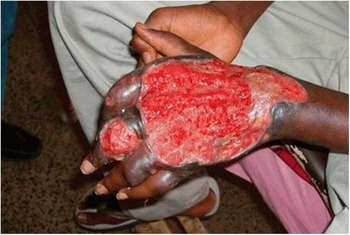
Buruli ulcer (Fig. 1) is an unpleasant ulcerating disease of the skin caused by infection with a Mycobacterium M. ulcerans.Reference Portaels, Silva and Meyers 1 It is still widespread affecting some 33 countries in the world from Africa to South America and the Pacific. It is estimated that there are still 5000–6000 new cases per year.Reference Chany, Tresse, Casarotto and Blanchard 2 , Reference Sizaire, Nackers, Comte and Portaels 3 The early stage of the infection is characterized by a painless nodule, which breaks down into an ulcer, most commonly affecting the arms or legs. Often, the ulcer becomes undermined, being larger inside than at the surface of the skin. As the disease worsens, the ulcers may become huge affecting underlying structures such as bone. If treated early, antibiotics are effective in 80% of people, as the causative organism is sensitive to antimycobacterial antibiotics. However, many cases require surgical excision of the ulcer, a relatively minor operation and successful if undertaken early, but advanced cases may require prolonged treatment with extensive skin grafting.
Buruli ulcer.

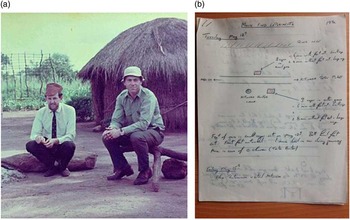
When David Barker went to Uganda, relatively little was known about the disease and specifically the mode of transmission was unclear, although it was thought to be the result of an insect vector. The disease was known to occur in communities in close proximity to rivers and lakes, and epidemiological studies in Uganda showed the disease had the highest prevalence in communities living and working in the swampy areas adjacent to the river Nile. Furthermore, outbreaks of the disease appeared to be connected with the flooding of previously dry areas.Reference Barker 4 From careful observations of these affected communities, David Barker formulated the hypothesis that scratches and other skin trauma caused by contact with the razor-sharp reeds growing in swamps alongside the Nile might be a portal of entry for the causative mycobacteria.Reference Barker, Clancey, Morrow and Rao 5 This hypothesis was able to explain why the disease most commonly affected the arms or legs. It also explained an observation that seasonal trends were seen in men but not women, as men only worked in the swamps in harvest time, whereas women worked there all the year round.Reference Revill and Barker 6 The hypothesis was then tested using classical epidemiological investigative techniques. These showed that the risk of disease in families was related to the source of their water. Families who got their water from swamps had the highest disease prevalence (53%), it was much lower in those who got their water from seasonal swamps (25%), whereas the lowest prevalence (6%) was seen in families who used boreholes.Reference Barker and Carswell 7 A series of experiments were planned, which included animal experiments (Fig. 2). This explanation was greeted with scepticism at the time but he persevered, something which perhaps prepared him for a much larger task in his future, that of convincing a sceptical world of the importance of early factors in common chronic disease. Unfortunately, this promising work was cut short by Idi Amin’s coup d’état in 1971. David Barker and his family were forced to flee by night to safety in neighbouring Kenya.
David Barker in Uganda with Wilson Carswell (left). Notes describing field experiments with mice, which were never completed (right).

Since these early studies, there has been a lot more work on Buruli ulcer, now recognized by the World Health Organisation as one of 17 neglected tropical diseases.Reference Sizaire, Nackers, Comte and Portaels 3 , 8 It is now thought that aquatic bugs belonging to the genus Naucoris (family Naucoridae) and Diplonychus (family Belostomatidae) are an important reservoir of the disease and M. ulcerans appears to reside in their salivary glands.Reference Chany, Tresse, Casarotto and Blanchard 2 However, it is not clear whether the major source of transmission is via the painful bites, which these bugs are known to inflict, or whether surface contamination of reeds and other vegetation with the organism coupled with minor skin trauma occurs in the way that David Barker proposed. However, protecting the skin while working in these watery areas, for example, by wearing trousers, still appears to be a viable and practical preventative measure.Reference Sizaire, Nackers, Comte and Portaels 3
Although he never returned to Africa, David Barker continued to take an interest in the continent. He published one of the earliest books on epidemiology in the tropics,Reference Barker 9 which is still in print. He was also instrumental in advising and helping set up the author’s studies of iodine deficiency in Central Africa.Reference Phillips, Lusty, Osmond and Church 10 However, the largest contribution will likely be the impact of the fetal origins hypothesis on our understanding of disease in Sub-Saharan Africa. Although it is often assumed that the prevalent non-communicable diseases (NCDs) in Sub-Saharan Africa are ‘lifestyle’ diseases such as Type 2 diabetes and coronary heart disease, the data now emerging from rural Africa, where most of the population live, suggest that this is not the caseReference Phillips, Mamo and Alemu 11 and that the conditions encountered are a long tail of often obscure diseases strongly associated with chronic poverty. They differ markedly from NCDs found in the rest of the world, they often have different risk factors and their pathogenesis is often poorly understood. However, emerging evidence suggests that the DOHaD model has much to teach us about the origin of many of these conditions. For example, rheumatic heart disease remains the commonest cause of heart disease in many areas of Sub-Saharan Africa. It has been powerfully associated with low socio-economic status, both historically in the West, when it was prevalent many years ago, and currently in resource-poor countries.Reference Steer, Carapetis, Nolan and Shann 12 A recent analysis of historical data from the United Kingdom suggests that factors in infancy operating during the 1st year of life may predispose people to developing rheumatic fever and subsequent rheumatic heart disease.Reference Phillips and Osmond 13 Another example relates to the problem of diabetes in Africa. In Ethiopia, we have shown that the predominant type in rural areas is a form of insulin-dependent disease occurring predominantly among poor young male adults, which seems to be widespread in Sub-Saharan Africa.Reference Alemu, Dessie and Seid 14 Studies of this suggest that it is likely to have a nutritional aetiology, relating to nutritional deficiencies in early life.Reference Fekadu, Yigzaw and Alemu 15 The work is challenging as conventional epidemiology is difficult in the African continent, as David Barker experienced in Uganda. However, it is clear that epidemiology with a developmental perspective has a major contribution to make in addressing the health needs of some of the very poorest and most marginalized communities.
Acknowledgements
The author is grateful to Dr Mary Barker and the Barker family for providing the photographs in Fig. 2.