INTRODUCTION
The goal of examining the ‘psycholinguistics of developing text construction’ was motivated by a view of discourse as a meeting ground of developing linguistic knowledge and general cognitive growth. To this end, a psycholinguistic approach to the growth and reorganization of linguistic forms at different developmental phases (e.g. Karmiloff-Smith, Reference Karmiloff-Smith1986; Tomasello, Reference Tomasello1998: vii–xxi) is related to later, school-age language development.Footnote 1 This rather ambitious endeavor has its antecedents in research on the acquisition of Hebrew (e.g. Berman, Reference Berman and Levin1986, Reference Berman, Gahl, Dolbey and Johnson1994, Reference Berman and Berman2004), which led to the realization that no single mechanism can explain the acquisition of language (or any other knowledge domain for that matter). Rather, language development is shaped by a confluence of cues in the complex interplay of perceptual, cognitive and communicative factors as well as linguistic features of morphosyntactic form and semantic content.
Another relevant perspective is the idea that linguistic forms are not abstract, isolated elements, but constructions that are acquired and represented through producing and interpreting them in different kinds of discourse (Bybee, Reference Bybee2006; Tomasello, Reference Tomasello2003). Experimental procedures fail to capture the full richness and diversity of linguistic constructions recruited to meet the needs of different communicative settings. Consequently, the best way to understand and evaluate later language development – the concern of this paper – is in the context of monologic discourse. The analytical procedures and empirical findings reviewed below aim to provide support for these perspectives as motivating such an endeavor.
The focus here is on LATER LANGUAGE DEVELOPMENT, on the assumption that the path from becoming a ‘native speaker’ to being a ‘proficient speaker’ (and writer) of a given language has a long developmental history (Berman & Slobin, Reference Berman and Slobin1994), and that language acquisition is an extended process from emergence to mastery (Berman, Reference Berman and Berman2004). Linguistic forms may emerge early in development, but initial comprehension and production of such forms is partial and piecemeal. Acquisition involves productive command of a wider range of form–meaning relations, and is a condition for achieving mastery. Mastery of linguistic knowledge requires a comprehensive repertoire of linguistic forms that need to be integrated, initially within a given domain and eventually over different domains, by means of ‘re-representation of knowledge’ (Karmiloff-Smith, Reference Karmiloff-Smith1992). Being a proficient speaker (or writer) means being able to deploy linguistic forms flexibly and appropriately in varied communicative contexts, an ability that requires extensive socio-cognitive development coupled with rich pragmatic and linguistic experience.
Several related theoretical perspectives guide the research program reviewed here. The first is linguistic, in line with usage-based models of language that aim to link the mental representations of linguistic knowledge and the world of utterances and their meanings (Croft & Cruse, Reference Croft and Cruse2004: 291). The second derives from Slobin's reformulation of the relation between thought and language as ‘thinking for speaking’ – or writing (Slobin, Reference Slobin, Gentner and Goldin-Meadow2003, Reference Slobin, Strömqvist and Verhoeven2004) – in order to ‘draw attention to the kinds of mental processes that occur during the act of formulating an utterance’ (1996: 71), and so to view text construction as a mental activity. The third is a developmentally motivated approach to the acquisition and growth of knowledge, based largely on Karmiloff-Smith's (Reference Karmiloff-Smith1992) model of the re-redescription and re-representation of knowledge in the development of language and other cognitive domains. The fourth is a ‘functional approach to language acquisition’ (Karmiloff-Smith, Reference Karmiloff-Smith1979) which takes the interrelation between (linguistic) forms and (discourse) functions as the point of departure for analyzing linguistic knowledge and language acquisition and use (Slobin, Reference Slobin, Bowerman and Levinson2001).
This conceptual framework highlights the role of discourse for the contextualization of language knowledge, in the recognition that ‘Discourse provides children with a developmental mechanism for the acquisition of linguistic devices’ (Hickmann, Reference Hickmann2003: 335). Prior work on children's discourse demonstrates that text-embedded analyses can shed important light on both cognitive and linguistic development (Berman & Slobin, Reference Berman and Slobin1994). Particularly pertinent to the present paper is research on the oral narratives produced by children between ages three to around nine or ten years of age in English (Peterson & McCabe, Reference Peterson and McCabe1983; Nelson, Reference Nelson1986) and other languages (Karmiloff-Smith, Reference Karmiloff-Smith1979; Hickmann, Reference Hickmann2003). In what follows, the insights of such research are extended along three dimensions: in age, to later language development from middle childhood to adolescence; in genre, contrasting personal-experience narratives with expository discussions; and in modality, by comparing spoken and written discourse.
This paper reviews and discusses findings in light of these variables by means of functionally motivated, yet quantifiable measures of the following facets of developing text construction abilities: global discourse structure; types of referential content; use of complex syntax for combining clauses; local, clause-internal lexicon and syntax; and the overall ‘discourse stance’ adopted by speaker–writers in constructing texts under given circumstances. This broad range of dependent variables, measured by largely innovative methods, reflects an integrative approach to text construction, since all these dimensions apply concurrently whenever a piece of discourse is produced.
DATABASE
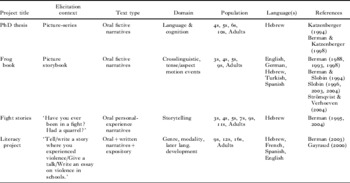
This paper has its roots in studies conducted with colleagues and students, as summarized in Table 1.
Background studies on developing text production abilities

These projects – starting with the oral narrative ‘frog story’ studies inspired by Dan Slobin at Berkeley, and evolving into research on developing Hebrew literacy with Dorit Ravid at Tel Aviv University – provided the conceptual and methodological framework for the large-scale cross-linguistic project that is the focus of the present paper.Footnote 2 The project involved eighty participants in four age groups (4th-grade children aged nine to ten years; junior high 7th-graders aged twelve to thirteen; high school 11th-graders aged sixteen to seventeen; and graduate school university students in their twenties and thirties), from mainstream, middle-class, monolingual backgrounds (for details, see Berman & Verhoeven, Reference Berman and Verhoeven2002; Berman & Katzenberger, Reference Berman and Katzenberger2004; Berman & Nir-Sagiv, Reference Berman and Nir-Sagiv2007).
Parallel data-elicitation procedures were followed for all four age/school levels in seven countries. Participants were shown a short, culturally neutral video film without words depicting (unresolved) situations of conflict – moral, social and physical – in a school setting. They were then asked to write and tell a story about an incident where they had been involved in ‘problems between people’ and to write a composition and give a talk discussing the topic of ‘problems between people’. Each participant thus produced four texts, with order balanced for genre (narrative/expository) and modality (spoken/written).
The study has several features relevant to a psycholinguistic approach to text construction. First, texts were elicited in semi-structured situations, but they represent ‘real’ language use, since they are not published or professionally edited. Moreover, the adult participants, while well-educated, literate speaker–writers of the standard dialect, were non-expert, not professional writers, editors or translators. Second, the texts we elicited were monologic and non-interactive. Elicitation was on a one-on-one basis, but investigators were instructed to give only minimal, non-verbal encouragement as input. Third, we elicited texts in both speech and writing, whereas most psycholinguistic research on language development focuses on oral language, and educationists deal mainly with written materials.
Finally, parallel procedures – instructions, data elicitation and transcription – were applied to the entire population. The same design was used for all languages and age groups, the same participants produced all four text types (oral and written narrative, oral and written expository), and both genres concerned the shared topic of interpersonal conflict.Footnote 3 These features promoted comparability and reliability across the independent variables of age and text type and the dependent variables delineated in the next section.
FACETS OF TEXT CONSTRUCTION ABILITIES
Largely innovative, functionally motivated yet quantifiable, criteria were applied in order to meet the challenge of connecting cognitive representations and linguistic knowledge in developing text construction. The overview provided in this section proceeds from (1) the principles underlying global-level text construction via (2) categories of referential content, to (3) clause-linking complex syntax, and (4) use of local linguistic devices in lexicon and syntax, concluding with (5) the concept of discourse stance as an integrative framework. Each subsection concludes by reviewing major developmental trends that emerged, mainly for English and/or Hebrew, with supporting evidence from other languages. Detailed analyses and quantitative findings of prior work are noted by reference to relevant studies.Footnote 4
Global structure and content
This section considers the elusive notion of global text quality, the structure and content of the text as a whole.Footnote 5 Subjective evaluations of overall text quality depend largely on the professional and personal background of judges who (often implicitly) apply criteria that range from originality of content to details of spelling and punctuation (Berman & Nir-Sagiv, Reference Berman, Nir-Sagiv, Evans and Pourcelin press-d).Footnote 6 To counter such problems, we devised explicit psycholinguistically motivated criteria for specifying levels of ‘global text construction’.
The innovative global-level analysis elaborated in Berman & Nir-Sagiv (Reference Berman and Nir-Sagiv2007) has the following features. First, the term ‘global’ refers to the overall structure and rhetorical effect of a piece of discourse, as against its ‘local’ linguistic expression – lexical items and syntactic constructions.Footnote 7 Second, it applies to both narrative and expository discourse. Third, structural well-formedness is defined explicitly in terms of the integration of top-down and bottom-up principles of discourse organization. Moreover, organization of text structure is a necessary but not sufficient basis for text construction: Speaker–writers need to go ‘beyond well-formedness’, in order to achieve proficient textual performance. Importantly, ‘structural well-formedness’ is genre-dependent, since types of discourse differ in their mental representations and so in their principles of organization. Following Karmiloff-Smith (Reference Karmiloff-Smith1979), we analyze narratives as constructed bottom-up, by integrating the isolated events that they recount within a top-down ‘action structure’ that realizes an internalized narrative schema (van Dijk, Reference van Dijk1980; Shen, Reference Shen1988). In contrast, expository texts are organized around generalized propositions in the form of ‘move-on’ statements or ‘core propositions’ that are elaborated by illustrative or delimiting ‘satellite’ elements (Matthiessen & Thompson, Reference Matthiessen, Thompson, Haiman and Thompson1988; Britton, Reference Britton and Gernsbacher1994). We re-interpret these insights as meaning that expository texts are organized top-down around a superordinate discourse topic, which is categorially conceptualized and delimited by bottom-up reference to specific instances and eventualities. Text construction thus entails a cognitive representation that proceeds from reliance on only bottom-up (narrative) events or top-down (expository) generalizations to a creative synthesis, culminating eventually in an ‘integrated re-representation’ of top-down and bottom-up processing.
This type of integration is demonstrated, for example, when speaker–writers can ‘go beyond structural well-formedness’ to achieve effective text construction. This typically means that they are able to depart from genre-canonic structure and content – by inserting expository-like generalizations in the generic present in narratives and by introducing reference to past-anchored, narrative-like events in expository texts (Berman & Nir-Sagiv, Reference Berman and Nir-Sagiv2004; Kupersmitt, Reference Kupersmitt2006). Or else they may create a particularly entertaining and interesting story or an impressively original and illuminating discussion. In narratives, this is achieved by meta-cognitive evaluative interpretation and/or explicit reference to the point of the story and its communicative function of amusing, instructing or impressing (Labov, Reference Labov1972; Reinhart, Reference Reinhart and Shen1995; Shen, Reference Shen, Ravid and Shyldkrot2004). In expository texts, this involves explicit marking of logical relations between discourse segments or explicit meta-textual commentary (Scinto, Reference Scinto1986; Camps & Milian, Reference Camps and Milian2000; Katzenberger, Reference Katzenberger, Ravid and Bat-Zeev Shyldkrot2004). Effective expository text construction requires cognitive faculties of CRITICAL THINKING – being able to elaborate on a topic by inferencing from personal experience (Schrire, Reference Schrire2002), culminating in CREATIVE THINKING and the ability to compile information in new ways (Huitt, Reference Huitt2004). Proficient text construction thus involves both discourse-structural competence and text-production performance, in a sense that departs importantly from the classical Chomskian distinction between competence as underlying knowledge of (linguistic) structure compared with performance as use of this knowledge in behavior. As I note elsewhere for oral narrative development (Berman, Reference Berman1995), the line between competence and performance is ‘not only flexible and fuzzy, but bi-directional’. Knowledge of linguistic forms and discourse structure underlies the ability to tell a story or construct an essay; but the activity of (understanding a text and) storytelling or expressing ideas impinges on this knowledge in the development of each individual towards becoming a proficient interpreter and constructor of extended discourse.
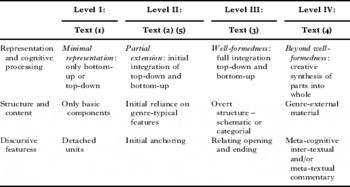
These ideas formed the background to specification of four levels of text construction abilities, along the dimensions of Defining Rank, Criterial Properties and Characteristic Features, based on criteria summarized in Table 2 (detailed in Berman & Nir-Sagiv, Reference Berman and Nir-Sagiv2007).
Dimensions in ranking four levels of discourse construction

As shown in Table 2, text construction is viewed as proceeding from Level I, minimal representation via II, partial extension, to III structural well-formedness, and on to IV beyond well-formedness by rhetorical felicity and divergence from genre-canonic constraints. These four levels are illustrated by the English expository texts in (1) through (4). For example, in (1), a 4th grader writes a Level I composition with only a minimal structure of top-down, detached generalizations.
(1) Level I text: composition of nine-year-old girl [eG16few]
I do not think fighting is good. You do not make friends that way. If you do not fight, you can have many many friends. But when you fight, you can hurt the person's feelings you are fighting with. You should always be nice and respectful to other people. And if you are not nice, you will end up not having any friends. That is why you should not fight.
This contrasts with the partial structure of the Level II composition in (2), which adds some further information beyond top-down generalities, while expressing largely prescriptive attitudes to the topic.
(2) Level II text: composition of twelve-year-old boy [eJ05mew]
I think there are many problems and conflicts in the world. I also think different people handle these problems in different ways. Some people make little problems out to be big conflicts. The world has many huge problems that need to be dealt with a lot quicker than some people's little problems. Some problems can lead to many bad conflicts, which happens a lot at schools, on the street, and many other places. Little problems can be easily set aside, while big problems might take thinking and some action. Different people can lead to many problems and differences in opinions also lead to many problems. I think if you are a good person, you can overcome most problems in life.
The high-schooler's text in (3) represents a considerable developmental leap.
(3) Level III text: composition of seventeen-year-old boy [eH01mew]
Conflict is a large problem particularly in High School, although it never goes away. High School is a major focal point of conflict because of the extreme amount of new tension that students are confronted with. Coming from a sheltered environment with the close supervision and intervention of parents and teachers, students are thrust into realization of the so called ‘real world’ where you must now make choices and resolve problems on your own. While you are never really on your own, this new freedom can give the overwhelming feeling of distancing yourself from your parents' control. Students are exposed to many new people and begin to form social cliques or groups. These groups not only follow racial and ethnic lines but also the class bracket that they are placed in such as advanced or remedial. This can have an impact on people because of the exposure or lack of it or jealousy and envy. Peer pressure is one of the main causes of conflict which never goes away but that students have a hard time learning to cope with. While conflict is not a necessarily bad thing, it does help prepare people for the real world which is full of conflict and problems.
This essay is well-formed, with the top-down superordinate topic of conflict elaborated by specific bottom-up categories such as high school, distancing from parents, racial and ethnic lines, peer pressure. Yet it was ranked at Level III, as not going ‘beyond well-formedness’, since its generalizations are unanchored in specific references to past events, nor are there meta-cognitive or meta-textual comments to guide the reader. In contrast, the text in (4), also from a high-schooler, was assigned Level IV, since it reflects a shift from one type of ‘discourse stance’ to another and relies on explicit (underlined) markers of discourse segmentation.
(4) Level IV text: composition of seventeen-year-old girl [eH04few]
Conflict is opposing ideas or stances between two or more people. In many ways it is a necessary part of life. On the other hand, it can cause disruption and chaos in the relationships of those involved. When people have a difference of opinion, a conflict is usually the result. This is a good way for those differences to be put aside. For example, I recently started swimming under a new coach. I did not like him at all – his coaching styles, the swim sets he assigned, or his overall attitude. One day after practice, I approached him and told him what bothered me about him, and that it was affecting my attitude about swimming. Since then we have gotten along much better, and I have a new appreciation for his coaching style, because he further explained it to me. In that way, conflict can be a good thing. The results that were achieved were better than the situation beforehand. On the contrary, conflict can ruin a friendship. My friend was very close friends with two other girls. They had an argument over priorities. The other girls would make plans and then break them at the last minute. Since then my friend has not spoken with them. This is a situation in which conflict was a bad thing. If the conflict cannot be resolved, then the relationship will suffer. In my case, I avoid conflict at all costs. It sometimes gets to a point where I void my opinion or hide the truth in order to prevent a conflict. On one hand, I very seldom argue with people. On the other hand, my ideas may go unheard, or a friendship is based on a fake foundation. There is a happy medium somewhere though. Hopefully some day I will realize when a conflict is necessary and use it intelligently, not as a fight but as a discussion to solve a common problem.
The text in (4) demonstrates the idea of going ‘beyond structural well-formedness’: it shifts flexibly from general to specific, from a distanced and generic discourse stance to personalized, specific illustrations, it alternates skillfully between subjective and objective reality, and clearly marks transitions from one part of the text to another. As such, it illustrates global text quality that combines cognitive flexibility with rhetorical expressiveness as the hallmark of effective text construction.
These sample texts illustrate significant age- and genre-related differences in both English and Hebrew (Berman & Nir-Sagiv, Reference Berman and Nir-Sagiv2007). A narrative schema was evidenced by middle childhood: the narratives of the nine- to ten-year-olds were nearly all beyond the first level (and several reached Level III) while older participants, all the adults and most of the adolescents, achieved Level IV. In contrast, the principles governing global-level expository text construction were achieved only in adolescence. Moreover, across age groups, participants scored lower in expository than in narrative text construction, with statistically significant differences in the variables of age and genre, but not language. These findings are supported by analysis of text openings and closings in English, Spanish and Swedish: In narratives, even the youngest children were able to open their texts ‘with a detached positioning’, whereas in their expository texts, they found it hard to abstract away from the scenes of conflict in the video clips shown at the outset (Tolchinsky, Johansson & Zamora, Reference Tolchinsky, Johansson and Zamora2002). Relatedly, in Berman & Katzenberger's Hebrew-based analysis, ‘the openings to narrative texts emerged as better and more canonically constructed at an earlier age than those of expository texts’ (2004: 88). These converging results from studies in several languages provide strong empirical support for the criteria we propose for evaluating global text quality.
Another facet of global text construction is demonstrated by the fact that even the youngest nine- to ten-year-old participants make clear inter-genre distinctions, as illustrated by the narrative compared with the expository text in (5).
(5a) Story written by nine-year-old boy [eG03mnw]
Me and my sister got a beanie-baby at Children's Hospital. We left them both on the daybed. When we came back, we did not know which one was which, so we started to fight about it. My sister gave me the wrong beanie-baby, and I said to Juliet that mine had a wrinkle on his head. So Juliet gave me the one she had in her hand. I took a marker and marked mine, and Juliet did not. So we knew which one was which.
(5b) Composition written by same nine-year-old boy [eG03mew]
I think that taking drugs is bad because they can kill you. I think making fun of kids that have problems with themselves and cannot help it is bad because they cannot help it.
The texts in (5) share the topic of ‘problems between people’, but differ markedly in orientation and content. The narrative recounts a specific event that happened to specific people in relation to a specific object at a specific time and place. In contrast, the composition makes generic or impersonal reference to classes of people and objects (kids, problems, drugs; you, they) and to abstract, generalized states of affairs (taking drugs, making fun). These texts illustrate clear, even dichotomous differentiation between the two genres typical of the nine- and twelve-year-olds (Berman & Nir-Sagiv, Reference Berman and Nir-Sagiv2004, Reference Berman and Nir-Sagiv2007). Studies compiled in Berman & Verhoeven (Reference Berman and Verhoeven2002) found statistically significant differences in linguistic forms in the narrative versus expository texts, including: use of voice in English, French and Dutch (less so in Spanish and Hebrew); verb structure in Dutch, English, French, Hebrew, Icelandic and Spanish; subject noun phrases in Dutch, English, Hebrew and Spanish; and use of modals in English, French and Hebrew. Marked contrasts in expression of temporality also characterized texts produced in the two genres in English, Hebrew and Spanish (Kupersmitt, Reference Kupersmitt2006). Moreover, these differences were by and large clearly marked from age nine years on.
The ability to go ‘beyond structural well-formedness’, as illustrated in text (4), emerged much later, however. Until high-school age, children tended to observe distinctions between the two genres in a rigidly dichotomous fashion. Only adolescents and adults included less genre-typical forms of linguistic expression – for example, impersonal constructions and the timeless present or irrealis mood in narratives, and reference to specific episodes from the past in expository texts. Even in narratives, within-text shifts between the two genres were rare in 4th grade, and occurred only occasionally among 7th-graders, where they were confined mainly to codas and still story-linked (for example, ending a story about a quarrel with a classmate by saying But now we are good friends again, or And I haven't talked to her since then). With age, these departures occurred increasingly in both openings and codas, and occasionally even in other segments of the narrative, in the shape of ‘story external’ generalizations not directly anchored in the events recounted. This shift from dichotomy to divergence reflects a less monolithic, more diversified discourse texture in adolescence. Moreover, the shift is less widespread, and occurs much later, in expository than in narrative texts. In this respect, too, well-formed narratives based on an internalized narrative schema and organized around a canonic action structure proved to be ‘one step ahead’ of well-structured expository texts that proceed from top-down generalizations to bottom-up categorial specifications.
Categories of referential information
The texts we analyzed all dealt with the shared topic of interpersonal conflict, so that their content was largely predetermined. Accordingly, we undertook a categorial analysis of the referential information contained in the texts, in relation to the variables of age and modality. Following Berman (Reference Berman1997), we defined three categories of narrative information: Obligatory core Eventive content supplemented by Descriptive and Interpretive elaborative elements (Berman & Ravid, Reference Berman, Ravid, Tyler, Kim and Takadain press-a).Footnote 8core elements are realized as plot-advancing ‘eventives’ in narratives and as ‘generalized propositions’ embodying claims or arguments in expository discourse (Kupersmitt, Reference Kupersmitt2006). In both genres, ‘descriptives’ specify the factual, typically physical attributes of entities or states of affairs, serving an orientational or anchoring function that provides relevant background information to the core elements of the text. And ‘interpretives’ provide information on speaker–writers' personal attitudes, giving voice to subjective evaluative commentary – about core events or ideas and/or about the information provided by descriptive background material.
This specification of three categories of genre-dependent, but topic-neutral, informative material enabled us to specify the ‘information density’ of a text. Analysis of a subsample of narrative texts in English and Hebrew revealed significant differences as a function of both age and of modality (Ravid & Berman, Reference Ravid and Berman2006). Not surprisingly, we found that types of information change significantly as a function of age. In narratives, interpretive elements increase with age at the expense of ‘core’ events, and this occurs more markedly from high school up. In expository texts, core generalized propositions expressing socially circumscribed prescriptive attitudes are replaced, with age, by more individual, cognitively motivated epistemic attitudes (Berman & Ravid, Reference Berman, Ravid, Olson and Torrancedin press-b).
Moreover, the relative amount of information differed significantly as a function not so much of age as of modality, with written texts higher than spoken in ‘informational density’. This was defined as the proportion of informative, referential content compared with non-novel and/or non-contentive ancillary material, for example, reiterations, false starts, repairs and other disfluencies, as well as different kinds of pragmatic discourse markers. These modality-based differences are illustrated by the texts in (6), from a junior-high student who produced the spoken version in (6b) after her written text in (6a) – with ‘ancillary’ elements bolded.
(6a) Story written by twelve-year-old girl [eJ06fnw]
Once my good friend Ruth and I were in a big fight because my other friends and I were trying to kick her out of our group. We wanted Ruth out of our group because we did not like her any more and she was really starting to get very annoying. My best friend Ashley and I would always talk behind her back, so finally we started saying it to her face and we stopped hanging out with her at school. Then a couple days after we stopped hanging out with her, her mom called and started accusing me that I stole her folder. And I knew from experience that she was not very good at keeping track of her stuff, and I did not steal anything. It made me so mad that her mom had the nerve to do that!
(6b) Oral narrative of the same girl [eJ06fns]
I wrote a story about a time my friend and I, her name is Ruth, we, well,my other best friend and I didn't like her any more. So we started … and she was getting really annoying and being kind ofmean to us. So we started justbeing mean back and saying … And thenwe started not hanging out with her after a while. So, and theneverything was justgoing normal. And then herand then her mom called my mom, and said that I took her folder and I didn't take it. And thenshe was still accusing me of it, and I didn't take it. And I knew from past experience that she always used to lose stuff. Sonow we're not hanging out with her. And that's about it.
The written text in (6a) contains only two bolded items, the intensifying discourse-markers really and so. In contrast, the oral version of this girl's story in (6b) contains considerable ‘ancillary’ material of different types: false starts, repetitions and other indicators of disfluency, along with hedges (just, kinda/kind of) and segment-tagging discourse markers (and then, so, and that's about it). Such differences between the relatively uncluttered texts produced in writing and their oral counterparts were typical in both English and Hebrew, largely irrespective of age (Berman & Nir-Sagiv, Reference Berman, Nir-Sagiv, Nippold and Scottin press-c; Ravid & Berman, Reference Ravid and Berman2006). These modality-based contrasts are due to processing difficulties in online speech output compared with the more monitored and reflective nature of written text production (Berman & Ravid, Reference Berman, Ravid, Olson and Torrancedin press-b; Strömqvist, Nordqvist & Wengelin, Reference Strömqvist, Nordqvist, Wengelin, Strömqvist and Verhoeven2004). On the other hand, with age, again most markedly from adolescence, speaker–writers may assign ancillary means of expression different, more rhetorically motivated discourse functions. For example, reiterations of earlier mentioned content may be used deliberately for dramatic effect rather than indicating processing difficulties such as backtracking or disfluency.
Clause-combining complex syntax
Clause-combining complex syntax or ‘syntactic packaging’ (Berman & Slobin, Reference Berman and Slobin1994) is a domain of discourse that lies between global text organization and local linguistic expression. We specify the discourse function of ‘connectivity’ (Berman, Reference Berman, Dittmar and Penner1998) in terms of clause packages – units of text that link syntactically defined clauses to the thematic, topic-based notion of discourse constituents, such as scene or episode in narratives and idea or thought-unit in expository texts (Chafe, Reference Chafe1994).Footnote 9
A Clause Package (CP) is a unit of typically two or more clauses, usually linked by overt syntactic means such as conjunctions, but that may also be connected by semantic relations inferred from the text (Berman & Nir-Sagiv, Reference Berman, Nir-Sagiv, Guo, Lieven, Ervin-Tripp, Budwig, Özçalişkan and Nakamurain press-a). Each clause in a Clause Package is analyzed along several dimensions: type of clause – main clause, coordinate, complement, relative, etc.; type of linkage – a single or ‘isolated’ main clause, a main clause juxtaposed to another main clause, a same subject or different subject coordinate clause, a relative clause embedded inside a complement clause, an adverbial clause preposed to the main clause, etc.; and type of marking – by an explicit syntactic marker, by subject ellipsis in non-finite clauses or by non-syntactically motivated utterance-initial discourse markers such as and in children's early narratives (Berman, Reference Berman, Slobin, Gerhardt, Kyratzis and Guo1996).
The syntactic architecture of a text is defined by clause-linking strategies deployed inside each Clause Package, ranked on a five-point scale, as follows: isolating (lone or juxtaposed clauses), symmetric paratactic stringing (overt subject coordination), asymmetric or dependent stringing (elliptical conjoined clauses and complement clauses), hypotactic layering (relative and adverbial clauses), and nesting of each non-isolated clause inside other types of clauses, coordinate, complement, adverbial or relative. These different strategies are illustrated in (7) from the opening segments of narratives written by high-school adolescents in three different languages (mc stands for Main Clause and angled brackets <…> indicate center-embedded or parenthetical clauses).
(7) Opening segments of three high-school narratives:Footnote 10
Hebrew [hH17]
CP1:Be-ofen klali ani loh mitxakexet be-ofen ishi imm yeladim le-itim krovot. [iso]
‘Generally speaking I don't often personally rub up against other kids.’
CP2:Ha-mikre <še-ani maclixa laxshov alav axshav> [endo]hu mikre [iso=mc]še-bo ben kita sheli paga bi. [hypo]Hu tipus koxani meod [PAR=MCJ]ve-noheg lehitapel el yeladim. [AsPAR]
‘The incident <I manage to think about now> is one where a kid in my class hurt my feelings. He's a very power-hungry type and tends to pick on kids.'
English [eH02]
CP1:When I was in the seventh grade, [hypo]I had a conflict with a boy [iso=mc]who was in a few of my classes. [hypo]
CP2:As it turned out, [hypo]his father was an executive vice-president at the company [iso=mc]where my father worked. [hypo]
CP3:The boy was constantly giving me grief [iso=mc]saying [aspar, nf]that <if I ever did anything> [endo] <to upset him> [hypo]> he would have my father fired. [aspar]
Spanish [sH11]
CP1:Uno de los casos más importantes <que he vivido> [endo] <relacionado con el mundo del colegio, los estudiantes y todo su ambiente>, [endo]fue el caso de un alumno [iso=mc]que era compañero mío [hypo]e incluso éramos amigos. [par]
‘One of the most important incidents <that I have lived> <relating to the world of school, students, and its whole atmosphere> was the case of a student who was a classmate of mine and (we) were even friends.’
As these examples indicate, a Clause Package serves the role assigned in other conceptual frameworks to such notions as a sentence in written language, Chafe's (Reference Chafe1994)period intonation unit in speech, or an utterance in child language studies. And it mediates between local, clause-internal lexicon and syntax and global discourse organization to characterize how schoolchildren and adolescents package information when constructing texts. We found clear developmental differences both in the number of clauses packaged together and in the types of syntactic architecture used for clause-linkage, differences which, again, are particularly marked from adolescence on. Further, development is not merely a shift from linear (juxtaposed or coordinated) structures to more hierarchical means (relative and adverbial clauses). Rather, the most complex type of interdependent ‘nesting’ is realized by stacking of different types of clauses together, such as coordination on complement clauses or complementation on adverbial clauses, etc.
Moreover, the propensity for stacking and nesting differs both cross-linguistically and cross-modally. Analysis of four languages reveals significant differences in the number of clauses packaged together in a single unit, ranging from a mean of around three in French and Hebrew up to four in English and as high as eight to ten in Spanish in the adult narratives.Footnote 11 There were also marked differences in the rhetorical options favored in each language: paratactic stringing of clauses in French and Hebrew, complementation and non-finite subordination in English, and intertwined dependencies in Spanish.
In modality, significantly more clauses were combined together in a single package in spoken compared with written texts. This seems to support Halliday's (Reference Halliday1989) observation that speech is more complex than writing, although it very much depends what is meant by complexity in this connection. In the written texts, the bulk of all Clause Packages, across age groups and increasingly from high school up, were linked by overt markers of syntactic coordination and subordination, reflecting development of the notion of a sentence as a viable unit of written language. Spoken texts contained more clauses that were thematically and discursively rather than syntactically linked together: They contained significantly higher proportions of three types of clauses compared with written texts: direct speech – syntactically non-marked complement clauses; juxtaposed main clauses strung together without overt marking between them; and parenthetical clauses or asides commenting on what has just been said or is about to be reported (Berman & Nir-Sagiv, Reference Berman, Nir-Sagiv, Aram and Koratin press-b). Clause packaging thus emerges as an important diagnostic of text construction in distinguishing cross-linguistic and cross-modal preferences as well as age-related changes.
Linguistic expression: lexicon and syntax
This facet of developing text construction abilities has been the focus of research on children's narrative development with a form/function approach to analyzing the linguistic devices recruited to meet narrative discourse functions. The criteria specified below both derive from and go beyond prior analyses. To start, we separated out lexical items from syntactic constructions, in order to assess the connection between them. Second (following Berman & Slobin, Reference Berman and Slobin1994; Hickmann, Reference Hickmann2003), account is taken of whether measures may be affected by language-particular constraints in structure and/or usage. Third, our measures consider ‘the local level’ of isolated lexical items and clause-internal syntactic constructions as distinct from the clause-combining constructions outlined earlier, in order to examine how different dimensions of language use may overlap. Thus, various lexical criteria (e.g. word length and nominal abstractness) can be shown to converge, and a given syntactic construction may function at more than one level of analysis – for example, Relative Clauses contribute to Noun Phrase length and complexity, while they also play a role at the intermediate level of clause-combining syntax.
Measures of vocabulary
Text-based vocabulary usage was evaluated by two accepted measures – word length and lexical density – and extended for the English- and Hebrew-language samples by two innovative analyses – of lexical register and nominal semantics.Footnote 12 All and only open-class items (nouns, verbs, adjectives) were analyzed for these four dimensions. We defined word length in syllables, to accommodate both written and spoken language, and to overcome problems of the Semitic orthography of Hebrew – even though number of letters per word has proved diagnostic of literacy levels in English (Malvern, Richards, Chipere, & Durán, Reference Malvern, Richards, Chipere and Durán2004). The relatively linear morphology of English makes it likely that longer words are not only rarer and more sophisticated, but also derivationally more complex in structure (e.g. Germanic childishness, unforgiving, Latinate misinterpreting, institutionalization). Yet word length is developmentally significant even in Hebrew, a language with rich synthetically bound, stem-internal morphology, cf. xazak ‘strong’, xózek ‘strength’, xizek ‘strengthened’, xizuk ‘strengthening’ (Nir-Sagiv, Reference Nir-Sagiv2005).
Lexical density – defined as the proportion of open-class, content-word items out of total word tokens in a text – is a good indicator of ‘textual richness’, since open-class items convey the bulk of the semantic content and propositional information in a text. This has been shown to differentiate between different levels of school-age development (Malvern et al., Reference Malvern, Richards, Chipere and Durán2004), between spoken and written language use (Halliday, Reference Halliday1989; Berman & Verhoeven, Reference Berman and Verhoeven2002) and between narrative and non-narrative usage (Ravid, Reference Ravid, Ravid and Bat-Zeev Shyldkrot2004a).
Lexical register – level of language usage as specified by high or formal compared with neutral or everyday vocabulary items – demanded language-particular criteria, reflecting the typological and culture-bound nature of this linguistic feature. For English, we compared the proportion of words from Romance and of Germanic origin out of total content words in a text – on the assumption that even today, Romance-derived words indicate a more sophisticated or higher-register lexicon than words of the native Germanic stock (Bar-Ilan & Berman, Reference Bar-Ilan and Berman2007). Such criteria are irrelevant in Hebrew, where there is no direct correspondence between historical origin (Biblical, Mishnaic, Medieval and Modern) and level of style from literary to colloquial. In English, scoring relied on conventional dictionaries, while in Hebrew, items were rated as high-formal, neutral-everyday or low-level substandard by trained linguists and Hebrew-language specialists (Nir-Sagiv, Sternau, Berman, & Ravid, Reference Nir-Sagiv, Sternau, Berman and Ravidin press).
lexical abstractness was a fourth lexical criterion, measured by an innovative, context-sensitive scale for evaluating noun semantics (Ravid, Reference Ravid2006). A condensed version of Ravid's 10-point scale was adopted for ranking nouns in different languages, as concrete, imageable and specific at one end – e.g. concrete objects and specific people like a ball, John) – versus abstract, generic or derivationally complex at the other – e.g. rival, cult; relationship, existence (Nir-Sagiv, Bar-Ilan & Berman, Reference Nir-Sagiv, Bar-Ilan, Berman, Kupferberg and Stavans2008).
These different facets of lexical usage are illustrated by the narratives of a 4th-grader in (8a) – repeated from (5a) – and an 11th-grader in (8b). Open-class items (nouns, verbs, adjectives) are underlined, since these serve as a measure of lexical density.Footnote 13
(8a) Story written by nine-year-old boy [eG03mnw]
Me and my sister got a beanie-baby at Children'sHospital. We left them both on the daybed. When we came back, we did not know which one was which, so we started to fight about it. My sistergave me the wrongbeanie-baby, and I said to Juliet that mine had a wrinkle on his head. So Juliet gave me the one she had in her hand. I took a marker and marked mine, and Juliet did not. So we knew which one was which.
(8b) Story written by sixteen-year-old boy [eH02mnw]
When I was in the seventh grade I had a conflict with a boy who was in a few of my classes. As it turned out, his father was an executivevice-president at the company where my fatherworked. The boy was constantly giving me grief, saying that if I ever did anything to upset him, he would have my fatherfired. I knew this was ridiculous, but nevertheless it was plenty annoying. The boy was not just annoying to me, he had conflicts with at least ten other people I knew, not exaggerating. So one day we went to the counselingoffice at the school. The counselortold us that since the teachers had not reported anything, we had no proof of the boy'sactions, so the administration at the schooldid nothing. I visited the principal, but he did not take any action either. So the boykept up his incessantpestering, and one day I finally snapped. When the teacher was out of the room, the boysaid something to me and I turned around and confronted him. The boytold me that I would not or could not do anything to him, so I proved him wrong. I hit him, and from that day on he stayed away from me. I probably should not have resorted to that action but nothing else I had doneworked.
The two narratives are similar in lexical density since both have around one-third content word, open-class items, although the younger child's text in (8a) repeats the same items more often. On the other hand, the content words in the two texts divide up differently in register: only one Latinate-origin word in (8a), hospital, compared with nearly half the content words in the narrative of the high-schooler in (8b). Relatedly, the only words of more than two syllables in (8a) are the name Juliet and the compound noun beanie-baby, as against nearly 10% of the words in (8b). More sophisticated use of ‘advanced’ vocabulary and a ‘literate lexicon’ (Ravid, Reference Ravid and Berman2004b) is reflected in (9), the expository essay of the seventeen-year-old who wrote the story in (8b).
(9) Expository composition written by same boy [eH02mew]
Many peoplecontend that the issue of conflict is an issue of good against evil, the finalbattle, the Apocalypse, etc. However, the issue of conflict should not be addressed as an issuerequiring a completesolution but rather a restraint. If one must think of conflict as a problem, then conflicts should be referred to as a necessaryevil in modernsociety. Many importantthingsarise out of conflictincludingdifferingopinions and aestheticdifferentiation and originality. On the other hand, conflict can result in a violenteruption, namely war. To resolve the issue of conflict, a cure should not be sought. Instead people should learn to be able to harness the extent of a conflict to keepthings under control. Only when conflictsbecome out of control, do they result in violentoutbursts and become an evil.
The expository text in (9) is lexically denser than the narratives (around 80% of the words are open-class items, almost half of Latinate origin), and it includes a substantial number of polysyllabic words and abstract nouns. Moreover, lexical density differentiates not only by age and genre, but also by modality, since written texts typically have greater lexical density than their spoken counterparts (Berman & Nir-Sagiv, Reference Berman, Nir-Sagiv, Nippold and Scottin press-c; Berman & Ravid, Reference Berman, Ravid, Olson and Torrancedin press-b). This is illustrated by the written versus spoken narratives of a junior-high-school girl given earlier: Over one-third (35%) of the words in her written narrative (6a) are open-class items (e.g. friend, start, good) as against only one quarter (25%) in the oral version (6b). This is typical of the impact of modality on lexical density, with the relatively higher proportion of content words in written texts increasing with age, significantly from high school up.
The texts in (6), (8) and (9) show how different criteria of text construction – amount of ancillary material, linguistic register and lexical density – have a combined impact in relation to the variables of age ((8a) versus (8b)), genre ((8b) versus (9)) and modality ((6a) versus (6b)). Moreover, statistically significant correlations emerged between the different facets of lexical usage that we examined – word length, lexical density, lexical register and noun abstractness – in both English and Hebrew, in both narrative and expository texts.Footnote 14 Current research points to lexical knowledge as a crucial component in higher-order cognitive activities and suggests that lexical quality is a critical factor in distinguishing skilled versus poor readers (Perfetti, Reference Perfetti2007). The findings reviewed here for text production reveal that vocabulary is a reliable indicator of linguistic expression, too. And they provide discourse-motivated evidence for the claim that consolidation of the literate lexicon is an extended process that plays an important role in later, school-age language development (Carlisle, Reference Carlisle2000; Dockrell & Messer, Reference Dockrell, Messer and Berman2004).
The texts in (6), (8) and (9) also illustrate how use of the lexicon (and of morphosyntactic constructions, too) interacts with thematic content of texts. Genre has an impact here, since in contrast to personal-experience narratives, expository texts relate mainly to generic categories of people and to abstract generalized situations (Berman & Nir-Sagiv, Reference Berman, Nir-Sagiv, Nippold and Scottin press-c). Development also plays a role, since in talking and writing about interpersonal conflict, younger children are concerned with fights or quarrels about physical objects and possessions, at home or school, while more mature speaker–writers discuss relationships in the family, at work or in society at large. The narrative lexicon of younger children refers mainly to animate agents and to concrete situations or judgmental commentary on the conflicts they describe, whereas older speaker–writers relate to more general and distanced topics such as marginalization, ethnic discrimination or social acceptance.
Clause-internal syntactic complexity
Our study combines accepted with novel measures of syntax, taking into account: clause density, noun phrase heaviness, relative and non-finite clauses, and passive voice. utterance length, evaluated by the mean length of sentences in words, is an accepted measure of syntactic complexity among school-age children (Hunt, Reference Hunt1965; Loban, Reference Loban1976). We took as a more reliable unit of analysis the clause, defined as ‘a unified predicate describing a single situation (activity, state or event)’ (Berman & Slobin, Reference Berman and Slobin1994: 660–63), specifying clause density by mean number of words per clause. Research indicates that this can serve as a rough measure of later language development analogous to MLU for grammatical complexity in early child language (Ravid, Reference Ravid, Ravid and Bat-Zeev Shyldkrot2004a). For example, the high-schooler's expository text in (9) averages over eight words per clause.
Number of prepositional phrases has also been taken as criterial of text-embedded, school-age language (e.g. Hunt, Reference Hunt1965; Scott & Windsor, Reference Scott and Windsor2000). We propose, instead, noun phrase heaviness as a criterion of syntactic complexity that combines several variables: length in words, number of dependent nodes and depth and types of modifiers. This proves to be developmentally diagnostic: Compare, for example, the relatively simple NPs in the nine-year-old's text in (8a) – my sister, a wrinkle, the wrong beanie-baby, the one she had in her hand – with those used in the adolescent's story in (8b): a few of my classes, an executive vice-president, his incessant pestering, the administration at the school, the company where my father worked. Work in progress shows that parallel criteria of NP-internal complexity yield similar results along the variables of age, genre and modality in English, French, Hebrew and Spanish, even when NP length is assigned different values in more or less analytic languages (compare, for example, the six words of English all the girls in the class versus the three in the Hebrew equivalent kol hayeladot bakita).
As a third syntactic criterion, we counted proportion of relative clauses – e.g. a boy who was in a few of my classes; the company where my father worked, at least ten other people I knew in the high-schooler's narrative in (8b). This ‘hypotactic’ syntactic layering is developmentally diagnostic in different languages (Berman & Nir-Sagiv, Reference Berman, Nir-Sagiv, Guo, Lieven, Ervin-Tripp, Budwig, Özçalişkan and Nakamurain press-a). Next, use of passive voice represents a more marked, more advanced clause-level construction in many languages, to a greater extent in Dutch, English and French than in languages that have other, highly accessible syntactic means of downgrading agency, such as impersonal constructions in Hebrew or Spanish. A final syntactic criterion shown to be developmentally distinctive in different languages is non-finite subordination, a tightly cohesive type of inter-clausal connectivity. Again, with age and most significantly from high school up, more complex syntactic constructions are increasingly deployed, in both genres and in both speech and writing. This is more marked in expository than in narrative texts, with written expository texts emerging as a favored site for complex, sophisticated language.
Analyses of different facets of what we term ‘local linguistic expression’ revealed a strong relationship between lexicon and syntax. Significant correlations emerged between lexical usage in relation to clause length, relative clauses and noun phrase complexity. Lexicon and syntax also correlated in largely similar ways in English and Hebrew, two typologically different languages. These findings for vocabulary–syntax correlations in texts of schoolchildren and adolescents underscore the strong connection between command of the lexicon and grammatical development that has been shown for the language of young preschool children (e.g. Marchman & Bates, Reference Marchman and Bates1994; Marchman & Thal, Reference Marchman, Thal, Tomasello and Slobin2005). And they support a psycholinguistic view of grammar and the lexicon as ‘inseparable’ components of language knowledge and language use (Bates & Goodman, Reference Bates, Goodman and Altmann1997).
However, we found a dissociation between local linguistic expression and the global discourse level of text construction defined by the four levels of structural well-formedness combined with pragmatic appropriateness discussed earlier. There were very low correlations, both negative and positive, between lexicon and syntax on the one hand, and overall text quality on the other (Berman & Nir-Sagiv,Reference Berman, Nir-Sagiv, Evans and Pourcelin press-d). Some speaker–writers who used advanced-level, sophisticated language tended to construct relatively flat or juvenile texts while some texts that were well-organized in global structure made use of quite simple, everyday forms of expression. This finding, which needs to be substantiated for other languages and extended to other types of discourse, and to oral as well as written texts, has certain implications for specifying what exactly is involved in the overall notion of ‘text quality’. Use of complex, high-level linguistic expression is not a sufficient, nor even a necessary, condition for producing a ‘good’ piece of discourse. Several participants who scored high on vocabulary and syntax reached only Level I or II in global text quality, while numerous participants who did well on overall text quality scored around average or even less on linguistic expression.
Besides, despite the dissociation between local linguistic expression and global dimensions of text construction, both showed marked and significant age-related changes. In other words, these two critical facets of text construction abilities develop and change in tandem as a function of increased cognitive maturity and the extended experience with literacy-based activities required to construct a rhetorically effective story or to write a well-organized expository essay on an abstract topic such as interpersonal conflict.
Discourse stance
The notion of ‘discourse stance’ serves as an integrative framework for examining development in production of different types of discourse. Defined initially in a position paper as ‘how speaker–writers use language to position themselves with respect to a piece of discourse under given circumstances’, the idea was subsequently examined for each of the seven languages in the project (Berman & Verhoeven, Reference Berman and Verhoeven2002; Berman, Reference Berman2005). Adopting a form/function perspective, we characterized discourse stance as involving the dimensions of orientation (speaker–writer, hearer–reader or text-oriented), attitude (affective, prescriptive, epistemic), and generality of reference (deictic or anaphoric, specific or generic, concrete or abstract). Various linguistic constructions were analyzed as expressing these notions: types of pronominal reference, passive and middle voice for downgrading agency, and nominalizations for abstract, distanced rendering of predicating content.
Contrasts along these dimensions are illustrated by the texts of a 7th-grader who, typically for his age group, achieved Level III in command of global discourse structure in narrative and Level II in expository texts. The examples in (10) compare the narratives he produced first in speech and then in writing, with ‘ancillary’, non-referentially informative material, underlined.
(10a) Oral narrative told by a twelve-year-old boy [eJ05mns]
Well, it's not my brother, but one guy one time this kid named Phil, we were likejust getting in fights about arguments and stuff, and his like his parents were weird and stuff. So then we doorbell-ditched him one day, and and likehe like had like his grandparents over or something and they got really mad. So then we had to run around the street, and then his parents found out and then they called our parents and we had to go up and apologize to them and the grandparents that we didn't even know. We had to go apologize to them. That's how it ended.
(10b) Narrative written by the same twelve-year-old boy [eJ05mnw]
A kid named Phil and I used to get in a lot of fights and arguments. One day my friends and I doorbell-ditched his house while his grandparents were home. His parents found out and called our parents. Then our parents made us go up and apologize to the grandparents.
In discourse stance, the spoken narrative in (10a) is more affectively involved than the written version in (10b), as evidenced by the interpretive comments added to the description of events – that the friend's parents were weird, his grandparents got really mad and the boys had to apologize to the grandparents that we didn't even know. Moreover, although both versions refer to the same participants and events, as expected the oral version in (10a) contains far more ‘ancillary’ reiterations, false starts and pragmatic discourse markers, illustrating the fact noted earlier – for examples (6a) and (6b) – that oral texts contain more referentially non-informative material than their written counterparts (Ravid & Berman, Reference Ravid and Berman2006).
Compare these narratives to the expository essay in (11), written by the same 7th-grader a few days later.
(11) Expository text written by the same boy [eJ05mew]
I think there are many problems and conflicts in the world.
I also think different people handle these problems in different ways. Some people make little problems out to be big conflicts. The world has many huge problems that need to be dealt with a lot quicker than some people's little problems. Some problems can lead to many bad conflicts, which happens a lot at schools on the street and many other places. Little problems can be easily set aside, while big problems might take thinking and some action. Different people can lead to many problems, and differences in opinions also lead to many problem. I think if you are a good person, you can overcome most problems in life.
The personal-experience story in (10b) is entirely subjective in orientation, with the narrator and his friend as co-protagonist at its deictic center; it is largely matter-of-fact in attitude, with no distancing from events beyond the habitual past used to in the initial background statement and use of the coercive causative our parents made us …; and it is entirely personal and specific in reference to people, place and time. Except for the introductory sentence (getting into a lot of fights and arguments), the rest are all events anchored in the simple past. In contrast, nearly every proposition in this boy's essay (11) is worded in general terms, without specific reference to an individual or entity. This is typical of the expository texts, which rely largely on categorial nominals or generic pronouns, rather than the personal pronouns of the narratives, including use of generic you in the concluding statement of (11). The only exception is the formulaic expression I think in the opening and concluding segments of the text; like French je trouve or Spanish creo, this serves as a ‘segment-tagging’ discourse marker of the expository genre. Many of the statements rely on the modals can and might and project an irrealis attitude, either deontically judgmental – problems that need to be dealt with – or more cognitively distanced and epistemic – I also think (that) … . A distanced, impersonal discourse stance is also realized by detached temporal reference: the statements in (11) are all either atemporal generic-present statements or irrealis future-oriented contingencies.
The texts in (10) and (11) underscore our conception of discourse stance as an overall communicative framework shaping the course of text construction. The contrast between the more immediately subjective stance of an oral personal experience narrative and the more distanced, less involved expository essay is expressed by a ‘conspiracy’ of different linguistic devices working in conjunction: (1) nominal reference through personal pronouns and concrete nouns as against generic pronouns and categorially abstract nominals; (2) temporal reference anchored in specific events in the past versus atemporally detached generalizations in the timeless present and/or irrealis mood; and (3) agent-oriented versus non-agentive constructions, often by passive voice in English, by generic subjects like French on ‘one, we’ and Swedish man ‘man, people’, or by subjectless impersonals in Hebrew and Spanish.
These distinctions are in part due to the fact that the texts in (10) and (11) represent two distinct discourse genres: an account of a personal experience versus an expository discussion of an abstract topic. As noted earlier, inter-genre distinctiveness is demonstrated even by the youngest, nine-year-old participants. Yet in discourse stance, the distinction between genres is most clearly manifest only from adolescence on. As detailed for different languages in the articles compiled in Berman (Reference Berman2005), findings for discourse stance in relation to the variables of genre (and also modality) clustered together in the two younger age groups, with a significant cut-off between twelve-year-olds and adolescents aged sixteen to seventeen. From high school up, there was increased reliance on linguistic forms that are more ‘marked’ for expressing similar referential content, including: passive voice (and in English more be compared with get passives and in French a shift to syntactic passives in place of generic on); a switch from deontic to epistemic attitudes expressed by modal constructions in English, French and Hebrew; use of past perfect for backgrounding in English and Spanish; use of personal compared with more distanced generic pronouns in Dutch and English; increased reliance on devices for downgrading of agents in Spanish; and more abstract nominal reference to distanced types of conflict in Hebrew and Spanish.
These interlocking findings support our approach to discourse stance as deriving from clusters of related factors, rather than from dichotomous oppositions between speech/writing, narrative/expository, involved/distanced. The notions of modality, genre and stance do not constitute three mutually exclusive domains but are, rather, overlapping aspects of text-embedded linguistic communication, each with its particular focus. Thus, ‘genre’ focuses on the text – the structure, content and linguistic properties of a piece of discourse; ‘modality’ focuses on the medium (spoken or written, aural or manual) and the impact of online versus offline processing constraints; while ‘stance’ involves the interaction between text as discourse and sender/receiver as speaker–writer or hearer–reader in different communicative contexts.
GENERAL CONCLUSIONS
This attempt to address the ‘psycholinguistics of text construction’ was motivated by the conviction that insights into developing discourse production can best be derived from an integrative view of the process, realized here by a complex research design involving the variables of age, genre, modality and target language. The point of departure for this investigation was provided by global analysis of overall text structure, characterized as requiring the integration of bottom-up and top-down cognitive processes. This provides a discourse-oriented framework couched in terms of genre-dependent mental representations – an internalized schema in narratives and categorial conceptualization in expository discourse. These cognitive, primarily structural, achievements are elaborated from adolescence in two main ways: expressively, by meta-cognitive reflection and rhetorical expressiveness going ‘beyond well-formedness’ in text-construction; and in content, by fleshing out narrative events and narrowing down expository generalizations by descriptive and interpretive elements of referential content. This represents an approach to the ‘contextualization of language knowledge’ that takes into account both structure and content, deliberately blurring the distinction between discourse competence and textual performance (Berman, Reference Berman1995; Hickmann, Reference Hickmann, Fletcher and Garman1986; Reilly, Reference Reilly1992).
At an intermediate level of analysis, textual connectivity is captured by the syntactic architecture that emerges within and between Clause Packages as well-defined units of discourse. Clause packaging reflects linguistic command of complex syntax combined with the cognitive ability to organize related pieces of information about events and ideas in connected text. At a more local level of analysis, the lexical expressions and syntactic constructions used for verbalizing discourse reflect both linguistic knowledge and cognitive flexibility, enabling speaker–writers to recruit a varied range of linguistic means for expressing textual content. Finally, the notion of discourse stance provides an integrative framework to account for communicative context.
The findings yielded by these analytic procedures indicate that developing text construction abilities can usefully be evaluated by more functionally motivated categories than accepted measures of grammatical complexity (for example, T-units) and by more explicitly motivated criteria than rather vague notions such as ‘idea (or propositional) density’ (Mitzner & Kemper, Reference Mitzner and Kemper2003). As such, they provide qualitative insights into discourse development that go beyond purely quantitative measures such as number of words per utterance (Miller & Klee, Reference Miller, Klee, Fletcher and MacWhinney1995), type–token measures of lexical diversity (Malvern et al., Reference Malvern, Richards, Chipere and Durán2004), or overall text length.Footnote 15
Several major trends emerged in relation to the independent variables of age and text type (genre and modality). First, a striking developmental finding in all domains – global text quality, referential content, as well as clause packaging, lexicon, clause-level syntax and discourse stance – was a clear and consistent cut-off point in adolescence. Across the variables of genre (narrative/expository), modality (speech/writing), and in different target languages, results for different facets of text production clustered together in the two younger age groups (middle childhood and preadolescence from age nine to thirteen), with a significant cut-off between twelve-year-olds and adolescents aged sixteen to seventeen. This pervasive finding underscores the deepening and broadening of form–function relations in developing discourse as the hallmark of later language development. Our analyses confirm that children by middle childhood know how to construct well-formed narratives and how to distinguish linguistically between these and expository texts, but they also show that it takes until adolescence to deploy a large range of linguistic forms flexibly and appropriately to meet the cognitive and communicative requirements of different types of discourse.
These findings are illuminated by research in developmental psychology and neuroscience that highlights adolescence as a period of major transition in ‘the shift from a caregiver-dependent child to a fully autonomous adult’ (Paus, Reference Paus2005: 60), changes that Steinberg (Reference Steinberg2005) attributes to the assembly of an advanced ‘executive suite’ of abilities. And they are well-motivated as corresponding to the later levels (E3 and E4) in Karmiloff-Smith's (Reference Karmiloff-Smith1992) developmental model of meta-cognition and representational re-description, involving increased accessibility to and interconnections between diverse categories and systems.
Linguistically, this means that, with age and schooling, children are able to use the expressive options available in their language with increased complexity and variation (Berman, Reference Berman, Hoff and Shatz2007; Slobin, Reference Slobin, Bowerman and Levinson2001, Reference Slobin, Gentner and Goldin-Meadow2003). For example, in the lexical domain, they learn to expand their vocabularies beyond the constraints of basic target-language preferences (such as analytical word-formation processes in English and word-internal affixation to a root in Hebrew), reflecting the general developmental shift ‘from dichotomy to divergence’ noted in this paper. While young children typically know and use only a limited set of options for expressing themselves, augmented cognitive flexibility and increased linguistic knowledge in adolescence enable older speaker–writers to deploy more varied and less canonic means of lexical expression.
As concerns the variable of discourse genre, our findings for robust inter-genre differentiation are supported by research on (fictional) narratives and (descriptive) expository texts produced by normally developing and learning disabled ten- to twelve-year-olds (Scott & Windsor, Reference Scott and Windsor2000). And they are consistent with observations of ‘variations in children's use of devices such as referring expressions, temporal aspectual morphology and connectives across different types of discourse situations’ among younger children (Hickmann, Reference Hickmann2003: 299). Importantly, child language research demonstrates that even preschoolers can distinguish, for example, between scripts and personal-experience narratives (Hudson & Shapiro, Reference Hudson, Shapiro, McCabe and Peterson1991), between pretend play and storytelling (Benson, Reference Benson1993) and between fictional narrative and description (Sandbank, Reference Sandbank and Tolchinsky2002).
Clearly, then, genre recognition and differentiation are psychologically real and accessible from a young age, indicating the early emergence of social–cognitive sensitivity to communicative setting. Linguistic marking of inter-genre differentiation demonstrates that children recognize that dynamic verbal predications anchored in past time are suited to event-based narratives, and that abstract nominals in the timeless present are appropriate for topic-based expository discourse. They can do so because the relevant linguistic knowledge is available even at preschool age, including early – some would say innate – categorial distinctions between different word classes – here, verbs and nouns (Pinker, Reference Pinker1984; Levy, Schlesinger & Braine, Reference Levy, Schlesinger and Braine1988), and between specific past tense and timeless present or irrealis mood (Weist, Reference Weist, Levin and Zakay1990; Aksu-Koç & von Stutterheim, Reference Aksu-Koç, von Stutterheim, Berman and Slobin1994). Cognitively, the ability to differentiate between narrative storytelling and expository text construction means that school-age children have internalized – though not necessarily mastered – the narrative as against the paradigmatic or logico-scientific mode of thought (Bruner, Reference Bruner1986).
However, by going beyond early childhood, our study revealed a rather more complex developmental story in the interaction between development and discourse genre. First, while bottom-up narrative events are integrated within a top-down schema by age nine to ten years (Karmiloff-Smith, Reference Karmiloff-Smith1979), it takes until adolescence or beyond for top-down expository generalizations to be anchored in bottom-up specifics (Berman & Nir-Sagiv, Reference Berman and Nir-Sagiv2007). Moreover, inter-genre distinctiveness, too, is modified, by a shift ‘from dichotomy to divergence’, only in adolescence. The ability to diverge from genre-typical referential content and linguistic expression requires prior command, reorganization, and re-representation of the principles governing global text organization – and so emerges earlier in narratives than in expository texts. It involves cognitive flexibility to switch perspectives from specific episodic to general atemporal reference in narratives and from timeless generalization to specific events in expository texts. Relevant meta-cognitive skills appear in middle childhood and consolidate in adolescence (Flavell, Miller & Miller, Reference Flavell, Miller and Miller1993), including the ability to entertain different possibilities and consider multiple solutions to problems (Inhelder & Piaget, Reference Inhelder and Piaget1958; Santrock, Reference Santrock1996), and to achieve higher levels of critical thinking (Kuhn, Reference Kuhn1999). As Steinberg notes, adolescents are ‘more capable of abstract multi-dimensional, planned and hypothetical thinking … with marked improvement in deductive reasoning, more efficiency and capacity of information processing and expertise’ (2005: 70). These cognitive developments are supported by increased school-based experience with different subgenres of narrative (fiction, biography, history) as well as expository prose (encyclopedias, science texts and journals) requiring students to constantly shift between different styles of written discourse. Such activities provide the knowledge base and rich contexts for ‘thinking for speaking and writing’ (Slobin, Reference Slobin, Strömqvist and Verhoeven2004), since developing inter-genre flexibility depends, inter alia, on increased exposure to discourse variation, as a key feature of ‘linguistic literacy’ (Ravid & Tolchinsky, Reference Ravid and Tolchinsky2002).
As regards modality, the design of our study made it possible to distinguish between features of text construction that appear relatively impervious to whether they were produced in speech or writing compared with those where modality has a major impact on text form and content. Modality effects appear least relevant in domains that are critically genre-determined, such as: principles of global discourse structure, types of referential content and linguistic expression of temporality and nominal reference. On the other hand, our study revealed significant modality-dependent differences along the dimensions of density and markedness. Thus, spoken texts were more ‘spread out’ and communicatively richer in features that are rare or absent in their written counterparts. Across age groups in different languages, they were consistently and significantly longer than their written counterparts irrespective of the order in which they were produced (Berman & Verhoeven, Reference Berman and Verhoeven2002), and spoken narratives contained significantly more instances of ‘ancillary material’ beyond the referential information that they convey. In contrast, also across the board, but most significantly from high school up, the written texts were typically denser, with more information packaged into smaller units of text, and they were stylistically more marked, with higher-register, more formal means of linguistic expression and greater reliance on the ‘literate lexicon’. From the perspective of text construction adopted here, competence – in the sense of well-formed global structure – is manifested similarly in both modalities. Text construction performance, in contrast, differs markedly both quantitatively (e.g. in overall length) and qualitatively (e.g. in reliance on different amounts and types of discourse marking elements).
These contrasts in part relate to the intrinsic difference between the two modes of language production, with speech normally produced under the pressure of rapid online processing, in contrast to the displaced nature of offline writing that allows for more planning and monitoring (Chafe, Reference Chafe1994). Consequently, speech and writing also constitute two different styles of discourse, since they differ in illocutionary force, with speech manifesting more expressive and writing more reflective powers (Olson, Reference Olson1994). Hence, in the course of text construction, writing provides more opportunity for variation, for use of complex language and a more elaborated style of expression (Biber, Reference Biber1988; Halliday, Reference Halliday1989). In considering the interaction of modality with (later) language development, our study underscores the role of both cognitive and experiential factors: while in all languages the nine-year-olds were able to express themselves in writing, only the high-school participants showed command of written language as a special style of discourse. This, too, can be attributed to increased flexibility together with consolidating linguistic literacy by extended experience with school-based activities and different types of texts.
The outcomes discussed above concern trends that were generally shared by the different languages in the project. Findings for cross-linguistic differences are largely suggestive to date, and deserve further attention in functional and developmental perspectives for all four text types. Comparisons of tense–aspect systems in English, Hebrew and Spanish and of modals in English, French and Hebrew lend support to Slobin's (Reference Slobin, Bowerman and Levinson2001) suggestion that where a language has a grammaticized means of making a given categorial distinction, the notions realized by these forms will be readily accessible to speaker–writers from early on, and they will seek to express them even in periphrastic ways. On the other hand, inter-language differences in use of passive voice and of clause-linkage strategies echo the theme of ‘contrastive rhetoric’ noted in Berman & Slobin (Reference Berman and Slobin1994: 622–41). Slobin's (Reference Slobin, Gumperz and Levinson1996, Reference Slobin, Gentner and Goldin-Meadow2003) discussion of the ‘discourse effects of linguistic typology’ in different narrative subgenres underscores the idea that language-specific rhetorical style is not only or even primarily a feature of linguistic structures per se. Rather, rhetorical preferences can be accounted for in relation to alternative expressive options for meeting different discourse functions. This has been noted within languages in the present project – with respect to passives compared with generic on in French, middle voice impersonals compared with other means for agency downgrading in Spanish and nominalizations rather than finite subordination for expressing textual connectivity in Hebrew. Such functionally motivated comparative analyses of the distribution of different forms still need to be conducted between different langssuages. A particularly interesting avenue for further research is provided by superficially similar forms (for example, English one, French on or Swedish man) that function rather differently in each language. The database reviewed here, by extending its domain beyond early childhood and including expository discourse, provides a rich source for further investigation of these ideas.
Unlike the bulk of psycholinguistic research on language acquisition, the focus of the research program reviewed here is later, school-age language development, as instantiating the ‘long developmental history’ noted in the Introduction. Its findings support other recent research showing that later language development is a fruitful and important domain of investigation (Berman, Reference Berman, Hoff and Shatz2007; Nippold, Reference Nippold2006; Tolchinsky, Reference Tolchinsky and Berman2004). They show that language acquisition is a protracted process which goes well beyond emergence en route to mastery of text-embedded language use. School-age discourse development proves particularly interesting for considering the interface between linguistic and cognitive abilities since, in order to achieve maturely proficient text construction, speaker–writers need to integrate different kinds of knowledge and mental resources. From a form–function perspective, this involves recruiting a varied range of appropriate linguistic means to meet different discourse functions. In terms of processing, it requires engaging concurrently in preplanning of the discourse as a whole and in ongoing monitoring of the text, while attending to both top-down and bottom-up facets of text construction. And in order to produce texts that are both structurally well-formed and rhetorically expressive, speaker–writers need to treat the topic from multiple perspectives and to perceive the task in appropriate meta-cognitive terms. These are formidable cognitive demands that our studies show to be late developing, continuing into adolescence and beyond.