Today, public health agencies are an integral part of the larger framework of governmental, non-governmental, and community organizations that provide emergency preparedness and response services to their communities following disasters. Among their contributions to relief efforts are disease control and prevention, assessment of potential physical and mental health impacts, and sanitation and nutritional services. One way public health departments are able to assist in disaster situations is through the gathering and analysis of data about unmet needs in the community after a disaster.
The Community Assessment for Public Health Emergency Response (CASPER) is a 2-stage cluster sampling method modified by the Centers for Disease Control and Prevention (CDC) for rapid assessment of post-disaster needs.Reference Malilay, Flanders and Brogan 1 The primary goals of disaster-related CASPERs are to produce household-based population estimates of needs for decision-makers, assess the impact of the disaster on the community, characterize the population residing in the disaster area, and evaluate the effectiveness of relief efforts. 2 A key benefit of CASPER in the disaster response and recovery setting is its fast turnaround time, which can provide decision-makers with information quickly. More recently, the CASPER method has increasingly been modified for gathering data in non-disaster settings.Reference Schnall, Nakata, Talbert, Bayleyegn, Martinez and Wolkin 3 – Reference Conley, Vagi and Horney 6
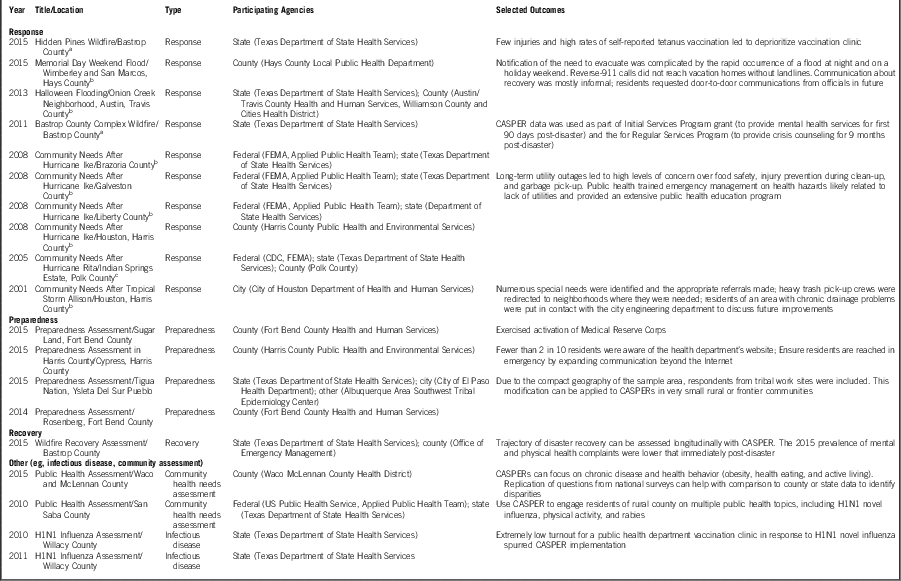
At least 19 CASPERs have been conducted in Texas since 2001, when a community needs assessment was completed in Houston following Tropical Storm Allison.Reference Waring and Brown 7 While most CASPERs focused on aspects of preparedness (n=4) or response (n=10), CASPER was also used in Texas for Community Health Needs Assessments (n=2), infectious disease assessments (n=2), and to assess long-term recovery (n=1).
While CASPERs flexibility has been demonstrated in the literature, the documentation of specific actions that have resulted from the utilization of CASPER data has been limited. Since the use of CASPER in Texas has been steadily increasing and diversifying, it is important to identify lessons learned by jurisdictions that have conducted CASPERs and document specific benefits, measurable outcomes, and changes to policies and programs associated with CASPER data.Reference Zane, Haywood and Adams 8
METHODS
A list of Texas Department of State Health Service Regions and local health departments that completed a CASPER between 2001 and 2015 was compiled along with contact information for a key informant knowledgeable about the CASPER. Written copies of CASPER field reports or After Action Reports were obtained online or via e-mail contact with key informants. A written interview guide (online data supplement) was developed in partnership with health department staff to collect information about each informant’s experience with CASPER during telephone interviews conducted by a trained graduate student. Written reports and transcripts of recorded interviews were content analyzed for key themes using inductive coding (ie, there were no predetermined themes; themes emerged from the data through review and comparison). A spreadsheet was created in Microsoft Excel and information regarding each identified theme was transcribed onto the spreadsheet for analysis. In total, 18 themes were identified in the CASPER reports and 6 in the key informant interview transcripts.
RESULTS
In total, 19 CASPER reports were included in the analysis (Table 1); 9 key informants were identified (multiple CASPERs were conducted by the same jurisdictions) and 8 interviews were completed. Five major cross-cutting themes were identified based on the frequency with which they were present in the combined inductive coding of the reports and the transcripts.
CASPERs Conducted in Texas, 2001-2015 (n=19)

Abbreviations: CASPER, Community Assessment for Public Health Emergency Response; CDC, Centers for Disease Control and Prevention.
a Fire Management Assistance Declaration.
b Major Disaster Declaration.
c Emergency Declaration.
Identifying Lessons Learned
Usefulness of CASPER Data
With many organizations involved in preparedness, response, and recovery in disaster-affected communities, it is reasonable to assume there are overlaps in data collected. While some participants recognized the possibility of CASPER data being redundant with data available from the Office of Emergency Management (OEM) or the American Red Cross, all participants highlighted the usefulness of CASPER in providing primary data about their community. Two informants stated that they used data from other organizations to improve their CASPER surveys by eliminating redundant questions, which left room on the survey for new information. Respondents felt household-level data from CASPER is a valuable way of estimating exactly how many people are without access to a particular service. For example, 1 informant stated, “For the preparedness CASPERs, a lot of times it’s things our Emergency Management knows anecdotally. But to have an actual number is really helpful for them to help guide their planning and their funding requests.”
In our sample, 90% of the disaster response CASPERs (9 of 10) collected information about immediate needs for public health and emergency management decision-making that informants felt was not otherwise available. CASPER data were used for immediate post-disaster resource reallocation in 80% (8 of 10) of the assessments. For example, when CASPER data showed that tetanus vaccination was not a priority need after the 2015 Hidden Pines wildfire, medical resources were redirected to other needs. In all response or recovery CASPERs (10 of 10), data was used to inform the development of plans by public health officials and emergency management personnel. For example, recreational vehicle hook-ups were added to a local recreation center to facilitate the use of the center by evacuees. In another case, local officials were able to make policy changes to require developers provide more than 1 roadway for ingress and egress from new developments.
Feasibility of CASPER in Disaster and Non-Disaster Settings
CASPERs are valued by respondents as a data collection tool in a disaster setting because they are relatively inexpensive and can be completed quickly; however, many resources are still required to effectively conduct one. All participants felt that conducting a CASPER in their jurisdiction was feasible if certain resources were available, including funding (a previous review of lessons learned from CASPER in Texas estimated costs of $3000-7500), personnel, supplies, expertise, and leadership.Reference Zane, Haywood and Adams 8 Seven of 8 informants felt that a non-disaster CASPER was feasible. A major obstacle identified for non-disaster CASPERs is funding. As 1 participant stated, “In a disaster setting, everybody wants to help out and everybody understands the urgency of getting good information on the community after a heat wave, flood, or wildfire. But when it’s an everyday type of thing, people may not understand that this is a tool that can be used in those settings.”
Documenting CASPER Benefits, Outcomes, and Policy Changes
Usefulness of the CASPER Toolkit and Other Resources
The CASPER Toolkit, developed by CDC, provides training materials and a reference guide for those preparing to conduct a CASPER. 9 The Toolkit includes information on preparing for a CASPER, conducting the assessment, data entry and analyses, and writing the report. It also includes tracking forms, informed consent materials, and a question bank. Key informants agree the Toolkit is a valuable resource, especially for those planning and conducting their first CASPER. “There are a lot of survey methods out there… but what is really awesome about CASPER is that it’s all laid out and easy to follow and you know exactly what you need. You can pick up the manual and go with it. It’s an awesome resource.” Other resources utilized by the respondents included the Texas Department of State Health Services’ Texas CASPER Field Guide. A key resource cited by respondents was having a staff member who had experience conducting a CASPER. Conversely, if a health department loses a team member with specific expertise, such as software for sampling or analysis, respondents struggled to learn new skills in time to conduct a CASPER. This requirement for experienced personnel is a critical gap that has been identified in other CASPER evaluations.Reference Horney, Davis, Davis and Fleischauer 10
Improving Public Health Communication in the Community
All written reports included information about public health information that was conveyed to communities as part of the CASPER. For example, 1 health department, upon discovering that fewer than 2 in 10 residents were aware of the local health department’s website, took action to ensure that their residents are being reached in the event of an emergency by expanding communication beyond the Internet. Several reports mentioned the need to expand the health department’s use of social media as well as direct linkages with neighborhood associations. The use of multiple modalities of communication and communication in multiple languages was seen as an urgently needed improvement. A non-response CASPER provides a valuable opportunity for health departments to find gaps in their public information and health education messaging before a disaster. Every key informant described providing households who were interviewed as part of their CASPER with information for both non-disaster (eg, influenza vaccination) and disaster (eg, evacuation routes) situations.
Improving Public Health’s Relationships with the Community and Emergency Management
As mentioned previously, conducting a CASPER provides an opportunity for public health staff, agency partners such as emergency management, and volunteers to interact with the communities they serve. The interaction serves as a way to familiarize the community and partners with the role of the public health department and develop a relationship of trust. This is helpful when a disaster occurs in that the public is more aware of the role of public health and potentially more receptive to the CASPER teams. According to key informant interviews, 16 of 19 CASPERs (84%) conducted in Texas were used to improve public health and emergency management plans for response, recovery, or mitigation. When asked whether any specific changes had been made within their OEM following their CASPER, 3 participants provided a clear example. Following a CASPER, the public health department helped update the region’s Emergency Operations Plan and the Emergency Operations Center Appendices. A joint exercise was then developed to exercise the updated plans and plan elements. Another respondent reported a joint project with OEM to improve the community alert system. A third pointed out that following a CASPER, OEM requested that the health department conduct a follow-up CASPER to assess progress towards recovery.
DISCUSSION
Based on this review of the use of CASPER in Texas, it remains important to document specific benefits, measurable outcomes, and changes to policies and programs that are associated with the use of CASPER data, although this may be difficult for longer-term outcomes. However, related themes were identified. For example, conducting CASPERs is thought to improve relationships between public health agencies and partners in OEM. Partnerships are seen as a key element in successfully conducting a CASPER and ensuring results are actionable. Positive experiences in partnering to conduct a CASPER or in sharing the data that results from a CASPER fuel its continued use in Texas, even when these experiences are not formally documented in CASPER field reports. For example, a partnership between Texas DSHS and Bluebonnet Trails Community Services, a local mental health non-profit who had participated in the development and implementation of the CASPER following the Bastrop Complex Fire in 2011, resulted in a successful application for funding from the Federal Emergency Management Agency for a counseling program, Texas P.R.I.D.E (People Recovering In Spite of Devastating Events). Using CASPER data and other information, Bluebonnet Trails subsequently received funding from the National Institute of Mental Health to develop web-based counseling tools for impacted residents, for a total of ~$720,000. Other funding was received from the Texas General Land Office to address improvements in evacuation routes and address erosion.
CASPERs may also be an effective way to increase the public’s awareness of public health’s capabilities and their role in a disaster or emergency. The ways in which public health and other agencies reach communities with health information during and after a disaster are changing rapidly and many governmental agencies, including public health, risk being left behind.Reference Graham, Avery and Park 11 Changes in communication methods, such as the use of Twitter, Facebook, and text messaging are becoming the preferred method of communication, especially during disasters and other emergencies.Reference Blumberg and Luke 12 CASPER surveys are also a way to reach residents at a time when nearly 50% of US households use cell phones and do not have a landline telephone, making data collection via random digit dialing increasingly difficultReference Blumberg and Luke 12 .
This study has several limitations. Since key informants were relatively experienced in conducting CASPERs, response bias may have led them to report a more favorable opinion of CASPER’s usefulness or feasibility. Key informants were also asked to recall details of CASPERs that occurred as many as 15 years ago, which could have resulted in recall bias. Finally, the study relied on the qualitative review of documents (eg, field reports and After Action Reports) that were often produced rapidly to summarize the results of CASPERs, frequently in the post-disaster period, and for the purpose of providing data to decision-makers. Since these reports were not developed for the purpose of evaluating changes to policies and programs associated with the use of CASPER data, these changes may have occurred but not have been documented in the available reports. Since only governmental public health key informants were interviewed, we have no information on the perceived usefulness of CASPER for households that participated.
CONCLUSION
The use of CASPER in Texas, and across the United States, continues to grow, as does the dissemination of CASPER findings via both peer-reviewed publications and internal reports. 14 , Reference Bayleyegn, Schnall and Ballou 15 However, too much of the evidence supporting the usefulness of CASPER data is informal and has not been documented. Thus, it is increasingly important to document specific benefits, actions, and changes to planning or policy taken as the result of data collected using CASPER, perhaps as part of existing After Action Report development or other “hot wash” activities. Follow-up will still be needed to document longer-term outcomes, such as grants awarded based on CASPER data. We were only partly successful in attempting to document this in Texas. Overall, data collected from CASPERs in Texas is seen as useful and complimentary, rather than redundant. CASPER data is widely seen as supporting a more efficient and effective population-based response to emergencies, and in non-disaster settings, as a useful means of training and exercising agency capabilities. Household-level data, collected in a statistically sound way to ensure generalizability, provides a unique resource for public health and partner agencies. CASPER is most useful when trained and experienced staff are involved, making it a priority to retain or train staff in CASPER. Finally, conducting CASPERs improves relationships with both the community—by engendering trust and raising the visibility of the role of public health in various areas—and with partner agencies by supporting an improved understanding of roles and capabilities around preparedness, response, and recovery.
Supplementary material
To view supplementary material for this article, please visit https://doi.org/10.1017/dmp.2017.143.