Well-fed people can enhance their dignity, their health and their learning capacity. Putting resources into social programs is not expenditure. It is investment.
This chapter analyzes the transformation of social policies in Latin America. The poor were traditionally excluded from public welfare. Social insurance policies – old age pensions, health insurance, housing support and disability, and maternity benefits – disproportionately benefited the middle classes, leaving the poor unprotected. In theory, funded by contributions, Latin America’s “truncated welfare states”ended up paid by general taxation, which meant that the poor effectively transferred income to the rich, reinforcing and widening income inequality (Lindert et al., Reference Lindert, Skoufias and Shapiro2006).
The biggest social policy challenge during the democratic era has been to extend welfare benefits to those traditionally excluded from social insurance programs, which in most Latin American countries were set up by authoritarian regimes (Mares and Carnes, Reference Mares and Carnes2009). Democratization in Latin America was not accompanied by immediate improvements in social expenditures for poverty relief. Countries in the region transited to democracy during an era of economic crises and structural adjustment, which made fiscal contraction necessary (Haggard and Kaufman, Reference Haggard and Kaufman1995). As Latin American countries were able to regain economic growth – in part spurred by recent booms in commodity prices – diverse social programs involving food support, conditional cash transfers, financial support of education, noncontributory old-age pensions, and health insurance for the poor had begun to mushroom throughout the region.
This chapter documents the expansion of social protection in the region, distinguishing four paths of welfare system development:
Clientelistic social protection in which most poverty relief programs are discretionary and administered through partisan or personal networks. Examples are Mexico’s PRI prior to 1997, Fujimori in Peru, Hugo Chávez in Venezuela, Rafael Correa in Ecuador, and the Peronists in Argentina. Clientelism in social protection fosters corruption and rent-seeking and is not effective at alleviating poverty.
Entitled social protection whereby expanded benefits to the poor are targeted according to means-testing criteria, which are also better insulated from political manipulation. This outcome characterizes Brazil after the Partido dos Trabalhadores won the presidential election in 2002, when Bolsa Familia was expanded to become the largest CCT program in the world, and Mexico after 1997 when Progresa/Oportunidades was launched. Colombia, Chile, Uruguay, and Costa Rica also fit this characterization. Although an array of clientelistic programs and practices persist in these countries, these coexist with CCTs and other means-tested poverty alleviation programs.
Universalistic social protection in which poverty alleviation programs, including CCTs, are universalistic rather than targeted. Bolivia during the presidency of Evo Morales exemplifies this pattern. Universalism discourages clientelistic manipulation and entails lower administrative costs, but makes poverty alleviation much more expensive.
Failed social protection is the last of the four trajectories. Guatemala is a stark case to consider, in which expansion of social assistance programs for the poor was frail and short-lived.
This chapter proceeds as follows. Section 1.1 maps Latin American social protection policies on our conceptual map that highlights the governance dimensions of antipoverty programs: universalism versus targeting and nondiscretionary versus discretionary. Section 1.2 argues that democratization and pressures from below propelled Latin American countries to expand truncated welfare states by creating an array of social programs directed at the poor. Section 1.3 discusses how real poverty relief requires moving away from clientelism toward nondiscretionary programs that target beneficiaries according to income rather than political criteria. Whether countries will endorse nondiscretionary social assistance depends on the existence of institutional constraints that effectively deter political manipulation of antipoverty programs. Section 1.4 maps Latin American countries along the four paths of welfare system development.
1.1 Varieties of Social Policies
Throughout most of the twentieth century, the main redistributive efforts in the region went into starting the construction of welfare states. Unlike their European counterparts, these Latin American welfare regimes were limited because, whatever their nominal degree of universality, they only covered persons with formal employment (Lindert et al., Reference Lindert, Skoufias and Shapiro2006). This restriction of social insurance to the formal sector has led to the characterization of the region’s various social protection systems as “truncated welfare states” (De Ferranti et al., Reference De Ferranti, Perry, Ferreira and Walton2004; Fiszbein, Reference Fiszbein2004; Rawlings et al., Reference Rawlings, Sherburne-Benz and Van Domelen2004). Moreover, despite formal membership contributions, social insurance plans have run considerable deficits that must be financed through tax revenues.
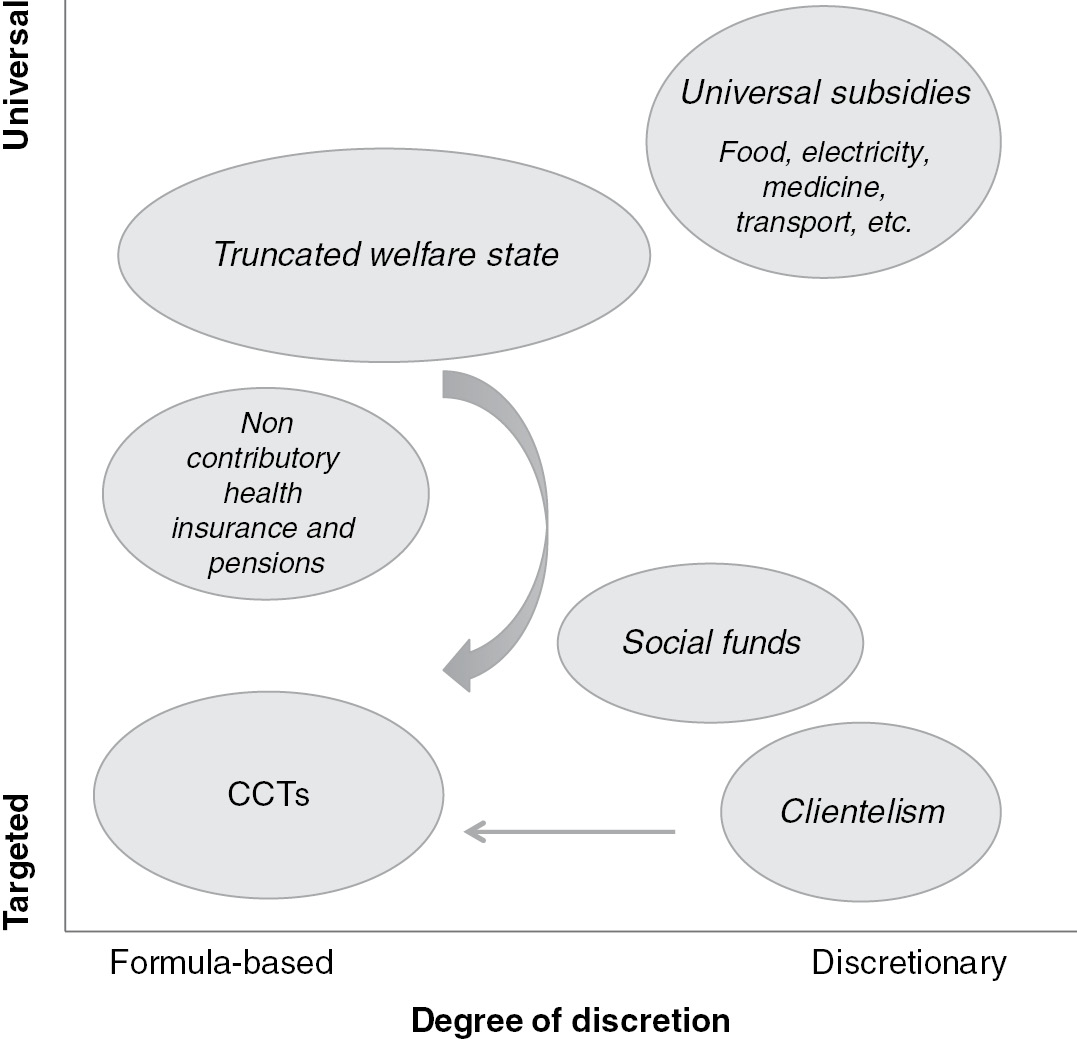
Along these governance dimensions of poverty relief, Latin America’s historical welfare regimes can be located in the upper left region of Figure 1.1, which maps social policies by degree of government discretion and the extent to which they are targeted or universal. Welfare polices benefited formal workers and state employees, who could not be withdrawn from the welfare regime on the basis of partisanship. Hence, according to our categorization, these traits make these social insurance programs nondiscretionary.
Social protection in Latin America.

Latin American social insurance programs – maternity and family benefits, health insurance, old-age pensions, and disability benefits – typically began as emoluments meant for relatively small groups such as state employees, armed-forces personnel, and those working in certain favored industries (Mesa-Lago and Bertrabou, Reference Mesa-Lago and Bertranou1998). The welfare state’s coverage gradually expanded throughout the twentieth century until most formal workers came under its umbrella (though formal employees in agriculture were rarely incorporated).
Nominally financed by contributions, most of these programs are in fact financed by general revenues. Because “the regressivity in social insurance schemes has not been helped by any significant progressivity in tax financing,” these schemes foster a “reverse Robin Hood effect,” in which the poor are made to pay for the benefit of the rich (Lindert et al., Reference Lindert, Skoufias and Shapiro2006). Latin American social policy, in other words, has mostly historically worked backward, making preexisting economic and social inequalities wider rather than narrower.
Another form of social policy commonly used in Latin America during the period of Import Substitution Industrialization (ISI) were price controls and universal subsidies – for food, gasoline, electricity, medicines, transport, among others. In Figure 1.1 these policies are mapped in the upper-right region. Many of these poorly targeted subsidies ended up benefiting in a disproportionate manner the middle and upper classes in the cities (Bates, Reference Bates1981). Like social insurance benefits, these price controls and subsidies are poorly targeted, but they are also discretionary, since politicians can often start, stop, or modify them by decree. It is not uncommon, for example, to observe food, medical, and transport subsidies rise during electoral years and plummet once the election is over.
To expand benefits to the poor, especially once electoral democracy took root in the region in the early 1990s, Latin American countries began to introduce a series of social funds intended to improve social infrastructure and provision of public goods in poor communities (Rawlings et al., Reference Rawlings, Sherburne-Benz and Van Domelen2004). With its regressive urban bias, the era of ISI produced massive migration from the countryside to city slums on the outskirts of most major cities in Latin America. It also left thousands of towns and rural communities with no basic public services.
Two of the most well known of these social funds were Peru’s Fondo de Cooperación para el Desarrollo Social (FONCODES) and Mexico’s Programa Nacional de Solidaridad (Pronasol). We map those social funds in Figure 1.1 as reflecting discretionary policies that deliver public goods to communities. Empirical evaluations of these social funds show mixed results. In principle, most of them assigned benefits in decentralized fashion in response to petitions from community organizations, while in practice politicians and bureaucrats at the center enjoyed wide discretion to choose beneficiaries.
Discretionary poverty alleviation programs such as FONCODES and Pronasol are particularly vulnerable to political interference, and as later chapters reveal, they do not alleviate poverty. Over the past decade Latin America has gradually begun to introduce nondiscretionary social protection programs to target the poor. Many social protection programs focus largely on helping raise the consumption levels of the destitute poor (Lindert et al., Reference Lindert, Skoufias and Shapiro2006). The best-known contemporary social assistance schemes are conditional cash transfers (CCTs). These programs are progressive in relative terms in that the average transfer represents a higher proportion of income (consumption) for those at the poorer end of the spectrum.
Between 1997 and 2011, most Latin American countries introduced cash transfers granted to women conditional to their children’s school attendance and health clinic visits. These programs may also require attending basic courses on preventive health care and hygiene and offer nutritional supplements. CCTs are meant to benefit the extreme poor.
Brazil implemented the first federal program in 2001 (after similar programs at the state level) and the first Lula da Silva administration (2003–2006) expanded Bolsa Familia to the entire country. Mexico implemented the first nationwide CCT program in 1997, Honduras in 1998, Nicaragua in 2000, Colombia and Jamaica in 2001, Chile in 2002, Ecuador in 2003, El Salvador and Dominican Republic in 2005, Guatemala in 2008 (Diaz-Cayeros and Magaloni, Reference Diaz-Cayeros and Magaloni2009; De la O, 2013). “By 2008 every Latin American country except Cuba, Haiti, and Venezuela had enacted a CCT program covering from 12 (El Salvador’s Red Solidaria) to 100 percent (Ecuador’s Bono de Desarrollo Humano) of its poor population” (McGuire, 2013: 3).
The largest CCT program is Brazil’s Bolsa Familia followed by Mexico’s Oportunidades. Both of these programs have been credited with reducing inequality (Soares et al., Reference Soares, Ribas and Osório2010). In general, evaluations reveal highly positive results from CCTs. Mexico’s Progresa, which is arguably the most researched of all these programs, was found to be associated with increased food consumption, declines in school dropout rates, and increases in children’s average height and weight, among other indicators (Levy, Reference Levy2006; Gertler, Reference Gertler2004). Colombia‘s Familias en Acción boosted school enrollments and healthcare access, although it failed to show any effect on nutritional levels (Attanasio et al., Reference Attanasio, Battistin, Fitzimons, Mesnard and Vera-Hernández2005).
The process of diffusion of this policy innovation across Latin America is evident. But politics has played an important role in shaping the timing of adoption (Diaz-Cayeros and Magaloni, Reference Diaz-Cayeros and Magaloni2009) as well as the program’s institutional details, including not only how beneficiaries are identified and selected, but also whether the program is properly insulated from political manipulation (De la O, 2012).
Democracy has generated a cycle of redistribution in the region, but whether this cycle ends up benefiting the poor over the long run depends on a country’s institutions and on the design that social protection takes. CCTs vary significantly in their governance structures and implementation. Although in Figure 1.1 we have mapped these on the lower-left corner indicating nondiscretionary governance, there is variation across Latin America. De la O’s (2015) evidence shows that in countries where the executive power’s electoral strength was dominant, measured as undivided government, CCT program design is less strict. Hence, majority parties that rule unconstrained are more likely to attempt to direct CCTs for political gain. Further, CCTs are likely to be less effective in countries with limited state capacity in the provision of health services and education to the impoverished.
Mexico’s Oportunidades and Brazil’s Bolsa Familia are among the most professional and better insulated, and so is Colombia‘s Familias en Acción. But other countries have failed to enact CCTs that are free of political manipulation. Guatemala’s Mi Familia Progresa (MIFAPRO) is perhaps one of the clearest examples of failure, driven by limited state capacity and defective design. As we further discuss, the program was terminated because of accusations of political manipulation by the former president, Alvaro Colom, and his electioneering wife, Sandra Torres.
Figure 1.1 shows a movement in social policy in Latin America from universalism to improved targeting. This movement is consistent with the current approach to poverty relief around the world, which has shifted away from universalism (Coady et al., Reference Coady, Grosh and Hoddinott2004). How governments select or target the poor involves decisions about governance. To target the poor, governments can employ objective income criteria or they can resort to self-reporting; the latter can be done even through self-assessments of one’s status or through community-based assessments (Alatas et al., Reference Alatas, Banerjee, Hanna, Olken and Tobiass2012).
In Figure 1.1 effective poverty relief requires movements toward the lower-left region occupied by CCTs, or what we call entitled policies of social protection. These redistributive policies targeted to the poor are administered through professional bureaucracies. But expansion of social benefits to the poor can also take the form of clientelistic social protection, which we map on the lower-right region of Figure 1.1. Clientelism targets benefits to the poor through political criteria. In the section that follows, we discuss what propelled Latin American countries to expand welfare benefits to cover the poor and describe the particular form this expansion took place in various countries.
1.2 The Expansion of Social Benefits to the Poor
Despite important variations across Latin America, countries in the region have witnessed similar transformations in their welfare regimes. What drove the expansion of Latin American’s welfare regimes? Why are poverty relief programs discretionary or nondiscretionary? The first question involves addressing movements along the vertical axis of Figure 1.1 from universal to targeted programs, and the second along the horizontal one from discretionary to nondiscretionary programs. In the pages that follow, we discuss each of these processes.
Moving beyond Truncated Welfare States
Changes in the mechanics of redistribution often result from pressures from below. Acemoglu and Robinson (Reference Acemoglu and Robinson2006) and Boix (Reference Boix2003) have made this claim for nineteenth-century Europe and the world in general. In their view, democracy and dictatorship are different equilibria of a game of redistribution between the rich and the poor. The elite can voluntarily extend democracy in order to prevent a violent revolution that ends by seizing their assets by force. Democracies are expected to arise in more egalitarian societies and, consistent with the Meltzer and Richard’s (Reference Meltzer and Richard1981) model, to lead to redistribution because electoral competition generates incentives to enact policies and a tax rate consistent with the median voter’s preferences. If the median voter, rather than the elite, sets too high a tax rate, the elite can mount a coup against democracy, and a military regime will come to thwart demands for redistribution.
One of the challenges this view faces for the case of Latin America is that the creation of welfare states often took place under authoritarianism (Mares and Carnes, Reference Mares and Carnes2009). Dictators tended to privilege powerful interests such as labor and state employees over the mass of poor citizens. The poor were occasionally targeted with government transfers, yet it was often with highly discretionary policies, which were meant to control them. Land reform was a common form of social policy that was targeted to the poor to prevent revolt (Albertus, Reference Albertus2015).
Another lesser challenge to Meltzer and Richard’s (Reference Meltzer and Richard1981) model predicting that democracy should lead to redistribution comes from the fact that in Latin America it took more than a decade for democracy to produce some meaningful redistribution. This is due to the fact that the shift to democracy in the 1980s and 1990s was accompanied by fiscal and state retrenchment as well as serious contractions of international financial flows, including public debt (Haggard and Kaufman, Reference Haggard and Kaufman1995). In many countries this period also witnessed episodes of hyperinflation and repeated but failed attempts at macroeconomic stabilization. In this context of hard times, governments on left and right converged on a set of policy initiatives (the so-called Washington Consensus) to confront these challenges. Hence, demands for redistribution by the mass of poor voters could not be promptly met with significant expansions of welfare benefits.
Although democracy did not have an immediate impact on redistribution, it did create an institutional space that gave more power to the poor. Kaufman and Segura-Ubiergo (Reference Kaufman and Segura-Ubiergo2001) demonstrate that trade integration and openness to capital markets after the 1990s had a consistently negative effect on aggregate social spending. The authors then disaggregate spending into social security transfers and expenditures on health and education. They find that a shift to democracy led to increases in health and education spending. Similarly, Brown and Hunter (Reference Brown and Hunter1999) investigate the effects of political regimes on social spending in Latin America, and they find that during times of economic crises, democracies, relative to autocracies, increased resources to social programs.
These studies do not contemplate other forms of social spending, including the enactment of social protection programs. Diaz-Cayeros and Magaloni (Reference Diaz-Cayeros and Magaloni2009) employ a survival model to explain the timing of implementation of CCTs across the region. Their econometric findings suggest that democracy generated incentives to reach out to the poor with social benefits. The more years since the democratic transition, the larger the probability of adoption of a CCT. Their results also suggest that CCT adoption is not correlated with ideology: governments from the left and the right have sought to accommodate the poor with an expansion of social protection. The authors also show that inequality and poverty generate more pressures for the expansion of benefits to the poor. Finally, state capacity also seems to matter: CCTs are adopted more rapidly where public institutions are able to reach out to the poor, as measured by higher immunization levels that presupposed functioning clinics and health services.
From Clientelism to Entitlements
This chapter traces the evolution of Latin America’s social policy in recent years, identifying two types of welfare regimes – clientelistic and entitled social protection – and argues that only the latter works to reduce poverty. Clientelism denies poverty relief to qualifying citizens on the basis of partisanship. That is why these policies often fail to improve the well-being of the poor. Entitled social protection programs instead target beneficiaries according to income, often through means-testing. Nondiscretionary programs are also harder to manipulate because politicians cannot deselect beneficiaries on the basis of political intent.
To account for movements along the axis of discretion, our approach emphasizes the political incentives to delegate the implementation of social protection to a professional bureaucracy. As argued by Geddes (Reference Geddes1994), “bureaucratic inefficiency, patronage-induced overstaffing, and outright corruption retard economic development and reduce public well-being in developing countries” (p. 371). Proper bureaucratic insulation is necessary to restrain clientelism. Nevertheless, these types of administrative reforms often face severe obstacles to their enactment because politicians profit from manipulating social programs to better serve their prospects for remaining in power.
In her study of Latin American civil service reform, Geddes (Reference Geddes1994) provides an insightful account of why and when politicians in developing countries are expected to adopt reforms that insulate bureaucracies from political manipulation. “No politician in competition with others engaged in trading jobs and favors for votes can afford unilaterally to eschew reliance on patronage. Some, however, might be willing to give up this resource if others did” (p. 375). Her game theoretic approach emphasizes the following factors as driving politicians’ decisions to delegate power to independent bureaucratic agencies: (1) political parties are more likely to pass reform when patronage is evenly distributed among the strongest parties; (2) reforms are more likely to pass when the electoral weight of the top two parties remains relatively even and stable; (3) even when one party dominates, reforms are more likely to pass when the majority anticipates losing and seeks to tie the hands of its successors and prevent them from conquering the bureaucracy to serve their own patronage ends.
We extend this argument to understand the establishment of entitled social protection, which we claim is influenced by the balance of forces between political parties and their expectation to lose power in future elections. When a majority party dominates and there is no balance of power between competing parties, this party will seek to conquer the bureaucracy to administer social programs according to partisan goals.
An important implication of our theoretical approach is that effective poverty alleviation might paradoxically presuppose the presence of strong center-right parties that are necessary to restrain majoritarian left-wing coalitions in their attempt to conquer the state to serve their own partisan ends. A strong center-right political force is present in countries where we find entitled social protection regimes: Mexico, Brazil, Chile, Uruguay, Costa Rica, and Colombia. When center-right parties are weak, unable to build roots in society (often because of their ideological extremism as in Bolivia), or have a woeful record in power (as the Union Cívica Radical in Argentina or the AD and Christian Democratic parties in Venezuela), left-leaning parties or candidates will be better able to amass large electoral majorities and undermine the system of checks and balances to operate social programs and poverty reduction through clientelistic networks.
1.3 Mapping Social Protection in Latin America
Democratization in Latin America has contributed to the creation of new public programs aimed at poverty relief. Below we differentiate Latin American countries according to how they expanded welfare programs for the poor.
Clientelistic Social Protection
Clientelistic redistribution targets benefits to a party’s support base. Poverty relief is given according to partisanship, and it is administered through clientelistic networks rather than professional bureaucratic agencies. Clientelistic redistribution hence presupposes that an incumbent party captures the bureaucracy to distribute jobs, government programs and transfers, and other benefits to its supporters.
We distinguish two different forms of clientelistic redistribution in Latin America, a “personalistic” and a “partisan” one. In the first, neopopulist leaders from outside the established party system use clientelistic redistribution to solidify their grip on power. In many of these cases, neopopulist leaders have also undermined democratic political institutions. Where established party systems failed to accommodate the poor with more expansive social policies, they became more vulnerable to the emergence of neopopulist leaders (Weyland et al., Reference Weyland, Madrid and Hunter2010; Cleary, Reference Cleary2006). Alberto Fujimori in Peru, Hugo Chávez in Venezuela, and Rafael Correa in Ecuador are notable examples.
Clientelistic redistribution can also be administered by established dominant parties, like Mexico’s PRI and the PJ in Argentina. In both the cases, populist parties were able to amass electoral support by administering social programs and patronage through their partisan networks (Levitsky, Reference Levitsky2003; Calvo and Murillo, Reference Calvo and Murillo2004; Magaloni, Reference Magaloni2006; Molinar and Weldon, Reference Molinar, Weldon, Cornelius, Craig and Fox1994). Partisan biases in fiscal and electoral institutions reinforced these parties’ incumbency advantage. In line with Geddes’ (Reference Geddes1994) theory, these dominant parties possessed no incentives to delegate the administration of social programs to an independent bureaucracy.
Clientelism traps the poor in a perverse relationship: either you are with the government or you will not get government transfers. The problem is that poor voters under this type of “punishment regime” cannot sanction government corruption because individual defection is costly. Exiting the system requires the capacity of a voter to absorb the costs of not having access to the spoils system. These costs are formidable for the poor, who often depend on the machine’s favors for basic survival.Footnote 1 In the following sections, we briefly discuss examples of personalism and partisan clientelism in social protection.
Peru
Peru witnessed one of the first episodes of neopopulism during the 1990s. An outsider and practically unknown candidate, Alberto Fujimori was elected in 1990 on a populist platform defeating rightist Mario Vargas Llosa. Upon assuming office, Alberto Fujimori switched his campaign promises and instituted wide-ranging neoliberal reforms, the so-called Fujishock (Stokes, Reference Stokes2001). Fujimori succeeded in stabilizing the economy and pacifying the country with the defeat of Sendero Luminoso. The fear of mounting social tension led him to enact a major expansion of poverty relief through the FONCODES.
The program provided public goods – clean water, roads, electricity, schools, clinics, and hospitals – as well as particularistic transfers, including nutritional supplements and food. Schady (Reference Schady2000) demonstrates that FONCODES funds were not assigned to reach the poor but to orchestrate Fujimori’s reelection for a second term. Between 1991 and 1993, FONCODES expenditures favored his supporters. After a disappointing result in a national referendum held in 1993, however, Fujimori administration redirected resources in an attempt to “buy back the vote in turncoat provinces” (Schady, Reference Schady2000: 291). FONCODES allowed Fujimori to bolster his popularity and political capital, enabling him to win the constitutional referendum to permit his reelection. He was also able to win the 1995 presidential election.
Fujimori resorted to increasingly authoritarian measures. In response to political deadlock, Fujimori decided to close Congress, suspended the constitution, and purged the judiciary with the support of the military – also known as the autogolpe (auto-coup). Fujimori ran for a third term, even though the constitution forbade this. His opponent Alejandro Toledo campaigned forcefully to have the election annulled. At this point, a corruption scandal involving Vladimiro Montesinos broke out (McMillan and Zoido, Reference McMillan and Zoido2004). A cable television station broadcasted the footage of Montesinos bribing opposition congressman Alberto Kouri for his defection to Fujimori‘s Perú 2000 party. Fujimori’s support virtually collapsed. He left Peru in 2001 and eventually served jail time for using Montesinos to bribe and tap the phones of journalists, businessmen, and opposition politicians.
Since Fujimori left office, governments in Peru have not expanded social benefits to the poor in a substantial manner. Peru should hence be characterized today as a case of limited expansion of social protection; it spends less than most other Latin American countries in social policies. Only Guatemala and Ecuador spend less (Yamada and Castro, Reference Yamada and Castro2012).
Venezuela
Venezuela experienced a colossal challenge to its party system by a neopopulist outsider. The emergence of Hugo Chávez and the Movimiento Bolivariano can be traced to the collapse of Venezuela’s two-party system, stable since the Punto Fijo Pact in 1958. Failed structural adjustment and neoliberal reform implemented by the administration of Carlos Andrés Pérez led to massive protests and looting. The president ordered the violent repression of the protests known as Caracazo, which left many people dead. The 1989 riots were the worst in Venezuelan history. The president decelerated a state of emergency. The crisis of government and economic collapse led to the impeachment of the president in 1993 (Weyland, Reference Weyland2004; Pérez–Liñal, Reference Pérez-Liñal2007; Lupu, Reference Lupu2013).
Hugo Chávez began preparing for a military coup, and although he failed to grab power by force, he later won the presidential elections in 1998. The mass of poor voters supporting Chávez revolted against the domination of politics by Venezuelan oligarchy since 1958 and its two-party system, the Christian Democratic Party (Political Electoral Independent Organization [COPEI]) and Democratic Action Party (AD). Chávez was able to expand and solidify his power to a large extent because the Venezuelan oligarchy and the preexisting party system had failed to accommodate the poor, improve living standards for the vast majority, and curb corruption. In addition, ideological convergence between AD and COPEI led to a failure of representation (Seawright, Reference Seawright2012; Morgan, Reference Morgan2011).
He was able to amass power because he used money from the oil boom to expand social benefits. During his government, Chávez successfully mobilized support from the poor through a large expansion of programs such as Las Misiones Bolivarianas, which have entailed a massive expansion of antipoverty initiatives, including educational campaigns, construction of thousands of homes, enactment of food and housing subsidies, construction of clinics, expansion of medical protection, the granting of land titles, among others.
These programs are largely administered through clientelistic practices. In their seminal study, Hsieh et al. (Reference Hsieh, Miguel, Ortega and Rodriguez2011) employ the well-known Maisanta list of several million voters who in 2003 signed a petition to remove Chávez from office and match it with household survey in order to measure the economic effects of being identified as Chávez political opponent. They find that voters who were identified as Chávez‘s opponents experienced a 5 percent drop in earnings and a 1.3 point drop in employment rates after the president released the list throughout the government bureaucracy. Hawkins et al. (Reference Hawkins, Rosas and Johnson2011) present a fascinating analysis of Las Misiones, showing that Chavez’s control of the programs is strong and that the programs have been plagued with political manipulation and corruption. Stokes et al. (Reference Stokes, Dunning, Nazareno and Brusco2013) also find that benefits in the Misiones social programs went to Chavez’ supporters.
Similar to Fujimori, Chávez undermined democratic political institutions (Mainwaring, Reference Mainwaring2012; Levitsky and Way, Reference Levitsky and Way2010). When he was elected in February 1999, the legislative and judicial branches of the national government were controlled by opposition forces. Chávez diluted these checks and balances by rewriting the Venezuelan constitution and packing the new Supreme Court with judges he could control. After having been reelected trice, he died with large popular support in March 2013.
Argentina
The case of Argentina cannot be understood without taking into account the resilience of the Peronista Party (the Partido Justicialista or PJ) in both the provincial governments and the federal level since the return to democracy in 1983. The Peronista machines have traditionally mobilized voters in the city of Buenos Aires, its hinterland, and the other provinces by distributing food, medicines, or employment (Levitsky, Reference Burgess and Levitsky2003; Auyero, Reference Auyero2007; Szwarcberg, Reference Szwarcberg2012; Giraudy, Reference Giraudy2007; Weitz-Shapiro, Reference Weitz-Shapiro2012 and Reference Trejo2014).
After the transition to democracy in 1983, political power alternated between the Radical Civic Union (UCR) and the PJ. Argentina experienced a profound economic crisis and hyperinflation during the 1980s. President Menem campaigned as a populist but upon assuming office adopted a neoliberal agenda of economic reform (Stokes, Reference Stokes2001). The successful turnaround of the economy contributed to president Menem’s popularity. After a political agreement with the UCR, he was able to modify the constitution to run for reelection in 1995. Menem’s second term became tainted with accusations of corruption, and as a result his party suffered a massive defeat in the 1997 mid-term elections. He attempted to run for reelection a third time in 1999 but his attempt was ruled unconstitutional. UCR candidate Fernando de la Rua defeated Eduardo Duhalde of the PJ in those elections.
The pegging of the peso and mounting fiscal deficient made economic policies unsustainable. De la Rua enacted austerity measures and budget cuts. The financial crisis and the wave of capital flight led de la Rua to impose a freeze on cash withdrawals, which triggered popular protests and rioting. He was forced out of office with the cry “¡Que se vayan todos!” (Away with them all!) The riots toppled two presidents in the span of ten days. By the following legislative elections of 2005, his party virtually disappeared from the political scene (Lupu, Reference Lupu2013).
Little-known Peronist governor, Nestor Kirchner, won the presidential elections of 2003 after Menem withdrew from the run-off election. The country was bankrupt, with a depleted middle class and rising poverty. He was able to restructure Argentine debt first by announcing the cancelation of its foreign debt to the IMF and then offering a single payment. Upon assuming office, he declared social problems his first priority and expanded social programs. Nestor Kirchner “left office as the most popular outgoing president in modern Argentine history. After taking office in the aftermath of Argentina‘s worst-ever-recession, Kirchner presided over four years of export-led growth, rooted in a comparative exchange rate and soaring commodity prices…. Kirchner also pushed through a social security reform that extended access to unemployed and informal sector workers, thereby bringing more than a million new people into the system. Investment in public works increased more than a fivefold under Krichner, producing major expansion in housing and infrastructure” (Levitsky and Murillo, 2008: 17). Living standards improved and unemployment and poverty fell. Succeeding her husband, Cristina Kirschner won the 2007 election by a landslide and the PJ has been able to increasingly consolidate its dominance in power profiting from opposition weakness after the UCE collapse. The PJ remains virtually unchallenged in many peripheral provinces, although the major metropolitan areas are highly competitive.
Defying the trends throughout Latin America, Argentine leaders did not create a true CCT program, even though they had a large number of transfer programs in place, particularly related to unemployment, worker retraining and other labor issues. The character of the cash transfer programs in Argentina is consistent with the overall architecture of distributive politics in the country. Calvo and Murillo (Reference Calvo and Murillo2004) have provided strong evidence regarding the primacy of a partisan logic in the allocation of fiscal transfers and public employment opportunities in Argentina.Footnote 2 In the same vein, Giraudy (Reference Giraudy2007) shows that in the specific case of workfare programs (such as the Plan Jefes y Jefas de Hogares Desocupados created in 2002, following the Plan Trabajar launched in 1996 by President Menem) partisanship overrides criteria related to need or poverty. Within the framework of the social security system, Argentina has also created a universal child allowance program for uninsured workers in the informal sector. The program’s targeting the poor is probably better than what was observed in Trabajar or Jefes y Jefas, and its coverage has been growing.
Networks of voters controlled or intermediated by political brokers (punteros) seem to play a key role in the way all these programs are designed and operated in Argentina. As noted by Stokes et al. (Reference Stokes, Dunning, Nazareno and Brusco2013), those brokers may be at odds with the party leadership, but they are also necessary for voter mobilization on election day (Nichter, Reference Nichter2008). Political networks that mobilize support are not exclusive to the PJ, but are also present in other parties like the Union Civica Radical (UCR) (Calvo and Murillo, Reference Calvo and Murillo2013).
A critical challenge Argentine social policies face today is rooted in politics and the absolute dominance of the PJ. After the collapse of the UCR, no new stable non-Peronist alternatives have emerged. “With the collapse of the UCR, the non-Peronist half of the party system has become a fragmented collection of personalistc vehicles, local patronage-based machines, and short-lived programmatic parties” (Levitsky and Murillo, 2008: 23). Without a strong opposition, the system of checks and balances is weak and the PJ has ample leeway to manipulate social policies and administer them through its clientelistic networks.
Entitled Social Protection
The establishment of entitled welfare regimes in Latin America has taken place in countries where systems of checks and balances operate more effectively to counterbalance majoritarian tendencies. Mexico and Brazil stand out for their capacity to reduce poverty and inequality through the implementation of effective social protection policies. Both counties have established welfare regimes based on entitlements rather than discretionary handouts. In 2010 the largest CCT programs in Latin America were Brazil’s Bolsa Família, which served about 52 million people (compared to 53.3 million living on less than $4 per day), and Mexico’s Oportunidades, which served about 24 million people (compared to 27.8 million living on less than US$4 per day) (McGuire, Reference McGuire2013). In both cases incumbent parties were constrained to administer social policies, and particularly CCTs. This does not mean no political returns accrued to their entitlement programs, but that they could not use partisan and governmental networks to skew program grants.
The Brazilian Social Democracy (PSDB), which has moved to the center-right after Fernando Cardoso forged an alliance with the Liberal Front Party and was elected president, played a fundamental role in creating the predecessor of Bolsa Familia. President Luiz Inacio Lula da Silva of the Workers Party must be credited for the dramatic reduction of income inequality taking place in Brazil during his administration because he massively expanded social benefits to the poor. But the presence of the PSDB and of Brazil’s federal system of government have served as critical counterbalancing forces to restrain the Workers Party from administering Bolsa Familia and other social programs through clientelistic practices.Footnote 3
Bolsa Familia had been originally pioneered in Brasilia and other municipalities and states had adopted it before Cardoso, and later adopted the program at the federal level. Upon assuming office, Lula chose moderation in economic policy and discourse (Campello, Reference Campello2013). But he put social programs at the top of his agenda. In 2003 Lula formed Bolsa Familia by combining Bolsa Escola with other programs such as Bolsa Alimentação, Cartai Alimentação and Auxilio Gas. He also created a new Ministry of Social Development and War against Hunger and massively expanded the program to cover the poor all over Brazil. During Bolsa Família‘s first six years of operation (2003–2009) per capita public health care spending rose 70 percent.
As a redistributive program, Bolsa Familia depends on central local collaboration. Municipal governments act as the main agents of the federal government in the implementation of the program, although local authorities cannot claim credit or cut out beneficiaries. Hence, Bolsa Familia is embedded in a federal system of government that is strongly antimajoritarian. The program was mounted on Cardosso’s successful fiscal reform that gave municipalities incentives to collaborate with the central government in fiscal stabilization.
The relative stability of Brazilian institutions and its party system created strong moderating incentives for president Lula’s PT government (Hunter, Reference Hunter2010 and Reference Hunter2007). The president confronted multiple veto players and faced institutional constraints that would not have allowed him to design a discretionary welfare regime for the poor. Brazil has a strong federal system, and governors and municipal presidents are very powerful. State governors are able to constraint the central government. Subnational interests effectively get articulated within the Brazilian National Congress (Samuels, 2006).
The consolidation of the Brazilian party system was gradual, but it is with Lula’s presidency (2003–2011) that the PT grew into a national party with widespread electoral appeal, to a large extent because of the expansion of social benefits and social policies to the poor, including through Bolsa Familia. Brazil’s political parties were proscribed during the first part of the military dictatorship, but then they were allowed to compete from 1966 to 1979 into a legally enforced two-party political system: the National Renewal Alliance Party (ARENA) and the official opposition Brazilian Democratic Movement (MDB). When Brazil returned to democracy, a large amount of parties emerged and the system became very fragmented and inefficient (Mainwaring, Reference Mainwaring1999). The system has gradually consolidated into five stronger parties: the Workers party (PT), the Brazilian Social Democracy Party (PSBD), the Brazilian Democratic Movement (PMDB), and the Democrats (DEM). The PSBD is the strongest opposition to the PT. Although in its origins center-left in orientation, the party shifted to the right when Henrique Cardoso forged an alliance with the right-wing Liberal Front to run for the presidency. The PSBD was born as part of the democratic opposition to the military regime and has a strong base of support.
Hunter and Sugiyama’s (Reference Hunter and Sugiyama2009) study of clientelism and Bolsa Família in Brazil in 2009 found that the method of transfer (a debit card that cuts out the middleman) and provisions for voicing complains such as a toll-free number prevented Bolsa Familia from becoming a program easily manipulated by local officials for political gain. In his cross-sectional study of Brazil’s 5,565 municipalities in 2008, Fried (Reference Fried2012) found no evidence of preferential targeting of Bolsa Família either to core government supporters or to swing voters. No doubt that Lula’s government expanded eligibility for Bolsa Família with the aim of winning votes in the 2006 presidential election. “That might be interpreted as the politicization of a CCT program, but it is also a case of electoral incentives encouraging a policy that helps the poor” (McGuire, Reference McGuire2013: 10).
Universalistic Social Protection
Bolivia has embarked on a distinctive path in the expansion of its social programs. Universalism is the cornerstone of Bolivian social protection policies, including the recently instituted CCT programs, which constitutes a departure from the movement toward increased targeting taking place in most other Latin American countries.
Prior to the arrival of Evo Morales to the presidency in 2005, democracy in Bolivia had brought very little for the poor. During the 1980s, Bolivia experienced one of the deepest economic recessions in the region, with rampant inflation, massive job losses and a severe currency crisis. Austerity measures succeeded in curbing inflation but also widened the huge wealth gap between the white elite and the impoverished Indian population and generated social unrest (Madrid, Reference Madrid2012).
Bolivia introduced Latin America’s first social investment fund, the Fondo Social de Emergencia, in 1986. The fund was demand-driven and gave cash transfers to successful proposals by community leaders. The funds were geared toward building or improving public facilities like health clinics, water and sewer lines, and roads. The most impoverished communities did not receive these funds because they did not have the capacity to submit successful proposals to the government (McGuire, Reference McGuire2013). The Movimiento Nacional Revolucionario (MNR) government of Gonzalo Sánchez de Lozada passed a decentralization law in 1994 that gave a much greater role to municipalities in designing and administering social services. Faguet (Reference Faguet2004) demonstrates that these funds had a positive impact on improving investments in basic infrastructure for impoverished communities.
Sánchez de Lozada was forced to resign during his second term in office, after massive street protests related to the Bolivian gas conflict. Political instability continued after his resignation and in 2005 the new president, Carlos Mesa, also had to resign as a result of growing discontent and popular unrest. Massive protests and roadblocks made Congress to move the 2007 elections to 2005.
Evo Morales won with 53.7 percent of the vote. He became the country’s first democratically elected president to win an absolute majority in the first round. His election represented a radical shift for his country. His victory was made possible by the systematic failure of the established political parties to enact policies to alleviate poverty and aid the country’s indigenous majority. Until Evo Morales‘ victory, Bolivia had remained a country divided into two separate countries in which the indigenous majority was for the most part excluded (Madrid, Reference Madrid2012).
Social policies began to marginally expand under President Gonzalo Sánchez de Lozada. He introduced a universalistic Bono de Solidaridad (Bonosol) retirement pension, which gave every Bolivian age sixty-five or older an annual pension of about US $230. However, the triumph of Evo Morales brought a more fundamental transformation of the social protection regime.
During his first term, he increased state intervention in the economy by nationalizing oil, mines, gas, and communications. Thanks to revenue from the energy sector, he has been able to expand social programs, including through the introduction of a CCT program and the expansion of the noncontributory old-age pensions, renamed Renta Dignidad. A new state-owned committee was also established to distribute food at subsidized prices. Not only the Bono Juancito Pinto and the Bono Juana Azurduy, but also the noncontributory pension, Renta Dignidad, are funded by dividends from renationalized state corporations and by taxes on natural gas and mineral extraction (McGuire, Reference McGuire2013).
These social programs afforded Evo Morales huge electoral support. He was able to employ his popularity among the poor to win a referendum to enact a constitutional reform in 2009. After modifying the constitution, he was able to reelect himself for a second five-year term by a landslide victory of 64 percent of the vote in the 2009 presidential elections. Candidates from his party (Movement toward Socialism) have claimed large majorities in both Chambers of the National Congress and have won the majority of Bolivia’s nine departments.
Extreme poverty and inequality remain pervasive in Bolivia. The government has emphasized the need to develop and expand social programs. Two CCTs have been enacted in Bolivia Bono Juancito Pinto (for schoolchildren) and Bono Juana Azurduy (for expectant and new mothers). According to McGuire (Reference McGuire2013) careful analysis, they have not demonstrably reduced poverty and improved health. “One thing that distinguishes these programs is their universality. Bolivia has Latin America’s only CCTs that are not targeted either to people below a certain income level, or to people living in particular impoverished regions” (p. 1). According to McGuire (Reference McGuire2013), the lack of demonstrable program impact has to do more with problems in the public provision of health and education services, and low state capacity, than to the universality of these programs.
Indigenous peoples are clearly better off after Evo Morales came to power because now there are social programs aimed at assisting them. Moreover, his presidency has brought an important agenda of institutional reform that grants constitutional statue to indigenous traditions and governance. A dilemma Bolivia faces is that super-majoritarianism might work to undermine democracy. A related challenge is that without institutional constraints, the Movimiento al Socialismo has been able to conquer the state.
Aborted Expansion of Social Protection
Guatemala has traditionally excluded and oppressed the poor, mostly indigenous Mayans. Social and economic injustice and racial discrimination contributed to a long Civil War (1960–1996). The peace accords of 1996 ending the thirty-six-years violent conflict led to the establishment of electoral democracy. Guatemala experienced the first important expansion of social benefits to the poor during the presidency of Alvaro Colom, who was elected in 2007. He expanded social programs and access to health and education to the poor. Many of these programs, including the CCT MIFAPRO, were discredited because of alleged political manipulation. The incoming administration of Otto Perez Molina, of the right-wing Partido Patriota elected in 2012, reversed many of these social policies.
MIFAPRO constituted one of the first social protection schemes ever targeted to the poor in Guatemala. The program was created from a presidential initiative within the executive secretariat of the presidency. It was ascribed to the Ministry of Education. In addition, and most controversially, the execution and monitoring of the program was assigned to the Consejo de Cohesión Social (Council of Social Cohesion) and the Oficina de la Primera Dama de la Nación (Office of the First Lady). Hence Sandra Torres was in charge of orienting social investment and combating poverty during her husband’s presidency. The program was ultimately discredited when there were rumors that Sandra Torres would divorce the president to overcome a constitutional impediment that forbade her to run for the presidential election of 2011. She wanted to run as the candidate of her party, the Unidad Nacional de la Esperaza (UNE). The Supreme Court ruled against her candidacy for the presidency on the grounds of a “serious intent to subvert the law” via divorce.
The accusations of political manipulation gave arguments to the right-wing Patriotic Party and the upper classes to reverse the expansion of social policies in Guatemala. MIFAPRO was one of the first social assistance schemes ever instituted in the country with the explicit aim to alleviate extreme poverty. According to the report by UNDP on MIFAPRO (UNDP, 2011), the Guatemalan CCT could have served as the foundation for a more ambitious social assistance regime in a country afflicted with extreme poverty. The report remarks that “even if the program is properly designed to insulate it from clientelistic practices and political manipulation, it is true that a better institutionalization would insulated it more effectively” (UNDP, 2011: 50).
Interviews collected by one of the authors in the summers of 2011 and 2012 with a large number of women in various rural communities in the region of Lake Atitlán made evident the difference the program was making for indigenous families to cope with child malnutrition and mortality from preventable illnesses. In several interviews it became clear how the cash given through MIFAPRO made the difference between life and death for the children of the impoverished communities. One woman reported using the cash to take her baby girl to a private doctor when she had a terrible attack of diarrhea that otherwise would have killed her. The little girl was now around three years old, and was playing with two of her brothers. The mother was clearly thankful to MIFAPRO for saving her only daughter’s life. Other women reported using the cash to pay for transportation to reach the nearest hospital in an emergency. All of these women reported using the money to feed their children better – occasionally they could buy some meat, even if in small quantity. One woman was using the CCT cash to buy formula that allowed her to feed her baby after her breast milk dried out due to a postpartum infection. The alternative would have been feeding the baby “water and sugar”, and most likely death due to extreme malnutrition.
In our interviews we learned about how frightened women were to talk about politics and about revealing their partisanship. Women hardly talked openly about the coming presidential elections, although we were able to gain insight from a few who were more outspoken. We learned about how terrified women were of the Patriotic Party and its candidate because they believed that if this party won MIFAPRO would be terminated. It was hence unsurprising that women did not want to talk about their partisanship openly for fear of being identified with the opposition in the event the candidate of the “Mano Dura” (strong hand) had won.
The critical importance of state capacity for proper implementation was evident in our interviews. In the communities we visited the last cash transfer scheduled to arrive in the spring never did. State officials had not returned since 2008 to collect new income information to be able to incorporate new deserving beneficiaries. More than political manipulation, many of the problems on the ground were clearly about implementation and lack of state capacity.
The program was terminated after the elections Otto Perez Molina won the presidential elections. When we returned the following summer to interview with families in the same communities, we encountered a sad panorama. The benefits from MIFAMPRO had been removed from the entire region, which was clearly supportive of the UNE in the presidential elections. As we were interviewing one woman who had recently delivered her sixth baby, we learned that she had been feeding the baby water with diluted corn maize because her breast milk had dried out after a postpartum infection. She had no cash to buy formula and the baby was literally dying in her desperate hands.Footnote 4 The optimism the CCT program had brought among the women had been replaced by stoic faces confronting, once again, the adversities of having to live in extreme poverty without a safety net.
1.4 Conclusion
This chapter has documented the expansion of social protection in the region, distinguishing four paths of welfare system development. Democratization and pressures from below propelled Latin American countries to expand truncated welfare states by creating an array of social programs to benefit the poor. We argued that effective poverty relief requires moving away from clientelism and establishing nondiscretionary programs that target beneficiaries according to income rather than partisanship or other political criteria. Democratic politicians will inevitably be tempted to manipulate social programs and poverty relief for electoral objectives. Hence nondiscretionary social assistance can come about only when there are effective institutional constraints to prevent incumbents from politicizing antipoverty programs.
It is the variety of wants in different climates that first occasioned a difference in the manner of living, and this gave rise to a variety of laws.
Mexico provides a unique opportunity for the study of poverty relief strategies because of the fundamental transformation its social policies experienced over two decades, from 1988 to 2006. The clientelistic linkage between politicians and the poor that prevailed during the era of PRI dominance weakened with the emergence of an entitlement-based strategy of poverty relief. Clientelistic social protection was at the heart of the PRI’s dominance by generating substantial electoral rewards. The ruling party spent billions of dollars on behalf of the poor but, as later chapters demonstrate, these resources had only a limited impact on poverty reduction.
This chapter lays the groundwork for the geographic approach that underlies our study of antipoverty policies. To understand poverty-alleviation strategies, we territorially disaggregate programs, policy interventions, and outcomes at the local level. In the next section we discuss poverty relief efforts, classifying the various Mexican social protection programs according to the scheme presented in the previous chapter. Section 2.2 discusses the geographic correlates of the spatial distribution of poverty across Mexican municipalities. Section 2.3 describes the overall strategies of public good provision and poverty alleviation in Mexico from a geographic perspective, and Section 2.4 recounts the changing patterns of political contestation in Mexico, also using a geographic approach.
2.1 Mexico in Comparative Perspective
The poor in Mexico did not benefit much from the so-called economic miracle, when the country consistently grew at an average annual rate of around 6 percent from the 1930s until the early 1980s (Hansen, Reference Hansen1971). Despite revolutionary and propoor rhetoric, the PRI-led governments of the time failed to implement successful poverty-alleviation programs. Although many development indicators improved as the decades progressed (Wilkie, Reference Wilkie1978), the improvements tended to disproportionately benefit the already wealthy regions, rather than the poorer areas, which lagged well behind (Medellin, Reference Medellin and Wionczek1974).Footnote 1 Despite overall growth, income distribution barely changed from 1958, when the first measurements were taken, to the 1980s, when Mexico plunged into economic turmoil.
With the debt crisis of 1982, prospects for the poor became even dimmer. Combating poverty with social programs in a low-growth economy was a daunting challenge. Employment and other income-generating activities grew sluggishly, while public resources for helping the poor became scarce. Real government expenditures suffered a dramatic cutback during the post-1982 period. At the same time, Mexico underwent a major economic restructuring involving privatization, trade policy, and fiscal reform. Income inequality is shown to have worsened during this period. Between 1984 and 1992 there was a “steep fall in the income of ninety percent of the population in favor of the wealthiest 10 percent” (Trejo and Jones, Reference Trejo, Jones, Purcell and Rubio1998). Despite prospects for recovery after the economic restructuring, the Peso Crisis of 1994–1995 delivered a massive setback to social programs. Poverty reached alarming levels.
Table 2.1 shows the evolution of Mexican poverty in rural areas and the country as a whole, according to estimates calculated by the National Council for the Evaluation of Social Policy (Consejo Nacional de Evaluación de la Política de Desarrollo Social [CONEVAL]).Footnote 2 The estimates use a common methodology to ensure comparable poverty lines based on data from household surveys.Footnote 3 The table report two types of poverty lines: one for nutritional status (caloric intake); and a second one for assets (possession of basic capacities plus other necessities, such as clothing, transportation, and shelter).
| Poverty Line | Rural Nutrition | Rural Assets | National Nutritional | National Assets |
|---|---|---|---|---|
| 1992 | 34.0 | 66.5 | 21.4 | 53.1 |
| (2.3) | (1.8) | (1.12) | (1.36) | |
| 1994 | 37.0 | 69.3 | 21.2 | 52.4 |
| (1.8) | (1.7) | (0.82) | (1.22) | |
| 1996 | 53.5 | 80.7 | 37.4 | 69.0 |
| (1.6) | (1.0) | (1.04) | (1.07) | |
| 1998 | 51.7 | 75.9 | 33.3 | 63.7 |
| (2.2) | (1.8) | (0.93) | (0.94) | |
| 2000 | 42.4 | 69.2 | 24.1 | 53.6 |
| (2.1) | (1.9) | (1.04) | (1.25) | |
| 2002 | 34.0 | 64.3 | 20.0 | 50.0 |
| (2.0) | (2.3) | (0.93) | (1.11) | |
| 2004 | 28.0 | 57.4 | 17.4 | 47.2 |
| (2.0) | (2.3) | (0.64) | (0.70) | |
| 2006 | 24.5 | 54.7 | 14.0 | 42.9 |
| (1.7) | (1.8) | (0.73) | (0.83) | |
| 2008 | 18.6 | 47.8 | ||
| (0.57) | (0.65) | |||
| 2010 | 18.8 | 51.1 | ||
| (0.55) | (0.63) | |||
| 2012 | 19.7 | 52.3 | ||
| (0.92) | (1.05) |
Source: CONEVAL, 2007 and http://www.coneval.gob.mx/Medicion/EDP/Paginas/Evolucion-de-las-dimensiones-de-la-pobreza-1990-2014-.aspx accessed Oct 2, 2014.
Note: Information is not updated through 2014 for rural areas because CONEVAL introduced a multidimensional methodology for the calculation of poverty rates, that does not provide the breakdown. Poverty rates have witnessed moderate increases since 2008.
The table measures poverty using a headcount index: the percentage of persons falling below the poverty line. It also presents the standard errors of the estimates (in parenthesis) to better demonstrate how changes in the evolution of poverty through time are statistically significant. It is undeniable that extreme poverty fell in Mexico after the introduction of the new social protection regime in 1997: Progresa and FISM. In 1996, 53 percent of the population were extremely poor according to CONEVAL’s definition of nutritional poverty. This percentage fell to 24 in 2006.
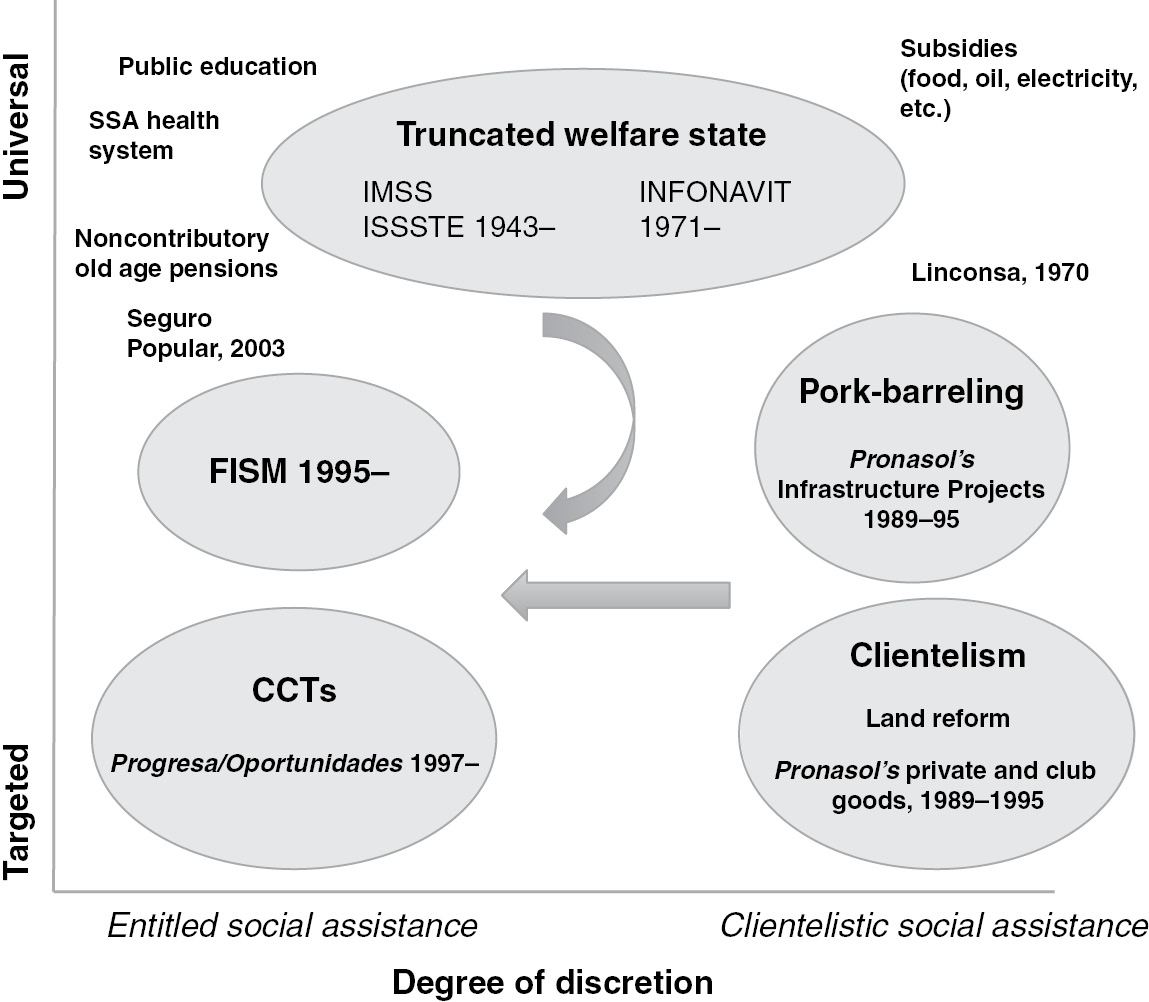
The evolution of poverty is surely related to the historical policies followed by the federal government. Figure 2.1 maps Mexico’s social policies during the twentieth century on the two dimensions of governance discussed in the previous chapter. Since the early 1940s, Mexico began to introduce social insurance schemes tied to participation in the formal labor market. Created in 1943, the Instituto Mexicano del Seguro Social (IMSS) provides insurance to nongovernment workers, including individual retirement funds, disability and life insurance, health insurance, and health services.Footnote 4 The Instituto Nacional del Fondo de Vivienda para los Trabajadores (INFONAVIT) provides subsidized housing to private sector workers. Similar benefits are provided to state employees through the Instituto de Seguridad y Seguro Social para Trabajadores del Estado (ISSSTE), which also gives financial assistance from its housing fund (FOVISSSTE).
Social protection in Mexico.

The poor remained without access to the formal social insurance system. In addition to investments in public education and health, land reform was surely the most important redistributive effort carried out by the PRI during the postrevolutionary period, up until 1991 when the era of agrarian reform was declared closed. Over the years, 60 percent of Mexico’s territory was distributed. Owing to the clientelisitc implementation of land reform, the PRI was able to amass electoral support among peasants for many decades.
In 1988 the hitherto stable hegemonic party regime experienced an electoral shock that led to a shift in social policy. The electoral shock resulted from a combination of factors. A severe economic recession – low wages, high inflation, currency instability, and underemployment in the cities – led voters to defect to the opposition. Market-oriented reforms also restricted the availability of state resources that were traditionally used to buy off party factions and electoral support. The 1988 elections made it clear that the PRI had failed to build solid clientelistic networks with the growing masses of the urban poor.
President Carlos Salinas established Pronasol with the stated intent to combat poverty.Footnote 5 Instead, as we demonstrate in this book, Pronasol was designed as an instrument for reestablishing the PRI’s electoral dominance. Pronasol sought to establish alternative party-society relationships that would go around the failing corporatist mechanisms and state bureaucracies. It soon became the cornerstone of the government’s social policy. Its resources represented, on average, 1.18 percent of GDP each year.
A large proportion of Pronasol programs involved investments in sewerage, piped water, roads, and the construction of schools and health clinics. But Pronasol also included many programs that targeted discretionary private goods to individuals or small communities – subsidized credit, scholarships, wells, livestock, construction materials, and the like. The program’s investments benefited the PRI’s core supporters and were not properly targeted to the poor.
In the 1990s, as the process of democratization unfolded, a new social assistance regime came into place. Through the randomization of the first CCT program in Mexico, Progresa‘s initial rollout from 1997 to 1999, scientific evaluations were made on the impact of the program on the welfare of the poor. The presidential administration of Vicente Fox became convinced that the program was effective; he decided to rename it and expand it into urban areas. We demonstrate in this book that beneficiaries of Progresa – and later Oportunidades – have generously rewarded incumbents at the polls.
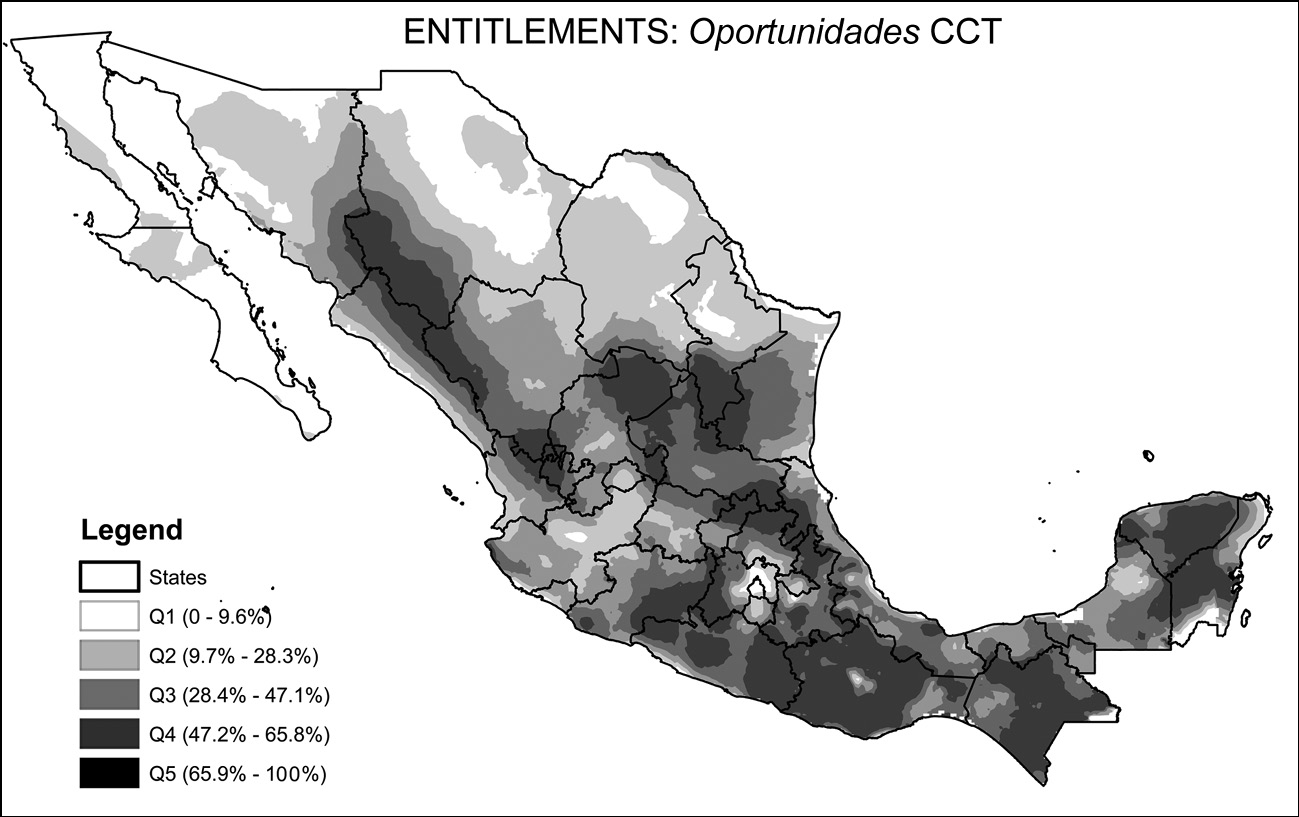
After Vicente Fox’s victory in 2000, the program was expanded in rural areas, and extended to urban and semiurban areas using parallel criteria to select beneficiary families. For the last phase, the program was also transformed into a demand-type scheme where eligible people were no longer identified by the government, but they self-select to apply. The scope of Progresa/Oportunidades is far-reaching. At the end of 1999, Progresa covered approximately 2.6 million families, and about 40 percent of all rural families. By 2005, Oportunidades covered 5 million families, almost 70 percent rural, and the rest semiurban and urban. This meant that by the end of 2005, more than half of Mexican families in extreme poverty were receiving Oportunidades funds. The program’s budget has increased steadily since 1997, although transfers per beneficiary have decreased slightly.
Because of its progressive structure, Progresa/Oportunidades is the most propoor of all major Mexican social assistance programs. The World Bank has calculated in its public expenditure review for Mexico in 2005 that most public programs are regressive, and that public expenditure in general is slightly regressive (World Bank, 2004a). Other national programs that have been progressive are school spending (preschool, elementary and lower secondary), health clinics for the uninsured population through the ministry of health (SSA), and the Programa de Apoyos al Campo (Procampo) transfers to peasants.Footnote 6 Procampo replaced price supports for basic grains with direct cash payments. The most regressive programs have been those managed by the Public Employees Social Security Institute (ISSSTE) and support for public universities.
Despite enormous improvement in poverty alleviation under Oportunidades, the program still suffers limitations. For example, poor households are excluded from receiving transfers if there is no school or clinic in the community or within a reasonable distance, which is the case in some of Mexico’s poorest localities. Second, the continuity of the program is always at stake when there is a change in federal administration and governments are tempted to water down its targeting. Third, the transfers themselves are not generous enough to place all households in the program above the poverty line, so a substantial population remains in poverty, even after the transfer. Finally, Oportunidades is not well integrated with other social assistance programs that seek to generate better quality services and to support income-generating activities (de Janvry, Reference De Janvry2006).
Highly targeted programs may suffer important political limitations. As Pritchett (Reference Pritchett2005) explains: “If the budget for redistribution is politically determined, the impact of targeting on the poor cannot be determined by a technocratic evaluation of the hypothetical impact of a given targeting design alone; it must account for the effect of changes in the degree of targeting on the size of the budget available for redistribution. It is possible that ‘more for the poor is less for the poor’ and that the less targeted program will deliver fewer benefits for the poor” (p. 1).
CCTs can suffer underfunding. In fact, social spending is relatively low in Mexico at 9.1 percent of GDP in 2000.Footnote 7 Most of the spending goes to education and health (3.8 and 2.2 percent of GDP respectively). Social protection spending constitutes the remaining 3 percent. Around 72 percent of social protection spending is devoted to regressive programs (IMSS and ISSSTE), whereas only 27 percent (0.8 percent of GDP) goes to the better-targeted social assistance programs, including Oportunidades (Lindert and Allard, 2006).Footnote 8 Hailed as the most successful poverty alleviation program in Mexico’s history, Oportunidades made only up 0.3 percent of GDP in 2000.
2.2 The Geography of Poverty
Behind the national figures that exhibit some improvements, there are vast differences across the territorial landscape. Unpacking poverty in Mexico requires a better understanding of its relationship with geography. The central goal of our analysis is to understand the impact social programs have made on poor communities and the evolution of poverty. In the rest of this chapter, we outline the basic spatial patterns of poverty, the geography of public expenditure, and the distribution of political power across the territory.
Poverty in Mexico is highly correlated with specific topographic and climatic characteristics. A typical, extremely poor locality is generally isolated from main cities, roads, and highways. One of the most unequal countries in the world, Mexico’s social disparities are reflected in its high incidence of poverty. The poor are concentrated in rural communities. The rural poor historically have lacked basic services such as drinking water, roads, and health care, and they have suffered from hunger, malnutrition, and preventable disease.
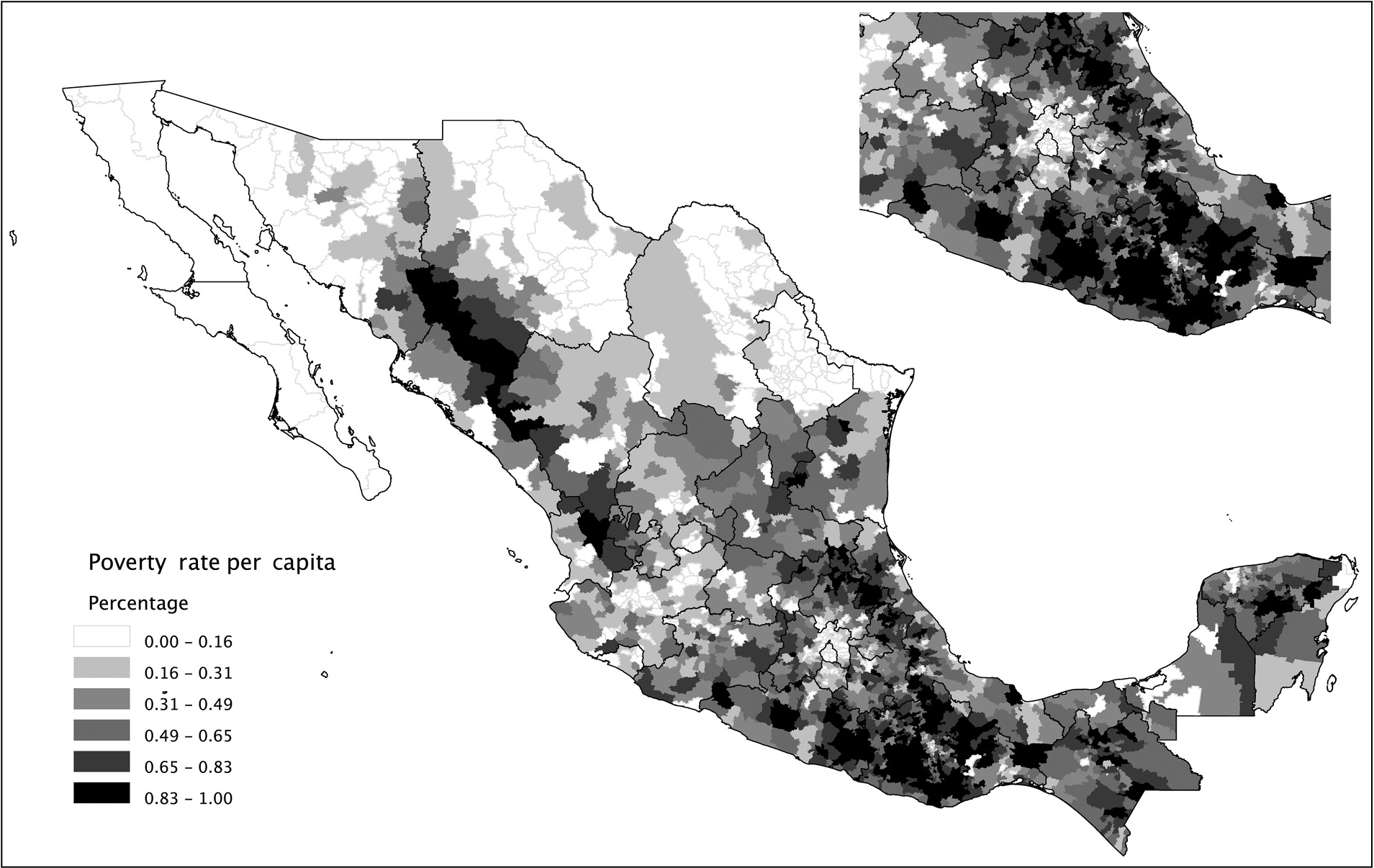
Figure 2.2 maps poverty across Mexico. The map uses the CONEVAL computation of nutritional poverty (i.e., a poverty line drawn at the minimum caloric intake necessary for survival) at the municipal level in 2000. It highlights the prevalence of extremely poor households across Mexico, with a spatial distribution showing that poverty is most concentrated in rural areas.
Share of population living under nutritional poverty line (CONEVAL), 2002.
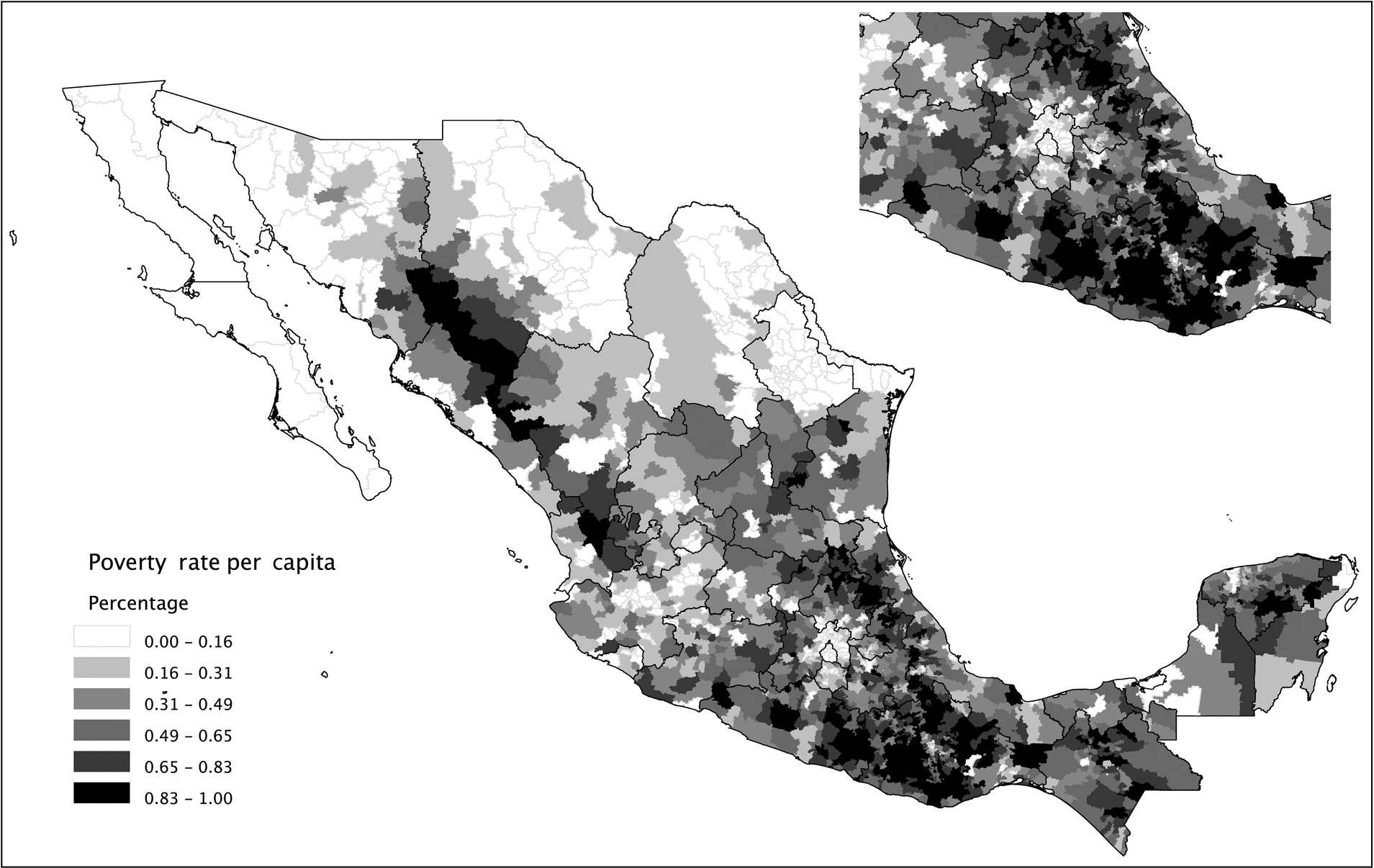
There is an undeniable statistical correlation between the patterns of poverty and destitution displayed by the map in Figure 2.1 and a set of geographic variables. The rural poor in Mexico tend to live in less accessible and hospitable places. Their settlement patterns usually reflect inherited and long-standing historical processes that have also generated the borders separating jurisdictions. The South is poorer than the North, and it also has the highest concentration of indigenous peoples. Southern states such as Chiapas, Yucantán, Oaxaca, Guerrero are among the poorest. Puebla, Michoacán, and areas of Veracruz also exhibit high incidence of poverty. In the North poverty is concentrated la Sierra Tarahumara, an area of the Sierra Madre Occidental inhabited by the Tarahumaras. Rural Western Central Mexico in Nayarit, Durango, Jalisco, and Zacatecas is also impoverished.
Gallup et al. (Reference Gallup, Sachs and Mellinger2001, Reference Gallup, Gaviria and Lora2003) and Sachs (Reference Sachs2005) have argued that geography plays a key role in development. For example, landlocked countries tend to grow at a slower rate than those with coastal access and navigable rivers. Across the world, it is well known that latitude is correlated with per capita GDP levels (Sachs, Reference Sachs2005). We know that institutional and historical processes also shape the evolution of well-being (Acemoglu and Robinson, Reference Acemoglu and Robinson2006); and that geography is not destiny (Gallup et al., Reference Gallup, Gaviria and Lora2003). Yet poverty profiles are inevitably linked to the geographical characteristics of the territories where poor people live. This geographic relationship presents a methodological opportunity. Since human agency can only change geographic attributes at the margin (roads, bridges and tunnels can be built, swamps can be drained and rivers dammed, but mountains cannot be moved), geographic attributes are extremely good predictors of the spatial distribution of poverty.
The most striking aspect of Mexico’s natural geography is its extreme variation. And those variations are highly correlated with poverty. Mexico provides a contrast to the findings by Gallup et al. (Reference Gallup, Sachs and Mellinger2001) that population and economic activity tend to concentrate on coasts and major waterways. The overwhelming majority of Mexican municipalities are landlocked and the population is not concentrated in coastal areas. The development of Mexico’s transportation infrastructure since the nineteenth century has provided most municipalities with access to both railroads and major roads (within an average of twenty-three kilometers and five kilometers, respectively).
Table 2.2 presents an ordinary least squares (OLS) regression of several indicators of poverty and development on a selection of geographic variables.Footnote 9 The dependent variables are all normalized into z scores with a mean of 0 and a standard deviation of 1 to make it possible to compare the impact of various geographic features across regressions (although each of the indicators is constructed with different underlying data). To measure poverty, we employ three alternative indicators. The first indicator we use is the nutritional poverty headcount index presented in Figure 2.2. A second indicator measures the relative deprivation of municipalities in 1990. The index combines characteristics of households, including access to public services such as sewage systems, drinking water and electricity, access to housing construction materials, and individual traits such as literacy and earnings according to the 1990 census. The final dependent variable is the Human Development Index (HDI) calculated by UNDP on the basis of 2000 census data.Footnote 10
| 1 | 2 | 3 | 4 | 5 | 6 | |
|---|---|---|---|---|---|---|
| Poverty headcount w/ Natural Geography | Poverty headcount w/ Natural Geography | Marginality index w/ Natural Geography | Marginality index w/ Human Geography | HDIw/ Natural Geography w/ Natural Geography | HDIw/ Human Geography w/ Human Geography | |
| Spatial lag | 0.265 | 0.169 | 0.174 | 0.117 | 0.123 | 0.06 |
| (0.054)** | (0.043)** | (0.057)** | (0.048)* | (0.062)* | (0.054) | |
| North | –0.963 | –0.706 | –0.97 | –0.755 | 1.001 | 0.74 |
| (Km/1000) | (0.069)** | (0.070)** | (0.069)** | (0.071)** | (0.071)** | (0.072)** |
| East | 0.509 | 0.568 | 0.356 | 0.444 | –0.275 | –0.398 |
| (Km/1000) | (0.054)** | (0.051)** | (0.055)** | (0.053)** | (0.054)** | (0.054)** |
| Temperature | –0.014 | –0.004 | –0.015 | –0.006 | 0.012 | 0.005 |
| (°C) | (0.003)** | (0.002) | (0.003)** | (0.003)* | (0.003)** | (0.003) |
| Rainfall | 0.762 | 0.905 | 0.963 | 0.997 | –0.813 | –0.851 |
| (Meters) | (0.100)** | (0.081)** | (0.099)** | (0.085)** | (0.099)** | (0.084)** |
| Coastline | –0.697 | –0.504 | –0.772 | –0.643 | 0.84 | 0.678 |
| (1= coast/border) | (0.073)** | (0.070)** | (0.074)** | (0.071)** | (0.070)** | (0.070)** |
| Rugged Terrain | 0.95 | 0.599 | 0.998 | 0.642 | –0.814 | –0.484 |
| (st. dev. Km) | (0.377)* | (0.292)* | (0.390)* | (0.291)* | (0.323)* | (0.249) |
| Altitude | –0.893 | –0.482 | –1.067 | –0.657 | 0.791 | 0.396 |
| (km) | (0.375)* | (0.291) | (0.388)** | (0.291)* | (0.322)* | (0.249) |
| Distance City | 0.002 | 0.002 | –0.003 | |||
| (Km) | (0.000)** | (0.001)** | (0.000)** | |||
| Distance Rail | 0.004 | 0.004 | –0.005 | |||
| (km) | (0.001)** | (0.001)** | (0.001)** | |||
| Distance Road | 0.018 | 0.019 | ||||
| (km) | (0.001)** | (0.002)** | (0.002)** | |||
| Population | –0.222 | –0.14 | 0.159 | |||
| (Log) | (0.012)** | (0.014)** | (0.014)** | |||
| Area | 0.044 | 0.038 | ||||
| (Km2/1000) | (0.010)** | (0.011)** | (0.009)** | |||
| Constant | –0.432 | 0.736 | –0.041 | 0.405 | –0.003 | –0.504 |
| (0.160)** | (0.192)** | (0.163) | (0.215) | (0.163) | (0.221)* | |
| Observations | 2425 | 2375 | 2425 | 2375 | 2425 | 2375 |
| R-squared | 0.33 | 0.57 | 0.3 | 0.48 | 0.27 | 0.48 |
Note: Robust standard errors in parenthesis.
* Significant at the 5% level; ** significant at the 1% level.
The independent variables include a correction for spatial autocorrelation (poverty in neighboring municipalities) latitude, longitude, altitude, rainfall, and temperature. Mexico is a particularly mountainous country, so we calculated from the data on altitude the ruggedness of each municipality’s terrain (measured as the standard deviation of altitude). This measure indicates how physically inaccessible a place is. We calculated the number of major rivers crossing a municipality and whether there was a major lake. The coastline variable detects access to the sea. Given the peculiarities of Mexico’s highly permeable border with the United States, we coded municipalities on the northern border also as coastline.
The land area of the municipality reflects a measure of size, while population indicates the relative importance of municipalities. Population density combines both of these indicators, reflecting to a large extent the degree of urbanization. Finally we calculated four indicators reflecting accessibility to markets: distance to major highways, railroad tracks, cities of more than 100,000 inhabitants and Mexico City. All the distance variables were calculated, using a Euclidean metric, to the closest point on the border of the jurisdiction.
The table explicitly states in its headings that the coefficients should be read as suggestive of correlations to poverty, not of a causal relationship in which the geographic variables “explain” or produce specific outcomes of poverty and development.Footnote 11 Two estimations are reported for each index, one that includes only variables of natural or physical geography (latitude, longitude, temperature, rainfall, coastline, altitude and terrain ruggedness), and the other that includes what we call “human geography,” indicating that the variables of distance, population and even land area are the product of demographic, socioeconomic, and political choices, accumulated over several decades and even centuries.
These results allow us to identify a distinctive geographic profile of poverty in Mexico. Estimations 1, 3, and 4 show that a third of the variance, as reflected by the R2 statistic, is accounted for by natural geography variables alone. There is a powerful North-South divide that is evident in the latitude variable. The size of the effect is substantial. Using the coefficients from estimation 5, if we take municipalities with identical characteristics, except that one is located a thousand kilometers farther to the north, that sole difference would yield a change of one standard deviation in the HDI z score. The estimation also reveals an east-west cleavage. One thousand kilometers more to the east yields a poverty headcount index one-half a standard deviation larger.
Rainfall is statistically significant through all the estimations, including those with human geography variables, suggesting that places with more rainfall tend to be characterized by greater deprivation. Rugged terrain is significant at the 95 percent level, implying the presence of geographic poverty traps in areas made remote and difficult to access due to topography (Jalan and Ravaillon, Reference Jalan and Ravallion2002; Bloom et al., Reference Bloom, Canning and Sevilla2003). The poor in Mexican municipalities with inaccessible terrain have a hard time migrating out of those places or readily move their accumulated human capital or assets beyond a threshold that allows them to increase their productivity.Footnote 12
Temperature and altitude are statistically significant only when variables linked to human geography are not included in the estimation, which suggests that the correlation of these environmental conditions with poverty is less pronounced in the presence of human activities that facilitate the movement of goods and people across a territory.
The inclusion of the human geography variables increases the power of the regressions significantly. More than half of the variance in the distribution of poverty is accounted for when human geography is taken into account, as indicated by the R2 statistic. The equivalent statistics for the marginality index and the HDI are similar. The human geography variables are all significant in the expected direction. When a municipality is far from a large city, has no nearby railroad line and is not linked to the rest of the country through the highway network, its population is significantly poorer. Larger municipalities in terms of land area tend to be poorer, but more population is associated with less poverty, which in the end means that places with greater population density (i.e., more urban concentrations) exhibit less poverty.
When controlling for human geography, the variables related to the topography of the territory either cease to be statistically significant or reduce their association with poverty, which is consistent with the view that infrastructure and urbanization allow people to overcome poverty. Government action or inaction can hence have a large impact on poverty alleviation.
Among the human geography variables, the distance to railroads and the land size of municipalities have been virtually fixed over the past century. Most railroads were built in the nineteenth century (Coatsworth, Reference Coatsworth1976), and the municipal subdivision has only changed marginally since 1917 (Blum and Diaz-Cayeros, Reference Blum and Diaz-Cayeros2002). Most cities with more than 100,000 inhabitants were established as large urban concentrations in colonial times. According to Tanck de Estrada (Reference Tanck de Estrada2005) there were around twenty Spanish cities and “villas” in 1800, as distinct from the so-called Indian pueblos. Spanish cities were the centers of power and wealth in the colonial period. Although much has changed since then, today’s large cities were established in the late colonial period, with the exception of cities on the northern border and some coastal ports that have blossomed as tourist centers in the past few decades.
On the contrary, other human geography variables have been changing rapidly during the past decades. Demographic patterns are not exogenous to the social, economic, or political processes of both the recent and the distant past. These sociopolitical processes include dislocations produced by social upheaval at the beginning of the twentieth century, massive urban migration since the 1960s, and the large-scale emigration to the United States since the 1980s.
National highway construction in Mexico began in the 1920s, and the new construction often followed old colonial routes (Ortiz Hernán, Reference Ortiz Hernán1994). But there has been a steady expansion of road networks since the 1960s, with a recent boom in highway construction in the 1990s funded by joint private-public ventures. Among the geographical variables included in our estimations, highways are arguably the most reflective of recent government activity.
The location, climate, and terrain of a municipality are important predictors of poverty levels. Our results suggest that poverty is determined by a combination of human agency and geographic conditions, but is driven more by the latter. Again, the associations shown in these estimations are not necessarily causal. In fact, the social, economic, and political processes captured by the geographic variables, particularly the ones shaped by human agency, are very likely the consequence of poverty as much as the cause. Teasing out the links of causality goes beyond the scope of this chapter.
2.3 Strategies for Public Goods Provision and Poverty Alleviation
The accumulated experience of two decades of poverty relief spending in Mexico affords a unique opportunity to compare and contrast poverty- alleviation efforts, particularly with regard to differences between discretionary and formula-based programs, targeted and universal approaches, and centralized and decentralized decision making. It also provides insights into the ways in which local politics influences the implementation and allocation of funds across households and political jurisdictions. This book compares social spending strategies in all of Mexico’s municipalities that span three presidential terms.
Figure 2.3 shows the geographic distribution of the funds for Pronasol, FISM and Progresa/Oportunidades at the municipal level. The maps are organized into rows and columns corresponding to Figure I.1. The first two maps show nondiscretional or formula-based antipoverty funds distributed to municipalities while the maps in the next page discretional programs. The top map shows funds for localities (earmarked and block grants in the case of FISM and public goods constituting pork-barrel appropriations for Pronasol); while the bottom map depicts programs targeted to individuals (through entitlement-based transfers in the case of Oportunidades and in a clientelistic manner in the case of Pronasol).
The geography of poverty relief transfers in Mexico, 1989–2005.
Note: Pronasol average data for 1989–1994; FISM data for 2000; Oportunidades coverage for 2005. All figures are per capita in real pesos of 1994 or share of population for Oportunidades (1 USD = 3.3 MXP).
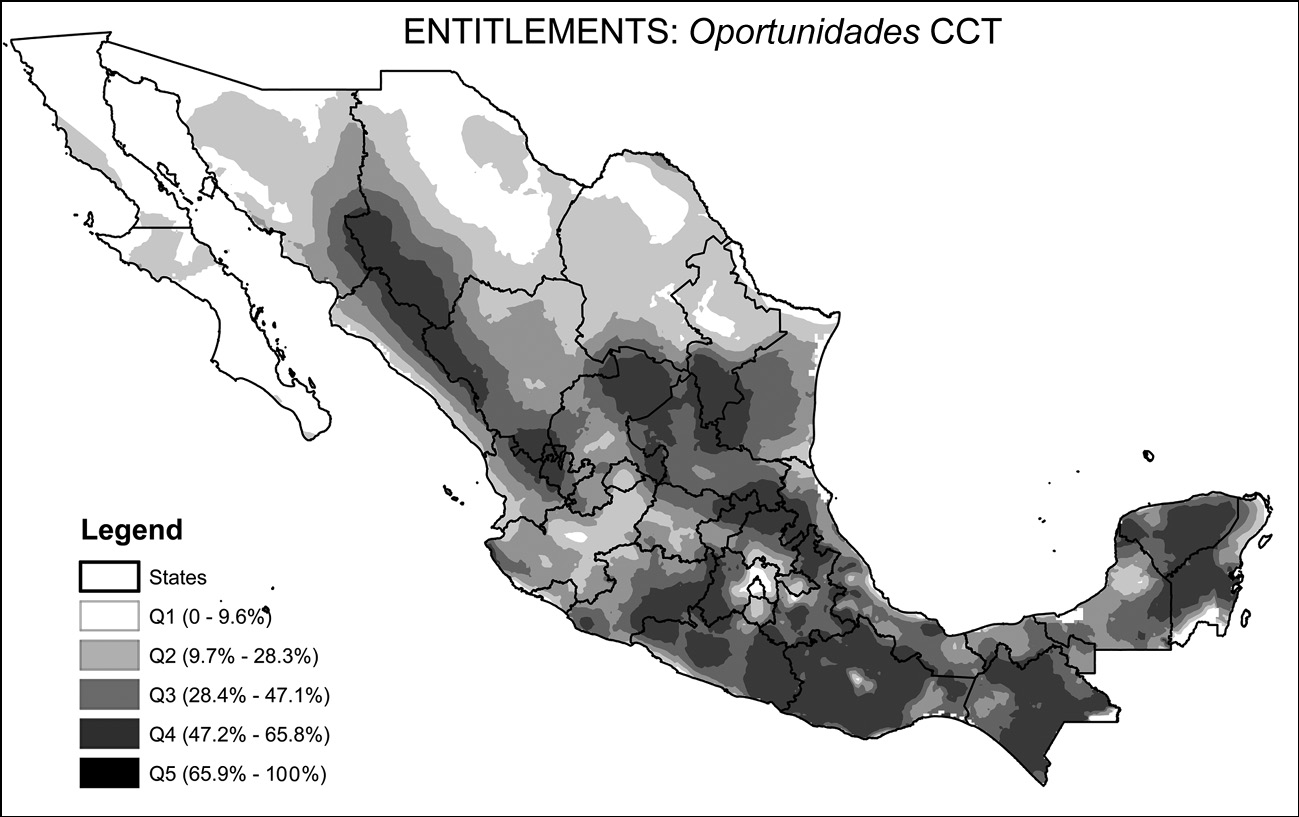
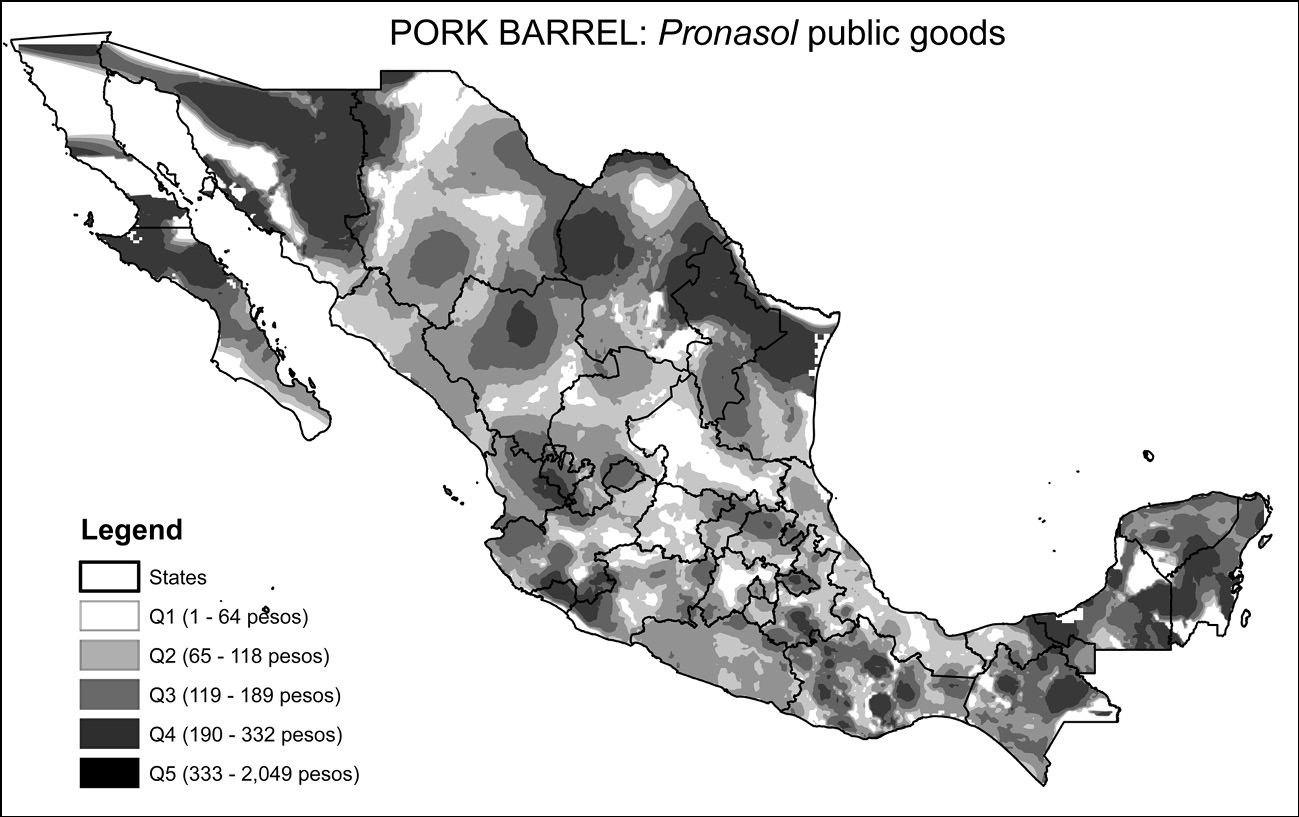
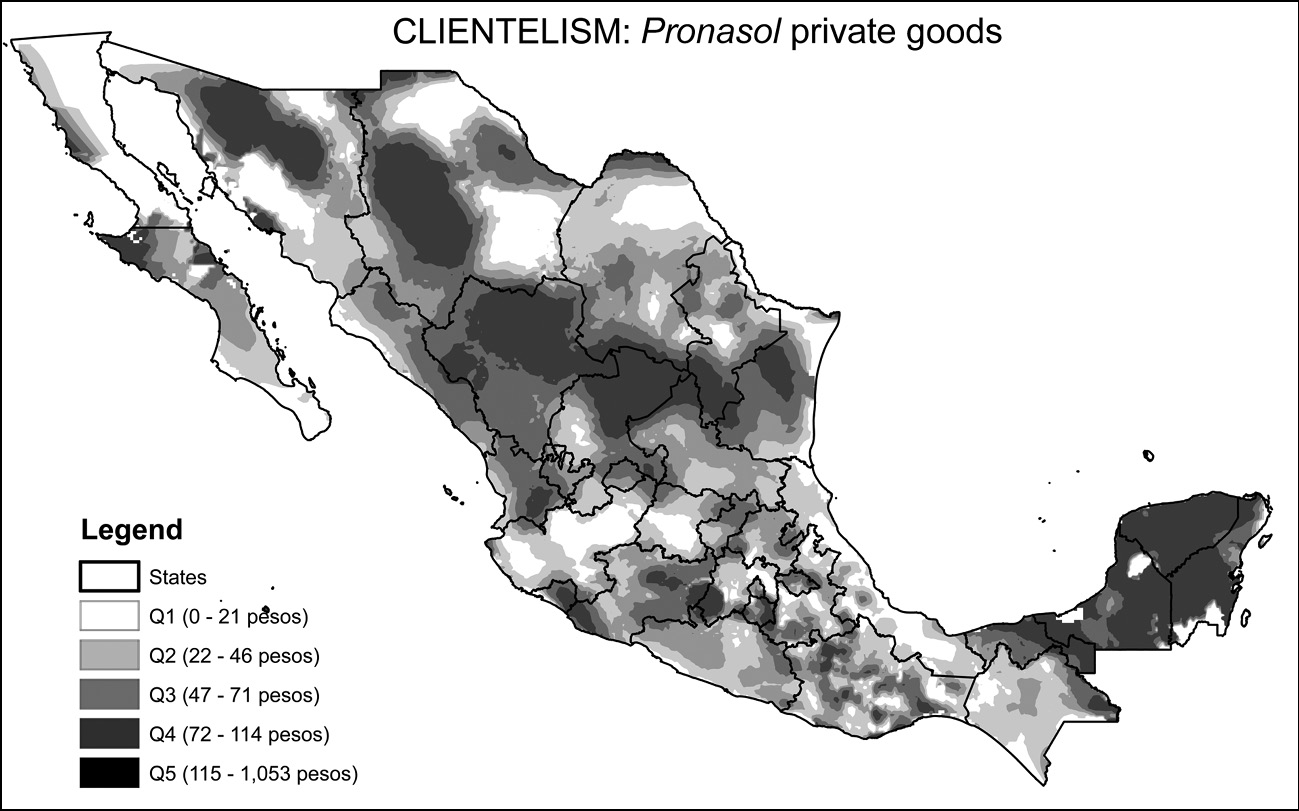
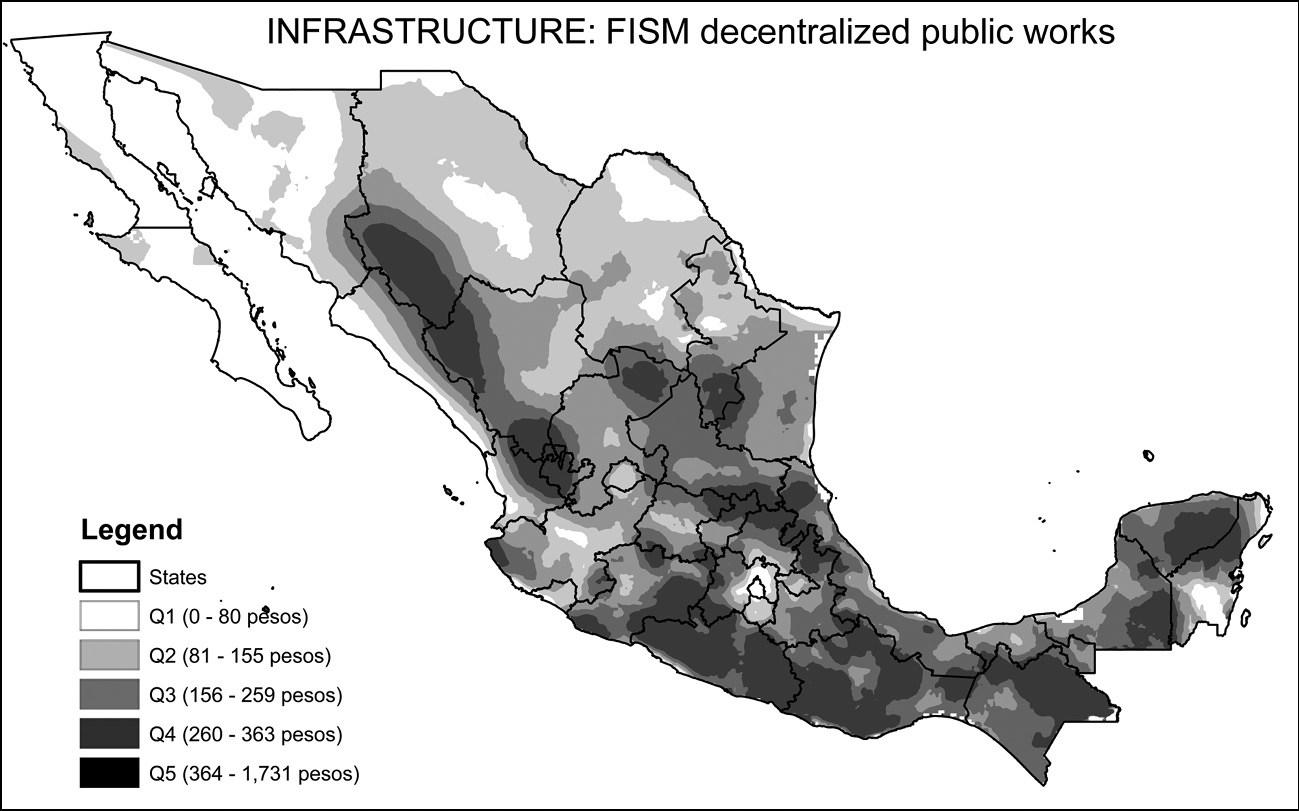
The map in the bottom of the second page shows the mean per capita allocation of Pronasol funds for private goods, measured in 1994 pesos, for the 2,417 municipalities in Mexico at the time, during the six years of the program (1989–1994).Footnote 13 Pronasol was made up of more than twenty programs, which we reclassified into projects providing private goods and projects providing public goods.Footnote 14 The map in the top row of that discretional column shows the public goods allocations of Pronasol for the same time period. The map in the top left cell shows the mean allocation of municipal social infrastructure funds (FDSM/FISM) from 1996 to 2000, also in real per capita terms.Footnote 15 The final map in the figure in the bottom left cell shows the mean per capita allocation of Oportunidades funds from 2001 to 2005.Footnote 16
In order to render the visualization of highly disaggregated data more effective, the maps show smoothed surfaces of spending estimated in similar fashion to temperature or rainfall maps. This is created through a third degree spatial polynomial of spending over 30 neighboring municipalities in the territory (in the rainfall analogy, this is similar to having 2,430 weather stations, and the surface is generated by something similar to an average of their readings over the territory). The isolines shading the maps establish contours of territory with similar levels of funding, just like in a typical topographic map.
Despite their widely different levels of development, all municipalities in Mexico received at least some funds from each program. The different criteria for selecting beneficiaries are reflected in the geographic patterns observed in the figure. The magnitude of the funds involved in each program varies widely. Pronasol public goods comprised the largest appropriations, followed by FISM. Oportunidades funding is substantially smaller than the private goods component of Pronasol, which was less than half of the public goods allocation. The programs were different from one another in several respects: Pronasol included funding geared towards large infrastructure investment in highways, sizeable transfers devoted to financing local public goods and transfers to individuals and organized groups. FISM has a narrower scope, providing direct municipal financing for local public goods selected and administered by local governments. Progresa provided CCTs to individual households in rural areas only, while Oportunidades expanded the rural coverage of Progresa to urban beneficiaries using the same basic design of the CCT program.
The most notable feature to emerge from a visual comparison of the maps is the marked difference in the geographical distribution of funds. An even shading of any map would mean that funds were distributed in an equal per capita amount across municipalities, rather than targeted to poorest localities. Maps with contrasting dark and light shades indicate more unequal allocations or, in this context, better targeted allocations. Areas of the country with greater concentrations of poor households should deservedly have more funds allocated to them than richer regions.
A comparison of the mapping of poverty and the distribution of social program outlays (Figures 2.2 and 2.3) suggests that the program that most closely matched poverty profiles across space is Oportunidades. FISM funds also show a remarkably similar distribution to the one found in a poverty headcount ratio. In contrast, private goods provision in the Pronasol program was concentrated in Northern Mexico and the Yucatán peninsula, not necessarily the poorest areas of the country. Very low allocations of those funds were observed in the state of Veracruz on the Gulf coast, and in the western highlands, particularly in the state of Jalisco. The distribution of Pronasol public goods is somewhat distinct: large amounts of funds were allocated in some Northern states, while smaller ones went to central areas, particularly the region North of Mexico City. An assessment of whether there is enough of a match between the territorial distribution of public funds and the mapping of poverty is developed in future chapters.
2.4 The Political Landscape
Our focus in this book is on how social programs are shaped by political and electoral considerations, and how these programs impact welfare and voting decisions. In much of the analysis of the book we take into account the partisan identity of incumbents at the municipal level and the degree of competition they face. The complexity of capturing the political landscape of a country is reduced, to some extent, by the existence of relatively nationalized political parties. Through patterns of observed electoral support we are able to know something about the configuration of political preferences across the territory, which can be used as convenient shorthand for more complicated interactions between individual politicians, communities, and voters.
The first map shown in Figure 2.4 displays the support for the PRI in the 1994 federal elections, which yielded a PRI victory despite strong challenges from both the PAN and the PRD. The first thing to note is that, although the party no longer enjoyed the levels of electoral support it had grown accustomed to in the hegemonic era, it still commanded very large majorities in most municipalities in the country. Shaded in white are places where the PRI candidate Ernesto Zedillo received less than 42 percent of the vote; and in dark grey the municipalities where he got more than 50 percent of the vote. The municipal map visually exaggerates the importance of northern support due to the larger territorial size of municipalities in that region, but nevertheless it attests to widespread support for the PRI throughout the country, with the exception of greater Mexico City, the western highlands and parts of the south. A striking correlation is apparent between the geography of Pronasol expenditures displayed in Figure 2.3 and the geography of PRI support. This correlation will be systematically explored in subsequent chapters where we will develop a measure of PRI core support using long-term electoral returns from 1970 until 1988 that are exogenous to later expenditures. The positive correlation between this measure of PRI core support and expenditures will be the subject of our statistical models in Chapter 4.
Electoral geography.
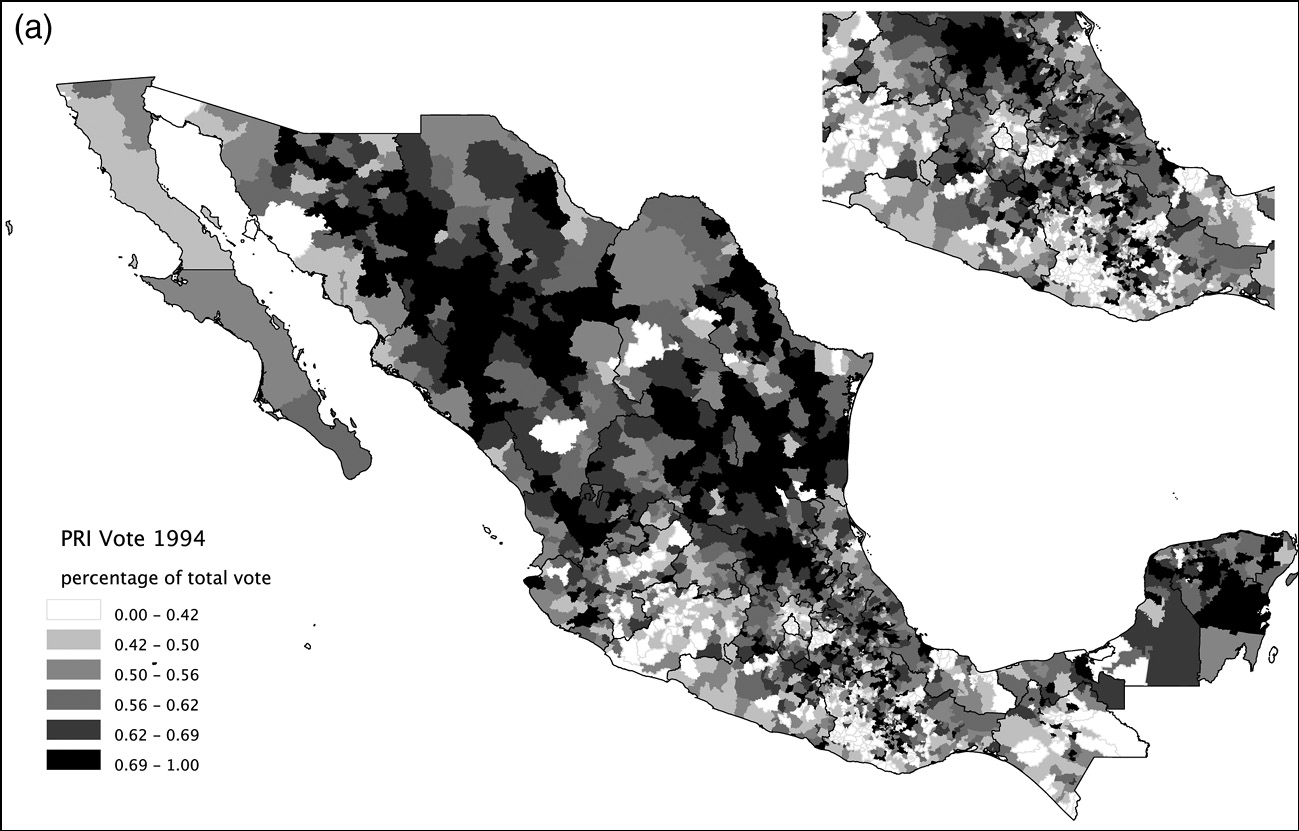
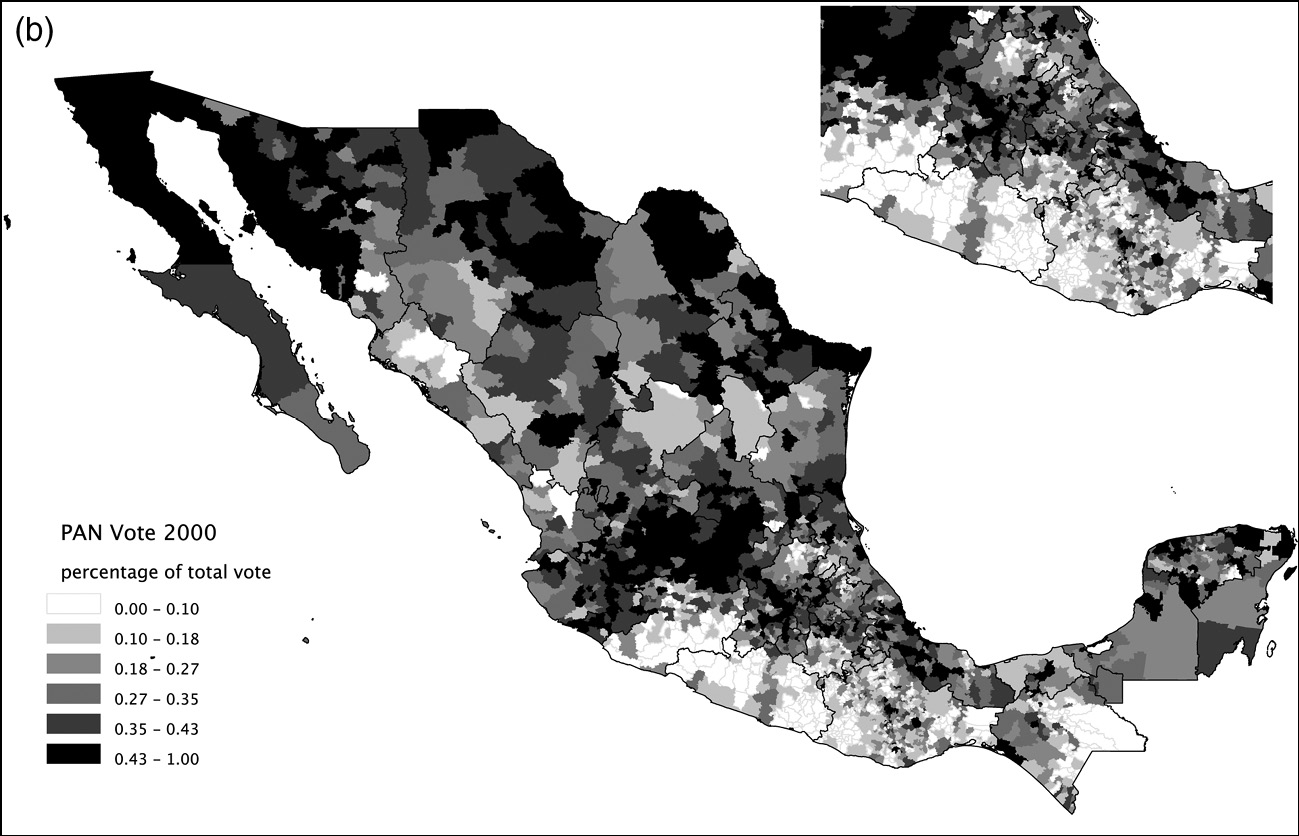
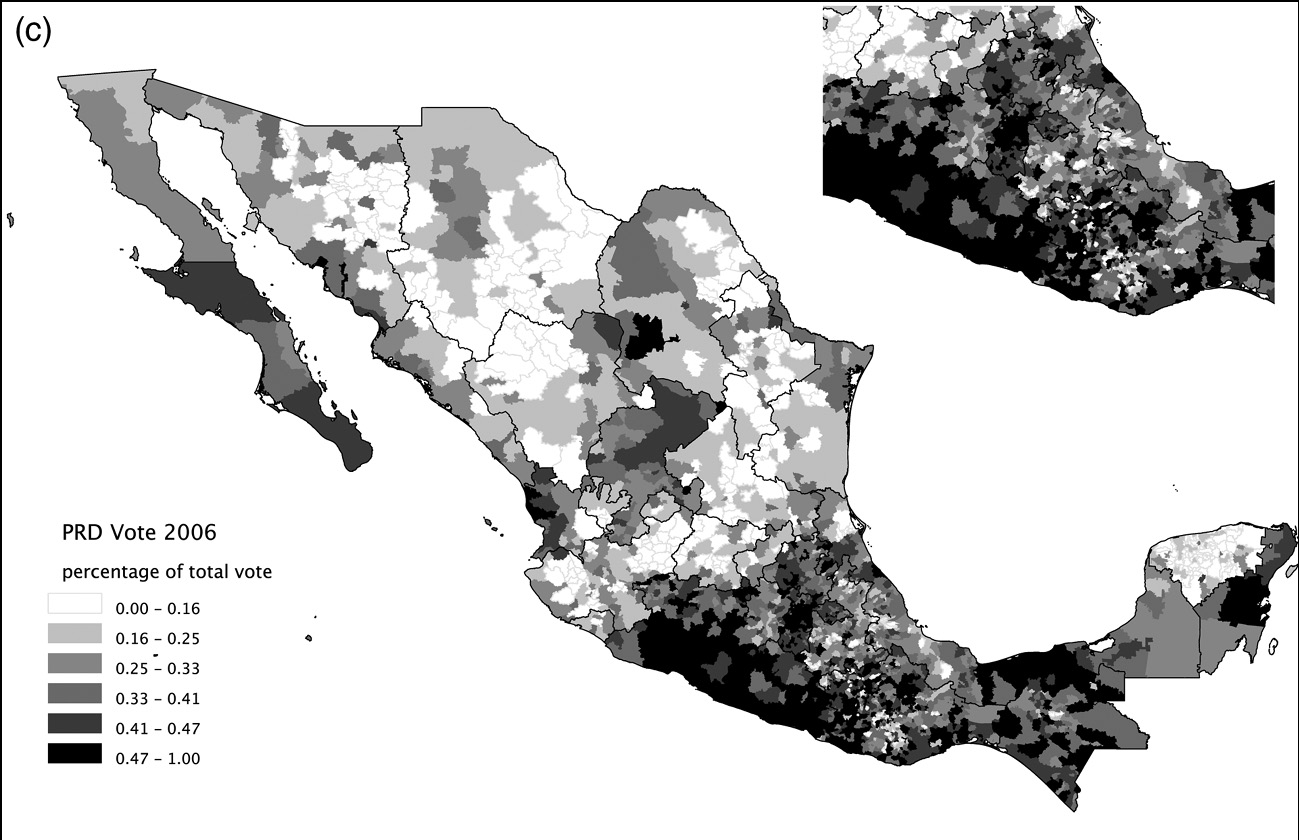
The second map shows the distribution of vote shares for the PAN in the 2000 elections, with the general shading indicating some regional contrasts in support. The highest vote shares for the PAN appear in the western highlands, the northern border and scattered municipalities in central Mexico. The party appears extremely weak, with vote shares below10 percent, in the south, where most of the poor concentrate. In contrast to the PRI map above it, the levels of support for the PAN across municipalities were much lower than those enjoyed by the PRI, even in elections that the ruling party lost. A simple visual comparison between the poverty map in Figure 2.2 and the PAN’s electoral returns in 2000 displayed in Figure 2.4 highlights its scant support among the rural poor when it won the presidency in 2000. In Chapter 8 it will become apparent how the PAN was able to increase its electoral base among the poor in the 2006 presidential elections, expanding Oportunidades during Vicente Fox’s presidential term.
The third map shows levels of electoral support of the PRD in the 2006 elections, which candidate Andrés Manuel López Obrador lost by a small margin based on officially sanctioned results. We use 2006 to map the PRD’s vote because that is the year of the left’s strongest performance in national elections. In the Southern half of the country, PRD strength appears to be highly correlated with the distribution of poverty in Figure 2.3. In the Western highlands and the North, that is not the case.
Although the three maps reflect different presidential elections spanning twelve years, taken together the maps tell an important story about the character of electoral competition in Mexico. From the mid-1990s onward, partisan competition in federal elections has strengthened, but in clearly defined territorial patterns. The PRI is electorally competitive throughout the country, generally facing challenges from the PAN in the North and West and from the PRD in the South. The PAN and the PRD, however, rarely compete against each other in any particular municipality, state, or region. Truly three-party elections are mostly observed in the central region of the country, especially in greater Mexico City, and in some urban districts in the rest of the country.
While the federal electoral results provide a good overview of the conditions that make Mexican electoral politics so vibrant and competitive, it is important to note that democratization did not just come about as a national process. Local processes of alternation in political power, where the PRI had no other choice but to recognize its defeats in municipal and eventually state-level electoral contests preceded the transition to democracy. Figure 2.5 provides an indicator of the process of democratization from a local perspective, by showing the years since an alternation in mayoral races taking place in each of the municipalities.
Municipal democracy: years since party alternation.

Alternation at the local level provides an unambiguous indicator that the PRI no longer held a monopoly of representation, even if voters may have decided to allow that party to return to political office in subsequent elections after its defeat. The general pattern displayed in the map shows, first, that virtually all municipalities have had some alternation by 2006. In this sense,despite the deep entrenchment of party bosses and machines in various regions, democratization from below is undeniable.
Second, democratization from below does not seem to obey a particular territorial logic or be simply driven by modernization processes. While in the early 1990s capital cities in the states and relatively rich municipalities were more likely to vote against the PRI, as democratization advanced electoral victories of the opposition were observed throughout the country.
It is perhaps not so surprising, in the context of these electoral challenges, that PRI governments strategically used the distribution of poverty relief resources. The political imperative of the party was to remain in office, and prevent further erosion, in the face of vigorous competition by parties. The next chapter moves to the task of providing a theory of how politicians address electoral threats using the distribution of transfers to voters as a way to buy off political support; the chapter after that assesses the success of that strategy for the case of Pronasol during the Salinas years.
Core supporters will not long tolerate a
party that delivers benefits to outsiders.
3.1 Introduction
Poverty-stricken places are seldom transformed by growth- and welfare-enhancing policies steadfastly applied by government actors. Instead, politicians opt to target the poor with private, excludable benefits which tend to peak at election time. In many developing countries without a propoor bias in social spending, clientelism is often the only safety net available to them. In turn, they frequently reward political parties that engage in these practices. The poorer the voters are, the more they are trapped in this relationship of material dependence. Classic studies of political clientelism emphasize that this form of exchange thrives where voters are poor. For example, James Scott (Reference Scott1972a) argued that patron-client links are based on poverty and inequality and the fact that the “patron is in a position to supply unilaterally goods and services which the potential client and his family need for their survival and well-being” (p. 125).
This chapter provides a formal model of machine politics. We build on existing theories of distributive politics, originally developed for understanding the determinants of discretionary welfare transfers in consolidated democracies (Dixit and Londregan, Reference Dixit and Londregan1996; Cox and McCubbins, Reference Cox and McCubbins1986) and on more recent models of clientelism (Stokes, Reference Stokes2005; Nichter, Reference Nichter2010).
Most of these models focus on what Nichter (2010) calls short-term electoral clientelism. We define clientelism as the voluntary exchange of discretionary private transfers for votes, whose continuation is contingent upon demonstrable political support.Footnote 1 That transfers be discretionary is key to our definition of clientelism, making the allocation criteria explicitly political. Since most of a party’s electoral investment strategies are embedded in ongoing relationships and programs that translate into accumulated benefits that accrue beyond elections, our theory is not focused on campaign handouts and vote buying on the spot market.
Our theory departs from the literature in two fundamental ways. First, we conceive of parties and voters as engaged in strategic interactions that extend indefinitely into the future. Second, we posit that partisan loyalties are conditional – a product of past political exchanges that are embedded in a relational network. Prior models of distributive politics rest on the assumption that a core or loyal voter’s proximity to a party remains unaffected by the party’s performance. Given this assumption, the loyal voter is captive, disposed to support her party no matter what, even after being cut off from the stream of patronage benefits (Stokes, Reference Stokes2005; Stokes et al., Reference Stokes, Dunning, Nazareno and Brusco2013).
This assumption is problematic. It implies that core voters are unresponsive to welfare benefits, which is particularly difficult to argue for developing societies. When voters are poor, they tend to base their decisions critically on material considerations – for example, what will provide for the next meal, a leak-free roof, medicine, or clothes and scholarships for their children. Ideology and other symbolic appeals are secondary considerations at best.
Our model posits that voters‘ partisan loyalties are constructed through a history of interaction with a party’s brokers and organizational networks.Footnote 2 Material exchanges play a fundamental role in this relational history. Voter loyalty is also conditional on whether the party can credibly signal that these exchanges will continue into the future. This is one critical reason why particularistic transfers usually spike at election time, as we will empirically show in subsequent chapters.
The theory allows us to understand, for example, why the Peronist party in Argentina funnels jobs and patronage to its own supporters, why the rules-of-thumb for political machines in the United States were to “hold what you’ve got” and “take care of your own” (Holder, 1975, cited in Cox and McCubbins, Reference Cox and McCubbins1986: 383), and why the PRI disproportionately delivered benefits to its loyal voters.
Our theoretical approach further answers some fundamental questions of strategy. When do politicians choose to buy votes with discretionary private goods and when with patronage for public goods provision? To what types of voters are these benefits targeted? The literature on distributive politics has for the most part ignored the fact that politicians have at their disposal a large basket of potential transfers to build and mobilize electoral support. This chapter develops a theory and the next one provides empirical evidence for a portfolio diversification logic driving the relative shares of private and public goods distributed in a given district. We provide expectations of how voters should respond to the different strategies of vote buying – namely, how many votes do particularistic transfers provide compared to public goods provision. We thus provide a more comprehensive picture of electoral investment strategies than that available in most studies of distributive politics.
In our view, party machines deliver particularistic benefits to their core voters and public goods to the population at large. Machines favor the exchange of particularistic and excludable benefits to core voters because these can be targeted with precision, rewarding supporters and punishing opponents. The targeting is critical because it solves problems of voter opportunism and reduces the costs of vote buying, allowing the machine to appropriate more rents. The clientelistic contract further allows the machine to deter voter exit through a credible threat of punishment (Magaloni, Reference Magaloni2006; Diaz-Cayeros et al., Reference Diaz-Cayeros, Magaloni and Weingast2001). Clientelism is self-sustaining, in our theoretical claim, because party and voters expect to interact into the future and can sanction each other for breaking the contract.
But political machines also rely heavily on public goods or pork-barreling projects. Public infrastructure projects, we demonstrate, are employed for electoral purposes when the politician’s base of electoral support falls below a certain threshold and the votes of a larger and more heterogeneous electorate are needed to win elections. Of course, there might be nonelectoral uses for both private and public goods transfers. In a classic article, Shepsle, Weingast, and Johnsen (Reference Sen1981) stress the private consumption gains that business or contract patronage entails for firms, labor, suppliers, and other interests, usually within the district but possibly outside it as well. Local public goods are rarely if ever “pure” public goods. We know that politicians and parties derive electoral benefits from pork-barrel spending, but our model provides an account of how it is used as a complementary strategy to clientelism in the face of stiffer electoral competition.
Our approach to machine politics is compatible with Calvo and Murillo (2011), who argue that voter-party linkages are not spot exchanges, but rather based on long-term interactions with partisan organizations and public officials. Machine politics is embedded in organizational networks where parties employ brokers, bosses, and patrons to acquire knowledge about local voters – their political predispositions, their reference groups and social networks, their patterns of political participation and their partisan affinities. Voters also develop distributive expectations as a result of their prior interactions with political networks (Calvo and Murillo, 2011). In their study, Stokes et al. (Reference Stokes, Dunning, Nazareno and Brusco2013) also emphasize long-term linkages in their broker-centered account of machine politics.
This chapter unfolds as follows. The next section highlights the two dimensions of government transfers relevant for the study of distributive politics. Section 3.3 places our theoretical approach within the core-versus-swing voter debate and studies of clientelism. Section 3.4 develops a formal model answering the core voter “puzzle”: why do parties invest in voters that are already likely to support them? Section 3.5 develops our theory of portfolio diversification to account for public goods provision. Machines that are under pressure from competition are caught in a dilemma: sustaining their electoral coalitions over time by taking care of their core voters, or maximizing their chances of reelection by catering to swing voters. The latter strategy can be advantageous in the short term, but is destabilizing over time. To solve this dilemma, we argue that machines can diversify their portfolio of electoral investments by targeting discretionary private benefits to their core voters and spending on public goods to attract the support of a wider set of citizens.
3.2 Discretionary Private and Public Goods
We classify distributive policies conceived as “instruments of electoral investment” according to two dimensions: whether their benefits are private or public goods and the degree to which there is formal government discretion, or leeway, to decide who benefits, when transfers are given, and when they are withdrawn. Private goods can be targeted to individuals and exhibit excludability of consumption, whereas public goods can be targeted only to localities or districts and their consumption is generally nonexcludable. Instruments of electoral investment are nondiscretionary when the program defines ex ante, in legal and abstract terms, those who can receive benefits and under what conditions. This programmatic redistribution differs from discretionary transfers or what Dixit and Londregan (Reference Dixit and Londregan1996) call “tactical redistribution,” which can take a variety of forms, including campaign handouts, subsidies, tariff protection, and pork-barreling projects. The focus here is on tactical redistribution – investments in discretionary private and public goods.
Discretionary private goods are excludable and reversible. Excludability allows parties to target benefits, rewarding and punishing voters according to their political loyalties. Many public works exhibit some degree of excludability because they are targeted to specific localities. Magaloni (Reference Magaloni2006) shows, for example, that Pronasol‘s social infrastructure projects generally bypassed municipalities governed by opposition parties. Nevertheless, when a bridge is built or a public clinic or school constructed, it is not feasible to exclude opposition voters in that locality from consuming their benefits. Public goods cannot be targeted with precision to punish opponents.
The second fundamental difference is their reversibility. Discretionary private transfers can be made for any length of time and can be withdrawn when the politician so decides. In contrast, public goods once in place are harder to withdraw: infrastructure projects such as roads and highways, bridges and canals, sewage and irrigation systems, public service facilities and power plants are fixed investments. In some cases, however, politicians may intentionally choose to forego maintenance of fixed investments. For example, in their study of Peru, Paxton and Schady (Reference Paxson and Schady2002) find that incumbents sometimes purposely neglect to maintain public infrastructure.
In the introduction we classified discretionary private goods as clientelistic transfers. Discretionary public goods transfers spent on infrastructure constitute what is often referred to in the literature as “pork-barrel” politics (Shepsle and Weingast, 1980; Ferejohn, Reference Ferejohn1974). Pork differs from clientelism in that its principal benefits cannot be targeted to the individual. Public goods, therefore, are subject to a commitment problem, since their benefits are widely shared, even by opposition backers. Yet public goods are more effective at reaching a larger share of the population and, consequently, building more encompassing electoral coalitions (Bueno de Mesquita et al., Reference Bueno de Mesquita, Smith, Siverson and Morrow2003; Chhibber and Noorudding, 2004; Magaloni et al., Reference Magaloni, Diaz-Cayeros, Estévez, Kitschelt and Wilkinson2007).
3.3 Core versus Swing Voters
There are two opposed models of discretionary transfers that focus on what Dixit and Londregan (Reference Dixit and Londregan1996) call “tactical redistribution.” The first model is the core-voter model, developed by Cox and McCubbins (Reference Cox and McCubbins1986), hereafter CM. Their theory begins by defining the conditions under which distributive politics will generate stable electoral coalitions. CM divide the electorate into three groups – core supporters, swing voters, and opposition backers – and ask which of these voting groups would reelection-minded politicians choose as the main beneficiaries of targeted transfers. These groups differ in what the authors call an “adherence dimension” – how responsive they are to transfers from a given party. In their model, core supporters are the most electorally responsive group because parties know their preferences and desires well, while swing voters and opposition backers are less well identified and less likely to be trustworthy. CM predict that risk-averse candidates trying to maximize electoral support will deliver redistributions first and foremost to their core voters.
The result of the CM model hinges on the assumption of risk-aversion on the part of politicians, on the one hand, and on the notion that core voters are less risky than other voters because politicians are in “frequent and intensive contact with them and have relatively precise and accurate ideas about how they will react” (Cox and McCubbins, Reference Cox and McCubbins1986: 379). It has become commonplace to critique the core-voter model for this depiction of politicians investing scarce resources in a voter group that is likely to vote for them regardless. We will address this critique and its premises in the following sections.
A second set of models predict that politicians should benignly neglect loyal supporters and instead target swing voters, who can be decisive for election outcomes and for whom a benefit transfer may incline their vote choice in favor of the incumbent (Lindbeck and Weibull, Reference Lindbeck and Weibull1987; Dixit and Londregan, Reference Dixit and Londregan1996; Stokes, Reference Stokes2005 and Reference Medina, Stokes, Kitschelt and Wilkinson2006). The Dixit and Londregan (Reference Dixit and Londregan1996) model, hereafter DL, begins by asking whom politicians running for office would target with discretionary transfers. Voter utility is a function of issue positions and private consumption; the parties’ issue positions are assumed to be fixed; and tactical reallocations of the budget are relatively flexible. Under the assumption that a politician’s transfers are feasibly and equally targetable to all voters (i.e., the “leaky bucket” is the same for each voter group) and that any incumbent will seek to maximize his probabilities of reelection (the key premise also for Lindbeck and Weibull, Reference Lindbeck and Weibull1987), the model predicts that politicians should favor swing voters, defined as those close to the point at which voters are ideologically indifferent to the alternatives.Footnote 3
The literature has attempted by various means to identify swing-voter groups. One way is to employ surveys, as in Stokes’ various contributions (Reference Stokes2005, Reference Medina, Stokes, Kitschelt and Wilkinson2006, and Reference Stokes, Dunning, Nazareno and Brusco2013). The other is to use aggregate vote returns.Footnote 4 “Under some assumptions about the distribution functions (i.e., symmetry and single peakedness) and parties’ objective functions, there will be a one-to-one correspondence between the density at the cutpoint and the closeness of the last election” (Dahlberg and Johansson, Reference Dahlberg and Johansson2002: 30). This is the reason swing voters are commonly credited with deciding a tight race at the district level.
Stokes (Reference Stokes2005) critiques these models for not taking commitment problems into account. “Both assume by caveat that the party will not renege on its offer of particularistic rewards once it has won the election. And they don’t deal adequately with the fact that a voter once in the voting booth can also renege by voting his or her conscience or preference ignoring the reward he or she received” (p. 316). To deal with commitment problems, she proposes a repeated interaction game in which parties can monitor voters’ actions and both sides foresee their interaction extending into the future. Her model builds on DL in that voters presumably are swayed by both the issue positions of the parties and the income and consumption transfers received from them. Stokes’ model generates predictions akin to those of the swing voter model. Loyal voters do not extract private rewards because they cannot vote against the party. “Such a threat would lack credibility: the party knows that the loyal voter, even without rewards, is better off cooperating forever than defecting forever” (p. 320). Weakly opposed voters and indifferent voters are the target of vote buying because, in her approach, only they can credibly threaten to vote against the incumbent in the absence of a transfer.
Nichter (Reference Nichter2008) departs from these approaches by arguing that parties buy turnout rather than votes. With the secret ballot, he asks, what prevents individuals from accepting rewards and then voting as they wish? He offers an alternative explanation, which he terms “turnout buying,” suggesting that parties will reward supporters for showing up at the polls in order to activate their otherwise passive constituencies. Whereas Stokes’s vote-buying model predicts that parties will target swing voters, Nichter’s turnout-buying theory predicts that they will target strong supporters.
Stokes et al. (Reference Stokes, Dunning, Nazareno and Brusco2013) provide an account of machine politics that stresses the importance of party brokers in targeting benefits to loyal voters. The model predicts that benefits will flow to core supporters because party brokers prefer to invest in them. Investment in the core can be very wasteful but generates opportunities for rent-seeking by brokers. The party leadership would prefer to direct investments to swing voters, an electorally more efficacious strategy, but cannot control their local agents nor their decisions over transfers. Thus, the core-voter model by this account is the product of misaligned incentives within parties that sustain strong agency losses. Investment in core supporters, in other words, is perverse.
The models discussed focus on short-term electoral clientelism and hence take party loyalty as exogenous. However, party’s investment strategies are embedded in ongoing decisions whose benefits extend well beyond election time. Our approach departs from the existing literature by conceiving of parties and voters as engaged in enduring strategic interactions. We further distance ourselves by positing that partisan loyalties are conditional – a product of the history of political exchanges and tactical redistributions tying voters to parties.
Most theories of distributive politics rest on the assumption that a loyal voter’s ideological proximity to a party remains unaffected by the retrospective tally of the party’s behavior. Given this assumption, the loyal voter is captive. Even when cut off from the stream of patronage benefits, she is assumed to continue to vote for her party because her ideological proximity remains unaffected (Dixit and Londregan, Reference Dixit and Londregan1996; Stokes, Reference Stokes2005; Stokes et al., Reference Stokes, Dunning, Nazareno and Brusco2013). This assumption is, at the very least, questionable. If the loyal voter is routinely ignored or disdained by her party, while other voter groups receive the party’s discretionary favors, she may well begin to distrust the party, avoid turning out, and even consider switching support to an alternative.
The literature on core and swing voters ignores this strategic dilemma because it takes partisan loyalties as exogenous. A party that exclusively targets swing voters would not be viable in the long run. In their classic study on social democracy, Przeworski and Sprague (Reference Przeworski and Sprague1986) emphasize this strategic dilemma. They argue that socialist parties that needed to mobilize the support of middle-class allies in order to win alienated their working-class core, which became available for political mobilization by other political parties on the basis of different political identities (religious or ethnic) or more extremist appeals (communist). The problem we consider here is analogous to the socialist party’s dilemma: machines risk losing their core supporters when they attempt to build broader coalitions by delivering transfers to voter groups outside the core.
Partisan loyalties cannot be modeled independently from welfare transfers. CM put this idea succinctly: if a “politician’s core supporters are those who will stick with him through thick and thin … then core support groups will be totally unresponsive and will be given nothing (in pure redistributive terms)” (Cox and MCubbins, Reference Cox and McCubbins1986: 380). However, as the authors note, “it seems irrational in the long-run for any group to be totally unresponsive to redistributions of welfare” (p. 382). Hence, swing-voter models generate the paradoxical result that core voters are unresponsive to welfare benefits and unmolested by their withdrawal.
Moreover, the common assumption that core voters will support a party no matter what is difficult to sustain in developing societies. Poor voters are typically more responsive to the delivery of pocketbook benefits. DL consider this possibility by positing a parameter that measures the relative importance of income and consumption gains to the voter. The higher the parameter, the more voters focus on transfers and the more “apolitical” they become (Weitz-Shapiro, Reference Trejo2014; Magaloni, Reference Magaloni2006; Stokes et al., Reference Stokes, Dunning, Nazareno and Brusco2013).
The swing-voter model is hence unable to explain machine politics in developing societies and their residual survival in developed ones, because it seems disingenuous to think that a political party succeeds by ignoring its core base. This is particularly questionable when a party’s core base is disproportionately composed of poor voters, as occurred with the PRI in Mexico and the PJ in Argentina and so many other party machines around the world.
Our working assumption diverges from these models. We posit that the poor’s partisan loyalties are constructed through material inducements rather than symbolic or ideological appeals. It is not that poor voters in the developing world do not exhibit strong partisan loyalties. The argument is that their partisan identities are constructed through a history of interactions in which material exchanges play a fundamental role.
To put an example, it is evident that few voters can be thought of as PRIístas or Peronistas because of ideological or programmatic considerations or because of a personal attachment to caudillos like Lázaro Cárdenas and Juan Domingo Perón. These parties, in fact, have no sharp programmatic platform and draw support from many social groups, although disproportionately from the poor (Gibson, Reference Gibson1996; Magaloni, Reference Magaloni2006; Calvo and Murillo, 2011). Moreover, most of their supporters were not alive when the caudillos held the stage.
Loyalty to these parties stems from the steady treatment of their loyal supporters as their core clienteles. This simply means that their supporters have repeatedly interacted with the party’s brokers to collect favors and transfers in the past, and that they hold expectations to continue to benefit from its spoils system into the future. Party loyalty in these settings is the product of on-going relations between voters and brokers within the party’s networks, in which the exchange of material benefits and political support plays a central role. In this context, loyalty reflects a voter’s sense of belonging to the relational network rather than like-mindedness.
We hence model the strategic interaction between a core voter and her party as a dynamic game in which her attachment to the party is a function of their history of political exchanges. Partisan loyalties are anchored in that history. We call this conditional party loyalty. The corollary is that partisan loyalty is weakened when a party neglects its core constituencies and delivers benefits mainly to nonloyalists.
3.4 A Theory of Vote Buying with Conditional Partisan Loyalty
To illustrate our theory of conditional party loyalty, consider the following game tree. A core voter must decide in the first period between voting for the machine or the opposition. The machine then decides to target side payments, rewarding or punishing voters according to their electoral choice. The core voter in the second period must decide whether to remain loyal to the party or change into a swing voter. The game results in eight possible outcomes, which we label a–h. The representation of the sequential game is presented in Figure 3.1.
A model of ongoing vote buying.

This game is an extension of Magaloni’s (Reference Magaloni2006) and Diaz-Cayeros et al.’s (Reference Diaz-Cayeros, Magaloni and Weingast2001) “punishment regime.” Their game has only one subgame in which the machine moves last. If the game is not repeated, the machine possesses no incentives to reward the loyal voter. Hence, an important difference between the “punishment regime” model and this one is that voters here are given a second move at time t+1. After the machine rewards or punishes, the voter can opt to remain loyal or not. The model assumes that voters reciprocate a party with loyalty only when they are rewarded and otherwise they become swing voters. A swing voter is not attached to any political party either by personal reciprocity developed through a history of interaction or through ideology. Hence swing voters are open to political mobilization. By adding this last move to the punishment regime game, we can better uncover why a machine decides rationally to fulfill its part of the agreement by rewarding its core voters.
In the lower subgame, the core voter defects to the opposition and the machine needs to decide whether to reward or to punish her. Following the logic in the punishment regime game, we posit that the machine prefers to punish defectors because otherwise it would generate perverse incentives for disloyalty. Once the machine punishes, the voter must decide whether to recuperate her loyal status, and be rejected again, or remain disloyal. The off-the-path equilibrium outcome in the lower subgame is, hence, that the machine punishes the voter who will remain opportunistic thereafter. In other words, disloyal voters who defect are never “bought back.”Footnote 5
In the upper subgame, the machine needs to decide whether to reward a loyal core voter or to betray her. This choice has no bearing on the current election because the core voter has already voted. In line with the swing-voter logic, the machine still has incentives to disappoint core voters. Yet in our model there is a clear benefit in catering to the core because party opportunism undermines the strength of political loyalties in future contests (outcome d). Worse, reneging on loyal voters helps to create the conditions in which a buyer’s market is changed into the opposite, a seller’s market in which a vote inevitably grows more and more expensive.
Hence, the machine needs to compare the utility from outcomes a and d when making its choice in the upper subgame. If the machine continually delivers transfers to its core voters, this reflects its concern to preserve and strengthen political loyalty into the future. Just how valuable this reserve of voter loyalty is for the machine needs to be evaluated against the temptation to betray the core voter in this period and the expected value of buying swing voters in future elections. To answer this question, we develop an infinite game of vote buying that formalizes these intuitions, which is explained in the following pages in detail.
Consider this scenario: a voter must decide between supporting the incumbent or the opposition, and the incumbent must in turn decide to reward the voter with a transfer, t > 0, or to punish her (t = 0). Stokes (Reference Stokes2005) highlights the commitment problem in this interaction. She solves the dilemma by repeating the game infinitely and positing that the players follow a grim-trigger strategy: cooperate until the other player defects and then defect forever. However, in her approach, loyal voters do not get transfers at all because their ideological proximity remains unaffected should the incumbent renege on his promises in the previous move, in any number of times the game is repeated.
We propose a different formulation of the problem. In our view, partisan loyalties are defined as a function of the history of interactions. Imagine that the incumbent party has to decide whether to buy a particular voter through a monetary pay-off. This voter can be characterized either as a core or a swing voter. The core voter will vote for the incumbent party today, even if she does not get a transfer. But if her party shirks, she will become detached from her party and begin to act like a swing voter tomorrow. Hence, core-voter support is apparently unconditional today, but tomorrow it is conditioned by the changing history of tactical redistribution.
Core-voter loyalty translates into certain electoral support, so that the probability of voting for the machine is equal to 1. The risk of core-voter opportunism is negligible. This is because core voters, once at the ballot box, have no reason to renege on the contract after having accepted the patron’s transfers. Money, transport, and other benefits might still be needed to mobilize core voters to the polls (Nichter, 2011),Footnote 6 but their vote choice is not in question. Swing voters are less proximate to the incumbent party and are not tied to it by a sense of obligation and mutual trust developed through a personalized history of exchanges. However, a transfer to a swing voter may convince her to support the incumbent according to a random variable s∼[0,1]. The expected value of swing-voter support (E[s]) is less than the certain value of the core voter because swing voters are riskier investments and can behave opportunistically. They can renege without serious consequence and, thus, are the true source of commitment problems in vote buying.
Following CM, our model assumes that it is less costly to buy off core voters because they are more responsive to transfers, given that the party knows their needs and desires better than those of voters not tied to the party’s organization. In other words, it is significantly less expensive to entice a voter to support you when he or she is personally tied to you, trusts you, and expects to interact with you into the future. Party brokers often know their core supporters by name, where they live, how many children they have, where they attend school, and what their needs and desires are. This informational advantage, Zarazaga (Reference Zarazaga2011) claims, allows party brokers to be aware of voters’ “reservation value,” or opportunity cost, and accordingly pay core voters the minimal amount necessary. Less attached to the party and its brokers, swing voters need more expensive favors to be convinced to rally to the vote buyer.
Let the transfer for the core voter be denoted by t. The transfer used in the effort to buy off the swing voter is set at t̄ > t. This means that the core-voter strategy is less expensive, allowing party elites to capture some rents: r = t̄ − t.Footnote 7
The choice for the party is restricted to the allocation of funds to either the core or the swing voter.Footnote 8 Given our formulation of the problem, the party may be tempted to exploit core voters whose support is guaranteed in the current election in order to pursue swing voters. Note, however, that the swing-voter strategy entails the following costs: (1) it erodes core voters’ loyalty for future rounds; (2) the party can appropriate fewer rents because it needs to spend more on transfers to buy swing voters; and 3) it is riskier due to the higher likelihood of swing-voter opportunism.
Suppose the party’s utility function is simply the difference between a benefit measured in votes, minus the cost of the transfer used to induce the vote. The party cares about future elections, but at the discounted rate 0>δ>1:
 (1)
We can describe the value of catering to swing or core voters assuming that the party’s decision in this election defines the stream of utility over time. To simplify, the party sticks to the same strategy – core or swing – in all subsequent rounds, and voters respond accordingly. This means that if the party chooses the swing-voter strategy, the core voter supports it in this election, but becomes a swing voter in all subsequent elections. If the party chooses the core-voter strategy, the party continues to deliver transfers to this voter and this voter remains loyal forever as she continues to receive transfers. The party’s utility functions of following a swing strategy, Us, and of following a core strategy, Uc, are given by:
 (2)
and
 (3)
The first utility function defines the benefits of betraying the core voter’s loyalty in this election by giving the transfer to the swing voter. The swing-voter strategy clearly condemns the party to buying votes on the spot market every time elections are held, which is a far riskier, more costly, and very inefficient strategy over the long run.
The second one shows the steady support of the core voter that is obtained by delivering transfers to her. This strategy is significantly less costly over the long run and entails a smaller amount of transfers to voters. The party will follow the swing-voter strategy if its utility is higher than what it obtains from favoring its core. Solving the infinite temporal horizon and substituting the transfers expressed as rents for the incumbent yields the following condition:
 (4)
This basically states that the party will shirk its commitment to the core voter when the expected value of the swing voter (the left-hand side of the expression) is larger than the present value of two different opportunity costs. The first is the gap between the certain support of the core voter and the unreliable support of the swing voter. The larger this gap (i.e., the greater the likelihood the swing voter will behave opportunistically), the more likely the party will pursue the core-voter strategy. This gap is discounted from the second interaction or move onward.
The second opportunity cost, accruing over time, is the discounted value of the stream of rents that would be obtained from investing in buying the vote of the less expensive core voter. The larger the stream of rents, the stronger the party’s incentive to choose the core-voter strategy. The core-voter strategy allows the machine to survive in office over the long run at lower expense. The machine, then, has strong and perduring incentives to construct and preserve partisan loyalties, generate rents, and minimize electoral risk. These are compelling reasons for parties to continue to invest in their loyal cores.
Clientelism entails a durable and stable relationship between a patron party and its core voters. When party and voter expect to interact into the future, it can be a self-sustaining contract. Loyal voters anticipate continued access to the spoils system and reciprocate the party with steadfast electoral support. Clientelism is also self-sustaining because both sides can sanction reneging on the contract: parties punish voters who defect and voters are unfaithful to parties that do not honor loyalty.
Robinson and Verdier (2003) argue that clientelism involves a strong commitment problem: what prevents individuals from accepting rewards and then voting as they wish? In their approach, the commitment problem is solved by privileging the distribution of jobs, which ties the political machine to the voter in a long-term relationship of mutual convenience. Voters will support the machine to protect their jobs, while the party will create and sustain jobs to keep its power over clients.
However, clientelism as a mode of vote buying encompasses many more transferable goods than job patronage. Politicians in the developing world often resort to the distribution of credit and cash handouts, production subsidies, food baskets, grain and livestock, fertilizer and other farming inputs, construction materials, household appliances, medicines, and so forth, because they are easy to distribute. Our explanation of how parties deal with the commitment problem is through repeated investment in established relationships with their core supporters.
The literature has overemphasized the violation of the secret ballot as a primary means of enforcing the patron-client relationship. Although direct observation of voting is advantageous, it is by no means necessary (Stokes, Reference Stokes2005; Magaloni, Reference Magaloni2006; Nichter, Reference Nichter2008 and Reference Nichter2009). Clientelism can be self-sustaining even with the secret ballot. In our view, machines do not need to monitor votes on the day of the election, but they should distinguish allies from enemies by tracking voter loyalties ex ante, an effort that requires dense party organization.
Voters are loyal to the machine because they expect to receive benefits today and in the future, and because they need these to survive. Voter loyalty to a machine is, so to speak, a form of insurance for its core voters, a ticket to a continuous stream of benefits. Normally, at election time the machine signals with the transfer of particularistic benefits to its core supporters that the clientelistic contract remains valid. Although partisan loyalties may involve a moral sense of obligation (Greene and Lawson, 2011), these loyalties and the consequent sense of reciprocity (Finan, 2010) are essentially conditional. If the machine fails to dispense expected favors, core voters will soon cease to feel obliged to reciprocate.
The core voter strategy is an equilibrium strategy under certain conditions that we discuss in turn. First, political parties need to be long-lived organizations that expect to last into the future. This presupposes certain stability in the party system, or at least that parties able to compete and survive over the course of several elections.
Second, our approach presupposes that party loyalty is not anchored in ideology, affect or symbolic appeals, but is conditioned by personal exchanges of material inducements and support. The model could be extended to accommodate different “tolerance thresholds” on the part of core voters and these thresholds can be made to vary inversely with the strength of some primordialist basis of party identification or with a voter’s ideology. The more captive the core voter is to ideology or to an affective source of partisan identification, the more parties can abuse them by catering to swing voters.
Third, the swing-voter strategy has one clear and undeniable advantage: it can make the difference in winning or losing the current election. The swing-voter strategy responds to short-term imperatives but is destabilizing over time because it undermines core-voter loyalties. Just how valuable those reserves of loyalty can be is clear when one considers that the alternative is to build more expensive, fickle, and uncertain electoral coalitions for every election and thus to encourage growing voter opportunism.
Finally, in the model the core-voter strategy is associated with higher rent extraction. Political machines capture more rents because core voters are presumed to be “cheaper” (or easily maintained), as long as they consistently receive the discretionary payments to which they have grown accustomed. Hence, the larger the price difference between swing voters and core, the stronger the incentives to maintain a core base of loyal voters through the delivery of particularistic transfers.
This approach allows us to generate several empirical predictions to be tested in subsequent chapters. The central empirical proposition emerging from our model is that a party will target particularistic transfers mostly to its core base, here defined as voters who regularly support the party who are linked to the party organization and have access to the system of spoils. Hence we evaluate the following hypothesis:
Hypothesis 1: Particularistic excludable transfers should be disproportionately directed to core voters.
A further empirical implication of our approach relates to core-voter leverage. Machines in our model offer transfer to their core to prevent their disloyalty. Machines then should intensify their clientelistic practices or delivery of private goods to prevent their core from eroding. If core voters cannot credibly threaten to exit, they retain little leverage to entice their party to cater to them. In the presence of a credible alternative to the machine, core voters are more likely to receive attention from their party. From this argument we derive the following two hypotheses:
Hypothesis 2: Higher levels of core erosion across electoral cycles should be associated with intensified efforts at retaining core-voter support through clientelism.
Hypothesis 3: If electoral markets are monopolistic, core voters may suffer benign neglect relative to places where electoral competition is stronger.
With respect to the opposition, the machine must issue credible threats to punish defection. This involves avoiding all attempts to reward disloyalty by “buying back” former supporters who have defected to the opposition.
Hypothesis 4: The machine should punish voters who defect to the opposition by withdrawing transfers from them.
Finally, we also expect to find effects for the electoral cycle. The machine fulfills its part of the bargain when it rewards core voters whose support is certain; it does so in order to reaffirm its commitment to them into the future and to prevent erosion of party loyalties. We expect parties to increase particularistic transfers prior to elections as a way of signaling these commitments.Footnote 9
Hypothesis 5: Machines should increase particularistic transfers prior to elections.
The temptation to buy swing votes on the spot necessarily increases in highly competitive elections when these votes can tilt the outcome. Machines under pressure from competition are hence caught in a dilemma. They can maximize their chances of victory by catering to swing voters, but at the cost of undermining core-voter loyalties. Machines can diversify their portfolio of electoral investments to solve this dilemma. We move now to the discussion of portfolio diversification and public goods provision.
3.5 Portfolio Diversification and Public Goods Provision
The literature portrays the investment decision between core and swing voter as an either/or strategy. The empirical record is mixed at best (Londregan, Reference Londregan2007). There are empirical studies that support the swing-voter logic (Schady, Reference Schady2000; Dahlberg and Johansson, Reference Dahlberg and Johansson2002; Stokes, Reference Stokes2005); others are consistent with the core-voter logic (Calvo and Murillo, Reference Calvo and Murillo2004; Hiskey, Reference Hiskey2003; Levitt and Snyder, Reference Levitt and Snyder1995; Nichter, Reference Nichter2008), and yet others who argue that not all core voters are alike and that machines target core voters in more competitive places while punishing the opposition (Magaloni, Reference Magaloni2006). Many studies conflate private and public goods.Footnote 10
Parties can devise strategies that allow them simultaneously to lock in their core and seek to expand their electoral coalitions beyond the core. Portfolio diversification, we contend, allows parties to accomplish this. Our approach is similar to Bueno de Mesquita et al. (Reference Bueno de Mesquita, Morrow, Sieverson, Smith, Bueno de Mesquita and Root2000) in that we argue that transfers for public goods can be used to expand the size of the coalition, while private goods can be employed to reward the core.
Most of the core-versus-swing voter debate has been conducted without paying much attention to broader patterns of political competition. Party systems, electoral rules, and levels of electoral competition shape incentives for engaging in vote buying. Some studies have examined these issues. Chhibber and Nooruddin (Reference Chhibber and Nooruddin2004) investigate the impact of subnational party system configurations on the propensity of parties to invest in private or public goods provision in their study of India. Drawing on Bueno de Mesquita et al. (Reference Bueno de Mesquita, Morrow, Sieverson, Smith, Bueno de Mesquita and Root2000), they predict that the relative importance of private versus public goods will be a function of the effective number of political parties. Using data from Indian states from 1967 to 1997, they show that public goods are more important in bipartisan contexts, where a larger size of the electorate is needed to win elections. In contrast, private goods provision is more prevalent in multiparty systems because politicians can retain power by delivering particularistic benefits to a smaller group of supporters.
Our theory of portfolio diversification was developed in Magaloni et al. (Reference Magaloni, Diaz-Cayeros, Estévez, Kitschelt and Wilkinson2007). We summarize it here and use it to derive our hypotheses on public goods provision. Political parties must decide how to allocate a basket of discretionary transfers to voters that range from private, excludable outlays that can be individually targeted, to nonexcludable public goods that are targeted to districts and consumed by all voter groups. As instruments of electoral investment, these transfers differ in their relative budgetary cost, their expected electoral return defined as the number of voters they benefit, and their level of electoral risk.
Our theory of portfolio diversification assumes a positive correlation between expected yields and risks: risky investments yield higher expected electoral returns. Public goods are risky electoral investments, we claim, because they can’t be targeted – everyone, including opposition backers, can enjoy them. Private, excludable transfers, if properly targeted to a party’s core base, are risk-free but they may not yield the highest electoral return, since fewer voters can normally be targeted through clientelism. Moreover, governments face budget constraints, which means that they might not be able to buy every necessary vote with particularistic, excludable benefits.
The problem of finding the politically optimal allocation of public versus private transfers is determined by budget constraints, the size of the core base of support, and the incumbent’s risk aversion. These conditions in turn depend on how cheap it is to buy votes from core constituencies. Hence, the central feature of the socioeconomic theory of clientelism, namely, the association between poverty and clientelism, is accounted for in this model by the demand-side assumption that it is cheap to buy votes from the poor.
A party’s optimal strategy, then, is to diversify its allocation of funds between public and private goods, devoting a proportion of the budget to public goods, and the remainder to private ones. This mixed-basket strategy yields a higher overall return, taking advantage of the electoral opportunities afforded by public goods provision, while hedging risks through an optimal combination with the risk-free investment.
The proportion of public goods allocations will be higher:
1. The smaller the size of the party’s core base.
2. The higher the costs of vote buying through clientelistic transfers.
3. The higher the vote threshold necessary to obtain victory.
4. The smaller the difference in yield between the two types of goods.
5. The lower the risk of the public good.
6. The less risk-averse the politician with respect to the risk-hedging function of clientelism within his investment portfolio.
Hence, we expect that political machines will diversify their portfolio of electoral investment and deliver public goods when the size of their core is not certain to sustain them in power. Public goods provision in our approach results from competitive pressures, pushing machines to cater to a wider set of voters. We evaluate the following hypothesis:
Hypothesis 6: Machines should spend more in public goods when pressed by electoral competition.
Machines diversify their portfolio of electoral investments to solve the perpetual dilemma of catering to core-versus-swing voters. Our approach highlights the virtues of political competition for the provision of public goods, but does not predict that clientelism will disappear with it. Clientelism can serve as a risk-hedging strategy under conditions of political competition and hence we do not expect politicians to abandon it altogether.
Finally, the expected yield of private goods provision varies inversely with income. It would be exceedingly costly to establish a solid base of core support on the basis of particularistic transfers when voters are wealthier. Politicians face budget constraints that compel them to find a combination of public and private goods that is electorally optimal and feasible. Moreover, rich voters are not likely to respond to particularistic transfers the way poor voters do.
Hypothesis 7: Public goods provision should be higher at higher levels of development.
3.6 Conclusion
Much of the extant theory on distributive politics has portrayed investments in core supporters as irrational. Yet strong empirical evidence in comparative studies points to the hard fact that parties target core constituencies. This chapter has developed a model of distributive politics that makes sense of this empirical regularity. Our argument that parties must invest in loyal voters is consistent with CM, although we derive these results from a different formulation of the problem that, we believe, better portrays the strategies of vote buying in the developing world.
Our model departs from the notion that partisan loyalty is exogenous. Where ideology and other symbolic appeals are but feeble sources of partisan identity, political parties are compelled to construct voter loyalty through relational networks and a history of exchange in which material inducements play a fundamental role. Partisan loyalty so constructed is essentially conditional.
Our conditional loyalty theory allows us to derive a logic of why machines devote a disproportionate amount of resources to their core supporters. We have claimed that machines target their core voters with particularistic, excludable transfers to keep them loyal over the long run. Our model demonstrates the benefits of owning a reserve of core voter loyalty. Voter loyalty serves to mitigate the perpetual risk of voter opportunism that vote buying on the spot entails.
Honoring core-voter loyalty also translates into clear material benefits for political machines. The core voter strategy allows the machine to appropriate rents because it can survive without having to transfer as many resources to core voters as it would in order to create new support coalitions with every election.
Although beneficial to each individual core voter, the clientelistic linkages trap them in a relationship based on material dependence and is sustained through a credible threat of punishment. Voters who defect to the opposition will be excluded from the stream of present and future benefits. This means that voters are loyal to the machine in part because of their access to a stream of welfare benefits, and in part because of fear of punishment. The dilemma is one of voter coordination. Each voter acting alone has powerful reasons to remain loyal to the machine because if she does not, she will be excluded from the spoils system. But if everyone reasons likewise, the machine can be sustained in equilibrium.
The following chapter will evaluate our empirical predictions through an analysis of the six-year duration of the Pronasol program in Mexico.
A political party may employ one of two basic strategies in its efforts to attract voters […]. It may distribute divisible benefits – patronage of various sorts – to the individuals who support the party. Alternatively, it may distribute collective benefits or appeal to a collective interest.
4.1 Introduction
The Pronasol program was inaugurated in what today is known as Valle de Chalco Solidaridad, a municipality located in the State of Mexico, on the eastern outskirts of Mexico City. It split off from Chalco as a separate jurisdiction in 1994 and was renamed Chalco Solidaridad after Pronasol. At the end of the 1970s, Chalco was a rapidly expanding shantytown, as people began migrating out of Mexico City in search of land. By the 1980s, the valley was occupied by nearly a quarter million people living without potable water, paved streets, medical services, schools, or electricity. In the 1988 presidential elections, the people of Chalco voted two to one against the PRI. The PRI was so unpopular that the prospect of a visit from recently elected President Salinas filled officials with fear.
Salinas’ team carefully planned a magical spectacle for his visit to Chalco, where it was decided that he would announce his strategy to “put an end to poverty.” He invited more than thirty intellectuals and public opinion leaders to accompany him and spread publicity about the visit. They spent the night hosted in the humble homes of local families to gain perspective on the impact of Salinas’ new poverty-reduction strategy. For his first act, as President Salinas walked down the dark, dirty streets, the newly installed public lighting turned on for the first time, illuminating the faces of a still-skeptical audience. Salinas then came to a raised podium where he opened a public faucet to release a gushing flow of potable water. As Chalco inhabitants shouted in unison “ciérrale, ciérrale” (“turn it off, turn it off,” repeating a public campaign slogan against wasting water), Salinas told them that he wanted to make very clear that this time “government promises were for real,” and that the new public services were here to stay. The hope was that after witnessing what some residents still remember as a “miracle,” Chalco voters would handsomely reward the PRI in future elections.
Impressive as it sounded, the program over the long run did not do much to reduce the number of Mexicans living in poverty. Salinas devoted more than $15 billion in federal funds to the program. State officials, governors, municipal authorities, local party brokers, and community leaders were all branded with its symbolic ribbon: a red, white, and green braid that represented Mexicans working in solidarity. The emblem was placed on every project across the country. There was also continuous government propaganda, such as TV ads that showed touching scenes of women, children, peasants, old people, and farm laborers, all being helped out of poverty by the program. In the aggregate, public infrastructure projects covered 72 percent of all expenditures. A large share of these resources was spent on the construction of interstate highways that were not particularly beneficial to poor citizens without automobiles. Particularistic transfers (construction materials, credit to small businesses, tractors, scholarships, etc.) accounted for 28 percent of all Pronasol expenditures. Yet with the passing of time the program’s portfolio changed. By 1994, close to 40 percent of the funds were devoted to clientelistic transfers.Footnote 1
In this chapter we perform a systematic analysis of the political logic of Pronasol‘s vast operations. We test our predictions about the political factors shaping politicians’ decisions to invest in core versus swing voters and to transfer private versus public goods to buy votes. By modeling these logics, we will demonstrate with systematic evidence that Pronasol was driven by the PRI’s inescapable need to sustain its core constituencies, staunch the erosion of its dominant-party status, punish and deter further exit to the opposition by municipal electorates, and to claim credit for reversing six years of deteriorating social and economic conditions in the wake of the financial collapse of 1982.
We focus on Pronasol for three main reasons. First, our theory of vote buying is about discretionary transfers, and political and bureaucratic discretion was the touchstone of Pronasol. The program was characterized by the discretionary selection of projects and beneficiaries, with input from voluntary “solidarity committees” at the community level (Kaufman and Trejo, Reference Kaufman and Trejo1997). However, in virtually all cases, it was organized at the top and run initially from the Office of the President and later from the Ministry of Social Development (Sedesol) (Bailey, Reference Bailey, Cornelius, Craig and Fox1994). Equally centralized was its system of financial control and coordination, with the Finance Ministry directly routing federal transfers to localities as well as earmarking revenue-sharing grants for state governments.Footnote 2
Second, we are interested in understanding what makes poverty-alleviation programs effective or ineffective. Pronasol was ostensibly designed to alleviate poverty and the program became the cornerstone of government social policy. However, as we will demonstrate in later chapters, the program’s results were disappointing. Results in this chapter suggest that Pronasol failed to help the poor because the program was administered with the overarching goal of sustaining the PRI’s electoral hegemony by locking in voters through clientelism rather than seeking to reduce poverty.
Third, Pronasol distributed excludable private transfers as well as public goods, which allows us to assess our thesis of portfolio diversification. Pronasol was a large umbrella, comprising twenty subsidiary programs that involved a wide range of benefits delivered over six years to every municipality in the country. These included private goods – such as student scholarships, worker retraining grants, and temporary employment schemes – and club goods for producer groups, especially cheap credit and financial and managerial support for a privileged network of small businesses (known as empresas de solidaridad) as well as rural infrastructure for ejidos, the semicollective peasant farms still tied organizationally to one of the PRI’s corporatist pillars. Pronasol also included a broad list of small-scale social and economic infrastructure projects as well as a very large program of municipal block grants for public works and maintenance.Footnote 3 Finally, there were two special programs that dedicated funds to the construction of regional hospitals and state and interstate highways, spanning numerous municipalities and states.
In order to discern the motives beneath Pronasol‘s vast operations, we model the per capita allocations for each municipality over six years as total, private, and public goods, as well as the share of particularistic transfers in the total sum of allocations to every municipality during the Salinas administration. We equate particularistic transfers, as explained in the introduction, with clientelism and discretionary public goods projects with pork-barreling.
We proceed in two steps. The first is to model total municipal-level allocations from 1989 until 1994 without taking into account how municipal elections held between those dates might have changed yearly allocations. We call this the “centralist” logic of the program, designed with the overarching goal of sustaining the PRI’s electoral dominance at the national level. Although Pronasol was a highly centralized program largely engineered out of the office of the president, it was operated by a vast network of state governors, municipal presidents, and local party brokers. The second step is to model the extent to which Pronasol’s allocations responded to the short-term dynamics of local elections, including the timing of municipal elections, their level of competitiveness, partisan divisions in the local electorate, and the partisan identity of municipal government. We call this the “peripheral logic” of the program.
Our overriding hypothesis is that the bulk of Pronasol‘s allocations, for both private and public goods, should favor the PRI’s core constituencies. Yet our conditional party loyalty model generates more nuanced predictions than simply claiming that more transfers are conferred upon hegemonic bastions. This is because not all loyal municipalities are alike. In some places, the PRI had a virtual electoral monopoly with no opposition presence; elsewhere, loyal voters had credible exit options. Our theory leads us to expect that the PRI would target more particularistic transfers to loyal municipalities whose support is expected to weaken in upcoming elections if the party fails to deliver benefits. We operationalize our notion of conditional party loyalty by looking at the dynamics of party loyalty over time. In particular, we expect the PRI to increase its clientelistic practices in loyal municipalities where voters’ partisan attachments are eroding.
Our theoretical approach argues that party machines will diversify their portfolio of electoral investments, targeting the party’s core with particularistic benefits while delivering public goods where the party’s core is not strong enough to win elections. Our expectation is that politicians should emphasize public over private goods provision when they need to attract more heterogeneous voter groups to win an election.
A substantial amount of research has already accumulated on Pronasol, but we depart from this body of work in several respects. Many studies employ state-level data for specific years (Molinar and Weldon, Reference Molinar, Weldon, Cornelius, Craig and Fox1994; Bruhn, Reference Bruhn1996) or, when looking at municipalities, focus on limited samples (Hiskey, Reference Hiskey2003). Only Magaloni (Reference Magaloni2006) and the present study cover all Mexican municipalities over the lifespan of the program.Footnote 4 Molinar and Weldon claim that Pronasol funds poured into communities where the PRI had its poorest showing in the 1988 presidential elections. Taking our Chalco example as emblematic, this is the so-called buy-back strategy, meant to persuade localities that bolted in 1988 to return to the fold. Using municipal-level data for two states, Hiskey (Reference Hiskey2003) claims that Pronasol money went to hegemonic bastions where the PRI won with the largest margins of victory. Critiquing these results for their strong endogeneity problems and using municipal-level data for the entire life of the program, Magaloni (Reference Magaloni2006) shows that the PRI followed an “entry-deterrence” strategy in which opposition-controlled municipalities were systematically punished with fewer funds while loyal municipalities in more competitive contexts were rewarded by the PRI. Our results here are consistent with Magaloni (Reference Magaloni2006) in that the bulk of Pronasol’s programs were targeted to hegemonic places where loyalties were eroding, as opposed to the most secure bastions. But our analysis diverges when we dissect Pronasol’s allocations for targeted particularistic goods versus public goods. We build upon the theory of conditional party loyalty, which dissects the PRI’s strategic decisions better.
Furthermore, whereas previous studies have mostly focused on one or two programs (see articles in Cornelius, Fox and Craig, Reference Cornelius, Craig and Fox1994), our work encompasses all of Pronasol‘s programs. In order to assess the welfare effects of Pronasol (discussed in Chapters 5 and 6) as well as its political logic, we have classified programs into the general categories of private and public goods provision.
This chapter is organized as follows. The next section proposes a new approach to the measurement of core size. The third section is dedicated to the overarching logic that informs Pronasol by offering support for our claims that core municipalities received disproportionately larger transfers and that hegemonic decline spurred intensified clientelism. This section also discusses the relationship between economic development at the municipal level and the distribution of clientelism and pork within Pronasol, questioning the conventional view that clientelism is endemic to settings of poverty and largely absent from wealthier regions. The last section explores the peripheral logic of Pronasol, gauging the effects of municipal elections and local partisan configurations on program transfers.
4.2 How to Measure Core Support
When focusing on aggregate electoral data, the conventional measure for core support of a party in Mexican electoral studies is its most recent vote share. But core support should not be measured using short-term indicators, for two reasons. The first relates to problems of endogeneity that stem from the fact that vote shares at time t are likely to be shaped by allocation decisions at time t and t-1. “Since there may well be serial correlation and an effect of expenditures on elections, studies that disregard the possibility of simultaneity must be treated with caution” (Schady, Reference Schady2000: 298).Footnote 5
But there is a second, theoretical reason why a party’s core support should not be inferred from vote returns of a single election: partisan loyalties are long-term attachments. A party’s core backers are those voter groups that honor partisan loyalties beyond one election, a form of stable support not readily captured by myopic measures of election results. Indicators like vote shares or victory margins in the preceding electoral cycle do not unambiguously reflect long-term attachments, and might be attributable to factors idiosyncratic to that election. Instead, underlying trends in the electoral history of local jurisdictions divulge more information about the dynamics of partisan loyalties than the vote returns of a single election.Footnote 6
Students of Mexican electoral politics have long documented a clear modernization trend since the 1960s, in which the PRI gradually lost support across the country, especially in places exhibiting higher levels of development. Nevertheless, the PRI retained secure electorates in vast regions, often running uncontested for decades. After the devastating financial crisis of 1982, the process of dealignment from the hegemonic party became more pronounced, progressing at varying paces throughout the country, with some hegemonic bastions holding steady, others slowly drifting away, and still others showing rapidly deteriorating support for the PRI. During this time of contested hegemony, short-term electoral indicators fail to give an accurate picture of voter loyalties. In particular, conventional measures of party support – vote shares, the closeness of electoral races as measured by the margin of victory, electoral competitiveness reflected in the effective number of parties, and electoral volatility understood as net intertemporal vote swings – do not capture the deeply rooted partisan attachments that were crucial for building and sustaining hegemony over several decades.
Core support and stable partisan attachments, we contend, should be inferred from the long-term evolution in a party’s vote shares. Thus, we focus on long-term voting trends in municipal elections. Long series of electoral returns summarize a great deal of information about the evolution of partisan loyalties and about the capacity of party cadres and brokers to deliver the vote for the PRI. Our theory leads us to predict that parties should target their core base with largesse, particularly when voter loyalty is conditional on the delivery of benefits.
In order to identify conditional party loyalty we calculate two variables that are distinct from vote shares, margins, competitiveness, and volatility. The first one measures the size of the PRI’s core in each municipality. The second one captures the erosion of partisan attachments through time. This means that for each municipality our estimations describe not only the size of the PRI’s core, but also the extent to which loyalties are stable, as measured by a time-sensitive level of erosion of core support.
The size of the core and the rate of erosion of loyalty in each municipality are calculated using data from 1970 to 1988. The data is truncated on both ends because there is no available compilation of municipal-level electoral data prior to 1970. After 1988, municipal electoral data suffer from an endogeneity problem given that Pronasol was enacted in December, 1988. To measure the size of the core, we borrow from asset-pricing analysis in the finance literature and regress the PRI’s average vote share in the country as a whole (VNi) on its vote share in each individual municipality (Vmi). Hence for every municipality we estimate, across time i, the regression is:
The alpha parameter measures core support, namely, the predicted value of the PRI’s vote share in a given municipality in the hypothetical scenario that the party receives no votes at the national level. Alpha conveniently captures the way in which local electorates behave independently of national electoral patterns in that it isolates the level of voter loyalty, as mediated by the local party organization and its brokers who mobilize electoral support for the party as a whole in that municipality.
In order to ensure that vote shares are bound between 0 and 1 we estimate the regressions in log-odds ratios. To understand better how alpha reflects the differential safety of each municipality, from the perspective of the PRI, one can express it in terms of an ordinary least squares framework:
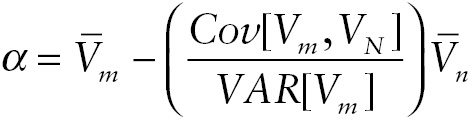
Notice that alpha represents how much higher or lower the average vote share in a given municipality is with respect to the national average vote share gained in all municipal elections that same year, but corrected by risk (the term in brackets). In these calculations, the PRI’s national vote share (VN) is not its support in federal elections, but rather its aggregate electoral support in all municipal elections held in different states between 1970 and 1988. Alpha is thus the predicted value of every municipality’s PRI vote, controlling for its national vote share in any given year in that period. The expected value of national vote shares is adjusted with the covariance between national and municipal electoral patterns divided by the variability of municipal elections.
By analogy with asset pricing, alpha measures the degree to which a municipality outperforms or underperforms the national market in municipal votes. “Excess returns” in elections, then, signal the skill or capacity of a municipal party, its office holders and cadres, brokers and candidates, organizational linkages and campaign strategies, in assuring relative support levels above the national trend. Chronic underperformance, in contrast, implies that municipal parties are unable to stem losses in any given election and are therefore vulnerable to takeover. The alpha parameter, in short, tells us how many more or fewer votes the PRI receives in each municipality, according to its known behavior in the past.Footnote 7
A useful illustration of the geography of alpha is provided in the municipal map in Figure 4.1. The darker zones have the highest alpha scores and include all municipalities in which the PRI held sway in uncontested elections or sustained its hegemony with at least 65 percent of the municipal vote since the onset of the series. The white zones are those with significant opposition presence, including several scores of municipalities won by opposition parties at least once between 1970 and 1988. The patent advantage of using log-odds ratios here is that they magnify opposition strength in a pattern spread throughout the country, when opposition presence was clearly marginal outside the big cities.
PRI core voter support.
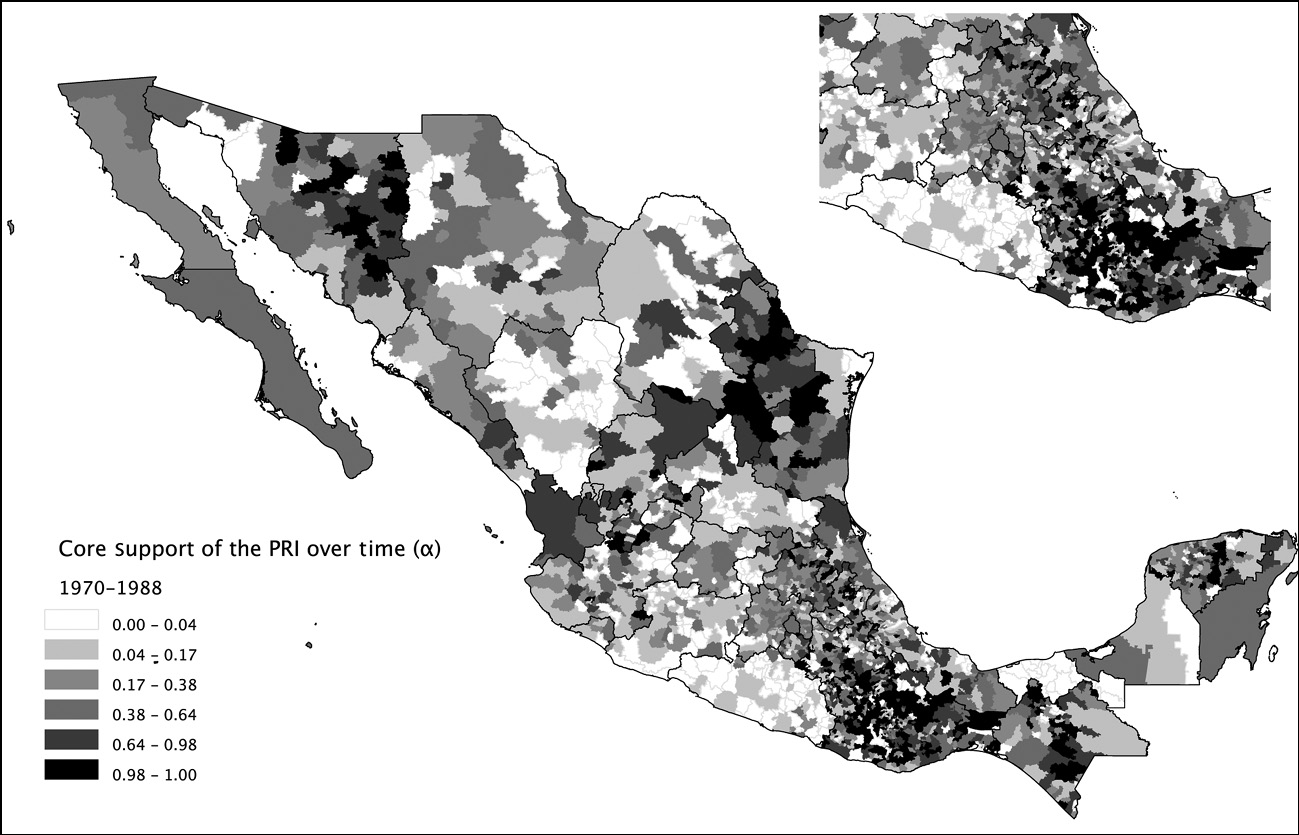
To measure the erosion of partisan attachments we use the linear trend in PRI municipal vote shares between 1970 and 1988. The trend is indicated by the slope of a time series regression for each municipality on a time trend of the form:
Note that this is not a pooled time-series estimation, but rather the calculation of separate regressions, one for each municipality, where T reflects every year an election is celebrated. In federal elections, on average, the PRI suffered a yearly decline of 1.25 percent of its national vote from the peak year of hegemony in 1961, when it garnered 91 percent of the national total, to the national elections of 1994. In municipal elections, the decline averaged 1.5 percent per year since 1970 over aggregated three-year cycles. In the case of municipal trends, the variation across units is large, given that the accumulated impact of demographic change, modernization, political and economic events, and other election-relevant factors on the party’s electoral fortunes was highly differentiated across the country’s states and municipalities.
The slope of each of the regressions captures the erosion of the PRI’s core support. Given the overall trend of decline for the PRI, this corresponds to the rate of dealignment from the party in every locality. As an analogy, the slope is the municipal trend in volatility specific to one party.Footnote 8 We term this variable decline. Higher negative numbers mean greater erosion of support over the years.
There is some overlap between erosion and the commonly used concept of volatility – more volatile municipalities do show more negative slopes for the PRI. But erosion and volatility are very different indicators. The conventional standard for measuring volatility in a party system is the Pederson index. However, this index suffers from the same deficiency as vote share in t-1 or first differences in consecutive election returns. Short-term volatility may simply not reveal sufficient information about the electoral dynamics of a jurisdiction. Instead, a long-term measure better reflects the cumulative effects of demographic change, geographical mobility, economic shocks, and political events in the historical dealignment from the PRI, as well as the slow but steady growth of opposition support in that period.
Figure 4.2 provides a scatter plot of our municipal measures of core size and its erosion. Naturally, there is a positive association between both variables, whereby higher levels of PRI core support correlate with lower levels of erosion over the years. Yet the figure shows that for any given level of core support on the horizontal axis, there are widely varying trends in electoral decline, on the vertical one. The average core value through 1988 was 0.47, while the average trend in dealignment was –0.29.
Correlation between core voter support and vote erosion (municipal level data using PRI vote shares from 1970 to 1988).
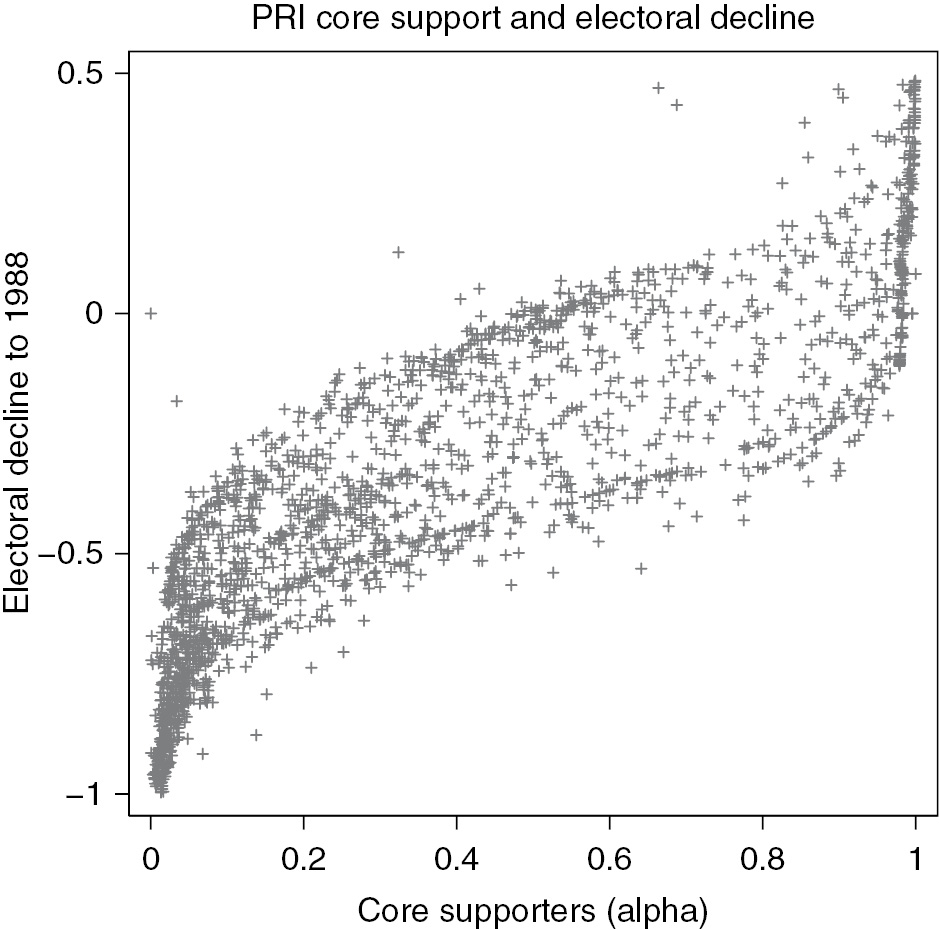
Our approach is to characterize each municipality by both core support and core erosion. Municipalities with high core support (large alphas) are loyal places. Loyal municipalities vote for the PRI in high numbers and remain reliable supporters even when other municipalities defect in response to economic recession, budget cutbacks, lack of jobs, currency devaluations, inflation, and so forth. Our theoretical expectations are that the PRI would invest resource transfers, for both private and public goods, in loyal places. But loyal voters are not all alike. Our core-voter model dissects loyalty according to levels of conditional core support. Some loyal municipalities exhibit little or no erosion of core voter support, while others have experienced a rapid deterioration over time. If core voters are not attended, they may defect and become swing voters in subsequent elections. This hypothesis leads us to expect that the PRI should concentrate its clientelistic practices in places where core size is shrinking in an attempt to lock-in still loyal voters.
With respect to municipalities with low core support (a small alpha), our theory leads us to predict an incumbent party’s disinterest in vote-buying through particularistic transfers. These small-core municipalities are places where the local party organization and its brokers have failed to mobilize strong support in favor of the PRI in one election after another. It is possible that in those places the local party organization is too weak and disorganized to be able effectively to target benefits. Voters in these places are also likely to be distant from the PRI and perhaps wealthy enough to desist from selling their votes to a corrupt party machine. Even when we do not expect the party to target small-core places with particularistic transfers, our theoretical approach proposes that the incumbent party should increase public goods provision for the purpose of attracting swing voters and even opposition backers.
Our empirical predictions according to how core size and erosion, our two main independent variables, shape Pronasol’s investments are: first, the bulk of Pronasol transfers for both private and public goods should favor settings of high core support, meaning that alpha should be positively associated with allocations.
Second, consistent with our argument that partisan loyalties are conditional and that clientelism is used to lock-in a party’s core backers, we expect private goods to be allocated preferentially to still loyal municipalities with higher rates of erosion (relative to those where erosion is negligible). Higher negative numbers mean higher erosions of core support; the effect of this variable should therefore be negative.
Third, we expect the PRI to allocate more public relative to private goods in small-core municipalities where the party must seek to build more encompassing electoral coalitions and cannot rely on its local agents to target benefits and carry the district. However, in line with the “punishment regime” approach, if the PRI has lost the municipality to the opposition in the past, we expect the PRI to punish these places with lower overall expenditures on public goods programs (Magaloni, Reference Magaloni2006; Diaz-Cayeros et al., Reference Diaz-Cayeros, Magaloni and Weingast2001).
4.3 Modeling Pronasol’s Centralist Logic
The model specification for our investigation of the centralist logic of Pronasol is exceedingly parsimonious. Aside from controls for population size and levels of development, our statistical model uses only three political variables: the measure of core size, the measure of core decline (both constructed with long-term municipal electoral data from 1970 to 1988), and the measure of electoral shock from the 1988 presidential election. We add this variable because there is consensus in the literature that this election led the PRI to enact Pronasol and influenced program expenditures.
The system shock in 1988 resulted from the split in the ruling party wrought by presidential contender Cuauhtémoc Cárdenas and his defeat in an election widely viewed as fraudulent. Cárdenas is the son of a former president, the revered Lázaro Cárdenas (president from 1934 to 1940). Cuauhtémoc split from the PRI, the party his father helped found, to form the group Corriente Democratizadora in 1987. The 1988 contest, by the official and much disputed count, saw the PRI lose almost a quarter of the national vote and created a strong and permanent opposition on the left. Following the bitter postelectoral conflict over the legitimacy of the vote count, president-elect Carlos Salinas promised a dramatic shift in social policy, aimed at poverty relief and social development after six years of a roller-coaster economy and stringent austerity in public finances. Pronasol mushroomed into being shortly thereafter. Apart from the effort to mitigate protest, stifle discontent, shore up legitimacy for the new government, and marshal support for other parts of its reform agenda, Pronasol was an attempt to revive a ruling party reeling from the split and the electoral meltdown (Dresser, Reference Dresser, Cornelius, Craig and Fox1994; Cornelius, Craig, and Cook, 1994). Numerous studies of spending patterns have stressed the specter of the 1988 elections in the new government’s effort to showcase its solidarity program, Pronasol. Specifically, this research highlights the purported attempt to buy back both the voters and the turncoat machines that defected to Cárdenas (Molinar and Weldon, Reference Molinar, Weldon, Cornelius, Craig and Fox1994; Bruhn, Reference Bruhn1996), finding evidence for a disproportional flow of transfers to states where support for Cárdenas was high.Footnote 9
In addition to being part of the conventional wisdom about the motives and uses of Pronasol, the buy-back thesis merits our attention because it counters our expectations about the association between voter loyalty and party largesse. In effect, it is a variation on the swing-voter model. If the PRI targeted defectors from its ranks in 1988, then it rewarded partisan disloyalty. But if it did not, as Magaloni (Reference Magaloni2006) finds, our hypotheses about conditional party loyalty would be buttressed.
In order to gauge the accuracy of the buy-back claim, we include the controversial measure of the PRI’s vote margins at the municipal level in the 1988 presidential race (1988 margin). This measure is controversial because the electoral data are incomplete. Electoral authorities at the time released the voting tallies for 29,999 precincts, out of a nationwide total of nearly 55,000, but never revealed the remainder’s vote counts. Once these partial data are aggregated into municipal-level figures, precinct coverage ranges from almost 100 percent (in big cities) to just under 10 percent (in more outlying rural municipalities). While the bias of underreporting might be distributed along an expected continuum of high to low opposition support, as the precinct moves away from the cities, it is nonetheless the case that the geography of the Cárdenas vote in 1988 – cutting a swathe from east to west across the middle and heavily populated part of the country – does not seem to fit the conjecture. The 1988 vote margins reach only a correlation of 0.20 with the alpha measure of core support for the PRI, and one of 0.07 with the measure of core erosion. This dissociation between federal and local voting patterns should allow for a clean test of the impact on allocation decisions of the electoral shock from 1988.
Control variables in the model are straightforward. The creators of Pronasol pronounced it a program for poverty relief and social development. It is a reasonable assumption that the census-based measure of poverty or social marginality, known as the CONAPO index, guided the allocations made within the program over the course of its existence. Developed by the Mexican government, the CONAPO index calculates the level of social marginality per municipality, using a set of indicators that include the percentage of the employed population living below the minimum wage, illiteracy, housing without access to sewage, electricity, drinking water, and population engaged in rural activities.
In addition to the CONAPO index, we include its square value (CONAPO2). In earlier work (Magaloni, Diaz-Cayeros, and Estévez, Reference Magaloni, Diaz-Cayeros, Estévez, Kitschelt and Wilkinson2007), we found a curvilinear relationship between private goods provision and development levels, with more per capita funds going to municipalities at medium levels of development. Here, the reason for including the quadratic expression is to test for its impact on other categories of Pronasol expenditures that we use as dependent variables. Figure 4.3 shows the per capita allocation of private goods according to development levels as measured by the poverty index. Clientelism (measured by particularistic transfers) exhibits an inverted J-shape relationship with development, even without controlling for other variables, which is striking from the modernization point of view. As we will demonstrate, this relationship does not depend on political configurations as reflected by the measures of core support and core erosion (nor other conventional measures of political competition, such as the number of parties).
Clientelism and development.
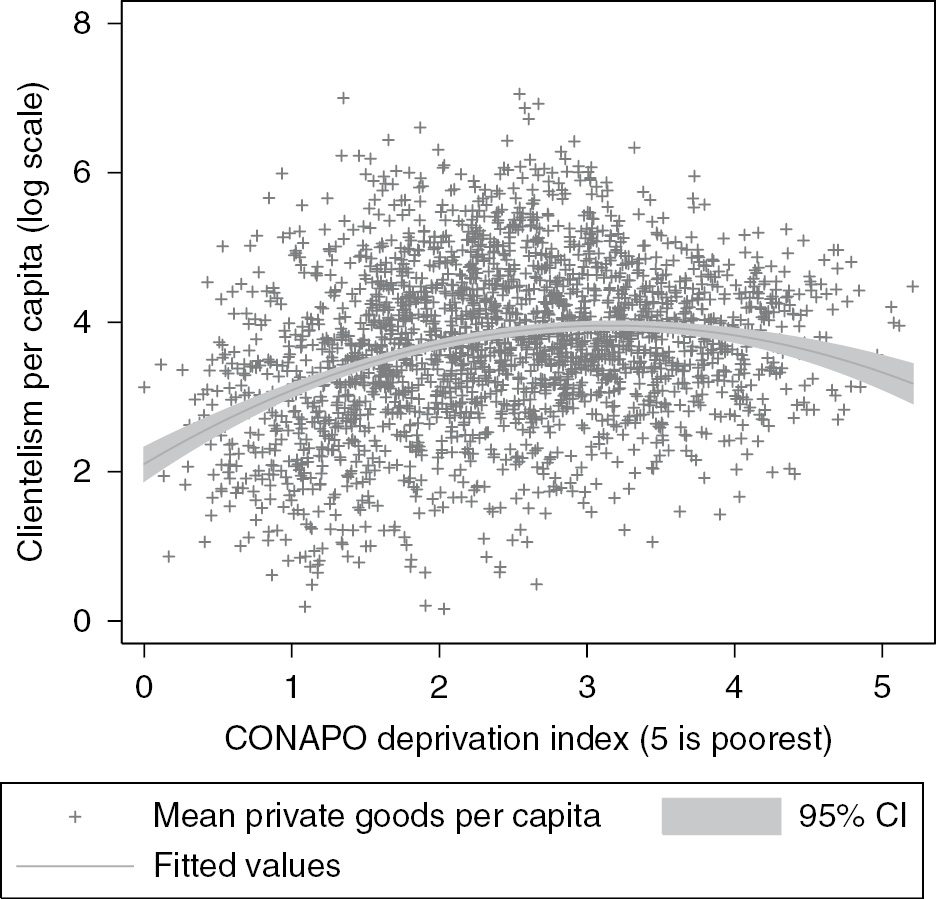
The finding that clientelism tends to decrease at the highest levels of development is consistent with the socioeconomic theory of linkage building, which states that richer voters’ preference for public goods provision over private transfers makes it too expensive for a party to attempt to buy them off through particularism (Kitschelt, 2000). Thus, clientelism tends to be greatly reduced, albeit never fully eradicated, at the highest level of development. Contrary to this theory, the Mexican case documents that clientelism is greatest at middle levels of development, not in the poorest localities.
The question arises as to whether core support, core erosion, and political variables in general respond to economic development. Our dataset allows us to separate the socioeconomic from the political processes that influence clientelism. In cross-national comparisons, development is correlated with political competition, and in Mexican studies, development levels usually show a strong inverse relation with PRI support (Klesner, Reference Klesner2000). Our long-term measures of municipal electoral behavior, on the contrary, are distinctly political. There is no correlation between the poverty index and the erosion of electoral support, as measured by our variable erosion (ρ = 0.05). Although poor localities tend to have larger shares of core voters, as one might expect, the correlation between the poverty index and alpha is modest at best (ρ = 0.24).
We also control for municipal size in the models, employing the natural log of population (logpop). To some extent, one should expect that large and more heterogeneous populations would be associated with higher development levels, but the Pearson’s correlation between logpop and CONAPO is 0.40, indicating that these variables measure different municipal-level traits. In another order of calculation, in the event large cities are favored with per capita expenditures, one could surmise a political interest in those jurisdictions with large raw voting power.
The dependent variables for the central models of Pronasol are mean municipal-level expenditures from 1989 to 1994. We run four cross-sectional models. Model 1 considers total per capita expenditures. Models 2 and 3 look at per capita private and public goods, respectively. These three are all expressed in logarithmic terms. Model 4 tests the shares of private goods within total Pronasol transfers to each municipality. In order to ensure that the estimations do not suffer from spatially autocorrelated errors, a spatial lag is included. We have calculated a (queen) proximity matrix of order 2 in which both the contiguous and the contiguous-at-one-remove values in the dependent variable are taken into account. The spatial weights and the regressions including the spatial lag were all run on GeoDA. Results are provided in Table 4.1.
| 1 | 2 | 3 | 4 | |
|---|---|---|---|---|
| Total PC Expenditures | Private Goods PC | Public Goods PC | Share (Private/Total) | |
| Spatial lag | 0.031 | –0.032 | 0.051 | 0.060 |
| (0.037) | (0.055) | (0.041) | (0.058) | |
| Constant | 7.305 | 3.866 | 7.065 | –0.057 |
| (0.257)** | (0.356)** | (0.274)** | (0.052) | |
| Logpop | –0.272 | –0.168 | –0.251 | 0.011 |
| (0.012)** | (0.020)** | (0.013)** | (0.003)** | |
| Conapo | 0.014 | 0.804 | –0.249 | 0.160 |
| (0.062) | (0.108)** | (0.069)** | (0.017)** | |
| Conapo2 | –0.008 | –0.132 | 0.037 | –0.028 |
| (0.012) | (0.020)** | (0.013)** | (0.003)** | |
| Alpha | 0.319 | 0.395 | 0.162 | 0.035 |
| (0.076)** | (0.130)** | (0.083)* | (0.021)* | |
| Decline | –0.233 | –0.628 | –0.048 | –0.103 |
| (0.068)** | (0.119)** | (0.076) | (0.018)** | |
| 1988 Margin | 0.192 | 0.033 | 0.250 | –0.028 |
| (0.038)** | (0.066) | (.042)** | (0.012)* | |
| N | 2422 | 2422 | 2422 | 2422 |
| R2 | 0.310 | 0.125 | 0.220 | 0.073 |
Note: Coefficients from OLS cross-sectional regressions of municipal-level allocations
(ln) from 1989 until 1994. Robust standard errors in parentheses.
* Significant at 5% level; ** significant at 1% level.
The initial result to highlight is that total per capita transfers averaged over six years show an extremely weak relationship to municipal welfare levels as measured by the CONAPO index (column 1). This is partially mitigated by a strongly negative relationship with municipal size, which rules out a big-district strategy for capturing large voter blocs. Thus, Pronasol funds, which were presumably intended to help the poor, were, in reality, spent with other priorities in mind.
The strictly electoral variables are unambiguous in their impact. First, larger overall transfers are strongly associated with the PRI’s traditional strongholds in municipal elections. The larger the core size for the party, as measured by alpha, the greater the total flow of per capita transfers. Second, the rate of vote loss over the long term affects allocations in the expected direction, with strong declines attracting higher levels of investment. Third, those localities staunchly loyal to the PRI in 1988 were favored with more transfers during the Salinas administration, while those that backed the opposition were punished, in relative terms. With respect to the overarching logic of Pronasol, a buy-back strategy aimed at voters who earlier had defected was not a systematic criterion in the geographical distribution of funds. Nor could it have been, since to bribe municipalities back into the fold would have established the wrong incentive by rewarding defection. In sum, the core-voter model and the notion of conditional party loyalty are strongly supported by these results with respect to total Pronasol transfers.
A more nuanced story about the core-voter strategy is told through the distinction made between the two basic types of electoral investment contained within Pronasol (columns 2 and 3). Our expectations are that core supporters will be preferentially targeted for benefits, in the form of both private and public goods. However, the objectives sought by the provision of private versus public goods will separate according to how threatening the core’s defection is in any given municipality. Our conditional party loyalty theory claims that locking-in the core and halting core defection is a key motive of clientelism. Public goods are not the favored instruments for keeping the core loyal. These claims are strongly supported by the empirical evidence. Consistent with our conditional party loyalty theory, the PRI tried to halt the drift of its core base through the intensification of clientelistic transfers rather than through the provision of public goods. The variable decline is strongly significant in the expected direction in models 1, 2, and 4, but not in model 3. These results provide support to our claim that clientelism as an investment strategy is intended to preserve preexisting core constituencies that might otherwise defect.
From columns 2 and 3 it is clear that small municipalities as measured by population size (logpop) fare better than large ones for both categories of electoral investment. However, the poverty index and its squared value assume diametrically opposed associations with the two types of benefit outlay. With respect to clientelism, one observes an inverted J-shaped relationship with development level. Intermediate levels of development (or poverty) attract higher levels of private goods provision, while the polar opposites on the scale are less favored by particularistic transfers. In the case of public goods provision, the opposite relationship holds. It is the poorest and richest ends of the development continuum that receive larger transfers for collective goods, while the intermediate levels obtain fewer of these benefits. At the same time, the coefficients for the quadratic expression are much larger in the case of clientelism, indicating a pronounced differential in distribution. The curve for public goods is flatter and seems to indicate almost a buckshot strategy, if not quite a universalistic one, for the distribution of collective goods at all levels of development. In any case, the important result that Pronasol did not particularly favor the poorest municipalities continues to hold.
The last model in column 4 tests for the determinants of the share of clientelism within the complete basket of Pronasol transfers to each municipality. In our view, a critical difference with respect to the debate over core- versus swing-voters is that investment diversification entails obvious advantages for incumbent politicians with discretionary funds available. It is probably the case that the larger overall share of public goods provision within Pronasol (an average 72 percent over six years) and the intense media campaign that accompanied its expansion served to shield from public scrutiny the clientelism that lay within the program and that increased in proportion over time. The specific combination of these investments for each municipality, we posit, reflected to some degree the risk assessment the PRI devised for each locality and balanced the imperatives of catering to its long-term core constituencies while claiming credit for collective welfare benefits.
The results of the diversification model are presented in the last column of Table 4.1. The poverty index shows an inverted J-shaped curve, much like that of per capita private goods transfers. Municipalities at intermediate levels of development obtain the highest shares of private goods, but the poorest municipalities still receive almost double the share going to the richest. Population size is positively associated with the composition of the portfolio, with higher shares of clientelism going to larger municipalities, but this result reflects lower relative transfers for collective goods than for private ones.
The alpha parameter reflecting core size is positively related to shares of clientelism, as it was (more strongly) for private transfer amounts. These results are an indication that, per our predictions, the relative share of public goods in the portfolio increases where the PRI’s core is smaller and the party faces stronger competitive pressures, a point that will become even more transparent when analyzing the peripheral logic of Pronasol with respect to local elections and local partisan configurations. Public goods provision is not as effective an instrument for the retention of partisan loyalties, but is used in places with low core support as a means of attracting non-core-voter groups. The measure for long-term electoral dealignment follows its earlier pattern, with intensified clientelism for those locations with higher rates of decline in PRI support.
Finally, the shock waves from 1988 skewed the distribution of total Pronasol funds in favor of districts loyal to the PRI in that watershed election. The results for public and private goods transfers within the program, however, reveal a differential impact of the 1988 elections. Most of the reward for loyalty in 1988 is concentrated in greater public goods provision, with disloyal districts assigned fewer funds for public works. Outlays for clientelism are unrelated to 1988 election returns.
To have a sense of the range of effects for our main explanatory variables alpha and decline, Figure 4.4 simulates the predicted values of per capita private goods provision or clientelism, according to varying electoral variables and with the socioeconomic controls and 1988 margins set at their means. Shown are three scenarios for alpha: a stronghold municipality at one standard deviation above the mean; another at the mean; and a third one at one standard deviation below the mean. The graph then plots the per capita transfers for private goods according to the rate of decline in party loyalty over time. The simulated effects for both variables are substantively important: a stronghold with stable support for the PRI receives a bonus of 8 pesos per capita over one with few core supporters; an unstable bastion obtains 20 pesos more per inhabitant than the amount going to the PRI’s weakest districts. Moreover, when the PRI’s rate of decline increases from the mean rate (–0.299) by one additional standard deviation (–0.682), per capita allocations grow by about 10 pesos; when it jumps two standard deviations (–1.164), the benefits almost double in value per head over those for municipalities at the average rate of dealignment.
Simulated effects of municipal electoral history on private goods.
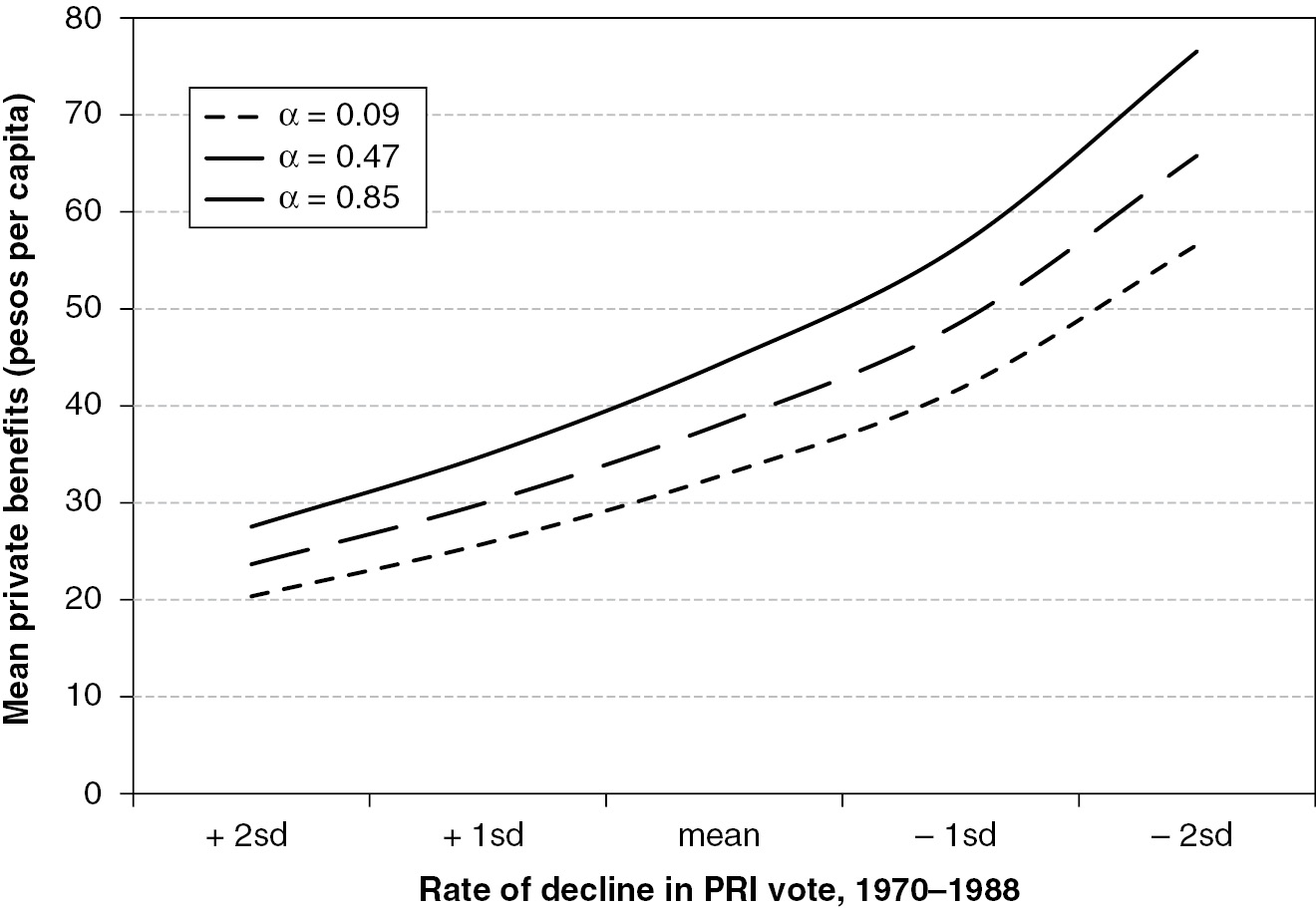
On the basis of these general models of Pronasol allocations, the conclusion is inescapable. Pronasol was a program designed and operated on behalf of the PRI’s core constituencies throughout the country and its expenditures markedly benefited municipalities consistently loyal to the ruling party. There is scant evidence in these models of behavior approximating the party opportunism of the swing-voter model. We also uncover strategic behavior by the PRI that resulted in more clientelistic transfers disproportionately targeted to municipalities where core support was eroding more rapidly over time due to a multifaceted process of development. Consistent with our theory of conditional party loyalty, the PRI used clientelism primarily as an attempt to lock-in its core base. Finally, there is no evidence of a buy-back logic. Disloyal municipalities, and especially those that supported Cárdenas in 1988, were punished with fewer per capita transfers. Overall, Pronasol’s total per capita expenditures were not targeted to benefit the poor, but to sustain the PRI’s electoral hegemony, to block if not destroy the embryonic party formation that resulted from the Cárdenas split, and to lock-in ruling party voters through intensified clientelism.
4.4 The Peripheral Logic of Pronasol
The partisan heart of Pronasol should beat just as strongly when faced with more immediate or short-term challenges such as election schedules, local party systems, and the party label of local incumbents. Our expectations are that the investment strategy adjusted to every municipality’s political facts on the ground will reflect the dependence of the national incumbent on the party machines and operators who reliably turn out the vote and govern localities in alliance with party higher-ups.
To this point we have focused on Pronasol‘s political motives as centrally devised, driven by national electoral imperatives, including safeguarding hegemony and maximizing electoral support across the board. But as we have emphasized, Pronasol’s operations on the ground were run through a vast network of politicians and officials, including state governors, municipal authorities, local party brokers and community leaders, as well as centrally designated Pronasol delegates. In this section we assess the extent to which local and regional politicians were able to shape Pronasol’s investment strategies to attend to their district’s electoral needs. We ask in particular if Pronasol’s disbursements responded to municipal election schedules, local party system configurations, and the party label of local incumbents.
Our expectations are that the investment strategy adjusted to every municipality will continue to reflect a core-voter orientation. However, we expect to observe some tinkering of Pronasol according to local election calendars and expectations about the competitiveness of coming municipal elections.
Municipalities, of course, range widely in terms of their levels of electoral competitiveness and their party system configurations. Small cores in one set of localities translate into lower vote shares, tighter electoral margins, and a larger effective number of competitors within the municipal party system. In such places, it is unlikely that mere cultivation of the core constituency will produce victory in any upcoming election. Electoral competition, then, should oblige incumbent politicians to appeal to segmented electorates beyond their normal constituencies through policies and promises that entail a broadly cast net of welfare benefits generated by public goods provision – thus, the imperative of diversification in the choice of electoral investments.
In addition to previously used socioeconomic controls and the lagged values of the dependent variables, the peripheral models respecify the political and electoral variables used earlier. In the peripheral logic models, we are dealing with pooled-time series, where our dependent variables vary from year to year, rather than cross-sectional models. Here we include dummy indicators for election year, one for federal elections held in 1991 and 1994 (national election), and another for election years in the staggered municipal calendar (local election). It should be noted that in Mexico’s busy election calendar, municipal elections take place in staggered three-year cycles, meaning that every year there are municipal elections taking place in different states. If national and local politicians took electoral dynamics into account in their allocation decisions, we expect both variables to be positively associated with our dependent variables.
Also included are electoral variables strongly related to the political measures specified for the previous models but which highlight more telltale features of partisan control and competition during the years of the Salinas administration. We propose a typology of competitiveness from the perspective of the PRI, which incorporates the influence of the electoral legacy of the 1970s and 1980s and dissects its strength in the 1990s. The typology comprises four exclusive categories of municipal competition:
1. Monopoly is defined as a one-party municipality in which the PRI had an unbroken string of victories with at least 65 percent of the vote in every election since 1970, and ran uncontested (100 percent of the vote) during the Salinas administration.
2. Hegemony is defined as a municipality in which the PRI registered vote shares between 65 and 100 percent from the 1970s to the Salinas years, but faced opposition on the ballot.
3. Marginals is the label given to all other municipalities governed by the PRI, though they are not, strictly speaking, marginal districts, but rather competitive ones, in which an opposition party has sufficient strength to count as a viable contender in any local election.
4. Opposition refers to municipalities governed by any opposition party.
This simple typology of competitive challenges faced by the PRI at the municipal level is defined in terms of mean alpha and decline scores (Figure 4.5). Predictably, the categories of monopoly and hegemony exhibit much larger mean cores than competitive municipalities. But only monopoly provides a stable electoral trend over time. The municipalities corresponding to opposition and marginals are practically indistinguishable in terms of their electoral legacies.
Mean core size and trends by level of competition.
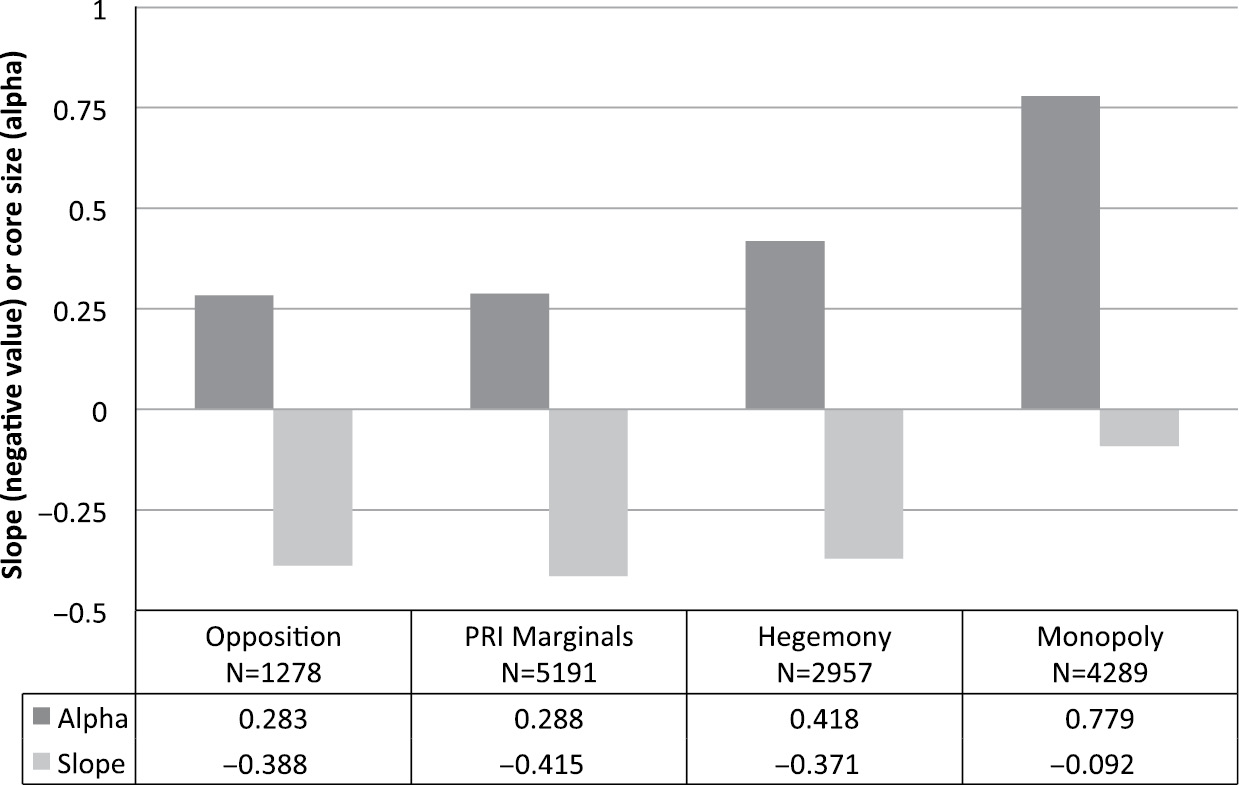
In line with the results from the central models in Table 4.1, we expect in these peripheral models that the highest per capital funding levels should go to hegemonic municipalities where alpha is large but, in contrast to monopolistic electoral markets, strong erosion of PRI support over time has occurred. Although PRI marginals and opposition municipalities possess very similar electoral legacies, they should receive very different treatments, the latter being unambiguously out of favor, consistent with the notion of a punishment regime. Once again, this punishment strategy is inconceivable within the swing-voter model.
More conventional indicators of competitiveness also differentiate these categories in predictable ways. Table 4.2 describes the Laakso-Taagepera index of the effective number of parties (N), as well as the mean absolute margin of victory in municipal elections held from 1989 to 1994 for the four categories. While the PRI’s monopolistic and hegemonic municipalities could endure the loss of one standard deviation in votes, or the entry of 0.5 competitors as measured by the Laakso-Taagepera index, without facing high odds of losing the municipality, the same was not true for competitive municipalities. If the ruling party had staked its interests in winning competitive municipalities, logically it should be expected to invest more heavily in them, following the imperatives of the swing-voter model. Our theory holds, instead, that core constituencies should continue to reap the benefits of electoral investment.
| Effective N | (sd) | Margin of Victory | (sd) | |
|---|---|---|---|---|
| Monopoly | 1.224 | (.401) | 0.807 | (.308) |
| Hegemony | 1.585 | (.516) | 0.518 | (.264) |
| PRI Marginals | 1.825 | (.785) | 0.276 | (.242) |
| Opposition | 1.437 | (.980) | 0.288 | (.266) |
There are two strategic exceptions to this general expectation. First, monopolistic or noncompetitive elections in which the ruling party runs uncontested do not require a high ratio of clientelism-to-pork transfers because core supporters have no credible exit option. Second, we claim that the PRI should diversify its spending by investing in higher shares of public goods in competitive or high-N municipalities, which, not coincidentally, are the municipalities with small PRI cores.
To explore this facet of investment diversification further, we include municipal-level N in the peripheral model, in line with Chhibber and Nooruddin (Reference Chhibber and Nooruddin2004). However, since the local structure of competition during the period 1988–1994 is clearly affected by Pronasol expenditures, we instrument the effective number of municipal parties with its value in t−1.Footnote 10 This instrumented measure of
 captures, then, the effect of an expected competition structure in any municipality.
The results for the peripheral models are presented in Table 4.3. The first two models test for per capita allocations in private and public benefits, respectively, and the third for the relative share of private goods within the total basket of municipal funds. Since we explore the effects of local electoral politics on transfers over time, yearly observations are pooled, controlling for the time trend (year) and the lagged value of each dependent variable.
| 1 Private Goods pc |
2 Public Goods pc |
3 Share (Private/Total) | |
|---|---|---|---|
| N | –0.122 | 0.363 | –0.057 |
| (0.064)* | (0.070)** | (0.009)** | |
| Monopoly | 0.403 | 0.269 | –0.015 |
| (0.096)** | (0.047)** | (0.007)* | |
| Hegemony | 0.720 | 0.262 | 0.028 |
| (0.089)** | (0.042)** | (0.008)** | |
| Marginal | 0.444 | –0.051 | 0.030 |
| (0.077)** | (0.039) | (0.007)** | |
| Local Election | 0.189 | –0.737 | 0.097 |
| (0.102) | (0.113)** | (0.014)** | |
| National Election | 0.285 | 0.061 | –0.001 |
| (0.048)** | (0.024)** | (0.004) | |
| Logpop | 0.154 | –0.175 | 0.008 |
| (0.023)** | (0.013)** | (0.002)** | |
| Conapo | 1.226 | –0.091 | 0.123 |
| (0.112)** | (0.062) | (0.010)** | |
| Conapo2 | –0.194 | 0.016 | –0.021 |
| (0.022)** | (0.011) | (0.002)** | |
| Year | 0.421 | –0.005 | 0.034 |
| (0.021)** | (0.011) | (0.002)** | |
| Private Goods t−1 | 0.377 | ||
| (0.010)** | |||
| Public Goods t−1 | 0.190 | ||
| (0.009)** | |||
| Private Share t−1 | 0.319 | ||
| (0.010)** | |||
| Constant | –40.363 | 5.883 | –3.162 |
| (2.058)** | (1.044)** | (0.164)** | |
| N | 11008 | 10995 | 10991 |
| R2 | 0.35 | 0.15 | 0.19 |
Note: Coefficients from OLS pooled time series regressions of municipal-level per capita allocations (ln) and shares. Robust standard errors in parentheses.
* Significant at 5% level; ** significant at 1% level.
The behavior of the control variables is very similar to that observed in the earlier models. Clientelism is strongly curvilinear with development levels, while pork shows no relationship to the poverty index. Per capita transfers for private goods increase and for public goods decrease with municipal size. Importantly, recourse to clientelism increases strongly over the lifespan of the program.
Electoral cycles in spending are quite clearly present during the Salinas term, but specifically for federal elections in 1991 and 1994. Indeed, a national election always trumps local ones, indicating the dominance of the centralist strategy over six years of Pronasol operations. There is weak evidence that Pronasol’s particularistic transfers increased prior to municipal elections, but transfers for public goods paradoxically decrease quite dramatically. In other words, the local election calendar did not dictate disbursements among Pronasol’s social infrastructure projects. Credit-claiming by its municipal parties perhaps rested on the record of accumulated pork-barrel transfers, but was not based on opportunistic infusions of funds for public works and infrastructure projects. Nonetheless, the context of an upcoming municipal election modifies the investment strategy in favor of clientelism, albeit with its funding levels unchanged. This relative stability of clientelistic transfers with respect to local electoral cycles, in contrast to the erratic flows of resources for public goods, supports the core-voter model. Particularism, as expected, enjoys a steady and constant resource flow that confirms the primacy of delivering the goods to core voters.
Municipal competition types perform as expected. Clientelistic per capita transfers are highest in hegemonic municipalities, while monopolies and marginals receive almost equal treatment. Opposition-controlled municipalities, the base category for model comparisons, obtain the lowest amounts of particularistic transfers. In the case of per capita public goods transfers, one-party and hegemonic districts enjoy the highest allocations, while opposition districts and PRI marginals receive very similar treatment at lower levels of funding.
The full measure of the core-centered logic of Pronasol can be appreciated in Figure 4.6, which maps clientelism for each category of competition against the poverty index. Particularistic transfers to hegemonic municipalities were double those received by opposition-held municipalities, at any level of development. Particularistic transfers destined for monopolies and marginals were about 50 percent higher than what opposition-held municipalities received. The largest breach in absolute terms comes at intermediate levels on the poverty index, as before, yet the poorest localities enjoy at least three times the resources delivered to the richest. At the same time, one-party and competitive municipalities controlled by the PRI are assigned similar amounts of clientelism at all development levels.
Clientelism and competition.
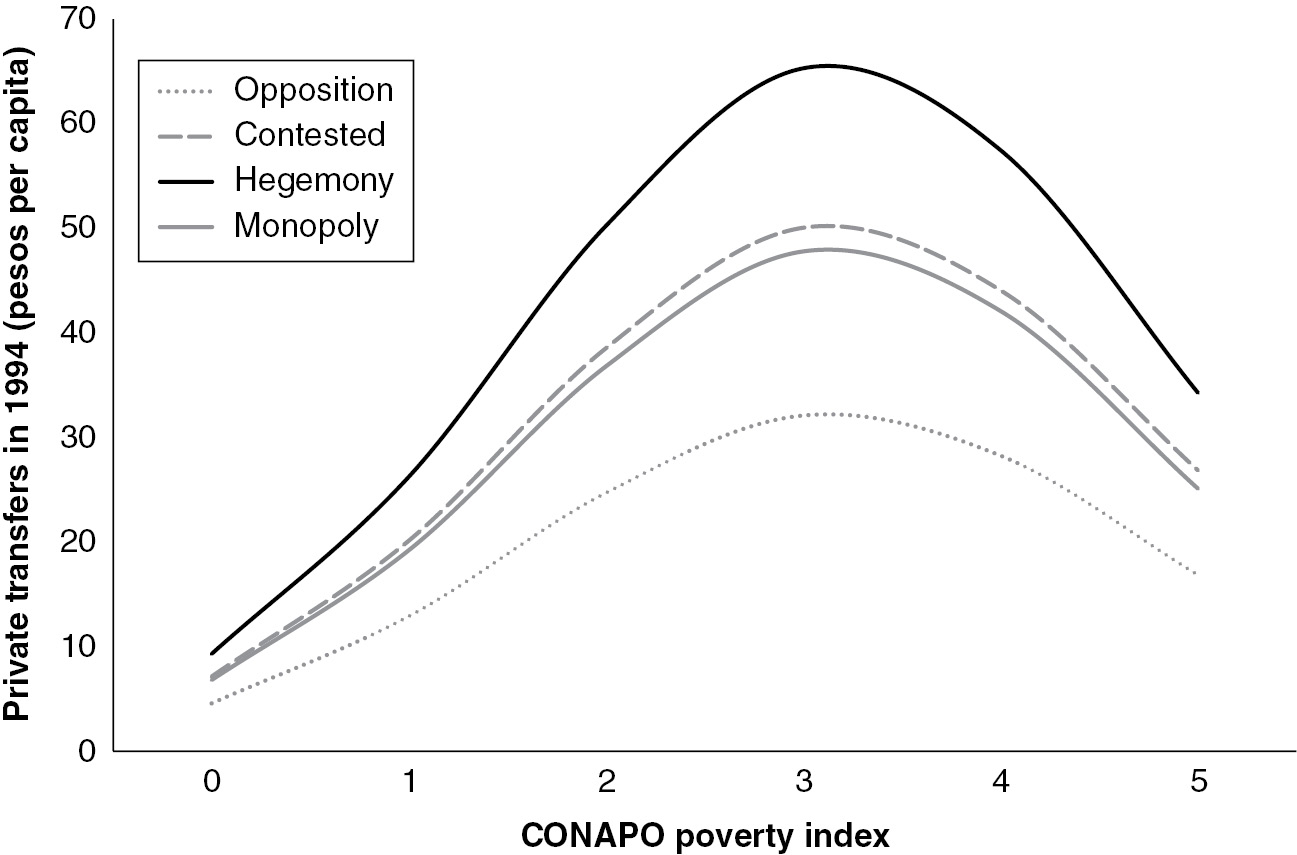
From the perspective of the swing-voter model, this distribution of particularistic transfers would seem perverse; from that of the core-voter model, it reflects the centrality of partisan expectations and commitments to both voters and local party brokers. That is, private benefits that are selectively targeted should not be given to outsiders because they generate the wrong type of incentives by rewarding defection. Larger core constituencies take the greater slice of the pie, mitigated only by the lower incidence of private transfers in situations of monopoly where core voters have no credible exit option. This last finding is in accordance with Medina and Stokes (Reference Medina, Stokes, Kitschelt and Wilkinson2006) who argue that monopolies suffer benign neglect by incumbents with respect to handouts. In competitive municipalities, with smaller cores, the party label of municipal government is decisive for allocation. Again, the swing-voter model would argue for similar treatment of all marginals, since a weak marginal municipality controlled by the opposition entails the same vote-buying potential as a weak marginal governed by the PRI. However, that claim devalues the comparative advantage of partisan organizations in control of government in local politics. Hence, our results indicate that opposition municipalities, even if lost by small margins, invariably get the short end of the stick.
However, what the swing-voter model fails to find in patterns of private transfers in the Mexican case can account for part of the distribution of pork transfers across municipalities. The results reveal that more public goods are assigned to districts where the coming elections are expected to be competitive. This is measured by the predicted effective number of parties (
 ) which has a positive and statistically significant sign for public goods allocations and a negative and statistically significant sign for private goods allocations and for the share of private goods within the municipal portfolio. The same results hold if we run the regressions with expected margin of victory, with higher public goods provision where upcoming municipal elections are expected to be close. These results support our claim that incumbent parties will diversify their portfolios by investing more in collective goods in competitive districts. We should emphasize that
 is the expected competition structure for the very next election. This instrumented variable of competitiveness, unlike our party configuration typology, is constructed with short-term election results or returns from the previous municipal race. Thus, the effect of N conveniently captures the way in which politicians adjust investment decisions according to short-term election imperatives.
In Figure 4.7 we simulate the effects of
 on the disbursement of collective benefits in local election years, holding other variables at their mean. The patent result is that per capita expenditures for collective goods increase rapidly as the expected effective number of parties grows. For the bipartisan and multipartisan competition mushrooming in Mexico in the 1990s, this corresponds to about double the per capita investment in pork assigned to low-N municipalities in an election year. As a result of the skew favoring core constituencies in the allocation of private transfers, the share of public goods within the Pronasol basket increases markedly for N in the competitive range.Footnote 11 The cost is hefty, since per capita transfers for pork are routinely two to three times the amount distributed as private transfers.
Clientelism and effective competition.
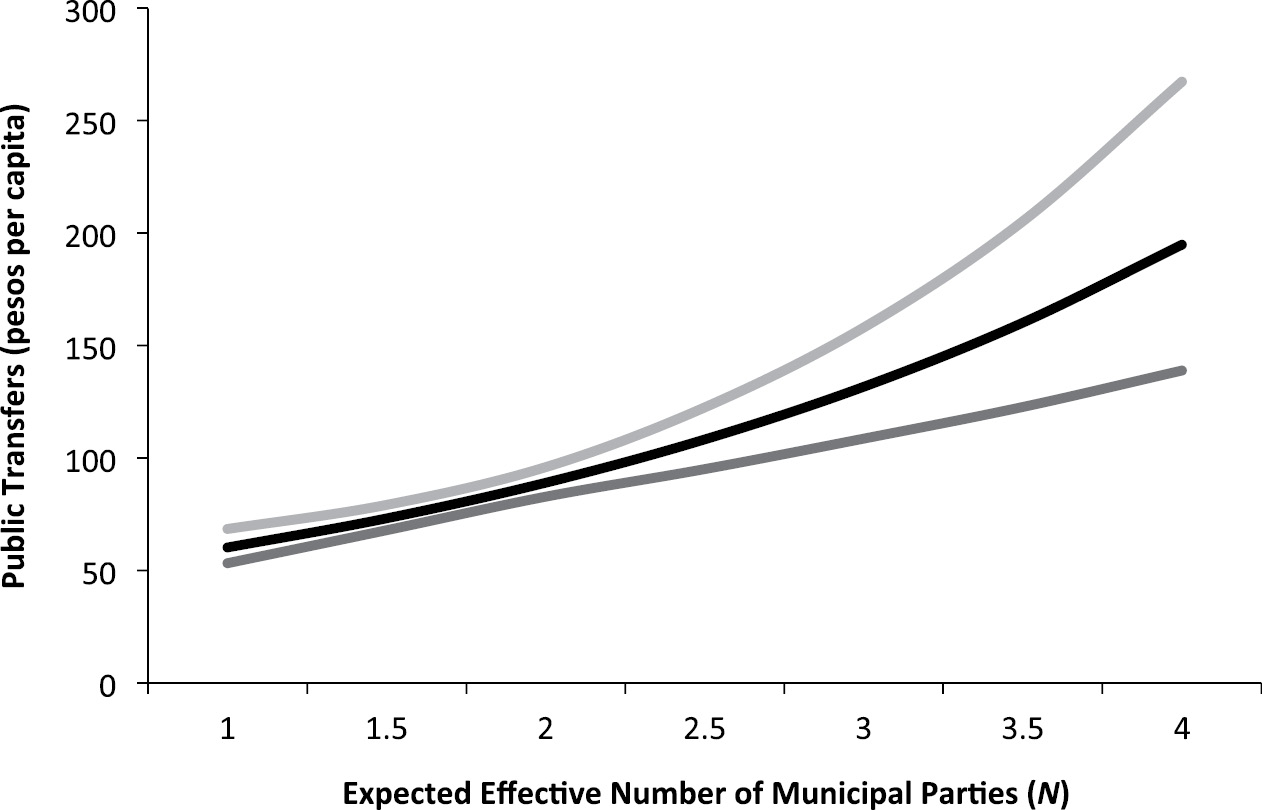
4.5 Conclusion
The Pronasol projects in Chalco Solidaridad had a lasting impact on improving the lives of the poor in that municipality. Many other Pronasol projects also contributed to improving welfare by bringing health clinics, schools, water systems, sewage systems, electrification, and more to previously impoverished localities. Unfortunately, this was not the overarching logic behind Pronasol’s vast operations. One of the central political motivations behind its public infrastructure projects, as our results suggest, was that the PRI could no longer count on core support sufficient to win elections and thus needed to legitimize itself through broader collective projects for which it could claim credit. For the most part, the poor were not actually targeted nor preferentially benefited by the program’s array of particularistic and collective projects. Our results in this chapter demonstrate that clientelism was used to lock-in the PRI’s core base of support. But, as we will demonstrate in subsequent chapters, clientelism contributed very little to improving the welfare of the poor. Although our results demonstrate that it paid to be loyal to the PRI, the logic of political linkages left the poor trapped in a long-term relationship of material dependence.
The results in this chapter provide robust empirical support for our main theoretical claims. The chapter has presented empirical evidence for our theory of conditional party loyalty. The theory departs from the core- versus swing-voter debate in viewing partisan loyalties as endogenous, shaped by the history of interactions and tactical redistributions. Voters’ loyalties cannot be taken for granted, we argue, and this is especially true where voters respond weakly to ideological, programmatic, and other symbolic appeals, as is prevalent throughout the developing world.
We see politicians as motivated by both short- and long-term considerations. They seek to construct partisan coalitions that are stable over time and they want to win the current election as well. These goals often place parties in a strategic dilemma: if they appeal to swing voters to win the current election by delivering discretionary transfers to them, they risk alienating their core voters in future elections. Alienating the core can be quite self-destructive. One solution to this dilemma, we have argued, is to diversify the portfolio of electoral investments, targeting particularistic transfers to core supporters, while delivering collective benefits to electorates at large.
The strategy we uncover has a strong core-voter bias: parties should primarily target particularistic benefits to voters who have consistently supported them in the past. These voters are not only better known by local party brokers, but are also less risky as investments. Yet the more the core is willing to drift, given the presence of alternatives to the ruling party, the more we expect a machine to rely on clientelism to lock-in loyal voters. Our theory argues that discretionary private transfers are preferable to collective goods if one is to construct stable and durable electoral coalitions. This form of political exchange is what we, and others, have characterized as clientelism.
Our theory is also one of portfolio diversification. Pronasol‘s strong bias in favor of core constituencies and districts under firm PRI control is undeniable with regard to discretionary transfers of private benefits. Clientelism was consistently used to reward core-voter groups, with politicians strongly intensifying this practice in municipalities that were experiencing higher core erosion over time. The strategy employed in the allocation of pork-barrel projects is less straightforward. Our results reveal that within Pronasol’s overarching strategy, public goods provision also emphatically favored core districts and punished opposition-controlled ones. However, local politicians modified their portfolios of electoral investment to increase the share of public goods over private goods in small core voter municipalities. Intended to attract support from broader and more heterogeneous coalitions, pork appears to be a second-best, though necessary, strategic choice for party machines facing rising competition.
Finally, the models accounting for the peripheral logic of Pronasol strongly suggest that politicians privileged and even intensified clientelistic practices prior to national and municipal elections alike. Local party organizations and brokers were able to adjust investment decisions to take their own short-term electoral needs into account. Overall, our empirical results demonstrate that poverty alleviation was, at best, a secondary objective. Expenditures did not systematically benefit the poorest municipalities. The entire program with its vast array of transfers and projects was administered with the goal of sustaining the PRI’s electoral hegemony. Pronasol was highly successful at buying votes for the PRI, as we will demonstrate in later chapters, but extremely ineffective at combating poverty.