Introduction
The Antarctic terrestrial ecosystem exhibits relative simplicity due to its low plant diversity, which is composed of only cryptogams and two native vascular species. This simplicity makes the ecosystem vulnerable to the arrival of non-native species due to the regional effects of climate change in Antarctica and the large increase in people visiting parts of this territory each year (Chown et al. Reference Chown, Huiskes, Gremmen, Lee, Terauds, Crosbie, Frenot, Hughes, Imura, Kiefer, Lebouvier, Raymond, Tsujimoto, Ware, van de Vijver and Bergstrom2012). Improvements in environmental conditions (increases in temperature and water availability) not only favour the likelihood of colonization by new populations of native species, but also by non-native species (Huiskes et al. Reference Huiskes, Gremmen, Bergstrom, Frenot, Hughes, Imura, Kiefer, Lebouvier, Lee, Tsujimoto, Ware, van de Vijver and Chown2014).
The expansion of human activity in the Antarctic Treaty area due to increased scientific activity, requirements for logistical support and tourism has enhanced the risk of the arrival of non-native species in the region. In the past, Antarctica’s geographical isolation from the rest of the world posed certain constraints. Natural barriers, such as ocean and atmospheric circulation patterns, around the continent contributed to the relatively late arrival of humans to the region. However, these constraints have now been overcome to a certain extent (Hughes et al. Reference Hughes, Convey, Maslen and Smith2010, Chown et al. Reference Chown, Huiskes, Gremmen, Lee, Terauds, Crosbie, Frenot, Hughes, Imura, Kiefer, Lebouvier, Raymond, Tsujimoto, Ware, van de Vijver and Bergstrom2012, Lityńska-Zając et al. Reference Lityńska-Zając, Chwedorzewska, Korczak-Abshire, Augustyniuk-Kram and Olech2012, Chwedorzewska et al. Reference Chwedorzewska, Korczak-Abshire, Olech, Lityńska-Zając and Augustyniuk-Kram2013).
Human beings have been visiting Antarctica for 190 years but it is only in the last 70 years that there has been a permanent presence. Therefore, the propagule pressure is not comparable with the rest of the world. However, on a small-scale, some regions of Antarctica have high levels of introduced plant propagules (Hughes et al. Reference Hughes, Pertierra, Molina-Montenegro and Convey2015). The areas associated with the highest levels of human activity are in the vicinity of the c. 75 scientific bases that have been established since 1944, with c. 44 000 people visiting Antarctica each year, including both scientists and tourists. Moreover, there are c. 4000 logistics personnel who are responsible for supporting scientific activities in the Antarctic Treaty area (International Association of Antarctica Tour Operators, https://iaato.org/). Scientific expeditions and support personnel may act as vectors for the introduction for plant propagules. Studies have generally focused on determining the types of plant species being transported to Antarctica (Hughes & Convey Reference Hughes and Convey2012).
A good way to determine which species could possibly colonize the Antarctic Treaty area is to perform a pollen analysis in order to define which types of plant taxa are arriving, as there is a close relationship between pollen and vegetation (Fuentes-Lillo et al. Reference Fuentes-Lillo, Troncoso-Castro, Cuba-Díaz and Rondanelli-Reyes2016). A recent study based on current pollen rain indicated that species of the Asteraceae, Brassicaceae and Poaceae families have a greater chance of arriving in Maritime Antarctica (Fuentes-Lillo et al. Reference Fuentes-Lillo, Troncoso-Castro, Cuba-Díaz and Rondanelli-Reyes2016).
Several studies have reported the presence, and in some cases the successful establishment, of plant species including Nassauvia magellanica (Gmel), Cerastium sp., Alopecurus geniculatus L., Puccinellia distaris (Jacq.) Parl., Rumen pulcher L., Stellaria media L. and Chenopodium rubrum L. in the Antarctic Treaty area (Hughes et al. Reference Hughes, Pertierra, Molina-Montenegro and Convey2015); all of these species have been eradicated from the areas where they were reported. Only two non-native species have established in Antarctica: Poa annua L. (Olech & Chwedorzewska Reference Olech and Chwedorzewska2011) and Poa pratensis L. (Pertierra et al. Reference Pertierra, Lara, Benayas and Hughes2013), and both are currently part of an eradication programme (ATCM 2015, Galera et al. Reference Galera, Wódkiewicz, Czyż, Łapiński, Kowalska, Pasik, Rajner, Bylina and Chwedorzewska2016). Furthermore, the non-native species Juncus bufonius L. has been described in the vicinity of two native species, Colobanthus quitensis (Kunth) Bartl. and Deschampsia antarctica Desv., close to the Polish Arctowski Station (Cuba-Díaz et al. Reference Cuba-Díaz, Troncoso, Cordero, Finot and Rondanelli-Reyes2013). As for vectors involved in the arrival of propagules, previous studies have shown that a large number of propagules are carried on the clothing of scientists and logistics personnel (Lee & Chown Reference Lee and Chown2011, Lityńska-Zając et al. Reference Lityńska-Zając, Chwedorzewska, Korczak-Abshire, Augustyniuk-Kram and Olech2012). One study that analysed clothing and equipment of scientists arriving at Arctowski Station identified 16 families of non-native plants, most commonly Asteraceae, Apiaceae, Brassicaceae and Poaceae (Lityńska-Zając et al. Reference Lityńska-Zając, Chwedorzewska, Korczak-Abshire, Augustyniuk-Kram and Olech2012). Moreover, Lee & Chown (Reference Lee and Chown2009) found a positive correlation between the arrival of building materials and the presence of seeds. Species from families such as Asteraceae, Amaranthaceae, Brassicaceae, Caryophyllaceae, Fabaceae and Poaceae have been reported. All of these studies have demonstrated that the greatest influence on the arrival of plant propagules is human activity in Antarctica (Hughes et al. Reference Hughes, Pertierra, Molina-Montenegro and Convey2015).
Maritime Antarctica, specifically Fildes Peninsula, King George Island, South Shetland Islands, is an area where there is a high flow of scientists, tourists and logistics personnel from the five permanent stations: Great Wall (China), Bellingshausen (Russia), Artigas (Uruguay), Professor Julio Escudero (Chilean Antarctic Institute) and Eduardo Frei Montalva (Chilean Air Force). Furthermore, this final station includes Villa Las Estrellas, which has a hospital, school, bank, small supermarket, post office and chapel, among other services. There is also the Fildes Bay maritime station, belonging to the Chilean Navy, and the most important air strip (Teniente Rodolfo Marsh Air Base), used by aircraft for supplying the stations and transportation of personnel, as well as for tourist transfers from South America to cruise ships (Peter et al. Reference Peter, Buesser, Mustafa and Pfeiffer2008). This area generally has high potential for colonization by non-native species.
Research suggests that the presence of propagules of non-native species is closely related to the high level of human usage of Fildes Peninsula. Therefore, in order to establish whether there is connection between human activities and the arrival of propagules, we determined the presence of propagules in three areas of Fildes Peninsula: i) a heavily used area (Eduardo Frei and Escudero stations), ii) a moderately used area (Ardley Island) and iii) an area without human disturbance (Collins Glacier). This is the first record of plant propagules in the area, laying down the foundation for long-term investigations and the creation of conservation protocols.
Materials and methods
Study area
During the 2015 summer, plant propagules were collected from topsoil in three areas of Fildes Peninsula (Fig. S1 found at http://dx.doi.org/10.1017/S0954102017000037), each area was associated with different levels of human activity. The area between Eduardo Frei, Chilean Air Force (FACH), and Escudero stations, Chilean Antarctic Institute (INACH), represents an area with a steady stream of human activity, whether scientific, logistical and/or tourism. This area was divided into ten sampling sub-areas, corresponding to runway (S1), FACH guest accommodation (S2), the main FACH fuel tank (S3), entrance to the Russian Bellingshausen Station (S4), three sub-areas corresponding to FACH logistics personnel dormitories (Module A (S5), Module B (S6) and Module C (S7)), Villa Las Estrellas (a permanent Chilean civilian settlement on the peninsula (S8)), Villa Las Estrellas church (S9) and the perimeter of the INACH Escudero Station (S10). Ardley Island (S11) also represents an area with a steady stream of visitors but these are restricted to scientific personnel studying the island and to tourists who can circulate between Faro Point and the edge of Braillard Point. Finally, the third area represented an area of low human activity, the terminal moraine of Collins Glacier (S12); only scientific personnel studying the area are permitted access to this area.
Sampling and seed identification
Sampling consisted of drawing a 1 m2 quadrant in each area and sub-area. For each quadrant, 100 g of soil to a depth of 5 cm were taken; sampling was performed in triplicate (Wódkiewicz et al. Reference Wódkiewicz, Ziemianśki, Kwiecien, Chwedorzewska and Galera2014). Samples were sieved, using 2–5 mm diameter sieves in order to obtain soil free of rocks, as well as finer material for later observations. After sieving the samples were stored at 4°C for transport to the Biotechnology and Environmental Studies Laboratory, Los Ángeles Campus, University of Concepción, Chile. In the laboratory, the sieved samples were observed under a stereoscopic microscope with an attached CCD microimaging 5.1-megapixel camera and digitized using Micrometrics SE Premium 4 software in order to determine the presence of seeds, caryopsis and other plant debris.
Invasion index
To determine the impact that the identified species could have on the Antarctic ecosystem, an impact score was determined following the methods of McGeoch et al. (Reference McGeoch, Shaw, Terauds, Lee and Chown2015), which integrates four criteria. The first criterion is propagule pressure. The second is the presence of the identified species on the IUCN red list (www.iucnredlist.org), indicating if it has demonstrated invasive behaviour in another location. The third criterion is whether there is a current programme for eradication of the species underway. Finally, if the species has been found previously in any of the 33 Antarctic biogeographical regions (including the Antarctic Conservation Biogeographical Regions and Southern Ocean Island Bioregions). The impact score provides us with information about the potential threat of a species colonizing the Antarctic Treaty area.
Results
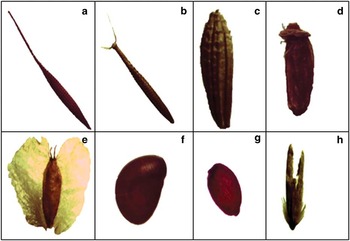
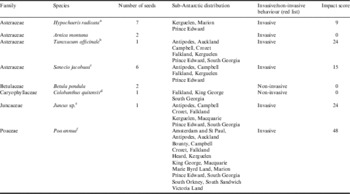
Eight species were identified in the soil samples (Fig. 1). All of the identified species are found in herbaceous habitats, with the exception of Betula pendula Roth, which is found in arboreal habitats. Of the identified species, four belonged to the Asteraceae family (Arnica montana L., Hypochaeris radicata L., Senecio jacobaea L. and Taraxacum officinale (L.) Weber ex Wigg.), one to the Betulaceae family (B. pendula), one the Caryophyllaceae family (Colobanthus quitensis), one to the Juncaceae family (Juncus sp.) and one to the Poaceae family (P. annua) (Table I and Table S1 found at http://dx.doi.org/10.1017/S0954102017000037).
Seeds found in topsoil samples from study areas and sub-areas. a. Hypochaeris radicata, b. Arnica montana, c. Taraxacum officinale, d. Senecio jacobaea, e. Betula pendula, f. Colobanthus quitensis, g. Juncus sp., h. Poa annua. (10X).

Taxonomy, abundance, distribution, invasive behaviour and impact score for seeds identified in soil samples from study areas and sub-areas on Fildes Peninsula.

a Gremmen & Smith Reference Gremmen and Smith1999, Whinam et al. Reference Whinam, Chilcott and Bergstrom2005.
b Frenot et al. Reference Frenot, Chown, Whinam, Selkirk, Convey, Skotnicki and Bergstrom2005, Convey et al. Reference Convey, Key and Key2010, Lebouvier et al. Reference Lebouvier, Laparie, Hulle, Marais, Cozic, Lalouette, Vernon, Candresse, Frenot and Renault2011.
c Ehrenfeld Reference Ehrenfeld2003, Frenot et al. Reference Frenot, Chown, Whinam, Selkirk, Convey, Skotnicki and Bergstrom2005.
d Convey Reference Convey1996.
e Greene & Walton Reference Greene and Walton1975, Gremmen Reference Gremmen1997, Frenot et al. Reference Frenot, Chown, Whinam, Selkirk, Convey, Skotnicki and Bergstrom2005.
f Van der Vijver et al. Reference Van de Vijver, Ledeganck and Beyens2002, Frenot et al. Reference Frenot, Chown, Whinam, Selkirk, Convey, Skotnicki and Bergstrom2005, Parnikoza et al. Reference Parnikoza, Kozeretska and Kunakh2011, Molina-Montenegro et al. Reference Molina-Montenegro, Carrasco-Urra, Acuña-Rodríguez, Oses, Torres-Díaz and Chwedorzewska2014.
Six of the eight identified species are found in the sub-Antarctic islands; T. officinale and P. annua have been the most successful at colonizing in this ecosystem. Of the identified species, B. pendula and C. quitensis are the only species that have a non-invasive nature. Furthermore, C. quitensis is native to Antarctica; therefore, the source of dispersion for this species is probably within King George Island.
An impact score was determined in order to determine the level of threat posed by each species to the Antarctic Treaty area. The species that would have the highest impact was P. annua with a score of 48, followed by T. officinale and Juncus sp. with scores of 24 and S. jacobaea with a score of 15. Since they did not meet the criteria for invasiveness and/or have not been found previously in the Antarctica biogeographical regions, A. montana, C. quitensis and B. pendula had an impact score of 0 (Table I).
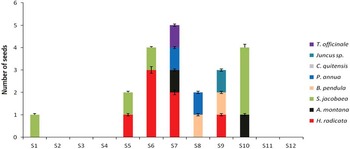
Analysis of the distribution and abundance of the species found at the sample sites (Fig. 2) shows that sites S5–S10 had the highest concentration of seeds. There were no seeds found at sites S2, S3, S4, S11 and S12. The most common species were H. radicata and S. jacobaea. These species were also the most widely distributed across the different study sites. The results indicate that there is a relationship between the level of human activity and the presence of seeds. Site S7 had the greatest overall number of seeds and the largest diversity; this site is in an area next to the dormitories of FACH logistics personnel. A high number of seeds were also found at site S9, next to Villa Las Estrellas church, an area associated with a high flow of tourists each season. There were no seeds found at sites S2, S3 and S4, these areas represent the roads linking the airport with Eduardo Frei and Professor Escudero stations. Ardley Island and Collins Glacier areas (S11 and S12) were used as controls and no seeds were found, probably related to the relatively low levels of human activity in these areas. No other types of propagule, e.g. caryopsis, spikes or gymnosperm cones, were found in any of the samples evaluated in this study.
Abundance of seeds collected from topsoil by sample site according to species identified. S1=runway, S2=FACH guest accommodation, S3=main FACH fuel tank, S4=entrance to Russian Bellingshausen Station, S5=Module A, S6=Module B, S7=Module C, S8=Villa Las Estrellas, permanent Chilean civilian settlement on the peninsula, S9=Villa Las Estrellas church, S10=the perimeter of the INACH Escudero Station, S11=Ardley Island, S12=Collins Glacier. Bars represent standard error.

Discussion
The taxa identified in the soil at the sites in this study correspond for the most part with findings of other studies performed in the vicinity of Antarctic stations. A study carried out at Arctowski in Admiralty Bay, King George Island, analysed the clothing and equipment of scientists and logistics personnel upon arrival at the station (Lityńska-Zając et al. Reference Lityńska-Zając, Chwedorzewska, Korczak-Abshire, Augustyniuk-Kram and Olech2012). They found a broad spectrum of seeds and plant debris being transported in to Antarctica. Most the seeds belonged to the Poaceae and Asteraceae families, with Lactuca serriola L., Leontodon autumnalis L. and P. annua being the most commonly identified seeds (Lityńska-Zając et al. Reference Lityńska-Zając, Chwedorzewska, Korczak-Abshire, Augustyniuk-Kram and Olech2012). These results are similar to our findings, where four of the eight species belong to the Asteraceae family and one to the Poaceae family. While tourists, scientists and logistics personnel associated with research serve as vectors for seed transport, there are also other potential vectors (Hughes et al. Reference Hughes, Convey, Maslen and Smith2010). Lee & Chown (Reference Lee and Chown2009) determined that there is a positive correlation between the construction of scientific bases and the arrival of propagules. By analysing building materials for the Halley VI Station upon arrival, they identified 34 taxa, the largest number of seeds belonged to Asteraceae and Poaceae. Again, the genera identified are similar to the findings of the present study (i.e. Hypochaeris, Taraxacum and Poa). These studies identified seeds on luggage, cargo and the clothing of scientists and logistics personnel. However, they did not verify the presence of these propagules in the soil. In this study, we have shown that not only are seeds being passively transported to Fildes Peninsula, the seeds are being deposited in the topsoil.
The presence of C. quitensis, Juncus sp. and P. annua seeds in the study areas could be associated with two types of vector. The first type, abiotic vectors, includes factors such as wind dispersal from nearby areas; as has been demonstrated at the Arctowski (Harmata & Olech Reference Harmata and Olech1991). Populations of C. quitensis and P. annua, as well as J. bufonius, have been found nearby (Cuba-Díaz et al. Reference Cuba-Díaz, Troncoso, Cordero, Finot and Rondanelli-Reyes2013). The second type, biotic vectors, may involve the movement of scientists around King George Island and the arrival of tourists, scientists and logistics personnel from areas further north (Lee & Chown Reference Lee and Chown2011). Biotic vectors also include birds and marine mammals, which may also be key in the arrival of these species (Hughes & Convey Reference Hughes and Convey2012). The presence of B. pendula may be a consequence of human-mediated transport or of natural dispersal since the structure of this seed enables it to travel distances of hundreds and even thousands of metres (Reyes et al. Reference Reyes, Casal and Trabaud1997). Further research is required to determine the relative contributions of biotic and abiotic factors in the dispersal of these seeds. Our results clearly indicate that the transport of these seeds is related to the influx of humans each year to Fildes Peninsula and not the effects of the wind or any animal vectors.
It is important to note that all the species identified in this study, with the exception of B. pendula and A. montana, have a sub-Antarctic distribution, in addition to being species that are considered invasive both in their sub-Antarctic distribution as well as globally. Therefore, it is necessary to determine the possible consequences of the arrival of these species to Maritime Antarctica. The impact score allows us to determine which species are most likely to be transported to the area and to successfully establish there. Our results indicate that P. annua is the greatest threat to the area, consistent with reports that P. annua has already colonized areas in Maritime Antarctica. Specifically, it has been reported in the vicinity of the Polish Arctowski Station, where it has spread to areas surrounding its source of introduction (Olech & Chwedorzewska Reference Olech and Chwedorzewska2011). Moreover, and of particular interest to this study, this species has been recorded in areas associated with high levels of human activity (Chwedorzewska et al. Reference Chwedorzewska, Giełwanowska, Olech, Molina-Montenegro, Wódkiewicz and Galera2015). Both T. officinale and Juncus sp. received a score of 24. In the case of Juncus sp., there is evidence of the presence of this species in Maritime Antarctica and of its potential to establish itself in the current conditions of this ecosystem (Cuba-Díaz et al. Reference Cuba-Díaz, Troncoso, Cordero, Finot and Rondanelli-Reyes2013, Reference Cuba-Díaz, Fuentes, Rondanelli-Reyes and Machuca2015). Careful consideration should be applied to T. officinale as its properties, such as a wide range of germination temperatures (5–25°C), seed bank formation, drought resistance and self-pollination, would enable this species to become established in Maritime Antarctica. Furthermore, its seeds are wind dispersed, and it already has a cosmopolitan distribution, including the sub-Antarctic islands and Andean ecosystems (Cavieres et al. Reference Cavieres, Quiroz, Molina-Montenegro, Muñoz and Pauchard2005). Finally, S. jacobaea received an impact score of 15. Although insignificant compared with the score for P. annua, it has similar characteristics to T. officinale, e.g. a wide range of germination temperatures (5–25°C), with up to 60% germination at 5°C. Moreover, it also has a cosmopolitan distribution, wind dispersed seeds and is self-pollinated, features essential for potentially successful establishment in Maritime Antarctica (van der Meijden & van der Waals-Kooi Reference Van der Meijden and van der Waals-Kooi1978).
Distribution analysis of these species at the sample sites showed a higher concentration of seeds in the sub-areas corresponding to the airport, logistics personnel dormitories (FACH), Villa Las Estrellas church, Villa Las Estrellas and Escudero Station. Recently, the pollen spectrum was determined for current pollen rain in the same area, demonstrating that the same sub-areas also present the highest concentration of pollen grains per gram of dry sediment, suggesting that taxa belonging to Asteraceae, Brassicaceae and Poaceae in topsoil samples are indicative of human impact (Fuentes-Lillo et al. Reference Fuentes-Lillo, Troncoso-Castro, Cuba-Díaz and Rondanelli-Reyes2016). The sub-areas corresponding to logistics personnel dormitories (FACH), Villa Las Estrellas church and Escudero Station were associated with the highest number of seeds compared with other sub-areas that also have high levels of impact. This may be related to a greater flow of people on foot in these areas, as opposed to vehicular travel in the areas that link Eduardo Frei and Escudero stations. This supports one of the hypotheses of this study, indicating that ‘human’ vectors are responsible for the transportation of seeds to the peninsula (Lee & Chown Reference Lee and Chown2009, Lityńska-Zając et al. Reference Lityńska-Zając, Chwedorzewska, Korczak-Abshire, Augustyniuk-Kram and Olech2012, Hughes et al. Reference Hughes, Pertierra, Molina-Montenegro and Convey2015).
It will be necessary to complement these findings with future studies in order to determine the potential impact of the identified species if they succeed in establishing themselves in the maritime Antarctic Treaty area. For example, future research could determine the germination ability and viability of these biological particles under scenarios differentiated according to temperature and humidity. Moreover, it is important to conduct studies of competition (such as those performed by Molina-Montenegro et al. Reference Molina-Montenegro, Carrasco-Urra, Acuña-Rodríguez, Oses, Torres-Díaz and Chwedorzewska2014 with P. annua), to determine the possible effects of these non-native species on native Antarctic flora and on the Antarctic terrestrial ecosystem in general.
There is still no evidence, except for P. annua (Hughes et al. Reference Hughes, Pertierra, Molina-Montenegro and Convey2015), of any of the species identified in this study having achieved establishment on the Fildes Peninsula. This may be due to weather conditions preventing germination, keeping seeds in a state of dormancy until weather conditions improve. However, the climate change that is currently affecting the Antarctic Treaty area (Turner et al. Reference Turner, Bindschadler, Convey, di Prisco, Fahrbach, Gutt, Hodgson, Mayewski and Summerhayes2009) may increase average air temperature, bringing with it increased water availability, higher nutrient content in soils and greater ice-free areas, thus generating an environment in which these species may germinate and complete their life cycles (Huiskes et al. Reference Huiskes, Gremmen, Bergstrom, Frenot, Hughes, Imura, Kiefer, Lebouvier, Lee, Tsujimoto, Ware, van de Vijver and Chown2014).
Conclusion
The results of this study suggest that to a certain extent propagule transport is directly related to human activity in Fildes Peninsula. Therefore, it is imperative to implement biosafety protocols to help mitigate the arrival of these species to Fildes Peninsula and to other areas with high levels of human activity. Future research may provide information on the invasive potential of the species identified in this work in current Antarctic conditions and in the near future under the influence of regional climate change.
Acknowledgements
This research was funded with contributions by INACH (Chilean Antarctic Institute) PR_05-15 and INACH RG_02-13 projects. The authors wish to acknowledge the logistical support provided by the Chilean Air Force and Correos de Chile. We would like to thank International Journal Revisions (http://www.journalrevisions.com) for their English revision. Furthermore, we would like to acknowledge the reviewers, including Katarzyna Chwedorzewska, for helping us to make this study a more robust work.
Author contributions
All authors contributed extensively to the work presented in this paper. EFL performed the search and identification of biological material, data analysis and interpretation, and contributed to writing and editing the manuscript. MCD supervised the study, contributed to the central idea and the writing and editing of the manuscript. MRR supervised the study, collaborated in the identification of biological material and edited the manuscript. JMTC supervised the study and edited the manuscript.
Supplemental material
A supplemental table and figure will be found at http://dx.doi.org/10.1017/S0954102017000037.