Department stores are seen as a defining feature of retail transformation in the late nineteenth and early twentieth centuries; their recent demise seems symptomatic of a further retail shift—out of town and into virtual space.Footnote 1 Their origins might be contested, with the Paris Bon Marché, Stewart's Marble Palace in New York, or—more contentiously, perhaps—shops like Bainbridge's of Newcastle or Kendal Milne in Manchester all having a claim to be the first department store, but their spread and influence across the globe seems readily apparent.Footnote 2 They appeared first in major cities across the United States and Europe, later spreading to Russia, Japan, South America, the Middle East, and a range of British dominions.Footnote 3 Their association with metropolitan centers underpins the view of department stores as important vehicles for urban, retail, and social modernization. In some places, including Japan, they were consciously deployed as instruments of Westernization, a role that has led some historians to see them as agents in an increasing homogenization of the processes and practices of consumption.Footnote 4 Yet they also spread to small towns in Europe and North America, where they “brought modern retailing to outposts” and formed “sources of pride for communities outside major retail centers.”Footnote 5 In both instances, modernity is linked to metropolitan values and practices, be that at a global or a national scale, and modernization involved rolling these out to peripheral areas.
All this assumes that there was a set of qualities and attributes that defined department stores and set them apart from other forms of retailing, such as the multiple retailers or chain stores that grew rapidly in parts of Europe and North America in the later nineteenth century. In reality, defining the department store is notoriously difficult: the model changed over time and space, and nomenclature was far from universal. While they were called department stores in the United States and Japan, British shops rarely used the term before the 1930s (although the term was used and understood in the trade press) and French stores were often “grand magasins.” Apart from size (which is, of course, a relative rather than absolute measure), what characterized these stores was their organization into separate departments, coupled with central operating functions, including accounts or marketing.Footnote 6 Writing in the 1950s, James Jefferys suggested that British department stores should be defined as any shop with at least four separate departments, including women's and children's wear—a threshold that included scores of shops outside more formal definitions.Footnote 7 He also recognized their evolutionary nature by adding a category of “part department stores” (those that did not quite meet the full criteria) and the importance of female consumption in shaping their status and character. More recently, Thomas Markus has focused on the size and character of the retail space, designed to enhance display and encourage free movement.Footnote 8 Governments and trade organizations drew on similar criteria. The Japan Department Stores Association, for instance, followed the 1937 Department Stores Law in defining them as stores having two or more departments that included clothing, food, homeware, and haberdashery, and a sales area over 3,000 square meters in one of the six largest cities or over 1,500 square meters in other cities.Footnote 9
Such definitional difficulties are particularly challenging in the British context because of the highly varied nature and sizes of stores and the evolutionary nature of their development. However, Vicki Howard notes that censuses in the United States also undercounted department stores because they omitted many small-town stores not formally identified as department stores—exactly the kind of businesses picked up by Jefferys's criteria.Footnote 10 Both within and between countries, then, there were large variations in what a department store might comprise: Macy's was not the same as Harrods, and both were different from provincial stores like Miller & Paine in Lincoln, Nebraska, and Brookfield's in Stafford, England. Americans were discomfited by the floorwalkers in London stores, but metropolitan shoppers may have felt equally at odds with the cramped rooms in many provincial stores.Footnote 11 These differences bring into focus fundamental questions about what it meant to be a department store and about the relationship between local and national cultures, economies, and societies on the one hand and the development and character of department stores on the other. More fundamentally, they challenge the universality of the department store's apparently common qualities and their role in retail change.
In this article, we explore the development of department stores in two contrasting contexts—Britain and Japan—in the early twentieth century. Our purpose is twofold. First, we wish to ascertain the extent to which there were universal qualities defining the operation, practices, and experience of department stores. Is the department store a meaningful category when looking across the globe and down the urban hierarchy, and how do we best understand how local circumstances shaped the character of department stores? Second, and building from this, we want to assess their role as agents of retail and consumer transformation: Did stores in Britain and Japan have a similarly transformative effect on the lives of consumers, and, again, how might we understand any differences in their impact?
Our comparators are deliberately chosen because they represent very different cases of department store development. In Japan, department stores were introduced as a conscious mechanism of modernization and Westernization and formed a genuinely new form of retailing; in Britain, most department stores grew organically and thus built on a long tradition of retailing that presaged many aspects of department store retailing. We take a pragmatic approach to defining the objects of our inquiry: stores counted in official enumerations plus any others that met Jefferys's threshold of four separate departments. This allows us to include both metropolitan leviathans and provincial Lilliputians (shops such as Brookfield's and the Empire Trading Stamp Company in Sheffield that lay outside formal definitions of department stores) and to explore the universality of both key aspects of department store trading and their impact on retailing and society more generally. We argue that department stores played a key role in retail, consumer, and societal modernization, but that the nature and process of modernity was contingent on local circumstances that were also critical in shaping the character and operation of retail business, even in a seemingly global phenomenon like department stores. We thus highlight the importance of comparative analysis in understanding the relationship between the global and local.
The Basics: Growth, Numbers, and Distribution
The origins of British department stores were many and varied. A few were created ab initio—most famously, Selfridges on Oxford Street—and others were opened as branches of a parent company, as seen with Lewis's during the 1880s. However, most grew organically, the classic model being that of the draper gradually expanding the range of goods on offer: adding ready-made clothes and shoes, furniture, glass and china, perhaps jewelry and perfumes. Sometimes the retailer originally traded as a grocer (e.g., Harrods, Broadbent of Southport), outfitter (Fenwick of Newcastle), or house furnisher (Sloper of Devizes, Wiltshire), but the basic process of expansion remained the same.Footnote 12 This was true even in Gareth Shaw's second, “revolutionary,” stage of development: branches were often already trading in some form before they became department stores and many “newcomers” were in reality older businesses.Footnote 13
In Japan, the first wave of department stores also grew from drapery stores, but the character of these stores was completely different. Drapery (especially silk drapery) stores were very difficult to establish in nineteenth-century Japan because only the Samurai class were permitted to wear silk kimonos.Footnote 14 Since most Japanese department stores originated as stores that dealt in silk draperies, their early customers were only from the upper classes, making them very exclusive establishments. Staff needed significant knowledge and experience to be able to advise customers on the many conventions and rules governing silk kimonos. For example, fabrics patterned with flowers are often worn on celebratory occasions in Japan, but there are rules governing the kind of flowers that should be worn in different seasons. Furthermore, silk drapers generally survived longer than other types of stores at the time, and those that transformed into department stores at an early stage had already been in business for two or three centuries: Matsuzakaya opened its first store in 1611, Shirokiya in 1662, and Mitsukoshi in 1673.Footnote 15 These stores had already established a special and prominent place in Japanese society.
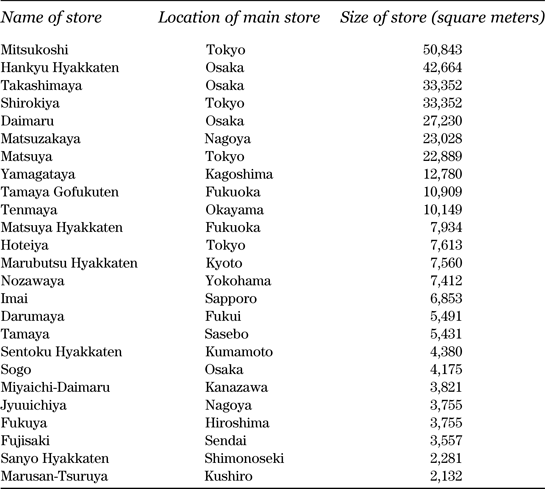
Given these differences in origin, it is no surprise that the number of stores was very different in the two countries. Jefferys estimates that there were 475 to 525 department stores in Britain by 1938, but Jon Stobart has recently argued that the number was probably greater, identifying around 600 in England by the early 1930s, at least half of which were already trading as department stores around 1914.Footnote 16 Many of these were small businesses, very different from their metropolitan counterparts, yet they all fulfilled Jefferys's essential criteria. Numbers in Japan were much smaller: in 1924 there were twelve department stores run by only seven companies. By the time they established an industry association in 1933, there were twenty-five department store companies and a further eleven companies that had not joined this association, although their sales floors were large enough and they sold a variety of merchandise (Table 1). This number represented the tip of a much bigger retail iceberg: in 1931, there were 128,303 retailers in Tokyo alone.Footnote 17
Location and Floor Space of Department Store Association Stores in Japan, 1933

Source: Japan Department Stores Association, Nihon Hyakkaten Kyokai 10 nenshi [A 10-year history of the Japan Department Stores Association] (Tokyo, 1959), 8–9.
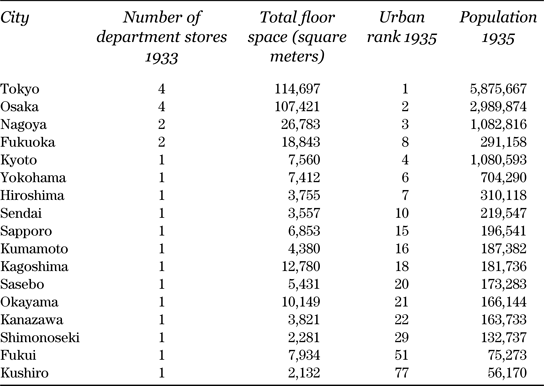
It might be argued that such profound differences in numbers reflect different definitions or different levels of maturity in the retail system. However, there is little to suggest that a more flexible definition, as taken for England, would significantly increase the figures for Japan. Moreover, the number of Japanese department stores remained fairly modest through the remainder of the twentieth century: there were 111 stores in 1950, rising to 132 stores by 1960.Footnote 18 A more convincing explanation links to the different origins of department stores and the different political-economic context in which they were established and grew. What we see in Japan is, in effect, a set of department stores that equates with the top end of a hierarchy of British stores that stretched from metropolitan leviathans to provincial Lilliputians. This impression is reinforced when we look at the geographical distribution of department stores in the two countries. In Japan most department stores developed initially in the largest cities, such as Tokyo and Osaka, spreading by 1935 to other cities with populations over one hundred thousand, especially the capitals of prefectures (Table 2). Exceptions were rare: Darumaya in Fukui and Marusan-Tsuruya in Kushiro, for instance, were relatively small towns that equated in size to English towns like Lincoln or Worcester.
Distribution of Department Stores, Urban Rank, and Town Size in Japan, c. 1933

Sources: Japan Department Stores Association, Nihon Hyakkaten Kyokai 10 nenshi [A 10-year history of the Japan Department Stores Association] (Tokyo, 1959), 8–9; “Population Census, 1935,” Statistics Bureau, Ministry of Internal Affairs and Communications (website), accessed 6 Mar. 2017, https://www.e-stat.go.jp/stat-search/files?page=1&layout=datalist&tstat=000001036872&cycle=0&tclass1=000001037820&second2=1.
Note: There were almost three hundred cities in Japan at the time.
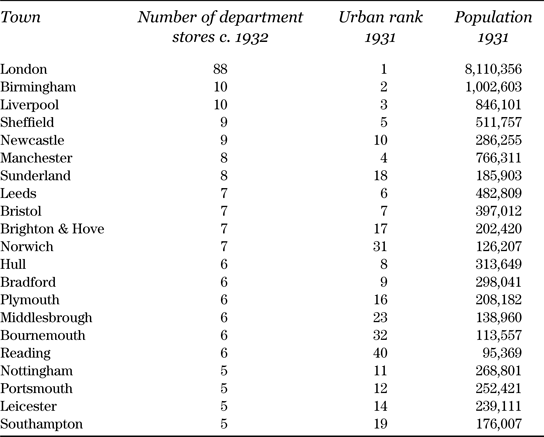
Distribution of Department Stores, Urban Rank, and Town Size, in England, c. 1932

Sources: Various Kelly's Directories: Lincolnshire and the City of Hull (London, 1930), Birmingham and Suburbs (London, 1930), Bristol and Suburbs (London, 1930), Devon and Cornwall (London, 1930), Berkshire (London, 1931), Hampshire and the Isle of Wight (London, 1931), Sheffield and Rotherham (London, 1932), Leeds and Suburbs (London, 1932), Nottinghamshire (London, 1932), Liverpool and Suburbs (London, 1932), Manchester, Salford and Suburbs (London, 1932), Leicestershire and Rutland (London, 1933), North and East Ridings of Yorkshire (London, 1933), Cambridgeshire, Norfolk and Suffolk (London, 1933), Durham and Northumberland (London, 1934), Kent, Surrey and Sussex (London, 1934), Bradford and Suburbs (London, 1936); and Kelly's Post Office London Directory (London, 1932).
English department stores were spread across the country, in small towns as well as metropolitan areas. London dominated—Kelly's trade directories listed eighty-eight by the 1930s—but each English county had at least one department store, and sixteen had ten or more.Footnote 19 These provincial patterns were often shaped by the presence of large towns and cities, since those at the upper end of the urban hierarchy also contained the largest number of department stores (Table 3). However, the underlying socioeconomic character of both these cities and their regions was highly varied and impacted upon department store growth in different ways. To take just three counties as examples: provision in County Durham in northeast England was centered on the industrial towns of South Shields, Stockton-on-Tees, West Hartlepool, and especially Sunderland, each of which contained at least three department stores in the early 1930s; provision in Warwickshire in the Midlands was dominated by industrial Birmingham, with seven department stores, but the former leisure resort of Leamington Spa also had three small department stores; in Sussex on the south coast it was seaside resorts that stood out, most notably Brighton (seven stores), but also Eastbourne, Hastings, and Worthing (two or three apiece).Footnote 20 This last group of towns points to the importance of tourism in the development of department stores, which could in turn form important attractions in their own right. The presence of holidaymakers with money to spend helps to explain the relatively high position in Table 3 of Brighton and Bournemouth, but a well-heeled resident population was also important, for example, in Leamington or in picturesque county towns like Chester or Norwich.
The result of this range of stimuli to development was that Britain had a much denser network of department stores, places as small as Cromer in Norfolk (with a 1931 population of 4,176) and Devizes in Wiltshire (population, 6,058) having shops that fulfilled Jefferys's basic criteria and were locally recognized as department stores. These stores were clearly very different from their counterparts in larger cities, let alone London stores like Harrods or Swan & Edgar or their equivalents in Tokyo and Osaka.Footnote 21 This reflects both the different origins and different development trajectory of British department stores and the broader market being served. Japanese stores were firmly aimed at the upper middle class and elite, although this gradually expanded downward as industrialization produced a growing white-collar class. In Britain, there is a well-established binary of stores: those serving the middle and upper middle classes, which competed on the basis of service and quality, and those serving the working and lower middle classes, which competed primarily on price.Footnote 22 To this, we need to add a third set: small department stores serving a mixed clientele drawn from a very localized area. This varied customer base lay behind the much wider distribution of stores, with many serving a relatively modest market area. Japanese stores, by contrast, needed to be able to draw on a large hinterland to generate sufficient demand from wealthy middle-class customers and so were located in big cities. The flagship stores of the five largest department stores were located in the commercial areas of the largest cities.
We should be wary, though, of being reductionist in our understanding of the distribution of department stores. A number of factors were important, including competition from other department stores, the attraction of transport links, and the scale of business. Taking these in turn, there was considerable overlap in market areas served by different stores both in Britain and Japan. Browns of Chester, as an upmarket store, was able to attract wealthy customers from the Wirral, which lay more naturally in the market area of Liverpool and its sizable department stores, including Lewis's, Blacklers, Owen Owen, and Bunney's. A Mass Observation study of the shop in the 1940s noted one customer's recollection that these well-to-do customers would prefer “a shopping day involving a run in the car through the Wirral to the ancient and always interesting city of Chester, rather than to the ferry crossing of the River Mersey.”Footnote 23
Quite apart from highlighting shopping as leisure, this comment underscores the importance of transport to the success and sometimes to the location of department stores. By the 1930s, the motorcar was beginning to have an influence in Britain, at least for stores serving wealthier customers, but far more important were suburban trains and, especially, omnibuses and trams.Footnote 24 These brought suburbanites to the city center and were thus vital in ensuring that a sufficient number of customers could reach the store. It was no accident that Bainbridge's in Newcastle chose to advertise in its 1912 Souvenir Store Guide that 2,500 trams passed its door every day.Footnote 25 Similarly, though from the opposite perspective, a fictional shopkeeper in a secondary center within Stoke-on-Trent bemoaned that “the electric trams . . . simply carried to Hanbridge [the city center] the cream and much of the milk of Bursley's trade.”Footnote 26 It is notable that the trams ran past the doors of all four department stores in Stoke's city center, although their location was driven initially by the location of the market and the main shopping thoroughfare.Footnote 27 In London as well, department stores were conveniently placed in relation to underground stations, but it was the prestige of the street that generally determined their location.
The link between transport termini and department store growth was much more direct in Japan. Hankyu Railway started its rail service in 1910, connecting Osaka with suburban areas for the growing numbers of white-collar commuters. When the company refurbished its facilities at Umeda station in 1922, it decided to also launch a store within the building for its customers. Hankyu opened this store in 1925, where it mainly sold food and included several restaurants, but in 1929 it was redeveloped into the first Hankyu department store, with ten floors covering about 10,000 square meters and selling an expanded range of merchandise including silk and cotton kimonos. Its founder, Ichizo Kobayashi, pointed out the benefits of this location, as its customers were already at the station and did not need to be drawn in with promotions and advertisements, as was necessary for other department stores.Footnote 28 Also, as a railway company, Hankyu was able to use the highly effective strategy of offering transport services during off-peak hours, so that its department store became a popular destination for housewives going shopping in the daytime. In this way, the Hankyu department store had one hundred thousand visitors on an average weekday, while Daimaru had seventy thousand and Mitsukoshi and Takashimaya each had thirty thousand. Also, while most department stores were at their busiest at around three o'clock, the Hankyu department store usually had its peak hours between five and seven o'clock due to its commuter customers.Footnote 29
This success encouraged similar developments by other department stores. When a subway line opened near Mitsukoshi in 1932, the company built an underground entrance to its store, directly connected by a hallway to the subway station. This hallway was the work of a French designer; it had a marble ceiling and walls, and shop windows displayed Mitsukoshi's newest products. Mitsukoshi also covered a large part of the cost of the whole station, which was officially named “Mitsukoshi-mae” (in front of Mitsukoshi) to honor this contribution.Footnote 30 In this way, and in contrast with Britain, railway and subway lines sometimes had a more direct impact on the location of department stores and the retail geography of the city.
Scale of Operation: Plots and Premises
Japanese stores operated at a large scale in terms of both the size of their premises and their turnover. The combined sales of all stores in the Japan Department Stores Association in 1938 amounted to ¥642.56 million, which then peaked at ¥886.47 million in 1941 in parallel with the growing number of stores. The gross margin of Mitsukoshi was ¥537,000 (approximately £58,000) in 1905, which increased to ¥2.37 million in 1915, rose to ¥10.54 million in 1925, and peaked at ¥26.1 million (£2,827,000) in 1941.Footnote 31 Matsuzakaya had sales of almost ¥20 million (£2,166,000) in 1919, which increased fourfold by 1929 and sixfold by 1939.Footnote 32 Such growth was supported by a period of rapid expansion of middle-class white-collar workers, but equally important was the fact that department stores were the only large, modern retailers in Japan at this time.Footnote 33 They took a substantial share of the market, for example, accounting for almost 25 percent of total retail sales and 55 percent of clothing sales in Tokyo.Footnote 34
In comparison, British department stores, faced with competition from multiple retailers and co-operative stores, captured only 1 to 2 percent of retail sales in 1900, rising to 3.5 to 5 percent by 1930; even in clothing and shoes, these figures were just 5.5 to 7 percent and 12 to 14 percent, respectively.Footnote 35 Moreover, only a handful of British stores were operating at the level of Mitsukoshi and Matsuzakaya. Harrods was exceptional, with sales peaking in 1919 at £1,850,000, though several other London stores were turning over £1 million at this time and D H Evans, for example, returned profits of £169,200. In the provinces, James Howell & Co. of Cardiff had profits of £73,246 on a turnover of £913,942 in 1920, while Binns in Sunderland had a turnover in excess of £760,000 in 1921.Footnote 36 These were the leviathans. Many other stores, both in London's suburbs and in provincial towns, operated at a much smaller scale. For example, Broadbent of Southport in Lancashire (with a 1931 population of 76,621) experienced good growth in the period from 1914 to 1934, turnover increasing more than threefold, but this still meant a peak of less than £150,000. Similarly, Cockayne's of Sheffield showed a gross profit of £16,189 in 1914—healthy, but in a completely different league from D H Evans or Howells, let alone Mitsukoshi and Matsuzakaya.Footnote 37
Similar diversity marked the size and character of retail premises in Britain. By 1920, Harrods’ Knightsbridge store covered 18,200 square meters with nearly 81,000 square meters of floor space over several storeys; the new store opened by D H Evans in 1937 comprised 34,500 square meters over eight floors, and Binns in Sunderland enjoyed 28,000 square meters of sales space split between premises on either side of Fawcett Street. In contrast, Sloper in Devizes occupied a modest double-fronted shop, as did Woodward's in Leamington Spa, while the thirteen separate departments of the Empire Trading Stamp Company in Sheffield were each contained in very modest rooms in its Howard Street premises. In Japan, the largest store was Mitsukoshi. Its first Western-style building, built in 1910, had a sales area of 5,210 square meters over three floors, but this grew progressively to 13,210 square meters over six floors in 1914 and to 50,843 square meters after it refurbished its main store with luxurious marble halls in 1935. By this time, there were another nine stores with over 10,000 square meters of floor space, and even the smallest had 2132 square meters (Table 1).
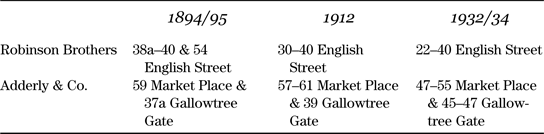
The premises occupied by British department stores were almost always built up slowly over time as the shop expanded its range of goods and sales area. Stobart has shown how, in a variety of towns, the mean frontage of department stores (that is, the number of plots they occupied on a street) grew two- or threefold between 1892 and 1932.Footnote 38 A couple of examples serve to illustrate the general trend (see Table 4). Robinson Brothers of Carlisle experienced a gradual expansion of their English Street premises before being acquired by Binns in 1926. The growth of Alfred Adderly & Co. of Leicester was more complex as they had premises on two parallel streets. The Market Place frontage was gradually expanded, while the shop on Gallowtree Gate was moved until it adjoined the back of the Market Place premises, giving a store opening onto two streets. Both of these examples follow the process that Shaw outlines for Beatties in Wolverhampton.Footnote 39 He argues that this allowed for the construction of larger, integrated premises that would provide suitable retail space and an impressive showcase for the business. For such buildings, island sites were preferable because they allowed wholesale reconstruction, sometimes at a monumental scale.
Growth of Premises of Robinson Brothers of Carlisle and Adderly & Co. of Leicester, 1894–1934

Sources: Various Kelly's Directories: Cumberland (London, 1894, 1934), Cumberland and Westmorland (London, 1914), Leicestershire and Rutland (London, 1895, 1912, 1932).
Monumentalism is an idea closely linked with the department store across the world.Footnote 40 Harrods’ enlargement of its Knightsbridge store was a deliberate counter to Selfridges' enormous edifice on Oxford Street—part of a broader “arms race” in the scale and opulence of building. Neoclassical styles were prevalent, with impressive cupolas adding external magnificence as well as facilitating the lighting of interiors through dramatic atria. Sweeping staircases added to the theatricality of interiors and the later addition of lifts and then escalators added to the spectacle—as they did in provincial stores across the United States.Footnote 41 Elaborate and impressive buildings were by no means restricted to metropolitan stores: John Walsh's premises on High Street, Sheffield, were integral to the corporation's attempt to improve the grandeur of the street; Lewis's Manchester store incorporated a central well rising through six stories; Binns’ Sunderland store was built along the latest American lines; and Plummer Roddis in Bournemouth was built in the latest art deco style.Footnote 42 This monumentalism contributed to their attraction as places to visit, but there were many smaller department stores with fewer architectural pretensions. Frontages were often built to meld with rather than stand out from neighboring properties, as with Brookfield's in Stafford, Woodward's in Leamington Spa, and even Schofields in Leeds—a large store, but one where the frontage in Headrow remained an assortment of different architectural styles and separate entrances. Inside, the store also remained disjointed—a complaint familiar from Whiteley's Bayswater store and repeated elsewhere, including Browns of Chester.
While monumentalism and integration were not always features of even quite important British stores, Japanese department stores almost invariably formed city landmarks. Mitsukoshi's 1914 store, for example, was built in the Renaissance style and was reputedly the largest store east of the Suez Canal. It boasted the first escalators seen in Japan, in addition to elevators, heating, and emergency sprinklers, all of which comprised the latest technology at the time. Other department stores soon followed suit, constructing their own new Western-style buildings, including Matsuzakaya (1910) and Takashimaya (1911). These stores had landmark facades and equipment that, together with the events they staged, made them tourist attractions. Many stores hosted exhibitions of paintings and music concerts, creating considerable interest at a time when there were very few museums or concert halls in Japan. Takashimaya in Osaka staged a particularly successful event, building a copy of the famous shrine at Nikko that drew tens of thousands of visitors to the store every day over a three-week period in 1927.Footnote 43
Such events were very challenging to organize and were only possible for the most powerful retailers—that is, department stores. The buildings were also hugely expensive to construct. To fund them, department stores were reformed and modernized from family-owned businesses to limited companies, a change that created huge cash infusions through initial public offerings. New buildings and new management structures were thus part of the same process of modernization and Westernization; Mitsukoshi converted its organization into a limited company in 1904 and built its new store in 1913, while Takashimaya became a limited company in 1919, building a new store three years later.Footnote 44 Turning the argument around, only those retailers that could modernize and Westernize were able to transform their business into department stores; modernization and department store development were thus part of the same retail strategy. In Britain, the process of modernization was more contingent and contested: department stores had to comply with local government schemes for street improvement, struggled to assemble large plots for flagship stores, and often remained family-owned businesses, in which modernity, especially when equated with American practices, was sometimes explicitly rejected.Footnote 45 This helps to explain why Japanese department stores comprised the top end of a hierarchy of retailers (whether measured in turnover or floor space), while those in Britain were located at different levels of this hierarchy.
Management Structures
In part because of their gradual and organic growth, the early development of many British department stores was dominated by founders and their families. We see this in the names accorded to stores and in many store histories that dedicate a lot of space to discussion of the founder as a hero figure.Footnote 46 It is clear that men such as David Lewis, Hugh Fraser, and William Debenham—and later Gordon Selfridge and Charles Digby Harrod—were remarkable businesspeople, able to tap into growing markets and innovate in their retail practices. Yet they were part of a much longer and broader tradition of entrepreneurial shopkeepers. What made the management of most nascent department stores different was not simply the brilliance of the central figure, but also the delegation of responsibility to individual departments and their managers. In many cases, this traditionally meant the buyer who was responsible for both acquiring and selling the stock in their particular department.Footnote 47 This devolved system is seen very clearly in the departmental structure of Cockayne's of Sheffield. For each of twenty-eight different departments, from decorating and painting through foreign fancy drapery goods to the restaurant, there was at least one manager plus a number of assistants, salespeople, workroom hands, and the like.Footnote 48 A similar management structure initially characterized many of the leading Japanese department stores, which continued under the direction of their founding families after they switched from being silk drapers. While employees were raised in a harmonious “company family” community—a type of paternalism that went well beyond anything seen in Britain—managers were again responsible for their own departments, initially organized by type of fabric but later incorporating Western clothing and interior goods.
The management systems in both Britain and Japan were at least partly transformed by a conscious adoption of more “modern” practices from overseas, especially the United States. In Britain, much of the credit is given to Selfridge and the management innovations he introduced in his Oxford Street store.Footnote 49 Of particular significance was the use of functional management, which involved centralized operations under professional managers including heads of accounting, merchandise, and, later, advertising. Hrant Pasdermadjian placed emphasis on the importance of the retail inventory method, which allowed store managers to track gross profits and stock value, control slow-moving stock, and improve accounting procedures and the grouping of merchandise lines, among many other things. These innovations reined in the power and independence of the departmental buyers and brought greater coherence to the appearance and organization of the department store. However, as Peter Scott and James Walker note, they had less impact on sales processes and thus the customer's experience of the store.Footnote 50 Moreover, any impact was spatially and hierarchically uneven, with metropolitan stores and the emerging stores groups (such as Debenhams and Lewis's) being quickest to adopt new systems and procedures.
This divide between traditionalists and modernists might be somewhat overplayed, although Scott and Walker note that provincial department stores were less likely to invest in new technology and new management systems and were therefore less efficient than their London counterparts.Footnote 51 Similar differences were seen in Japan. When profits in the Mitsukoshi business began to decline after the Meiji Restoration in 1868, Mitsui Bank, a powerful partner company within the Mitsui Group of which Mitsukoshi was also a member, sent a manager to work at the nascent department store in 1895. Yoshio Takahashi modeled its new retail format on U.S. department stores, especially Wanamaker's. However, Ohsuke Hibi, a subsequent manager sent from Mitsui Bank, later changed its model to be more like Harrods, following his investigations in the United Kingdom. Models of Western modernity were not always American.
Despite the success of this new mode of operating for Mitsukoshi, other large stores—including Matsuzakaya and Takashimaya—delayed converting into department stores, partly because their businesses remained profitable in their traditional format and partly because of the conservatism of older directors. By the 1920s, though, they too were modernizing; they sent their managers to department stores in Europe and the United States to learn about modern retailing and introducing new technologies and advanced operations.Footnote 52 This shift required new managers capable of successfully organizing the transformation, and newly established department stores needed managers who were able to run these huge new stores. Other stores began to hire managers from Mitsukoshi, reflecting the company's leading reputation and its managers’ unique knowledge and experience of modern retailing. Daimaru, for example, hired Junkichi Satomi in 1923, a manager who had visited the West during his time at Mitsukoshi; when he became the director of Daimaru, between 1941 and 1950, he oversaw the modernization of its management, such as introducing employment contracts and creating modern employment regulations. Iwataya also hired a manager who had worked for Mitsukoshi to run a new department store that it was opening in 1935, and it sent employees to the Hankyu department store in Osaka for training. Kobayashi, the founder of Hankyu, had worked for Mitsui Bank between 1892 and 1907 and had a good relationship with Mitsukoshi. In short, Mitsukoshi was seen as a market leader, both in business and management, so other department stores were keen to hire its managers to operate their own stores.
Again, distinctions between British and Japanese stores partly reflect different development trajectories and corporate structures. Small provincial stores in Britain could gain access to knowledge about new American practices through the trade press and the exemplars of innovative British stores, including Selfridges. However, they generally lay outside the formal knowledge-sharing mechanisms of the trade associations and found it more difficult to fund trips that allowed their owners or managers to gain personal experience of these innovations. Moreover, unlike Japan, there was no central political agenda of modernization that drove the small stores in Britain to innovate, and the managers of some stores saw such changes as not simply unnecessary, but also undesirable: modern practices and terminology, closely associated with the United States, were anathema. For instance, the managing director of Browns of Chester noted in 1926 that, “While Browns’ policy is progressive, the American store influence now so prevalent in this country has been resisted. . . . Browns of Chester must never in any circumstances be called a Store. It is a shop.”Footnote 53 In part, of course, this was a reaction against the idea that “Stores” served a lower class of clientele, whereas Browns courted wealthier customers, but similar reticence marked attitudes in other stores, both in Britain and elsewhere. The Canadian store Eaton's initially rejected the idea of bridal salons as being a “damnable American idea—too flamboyant.”Footnote 54 Such reactions found their echo in the conservatism seen in directors at Matsuzakaya and Takashimaya, but the old guard in Japan was more quickly superseded by younger and more progressive managers.
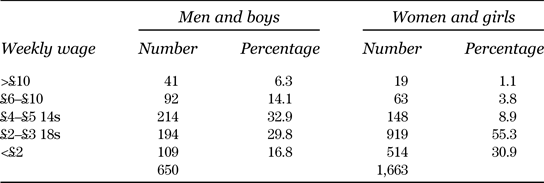
Throughout these changes in structures and procedures, top management remained a predominantly male domain in British department stores, with a strong streak of paternalism persisting well into the twentieth century, even in some of the larger groups. That said, there was an acknowledged role for female buyers from the late nineteenth century onward, and twenty-eight of the forty-seven senior managers at Fenwick of Newcastle were women by 1932. Moreover, some larger stores sought to follow the example of Parisian department stores, which paid high wages to some of their female workers, making them “Queens of the Proletariat.”Footnote 55 Yet most women's experience of working in department stores was in poorly paid shop floor or backroom jobs, even if they far outnumbered their male counterparts. A 1931 census of staff employed by the John Lewis Partnership enumerated 1,663 women and 650 men, but most of the women were in relatively poorly paid positions (see Table 5).
John Lewis Partnership Wages and Staff Numbers, 1931

Source: Draper's Record, 6 Feb. 1932, Q338.47687DR1, Manchester Central Library, Manchester, U.K.
The widespread employment of female shop assistants is seen as a particularly Anglo-American phenomenon, with numbers being much lower in many European countries.Footnote 56 However, in Japan, while management remained predominantly male, the number of female shop workers was quite high by the 1930s. A contemporary study by Hoshino found that women comprised 47 percent, 55 percent, and 61 percent of the workforce in the three largest department stores in Osaka, many of them working in the store restaurants. However, few of them saw this work in terms of career progression; many simply enjoyed wearing the Western-style uniforms and commuting to the modern department stores for a few years, viewing it as a social experience prior to marriage. Their salaries were quite low, mostly less than ¥30 per month, and did not increase during their career; by comparison, female bus conductors earned ¥40 per month and male workers at the department stores who graduated from professional schools had starting salaries of ¥35 per month, with a view to progressing as their careers developed.Footnote 57 The stores themselves considered women to be inferior to men in the labor force, while female workers were also unenthusiastic about learning advanced skills. This created problems for some stores—especially those newly established in the 1920s—as they struggled to retain female employees. In order to address this problem and secure the necessary personnel, Hankyu established a women's vocational school in 1936 and Daitetsu opened a women's commercial school in 1937. For their parent railway companies, this was also a strategy to increase the number of commuters between the suburbs, where the women lived, and the schools, which were located in the city center.Footnote 58
Customer Experiences: Service and Self-Service
Department stores are often seen as having transformed the experience and practices of shoppers, ushering in a new era of modern consumerism and shopping through their innovative retail practices and spaces.Footnote 59 In assessing the veracity of these claims, it is useful to examine how these processes unfolded in and impacted on different social and cultural contexts. In terms of retail practice, we examine the customer service and the provision of facilities that created a “modern” leisurely shopping environment; from the perspective of the customer, we explore changing shopping experiences, especially for women.Footnote 60
A high level of customer service was not new, but department stores often sought to exploit it as something that made them distinctive. Japanese department stores that had grown from silk drapers drew on their long tradition of customer service. Mitsukoshi, for example, distributed a handbook to its staff in around 1907 that showed what was expected of its sales staff: i) always paying attention to customers, so they should keep an eye on what was happening all around them; ii) always thinking about and anticipating what customers want, so they are on the same wavelength; iii) welcoming not only customers who are clearly intending to make a purchase, but also those who are just browsing and enjoying walking around the store; iv) welcoming all customers equally and courteously, and not giving preferential treatment to wealthy-looking customers; and v) never yawning, appearing sulky, or gossiping, always maintaining good posture and a smile, and being polite and courteous with customers at all times.Footnote 61
This high level of service differentiated department stores from other retailers and the effective management of sales staff meant it could be maintained, no matter what the previous sales experience of each staff member; with clear guidelines and modern organizational management, high-quality service was assured. Such guidelines, and the close regulation of staff that they implied, closely reflected practices in European department stores. As early as 1887 the Draper's Record advocated Wanamaker's system of staff management, but a growing number of metropolitan stores introduced their own education departments while others looked to Bon Marché in Paris, for example, in recruiting only grammar school girls or poaching staff trained in other department stores.Footnote 62 Such practices continued well into the 1930s, at least in stores aiming at a middle- and upper-class clientele, in part because they helped to distinguish these stores from the growing number and variety of multiple retailers. We get a flavor of this from the interviews recorded by Mass Observation in its study of Browns of Chester. One working-class woman noted, “People say the assistants there are nicer than anywhere else. They're so helpful, you see”; another agreed: “the assistants there are really nice. They let you look round and tell you where everything is. They show you everything.”Footnote 63 Such high levels of customer service required sales assistants to engage in lengthy discussions with customers, ascertaining and fulfilling their requirements, and often offering advice—again, a practice with deep roots in earlier retail formats.Footnote 64 Other British department stores took a different approach, aiming for greater efficiency rather than high levels of service. This was especially true of stores like Lewis's that served a working- and lower-middle-class clientele and sometimes involved allowing customers to help themselves to goods arranged on tables or placed in boxes—a practice that David Lewis adopted from the outset in his Manchester store, which opened in 1880.Footnote 65
Browsing and the open display of goods are often seen as a key characteristic of department stores. While these were established elements of shopping practice in eighteenth-century Britain, department stores developed and deployed techniques for displaying goods in ways that were more complex, elaborate, and varied than was possible in smaller stores.Footnote 66 Some goods were laid on tables, placed in boxes, or draped over banisters, and growing use was made of glass display cabinets. Ubiquitous by the turn of the century, these glass cabinets differed from those deployed in earlier shops by being placed on the shop floor or incorporated into counters. The former were joined from the late nineteenth century by mannequins modeling clothing and in the 1920s by more complex tableaux that combined a set of associated goods or outfits—for example, sporting equipment or spring fashions. In some ways, these echoed the increasingly sophisticated window displays mounted in London and some of the larger provincial stores; Co-operative Central Stores often proved particularly innovative in this regard.Footnote 67 At the same time, however, many department stores, including Lewis's, adhered to older traditions of crammed window displays and massed goods within the shop.
Japanese stores imported new ideas of display from the West, often adopting a British rather than American model. There were glass cabinets containing expensive imported products, but these remained locked until a sales assistant came with a key. Equally, while stationery and books were displayed openly, sales assistants would move a step closer if customers showed interest in these products. Indeed, staff handbooks instructed that the best time to approach customers was when they picked up a product to inspect it more closely.Footnote 68 This high level of customer service was expected and welcomed by Japanese customers and was quite different from the “modern” self-service shopping that characterized many American stores. Sales assistants did much more in Japan than was claimed in the United States, where a store manager proclaimed that “the goods sell themselves, and the clerks merely wrap them up and take the money.”Footnote 69
Similar priorities and practices were apparent in Britain. The women interviewed by Mass Observation reported that the assistants in Browns were there to serve customers rather than the customers helping themselves. More generally, the sales assistant helping and advising customers from behind a counter remained common in many stores into the postwar period. Photographs of the glove department in Howells of Cardiff in the late 1920s show numerous glazed cabinets and open displays, but two well-dressed women stand at a counter inspecting goods in a way that closely resembles the illustration of Benjamin Cole's trade card, produced some two hundred years earlier—the scale of the shop is different, but the practices remain largely unchanged. Similarly, a photograph of the menswear department at Harrods, taken in 1930, shows men browsing ties and other accessories that are on open display on the shop floor, but those engaged in buying are stood or sat at a glazed counter while being served by suited assistants.Footnote 70
Department stores also offered their customers a wide range of additional services, which made their visit a pleasurable experience. British department stores built on the earlier tradition of bazaars, which, with their dioramas and waxworks, were frequently places of entertainment as well as retailing. The range of leisure activities grew to include orchestras and bands, fashion shows and demonstrations of hat making, celebrity visits and novelty acts, balloon launches and pageants.Footnote 71 These were aimed at making the department store a place to visit as well as to shop; the expense was repaid in greater footfall and greater sales. Linked to this was a set of rather more mundane facilities aimed at making the customer more comfortable and allowing them to stay in the store longer: tearooms, restaurants, resting rooms, and toilets. Erika Rappaport argues that the last of these were particularly significant for women at a time when public conveniences were mainly for men.Footnote 72 The importance of such facilities is apparent from their presence in even quite modest provincial department stores (e.g., Brookfield's in Stafford) and in those with an essentially working-class or lower-middle-class clientele, like Lewis's. Indeed, this challenges Scott and Walker's suggestion that it was only stores serving wealthier customers that sought to compete on service.Footnote 73
To an extent, such forms of entertainment and facilities were culturally specific, but their presence in Japanese department stores links closely to the agenda of Westernization. Following a visit made to London in 1906, the CEO of Mitsukoshi, Ohsuke Hibi, decided to model his main store on Harrods. In addition to creating a comfortable shopping environment for customers, he introduced various services to attract family customers to the store: weekly piano and, subsequently, violin concerts in the customer lounge (1906, 1907), an art gallery (1907), and concerts by a Western-style band in the main hall (1909). This not only functioned as a showcase of Western musical instruments to stimulate sales but was also an opportunity for Japanese consumers to become more aware of Western culture. While American department stores played classical music to reinforce their sophisticated image and to promote high-end sales, Japanese department stores used Western musical instruments in order to introduce and promote Western culture.Footnote 74 Their new target customers were highly educated businessmen and their families, who had growing incomes during the interwar period of industrialization in Japan. Encouraged by the promotion of Western culture as advanced and exclusive, these customers had their own houses built to include a modern Western-style room and they bought fashionable Western products from department stores for their homes. The ideal image of modern life for many newly wealthy Japanese men at the time was to have a wife or daughter who played the piano or violin in their home: an amalgamation of Western taste and Japanese lifestyle. Elsewhere in Mitsukoshi stores were exhibitions on Western lifestyle, including photographs of foreign countries, children's toys, and the latest fashions.Footnote 75 This linked to Hibi's philosophy that Mitsukoshi should contribute to the social and cultural development of its consumers’ lives, but it also made good business sense in that it increased awareness and ultimately sales of key Western goods.
This consciously educational role for entertainment and facilities distinguished Japanese department stores from their counterparts in the West, as did the lack of continuities in retail format and leisurely shopping environments. This meant that Japanese department stores were more genuinely new retail and leisure spaces that offered customers profoundly different shopping experiences from those they were used to. This was liberating in some ways, but also problematic because customers lacked a preexisting culture of shopping that might provide appropriate points of reference. For instance, the Mitsukoshi store included an elegantly decorated customer lounge, with Western-style tables and chairs, where shop assistants served tea and biscuits. These were popular with the store's upper-class customers and they attracted a lot of publicity, but most customers, especially women, did not realize they were allowed to go into the room and so just had a quick look from the door.Footnote 76 Mitsukoshi had to circulate information leaflets on the facilities that were available to all the store's customers, making it clear that everyone was welcome to come into the store, even if they had no intention of buying anything—a key element of department stores in both Europe and North America.Footnote 77
Japanese department stores outside the biggest cities also caused culture shock when they first opened, but were quickly assimilated into established social norms and created new consumer and social practices. In 1916, the provincial drapery store Yamagataya, in Kagoshima (Table 1), was transformed into a department store modeled on Mitsukoshi in Tokyo. This new store had a huge impact on consumers, who were initially surprised by the huge building because until then only temples had been constructed on this scale, and local people did not have chance to visit Tokyo and Osaka due to lack of public transport at the time. The entrance was made from Italian marble and fronted by six Western-style window displays with large glass panes. People admired this store passionately, especially with its modern Western-style equipment including the latest elevator from Otis Brothers & Co., which became particularly popular among children on school trips. It also became common for college students to visit in order to buy cheap pencils and admire the beautiful young saleswomen in their fashionable uniforms.Footnote 78
As this shows, Japanese stores were the haunt of men and children—a contrast with the image of the department store being especially oriented toward women. Indeed, historians are often overly eager to identify the department store as a female space—a tradition that can be traced back to Émile Zola and that links into wider notions of women's absence from the public sphere.Footnote 79 This eagerness ignores the long history of female engagement with shopping and perhaps tells us more about male anxieties about women empowered through their consumption and their labor in department stores and other shops or turned into kleptomaniacs by the riches on offer.Footnote 80 Shoplifting, reckless spending on their husbands’ accounts, and sexual impropriety were present, but were overblown in the popular imagination. Yet department stores did provide middle-class women with respectable and practical spaces in which to spend time and money. Indeed, they were one of only a handful of publicly accessible buildings providing women's toilets—themselves an attraction and a means of keeping women in stores longer.Footnote 81 Moreover, department stores geared much of their advertising to women, and images of store interiors frequently show them packed with female shoppers. In part as a response to this, some British department stores felt it necessary to reassure male customers that they could access the departments they wanted without the embarrassment of encountering along the way other less manly things, like the perfume department. Some stores had a separate entrance to their “Man's shop,” while many others contained smoking rooms, barbers, or reading rooms where men might wait while their wives shopped.Footnote 82
Japanese department stores were initially a male domain—a gendering of space shaped by traditional retail practices and by the nature of the Westernization process.Footnote 83 The main customers of traditional drapers were men; they earned and handled the money while women took care of the home. Moreover, most of the Western products initially sold by department stores were for men: stationery, hats, umbrellas, walking sticks, clothing, and shoes. It was only in the 1910s, when the male market was well established, that department stores began to target women and children, enticing them with the modern facilities and entertainment described above. As in the West a generation or two earlier, Japanese department stores then became a place for middle-class women to visit, similar to going to see a play at the theater.Footnote 84
Once department stores succeeded in attracting women to the stores, their merchandise expanded to include products specifically for them, a practice that became increasingly profitable. At the same time, department stores also targeted specific Japanese customs, such as the wedding tradition that a bride's parents buy goods for the couple's new home and life together, including many different kinds of kimonos for various occasions, a futon, and other furniture and homeware. This was a suitable occasion for women to visit a store for shopping, and stores such as Mitsukoshi set up sales displays specifically to meet this demand. In these a wide range of goods ordinarily found in many different stores was brought together in one place, from traditional items to modern (i.e., Western) imported objects and furnishings for their new life. In 1916 Mitsukoshi introduced a concierge desk where customers could discuss the details of the wedding party and their outfits, and in 1922 it launched a sales space exclusively for wedding-related products. From 1909 Takashimaya held annual exhibitions of the wedding furnishings bought by customers for their marriage ceremonies and new homes. The store further encouraged sales by using leaflets to advertise these products and its personalized service, and to assure consumers that its stores could cater to all their wedding requirements. Women's magazines also ran articles covering celebrities’ wedding experiences, with beautiful pictures taken at department stores; it then became hugely attractive to young brides-to-be to buy the same fashionable products at the same stores.Footnote 85 This was a highly effective marketing strategy for department stores and meant that women eventually became their best customers.
Conclusion
Comparative studies reveal both the general properties, principles, and practices of department store retailing, and the particularities of time and place. Our study of Japanese and British department stores shows that they had much in common: both typically grew out of drapery stores and expanded by offering new lines of merchandise; they became “cathedrals of consumption,” with modern equipment and facilities (including elevators, glass display cases, tearooms, and art displays), and they increasingly opened their doors to everyone, although the experiences of shoppers undoubtedly varied with age, class, and gender. Many offered high levels of customer service, especially in comparison with American department stores, which were quicker to introduce self-service shopping, and the burgeoning network of chain stores found in Britain, where price and efficiency were often the key trading advantages. British and Japanese department stores focused on expanding and perfecting the sales floors of their anchor stores with high-quality merchandise, prioritizing this over the standardization and chain store operation seen in America. At the same time, both took lessons on modern management structures from their counterparts in the United States.Footnote 86
For all these similarities, Japanese and British department stores displayed important differences in their character and development trajectory. Department stores emerged much later in Japan, but then grew very quickly to enjoy a much larger share of total sales. In part, this growth and dominance reflects a lack of competition in the form of chain stores and co-operatives, as well as independent retailers, which in Britain often offered a similar set of goods and sometimes a similar shopping experience. Indeed, it is possible to argue that certain British chain stores, including Boots and Marks & Spencer, were effectively department stores by the 1930s; others, such as Woolworths, were driving modern practices such as self-service.
Yet the dominant position of Japanese stores was also a product of the size and complexity of the businesses that lay behind them: their scale of operation was much larger than most British stores, with a handful of department stores dominating the retail market in Japan. Well into the twentieth century, Britain was characterized by a large number of small independent department stores spread across the country in a dense network. Almost any town of note had at least one shop that could reasonably portray itself as a department store, able to meet most needs of the local consumer. In contrast, Japanese department stores were essentially metropolitan and thus corresponded with the upper tier of the British department store hierarchy comprising London stores such as Harrods, Selfridges, and D H Evans and provincial stores like Kendals (Manchester), Bainbridge's (Newcastle), and Brown Muff & Co. (Bradford). Like their Japanese counterparts, these metropolitan stores primarily sold to upper- and middle-class customers, whereas small-town stores served a much wider cross section of society, while others, like Lewis's, specifically targeted a working-class market. There was therefore much greater diversity in department stores in Britain than in Japan. Department stores could be many different things in a more mature and variegated retail system.
This heterogeneity does not undermine the department store as a meaningful category. Their common and unique qualities help historians to identify and explore those aspects of organization and practice that were central in producing retail and consumer transformation. Here, the distinctions between British and Japanese stores become more evident. Those in Japan effectively revolutionized and modernized retailing in a way that their British counterparts did not. The evolutionary development of many British stores, and their adoption and improvement of earlier forms of shop design and marketing, meant their impact was incremental. British shoppers had long been able to browse goods in a leisurely manner and in settings that facilitated leisurely shopping. In this sense, modernity came gradually, despite the oft-quoted impact of visionaries such as Gordon Selfridge. Japanese stores choosing to switch from traditional modes of selling to department store retailing were consciously choosing a very different modus operandi, one with profound implications for their shops, selling practices, customer base, and identity. The wider impact of the decisions by individual firms was hugely important, in part because of the stores’ size, but also due to their continued emphasis on upper- and middle-class consumers—those with political, economic, and cultural influence. Perhaps most significant was their alignment with the government agenda of modernization and Westernization. Combined, this allowed Japanese department stores to lead the Westernization of the Japanese lifestyle through sales of their Western products and promotion of Western material culture and values.
Only through comparative analysis can these differences be brought into focus and laid alongside the long-term fortunes and impacts of department stores in different countries. What our analysis shows is that both the nature and process of retail modernization and the power of department stores to transform retailing and shopping, and to shape broader cultural and social practices, were contingent on local circumstances. The department store was a truly global phenomenon, but it was also a product of its local and national context. Provincial stores were not simply smaller copies of metropolitan giants, nor were Japanese stores slavish replicas of Western models, despite the visits made to stores in other countries to learn about management practices and store layout. Local and national differences reflected the economic, political, and cultural setting in which the department store operated and also the long-term history of retail and shopping practices in that place.