INTRODUCTION
Haemosporidian parasites are responsible for millions of infections and thousands of deaths in humans, as well as domestic and wild animals each year (Valkiūnas, Reference Valkiūnas2005; Enayati and Hemingway, Reference Enayati and Hemingway2010). Infections may spread further owing to current environmental changes because climate warming enhances the geographical expansion of both parasites and vectors into regions from which they were previously absent (Jones et al. Reference Jones, Pater, Levy, Storeygard, Balk, Gittleman and Daszak2008). Despite their relevance for human and animal health, insect vectors feeding on different vertebrate species and transmitting haemosporidians are poorly known (Santiago-Alarcon et al. Reference Santiago-Alarcon, Palinauskas and Schaefer2012a). This creates two challenges. First, as the insect vectors of most of the haemosporidian parasites described to date are unknown, we do not know how and with whom these vectors directly and indirectly interact. Second, if vectors suck blood from humans and other vertebrates (e.g. Mayne, Reference Mayne1928; Coggeshall, Reference Coggeshall1940; Lefèvre et al. Reference Lefèvre, Gouagna, Dabiré, Elguero, Fontenille, Renaud, Costantini and Thomas2009), humans will be exposed to a wide range of parasites existing in the animal community surrounding them (Santiago-Alarcon et al. Reference Santiago-Alarcon, Havelka, Schaefer and Segelbacher2012b). Hence, it is important to know what blood parasites make it into the bloodstream of humans, even if they initially do not develop into an infection, because this is the first step towards new emerging diseases (Arinaminpathy and McLean, Reference Arinaminpathy and McLean2009).
Haemosporidians are mainly transmitted by five families of Diptera: Culicidae, Hippoboscidae, Simuliidae, Ceratopogonidae and Psychodidae (Valkiūnas, Reference Valkiūnas2005; Santiago-Alarcon et al. Reference Santiago-Alarcon, Palinauskas and Schaefer2012a). Until recently it was believed that most vector species had specialized feeding habits, in general feeding on different vertebrate classes, but recent molecular data have found some vector species with generalized feeding habits (e.g. Santiago-Alarcon et al. Reference Santiago-Alarcon, Havelka, Schaefer and Segelbacher2012b). Studies on host feeding preferences have demonstrated that many species of Culicoides (i.e. biting midges) are specialized on either birds (e.g. Culicoides kibunensis) or mammals (e.g. Culicoides chiopterus, Culicoides deltus), but that some species are host generalists (e.g. Culicoides festivipennis, Culicoides obsoletus) (Bennett, Reference Bennett1960; Burýlova, Reference Burýlova1975; Santiago-Alarcon et al. Reference Santiago-Alarcon, Havelka, Schaefer and Segelbacher2012b). Host generalists are of special interest because they are capable of feeding on different vertebrate groups, and thus can facilitate the emergence of new diseases by spreading parasites to new hosts. Furthermore, under unfavourable or altered ecological conditions, vectors specialized on a specific vertebrate group can be found to feed on suboptimal hosts (Lefèvre et al. Reference Lefèvre, Gouagna, Dabiré, Elguero, Fontenille, Renaud, Costantini and Thomas2009). A recent study has shown that C. kibunensis readily takes blood from humans in an urban forest of southwestern Germany, and that some of these midges are infected with avian blood parasites (Santiago-Alarcon et al. Reference Santiago-Alarcon, Havelka, Schaefer and Segelbacher2012b). These results, together with the knowledge that Culicoides vectors are competent for a diverse array of parasites (e.g. viruses, trypanosomes, microfilarids, haemosporidians: Borkent, Reference Borkent and Marquardt2005), suggest that we do not have a clear understanding of the parasites to which humans are exposed. Moreover, the above-mentioned studies imply that parasite–vector–host interactions are less constant than typically acknowledged. This means that, despite the fact that humans have been historically exposed to a diverse array of parasites (i.e. people have not always lived in cities or towns), new parasite–human interactions may become established. Hence, novel health problems for humans may arise under a scenario of geographical range expansion of both insect vectors and the diseases they transmit due to habitat alteration and climate change (e.g. Jones et al. Reference Jones, Pater, Levy, Storeygard, Balk, Gittleman and Daszak2008).
Even in the best-studied regions, we lack knowledge on the diversity of competent vectors transmitting haemosporidians. This limitation contrasts with the better-known diversity of haemosporidian parasites, particularly for birds in temperate areas (Santiago-Alarcon et al. Reference Santiago-Alarcon, Palinauskas and Schaefer2012a). Some studies have characterized the seasonal variation in the occurrence of avian haemosporidians in different bird species (e.g. Herman, Reference Herman1938; Clark, Reference Clark1964; Bennett and Cameron, Reference Bennett and Cameron1974; Super and van Riper, Reference Super and van Riper1995; Bensch and Åkesson, Reference Bensch and Åkesson2003; Santiago-Alarcon et al. Reference Santiago-Alarcon, Bloch, Rolshausen, Schaefer and Segelbacher2011). However, few have compared those seasonal changes in parasite abundance with the abundance of putative vectors (e.g. Janovy, Reference Janovy1966; Greiner, Reference Greiner1975; Klei and DeGiusti, Reference Klei and DeGiusti1975; Atkinson, Reference Atkinson1988; Garvin and Greiner, Reference Garvin and Greiner2003). A time lag separates the emergence of competent vectors and the onset of parasites in the peripheral blood of birds in temperate areas (Janovy, Reference Janovy1966; Klei and DeGiusti, Reference Klei and DeGiusti1975; Atkinson et al. Reference Atkinson, Forrester and Greiner1988; Sol et al. Reference Sol, Jovani and Torres2000), and so determining the temporal availability of competent vectors is fundamental to understanding and predicting disease dynamics (Keeling and Rohani, Reference Keeling and Rohani2008). Most previous studies were conducted prior to the development of molecular methods to identify vectors, parasites and host blood meals, and so new opportunities now exist to characterize potential pathways of disease transmission.
Here, we studied feeding preferences and seasonal variation of Culicoides (Diptera: Ceratopogonidae) vectors in an urban forest (Mooswald) in the city of Freiburg in southwestern Germany, and compared the observed seasonality with variation in haemosporidian prevalence in blackcaps between early (spring) and late breeding season (summer/autumn). Our study site is embedded in a matrix of buildings and farms, and humans frequently use it for recreation. This raises the possibility that humans may be exposed to pathogens of wildlife bitten by potential vectors (e.g. ornithophilic Culicoides feeding on humans). In this study, we determine (1) the vertebrate species from which Culicoides vectors obtain blood meals, (2) the haemosporidian parasites that infect Culicoides vectors, (3) changes in Culicoides species and abundances across seasons, and (4) seasonal variation in haemosporidian prevalence in blackcaps and its relationship to variation in Culicoides populations. This information will help us to understand exposure of urban human populations to Culicoides vector species and vector-borne parasites from wild animals.
MATERIALS AND METHODS
Bird species model and bird sampling
We used the blackcap (Sylvia atricapilla) as a system to analyse associations between the temporal patterns of haemosporidian infections and the temporal availability of haemosporidians putative Culicoides vectors. The blackcap is a migratory passerine bird that is abundant and widely distributed across Europe (Pérez-Tris et al. Reference Pérez-Tris, Bensch, Carbonell, Helbig and Tellería2004) and well-studied across its geographical range (Pérez-Tris and Telleria, Reference Pérez-Tris and Tellería2002; Telleria and Pérez-Tris, Reference Tellería and Pérez-Tris2003; Bearhop et al. Reference Bearhop, Fiedler, Furness, Votier, Waldron, Newton, Bowen, Berthold and Farnsworth2005; Rolshausen et al. Reference Rolshausen, Segelbacher, Hobson and Schaefer2009, Reference Rolshausen, Hobson and Schaefer2010). Haemosporidian parasites infecting this bird have been sampled across Western and Central Europe (Pérez-Tris et al. Reference Pérez-Tris, Hellgren, Križanauskienė, Waldenström, Secondi, Bonneaud, Fjeldså, Hasselquist and Bensch2007; Santiago-Alarcon et al. Reference Santiago-Alarcon, Bloch, Rolshausen, Schaefer and Segelbacher2011), with some samples from Sweden and the Baltic Sea region (Križanauskienė et al. Reference Križanauskienė, Pérez-Tris, Palinauskas, Hellgren, Bensch and Valkiūnas2010). It is common to find high prevalence (>70%) of Haemoproteus spp. in blackcaps across their distributional range (Pérez-Tris and Bensch, Reference Pérez-Tris and Bensch2005a, Reference Pérez-Tris and Benschb; Pérez-Tris et al. Reference Pérez-Tris, Hellgren, Križanauskienė, Waldenström, Secondi, Bonneaud, Fjeldså, Hasselquist and Bensch2007; Križanauskienė et al. Reference Križanauskienė, Pérez-Tris, Palinauskas, Hellgren, Bensch and Valkiūnas2010; Santiago-Alarcon et al. Reference Santiago-Alarcon, Bloch, Rolshausen, Schaefer and Segelbacher2011). However, these parasites seem to have no significant effect on the condition of this bird species other than a short-term weight loss (Valkiūnas et al. Reference Valkiūnas, Žičkus, Shapoval and Iezhova2006). Haemoproteus parabelopolskyi, a parasite of blackcaps, is transmitted by the midge Culicoides impunctatus in Eastern Europe (Curonian Spit, Russia), which is considered to be an important vector of Haemoproteus species across Europe (Valkiūnas et al. Reference Valkiūnas, Liutkevičius and Iezhova2002; Valkiūnas and Iezhova, Reference Valkiūnas and Iezhova2004a, Reference Valkiūnas and Iezhovab). In addition, preliminary data indicate that H. parabelopolskyi can be transmitted by C. kibunensis in southern Germany, where C. impunctatus is rare (Santiago-Alarcon et al. Reference Santiago-Alarcon, Havelka, Schaefer and Segelbacher2012b).
We captured blackcaps in southwestern Germany, in Freiburg (48°00′N 07°51′E) from 2007 to 2011 and in Radolfzell (47°45′N, 08°59′E) in 2006, using mist nets aided by tape recordings of blackcap song. We analysed haemosporidian infection of 166 blackcaps caught during spring and autumn 2006, 169 caught during spring and summer 2007, 120 caught during autumn 2009 (see Santiago-Alarcon et al. (Reference Santiago-Alarcon, Bloch, Rolshausen, Schaefer and Segelbacher2011) for detailed sample sizes), and 18 during summer 2011. Each individual bird was marked with a standard aluminium ring, sexed, and aged based on plumage and skull pneumatization (Shirihai et al. Reference Shirihai, Gargallo and Helbig2001). We took ∼75 μL of blood from the brachial vein of each captured bird using heparinized capillary tubes and stored the samples at −20 °C in the laboratory. Each bird was released after sampling.
Vector sampling
We collected Culicoides midges during 2010 and 2011 using BG Sentinel® traps (Regensburg, Germany) with UV light; we added dry ice (CO2 source) as an additional attractor in 2011. Collections were made in an urban forest of Freiburg in Southwestern Germany (Mooswald Forest, 48°00N, 07°51E). This forest is a mixed deciduous forest with water available in small streams and ponds where Diptera vectors can develop. The forest contains many walking trails including some forest roads. Traps were operated overnight starting at 18:00 h, and picked up next morning at 08:00 h. We sampled from late March until the beginning of October in 2010 conducting a total of 32 trapping nights using two traps, which yielded 64 samples; we detected no Culicoides in March and we did not sample in August. From June to August 2011, we conducted 14 trapping nights using two traps for a total of 28 samples. Insects collected in 2010 were used to study the phenology of the Culicoides community.
Samples were subsequently processed in the lab with a stereomicroscope; each Culicoides sample was divided into engorged (i.e. insects with a full or partial blood meal) and unfed midges. Engorged midges from 2011 were used for blood meal analysis; blood meal results for midges from 2010 can be found in Santiago-Alarcon et al. (Reference Santiago-Alarcon, Havelka, Schaefer and Segelbacher2012b). We dissected the abdomen and thorax of each individual midge; dissecting tools were sterilized with alcohol and flame for every insect. We extracted the DNA from the blood contained in the abdomen and conducted PCR (see below). Midges that previously had a blood meal (i.e. parous) might have been infected with haemosporidian parasites, in which case different developmental stages could be present in the insect's mid gut wall (i.e. oocysts) or in the salivary glands (i.e. sporozoites), which would imply that these vectors could inject haemosporidian sporozoites during subsequent feeding bouts. The thorax of each dissected midge collected in 2011 was also stored in 70% alcohol for subsequent laboratory work (DNA extraction and PCR to detect parasites). The head, genitals, legs, and wings of dissected midges were mounted on microscope slides in Euparal for subsequent morphological identification. Unfed midges were kept in 70% alcohol until they were processed for identification. Determination was conducted using taxonomic keys (Kremer, Reference Kremer1965; Havelka, Reference Havelka1976; Országh, Reference Országh1976; Szadziewski, Reference Szadziewski1984; Delécolle, Reference Delécolle1985). Representative Culicoides specimens were mounted on slides and they are kept in the insect collection of Havelka and Aguilar at the Staatliches Museum für Naturkunde in Karlsruhe, Germany.
Molecular work
We extracted DNA from blood meals, abdomens and thoraxes of the Culicoides midges and from bird blood samples using the DNeasy Blood and Tissue® kit (QIAGEN, Hilden). DNA quality was checked on a 1·2% agarose gel. We conducted a nested PCR to amplify the bar code (COI mitochondrial DNA gene) of each blood meal using the protocol described in Alcaide et al. (Reference Alcaide, Rico, Ruíz, Soriguer, Muñoz and Figuerola2009), which amplifies ∼758 bp. We also used parasite genus-specific primers in a nested PCR protocol that amplifies a fragment of ∼524 bp of the cytochrome b mitochondrial DNA gene of haemosporidian parasites (Hellgren et al. Reference Hellgren, Waldenström and Bensch2004) to verify whether avian blood samples and vector abdomens and thoraxes were infected. All PCRs were run with positive controls (blackcap haemosporidian-infected blood sample, and blood samples from another five bird species (blue tit (Cyanistes caeruleus), great tit (Parus major), robin (Erithacus rubecula), blackbird (Turdus merula) and songthrush (Turdus philomelos) as positives for the blood meal analysis) and a negative control (ddH2O). Subsequently, we cleaned the PCR products with the MinElute kit (QUIAGEN, Hilden), placed them in a 96-well plate and sent them out for sequencing at Microsynth AG, Switzerland. Sequences were edited with 4Peaks v.1.7.2 (mekentosj.com). We used the identification engine of the BOLD (Barcode of Life Data Systems) systems v2.5 (Ratnasingham and Hebert, Reference Ratnasingham and Hebert2007) to identify the vertebrate species for each COI sequence obtained from the blood meals. Cyt b sequences obtained from haemosporidian-infected blood meals, abdomens and thoraxes were compared against DNA sequences available in GenBank™ by using the BLAST algorithm of the NCBI (National Center for Biotechnology Information) database. Sequences were deposited in GenBank™ (accession numbers for mtDNA cyt b: KF192995-KF193002, and for mtDNA COI: KF193003-KF193056).
Statistical analyses
To analyse changes in Culicoides species throughout the study period, we used a χ2 test to compare the abundances of Culicoides recorded in each month, assuming as expected values the average monthly abundance. Subsequently, to detect changes in assemblage structure, we contrasted the monthly rank-abundance curves (Feinsinger, Reference Feinsinger2001) and then we calculated the Exponential Shannon Index using the SPADE program (Chao and Shen, Reference Chao and Shen2010), which reflects the number of equivalent species with respect to their relative abundance (Jost, Reference Jost2006, Reference Jost2010). Finally, we evaluated changes in assemblage structure between months through a randomization test, assigning 10 000 random partitions (Solow, Reference Solow1993, two-sided test). The test was performed in the Species Diversity and Richness v.3.02 program (Henderson and Seaby, Reference Henderson and Seaby2002). Compositional similarity between contiguous months was analysed using the Jaccard Index based on incidence, as well as the Jaccard Index based on abundance (including the calculation of standard error by means of a bootstrapping procedure), both indices were calculated using the SPADE program (Chao and Shen, Reference Chao and Shen2010).
We used the program Quantitative Parasitology 3.0 (Rózsa et al. Reference Rózsa, Reiczigel and Majoros2000) to calculate unbiased haemosporidian prevalence estimates. We estimated 95% confidence intervals by Sterne's exact method (Reiczigel, Reference Reiczigel2003).
RESULTS
Blood meal analysis
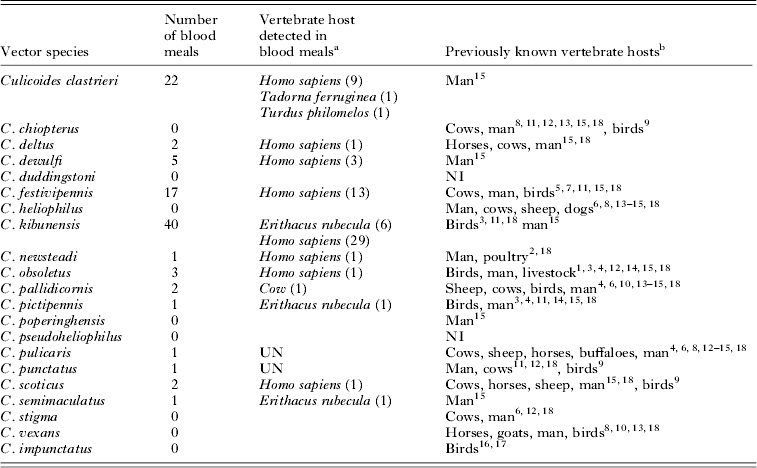
We trapped 98 engorged (i.e. insects with full or partial blood meals) Culicoides midges of 13 different species (Table 1). We obtained good-quality COI sequences from 69 blood meals; most likely the DNA in the other 29 blood meals was degraded due to digestion in the vector's mid gut. Fifty-eight blood meals (84%) were derived from humans, 10 from birds (E. rubecula, T. philomelos, Tadorna ferruginea), and one from livestock (cow). We identified eight Culicoides species with blood meals derived from humans (Table 1). For a second time, we found C. kibunensis, previously known to feed only on birds, with 29 human blood meals; we also detected two host generalist (i.e. bird- and mammal-feeding) Culicoides species (C. festivipennis, C. obsoletus) with 14 human blood meals. We present for the first time bird records for Culicoides clastrieri and C. semimaculatus, which makes them generalists considering that we previously found them feeding on humans (Table 1). We corroborate our previous finding on Culicoides dewulfi feeding exclusively on humans (Table 1).
Blood meals from Culicoides vector species found in the Mooswald forest of Freiburg during summer 2011

NI = no information available; UN = unidentified host (PCR failed to amplify or sequence was of low quality).
a Number of times a vertebrate host was identified from a blood meal is in parenthesis.
b References: (1) Bennett (Reference Bennett1960); (2) Braverman et al. (Reference Braverman, Boreham, Galun and Ziv1977); (3) Burýlova (Reference Burýlova1975); (4) Butenko (Reference Butenko1967); (5) Fritz (Reference Fritz1982); (6) Havelka (Reference Havelka1976); (7) Kitaoka et al. (Reference Kitaoka, Morii and Kosuge1965); (8) Kremer (Reference Kremer1965); (9) Lassen et al. (Reference Lassen, Nielsen, Skovgård and Kristensen2011); (10) Minár (Reference Minár1965); (11) Nielsen (Reference Nielsen1964); (12) Nielsen (Reference Nielsen1971); (13) Országh (Reference Országh1976); (14) Paclt et al. (Reference Paclt, Callot and Kremer1970); (15) Santiago-Alarcon et al. (Reference Santiago-Alarcon, Palinauskas and Schaefer2012a, Reference Santiago-Alarcon, Havelka, Schaefer and Segelbacherb); (16) Valkiūnas and Iezhova (Reference Valkiūnas and Iezhova2004a); (17) Valkiūnas and Iezhova (Reference Valkiūnas and Iezhova2004b); (18) http://www.bluetonguevirus.org/culicoides
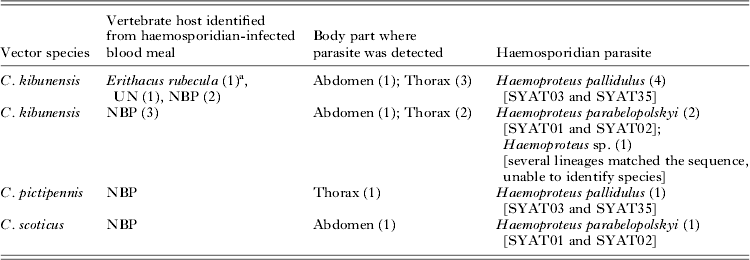
We found haemosporidian parasites in the thoraxes of six midges and the abdomens of three additional midges (Table 2). Haemoproteus pallidulus (lineages SYAT03 and SYAT35) infected four specimens of C. kibunensis and one of Culicoides pictipennis. One C. kibunensis infected with H. pallidulus fed on E. rubecula, which represents a new bird host record for this parasite. Haemoproteus parabelopolskyi (lineages SYAT01 and SYAT02) infected two individuals of C. kibunensis and one of Culicoides scoticus.
Haemosporidian parasites found in blood meals (abdomens) and thoraxes from Culicoides species collected in the Mooswald forest of Freiburg during summer 2011
UN = unidentified host (PCR failed to amplify or sequence was of low quality); NBP = no blood, parous specimen.
Parasite lineages are indicated in brackets and the number of times the interaction was observed is indicated in parentheses.
a New bird host record for H. pallidulus (Sylvia atricapilla was the only known host, see Križanauskienė et al. Reference Križanauskienė, Pérez-Tris, Palinauskas, Hellgren, Bensch and Valkiūnas2010).
Culicoides diversity and seasonality
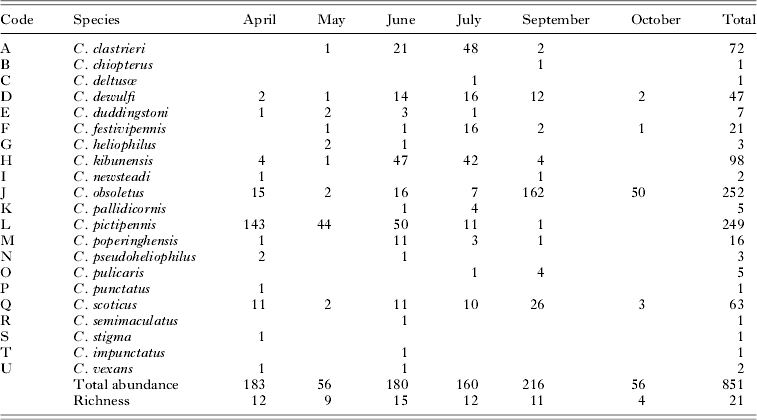
We identified 22 Culicoides species in the Mooswald forest. Vector sampling in 2011 added Culicoides furcillatus (only one specimen was collected) to the 21 species identified during 2010 (see Santiago-Alarcon et al. Reference Santiago-Alarcon, Havelka, Schaefer and Segelbacher2012b). During 2010, species richness per month varied between 15 species (in June) and four species (in October; Table 3). Altogether, we caught 851 Culicoides individuals, with notable differences between months (χ2 = 167·2, P<0·001, d.f. = 5): the highest abundance (216 individuals) occurred in September, while the lowest (56 individuals) occurred in both May and October (Table 3). Culicoides obsoletus and C. pictipennis were the most abundant species in the study, with 252 and 249 individuals respectively, which together represents 59% of all species recorded. In contrast, eight species were recorded just once or twice: C. chiopterus, C. deltus, Culicoides newsteadi, Culicoides punctatus, C. semimaculatus, Culicoides stigma, C. impunctatus and Culicoides vexans. Concerning temporal distribution, three species were recorded in all months of the study (C. dewulfi, C. obsoletus and C. scoticus), while six species were recorded in just 1 month (see Table 3). The remaining species were detected in 2 to 5 months.
Culicoides species recorded between April and October 2010 in an urban forest of Freiburg, Germany
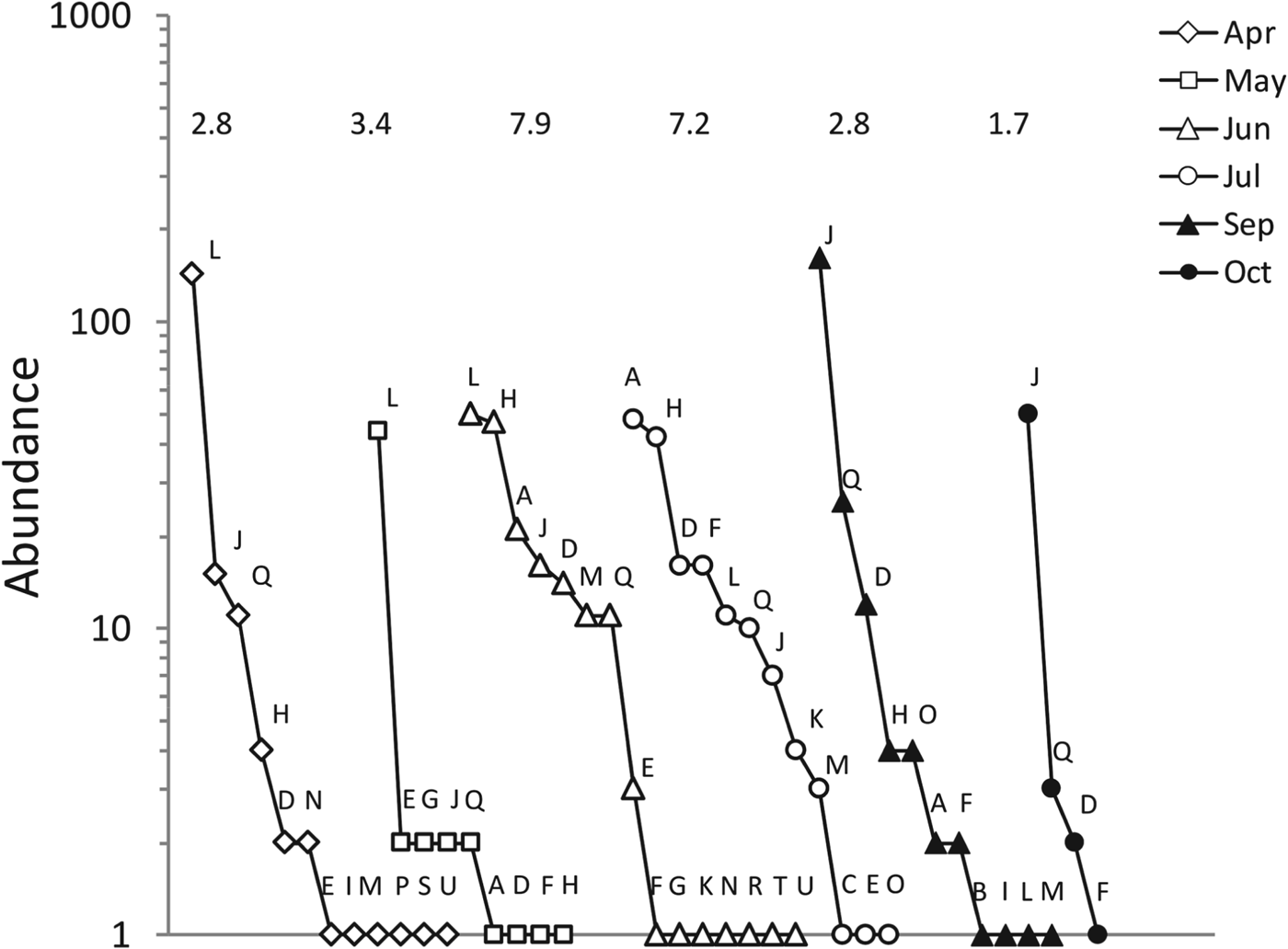
The structure of the species assemblage changed over the study period. Besides variation in species number, there were also changes in relative abundance and hence in the hierarchical position of species (Fig. 1). The slopes of range-abundance curves were steeper in the first and last months of the study, while during the intermediate months, in particular June and July, the slopes were shallower, indicating higher evenness in the assemblage. As a consequence, the Exponential Shannon Index values were higher (see Fig. 1). Assemblage structure did not differ between June and July, but these months differed from the assemblage structure of the other months. Also, assemblage structure in October differed from all other sampled months, while no differences were found between April, May and September (see Supplementary Table S1 – in Online version only for delta values and P-values). We detected a change in the dominant species throughout the study period. Culicoides pictipennis was the dominant species during April–June, but in July its hierarchical position decreased due to a notable decrease in abundance, and only one individual was recorded in August. No individuals of C. pictipennis were detected during September. Culicoides obsoletus dominated the assemblage during September and October and, although it was also present in the previous months, its abundance was moderate or low. It was also evident that rare species (1 or 2 individuals) occurred in all months, although the number varied considerably and different species were rare in different months (Fig. 1, Table 3).
Dominance–diversity curves for Culicoides assemblages in six different months during 2010 in an urban forest of Freiburg, Germany. Numbers above graphs denote Exponential Shannon Index value for each month. Species codes (capital letters) are given in Table 3.
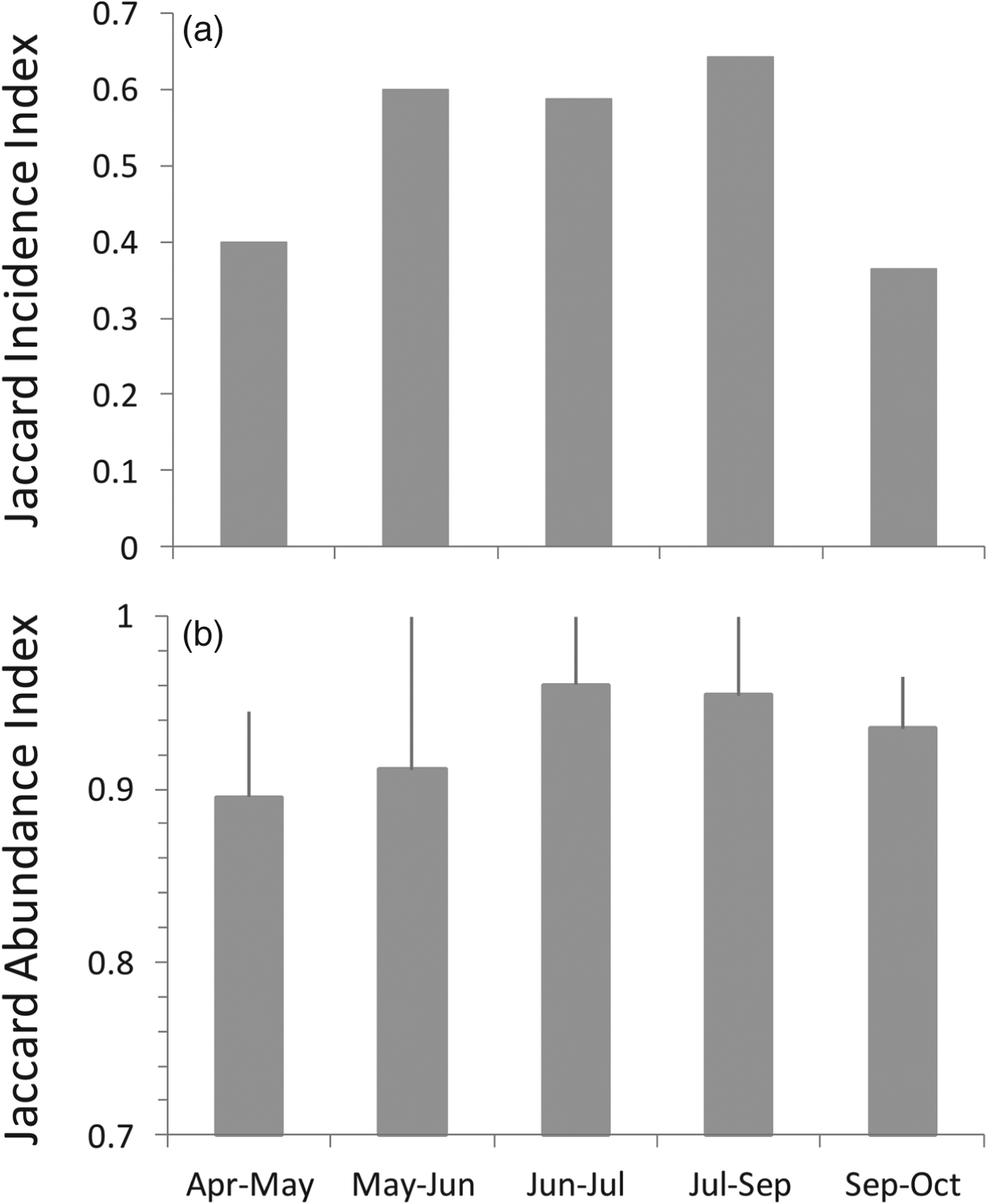
Compositional similarity between adjacent months was lowest at the beginning and the end of the sampling season (Jaccard Index based on incidences, JIin = 0·40 and 0·36, respectively), while in intermediate adjacent months (i.e. summer) compositional similarity was higher (JIin = 0·59 and 0·64; Fig. 2a). However, when compositional similarity was calculated using abundances (Jaccard Index based on abundances, JIab) the observed pattern was different. The lowest compositional similarity was detected at the beginning of the sampling season (JIab = 0·89), then increased until reaching a maximum value between June and July (JIab = 0·96) and subsequently slightly decreased towards the end of the study season (JIab = 0·94; Fig. 2b). Values of JIab agree with those of the Exponential Shannon Index (Fig. 1), which indicates higher evenness (i.e. more similar abundances among species) for the summer months.
Compositional similarity of Culicoides species between months in an urban forest of Freiburg, Germany. Results are shown for Jaccard Index, based on incidence (a) and abundance (b). Error bars are 1 SE, computed by a bootstrapping procedure (see Methods).
Parasite prevalence
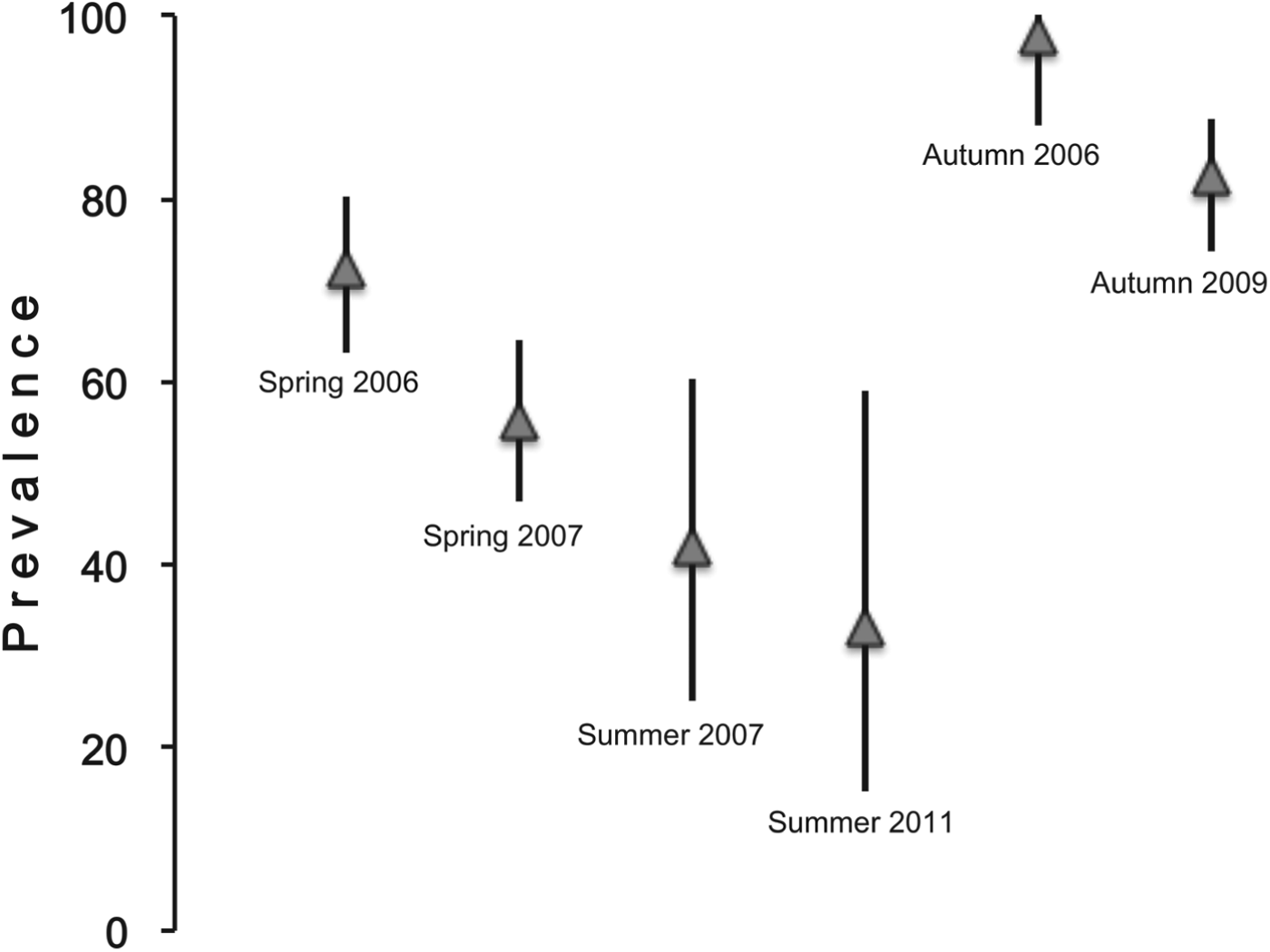
Haemosporidian parasite infection in blackcaps was lowest in summer (2011: 33·3% CI: 15·6–58·6%) and highest in autumn (2006: 97·8%, CI: 88·4–99·8%). There were no differences in prevalence within seasons in different years, but there were significant differences between autumn and the other two seasons (Fig. 3). There is a tendency for prevalence to decrease from spring to summer and then to peak again later in the season in autumn (Fig. 3).
Haemosporidian prevalence (assessed with nested PCR) variation among seasons for different years in blackcaps captured at two sites in southwestern Germany (2007–2011 in Freiburg and 2006 in Radolfzell). 95% CI (black lines) were calculated by the Sterne's exact method (see Methods).
DISCUSSION
Culicoides feeding preferences and haemosporidians
The use of molecular methods to determine interaction networks helps us to understand the ecology of parasites and the diseases they produce (Alcaide et al. Reference Alcaide, Rico, Ruíz, Soriguer, Muñoz and Figuerola2009). Moreover, understanding the feeding network of vectors and identifying the parasites they transmit will aid in identifying health threats for both humans and animals. Our blood meal analysis demonstrates that Culicoides vectors feed readily on humans and that they have broad host preferences. Seasonal sampling shows that there are different Culicoides species feeding on humans throughout the whole vector season (from April to October), suggesting that humans are potentially exposed to any wild bird parasite transmitted by this vector genus for most of the year. For instance, we found that C. kibunensis, previously considered an ornithophilic midge, regularly takes blood meals from humans; this is a common species at our study site and it is frequently infected with avian haemosporidians (Table 2). We previously detected C. clastrieri and C. semimaculatus feeding on humans (Santiago-Alarcon et al. Reference Santiago-Alarcon, Havelka, Schaefer and Segelbacher2012b), and in the present study we found these two species feeding on bird hosts as well (Table 1), which places them as generalists and as epidemiologically relevant considering the transmission of wild animal parasites into humans. Furthermore, we found one empty abdomen of a C. scoticus specimen infected with a bird parasite (H. parabelopolskyi), which would suggest that C. scoticus also feeds on birds in our study site. Because the abdomen of this vector was empty and it was a parous specimen (i.e. it had already completed at least one gonotrophic cycle), the detected parasite DNA most likely derived from oocysts located in the vector's mid-gut. This is the second time C. scoticus is registered feeding on birds (see Lassen et al. Reference Lassen, Nielsen, Skovgård and Kristensen2011); previously this species was known to feed only on non-human mammals, but our results indicate that this species commonly feeds on humans, as well (Table 1, see also Santiago-Alarcon et al. Reference Santiago-Alarcon, Havelka, Schaefer and Segelbacher2012b). Additionally, our analysis has also detected new parasite–bird associations. Haemoproteus pallidulus is a recently described species that is known to infect only blackcaps (Križanauskienė et al. Reference Križanauskienė, Pérez-Tris, Palinauskas, Hellgren, Bensch and Valkiūnas2010). Here, we detected H. pallidulus infecting the abdomen of a C. kibunensis vector that fed on a robin, which implicates the robin (E. rubecula) as a new bird host for this parasite. Caution must be practiced, however, before a definitive statement on this new record can be made because we have only found genetic lineages of Plasmodium relictum, Haemoproteus balmorali and Leucocytozoon majoris infecting robins at our study site (Santiago-Alarcon et al. unpublished results) and because the vector was parous, meaning that infection with H. pallidulus could have derived from a previous feeding bout on a different bird species (e.g. blackcap). Finally, C. impunctatus, which is the competent vector for H. parabelopolskyi in Eastern Europe, is rare in surveys conducted in Freiburg, which seems to indicate that the competent vector in Eastern Europe for H. parabelopolskyi is replaced in southwest Germany by C. kibunensis, and to a lesser degree, based on their abundances, also by C. scoticus and Culicoides poperinghensis (Santiago-Alarcon et al. Reference Santiago-Alarcon, Havelka, Schaefer and Segelbacher2012b; Tables 1 and 2). Thus, our results indicate that many unknown haemosporidian–host associations that are potentially relevant for human and animal health remain to be discovered.
Experimental studies have demonstrated that an avian parasite, Plasmodium lophurae, can adapt to and be viable in mice after just four rounds of infectious inoculations (McGhee, Reference McGhee1951). Furthermore, erythrocytes of different mammal species have been shown to be susceptible to invasion by bird Plasmodium parasites (McGhee, Reference McGhee1957). These studies suggest that haemosporidian parasites can adapt to new distant hosts rather quickly. Our results show that many Culicoides species of medical and veterinary importance are feeding across a diverse array of vertebrate hosts (Table 1), which posit them as ideal vectors to transmit parasites across large taxonomic distances. Many of those generalist vector species are susceptible to avian haemosporidian parasites (Plasmodium sp. and Haemoproteus sp., Santiago-Alarcon et al. Reference Santiago-Alarcon, Havelka, Schaefer and Segelbacher2012b; Table 2). This is important because the potential of parasites to rapidly adapt to new hosts will be one of the greatest challenges to human and animal health, as well as of increasing importance in the study of zoonotic diseases. Although Culicoides vectors infected with avian haemosporidians could transmit these parasites to humans, it is difficult to predict if a disease will eventually develop because parasites not adapted to the immune system of novel hosts can be rapidly detected and cleared (Ewald, Reference Ewald1994).
Plasticity of feeding preferences could vary for different vector families in an urban setting. For example, Kim et al. (Reference Kim, Tsuda, Sasaki, Kobayashi and Hirota2009) studied feeding preferences of Culex sasai (Diptera: Culicidae) in an urban park in Tokyo, Japan; different from our Culicoides results, this mosquito species seems to rarely use humans as part of its diet despite its generalist feeding habit (it fed on both birds and livestock). This result is for a single Culex species, however, and it might not be representative of the feeding habits of Culicidae in general. For instance, Lefèvre et al. (Reference Lefèvre, Gouagna, Dabiré, Elguero, Fontenille, Renaud, Costantini and Thomas2009) has found a plastic feeding response of Anopheles gambiae mosquitoes in a rural community of Burkina Faso, where preferences from humans have changed towards livestock due to year-round use of mosquito nets. Moreover, Culex quinquefasciatus alternated their feeding preferences between humans and livestock depending on the time of the year (Lefèvre et al. Reference Lefèvre, Gouagna, Dabiré, Elguero, Fontenille, Renaud, Costantini and Thomas2009). Hence, a more thorough analysis of Culicidae and other Diptera vector families feeding preferences is needed before generalizations are made.
In reference to viral diseases transmitted by Culicoides, bluetongue virus (BTV, Reoviridae: Orbivirus) was detected in central Europe in 2006 (Mehlhorn et al. Reference Mehlhorn, Walldorf, Klimpel and Schmahl2008). This is a disease of domestic livestock and wild ruminants that can create substantial economic problems (Mehlhorn et al. Reference Mehlhorn, Walldorf, Klimpel, Jahn, Jaeger, Eschweiler, Hoffmann and Beer2007, Reference Mehlhorn, Walldorf, Klimpel and Schmahl2008). Culicoides obsoletus, Culicoides pulicaris and C. scoticus are considered the main vectors of BTV in Germany and obtain their blood meals only from livestock (Mehlhorn et al. Reference Mehlhorn, Walldorf, Klimpel, Jahn, Jaeger, Eschweiler, Hoffmann and Beer2007; Bartsch et al. Reference Bartsch, Bauer, Wiemann, Clausen and Steuber2009). In our previous (Santiago-Alarcon et al. Reference Santiago-Alarcon, Havelka, Schaefer and Segelbacher2012b) and present study we found C. obsoletus, C. scoticus and C. pulicaris feeding on humans (Table 1). Given that BTV is already established in Germany, BTV could potentially also invade human blood via infectious Culicoides bites, though BTV and other Orbivirus (Arbovirus: Reoviridae) apparently do not produce acute illness in humans (Mellor et al. Reference Mellor, Boorman and Baylis2000; Quan et al. Reference Quan, Van Vuuren, Howel, Groenewald and Guthrie2008; Gethmann et al. Reference Gethmann, Hoffmann, Probst, Beer, Conraths and Mettenleiter2010; but see Calisher, Reference Calisher1994).
In areas with some degree of habitat modification (e.g. suburban and urban forests), infectious vectors can bite hosts that can turn to be suboptimal for both the parasite and the vector (i.e. host blood factors can be detrimental for vectors). In the case of urban forests or other areas with high densities and abundance of humans, humans can serve as a blood source that is a bigger and more accessible target than the wild animal source. Thus, humans can intercept vector infectious bites and can be acting either as a dead-end host or as a highly mobile reservoir capable of carrying viable wild animal parasites to other regions inhabited by naïve animal communities (e.g. islands). Moreover, continuous exposure of humans to novel parasites poses potential health problems created by emergent diseases. It is, therefore, a priority to study the biodiversity of haemosporidian parasites in wild vertebrates and of the vectors transmitting them since we must first know what is present to be prepared for any epidemiological emergency. Thus, future studies should focus on urban and suburban forests, where the transmission of putative non-human parasites into humans is more likely compared with sparsely populated rural areas (e.g. Bradley and Altizer, Reference Bradley and Altizer2007).
Culicoides diversity and seasonality
We found a total of 22 species at one location in Freiburg (Mooswald Forest, 48°00N, 07°51E). Fifty-six species of Culicoides have been registered for Germany (Havelka and Aguilar, Reference Havelka, Aguilar, Schumann, Bährmann and Stark1999). Twenty-five Culicoides species (removing Culicoides puncticollis from their list, which is a synonym of C. nubeculosus) have been recorded at 20 locations in northwest Germany (Kiel et al. Reference Kiel, Liebisch, Focke and Liebisch2009), 10 species at 19 locations in the state of Nordrhein-Westfalen (Mehlhorn et al. Reference Mehlhorn, Walldorf, Klimpel, Schmahl, Al-Quraishy, Walldorf, Mehlhorn and Bätza2009), and 22 species further south at 12 locations in the states of Saarland and Rheinland-Pfalz (Vorsprach et al. Reference Vorsprach, Meiser, Werner, Balczun and Schaub2009). A survey of Culicoides species in the state of Baden-Wuertemberg, where our sampling was conducted, have only determined species groups (i.e. C. obsoletus s.l., and C. pulicaris s.l.) and no further details on species identities were provided (Hörbrand and Geier, Reference Hörbrand and Geier2009). Twenty-nine species of Culicoides have been identified for the state of Baden-Wuertemberg (Havelka unpublished information). We observed a peak of species richness in April (n = 12) and then another in June (n = 15); species richness rapidly declined in October (n = 4). This pattern of species richness is different to the one observed in more northern regions of Germany, where the highest number of species was recorded during September and October (Vorsprach et al. Reference Vorsprach, Meiser, Werner, Balczun and Schaub2009). It is remarkable that we found at a single location about the same number of Culicoides species as the above-mentioned studies, which sampled broadly and throughout the whole year. This can pertain to different climatic conditions that are found in Freiburg and the southern parts of Germany, more Mediterranean-like weather in late spring and throughout the summer, which would certainly influence faunal diversity. Hence, we expect to find a much larger species count and possibly different species composition in this region of Germany when a more intense and complete sampling is performed.
Assemblages were more similar during summer months compared with early spring and early autumn, where Culicoides communities were less similar in both abundance and species composition (Fig. 1). There was a change in species composition across the study period; of particular importance are the changes in dominant species at the beginning, middle and end of the study period. Culicoides pictipennis was the dominant species during spring and was gradually declining as the season progressed, and completely disappeared by the end of the summer. Culicoides kibunensis and C. clastrieri were dominant during summer months, disappearing by the end of the summer. Culicoides obsoletus was the dominant species by the end of the summer and early autumn, which is in agreement with other surveys conducted in Germany (Hörbrand and Geier, Reference Hörbrand and Geier2009; Mehlhorn et al. Reference Mehlhorn, Walldorf, Klimpel, Schmahl, Al-Quraishy, Walldorf, Mehlhorn and Bätza2009; Vorsprach et al. Reference Vorsprach, Meiser, Werner, Balczun and Schaub2009). Culicoides dewulfi, C. obsoletus and C. scoticus were present during the whole season, of these C. scoticus maintained similar abundances among the different sampling months (Table 3). All these Culicoides species are generalists, feeding on humans, livestock and birds (Santiago-Alarcon et al. Reference Santiago-Alarcon, Havelka, Schaefer and Segelbacher2012b, Table 1), except C. dewulfi, which is known to feed only on humans (Santiago-Alarcon et al. Reference Santiago-Alarcon, Havelka, Schaefer and Segelbacher2012b, Table 1). The relevant issue is that these Culicoides species (including C. festivipennis) are abundant and dominate the vector community throughout the avian community's breeding season, which makes them potential vectors for parasite transmission across vertebrate groups. For instance, C. obsoletus, C. scoticus and C. pulicaris are known vectors of viruses that are lethal to livestock (Mehlhorn et al. Reference Mehlhorn, Walldorf, Klimpel, Jahn, Jaeger, Eschweiler, Hoffmann and Beer2007; Bartsch et al. Reference Bartsch, Bauer, Wiemann, Clausen and Steuber2009, see above), and these species readily feed on humans (Santiago-Alarcon et al. Reference Santiago-Alarcon, Havelka, Schaefer and Segelbacher2012b, Table 1). Furthermore, we have detected abdomens and thoraxes of C. kibunensis and C. pictipennis specimens infected with DNA of avian Haemoproteus and Plasmodium parasites (Santiago-Alarcon et al. Reference Santiago-Alarcon, Havelka, Schaefer and Segelbacher2012b, Table 2). Considering that Culicoides are able to transmit a large array of parasites (e.g. viruses: Mellor et al. Reference Mellor, Boorman and Baylis2000; trypanosomes, microfilarids, haemosporidians: Borkent, Reference Borkent and Marquardt2005), that most abundant and generalist midges are present throughout the whole season (despite significant changes in assemblage structure), and that they readily feed on humans, it is a priority to study the feeding preferences of dipteran vectors and the parasites they are susceptible to in an urban/suburban setting, where human populations are denser and chances of novel zoonosis are higher. We propose, under a conservation medicine framework, to design studies focused on a gradient going from urban to suburban forests and to more isolated well-conserved forests, in order to identify threats to human health as feeding preferences and composition of parasite and vector communities change along the habitat perturbation gradient (see also Bradley and Altizer, Reference Bradley and Altizer2007).
Seasonal haemosporidian prevalence
Blackcap (S. atricapilla) haemosporidian prevalence was >50% during spring and it decreased during summer (30–40%), peaking later on during early autumn (Fig. 3). The way we interpret this pattern is as follows: (1) because many blackcaps arrive in mid-March when no detectable Culicoides vectors are present at our study site, we assume that there is a large fraction of blackcaps returning from wintering quarters that are already infected (see Santiago-Alarcon et al. Reference Santiago-Alarcon, Bloch, Rolshausen, Schaefer and Segelbacher2011), and a few others should acquire infection in breeding grounds during April and early May, when midges are already available for parasite transmission (i.e. infection probability increases later during the breeding season, see Santiago-Alarcon et al. Reference Santiago-Alarcon, Mettler, Segelbacher and Schaefer2013); (2) parasite prevalence decreases towards the summer because new susceptible birds are added to the blackcap population, ‘diluting’ the proportion of birds already infected; and (3) because during the breeding period and throughout the summer there is a well-developed Culicoides vector community, most chicks/fledglings could get infected. Parasites in peripheral blood will not be detected until late summer or early autumn, however, when parasites have completed merogony in internal organs of birds. It is particularly relevant that C. kibunensis, one of the most common midges throughout the summer, has been detected feeding on blackcaps at our study population (Santiago-Alarcon et al. Reference Santiago-Alarcon, Havelka, Schaefer and Segelbacher2012b); moreover, we detected C. kibunensis abdomens and thoraxes infected with H. parabelopolskyi (see Table 2), a common parasite of blackcaps (Santiago-Alarcon et al. Reference Santiago-Alarcon, Bloch, Rolshausen, Schaefer and Segelbacher2011). Thus, the observed pattern is in agreement with that found in other studies conducted in temperate regions, where there is a time lag between the availability of competent vectors and the onset of haemosporidians in the peripheral blood of birds (Janovy, Reference Janovy1966; Klei and DeGiusti, Reference Klei and DeGiusti1975; Atkinson et al. Reference Atkinson, Forrester and Greiner1988).
ACKNOWLEDGEMENTS
We thank R. Mettler, C. Hermes, M. Melchior and M. Hoffman for assistance during fieldwork. R. E. Ricklefs and two anonymous reviewers provided comments that improved the quality of the paper.
FINANCIAL SUPPORT
This work was supported by the Deutsche Forschungsgemeinschaft (H. M. S., grant number 1008/6-1); the Alexander von Humboldt Foundation (D.S.-A., post-doctoral grant); and by the Wissenschaftliche Gesellschaft Freiburg (H. M. S. and G. S.).
DATA ACCESSIBILITY
Because we have no new mtDNA COI or cyt b sequences to report to GenBank™, we have decided instead to provide text files containing all sequences used for our analyses in FASTA format. We are providing two files, one for each gene, which are named: Supplementary Data S1 – in Online version only (contains: mtDNA-COI blood meal sequence data) and Supplementary Data S2 – in Online version only (contains: mtDNA-Cyt b haemosporidian sequence data). We provide an Excel file (Supplementary Data S3 – in Online version only) containing Culicoides data used for diversity analyses collected in 2010, the same file also includes numbers of Culicoides species collected during summer 2011 and the complete list of 2011 Culicoides that were dissected for subsequent molecular analyses (blood meal and haemosporidian parasite screening of both thoraxes and abdomens). Finally, we provide an Excel file (Supplementary Data S4 – in Online version only) with the haemosporidian infection data for blackcaps for the different years reported in the study. Data are archived in Dryad doi: 10.5061/dryad.5nt04.
AUTHOR CONTRIBUTIONS
DS-A wrote the paper; DS-A and HMS designed the study; DS-A and PH mounted Culicoides specimens and PH made all Culicoides taxonomic identifications; EP conducted all diversity analyses; DS-A and GS did all molecular work; HMS provided valuable insights throughout the different versions of the paper.
SUPPLEMENTARY MATERIAL
To view supplementary material for this article, please visit http://dx.doi.org/10.1017/S0031182013001285.