Introduction
CHD is not only a structural cardiovascular disorder but also a chronic systemic condition that may influence nutrition, metabolism, endocrine signalling, and somatic growth. These interactions are especially relevant in cyanotic CHD, where persistent hypoxaemia, increased metabolic demand, pulmonary vascular disease, recurrent infection, feeding difficulty, and delayed surgical correction may converge during periods of rapid childhood growth. This issue carries particular significance in low-resource or delayed-referral settings, where prolonged preoperative cyanosis and coexisting undernutrition are more common and may compound the adverse effects on growth. Reference Chinawa, Chinawa, Duru, Chukwu and Obumneme-Anyim1–Reference Varan, Tokel and Yilmaz5
The myocardium releases biologically active natriuretic peptides, particularly atrial natriuretic peptide and B-type natriuretic peptide, in response to stretch, pressure load, and myocardial stress. These peptides are clinically useful markers of cardiovascular burden and may also interact with renal, vascular, adipose, and metabolic pathways. However, in children with cyanotic CHD, their broader endocrine and metabolic significance remains incompletely defined. Reference de Bold, Borenstein, Veress and Sonnenberg6–Reference Cantinotti, Clerico, Murzi, Vittorini and Emdin10
Growth failure in cyanotic CHD is multifactorial. Linear growth faltering, poor weight gain, and malnutrition cannot be explained solely by low caloric intake. Chronic hypoxaemia, inflammation, impaired hepatic perfusion, increased resting energy expenditure, feeding difficulties, neurohormonal activation, and postoperative recovery all affect growth trajectories. Several studies have described reduced insulin-like growth factor 1 concentrations, altered growth hormone-insulin-like growth factor signalling, changes in appetite-related hormones, and incomplete catch-up growth after delayed repair. Reference Varan, Tokel and Yilmaz5,Reference Soliman, Madkour and Galil11–Reference Huang, Zhang and Wang20
This review was prepared to provide an integrated paediatric cardiology-focused synthesis of these mechanisms. The objectives were to summarise evidence on cardiac endocrine biomarkers in cyanotic CHD, evaluate secondary systemic hormonal and metabolic adaptations, and relate these changes to growth, nutritional status, and postoperative recovery.
Materials and methods
This structured narrative review used a transparent search strategy informed by Preferred Reporting Items for Systematic Reviews and Meta-Analyses principles. These principles were applied to improve transparency of study identification and selection, although quantitative meta-analysis was not feasible because of substantial heterogeneity in lesion type, age group, hormonal assay, surgical status, and outcome definitions. Reference Liberati, Altman and Tetzlaff21
PubMed, Scopus, and Google Scholar were searched for studies published between January 1990 and December 2025. Search terms included combinations of cyanotic CHD, CHD, natriuretic peptide, atrial natriuretic peptide, B-type natriuretic peptide, growth hormone, insulin-like growth factor 1, insulin-like growth factor binding protein 3, endocrine function, growth failure, weight gain, malnutrition, ghrelin, leptin, insulin, cortisol, and surgery. Reference lists of eligible articles were also reviewed.
Eligible studies included original human research involving paediatric patients with cyanotic CHD or paediatric CHD cohorts with relevant cyanotic subgroups. Studies were included when they reported at least one cardiac biomarker, systemic hormonal parameter, metabolic marker, growth outcome, nutritional index, or postoperative recovery outcome. Prospective cohorts, retrospective cohorts, case–control studies, cross-sectional studies, and interventional studies were eligible. Editorials, narrative reviews without original data, non-indexed reports, animal-only studies, and case reports with fewer than five patients were excluded.
Two reviewers screened titles and abstracts, followed by full-text assessment of potentially relevant articles. Extracted data included age group, cardiac diagnosis, cyanosis status, biomarker or hormone assessed, growth or nutritional measure, timing of surgery, and principal findings. Risk of bias was evaluated using ROBINS-I principles for observational studies and Cochrane guidance for trials, with attention to selection bias, confounding, outcome measurement, incomplete data, and selective reporting. Reference Higgins, Savovic, Page, Elbers and Sterne22,Reference Sterne, Hernan and Reeves23
Results
Thirty-six studies were included (Figure 1). The evidence base comprised studies of cardiac biomarkers, growth hormone-insulin-like growth factor axis alterations, anthropometric and nutritional outcomes, appetite-related hormones, metabolic markers, inflammatory markers, and postoperative recovery. Most studies were observational, involved relatively small cohorts, and included heterogeneous cardiac diagnoses. The overall methodological quality was low to moderate, mainly because of referral-centre selection, incomplete adjustment for disease severity and nutrition, and variation in surgical timing.
PRISMA-based study selection flow diagram for the structured narrative review. The diagram summarises identification, screening, eligibility assessment, and final inclusion of 36 studies evaluating cardiac biomarkers, hormonal adaptations, growth outcomes, and nutritional status in children with cyanotic CHD.

Cardiac endocrine biomarker studies consistently demonstrated activation of natriuretic peptide signalling in CHD. Atrial natriuretic peptide, B-type natriuretic peptide, and N-terminal pro-B-type natriuretic peptide were elevated in fetal, neonatal, paediatric, and adult CHD populations, particularly when ventricular load, myocardial strain, or cyanosis was present. These biomarkers are best interpreted as indicators of haemodynamic stress and myocardial adaptation rather than as primary mediators of growth failure. Reference Cantinotti, Clerico, Murzi, Vittorini and Emdin10,Reference Cantinotti, Storti and Lorenzoni24–Reference Xie, Huo, Chen and Hou29 Complementary biomarker studies have evaluated cardiac troponin I in congenital defects with pressure or volume overload. Reference Eerola, Jokinen, Savukoski, Pettersson, Poutanen and Pihkala30
Several studies reported lower circulating insulin-like growth factor 1 or insulin-like growth factor binding protein 3 concentrations in children with cyanotic CHD, sometimes despite normal or mildly elevated growth hormone levels. This pattern suggests impaired anabolic signalling but does not establish primary growth hormone resistance. Reduced insulin-like growth factor 1 probably reflects multiple interacting mechanisms, including chronic hypoxaemia, undernutrition, systemic inflammation, hepatic perfusion abnormalities, and overall cardiac severity. Reference Soliman, Madkour and Galil11–Reference Soliman, Elawwa, Khella, Saeed and Yassin14,Reference Peng, Fu and Deng31 Fetal CHD research has also examined cord-blood IGF-1 and IGFBP-3 in relation to perinatal brain development. Reference Nijman, Claessens and Breur32
Growth and nutritional studies consistently showed that linear growth impairment, underweight, and wasting are common in children with CHD and are particularly important in cyanotic or more severe lesions. Stunting appears to reflect chronic illness and prolonged nutritional stress, whereas poor weight gain may be driven by increased energy expenditure, feeding fatigue, recurrent hospitalisation, pulmonary hypertension, and delayed repair. These outcomes are interrelated and should be assessed together rather than as isolated nutritional measurements. Reference Chinawa, Chinawa, Duru, Chukwu and Obumneme-Anyim1–Reference Varan, Tokel and Yilmaz5
Metabolic and appetite-related hormone studies described altered ghrelin, leptin, insulin, cortisol, tumour necrosis factor alpha, and interleukin 6 patterns. Elevated ghrelin may reflect compensatory appetite stimulation during undernutrition, whereas reduced leptin may reflect diminished fat mass and altered energy balance. Abnormal insulin secretion and elevated cortisol suggest physiological stress and impaired anabolic efficiency. However, the available studies are too limited to support routine clinical use of these markers outside research settings. Reference Lundell, Sabel, Eriksson and Mellgren16–Reference Huang, Zhang and Wang20,Reference Lundberg, Carlsson and Mandalenakis33
Longitudinal studies indicate that surgical correction may be followed by partial recovery in insulin-like growth factor 1 concentrations, growth velocity, weight gain, and nutritional status. Recovery is more likely when hypoxaemia and haemodynamic burden are relieved early and when postoperative nutrition is optimised. Incomplete catch-up growth after delayed repair suggests that prolonged preoperative hypoxaemia and malnutrition may have lasting effects on growth potential. Reference El-Sisi, Khella, Numan, Dilwar, Bhat and Soliman13–Reference Sethasathien, Sriprachyakul and Thamlikitkul15 A postoperative neonatal study evaluated oxandrolone as a growth-promoting adjunct after surgery for complex CHD; this distinct intervention should not be interpreted as evidence for routine endocrine drug treatment. Reference Burch, Spigarelli and Lambert34
Discussion
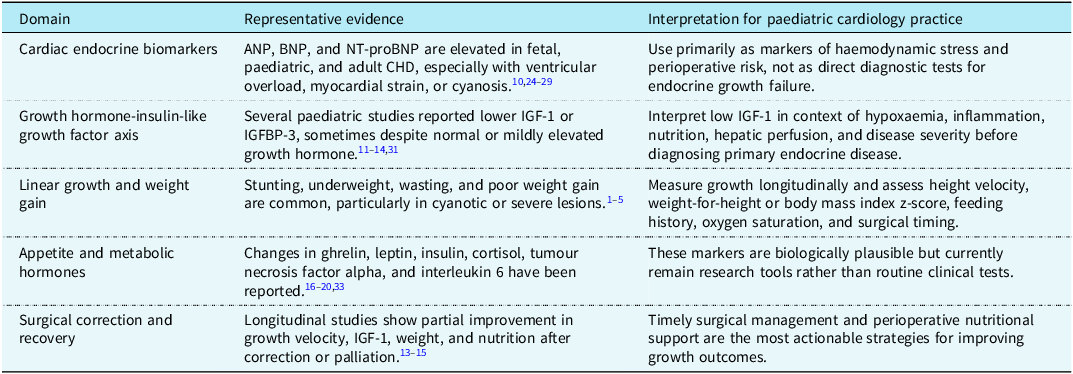
The central finding of this review is that growth failure in cyanotic CHD is best understood as a multifactorial cardiovascular-nutritional syndrome with secondary endocrine and metabolic adaptations (Table 1). The evidence does not support viewing these children as having isolated primary endocrine disease. Instead, chronic hypoxaemia, myocardial stress, altered perfusion, feeding difficulty, recurrent illness, inflammation, and undernutrition appear to interact with anabolic and appetite-regulating pathways (Figure 2). Reference Chinawa, Chinawa, Duru, Chukwu and Obumneme-Anyim1–Reference Varan, Tokel and Yilmaz5,Reference Dinleyici, Kilic and Buyukkaragoz12–Reference Soliman, Elawwa, Khella, Saeed and Yassin14,Reference Lundell, Sabel, Eriksson and Mellgren16–Reference Huang, Zhang and Wang20
Graphical abstract summarising the proposed pathway by which cyanotic CHD, chronic hypoxaemia, haemodynamic stress, cardiac endocrine biomarker activation, secondary hormonal adaptation, and nutritional compromise interact to impair linear growth and weight gain. Early correction, nutritional optimisation, and multidisciplinary follow-up may partially reverse these abnormalities.

Consolidated evidence map of endocrine, nutritional, and growth pathways in cyanotic CHD

Table 1. Long description
A table with five rows and five columns. The columns are labeled Domain, Representative evidence, Interpretation for paediatric cardiology practice, and two additional columns for references. The rows are labeled Cardiac endocrine biomarkers, Growth hormone-insulin-like growth factor axis, Linear growth and weight gain, Appetite and metabolic hormones, and Surgical correction and recovery. Each row provides detailed evidence and interpretations for pediatric cardiology practice related to the specific domain. The table includes specific biomarkers, growth factors, and clinical outcomes, with references cited for each domain.
ANP = atrial natriuretic peptide; BNP = B-type natriuretic peptide; IGF-1= insulin-like growth factor 1; IGFBP-3 = insulin-like growth factor binding protein 3; NT-proBNP = N-terminal pro-B-type natriuretic peptide.
Natriuretic peptides occupy an important place in this framework. They reflect myocardial stretch and haemodynamic stress across the lifespan and are clinically useful for risk stratification and perioperative monitoring. Their relationship with adipose tissue metabolism and insulin sensitivity is biologically plausible, but paediatric evidence remains insufficient to assign them a direct causal role in growth failure. For clinical care, their strongest current value remains cardiovascular assessment rather than endocrine decision-making. Reference Clerico, Giannoni, Vittorini and Passino7–Reference Cantinotti, Clerico, Murzi, Vittorini and Emdin10,Reference Cantinotti, Storti and Lorenzoni24,Reference Hopkins, Chen, Fukagawa, Hall, Knot and LeWinter26,Reference Trojnarska, Gwizdala and Katarzynski27,Reference Xie, Huo, Chen and Hou29
The growth hormone-insulin-like growth factor axis provides a mechanistic bridge between cardiac disease severity and somatic growth. Reduced insulin-like growth factor 1 in children with cyanotic CHD may reflect impaired hepatic production, inflammation, insufficient substrate availability, and hypoxaemia. Because several studies are cross-sectional and confounding is substantial, growth hormone stimulation testing should be reserved for children with persistent growth failure after cardiac stabilisation and nutritional optimisation, or for those with clinical features suggesting a primary endocrine disorder. Reference Soliman, Madkour and Galil11–Reference Soliman, Elawwa, Khella, Saeed and Yassin14,Reference Peng, Fu and Deng31,Reference Nygren, Sunnegardh, Albertsson-Wikland, Berggren and Isgaard35,Reference Caicedo, Diaz, Devesa and Devesa36
Nutritional management should begin early. Routine growth monitoring should include weight, length or height, body mass index, weight-for-height or body mass index z-score, height velocity, feeding history, energy intake, recurrent illness, oxygen saturation, and surgical timing. Dietetic assessment is essential because poor weight gain may be worsened by increased resting energy expenditure and feeding fatigue even when intake appears reasonable. In selected children, targeted nutritional supplementation before and after surgery may reduce postoperative decline and support catch-up growth. Reference Chinawa, Chinawa, Duru, Chukwu and Obumneme-Anyim1–Reference Varan, Tokel and Yilmaz5,Reference Sethasathien, Sriprachyakul and Thamlikitkul15
The strongest actionable intervention remains timely correction or palliation of the cyanotic lesion when clinically feasible. Surgical correction improves oxygen delivery and reduces haemodynamic stress, which may permit partial endocrine and nutritional recovery. Nevertheless, catch-up growth may be incomplete after prolonged cyanosis, emphasising the importance of early referral, close surveillance, and coordinated postoperative follow-up. Reference El-Sisi, Khella, Numan, Dilwar, Bhat and Soliman13–Reference Sethasathien, Sriprachyakul and Thamlikitkul15
Clinical implications
Children with cyanotic CHD should receive integrated cardiology, nutrition, and endocrine surveillance rather than fragmented assessment. Cardiologists should consider growth faltering as a clinically meaningful marker of systemic disease burden. Endocrinologists should interpret low insulin-like growth factor 1 in the context of hypoxaemia, inflammation, nutrition, and hepatic perfusion. Dietitians should be involved early, particularly before and after surgery, because nutritional recovery may influence both weight gain and linear growth. Reference Chinawa, Chinawa, Duru, Chukwu and Obumneme-Anyim1–Reference Varan, Tokel and Yilmaz5,Reference Dinleyici, Kilic and Buyukkaragoz12–Reference Sethasathien, Sriprachyakul and Thamlikitkul15
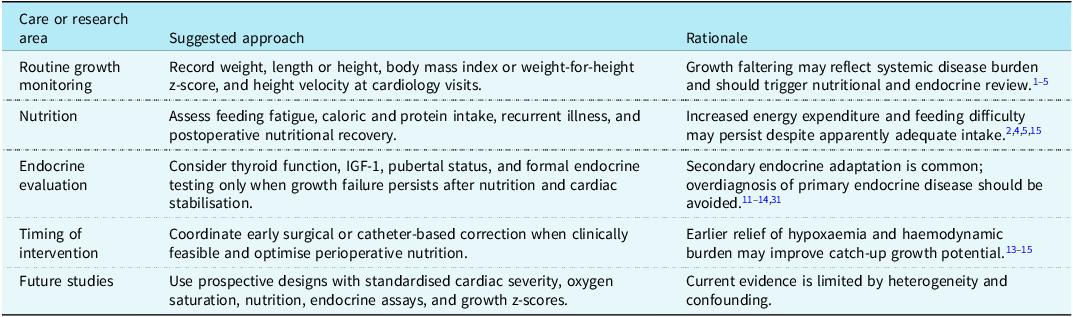
A practical approach is to measure growth at every cardiology visit, identify deceleration in height velocity early, document nutritional intake and feeding difficulty, optimise caloric and protein delivery, and re-evaluate endocrine markers after cardiac stabilisation. In practical terms, anthropometric assessment—weight, length or height, and the corresponding z-scores—should be recorded at every cardiology visit, whereas formal endocrine reassessment (including IGF-1 and thyroid function) is generally best deferred until approximately three to six months after cardiac and nutritional stabilisation, or performed sooner if growth failure persists despite adequate caloric and protein intake. Persistent severe short stature, poor height velocity despite adequate nutrition and cardiac repair, delayed puberty, or symptoms suggesting hypothyroidism, adrenal disease, or growth hormone deficiency should prompt formal endocrine evaluation (Table 2).
Proposed clinical surveillance framework and research priorities

Table 2. Long description
A table with five rows and three columns. The columns are labeled Care or research area, Suggested approach, and Rationale. Row 1: Care or research area, Routine growth monitoring; Suggested approach, Record weight, length or height, body mass index or weight-for-height z-score, and height velocity at cardiology visits; Rationale, Growth faltering may reflect systemic disease burden and should trigger nutritional and endocrine review. Row 2: Care or research area, Nutrition; Suggested approach, Assess feeding fatigue, caloric and protein intake, recurrent illness, and postoperative nutritional recovery; Rationale, Increased energy expenditure and feeding difficulty may persist despite apparently adequate intake. Row 3: Care or research area, Endocrine evaluation; Suggested approach, Consider thyroid function, IGF-1, pubertal status, and formal endocrine testing only when growth failure persists after nutrition and cardiac stabilisation; Rationale, Secondary endocrine adaptation is common; overdiagnosis of primary endocrine disease should be avoided. Row 4: Care or research area, Timing of intervention; Suggested approach, Coordinate early surgical or catheter-based correction when clinically feasible and optimise perioperative nutrition; Rationale, Earlier relief of hypoxaemia and haemodynamic burden may improve catch-up growth potential. Row 5: Care or research area, Future studies; Suggested approach, Use prospective designs with standardised cardiac severity, oxygen saturation, nutrition, endocrine assays, and growth z-scores; Rationale, Current evidence is limited by heterogeneity and confounding.
Limitations
The evidence base is limited by observational designs, small sample sizes, heterogeneous lesions, mixed cyanotic and acyanotic cohorts, variable timing of surgery, and inconsistent hormonal assays. Many studies did not adequately adjust for caloric intake, socioeconomic factors, recurrent infection, pulmonary hypertension, medication exposure, or severity of cyanosis. These limitations prevent strong causal inference and preclude meta-analysis. Future prospective studies should use standardised anthropometric outcomes, serial endocrine and inflammatory measurements, detailed nutritional assessment, and clearly defined surgical time points. Reference Higgins, Savovic, Page, Elbers and Sterne22,Reference Sterne, Hernan and Reeves23
Conclusion
Cyanotic CHD has important secondary endocrine, metabolic, and nutritional consequences that contribute to impaired growth. Current evidence supports an association between chronic hypoxaemia, myocardial stress, altered anabolic signalling, poor nutritional status, and incomplete catch-up growth, although causality remains incompletely defined. Early surgical correction, individualised nutritional support, and coordinated cardiology-endocrinology follow-up are the most clinically actionable strategies for improving growth and long-term outcomes. Future prospective, multicenter studies incorporating standardised growth, nutritional, oxygen saturation, and endocrine outcome measures are needed to clarify causal pathways and to optimise surveillance and intervention strategies. Reference Chinawa, Chinawa, Duru, Chukwu and Obumneme-Anyim1–Reference Varan, Tokel and Yilmaz5,Reference Dinleyici, Kilic and Buyukkaragoz12–Reference Sethasathien, Sriprachyakul and Thamlikitkul15
Acknowledgements
None.
Financial support
This research received no specific grant from any funding agency, commercial, or not-for-profit sectors.
Competing interests
The authors declare none.
Ethical standard
Not applicable. This structured narrative review did not involve new human or animal experimentation and therefore did not require institutional review board approval.
Suggested social media synopsis
Growth failure in cyanotic CHD reflects chronic hypoxaemia, nutrition, and secondary endocrine adaptation; early repair and multidisciplinary care are key. #PedsCards.