

1 Introduction
While we usually observe public transfers in kind, such as public education, medical services, and public formal care for elderly people, it has been a controversial issue whether these public transfers should be in cash or in kind. People in favor of transfer in cash assert that no individual would prefer an in-kind transfer to its cash equivalent simply because he is able to spend it in any way he chooses, or that the second theorem of welfare economics ensures that the transfer of numeraire is sufficient to achieve a targeted optimum. Thurow (Reference Thurow1974) says: ‘While it is not axiomatically true that cash transfers always dominate restricted transfers, the general economic case for cash transfers is strong enough that the burden of proof should always lie with those who advocate restricted transfers. It is their duty to show that the aid is motivated by specific good externalities, that it is part of our individual-societal social welfare function, that it is directed at groups with limited consumer sovereignty, or that it is necessary to the furtherance of some essential value’ (p. 195).
One strand of research emphasizes normative roles of in-kind transfer related to individual-societal social welfare functions, such as paternalistic preferences (Pollak, Reference Pollak1988), targeting a minimum requirement of merit goods (Ireland, Reference Ireland1990; Besley and Coate, Reference Besley and Coate1991), and pecuniary redistribution (Coate, Reference Coate1989; Coate et al., Reference Coate, Johnson and Zeckhauser1994).
The other strand of research emphasizes the positive roles of in-kind transfer, such as internalizing externalities (Buchanan, Reference Buchanan1968; Garfinkel, Reference Garfinkel1973), the effectiveness of quantity controls in a suboptimal economy (Guesnerie and Roberts, Reference Guesnerie and Roberts1984), enhancing work incentives (Leonesio, Reference Leonesio1988), alleviating the self-selection constraint (Nichols and Zeckhauser, Reference Nichols and Zeckhauser1982; Blackorby and Donaldson, Reference Blackorby and Donaldson1988; Munro, Reference Munro1992; Cremer and Gahvari, Reference Cremer and Gahvari1997; Blömquist and Christiansen, Reference Blömquist and Christiansen1998), and resolving the Samaritan's dilemma (Lindbeck and Weibull, Reference Lindbeck and Weibull1988; Bruce and Waldman, Reference Bruce and Waldman1990, Reference Bruce and Waldman1991; Coate, Reference Coate1995).
The purpose of this paper is to demonstrate the other type of rationale of superiority of transfer in kind over in cash related to old age support programs. To make the model as simple and clear as possible, we extend Drazen's (Reference Drazen1978) model of human capital investment in the following three ways. First, we add informal parental care in the retirement period. Second, the parental care is provided by an adult child in exchange for a bequest (Bernheim et al., Reference Bernheim, Shleifer and Summers1985).Footnote 1 Third, the original model is extended to an endogenous growth model (Lucas, Reference Lucas1988).
A critical assumption is that informal care is provided within the family. There are two reasons. One is related to the supply side. If informal care is more cost-effective than formal care, which could be provided publicly or privately, then the use of informal care would be more efficient. The other reason is related to the demand side. Elderly people would like to live in their own home, live together with or at least near to their children, or meet them as frequently as possible. Fragile people would be restricted from moving freely outside of their home. In such circumstances, a possible candidate for primary carer would be the spouse or one of the adult children.Footnote 2 In an actual situation, some strategic behavior may occur. For example, a primary carer could make a credible threat not to provide his parent with informal care. This is the only source of inefficiency in our model.
A main difference between the original model of Drazen (Reference Drazen1978) and ours is the cost of education. In retirement, an old parent leaves a bequest for his child not to refrain from providing informal care, the price of which is equal to the child's real wage rate, i.e. human capital. Thus, this strategic behavior generates a disincentive effect on human capital formation. In middle age, a young parent may choose less child education because he takes into account the future cost of education. In this economy, we introduce two types of public transfer program: one is a transfer in cash, such as an unfunded public pension, and the other is a transfer in kind, such as public formal care.
It seems that the transfer in cash scheme would be effective if it is financed by a labor income tax. By reducing the child's real wage rate, we would be able to alleviate the individual rationality constraint related to caregiving. However, it is not the case. The reduced real wage rate decreases the benefit of human capital proportionally, making bad things worse because of the excess burden of labor income taxation. The transfer in cash scheme decreases education and also economic growth.
The transfer in kind scheme also suffers the disincentive effect on human capital formation. However, if the transfer is made in kind, a positive education effect is added to the valuation of the service provided.Footnote 3 An old parent values the formal care in terms of the substitute, i.e. informal care. Thus, he would behave as if he received income associated with the child's human capital. This valuation effect enhances the benefit of education. It turns out that the net effect is positive. The transfer in kind scheme increases education and also economic growth.
It has been widely recognized that a higher rate of growth need not increase welfare. As Drazen (Reference Drazen1978) points out, however, we usually observe that the rate of return from human capital is higher than that from non-human capital, which implies that the level of education in the laissez-faire economy is smaller than the optimal one. If it is the case, the transfer in kind is superior to the transfer in cash in the context of welfare.
This paper is related to three strands of research. First, some researchers point out that in-kind transfer alleviates the self-selection constraint. In our model, the individual rationality constraint can be alleviated by a transfer policy. However, the mechanism is different in two aspects. First, it is not the in-kind transfer itself but the tax policy that alleviates the individual rationality constraint. Second, an important role of in-kind transfer in the self-selection economy is to decrease the welfare of low-skilled persons to make mimicking less attractive. There is neither mimicker nor loser in our model.
Second, some researchers emphasize that in-kind transfer resolves the Samaritan's dilemma. Bruce and Waldman (Reference Bruce and Waldman1991) and Coate (Reference Coate1995) point out that the central issue in the Samaritan's dilemma is the problem of timing and commitment. The timing matters in our model because the earlier decision on human capital investment is affected by the later decision on bequests. However, the problem of commitment does not matter because the same person chooses both investment and bequests in our model.
Finally, some researchers analyze policy effects in extended models of Drazen (Reference Drazen1978), such as a bequest-constrained economy (Becker and Murphy, Reference Becker and Murphy1988; Nerlove et al., Reference Nerlove, Razin and Sadka1988; Caballé, Reference Caballé1995; Rangazas, Reference Coate1996) and, more generally, a borrowing constraints economy (Altig and Davis, Reference Altig and Davis1989, Reference Altig and Davis1992, Reference Altig and Davis1993). A critical difference between the literature and this paper is the motive for bequest. While the literature assumes conventional altruism, this paper assumes the strategic motive.Footnote 4 To the best of our knowledge, there is no literature to compare transfer in cash and in kind in this line of research.
This paper is relevant in three aspects. First, it presents some insights into policy debates concerning population aging. Our results give an alert against alleged Liberalists who believe monetary transfer is superior to conventional in-kind transfer. Second, the analytical solution is useful for testing for robustness. Clear-cut results in the comparative statics will serve the purpose, although some assumptions may be restrictive. Finally, our results are consistent with empirical evidence. It will be shown that (1) informal care is negatively correlated with education, (2) informal care is negatively correlated with formal care, and (3) the effect of education on labor supply is ambiguous. Some empirical findings support these relationships.Footnote 5
The construction of the paper is as follows. In Section 2 we analyze the transfer in cash scheme and the transfer in kind scheme alternatively. We know the transfer in cash scheme prevents economic growth, and that the transfer in kind scheme promotes economic growth. In Section 3, we first derive the social optimum to discuss the optimal scheme in a sense of the second best. Next, we illustrate changes in time allocation when the schemes expand in order to compare the results with empirical evidence. Finally, we discuss a possible use of the individual accounts. The final section concludes the paper.
2 Model
We use a three-period (education, working, and retirement) overlapping generations model with a two-way intrafamily transfer in middle age. Workers in middle age educate their children as an inter vivos transfer and provide informal parental care in exchange for a bequest. Population newborn is constant and normalized to unity. It is the intergenerational spillover effect of human capital that generates economic growth.
In Section 2.1 we examine an economy with public transfer in cash, such as a public pension. In Section 2.2 we incorporate transfer in kind, such as public formal care instead.
2.1 Transfer in cash
Consider a life cycle of an individual born at period t−1. In the first period of life, he receives education from his parent. The education improves his human capital h t in the second, working period. In the second period, he has one child and allocates his time among labor l t, child education e t, and parental care z t. He receives a bequest b t from the parent in exchange for parental care, consumes c 1t and saves s t. In the third, retirement period, he consumes c 2t+1 and leaves a bequest b t+1 in exchange for informal care z t+1 from the child.
To make clear the intrafamily relationship, we first explain the maximization problem in the retirement period, then return to the working period.
The maximization problem in the retirement period is formulated as

subject to


where I t+1, c 2t+1, b t+1 stand for retirement income, old-age consumption, and a bequest, respectively. z t+1 stands for informal care (or attention) that the child provides within the family. h t+1 is the child's human capital and w t+1 is a wage rate per unit of effective labor. τw∊[0, 1) is a contribution rate for workers. Equation (1) is a budget constraint. Equation (2) is the individual rationality constraint, which implies that an old parent has to pay at least a reservation wage of the child for informal care.
According to a constant parameter attached to informal care γ∊[0, 1), the optimal allocation is c 2t+1=(1−γ)I t+1 and b t+1=γI t+1. The indirect utility in the retirement period is given by

Equation (3) shows that the welfare in retirement decreases with the child's human capital h t+1. The reason is that the human capital increases the child's reservation wage, which is the price of informal care the parent faces. It is the strategic behavior which generates additional cost of education.Footnote 6
The maximization problem in the working period is formulated as

subject to budget constraints
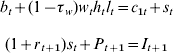
a time constraint

and a technology of human capital formation

c 1t, b t, s t stand for middle-age consumption, a bequest from the parent, and a saving, respectively. l t, e t, z t stand for labor, child education, and parental care. h t is his own human capital and h t+1 is his child's human capital. r t+1 is an interest rate and P t+1 is a pension benefit. u*2t+1 is given by equation (3), and V(.) is a value function of human capital. β∊(0, 1) is a discount factor and ρ∊(0, 1) is a parameter attached to the child's welfare.
Equation (4) implies that the growth rate on a balanced growth path is given by ϕ(e t)−1.
We assume the education function ϕ takes the form of constant elasticity

Rearranging the constraints, the maximization problem is reformulated as

subject to (4) and

Assuming the interior solutions, the first-order conditions require

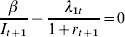

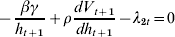
where λ1t and λ2t stand for multipliers attached to the constraints (6) and (4), respectively.
Equation (10) stands for the cost and benefit of the child's human capital. The second term is a benefit from altruism and the third term is a cost in a usual way. The first term βγ/h t+1 is an additional cost of human capital generated by the strategic behavior in retirement, which contrasts this model with the other altruistic models.
Solving equations (4), (6), (7), (8), (9), and (10), we have net demand functions of h t. From the envelope theorem, and using (5), we have

Substituting (9) and (11) into (10), and using (5), we have

which determines the motion of education.
On the other hand, equations (6), (7), and (8) give us
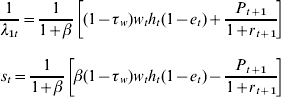
The production sector uses a constant returns to scale technology, which is specified by a Cobb–Douglas form

where y t, k t, h t stand for output, physical capital, and human capital, respectively. l t is raw labor and h tl t stands for effective labor. A>0 is a scale parameter and α∊(0, 1) is the physical capital share.
Factor markets competition requires

where τf∊[0, 1) is a contribution rate for firms.
The budget of unfunded public pension is balanced when

Physical capital market is clear when

Since the model is closed, the good market clearing condition

is derived from the Walras' law.
We put aside the procedure to derive the equilibrium to Appendix 1.
It can been shown that equation (12), which is the core in the model, can be transformed to

where θ stands for a parameter representing the scale of transfer scheme
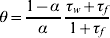
Given α, θ is increasing in τw and τf.
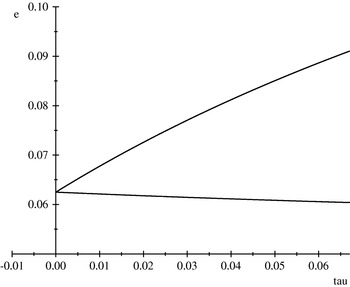
Figure 1 shows the equilibrium education e* in the transfer in cash scheme. The interior condition for education requires

Equilibrium

Since ρ∊(0, 1), the equilibrium is unstable, which implies no transition. We know the intercept A(θ) is decreasing in θ given that γ>0. It implies that e* is decreasing in θ. The transfer in cash prevents human capital investment and also economic growth.
It is useful to see equation (12) in order to interpret the education effect of the transfer in cash scheme. The second and third term stand for conventional benefit and cost of education. In Appendix 1, we have

which is decreasing in θ. Since the transfer policy decreases the benefit and cost proportionally, it is irrelevant to education if the strategic behavior is absent, i.e. γ=0. However, if γ>0, the disincentive effect weighs on the cost side, decreasing education.
Comparative statics shows that e* increases with ρ and η, and decreases with β and γ. Education is higher when altruism is stronger, human capital formation is more efficient, people are more patient and less interested in informal care. In sum, we have the following proposition.
Proposition 1
The education in transfer in cash scheme is given by

The education is decreasing in θ because of the disincentive effect of the strategic behaviour. The transfer in cash scheme prevents economic growth.
2.2 Transfer in kind
This section introduces a transfer in kind, such as public formal care. It implies that a care service sector is newly added to the production side. Since care services are usually labor intensive, we assume formal care is produced by labor input only. A linear technology is assumed: one unit of labor is transformed to ε unit of formal care. Thus, the parameter ε stands for the cost effectiveness of formal care relative to informal care. If ε<1, then the informal care is more cost-effective. Assuming perfect labor mobility, wages are equalized between the good production and the care sectors.
The optimization problem in the retirement period is formulated as

subject to
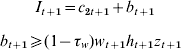
z G⩾0 stands for labor employed in the care sector. It is assumed that formal and informal care are perfect substitutes in order to have analytical solutions. Although it seems restrictive, the qualitative results would not be changed if the imperfect substitution is assumed.
The interior condition for informal care requires

If equation (16) is satisfied, we have the demand for consumption and informal care


and the indirect utility

Comparing equations (3) and (17), we can recognize an additional benefit of the child's human capital. The parent values one unit of formal care exactly at the same price as informal care (1−τw)w t+1h t+1. Even if they are imperfect substitutes, it can be shown that the valuation of formal care is positively related to the child's human capital. The higher the degree of substitution, the larger the valuation effect of the child's human capital.
The maximization problem in the working period is formulated as

subject to
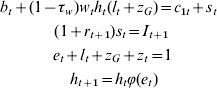
One of the differences from the previous section is the opportunity of employment. He can choose to supply labor either in the production sector l t or in the care sector z G.
Rearranging the constraints, the maximization problem is reformulated as

subject to

Assuming the interior solutions, the first-order conditions require




Equation (22) stands for the cost and benefit of the child's human capital. Comparing with equation (10), we can see the first term stands for the valuation effect. From the envelope theorem, we have

Substituting equations (20), (21), and (23) into equation (22), we have

where G t+1 stands for the present value of formal care
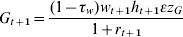
The first term in equation (24) stands for the valuation effect.
On the other hand, equations (18), (19), and (20) give us
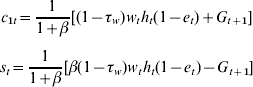
The technology in the good production sector is the same as the previous section. The production cost of formal care w th tz G is financed by worker's contribution τww th t(l t+z G) and firm's contribution τfw th tl t. The balanced budget requires

Market clearing conditions are the same as the previous section. The derivation in detail is put aside to Appendix 2.
It can be shown that the core equation in the transfer in kind scheme (24) is transformed to

The only difference between equations (13) and (26) is the constant term, namely the intercept A(θ) in Figure 1.
The interior condition for informal care (16) requires

and the interior condition for education requires
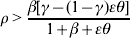
In the same way in the previous section, the equilibrium e** is unstable since ρ∊(0, 1). Contrasted with the previous section, e** is increasing in θ because the intercept A(θ) is increasing in θ. The transfer in kind promotes human capital investment and also economic growth. Equation (24) explains the reason. In Appendix 2, we have
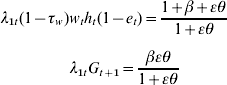
Conventional benefit and cost of human capital, which are represented respectively by the third and fourth term in equation (24), decrease proportionally in response to the transfer policy. The disincentive effect of the strategic behavior, the second term, is negative and constant as shown in the previous section. The first term λ1tG t+1 stands for the positive valuation effect, which increases with transfer policy. Therefore, the net effect on education is positive. When γ tends to zero, the interior condition (27) implies the policy is irrelevant to education. It is because the strategic behavior concerning caregiving is the only source of inefficiency.
Comparative statics results are similar to the previous section. e** increases with ρ, η, ε, and decreases with β and γ. Education is higher when altruism is stronger, human capital formation is more efficient, people are more patient and less interested in informal care, and the formal care sector is more cost effective than informal care. In sum, we have the following proposition.
Proposition 2
The education in transfer in kind scheme is given by

where γ−(1−γ)εθ⩾0. The education is increasing in θ because the positive valuation effect dominates the disincentive effect in the strategic behavior. The transfer in kind scheme promotes economic growth.
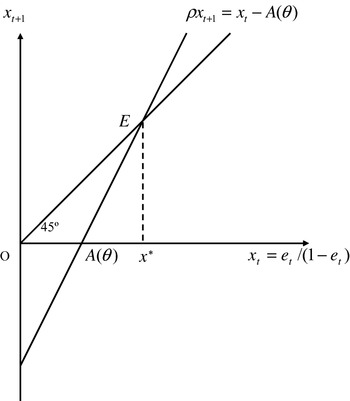
Figure 2 compares the education effect of transfer policies. The lower curve is e* in equation (15) and the upper curve is e** in equation (28). The horizontal axis is a contribution rate, instead of θ, based on the fifty−fifty rule (τw=τf=τ) which several countries have adopted. Assumed parameters are: η=0.4, β=0.5, ρ=0.2, γ=0.2, α=1/3, and ε=1. From equation (14), θ=4τ/(1+τ) and equation (27) requires τ⩽6.67%.
Education, cash versus in-kind

The time share of child education in the laissez-faire is 6.25%. Under the transfer in cash scheme, the share decreases slowly. When the contribution rate is 6.67%, the share dips to 6.04%. The impact is fairly modest. Under the transfer in kind scheme, the time share increases sharply. One of the reasons is of course the assumption of perfect substitution. When the contribution rate is 6.67%, the share ups to 9.10%. We know the impact of the valuation effect on education is much larger than the disincentive effect.
3 Discussions
3.1 Welfare
The previous section demonstrates that transfer for elderly people should be in kind rather than in cash in the context of economic growth. This section shows it is also true in the context of welfare in some circumstances.
It is a strategic behavior about informal care within the family that causes inefficiency. If parents can access to the market of care services, the inefficiency would vanish. From the fact that the rate of return from human capital is higher than that from non-human capital, however, education in the laissez-faire is likely to be insufficient. If it is the case, a transfer policy to promote education would be welfare-improving. The transfer should be in kind rather than in cash in the context of welfare.
The procedure of the exercise is as follows. First, we characterize the social optimum. Second, we derive a sufficient condition for the optimal contribution rate to be positive in the transfer in kind scheme. Finally, we confirm that the equilibrium is the second-best optimal because of the excess burden of labor income taxation.
Iterating to substitute the utility functions toward the future, we can formulate a social planner's problem as of period zero as

subject to
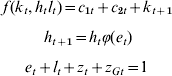
Obviously the product efficiency requires z Gt=0 (z t=0) when ε<1 (ε>1). Thus we assume ε=1. The derivation of the solution is set aside to Appendix 3. It can be shown that the law of motion is determined by the following simultaneous difference equations of e t and x t.

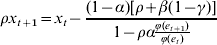
where x t=λ2th t+1 stands for current value of human capital. Equation (29) regulates xt=x(e t−1, et) and also x t+1=x(et, e t+1). Substituting them into equation (30), we have a second-order difference equation of e t.
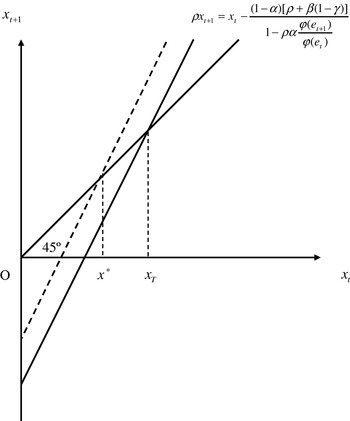
Figure 3 illustrates the equilibrium and the comparative dynamics. The equilibrium is unique and unstable. Suppose that the economy stays at the equilibrium E until period T−1 (e t−1=e* for ∀t⩽T) and that education in period T increases (e T>e*). First, the current value of human capital increases (x T>x*) from equation (29). Second, to adjust the cost and benefit of human capital, which is represented by equation (30), the line has to shift rightward. It implies e T+1>e T. The procedure continues forever. In the same way, if e T<e*, then e T+1<e T. Therefore, the equilibrium is unstable.
Social Optimum

From equations (29) and (30), the optimal education is given by

When γ=0, we have e*=e**=e=ηρ/[1−(1−η)ρ].Footnote 7 It is because the only source of inefficiency arises from the strategic behavior about informal care in our model. Comparing equations (26) with ε=1 and (31), we have the following proposition.
Proposition 3
The transfer in kind scheme achieves the optimal education if and only if

From equation (32), we know the contribution rate is positive if and only if

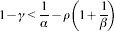
The condition (33) is more likely to be satisfied for larger γ and β and smaller ρ and α.Footnote 8 The scheme is effective when the distortion of strategic behavior is large, altruism is small, and people are more patient.
To show that equation (32) is not the first best, we examine how the transfer in kind scheme improves resource allocations. From appendices 2 and 3, we know that the resource allocation under the transfer in kind scheme with ε=1 is given by
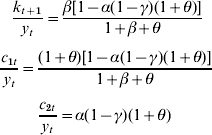
and that the optimal allocation is given by
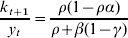
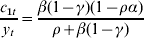

Comparing them, we have the following proposition.
Proposition 4
The transfer in kind scheme achieves the optimal allocation if and only if

The scheme is also effective in the context of resource allocation if the condition (33) is satisfied.
Finally, comparing equations (32) and (34), we have the following proposition.
Proposition 5
Suppose that the transfer in kind scheme is effective. The contribution rate to restore the optimal education is smaller than that to restore the optimal allocation. The scheme is not the first-best solution.
Proof From (32) and (34), we have

which is positive when the condition (33) is satisfied. □
Using parameters in section 2.2 and assuming the fifty–fifty rule, equations (32) and (34) give τ=2.53% and τ=50.0%, respectively. The optimal allocation cannot be feasible because the latter value violates the interior condition (27). However, a modest transfer in kind scheme can restore the optimal education and improve welfare.
3.2 Time allocation
The previous section demonstrates that some kind of transfer policy for elderly people should be in kind rather than in cash in the context of economic growth and welfare. Another merit can be pointed out, namely employment. Since the public provision of formal care widens the opportunity of employment, it is likely to improve the rate of employment by releasing informal parental care from the family.
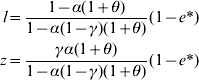
Appendix 1 shows that labor and informal care under transfer in cash scheme are given by
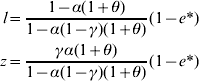
The education e* is given by equation (15). Since e* is decreasing in θ, the informal care z increases with θ. The negative relationship between education and informal care is consistent with an empirical finding in Engers and Stern (Reference Engers and Stern2002). The effect on an employment rate, which is measured by the working time l, is ambiguous because the share effect is negative and the education effect is positive.Footnote 9
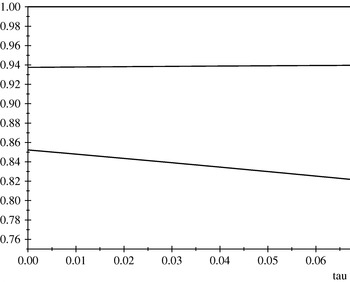
Figure 4 illustrates the changes in time allocation under transfer in cash scheme. It indicates education, informal care, and labor from top to bottom. In this case, the employment rate decreases with the transfer policy.
Time allocation, cash

Appendix 2 shows that employment in the good sector l and the care sector z G, and informal care z under transfer in kind scheme are given by
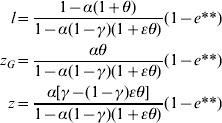
Since e** is increasing in θ, both employment in the good sector l and informal care z decrease with θ. The negative relationship between education and informal care is observed again. The effect on employment in the care sector z G is ambiguous because the share effect is positive and the education effect is negative. However, it is likely that z G increases with θ and that total employment l+z G also increases.
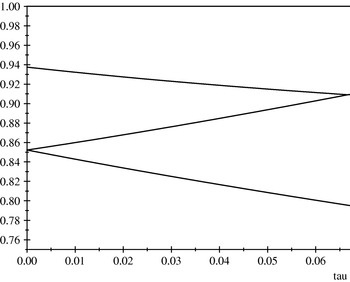
Figure 5 illustrates the changes in time allocation under transfer in kind scheme. It indicates education, informal care, employment in the care sector, and the good production sector from top to bottom. The negative relationship between formal and informal care is consistent with Hoerger et al. (Reference Hoerger, Picone and Sloan1996) and Pezzin and Schone (Reference Pezzin and Schone1999). Informal care is entirely crowded out at the upper bound of τ=6.67%. In our specification, both total employment l+z G and the amount of care service parents receive z+εz G increase when the scheme expands.
Time allocation, in-kind

3.3 Individual accounts
Miyazawa (Reference Miyazawa2004) demonstrates that a social security system financed by a labor income tax has a decent impact on economic growth under individual accounts, which means that a social security benefit received in retirement is tied with choices in middle age, such as labor, education, and savings. The same logic applies to this model. Under the transfer in cash scheme in Section 2.1, suppose that a parent in middle age expects to receive a social security benefit

in retirement. Then, he has an incentive to invest in his child's human capital because the investment will be paid back as the social security benefit. It can be shown that the transfer in cash scheme under individual accounts rule is the same policy effect as the transfer in kind scheme in Section 2.2. Moreover, the effect can be larger if the valuation effect is smaller, which corresponds to a case in which formal care is less substitute for informal care. The superiority of transfer in kind over in cash vanishes. However, the individual accounts rule would face the problem of administration cost and real effectiveness. Diamond (Reference Diamond2004) shows a rather negative point of view with respect to labor incentives related to the individual accounts.
Concluding remarks
This paper demonstrates that transfer in kind matters in old age support programs. The reason for this is that an old parent values publicly provided services in terms of his child's human capital, which promotes human capital investment in middle age. This valuation effect is intrinsic in transfer in kind, which should not be neglected when a market of care service is incomplete or absent.
There is scope for future analyses. First, perfect substitution between formal and informal care is restrictive. With a more general function, such as CES function and plausible parameters, we would have a relevant solution numerically. It would be expected that the positive valuation effect is weakened, while the qualitative characteristics would not be changed. Second, it would be useful to incorporate living arrangements into the model. Pezzin et al. (1996) show that the substitution between formal and informal care is relatively small, and that a generous public home care program significantly increases the probability that unmarried persons will live independently, and reduces the probability of living in shared households or in nursing or personal care homes. A proper transfer in kind would alleviate the inefficiency caused by a strategic behavior concerning living arrangements. Third, it is well known that an older daughter plays an important role as a primary carer except for the spouse of the cared-for. It could be an outcome of a strategic behavior concerning caregiving among siblings. To endogenize the selection of primary carer and examine the behavioral response to a policy change would be an important theoretical topic in the issue of whether transfer in kind matters in old age support programs. Finally, to incorporate uncertainty seems interesting. Diamond (Reference Diamond2004) emphasizes annuitization as one of the most important roles of public pensions.
Diamond (Reference Diamond2004) also mentions auxiliary benefits. We believe that our results meet his insight. It says: ‘we are learning more about the way in which the allocation of resources within the family does not conform to a single maximization with a single budget constraint. Since the government cares about the different family members (and not just the worker), direct allocations to family members matter since they will change the allocation of resources within the family. Protecting family members is a role governments have recognized for centuries.’
Appendix 1
[Transfer in cash scheme]
The equilibrium is characterized by the following ten equations










From (A1.7), (A1.8), and (A1.9)

Substituting (A1.11) into (A1.3) and using (A1.10)
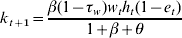

Substituting (A1.13) into (A1.2)

Substituting (A1.14) into (A1.6), and rearranging, we have

which is equation (13) in the main body. The condition e*∊(0, 1) requires

Since ρ∊(0, 1), the sequence {e t/(1−e t)} diverges unless e t+1=e t=e*. The steady state is unstable. There is no transition.
From (A1.15), we have

which is equation (15) in the main body.
[Time allocation]

Substituting (A1.4) and (A1.14) into (A1.5)

Dividing both sides and arranging
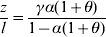
Solving (A1.1) and (A1.16), we have
[Resource allocation]
From (A1.8), (A1.12), and (A1.17)

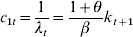
Therefore

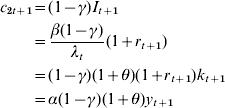
which completes the proof.
Appendix 2
[Transfer in kind scheme]
The equilibrium is characterized by the following 11 equations





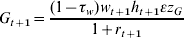





Substituting (A2.10) into (A2.6), and using (A2.8) and (A2.9)

Substituting (A2.12) into (A2.4) and using (A2.11)
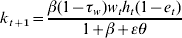

Substituting (A2.14) into (A2.2)

Substituting (A2.14) and (A2.15) into (A2.7), and rearranging

which is equation (26) in the main body.
From the assumption (16), we have

The condition e**∊(0, 1) requires
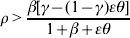
Since ρ∊(0, 1), the sequence {e t/(1−e t)} diverges unless e t+1=e t=e**. The steady state is unstable. There is no transition.
From equation (A2.16), we have

which gives equation (27).
[Time allocation]
From (A2.10)

From (A2.3) and (A2.11), I t+1=(1+r t+1)k t+1.
Therefore (A2.5) gives

Substituting (A2.8) and (A2.9) into the right-hand side, and rearranging

Solving (A2.1), (A2.17), and (A2.18), we have



[Resource allocation]
From (A2.9), (A2.13), and (A2.19)
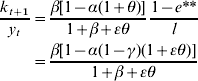

Therefore

From (A2.5)

Using (A2.8), (A2.19), (A2.20), and (A2.21), we have

which completes the proof.
Appendix 3
[Social optimum]
Let us set up the Lagrangian
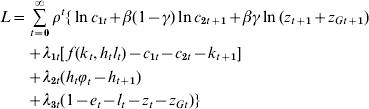
For convenience, we use a notation ϕt=ϕ(e t).
The first-order conditions require

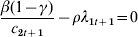
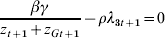







The transversality conditions are limt→∞ρtλ1tk t+1=0 and limt→∞ρtλ2th t+1=0.
From (A3.9), the BGP condition requires
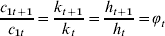
The constant income share implies


First, substituting (A3.1) into (A3.7), and using (A3.11)


[Resource allocation]
Substituting (A3.1), (A3.2), (A3.15), and k t+1=ϕtk t into (A3.8), we have
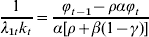
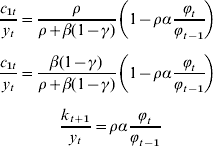
Therefore, the resource allocation is given by
[Education]
Multiplying both side of (A3.5) by e t and using ϕt′e t=ηϕt, we have

Multiplying both side of (A3.4) by l t and using (A3.13), (A3.15) and (A3.16), we have
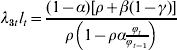
Substituting (A3.3), (A3.17), and (A3.18) into (A3.10), we have

Substituting (A3.19) into (A3.17), and rearranging

which is equation (29) in the main body.
Finally, multiplying both side of (A3.6) by h t+1, and using (A3.9), (A3.13), (A3.15), and (A3.16), we have

which is equation (30) in the main body.
[Uniqueness]
At a steady state, equation (A3.21) gives

Substituting this into (A3.20), we have a unique solution

[Time allocation]
Substituting (A3.22) into (A3.19)

Substituting this into (A3.3) and (A3.18), we have
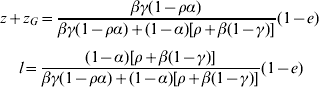
[Instability]
The law of motion is regulated by equations (A3.20) and (A3.21)


where λ2th t+1=φ(e t−1, e t) and D=(1−α)[ρ+β(1−γ)].
Differentiating (A3.23), and evaluating at e*, we have


Let e t−1=e*. Total differentiating (A3.24), and evaluating e t=e t+1=e*, we have

Therefore

From (A3.25) and (A3.26), de t+1/de t>1. The equilibrium is unstable. There is no transition.