Introduction
Globalization has provoked a lively debate about governance and accountability beyond the nation-state. Some see the emerging order as one of horizontal and overlapping networks among governments and private actors1
Slaughter 2005
In this context, Europe has become a laboratory for new forms of governance beyond or alongside the nation-state. Constitutional woes notwithstanding, integration places the European region at the forefront of both normative and empirical inquiry into the meaning of political order and community in the face of increasing interdependence among states, other organizations, and people.5
Leading journals in the debate on postnational governance in Europe and elsewhere include Constellations, European Journal of International Relations, European Journal of Political Theory, European Journal of Social Theory, Global Society, Journal of Common Market Studies, Journal of European Public Policy, and Millennium.
Kopstein 2006, 90.
Given that economic interdependence, policy spillover, and cross-border risks are not unique to Europe, it is hardly surprising that the Continent's approach to governance has taken on important model functions.7
The African Union is the most concrete example of countries explicitly emulating the EU's version of regional integration. There are similar attempts, by the EU itself and others, to apply the lessons of European integration to global institutions such as the World Trade Organization.8Nicolaïdis and Howse 2002.
Background
Europe, to borrow Glyn Morgan's terms, is at once a “project,” a “process,” and a “product.” The bulk of integration literature has traditionally focused on the latter two, examining the ways in which member states have constructed the European Union and its institutions—the process—and assessing the outcomes of these efforts at any given time in terms of institutions and policies—the product. Up until the late 1990s, furthermore, both process and product were defined purely at the European level, with scant attention paid to resultant changes within member states. Debates among intergovernmentalists, supranationalists, and multilevel-governance theorists revolved around the following questions: Who holds the principal decision-making authority in the EU? Are states, in fact, voluntarily surrendering parts of their sovereignty in the interest of policy efficiency? Can they reverse the process at any moment? Do EU institutions merely operate to serve the interests of sovereign states, or do they generate their own integrationist dynamic? At the level of Europe as product, furthermore, a steady stream of opinions in a trans-Atlantic debate characterized by binary opposites has been alternately praising the EU as a model10
or dismissing it as economically, culturally, and strategically obsolete.11More recently, “Europeanization,” understood as the Union's effects upon member state politics and policies, has become a principal area of research that asks what European policies actually mean for nation-states and their citizens.12
Börzel 2001b and 2003; Cowles, Caporaso, and Risse 2001; Dyson 2002; Featherstone and Radaelli 2003; Graziano and Vink 2006; Héritier 2001; Menz 2005; Parsons 2007. For a methodological critique, see Haverland 2006.
Olsen 2002, 923–24.
Five of the six books investigate how states process rules issuing from international organizations. Contributing to a burgeoning literature15
Albi 2005; Bartels 2005; Cremona 2003; Fisher 2006; Grabbe 2006; Haughton 2005; Jacoby 2004; Kelley 2006; Pridham 2005; Quirico 2005; Sadurski 2004 and 2006; Scott 2006; Sissenich 2007a. For a review, see Haughton 2007. On the implications of enlargement for EU governance, see Scott 2006; Sjursen 2006; and Zielonka 2007.
For a methodologically thorough and well-theorized example of sector-level analysis of rule diffusion during enlargement, see Schimmelfennig and Sedelmeier 2005.
Underlying the issue of rule projection beyond the nation-state is the question of causal mechanisms. At issue is whether actors adopt rules because they conclude that the benefits outweigh the costs of compliance or because they let themselves be socialized into community norms. The rationalist-constructivist debate captures competing conceptions of human agency. Whereas rationalists see actors as unitary and individual, constructivists posit that actors and rules are mutually constitutive.17
For a review of this debate in the study of European integration, see Pollack 2005.
How we appraise the effectiveness of rules for current and future members of regional organizations should influence our take on Morgan's The Idea of a European Superstate, which explores what would constitute adequate democratic justifications for European integration as a project. Scholars and policymakers have rarely debated the desirable end point of European integration, following instead the Monnet method of step-by-step integration in limited policy spheres, a strategy of incrementalism that deliberately eschewed master plans because a consensus was unlikely to materialize. The question that, according to Morgan, has been neglected far too long is this: What sort of polity beyond the nation-state, if any, should Europeans create? He presents his answer in an elegant and forcefully argued essay in reaction to the EU's constitutional ratification debacle of 2005. Rather than renovate the EU's institutional setup to make it more user-friendly, Morgan contends, European leaders need to develop persuasive reasons to move forward with integration. Without a rationale for integration that reasonable citizens of all creeds could support, discussions of institutional design would be pointless. The value of his contribution lies in spelling out metacriteria for appropriate justifications; where he falters is in producing an actual viable justification and, more importantly, deducing a desirable institutional format for the future EU. Europe certainly demonstrates that rules can be effective beyond the nation-state. Nevertheless, state structures and social actors remain important filters for external rules. This lends prima facie plausibility to Morgan's plea for a European superstate. But there are reasons to resist this call: Empirically, Europeans are unlikely to agree on the desirability of such a superstate. And even if they did, the process of constructing a European superstate would itself destabilize global security, thereby undermining its intended goal.
Outsider Compliance: International Organizations and Membership Conditionality
Since the recent accessions of 10 postsocialist countries to the European Union, it has become commonplace to call enlargement the EU's “best foreign policy tool.” Thus, Vachudova argues in Europe Undivided that “the EU's leverage on aspiring member states appears to be the single best tool for promoting stability, democracy, and economic prosperity on the European continent” (p. 247), a claim that will find its real testing ground in Bosnia and Serbia. Europe may lack common purpose and military capability, but it is built on a consensus on liberal democratic principles. For economic, political, and occasionally ideational reasons, the EU holds a powerful appeal for neighboring countries. Given reasonable prospects of entry, countries will pursue domestic reforms in an effort to clear the EU's increasingly demanding hurdles toward membership. By offering powerful incentives for democratization and market transformation among prospective members, the EU enhances regional security and stability. One might spell out a similar logic for NATO's enlargement, the subject of Gheciu's constructivist comparison of the Czech and Romanian quests for NATO entry in 1998 and 2004, respectively. Though Vachudova and Gheciu arrive at similar conclusions about the effectiveness of external rule projection, they disagree on the mechanisms through which rules take hold. Rational cost–benefit analysis forms the basis on which Vachudova's elite actors make their decisions to comply with EU prescriptions. Considerations of appropriate conduct, by contrast, motivate rule adoption in Gheciu's account.
Conditionality Versus Socialization
By focusing on a traditional military alliance, Gheciu's NATO in the “New Europe” is designed as a least-likely test for constructivism's premise that identity, legitimacy, and appropriateness are the principal motivating forces of states' conduct.18
For reviews of constructivism in international relations, see Checkel 1998 and Zürn and Checkel 2005.
Gheciu contrasts two modes of security policy: geostrategic arrangements that assume international anarchy and are assumed to be the traditional logic underlying military alliances versus domestic liberal-democratic reforms that enhance internal and hence external stability. Beyond ensuring the military preparedness of prospective allies in CEE, NATO sought to promote “the construction of a particular kind of liberal state identity” (pp. 2–3) based on such norms as transparency and accountability in the defense sector, separation of powers, and democratic and civilian oversight of general staff and military commanders during peacetime (pp. 10–11). If this mandate seems uncontroversial today, it bears remembering that Greece and Turkey joined the Alliance in 1952, long before becoming democracies. Clearly, during the Cold War, NATO's strategic considerations tended to outweigh concerns about domestic institutions. On the other hand, Spain was denied entry until 1982 because a number of member states viewed Francisco Franco's regime as incompatible with NATO principles. Gheciu shows that both geostrategic and domestic-institutional means of promoting security have existed since NATO's beginnings, producing different policies as the strategic context evolved. Since the end of bipolarity, NATO has placed strong emphasis on domestic structure as a key toward security.
More controversial is Gheciu's assertion that membership conditionality was largely irrelevant for effecting domestic reform in the candidate countries. She argues that neither Czechs nor Romanians were much concerned with military threats as a motive for joining NATO. Both countries ultimately joined, says Gheciu, because their reform-minded leaders sought Western guidance in building liberal-democratic states as they sought to “[transcend] the stigma of Communism” (p. 82). NATO, for its part, apparently recognized that the domestic incentive structure in the candidate countries did not lend itself to a rewards-based approach. Instead, according to Gheciu, NATO pursued elite socialization. Through extensive seminars and consultations among Western and candidate country elites, NATO sought to alter elite perceptions, causal beliefs, and behavioral dispositions.
The challenge for Gheciu is to show that the alliance's intended and actual effect went beyond rule compliance to the level of preferences and identities. Conditionality combined with NATO's pedagogic activities might make instrumental compliance seem like a foregone conclusion. But Gheciu claims that domestic reforms were the result of shifting actor preferences and beliefs independent of NATO conditionality. To support her claim, the author triangulates open-ended interviews with 95 NATO and candidate country officials (conducted from 1999 to 2000), participant observation in NATO seminars, and discourse analysis of official documents. Her book is exemplary in applying multiple qualitative methods to test her claims and verify her findings through complementary forms of evidence.
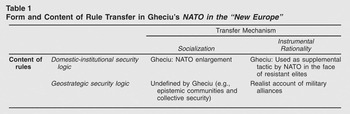
It is useful here to disentangle two analytical dimensions, rule content and transfer mechanisms, that are logically separate but empirically linked in Gheciu's account. First, the distinction between geostrategic and domestic-institutional approaches to security describes the content of rules. Second, the contrast between instrumental rationality and socialization captures transfer mechanisms. The two dichotomies yield four possible combinations (see Table 1): 1) The book's two case studies highlight socialization as a mechanism to promote the domestic-institutional logic of security. 2) Instrumental rationality (via membership conditionality), according to Gheciu, served as a supplemental tactic in the face of elite resistance to NATO's domestic strategy. 3) Realist theory, as the author shows, generally combines the geostrategic security logic with instrumental rationality. 4) Oddly, the book leaves the last possible combination unexplored: socialization in pursuit of rules based on a traditional geostrategic understanding of security, as argued, for instance, by the literature on epistemic communities and collective security.19
By not fully developing this theoretical framework, the book leads us to falsely associate instrumental rationality with geostrategic security arrangements and socialization with domestic-institutional reform toward international security. Blurring these analytical distinctions does a disservice to the constructivist research agenda, which aims at least partly to expose the socially contingent nature of all rules in international politics, including those of security alliances based on the assumption of anarchy.20 On the other hand, if Gheciu wishes to imply that rule content and forms of rule transfer cannot be separated (for logical or practical reasons), then the book falls short of making that case.Form and Content of Rule Transfer in Gheciu's NATO in the “New Europe”

Domestic Politics and the Promise and Limits of Conditionality
Whereas Gheciu emphasizes the convergence of Czechs and Romanians around Western liberal norms, Vachudova seeks to explain variation in democratic trajectories. In Europe Undivided, she examines why Central and Eastern European countries experienced divergent liberal or illiberal paths after 1989. This carefully researched book (based on extensive interviews with roughly 120 key actors and observers) gives a rationalist account of external rule transfer and compliance that privileges elite calculations in the domestic power struggle. Vachudova makes a subtle argument about how external influence worked in the case of the EU—mostly indirectly, by changing the environment of political competition on the ground—and gains analytical leverage, not from evaluating competing hypotheses side by side but from presenting a considerable range of variation in the EU's influence on her six cases.
Two factors account for the variation, she argues: at the domestic level, the quality of political competition at the time of the 1989 transition; and at the international level, the impact of the European Union and possibly other international organizations. Giving countries the mere prospect of membership granted the EU “passive leverage,” which Vachudova defines as the “attraction of EU membership” (p. 63) without attempts at deliberate influence by the EU. For candidates, future membership held the promise of EU market access and subsidies, a seat at the bargaining table, and the protection of EU rules. It also offered elites the opportunity to externalize unpopular but necessary reforms by shifting responsibility to Brussels. Rational cost–benefit analysis led liberal regimes in Poland, the Czech Republic, and Hungary to persevere with their reforms in anticipation of membership (p. 91). The trouble with passive leverage was that, while reinforcing liberal reforms in countries already thus inclined, it allowed rent-seeking elites in illiberal regimes to continue their policies of ethnic bigotry and economic corruption. From Vachudova's perspective, both the EU's protectionist trade regime and its unwillingness to impose strict accession requirements at this time were short-sighted and risked undermining the transition process in the region.
Passive leverage operated until 1994, when the EU became more serious about specifying accession conditions. “Active leverage” involved deliberate enforcement of the 1993 Copenhagen accession criteria by the European Commission and other EU actors. Asymmetric interdependence meant that the EU was able to dictate requirements unilaterally, given the candidates' intense desire to join the club and the opportunity cost from not joining. In sharp disagreement with critics who have characterized EU enlargement as a quasi-colonial project, Vachudova highlights the voluntary character of accession preparations that gave the EU added influence over accession requirements.21
E.g., Böröcz and Kovács 2001.
Active leverage, Vachudova shows, worked in particular by strengthening reform elites in postcommunist countries, a lesson that might travel well to contexts outside of Europe. Gheciu makes a similar point about NATO, but pays rather less attention to domestic political struggles. Whereas direct pressure on governments yielded only partial results and focused mostly on liberal regimes, EU leverage made political systems in illiberal regimes more competitive by serving as “focal point for cooperation among opposition political forces” (Gheciu, p. 162), supplying strategic information to reform-minded opposition actors, and delivering instant rewards for reformers once they were in government. Both political parties and nongovernmental organizations received financial and technical assistance from the EU. The differential empowerment of domestic actors helped lock countries into the preaccession process and increased the stakes of defection. In the later stages, accession preparations signaled to economic actors that all mainstream parties were committed to the reforms, and changes in government would not reverse this process.
In contrast to the macropolitical accounts of both books discussed so far, the volume by Hughes, Sasse, and Gordon on regional policy in Central and Eastern Europe arrives at more skeptical conclusions about the impact of external rules on domestic institutions. The focus of Europeanization and Regionalization in the EU's Enlargement to Central and Eastern Europe is on one policy area—regional policy—in which political stakes on the ground are high but EU rule density is low.22
On rule determinacy as a variable influencing compliance, see Schimmelfennig and Sedelmeier 2005.
The authors find that EU conditionality operated inconsistently, imprecisely, and sluggishly. They detect little more than a “temporal correlation” between regional reforms in Central and Eastern Europe and EU accession conditionality (p. 137). European integration, they argue, does not produce institutional and policy convergence, as judged by the evidence on regional reforms in the candidate countries. They highlight instead the importance of path dependence and institutional obstacles, as a result of which Poland's regional reforms established democratic self-governance at the regional level, whereas Hungary designed regions solely on a statistical level for the maximization of EU structural funds. By and large, then, regional reforms were homegrown rather than imposed by the EU.
In a troublesome sign for the prospect of EU rule implementation on the ground, Hughes, Sasse, and Gordon find that at least prior to the 2004 enlargement, local leaders had relatively little knowledge about EU-funded projects in their cities and perceived EU accession to have primarily national-level effects. This is indeed an indicator of the EU's failure to work with actors other than national governments, whether regional elites or societal representatives. But it is hard to share the authors' worry about insufficient levels of elite identification with Europe (pp. 158–62) without considering equivalent data from the old member states. In fact, research based on the World Values Survey (1999–2002) shows that in both the old member states and the 2004 entrants, citizens identify first and foremost with their region, next with their country, and last with Europe as a whole.23
Harris 2005.
In sum, the three studies dealing with membership conditionality in international organizations come to different, though compatible, conclusions about rule transfer. NATO, whose conditionality was less credible than that of the EU, appears to have relied on elite socialization to achieve the liberal-democratic reforms at the domestic level that it perceived as necessary for extending security and stability in Europe. The EU was able to restructure the environment of political competition in illiberal regimes to benefit reform-minded elites. But moving from the macro to the meso level of analysis demonstrates the gaps in EU rule transfer, as in the case of regional policy. More sector-level research is needed to enhance our understanding of the political dynamics of conditionality. Such studies are likely to show considerable variation in conditionality and compliance across countries and policies.
Insider Compliance: Global, European, and National Governance
One reason for membership conditionality in intergovernmental organizations is that enforcement mechanisms may be substantially weaker once the membership carrot is no longer available. Conventional wisdom about the EU has it that implementation and enforcement are weak, especially in contrast to its regulatory capacity.24
The EU's own administrative resources are minimal and insufficient for the task of monitoring the behavior of 27 member states. Implementing laws and policies is the task of member states that may or may not find it in their interest to comply. While the Commission has some resources for ensuring that member states write EU directives into national law, it largely depends on courts and private actors for exposing gaps in implementation, regardless of the European Court of Justice's status as the world's most powerful supranational court.25See, for instance, Alter 2000.
Börzel 2001a.
Two recent collaborative volumes set out to address this knowledge gap about actual compliance outside the nation-state in systematic fashion. In Complying with Europe, Falkner et al. investigate the implementation of six social and employment directives in the 15 old member states. Their goal is to see whether worries about the EU's “open method of coordination,” a relatively new policymaking style that combines obligatory minimum standards, peer pressure toward jointly established best practices, and options for member-state departures, are justified (they are not). The authors detect divergent “national culture[s] of digesting adaptation requirements” (p. 319) in reaction to external rules. Law and Governance in Postnational Europe, edited by Zürn and Joerges, compares legal compliance at the global, European, and national (German) level in three sectors: state aid, trade in foodstuffs, and redistributive mechanisms. The editors and authors find that compliance is actually best at the European level, contrary to common assumptions. Both volumes illustrate the value of collaborative work in complex multicountry or multilevel research.27
Oddly, however, it appears that comparativists are less likely than other political scientists to engage in collaborative research (Munck and Snyder 2007). This is unfortunate given the labor intensity of generating qualitative data.
Falkner et al. examine the way in which the 15 old EU member states have adopted six directives from the 1990s and integrated them within their preexisting legislation, yielding a total of 90 cases.28
There are more than 60 EU directives on social and employment policy currently in force.
Compliance in social policy, the authors find, strongly depends on national and supranational monitoring and enforcement. It is thus worrisome to see inconsistencies in Commission enforcement across policies and directives. Against intergovernmentalist assumptions that member states largely do as they please, noncompliance as an act of member state opposition seems to have been largely irrelevant here. Nor does policy misfit predict a country's actual implementation record. Stakeholder involvement may slow down a country's compliance with EU rules, though it remains to be tested whether government-stakeholder dialogue may not ultimately improve the actual functioning of the rule, as I have argued for the postcommunist countries.29
Sissenich 2007a.
Zürn and Joerges's Law and Governance is motivated by the question of whether compliance is inherently weaker outside of nation-states, where common values and a hierarchy of material enforcement capabilities may be missing. This is a well-designed study that examines compliance in three different institutional settings and three different policy types: constitutive rules about the market (subsidy controls at the German, European, and global level); regulatory policies designed to correct markets (trade in foodstuffs at the EU and WTO level); and distributive policies with “market-breaking” implications (at the German and European level). They thus deliberately include variation in the political dynamics engendered by different policy types.30
What accounts for compliance across governance levels is the existence of low-cost monitoring and enforcement mechanisms, as predicted by rational institutionalism, along with legal supervision by third parties. A rule's adaptability to changing circumstances will enhance compliance, as will a target actor's participation in rulemaking. Like Falkner et al., Zürn and Joerges and their colleagues emphasize rational-institutionalist criteria of monitoring and enforcement, but their emphasis on legal reasoning adds such factors as third-party rule supervision, supremacy and direct effect of supranational over national law, and individual actionability of rules. This means that societal actors carry a stronger weight as rule entrepreneurs pushing for enforcement against domestic obstacles than is conceded by Falkner et al. Their findings are only of limited comparability, however, because Complying with Europe is concerned with intra-EU variation, whereas Law and Governance deals with variation across governance levels.
Causal Mechanisms: Rational Choice Versus Constructivism
Instrumental rationality and socialization are more compatible than is assumed, implicitly or explicitly, in the books reviewed here. One cannot help but suspect that Falkner et al.'s “world of rule neglect” might perhaps benefit from socialization attempts such as those targeted at NATO's entrants. Changing elite and mass perceptions about the intrinsic value of rule compliance might go a long way toward helping scofflaw EU member states overcome hurdles toward compliance. Let us consider the socialization modes that, according to Gheciu, altered actor preferences: teaching, persuasion, and role playing.
“Teaching” aims to change individuals' categories of interpreting the world through sustained educational activities between willing and self-acknowledged teachers and novices in formal settings, such as workshops, seminars, and consultations (Gheciu, p. 88). “Persuasion” seeks to alter causal thinking about specific policies and operates through rational argumentation. Persuasion was particularly important in situations where Czechs and Romanians resisted the inherently unequal relationship implicit in teaching. In such instances, Gheciu argues, NATO officials shifted from seeking to change their interlocutors' values to changing causal perceptions (pp. 94–95). “Role playing” focuses on a person's behavior rather than his or her thinking. Crisis simulations, in particular, served to prepare elites for acting according to liberal-democratic principles. The key to success here is that socialization targets be allowed to actively engage with their assigned role, which should not go against deep-seated practices or conflicting roles in actors' domestic contexts (pp. 100–101). Importantly, none of these modes relies on shaming or other forms of social censure.31
This distinguishes Gheciu's concept of socialization from Johnston's (2001) concept of “social influence.”
In specifying socialization modes, Gheciu's book does an excellent job of explicating the microfoundations of macropolitical change. However, an obvious problem with methodological individualism, whether in the context of socialization or of instrumental rationality, is that of causal aggregation, inferring macro-level outcomes from individual-level changes. Even if we grant that elites may be subject to socialization effects (a sometimes doubtful proposition even in the EU's most likely setting, the Commission),32
several analytical steps are required to demonstrate that individual-level socialization changes not only individual preferences but also collective ones. How do elite “socializees” bring on board their elite opponents, let alone domestic society? One of the scope conditions of international socialization may well be the insulation of elites from democratic input. Thus, Jeffrey Checkel highlights depoliticization and nondistributive mandates as conditions that facilitate socialization by dodging the aggregation problem.33 Where this is not possible, what are the long-term consequences of policy changes resulting from elite socialization in the absence of corresponding efforts targeted at society at large? Vachudova's point about external empowerment of domestic civil society against illiberal leaders, a causal mechanism firmly grounded in rational instrumentalism, is crucial here. As the EU's failed Constitutional Treaty suggests, elite socialization that fails to persuade electorates may undermine the European integration project.Beyond the problem of causal aggregation, much of the constructivist literature suffers from a normative bias34
As acknowledged by Finnemore and Sikkink 2001.
To what extent are socialization and instrumental rationality compatible? Checkel has pointed out several ways. First, even role playing and persuasion are rooted in rationality. Role playing, that is, the use of behavioral shortcuts viewed as suitable for a given situation, corresponds to the notion of bounded rationality. Bounded rationality predicts satisficing behavior in the face of individuals' limited ability to calculate the costs and consequences of multiple actions in multiple realms. Persuasion, meanwhile, rests on Habermasian communicative rationality.35
Checkel 2007.
Checkel 2005.
But certain mechanisms might also interact at different levels of analysis. Take the example of reform externalization that is apparent in both Gheciu's and Vachudova's accounts: Reform-oriented elites, recognizing the obstacles in the way of homegrown reforms, may employ instrumental reason by seeking out the pressure/guidance provided by international organizations, thereby making themselves available for socialization efforts at the individual level.37
Zürn and Checkel (2005, 1061) make a similar point.
Sissenich 2007a.
Implications for Future Integration
If rule compliance is possible without the coercive apparatus and community of values of the nation-state, then what is the point of calling for a “European superstate,” as Morgan does in his exploration of justifications for European integration? If we are to believe the bulk of the books discussed here, then surely governance need not take on the form of a quasi-state in order for rules to operate effectively. But compliance is the least of Morgan's concerns. His advocacy for turning the EU into a nation-state is informed not by worries about rule effectiveness but by his concern with possible democratic justifications for integration.39
See my critique in Sissenich 2007b.
Without communal bonds among EU citizens, Morgan argues, we need a Rawlsian approach: In light of diverse conceptions of the good, a fair procedure should produce outcomes on which hypothetical free and equal persons could agree, regardless of individual values. He offers three criteria: publicity, accessibility, and sufficiency. All three serve as filters that leave the ultimate specification of goals open and subject to democratic deliberation. Morgan spells out a tentative list of public values: “moral equality of all individuals, personal security, personal and political liberty, and material prosperity” (p. 34). The point of the publicity criterion is that particularistic goals, such as social democracy or environmentalism, are ruled out as justifications for integration. A public justification follows from the tentative public values either logically or empirically and could be endorsed by the hypothetical “bare citizen.” Accessibility means that all people should be able to participate in a constitutional debate on European integration. Thus, any justification for integration whose appreciation requires specialized expertise is undemocratic and fails the test. Sufficiency, the third criterion, requires that European integration not merely be consistent with a given justification but constitute a necessary consequence of this justification. Sufficiency means that a justification could be realized only or most efficiently and effectively through integration.
One has to applaud Morgan for formulating evaluative criteria for public justification of the European project regardless of what direction it takes and even if the status quo is to be maintained. Rather than speculate about values that might or might not unite Europeans, he defines a standard of deliberation that eliminates a number of widely discussed goals, such as market efficiency or social welfare. But the threshold of accessibility is debatable and does not provide clear-cut criteria. More importantly, as Rawlsian approaches tend to do, the standard suffers from assuming away, rather than explicitly engaging, political difference. Even the bare citizen's public values are subject to contention: Feminist critics of contract theory have noted that, in light of differences in reproductive abilities, there can be no neutral conception of humans; thus, contract theory has always rested on the deliberate bracketing of the family and its inequalities. Rawlsian proceduralism, based on an allegedly neutral conception of a default human, is unable to account for power differentials grounded in empirical reality, notably sex and gender, bodily ability, nationality, and species membership.40
What might constitute a substantive justification that fulfills Morgan's three criteria? Democracy, it turns out, is not an adequate goal for European integration, as it falters on the sufficiency criterion: It is hard to make the case that democracy requires European political integration. Of course, one might make the same argument about the nation-state. Likewise, welfare fails the sufficiency and publicity test. Instead, Morgan champions security—defined at the individual level but with consequences for aggregate policies—as the public value that can supply a justification consistent with the three criteria. Thus, Europe's actual justificatory discourse has it exactly backwards by favoring welfare and neglecting security. Security, he claims further, necessitates a unitary European state. Morgan's logic here is Realist: Unipolarity, currently in the form of U.S. hegemony, is inherently unstable. Balancing thus calls for more than one superpower, and it is in Europe's security interest to pursue superpower status for itself, rather than cede this ground to competitors. NATO has never been an alliance of equals. Europe's dependence on the United States places the very definition of sovereignty in the hands of one superpower, with risks already evident in the Bush era's unilateral handling of this concept. As a superpower, the United States espouses multilateralism only when this suits its interests. American unilateralism places Europe at risk. Effectiveness and efficiency criteria indicate that the nation-state is still the most successful format for becoming a superpower. Hence, the EU, like the United States earlier, will have to centralize foreign and security policy.
Still, Morgan seems ambivalent in touting security as a rationale for European integration. On the one hand, his call for a European superstate is premised on the purely hypothetical exercise of finding a plausible democratic justification for integration. On the other hand, he is unequivocal about his conclusion that only a European superstate can make Europe secure. While the internal logic of his argument may be rather compelling, its practical realization might place not just Europeans but the rest of the world at grave risk. Casting a debate on constitutive changes in Europe's political order in purely normative rather than empirical terms means ignoring that historically, states have been the result not so much of contracting as of war making; in some states, but hardly everywhere, war making was followed by a gradual expansion of the rights of citizens.41
Tilly 1990.
Morgan's security justification aims to stabilize global politics by raising Europe to the status of a superpower and thus ending U.S. hegemony. But 50 years of European integration have taught us that member states are unlikely to be persuaded to transfer voluntarily their military sovereignty to a European superstate. Instead, creating such a superstate would likely require coercion and thus produce bloodshed both within the EU and between the EU and its competitors. Thus, Morgan's argument fails his sufficiency test: If establishing a superstate requires war, then European integration is inconsistent with the goal of security. Given that Europeans have varied understandings of security, not all of which are in line with Morgan's Realist version, the goal also fails the publicity requirement. If neither democracy nor welfare nor security satisfies Morgan's tests, perhaps his framework is overly restrictive: In seeking to produce determinate answers, it rules out perfectly plausible candidates that have been invoked at various points in the integration process and imbued with different meanings for different constituencies. Balancing trade and social welfare promises to be a goal more capable of generating a public consensus behind integration than is the case of security—even if this means a continuation of the bricolage that has characterized the Union since its inception.
Conclusion
The research on postnational rule projection discussed here highlights the value of three kinds of synthesis: first, between comparative and international relations scholarship; second, between rationalist and sociological accounts of human behavior; and third, between normative reasoning and empirical understanding. To begin, bringing together the agendas and tools of international relations and comparative politics is indispensable if we are to understand politics in all but the most isolated systems.42
For a related call to combine international relations and comparative politics research, albeit specifically to promote the constructivist research program, see Finnemore and Sikkink 2001.
Wimmer and Glick Schiller (2002, 327) attribute the term “methodological nationalism,” which echoes Karl Popper's methodological individualism, to Martins (1974, 276).
In this spirit, the evidence emerging from the works discussed here highlights the need for monitoring and enforcement mechanisms in making rules work beyond borders. Such mechanisms can be situated at multiple levels, but the nation-state's centralized bureaucracy remains crucial. By contrast, the role of state-society relations in rule projection and adoption has been given short shrift. Rule projection has tended to be most successful where it has empowered domestic agents of reform; in fact, domestic actors may deliberately enlist international organizations in an effort to externalize reforms and deflect blame. By the same token, where external rules are nonspecific and fail to resonate with political entrepreneurs or societal interests, we should not expect any meaningful impact on the ground, at least not in the short term. Some EU rules even call for the explicit collaboration of stakeholder groups and are likely to be hampered by the uneven development of organized civil society between Eastern and Western Europe. The Union's multilevel character opens up new opportunities for strategic alliances between nonstate actors and EU institutions, but most citizen activism still operates through national avenues, if it operates at all.45
Once countries are EU members, the EU's regulatory character has the potential of equipping societal representatives with new tools for advancing their claims through court action. But ultimately, such empowerment depends on the strength of organized interests at the domestic level and the willingness of national courts to engage the European Court of Justice.Secondly, studying how international organizations promote their rules among old and new members shows us that rationalist and sociological accounts of causal mechanisms can be reconciled in middle-range social research.46
See also Jupille, Caporaso, and Checkel 2003, who highlight three points of overlap between rationalists and constructivists: 1) a focus on collectivities rather than individuals in much of the empirical research of both programs; 2) an effort to theorize constraints/structures, whether material, social, or institutional; and 3) the openness of the concept of utility to any possible content, including altruism.
At a more abstract level, shifting between units of analysis demonstrates that different logics may operate simultaneously. Instrumental rationality by collective entities, such as the European Commission or candidate country governments, may facilitate socialization processes among individuals that would never come to pass without conditionality. Without accession conditionality, Central and Eastern European governments would have had little reason to subject the inner workings of their ministries to the close scrutiny of bureaucrats from the member states; at the individual level, however, this process of peer exchange facilitated social learning that, according to the participants, often operated reciprocally. But as I have argued, there are political risks involved in strategies that count on elite socialization without at least attempting to spread the underlying values to society at large, a point illustrated by the waning enthusiasm of candidate country electorates as the accession date drew near. Research that bridges instrumental rationality and socialization as causal mechanisms should investigate the following questions: What is the relationship between message and delivery, between rule content and the form of its transfer? Is socialization really the domain of liberals, as much of the constructivist literature seems to imply? How do we make sense of cultural foreign policy—as a propaganda tool in the service of power consolidation or as an inherently value-neutral socialization device that can be claimed by agents of any ideological outlook? Further, how do different mechanisms interact—sequentially and at different levels of analysis? How does the methodological individualism inherent in elite socialization accounts help us explain aggregate social change? At the policy level, what are the risks of focusing on elite socialization at the expense of engaging society more broadly? The puzzle of rule diffusion beyond the state, central to European integration but increasingly to new forms of governance in other parts of the world as well, is uniquely suited to shed light on this broader question of what motivates changes in the behavior of individuals and groups.
Third, let me emphasize the need for bridging empirical and normative analysis of new forms of governance.47
Specifically, I worry about the perils of constructing policy recommendations from normative theory in the absence of any empirical grounding, as illustrated by Morgan's book. Morgan is right to question the ability of justifications such as welfare and democracy to persuade reasonable citizens to support European integration. But his proposed alternative, though cast in partly hypothetical terms, ignores not only ample evidence of Europeans' divergent views about security but also the chain of actions required to establish the requisite political order. Far from unifying European citizens behind a common project, the launch of a European superstate capable of rivaling the United States would destabilize the existing peace in Europe and jeopardize global norms, such as nuclear nonproliferation. At the root of this absurd turn in Morgan's argument is the failure to differentiate social contract theory as a heuristic device from an historical account of state making. Historically, political orders have tended to result from contention, not from social contracting. State making was thus less the product of democratic justification than an efficient strategy in the consolidation of rule. Democracy sometimes followed the state-making exercise and therefore has been empirically tied to the organizational form of the state. One may therefore question its applicability to political orders that radically differ from the state. But if political theorists would do well to inquire about the empirical implications of their stipulations, the reverse is true for empiricists. If social science is never truly value-free, then we need a more explicit debate about the normative implications of emerging forms of governance. In that sense, Morgan's intervention is a refreshing start that, one hopes, will be followed by a lively debate about justifiable directions for the European project.