Introduction
Entrepreneurial orientation (hereinafter EO) (Covin & Lumpkin, Reference Covin and Lumpkin2011; Dess, Pinkham, & Yang, Reference Dess, Pinkham and Yang2011) is one of the most salient business management principles in the literature (Gupta & Gupta, Reference Gupta and Gupta2015). Research views companies that achieve greater innovation, a higher level of risk-taking and proactive competition as entrepreneurship-oriented (Covin & Slevin, Reference Covin and Slevin1986; De Mel, McKenzie, & Woodruff, Reference De Mel, McKenzie and Woodruff2009; Dess & Lumpkin, Reference Dess and Lumpkin2005; Miller, Reference Miller1983).
EO is one of the most important factors for companies' growth and profitability. The literature has thus paid much attention to EO's relationship to business performance and shown that companies with greater EO have better performance and better chances of growth and survival (Gupta & Wales, Reference Gupta and Wales2017; Pittino, Visintin, & Lauto, Reference Pittino, Visintin and Lauto2017; Rauch, Wiklund, Lumpkin, & Frese, Reference Rauch, Wiklund, Lumpkin and Frese2009). In seeking to understand EO in greater depth, various studies analyse the figure of the CEO, on the assumption that business decisions involve great ambiguity and uncertainty, and are particularly susceptible to influence by the CEO's personality (Nei, Foster, Ness, & Nei, Reference Nei, Foster, Ness and Nei2018; Rondan-Cataluña, Navarro-García, & Arenas-Gaitan, Reference Rondan-Cataluña, Navarro-García and Arenas-Gaitan2016; Simsek, Reference Simsek2007). Although studies that relate the CEO to EO indicate the importance of aspects such as the leader's personality traits and attitudes (Kozubíková, Čepel, & Zlámalová, Reference Kozubíková, Čepel and Zlámalová2018), personal values and internal motivation (Baum & Locke, Reference Baum and Locke2004; Mohd, Kamaruddin, Yahya, & Sanidas, Reference Mohd, Kamaruddin, Yahya and Sanidas2015) and dynamic capabilities (Ruiz-Ortega, Parra-Requena, García-Villaverde, & Rodrigo-Alarcon, Reference Ruiz-Ortega, Parra-Requena, García-Villaverde and Rodrigo-Alarcon2017), very few consider the different dimensions of CEO personality as variables that influence the company's EO.
Research on organizational behaviour has traditionally positioned the CEO as the most influential change agent in the business environment (Chung & Lo, Reference Chung and Lo2007), especially in small- and medium-sized enterprises (SMEs) (Thong, Reference Thong1999; Wincent & Westerberg, Reference Wincent and Westerberg2005). SMEs tend to have very centralized structures in which the CEO makes the main decisions (Finkelstein & Hambrick, Reference Finkelstein and Hambrick1996; Thong, Reference Thong1999). Moreover, SME managers' abilities and personality characteristics are universally regarded as one of the most powerful sets of factors impacting (whether positively or negatively) the firm's competitiveness and ultimate success (Wijewardena, Nanayakkara, & De Zoysa, Reference Wijewardena, Nanayakkara and De Zoysa2008)
Management can manage EO, but its proper development depends on the leader's personal characteristics (Bateman & Crant, Reference Bateman and Crant1993; Becherer & Maurer, Reference Becherer and Maurer1999). The influence of the leader's characteristics on the company's EO is a key factor in the company's degree of manoeuvrability. This study identifies the missing link between the individual and organizational levels, a link especially important because in SMEs the organization becomes an extension of the entrepreneur (Finkelstein & Hambrick, Reference Finkelstein and Hambrick1996; Wincent & Westerberg, Reference Wincent and Westerberg2005). Two analytical questions follow: Can the CEO's personal background influence the company's EO? If so, does this background weaken or enhance the company's EO?
Although the literature has progressed in understanding the importance of executives' personality, specific psychological traits and mechanisms that unite principals' personality with strategic influence and performance remain unexplored (Avolio, Sosik, Jung, & Berson, Reference Avolio, Sosik, Jung, Berson, Borman, Ilgen and Klimoski2003; Boal & Hooijberg, Reference Boal and Hooijberg2001).
This study aims to determine the links between specific characteristics (personality, proactivity and resistance to change) of the CEO and the EO of SMEs. According to the OECD, 99% of companies in Spain are SMEs, making further study necessary to improve knowledge and management of SMEs (Bañón & Sánchez, Reference Bañón and Sánchez2005; Rondan-Cataluña, Navarro-García, & Arenas-Gaitan, Reference Rondan-Cataluña, Navarro-García and Arenas-Gaitan2016). Given that all economic actors recognize EO's importance in job creation, technological innovation and economic rejuvenation, it is important that study of SMEs be a research priority (Freeman, Styles, & Lawley, Reference Freeman, Styles and Lawley2012).
Our analysis is structured as follows. First, we perform a literature review of the study variables and justify the study hypotheses. Next, we describe the data collection and variable validation processes used, and contrast the research hypotheses. Subsequently, we present the results obtained, followed by the main conclusions, implications for management, limitations and future lines of research.
Theoretical framework and hypotheses
Personality and entrepreneurial orientation
The EO literature has developed from two conceptualizations of the construct itself (Covin & Wales, Reference Covin and Wales2012). The first, initially proposed by Miller (Reference Miller1983) and subsequently adopted by Covin and Slevin (Reference Covin and Slevin1989), views EO as ‘a basic one-dimensional strategic orientation’ (Covin & Slevin, Reference Covin and Slevin1989: 79) that appears in the presence of three components, two behavioural (innovation capacity and proactivity) and one attitudinal (risk assumption). Innovation capacity is the willingness to support new ideas, to experiment and to use creative processes (Covin & Slevin, Reference Covin and Slevin1989; Miller & Friesen, Reference Miller and Friesen1983). Proactivity is opportunity-seeking, forward-looking behaviour that acts on future needs and trends ahead of competitors, thereby actively entering new product/market spaces, creating first-mover advantages and seeking market leadership positions (Anderson, Kreiser, Kuratko, Hornsby, & Eshima, Reference Anderson, Kreiser, Kuratko, Hornsby and Eshima2015; Rauch et al., Reference Rauch, Wiklund, Lumpkin and Frese2009). Finally, risk assumption involves the implementation of actions requiring significant levels of resources without certainty of success (Lumpkin & Dess, Reference Lumpkin and Dess1996; Rauch et al., Reference Rauch, Wiklund, Lumpkin and Frese2009). The second perspective, proposed by Lumpkin and Dess (Reference Lumpkin and Dess1996), is multidimensional. It does not require simultaneous appearance of the various components (Covin & Wales, Reference Covin and Wales2012) and introduces two additional factors, competitive aggressiveness and autonomy. Although other studies have investigated and reconceptualized EO (Anderson et al., Reference Anderson, Kreiser, Kuratko, Hornsby and Eshima2015; Martens, Lacerda, Belfort, & de Freitas, Reference Martens, Lacerda, Belfort and de Freitas2016; Wales, Reference Wales2016), the literature debates whether EO is a one-dimensional or multidimensional construct (Wales, Gupta, & Mousa, Reference Wales, Gupta and Mousa2013). Analysing two conceptualizations of corporate EO – as multidimensional and as a composite – De Clercq, Dimov, and Thongpapanl (Reference De Clercq, Dimov and Thongpapanl2013) conclude that neither is intrinsically superior and that the two are mutually compatible. This study uses the one-dimensional construct identified by Miller (Reference Miller1983) ‘as an imprint of the leader in the organization, the result of certain individual characteristics that represent the distinctive features of the entrepreneurial personality and motivation’ (Pittino, Visintin, & Lauto, Reference Pittino, Visintin and Lauto2017: 225). EO can refer to both companies and individuals, and it can be an important feature of either new or existing companies (Ferreira, Jalali, Bento, Marques, & Ferreira, Reference Ferreira, Jalali, Bento, Marques and Ferreira2017). In fact, the CEO often plays a fundamental role in the company's EO because business decisions, which involve great ambiguity and uncertainty, are influenced by the executive's personality (Simsek, Reference Simsek2007). Because CEOs' authority in decision-making and pervasive influence strongly shape the firm's strategy, culture and actions, they are critical to the survival and development of SMEs (Beaver & Jennings, Reference Beaver and Jennings2001; Davies, Hides, & Powell, Reference Davies, Hides and Powell2002; Palmer, Niemand, Stöckmann, Kraus, & Kailer, Reference Palmer, Niemand, Stöckmann, Kraus and Kailer2019; Puplampu, Reference Puplampu and Kuada2005). Unlike larger firms, where success is determined primarily by organizational variables, SMEs owners are the ‘source of action’ (Rauch & Frese, Reference Rauch and Frese2000).
Since the 1980s, the predominant reference system for personality traits is the Big Five (or Five-Factor) model (Costa & McCrae, Reference Costa and McCrae1992; John, Naumann, & Soto, Reference John, Naumann, Soto, John, Robins and Pervin2008), one of the most accepted integral models of personality (Major, Turner, & Fletcher, Reference Major, Turner and Fletcher2006). This system condenses personality into five critical factors (Fincham & Rhodes, Reference Fincham and Rhodes2005): extraversion, neuroticism, agreeableness, conscientiousness and openness to experience. The detection of the five factors across numerous cultures and languages has provided strong support for this model and demonstrated its high level of universal applicability (Bell & Njoli, Reference Bell and Njoli2016). Various studies have used these dimensions to analyse CEO personality. On the one hand, Judge and Bono (Reference Judge and Bono2000) liken traits from the five-factor model to transformational leadership behaviour. Crant and Bateman (Reference Crant and Bateman2000) analyse the relationship of measures of proactive personality and of the five-factor model to perceptions of charismatic leadership. Ployhart, Lim, and Chan (Reference Ployhart, Lim and Chan2001) test the distinction between typical and maximum criteria using ratings of transformational leadership performance to examine whether the criterion-related validities of the five-factor model differ for the two types of criteria. On the other hand, Giberson, Resick, and Dickson (Reference Giberson, Resick and Dickson2005) investigate trait homogeneity in organizations. They examine intra-organizational similarity among members' personality traits and personal values to test the relationship between the top leaders' personal characteristics, organizational profiles of personality and values using Big Five model. Finally, Do and Minbashian (Reference Do and Minbashian2020) study the relationship between personality and leadership by conceptualizing personality in terms of factors at the broadest levels of the personality hierarchy. Since CEOs are the principal decision makers and are ultimately responsible for the firm's strategic decision making, their personality traits have a significant impact on strategic decisions (Lefebvre & Lefebvre, Reference Lefebvre and Lefebvre1992; Palmer et al., Reference Palmer, Niemand, Stöckmann, Kraus and Kailer2019). Because CEOs – and thus their personalities – can be central to strategic changes in SMEs (Herrmann & Nadkarni, Reference Herrmann and Nadkarni2014), we consider the SME context as suitable for examining the relationships theorized.
Based on the foregoing, we now analyse each dimension and its relationship to EO.
The sociability of extraverted CEOs enables them to mobilize others and develop extensive interactions or social networks, both internally and externally. These social interactions are crucial to collection of information that supports interpretation of new information (Kraatz, Reference Kraatz1998) and its rapid transmission (Davis & Greve, Reference Davis and Greve1997).
Research suggests that specific traits are universal predictors of leaders' ability to influence and motivate followers to embrace their strategic vision of the firm (Gupta, Wieland, & Turban, Reference Gupta, Wieland and Turban2019). For example, meta-analysis has shown that extraversion is strongly associated with the leader's ability to motivate and inspire individuals (Bono & Judge, Reference Bono and Judge2004). Strategic leadership research has argued that the CEO's personality influences strategic entrepreneurial activities by shaping how CEOs define and communicate strategic vision and goals, and mobilize and coordinate the activities of top management team members, key agents championing strategies across various levels in the organization (Herrmann & Nadkarni, Reference Herrmann and Nadkarni2014; Nadkarni & Herrmann, Reference Nadkarni and Herrmann2010).
Agreeableness, in turn, fosters a culture of creativity and risk-taking grounded in cooperative relationships that are open and based on trust (Judge & Bono, Reference Judge and Bono2000). Highly conscientious individuals are oriented to achievement, work hard and show independence (Barrick, Mount, & Judge, Reference Barrick, Mount and Judge2001).
CEOs who are sympathetic, courteous, forgiving, trusting and cooperative (i.e., agreeable) perform better because persons possessing such traits are more rule-compliant and cooperative (Yeh et al., Reference Yeh, Yuan, Chen, Lo, Chou, Huang and Wan2016). Furthermore, Nadkarni and Herrmann (Reference Nadkarni and Herrmann2010) argue that achievement-oriented CEOs take control and responsibility for strategic activities. Conscientiousness is therefore positively related to the business's long-term survival (Ciavarella, Buchholtz, Riodan, Gatewood, & Stokes, Reference Ciavarella, Buchholtz, Riodan, Gatewood and Stokes2004).
Neuroticism reflects an individual's degree of emotional stability (Yong, Reference Yong2007). High emotional stability can improve individuals' ability to maintain relationships (Hurtz & Donovan, Reference Hurtz and Donovan2000), potentially facilitating the entrepreneur's long-term success by establishing networks with customers, employees and suppliers (Zhao & Seibert, Reference Zhao and Seibert2006). Successful CEOs manage their emotions and respond to others. They stimulate and motivate employees through good social skills and empathy. Such CEOs regulate their own emotions and those of employees through strong self-regulation and self-awareness skills (Goleman, Reference Goleman2000; Maamari & Majdalani, Reference Maamari and Majdalani2017).
People who are open to new experiences are intellectually curious and receptive to a wide range of stimuli. They are reflective and creative (McCrae & Costa, Reference McCrae and Costa1987). They do not fear new challenges but are versatile and imaginative (Yong, Reference Yong2007). Leaders who are open to new experiences actively seek excitement and risk (Judge, Heller, Mount, Reference Judge, Heller and Mount2002). Individuals with a high level of openness to experience are more intellectually challenged, creative, imaginative and attentive to their internal sensations (Javed, Khan, Arjoon, Mashkoor, & Haque, Reference Javed, Khan, Arjoon, Mashkoor and Haque2020; Silvia, Nusbaum, Berg, Martin, & O'Connor, Reference Silvia, Nusbaum, Berg, Martin and O'Connor2009). Open-minded individuals' healthy curiosity and high degree of innovative thinking generates a variety of ideas and perspectives (Baer & Oldham, Reference Baer and Oldham2006; Javed et al., Reference Javed, Khan, Arjoon, Mashkoor and Haque2020). EO provides a competitive advantage by efficiently regulating processes and strategies, and by discovering the talent or productive behaviours in the organization. EO is thus very important for recognizing opportunities and/or their benefits in the environment. It creates a dynamic, flexible, innovative, competitive organizational structure that is especially successful at shaping the work environment to achieve advantage and long-term gains (Covin & Miles, Reference Covin and Miles1999; Kör, Reference Kör2016; Zahra, Reference Zahra1986).
CEOs' need for change and risk assumption can promote behaviours that change existing products and/or processes (Nadkarni & Narayanan, Reference Nadkarni and Narayanan2007). We thus expect higher levels of openness to lead to a higher probability of business survival and a lower failure rate (Ciavarella et al., Reference Ciavarella, Buchholtz, Riodan, Gatewood and Stokes2004).
Following these arguments, we propose the following hypothesis:
Hypothesis 1 A CEO personality in which either a high level of extraversion, agreeableness, conscientiousness or openness to experience; or a low level of neuroticism predominates is positively related to the company's entrepreneurial orientation.
Personality and personal proactivity
Personal proactivity refers to individuals' predisposition to act and influence their environment (Thomas, Whitman, & Viswesvaran, Reference Thomas, Whitman and Viswesvaran2010). Proactive people tend to ‘look for opportunities, show initiative, act and persevere until significant changes are achieved’ (Bateman & Crant, Reference Bateman and Crant1993: 105). Individuals with proactive personality tend to be future-oriented and to focus on improving themselves (Parker, Lüdtke, Trautwein, & Roberts, Reference Parker, Lüdtke, Trautwein and Roberts2012).
Previous research has shown consistent positive relationships between proactive personality and two Big Five factors: conscientiousness and extraversion (Bateman & Crant, Reference Bateman and Crant1993; Crant, Reference Crant1995; Crant & Bateman, Reference Crant and Bateman2000). In one study, proactive personality also correlated positively with openness and negatively with neuroticism (Crant & Bateman, Reference Crant and Bateman2000). After controlling for both extraversion and conscientiousness, Crant (Reference Crant1995) demonstrated that proactive personality accounted for incremental variance in the job performance of real estate agents and concluded that specific measures of personality, such as proactive personality, ‘can have incremental validity over the Big Five factors’ (p. 536).
More recently, Thomas, Whitman, and Viswesvaran (Reference Thomas, Whitman and Viswesvaran2010) concluded that individual proactivity is conceptually somewhat related to the Big Five personality traits, since the proactive assumption of five-factor theory suggests that ‘individuals are neither passive victims of their life circumstances nor empty organisms programmed by histories of reinforcements’ (McCrae, Costa, Pervin, & John, Reference McCrae, Costa, Pervin and John1999: 142). Overall, however, comparative research differentiates the Big Five personality traits from emergent proactive constructs (Bateman & Crant, Reference Bateman and Crant1993; Major, Turner, & Fletcher, Reference Major, Turner and Fletcher2006; Young, Glerum, Wang, & Joseph, Reference Young, Glerum, Wang and Joseph2018).
In a study to validate a scale for personal proactivity, Bateman and Crant (Reference Bateman and Crant1993) find that the construct of personal proactivity is positively related to extraversion, conscientiousness, need for achievement and need for mastery; and is not related to openness, neuroticism, pleasantness, locus of control and mental capacity (Bateman & Crant, Reference Bateman and Crant1993; Crant, Reference Crant1995). As indicated above, Bateman and Crant (Reference Bateman and Crant1993) find disposition to proactivity to be conceptually related to extraversion because both involve the search for new experiences and activities. The tendencies to sociability, activity and energy that characterize extraverts may be related to proactive tendencies to create new environments through social pathways (Major, Turner, & Fletcher, Reference Major, Turner and Fletcher2006).
Personal proactivity is also related to conscientiousness (Bateman & Crant, Reference Bateman and Crant1993). Both proactivity and conscientiousness imply persistence in achieving goals, self-discipline and effort towards realistic achievement. Proactive individuals anticipate and plan the optimization of procedures (Major, Turner, & Fletcher, Reference Major, Turner and Fletcher2006).
The sociable, active and assertive tendencies that characterize extraverts may be related to proactive tendencies to shape environments through social avenues (Major, Turner, & Fletcher, Reference Major, Turner and Fletcher2006). For example, extraverts' sociability may relate to proactive propensities to communicate and to voice change initiatives. Facets of activity and assertiveness may also relate to personal tendencies to rally support for change and assertively support change in the face of opposition (LePine & Van Dyne, Reference LePine and Van Dyne1998; Thomas, Whitman, & Viswesvaran, Reference Thomas, Whitman and Viswesvaran2010; Wu & Turban, Reference Wu and Turban2007).
Proactive behaviour is related to openness to experience, since both involve exploration of the unknown. The need to change and assume risk can promote behaviours that disrupt the existing product and generate advantages from companies' stable resources (Nadkarni & Narayanan, Reference Nadkarni and Narayanan2007). Because individuals with a high degree of openness tend to gravitate towards intellectual and imaginative pursuits (Digman, Reference Digman1990), the intellectual component of openness may foster proactive individuals' efforts to evaluate complex environments and plan transformative changes (Crant & Bateman, Reference Crant and Bateman2000; Rode, Arthaud-Day, Mooney, Near, & Baldwin, Reference Rode, Arthaud-Day, Mooney, Near and Baldwin2008).
Major, Turner, and Fletcher (Reference Major, Turner and Fletcher2006) find that altruism (a facet of the dimension agreeableness, which reflects concern for the welfare of others and a tendency to generosity) correlates positively with personal proactivity.
Individuals who score high on the dimension of neuroticism may experience high levels of anxiety, depression and vulnerability that inhibit their ability to concentrate and to influence their environment (e.g., Major, Turner, & Fletcher, Reference Major, Turner and Fletcher2006). Individuals with high levels of anxiety are not expected to seek out or participate in new learning opportunities (Major, Turner, & Fletcher, Reference Major, Turner and Fletcher2006). Emotionally stable people (low scores in neuroticism), in contrast, experience states of relaxation and self-confidence that facilitate a proactive approach (Bateman & Crant, Reference Bateman and Crant1993).
Drawing on these arguments, we formulate the following hypothesis:
Hypothesis 2 A CEO personality with a predominantly high level of extraversion, agreeableness, conscientiousness or openness to experience; or a predominantly low level of neuroticism is positively related to a high level of individual proactivity.
Personality and resistance to change
The Big Five (Five-Factor) model of personality provides a good framework for analysing individual differences and attitudes to change. Several studies find that attitude to change can be predicted by traits such as self-esteem (Wanberg & Banas, Reference Wanberg and Banas2000), risk tolerance (Judge, Higgins, Thoresen, & Barrick, Reference Judge, Higgins, Thoresen and Barrick1999a), need for achievement (Miller, Johnson, & Grau, Reference Miller, Johnson and Grau1994) and locus of control (Lau & Woodman, Reference Lau and Woodman1995).
A number of empirical studies have focused on other dispositional variables. In a study of managers, Judge et al. (Reference Judge, Thoresen, Pucik and Welbourne1999b) found that seven personality factors predicted reactions to change. They divided these factors into two main categories. Positive self-concept includes locus of control, self-efficacy, self-esteem and positive affectivity, while risk tolerance includes openness to experience, tolerance of ambiguity and risk assumption. A number of researchers have reported self-efficacy – and more specifically, change-related self-efficacy – as a significant variable (Herold, Fedor, & Caldwell, Reference Herold, Fedor and Caldwell2007; Holt, Armenakis, Feild, & Harris, Reference Holt, Armenakis, Feild and Harris2007; Jimmieson, Terry, & Callan, Reference Jimmieson, Terry and Callan2004; Rosenbaum, More, & Steane, Reference Rosenbaum, More and Steane2018; Rudisill & Edwards, Reference Rudisill and Edwards2002; Wanberg & Banas, Reference Wanberg and Banas2000). Lau and Woodman (Reference Lau and Woodman1995) found a significant relationship between locus of control and the formation of change schemata but little impact of dogmatism. These authors argue that attitudes to change depend on individual patterns of change, defined as mental maps that represent knowledge structures about attributes and relationships between different change events. In their study, personality affects these schemas significantly.
Vakola, Tsaousis, and Nikolaou (Reference Vakola, Tsaousis and Nikolaou2004) suggest that openness to experience is related to positive attitude towards change because it describes people who cope effectively. Such people are tolerant and open to new ideas and suggestions. Following Smollan, Matheny, and Sayers (Reference Smollan, Matheny, Sayers, Zerbe, Ashkanasy and Hartel2010), we argue that the concept of openness to experience virtually defines adaptation to change. McCrae (Reference McCrae1994) and Watson and Clark (Reference Watson and Clark1997) specifically identify positive affectivity with propensity to change. From a conceptual standpoint, the other four factors may also be relevant to organizational change.
Vakola, Tsaousis, and Nikolaou (Reference Vakola, Tsaousis and Nikolaou2004) expect the dimension of consciousness – which describes people with self-discipline, ambition and competence (Costa & McCrae, Reference Costa and McCrae1992) – to correlate positively with positive attitudes towards change. For Brennan and Skarlicki (Reference Brennan and Skarlicki2004), conscientiousness contributes to the way survivors of downsizing continue to perform and Moon, Kamdar, Mayer, and Takeuchi (Reference Moon, Kamdar, Mayer and Takeuchi2008) report that conscientiousness is related to taking charge, a construct that includes initiating change.
We expect a negative relationship between the dimension of agreeableness and resistance to change, since individuals who score high in agreeableness are more reluctant to resist and more willing to follow new procedures and policies that arise from changes in the organization (Costa & McCrae, Reference Costa and McCrae1992). Agreeableness also fosters a culture of creativity and risk-taking based on cooperation, open relationships and employee trust (Judge & Bono, Reference Judge and Bono2000).
As to the relationship between extraversion and attitude towards change, extraverted people tend to take initiative and develop the capacity to adapt quickly to changes in the environment. These actions require creation of new ideas that can deviate from past strategies (Johnson, Lee, Saini, & Grohmann, Reference Johnson, Lee, Saini and Grohmann2003).
Finally, we investigate neuroticism. Bass and Stogdill (Reference Bass and Stogdill1990) suggest that most of the successful CEOs are emotionally stable (low on neuroticism). Emotional stability may enhance effective leadership, social interaction and complex decision-making (Boudreau, Boswell, & Judge, Reference Boudreau, Boswell and Judge2001; Judge et al., Reference Judge, Heller and Mount2002). Emotional stability is associated with optimism, self-confidence, self-assurance, decisiveness and success (Gow, Kaplan, Larcker, & Zakolyukina, Reference Gow, Kaplan, Larcker and Zakolyukina2016). Emotionally stable people tend to remain calm and balanced in stressful situations (McCrae & Costa, Reference McCrae and Costa1997). They are less threatened by uncertainties and not afraid to challenge the status quo and take risks (Judge & Bono, Reference Judge and Bono2000; Nadkarni & Herrmann, Reference Nadkarni and Herrmann2010; Peterson, Smith, Martorana, & Owens, Reference Peterson, Smith, Martorana and Owens2003; Shimizu & Hitt, Reference Shimizu and Hitt2004). Others argue against this positive view of emotional stability, however, holding that emotionally stable individuals ignore important cues because they are too focused (Easterbrook, Reference Easterbrook1959). Also, negatively related to beliefs about the importance of working hard (Gottfredson, Jones, & Holland, Reference Gottfredson, Jones and Holland1993), neuroticism is probably undesirable in a CEO. Consistent with this argument, some studies find that neuroticism is negatively related to job performance and career success (Sackett, Lievens, Van Iddekinge, & Kuncel, Reference Sackett, Lievens, Van Iddekinge and Kuncel2017; Salgado, Reference Salgado1997; Tett, Jackson, & Rothstein, Reference Tett, Jackson and Rothstein1991).
People with a high degree of neuroticism cope poorly with stress (McCrae & Costa, Reference McCrae and Costa1987). Since introducing change is usually associated with increased levels of stress and insecurity (Elrod & Tippett, Reference Elrod and Tippett2002), it can generate resistance to change and inhibit successful implementation of change processes. We thus expect individuals' emotional stability (i.e., lower neuroticism) to be negatively related to negative attitudes (resistance) to change.
Although personality can influence and even play a key role in adaptation to change, other variables may exert stronger influence on some people and some types of change (Smollan, Matheny, & Sayers, Reference Smollan, Matheny, Sayers, Zerbe, Ashkanasy and Hartel2010). For example, a person who is high in neuroticism and therefore possibly predisposed to resist change is nevertheless likely to react somewhat positively to an organizational change that lowers stress or delivers valued outcomes. Conversely, even those who show significant levels of agreeableness, conscientiousness and openness to experience will probably resist change that is clearly unfavourable and unjust (Bareil, Savoie, & Meunier, Reference Bareil, Savoie and Meunier2007; Chawla & Kelloway, Reference Chawla and Kelloway2004; Day, Crown, & Ivany, Reference Day, Crown and Ivany2017).
Based on these arguments, we formulate the following hypothesis:
Hypothesis 3 A CEO personality in which a high level of extraversion, agreeableness, conscientiousness or openness to experience predominates; or in which a low level of neuroticism predominates is negatively related to a high level of resistance to change.
Personal proactivity and entrepreneurial orientation
Proactive personality in the CEO can be an important predictor of an organization's EO. Empirical evidence shows that proactive personality is positively related to a series of organizational outcomes, including job performance (Crant, Reference Crant1995), tolerance to stress at work (Parker & Sprigg, Reference Parker and Sprigg1999), participation in organizational initiatives (Parker, Reference Parker1998) and entrepreneurial behaviour (Becherer & Maurer, Reference Becherer and Maurer1999).
To measure proactive personality, the scale evaluates personal disposition towards proactive behaviour, a concept intuitively related to entrepreneurial spirit (Crant, Reference Crant1996). Since identification of opportunities is an important aspect of individual initiative (Tang, Kacmar, & Busenitz, Reference Tang, Kacmar and Busenitz2012), proactive personality is a crucial antecedent of businesses that are alert to opportunities. Using longitudinal data from two high schools in Helsinki, Finland, Obschonka, Hakkarainen, Lonka, and Salmela-Aro (Reference Obschonka, Hakkarainen, Lonka and Salmela-Aro2017) confirm that creativity and proactivity improve the connection between personality and business alertness. EO as a strategic stance towards entrepreneurship implies willingness of the organization's members to innovate, seek and take risks, and be more proactive and aggressive than competitors in the search for new market opportunities (Li, Fay, Frese, Harms, & Gao, Reference Li, Fay, Frese, Harms and Gao2014). We thus expect the CEO's personal proactivity to predict the organization's EO.
Following these arguments, we formulate the following hypothesis:
Hypothesis 4 The CEO's personal proactivity is positively related to the organization's entrepreneurial orientation.
Resistance to change and entrepreneurial orientation
The CEO's attitude towards change can influence the organization's strategy significantly (Musteen, Barker, & Baeten, Reference Musteen, Barker and Baeten2006). According to Langkamp-Bolton and Lane (Reference Langkamp-Bolton and Lane2011), attitude influences the emergence of EO, specifically in innovation, risk-taking and proactivity. This finding could suggest that the company's strategy is conditioned by the CEO's attitude towards change.
Hambrick and Mason (Reference Hambrick and Mason1984) find that a general director with a high level of dogmatism and a preference for sustaining the organization's status quo and tested practices discourages EO in the organization (Halikias & Panayotopoulou, Reference Halikias and Panayotopoulou2003). SMEs' stance on entrepreneurship and the values associated with it can, however, promote the organization's transformation and renewal, and support the construction of new competencies (Grinstein, Reference Grinstein2008). This finding suggests that developing EO in the company induces a will to change in its members and improves the organization's flexibility (Dayan, Zacca, Husain, Di Benedetto, & Ryan, Reference Dayan, Zacca, Husain, Di Benedetto and Ryan2016).
Following these arguments, we formulate the following hypothesis:
Hypothesis 5 The CEO's resistance to change is negatively related to entrepreneurial orientation in the organization.
Methodology
To perform the empirical study, we took as the target population companies located in the geographic territory of Spain in four sectors: food, wine, footwear and information and communication technologies. We chose these sectors due to the differences in the speed of change in their industries, an issue of great interest in the strategic management literature (Eisenhardt & Martin, Reference Eisenhardt and Martin2000).
The questionnaire was addressed to firms defined as SMEs in European Union Recommendation 2003/361/CE (European Union, 2003). The companies selected were sent the online questionnaire, a statement explaining the study’ purpose and a cover letter (via email) addressed to the company's manager.
We used a sample of SMEs because SMEs form the backbone of EU countries' growth: SMEs represent 99% of enterprises and 67% of all employment in the EU (OECD, 2012). Improving SMEs' managerial knowledge and competencies is thus crucial to leveraging development of the whole economy (Hussain, Millman, Matlay, Birmingham, & Barr, Reference Hussain, Millman, Matlay, Birmingham and Barr2006). Companies in general, and SMEs in particular, are influenced by the character of their CEO, the individual with the strongest effect on decision-making in the company (Rondan-Cataluña, Navarro-García, & Arenas-Gaitan, Reference Rondan-Cataluña, Navarro-García and Arenas-Gaitan2016). This role is even more intense in SMEs (Chung & Luo, Reference Chung and Luo2013).
The sample finally selected included 4,396 SMEs from the SABI (System of Analysis of Iberian Balance database) database (Bureau Van Dijk, 2013). The selection method was random sampling, and the number of companies obtained in each sector directly reflected the sector's proportion of the total population.
The first mailing was sent in February, followed by second and third mailings in March and April, respectively. We received 376 questionnaires, of which 358 were valid, yielding an approximate response rate of 8.5%. This response rate is satisfactory, since it exceeds the minimum threshold for applying structural equations methodology and testing the psychometric properties of the measurement scales (Williams, Gavin, & Hartman, Reference Williams, Gavin, Hartman, Ketchen and Bergh2004).
We performed the data analysis with structural equations modelling using partial least squares (PLS-SEM) (Fornell & Cha, Reference Fornell, Cha and Bagozzi1994). Several characteristics of PLS-SEM have increased researchers' use of this technique in areas such as management, market research and strategy (Sattler, Völckner, Riediger, & Ringle, Reference Sattler, Völckner, Riediger and Ringle2010).
Measures used
Personality
To analyse CEO personality, we used 23 items adapted from the scale used by Hewee and Shamuganathan (Reference Hewee and Shamuganathan2010). These items enable us to measure the five personality factors.
Calculation of the Cronbach's α confirmed that all dimensions of the scale have high levels of reliability (extraversion: α = .807, agreeableness: α = .878, conscientiousness: α = .811, neuroticism: α = .776, openness to experience: α = .855).
Entrepreneurial orientation
To measure the variable EO, we adapted nine items from the original scale developed by Covin and Slevin (Reference Covin and Slevin1989). In developing this measure, Covin and Slevin theorized that the three dimensions of EO act together to explain a basic, one-dimensional strategic orientation. The variable focuses on risk-taking orientation, proactivity and innovation by the company's management. We verified that this scale presents a high level of reliability (α = .871).
Personal proactivity
We measured personal proactivity through six items from the original proactive personality scale developed by Bateman and Crant (Reference Bateman and Crant1993). We adapted these six elements following a previous study by Claes, Beheydt, and Lemmens (Reference Claes, Beheydt and Lemmens2005), who concluded that the abbreviated six-item scale measured proactive personality similarly to the scale developed by Bateman and Crant (Reference Bateman and Crant1993).
We verified internal consistency of the scale's items by analysing the Cronbach's α, which enabled us to confirm that this scale had a high level of reliability (α = .819).
Resistance to change
To analyse this construct, we used an adaptation of the 11-item scale developed by Oreg (Reference Oreg2006). We also confirmed this scale's high level of reliability through the Cronbach's α (α = .930).
All variables were measured using a 7-point Likert scale, on which 1 = ‘total disagreement’ and 7 = ‘total agreement’.
Analysis and results
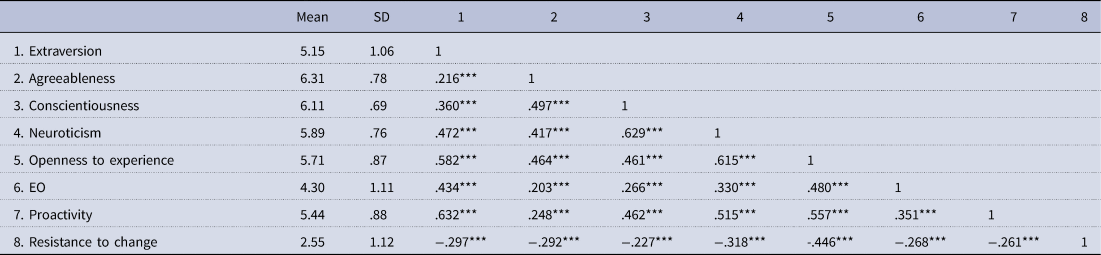
Table 1 displays the results of the descriptive data analysis and the correlation matrix. We observe a good associative relationship among the variables in the model.
Correlation among variables analysed
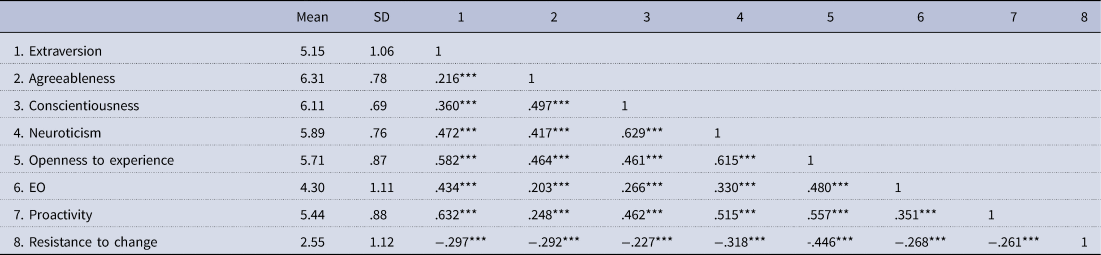
n = 358; *p < .05;**p < .01;***p < .001.
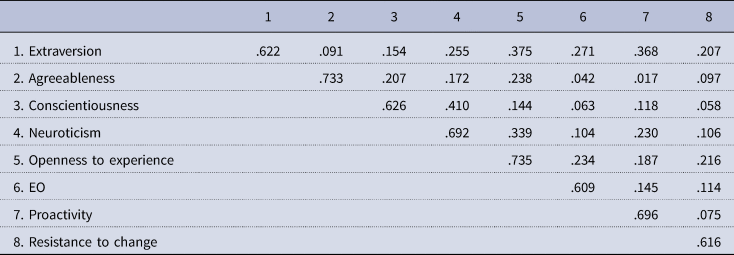
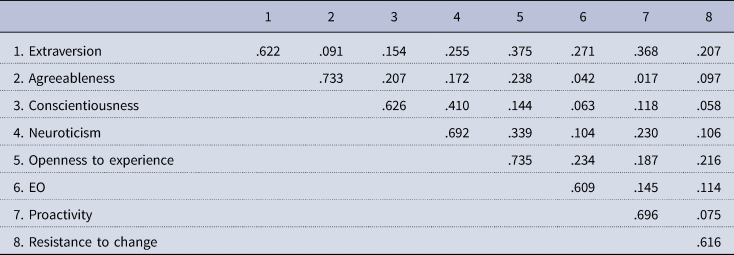
Evaluation of the measurement model showed α and CR values above the required threshold of .7 for all constructs (Hair, Ringle, & Sarstedt, Reference Hair, Ringle and Sarstedt2011). All constructs also followed Fornell and Larcker's (Reference Fornell and Larcker1981) recommendation that the average variance extracted be greater than .50.
To test discriminant validity, we analysed the Fornell and Larcker criterion (Reference Fornell and Larcker1981) and confirmed that all study constructs met this requirement (see Table 2).
Discriminant validity
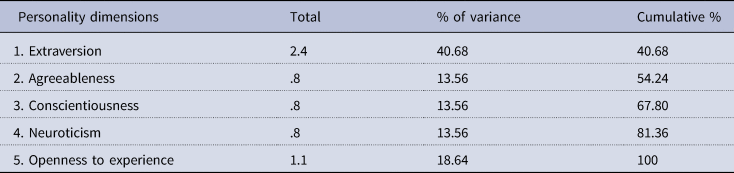
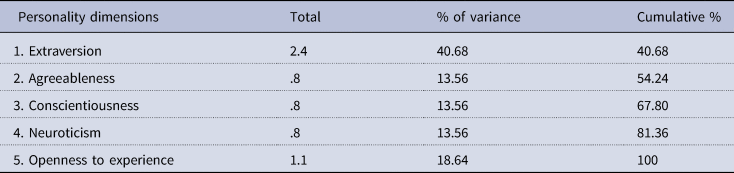
Since the items that assess CEO personality consist of five subscales, it is important to know which factors provide the best data in the study. Construct analysis aims to determine whether the constructs are homogeneous – that is, whether they can measure the construct (Gregory, Reference Gregory2007). As Table 3 shows, the five personality dimensions explain 100% of the variance. These results are consistent with the findings of John and Srivastava (Reference John, Srivastava, Pervin and John1999). Similarly, Benet-Martinez and John (Reference Benet-Martinez and John1998) find that the taxonomy of the five main factors is similar across different types of samples.
Initial values for total variance explained
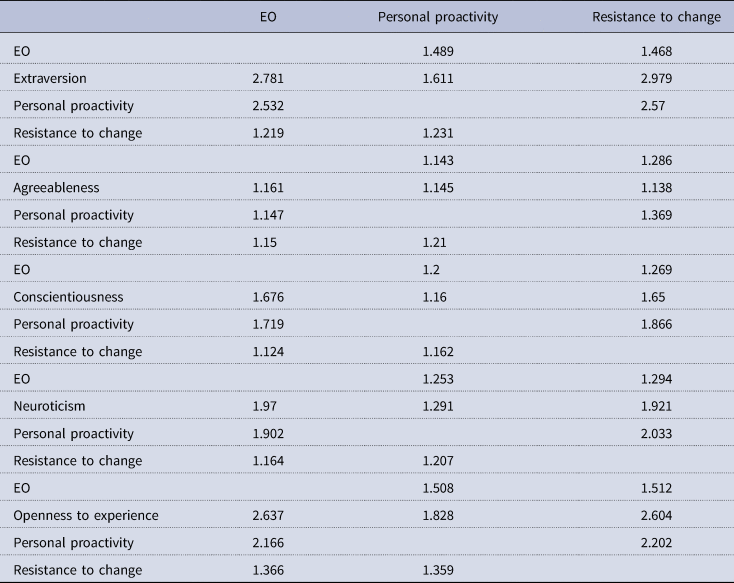
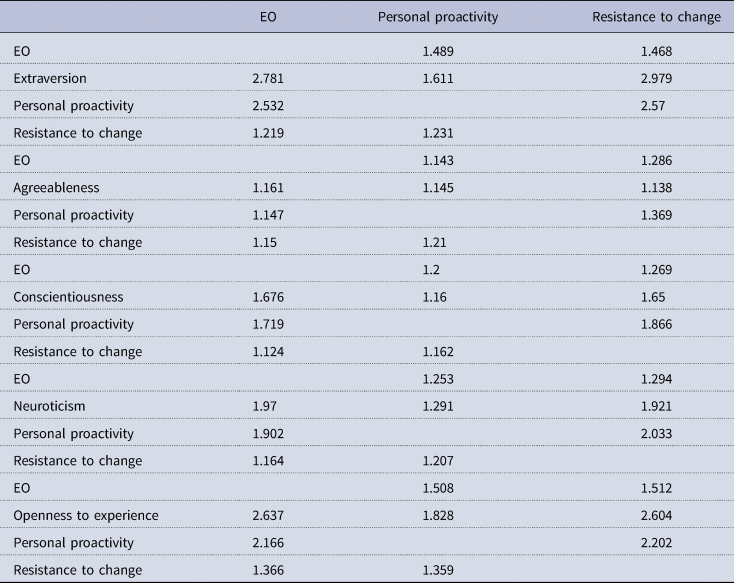
To assess common method bias, we used the test developed by Kock and Lynn (Reference Kock and Lynn2012). These authors propose a full collinearity test as a comprehensive procedure to assess vertical and lateral collinearity simultaneously (Kock & Gaskins, Reference Kock and Gaskins2014). Obtaining a Variance Inflaction Factors (VIF) greater than 3.3 indicates pathological collinearity, as well as the possibility that the model may be contaminated by common method bias. If all VIFs obtained in a full collinearity test are less than or equal to 3.3, the model can be considered as free of common method bias (Kock, Reference Kock2015). Table 4 shows that the model is free of common method bias.
Full collinearity VIFs
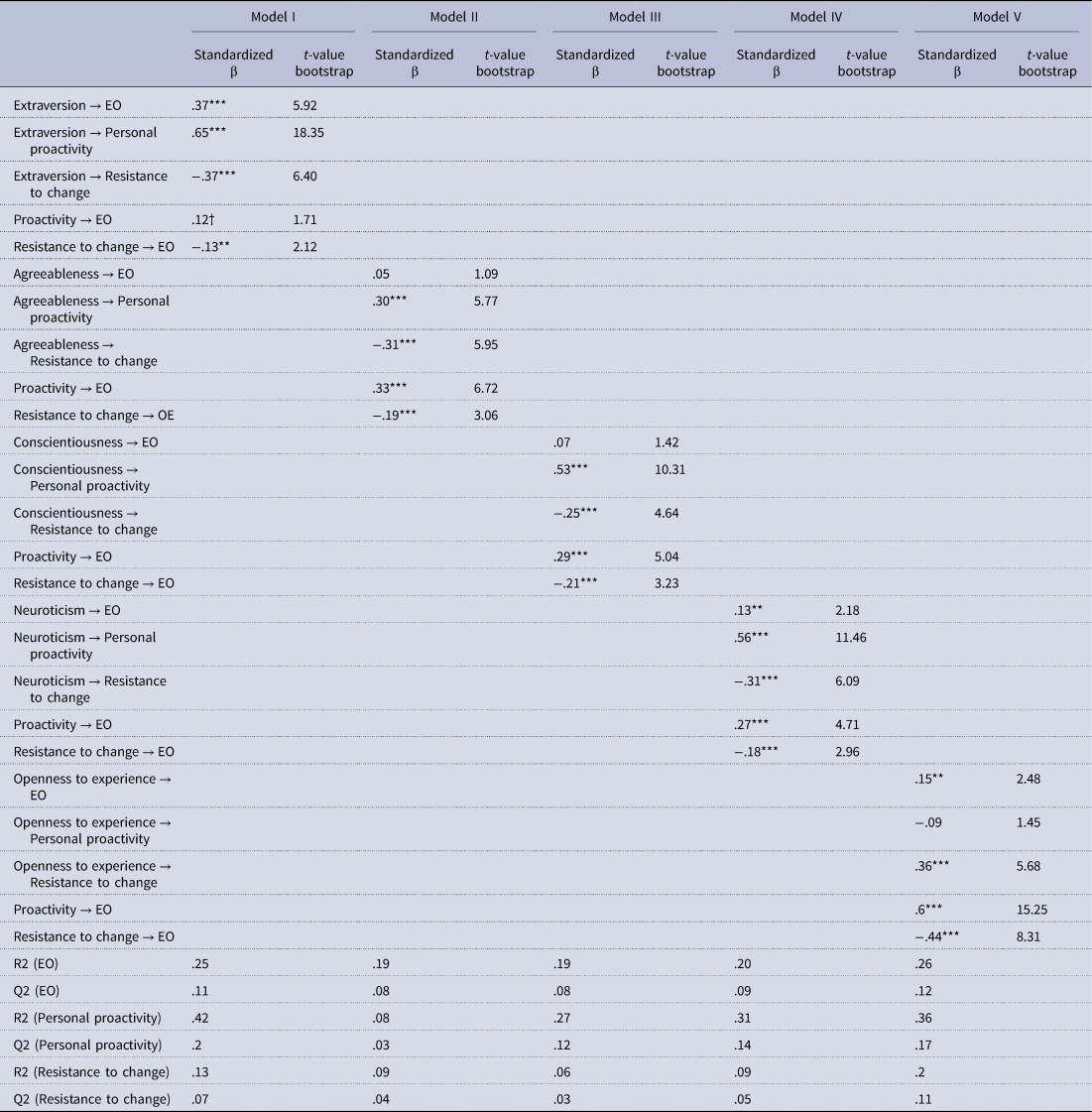
The second stage of the analysis, interpretation of a PLS-SEM model, evaluates the structural model. Table 5 summarizes the results of the PLS-SEM analyses. The variance of the latent dependent variables explained by the constructs that predict them (R 2) is higher than .1 for all latent variables. In analysing the size of R 2 (Falk & Miller, Reference Falk and Miller1992) as a criterion of predictive relevance, we applied the sample reuse method (Q 2 through blindfolding) proposed by Stone (Reference Stone1974) and Geisser (Reference Geisser1975). The Q 2 values are greater than zero for all latent dependent variables, indicating that the model has predictive validity. The results of this procedure show that all structural relationships proposed are significant (see t-value in Table 5).
Hypothesis validation
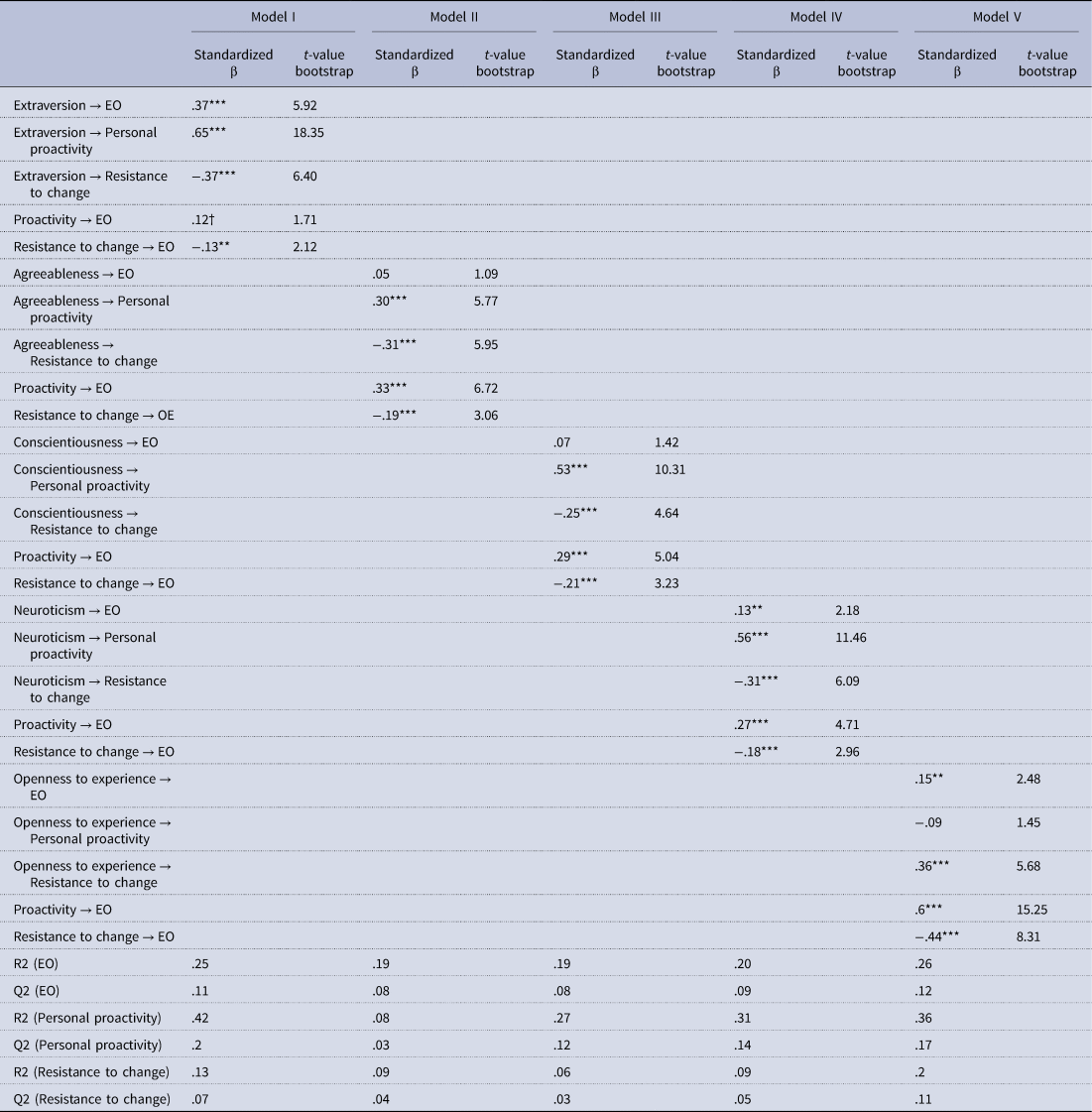
*p < .05; **p < .01; ***p < .001.
The results obtained in this study indicate that extraversion, neuroticism and openness to experience significantly affect the company's EO (β = .37, β = .13, β = .15 and p < .001, p < .01, respectively), but that other dimensions, such as agreeableness and conscientiousness, do not (β = .05 and β = .07, respectively).
Second, EO is affected positively by individual proactivity and negatively by resistance to change in each of the models analysed. These results support hypotheses 1a, 1d, 1e; 2a, 2b, 2c, 2d and 3a, 3b, 3c, 3d. They do not support hypotheses 1b and 1c, and 2e and 3e. The results also support hypothesis 4, since we have verified that individual proactivity affects the company's EO positively and significantly. Resistance to change, in contrast, affects the business's EO negatively and significantly, supporting hypothesis 5. Table 5 presents the model relationships analysed.
Conclusions and discussion
Recognized as a determining factor in a company's growth and profitability (Brown, Davidsson, & Wiklund, Reference Brown, Davidsson and Wiklund2001), EO is a key ingredient for an organization's success.
The current study explores the relationship between the EO an organization develops and the CEO's personal traits and characteristics. Several previous studies (Raisch & Birkinshaw, Reference Raisch and Birkinshaw2008) note the importance of the CEO's role in the organization's decisions. This role becomes crucial in SMEs (Chung & Luo, Reference Chung and Luo2013; Rondan-Cataluña, Navarro-García, & Arenas-Gaitan, Reference Rondan-Cataluña, Navarro-García and Arenas-Gaitan2016; Thong, Reference Thong1999; Wincent & Westerberg, Reference Wincent and Westerberg2005). Because SMEs tend to have very centralized structures, the general director makes the fundamental decisions (Finkelstein & Hambrick, Reference Finkelstein and Hambrick1996; Thong, Reference Thong1999).
Our results extend previous research by highlighting the role of the CEO's personality in the organization's development of EO. They also show the influence of two other personality traits, individual proactivity and resistance to change, linking the CEO's personality to the organization's EO.
More specifically, we find that some dimensions predominant in the CEO's personality exert a significant influence on the organization's EO. CEO personality with a high level of extraversion or openness to experience; or a predominantly low level of neuroticism exerts a positive influence on the development of organizational EO.
We also find that CEOs who scored high in extraversion, agreeableness or conscientiousness; or low in neuroticism showed both high levels of personal proactivity and less resistance to change.
Furthermore, we analysed individual proactivity and resistance to change as mediators of the effect of the CEO's personality dimensions on the company's EO.
Our results show that the CEO's personal proactivity has a positive influence on the organization's EO. Proactivity is characterized as or preceded by specific dimensions of the CEO's personality – extraversion, agreeableness, conscientiousness and neuroticism. All of these dimensions exert a positive influence on the organization's development of EO. The dimension openness to experience does not significantly influence personal proactivity, however, perhaps indicating that the CEO's creativity is not related to openness to new experiences and active risk seeking.
Furthermore, we verify that the leader's resistance to change exerts a negative influence on EO. Resistance to change is also characterized or preceded by the dimensions of CEO personality. In this case, CEO personality with a predominantly high level of extraversion, agreeableness, conscientiousness or openness to experience; or a low level of neuroticism is negatively related to resistance to change, which in turn negatively influences the organization's development of EO.
We can derive various theoretical and practical implications from this empirical study. From the theoretical point of view, our study broadens the perspective of ‘Upper Echelons’ theory (Finkelstein & Hambrick, Reference Finkelstein and Hambrick1996; Hambrick, Reference Hambrick2007) by showing what happens in the specific case of general managers of Spanish SMEs. We highlight the role of CEO personality in the company's EO, as well as the role of individual proactivity and resistance to change as channelling elements between the leader's personality and the organization's EO. These findings explain how individual CEO traits translate into the characteristics of the organization.
From the practical point of view, the results have significant implications for recruitment and development of the organization's CEO. If an organization wants to develop EO, it must take the CEO's personal characteristics into account. Organizations should look for individuals with personalities in which extraversion, agreeableness, conscientiousness or openness to experience predominate. Companies that wish to achieve EO should seek a CEO who responds positively to change, that is, a CEO who does not resist and who is proactive. These leadership characteristics exert a strong influence on the organization's development of EO.
This study is subject to various limitations. The first involves the limited generalization of current results to large companies, since our research focuses on SMEs. It would be interesting for future studies to test in large companies the relationships our research establishes in SMEs. Second, our sample was composed of companies operating in only four Spanish business sectors. Future research should disaggregate the factors omitted from our analysis of EO, risks and organizational proactivity. This study measured EO as a first-order reflective construct, following the theorization by Covin and Slevin (Reference Covin and Slevin1989). In this measure, the three dimensions of EO work together to explain a basic one-dimensional strategic orientation. Some literature, however, recommends using EO as a disaggregated construct and treating its dimensions separately (Hughes & Morgan, Reference Hughes and Morgan2007). Other research even supports the argument that EO should be measured on a second-order formative scale (Covin & Wales, Reference Covin and Wales2012; Jarvis, MacKenzie, & Podsakoff, Reference Jarvis, MacKenzie and Podsakoff2003). We plan to assess these ways of measuring EO by developing new research models in the future.
Another future line of research could test the possible relationship between the personality of CEOs who develop their professional careers in social companies. Due to the individual's importance to the success of social enterprises, several researchers have identified a portrait of social leaders (Thorgren & Omorede, Reference Thorgren and Omorede2018).
Future research could also focus on the relationship between CEO personality and causal and effectual logic (Sarasvathy, Reference Sarasvathy2001) in decision-making in the early stages of business growth. Such analysis could provide important additional insights by investigating how workplace values relate to actual leadership behaviour and effectuation.
Acknowledgements
The authors acknowledge Spanish Ministry of Economy, Industry and Competitiveness for partial financing of this research through projects ECO2013-45885-R and ECO2016-80677-R.
Dr. Antonio José Verdú-Jover is Full Professor of Management at Miguel Hernandez University. He received his PhD in Management from the University of Granada. His current research interests include strategic and organizational flexibility, strategic fit, organizational learning, strategic entrepreneurship, innovation, business environment and entrepreneurial processes. He has published in various international journals such as Journal of Small Business Management, British Journal of Management, Industrial Marketing Management, Personnel Review, International Journal of Human Resource Management, Technovation, Organization Science, International Journal of Production Economics, International Business Review and Journal of Communication. He also has contributed as a researcher in two European projects and has been the main researcher in three projects founded by the Spanish Ministry of Education and Science.
Dr. Marina Estrada-Cruz is PhD assistant of Entrepreneurship in Miguel Hernandez University. She received her PhD in Marketing and Strategic Business Management within the line of research focused on social entrepreneurship, innovation and effectuation. Similarly, actively collaborates since the year 2014 in the development of the GEM report in the Valencian Community and in GUESSS (Global University Student's Survey) project. She has published in various journals such as European Research on Management and Business Economics, BRQ Business Research Quarterly and Journal of Enterprising Communities: People and Places in the Global Economy. In the professional field, she worked at the Business Innovation Centre in Elche, as head of Economic, Financial and Advisory Area for Entrepreneurs and companies where she has more than 10 years of experience.
Dr. Noelia Rodriguez-Hernandez holds a degree in Business Administration and Management; she has completed Master's in Human Resources Management, Labor and Organizations and she holds a Phd in Marketing and Strategic Business Management. During the development of her doctoral thesis, she specialized in topics related to strategic entrepreneurship in companies. In her professional career, she highlights her 4-year experience as a researcher in the Department of Economic and Financial Studies of the Miguel Hernández de Elche University (UMH), in the area of Business Organization. On the other hand, she has worked as a practicing economist doing work in areas such as accounting, taxation, market research and training. Noelia currently works as an innovation agent for the UMH Foundation, as well as a Part Time Lecturer in the Department of Economic and Financial Studies UMH.
Dr. José María Gómez-Gras is Professor in Business Organization Area in Miguel Hernandez University (UMH). He holds a PhD in Economics and Business Studies, ‘Censor Jurado de Cuentas’ and Economist-Auditor, with an experience of 38 courses. Currently he is Excellence Model Assessor of the EFQM (European Foundation for Quality Management). He is the author of more than 100 scientific papers and researcher in more than 50 national and international projects on the problems of the business world and the creation and management of new ventures. Since its creation, he has been the head of the research group on ‘Promotion and New Business Creation’ of the UMH and the ‘Global Entrepreneurship Monitor’ Observatory in the Valencian Community, promoted internationally by Babson College and London Business School.