To understand American political parties, one must look beneath their labels. Beneath those labels are factions that have conflicting goals, incentives, and resources. These factions are loosely organized networks that link members of Congress to party activists, pressure groups, policy entrepreneurs, and intellectuals in efforts to control the policymaking process. Factions are engines of political change that develop new ideas, refine them into workable policies, and promote them in government. Because America’s big-tent parties are cumbersome instruments, factions help account for changes in public policy, modes of electoral mobilization, and the parties’ ideological positions. Factions are thus a fruitful way to see how different elements—elements too often studied in isolation—within a party interact.
The existing literature on American intraparty factions at the national level is small and largely unsystematic. Historians regularly refer to factions in their narrative accounts of different periods, but they use the term colloquially. Of the work that political scientists have done, most of it treats state rather than the national parties.Footnote 1 This has led a leading scholar to claim that “factionalism does not appear to be a salient characteristic of the American party system.”Footnote 2 Consequently, we know less than we should about factional activity over the course of American political development. More work is needed to distinguish factions from other groupings within the parties and to analyze their strategies, behavior, and effects. This article is a contribution to that effort.
To make the case that factions are central to understanding American party development, I will provide a theoretical definition of faction along with a detailed case study of the “Liberal-Labor” faction. This faction arose out of the policymaking and electoral context of the late 1940s and became the motor of the post–New Deal Democratic Party between 1948 and 1968.Footnote 3 By demonstrating that Liberal-Labor was a faction, as defined here, I will examine how it came into being, along with its organizational qualities, agenda, and actions. The objective is to revive factions as a conceptual tool for understanding American parties and to facilitate future comparison with other factions or party subunits that have been treated as such, including Liberal Republicans, southern Democrats, New Politics Democrats, and New Right Republicans.Footnote 4 On the basis of such comparative analysis, a typology of faction properties and behavior can be developed.
I chose the Liberal-Labor case because it was an archtypical, change-oriented faction. While some factions are bent on preserving the status quo, others try to take over and transform their party. The organizational mechanisms of change factions, their ideological commitments, and the tactical arsenal they employ are distinct from status quo–oriented factions. This article highlights the properties of that type. It shows how the faction linked pressure groups to the party apparatus and took steps to shift the party’s policy program to the left. In sum, looking at Liberal-Labor as a faction leads us to interpret familiar history in new ways.
Comprised of leadership from the labor movement, liberal organizations, and affiliated legislators, the Liberal-Labor faction created a policy agenda for the Democratic Party, shifted the distribution of power in Congress, shaped presidential nominations, and provided the party with a campaign apparatus. In Congress, Liberal-Laborites made themselves into a whip system by developing new organizations and communications networks, forging ties to key interest groups, and associating the national party with a set of symbols, images, and interests. In the presidential nomination process, the faction played a role in the selections of John F. Kennedy in 1960 and Hubert Humphrey for vice president in 1964 and president in 1968. The faction also partially replaced the formal institutions of the Democratic Party in parts of the country with its auxiliary organizations. Consequently, the Liberal-Labor faction helped formulate new policies, inspire public opinion, and mobilize outside groups to spearhead legislation to secure certain policy outcomes and change the Democratic Party’s reputation.
A DEFINITION OF FACTION
A rigorous definition of faction is particularly important because the term has so many connotations that can lead the analyst astray. Even if there is some disagreement about the conceptualization advanced here, we will still have recourse to a relatively clear definition from which to take our bearings.Footnote 5 The following detailed case study is meant to illustrate the theoretical claims. As the old saying goes, a picture is worth a thousand words. The result is an important contribution insofar as we currently lack a systematic definition of faction to test and study.
Part of the reason factions have not received extensive treatment is the negative qualities associated with them. According to David Hume, “Factions subvert government, render laws impotent, and beget the fiercest animosities among men of the same nation.”Footnote 6 The Federalist famously called for institutions with teeth in them to “break and control the violence of faction.”Footnote 7 This view has endured.Footnote 8 Factions are often said to wreak havoc in political systems where parties have yet to develop or to be destructive forces where stable parties exist.Footnote 9 Factions thus inspire fear and loathing and are things to be avoided or overcome.
In spite of the conceptual baggage of any political word, “faction” is the best term to indicate the phenomenon of interest here. Other analysts have employed different words to designate party subunits, such as “cliques,” “blocs,” “movements,” “wings,” “currents,” or “tendencies.” But all these terms slightly miss the target. “Clique” and “bloc” suggest small tightly bound groups that are short-lived. “Movement,” “wing,” “current,” and “tendency” imply broad, highly diffuse entities of uncertain temporal duration.Footnote 10 As we shall see, factions can also be distinguished from the galaxy of caucuses, coalitions, pressure groups, clubs, and alliances that may exist inside American parties.
The conception of faction employed here dispenses with any negative connotations. Factions can be said to exist inside established parties, where, whether motivated by ideology or interest, their dangerous character is tempered. They can even produce some “positive” results. A faction, as defined here, is a party subunit that has (1) the ideological consistency, (2) the organizational capacity, and (3) the temporal durability to (4) undertake significant actions to shift a party’s agenda priorities and reputation along the Left-Right spectrum. Factions exist when some party members share a common identity, are aware of differences that separate them from other party members, and cooperate on a range of issues. Factions acquire names, create organizations, and articulate different positions from others within their party.Footnote 11 The battle among competing factions or between factions and other groups within the party might be characterized as the struggle for the “soul” of the party. In the case at hand, the Liberal-Labor faction squared off against its conservative southern rivals for control of the Democratic Party.
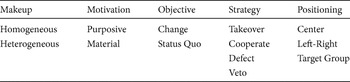
Because parties are not simply aggregations of voter preferences or demographic groups, they are occasionally driven by “parties within parties,” or factions. These factions are players on the party team; although, when they emerge, they are not part of the starting lineup. Their aim is to become the starting lineup, or at least call the plays. In the most critical cases, they seek to spark a clubhouse revolt, fire the coach, and take over the franchise. When a sufficient number of party elites form a faction, their goal is to change or prevent the change of the values, norms, ideas, expectations, and rules of the political game. The properties of such factions (discussed below) are summarized in Table 1.
Faction Properties

American party factions vary in type and character on each of the four elements that define them. Some factions are motivated more by their purposes. For these factions, the ideological aspect is front and center. Other factions may lack such ideological consistency but are better organized. For them, “material” resources secured by factional organization are the sustaining element. While there can be significant variation in the mode of factional organization, factions generally blur the lines between pressure groups, policy entrepreneurs, and social movements. Focus on the formal party institutions or smaller units of analysis overlooks how factions form coherent partisan networks that draw on resources from a variety of auxiliary associations. Looking within the parties shows that American parties are comprised of issue networks linking politicians and “outside” groups. Factional analysis reveals the cross-pollination of formal partisan organizations and informal networks, as adherents frequently serve in both interest groups and official party capacities. Consequently, factions are not ephemera that exist for an election cycle but endure for roughly twenty-year periods.Footnote 12
There is always a core cadre of faction members, but as one moves outward from that core, affiliates’ level of commitment to the faction on the full array of issues varies. Some factions are, however, more homogeneous than others. Again, considering the period here, it is evident that the southern conservatives were more homogeneous than the set of interlocking cross-class and biracial organizations that comprised the Liberal-Labor faction. More heterogeneous factions are prone to fragmentation as they expand and new issues arise. This became apparent for the Liberal-Labor faction when it was confronted with the Vietnam War, the shattering of the anticommunist consensus, and the rise of “quality of life” or “postmaterial” issues on the domestic front. Furthermore, such a heterogeneous faction suffered from centrifugal forces after major items on its agenda were passed into law—such as the 1964 Civil Rights Act and the Voting Rights Act and the Social Security Act Amendments (Medicare Act) in 1965.
Factions can also be defined and identified by what they do. Some seek preservation and others change. Change factions are typically driven by ideals, while status quo–oriented factions seek to preserve material benefits. To exercise their influence, change factions have three strategic options: attempt to take over the party, cooperate with it, or vote with the opposition. Unlike factions in parliamentary regimes, the American variety do not form new legislative parties. Nor do factions switch parties given the incentives created by American government. They do, however, occasionally form alliances across party lines, such as, the Conservative Coalition. In the presidential arena, factional tensions have also produced splinter parties that endure for an election cycle or two. In the case under consideration here, the Liberal-Labor faction sought to take over the Democratic Party, even if that forced the southern faction into a third party or into an alliance with the GOP.
More specifically, factions often drive the parties toward or away from the political center. Rather than consistently seeking the center, as the Downsian model predicts, American parties have a more complex political calculus as a result of factional activity.Footnote 13 According to Anthony Downs, the two-party system provides huge incentives for the parties to try to capture “median voters” not strongly attached to the parties and whose electoral choices often determine outcomes. Yet, as political scientists have shown, the electorate is far from highly informed about politics and public policy, which relaxes the center-seeking incentives.Footnote 14 As Larry M. Bartels concludes a recent study: “Whatever elections may be doing, they are not forcing elected officials to cater to the policy preferences of the ‘median voter.’”Footnote 15 Therefore, political elites have a good deal of room to maneuver in order to shape their party’s brand and convert their views into public policy. In order to position themselves to enact their policy preferences once in office, political elites will try to move their party as far from the center as possible without losing a critical mass of swing voters necessary to win an election.Footnote 16 Positioning vis-à-vis other party elites is also important for governance. Consequently, as Bartels argues, American politics over the past century “is [largely] a story of powerful public officials pursuing their own ideological impulses, ignorant or heedless of the public sentiment.”Footnote 17 The preferred vehicles for these powerful public officials and their allies to pursue their ideological impulses have often been factions.
To be more precise, in pursuing their agendas, factions do not simply seek to move the party to the left or the right, toward or away from the median voter. Sometimes such movement is driven by the hope of winning a “target” constituency. Such constituencies are groups whose political loyalties are up for grabs. Factions make concerted efforts to appeal to such constituencies and work doggedly to pass policies that faction members believe will resonate with them. Securing the support of such constituencies can also help the party compensate for potential losses among swing voters in the center. In the case at hand, black voters in key Electoral College swing states were clearly such a target constituency for the Liberal-Labor faction. While most blacks began voting for Democrats in the 1930s, others remained loyal to the party of Lincoln. A GOP study of the black vote in 1956 election noted: “In a close nationwide election, the vote of Negroes may well be crucial in determining which party wins the presidency.”Footnote 18 Early in his Senate career, faction leader Hubert Humphrey warned his southern colleagues that to maintain Democratic congressional majorities, it would be necessary to bring blacks into the party because they were moving from the South to northern cities. “If we are to have a majority here in Congress,” he said, “we must have representation from cities like Philadelphia—over 400,000 Negroes now—Detroit, Cleveland, New York, and California.”Footnote 19 Liberal-Labor Democrats took Harlem representative Adam Clayton Powell’s (D-N.Y.) endorsement of Eisenhower in 1956 as a sign that Republicans could still lure African Americans. Consequently, even amid the celebrations of the 1958 Democratic congressional election victories, national party chairman (and factional affiliate) Paul Butler saw fit to warn the party that it could not win the presidency in 1960 unless it took a “forthright and positive stand” on the issue of civil rights.Footnote 20
THE ORGANIZATION OF THE LIBERAL-LABOR FACTION
Consistent with the above definition of factions, the Liberal-Labor faction within the Democratic Party connected pressure groups and the party. In the early 1950s, leaders of the labor movement became a predominant element within the Democratic Party, especially the American Federation of Labor (AFL), the Congress of Industrial Organizations (CIO), the United Auto Workers (UAW), union lobbyists, and the Committee on Political Education’s (COPE) political operatives. According to J. David Greenstone: “The American labor movement’s activities during much of the 1950s and 1960s [constituted] a faction within the Democratic Party.”Footnote 21 While Greenstone saw labor as constituting a faction by itself, a fuller reading of the historical record indicates that to form a truly effective national intraparty faction, the labor movement combined with the leadership of the so-called liberal lobby—a phalanx of political associations. The most prominent organizations in this formation were the National Association for the Advancement of Colored People (NAACP), the American Jewish Congress (AJC), the American Civil Liberties Union (ACLU), the Leadership Conference on Civil Rights (LCCR), the National Committee for an Effective Congress (NCEC), and the Americans for Democratic Action (ADA).Footnote 22 Labor and the liberal associations wove together a web with members of Congress (and their staffs). In Congress, for instance, affiliated legislators included Hubert Humphrey (Minn.), Eugene McCarthy (Minn.), Paul Douglas (Ill.), Frank Thompson (N.J.), and Richard Bolling (Mo.). Under the chairmanship of Paul Butler, a group of party operatives created the Democratic Advisory Council within Democratic National Committee (DNC) and affiliated themselves with the faction. In sum, the faction’s core was the leadership of the AFL-CIO, various progressive associations, some DNC officers, and affiliated legislators in the House and Senate.
The New Deal, World War II, and the Cold War created the conditions for the faction’s emergence. New Deal legislation (the Wagner Act of 1935) encouraged dramatic industrial union growth, enhanced unions’ ability to participate in politics, and solidified working people’s identification with the Democratic Party.Footnote 23 Membership in unions affiliated with the American Federation of Labor (AFL) increased from 4.6 million in 1941 to 7 million in 1945, and total union membership increased from 10.5 to 14.7 million. Labor’s base was the center of America’s manufacturing and industrial might in the Northeast and the Midwest. As David Plotke has observed, labor’s geographic concentration shaped the character of its power in national politics, since “two-thirds of union membership [were] concentrated in ten states.”Footnote 24 In 1956, Congressional Quarterly estimated that there were 110 districts outside the South where 55 percent or more of employed persons were blue-collar workers. Of these districts, 69 were in the New England and Mid-Atlantic states (including West Virginia), while there were 33 in the Midwest and Plains states (including Kentucky and Oklahoma) and 8 in the Pacific and Mountain states.Footnote 25 Some of these districts, especially those that had strong and politically engaged unions, reliably produced “labor congressman” for the Democratic Caucus.Footnote 26 Such concentration channeled influence on the national stage in ways that were sharp and deep rather than broad and shallow. Rapid union expansion spawned a new management drawn directly from the membership, who installed themselves in the high counsels of the Democratic Party.Footnote 27
Threats to its interests forced labor into a deeper engagement in party politics. While labor had actively supported Democrats in the 1930s, it was not until the expansion of union membership as a result of the Wagner Act and World War II that labor began to engage fully in electoral politics. This was driven by the southern Democratic faction’s efforts to block the advancement of civil rights and the growth of organized labor.Footnote 28 The 1940s established a pattern in national policymaking: legislation to improve the lives of African Americans or enhancing the power of the labor movement was blocked by the Conservative Coalition of southern Democrats and Republicans. The threat posed by the Conservative Coalition to labor’s interests spurred its involvement in partisan politics. President Franklin Roosevelt’s compromises with and failed efforts to defeat southern conservatives indicated that the party still required transformation.Footnote 29 Advancement of progressive social policy thus demanded the mobilization of a new faction to confront southern conservatives.
At the same time, the emerging Cold War forced labor leaders to take significant steps to sever ties with communists and radicals on their left flank. In the wake of the Henry Wallace debacle of 1948 and the rise of McCarthyism, labor and liberals needed to provide public assurances that they were part of the American mainstream. To ensure their national legitimacy, George Meany, Walter Reuther, and other labor leaders became antagonists of “Reds” everywhere. Meany in particular took a hard line against the Soviet Union, referring to communists as “gangsters.”Footnote 30 On the liberal lobby side of the faction, Joseph Rauh described one of the motivations for the formation of the ADA as being “to separate the Commies from the liberals.”Footnote 31 The anti-Communist consensus of the early Cold War drastically reduced tensions within the faction over foreign policy and allowed it to focus its efforts on the domestic front. With the collapse of that consensus over the Vietnam War, however, the faction had trouble maintaining its unity as American priorities abroad became the subject of contentious disputes.
The great events of midcentury also brought civil rights organizations into party politics. The 1936 election brought African Americans into the Democratic Party for the first time. And the Cold War meant that the northern intelligentsia could no longer turn a blind eye to the racial caste system in the South.Footnote 32 As the New Republic put it, segregation made “mockery of the theory that we are fighting for democracy.”Footnote 33 In sum, war put civil rights on the national agenda. It also gave birth to an array of new organizations, injected new energy into some older ones, and set them to work on behalf of African Americans. Consequently, many associations in the liberal lobby saw massive growth in their organizations throughout the 1940s. By the end of that decade, the NAACP, for example, had more than five hundred thousand members.Footnote 34
Policymaking patterns in the 1940s drove these diverse organizational elites to combine with members of Congress into a partisan faction. Together they formed an interlocking directorate as many of the same people often served in multiple organizations. For example, Joseph Rauh worked as a lobbyist for the ADA, an attorney for the UAW and personal friend of UAW President Walter Reuther, a speechwriter for Hubert Humphrey during the 1960 presidential primaries, and an advocate for the Mississippi Freedom Democratic Party in 1964. Not only did labor contribute money to the NAACP and the ADA, but many labor leaders served on the boards of these organizations and were counted among their membership. For instance, when the ADA formed, labor unions made up one of its three principal sources of funding.Footnote 35 The Leadership Conference on Civil Rights (LCCR) was an umbrella organization that brought together roughly sixteen civil rights, labor, and religious groups to help plan strategy and was headed by Roy Wilkins of the NAACP. Because the men attached to these organizations traveled the same social circuit, many of them became close friends.
In his autobiography, Wilkins recounts how in the wake of the murder of Medgar Evers and President Kennedy’s public announcement of his civil rights bill, the faction was badly divided on tactics. After a meeting with the president, faction leaders repaired to Walter Reuther’s hotel suite to discuss tactics and strategy. While Martin Luther King Jr. was planning to bring protest from Montgomery to Washington, faction leaders hashed out how best to lobby Congress to win over a sufficient number of the roughly thirty swing votes in the Senate. It was in meetings such as this one that issues of strategy and tactics within the faction were handled.Footnote 36
The combination of liberal interest groups and the labor movement was a marriage of conviction and interest. In principle, there was an agreement that segregation was immoral and unjust. For instance, in a 1952 speech, George Meany denounced “discrimination and segregation in the nation’s capital [as] a national disgrace.”Footnote 37 In practice, their alliance put the spotlight on their common enemy: southern Democrats. African American associations saw ties to organized labor as a means to increase their funding and organizational capacity. Some labor leaders saw increased African American access to the job market as a means to expand its membership. Both sides recognized that only together could they undermine the power of conservative southern legislators. Therefore, the AFL called on Congress to set up a billion-dollar fund to carry out the Supreme Court’s historic 1954 Brown v. Board of Education desegregation decision.Footnote 38
Nonetheless, the attitude of many local labor unions toward African Americans remained decidedly hostile.Footnote 39 Strikes, riots, and violence broke out at many job sites when companies tried to hire blacks. Many unions had poor track records at integrating and promoting African Americans.Footnote 40 As Michael K. Brown has argued, labor’s leadership became an arm of the Democratic Party, while local unions concentrated on preserving benefits at the bargaining table.Footnote 41
The factional alignment that formed was therefore concentrated largely among the elites of these organizations, who had access to affiliated members of Congress. In government, the Liberal-Labor faction forged a triangular network comprised of the Democratic Study Group (DSG) in the House, a liberal bloc in the Senate, and the Democratic Advisory Council (DAC). To obtain the benefits of having their policies on the congressional agenda, this factional network became a phalanx of mutual reinforcement that often bypassed the Democratic Party’s congressional leadership.
The faction adopted the tactic of taking its case directly to the press and the public. Adept at mobilizing public relations campaigns, the ADA, AJC, NAACP, and ACLU interacted with reporters, staffers, interest groups, think tanks, and experts to provide affiliated legislators data and background on key issues. ADA operative Joseph Rauh used leaks to the press as means of communicating and pressuring legislators. “I’m a big leaker,” he recollected, “I engaged in a lot of leaks because I believe that the only way you ever get anything done in the Government is to get the problem out in the open.”Footnote 42 These efforts at public persuasion were a novel strategy given Congress’s insular modus operandi at that time. The liberal associations also provided members of Congress with researchers, campaign operatives, and access to their national membership bases.Footnote 43 Therefore, the liberal lobby gained the support of members of Congress in publicizing their cause, while those same members gained access to new donors, policy analysis, and foot soldiers in campaigns.
Beginning in the early 1950s (and expanded after the AFL and the CIO merged in 1955), labor developed an extensive lobbying effort in Washington. The AFL-CIO also enhanced their political operations by creating the Committee on Political Education (COPE). COPE developed and expanded labor’s public policy agenda and kept affiliated legislators abreast of it. Labor unions could offer liberal legislators a host of resources, including a cadre of experienced lobbyists, grassroots activists, and campaign advisers, as well as campaign funds, policy analysis, and an agenda for government action. Alan Draper estimates that by the mid-1950s, labor could count on roughly 140 votes, or about one-third of the votes in the House.Footnote 44 On the basis on legislative performance, COPE and the liberal associations developed rating systems, legislators’ scores on which were then used in endorsement decisions. These also proved to be valuable tools in media relations. Greenstone concluded: “Union activities paralleled the efforts of such party organs as the office of the Democratic whips in the House of Representatives … labor could act as a broker among some of the Democrats.”Footnote 45
For liberal legislators intent on expanding their ranks on Capitol Hill, the capacity of the unions for electoral mobilization was indispensable. In order to elect “liberals” in 1956, for example, “COPE distributed 30 million pieces of literature, including 10.2 million copies of its voting record on members of Congress.”Footnote 46 Such efforts were especially important because from the 80th to the 85th Congress, Democrats clung to slim majorities in the Senate.Footnote 47 Competition for control of the House was also relatively intense in the 1950s. In particular, liberals and labor had their eyes on congressional districts on the periphery of their northern industrial base—and some inside it that remained in Republican hands—where levels of union membership were modest. The biggest battleground districts between 1948 and 1964, where the parties alternated in making net gains, were located in a handful of states, including New York, Pennsylvania, West Virginia, Kentucky, Ohio, Indiana, Illinois, and Missouri.Footnote 48 Five of these states (New York, Ohio, Illinois, and Missouri) were among the top ten states in the number of union members.Footnote 49 For instance, Louis E. Graham was the Republican representative of Pennsylvania’s 25th district, a heavily blue-collar district, from 1945 to 1955 and voted with the GOP on labor issues (including Taft-Hartley). In 1954, Democrat Frank M. Clark defeated him and the district remained reliably Democratic.
The electoral activities of unions in the 1950s led the Congressional Quarterly to report that “labor organizations and labor leaders who have been content to operate behind the scenes in the Democratic Party are trying to take over the party in certain areas, and either name candidates or become candidates themselves.”Footnote 50 Labor profited from the alliance with congressmen, as liberal politicians offered to push legislation that was dear to unions—especially the rewriting of certain sections of the Taft-Hartley Act. In addition, liberal legislators could help promote the union cause in the media and attempt to give it more room to maneuver as it tried to expand into the South.
Lines of communication to hammer out strategy and provide political intelligence also developed among liberal legislators and the unions. For instance, Humphrey held lengthy strategy sessions during his first year in the Senate with CIO president Phil Murray and AFL president Bill Green. Humphrey later gave a long speech on the Senate floor denouncing and dissecting the Taft-Hartley Act, which labor unions then printed as a pamphlet and distributed to the rank-and-file.Footnote 51 The other lines of communication were through ALF-CIO lobbyist Andrew Biemiller and Joseph Rauh at the ADA.Footnote 52 Both provided regular reports and policy analysis to liberal legislators. Indeed, as a former member of Congress, Biemiller had an “enviable reputation” on Capitol Hill.Footnote 53 Having trained at the knee of Sam Rayburn, he possessed an intimate knowledge of the inner workings of the legislative process. In addition, many of the staff of liberal legislators in the House and Senate had worked for the unions or had other significant ties to them. In the Senate, the concentration of liberals on just a few committees also facilitated communication among liberals, their staff, and the union leadership. With a Democratic president in the Oval Office, labor leaders could act as liaisons between Capitol Hill and the White House.Footnote 54 Finally, regular conferences hosted by the liberal lobby and unions provided a forum for faction affiliates to meet and hammer out strategy.Footnote 55
In the House, as early as the Eighty-third Congress (1953–54), Democratic liberals began to make common cause.Footnote 56 An eighty-member network of Liberal-Labor legislators calling themselves “McCarthy’s Mavericks” formed in 1955 to press for civil rights, welfare-state expansion, and congressional reform. Hailing the 1958 election as a mandate for a bold liberal agenda, they sent a letter to House Democrats spelling out a course of action.Footnote 57 Partly in response to the conservative bias of a seniority system that allocated committee chairmanships to southern Democrats, McCarthy’s Mavericks formally organized themselves into the Democratic Study Group (DSG) in 1959.Footnote 58 The DSG became the first formally organized “party-within-a-party” in the House. It tried to bring greater coherence to the liberal Democratic bloc by providing information about legislation reported from committees to the floor. The DSG invested substantial resources in coordinating and educating members on parliamentary procedure to prevent them from being out-maneuvered by the notoriously crafty southern Democrats.Footnote 59 In the 1960s, the DSG expanded its functions to help members with campaigns and became an important coordinator of liberal lobbying groups.
In the Senate, the Liberal-Labor faction comprised roughly twenty senators that constituted the so-called liberal bloc. Liberal-Labor senators used the co-sponsorship of bills as a unifying mechanism and signaling technique.Footnote 60 In addition, liberal senators concentrated themselves in just a few committees. During the 1959–72 congresses, 64 percent of the Senate liberals were concentrated on three committees: Labor and Public Welfare, Judiciary, and Banking.Footnote 61 From this power base, liberals developed a network that established channels of communication among liberal senators, their staffs, and other elements of the Liberal-Labor faction. Chief AFL-CIO lobbyist Biemiller provided them with research data, procedural advice, and a range of administrative services. Michael Foley concludes that the Senate liberals’ activity transformed the folkways of the institution.Footnote 62
To enhance party policymaking power, DNC chairman Paul Butler created a new organ within the party’s structure: the Democratic Advisory Counsel (DAC). Liberals hoped that this body would pronounce authoritative party policy positions and help shift the public debate and legislative priorities in Congress in their direction. By publicly endorsing certain measures promoted by the DSG or the liberal bloc in the Senate, the DAC endowed them with the imprimatur of the national party. For precisely this reason, however, southern Democrats viewed the creation of the DAC as an attack on them. Southern committee chairs complained that Butler had openly divided the party. House Speaker Rayburn publicly denounced the DAC and Senate Majority Leader Lyndon Johnson privately opposed its creation. The DAC symbolized the factional split between Liberal-Laborites and the national chairman on one side and the congressional leadership and committee chairmen on the other.
The overlapping alliances among members of Congress, liberal lobby groups, and union leaders, as James Sundquist has written, “formed a single institution [that was] self-conscious and cohesive. Its members were bound together by a common interest in legislative strategy, tactics, manipulation, and brokerage, a common responsibility in these matters, a common activist temperament, and a common political partisanship.”Footnote 63 Nonetheless, the faction was able to maintain greater unity on some issues than others. Civil rights for African Americans, social inequality, aid to education, and the minimum wage were issues on which liberal and labor faction affiliates could regularly find common ground. However, greater dissension existed on the specifics of labor policy (on which liberals had less interest), a Medicare program, urban poverty, and eventually the Vietnam War.
LIBERAL-LABOR’S IDEOLOGICAL COMMITMENTS
After Truman’s narrow victory in 1948, the Fair Deal’s demise, and the Republican sweep of the 1952 elections, it was clear that the grand designs of the New Deal had been short-circuited. The liberal public philosophy needed to be recast. The Liberal-Labor faction sought to offer its party a new version of the liberal creed. The result was a program that, by 1960, came to define the national Democratic Party.
The faction’s priorities included congressional reform, civil rights for African Americans, a more generous welfare state, and an anti-Communist foreign policy. In the 1950s, consensus on these issues was easier to maintain in the face of a Republican president and a Congress dominated by an alliance of conservative southerners and Republicans. Moreover, these issues were deeply intertwined. Civil rights leaders’ first priority was to win voting rights for African Americans. The labor leadership wanted to expand into the South, organize black workers, and use their expanded numbers to leverage welfare-state expansion. Liberal politicians wanted to secure the black vote in key swing states, bring the South more into line with the national Democratic Party, and exercise greater power on Capitol Hill. Consequently, as Julian Zelizer has shown, congressional reform was the path to securing the faction’s other goals.Footnote 64
Underpinning the faction’s agenda was a broader set of convictions. Liberal-Laborites advocated an expansive role for the central state in solving the nation’s economic and social problems.Footnote 65 They were confident that technocratic management could manage an industrial economy. As John Gerring has shown, this was evident in the Democratic Party’s platform positions on economic issues between 1952 and 1964.Footnote 66 Yet Liberal-Labor gave the economic interventionist position new content and meaning. They sought to broaden the party’s agenda to include a host of social groups and political issues that did not fit into the populist socioeconomic categories of the opulent rich versus working stiffs. It was not the middle classes that needed attention but the desperately poor. No longer was poverty seen as the result of economic causes but rather as a complex social pathology that required an array of subtle policies. But in the right hands, government was up to the task. Victims of exclusion could be incorporated through the application of sensitive policies.
Liberal-Labor advanced a theory of governance that called for greater control of the federal government over the states; more national, internally coherent, and ideological political parties; and, at least under Eisenhower, a stronger policymaking role for Congress vis-à-vis the president.Footnote 67 Only a centralized, truly national state could manage a modern economy, enlist the states as administrative units, and equitably distribute goods and services. Liberal-Labor rejected the southern Democrats’ vision of a welfare state that relied on means-tested programs run by the states, private charity, and stopgap federal programs.
To achieve Liberal-Labor’s aims, Congress required reform. Liberal-Labor believed congressional reform was a means to correct what they deemed the endemic weaknesses of Congress—its incapacity to act quickly, its inability to plan, and its propensity to delegate power to the executive.Footnote 68 The primary obstacle was the decentralized committee system, dominated by conservative southern Democrats.Footnote 69 To displace the baron’s power, Liberal-Labor envisioned a powerful congressional caucus dominated by the majority. Not surprisingly, the faction found the idea of British-style parliamentary parties congenial.Footnote 70 Disciplined parties would speed lawmaking, enhance Congress’s ability to plan, and give the legislature more power when dealing with the president.
Liberal-Laborites also sought to bring a host of new policy ideas to the public agenda. Internationally, they adopted a strong anti-Communist position and favored a firm response to the Soviet Union in the Cold War. Domestically, Liberal-Laborites sought to “complete” the New Deal, pressing for greater rights for African Americans and unions, national health care, urban renewal, and macroeconomic intervention. Some of the measures advanced by the Liberal-Labor faction built on ideas dating to the 1930s, but others were completely new. Liberal members of Congress developed some of the policies; others emerged from the lobby groups; but most derived from interaction between the two. For instance, the federal aid to education bill was developed in Congress, the Medicare proposal was written and pushed by the AFL-CIO, and discussions between the liberal groups and a senator produced the Manpower Development and Training Act.Footnote 71
By the 1960 election, the Liberal-Labor faction had established the legislative program of the national Democratic Party. As Sundquist put it: “The Democratic program that was presented to the country in 1960 was truly a party program. … The substance of the program had been written with unusual precision and clarity during the [previous] eight years—eight years that at the time seemed endlessly frustrating but that were, in retrospect, extraordinarily fruitful.”Footnote 72 By laying the intellectual and rhetorical foundations, the faction’s networking and lobbying operation had remade the Democrats’ policy platform. The shift in priorities and its meaning for the party’s public image was not lost on Liberal-Labor’s rivals, the southern Democrats, who protested loudly and repeatedly about the direction of the party.
In the longer term, however, the faction’s consensus on ideological and policy priorities could not hold. A number of factors weakened its unity. First, the arrival of Democratic presidents and large Democratic majorities in Congress in the 1960s meant that the unity provided by being in the opposition began to fray as the faction gained power and prominence. Indeed, the large number of ADA members and former members in the Kennedy administration meant that faction affiliates had to take some responsibility for governing the country. Second, the passage of the 1964 Civil Rights Act, the Elementary and Secondary School Act, and the creation of Medicare and Medicaid took some of the faction’s central priorities off the agenda. The consequence was that there was simply less consensus on smaller issues further down the faction’s agenda. Third, the escalation of American involvement in the Vietnam War shattered the Cold War foreign policy consensus within the faction. The result was that by the end of the 1960s the faction’s ideological commitments began to unravel.
MAJOR ACTIONS UNDERTAKEN BY LIBERAL-LABOR
The Liberal-Labor faction was largely responsible for the party’s ideological flavor and programmatic commitments at midcentury. By injecting itself into congressional politics and the Democratic Party’s presidential selection process, the faction prepared the groundwork for major federal legislation. It placed major legislative proposals on the national agenda and made them a part of the Democratic Party’s program. The assumption of the public’s overwhelming sympathy for activist government inspired the Liberal-Labor faction to act with purpose.
The faction argued that the only thing standing between the voting public and a more egalitarian state was the Conservative Coalition. Targeting its rival faction, the southern Democrats, Liberal-Laborites blamed the failure of progressive legislation during the 1940s and 1950s not on lack of public support for liberalism but on defective legislative procedures. The faction set out to repair national political institutions, in particular the House Rules Committee. And it transformed the public image of the national Democratic Party from a muddled picture born in crisis and tainted by segregation to one centered on a national commitment to reform.
Liberal-Labor undertook a major effort to change congressional rules as part of a larger strategy of breaking into the South. Both organized labor and civil rights groups wanted to capture new constituencies, which they hoped would give them the power to take over the Democratic Party. DNC chairman Paul Butler argued in 1958 in a television appearance that those in the party who “don’t want to go along on the racial problem … are going to have to take political asylum wherever they can find it, either in the Republican Party or a third party. … I certainly hope they would take leave of the Democratic Party.”Footnote 73 A few years later, Biemiller noted, “The 1964 Civil Rights Act and the 1965 Voting Rights bill will greatly increase the voting strength of Negroes in previously uncontested, conservative districts of the South, bringing some new forces into play in this long dormant area.” Even if such a move pushed some southern Democrats into the arms of the GOP, it would make the Democratic Party more consistent ideologically. Biemiller even claimed that a strong Republican Party in the South might have the beneficial effect of turning “Southern Democrats into a more liberal group.”Footnote 74
Liberal-Laborites argued that the image projected by southern committee chairs on civil rights legislation aided Republicans at the polls and was a drag on the party in presidential elections. Furthermore, in the 1950s, Liberal-Labor strategists worried that inaction might cause Democrats to lose an important slice of the African American vote in swing states such as New York, Michigan, California, Pennsylvania, Ohio, and Illinois.Footnote 75 As Hubert Humphrey put it, “The Republicans are going to proceed on the Civil Right Front. … I don’t intend to let them walk off with those honors. … Either we are going to act in this area of civil rights as Democrats, or we are going to suffer the consequences on the political front for years to come.”Footnote 76 Faction members believed that only by presenting a clear liberal image through measures passed by a reformed Congress could the Democratic Party retain a majority in the long term by winning seats in liberal Republican states and districts.
The election of John F. Kennedy in 1960, the reform of congressional rules, and the passage of labor and civil rights legislation were all part of a strategic plan to bring new constituencies (southern workers and blacks) into the Democratic Party. At the same time, such a strategy would enable the party to hold onto existing constituencies (northern blacks and liberal whites). However, it would also constitute a significant move away from the political center of the era. Nonetheless, the faction brought significant resources to bear in congressional and presidential politics to affect such a change. The ultimate consequence was to give liberal legislators much greater room to maneuver, which helped enact the Great Society.
Congressional Reform Efforts
To change the Democratic Party’s agenda, Liberal-Laborites sought to change the Congress’s internal distribution of power, even going so far as to try to reform the rules of the institution. On procedural issues, they sought to strengthen the congressional party caucuses at the expense of southern committee chairs and reduce the influence of rural legislators. More specifically, they took aim at the Rules Committee. In Liberal-Labor’s eyes, policy change, institutional reform, and a remaking of the Democratic Party went hand in hand.
In the 1950s, southern Democrats controlled the most important leadership positions and committee chairmanships in the House. According to Liberal-Laborites, only congressional reform would speed racial equality, spur welfare-state growth, and set the Democratic Party on a solid foundation for the future. Liberal-Labor sought to replace the committee-centered system with stronger, more ideologically coherent parties. Reducing the power of committee chairs in favor of party leaders, the faction held, would create the proper balance between executive and legislative branches and give Congress greater opportunities for policy leadership. In the House, Liberal-Labor also pushed for the federal redrawing of congressional districts to undermine the electoral base of many southern conservatives. Redistricting would empower urban and suburban voters and make the party more homogeneous. Democrats such as Humphrey, McCarthy, Douglas, and Bolling worked with Biemiller of the AFL-CIO and Rauh at the ADA to pressure the congressional leadership to enact such reforms.
In the 1950s House, Liberal-Laborites were unable to accomplish much in their several attempts to change the institution’s rules. Without directly challenging the seniority rule, it was hard to find ways to unseat powerful and entrenched committee chairmen. The biggest thorn in the side of Liberal-Labor was “Judge” Howard Smith (D-Va.), chairman of the House Rules Committee. The committee consisted of twelve members, at least half of which were members of the Conservative Coalition.
There has been much recent debate among congressional scholars over the status of the Rules Committee and its relation to the Democratic Party during this period. Gary Cox and Matthew McCubbins have argued that Smith and the Rules Committee ultimately served the interests of the party by keeping measures that would divide it from reaching the House floor.Footnote 77 Others have argued that the committee served the interests of the southern Democrat-Republican Conservative Coalition—especially when policies touched on labor policy and the fate of African Americans.Footnote 78
The analysis of the Rules Committee’s status makes more sense when seen through the lens of faction. From the point of view of Liberal-Labor, the party unity maintained by Smith and the Rules Committee hurt the party and served southern conservative interests. After Liberal-Labor mobilized a reform coalition in 1961, the House voted 217 to 212 to enlarge the Rules Committee from twelve to fifteen members.Footnote 79 Expanding the number of members on the committee would in theory weaken the power of Chairman Smith, who had publicly said that he would block elements of the New Frontier.Footnote 80 The faction mobilized a massive media campaign against Smith and the Rules Committee. The change of congressional rules showed that power could be shifted in a more centralized direction that would favor Liberal-Labor’s agenda. By 1961, Liberal-Labor’s activity had produced a usable agenda, a set of organizational structures and lines of communication in the House and Senate, and they had effected an important change of House rules.
Activity in Presidential Nominations
The Liberal-Labor faction was the only centralizing mechanism in the Democratic Party’s presidential campaigns. Organized labor distributed money, leaflets, telephone banks, and provided polling services, campaign researchers, strategists, and canvassers.Footnote 81 Its electoral efforts included voter registration drives and get-out-the-vote campaigns. COPE pulled so many voters into the Democratic Party that “labor functioned [in the 1950s and1960s] as the most important nation-wide electoral organization for the Democratic Party.”Footnote 82 In some areas of the country, labor entirely stood in for the organizational apparatus of the Democratic Party.Footnote 83 Labor’s efforts on behalf of state and local officials also made it a formidable power in the delegate selection process for the Democratic National Convention.
The AFL-CIO leadership often attended and was usually in close contact with strategically placed operatives at the Democratic conventions from 1956 to 1972. Indeed, AFL-CIO president George Meany believed that the AFL-CIO’s Executive Council, which he dominated, exercised a veto of sorts over the Democratic Party’s presidential and vice presidential nominees. According to Theodore H. White, when President Lyndon Johnson asked Meany for a list of his top vice-presidential choices in 1964, Meany responded that he had only one: Hubert Humphrey. Humphrey received the nomination.Footnote 84 At a minimum, the party professionals that controlled the party conventions were conscious of the need to select a candidate approved by the AFL-CIO.
Until 1972, although there were hundreds of delegates at each convention, a small number of state party leaders controlled most of the votes. These chieftains would meet in the “smoke-filled rooms” around the convention site to negotiate the party’s next presidential candidate. According to Taylor Dark, this system of elite bargaining privileged labor, since labor organizations were very powerful within many state parties, which made it the central powerbroker.Footnote 85
The presidential nomination politics of the 1960s tested the faction’s power and unity. The 1960 campaign was the most active labor had ever been in presidential nomination politics, which was also the first truly competitive contest since 1952. The faction initially favored Humphrey, their longtime ally and champion. Many faction members did not, however, believe that Humphrey could beat Nixon. After Humphrey lost badly in the Wisconsin and West Virginia primaries, liberals and union leaders decided to throw their weight behind Kennedy instead of Lyndon Johnson. As Eleanor Roosevelt wrote in her diary after Humphrey’s primary defeats: “We now have three active candidates in the field. … Senator Stuart Symington and Senator Lyndon Johnson certainly will have the backing … of President Truman and other powerful figures in the regular organization, while Senator Kennedy will be considered the candidate of the liberals.”Footnote 86 Joseph Rauh recollected that the ADA had “a good deal of influence in 1960. After Hubert [Humphrey] got trounced by Kennedy in ‘60, in Wisconsin and then in West Virginia … Walter Reuther and I helped swing the ADA to Kennedy. … The ADA’s role there really was to block Johnson, and I think that’s what happened.”Footnote 87 Kennedy’s victories over Humphrey in the primaries sealed his control over party chieftains. Polling data also suggested that Kennedy had a better shot against Nixon than the other aspirants.Footnote 88 Consequently, Meany, Reuther, and other labor leaders took up Kennedy’s cause behind the scenes.Footnote 89 Biemiller later said: “We thought that Jack Kennedy was a superior guy.”Footnote 90 They assisted him in several primaries and in rounding up support within state delegations. Labor’s activity was instrumental in defeating the Democratic Party’s southern congressional leadership’s opposition to Kennedy.Footnote 91
Nonetheless, Kennedy’s victory in the 1960 nomination contest was at best bittersweet for the Liberal-Labor faction. Indeed, as the general election campaign began, Nixon appeared stronger on the civil rights issue than Kennedy. Nixon won plaudits from black leaders, including Martin Luther King Jr., for joining the NAACP and voting against the poll tax in the House as well as speaking against segregation and calling for a stronger civil rights bill in 1957. Kennedy, by contrast, had courted southern segregationists in his 1956 presidential bid, helped Johnson weaken the 1957 civil rights bill in the Senate, and criticized the Eisenhower administration’s handling of school desegregation in Arkansas. Finally, Kennedy had chosen Johnson—a southerner with a weak record on civil rights, which horrified liberals—to be his vice president. Johnson’s selection led an ADA vice president to accuse Kennedy of “double-crossing the liberals of this country” on the floor of the national party convention. Over the course of the campaign, however, Nixon sought to win white southerners and Kennedy sought to shore up his support among civil rights leaders.
In 1964, President Lyndon Johnson did not face any serious competition for the Democratic Party nomination. His performance in office had satisfied key party leaders and eliminated prospective challengers. Johnson had even gone out of his way to open the White House to labor and liberal leaders. Nonetheless, Johnson wanted the party unified behind him for the fight against Republicans in the fall. To secure this unity, he looked to his newfound allies in the Liberal-Labor faction. This was most evident in Johnson’s employment of Humphrey and Reuther to tackle the difficulties posed by the competing Mississippi delegations to the Democratic National Convention. The “regular” Mississippi delegation was an all-white segregationist group, while the Mississippi Freedom Democratic Party (MFDP) delegation was biracial. The latter sought equal recognition with the former at the convention, which put Johnson in a difficult situation. He did not want to further alienate the white South, nor did he want to offend liberals. Humphrey and Reuther, both in good standing with the civil rights organizations, were dispatched to forge a solution. However, the compromise they worked out, which would have allowed partial seating of the MFDP, failed to win over the group, who publicly denounced the administration. Despite this setback, Johnson continued to cultivate labor leaders during the campaign, especially so that they would restrain strikes until after November. Despite Johnson’s crushing defeat of Arizona Senator Barry Goldwater in the fall and good relations with labor leaders, the MFDP episode revealed cracks in the Johnson administration’s relations with liberals.Footnote 92
As the presidential nomination contest of 1968 began, labor leaders remained strongly committed to Johnson’s renomination. Meany wrote a letter Johnson in December 1967 that stated his strong support for the president’s foreign and domestic policies.Footnote 93 Reuther was equally supportive of the Johnson administration as late as March 1968. Even as the liberal groups in the Liberal-Labor faction became increasingly disaffected from Johnson over the Vietnam War, labor’s support remained steadfast for the embattled president. Indeed, the faction in large measure crashed on the rocks of the Vietnam War and the end of the Cold War consensus.
After Johnson withdrew from the race, labor quickly switched to their longtime-ally Humphrey. At the 1968 Democratic Convention in Chicago, amid vociferous protest over Vietnam, the AFL-CIO played its powerbroker role to the hilt and party leaders yoked together a delegate majority for Humphrey. As David Broder observed at the time: “Never before has the national labor federation become so openly involved at so early a stage in the fight for the Democratic presidential nomination.”Footnote 94 The AFL-CIO could claim to influence a third of the delegates, given the power of state and local office holders who were indebted to labor for campaign support. Spread among forty-four delegations, the labor delegates provided useful intelligence to COPE director Al Barkan, who coordinated and directed the activities of these delegates and other union leaders to promote Humphrey’s candidacy. Despite strong opposition from the emerging New Politics faction that supported Eugene McCarthy, labor pulled off a coup for Humphrey.
The AFL-CIO viewed Humphrey’s nomination as a great victory. But to others in the party, labor’s actions seemed unfair, undemocratic, and illegitimate. The events of the 1968 campaign divided Liberal-Labor Democrats and emboldened a new faction to confront them. Labor’s refusal to endorse McCarthy “deeply alienated other factions within the Democratic Party, including the newly insurgent forces of youths, minorities, women, and the opponents of the Vietnam War.”Footnote 95 The emotions unleashed would come back to haunt unions, as they provided fuel for a drive to reform the nomination process that would ultimately undermine labor’s special role in Democratic presidential politics.
CONCLUSION
In the 1970s, Liberal-Labor divided and fell in battles over party presidential selection rules, appointments in the Carter administration, Democratic Party organizational matters, congressional reforms, and public policy priorities. It was displaced as a new faction, the New Politics Democrats, armed with new organizational resources, arose to challenge their objectives and motives. The experience of the Liberal-Labor faction suggests that factions are prone to dissolution to the extent that they achieve their political program and their opposition changes. Born to fight southern Democrats on their right, Liberal-Labor was unprepared to battle New Politics Democrats on their left. Factions are thus fragile creatures of a political period. As new elite factions arise and recast the political context, older factions are destabilized.
Attention to factions shows that America’s large and diffuse parties are not simply driven by exogenous factors, such as the electorate, the economy, or the behavior of the other party, but often by conflict among factions within the party itself. Nor are parties monolithic blocs that in Downsian fashion consistently move to the political center at election time. As the Liberal-Labor faction attests, factions are comprised of elites with strong ideological agendas that try to shift parties away from the center and capture new constituencies. Factions do this in order to give themselves the space to maneuver to enact their policy preferences. A factor worthy of consideration in explaining party change is thus the “shift in governing authority” within the party caused by factions.Footnote 96 Factions mobilize a variety of actors and organizations and channel their energy into reshaping the agenda and image of the party in which they reside.
This article has provided a theoretical definition of an American party faction and illustrated that definition through a single case. The analysis of the Liberal-Labor Democrats highlights how structures of political linkage created by factions shape the development of political conflict and public policy. Consonant with much scholarship in the field of American political development, this article has stressed how political elites are goal-oriented but how those goals are shaped, modified, and frustrated by the historical context in which they exist. A central lesson is that factions are a key variable that connects actors’ preferences to the “rules of the political game.” Factions enable partisan elites to realize more of their preferences than they otherwise would on their own. However, the fact that a faction had to be formed means that other contextual variables were at work to limit the preferred outcomes of faction members. In sum, by linking ideas and institutions, factions help explain distinct outcomes in American politics.
Consequently, using the rubric employed here, it should be possible to analyze other cases for how they shape party behavior and policy development. Two factions in the postwar period—southern and New Politics Democrats—have already been mentioned. On the Republican side of the isle, factional analysis has also yielded fruitful results in the study of the Liberal Republicans of the 1950s and the role of the New Right in the Republican Party from Goldwater to Gingrich. Further research to produce a complete typology of American party factions would in all likelihood yield interesting comparative findings as well as patterns of political change that factions unleash.
As recent political science scholarship has argued, the effects of elite ideology and political parties are powerful drivers of policy outcomes. The range of independent action by political elites is especially great where public preferences are divided, confused, or yet to be formed. But for elites to realize their ideological and partisan visions, America’s big-tent parties are cumbersome instruments. Therefore, it is often through the formation of factions that elites try to inscribe their preferences in public policy. Factional activity is thus important for understanding the development of American political parties and public policy outcomes.
As a source of energy within parties, factions provide networks of communication that attempt to rationalize party operations and governing. The Liberal-Labor case shows how party factions do not merely respond to existing public preferences but rather bring new ideas onto the public agenda, hone the ideas into workable policies, and take concerted action to promote their adoption. The faction’s core cadre imbued the Democratic Party with vigor during a period when southern Democrats were intent on defending the status quo. After the failures of the Fair Deal and the electoral losses of 1952, it was the Liberal-Labor faction that recalibrated the liberal program for a new era. Ultimately, the conflict generated by factions is over the power of consecration—the power to determine party orthodoxy.