Retinoblastoma is the most common primary intraocular tumor of childhood with the majority of cases occurring prior to five years of age. Survival rates in the United States now exceed 95% (Lu et al., Reference Lu, Francis and Dunkel2019), which has resulted in a growing number of long-term survivors at risk for treatment-related medical and psychosocial morbidity (Ford et al., Reference Ford, Chou and Sklar2015; Friedman et al., Reference Friedman, Chou and Oeffinger2016). Historically, to save lives, treatment required enucleation [surgical removal of eye(s)]. While much is known about the visual (Hall et al., Reference Hall, Ceisler and Abramson1999; Kelly et al., Reference Kelly, McKetton and Schneider2013), physical (Kaste et al., Reference Kaste, Chen and Fontanesi1997; Peylan-Ramu et al., Reference Peylan-Ramu, Bin-Nun and Skleir-Levy2001; Custer et al., Reference Custer, Kennedy and Woog2003; Aggarwal et al., Reference Aggarwal, Singh and Kumar2013), and cognitive (Ek et al., Reference Ek, Seregard and Jacobson2002; Willard et al., Reference Willard, Qaddoumi and Chen2014) ramifications of enucleation, data are lacking about survivors' perception of how this treatment impacts overall quality of life.
We asked retinoblastoma survivors to describe the ways in which enucleation had impacted their lives. Using a qualitative approach under the purview of Leventhal's Common-Sense Model (CSM; Leventhal et al., Reference Leventhal, Phillips and Burns2016), the current study summarizes survivors' responses and the most common themes elicited therein. The CSM is a dynamic model that emphasizes patients' self-regulative behaviors, such as monitoring blood levels, engaging in physical activity, and changing dietary habits (McAndrew et al., Reference McAndrew, Musumeci-Szabó and Mora2008; Leventhal et al., Reference Leventhal, Phillips and Burns2016). The CSM provides a conceptual framework that explains processes involved in patients becoming aware of their health threat (e.g., sight difficulties, pain in the eye, discharge from eye), navigating their own emotional responses to the threat (e.g., feeling depressed, annoyed, scared), formulating and creating action plans for addressing the threat (e.g., using a patch to prevent discharge, pain management strategies, etc.), and a self-regulative feedback loop that takes into consideration their own experience that influences how efficacious their action plans have been and the controllability vs. progression of the health threat (Leventhal et al., Reference Leventhal, Phillips and Burns2016). In the current qualitative study, using CSM as a theoretical framework, we describe how retinoblastoma survivors describe their cognitive and emotional representations and coping strategies.
Methods
Participants and procedure
The Retinoblastoma Survivor Study is a cross-sectional, survey-based study of medical outcomes, psychosocial health, and screening behaviors among adult survivors of retinoblastoma (age 18 years or older at the time of study) previously treated in the New York area. The study design has been previously described (Ford et al., Reference Ford, Chou and Sklar2015; Friedman et al., Reference Friedman, Chou and Oeffinger2016). Briefly, eligible participants (N = 987) were sent a survey packet and informed consent by mail, and then contacted by telephone two weeks after mailing to ascertain interest in participation. Interested participants provided consent and then completed the survey by mail or telephone interview; assessments were preferentially completed by telephone regardless of the participant's visual acuity. Enrollment occurred from March 2008 to February 2011. A total of 470 participants completed the survey and included 245 females (52%). Most participants were white (n = 427, 90.7%) and non-Hispanic (n = 434, 92.3%). Two hundred fifty-two participants (n = 252, 53.5%) had a history of bilateral disease; a total of 404 participants (85.9%) had one or both eyes removed and represent the subjects of this report (Table 1). The study was approved by the Memorial Sloan Kettering (MSK) and National Cancer Institute (NCI) Institutional Review Boards/Privacy Boards.
Demographic and treatment characteristics of 470 adult retinoblastoma survivors

Outcome measure
Survivors with a history of an enucleation (n = 404) were asked to describe how much the removal of an eye had affected their life on a five-point scale (A lot/Somewhat/A little/Not very much/Not at all); survivors were then asked to describe how and in what ways in free text, narrative form.
Data analysis
We utilized inductive approaches for analysis of qualitative data. For examining how much removal of an eye affected each survivor's life, we developed coding categories directly and inductively from the raw data (Hsieh and Shannon, Reference Hsieh and Shannon2005). This process included open coding and creating categories (Elo and Kyngas, Reference Elo and Kyngäs2015). Open coding refers to the analytical process of examining, comparing, and categorizing qualitative data to develop thematic concepts (Glaser and Strauss, Reference Glaser and Strauss1967) and resulted in a list of 59 different categories, including appearance, pain, limited peripheral vision, lack of depth perception, and others. Next, we followed the procedures for axial coding, which involve coding similar data sequences to foster connections between emerging thematic concepts. This process groups naturally collapsing categories into higher order headings and ultimately led to the emergence of two broad categories from this dataset: description of the problem [description of the threat/problem/hurdle faced due to removal of eye(s)] and coping strategies [description of behavioral and psychological efforts to master, tolerate, reduce, or minimize the threat/problem/hurdle faced due to removal of eye(s)].
Study participants, who were all treated with at least one enucleation were divided into four groupings based on the following factors combination of disease in one or both eyes (unilateral vs. bilateral disease), removal of one or both eyes (unilateral vs. bilateral enucleations), and whether an individual had previously received radiation therapy. The four groups were as follows: (1) unilateral disease with unilateral enucleation (i.e., normal vision in the contralateral eye, which would be intact/untreated; n = 190); (2) bilateral disease with bilateral enucleations (i.e., completely blind; n = 54); (3) bilateral disease with unilateral enucleation but no/unknown radiation (i.e., one eye enucleated with unknown vision in the intact eye; n = 12); and (4) bilateral disease with unilateral enucleation and radiation (i.e., one eye enucleated with questionable vision in the intact eye due to prior exposure to radiation and/or local therapies; n = 148). Because of the low number of participants in group with no/unknown that would preclude any form of meaningful analyses, we combined participants with bilateral disease with unilateral enucleation with/without radiation. Quantitative analysis included a series of chi-square analyses to examine the association between patient group and gravity of affect, and patient group and type of problems (physical, intrapersonal, social and relational problems, and affective).
Results
Patient groups and gravity of affect
Among 404 retinoblastoma survivors who had one or both eyes surgically removed, 148 (36.9%) reported that it affected their lives “a lot,” 102 (25.4%) somewhat, 44 (11%) a little, 57 (14.2%) not very much, 50 (12.5%) reported that they were not affected not at all, and 3 did not respond. Given the distribution, responses were collapsed into the following three categories describing the gravity of the affect: severe affect (a lot; n = 148, 36.9%), moderate affect (combining responses on somewhat and a little; n = 146, 36.4%), and low affect (combining responses on not very much and not at all; n = 107, 26.7%).
Chi-square analysis indicated a significant association between patient groups and gravity of affect (χ2(4) = 11.65, p < 0.05). Among participants with history of unilateral disease with unilateral enucleation, 76 (40.2%) survivors reported that removal of eye affected their lives severely; 55 (29.1%) reported moderate affect, and 58 (30.7%) reported low affect. Among participants with bilateral disease and bilateral enucleation, 23 (43.4%) survivors reported that removal of eyes affected their lives severely; 14 (26.4%) reported moderate affect, and 16 (30.2%) reported low affect. Finally, among participants with bilateral disease and unilateral enucleation, 70 (44%) survivors reported severe affect, 56 (35.2%) moderate affect, and 33 (20.8%) reported low affect.
Patient groups and type of problem
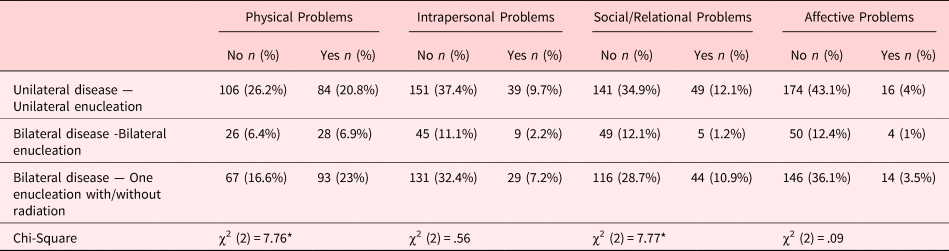
Chi-square analyses were carried out between the three patient groups and physical, intrapersonal, social and relational, and affective problems, respectively (Table 2). There was a significant association between patient groups and physical and social/relational problems, respectively (but no association between patient groups and intrapersonal or affective problems). Physical problems were noted by almost a quarter of participants with bilateral disease and unilateral enucleation (n = 93, 23%), compared with 84 (20.8%) participants with unilateral disease with unilateral enucleation, followed by 28 (6.9%) participants with bilateral disease and bilateral enucleation. Social/relational problems were noted by 49 (12.1%) participants with unilateral disease with unilateral enucleation, compared with 44 (10.9%) participants with bilateral disease and unilateral enucleation, and 5 (1.2%) participants with bilateral disease and bilateral enucleation.
Distribution of responses between patient groups and physical, intrapersonal, social and relational, and affective problems

* p < 0.05.
Qualitative analysis
This section is divided into the two subsections based on survivor responses: description of the problem and coping strategies.
Description of the problem
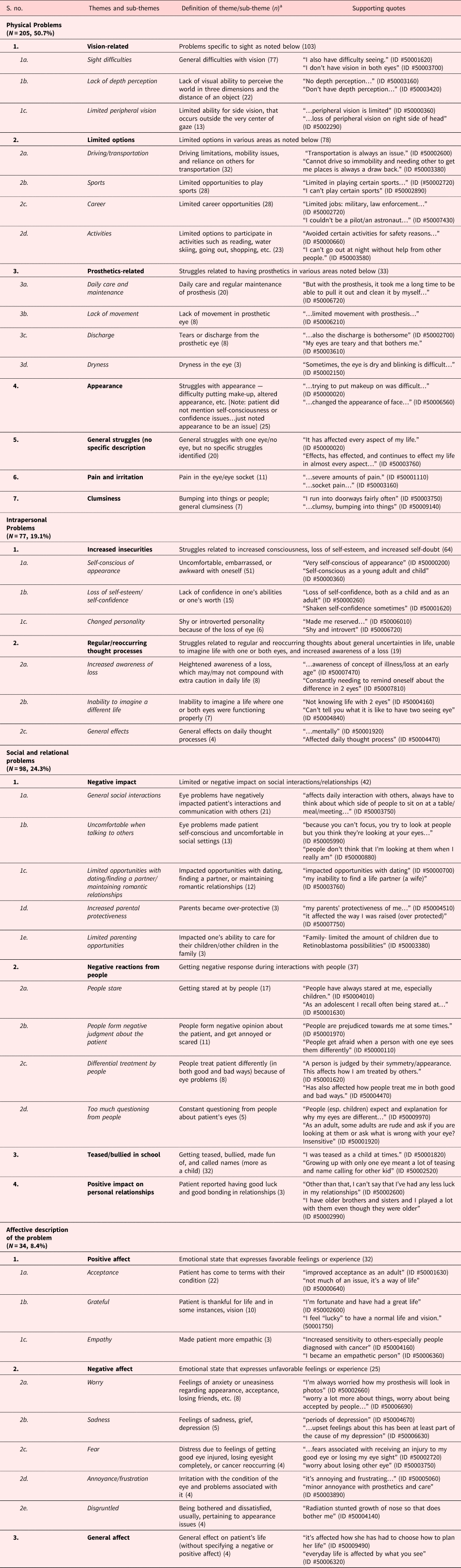
Participants noted four different types of problems which they attributed to prior enucleation(s): physical, intrapersonal, social and relational, and affective. Some of these problems were described as self-limited while others were lifelong challenges (Table 3).
Themes and sub-themes, definition, and supportive quotes for the problems faced by retinoblastoma survivors

Note: Themes and sub-themes are not mutually exclusive.
a (n) is for the number of participants whose response fits the theme/sub-theme.
Physical problems
More than half of survivors (n = 205) reported physical problems associated with loss of an eye(s), which refer to problematic and practical physical symptoms that impact quality of life, and included seven sub-themes: vision-related difficulties (n = 103, 25.5%), limited options (n = 78, 19.3%), prosthesis-related problems (n = 33, 8.1%), appearance-based (n = 25, 6.2%), general struggles (n = 20, 5%), pain and irritation (n = 11, 2.7%), and clumsiness (n = 7, 1.7%).
The most frequently reported physical problems were vision- or ocular-related, and included sight difficulties, limited peripheral vision, and lack of depth perception. Sight difficulties referred to general difficulties with vision (n = 77, 19.1%) participants. Lack of depth perception, or visual ability to perceive the world in three-dimensions and the ability to determine distances between objects, was also noted as a vision-related struggle (n = 22, 5.4%), as was limited peripheral vision (n = 13, 3.2%). Participants with limited peripheral vision described themselves as having “tunnel vision” where they could only focus on what was happening directly in front of them.
The second most endorsed physical problem related to limited options in various spheres of daily living, which included driving/transportation, sports, career, and other miscellaneous activities. Survivors most frequently reported problems related to driving/transportation, which not only limited survivors' mobility but also increased their reliance on others (n = 32, 7.9%). Limited ability to play in sports such as basketball, baseball, and tennis was also described (n = 28, 6.9%), as was limited ability to pursue specific careers (n = 28, 6.9%), including jobs in the military and law enforcement, or being a pilot or astronaut. Survivors also described limited options to engage in activities such as reading, going out, and shopping (n = 23, 5.7%).
Third, participants noted multiple struggles related to having an ocular prosthesis or an artificial eye following enucleation. These problems included issues related to daily care and maintenance of the prosthesis (n = 20, 5%), lack of movement in the prosthetic eye (n = 8, 2%), discharge from the prosthetic eye (n = 8, 2%), and dryness in the eye (n = 3, 0.7%).
Fourth, participants reported appearance-based problems (n = 25, 6.2%), including difficulty applying make-up, doing hair, and altered appearance. These problems were not discussed from a psychological viewpoint (i.e., making them self-conscious or less confident), but as a practical hindrance of daily living. Fifth, participants noted general life struggles (without providing any specifics; n = 20, 5%) which continued to affect them during adulthood. Sixth, pain as a chronic or ongoing physical problem was described (n = 11, 2.7%), followed by self-reported general clumsiness (n = 7, 1.7%) due to poor coordination, movement, or action, which led to bumping into things or people.
Intrapersonal problems
Nineteen percent of survivors (n = 77) reported intrapersonal problems, which included two sub-themes: increased insecurities (n = 64, 15.8%) and regular/recurring thought processes (n = 19, 4.7%).
The most frequent kind of intrapersonal problems experienced by participants related to increased insecurities, which were further sub-categorized into self-consciousness related to appearance, loss of self-esteem/self-confidence, and changed personality. Self-consciousness related to appearance was described as discomfort, embarrassment, and/or awkwardness with oneself (n = 51, 12.6%). Some survivors described their self-consciousness of appearance as more of an issue during childhood, but for others it was a constant source of discomfort. Loss of self-esteem/self-confidence was also described as an intrapersonal issue (n = 15, 3.7%), as was introversion as a result of prior enucleation (n = 6, 1.5%).
The second most endorsed intrapersonal problem described by participants referred to recurring thought processes, further sub-categorized into increased awareness of loss, inability to imagine a different life, and general effects on thoughts. Loss of an eye gave some survivors heightened awareness that they had a deficiency in life which, for some, led to extra caution in life (n = 8, 2%). Some survivors reported an inability to imagine a life without a prosthesis or with both eyes intact, while others described that this pattern of living with one/no eye had become a way of life for them (n = 7, 1.7%). Finally, a few participants (n = 4, 1%) described general effects on daily thought processes, without going into further detail.
Social and relational problems
Ninety-eight (24.3%) survivors reported social and relational problems, which refer to general communication issues experienced with people at large and/or issues related to forming and maintaining close relationships. These included both negative and positive impacts on relationships and were divided into four sub-themes: negative impact on social interactions/relationships (n = 42, 10.4%), negative reactions from people (n = 37, 9.2%), being teased/bullied in school (n = 32, 7.9%), and positive impact on personal relationships (n = 3, 0.7%).
The most frequent kind of social and relational problems included five sub-themes: general social interactions, discomfort when talking to others, limited opportunities with dating/finding a partner, increased parental protectiveness, and limited parenting opportunities. Survivors described how loss of an eye negatively impacted their interactions with others (n = 21, 5.2%). For instance, one survivor described difficulty communicating with others because he/she could not see others' facial reactions and instead had to base interactions on tone of voice. Eye problems also made survivors more self-conscious and uncomfortable in social settings (n = 13, 3.2%); this discomfort was accentuated by misunderstandings between survivors and their peers. For instance, an individual might presume that a retinoblastoma survivor was staring at him/her, when in fact the survivor was trying to focus his/her gaze. Participants also reported that lack of an eye limited their ability to meet romantic partners, and to maintain romantic relationships (n = 12, 3%). One survivor noted that her partner would tell her that he could not comprehend her emotions because of “one eye being dead.” For some survivors, their parents had become over-protective and/or over-bearing due to their retinoblastoma treatment during early childhood (n = 3, 0.7%). One person noted that their parents vs. approach to parenting may have been completely different if they had both eyes intact. Finally, a few survivors (n = 3, 0.7%) noted that removal of one eye/both eyes impacted their ability to care for their children/other children in the family.
The second most frequently endorsed social and relational problem related to negative reactions/responses during social interactions, and included four sub-themes: people stare, people form negative judgments, differential treatment, and too much questioning. Participants noted that they were often stared at by others due to their facial difference (n = 17, 4.2%). Participants also noted that people often formed negative opinions about them due to their appearance and would get easily annoyed or scared by them (n = 11, 2.7%), people treated them differently because of their eye problems (n = 8, 2%), or they were frequently asked questions by both children and adults regarding “what happened to their eyes” (n = 5, 1.2%).
Survivors also described getting teased, bullied, and called names (n = 32, 7.9%) due to prior enucleation(s). Although this problem was largely confined to childhood, the frequency with which it was reported signaled that this behavior had long-lasting impressions on survivors. Finally, a handful of survivors shared that their eye problems had strengthened their close relationships (n = 3, 0.7%).
Affective problems
Affective problems refer to emotions and emotional responses attributed by participants to loss of one or both eyes (n = 34, 8.4%). Respondents described three kinds of affective problems overall, ranging from positive affect (n = 32, 7.9%) to negative affect (n = 25, 6.2%) to general affect (n = 4, 1%).
The most frequently endorsed emotions by participants were positive and included: improved acceptance of their condition, particularly in adulthood (n = 22, 5.4%); being grateful for their life and visual ability (n = 10, 2.5%); and increased patience, empathy, and sensitivity to others (n = 3, 0.7%). However, participants also described negatives emotions such as: anxiety or uneasiness regarding appearance, acceptance, losing friends (n = 8, 2%); sadness, grief and depression (n = 5, 1.2%); fear or distress related to injuring their intact eye, losing eyesight completely, or cancer recurrence (n = 4, 1%); irritation with the condition of the eye and problems associated with it (n = 4, 1%); and being bothered and dissatisfied about their appearance (n = 4, 1%). Four patients also noted that loss of one or both eyes affected their lives generally without specifying any special kind of negative or positive affect.
Coping strategies
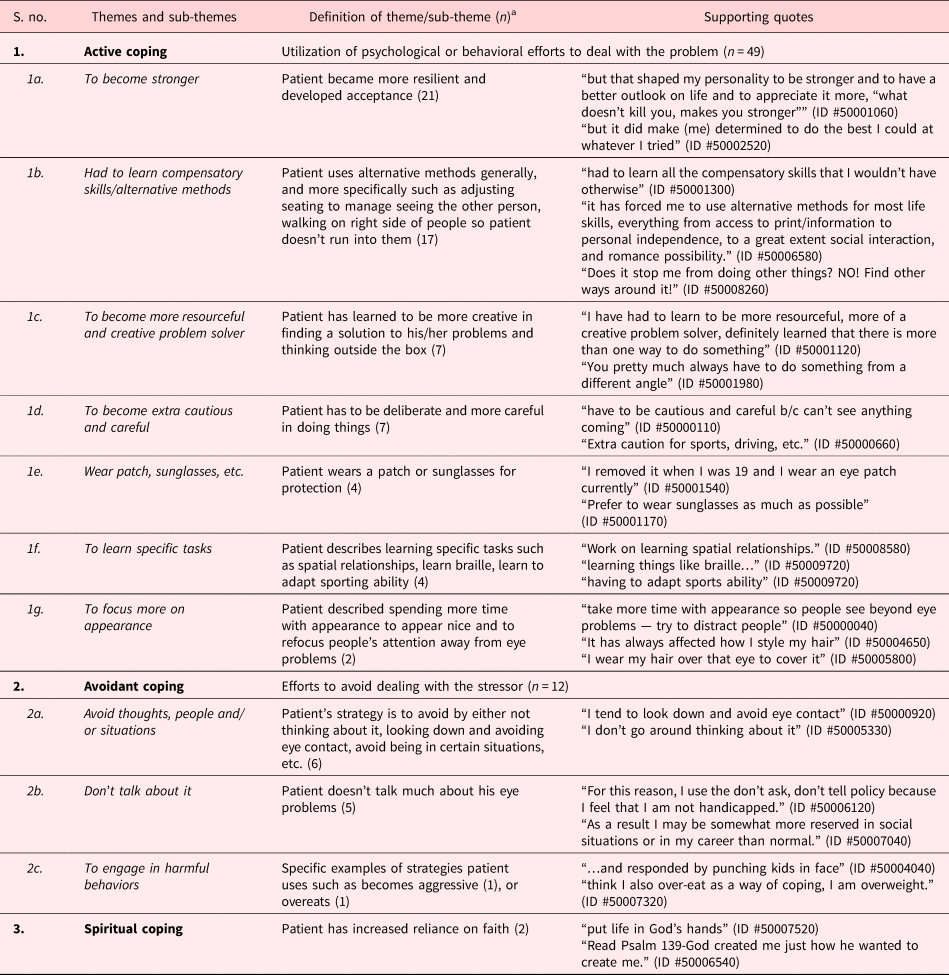
Participants noted three different types of coping strategies, or behavioral and psychological efforts to master, tolerate, reduce, or minimize stressful events (Table 4). These strategies fell into three categories: active coping (n = 49, 12.1%), avoidant coping (n = 12, 3%), and spiritual coping (n = 2, 0.5%).
Themes and sub-themes, definition, and supportive quotes for coping strategies described by retinoblastoma survivors

Note: Themes and sub-themes are not mutually exclusive.
a (n) is for the number of participants whose response fit the theme/sub-theme.
Active coping
Seven different kinds of active coping strategies, which refer to utilization of psychological or behavioral efforts to deal with a problem, were described by respondents. The most frequently used was the development of increased strength and resilience to deal with loss of an eye (n = 21, 5.2%). One respondent noted, “What doesn't kill you, makes you stronger.” The second most frequently used active coping strategy involved compensatory skills/alternative methods (n = 17, 4.2%); participants described strategies such as adjusting seating to better see another person and walking on the right side of people due to limited vision on the left. Third, respondents also learned to be more creative in finding solutions to problems and “thinking outside the box” (n = 7, 1.7%). Fourth, participants reported that they became deliberative and extra-cautious (n = 7, 1.7%) to prevent further damage to their intact eye or to protect themselves from physical harm due to limited vision. Fifth, participants (n = 4, 1%) started wearing a patch or sunglasses for protection, and sixth, participants described (n = 4, 1%) use of physical adaptations such as braille or adaptive sports. Finally, two respondents (0.5%) reported that they started spending more time on changing their appearance to draw people's attention away from their enucleated eye(s). These respondents chose hairstyles that would cover the missing eye and gave the impression that it was a stylistic decision.
Avoidant coping
Avoidant coping refers to conscious efforts to avoid dealing with the loss of one or both eyes and included three sub-categories. First, respondents avoided thoughts, people, and/or situations that made them vulnerable to reactions from strangers (n = 6, 1.5%). Some participants noted that they chose not to talk about their history of enucleation/prosthesis (n = 5, 1.2%), and one of them mentioned using the “don't ask, don't tell” policy regarding their enucleated eye. Finally, a couple of respondents reported that they engaged in harmful behaviors such as overeating to compensate for the prior loss of an eye.
Spiritual coping
Spiritual coping refers to increased reliance on faith and putting their life in God's hands to deal with their eye problems. Two respondents (.5%) described spiritual coping strategies.
Discussion
In this study of 404 adult retinoblastoma survivors treated between 1932 and 1994 and treated with at least one enucleation, we asked affected survivors to explain in narrative form how loss of one or both eyes impacted their lives. Using the established and well-researched CSM, this study provides the first qualitative description of the psychosocial effects of enucleation on retinoblastoma survivors' quality of life. After a mean of 42 years since diagnosis, almost a third of study participants (n = 148, 36.9%) still reported that their lives were profoundly affected by loss of one or both eyes due to surgical enucleation, another third (n = 146, 36.4%) reported moderate affect to their lives, and just over a quarter (n = 107; 26.7%) reported low affect.
While the impact of treatment on objective measures, such as overall survival (Yu et al., Reference Yu, Tucker and Abramson2009; Tamboli et al., Reference Tamboli, Topham and Singh2015), subsequent malignancy risk (Chauveinc et al., Reference Chauveinc, Mosseri and Quintana2001; Fletcher et al., Reference Fletcher, Easton and Anderson2004; Kleinerman et al., Reference Kleinerman, Tucker and Tarone2005; Marees et al., Reference Marees, Moll and Imhof2008, Reference Marees, van Leeuwen and Schaapveld2010; Liu et al., Reference Liu, Givi and Wolden2011; MacCarthy et al., Reference MacCarthy, Bayne and Brownbill2013; Fidler et al., Reference Fidler, Reulen and Winter2018), and even ocular cosmesis (Aggarwal et al., Reference Aggarwal, Singh and Kumar2013; Mourits et al., Reference Mourits, Hartong and Lissenberg-Witte2018), has been studied extensively in patients with retinoblastoma, far less data exist on subjective and psychosocial measures, particularly with regard to the impact of enucleation on long-term quality of life. Quantitative studies on quality of life exist with variable results (van Dijk et al., Reference van Dijk, Imhof and Moll2007a, Reference van Dijk, Huisman and Moll2007b; van Dijk et al., Reference van Dijk, Oostrom and Imhof2009b; Mourits et al., Reference Mourits, Hartong and Lissenberg-Witte2018; Zhang et al., Reference Zhang, Gao and Shen2018). For instance, a study of 65 children and adolescent retinoblastoma survivors demonstrated that survivors reported very good health-related quality of life (van Dijk et al., Reference van Dijk, Huisman and Moll2007b). However, in a similar study of 87 adult retinoblastoma survivors, survivors reported slightly lower quality of life, specifically regarding mental health (anxiety, feelings of depression, and loss of control) (van Dijk et al., Reference van Dijk, Imhof and Moll2007a).
To address this gap in the literature, we assessed survivors' perception of the impact of enucleation on quality of life. Overall, the study revealed three key findings. First, qualitative analysis of retinoblastoma survivors vs. own words in narrative form revealed that they continued to report physical problems, intrapersonal problems, social and relational problems, and affective problems. Of importance, participants discussed their physical struggles with appearance, as well as their struggles with self-consciousness due to appearance, many years after completion of therapy. Participants focused not only on how they viewed their physical appearance but also on their thoughts and feelings related thereto. Drawing parallels to body image concerns that many cancer patients and survivors experience (Fingeret et al., Reference Fingeret, Teo and Epner2014), these responses demonstrate that clinicians caring for retinoblastoma survivors must ask about appearance-related concerns and utilize psychological interventions to help survivors cope with their changed appearance after enucleation.
Second, multiple social and relational problems were described by retinoblastoma survivors, with teasing and bullying being prominent. In other studies of quality of life among retinoblastoma survivors (van Dijk et al., Reference van Dijk, Imhof and Moll2007a; van Dijk et al., Reference van Dijk, Oostrom and Imhof2009b), bullying and teasing have been reported as the main predictors of inferior quality of life. Improving public health knowledge about retinoblastoma specifically, and facial differences more generally, would be an important step to minimize survivors' discomfort and ensure that they are not constantly stared at, given differential treatment, or subjected to too many personal questions. Similarly, when a retinoblastoma survivor returns to school after enucleation, other children should be encouraged to communicate empathically with the survivor.
Finally, in-tandem with CSM, survivors described their own active and avoidant coping skills. Of all coping skills, the most frequently used were active in nature and consisted of becoming stronger and having more acceptance and learning compensatory skills/alternate ways of doing things. These active coping skills signal an effort toward resilience, which should favorably influence survivors' quality of life (van Dijk et al., Reference van Dijk, Grootenhuis and Imhof2009a, Reference van Dijk, Oostrom and Imhof2019b; Popa-Velea et al., Reference Popa-Velea, Diaconescu and Jidveian Popescu2017). Psychosocial interventions should encourage survivors to cultivate these types of active coping skills to improve behavioral and emotional outcomes, and overall quality of life.
Study limitations
The data for this study are derived from a cross-sectional, survey-based study of adult retinoblastoma survivors, previously treated in the New York area, and therefore cannot be generalized. A longitudinal study of a nationally representative sample of retinoblastoma survivors would yield a deeper understanding of different problems affecting them, and changes over time. The present study inquired about how the removal of an eye/both eyes had affected their lives in an open-text format. A different qualitative approach (an interview or focus group) would have allowed us to go beyond the description of problems faced and coping styles to better understand the ways in which these issues have contributed to participants' current assessment of their own quality of life.
Importantly, many centers have tried to preserve eyes using intra-arterial or intra-vitreal chemotherapy and far fewer eyes are now enucleated in major US centers than just 10 years ago (Abramson et al., Reference Abramson, Fabius and Issa2015), so we would expect fewer contemporarily treated patients to experience loss of one or both eyes. Still, many retinoblastoma patients worldwide are treated with enucleation and will thus face the psychosocial difficulties described by this cohort. Thus, the qualitative descriptions of issues affecting retinoblastoma survivors treated with enucleation remain pertinent and informative for clinicians treating retinoblastoma today.
Clinical implications
This study describes an empirical way of eliciting retinoblastoma survivor experience as part of a cross-sectional study or a clinical trial. Allowing a narrative format to let patients “tell their story” can enable the health care system to optimize supportive care to patients and families. Additionally, this study highlights the need for psychosocial clinical interventions to help retinoblastoma survivors previously treated with enucleation manage concerns about appearance; deal with teasing/bullying; and learn useful compensatory skills for activities of daily living.
Authors’ contributions
Designed research: JSF, CAS, LLR, RAK, KCO, JHF, DHA, IJD, and DNF. Performed research: JSF, CAS, LLR, RAK, KCO, JHF, DHA, IJD, and DNF. Contributed analytic tools: SCB, JFC, IJD, and DNF. Analyzed data: SCB, EP, MP, JFC, IJD, and DNF. Wrote the manuscript: SCB, IJD, and DNF. Edited the manuscript: All co-authors.
Ethics approval and consent to participate
The study was approved by the Memorial Sloan Kettering (MSK) and National Cancer Institute (NCI) Institutional Review Boards/Privacy Boards.
Consent for publication
Consent was obtained from all participants in the study.
Availability of data and materials
The datasets used and/or analyzed during the current study are available from the corresponding author on reasonable request.
Funding
This study was supported by the MSK Cancer Center Support Grant/Core Grant (P30 CA008748), New York Community Trust, the Frueauff Foundation, Perryvs.s Promise Fund, National Cancer Institute [NCI] grant U24 CA55727 (CCSS, GT Armstrong, PI), the Intramural Research Program of the National Institutes of Health [NIH], NCI (R Kleinerman), and NIH/National Center for Advancing Translational Sciences [NCATS] grant KL2 TR000458 (DN Friedman).
Conflict of interest
The authors declare that they have no competing interests.