Introduction
Roundworms of Toxocara genus are one of the most common intestinal helminths of domestic and wild carnivores worldwide. After ingestion of infective eggs by definitive hosts, L3 larvae hatch in the small intestine, undergo entero-hepatic-pulmonary migration and return to the small intestine. This form of infection occurs regularly only in carnivores of up to 3 months, and at 6 months of age it has almost ceased. Instead, the L3 travel to a wide range of organs and tissues, where they remain as dormant (somatic) larvae. In pregnant bitches, Toxocara canis larvae become mobilized and migrate to fetuses. Pups can be also infected by the L3 larvae present in the milk during lactation. In T. cati, only transmammary transmission occurs. After ingestion of infective eggs by paratenic hosts (small mammals, domestic animals, etc.), L3 hatch from eggs, migrate via blood vessels and remain in a dormant stage in the tissues. The development is resumed when the prey is eaten by a definitive host (Gillespie, Reference Gillespie1988; Bruňanská et al., Reference Bruňanská, Dubinský and Reiterová1995). The migration of larvae in humans (accidental hosts) causes larval toxocariasis, a serious helminthozoonosis, affecting predominantly children (Kinčeková et al., Reference Kinčeková, Banovčin, Fedor, Dubinský, Poláček, Pavlinová and Šimeková2008). Recent data from Croatia show 31% seroprevalence in children with eosinophilia (Sviben et al., Reference Sviben, Čavlek, Missoni and Galinovič2009).
Infection rates of T. canis reported worldwide vary from 2.5% in adult dogs to almost 80% in pups (Overgaauw & van Knapen, Reference Overgaauw, van Knapen, Macpherson, Muslin and Wandeler2000; Luty, Reference Luty2001) and between 4.5% and as much as 60% in foxes (Dalimi et al., Reference Dalimi, Sattari and Motamedi2006; Saeed et al., Reference Saeed, Maddox-Hyttel, Monrad and Kapel2006; Meijer et al., Reference Meijer, Mattsson, Angerbjörn, Osterman-Lind, Fernández-Aguilar and Gavier-Widén2011). In Slovakia, its prevalence in dogs ranges between 18.8% in adult animals and 53.2% in those under 6 months (Szabová et al., Reference Szabová, Juriš, Miterpáková, Antolová, Papajová and Šefčíková2007). During an extensive study between 2000 and 2006, eggs of T. canis were detected in 12.5% out of 1198 red foxes (Miterpáková et al., Reference Miterpáková, Hurníková, Antolová and Dubinský2009).
Small mammals, as paratenic hosts, play a significant role in the circulation of Toxocara spp. (Dubinský et al., Reference Dubinský, Havasiová-Reiterová, Peťko, Hovorka and Tomašovičová1995; Antolová et al., Reference Antolová, Reiterová, Miterpáková, Stanko and Dubinský2004; Hildebrand et al., Reference Hildebrand, Zalesny, Okulewicz and Baszkiewicz2009). About 50% of the diet of red foxes, the most numerous of wild carnivores in Europe, consists of small mammals (Reichholf, Reference Reichholf1996). Small mammals can also be considered an important reservoir of Toxocara larvae for dogs and especially for cats, which catch prey animals more often than dogs. Moreover, the number of pets has been rising markedly in the past 10 years in Slovakia. These facts create suitable conditions for the spread of infection and highlight an increased risk of transmission of Toxocara spp. to humans.
The aim of the study was to estimate the seroprevalence of Toxocara in small mammals from different localities in eastern Slovakia and compare the relationship between the occurrence of antibodies in different species of small mammals and their age and diet. To obtain a comprehensive picture of the role of small mammals in the natural foci of toxocariasis, we examined rodents and shrews from different types of habitats, with varying degrees of anthropogenic disturbance.
Materials and methods
Study sites and sampling of small mammals
Free-living small mammals were trapped during 2000–2004 in different localities in eastern Slovakia. They were caught in standard live and snap traps set in lines. The traps were spaced 5 m apart, and each line was usually exposed on two nights. Trap lines were checked regularly in the morning. Wicks soaked in an oil and nut mixture were used as baits.
The small mammals that were examined came from six areas of eastern Slovakia, namely Košická kotlina basin (alluvial habitats, windbreaks, acacia belts, fields, forest ecotones, gardens, deer parks; 190–280 m above sea level (asl)), Východoslovenská rovina plain (fields, windbreaks, field forests, shrubs, gardens, lowland forests in protected areas; 100–120 m asl), Beskydské predhorie mountains (alluvial habitats in agricultural landscape, forest ecotones; 270–280 m asl), Ondavská vrchovina mountains (alluvial habitats in agricultural landscape; 190–220 m asl); only a small proportion of the mammals was caught in other areas of eastern Slovakia (Valaškovce, Markovce and Úhorná).
The mammal material examined consisted of 15 species: Sorex araneus – common shrew (Linnaeus, 1758); S. minutus – pygmy shrew (Linnaeus, 1766); Neomys fodiens – water shrew (Pennant, 1771); Crocidura suaveolens – lesser white-toothed shrew (Pallas, 1811) and C. leucodon – bicoloured white-toothed shrew (Hermann, 1780), all belonging to the order Eulipotyphla, family Soricidae. The order Rodentia was represented by Apodemus agrarius – black-striped field mouse (Pallas, 1711); A. flavicollis – yellow-necked mouse (Melchior, 1834); A. sylvaticus – wood mouse (Linnaeus, 1758); A. uralensis ( = microps) – pygmy field mouse (Kratochvíl and Rosický, 1952); Mus musculus – house mouse (Linaeus, 1758); Mus spicilegus – mound-building mouse (Petényi, 1882); Micromys minutus – harvest mouse (Pallas, 1911); Myodes glareolus – bank vole (Schreber, 1780); Microtus arvalis – common vole (Pallas, 1778) and Microtus subterraneus – common pine vole (de Sélys-Longchaps, 1836).
The captured animals were identified and subjected to necropsy. Each heart with its blood clot was cut open, eluted in 1 ml of saline solution for 24 h and then centrifuged at 500 g for 2 min (Treml & Nesňálová, Reference Treml and Nesňálová1993) and the supernatant fraction (further referred to as the eluate) was subsequently used for serological examination.
According to their prevailing diet, animals were divided into three categories. Species feeding mostly on plants were classified as herbivores (M. glareolus, M. arvalis, M. subterraneus), those feeding on grain and seeds as granivores (genera Apodemus, Mus and Micromys). In both these groups there is a lower proportion of animal components in the diet. The third group, invertebratophages, was comprised of species that consume predominantly insects, but also spiders, centipedes, earthworms, etc. (genera Sorex, Crocidura and Neomys) (Anděra & Horáček, Reference Anděra and Horáček2005). Following zoological criteria, animals were divided into subadults and adults. Adults or ‘mature’ individuals were those either sexually active or inactive animals that had previously been sexually active. Sexually active males were individuals with distinctly larger testes and glandulae vesiculares. Sexually active females were those with a vaginal plug, corpora lutea, pregnant or lactating. Adult but sexually inactive individuals were males with testes in regression and females with placental scars. Small individuals showing no signs of sexual activity that had not yet reached sexual maturity were classified as subadults or ‘immature’.
The present study complied with all current laws governing research in Slovakia. Capture, handling and care of mammals complied with all relevant laws of the Slovak Republic.
Determination of anti-Toxocara antibodies by ELISA
The enzyme-linked immunosorbent assay (ELISA) has been reported to be sensitive and specific for the detection of anti-Toxocara antibodies in mice. Toxocara canis excretory–secretory antigen (E/S Ag) has been shown to be specific, without cross-reactions with sera of mice experimentally infected with T. leonina and Ascaris suum (Cuéllar et al., Reference Cuéllar, Fenoy and Guillén1995). Reperant et al. (Reference Reperant, Hegglin, Tanner, Fischer and Deplazes2009) validated the sensitivity of the antigen on serum of M. arvalis experimentally infected with T. canis. Havasiová-Reiterová et al. (Reference Havasiová-Reiterová, Tomašovičová and Dubinský1995) observed the production of detectable specific antibody levels in mice infected with as few as five and seven T. canis or T. cati eggs, respectively. Toxocara canis larval E/S Ag were prepared by the method of De Savigny (Reference De Savigny1975). Antibodies were determined in the eluates from the hearts of the small mammals using an ELISA modified by Havasiová-Reiterová et al. (Reference Havasiová-Reiterová, Tomašovičová and Dubinský1995). Microtitre plates were coated overnight at 4°C with antigen containing 1 μg/ml protein diluted in carbonate buffer (pH 9.6). The plates were washed three times with phosphate-buffered saline (pH 7.2) containing Tween 20 (PBS-T20). The eluates (diluted 1:2 in 5% skimmed milk in PBS-T20) were placed on plates in a volume of 100 μl/well. After incubation at 37°C for 1 h the plates were washed three times. Horseradish peroxidase-labelled anti-mouse immunoglobulin (anti-mouse polyvalent immunoglobulins IgG, IgA, IgM; Sigma-Aldrich Chemie GmbH, Steinheim, Germany) diluted 1:8000 in a volume of 100 μl was used as a conjugate. After incubation for 1 h, plates were washed three times and 100 μl of substrate (o-phenylenediamine with 0.05% hydrogen peroxide) were added. The reaction was stopped after 20 min of incubation in the dark at room temperature by 50 μl of 2 m sulphuric acid and optical density was measured spectrophotometrically at 490 nm (Thermo Labsystems Opsys MR, Chantily, Virginia, USA). Positive sera of mice experimentally infected with T. canis and sera of helminth-free mice were used as positive and negative controls, respectively.
Data analysis
According to the work of Rohlf & Sokal (Reference Rohlf and Sokal1995), the seroprevalence value was given with 95% confidence intervals (CIs). The presence of anti-Toxocara antibodies in relation to host species, year of host sampling and the diet habit of the hosts was analysed by maximum likelihood techniques based on log-linear analysis of contingency tables, beginning with the most complex model involving all possible effects (i.e. year of host sampling, diet habit, host species and seropositivity of Toxocara spp. expressed as presence/absence data) and interactions. Next, the minimum sufficient model was generated where the χ2 result was not significant, indicating that the model was adequate in explaining the data (Abu-Madi et al., Reference Abu-Madi, Behnke, Lewis and Gilbert1998; Behnke et al., Reference Behnke, Lewis, Mohd Zain and Gilbert1999). All statistical analyses were conducted using STATISTICA version 9.0 (StatSoft, Inc., Tulsa, Oklahoma, USA).
Results
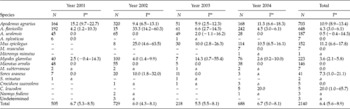
Trapped small mammals were classified into 15 species: 10 rodent and 5 insectivore species. Anti-Toxocara antibodies were confirmed in 7 species. Of the 2140 specimens examined, antibodies were found in 136 (6.4%; 95% CI 5.6–8.9%) animals. The highest seroprevalence was recorded in two rodent species, M. spicilegus and A. agrarius, with 11.2% (95% CI 6.6–17.8) and 10.9% (95% CI 8.9–13.4%) seroprevalence, respectively. The high seroprevalence that was detected in C. leucodon (20.0%) could be influenced by the small number of examined individuals. In the rest of the species, lower or no seroprevalence to Toxocara was detected. The absence of antibodies in several species of rodents and insectivores (e.g. A. sylvaticus, M. minutus, M. musculus, S. minutus, N. fodiens) might be affected by the small number of individuals examined.
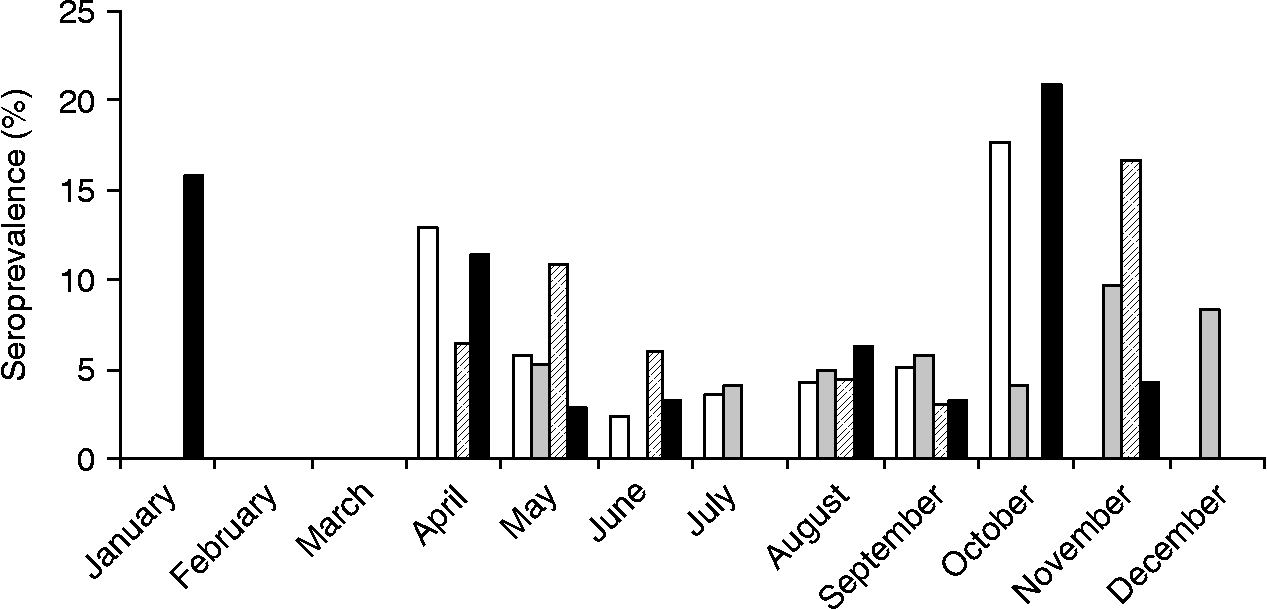
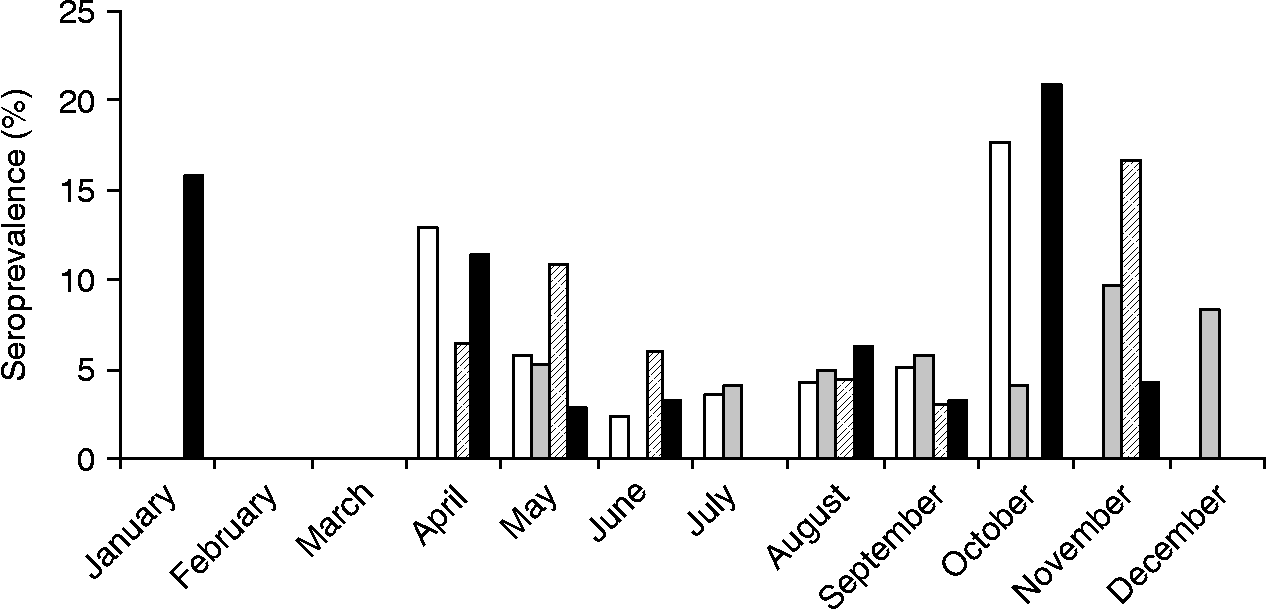
For the purposes of log-linear analyses we excluded host species negative for the presence of anti-Toxocara antibodies, thus we reduced the number of host species to four (i.e. A. agrarius, A. flavicollis, M. spicilegus and M. glareolus). As a result of log-linear analyses of contingency tables we obtained the following models: host species/seroprevalence of Toxocara spp.; host species/year of host sampling (χ2= 11.401; df = 12; P= 0.495) and diet habit/seroprevalence of Toxocara spp.; diet habit/year of host sampling (χ2= 5.906; df = 9; P= 0.749). These results indicate that the seroprevalence of Toxocara spp. is affected by host species (the highest seropositivity was observed in A. agrarius) (table 1) and simultaneously by diet habit (granivorous and invertebratophagous small mammals were characterized by the highest seroprevalence in comparison with herbivorous animals) (table 2). We did not observe any differences between the year of host sampling and the presence of anti-Toxocara antibodies. The seroprevalence ranged from 5.5 to 6.7%, without statistically significant differences between positivity in different years (χ2= 0.637; df = 3; P= 0.888). Although only a few samples were collected in February and March, the seasonal dynamics of antibodies had a similar course in all the years monitored. Seroprevalence was higher in the winter and spring than in summer, and in autumn it rose again, with significant differences detected in January and October (χ2= 49.097; df = 12; P < 0.000) (fig. 1). Age did not influence the presence of antibodies significantly (χ2= 3.754; df = 1; P= 0.053); however, older animals were infected more frequently (7.0%, 95% CI 5.5–8.8%) than subadults (4.9%, 95% CI 3.4–6.9%) (table 3).
Seroprevalence of anti-Toxocara antibodies in different species of small mammals from 2001 to 2004.

N, number of examined; P, seroprevalence; *, 95% confidence interval (95% CI); a, not calculated (due to small number of examined samples).
Seroprevalence of anti-Toxocara antibodies in small mammals from 2001 to 2004, relative to prevailing diet.

N, number of examined; P, seroprevalence; *, 95% confidence interval (95% CI); a, not calculated (due to small number of examined samples).
Seasonal dynamics of anti-Toxocara antibodies in small mammals from 2001 to 2004: 2001 (□); 2002 ( ); 2003 (
 ); 2004 (■).
Seroprevalence of anti-Toxocara antibodies in small mammals from 2001 to 2004, relative to host age.

N, number of examined; P, seroprevalence; *, 95% confidence interval (95% CI); a, not calculated (due to small number of examined samples).
Discussion
Due to the long survival of Toxocara larvae in the tissues, paratenic hosts play an important role in the circulation of this parasite. Small mammals represent an important reservoir of infection for both wild and domestic carnivores. The daily intake of the red fox is approximately 0.5–1 kg of meaty food, which corresponds to about 20–50 micromammals (Sládek & Mošanský, Reference Sládek and Mošanský1985). Localities with a higher density of small mammals are more frequently visited by foxes, which results in accumulation of their faeces containing parasite eggs in such places (Antolová et al., Reference Antolová, Reiterová, Miterpáková, Stanko and Dubinský2004). Another fact that contributes to the maintenance of Toxocara circulation in the wild is lactogenic transfer of T. canis larvae from mice to their offspring, as reported by Tomašovičová et al. (Reference Tomašovičová, Havasiová-Reiterová, Dubinský and Hovorka1993) and Reiterová et al. (Reference Reiterová, Tomašovičová and Dubinský2003).
The present study aimed to investigate the role of small mammals in the circulation of toxocariasis in the environment. Although, in natural conditions, massive infection with Toxocara spp. eggs would not be expected, Havasiová-Reiterová et al. (Reference Havasiová-Reiterová, Tomašovičová and Dubinský1995) found Toxocara larvae in brains and muscles of mice experimentally infected with five and seven T. canis or T. cati eggs, respectively. Out of the 2140 small mammals examined, which belonged to 15 species, anti-Toxocara antibodies were detected in 6.4%. Most infected mammals were members of the family Muridae (96.9%), while only 2.6% of animals belonged to the family Soricidae. High seroprevalence (11.2%) was found in M. spicilegus. The mound-building mouse inhabits natural steppes, grain fields, disturbed vegetation surrounding agricultural lands, orchards and open habitats along river courses, wood edges and glades, and rarely open woods away from human settlements. Its occurrence rarely exceeds the altitude of 200 m a.s.l. (Macholán, Reference Macholán, Mitchell-Jones, Amori, Bogdanowicz, Kryštufek, Reijnders, Spitzenberger, Stubbe, Thissen, Vohralík and Zima1999). Its typical property is the building of moulds, serving as reservoirs of food for winter. Lower positivity (10.9%) was observed in A. agrarius, the most numerous species of the study, representing almost one-third of animals (32.9%). This species prefers moist habitats and lives near streams, in shrubberies on riversides, but also in forests, agricultural land and meadows. In winter the black-striped field mouse takes up occupation near human settlements, in haystacks, storehouses and dwellings (Sládek & Mošanský, Reference Sládek and Mošanský1985). In recent decades, its marked spread into new areas has been observed not only in Slovakia, but also in other countries of central Europe (Dudich & Štollmann, Reference Dudich and Štollmann1986; Bryja & Rehák, Reference Bryja and Rehák2002; Ondríková & Stanko, Reference Ondríková and Stanko2009). Considering the high density of A. agrarius, together with a detected high prevalence of anti-Toxocara antibodies, we suppose that A. agrarius and M. spicilegus may have an important role in the circulation of toxocariasis in eastern Slovakia. Their zoonotic potential underlines their tendency to over-winter near human dwellings, which can lead to infection of domestic carnivores, especially cats, and subsequent increase of infection pressure on humans.
The second most numerous species was A. flavicollis (30.3% of animals) followed by Myodes glareolus (10.4% of animals). Both species are forest rodents. They reside in lowlands to highlands and also live on agricultural land (Reichholf, Reference Reichholf1996). Although the seroprevalence of antibodies was lower in these species (4.3 and 3.6%, respectively), their high density in rural areas can contribute to the spread of Toxocara spp., mainly in wild carnivores and outdoor cats. Other species were less numerous and the occurrence of anti-Toxocara antibodies was less frequent. The role of small mammals in the epidemiology of toxocariasis was surveyed by Dubinský et al. (Reference Dubinský, Havasiová-Reiterová, Peťko, Hovorka and Tomašovičová1995), who detected 15.1% seroprevalence and, similarly to this study, found a high prevalence of antibodies in A. agrarius (30.4%), with lower prevalences in A. flavicollis (11.3%) and Myodes glareolus (7.1%). They also found a correlation between seroprevalence of animals and the presence of Toxocara larvae in their tissues. In Poland, Toxocara spp. larvae were found in livers and brains of 12.9% individuals of A. agrarius (Hildebrand et al., Reference Hildebrand, Zalesny, Okulewicz and Baszkiewicz2009).
The relationship between the occurrence of anti-Toxocara antibodies and food composition was significant. Animals feeding predominantly on plants were less positive than those feeding on grass and seeds and in invertebratophages, whose diet consists of insects, earthworms, spiders, etc. It is also possible that herbivores do not ingest as much substrate (soil) as ground feeders.
Age did not influence the presence of antibodies significantly, but older animals were infected more frequently, probably due to their longer contact with a contaminated environment.
In all years, cyclic changes of seroprevalence were observed. A more frequent occurrence of antibodies in the spring was followed by a decrease in summer. In autumn seroprevalence started to rise and stayed at a similar level in winter. This tendency could be influenced by the survival of Toxocara spp. eggs in the environment. Temperature and moisture conditions in spring and autumn are suitable for egg survival. On the contrary, high temperatures and lack of rain in summer, and low temperatures in winter, can contribute to egg destruction. Toxocara L3 larvae in eggs are sensitive to cold and die below − 15°C. Their survival is also limited in dry and sandy soils (Gillespie, Reference Gillespie1988).
Epidemiological models strongly suggest that hosts living at a high density increase the ability for the spread of directly transmitted parasites into a host population (Arneberg et al., Reference Arneberg, Skorping, Grenfell and Read1998). Changes in density of small mammals depend on climatic conditions (Stanko, Reference Stanko1994) and can lead to changes of parasite prevalence in definitive hosts. Seroprevalence of the examined animals confirmed their contact with Toxocara spp. and demonstrated the presence of the aetiological agent in the monitored localities. Infected small mammals contribute to the circulation of toxocariasis, a serious helminthozoonosis, in the environment. Areas with a high prevalence of infected animals present constant infectious pressure on domestic and wild carnivores and thus also endanger human health and increase the infection risk for other paratenic hosts.
Acknowledgements
The present study was partially supported by the Slovak Research and Development Agency under contract no. APVV-0267-10 and the Slovak Grant Committee VEGA, grant no. 2/0011/12 and by the project ‘INFEKTZOON – Centre of Excellence For Animal Infections and Zoonoses (ITMS-26220120002)’ on the basis of support from Operational Programme Research and Development, funded by the European Regional Development Fund (0.5). We would like to thank Dr L. Mošanský and M. Onderová for their help during the field study and in the laboratory work.