Competition and conceptual convergence in bilinguals
In the process of converting thought to speech, the mind of a bilingual rests on a delicate balance between inhibition and activation of competing language systems. A growing collection of findings from production studies with speakers of diverse language combinations suggest that bilinguals seem to have surprisingly limited control over ‘switching off’ the non-target language system. Evidence for a parallel activation comes for instance from picture naming; bilinguals are faster in naming cognates (e.g., gato in Spanish, gat in Catalan for “cat”) than non-cognates (e.g., mesa in Spanish, taula in Catalan for “table”) (Costa, Caramazza & Sebastián-Gallés, Reference Costa, Caramazza and Sebastián-Gallés2000; Hoshino & Kroll, Reference Hoshino and Kroll2008). The inability to avoid accessing representations from the non-target system points to a shared conceptual substrate for lexical retrieval. Similar co-activation is detectable on the level of grammar. For example, we know that crosslinguistic gender priming effects surface in translation tasks with noun phrases containing gender-marked adjectives. German–Dutch (Lemhöfer, Spalek & Schriefers, Reference Lemhöfer, Spalek and Schriefers2008) as well as Greek–German bilinguals (Salamoura & Williams, Reference Salamoura and Williams2007) were found significantly faster in translating noun phrases with identical grammatical gender in both languages. This indicates that grammatical representations are also in some way contained within the same functional system. But co-activation of L1 and L2 representations does not tell us much about how bilinguals integrate relevant grammatical elements to build larger conceptual frames (e.g., temporal or spatial frames) when organising information in response to complex verbal tasks (Brown & Gullberg, Reference Brown and Gullberg2008, Reference Brown and Gullberg2011; Levelt, Reference Levelt1989). What are the implications of two simultaneously active grammatical representations for the ways in which temporal information is organised for expression? Zooming in on language production patterns in narratives, do sequential bilinguals structure temporal information as in their L1; or as in their L2; do they build a system based partly on L1 and partly on L2 elements; or do they opt for something else?
Language-mediated conceptual change in bilingual speakers has stepped up as a vibrant topic in current SLA and bilingualism research (Athanasopoulos, Reference Athanasopoulos and Pavlenko2011; Cook, Reference Cook and Cook2003; Gentner & Goldin-Meadow, Reference Gentner and Goldin–Meadow2003; Green, Reference Green1998; Pavlenko, Reference Pavlenko and Pavlenko2011). This work is L2 production-focussed, and builds on the classification of conceptual change types proposed by Pavlenko (Reference Pavlenko and Pavlenko2011) and Jarvis and Pavlenko (Reference Jarvis and Pavlenko2008), who distinguish (a) coexistence of L1 and L2 conceptualisation patterns, (b) transfer of L1-based patterns, (c) convergence of L1 and L2 leading to unique or in-between patterns of performance, (d) restructuring, (e) internalisation of new patterns, (f) influence of L2 on L1 performance, and (g) attrition of L1 patterns. The key notions in this work are conceptual restructuring, i.e., “performance of bilinguals that diverges from the L1 pattern and begins to resemble, albeit not necessarily fully, that of the L2 speakers” (Pavlenko, Reference Pavlenko and Pavlenko2011, p. 247), and conceptual convergence, i.e., “a particular type of restructuring, namely convergence between two systems, whereby a unitary conceptual category is created that incorporates both L1 and L2 features” (Jarvis & Pavlenko, Reference Jarvis and Pavlenko2008, p. 164). The analyses draw only on learners’ production in their L2, not in their L1: thus possible L2 influence on L1 patterns remains unexplored.
Active interest in the area of conceptual restructuring and convergence is all the more propelled by the fact that related studies yielded discrepant outcomes. With focus on language production studies, evidence was documented both in favour of conceptual restructuring in the direction of the L2 (e.g., Cadierno, Reference Cadierno, Achard and Niemeier2004; Hohenstein, Eisenberg & Naigles, Reference Hohenstein, Eisenberg and Naigles2006; Wolff & Ventura, Reference Wolff and Ventura2009, for motion events), as well as against it (e.g., Cadierno & Ruiz, Reference Cadierno and Ruiz2006, for voluntary and caused motion; Carroll & Lambert, Reference Carroll, Lambert, Dimroth and Starren2003; Schmiedtová, von Stutterheim & Carroll, Reference Schmiedtová, von Stutterheim, Carroll and Pavlenko2011, for event construal). Convergence in production patterns, i.e., linguistic performance not conforming to either the L1 or the L2 but found to be a hybrid of the source and the target patterns, was reported for language production of late bilinguals in the expression of caused motion (Hendriks, Hickmann & Demagny, Reference Hendriks, Hickmann and Demagny2008), in temporal subordination (Natale, Reference Natale2013), additive and contrastive event linkage (Tomita, Reference Tomita2013), and also event linearization (Vanek, Reference Vanek, Roberts, Ewert, Pawlak and Wrembel2013).
In Hendriks et al. (Reference Hendriks, Hickmann and Demagny2008), video retellings of advanced English learners of French exhibited idiosyncratic non-target-like devices in reference to motion, which was strongly evocative of a converged system of prototypical L1 and L2 patterns. In L1s, English speakers systematically conflated Motion with Manner in the main verb and expressed Path in non-verbal satellites (e.g., He pushes the basket of apples across the street), and French speakers typically conflated Motion with Path in the main verb and encoded Manner in peripheral structures (e.g., Il traverse la route en poussant son panier de pommes “he crosses the street pushing his basket of apples”). Interestingly, learners were found to transform existing Path verbs into satellite-like devices (e.g., Il pousse le panier de pommes au travers la route “he pushes the basket of apples across/through the road” (p. 30), which does not express boundary crossing). This shows that learners’ expressions resemble the target-like expression of Path in verb-like forms, yet they clearly digress from the target pattern, i.e., from expressing Path in main verbs and Cause+Manner in peripheral structures.
Of similarly close relevance to this study, Natale (Reference Natale2013) and Tomita (Reference Tomita2013) identified symptoms of converged concepts in late bilinguals’ narratives. Natale (Reference Natale2013) examined principles of subordination in the film retellings of French learners of Italian. Learners employed atypical subordination devices that conformed neither to the French L1 pattern (most frequently presentatives combined with relative clauses: there is an x which. . .) nor to the Italian L1 pattern (most frequently gerunds, e.g., Allora alza le mani cercando di raccogliere queste gocce “so he lifts his hands trying to collect these drops”, p. 158). Learners typically used temporal subordinate clauses, also for situations where this type of linking played a “minor role” (p. 163). In Tomita (Reference Tomita2013), film retellings of advanced German learners of Japanese exhibited an interesting type of convergence of L1 and L2 principles pertaining to strategies for contrastive event linkage. Whilst German L1 speakers typically preferred to follow a shift-in-TIME principle (P did not do X at time Z. Now, however, P did do X.), Japanese L1 speakers typically opted for a shift-in-ENTITY principle in response to the same stimulus (P did not do X at time Z, and R did do X at time Y. Finally, P also did X.). Learners tended to follow a hybrid set of principles, with (a) a significantly higher frequency of ‘now’-adverbials than in Japanese L1, resembling the German L1 pattern, (b) a comparable frequency of the additive particle –mo “also” to that in the Japanese L1 production, and (c) learner-specific uses of ‘finally’-adverbials which express the target-like meaning of [after a long and eager waiting] as well as “those which do not” (p. 142).
This study aims to contribute to the debate on conceptual change in the L2 in two ways. The first objective is to quantitatively assess the role of language distance in learnersʼ reliance on source language (L1) structuring principles. The second objective is to qualitatively examine learner-specific structuring techniques to identify whether preferences of sequential bilinguals reflect prototypical L1, L2, or other event conceptualisation patterns.
Language structure and temporal conceptualisation
Explorations on reference to time across languages have accumulated extensive support for the idea that preferences in how native speakers organise temporal information for expression are clearly related to grammaticalised form-function connections available in a given language (Berman & Slobin, Reference Berman and Slobin1994; Bohnemeyer & Pederson, Reference Bohnemeyer and Pederson2011; Filipović & Jaszczolt, Reference Filipović and Jaszczolt2012; Gumperz & Levinson, Reference Gumperz, Levinson, Gumperz and Levinson1996; Klein & Li, Reference Klein and Li2009; Li & Shirai, Reference Li and Shirai2000; Lucy, Reference Lucy1992; Stromqvist & Verhoeven, Reference Stromqvist and Verhoeven2004; Talmy, Reference Talmy, Robinson and Ellis2008). Speakers seem naturally sensitised to the form-function connections that their language grammars code obligatorily. This view is driven by the assumption that our mother tongue(s) trains us to pay attention to different aspects of experience thanks to routine marking of certain contrasts. By the same token, the absence of overt marking of specific contrasts in a given language can lead its speakers to show lower sensitivity to particular aspects of experience, or increased sensitivity to other aspects of experience. Formation of cognitive routines (Robinson & Ellis, Reference Robinson and Ellis2008) reflects the interaction of the conceptual substrate with language in the mind of the speaker, through a conventionalised adaptation of responses to communicative goals (Hudson, Reference Hudson2007; Langacker, Reference Langacker1999; MacWhinney, Reference MacWhinney, Robinson and Ellis2008; Tomasello, Reference Tomasello2003).
It is important to highlight that typological similarity of languages does not automatically imply identical performance of their speakers. For instance, film retellings by speakers of Czech (an aspect language) clearly showed that they conceptualise events much like speakers of German (a non-aspect language) rather than showing resemblance to preferences of speakers of Russian (an aspect language) (Schmiedtová & Sahonenko, Reference Schmiedtová, Sahonenko, Grommes and Walter2008). The context of such variation invites further crosslinguistic research on temporal reference to focus not on bipolar aspectual contrasts and categorical differences, but to address a finer level of detail and articulate hypotheses that incorporate the notions of regularity degrees in aspect marking.
Crosslinguistic similarity can be operationalized as the way in which a specific concept is grammaticalised across languages (e.g., von Stutterheim, Nüse & Murcia-Serra, Reference Von Stutterheim, Nüse, Murcia Serra, Behrens, Fabricius–Hansen and Johansson2002), and for this work the concept under scrutiny is ongoingness. The underlying assumption is that preferences in eventFootnote 1 construal are linked to the availability of grammatical forms that encode the conceptual category of ongoingness. Ongoingness is marked in very different ways across the source and target languages, allowing for the possibility to test hypotheses built on specific degrees of L1-L2 overlap. To briefly sketch out the major contrasts, in English, ongoingness marking is regular across tenses via the V+ing form that denotes imperfectivity. Czech is less systematic in this respect. The imperfectivising suffix –va, as in koupit/kupovat “to buy/to be buying”, is the only pure grammatical marker of ongoingness in Czech. And since the occurrence of simplex perfective verbs (e.g., koupit “to buy”) is infrequent, imperfectivising suffixation via –va is relatively scarce (Schmiedtová, Reference Schmiedtová2004). This means that in relevant contexts the grammar of Czech is likely to highlight ongoingness less than the grammar of English. In comparison, the Hungarian–English overlap is even smaller in terms of highlighting ongoingness. Hungarian simplex verbs are aspectually ambiguous (Csirmaz, Reference Csirmaz, Blaho, Vicente and de Vos2004), and because grammatical aspectual operators are largely absent (they only surface for particle verbs), the expression of ongoingness is achieved typically via lexical means. These language-specific aspectual distinctions present potential difficulties for learners in the process of acquiring a novel system of temporal framing for which new form-meaning connections need to be used. If a higher degree of L1-L2 overlap in grammatical marking of ongoingness implies facilitation in temporal restructuring, we should observe some advantage of Czech–English over Hungarian–English bilinguals in terms of approximation to target-like structuring patterns.
Theoretical underpinnings
Natural language production requires the mind of the speaker to prepare content for expression. This involves transforming information units into a format expressible in the used language. The preparation of content for expression includes three stages of message planning: conceptualisation, formulation and articulation (Levelt, Reference Levelt1989, Reference Levelt, Brown and Hagoort1999). A refined version of Levelt's language production model distinguishes four subprocesses within the conceptualisation stage: namely segmentation, selection, structuring and linearization (Carroll & von Stutterheim, Reference Carroll, von Stutterheim and Ramat2003; Habel & Tappe, Reference Habel, Tape, Klabunde and von Stutterheim1999). Segmentation (partitioning of situations) and selection (choice of components for verbalisation) together constitute macroplanning processes (the level of what to say), while structuring (temporo-spatial anchoring) and linearization (component ordering) represent microplanning processes (the level of how to say it)Footnote 2 .
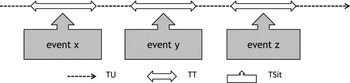
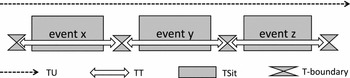
Structuring concerns anchoring several information units in a longer sequence within a particular referential frame (e.g., temporal and spatial anchor). In terms of possible temporal structuring contrasts, choices for the speaker lie between an anaphoric vs. deictic referential anchor (Carroll & von Stutterheim, Reference Carroll, von Stutterheim and Ramat2003). Each of these anchors serves to establish and maintain temporal coherence in a specific way. A deictic anchor entails the presentation of events as ongoing, and in larger chunks of discourse it is typically exhibited by keeping event times identical with the utterance time (Figure 1). An anaphoric anchor is characterised by frequent reference to endpoints and by temporal shifts from one (sub-)event to another (Figure 2). Building on this contrast, it is posited that speakers of languages encoding the concept of ongoingness grammatically within their aspectual system (such as English) will exhibit a high level of sensitivity towards ongoingness in their event conceptualisation processes, and that they will prefer to anchor events deictically. Grammatical marking of ongoingness in the aspectual system will lead to a specific attentional focus in speakers, which will lead them to highlight the ongoing event features in descriptions (e.g., a young man is surfing, the wind is blowing him off the board (Carroll et al., Reference Carroll, von Stutterheim, Nüse, Pechmann and Habel2004, p. 190)). However, speakers of languages with no specific marker for ongoingness (such as Hungarian) or having a specific ongoingness marker only for a small group of verbs (such as Czech) are expected to show lower sensitivity to this concept, since their grammars do not strongly direct their attention to this particular event feature. Lower sensitivity to ongoingness on the level of event linkage surfaces as anaphoric anchoring (an example from German L1: ein kleiner Mann surft auf den Wellen, dann wird er plötzlich von dem Brett geweht “a little man surfs on the waves, then he is suddenly blown off the board” (Carroll et al., Reference Carroll, von Stutterheim, Nüse, Pechmann and Habel2004, p. 190)). These assumptions are in accordance with Slobin's (Reference Slobin, Gumperz and Levinson1996) view that grammar is not a mere formal system but a set of general notions forming a schematic framework for conceptual organisation. If these assumptions are valid, we should find marked crosslinguistic differences in event conceptualisation processes.
Temporal linkage based on deictic anchoring (TT is maintained constant with the TU, events are linked to the TU, individual relations between TSits are left implicit and their temporal boundaries unspecified). TT stands for topic time (i.e., time for which the assertion is made), TSit for situation time (i.e. time for which the situation holds true), and TU for utterance time (i.e. time at which the utterance is made) (Klein, Reference Klein1994, p. 3).

Temporal linkage based on anaphoric shifts (the current TT is located in the post-time of the preceding TSit, event boundaries (T-boundary) are specified to act as anchor points for the next TT, and event chain formation is more typical than linking each TT to the TU separately).

Extending investigation to second language learners, previous findings show that bilinguals are capable of building language systems of their own which are not necessarily fixed in principles either of the L1 or of the L2 referential frame (Jarvis & Pavlenko, Reference Jarvis and Pavlenko2008). Instances of learner-specific phenomena of this type are treated as fully autonomous multicompetence features stemming from language interaction in the bilingual mind (Cook, Reference Cook1992, Reference Cook and Cook2003).
Some prominent theoretical models of the cognitive architecture in bilinguals posit language-specificity on the (sub)lexical level while remaining largely neutral to whether or how the status of conceptual representations for each language varies (e.g., the revised hierarchical model (Kroll & Stewart, Reference Kroll and Stewart1994); the bilingual interactive activation model (Dijkstra & van Heuven, Reference Dijkstra and van Heuven2002)). Other, usefully augmented models, such as the shared distributed asymmetrical model (Dong, Gui & MacWhinney, Reference Dong, Gui and MacWhinney2005) or the dynamic distributed activation model (de Bot, Lowie & Verspoor, Reference De Bot, Lowie and Verspoor2007), build on a converging view of conceptual representations in bilinguals, recognising that concepts contain L1-specific, shared, as well as L2-specific elements. A common denominator of these models is their focus on lexicalised concepts. Approaching conceptualisation from a different angle, this study targets grammaticalised concepts, namely the concept of ongoingness, and models the role of more than one type of grammaticalised knowledge at the stage of conceptualisationFootnote 3 . In doing so, we build on Levelt's language production model (Reference Levelt1989, Reference Levelt, Brown and Hagoort1999), and fully endorse his idea that access to language-specific grammatical information is crucial already at the stage of microplanning (1999, p. 93). This view aligns with Slobin's (Reference Slobin1987, Reference Slobin, Gumperz and Levinson1996) thinking-for-speaking hypothesis, positing language-specificity for cognitive operations already in the speech planning stage. In synchrony with previous suggestions that posit language-specific grammatical knowledge to play a role at the stage of conceptualisation (e.g., Flecken, von Stutterheim & Carroll, Reference Flecken, von Stutterheim and Carroll2013; von Stutterheim & Nüse, Reference Von Stutterheim and Nüse2003), the extension of Levelt's model in this work takes one additional step, and assumes different grammatical knowledge types to compete when bilingual speakers build a temporal conceptual frame during the process of preverbal message generation.
Besides comparing group means for the identification of more general trends in specific bilingual cohorts, current theoretical discourse in SLA points out the importance of considering within-group variation attributable to a host of factors with a potential impact on conceptual restructuring towards the L2, including learning context (Malt & Sloman, Reference Malt and Sloman2003), or length and amount of language exposure (Wolff & Ventura, Reference Wolff and Ventura2009). This study considers one within-group factor, the age of onset of L2 acquisition (AOA). The motivation for examining different AOAs of instructed learners relates to the yet unanswered question why in a school setting “the additional time associated with an early headstart has not been found to provide more substantial long-term proficiency benefits” (Harley, Reference Harley and Med1998, p. 27). One explanation could be that potential age effects on L2 learning examined alongside L2 input have not been sufficiently explored to date (Muñoz, Reference Muñoz2014). In response to this gap, production tests on instructed language learners with different AOAs, but with very similar proficiency levels and a comparably high frequency of L2 exposure outside the classroom, promises to further our understanding about the (lack of) age effect on L2 acquisition in input-limited environments.
Previous research on temporal structuring across languages and learner varieties
Native speakers’ responses in previous studies on temporal structuring were commonly found to conform to two main tendencies. These tendencies surfaced in relating topic time (TT, i.e., time for which the assertion is made) to situation time (TSit, i.e., time for which the situation holds true) (Klein, Reference Klein1994). In their film retellings, speakers of languages with a grammatical marker for ongoingness, including English, Arabic and Spanish, typically inclined to topic time maintenance (i.e., deictic anchoring, illustrated in Figure 1). Topic time maintenance represents event linkage where TT gets ‘pegged’ to the time of utterance (e.g., mum is unwrapping the cake, she is putting it on the table, and she is decorating it with chocolate icing). The temporal anchor for a given TT is the deictic ‘now’ of the event. Event construal characterised by deictic referential anchoring is typically marked with imperfective forms signalling ongoingness. Sequentiality is not in focus, and explicit lexical linkage of temporal relations between propositions is infrequent. Thus, in a context when sequentiality is defocussed in two consecutive or partially overlapping TSits, the listener has to rely to a great extent on contextual cues and general knowledge to decipher the exact temporal relation between individual TSits.
The second main tendency in structuring temporal information is topic time shifting (i.e., anaphoric anchoring). It is a type of event construal dominantly employed in film retellings by speakers of languages without grammatical marking of ongoingness, such as Swedish and German (Bylund, Reference Bylund and Pavlenko2011a; Carroll and von Stutterheim, Reference Carroll, von Stutterheim and Ramat2003; von Stutterheim and Lambert, Reference Von Stutterheim, Lambert and Hendriks2005). Characteristic features of this technique are holistic event construal and explicit specification of temporal relations between TT and TSit of the preceding event (e.g., then the mother unwraps the cake, and after that she puts it on the table, and then she decorates it). In other words, the TT of a given event is located in the posttime of the preceding TSit interval by means of temporal shifters (anaphoric markers such as then, after that, whereupon). When TT is shifted anaphorically, the temporal anchor for a given TT is the preceding TSit (Figure 2).
Findings from previous research on temporal structuring signal an important role for the language-specific category of grammatical aspect in event conceptualisation. Consensus was reached in claiming (a) that languages with no grammatical ongoingness marking direct their speakers to view events holistically and hence they employ TT shift as the preferred event linking technique; and also (b) that languages marking ongoingness grammatically sensitise their speakers to ongoing phases more, resulting in a tendency to maintain TT in event linking.
Research on temporal structuring in L2 has brought more heterogeneous results. Carroll and von Stutterheim (Reference Carroll, von Stutterheim and Ramat2003) found that advanced German learners of English significantly diverged from English temporal structuring patterns and preferred typically German TT shifting. Evidence for clear digressions from target-like event structuring also came from a study by von Stutterheim and Lambert (Reference Von Stutterheim, Lambert and Hendriks2005) testing French and German advanced learners with English L2. Even though highly proficient in terms of formal knowledge, the learners employed interesting techniques with no parallel in the English L1 data. They mixed temporal adverbials (TADVs) expressing punctuality with imperfective structures, as in the ground is suddenly opening (2005, p. 226). At variance with these findings, event structuring of Spanish speakers in L2 Swedish (Bylund, Reference Bylund2011b) was found target-like. Structuring patterns were examined by measuring the frequency with which speakers linked events via TADVs. Quantitative analyses showed that L2 production was characteristic for a high frequency of anaphoric TADVs (typically co-occurring with topic time shifting in Swedish), which was interpreted as evidence for conceptual reorganisation in L2 speakers at the level of microplanning (i.e., at the level of how temporal information for expression is structured). Although different, these findings are not necessarily contradictory. The difference in conceptual reorganisation may be attributed, inter alia, to acquisition context (whilst the participants in Bylund (Reference Bylund2011b) were naturalistic learners, those in von Stutterheim and Lambert (Reference Von Stutterheim, Lambert and Hendriks2005) were instructed learners) or to length of residence in the target language (TL) environment (participants in Bylund (Reference Bylund2011b) had resided in TL setting for over 15 years). These findings together signal that reorganisation of temporal structuring principles may be a very late feature in L2 development, and may only develop under certain circumstances.
With instructed learners in focus, the next undertakings in this line of research need not only to look at whether typological aspectual properties of L1 do or do not influence particular event conceptualisation processes in L2, but to carefully examine how specific degrees of L1-L2 overlap in ongoingness marking impact the L2 production of comparable learner groups. This type of research necessitates analyses of language produced by learners from at least two typologically distinct source languages (SL) acquiring the same TL – which differs from both SLs in the degree of overlap in marking ongoingness. With such design it is not only possible to test how learners from specific L1 backgrounds structure temporal information in discourse, but also to see whether particular structuring choices change as a function of similarity in L1-L2 ongoingness marking.
Research questions
-
(a) Do specific event structuring patterns per L1 group interact with the formal marking of ongoingness in these languages, and if so then how exactly? Which particular form-function mappings are preferred for temporal structuring in each of the L1 groups? Are temporal structuring preferences per group consistent across task types?
-
(b) What are the event structuring patterns that characterise Czech–English and Hungarian–English sequential bilinguals? Do sequential bilinguals adopt target-like principles for organising temporal information in discourse, do they remain rooted in the principles typical of the corresponding L1s, or do they prefer other choices? Can language distance in terms of encoding ongoingness in its aspectual system serve as a reliable predictor of how learners will digress from target-like structuring patterns? Does variation in the age of onset of L2 acquisition affect bilinguals’ structuring patterns?
Method
Informant characteristics
There were 75 participants in this study, divided into three monolingual L1 groups (15 Czech, 15 English, 15 Hungarian native speakers) and two bilinguals’ L2 groups (15 Czech–English and 15 Hungarian–English sequential bilinguals). As for bilinguals, the Hungarian–English group was recruited at International House Budapest and Katedra Language School Budapest (age range 23–36). Their mean AOA of learning English in an instructed environment was 9.3 years (range 3–15), and the average time spent in an English speaking country 2.7 years (range 1–7). The distribution with respect to various AOAs was comparable between subgroups (n = 8 for early acquirers with AOA 3–10; n = 7 for late acquirers with AOA 12+). The 15 Czech-English bilinguals (aged 19–43) were tested at International House Prague, and British Council Prague. Their mean AOA of English in an instructed setting was 10.2 years (range 4–24), also with a comparable of distribution within AOA subgroups (n = 8 for AOA 4–10; n = 7 for AOA 12+).
Both bilingual groups included only highly proficient speakers of English, with communicative competence of all 30 of them deemed near-native by two independent native speaker judges, who knew the participants well. All 30 L2 speakers were either candidates for the Cambridge ESOL Proficiency Exam (having passed a trial test), or CPE certificate holders. The L2 speakers’ self-assessed average use of English in a typical day was around 45% in the Czech group, and 50% in the Hungarian group. The questionnaire responses also pointed to multiple weekly exposure to movies/radio programmes/books/online texts in English for each participant. Recent contact with native speakers was not examined via questionnaires but was commented on during pre-test interviews.
Data elicitation material
Two tasks with complex verbal requirements (Brown & Gullberg, Reference Brown and Gullberg2008, Reference Brown and Gullberg2011; Bylund & Jarvis, Reference Bylund and Jarvis2011; Levelt, Reference Levelt1989) were used, a picture story description and a film retelling. There are two reasons behind the choice of these two tasks. The first reason is the lack of result homogeneity in previous related studies, in which task type was not systematically controlled for. For instance, while Bylund (Reference Bylund2011b) used a film retelling task and reported conceptual restructuring in highly advanced L2 on the level of microplanning, Carroll et al. (Reference Carroll, Murcia-Serra, Watorek and Bendiscoli2000) used a picture-based task and found results suggesting the opposite. The second reason is linked to previous explorations that detected modulation of event construal preferences based on task type. For example, Vanek (Reference Vanek, Roberts, Ewert, Pawlak and Wrembel2013) compared film retellings and picture descriptions of the same L1 and L2 groups, and found that preferences in (non-)chronological event ordering differed across the two tasks, with picture descriptions inviting adherence to chronology more strongly than film retellings. This difference was attributed to variation in the explicitness of event boundaries, which are clearer in films (especially for partial overlaps and concurrent events), and therefore provide a more hospitable context for reordering. Such variation may also have an impact on temporal structuring. It is possible that more explicit event boundaries in the video will attract anaphoric anchoring to a greater extent than the static picture stimulus will.
The first stimulus, the picture storyFootnote 4 , consists of five coloured and numbered pictures, showing situations that are interconnected by diverse temporal and causal relations. Participants were presented with the whole picture story on a single sheet of paper, which was at their disposal throughout the whole description task. The second stimulus is a coloured non-verbal animated clipFootnote 5 with the duration of 03ʹ50ʺ and the total bitrate of 286.60 kbps. It is a coherent story built up from six compact action fragments featuring a teenage boy at his birthday celebration. Every fragment is rich in temporal information, includes relations of simultaneity, posteriority, or partial overlap; and leaves an open possibility for the speaker to decide on temporal structuringFootnote 6 .
Procedure
In the film retelling task, the participants were individually presented an animation on a laptop screen. The instructions were to carefully follow the animation divided into six parts by pauses. During the pauses, the task was to “say what happens, in a way that a film-maker who has not seen the story could imagine and reproduce the events as accurately as possible”, based on their retelling. Each participant was shown the animation only once to ensure spontaneity in production. The chosen procedure naturally meant that elements of story grammar (i.e., initiating event, internal response, attempt, consequence, reaction) were built around respective film fragments rather than the animation as a whole. The same participants were asked to provide picture story descriptions. The instructions were to “describe what happens in the illustrated story to a film-maker so that he or she would be able to make an accurate film version of it”. Participants were first led to carefully scan the complete input material without taking any notes and then give a written account of what happens in it, proceeding from the first to the last picture. Following this procedure, elements of story grammar were centred around the story as a whole, not around individual pictures. To control for the language mode (Grosjean, Reference Grosjean1998) of the participants, all verbal interaction before and during testing between the experimenter and the bilinguals was strictly limited to the target language.
Coding
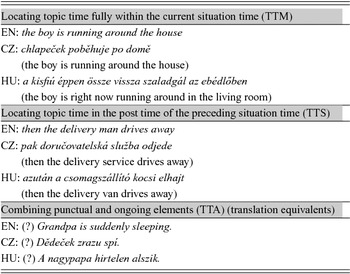
Combinations of lexical, grammatical and discourse markers per proposition were coded and analysed to unravel temporal structuring patterns that particular groups exhibited for establishing relations between topic time, situation time and utterance time. With regard to lexical marking, temporal adverbials (TADV) and temporal connectives (TCON) that contribute to the temporo-aspectual marking were coded on the basis of their functional properties: including anteriority, posteriority, simultaneity, iterativity, continuation, durativity, and punctuality. TADVs and TCONs together were labelled as T-marks. With regard to topic time management, either topic time maintenance (TTM) or topic time shift (TTS) were coded for each event partition based on their function in the discourse contextFootnote 7 . Ambiguous combinations of temporal markers within propositionsFootnote 8 (e.g., combination of an adverbial marking punctuality with a verbal affix marking ongoingness, occurring in learner production) were coded as an independent category (TTA). See Table 1 for examples.
Examples of topic time maintenance (TTM), topic time shift (TTS), and ambiguous combinations of temporal markers (TTA)

Results
Temporal structuring across L1s in picture descriptions
A one-way between-subject ANOVA was conducted to compare the frequencies of propositional links via T-marks in the picture descriptions of Czech, English vs. Hungarian native speakers.
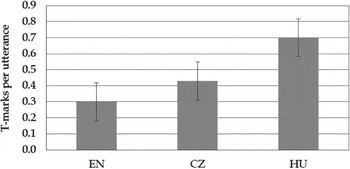
Figure 3 shows the mean frequencies of T-marks per utterance. Significant differences have been found in this respect [F(2,42) = 8.69, p = .001]. T-marks in Hungarian descriptions (M = 0.70, SD = 0.22) were more frequent (p = .001) than in English (M = 0.30, SD = 0.13) and also higher (p = .025) than in Czech descriptions (M = 0.43, SD = 0.18), without a significant difference between the latter two groups. This result shows that in the given type of discourse Hungarian L1 speakers tend to mark temporal relations by T-marks more frequently per utterance than English L1 and Czech L1 speakers. The distribution of T-marks across TADV types and temporal connectives in the three L1s was similar. Most T-marks were used to signal position (e.g., after that; 59.5% in English, 56.1% in Czech, 54.1% in Hungarian), followed by T-marks specifying duration (e.g., for a while; 21.5% in English, 20.7% in Czech, 18.9% in Hungarian), and temporal region (e.g., when; 16.5% in English, 8.5% in Czech, 14.4% in Hungarian).
Mean frequency of T-marks per utterance for L1 picture descriptions.

Temporal structuring in L2 picture descriptions
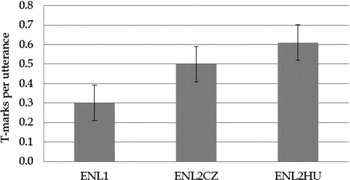
T-marks in ENL1 descriptions were compared with those in bilinguals’ descriptions (Figure 4). Significant differences were found between ENL1 and ENL2s [F(2,42) = 14.08, p < .001].
Mean frequency of T-marks per utterance for picture descriptions in learner groups and in the English L1 group.

The post hoc test (Tukey HSD, throughout the study) showed that proposition linkage via T-marks in ENL2 by Hungarian–English bilinguals (M = 0.61, SD = 0.24) was significantly more frequent (p < .001) than by English natives, showing no shift towards the target-like structuring pattern. The propositional linkage of Czech–English bilinguals via T-marks (M = 0.50, SD = 0.21) was found comparable to the corresponding L1 and TL. As for the distribution of T-marks across TADV and TCON types, bilinguals used most T-marks to express position (62.9% in ENL2CZ, 71.1% in ENL2HU), then near temporal region in ENL2CZ (17.0%) and duration in ENL2HU (16.7%), and the third most frequent T-marks expressed duration in ENL2CZ (14.6%) and near temporal region in ENL2HU (9.6%).
Using independent-samples t tests, no effect of age of L2 acquisition onset emerged in within-group comparisons of T-marks, neither within the group of Czech–English bilinguals [t(13) = −.991, p = .340], nor within the group of Hungarian–English bilinguals [t(13) = .880, p = .395].
L1 and L2 results from qualitative analyses
Czech and Hungarian speakers tended to base event linkage on TT shifts. English speakers, by contrast, showed strong preference for basing event linkage on TT maintenance. The next step is a comparative demonstration of three discourse samples (one per L1). All three L1 samples (Tables 2–4) are related to the same part of input and exhibit structuring options typically chosen in each L1 group.
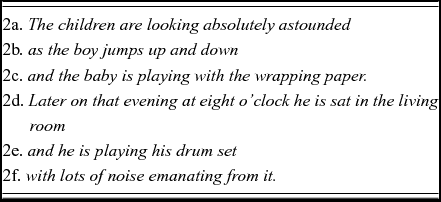
Example of temporal structuring in English L1 picture descriptions

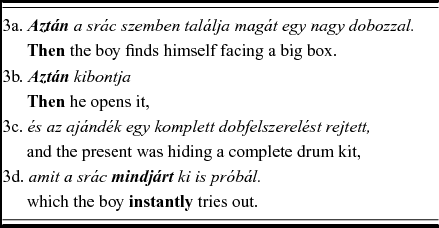
Example of temporal structuring in Hungarian L1 picture descriptions

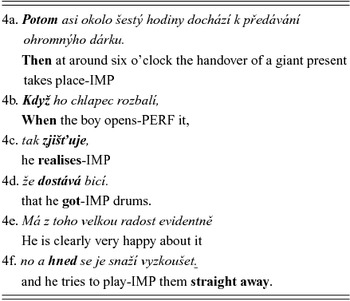
Example of temporal structuring in Czech L1 picture descriptions

As illustrated in Table 2, English native speakers typically employed deictic anchoring to link events in their picture descriptions. The deictic temporal frame typically coincides with TT maintenance, linking events to the TU, and lesser reliance on explicit specification of exact event boundaries. The temporal anchor for each TT in (2a–f) is the deictic now of the given event (with the exception of 2d), which goes hand in hand with an imperfective view. Temporal shifts, as in (2d), are infrequent compared to the Hungarian and the Czech production.
The dominant event linking technique in the Hungarian picture descriptions is anaphoric shifting. Anaphoric shifts, as shown in examples (3a), (3b), (3d), are carried out by linking the current topic time to the preceding situation time, usually by means of T-marks expressing posteriority (e.g., aztán “then”, mindjárt “immediately”).
Temporal information flow in the Czech descriptions was also predominantly structured via TT shifting. However, unlike in Hungarian descriptions, Czech speakers did not necessarily use T-marks to signal TT shifts but combined lexical and grammatical means for this purpose. T-marks indicating posteriority (such as potom “then” in 4a; hned “straight away” in 4f) were used to locate a given TT in the posttime of the preceding TSit. A holistic view necessary for referring to the right boundary of events in order to serve as anchor points for the next TT was also expressed via perfective verb forms (such as rozbalí “he opens” in 4b). Remarkably, structures with imperfective verb forms (such as zjišťuje “he is finding out” in 4c; dochází k předávání “the handover is taking place” in 4a; snaží se vyzkoušet “he is trying to play” 4f) were also used with the same function. This was achieved thanks to the structural property of Czech imperfectives in the present tense which, unlike English imperfectives, can refer to completed situations (Schmiedtová & Flecken, Reference Schmiedtová, Flecken, de Knop and de Rycker2008; Vanek, Reference Vanek, Filipović and Jaszczolt2012).
Descriptions from both bilingual groups were found to include instances of converging reference frames typical of L1 and L2. The example in Table 5 shows an unusually fused structuring technique by a Czech–English bilingual, who linked two imperfective forms in (5c) and (5d) with an anaphoric shifter. As imperfectives in English are commonly anchored deictically (i.e., maintained constant with TU and expressed without temporal boundaries), using an anaphoric shifter after that in (5d) disrupts the TU-linked frame and leaves the imperfective structure in (5d) unanchored. This combination may be grammatically flawless, nevertheless, it represents atypical structuring with no parallel in the native English database.
Example of converging reference frames in advanced Czech learner production

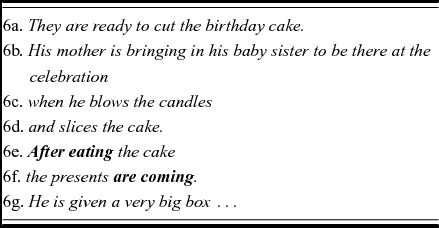
The same combination can also be found in the descriptions of Hungarian–English bilinguals. The example in Table 6 is a bilingual's attempt to shift the topic time with the T-mark after when linking (6e) with the imperfective structure in (6f). This event construal technique is interpreted as convergence of the typical Hungarian structuring pattern (linking TT to the preceding TSit by means of anaphoric shifters) with the typical English pattern (pegging TT to the TU). Converging reference frames diverts from structuring preferences in the TL.
Example of converging reference frames in advanced Hungarian learner production

Temporal structuring in L1 film retellings
Analogously to the first task, a one-way between-subjects ANOVA was conducted to compare explicit temporal linkage via T-marks in the film retellings of Czech, English and Hungarian L1 speakers.
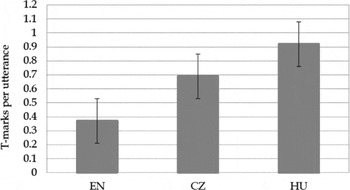
As shown in Figure 5, significant differences [F(2,42) = 15.81, p < .001] were found for mean T-mark frequencies per utterance between all three language groups, comparing English natives (M = 0.38, SD = 0.13) with Czech natives (M = 0.67, SD = 0.29) and Hungarian natives (M = 0.91, SD = 0.30). These results share complementary support that in the given type of discourse Hungarian L1 speakers tend to mark temporal relations by TADVs and TCONs per utterance with significantly higher frequency than English L1 speakers (p < .001), while Czech L1 speakers are in between the two groups, differing from the English speakers (p < .001) and also from the Hungarian speakers (p = .041). Despite crosslinguistic contrasts in T-mark frequencies, their distribution across TADV types and temporal connectives in the three L1s was similar (in the same frequency order as for picture descriptions).
Mean frequency of T-marks per utterance for native speaker film retellings.

Temporal structuring in L2 film retellings
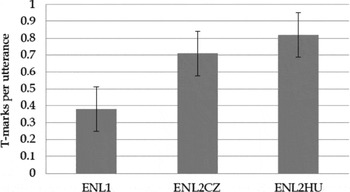
Results of a between-subject ANOVA (Figure 6) showed a significant difference in the linkage of propositions via T-marks between ENL1 and ENL2s [F(2,42) = 20.33, p < .001]. Propositions linked with T-marks in ENL2 by Czech–English bilinguals (M = 0.71, SD = 0.16) and also in ENL2 by Hungarian–English bilinguals (M = 0.82, SD = 0.27) were significantly more frequent (p < .001) in comparison with ENL1 (M = 0.38, SD = 0.13). This suggests that neither the Czech–English nor the Hungarian–English bilinguals adjusted the way in which they typically link temporal information in their L1s to L2-like patterns.
Mean frequency of T-marks per utterance for film retellings in learner groups and the English L1 group.

Unlike T-mark frequencies, their distribution across TADV types and temporal connectives in advanced L2 use were similar to that in English L1 (in the frequency order of T-marks specifying position -> near temporal region -> duration).
An independent-samples t test assessing the effect of AOA on the use of temporal markers showed a significant within-group difference [t(13) = −2.84, p = .014] in the Hungarian learner group. Hungarian learners with AOA 3–10 linked events with significantly fewer temporal markers per utterance (M = .67, SD = .21) than the AOA 12+ learners (M = .99, SD = .23). This contrast was not observed for the Czech learner subgroups, for which the T-mark differences were marginal (M = .78, SD = .15 for AOA 4–10; M = .65, SD = .15 for AOA 12+) [t(13) = 1.636, p = .128].
Results from qualitative analyses
The overall structuring preferences within the L1 groups were highly resemblant in the two tasks. The English speakers showed a general preference for deictic anchoring while the Hungarian and the Czech speakers tended to opt for anaphoric event linkage. Detailed examination of the bilinguals’ L2 data showed that learners do not simply import structuring principles from their L1s and apply them in the TL. Nor do they smoothly transit to TL principles, as their high formal L2 competence might suggest. One of the most perceptible learner-specific features recurring in advanced L2 user retellings can be characterised as convergence of reference frames, exhibiting similarities to that in bilinguals’ L2 picture descriptions.
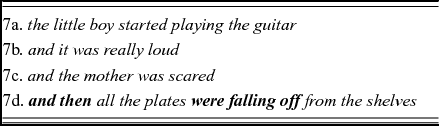
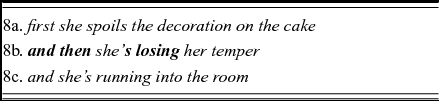
Examples in Tables 7 and 8 show a lack of consistency in structuring temporal information caused by converging reference frames of the source and the target languages. Propositions (7b) and (7c) are backgrounded states linked by adverbial then with an imperfective structure in (7d). Similarly, an imperfective structure in (8b) is linked to the preceding proposition with then. The incompatibility of such combinations lies in the fact that then is an anaphoric shifter forming a left temporal boundary and intrinsically locating a given TT interval into the posttime of the preceding TSit. However, imperfectives generally require the TT to be established deictically (i.e., with no boundaries) or with both the left and the right temporal boundaries specified, otherwise the imperfective structure remains unanchored (i.e., open on the right end as in (7d) and (8b)). This particular type of event construal is an amalgam of the Czech and the Hungarian pattern (linking TT to the preceding TSit via temporal shifters) with the English pattern (keeping TT constant with TU). Although perfectly grammatical, hybridisation of this kind does not occur in the native English data whatsoever. Such combinations are interpreted as indicators of conceptual convergence on the level of temporal framing.
Example of converging reference frames in an L2 film retelling by a Hungarian learner

Example of converging reference frames in an L2 film retelling by a Czech learner

Discussion
Deictic vs. anaphoric event linkage in L1 discourse
The temporal frame that scaffolds the mapping of conceptual material to linguistic forms in the English discourse is built on different elements than that in the Czech and the Hungarian discourse. While English speakers tend to prioritise the use of progressive forms for deictic anchoring, Czech and Hungarian speakers prefer the use of temporal adverbials to link events via anaphoric shifting. Language-specific patterns found in topic time management strongly support the idea that grammatical aspect is a key temporal device for supporting distribution of temporal information in structures that ensure unambiguous reference to event relations and that best fit within individual schematic frameworks for conceptual organisation. Particular structuring patterns quantitatively differed across task types. However, a close qualitative examination helped to establish that despite the discrepancy in results on the level of frequencies, the preferred structuring techniques per language group were identical in responses to both tasks.
Significantly higher frequencies of T-marks used for structuring discourse in L1s with less regular aspectual distinctions, and the propensity to deictic event linkage in L1 English with a fully grammaticalised concept of ongoingness, constitute findings in favour of the grammatical aspect hypothesis (von Stutterheim et al., Reference Von Stutterheim, Nüse, Murcia Serra, Behrens, Fabricius–Hansen and Johansson2002). Findings from Czech L1 highlight that it is not just the availability but the specific ways of encoding aspect in a given language that matter when examining the influence of grammar on event conceptualisation. In a wider context, these findings align well with earlier work about the impact of grammar on conceptual organisation (Slobin, Reference Slobin, Gumperz and Levinson1996; Talmy, Reference Talmy2000) and are also consistent with studies reporting effects of grammatical aspect on event construal patterns (Athanasopoulos & Bylund, Reference Athanasopoulos and Bylund2013; Schmiedtová & Flecken, Reference Schmiedtová, Flecken, de Knop and de Rycker2008; von Stutterheim, Bouhaous, Carroll & Sahonenko, Reference Von Stutterheim, Bouhaous, Carroll and Sahonenko2012).
Convergence of temporal reference frames in L2 discourse
Sequential bilinguals even at a very advanced L2 level were not found to follow the principles governing topic time management in the target language. While the English natives showed a general preference to link events deictically, Czech and Hungarian L2 learners generally tended to opt for anaphoric event linkage typical of their L1s. Some signs of approximation to L2-like structuring were detected, but such instances commonly included unique features digressing from the target patterns. The most conspicuous learner-specific structuring technique was joining imperfective structures with anaphoric shifters, interpreted as conceptual convergence of reference frames. Despite grammatical flawlessness of these constructions, the insertion of imperfective forms marking duration into a holistic event frame had no parallel in the English L1 dataset. Sequential bilinguals make use of imperfective forms compatible with the target-like deictic frame but on the global level of information planning they either combine these forms in a way that is distinctly evocative of discourse organisational principles of their L1s or resort to learner-specific uses. These findings support Slobin's (Reference Slobin, Gumperz and Levinson1996) thinking for speaking hypothesis and are also consistent with the grammatical aspect approach (von Stutterheim & Nüse, Reference Von Stutterheim and Nüse2003) proposing that preferences linked to the speaker's L1 aspectual system have a robust impact on information structuring in L2. Examples of convergence found across learner groups and task types are at variance with the view of conceptual reorganisation in L2 on the level of microplanning (Bylund Reference Bylund and Pavlenko2011a), namely on the level of how temporal information is structured for expression.
The L2-related hypotheses involved two major postulates, namely that L1 effects would be present at the level of temporal structuring in L2, with differences between L2 and TL reflecting the degree of L1-L2 similarity. Both of these predictions were corroborated by the results. L2 event structuring patterns (a) showed strong resemblance to those in respective L1s, and (b) significantly differed from TL patterns in terms of event linkage via time adverbials and temporal connectives. As for the magnitude of L1 influence on L2 structuring, contrasts between the choices of Hungarian learners and the English natives were more pronounced than between the Czech learners and the English natives. This finding confirms the assumption that the degree of overlap in aspect marking may serve as a predictor of how sequential bilinguals from L1s with no or irregular ongoingness marking will differ in temporal structuring patterns of a TL with regular ongoingness marking. Crosslinguistic similarity between relevant L1 and L2 structural elements must be seen as a crucial factor in L2 acquisition because it impacts on how potentially conflicting elements are resolved in L2 (Tolentino & Tokowicz, Reference Tolentino and Tokowicz2011). The finding that similarities in the grammatical encoding of ongoingness can to some extent facilitate acquisition of temporal structuring patterns in L2 is important – as it supports the linguistic relativity account, by showing that digressions from TL arise due to inadequate rethinking for speaking and not to some universal developmental phenomena shared by all learners of L2 English.
With respect to the age factor, the results do not support the idea that early-starting instructed learners would end up indistinguishable from native speakers. Neither do they align with the view that early starters would automatically surpass late starters in the long run. Some modest advantage for an early start (also see Larson-Hall, 2008) was found in the film retellings of Hungarian learners with AOA 3–10; however, this result was not consistent across the two tasks, and it was not mirrored in the Czech learner group despite very similar proficiency level and a comparably high frequency of L2 exposure. One plausible explanation for a more target-like language performance in Hungarian early starters’ film retellings (although not in picture descriptions) emerged during pre-test interviews, when 5 out of 8 Hungarian early starters (unlike the other L2 learners) reported extensive informal contact with native speakers of the target language at the time of testing. This is perceived as a signal that for instructed language learning the measure of current informal contact with native speakers might be more revealing than the overall L2 exposure or the starting age (Muñoz, Reference Muñoz2014; Muñoz & Singleton, Reference Muñoz and Singleton2011).
Relating results to theory – the language production model revised
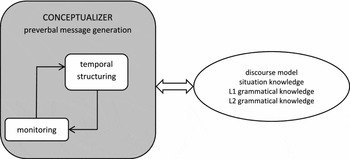
The impact of L1-specific grammatical features detected in temporal structuring support Levelt's proposition that grammatical knowledge becomes relevant already at the stage of microplanning. In addition to findings from L1s, support for language-specific event conceptualisation modulated by grammatical knowledge also comes from L2 varieties. Learners from typologically distant L1s display high levels of formal L2 competence, yet their discourse organisation commonly bears many symptoms of L1 and digresses from target-like patterns. The identified learner-specific structuring patterns indicate that different types of knowledge about how particular grammatical forms are employed for temporal organisation in discourse interact with each other when bilinguals construct a temporal conceptual frame. These findings necessitate some modification of Levelt's model (Figure 7) in order to increase its explanatory power for temporal structuring in bilinguals.
A revised conceptualisation component of the language production model (from Levelt, Reference Levelt1989, p. 9) integrating grammatical knowledge into the stage of preverbal message generation. Boxes represent processing units, ellipses symbolise knowledge stores, and bidirectional arrows stand for a two-way interaction.

Incorporating grammatical features into the knowledge base, in line with the claims advocated in von Stutterheim et al. (Reference Von Stutterheim, Bouhaous, Carroll and Sahonenko2012), as well as with Flecken et al. (Reference Flecken, von Stutterheim and Carroll2013), enables the conceptualizer to generate preverbal messages in compliance with the complex set of requirements connected to topic time specification, temporal grounding, and particular message planning choices. If grammatical knowledge was not integral to event conceptualisation, language-specific contrasts in topic time management directly attributable to aspectual operators would be unlikely. However, the results show that this is indeed the case. In English, the integration of grammatical knowledge into message generation is displayed by the finely-tuned use of progressive forms for deictic anchoring and related choices. For Czech and Hungarian speakers, language as a contributing factor to event conceptualisation surfaces in the systematic usage of temporal adverbials for anaphoric shifting.
The conceptual implications of L1-specific structural features are also manifested in the organisation of content for expression in L2. Temporal structuring preferences of sequential bilinguals with various AOAs provide further evidence that principles linked to L1-specific structural features guide choices even in highly advanced L2 (Carroll & von Stutterheim, Reference Carroll, von Stutterheim and Byrnes2006). Additionally, idiosyncratic structures in learner production corroborate suggestions that the process of reconceptualisation in bilinguals digresses not only from target patterns but also from a straightforward L1-to-L2 trajectory (Hendriks et al., Reference Hendriks, Hickmann and Demagny2008). Digressions despite high formal L2 proficiency may be due to the fact that L1-specific perceptual processing is so powerful that it modifies the relative perceptual saliency of L2 elements (Ellis, Reference Ellis2006) and, in turn, it leads learners to a convergence in building a conceptual framework partly on the basis on relevant L1 elements and only partly on the basis of the relevant L2 elements.
The process of converging two different frameworks provides a signal that both language systems are active and compete for selection in the bilingual mind. Parallel system activation has been widely attested in experiments on bilingual lexical access (e.g., Abutalebi & Green, Reference Abutalebi and Green2007; Green, Reference Green1998; Hermans, Bongaerts, de Bot & Schreuder, Reference Hermans, Bongaerts, de Bot and Schreuder1998; Kaushanskaya & Marian, Reference Kaushanskaya and Marian2007; Kroll & Stewart, Reference Kroll and Stewart1994), but we advocate an important further suggestion that the competition occurs also at the level of conceptual framing.
Temporal structuring and task type
Responses to the film verbalisation task were compared with static picture descriptions in order to check whether a change of task type has an impact on structuring patterns. Native speakers’ structuring patterns manifested in event linking preferences did quantitatively differ across task types. While the frequencies of event linkage via T-marks in the Czech L1 film retellings largely resembled those in Hungarian retellings, the T-mark frequencies in Czech L1 picture descriptions were quantitatively more similar to those in the English descriptions. Despite this discrepancy in quantitative results suggestive of an effect of task type, close examination of the Czech responses showed that anaphoric shifting was the underlying temporal structuring pattern in fact in both tasks. The lower frequency of T-marks in Czech descriptions is attributable to two factors. Unlike Hungarian and English, Czech (a) allows the marking of TT shifts via imperfective forms; and (b) enables the expression of a holistic view on events via perfective forms in here-and-now contexts. These extended possibilities to refer to the right temporal boundary can explain the lesser need to employ TADVs for topic time shifting.
Conclusion
The aim of this paper was to investigate the acquisition of event structuring patterns in sequential bilinguals from typologically dissimilar L1s. Czech and Hungarian learners’ responses to visual stimuli were analysed to test whether their L1 event structuring principles are susceptible to reorganisation in favour of those characteristic for the L2. Native speakers’ topic time management techniques served as a baseline for comparisons with L2 production.
Examination of L1 responses has shown that features such as no overt difference between perfective and imperfective events in Hungarian, perfective verbs used for the expression of a here-and-now meaning in Czech, and high regularity in signalling ongoingness with imperfective forms in English appear to be strongly associated with language-specific event structuring principles. L2 film retellings in all tested groups digressed from temporal structuring typical of the target language. Digressions from target-like patterns are attributable to two interacting systems for relating topic time to situation time, an area where the means of the source and the target languages do not overlap. Non-standard learner-specific structuring was manifested in linking ongoing events with temporal adverbials and connectors marking posteriority. Consequently, learner production resulted in over-informative reference to event relations with positional time adverbials, atypical for the TL. Over-explicitness via extensive lexical temporal linkage in L2 discourse is claimed (a) to reflect L1-rooted structuring strategies; as well as (b) to serve as a means for learners to ensure unambiguous reference to event relations. The data clearly show that overcoming L1-specific structuring principles remains a formidable task even for highly advanced L2 users.