INTRODUCTION
Gastropod molluscs belonging to the Columbellidae are well represented in European waters, with 23 known valid species (Pelorce, Reference Pelorce2009). According to the Check List of European Marine Mollusca (Taxonomic Database on European Marine Mollusca, accessed 5 January 2015) the family is represented by seven distinct genera: Columbella Lamarck, 1799 (2 spp.), Amphissa Adams H. & A., 1853 (1 sp.), Anachis H. Adams & A. Adams, 1853 (2 spp.), Nassarina Dall, 1889 (1 sp.), Zafra Adams A., 1860 (3 spp.), Mitrella Risso, 1826 (13 spp.) and Suturoglypta Radwin, 1968 (1 spp.). The two known native European species belonging to the genus Anachis are Anachis avaroides Nordsieck, 1975 and Anachis aliceae (Pallary, Reference Pallary1900). The former is only known from the Macaronesian archipelagos of Portugal in the Azores (Borges et al., Reference Borges, Costa, Cunha, Gabriel, Gonçalves, Martins, Melo, Parente, Raposeiro, Rodrigues, Santos, Silva, Vieira and Vieira2010) and Madeira (Albuquerque et al., Reference Albuquerque, Borges and Calado2009; Segers et al., Reference Segers, Swinnen and De Prins2009) and from Spain in the Canary Islands (Hernández et al., Reference Hernández, Rolán, Swinnen, Gómez and Pérez2011), while the latter typically occurs in the Mediterranean Sea (Pallary, Reference Pallary1900; Nordsieck, Reference Nordsieck1968; Maldonado, Reference Maldonado1973; Rubio & Barrajón, Reference Rubio and Barrajón1986; Sabelli & Spada, Reference Sabelli and Spada1986; Poppe & Goto, Reference Poppe and Goto1991; Peñas et al., Reference Peñas, Rolán, Luque, Templado, Moreno, Rubio, Salas, Sierra and Gofas2006; Pelorce, Reference Pelorce2009; Cossignani & Ardovini, Reference Cossignani and Ardovini2011; Gofas et al., Reference Gofas, Moreno and Salas2011). Samples taken at depths between 50 and 70 m off mainland Portugal revealed that Anachis aliceae is established, however, does not yet figure in the list of mollusc species reported form this geographical area. The present study records the presence of Anachis aliceae for the first time in the Algarve, south coast of Portugal. The authors hereby present a short note with a brief description and discussion of the species and present accurate data on its geographical distribution and habitat type.
MATERIALS AND METHODS
Surveys studying the mollusc fauna associated with baited Octopus vulgaris Cuvier, 1797 trapsFootnote 1 have been carried out since 2005 in the Lagos locality of south Portugal. Samples of by-catch detritus associated with the traps are obtained directly from the artisanal fishing fleet and regularly transported to laboratory facilities where organisms are separated, quantified and preserved in a 98% alcohol solution. The identification and basic geographical confirmation of the mollusc species present in the samples is initially done consulting two of the most complete publications that deal with the Portuguese malacofauna: Nobre (Reference Nobre1938–1940) and Macedo et al. (Reference Macedo, Macedo and Borges1999). A more detailed taxonomic study is undertaken whenever a species has not yet been recorded or when there are doubts of its occurrence in mainland Portugal.
RESULTS
SYSTEMATICS
Class GASTROPODA
Family COLUMBELLIDAE Swainson, 1840
Subfamily ATILIINAE Cossmann, 1901
Genus Anachis H. Adams & A. Adams, 1853
Anachis aliceae (Pallary, Reference Pallary1900)
(Figure 1)
Dorsal and ventral side of shell of: (A, G) Anachis aliceae 8.71 mm, Off Ponta da Piedade, south Portugal (37°00′46.69″N 8°70′39.11″W); (B, H) Anachis aliceae 8.03 mm, La Herradura, Grenada, Spain; (C, I) Anachis aurantia 8.41 mm, Fann, Senegal; (D, J) Anachis avaroides, 6.43 mm, Las Eras, Tenerife, Canary Islands, Spain; (E, K) Anachis avaroides 5.89 mm, Porto Santo Island, Madeira Archipelago, Portugal; (F, L) Anachis avaroides 4.79 mm, São Miguel Island, Azores Archipelago, Portugal.

MATERIAL EXAMINED
Between January 2011 and May 2014, eight live specimens of Anachis aliceae were recovered from by-catch samples obtained off Ponta da Piedade, Algarve, south Portugal: two specimens (37°01′79.13″N 8°68′36.96″W), five specimens (37°00′46.69″N 8°70′39.11″W) and one specimen (36°99′49.09″N 8°51′56.95″W).
OTHER MATERIAL EXAMINED
For taxonomic validation of the specimens sampled in southern Portugal, comparison material from different geographical locations was also studied: Anachis aliceae from La Herradura, Grenada, Spain; Anachis aliceae from Morocco (no exact locality); Anachis avaroides from the localities of Las Eras, Playa Paraiso and Las Americas Tenerife in Canary Islands, Spain; Anachis avaroides from La Restinga, El Hierro, Canary Islands, Spain; Anachis avaroides from Porto Santo Island, Madeira Archipelago, Portugal; Anachis avaroides from São Miguel Island, Azores Archipelago, Portugal; Anachis avaroides from Angra do Heroísmo, Ilha Terceira, Azores Archipelago, Portugal; Anachis aurantia (Lamarck, 1822) from Fann, Senegal, West Africa.
DIAGNOSIS
Shell fusiform, of normal size for the genus, adult size up to 8 or 9 mm. Suture straight. Protoconch paucispiral with approximately 1.75–2 smooth whorls. Teleoconch of 3.5–4.5 straight, slightly shouldered whorls. Axial sculpture of numerous axial ribs, with 20 equally spaced ribs on every whorl. Spiral sculpture of flattened, low, spiral cords, with six or seven cords on spire whorls and 12 or 13 cords on final whorl. Low, rounded knobs forming at intersection of spiral and axial sculpture, producing reticulate appearance. Outer lip slightly thickened, bearing continuation of spiral cords. Inner lip with anal sinus and five denticles: adapical denticles stronger, diminishing in strength towards the abapical end, the most abapical denticle weak or obsolete. Columellar callus with 4–6 denticles. Parietal callus thin but obvious. Siphonal canal short, open, slightly curved. Teleoconch whorls brown with white, completely white shells exist. Protoconch is off-white, semi-translucent. Aperture including columella white to off-white (Figure 1).
REMARKS
Anachis aliceae differs from the related Macaronesian Anachis avaroides (Figure 1) by its larger adult size (Anachis avaroides only reaches about 5–8 mm in total length), overall colour, wider shape, more shouldered shell, by its clear spiral sculpture (absent or very weak in Anachis avaroides) and by the presence of denticles on the columellar callus (Anachis avaroides has almost no columellar callus and shows no denticles). Anachis aliceae also looks morphologically similar to Anachis aurantia (Figure 1), a more southern species that occurs along the West African coast, especially from Senegal. Both species are about the same size and present similar axial and spiral sculpture. However, Anachis aliceae is distinguished from Anachis aurantia by its more shouldered shape shell, by the present of less teleoconch whorls (Anachis aurantia has 5.5 teleoconch whorls), a higher number of spiral cords (only 4–5 on early whorls in Anachis aurantia) and shell colour (Anachis aurantia has a pinkish protoconch and yellow to orange/red teleoconch whorls).
DISTRIBUTION AND HABITAT
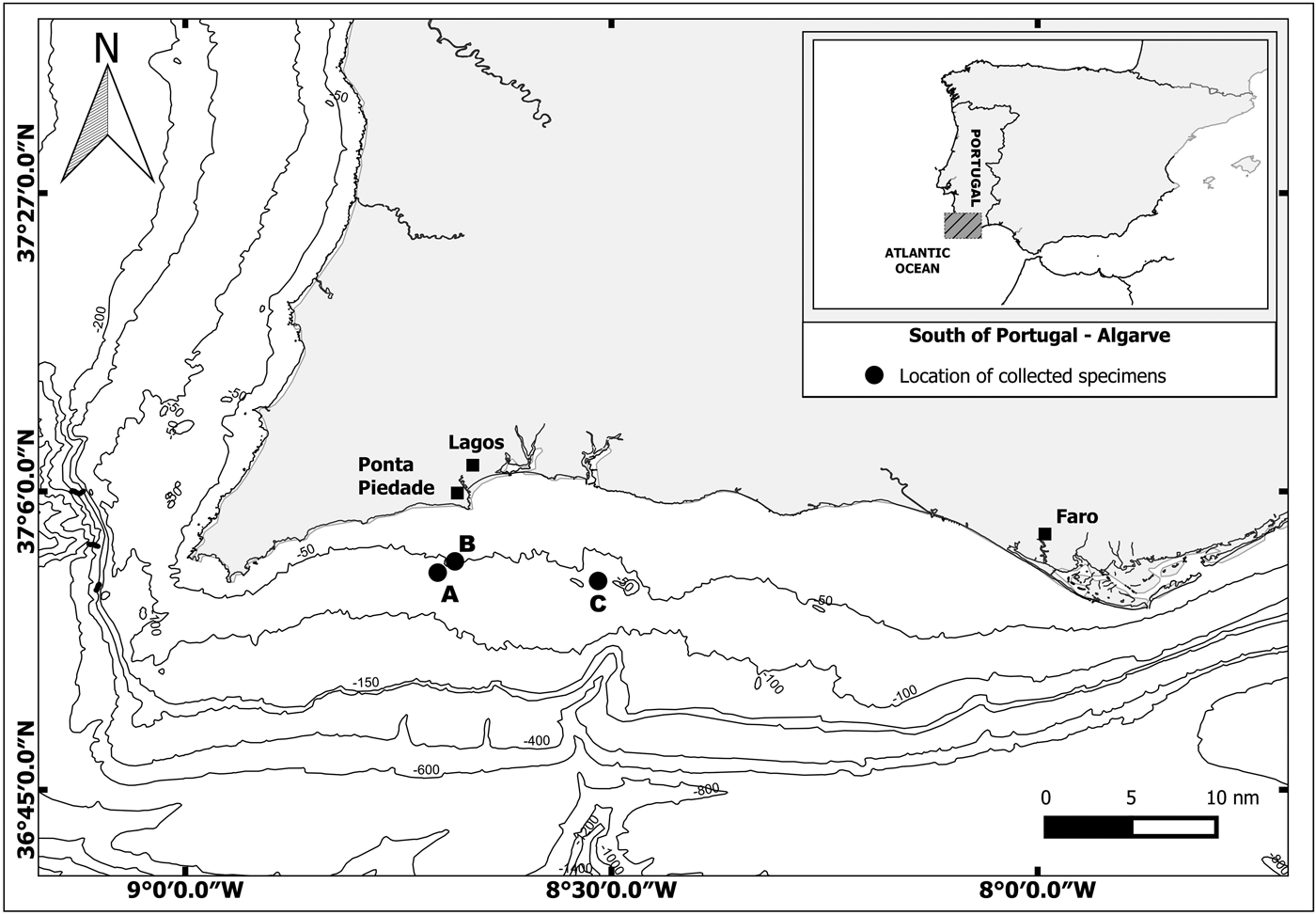
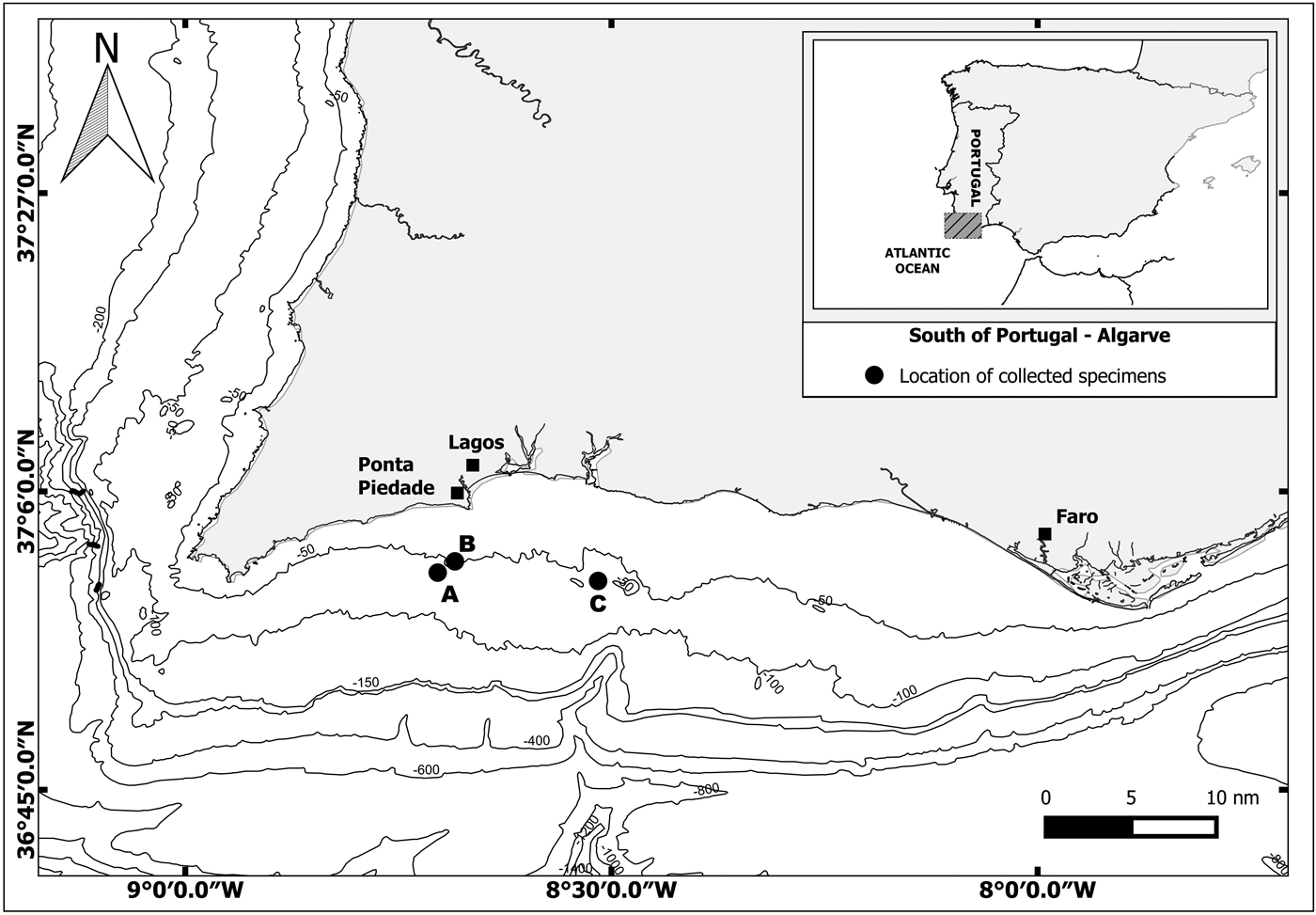
Specimens found originated from depths of 50–70 m, off Ponta da Piedade, from the Lagos region in the south coast of Portugal (between the coordinates 37°00′46.69″N 8°70′39.11″W and 36°99′49.09″N 8°51′56.95″W) (Figure 2). According to local bathymetrical charts, side scan sonar and multibeam sonar data obtained for the Mapping Atlantic Area Seabed Habitats (MeshAtlantic) project (http://www.meshatlantic.eu), the area where this species has been recovered from is mainly associated to rock and submerged/uncovered rock bottoms combined with sandy mud. By-catch trap analysis of other organisms found in the same studied samples (mainly belonging to the phylum Bryozoa, Cnidaria, Porifera and Chordata) together with by-catch analyses of fauna present in trammel and bottom gill nets, combined with remote operated vehicle observations (http://www.meshatlantic.eu) in nearby areas, all indicate that Anachis aliceae inhabits species-rich rocky environments. These rocky bottoms are largely colonized by sea fans (Eunicella spp., Leptogorgia spp., and Paramuricea clavata (Risso, 1826)), scattered with tree corals (Dendrophyllia ramea (Linnaeus, 1758)), yellow incrusting anemones (Parazoanthus axinellae (Schmidt, 1862)), branching sponges (Axinella spp.), spindle sponges (Crella spp.) and false corals (Adeonella calveti (Canu & Bassler, 1930) and Pentapora foliacea (Ellis & Solander, 1786)). This type of coral garden biotope is considered vulnerable and sensitive, and is protected by the OSPAR Commission, which is responsible for the protection of the marine environment of the North-East Atlantic waters. Additionally, Monteiro et al. (Reference Monteiro, Bentes, Oliveira, Afonso, Rangel, Alonso, Mentxaka, Galparsoro, Chacón, Sanz Alonso, Mendes, Guerra, Gaudêncio, Henriques, Bajjouk, Maud, Populus and Gonçalves2013) classify this habitat as a coral garden assemblage, defining it as a mixed gorgonian bottom. Recently, the same authors within the framework of the MeshAtlantic project have also suggested that this biotope be added to The European Nature Information System (EUNIS) as a new habitat type for European habitat classification (to be inserted in section A4.27 of EUNIS habitat type).
Locations of the sampling sites where Anachis aliceae specimens were collected at depths between 50 and 70 m, Algarve, south Portuguese coast.
RESULTS AND DISCUSSION
The marine gastropod Anachis aliceae that belongs to the Columbellidae is now reported for the first time from the southern Algarve region and is, hereby, newly added to the Portuguese mainland malacofauna biodiversity heritage. From the samples taken, A. aliceae seems to be established, since several live specimens have been sampled from rocky formations at bathymetric depths ranging from 50 to 70 m, mainly in mixed gorgonian bottoms. Anachis aliceae was first described from the Gulf of Oran, Algeria, Mediterranean Sea (Pallary, Reference Pallary1900). Its presence in the Gulf of Oran was confirmed in Nordsieck (Reference Nordsieck1968). Later, it was reported from Estepona, Malaga in the Alboran Sea (Sabelli & Spada, Reference Sabelli and Spada1986). Rubio & Barrajón (Reference Rubio and Barrajón1986) misidentified two species of A. aliceae also found in the Alboran Sea at La Herradura. Poppe & Goto (Reference Poppe and Goto1991) make reference to this species from the Western Mediterranean (Oran and Malaga). Peñas et al. (Reference Peñas, Rolán, Luque, Templado, Moreno, Rubio, Salas, Sierra and Gofas2006) cite it for the Alboran Island (Western Mediterranean) and Gofas et al. (Reference Gofas, Moreno and Salas2011) recognize that the species only occurs with certainty in the Alboran Sea and along the Algerian coast. To date, there is no confirmed or published data that accurately reports the presence of A. aliceae outside of the Mediterranean. Gofas et al. (Reference Gofas, Moreno and Salas2011) do, however, mention that A. aliceae is present in the southern Iberian Peninsula. Nevertheless, the authors lack to point out any confirmed locality or findings of the species for this geographical area and, in particular, for the Portuguese southern coast. Despite this vague citation for the Atlantic Ocean by Gofas et al. (Reference Gofas, Moreno and Salas2011), we accurately confirm with a high level of certainty and detail the presence of this species off the south coast of Portugal.
CONCLUSIONS
The discovery of Anachis aliceae in vulnerable and sensitive habitats such as ‘coral gardens’ reinforces the importance of these species-rich biotopes that have not yet been studied in full detail, especially in the southern coast of Portugal. In times where the biodiversity and preservation of vulnerable habitats is crucial, the need to accurately map species belonging to a given biotope type is the first and most important step to fully understand the structure of a given community. By discerning the species composition in detail, it is much easier to provide protection for and integration of important habitats in marine protected areas, which is essential for the marine spatial planning of vulnerable habitats such as ‘coral gardens’.
ACKNOWLEDGEMENTS
The authors gratefully acknowledge J.M.S. Gonçalves, P. Monteiro, F. Oliveira, L. Bentes, I. Sousa and M. Rangel from The Coastal Fisheries Research Group (CCMar, Universidade do Algarve, Faro, Algarve, Portugal) for their assistance and technical support. The authors would also like to thank the Lagos fishermen community; without their help in providing material for this study the newly reported species would not be known for the region.