


Introduction
Suicide is a complex public health concern with potentially profound psychological and emotional consequences for those bereaved by it. Those who lose a loved one to suicide often experience complicated grief, isolation, and psychological distress (Kõlves et al. Reference Kõlves, Zhao, Ross, Hawgood, Spence and de Leo2020; Pitman et al. Reference Pitman, Osborn, King and Erlangsen2014). Suicide bereavement has been associated with elevated risks of depression, anxiety, post-traumatic stress and social stigma, which can lead to diminished support networks compared to other types of bereavement (Andriessen et al. Reference Andriessen, Rahman, Draper, Dudley and Mitchell2017, Maple et al. Reference Maple, Sanford, Pirkis, Reavley, Nicholas and Ftanou2018). An important but less well understood part of suicide loss is attending a coronial inquest. In Ireland, the coronial inquest is an inquisitorial legal process concerned with establishing the circumstances and cause of death, often involving the examination of medical and forensic evidence, and may include a public hearing (Coroners Service Ireland 2020). Its purpose is to determine the circumstances of sudden, unexplained, or suspicious deaths, including suicide. For families bereaved by suicide, participation in this process can occur alongside grief and may introduce additional procedural, emotional, and practical challenges (Coroners Service Ireland 2020).
Previous research has demonstrated that bereaved families often report emotional strain, insufficient preparation, poor communication, and concerns about privacy during the inquest process (Coroners Service Ireland 2020, Spillane et al. Reference Spillane, Matvienko-Sikar, Larkin, Corcoran and Arensman2019, Reference Spillane, Larkin, Matvienko-Sikar, Corcoran and Arensman2023; Sunderland et al. Reference Sunderland, Beattie and Williams2015). Existing evidence, such as the qualitative Voicing Loss study in England and Wales, indicates that inquests can feel “alienating and disempowering,” with families struggling to navigate legal complexity while grieving (Sharpe et al. Reference Sharpe, Brookes-Howell, Locock, Lloyd, Simpson and Salisbury2019). Research specific to Ireland highlights systemic challenges, including inconsistent procedural practices across districts, part-time coroners, and inadequate support structures that may compromise families’ rights and experiences (Department of Justice, Equality and Law Reform 2000; Irish Council for Civil Liberties 2007; Scraton and McNaull Reference Scraton and McNaull2021).
Drawing on survey data from 735 individuals who had experienced a coronial inquest, this study adds breadth to an evidence base that has often relied on smaller qualitative samples (Sunderland et al. Reference Sunderland, Beattie and Williams2015; Sharpe et al. Reference Sharpe, Brookes-Howell, Locock, Lloyd, Simpson and Salisbury2019; Spillane et al. Reference Spillane, Matvienko-Sikar, Larkin, Corcoran and Arensman2019). It examines the experiences of people bereaved by suicide in Ireland, intending to identify common concerns and suggestions for improving support during the coronial inquest process.
Methodology
Study design
This qualitative study utilised existing data from the Irish Suicide Bereavement Survey, conducted by the National Suicide Research Foundation and HUGG (O’Connell et al. Reference O’Connell, Tuomey, O’Connor, Daly, Ruane-McAteer, Khan, McDonnell, Arensman, Grennan and Griffin2022a). This cross-sectional online survey, hosted on Qualtrics, was open from October 2021 to February 2022 and targeted adults in Ireland aged 18 and over who identified as bereaved or impacted by suicide. Participants were recruited via social media, print/digital media advertisements, and suicide support organisations. Of the original 2,413 people who participated in the original survey, a sub-sample of participants (n = 735, 30%) reported having gone through the coronial inquest process as a result of suicide bereavement (O’Connell et al. Reference O’Connell, Tuomey, O’Connor, Daly, Ruane-McAteer, Khan, McDonnell, Arensman, Grennan and Griffin2022a).
Data items
The current study focused on two open-ended survey questions specifically concerning experiences with the coronial inquest process: “Please describe what supports, if any, are/were available during the inquest process” and “Have you any suggestions for improving support during that process?”. Quantitative variables, including gender, age, time since loss, relationship to the deceased and impact of loss, were also used to describe the study sample (O’Connell et al. Reference O’Connell, Tuomey, O’Connor, Daly, Ruane-McAteer, Khan, McDonnell, Arensman, Grennan and Griffin2022a).
Ethical considerations
Ethical approval for the original survey was granted by the Clinical Research Ethics Committee of the Cork Teaching Hospitals (Sharpe et al. Reference Sharpe, Brookes-Howell, Locock, Lloyd, Simpson and Salisbury2019). The study was anonymous, with no personally identifiable information collected. The NSRF complies with all relevant data protection regulations and is registered with the Data Protection Agency. The research aims align with the original study’s scope, and informed consent was obtained as part of the survey process. Additional ethical approval for this paper was obtained from the Social Research Ethics Committee, and a formal data-sharing agreement with the NSRF was signed with the lead author.
Data analysis
Thematic analysis was conducted on participants’ verbatim responses using NVivo, guided by Braun and Clarke’s approach (Braun and Clarke Reference Braun and Clarke2006, Reference Braun and Clarke2019, Reference Braun and Clarke2021). Given that the data comprised responses to open-ended survey questions, the analysis focused on identifying patterned content and meanings across participants’ accounts while recognising the constraints on interpretive depth inherent in brief survey responses. An inductive, reflexive approach was used to allow patterns and meanings to emerge organically from participants’ narratives rather than being shaped by prior theoretical frameworks (Byrne Reference Byrne2022; Nowell et al. Reference Nowell, Norris, White and Moules2017). Reflexive thematic analysis was considered appropriate because of its flexibility in analysing patterns while acknowledging the researchers’ interpretive role (Nowell et al. Reference Nowell, Norris, White and Moules2017). The analysis began with familiarisation and initial open coding, which produced 40 initial codes (Terry et al. Reference Terry, Hayfield, Clarke, Braun, Willig and Stainton-Rogers2017). These were then grouped into broader candidate themes, which were discussed and agreed upon with the paper’s co-authors. NVivo 14 was used to conduct data analysis, visualisation, and mapping, ensuring a systematic and comprehensive analytical process. Stata 18 SE was used to describe the sample characteristics.
Findings
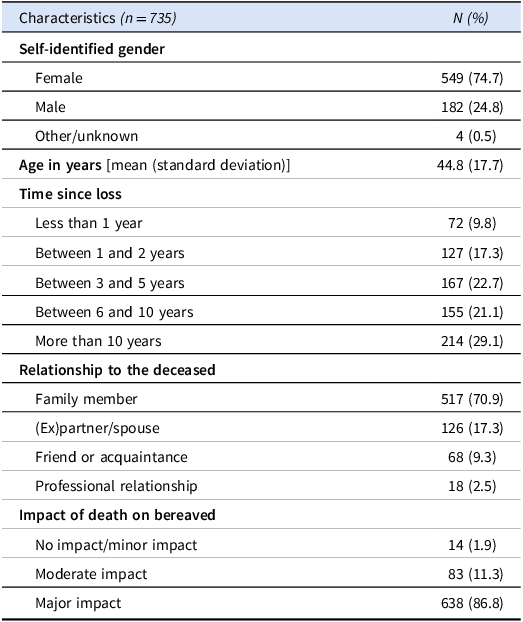
Of the 735 individuals who indicated that they had participated in a coronial inquest, 74.7% (n = 549) identified as female, with ages ranging from 18 to 85 years (mean 44.8, standard deviation 17.7) (Table 1). More than half of participants with experience of the inquest process (n = 421, 57.3%) had experienced a loss within the previous 5 years, with most reporting losing a family member (n = 517, 70.9%) and the majority (n = 638, 86.8%) reporting that the death had a major impact on their lives (Table 1).
Characteristics of study participants

Table 1. Long description
The table presents characteristics of 735 study participants who experienced a coronial inquest. It has 11 rows and 2 columns. The columns are labeled Characteristics and N (%). The rows are grouped into categories: Self-identified gender, Age in years, Time since loss, Relationship to the deceased, and Impact of death on bereaved. Under Self-identified gender, 549 participants are female (74.7%), 182 are male (24.8%), and 4 are other/unknown (0.5%). The mean age is 44.8 years with a standard deviation of 17.7 years. Time since loss is categorized into less than 1 year (72 participants, 9.8%), between 1 and 2 years (127 participants, 17.3%), between 3 and 5 years (167 participants, 22.7%), between 6 and 10 years (155 participants, 21.1%), and more than 10 years (214 participants, 29.1%). Relationship to the deceased includes family member (517 participants, 70.9%), (ex)partner/spouse (126 participants, 17.3%), friend or acquaintance (68 participants, 9.3%), and professional relationship (18 participants, 2.5%). Impact of death on bereaved is categorized into no impact/minor impact (14 participants, 1.9%), moderate impact (83 participants, 11.3%), and major impact (638 participants, 86.8%).
Four key themes emerged from the qualitative analysis, reflecting suicide-bereaved individuals’ experiences of the inquest process: availability and adequacy of support; communication and information provision; privacy considerations; impact of delays and prolonged timelines.
Availability and adequacy of support
Participants frequently reported a lack of formal support throughout the inquest process. The lack of guidance before, during, and after the proceedings left some families feeling isolated and unprepared. Many respondents felt the system offered little proactive help, leaving them to rely mostly on family and friends rather than formal supports.
“Officially none. I was with my partner’s family so we supported each other” (2).
The desire for more forms of support before participating in the inquests was highlighted as an important but missing component. Several noted that they were unaware of what to expect from the inquest, which contributed to heightened anxiety. They suggested that families should receive preparatory information explaining the process, which could include potential outcomes and emotional challenges they might face.
“As a family, we found the inquest itself absolutely horrendous… And my sister was completely traumatized by its outcome. We didn’t know what to expect and therefore we were not prepared.” (72)
During the inquest, some participants described feeling overwhelmed in an unfamiliar and sometimes distressing environment. Some expressed the need for the presence of a liaison officer or designated support person to provide real-time guidance and reassurance.
“Appointing family liaison officers to talk families through the process and to be present during the coroner’s court to explain jargon, paperwork, etc.” (222)
Immediately post-inquest, a recurring concern from participants was the sudden withdrawal of engagement from authority figures, leaving families to cope alone with the emotional impact.
“After the inquest we were just left out on the street - there was no one to tell us anything or to go anywhere within the building except to the bathrooms.” (337)
Some also expressed the importance of follow-up support, such as a scheduled check-in or referral to bereavement services, to help process the experience and manage lingering distress.
“If I had one professional to help me deal with the inquest and all of that even for a few weeks after my mum’s death, I think I would have coped so much better…” (245)
Communication and information provision
Poor communication also appeared as a recurring concern, with some describing unclear, inconsistent, or absent information regarding inquest procedures. Several participants suggested that lack of full transparency and delays in receiving updates contributed to feelings of uncertainty.
“None. Poor communication with coroner’s office. Not kept informed, given wrong and inaccurate info about the process.” (690)
Participants reported that communication from the coroner’s office was at times unclear, with many describing instances of receiving incorrect or contradictory information, at times leaving them uncertain about the process and its timeline. Specifically, the lack of clarity around when the inquest would take place was noted by some as adding to the emotional difficulty of their bereavement.
“There was no communication about this process that was helpful. It was a disgrace, the delay time and lack of assistance or guidance.” (2803)
Suggestions for improvement included providing families with accessible, clearly written explanatory materials outlining what to expect, as well as a direct point of contact for inquiries. Several participants stressed the need for compassionate and proactive communication to ease anxiety and foster trust in the process.
“There needs to be a lot more communication between the coroner’s office and bereaved families.” (2604)
Privacy considerations
Privacy concerns were frequently raised, particularly regarding the use of public courthouses for inquests. Some felt that these settings were not appropriate for the discussion of personal and sensitive matters. The presence of multiple families in the same courtroom was described as distressing, with some participants expressing that hearing other cases alongside their own added to the emotional difficulty of the experience.
“It was a long time ago but 5 different families were having inquests on the same day all convened together. This was horrendous, having to hear other families’ grief & stories as well as your own.” (1405)
Some participants said that sharing the setting with other families made it hard to focus on their own loss. They found this arrangement emotionally difficult and felt it did not fully recognise the sensitivities of bereaved families.
“I recall the embarrassment of having my statement read aloud to a room full of strangers awaiting inquests for their own loved ones. This must be additionally traumatizing for them. But also felt embarrassing for me, and I felt ashamed for my deceased family member who would not like to be discussed in this way or so openly.” (1506)
The role of the media in inquests was also a source of distress. Participants recounted instances where private details were published without their consent, exacerbating their emotional turmoil.
“The local paper printed private details which were requested to keep private. It was horrific.” (1436)
Some called for stricter regulations to protect families from unwanted media exposure, suggesting that inquests involving suicide deaths should have an option for confidentiality.
“Local journalists should be banned from attending inquests, we found it beyond upsetting that a journalist was sitting there taking notes on what was an extremely difficult time for us.” (1206)
To address privacy concerns, participants proposed alternative venues for inquests, such as dedicated private spaces rather than traditional courtrooms. Others suggested implementing measures that would allow families to request restricted attendance where appropriate.
“The stress of seeing media turning up at the court, even though it was for a different case, caused immense pressure for my family. A more private inquest or a preparatory warning would have helped.” (2797)
Impact of delays and prolonged timelines
Prolonged wait times for inquests were frequently described as a source of difficulty. Some participants reported waiting more than a year for an inquest, and described the uncertainty and prolonged process as making it more difficult to move forward with their lives and grieving.
“Didn’t have any support, and length of time you have to wait for inquest is horrible. Year to two years and you have to relive every second of the day I found my son [name & method of suicide redacted]. It never goes away and you definitely try to cope every day to keep it from destroying you. Definitely not have to wait so long after your loved one has passed away.” (116)
Participants also expressed frustration at the lack of updates during the waiting period. Some reported receiving generic responses when they inquired about timelines, which added to their feelings of being neglected by the system. The emotional burden of waiting was particularly pronounced for those who were required to give statements, as they felt unable to begin the healing process until after the inquest.
“Very little, the inquest did not happen for about 16 months after the event and we were not given an accurate date of it which was very stressful as we felt no closure and we could not get on with our life.” (2548)
Reducing wait times was a key recommendation noted by participants, with some calling for increased resources to expedite the scheduling of inquests, as well as improved communication about expected timelines. Participants suggested that even tentative dates would be preferable to the current uncertainty.
“The inquest was held about a year after the death, this felt like a long wait, so more resources to speed up the system would be desirable.” (179)
Discussion
This study extends understanding of the complex and often challenging experiences of individuals bereaved by suicide when navigating the coronial inquest process. Participants described feeling unprepared and unsupported, with particular concerns relating to communication, procedural transparency, privacy, and prolonged timelines.
These findings are consistent with previous qualitative research in Ireland and the UK, including studies reporting experiences of confusion, distress, powerlessness, exclusion and concerns about the public nature of inquests (Sharpe et al. Reference Sharpe, Brookes-Howell, Locock, Lloyd, Simpson and Salisbury2019; Spillane et al. Reference Spillane, Matvienko-Sikar, Larkin, Corcoran and Arensman2019; Sunderland et al. Reference Sunderland, Beattie and Williams2015). The similarity across these studies is notable despite differences in study design and coronial system. Spillane et al. (Reference Spillane, Matvienko-Sikar, Larkin, Corcoran and Arensman2019) reported a lack of clarity about legal procedures, feelings of powerlessness and exclusion during proceedings, variation in the sensitivity of communication, and challenges associated with the public nature of inquests. However, when managed well, inquests could provide some answers and a sense of closure, particularly where communication was clear and compassionate.
International reviews of coronial systems report similar challenges to those identified in the present study (Sunderland et al. Reference Sunderland, Beattie and Williams2015; Department of Justice, Equality and Law Reform 2000). An Irish governmental review of the coronial system has made recommendations aimed at improving the experience of bereaved families, including clearer information through websites and leaflets, greater ongoing support for relatives, and increased sensitivity, particularly in relation to media reporting. Further policy changes could focus on standardising communication protocols, respecting privacy, and reducing delays to help mitigate secondary trauma experienced by bereaved families.
Participants’ accounts suggest that aspects of the corinial process may interact with their experiences of grief, particularly where delays, uncertainty, limited support, or distressing interactions prolonged feelings of distress. However, the present data cannot establish how the inquest process affects the course of bereavement over time. Research focusing on how bereaved people interact with services such as the coroner’s office, healthcare, police, and support organisations may help inform more nuanced policies and therapeutic strategies.
Privacy and media access may represent a complex institutional challenge within the coronial process. While some bereaved individuals experience open proceedings as deeply distressing, inquests are conducted in a public forum, and the coroner’s verdict forms part of the public record, (Nowell et al. Reference Nowell, Norris, White and Moules2017) meaning that limitations on media reporting are not always possible. The HSE’s Media Guidelines for Reporting Suicide (Health Service Executive 2020) acknowledge the dual role of media in raising awareness and potentially causing harm, reinforcing the importance of responsible media practices, respect for family privacy, and the development of clearer protocols that balance transparency with compassion.
Future research could examine whether and how procedural support, communication, and the circumstances of participation in an inquest shape bereaved people’s experiences of grief over time. Further studies could also evaluate the effectiveness of interventions such as clearer, more frequent communication and modified inquest settings, including the role of liaison officers in supporting families’ engagement with legal processes.
Strengths and limitations
This study provides valuable insight into the experiences of suicide-bereaved individuals who navigated the Irish coronial inquest system, an underexplored area of bereavement research. Key strengths include the large sample size (n = 735), which provided a broad range of accounts and enabled the identification of recurring patterns in participants’ responses. The analysis also involved explicit engagement with the researchers’ interpretive role, consistent with the approach to thematic analysis adopted for this study. The study amplifies the voices of individuals often overlooked in institutional processes and contributes a lived-experience perspective to inform policy and practice. However, the findings should be interpreted with caution. The use of secondary survey data not specifically designed to explore coronial inquests limited the depth with which certain themes, such as privacy and media exposure, could be examined. The findings may have limited transferability beyond the Irish coronial context because of cultural, legal, and procedural differences. The study also relies on self-reported accounts and does not capture the perspectives of people who did not engage with the inquest process. The findings should therefore be understood as identifying recurring experiences and concerns within this sample rather than as representing all suicide-bereaved people who encounter coronial systems. Despite these limitations, the study provides a useful foundation for considering how coronial practices could be made more sensitive to the needs of people affected by traumatic and distressing bereavement.
Conclusion
This study documents a range of experiences described by participants in relation to the coronial inquest process. Several reported feeling unprepared, unsupported, or emotionally vulnerable, with some identifying challenges linked to communication, procedural transparency, and access to support. Concerns were also noted regarding privacy and media exposure, particularly in relation to the disclosure of sensitive information. These findings suggest that aspects of the inquest process may contribute additional distress for bereaved families and highlight the importance of considering how communication, support, and privacy practices may influence their experiences. Further research could build on these findings by examining how specific approaches to preparation, communication, family support, privacy, and follow-up affect bereaved people’s experiences before, during, and after an inquest. Evaluation of practical supports such as designated liaison staff, written information, clearer timelines, and opportunities for follow-up could help identify which changes are feasible and more responsive to the needs described by participants.
Acknowledgements
Deep appreciation is owed to the original study participants, whose shared experiences made this work possible.
Funding statement
This research received no specific grant from any funding agency, commercial, or not-for-profit sectors.
Competing interests
The author declares none.
Ethical standards
The author asserts that all procedures contributing to this work comply with the ethical standards of the relevant national and institutional committee on human experimentation and with the Helsinki Declaration of 1975, as revised in 2008. The author asserts that ethical approval for publication of this short report has been provided by their local Ethics Committee, and ethical approval for the use of information from the original survey was granted by the Clinical Research Ethics Committee of the Cork Teaching Hospitals.

 Open access

