1 Introduction
This article concerns the use of the size noun heaps in New Zealand English, as illustrated in examples (1)–(3) below from the Wellington Corpus of Spoken New Zealand English (WSC Spoken; Holmes et al. Reference Holmes, Vine and Johnson1998).
(1) we're RIGHT up in the back corner <laughs> and at <title> the oak </title> last night there was HEAPS of seats left they only filled the middle aisle (WSC Spoken, DPC232)
(2) and i went up there and i got a job with a cocky <sniffs> mustering that's quite good learned heaps <loud noise> eh i went along there and i didn't know anything (WSC Spoken, DPC243)
(3) and um it took them HEAPS HEAPS longer cos you know how if you just have one person doing it (WSC Spoken, DPC264)
In example (1), heaps is used to denote a particular quantity of seats, which the speaker wishes to emphasize as being large. The hyperbolic nature of the use of heaps is made especially salient by means of the focus stress placed on the word (indicated in the transcript by the capital letters). In example (2), heaps is used to intensify the nature of the learning process described, and although it does not bear focal stress, it is followed by the tag eh, a frequent solidarity marker in New Zealand English (Holmes Reference Holmes1982; Meyerhoff Reference Meyerhoff, Hall, Bucholtz and Moonwomon1992, Reference Meyerhoff1994), which allows a momentary pause for reflection over the intensifier and the verb it modifies. Finally, in (3), heaps is used to emphasize the lengthy amount of time that the particular task took (owing to only having one person involved). As in (1), heaps receives focal stress and is in fact uttered twice, the repetition further reinforcing the intensifying quality expressed.
According to Brems, heaps is ‘semantically similar’ to another size noun, namely piles, at least in British English, American English and, to some extent, Australian English (2011: 132). Despite being semantically similar, the two size nouns exhibit different selectional restrictions: piles is questionable as a replacement for heaps in (1)–(3), cf. (4)–6), respectively.
(4) . . . last night there was ?piles/lots of seats left they only filled the middle aisle
(5) that's quite good learned *piles/lots <loud noise> eh
(6) it took them *piles/?lots / a lot longer cos you know how if you just have one person doing it
The more widespread size noun lots appears to work well in (1) and (2), but arguably not as well in (3), where the only viable replacement for heaps is a lot (the singular form).
The examples in (1)–(3) suggest that the use of heaps in New Zealand English differs from previous accounts of (this and other) similar size nouns in other varieties of English. Brems (Reference Brems2011: 150) discusses such extensions of use of various size nouns (including heaps) with reference to Australian English (from the Collins Wordbank – CW) and De Clerck & Brems (Reference De Clerck and Brems2016: section 4 onwards) discuss such extensions with reference to British English (British National Corpus – BNC) and American English (Corpus of Contemporary American English – COCA). As heaps is particularly associated with Australian English (Brems Reference Brems2011: 145) and New Zealand English (Smith Reference Smith, Peters and Smith2009: 159), it makes sense to investigate its use in more detail in such varieties. The current study investigates extensions of heaps to different functions in New Zealand English and addresses three questions:
(i) What types of extensions in the use of heaps are found in New Zealand English and how widespread are they?
(ii) What process has given rise to this use?
(iii) Who (what type of speaker) is driving it?
2 Head nouns, size nouns and evaluative nouns
As discussed in Smith (Reference Smith, Peters and Smith2009), expressions of the type bags (of), bunches (of), lots (of), heaps (of) appear in the literature under a number of labels, including non-numerical quantifiers (Smith Reference Smith, Peters and Smith2009), open-class quantifiers (Quirk et al. Reference Quirk, Greenbaum, Leech and Svartvik1985: 264), quantifying nouns (Biber et al. Reference Biber, Johansson, Leech, Conrad and Finegan1999: 252), number-transparent quantificational nouns (Huddleston & Pullum Reference Huddleston and Pullum2002: 349–50), non-partitive scalar quantificational nouns (Radden & Dirven Reference Radden and Dirven2007: 131) and relative quantifiers (Langacker Reference Langacker, Rice and Newman2010: 6). The most comprehensive study of quantifiers in English comes from Brems (Reference Brems2010, Reference Brems2011, Reference Brems2012) and here, I follow her terminology of ‘size noun’ to refer to uses of heaps in New Zealand English.
In British English, size nouns have four main functions, according to Brems (Reference Brems2010). The first use is what she terms the ‘head noun’ use, as exemplified from New Zealand English in (7) and (8).
(7) This can be readily judged by the distribution of greenstone from its South Island sources, and the widespread presence of Mayor Island Obsidian – volcanic glass – in ancient village rubbish heaps hundreds of miles away from where it was quarried. (WSC Written, Fiction)
(8) . . . um they were very used to making hot beds and and of course hot beds are wonderfully exciting things to make because they can go wrong i've tried with er a few heaps of er compost and with a bit of animal manure thrown in and. . . (WSC Spoken, DGI038)
The crucial property of heaps as head noun is that it denotes a constellation or shape of a particular nature. The New Zealand Oxford Dictionary classes the word heap(s) as noun or verb (Deverson & Kennedy Reference Deverson and Kennedy2005: 498). As noun, it is listed as having three meanings:
1. a collection of things, lying haphazardly one on another
2. (esp. in pl) colloq. a large number or amount (there's heaps of time, is heaps better)
3. colloq. an old or dilapidated thing, esp. a motor vehicle or building
However, even the first meaning listed above for the noun heap(s) in New Zealand English differs somewhat from the original meaning in the (British) Oxford English Dictionary as first attested c. 725: ‘A collection of things lying one upon another so as to form an elevated mass often roughly conical in form. (A heap of things placed regularly one above another is more distinctively called a pile)’ (source: OED Online). The slight shift in definitions from a regular arrangement to a haphazard one might signal a shift in meaning by the time heaps reached New Zealand shores.
Syntactically, heaps acts as head of the noun phrase. In the examples above, heaps is modified by the noun rubbish in (7), and by the quantifier few and the prepositional phrase of compost in (8).
In contrast, compare its use in (9), where it expresses quantificational meaning, similar to that given in the earlier example (1). Here, it is no longer the head of the phrase, but rather a modifier of the head power.
(9) Much of its strength was right down towards the butt of the rod, giving it heaps of that much needed lifting power that is so essential for pulling stubborn fish out of deep water. (WSC Written, Skills trades and hobbies writing)
The analysis of heaps as modifier rather than head, in cases such as (9), is not without controversy. Its analysis as modifier is primarily made on the basis of verbal agreement patterns, namely the verb agrees with the noun following the preposition, not with heaps (heaps of bags are empty but heaps of noise is reported by the media). But not everyone is convinced by this argument. I return to this point in section 5, where the grammaticalization of heaps is discussed.
In addition to the functions of head noun and quantifier, a third function of heaps is that of a (negative) evaluative marker, as exemplified in (10) (Brems Reference Brems2011: 146, example 4.58):
(10) ‘We have a ranking of 92nd in the FIFA world lists. That's a depressing record.’ Jim Boyce Cliftonville was re-elected IFA president for the third successive year. ‘What a heap of shit.’ (CW-Sunnow)
While such uses are found productively in other varieties of English for size nouns lot(s) [of] and bunch(es) [of], evaluative heaps has been attested by Brems in only two examples in the Collins Wordbank (2011: 146).
A fourth function identified by Brems (Reference Brems2011) in relation to Australian English is that of adverb, as exemplified in (11) and (12) (from the Collins Wordbank; Brems Reference Brems2011: 150, examples 4.72 and 4.73).
(11) ‘My first Opals tour was really good and a real eye-opener’, Alexander said. I learned heapsFootnote 2 although I didn't get much court-time. (CW-OZnews)
(12) Those big leather-covered seats (electrically adjustable front and rear very rare), airbags, for both driver and front passenger, power sunroof, compact disc and heaps more goodies. (CW-OZnews)
She analyses heaps in (11) and (12) as having ‘adverbial functions, quantifying verbs, adverbs or (comparative forms of) adjectives’ (2011: 150) but gives no further details of how widespread this use might be in (Australian) English, what verbs and adjectives heaps might occur with, or what process might have led to these uses.
De Clerck & Brems (Reference De Clerck and Brems2016: 170–1) provide a more detailed discussion of extensions of various size nouns to adverb uses in British English and American English, focusing on load/lots, bunch, masses and heaps. These uses involve not just size nouns modifying verbs, but also uses of size nouns in a number of different (but related) functions: with elliptical NPs, modifying (comparative) adjectives, and modifying adverbs, as given below (from De Clerck & Brems Reference De Clerck and Brems2016: 170, examples 58, 49, and 54).
(13) Elliptical NP
For 900 quid we're not talking about BCCI, are we? Yes, they will cost heaps to insure and sure, a big V12 will eat fuel, but let's be honest, the biggest single cost with any new car is depreciation, and you will not lose much sleep about that. (CB-Times)
(14) Modifying comparative adjective
If you are an experienced player. . . it's heaps easier to not get caught.
(COCA 1 2001 ACAD SportBehavior)
(15) Modifying adverb
we must stand watch and pray! The days are evil. The nights a heap more so.
(COCA 2 1992 FIC Bk:House1000Corpses)
The only study of size nouns specifically in relation to New Zealand English is that by Smith (Reference Smith, Peters and Smith2009). He compares the use of various non-numerical quantifiers (his term for size nouns) across three varieties of English (New Zealand, Australian and British) with a focus on the quantifier (a) lot(s) of (a focus motivated by its high frequency). His data come from the ICE corpus components for each of the three varieties. As regards heaps of, he notes that it is more frequent in New Zealand English and Australian English than in British English (2009: 166, table 1), that it is preferred in speech rather than writing (2009: 165), and that it has the widest collocational range (2009: 171, table 6) (though no significance testing is reported for either of these measures).
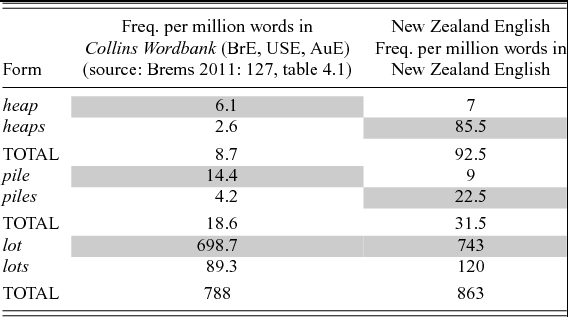
Frequency of heap(s), pile(s) and lot(s) in New Zealand English and British English

3 Methods and data
The data analysed here come from four different corpora of New Zealand English (NZE henceforth). The main uses of heaps are extracted from two corpora of NZE, containing one million words each, namely the Wellington Corpus of Spoken New Zealand English (WSC Spoken; Holmes et al. Reference Holmes, Vine and Johnson1998) and the Wellington Corpus of Written New Zealand English (WSC Written; Bauer Reference Bauer1993). The diachronic use of heaps is investigated in the historical ONZE Corpus (Fromont & Hay Reference Fromont and Hay2008; Gordon et al. Reference Gordon, Maclagan, Hay, Beal, Corrigan and Moisl2007). The ONZE Corpus comprises three spoken NZE subcorpora: the Mobile Unit, the Intermediate Archive and the Canterbury Corpus. The three ONZE subcorpora consist of speech from speakers born between 1850 and 1985. A more recent corpus of spoken monologues from the QuakeBox Corpus (Walsh et al. Reference Walsh, Hay, Bent, Grant, King, Millar, Papp and Watson2013) was also consulted, but this did not yield many hits. The findings presented in sections 4–6 relate to the data from the Wellington Corpora, and the discussion in section 6 involves additional data from the ONZE and QuakeBox Corpora.
The Wellington Corpora were coded exhaustively with the help of AntConc (Anthony Reference Anthony2014) (searching for ‘heaps’ and ‘heap’) because the aim was to document all the instances of heaps and to compare its use across spoken and written language, and within various genres of these, from a syntactic and a sociolinguistic perspective. Once identified, all examples were manually disambiguated. Each use of heaps was coded for a number of factors: its grammatical function in the clause (head noun, modifying an adjective, modifying a verb, modifying a clause and so on), its meaning, and for those uses involving [heaps+of+NOUN2], each of the NOUN2 items was coded for animacy (animate/inanimate), concreteness (concrete/abstract) and countability (count/mass).
For comparison, the Wellington Corpora were also exhaustively searched for pile(s) and lot(s), but given that these do not form the main focus of the article, I report on findings related to them only when relevant to the discussion of heaps (in section 4).
The Wellington Corpora were then used in conjunction with GraphColl (Brezina et al. Reference Brezina, McEnery and Wattam2015), which is part of the software package LancBox, in order to investigate collocation patterns. Finally, given that the spoken corpus contains sociolinguistic information about the participants recorded, each use of heaps was attributed to a particular speaker profile (speaker's age, ethnicity and gender). All graphics and statistical analysis were conducted with R (R development Core Team 2009).
4 Heaps in New Zealand English
This section documents the use of the size noun heaps in New Zealand English. First, I exemplify and comment on the three main uses of heaps found in the two Wellington Corpora and then provide a quantitative analysis of the relative uses identified across the two million words investigated, followed by an analysis of the collocational patterns observed.
4.1 Uses of heaps in New Zealand English in the Wellington Corpora
The great majority of examples identified in the Wellington Corpora exhibited the plural form heaps, not the singular heap. Only 14 instances of heap were found, most of which occurred in the WSC Written Corpus, and of these, apart from two unclear uses, most examples involved a head noun use of heap denoting a constellation or shape, frequently followed by the word compost. In contrast, the plural form heaps occurred 171 times in the two million words analysed, with a great majority occurring in the spoken transcripts (165/171 in spoken NZE and 6/171 in written NZE).
A comparison between the various frequencies of heap(s), pile(s) and lot(s) in the Wellington Corpora and the Collins Wordbank (mainly comprising British English, approx. 42 million words, but also some American English, approx. 10 million words, and Australian English, approx. 5 million words; see Brems Reference Brems2011: 86) is given in table 1. The table shows that while pile(s) and lot(s) have similar rates of occurrence in both varieties, heap(s) is more frequent in NZE compared to the other English varieties. This suggests that heap(s) requires further investigation in NZE. Moreover, while the Collins Wordbank exhibits higher uses of the singular form of heap and pile, the opposite is true of the Wellington Corpora. However, as regards lot(s), there is a preference in all corpora for the singular form lot over the plural lots.
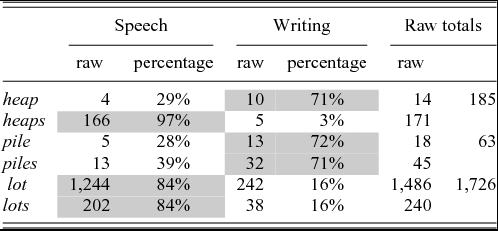
Comparisons between speech and writing indicate that in agreement with claims made by Smith (Reference Smith, Peters and Smith2009), NZE exhibits a significant preference for heaps in spoken language compared to written language (χ2 = 9.818, df=1, p=0.002). There is, however, a divide between heap and heaps across speech and writing, with spoken NZE favouring the plural form and written NZE the singular one (see table 2). There is also a further difference between heap(s) and pile(s): written NZE exhibits a preference for the singular form for heap(s) (heap rather than heaps) and spoken NZE prefers the plural one; this is not the case for pile(s), and in fact, both pile and piles are not common in speech. In other words, it appears that a certain amount of ground which is occupied by heaps in speech does not seem to be similarly matched by piles. I return to this point in section 5, where I discuss the grammaticalization of heaps, and further elaborate on the divergence between the uses of heap(s) and pile(s).
Frequency of use of heap and heaps in different linguistic mediums (in NZE)

The use of heaps as head noun and quantifier identified by Brems (Reference Brems2010) in British English and exemplified in (7)–(9) is also found in New Zealand English.
In addition to its main functions, NZE heaps appears in contexts where it denotes quantificational meaning but where it occurs without an overt of NOUN2 or more NOUN2. This use is what De Clerck & Brems (Reference De Clerck and Brems2016) term ‘elliptical NP’ constructions, a label I also adopt here. The reference of the (missing) of NOUN2 is either recoverable from the surrounding con/co-text (as in (16) below), or remains vague but still interpretable (as in (17)). In (16), the head noun time could be reasonably presumed to have been ellipted from the phrase heaps of time. However, in (17), it is less clear which noun is really ellipted (heaps of lines? heaps of capitals?), although the meaning is not unclear, as evidenced by the fact that the conversation carries on without any further clarification.
(16)


(17)

De Clerck & Brems deem examples such as (16) and (17) noteworthy because the occurrence of the size noun around verbs and with no neighbouring NOUN2 may ‘facilitate’ further extensions in use (2016: 170). In these examples, heaps does not just designate quantificational semantics but also carries an intensificational overlay, signalling emphasis and increased magnitude.
The NZE data exhibit two further functions of heaps, in which its intensifier meaning takes precedence over a quantificational one, namely as general adverb and as degree adverb.Footnote 3 The distinction between general adverb and degree adverb is made on the grounds of what the size noun modifies; general adverbs modify verbs, degree adverbs modify other adverbs or adjectives. General adverb uses are illustrated in (18) and (19), and degree adverb uses are given (20) and (21).
In (18) and (19), heaps modifies the verbs remind and hang out, respectively, amplifying and intensifying their meaning(s). The preceding modifier of heaps, like real,Footnote 4 in (19) is a degree adverb, providing further evidence of its adverb role.
(18)

(19)

In (3), repeated here as (20), heaps modifies the adjective longer (where it can be replaced by much), and in (21) the adjective stressful (where it can be replaced by very). While (20) instantiates a comparative construction, (21) shows that heaps can also occur in non-comparative constructions. This further testifies to the fact that the size noun is becoming a canonical degree adverb.Footnote 5 What is more, the use of heaps as degree adverb is not confined only to spoken language, but it can also be found in written language (albeit only in one out of six examples, but this might be due to the overall low frequency of occurrence of heaps in writing more generally).
(20) and um it took them HEAPS HEAPS longer cos you know how if you just have one person doing it (WSC Spoken, DPC246)
(21) . . . cos um yeah jared's doing that um at um wainui <pause> he's a at riverdale he's got six weeks but he said it was heaps stressful and he was up bulk bulk late each night just you know preparing and stuff like that and i rang him <pause> <drawls> on um thursday and he'd gone to bed at eight forty five when i rang (WSC Spoken, DPC250)
In its role as adverb, NZE heaps takes part in a number of idiomatic combinations, namely, give someone heaps meaning ‘to tease them or joke with them’, and get heaps meaning ‘to be teased or to be taken the mickey out of’ (see (22) and (23) respectively), or get with heaps ‘to engage in repeated sexual relations with someone’. All these uses are informal and occur in colloquial speech. The New Zealand Oxford Dictionary also notes one of these idiomatic uses: give (a person) heaps, NZ and AUST colloq. oppose with vigour, criticize or rubbish severely.
(22) you move <laughs> and you get over there and i said NO and um he just used to give him heaps and stuff and then when he found out that I'd broken up with him
(WSC Spoken, DPC120)
(23)

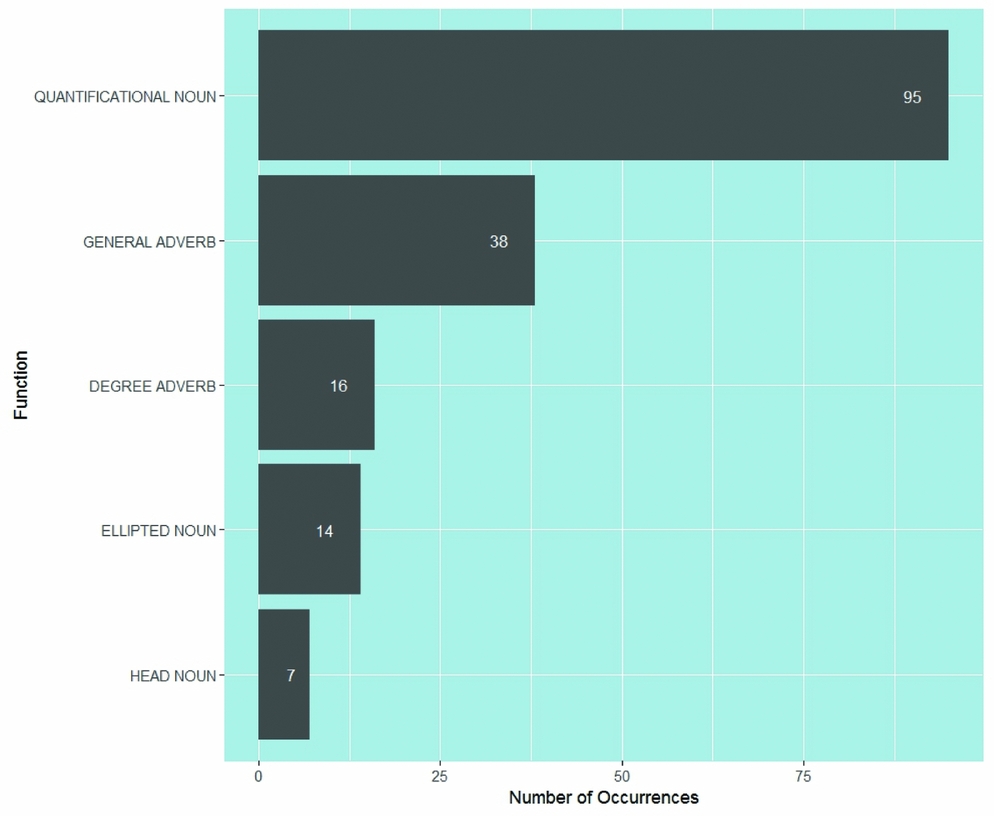
Figure 1 summarizes the different functions of heaps identified in NZE and their frequencies of occurrence in the two Wellington Corpora. The figure shows that heaps occurs most frequently as quantifier, general adverb and degree adverb, and least frequently as head noun. The productive use as quantifier is in agreement with accounts given by Brems (Reference Brems2011) of the Collins Wordbank Corpus and Smith (Reference Smith, Peters and Smith2009) of the ICE corpora.
The various functions of heaps in New Zealand English and their frequencies

4.2 Collocational patterns
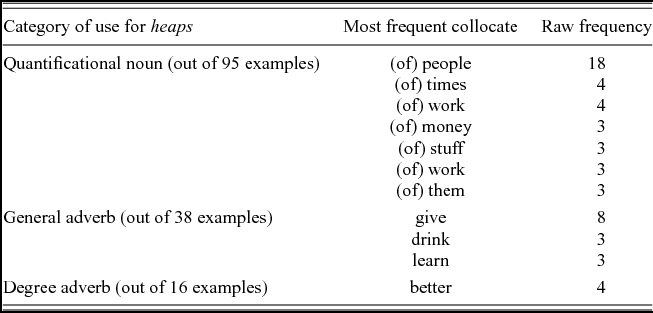
Both Smith (Reference Smith, Peters and Smith2009) and Brems (Reference Brems2010) investigate collocational properties of size nouns. Collocational properties are judged to be particularly important in uncovering paths towards grammaticalization (Brems Reference Brems2010: 102–3). Let us begin by considering raw frequencies of occurrence for a comparison with earlier work (but a more quantitatively informed approach will be presented later in this section). The Wellington Corpora show, in agreement with Smith (Reference Smith, Peters and Smith2009: 173) and Brems (Reference Brems2012: 143–5), that heaps often occurs with NOUN2 people (see table 3). The table also specifies the raw number collocates of heaps used as adverb (for collocates occurring 3 or more times with heaps).
Raw collocates of heaps in New Zealand English
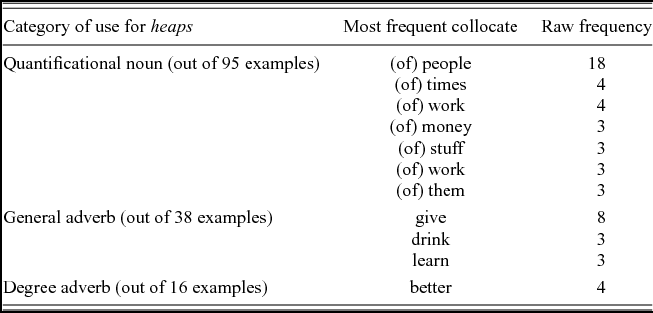
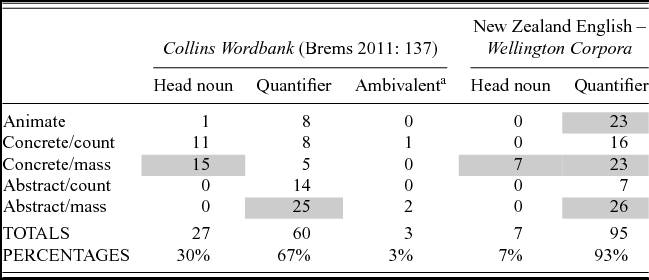
Table 4 gives a breakdown of the types of nouns that NOUN2 instantiates in the two sets of data. As found in the Collins Wordbank, in NZE, the nouns which occur with heaps tend to be mass rather than count. Furthermore, when heaps is used as a quantifier, NOUN2 tends to be an abstract mass noun, whereas when heaps is used as a head noun, NOUN2 is typically a concrete mass noun (but this separation is exclusive to NZE). One point of difference is the prevalence in NZE of quantifier heaps with a wide variety of noun types, in particular with animate nouns and concrete mass nouns. The use of quantifier heaps with animate nouns is rare in British, American and Australian English, but it is almost as frequent in NZE as with concrete mass nouns or abstract mass nouns – and virtually all examples involve the noun people, i.e. heaps of people.
Comparison of heaps of X in Collins Wordbank English and New Zealand English
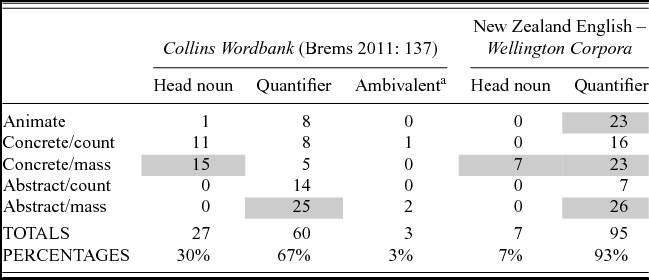
aBrems’ term ‘ambivalent’ refers to cases which are either ambiguous or vague.
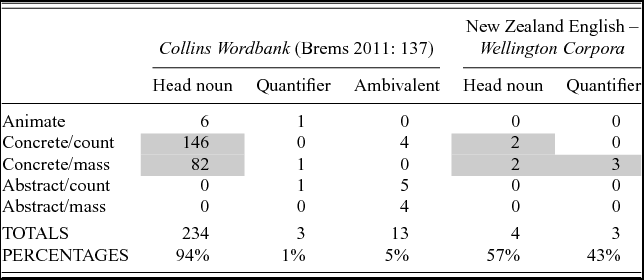
If we compare these profiles of heaps with that of the semantically similar size noun, piles, differences emerge between NZE and other varieties of English, as well as between piles and heaps within NZE (see table 5). First, within NZE, heaps is significantly more productive as quantifier than piles. Secondly, piles is more productive as head noun in British, American and Australian English than in NZE. In fact, if we take all uses of piles in the Wellington Corpora into consideration (not just piles of X), piles turns out to be used more frequently as head noun (11 uses) than as quantifier (3 uses), unlike heaps.
Comparison of piles of X in Collins Wordbank English and New Zealand English

I now return to heaps and its collocates. Let us reconsider the figures in table 3 once more. One problem with looking at raw frequencies of occurrence of collocates is that one cannot be sure that the observed association between heaps and its collocates is real, and not artificially generated by the fact that, say, people is itself a very frequent word in the corpus. This problem can be overcome by using a Mutual Information (MI) score, which takes into account frequency of use of the search word (here, heaps) and overall frequencies of the words which occur in its vicinity (the collocates) – see further discussion in Gries (Reference Gries2013). The MI scores are not the only measures available, but other measures give similar results, so I used MI scores here due to their widespread use in the literature.
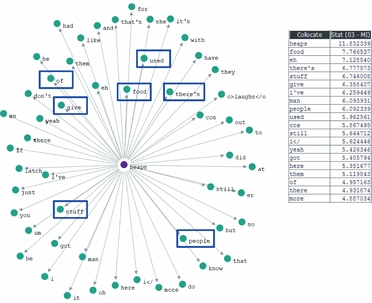
When controlling for overall frequency of collocates, the noun food becomes the strongest collocate of heaps, although people remains a frequent collocate also (see figure 2). This is illustrated visually with a collocational network graph obtained from GraphColl (Brezina et al. Reference Brezina, McEnery and Wattam2015). The length of the arrows is proportional to the strength of collocation, so that a longer arrow indicates a weaker collocational relationship, and a shorter arrow a stronger one. Additionally, the direction of the collocation is indicated by the direction of the arrow, such that a uni-directional collocation is signalled by a uni-directional arrow, and a bi-directional collocation is signalled by a bi-directional arrow (see Brezina et al. Reference Brezina, McEnery and Wattam2015 for more information). One useful feature of GraphColl is its ability to track chains of collocations, in other words, its ability to check whether a given collocate is a mutual collocate or not, e.g. bonsai collocates with tree, but tree does not necessarily collocate with bonsai, hence bonsai and tree are not mutual collocates. GraphColl can be used to do this by tracking second-order collocates by clicking on any one collocate and performing a new collocation analysis.
Collocation network for heaps in New Zealand English (L5-R5, T=3, MI score). The table next to the graph indicates the various collocates in order from strongest to weakest (first column), and gives their MI scores (second column).
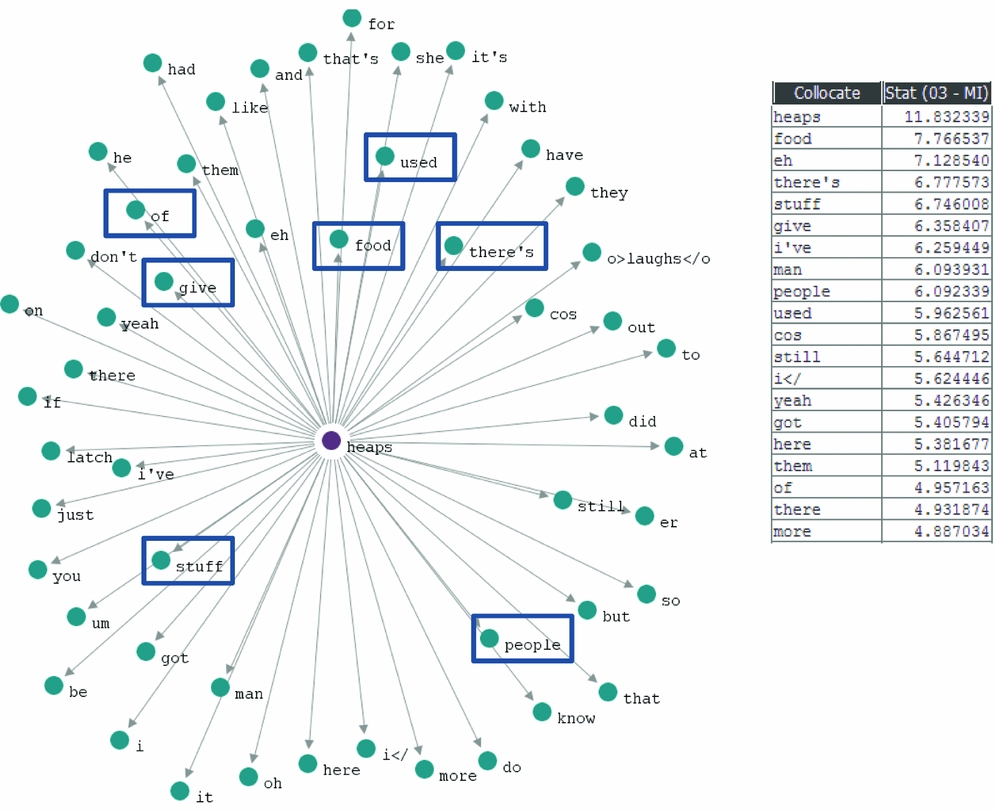
Figure 2 shows that in addition to its strongest (relative) collocate food, other noun collocates of heaps include stuff, man and them.
The strongest verb collocates of heaps are give and use, both of which are mutual collocates (the graphs are too busy to read and therefore not included here). The set of collocates of heaps is smaller than both of the sets of collocates of give and of use, respectively, which is not surprising given that both verbs occur frequently in the data. Given the high frequency of give and use in the corpus in general, the MI statistics are particularly important because they confirm that give and use indeed occur more frequently in the presence of heaps than in that of other words.
A manual inspection of the data shows that these collocates arise from uses of heaps as adverb. The idiomatic use of give [pronoun/noun] heaps was illustrated and discussed in the earlier example (22). As for the verb use, the strength of collocation between heaps and use might have to do with the frequent occurrence of habitual use (e.g. I used to give him heaps) and less to do with the main verb used X heaps (this construction only occurs once in the corpus).
Because GraphColl allows searches beyond words directly preceding or following heaps, larger recurring word combinations can be identified. In doing this, it becomes clear that in addition to the frequently occurring heaps of X, heaps also occurs productively in the formula there's heaps (of X), as also observed by Smith (Reference Smith, Peters and Smith2009: 167–8) for lots, i.e. there's lots. The collocation is again bi-directional, heaps collocates with there's and there's collocates with heaps in these data. A manual inspection of the corpus reveals that the construction there's heaps is typically of the form there's heaps of X.
Note that several collocates identified by GraphColl by controlling for overall frequency of use in the corpus (food, stuff, use) do not appear in the raw frequency counts given in table 3. This reaffirms the value of collocation measures such as MI scores, and their ability to illuminate relationships of association between various words within corpora that might be otherwise overlooked.
The collocation network of heaps is larger than that of its closely related size noun piles, most likely owing to the limited use of piles in NZE. Piles has three collocates in the Wellington Corpora, namely of (MI score 5.076), the (MI score 4.262) and and (MI score 3.910).
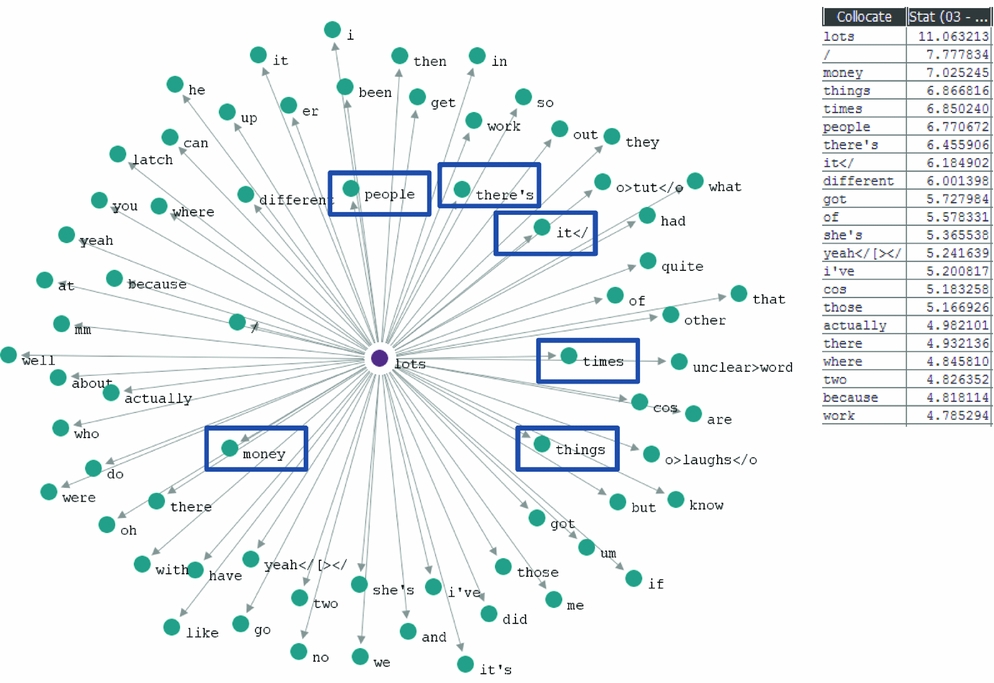
Finally, using the same MI parameters, the size and structure of the collocation network obtained for heaps can be compared with that of the most frequent size noun in NZE, lots (see figure 3).
Collocation network for lots in New Zealand English (L5-R5, T=3, MI score). The table next to the graph indicates the various collocates in order from strongest to weakest (first column), and gives their MI scores (second column).

Comparisons between figure 3 and figure 2 indicate that the two size nouns have collocational networks of similar size: 53 collocates for heaps, 66 for lots. There are also shared collocates between them, such as lots/heaps of people (both of and people are collocates for both size nouns) and there's lots/heaps of X. However, lots also collocates with money, things and times, which heaps does not (I revisit this point in section 5 when discussing the type of nouns that each size noun occurs with).
One difference between the two collocational networks is the absence of verbs in the collocation network for lots, compared to that of heaps (the only exception is the verb got, which occurs in the idiomatic expression to get lots with X).
5 From head noun → quantifier → intensifier
This article proposes that, as in other varieties of English, most notably British English and American English, in New Zealand English, the (original) head noun use of heaps is declining (see table 4). While the decline is steeper in NZE, with only 7 per cent of its uses being head noun uses compared to other varieties, where roughly 30 per cent of its uses are as head noun, the fact remains that the most common use of heaps in all varieties is the quantifier one.
But how did heaps come to acquire a quantifier role in these English varieties? Francis & Yuasa (Reference Francis and Yuasa2008) argue that size nouns which occur in phrases of the type SN of NOUN2 and designate a quantifier role take part in constructions which have embarked on a grammaticalization trajectory which is not fully completed. As such, these constructions encompass a divorce between the semantic and syntactic function of the size noun. Semantically, the size noun denotes quantificational meaning, but ‘without any referential index of its own’, while syntactically, they function as heads ‘bearing a syntactic index which determines number accord with the preceding determiner, if any [is present]’ (Francis & Yuasa Reference Francis and Yuasa2008: 55).
A different view is taken by Brems (Reference Brems2010). According to her, size nouns like heaps have fully grammaticalized from head noun to quantifier by means of a process which involves the stripping of expressions involving size nouns down to formulaic, un-compositional and ‘less flexible’, unanalysable units. As the grammaticalization process gains momentum, the size noun reaches fixation as quantifier to the extent that it no longer appears together with articles or other modifiers (which would have been the case in its role as head noun). In this new role, the size noun no longer functions as head. Instead, the nouns which they occur with take on the role of heads. The NZE data corroborate the grammaticalization trajectory described by Brems. However, unlike in NZE, the head noun use of heaps remains a common occurrence in the Collins Wordbank (made up largely of British and American English), alongside its new quantifier role.
Yet a different argument is put forward by Langacker regarding the internal structure of expressions involving the quantifier a lot of NOUN2. Langacker (Reference Langacker, Rice and Newman2010) argues that locating the head with the NOUN2 (as suggested by Brems Reference Brems2010) is problematic because this analysis would posit an unanalysable unit a lot of. Admittedly, in itself this is not troublesome for a framework like cognitive grammar which allows formulaic chunks, but the analysis runs into problems because the constituent boundary cannot be placed between of and NOUN2, since a lot of retains some degree of flexibility and meaning compositionality (a whole lot of, a great deal of, something of which I miss, and so on). Instead, Langacker argues that a lot of NOUN2 does not contain a head at all, but merely two components (neither of which acts as head): a quantifier a lot, and a prepositional phrase of NOUN (2010: 41–3). It follows then that heaps of NOUN2 would be analysed by Langacker in the same manner. While Langacker's arguments seem sound in theory, a close look at corpus data suggests that, at least as far as New Zealand English is concerned, this degree of flexibility and meaning compositionality do not apply.
In general, the most comprehensive account of the grammaticalization trajectory which has brought heaps to its new function is detailed in Brems (Reference Brems2010, Reference Brems2012). Like lots and bunch, heaps has undergone a number of changes in both syntactic patterns and semantic considerations, summarized in figure 4 from Brems; the interested reader is referred to her original paper for full details of the process (2010: 92–6).
Steps in the grammaticalization process of heaps from head noun to quantifier (Brems Reference Brems2010)

An important step in the grammaticalization process is the backgrounding of the semantic content which is, at least in part, brought about by the frequent co-occurrence of heaps with various nouns that evoke a scalar interpretation, leading to a quantifier reanalysis. One issue which remains to be established is whether the extension of collocational range is a precursor or a consequence of the grammaticalization process. This question needs to be investigated diachronically (not synchronically). Brems (Reference Brems2012) checks the type of nouns that heap(s) and lot(s) occur with by scrutinizing several diachronic corpora. Unfortunately, the rate of occurrence of these size nouns in historical data is limited and no conclusive quantitative account can be obtained from them (Brems Reference Brems2012: 213). Nevertheless, Brems notes that the discourse contexts in which heap(s) occurs in are typically hyperbolic, bringing about a reading of the construction heaps of NOUN2 which posits the interpretation of NOUN2 with respect to a scale of magnitude (2012: 216). The increased use of heaps in such constructions, termed host-class expansion by Himmelmann (Reference Himmelmann, Bisang, Himmelmman and Wiemer2004: 32–3) leads to a ‘leakage’ of scalar semantics onto the size noun, creating an association between the two.
Brems (Reference Brems2010: 100) emphasizes the fact that the grammaticalization of heaps and other items like it involves a process of loss-and-gain (in the vein of Hopper & Traugott Reference Hopper and Traugott2003: 87–93), where the construction heaps of may lose certain features, such as its internal compositionality, but will gain others, such as a quantificational interpretation. Put another way, it is the ‘company’ (Firth Reference Firth1957: 179) that heaps kept in actual interactions and real exchanges, rather than the potential for its occurrence, which has triggered changes towards a quantifier use. The close association between non-countable (mass) nouns and heaps can be interpreted as a shift (rather than a loss) towards the semantic space occupied by other quantifiers, in particular, many and much (Brems Reference Brems2010: 93; Reference Brems2012: 216). The same trend can be observed in NZE, where the head noun uses of heaps occur in constructions whose NOUN2 is by and large a concrete mass noun (see table 4). Given the similarity in collocation patterns observed for heaps in the various English varieties, it is highly likely that the same mechanism is responsible for the emergence of the quantifier use of heaps in NZE as it is observed in other varieties (or that NZE has in fact inherited both the head noun use as well as the quantifier use simultaneously from British English).
As already mentioned in section 4.2, one noticeable development in NZE is the widespread quantifier use of heaps with a variety of different nouns in NOUN2 position: while the abstract mass noun is still the most frequent collocate of quantifier heaps in NZE, animate and concrete mass nouns are almost equally common. Compared to the Collins Wordbank, the Wellington Corpora suggest a further step along the grammaticalization path, such that quantifier heaps acts as a fully fledged quantifier, able to occur productively and systematically with different types of nouns. A comparison of the quantifier uses of piles and heaps in the two data sets (see tables 4 and 5) shows that quantifier uses of piles are even more restricted in NZE than in other varieties of English. Despite being semantically similar, the two size nouns are not synonymous. Brems explains that piles is lexically more specified than heaps, such that a pile designates a more specific and intentionally organized agglomeration of items, along an inferred vertical dimension, whereas a heap is a more haphazard, unintentional gathering of objects (Reference Brems2012: 156) (this is in disagreement with its original definition in the Oxford English Dictionary). It appears that in NZE, the differences between piles and heaps are even more accentuated than in other varieties of English.
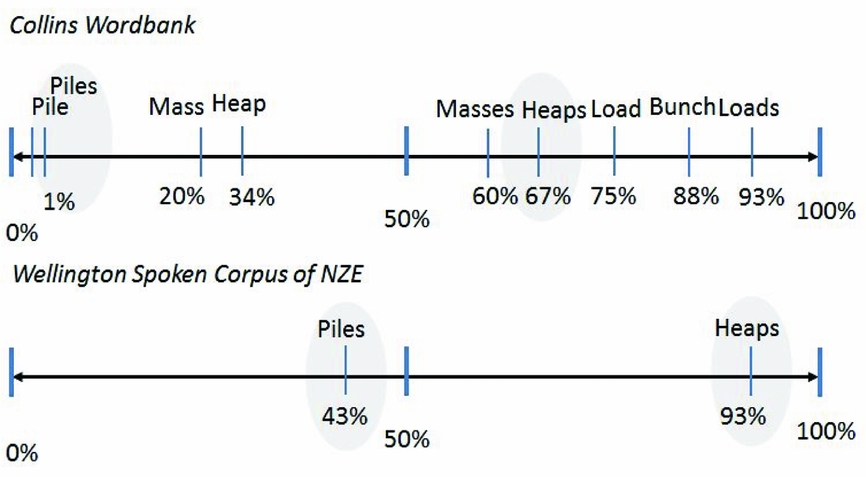
Figure 5 provides a comparison of the extent to which heaps and piles occur as quantifiers in NZE with those observed by De Clerck & Brems (Reference De Clerck and Brems2016: 166) and Brems (Reference Brems2012: 203) of various size nouns, including heaps and piles in the Collins Wordbank. The figure shows that in NZE, both piles and heaps are more frequently used in their grammaticalized role as quantifier compared to other varieties of English.
Degree to which various SNs occur as quantifiers in different English varieties

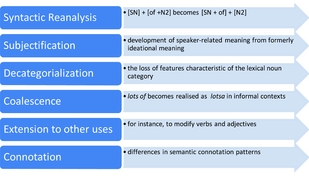
I now turn to adverb extensions of heaps. Traugott (Reference Traugott, Eckardt, Jäger and Veenstra2008: 231–2) posits a path of grammaticalization for lot of from partitive (designating units, a lot of fans) > degree modifier (scalar interpretations and hyperbolic contexts, that's a lot of fun) > degree adjunct (ellipted NP examples, where a lot stands on its own, without an associated of NOUN2, they had to excavate a lot).
It is possible to account for the next development of heaps as (general and degree) adverb by drawing on observations from Traugott (Reference Traugott, Eckardt, Jäger and Veenstra2008) and Brems (Reference Brems2010, Reference Brems2012). As heaps of NOUN2 increases its context of occurrence (level 1, host-class expansion, in the grammaticalization process, as proposed by Himmelmann Reference Himmelmann, Bisang, Himmelmman and Wiemer2004: 32) in its quantifier role, it is productively found in quantificational expressions which exhibit a wide variety of noun types, including with animate nouns (heaps of people), concrete count nouns (heaps of cars), concrete mass nouns (heaps of paper), abstract count nouns (heaps of ideas) and abstract mass nouns (heaps of stuff). In many examples, the size noun denotes a hyperbolic interpretation of ‘bigness’ rather than a concrete organization of items. In these constructions, the NOUN2 becomes the main point of focus, and the size noun is backgrounded (as also detailed by Brems Reference Brems2012: 215).
The productive uses of quantifier heaps enable the development of the following stage, namely syntactic context expansion (level 2 of the grammaticalization process), so that the preposition of is dropped, and heaps begins to occur in core argument positions neighbouring verbs, and without an associated NOUN2, for example in (2), I learned heaps. The syntactic context expansion is evidenced by the verb collocates identified in section 4.2. Interestingly, the collocation network for lots does not involve verbs (excepting the idiom to get with X lots), which suggests that while heaps is well on the grammaticalization path towards becoming an adverb, the same is not true for lots (even though it is possible to use lots in constructions such as I learnt lots, the Wellington Corpora do not present such examples, but they do contain similar examples with the singular form I learnt a lot).
The syntactic context expansion of heaps is also accompanied by a semantic–pragmatic context expansion (Himmelmann Reference Himmelmann, Bisang, Himmelmman and Wiemer2004: 33), whereby heaps acquires intensificational semantics. The hyperbolic meaning of heaps in heaps of NOUN2 constructions set the scene for the analogical extension from increased size to increased magnitude. The process of learning described in example (2) is thus emphasized by the qualifier heaps (rather than quantified).
As the process unfolds and intensifier uses become more widespread, intensifier heaps begins to occur without premodifiers, and in several cases, heaps occurs with focal stress signalling a change in prosody; see the earlier example (33). Eventually, heaps can be found not just with comparative adjectives (heaps better or heaps longer), but also with non-comparative ones, acting like a canonical adverb (heaps stressful; see (21)).
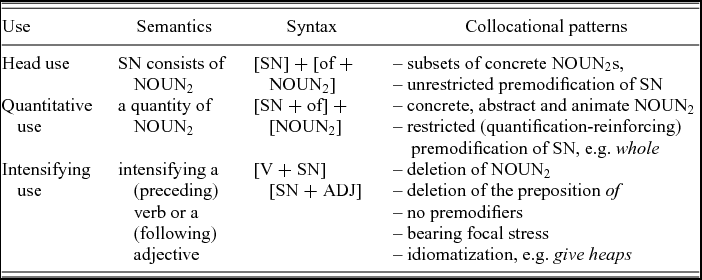
The grammaticalization trajectory of the size noun heaps in New Zealand English can thus be summarized (see table 6) by extending the table given in Brems (Reference Brems2010: 101, table 3) to include the new extension to intensifier, but also deleting the evaluative role which does not apply to NZE (this is the last row of Brems’ original table).
Grammaticalization trajectory of heaps in New Zealand English

6 Who is driving the change?
In this final section, I take advantage of the information included in the WSC Spoken Corpus to test whether innovative uses of heaps in NZE can be attributed to various speaker social profiles, in other words, testing who is driving the incoming change (research question 3, formulated in section 1). The study of morphological and syntactic variables from a variationist perspective has received relatively little attention in the linguistic literature for various reasons, which space precludes me from elaborating on here.Footnote 6 However, it is hoped that the present study of heaps in New Zealand English can contribute to this body of work.
As mentioned in section 3, the WSC Spoken Corpus contains information about the recorded participants. The use of heaps can be divided up into two main types: (i) innovative uses in which heaps functions as general adverb or degree adverb or appears with an ellipted NOUN2 (see examples (25) and (26)), and (ii) non-innovative uses, in which heaps functions as quantifier or head noun. Testing for correlations between various social characteristics of the speakers recorded and innovative uses of heaps can be done by means of Logistic Regression.
Logistic Regressions constitute a specialized type of Generalized Linear Model (GLM), namely GLMs with a binomial distribution modelling the chance of an event (for instance, an innovative use of heaps) versus a non-event (in our case, a non-innovative use of heaps). The binomial distribution is more appropriate here (instead of Poisson or Normal distributions) because the data contain a set number of trials (each instance of heaps in the corpus) where the outcomes are either an event or a non-event, and any two trials with the exact same conditions, that is, the same speaker with their associated sociolinguistic characteristics, have the same probability of producing an event. It is useful to clarify that the model is not expected to have predictive power (given a certain type of speaker, it will not be possible to predict a priori whether or not they might use heaps as an adverb), but instead, the model tests the influence of the variables, that is, seeks to find out whether any particular speaker characteristics might align routinely with innovative uses of heaps.
The innovative use of heaps was modelled by the following variables: speaker gender, speaker ethnicity, speaker age, genre of speech (conversation, teacher monologues, meetings, and so on) and total number of words. The variable of total number of words uttered by a speaker in a given conversation was included in the model, not to test for its significance, but as a control variable: so as not to bias results in favour of speakers who are more verbose, and therefore have more chances of using heaps innovatively just because they utter more words.
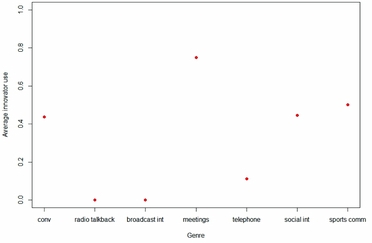
The full model resulted in two significant factors: age (χ2=17.338, df=9, p<0.04) and the borderline significant factor of genre (χ2=9.742, df=5, p<0.082). Once trimmed to these factors, it turned out that including one factor rendered the other non-significant and vice versa. It appears that our participants were straddled across genres in such a way that it is difficult to tell which of the two factors mattered most (or whether both are relevant). A quick inspection of the average innovative use of heaps in each spoken genre shows that meetings generate the highest average innovative use of heaps (see figure 6). The finding that the use of heaps is sensitive to genre is supported by an analysis of the newer QuakeBox Corpus of spoken NZE (Walsh et al. Reference Walsh, Hay, Bent, Grant, King, Millar, Papp and Watson2013) which comprises only 34 uses of heaps (and among these, significantly fewer innovative uses – only 6 intensifier instances compared to 28 quantifier examples).
Mean use of innovative heaps in different spoken genres

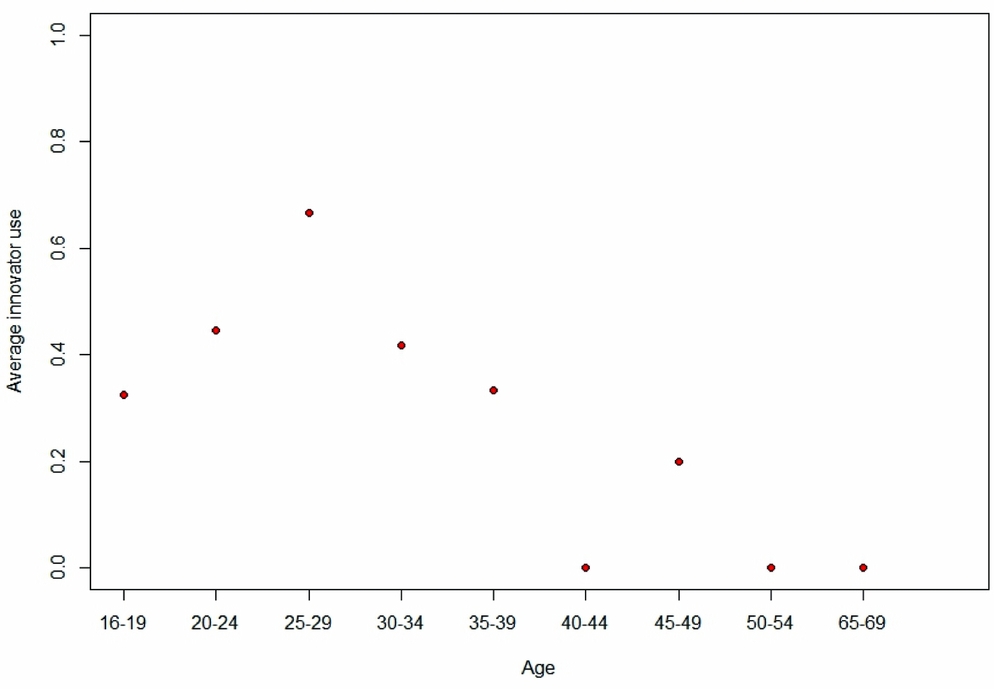
Given that genre was only borderline significant, it was removed from the model and the analysis was rerun with the speaker's age alone. The trimmed model did not perform significantly worse than the full model (χ2=23.225, df=2, p=0.142). Upon inspecting the model diagnostics, one influential observation (e.g., an outlierFootnote 7, Cooks distance ≥ 1) was discovered and removed. The plot in figure 7 gives the average use of innovative heaps per age group. The graph shows that the 25–29-year-old group has the highest average use of heaps in extended functions.
Average use of innovative heaps across various age groups

In sum, innovative uses of heaps in the WSC Spoken Corpus are associated with 25–29-year-old speakers and potentially with particular genres of speech. Because these figures are based on a limited dataset (only 91 instances of heaps), a larger corpus would be required to provide a more robust sense of the drivers of change as regards the use of heaps.
In a bid to better understand the historical development of heaps as intensifier in New Zealand English, the historical ONZE Corpus (Fromont & Hay Reference Fromont and Hay2008; Gordon Reference Gordon, Maclagan, Hay, Beal, Corrigan and Moisl2007) was consulted and all instances of heaps were extracted and coded. This set of subcorpora contains the oldest samples of New Zealand English available. The ONZE Corpus consists of speech from New Zealanders born in the 1800s–1900s (Mobile Unit, 204 speakers), 1890s–1930s (Intermediate Archive, 114 speakers) and 1935–85 (Christchurch Corpus, 849 speakers). The various subcorpora are not directly comparable in size or content, but they do give an impression of early New Zealand English (see Hay et al. Reference Hay, Maclagan and Gordon2008). Neither the Mobile Unit subcorpus, nor the Intermediate Archive rendered any cases in which heaps was used either as adverb or with an ellipted NP (only 3 uses of heaps were found in each of these subcorpora, all of them were quantifier heaps). Nor did these data contain any head noun uses of heaps. This might be in part owing to the very restricted use of heaps to begin with.
It was only in the most recent data from the Christchuch Corpus that extensions beyond quantifier uses of heaps were identified, or indeed any widespread uses of heaps at all. Specifically, among the 203 examples of heaps, 138 were quantifier uses, 1 was a head noun use, 33 were adverb uses and 29 were ellipted NP constructions (2 cases were ambiguous). These 62 innovative uses (of adverb heaps and ellipted NP constructions) were uttered by 42 speakers. Examples (24) and (25) exemplify adverb uses from the ONZE Corpus. The speaker in example (24) is a female born in 1972 and that of (25) is a male born in 1953.
(24) oh . take your helmet off or something y'know? yeah sounds quite embarrassing actually (laugh) (weird noise from interviewer) got hassled heaps after that – at school and just . every time I went to the rink . y'know that guy Lance? (ONZE, CC, fyn94-12a-08.trs)
(25) out um . how shall we say . putting it nicely . doing it with other ladies around the town – an she objected heaps – and I think she even gave him the boot a couple a times – an then he uh got a transfer (ONZE, CC, mon94-31b-03.trs)
As also noted for quantifier heaps (Brems Reference Brems2012: 216), in examples (24) and (25) from the ONZE Corpus, heaps can be replaced by lots and its function is to emphasize and amplify the meaning expressed by the verbs (got) hassled and objected, respectively.
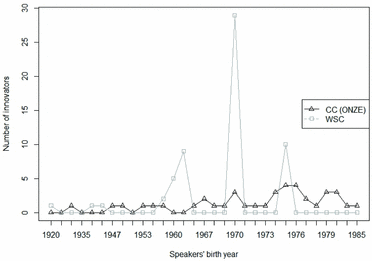
These findings appear to confirm that intensificational heaps represents an incoming change. In the ONZE Corpus, the earliest birth year for a speaker who used heaps in an innovative way was 1933. The birth years of speakers recorded as part of the Christchurch Corpus coincide with some of the birth years of those recorded on the WSC Spoken Corpus (the various ages reported by the participants in the corpus can be used to work backwards from the date of the corpus recording in order to calculate approximate birth years). In the WSC Spoken Corpus, the earliest birth year for a speaker who used heaps in an innovative way is roughly 1920 (the speaker was between 70 and 74 years old). He was in fact the only person from that age group to use heaps in this extended role. This means that the earliest uses of intensifier heaps can be compared across the two sets of data. For convenience, these uses were plotted on the same set of axes (see figure 8).
Comparison of number of innovative speakers (speakers which use heaps as adverb or degree adverb at least once) in the Christchurch Corpus part of the ONZE Corpus and the WSC Spoken Corpus (by speaker's birth year). The x-axis gives an estimated birth year for the WSC Spoken Corpus speakers based on the age of the speakers at the time of the recording.

Figure 8 shows that the use of heaps in extended functions increases in both corpora for speakers born between the 1950s and 1970s. There also appears to be a decrease in this use for speakers born in the late 1970s and beyond – but it is difficult to know why this might be (of course, using intensifying heaps depends on using heaps in the first place, and on other factors such as genre, context, topic and formality, as was discussed in the preceding section). Considering the speakers’ birth years ignores one important factor: their age at the time of the recording (this is recoverable for the WSC Spoken Corpus, but completely unknown for the Christchurch Corpus whose recordings were done by students over a period of time and are in fact still ongoing).
7 Conclusion
This article presents an analysis of the use of heaps in New Zealand English. As reported of other varieties of English (most notably British and American English), New Zealand English exhibits a frequently occurring use of heaps as quantifier, and a declining use of heaps as head noun. Secondly, as also exemplified by British and American English (De Clerck & Brems Reference De Clerck and Brems2016), NZE exhibits productive adverb uses of heaps, where the size noun functions as an intensifier. The NZE Wellington Corpora suggest that this innovative use is on the rise. The secondary grammaticalization step from quantifier to intensifier seems to be driven by younger generations of NZE speakers (in particular, 25–29-year-olds). The use of heaps as adverb may also be linked to particular spoken genres, but in general, as expected of any incoming change, spoken interactions are significantly more likely to encompass innovative uses. Extensions in the functions of heaps point to affinities between heaps and lots (and in some cases, the singular form a lot), bringing it closer to this size noun and away from the semantically similar piles. The possible grammaticalization of lots/a lot towards adverb uses awaits further investigation.