In some cases our sensory organs are no longer capable of rendering processes in the external world perceptible to us. Their inadequacy expresses itself, for example, in phenomena that involve the kind of expansion of space and time in which the conditions for summary perception are no longer at all present. The resources that aid our immediate sense perception in these circumstances will thus be charged with the task of expanding or diminishing space and time to the extent that the contiguity and succession of events is comprehensible to us. The microscope is thus essentially based upon the principle of spatial expansion, the map on that of spatial diminution. The pertinent contrivances for these purposes are largely derived from the graphic arts. How stereoscopy and instantaneous photography, which is based on temporal expansion, facilitate our perception! In spite of the multifarious applications of photography, one has yet to take the step of employing it in the opposite direction, namely as a means of temporal diminution. We demonstrate that phenomena that take place in too ephemeral and too rapid a succession for our eyes can, with the help of instantaneous photographs in series, be analyzed with our senses as the event passes in a comparatively longer time. Quite analogously, we could also compress into a small duration the moments of an event separated widely from one another in time and thereby give our perception an understanding of the nature thereof.
ExhibitingFootnote 1 in a few seconds the changes in a living creature over a long time would doubtless bring about a significant enhancement and concretion of perception. It was E. Mach who years ago first uttered and expounded upon these thoughts.Footnote 2
Now, some time ago I endeavored to demonstrate in practice the principle of temporal diminution in photography, departing from the notion that the experiences gleaned from a simple object would form a suitable basis for further experimentation. What is imparted here may accordingly be regarded as exploratory preparatory work for more difficult tasks.
An object appropriate for an initial such experiment is a rapidly growing plant. During the period from June 28 until August 15, 1890, a plant from the pumpkin family (Cucurbita pepo) was photographed twice daily (at 7 o'clock in the morning and evening). Fig. 1 clarifies the more specific circumstances in which these images, 95 in all, were taken. Completely accessible to light and air, the potted plant T (Fig. 1) was fastened onto the tripod S in front of the white background H. For the purposes of photography the room was darkened, while the arc lamp B served as a light source. This arrangement makes it possible to work in nearly constant lighting conditions, thus producing wholly equal negatives. In mounting the flame arc, which always flashed in the same place, a bothersome hard shadow of the plant was avoided on the background.
Ludwig Mach's photographic set-up.

Now, in order to be able to show a viewer in rapid succession the images representing the object in its individual stages of development, these were reproduced on celluloid film in the form of small ovals (of 15 mm height and 13 mm width) and affixed in chronological order to a kind of stroboscopic drum. By way of a screw-like configuration of the same (Fig. 2), the apparatus became quite compendious. If the photographs thus arranged are to be projected in succession, one shines light through the opening O of an image row onto the diametrically opposed image one pitch below and projects it with a lens onto a screen while also simultaneously imparting a screw motion to the drum (at the pitch of the image spiral) so that the images are moved successively into the light cone of the projection apparatus. One ought to mention here that the rotation ensues not steadily but jerkily; one image appears suddenly in the full light, residing there for a short time and making space for the neighboring image just as rapidly.Footnote 3 If such motion is carried out quickly and precisely with the help of a special apparatus and, furthermore, if the changes in the objects from one photograph to the next are not significant (as is the case when sufficiently many images are produced), then the intermittent incidence of the various photographs is not even felt by the observer, the impressions fade into a continuum, the observer sees, in the present case for example, the plant growing. The apparatus described in the following solves this problem in a truly simple manner.
Stroboscopic drum of the projection apparatus.

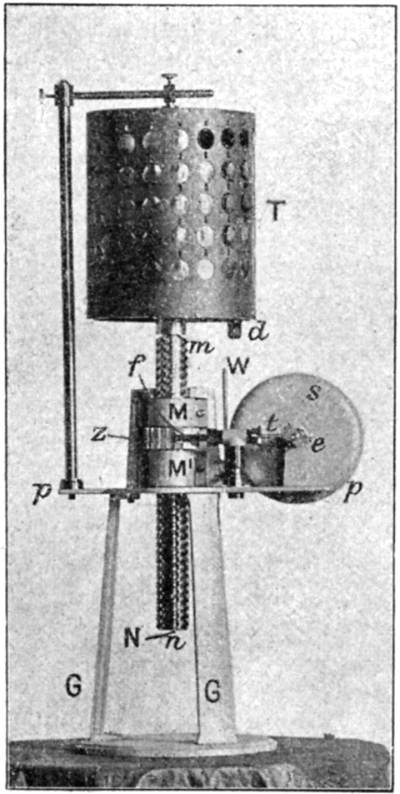
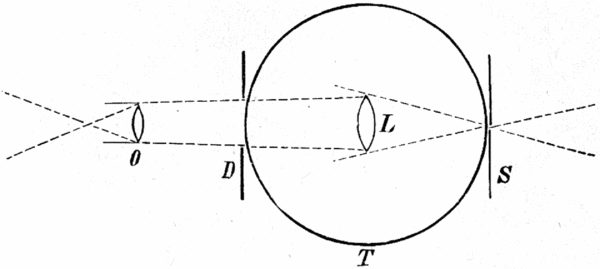
The cast-iron stand G G (Figs. 3 and 4) carries on its platform p p a small heavy flywheel s equipped with a cam e and the threaded spindle mn, which moves in the nuts M and M′. Upon this quadruply cut screw of 4 cm-pitch (which, for the sake of lightness, has been hollowed out), the cogwheel z is mounted with the aid of a wedge that fits into the milled groove N in such way that it can be axially displaced on the screw but not turned. The toothed rim fits exactly between M and M′. If one turns the wheel clockwise (when seen from above: in Fig. 3 from right to left), the spindle sinks vertically downward by dint of its right-handed threading. Pressed onto the cam e by the force of a coil spring hidden in housing g, the small steel tappet t is outfitted on its one end with a bronze prism that moves like a hinge and is held by f onto z. On the backside of the apparatus (Fig. 5) there is a pawl into which the gear ridges catch. The wheel z has as many teeth as there are pictures on one channel of the drum, and the pitch of mn corresponds exactly with the helical line of the images on the drum. Once the apparatus, with the drum, has been appropriately inserted into the optical axis of the projection device, one cog rotates at a time by the manipulation of s and z via a single activation of t, and the image remains fully illuminated for a short time (according to the rate of rotation) until this process is repeated. Since the gaps above the images are quite narrow, the light is already screened off at the moment when the image begins to move again (that is, when t once again advances z by a single cog), and it is in this way that only focused projection images are produced. When using electrical light, one is obligated to employ a small slit screen S in addition to the diaphragm D (Fig. 6), which helps keep out bad light. In this arrangement the lens O serves as the means of projection. L assumes the function of an illuminating lens (Figs. 5 and 6).Footnote 4
Total view of the projection apparatus.

The driving mechanism in detail.

Backside of the projection apparatus.

Scheme of the lense system.

Perhaps it is not superfluous to describe in somewhat greater detail a few small ancillary mechanisms that make using the apparatus significantly easier. If one wants to exhibit the series of images in a very short time, then it is advantageous to replace the cam e with another three- or four-part cam. Attached to the pure aluminum star that forms the support of the drum T is a small fin d, which releases a locking pin when it activates the setting lever W at the lowest point of the screw, whereupon the entire mechanism, resting on a conical peg, is shot out of the level of the cam by spring force (see Fig. 4). This set-up enables quick rotation through the end of experiment without one's having to worry about the failure of a moving component. The screw mn is threaded to such a degree of precision that it sits in the nut without jittering and, when lubricated with grease, sinks vertically downward in spite of its very low weight while the wheel z is simultaneously rotated by the same.Footnote 5 If one places the very light aluminum-and-cardboard drum T (with a diameter of 20 cm and a weight of 350 g) onto the spindle mn, this small increase in the moment of inertia then causes one or the other cog to pass over the locking mechanism at a somewhat more rapid speed. This drawback is rectified by means of a brake resting on a bow spring whose tension can be regulated by the screws a and b.
With this apparatus, 95 photographs were displayed successfully in a time span of approximately fifteen seconds. In addition to the somewhat discontinuous growth of the plant, its turns towards the light, the movements of its leaves, etc. were made perceptible. The growth, which at first proceeds rapidly, takes place more and more slowly, blossoms develop, and it makes stark swiveling movements. After some time, the period of decay begins as the leaves become limp and withered and as the stalk, leaning a bit sideways, ultimately collapses onto itself. The peculiar movements of the leaves strikingly resemble the wing beat of a bird taking flight. That the plant grows in fits and starts can be explained from the slightly more rapidly occurring growth during the night (see figures I–IX).Footnote 6
With this experiment, the demonstrability of the principle of temporal diminution in photography is admittedly substantiated, yet I believe I must point out some defects in my experiment. Because of the lack of soil warmth and the rapid “acidification” of the relatively small soil quantity, the plant grown in the pot showed still other signs of degeneration in addition to a significant retardation in growth. With such experiments in the future, it would thus be advisable to use only freely growing garden plants. For example, it would not be an unrewarding task to record in a series of such photographs the growth of a wild mushroom or the rotation of a sunflower during one day. The growth of etiolated plants, cell division under the microscope, etc. could be very nicely studied in this way. The principle, practicable in any case, promises valuable information, particularly in its application to animate creatures. And yet from this task entirely new difficulties arise, which I cannot go into at this point. Here, too, the definitive criterion must be to begin with truly simple and favorable circumstances, thus perhaps with low, very lethargic animals and then to proceed gradually with more difficult objects.
If this report gives cause for taking up the matter from another perspective and cultivating it further, then the goal of these preliminary experiments will have been fully met. Within a short period of time, the principle of temporal diminution suggested by E. Mach five years ago might then be made useful for a series of special biological investigations, and photography would yet again have won a new place among the tools that foster scientific knowledge.
A number of plant images represented in chronological order.